July 6, 2011 I BA Literature IV Hour  nehru.wikispacescom nehru.wikispaces.com
Today’s Class My Allotment Introduction to A. K. Ramanujan Works of A. K. Ramanujan Features of A. K. Ramanujan’s Poetry A River- An Introduction A River- Poetry Explanation A River- Notes
My Allotment Indian Writing in English Unit II: Poetry A. K. Ramanujan Small Scale Reflections of a Great House   A River Breaded Fish   Keki. N. Daruwalla  Death by Burial   The Epileptic
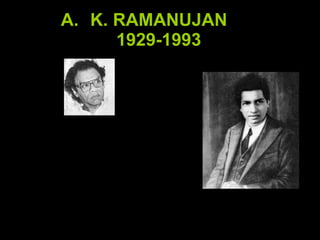
K. RAMANUJAN 1929-1993
A. K. RAMANUJAN 1 Mysore 1929 Attipat Krishnasamy Ramanujan Poet Translator Playwright Folklorist
A. K. RAMANUJAN 2 D. Bhanumiah’s High School Maharaja College of Mysore Fellow of Deccan College, Pune 1958-1959 Fullbright Scholar in Indiana University in 1959-1962 Mysore University Ph.D in Linguistics from Indiana University
Works of A. K. Ramanujan 1 Poetry, fiction and drama The Striders . London: Oxford University Press, 1966 Hokkulalli Huvilla, No Lotus in the Navel . Dharwar, 1969 Relations . London, New York: Oxford University Press, 1971 Selected Poems . Delhi: Oxford University Press, 1976 Samskara . (translation of U R Ananthamurthy's novel) Delhi: Oxford University Press, 1976 Mattu Itara Padyagalu and Other Poems . Dharwar, 1977 Second Sight . New York: Oxford University Press, 1986
Works of A. K. Ramanujan 2 Translations and studies of literature The Interior Landscape: Love Poems from a Classical Tamil Anthology , 1967 Speaking of Siva , 1973 The Literatures of India . Edited with Edwin Gerow. Chicago: University of Chicago Press, 1974 Hymns for the Drowning , 1981 Poems of Love and War . New York: Columbia University Press, 1985 Folktales from India, Oral Tales from Twenty Indian Languages , 1991
FEATURES OF RAMANUJAN’S POETRY Inscape or inner meaning is the hallmark of Ramanujan’s poetry.  Follows the tradition of interior landscape and exterior landscape  Imbibed this quality from Tamil poetics   His poems are compact Anti-Romantic Association of Thought
A RIVER- AN INTRODUCTION Reality of the river Against poets praise for river Critique of the poets who praised only the glory of river River in summer
A.K. Ramanujan  A River In Madurai, city of temples and poets, who sang of cities and temples, every summer a river dries to a trickle in the sand, baring the sand ribs, straw and women's hair clogging the watergates at the rusty bars under the bridges with patches of repair all over them the wet stones glistening like sleepy crocodiles, the dry ones shaven water-buffaloes lounging in the sun The poets only sang of the floods.  First Stanza
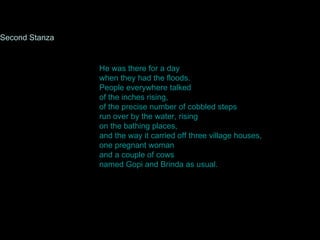
He was there for a day when they had the floods. People everywhere talked of the inches rising, of the precise number of cobbled steps run over by the water, rising on the bathing places, and the way it carried off three village houses, one pregnant woman and a couple of cows named Gopi and Brinda as usual.  Second Stanza
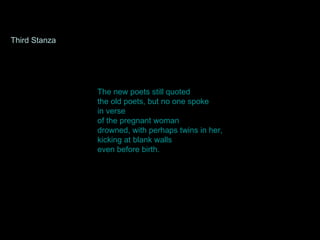
The new poets still quoted the old poets, but no one spoke in verse of the pregnant woman drowned, with perhaps twins in her, kicking at blank walls even before birth.  Third Stanza
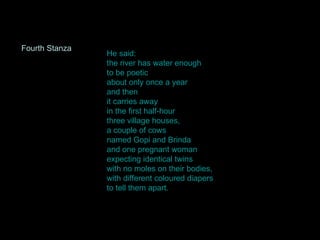
He said: the river has water enough to be poetic about only once a year and then it carries away in the first half-hour three village houses, a couple of cows named Gopi and Brinda and one pregnant woman expecting identical twins with no moles on their bodies, with different coloured diapers to tell them apart.  Fourth Stanza
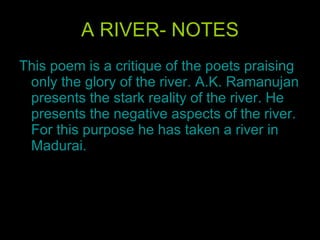
A RIVER- NOTES This poem is a critique of the poets praising only the glory of the river. A.K. Ramanujan presents the stark reality of the river. He presents the negative aspects of the river. For this purpose he has taken a river in Madurai.
A RIVER- NOTES 2 Ramanujan presents what the other poets failed to do. Poets, both ancient and modern simply glorified the river. But Ramanujan says that their claims may be true only once in a year.
A RIVER NOTES-3 Flooding of river is not only a sign of prosperity but also a cover for the fatal consequences of the same. The poet presents two cows Gopi and Brinda. Cows are considered to be the symbol of prosperity. But they are washed away by the flood. It means only that prosperity is washed away. That is, flood is capable of bringing adversity at times.
A RIVER NOTES-4 Summer takes away the charm of the river. It is dry in the summer. It dries to a trickle. Women’s hair clog the watergates. Under the bridges one could find rusty iron bars. It reveals that for the most part of the year the river is dry. He presents the image of shaven water-buffaloes lounging in the sun. Here the poet brings out the contrast between the river in summer and during floods. During floods cow gets washed away but in summer buffalo lounges. Buffalo is a symbol of death or darkness and the cow is the symbol of prosperity. He cleverly uses the image of cow and buffalo.He uses the hue of black and white to bring out the summer and flood.
A RIVER NOTES 5 He presents a pregnant woman who expects identical twins. There is also reference to three villages washed away by the flood. The use of numbers one,two, three makes an interesting reading. The very beginning is like a opening of a folk song. It has also got a folk rhythm. The twins may suggest the twin reality of the river. The pregnant woman may suggest the poetic idea of prosperity and the identical twins may suggest the similarity in the perception of ancient and modern poets. His play with numbers and colours presents the twin nature of things and it adds up to his style of depiction. His images are more suggestive. The poem appears to be simple but it has more layers of significance. At times it appears to be vague.
A RIVER NOTES-6 It is unusual indeed, in both theme and treatment.
Log on to nehru.wikispaces.com

I BA LITERATURE, 6TH JULY 2011

  • 1.
    July 6, 2011I BA Literature IV Hour nehru.wikispacescom nehru.wikispaces.com
  • 2.
    Today’s Class MyAllotment Introduction to A. K. Ramanujan Works of A. K. Ramanujan Features of A. K. Ramanujan’s Poetry A River- An Introduction A River- Poetry Explanation A River- Notes
  • 3.
    My Allotment IndianWriting in English Unit II: Poetry A. K. Ramanujan Small Scale Reflections of a Great House A River Breaded Fish Keki. N. Daruwalla Death by Burial The Epileptic
  • 4.
  • 5.
    A. K. RAMANUJAN1 Mysore 1929 Attipat Krishnasamy Ramanujan Poet Translator Playwright Folklorist
  • 6.
    A. K. RAMANUJAN2 D. Bhanumiah’s High School Maharaja College of Mysore Fellow of Deccan College, Pune 1958-1959 Fullbright Scholar in Indiana University in 1959-1962 Mysore University Ph.D in Linguistics from Indiana University
  • 7.
    Works of A.K. Ramanujan 1 Poetry, fiction and drama The Striders . London: Oxford University Press, 1966 Hokkulalli Huvilla, No Lotus in the Navel . Dharwar, 1969 Relations . London, New York: Oxford University Press, 1971 Selected Poems . Delhi: Oxford University Press, 1976 Samskara . (translation of U R Ananthamurthy's novel) Delhi: Oxford University Press, 1976 Mattu Itara Padyagalu and Other Poems . Dharwar, 1977 Second Sight . New York: Oxford University Press, 1986
  • 8.
    Works of A.K. Ramanujan 2 Translations and studies of literature The Interior Landscape: Love Poems from a Classical Tamil Anthology , 1967 Speaking of Siva , 1973 The Literatures of India . Edited with Edwin Gerow. Chicago: University of Chicago Press, 1974 Hymns for the Drowning , 1981 Poems of Love and War . New York: Columbia University Press, 1985 Folktales from India, Oral Tales from Twenty Indian Languages , 1991
  • 9.
    FEATURES OF RAMANUJAN’SPOETRY Inscape or inner meaning is the hallmark of Ramanujan’s poetry. Follows the tradition of interior landscape and exterior landscape Imbibed this quality from Tamil poetics His poems are compact Anti-Romantic Association of Thought
  • 10.
    A RIVER- ANINTRODUCTION Reality of the river Against poets praise for river Critique of the poets who praised only the glory of river River in summer
  • 11.
    A.K. Ramanujan A River In Madurai, city of temples and poets, who sang of cities and temples, every summer a river dries to a trickle in the sand, baring the sand ribs, straw and women's hair clogging the watergates at the rusty bars under the bridges with patches of repair all over them the wet stones glistening like sleepy crocodiles, the dry ones shaven water-buffaloes lounging in the sun The poets only sang of the floods. First Stanza
  • 12.
    He was therefor a day when they had the floods. People everywhere talked of the inches rising, of the precise number of cobbled steps run over by the water, rising on the bathing places, and the way it carried off three village houses, one pregnant woman and a couple of cows named Gopi and Brinda as usual. Second Stanza
  • 13.
    The new poetsstill quoted the old poets, but no one spoke in verse of the pregnant woman drowned, with perhaps twins in her, kicking at blank walls even before birth. Third Stanza
  • 14.
    He said: theriver has water enough to be poetic about only once a year and then it carries away in the first half-hour three village houses, a couple of cows named Gopi and Brinda and one pregnant woman expecting identical twins with no moles on their bodies, with different coloured diapers to tell them apart. Fourth Stanza
  • 15.
    A RIVER- NOTESThis poem is a critique of the poets praising only the glory of the river. A.K. Ramanujan presents the stark reality of the river. He presents the negative aspects of the river. For this purpose he has taken a river in Madurai.
  • 16.
    A RIVER- NOTES2 Ramanujan presents what the other poets failed to do. Poets, both ancient and modern simply glorified the river. But Ramanujan says that their claims may be true only once in a year.
  • 17.
    A RIVER NOTES-3Flooding of river is not only a sign of prosperity but also a cover for the fatal consequences of the same. The poet presents two cows Gopi and Brinda. Cows are considered to be the symbol of prosperity. But they are washed away by the flood. It means only that prosperity is washed away. That is, flood is capable of bringing adversity at times.
  • 18.
    A RIVER NOTES-4Summer takes away the charm of the river. It is dry in the summer. It dries to a trickle. Women’s hair clog the watergates. Under the bridges one could find rusty iron bars. It reveals that for the most part of the year the river is dry. He presents the image of shaven water-buffaloes lounging in the sun. Here the poet brings out the contrast between the river in summer and during floods. During floods cow gets washed away but in summer buffalo lounges. Buffalo is a symbol of death or darkness and the cow is the symbol of prosperity. He cleverly uses the image of cow and buffalo.He uses the hue of black and white to bring out the summer and flood.
  • 19.
    A RIVER NOTES5 He presents a pregnant woman who expects identical twins. There is also reference to three villages washed away by the flood. The use of numbers one,two, three makes an interesting reading. The very beginning is like a opening of a folk song. It has also got a folk rhythm. The twins may suggest the twin reality of the river. The pregnant woman may suggest the poetic idea of prosperity and the identical twins may suggest the similarity in the perception of ancient and modern poets. His play with numbers and colours presents the twin nature of things and it adds up to his style of depiction. His images are more suggestive. The poem appears to be simple but it has more layers of significance. At times it appears to be vague.
  • 20.
    A RIVER NOTES-6It is unusual indeed, in both theme and treatment.
  • 21.
    Log on tonehru.wikispaces.com