Automating the Coating Process
Presented by:
Nguyen Quang Vu
Business Development Manager
Finishing Brands UK
Automating the Coating Process
• Applicator Technologies
• Spray Characteristics
• Automation: Reciprocators & Robotics
• Product Presentation
• Production Requirements & Cycle Time
• Calculating Coating Volume Needs
• Selecting Automation
Applicator Technologies
 Air Atomization
 Hydraulic Atomization
 Centrifugal (Rotary) Atomization
 Electrostatics
Automating the Coating Process
Air Atomization Technology
 Conventional Air Spray
• Low Volume High Pressure
 HVLP
• High Volume Low Pressure
 LVMP (TransTech  Compliant)
• Low Volume Medium Pressure
Applicator Technologies
Conventional, HVLP, LVMP
• Functional mechanics are all the same
• Air impinging on fluid stream to create droplets
Atomization air exits
from center holes of
air cap and creates
droplets
Fan (Pattern) air
exits from horns of
air cap and shapes
pattern into elliptical
shape
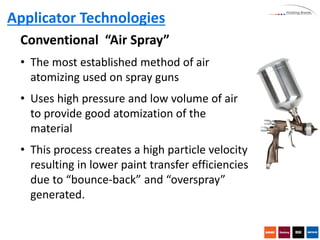
Conventional “Air Spray”
• The most established method of air
atomizing used on spray guns
• Uses high pressure and low volume of air
to provide good atomization of the
material
• This process creates a high particle velocity
resulting in lower paint transfer efficiencies
due to “bounce-back” and “overspray”
generated.
Applicator Technologies
HVLP (High Volume Low Pressure)
• Compliant technology developed in the 80’s
when environmental legislation was first
introduced.
• Uses larger compressed air volumes at lower
pressures to atomize coating materials.
• Can yield higher transfer efficiency than
conventional air spray, however, quality of
finish may be negatively impacted.
LVMP (Trans-Tech  Compliant)
• Introduced in the 90’s and is a combination
of Conventional and HVLP atomization
methods.
• Trans-Tech utilizes more compressed air for
the atomization process producing smaller
droplet than HVLP.
• Can yield higher transfer efficiency than
conventional air spray, with better quality
than HVLP.
Applicator Technologies
Conventional
• Spray at Any Pressure / CFM
• Air cap pressures typically 30 – 60 psi
HVLP
• Meets USA Regulatory Requirements
• Air cap pressure less than 10 PSI
• Requires air cap test kit
LVMP (TransTech, Compliant)
• Meets European Requirements
• Air cap pressures typically 20 – 40 psi
Applicator Technologies
Conventional, HVLP, LVMP
• Comparison of air consumption, efficiency and particle size
Particle Size
150
300
450
600
750
900
20 40 60 80 100
HVLP
LVMP
Air
AirConsumption(l/min)
Transfer Efficiency %
Applicator Technologies
Conventional, HVLP, LVMP
Applicator Technologies
Hydraulic Atomization
• Material at a high pressure is forced
through a fixed orifice.
• The material is atomized by shear
• Spray pattern size is based on angle
ground into tip
• Flow rate is based on fluid
pressure developed by pump
Applicator Technologies
Hydraulic Atomization Airless & Air Assisted
• Airless
 Typically 1000 - 4000 psi
 High flow capability
 Used with wide variety of
coating materials
Applicator Technologies
Hydraulic Atomization Airless & Air Assisted
• Air Assisted Airless
 Typically 300 - 1500 psi
 Air used to improve spray
pattern uniformity
Applicator Technologies
Hydraulic Atomization Airless & Air Assisted
Applicator Technologies
Air and Hydraulic Atomization
Applicator Technologies
Centrifugal (Rotary) Atomization
• Rotary atomizers were developed
by Harold Ransburg in the 1940’s.
• The term “Bell” comes from
the shape of the original
atomizers that were driven at
low speeds 900 -1800 rpm
with electric motors.
• The rotation was used to distribute coating
evenly around the perimeter and the
atomization process was purely due to the
electrostatic charge applied to the “bell”.
Applicator Technologies
Centrifugal (Rotary) Atomization
• High speed rotary atomizers, utilize mechanical
shearing action to atomize coatings materials.
• Rotational speeds vary from 15,000 – 100,000 rpm
Applicator Technologies
Centrifugal (Rotary) Atomization
• Atomized droplet size is
based on bell cup diameter
and rotational speed.
• Various diameters used
based on flow rate and
coating materials
• Bell cup design vary
Serrated edge
Non-serrated edge
Applicator Technologies
Centrifugal (Rotary) Atomization
• Shaping air is used to provide forward
direction to the spray pattern
• Various shape air technologies used
 Single shape function
 Dual shape function
 Vortex style
 Combinations
• lower particle velocities associated
with higher transfer efficiencies
when compared to air atomization
Applicator Technologies
Centrifugal (Rotary) Atomization
Applicator Technologies
Centrifugal (Rotary) Atomization
• TurboDisk operates at speeds of
6,000 - 40,000 rpm
• Various disk platters available
 Serrated edge conical available in
6, 9 or 12”
 Smooth edge uni-disk available in
6, 8, 10 & 12”
• lower particle velocities associated
with higher transfer efficiencies
when compared to air atomization
Applicator Technologies
Centrifugal (Rotary) Atomization
• TurboDisk is a specialized applicator
that works well with
 High production systems
 Minimal color changes
 Batch run parts
• Markets used in:
 Aluminum Extrusion Industry
 Door manufacturers
 Propane or cylinder manufacturers
 Car or truck filter
 Shock absorbers
 Sporting equipment
Applicator Technologies
Centrifugal (Rotary) Atomization
Applicator Technologies
Electrostatics
Definition: Method of paint application in which a
high voltage charge is used to dramatically increase
transfer efficiency.
• Coating is negatively charged
as it is atomized
• Product coated is at ground
potential, and appears to be
opposite charge
• Opposites attract - coating is
drawn to grounded product.
-
-
-
-
-
- -
-
-
-
-
-
-
-
- -
-
Applicator Technologies
Electrostatic: Two Methods
• # 1 Process: External or Indirect Charge
Fluid supply and
application
equipment at
ground potential
Wire grid is
electrically charged
Product coated
is grounded
through
conveyor system
Applicator Technologies
Electrostatic: Two Methods
• # 1 Process: External or Indirect Charge
Applicator Technologies
Electrostatic: Two Methods
• # 2 Process: Direct Charge
 When first developed, atomization
process was based on electrostatic
repulsion, like particles repel.
 Optimal atomization was obtained at a
maximum fluid flow rate of 10 ml/inch of
circumference
 Today atomization process is either
mechanical shearing action (rotary and
hydraulic atomizers) or air impingement.
Applicator Technologies
Electrostatic: Two Methods
• # 2 Process: Direct Charge
 With disk and bell applicators, charge is
transferred from disk platter or bell cup.
 Air atomized applicators utilize an
electrode in the fluid stream
Applicator Technologies
Electrostatic Applicators
• All atomization technologies are
available with electrostatics in manual
and automatic versions
Non - Electrostatic applicator applying coating
material to tubular target.
Back side of tube targets
after being coated
Fluid flow rate set at 200 cc/min
Applicator Technologies
Non-Electrostatics Application
Electrostatic air atomized applicator applying
coating material to tubular target.
Fluid flow rate set at 200 cc/min Back side of tube targets
after being coated
Applicator Technologies
Electrostatics Application
Electrostatic rotary atomizer applying coating
material to tubular target.
Fluid flow rate set at 200 cc/min Back side of tube targets
after being coated
Applicator Technologies
Electrostatics Application
Applicator Technologies
Electrostatics
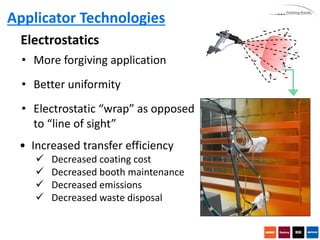
• More forgiving application
• Better uniformity
• Electrostatic “wrap” as opposed
to “line of sight”
• Increased transfer efficiency
 Decreased coating cost
 Decreased booth maintenance
 Decreased emissions
 Decreased waste disposal
-
-
-
-
-
- -
-
-
-
-
-
-
- - -
-
0
20
40
60
80
100
Bells Air Elec. Air Conv.
Min
Max
0
20
40
60
80
100
Bells Air Elec. Air Conv.
Typical Transfer Efficiency
on Metal Substrate
Typical Transfer Efficiency
on Plastic Substrate
Applicator Technologies
Electrostatics
• Increased transfer efficiency
• The best way to reduce coating usage is to minimize
the volume of material that is sprayed.
Applicator Technologies
Electrostatics
• You pay for paint 4 times!
 You pay somebody to buy it
 You pay somebody to apply it
 You pay somebody to clean it up
 You pay somebody to dispose of it
Applicator Technologies
Electrostatics can effectively be used on
non-conductors
1. Conductive Sensitizers
2. Conductive Primers
3. Conductive Adhesion Promoters
4. Inherent Conductivity (moisture content)
5. Misting
6. Imaging Techniques
7. Conductive Additives
8. Metal Deposition
Applicator Technologies
Electrostatics: Eight techniques used to
make non-conductors conductive:
Spray Characteristics
Applicator technologies can be used across a
wide range of markets and applications
TransportationWoodMetal Special Coatings
 Urethanes
 Latex
 Two-Component
 Epoxies
 Toners
 Stains
 NGR Stains
 Topcoats
 UV Materials
 Primers
 Base Coats
 Clear Coats
 Aerospace
specific coatings
 Waterborne
 Adhesives
 Mold release
 Ceramics
 Enamels
Spray Characteristics
Classification of Atomization Technologies:
• Finish Quality
Rough------------Fine
Large -------------------------------------------- Small
FinishQuality
Atomized Droplet Size
Airless
Air Assist
HVLP
LVMP
Conventional
Disk
Bell
Spray Characteristics
Classification of Atomization Technologies:
• Transfer Efficiency
Low---------------High
Conventional -------------------------------- Rotary
TransferEfficiency
Applicator Technology
Airless
Air Assist
HVLP
LVMP
Conventional
Disk Bell
E-Stat Gun
Note:
Spray Characteristics
Classification of Atomization Technologies:
• Speed of Application
Slow----------------Fast
HVLP ------------------------------------------ Airless
SpeedofApplication
Airless
Air Assist
HVLP
LVMP
Conventional
Disk
Bell
Applicator Technology
Comparison of Rotary and Air Atomization Technology
43
Spray Characteristics
Normal: 200 – 250mm
Normal Spray PatternCut-in Areas
44
Dual Shaping Air Spray Pattern - can be optimized for coverage
into deep recessed areas or larger surfaces.
Cut-in: 75 – 100mm
Spray Characteristics
Automation: Reciprocators and Robots
Machines and robots installed in spray booths
must be approved for operation in hazardous
area (Class 1, Division 1).
• Machines  Hard Automation
 Short Stroke Reciprocators
 Long Stroke Reciprocators
 Smart Reciprocators
 Special Machines (Rotary Spray)
• Robots  Flexible Automation
 Electric robots, highly reliable
Automation: Reciprocators and Robots
• Short Stroke Reciprocators
 A reciprocator increase the effective
coating area of the applicator.
 Typical stroke range 7 – 14”
 Blends round spray patterns together
providing very good coating uniformity.
 Improves coverage by changing
presentation of the applicator to
the part.
 Rotary atomizer, 30 cycles per
minute
 Air atomizers, 60 cycles per
minute
Automation: Reciprocators and Robots
• Long Stroke Reciprocators
 A reciprocator increase the effective
coating area of the applicator.
 Typical stroke length 3’ – 14’
 May be equipped with “toeing”
feature that angles applicators in
direction of travel.
 Rotary atomizer, 180 ft/min
maximum
 Air atomizers, 280 ft/min
maximum
12 cyc
1 min
50% Spray Pattern Overlap
Automation: Reciprocators and Robots
• Long Stroke Reciprocators
 Machine must be
synchronized with conveyor
to get uniform finish
 50% or 75% spray pattern
overlap most commonly used
 50% overlap: conveyor speed
(in) / pattern width (in) =
machine cycle rate
 75% overlap = above X 2
 Assume:
• 14 ft/min
• 12 in spray pattern
Conveyor TravelApplicatorTravel
14 ft
1min
12in
1 ft
1 cyc
12 in
XX @ 50% Overlap
Automation: Reciprocators and Robots
• Long Stroke Reciprocators
 Used with disk system
 Typical stroke range 3’ – 24’
 Recommend a minimum of
4 strokes on part while in
disk loop
 Maximum speed 4ft/sec,
recommend slower.
Automation: Reciprocators and Robots
• Long Stroke Reciprocators
 “S” loop conveyor configuration
 Allows access to both sides of part
Automation: Reciprocators and Robots
• Smart Reciprocators
• Special Machines (Rotary Spray)
 Similar to long stroke style reciprocator
 Additional axis of movement incorporated
 Variable stroke length
 Multiple atomizer mounted
on rotary axis
 Product coated conveyed
on belt beneath atomizers
 Integrated system to
reclaim material
Automation: Reciprocators and Robots
• Robots
 Flexible automation, programmed to accommodate product
coated.
 Ability to maintain optimal distance
between applicator and substrate.
 In most cases more cost effective
than designing custom “hardware”
solution
 Robot selection made based on
work envelope “reach” and payload
capability
Automation: Reciprocators and Robots
• Robots
Automation: Reciprocators and Robots
• Robots
Automation: Reciprocators and Robots
• Robots
Product Presentation
Product presentation is most often dictated by
• Manufacturing process
• Size or weight of the product coated
• Desire to coat new product in existing system
Conveyor Systems
• Overhead
• Floor mounted
• Chain on edge
• Power and Free (indexing)
• Horizontal belt or web
Product Presentation
Part Presentation
• Single or multiple parts per fixture
• Fixture may index on 90˚ or 180˚
increments
• Fixture may continuously rotate
• Rotation may be reversed in each
spray zone
Product Presentation
Part Presentation
• Repeatability
• Grounding
Product Presentation
Part Presentation
Production Requirements
• Following information is need to make
equipment recommendations
 Conveyor speed (ft/min)
 Rack centers (ft)
 Parts per rack
 Hours per shift
 Shifts per day
 Days per week
 Weeks per year of operation
2’
Calculating Coating Volume Needs
65
Comparison of application technology impact on
transfer efficiency
Calculating Coating Volume Needs
Evaluate the “Givens”
• Greenfield project?
• New program in existing finishing system
• Production requirements
Selecting Automation
Prioritize the requirements
• Finish quality
• Production level
• Coverage
• Transfer efficiency
• Environmental
Bring in the Experts
• Use equipment suppliers applications labs
Selecting Automation
Thank-you
Nguyen Quang Vu
Business Development Manager
Finishing Brands UK
0933993335

automating coating process

  • 1.
    Automating the CoatingProcess Presented by: Nguyen Quang Vu Business Development Manager Finishing Brands UK
  • 2.
    Automating the CoatingProcess • Applicator Technologies • Spray Characteristics • Automation: Reciprocators & Robotics • Product Presentation • Production Requirements & Cycle Time • Calculating Coating Volume Needs • Selecting Automation
  • 3.
    Applicator Technologies  AirAtomization  Hydraulic Atomization  Centrifugal (Rotary) Atomization  Electrostatics Automating the Coating Process
  • 4.
    Air Atomization Technology Conventional Air Spray • Low Volume High Pressure  HVLP • High Volume Low Pressure  LVMP (TransTech Compliant) • Low Volume Medium Pressure
  • 5.
    Applicator Technologies Conventional, HVLP,LVMP • Functional mechanics are all the same • Air impinging on fluid stream to create droplets Atomization air exits from center holes of air cap and creates droplets Fan (Pattern) air exits from horns of air cap and shapes pattern into elliptical shape
  • 6.
    Conventional “Air Spray” •The most established method of air atomizing used on spray guns • Uses high pressure and low volume of air to provide good atomization of the material • This process creates a high particle velocity resulting in lower paint transfer efficiencies due to “bounce-back” and “overspray” generated. Applicator Technologies
  • 7.
    Applicator Technologies HVLP (HighVolume Low Pressure) • Compliant technology developed in the 80’s when environmental legislation was first introduced. • Uses larger compressed air volumes at lower pressures to atomize coating materials. • Can yield higher transfer efficiency than conventional air spray, however, quality of finish may be negatively impacted.
  • 8.
    LVMP (Trans-Tech Compliant) • Introduced in the 90’s and is a combination of Conventional and HVLP atomization methods. • Trans-Tech utilizes more compressed air for the atomization process producing smaller droplet than HVLP. • Can yield higher transfer efficiency than conventional air spray, with better quality than HVLP. Applicator Technologies
  • 9.
    Conventional • Spray atAny Pressure / CFM • Air cap pressures typically 30 – 60 psi HVLP • Meets USA Regulatory Requirements • Air cap pressure less than 10 PSI • Requires air cap test kit LVMP (TransTech, Compliant) • Meets European Requirements • Air cap pressures typically 20 – 40 psi Applicator Technologies
  • 10.
    Conventional, HVLP, LVMP •Comparison of air consumption, efficiency and particle size Particle Size 150 300 450 600 750 900 20 40 60 80 100 HVLP LVMP Air AirConsumption(l/min) Transfer Efficiency % Applicator Technologies
  • 11.
  • 12.
    Applicator Technologies Hydraulic Atomization •Material at a high pressure is forced through a fixed orifice. • The material is atomized by shear • Spray pattern size is based on angle ground into tip • Flow rate is based on fluid pressure developed by pump
  • 13.
    Applicator Technologies Hydraulic AtomizationAirless & Air Assisted • Airless  Typically 1000 - 4000 psi  High flow capability  Used with wide variety of coating materials
  • 14.
    Applicator Technologies Hydraulic AtomizationAirless & Air Assisted • Air Assisted Airless  Typically 300 - 1500 psi  Air used to improve spray pattern uniformity
  • 15.
  • 16.
    Applicator Technologies Air andHydraulic Atomization
  • 17.
    Applicator Technologies Centrifugal (Rotary)Atomization • Rotary atomizers were developed by Harold Ransburg in the 1940’s. • The term “Bell” comes from the shape of the original atomizers that were driven at low speeds 900 -1800 rpm with electric motors. • The rotation was used to distribute coating evenly around the perimeter and the atomization process was purely due to the electrostatic charge applied to the “bell”.
  • 18.
    Applicator Technologies Centrifugal (Rotary)Atomization • High speed rotary atomizers, utilize mechanical shearing action to atomize coatings materials. • Rotational speeds vary from 15,000 – 100,000 rpm
  • 19.
    Applicator Technologies Centrifugal (Rotary)Atomization • Atomized droplet size is based on bell cup diameter and rotational speed. • Various diameters used based on flow rate and coating materials • Bell cup design vary Serrated edge Non-serrated edge
  • 20.
    Applicator Technologies Centrifugal (Rotary)Atomization • Shaping air is used to provide forward direction to the spray pattern • Various shape air technologies used  Single shape function  Dual shape function  Vortex style  Combinations • lower particle velocities associated with higher transfer efficiencies when compared to air atomization
  • 21.
  • 22.
    Applicator Technologies Centrifugal (Rotary)Atomization • TurboDisk operates at speeds of 6,000 - 40,000 rpm • Various disk platters available  Serrated edge conical available in 6, 9 or 12”  Smooth edge uni-disk available in 6, 8, 10 & 12” • lower particle velocities associated with higher transfer efficiencies when compared to air atomization
  • 23.
    Applicator Technologies Centrifugal (Rotary)Atomization • TurboDisk is a specialized applicator that works well with  High production systems  Minimal color changes  Batch run parts • Markets used in:  Aluminum Extrusion Industry  Door manufacturers  Propane or cylinder manufacturers  Car or truck filter  Shock absorbers  Sporting equipment
  • 24.
  • 25.
    Applicator Technologies Electrostatics Definition: Methodof paint application in which a high voltage charge is used to dramatically increase transfer efficiency. • Coating is negatively charged as it is atomized • Product coated is at ground potential, and appears to be opposite charge • Opposites attract - coating is drawn to grounded product. - - - - - - - - - - - - - - - - -
  • 26.
    Applicator Technologies Electrostatic: TwoMethods • # 1 Process: External or Indirect Charge Fluid supply and application equipment at ground potential Wire grid is electrically charged Product coated is grounded through conveyor system
  • 27.
    Applicator Technologies Electrostatic: TwoMethods • # 1 Process: External or Indirect Charge
  • 28.
    Applicator Technologies Electrostatic: TwoMethods • # 2 Process: Direct Charge  When first developed, atomization process was based on electrostatic repulsion, like particles repel.  Optimal atomization was obtained at a maximum fluid flow rate of 10 ml/inch of circumference  Today atomization process is either mechanical shearing action (rotary and hydraulic atomizers) or air impingement.
  • 29.
    Applicator Technologies Electrostatic: TwoMethods • # 2 Process: Direct Charge  With disk and bell applicators, charge is transferred from disk platter or bell cup.  Air atomized applicators utilize an electrode in the fluid stream
  • 30.
    Applicator Technologies Electrostatic Applicators •All atomization technologies are available with electrostatics in manual and automatic versions
  • 31.
    Non - Electrostaticapplicator applying coating material to tubular target. Back side of tube targets after being coated Fluid flow rate set at 200 cc/min Applicator Technologies Non-Electrostatics Application
  • 32.
    Electrostatic air atomizedapplicator applying coating material to tubular target. Fluid flow rate set at 200 cc/min Back side of tube targets after being coated Applicator Technologies Electrostatics Application
  • 33.
    Electrostatic rotary atomizerapplying coating material to tubular target. Fluid flow rate set at 200 cc/min Back side of tube targets after being coated Applicator Technologies Electrostatics Application
  • 34.
    Applicator Technologies Electrostatics • Moreforgiving application • Better uniformity • Electrostatic “wrap” as opposed to “line of sight” • Increased transfer efficiency  Decreased coating cost  Decreased booth maintenance  Decreased emissions  Decreased waste disposal - - - - - - - - - - - - - - - - -
  • 35.
    0 20 40 60 80 100 Bells Air Elec.Air Conv. Min Max 0 20 40 60 80 100 Bells Air Elec. Air Conv. Typical Transfer Efficiency on Metal Substrate Typical Transfer Efficiency on Plastic Substrate Applicator Technologies Electrostatics
  • 36.
    • Increased transferefficiency • The best way to reduce coating usage is to minimize the volume of material that is sprayed. Applicator Technologies Electrostatics • You pay for paint 4 times!  You pay somebody to buy it  You pay somebody to apply it  You pay somebody to clean it up  You pay somebody to dispose of it
  • 37.
    Applicator Technologies Electrostatics caneffectively be used on non-conductors
  • 38.
    1. Conductive Sensitizers 2.Conductive Primers 3. Conductive Adhesion Promoters 4. Inherent Conductivity (moisture content) 5. Misting 6. Imaging Techniques 7. Conductive Additives 8. Metal Deposition Applicator Technologies Electrostatics: Eight techniques used to make non-conductors conductive:
  • 39.
    Spray Characteristics Applicator technologiescan be used across a wide range of markets and applications TransportationWoodMetal Special Coatings  Urethanes  Latex  Two-Component  Epoxies  Toners  Stains  NGR Stains  Topcoats  UV Materials  Primers  Base Coats  Clear Coats  Aerospace specific coatings  Waterborne  Adhesives  Mold release  Ceramics  Enamels
  • 40.
    Spray Characteristics Classification ofAtomization Technologies: • Finish Quality Rough------------Fine Large -------------------------------------------- Small FinishQuality Atomized Droplet Size Airless Air Assist HVLP LVMP Conventional Disk Bell
  • 41.
    Spray Characteristics Classification ofAtomization Technologies: • Transfer Efficiency Low---------------High Conventional -------------------------------- Rotary TransferEfficiency Applicator Technology Airless Air Assist HVLP LVMP Conventional Disk Bell E-Stat Gun Note:
  • 42.
    Spray Characteristics Classification ofAtomization Technologies: • Speed of Application Slow----------------Fast HVLP ------------------------------------------ Airless SpeedofApplication Airless Air Assist HVLP LVMP Conventional Disk Bell Applicator Technology
  • 43.
    Comparison of Rotaryand Air Atomization Technology 43 Spray Characteristics
  • 44.
    Normal: 200 –250mm Normal Spray PatternCut-in Areas 44 Dual Shaping Air Spray Pattern - can be optimized for coverage into deep recessed areas or larger surfaces. Cut-in: 75 – 100mm Spray Characteristics
  • 45.
    Automation: Reciprocators andRobots Machines and robots installed in spray booths must be approved for operation in hazardous area (Class 1, Division 1). • Machines Hard Automation  Short Stroke Reciprocators  Long Stroke Reciprocators  Smart Reciprocators  Special Machines (Rotary Spray) • Robots Flexible Automation  Electric robots, highly reliable
  • 46.
    Automation: Reciprocators andRobots • Short Stroke Reciprocators  A reciprocator increase the effective coating area of the applicator.  Typical stroke range 7 – 14”  Blends round spray patterns together providing very good coating uniformity.  Improves coverage by changing presentation of the applicator to the part.  Rotary atomizer, 30 cycles per minute  Air atomizers, 60 cycles per minute
  • 47.
    Automation: Reciprocators andRobots • Long Stroke Reciprocators  A reciprocator increase the effective coating area of the applicator.  Typical stroke length 3’ – 14’  May be equipped with “toeing” feature that angles applicators in direction of travel.  Rotary atomizer, 180 ft/min maximum  Air atomizers, 280 ft/min maximum
  • 48.
    12 cyc 1 min 50%Spray Pattern Overlap Automation: Reciprocators and Robots • Long Stroke Reciprocators  Machine must be synchronized with conveyor to get uniform finish  50% or 75% spray pattern overlap most commonly used  50% overlap: conveyor speed (in) / pattern width (in) = machine cycle rate  75% overlap = above X 2  Assume: • 14 ft/min • 12 in spray pattern Conveyor TravelApplicatorTravel 14 ft 1min 12in 1 ft 1 cyc 12 in XX @ 50% Overlap
  • 49.
    Automation: Reciprocators andRobots • Long Stroke Reciprocators  Used with disk system  Typical stroke range 3’ – 24’  Recommend a minimum of 4 strokes on part while in disk loop  Maximum speed 4ft/sec, recommend slower.
  • 50.
    Automation: Reciprocators andRobots • Long Stroke Reciprocators  “S” loop conveyor configuration  Allows access to both sides of part
  • 51.
    Automation: Reciprocators andRobots • Smart Reciprocators • Special Machines (Rotary Spray)  Similar to long stroke style reciprocator  Additional axis of movement incorporated  Variable stroke length  Multiple atomizer mounted on rotary axis  Product coated conveyed on belt beneath atomizers  Integrated system to reclaim material
  • 52.
    Automation: Reciprocators andRobots • Robots  Flexible automation, programmed to accommodate product coated.  Ability to maintain optimal distance between applicator and substrate.  In most cases more cost effective than designing custom “hardware” solution  Robot selection made based on work envelope “reach” and payload capability
  • 53.
  • 54.
  • 55.
  • 57.
    Product Presentation Product presentationis most often dictated by • Manufacturing process • Size or weight of the product coated • Desire to coat new product in existing system Conveyor Systems • Overhead • Floor mounted • Chain on edge • Power and Free (indexing) • Horizontal belt or web
  • 58.
    Product Presentation Part Presentation •Single or multiple parts per fixture • Fixture may index on 90˚ or 180˚ increments • Fixture may continuously rotate • Rotation may be reversed in each spray zone
  • 59.
    Product Presentation Part Presentation •Repeatability • Grounding
  • 60.
  • 61.
    Production Requirements • Followinginformation is need to make equipment recommendations  Conveyor speed (ft/min)  Rack centers (ft)  Parts per rack  Hours per shift  Shifts per day  Days per week  Weeks per year of operation 2’
  • 62.
  • 63.
  • 64.
  • 65.
    65 Comparison of applicationtechnology impact on transfer efficiency Calculating Coating Volume Needs
  • 66.
    Evaluate the “Givens” •Greenfield project? • New program in existing finishing system • Production requirements Selecting Automation Prioritize the requirements • Finish quality • Production level • Coverage • Transfer efficiency • Environmental
  • 67.
    Bring in theExperts • Use equipment suppliers applications labs Selecting Automation
  • 68.
    Thank-you Nguyen Quang Vu BusinessDevelopment Manager Finishing Brands UK 0933993335