Questions & Answers: Airless Spraying
What is airless spraying??


You use an airless application more often than you think.
Because every time you take a shower u use an airless
system.


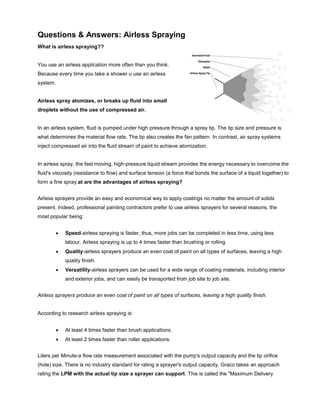
Airless spray atomizes, or breaks up fluid into small
droplets without the use of compressed air.


In an airless system, fluid is pumped under high pressure through a spray tip. The tip size and pressure is
what determines the material flow rate. The tip also creates the fan pattern. In contrast, air spray systems
inject compressed air into the fluid stream of paint to achieve atomization.


In airless spray, the fast moving, high-pressure liquid stream provides the energy necessary to overcome the
fluid's viscosity (resistance to flow) and surface tension (a force that bonds the surface of a liquid together) to
form a fine spray.at are the advantages of airless spraying?


Airless sprayers provide an easy and economical way to apply coatings no matter the amount of solids
present. Indeed, professional painting contractors prefer to use airless sprayers for several reasons, the
most popular being:


             Speed-airless spraying is faster, thus, more jobs can be completed in less time, using less
              labour. Airless spraying is up to 4 times faster than brushing or rolling
             Quality-airless sprayers produce an even coat of paint on all types of surfaces, leaving a high
              quality finish.
             Versatility-airless sprayers can be used for a wide range of coating materials, including interior
              and exterior jobs, and can easily be transported from job site to job site.


Airless sprayers produce an even coat of paint on all types of surfaces, leaving a high quality finish.


According to research airless spraying is:


             At least 4 times faster than brush applications.
             At least 2 times faster than roller applications.


Liters per Minute-a flow rate measurement associated with the pump's output capacity and the tip orifice
(hole) size. There is no industry standard for rating a sprayer's output capacity. Graco takes an approach
rating the LPM with the actual tip size a sprayer can support. This is called the "Maximum Delivery
Rating" which indicates the amount of latex paint (not water) that can flow through a particular tip, gun and
hose.


           BAR-a pressure measurement
            Typical maximum airless sprayer pressure ratings:
                o    200 bar
                o    210 bar
                o    230 bar

           Typical atomization pressures for airless applications:
                o    55-75 bar for lacquers
                o    85-125 bar for stains
                o    140+ for latex coatings


The pressure rating (e.g., 230bar) is the maximum working pressure of the sprayer. That is, the maximum
amount of pressure the sprayer is able to build. However, the pressure at the tip does not equal the
maximum working pressure. Hose length, tip size, the type of coating being sprayed, and even the filters
impact the amount of pressure available at the tip while spraying.


HP-a performance rating for the sprayer's motor or engine. There are a variety of motor types, operating
speeds and torque capabilities available. This makes horsepower a confusing rating method for distributors
and end-users alike. Some contractors prefer to have the biggest motor available because they believe it
means more power and longer sprayer life. This is not necessarily true, the motor and sprayer should be
matched to the jobs requirements.


MAXIMUM TIP SIZE-a rating that indicates the largest tip size (i.e., orifice) a sprayer is capable of
supporting, while maintaining a good spray pattern. The maximum tip size will depend on the type of coating
being sprayed and the amount of pressure needed to atomize the coating.


Choosing the right tip for a job is essential to optimize your performance, improve your work quality and
control your costs. The spray affects a job's profit margin as much as any other piece of equipment on the
site.


Getting the most from your spray tip depends on several factors:


           The tip's fan width
           The tip's orifice size
           Your sprayer's maximum output
           The type of paint you are spraying
           The type of surface you are spraying
   Tip wear


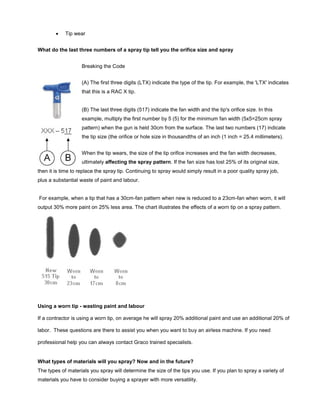
What do the last three numbers of a spray tip tell you the orifice size and spray


                    Breaking the Code


                    (A) The first three digits (LTX) indicate the type of the tip. For example, the 'LTX' indicates
                    that this is a RAC X tip.


                    (B) The last three digits (517) indicate the fan width and the tip's orifice size. In this
                    example, multiply the first number by 5 (5) for the minimum fan width (5x5=25cm spray
                    pattern) when the gun is held 30cm from the surface. The last two numbers (17) indicate
                    the tip size (the orifice or hole size in thousandths of an inch (1 inch = 25.4 millimeters).


                    When the tip wears, the size of the tip orifice increases and the fan width decreases,
                    ultimately affecting the spray pattern. If the fan size has lost 25% of its original size,
then it is time to replace the spray tip. Continuing to spray would simply result in a poor quality spray job,
plus a substantial waste of paint and labour.


For example, when a tip that has a 30cm-fan pattern when new is reduced to a 23cm-fan when worn, it will
output 30% more paint on 25% less area. The chart illustrates the effects of a worn tip on a spray pattern.


Using a worn tip - wasting paint and labour

If a contractor is using a worn tip, on average he will spray 20% additional paint and use an additional 20% of

labor. These questions are there to assist you when you want to buy an airless machine. If you need

professional help you can always contact Graco trained specialists.


What types of materials will you spray? Now and in the future?
The types of materials you spray will determine the size of the tips you use. If you plan to spray a variety of
materials you have to consider buying a sprayer with more versatility.
How many liters per week will you spray?
Purchasing a part-time sprayer to do a full-time job has disappointed many contractors. In the long run,
saving money on a sprayer that is inadequate for the job, or not durable enough, will cost a lot in lost labour.


What power sources are available? Will most jobs be indoors or outdoors?
Your answer will help choose a unit family (gas, electric, or compressed air) based on the power source
alone.


What types of surfaces will you be spraying?
Will you be spraying on drywall, exterior siding, or concrete? You have to consider the tip sizes needed as
well as the quality of finish required in order to choose the best sprayer for the job.


How many spray guns will you use at one time, now and in the future?
If you plan to use more than one gun at the same time, then you have to purchase a unit that has the ability
to handle multiple guns.


What types of jobs will you bid?
Each job has its own requirements. New construction, residential work, and commercial jobs vary in terms of:
coatings used, crew size needed, and power source available.


What hose lengths will you use?
Hose length depends on the job site, material being sprayed, tip size, and hose diameter. Your sprayer must
be able to support the length of the hose. Most Graco sprayers use DC motors, which are able to support
longer hose lengths than either AC or universal motor.


How much do you want to spend on a sprayer?
Buying a sprayer is an investment. You don't want to over-buy or under-buy. Keep in mind the cliché, "You
can pay now or later". Downtime resulting from an undersized, overworked sprayer or poor quality equipment
can quickly wipe out any savings from the initial low purchase cost of the sprayer.
A good spray pattern indicates that the paint or coating is completely atomized and distributed evenly onto
the surface. Several techniques help determine the quality of the spray pattern and the quality of the finish.
Techniques include everything from adjusting the pressure to the aiming of the spray pattern and
movement of the spray gun. The following techniques ensure a long-lasting quality finish:


Adjusting the pressure for spraying:


It is best to spray at the lowest pressure that completely atomizes the coating.
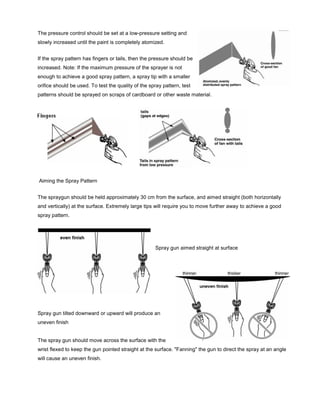
The pressure control should be set at a low-pressure setting and
slowly increased until the paint is completely atomized.


If the spray pattern has fingers or tails, then the pressure should be
increased. Note: If the maximum pressure of the sprayer is not
enough to achieve a good spray pattern, a spray tip with a smaller
orifice should be used. To test the quality of the spray pattern, test
patterns should be sprayed on scraps of cardboard or other waste material.


Aiming the Spray Pattern


The spraygun should be held approximately 30 cm from the surface, and aimed straight (both horizontally
and vertically) at the surface. Extremely large tips will require you to move further away to achieve a good
spray pattern.


                                                     Spray gun aimed straight at surface


Spray gun tilted downward or upward will produce an
uneven finish


The spray gun should move across the surface with the
wrist flexed to keep the gun pointed straight at the surface. "Fanning" the gun to direct the spray at an angle
will cause an uneven finish.
Triggering Technique


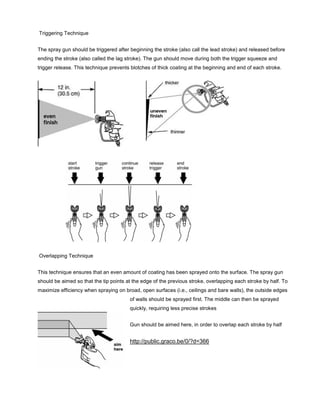
The spray gun should be triggered after beginning the stroke (also call the lead stroke) and released before
ending the stroke (also called the lag stroke). The gun should move during both the trigger squeeze and
trigger release. This technique prevents blotches of thick coating at the beginning and end of each stroke.


Overlapping Technique


This technique ensures that an even amount of coating has been sprayed onto the surface. The spray gun
should be aimed so that the tip points at the edge of the previous stroke, overlapping each stroke by half. To
maximize efficiency when spraying on broad, open surfaces (i.e., ceilings and bare walls), the outside edges
                                        of walls should be sprayed first. The middle can then be sprayed
                                        quickly, requiring less precise strokes


                                        Gun should be aimed here, in order to overlap each stroke by half


                                        http://public.graco.be/0/?d=366

Airless Spray Techniques

  • 1.
    Questions & Answers:Airless Spraying What is airless spraying?? You use an airless application more often than you think. Because every time you take a shower u use an airless system. Airless spray atomizes, or breaks up fluid into small droplets without the use of compressed air. In an airless system, fluid is pumped under high pressure through a spray tip. The tip size and pressure is what determines the material flow rate. The tip also creates the fan pattern. In contrast, air spray systems inject compressed air into the fluid stream of paint to achieve atomization. In airless spray, the fast moving, high-pressure liquid stream provides the energy necessary to overcome the fluid's viscosity (resistance to flow) and surface tension (a force that bonds the surface of a liquid together) to form a fine spray.at are the advantages of airless spraying? Airless sprayers provide an easy and economical way to apply coatings no matter the amount of solids present. Indeed, professional painting contractors prefer to use airless sprayers for several reasons, the most popular being:  Speed-airless spraying is faster, thus, more jobs can be completed in less time, using less labour. Airless spraying is up to 4 times faster than brushing or rolling  Quality-airless sprayers produce an even coat of paint on all types of surfaces, leaving a high quality finish.  Versatility-airless sprayers can be used for a wide range of coating materials, including interior and exterior jobs, and can easily be transported from job site to job site. Airless sprayers produce an even coat of paint on all types of surfaces, leaving a high quality finish. According to research airless spraying is:  At least 4 times faster than brush applications.  At least 2 times faster than roller applications. Liters per Minute-a flow rate measurement associated with the pump's output capacity and the tip orifice (hole) size. There is no industry standard for rating a sprayer's output capacity. Graco takes an approach rating the LPM with the actual tip size a sprayer can support. This is called the "Maximum Delivery
  • 2.
    Rating" which indicatesthe amount of latex paint (not water) that can flow through a particular tip, gun and hose.  BAR-a pressure measurement Typical maximum airless sprayer pressure ratings: o 200 bar o 210 bar o 230 bar  Typical atomization pressures for airless applications: o 55-75 bar for lacquers o 85-125 bar for stains o 140+ for latex coatings The pressure rating (e.g., 230bar) is the maximum working pressure of the sprayer. That is, the maximum amount of pressure the sprayer is able to build. However, the pressure at the tip does not equal the maximum working pressure. Hose length, tip size, the type of coating being sprayed, and even the filters impact the amount of pressure available at the tip while spraying. HP-a performance rating for the sprayer's motor or engine. There are a variety of motor types, operating speeds and torque capabilities available. This makes horsepower a confusing rating method for distributors and end-users alike. Some contractors prefer to have the biggest motor available because they believe it means more power and longer sprayer life. This is not necessarily true, the motor and sprayer should be matched to the jobs requirements. MAXIMUM TIP SIZE-a rating that indicates the largest tip size (i.e., orifice) a sprayer is capable of supporting, while maintaining a good spray pattern. The maximum tip size will depend on the type of coating being sprayed and the amount of pressure needed to atomize the coating. Choosing the right tip for a job is essential to optimize your performance, improve your work quality and control your costs. The spray affects a job's profit margin as much as any other piece of equipment on the site. Getting the most from your spray tip depends on several factors:  The tip's fan width  The tip's orifice size  Your sprayer's maximum output  The type of paint you are spraying  The type of surface you are spraying
  • 3.
    Tip wear What do the last three numbers of a spray tip tell you the orifice size and spray Breaking the Code (A) The first three digits (LTX) indicate the type of the tip. For example, the 'LTX' indicates that this is a RAC X tip. (B) The last three digits (517) indicate the fan width and the tip's orifice size. In this example, multiply the first number by 5 (5) for the minimum fan width (5x5=25cm spray pattern) when the gun is held 30cm from the surface. The last two numbers (17) indicate the tip size (the orifice or hole size in thousandths of an inch (1 inch = 25.4 millimeters). When the tip wears, the size of the tip orifice increases and the fan width decreases, ultimately affecting the spray pattern. If the fan size has lost 25% of its original size, then it is time to replace the spray tip. Continuing to spray would simply result in a poor quality spray job, plus a substantial waste of paint and labour. For example, when a tip that has a 30cm-fan pattern when new is reduced to a 23cm-fan when worn, it will output 30% more paint on 25% less area. The chart illustrates the effects of a worn tip on a spray pattern. Using a worn tip - wasting paint and labour If a contractor is using a worn tip, on average he will spray 20% additional paint and use an additional 20% of labor. These questions are there to assist you when you want to buy an airless machine. If you need professional help you can always contact Graco trained specialists. What types of materials will you spray? Now and in the future? The types of materials you spray will determine the size of the tips you use. If you plan to spray a variety of materials you have to consider buying a sprayer with more versatility.
  • 4.
    How many litersper week will you spray? Purchasing a part-time sprayer to do a full-time job has disappointed many contractors. In the long run, saving money on a sprayer that is inadequate for the job, or not durable enough, will cost a lot in lost labour. What power sources are available? Will most jobs be indoors or outdoors? Your answer will help choose a unit family (gas, electric, or compressed air) based on the power source alone. What types of surfaces will you be spraying? Will you be spraying on drywall, exterior siding, or concrete? You have to consider the tip sizes needed as well as the quality of finish required in order to choose the best sprayer for the job. How many spray guns will you use at one time, now and in the future? If you plan to use more than one gun at the same time, then you have to purchase a unit that has the ability to handle multiple guns. What types of jobs will you bid? Each job has its own requirements. New construction, residential work, and commercial jobs vary in terms of: coatings used, crew size needed, and power source available. What hose lengths will you use? Hose length depends on the job site, material being sprayed, tip size, and hose diameter. Your sprayer must be able to support the length of the hose. Most Graco sprayers use DC motors, which are able to support longer hose lengths than either AC or universal motor. How much do you want to spend on a sprayer? Buying a sprayer is an investment. You don't want to over-buy or under-buy. Keep in mind the cliché, "You can pay now or later". Downtime resulting from an undersized, overworked sprayer or poor quality equipment can quickly wipe out any savings from the initial low purchase cost of the sprayer. A good spray pattern indicates that the paint or coating is completely atomized and distributed evenly onto the surface. Several techniques help determine the quality of the spray pattern and the quality of the finish. Techniques include everything from adjusting the pressure to the aiming of the spray pattern and movement of the spray gun. The following techniques ensure a long-lasting quality finish: Adjusting the pressure for spraying: It is best to spray at the lowest pressure that completely atomizes the coating.
  • 5.
    The pressure controlshould be set at a low-pressure setting and slowly increased until the paint is completely atomized. If the spray pattern has fingers or tails, then the pressure should be increased. Note: If the maximum pressure of the sprayer is not enough to achieve a good spray pattern, a spray tip with a smaller orifice should be used. To test the quality of the spray pattern, test patterns should be sprayed on scraps of cardboard or other waste material. Aiming the Spray Pattern The spraygun should be held approximately 30 cm from the surface, and aimed straight (both horizontally and vertically) at the surface. Extremely large tips will require you to move further away to achieve a good spray pattern. Spray gun aimed straight at surface Spray gun tilted downward or upward will produce an uneven finish The spray gun should move across the surface with the wrist flexed to keep the gun pointed straight at the surface. "Fanning" the gun to direct the spray at an angle will cause an uneven finish.
  • 6.
    Triggering Technique The spraygun should be triggered after beginning the stroke (also call the lead stroke) and released before ending the stroke (also called the lag stroke). The gun should move during both the trigger squeeze and trigger release. This technique prevents blotches of thick coating at the beginning and end of each stroke. Overlapping Technique This technique ensures that an even amount of coating has been sprayed onto the surface. The spray gun should be aimed so that the tip points at the edge of the previous stroke, overlapping each stroke by half. To maximize efficiency when spraying on broad, open surfaces (i.e., ceilings and bare walls), the outside edges of walls should be sprayed first. The middle can then be sprayed quickly, requiring less precise strokes Gun should be aimed here, in order to overlap each stroke by half http://public.graco.be/0/?d=366