The Art of Effective
Storytelling
Michele Miller
Content Strategist
Professional Storyteller
@mmiller75
Disclaimer
It’s no secret that “Storytelling” has become one of the big
buzzwords everyone loves to throw around.
But I also want us to be realistic in our understanding of stories
as the very first social medium. This methodology is not new. It
has continuously been reinvented as more and more formats and
platforms become available.
Significant Objects
A study in measuring the
value of content
In 2009, two men by the names of Rob
Walker and Joshua Glenn purchased
cheap trinkets, and asked some of
today’s most talented creative writers to
invent stories about them, and then post
the stories and the objects together on
eBay to see whether the invented story
enhanced the value of the object.
The Hypothesis
Stories are such a powerful driver of
emotional value that their effect on a
given object’s subjective value can
actually be measured objectively.
In plain language,
Narrative transforms insignificant
objects into significant ones.
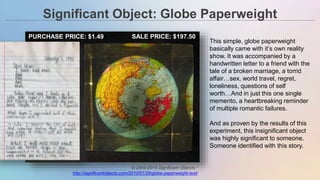
Significant Object: Globe Paperweight
PURCHASE PRICE: $1.49 SALE PRICE: $197.50
© 2009-2015 Significant Objects 1
http://significantobjects.com/2010/01/29/globe-paperweight-test/
This simple, globe paperweight
basically came with it’s own reality
show. It was accompanied by a
handwritten letter to a friend with the
tale of a broken marriage, a torrid
affair…sex, world travel, regret,
loneliness, questions of self
worth…And in just this one single
memento, a heartbreaking reminder
of multiple romantic failures.
And as proven by the results of this
experiment, this insignificant object
was highly significant to someone.
Someone identified with this story.
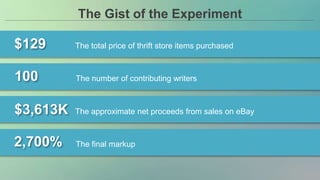
The Gist of the Experiment
$129 The total price of thrift store items purchased
$3,613K The approximate net proceeds from sales on eBay
100 The number of contributing writers
2,700% The final markup
Humans Are Not Moved To
Action By Data Dumps
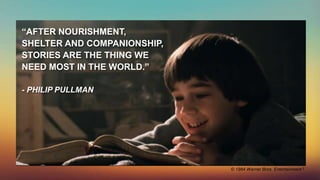
“AFTER NOURISHMENT,
SHELTER AND COMPANIONSHIP,
STORIES ARE THE THING WE
NEED MOST IN THE WORLD.”
- PHILIP PULLMAN
© 1984 Warner Bros. Entertainment 2
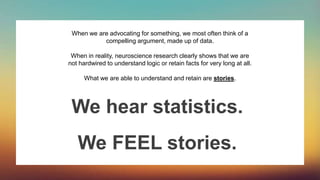
We hear statistics.
We FEEL stories.
When we are advocating for something, we most often think of a
compelling argument, made up of data.
When in reality, neuroscience research clearly shows that we are
not hardwired to understand logic or retain facts for very long at all.
What we are able to understand and retain are stories.
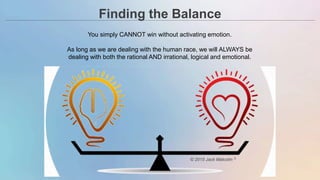
Finding the Balance
© 2015 Jack Malcolm 3
You simply CANNOT win without activating emotion.
As long as we are dealing with the human race, we will ALWAYS be
dealing with both the rational AND irrational, logical and emotional.
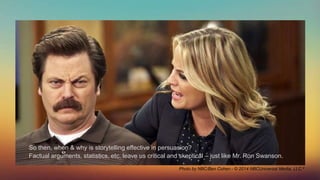
Photo by NBC/Ben Cohen - © 2014 NBCUniversal Media, LLC 4
So then, when & why is storytelling effective in persuasion?
Factual arguments, statistics, etc. leave us critical and skeptical – just like Mr. Ron Swanson.
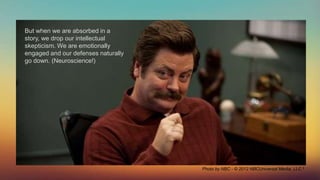
Photo by NBC - © 2012 NBCUniversal Media, LLC 5
But when we are absorbed in a
story, we drop our intellectual
skepticism. We are emotionally
engaged and our defenses naturally
go down. (Neuroscience!)
Storytelling Crimes
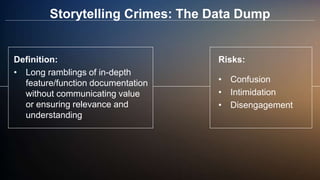
Storytelling Crimes: The Data Dump
Risks:
• Confusion
• Intimidation
• Disengagement
Definition:
• Long ramblings of in-depth
feature/function documentation
without communicating value
or ensuring relevance and
understanding
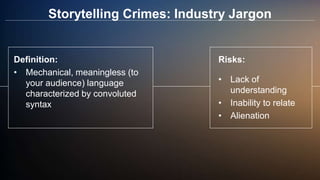
Storytelling Crimes: Industry Jargon
Risks:
• Lack of
understanding
• Inability to relate
• Alienation
Definition:
• Mechanical, meaningless (to
your audience) language
characterized by convoluted
syntax
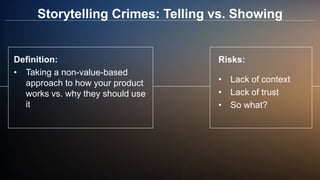
Storytelling Crimes: Telling vs. Showing
Risks:
• Lack of context
• Lack of trust
• So what?
Definition:
• Taking a non-value-based
approach to how your product
works vs. why they should use
it
From Product-Centered to
Story-Driven Content
People don’t buy products…
They buy better versions of themselves.
We are what we buy.
adapted from samuelhulick.com
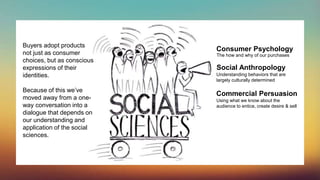
Social Anthropology
Consumer Psychology
Commercial Persuasion
Buyers adopt products
not just as consumer
choices, but as conscious
expressions of their
identities.
Because of this we’ve
moved away from a one-
way conversation into a
dialogue that depends on
our understanding and
application of the social
sciences.
The how and why of our purchases
Understanding behaviors that are
largely culturally determined
Using what we know about the
audience to entice, create desire & sell
Thinking Like the Customer
Couple of really important points here:
• The average customer does not think in terms
of “online” or “in-store”.
• You need to think like they do, which is one
brand, regardless of touch point
• You cannot force your customers to think like
the business
• To win, you need to be able to articulate this
mental model to your prospects & existing
customers
Stop talking
about yourself.
It’s definitely
not about you.
© 2013 UserOnboard.com 6
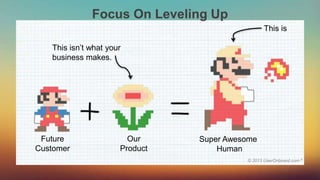
Future
Customer
Our
Product
Super Awesome
Human
Focus On Leveling Up
This is
This isn’t what your
business makes.
It’s time to change
your way of thinking
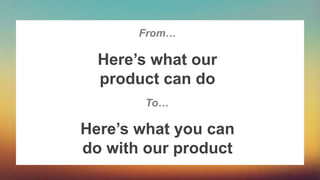
Here’s what our
product can do
Here’s what you can
do with our product
From…
To…
So How Does This Apply
In The Real World?
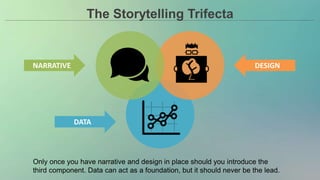
The Storytelling Trifecta
NARRATIVE
DATA
DESIGN
Only once you have narrative and design in place should you introduce the
third component. Data can act as a foundation, but it should never be the lead.
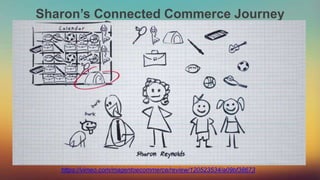
Sharon’s Connected Commerce Journey
https://vimeo.com/magentoecommerce/review/120523534/a09bf38673
References
1. Glenn, Joshua, & Walker, Rob. (2009). Significant Objects. © 2009-2015. Retrieved from
http://significantobjects.com/2010/01/29/globe-paperweight-test/
2. Petersen, Wolfgang. The NeverEnding Story. © 1984 Warner Bros. Entertainment.
Retrieved from http://www.imdb.com/title/tt0088323/
3. Malcolm, Jack. (2015). When the Heart Wins. Practical Eloquence. © 2015 Jack Malcolm.
Retrieved from http://jackmalcolm.com/blog/2014/09/when-the-heart-wins/
4. Cohen, Ben. (2014). Photo by NBC - © 2014 NBCUniversal Media. Retrieved from LLC
http://www.imdb.com/media/rm3054500864/tt1266020
5. Photo by NBC - © 2012 NBCUniversal Media, LLC. Retrieved from
http://www.imdb.com/media/rm3900878592/nm0644406
6. Hulick, Samuel. (2013). Features Vs. Benefits. User Onboarding. © 2013. Retrieved from
http://www.useronboard.com/features-vs-benefits/
Michele Miller
Content Strategist
Professional Storyteller
@mmiller75