UNIT V :INTERNETWORKING
PROT
OCOLS
Network
ProtocolsEmail
Architecture
Web server
Browsers
Domain Name
System IP protocol
IP
addresses
IPv6.
20/02/202
0
D
A
Y
A
N
A
N
D SC
IE
N
CE
CO
L
L
E
G
E
C
O
M
P
U
T
E
R S
CI
E
N
CE
D
E
P
A
R
T
M
E
N
T
C
O
M
P
U
T
E
R
NETWORK1
2.
NETWORK
PROT
OCOLS
Network Protocols area set of guidelines governing
the exchange of information in a simple,
dependable and secure way.
Network protocols are formal standards and
policies comprised of rules, methodology, and
configurations that define communication between
two or more devices over a network.
To effectively send and receive information, devices on
the two sides of a communication exchange must
follow protocols.
D
A
Y
A
N
A
N
D S
CI
E
N
CE
CO
L
L
E
G
E
C
O
M
P
U
T
E
R S
CIE
N
CE
D
E
P
A
R
T
M
E
N
T
20/02/202
0
2
3.
Network Time Protocol:
NetworkTime Protocol (NTP) is a protocol that synchronizes the clocks of
computer systems over data networks. NTP was designed by David L. Mills.
NTP permits network devices to synchronize their time settings with the NTP
server
. NTP is one of the most established internet protocols in current use.
D
A
Y
A
N
A
N
D S
CI
E
N
CE
CO
L
L
E
G
E
C
O
M
P
U
T
E
R S
CIE
N
CE
D
E
P
A
R
T
M
E
N
T
20/02/202
0
3
4.
Domain Name System
:
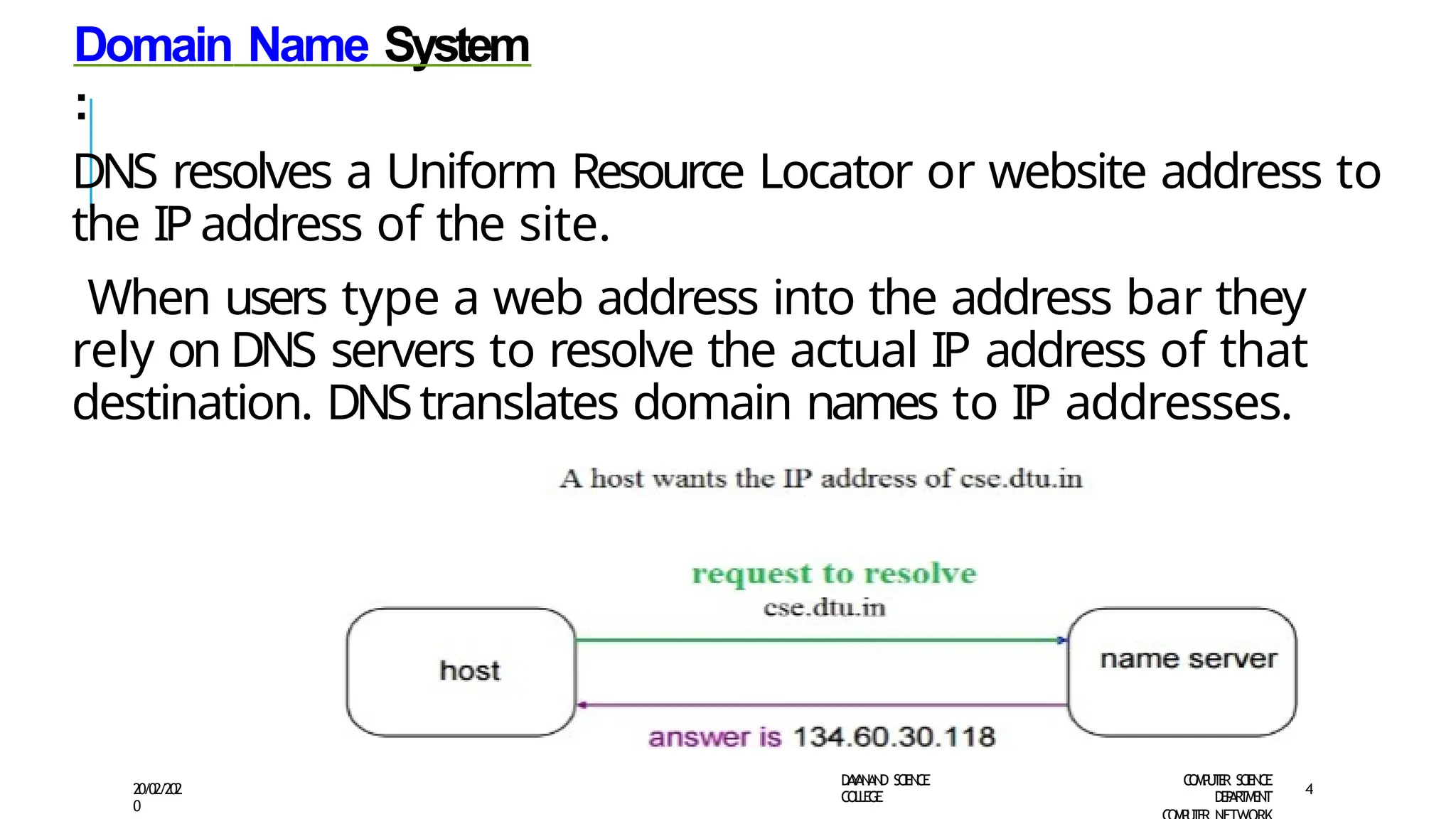
DNSresolves a Uniform Resource Locator or website address to
the IPaddress of the site.
When users type a web address into the address bar they
rely on DNS servers to resolve the actual IP address of that
destination. DNStranslates domain names to IP addresses.
D
A
Y
A
N
A
N
D S
CI
E
N
CE
CO
L
L
E
G
E
C
O
M
P
U
T
E
R S
CIE
N
CE
D
E
P
A
R
T
M
E
N
T
20/02/202
0
4
5.
Routing Information Protocol:
Itconstrains the number of hops permitted in a path on a network from the source
device to the destination. The maximum number of hops permitted for RIP is
fifteen.
It is a routing protocol used to exchange routing information. It figures the best
route based on hop count.
It actualizes the split horizon, route poisoning and, hold down mechanisms.
It is a dynamic routing protocol which uses hop count as a routing metric to find
the best path
between the source and the destination network
D
A
Y
A
N
A
N
D S
CI
E
N
CE
CO
L
L
E
G
E
C
O
M
P
U
T
E
R S
CIE
N
CE
D
E
P
A
R
T
M
E
N
T
20/02/202
0
5
6.
Dynamic Host ControlProtocol:
Dynamic Host Control Protocol (DHCP) uses a server to allocate an IP address
and
other configuration information to network devices.
As a result, the device is getting a permission slip from the DHCP server to
use the network.
DHCP enables users to send a request to the DHCP server whenever they
connect to a
network.
The server recognizes by providing an IP address to the user.
D
A
Y
A
N
A
N
D S
CI
E
N
CE
CO
L
L
E
G
E
C
O
M
P
U
T
E
R S
CIE
N
CE
D
E
P
A
R
T
M
E
N
T
20/02/202
0
6
7.
EMAIL A
RC
H
I
T
E
C
T
U
R
E
D
A
Y
A
N
A
N
D S
CI
E
N
CE
CO
L
L
E
G
E
C
O
M
P
U
T
E
RS
CIE
N
CE
D
E
P
A
R
T
M
E
N
T
20/02/202
0
7
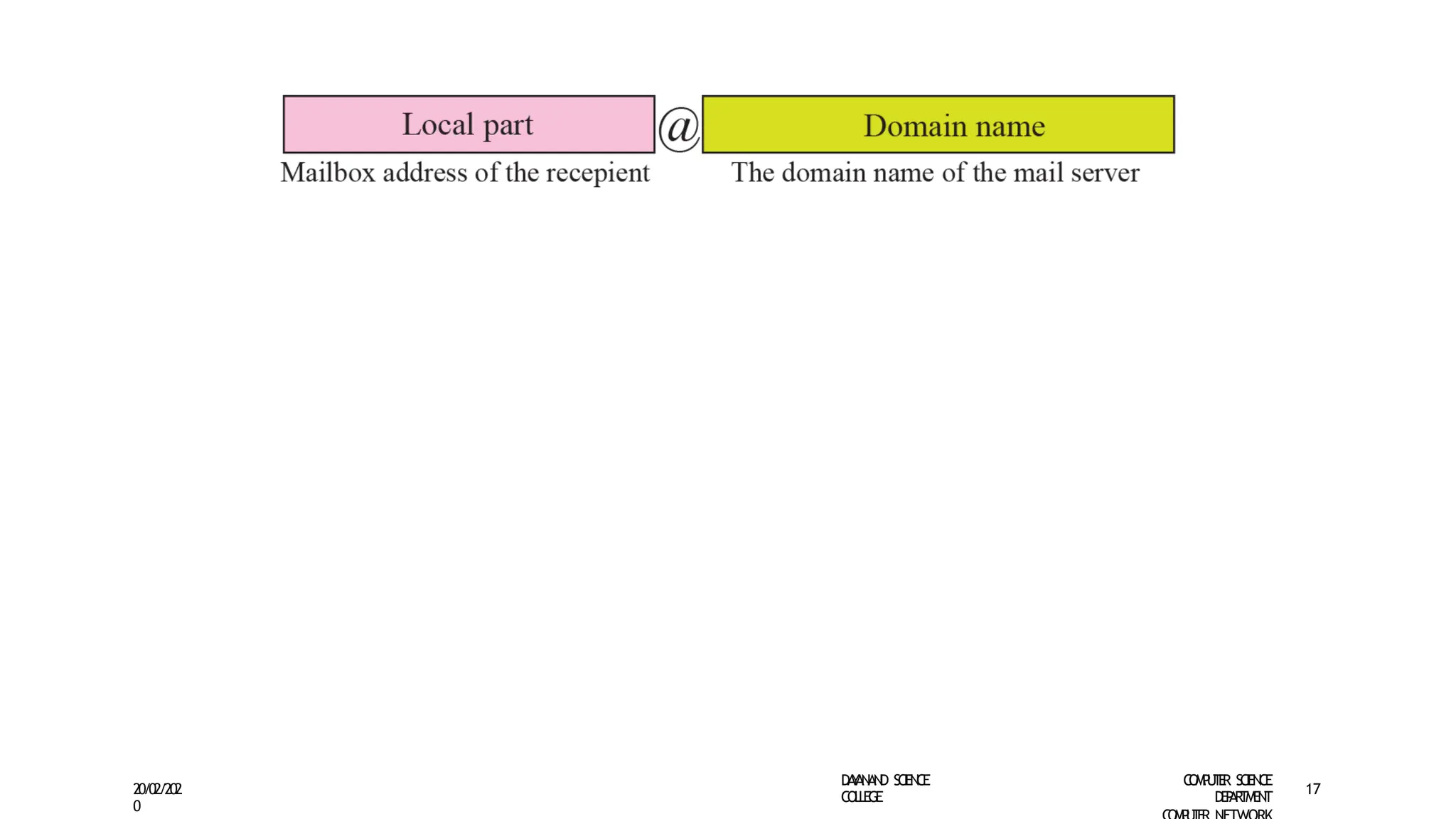
The term “e-mail” applies both to the Internet e-mail system based on the
Simple Mail Transfer Protocol (SMTP) and to intranet systems allowing users
within one organization to e-mail each other.
Often workgroup collaboration organizations may use the Internet
protocols for internal e-mail service. E-mail is often used to deliver bulk
unwanted messages, or
“spam”, but filter programs exist which can automatically delete most of
these. E-mail
systems based on RFC 822 are widely used.
1
2 3 4
5
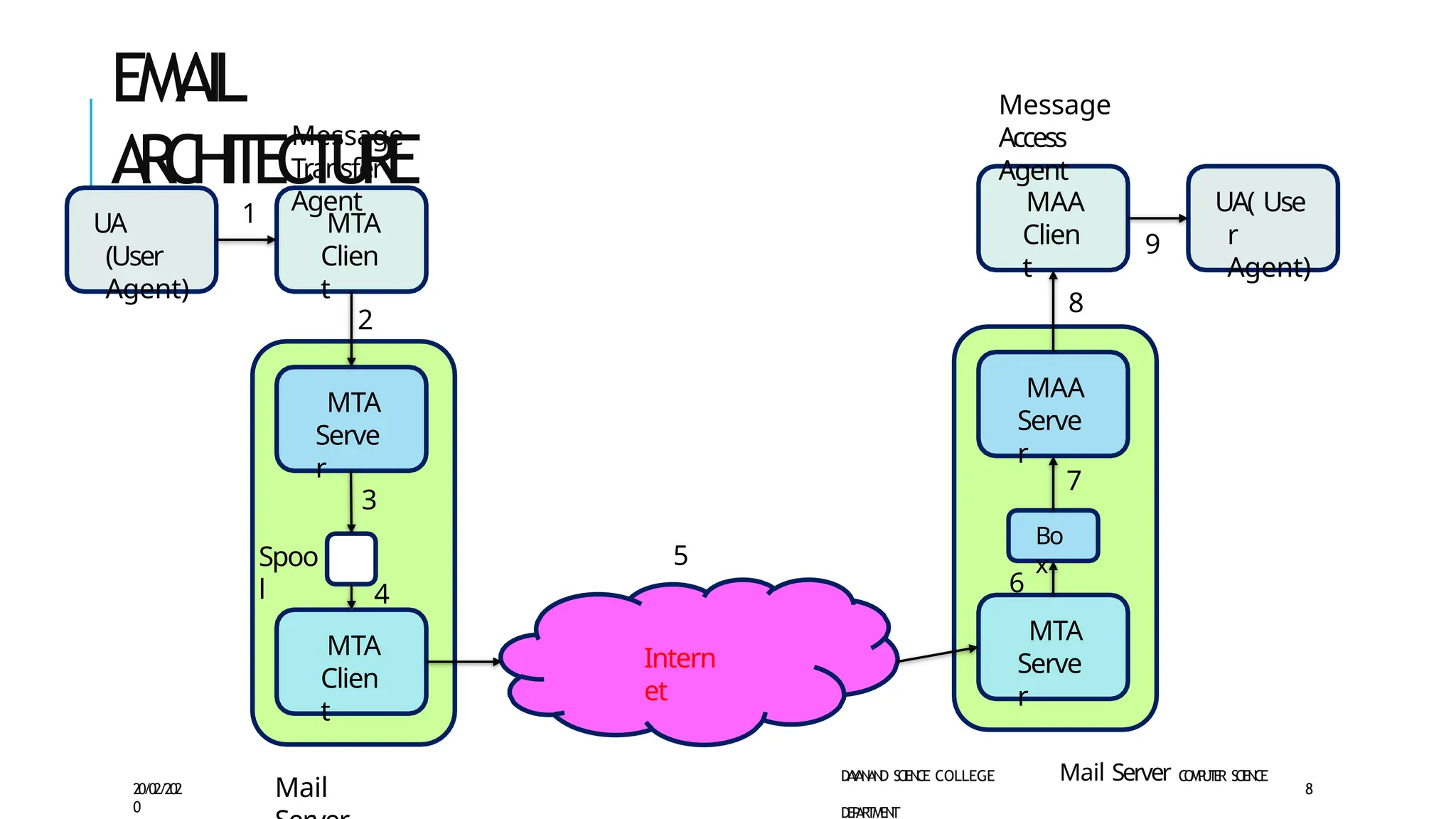
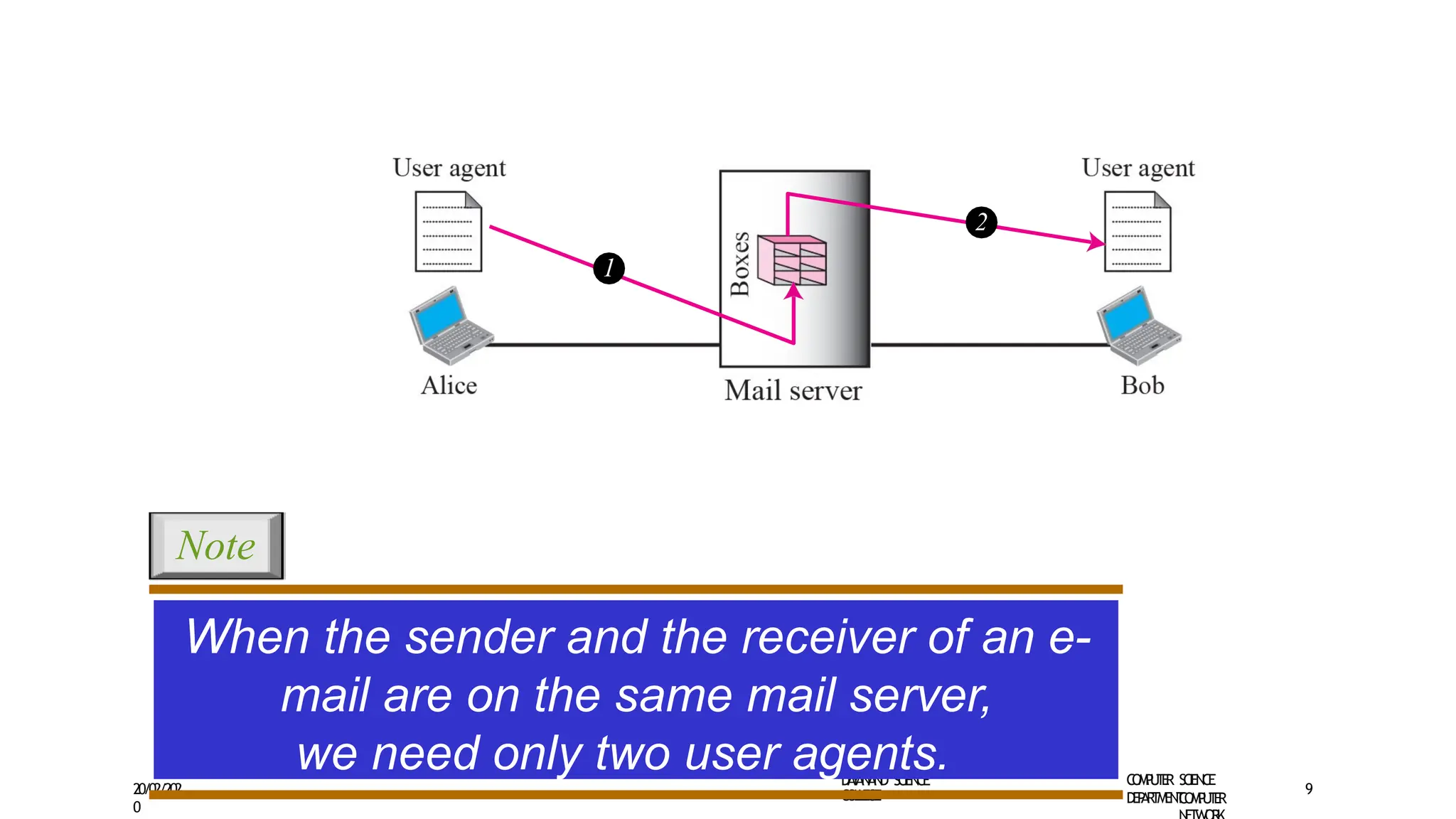
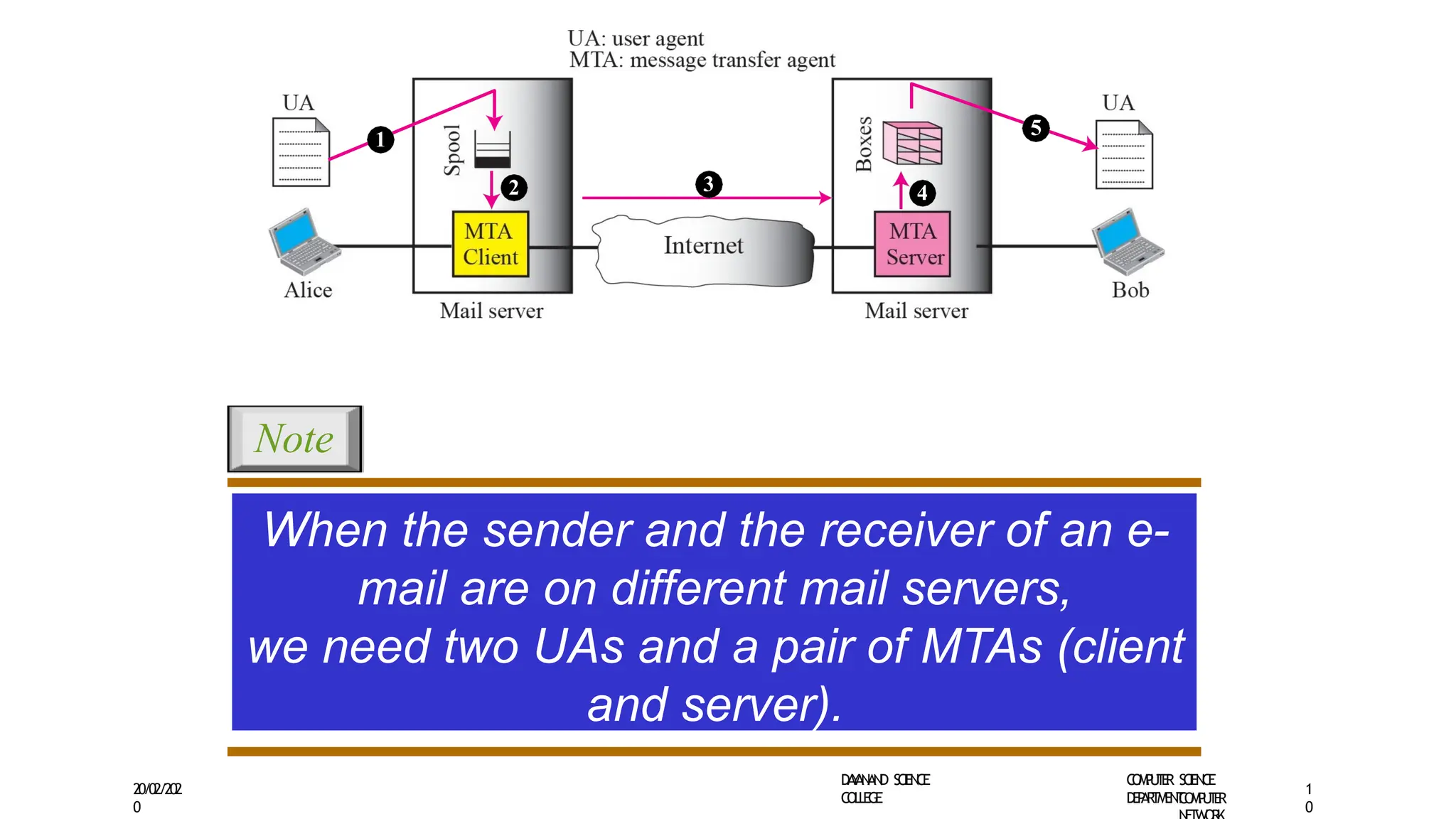
Whenthe sender and the receiver of an e-
mail are on different mail servers,
we need two UAs and a pair of MTAs (client
and server).
C
O
M
P
U
T
E
R
Note
20/02/202
0
D
A
Y
A
N
A
N
D S
CIE
N
CE
C
O
L
L
E
G
E
C
O
M
P
U
T
E
R S
CIE
N
CE
D
E
P
A
R
T
M
E
N
T
1
0
11.
1
2
3
4
5 6
7
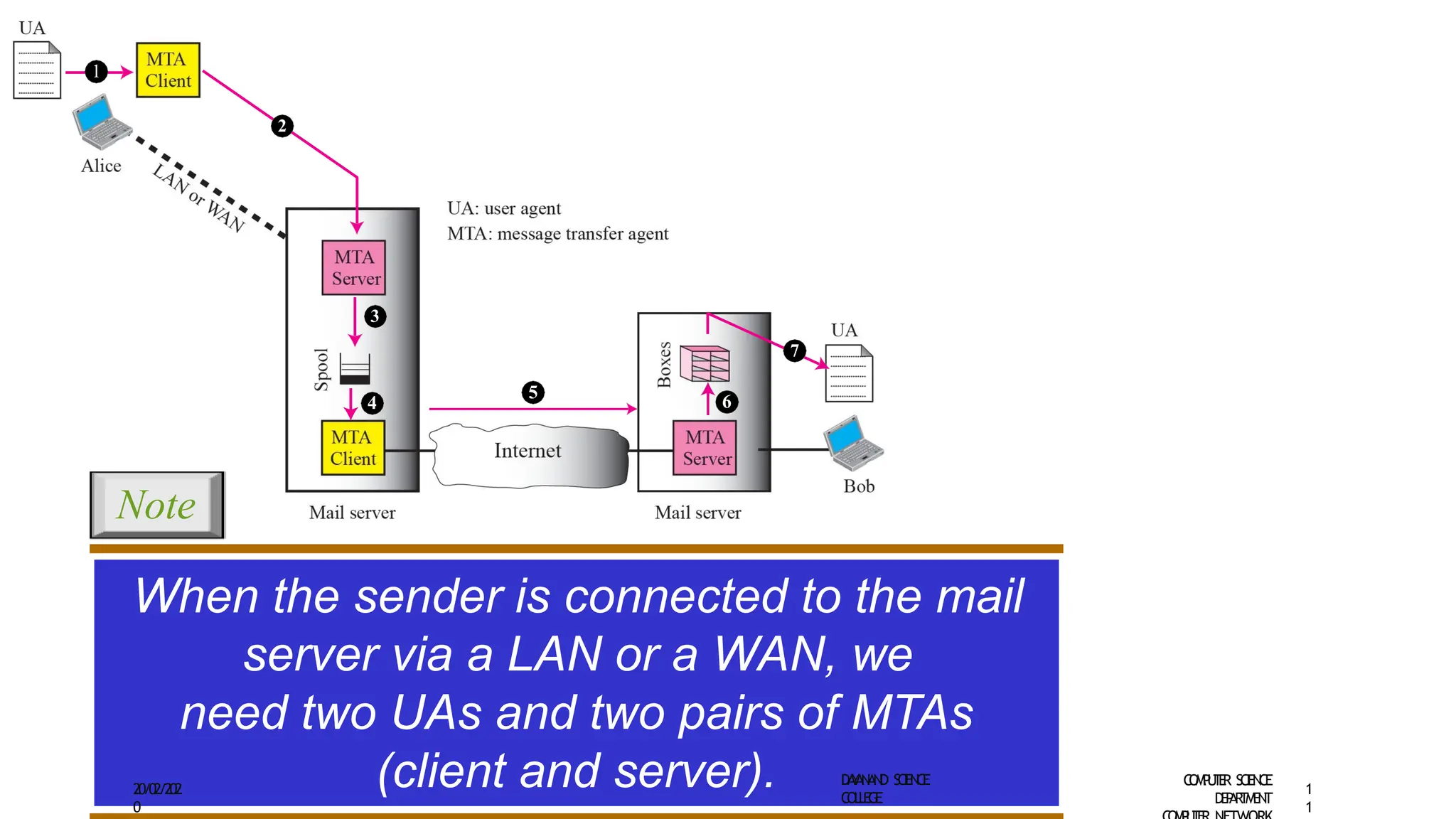
(client andserver).
Note
When the sender is connected to the mail
server via a LAN or a WAN, we
need two UAs and two pairs of MTAs
20/02/202
0
D
A
Y
A
N
A
N
D S
CIE
N
CE
C
O
L
L
E
G
E
C
O
M
P
U
T
E
R S
CI
E
N
CE
D
E
P
A
R
T
M
E
N
T
1
1
1 Architecture :
E-mailsystem normally consists of two sub systems
1. the user agents
2. the message transfer agents
The user agents allow people to read and send e-mails. The message transfer agents
move the messages from source to destination. The user agents are local programs
that provide a command based, menu-based, or graphical method for interacting
with e-mail system. Themessage transfer agents are daemons, which are processes
that run in background. Their job is to move datagram e-mail through system.
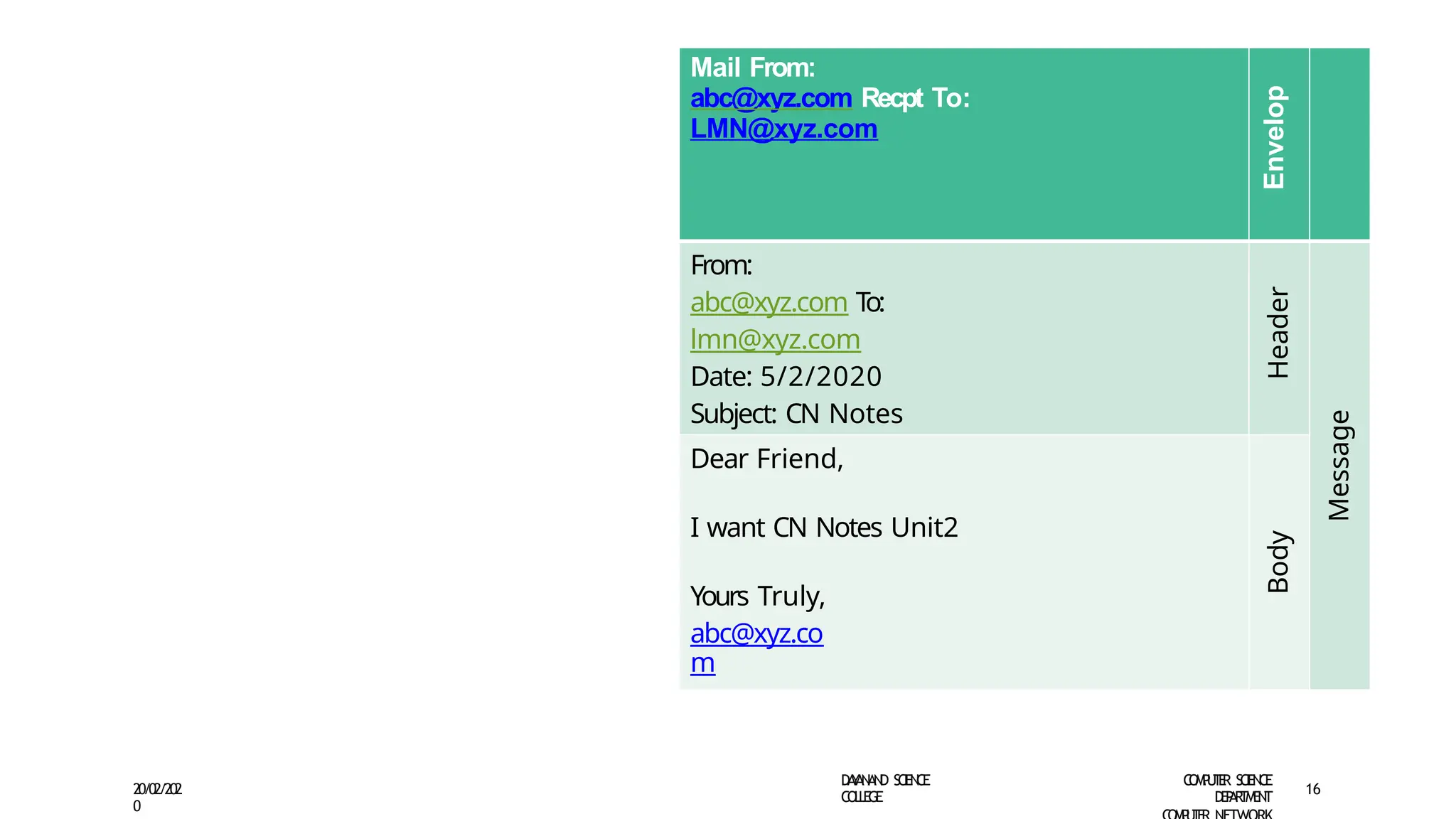
A key idea in e-mail system is the distinction between the envelope and its
contents. Theenvelope encapsulates the message. It contains all the information
needed for transporting the message like destinations address, priority, and
security level, all of which are distinct from the message itself.
D
A
Y
A
N
A
N
D S
CI
E
N
CE
CO
L
L
E
G
E
C
O
M
P
U
T
E
R S
CIE
N
CE
D
E
P
A
R
T
M
E
N
T
20/02/202
0
13
14.
The Header:
The headercontains control information for the user agents. It is structured
into fields such as summary, sender
, receiver
, and other information about the
e-mail.
· Body:
The body is entirely for human recipient. The message itself as unstructured
text;
sometimes containing a signature block at the end
D
A
Y
A
N
A
N
D S
CI
E
N
CE
CO
L
L
E
G
E
C
O
M
P
U
T
E
R S
CIE
N
CE
D
E
P
A
R
T
M
E
N
T
20/02/202
0
14
15.
2 Header format
Theheader is separated from the body by a blank
line. consists of following fields
· From: The e-mail address, and optionally name, of
the sender of the message.
· T
o: one or more e-mail addresses, and optionally
name, of the receiver’s of the message.
· Subject: A brief summary of the contents of the
message.
· Date: The local time and date when the message
was originally sent. D
A
Y
A
N
A
N
D S
CI
E
N
CE
CO
L
L
E
G
E
C
O
M
P
U
T
E
R S
CIE
N
CE
D
E
P
A
R
T
M
E
N
T
20/02/202
0
15
23-3 MESSAGE TRANSFERAGENT
D
A
Y
A
N
A
N
D S
CI
E
N
CE
CO
L
L
E
G
E
C
O
M
P
U
T
E
R S
CIE
N
CE
D
E
P
A
R
T
M
E
N
T
20/02/202
0
18
The actual mail transfer is done through
message transfer agents (MTAs). To send mail, a
system must have the client MTA, and to receive
mail, a system must have a server MTA. The
formal protocol that defines the MTA client and
server in the Internet is called Simple Mail
Transfer Protocol (SMTP). As we said before, two
pairs of MTA client-server programs are used in
the most common situation (fourth scenario).
Figure 23.8 shows the range of the SMTP protocol
in this scenario.
19.
23-4 MESSAGE ACCESSAGENT
D
A
Y
A
N
A
N
D S
CI
E
N
CE
CO
L
L
E
G
E
C
O
M
P
U
T
E
R S
CIE
N
CE
D
E
P
A
R
T
M
E
N
T
20/02/202
0
19
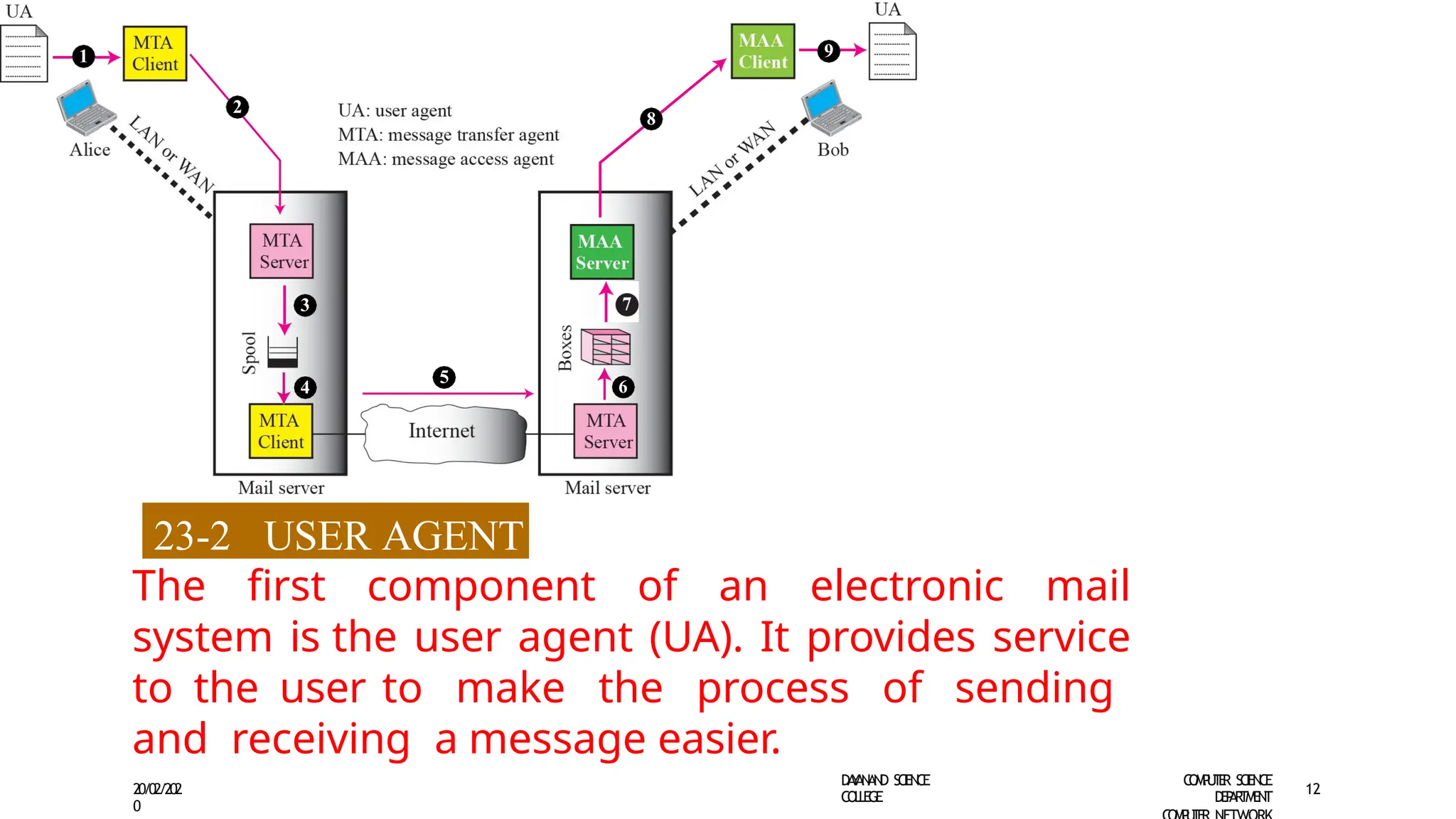
The first and the second stages of mail delivery
use SMTP. However, SMTP is not involved in the
third stage because SMTP is a push protocol; it
pushes the message from the client to the
server. In other words, the direction of the bulk
data (messages) is from the client to the server.
On the other hand, the third stage needs a pull
protocol; the client must pull messages from the
server. The direction of the bulk data are from the
server to the client. The third stage uses a
message access agent.
20.
WEB SERVER
D
A
Y
A
N
A
N
D S
CI
E
N
CE
CO
L
L
E
G
E
C
O
M
P
U
T
E
RS
CIE
N
CE
D
E
P
A
R
T
M
E
N
T
20/02/202
0
20
Web server is a computer where the web
content is stored. Basically web server is used
to host the web sites but there exists other
web servers also such as gaming, storage, FTP,
email etc.
Web site is collection of web pages while web
server is a software that respond to the
request for web resources.
21.
W
E
B SER
VER
WORKING
D
A
Y
A
N
A
N
D S
CI
E
N
CE
CO
L
L
E
G
E
C
O
M
P
U
T
E
RS
CIE
N
CE
D
E
P
A
R
T
M
E
N
T
20/02/202
0
21
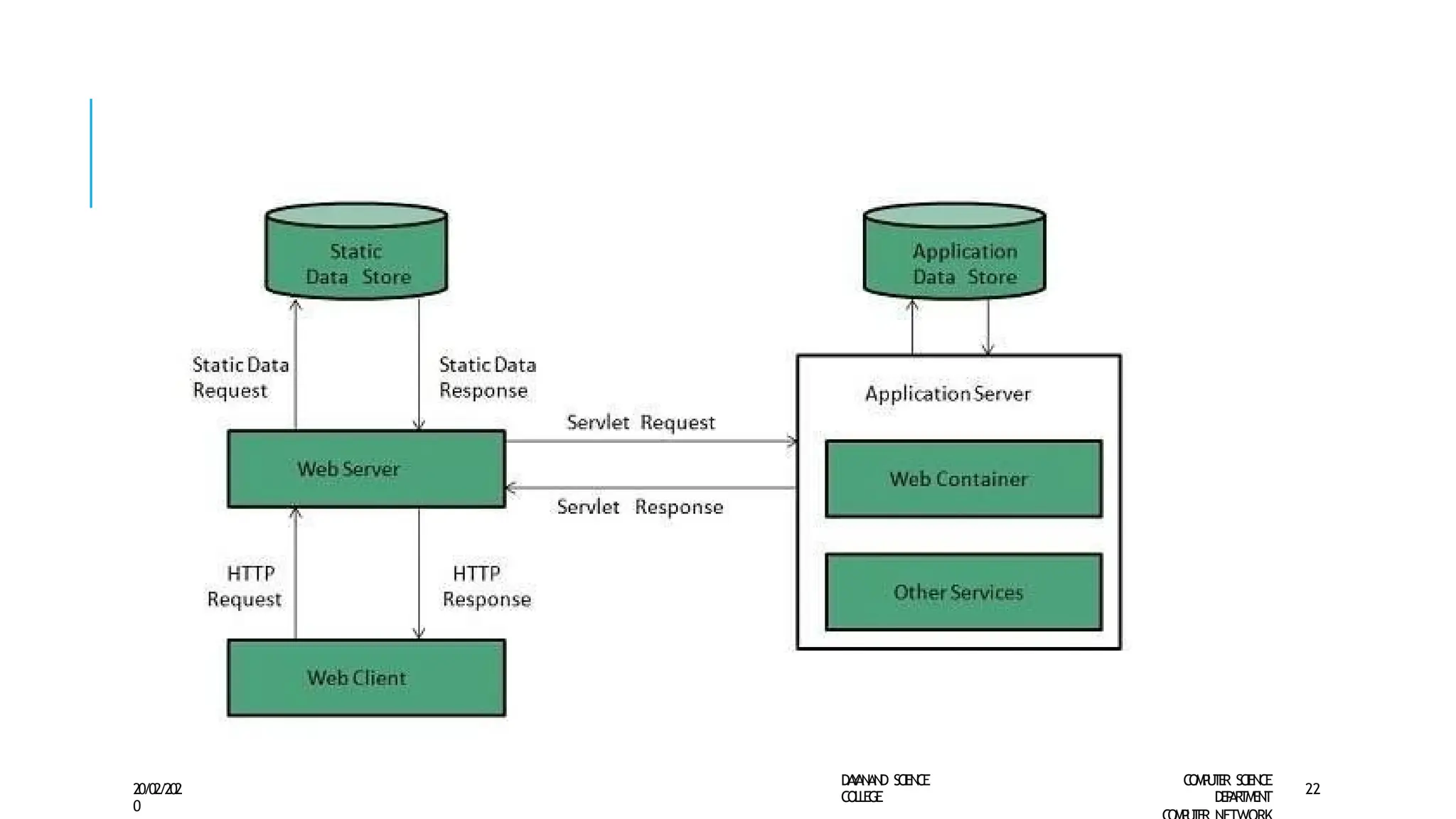
Web server respond to the client request in either
of the following two ways:
Sending the file to the client associated
with the requested URL.
Generating response by invoking a script
and communicating with database
KEY POINTS
D
A
Y
A
N
A
N
D S
CI
E
N
CE
CO
L
L
E
G
E
C
O
M
P
U
T
E
RS
CIE
N
CE
D
E
P
A
R
T
M
E
N
T
20/02/202
0
23
When client sends request for a web page, the web server search for the
requested page if requested page is found then it will send it to client with
an HTTP response.
If the requested web page is not found, web server will the send
an HTTPresponse:Error 404 Not found.
If client has requested for some other resources then the web
server will contact to the
application server and data store to construct the HTTP response.
Multi-
processing
D
A
Y
A
N
A
N
D S
CI
E
N
CE
CO
L
L
E
G
E
C
O
M
P
U
T
E
R S
CIE
N
CE
D
E
P
A
R
T
M
E
N
T
20/02/202
0
25
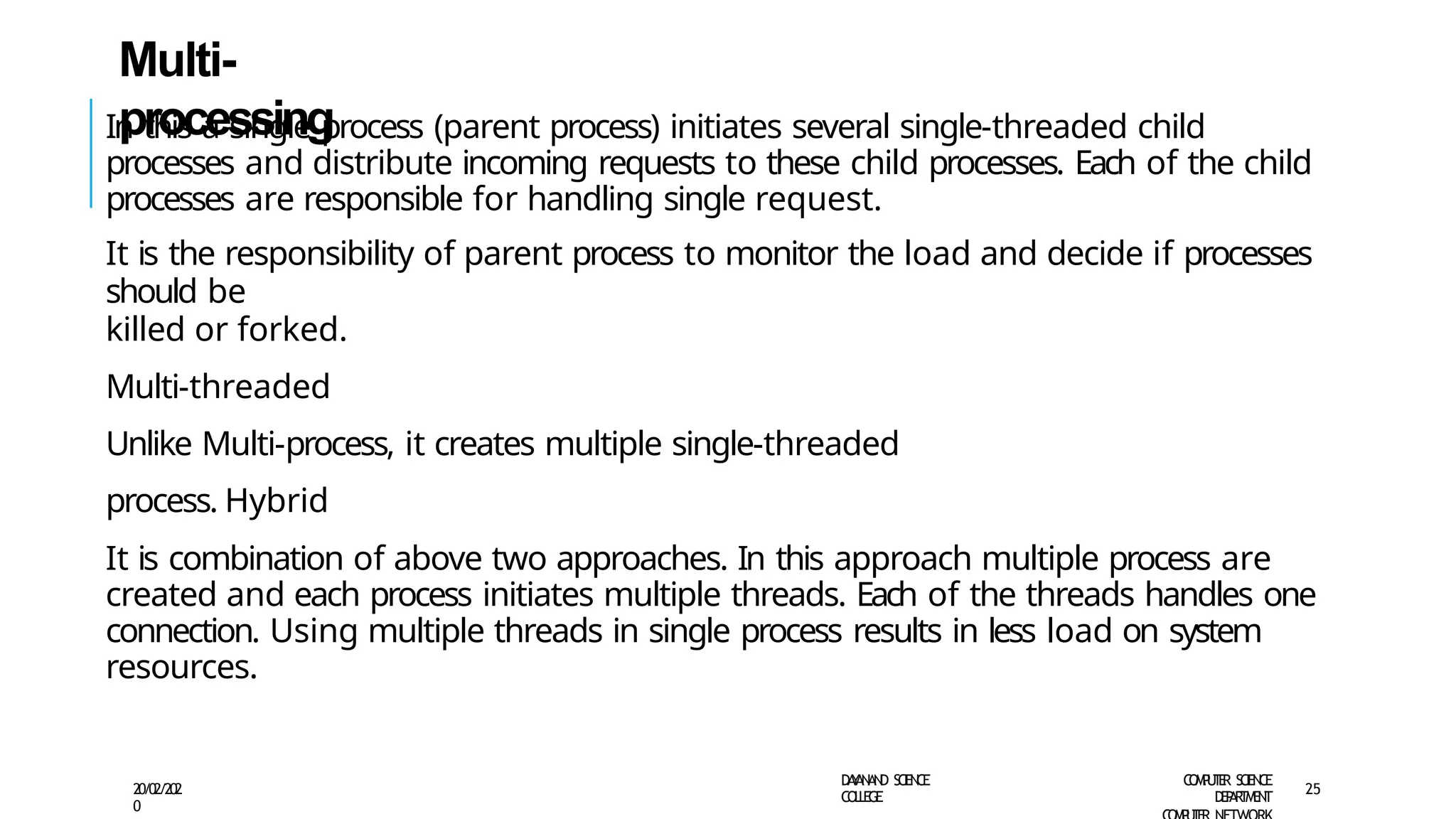
Inthis a single process (parent process) initiates several single-threaded child
processes and distribute incoming requests to these child processes. Each of the child
processes are responsible for handling single request.
It is the responsibility of parent process to monitor the load and decide if processes
should be
killed or forked.
Multi-threaded
Unlike Multi-process, it creates multiple single-threaded
process. Hybrid
It is combination of above two approaches. In this approach multiple process are
created and each process initiates multiple threads. Each of the threads handles one
connection. Using multiple threads in single process results in less load on system
resources.
26.
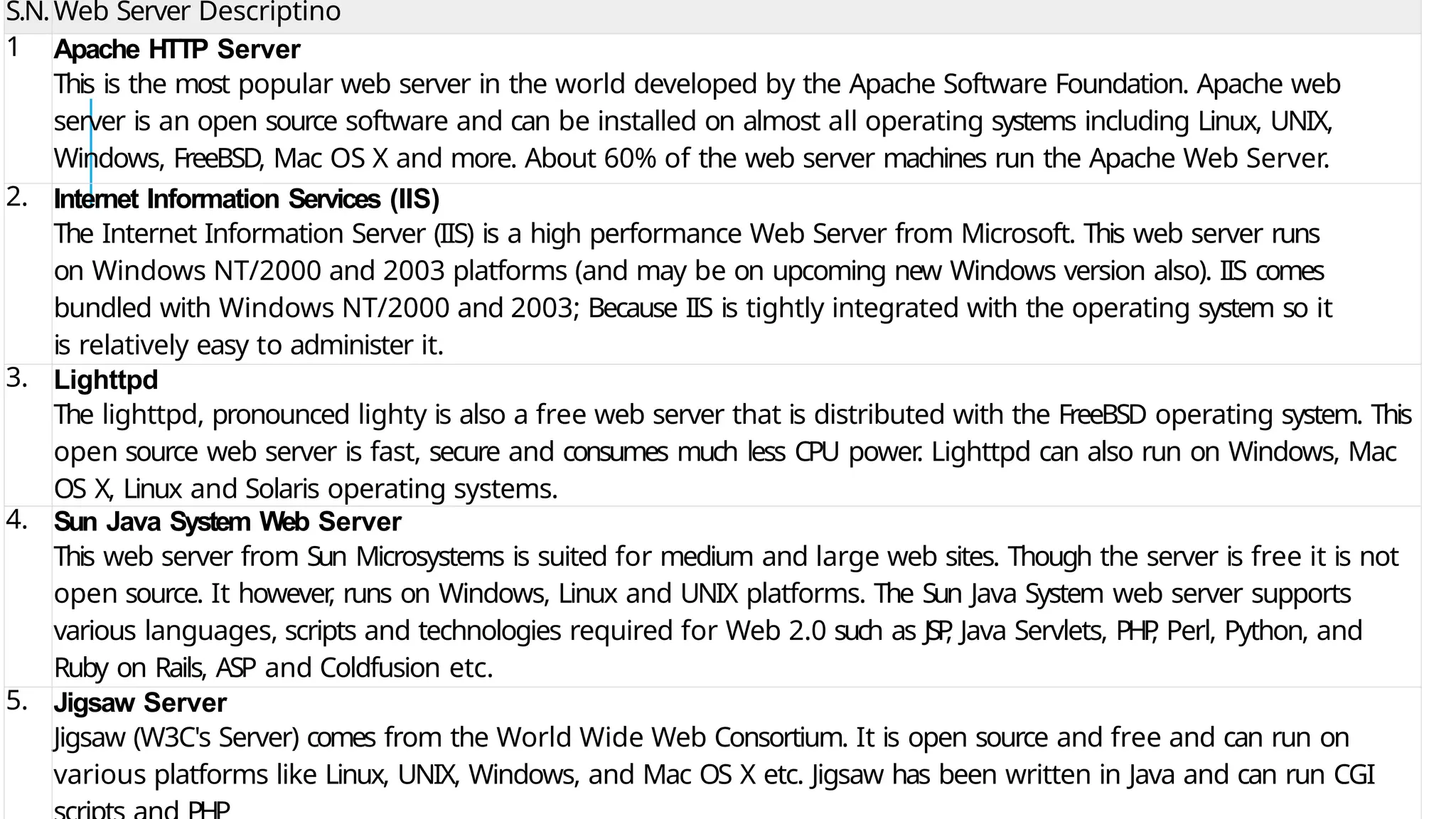
S.N.Web Server Descriptino
1Apache HTTP Server
This is the most popular web server in the world developed by the Apache Software Foundation. Apache web
server is an open source software and can be installed on almost all operating systems including Linux, UNIX,
Windows, FreeBSD, Mac OS X and more. About 60% of the web server machines run the Apache Web Server.
2. Internet Information Services (IIS)
The Internet Information Server (IIS) is a high performance Web Server from Microsoft. This web server runs
on Windows NT/2000 and 2003 platforms (and may be on upcoming new Windows version also). IIS comes
bundled with Windows NT/2000 and 2003; Because IIS is tightly integrated with the operating system so it
is relatively easy to administer it.
3. Lighttpd
The lighttpd, pronounced lighty is also a free web server that is distributed with the FreeBSD operating system. This
open source web server is fast, secure and consumes much less CPU power
. Lighttpd can also run on Windows, Mac
OS X, Linux and Solaris operating systems.
4. Sun Java System Web Server
This web server from Sun Microsystems is suited for medium and large web sites. Though the server is free it is not
open source. It however
, runs on Windows, Linux and UNIX platforms. The Sun Java System web server supports
various languages, scripts and technologies required for Web 2.0 such as JSP
, Java Servlets, PHP
, Perl, Python, and
Ruby on Rails, ASP and Coldfusion etc.
5. Jigsaw Server
Jigsaw (W3C's Server) comes from the World Wide Web Consortium. It is open source and free and can run on
various platforms like Linux, UNIX, Windows, and Mac OS X etc. Jigsaw has been written in Java and can run CGI
27.
B
R
O
W
SE
RS
D
A
Y
A
N
A
N
D S
CI
E
N
CE
CO
L
L
E
G
E
C
O
M
P
U
T
E
R S
CIE
N
CE
D
E
P
A
R
T
M
E
N
T
20/02/202
0
27
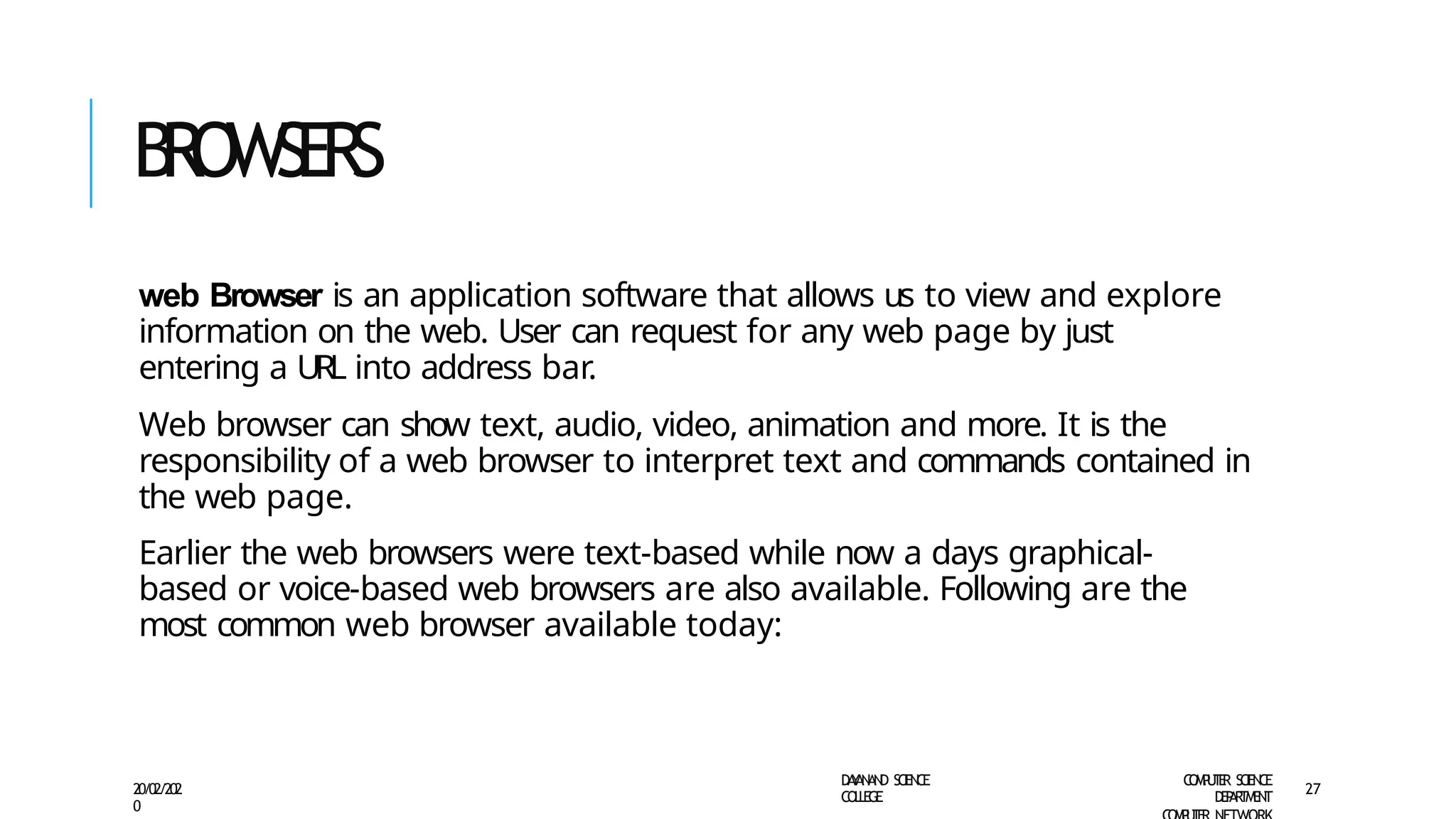
webBrowser is an application software that allows us to view and explore
information on the web. User can request for any web page by just
entering a URL into address bar.
Web browser can show text, audio, video, animation and more. It is the
responsibility of a web browser to interpret text and commands contained in
the web page.
Earlier the web browsers were text-based while now a days graphical-
based or voice-based web browsers are also available. Following are the
most common web browser available today:
28.
EXAMPLES O
F B
R
O
W
S
E
R
S
D
A
Y
A
N
A
N
DS
CI
E
N
CE
CO
L
L
E
G
E
C
O
M
P
U
T
E
R S
CIE
N
CE
D
E
P
A
R
T
M
E
N
T
20/02/202
0
28
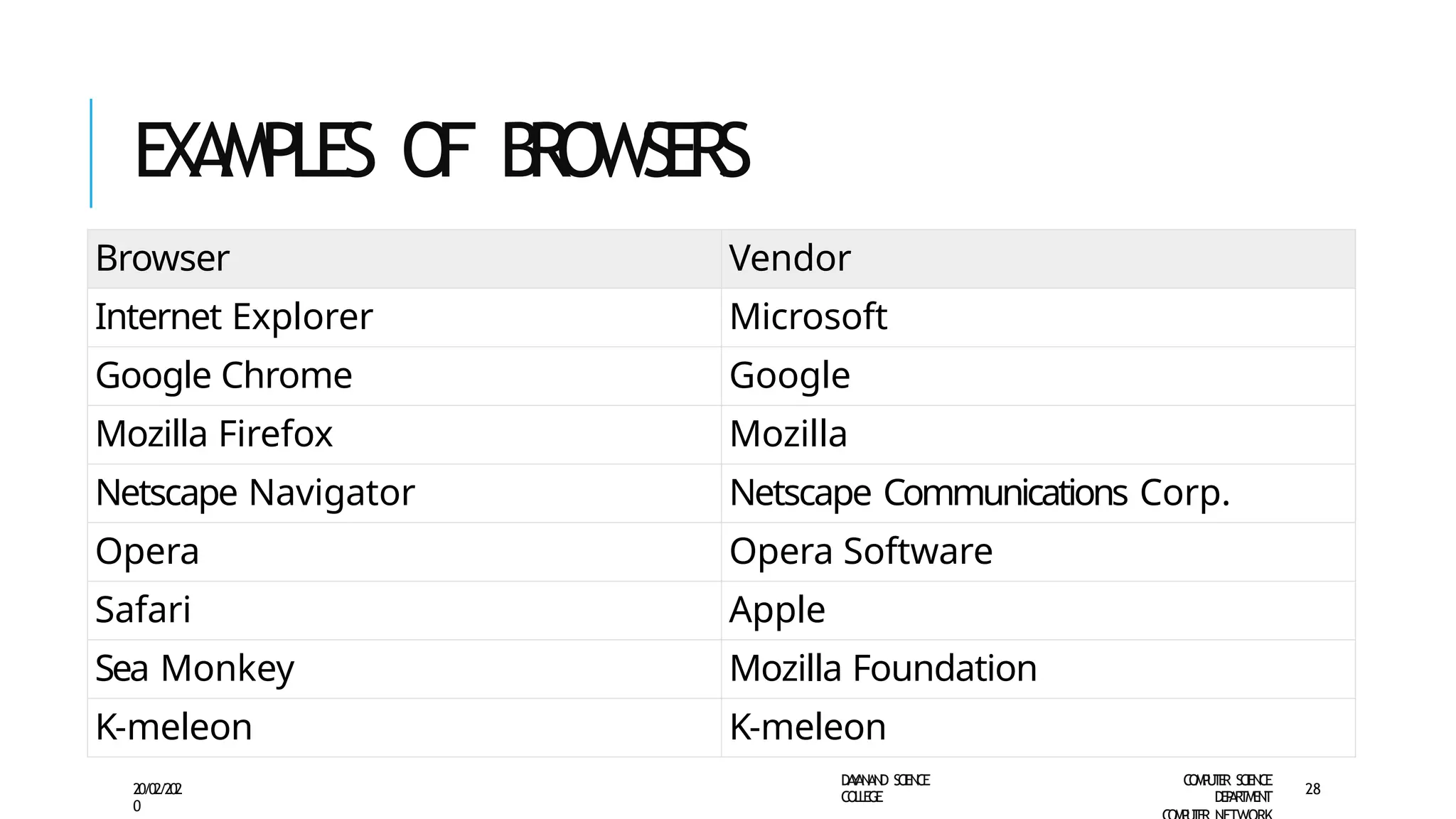
Browser Vendor
Internet Explorer Microsoft
Google Chrome Google
Mozilla Firefox Mozilla
Netscape Navigator Netscape Communications Corp.
Opera Opera Software
Safari Apple
Sea Monkey Mozilla Foundation
K-meleon K-meleon
Controller works asa control unit in CPU. It takes input from the keyboard or
mouse,interpret it and make other services to work on the basis of input it
receives.
Interpreter receives the information from the controller and execute the instruction
line by line. Some interpreter are mandatory while some are optional For
example, HTMLinterpreter program is mandatory and java interpreter is
optional.
Client Program describes the specific protocol that will be used to access a
particular service. Following are the client programs that are commonly used:
HTTP
SMTP
FTP
NNTP
POP
D
A
Y
A
N
A
N
D S
CI
E
N
CE
CO
L
L
E
G
E
C
O
M
P
U
T
E
R S
CIE
N
CE
D
E
P
A
R
T
M
E
N
T
20/02/202
0
30
31.
DOMAIN NAME
SYSTEM
D
A
Y
A
N
A
N
D S
CI
E
N
CE
CO
L
L
E
G
E
C
O
M
P
U
T
E
RS
CIE
N
CE
D
E
P
A
R
T
M
E
N
T
20/02/202
0
31
DNS is like a phone book for the internet. If you
know a person’s name but don’t know their
telephone number
, you can simply look it up in a
phone book. DNS provides this same service to the
internet.
When you visit https://dyn.com in a browser
, your
computer uses DNS to retrieve the website’s IP
address of 50.16.85.103. Without DNS, you would
only be able to visit our website (or any website)
by visiting its IPaddress directly, such as
32.
DNS stands forDomain Name System. A domain
is a unique string (Gingernameclub.com) associated
with an IP address.
An IP address is a string of numbers used to
identify a computer or resource on a network or
internet.
The Domain Name System (DNS) is a network
of directories on the internet used to resolve
host names (e.g., www.gingernameclub.com) into
machine-readable IP addresses (e.g.,
192.168.106.81). D
A
Y
A
N
A
N
D S
CI
E
N
CE
CO
L
L
E
G
E
C
O
M
P
U
T
E
R S
CIE
N
CE
D
E
P
A
R
T
M
E
N
T
20/02/202
0
32
33.
H
O
W DOES DNS
WORK?
D
A
Y
A
N
A
N
DS
CI
E
N
CE
CO
L
L
E
G
E
C
O
M
P
U
T
E
R S
CIE
N
CE
D
E
P
A
R
T
M
E
N
T
20/02/202
0
33
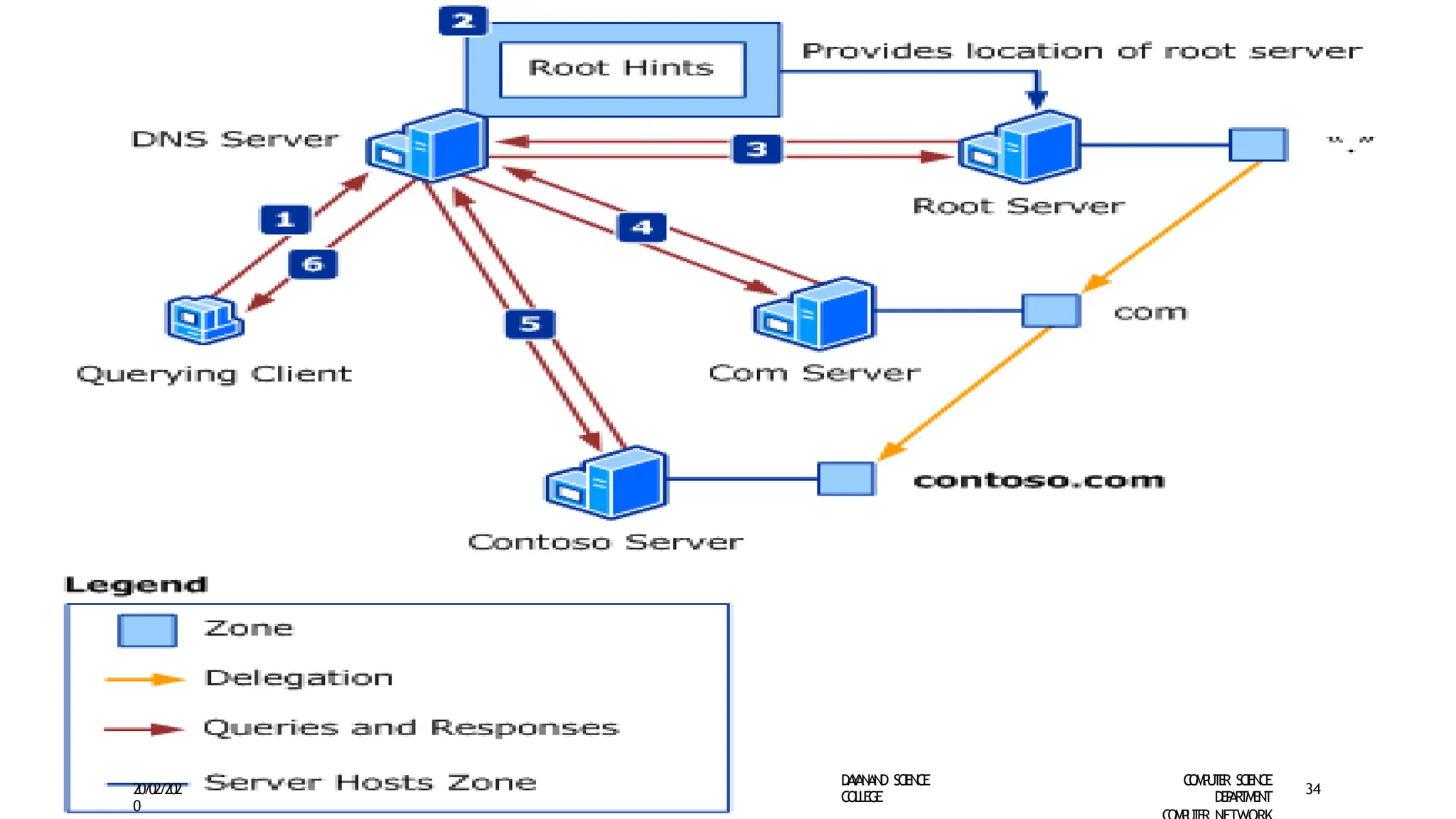
When you visit a domain such as dyn.com, your computer follows a series of steps to
turn the human-readable web address into a machine-readable IP address. This
happens every time you use a domain name, whether you are viewing websites,
sending email or listening
to internet radio stations
DOMAIN NAME SYSTEM
D
A
Y
A
N
A
N
DS
CI
E
N
CE
CO
L
L
E
G
E
C
O
M
P
U
T
E
R S
CIE
N
CE
D
E
P
A
R
T
M
E
N
T
20/02/202
0
36
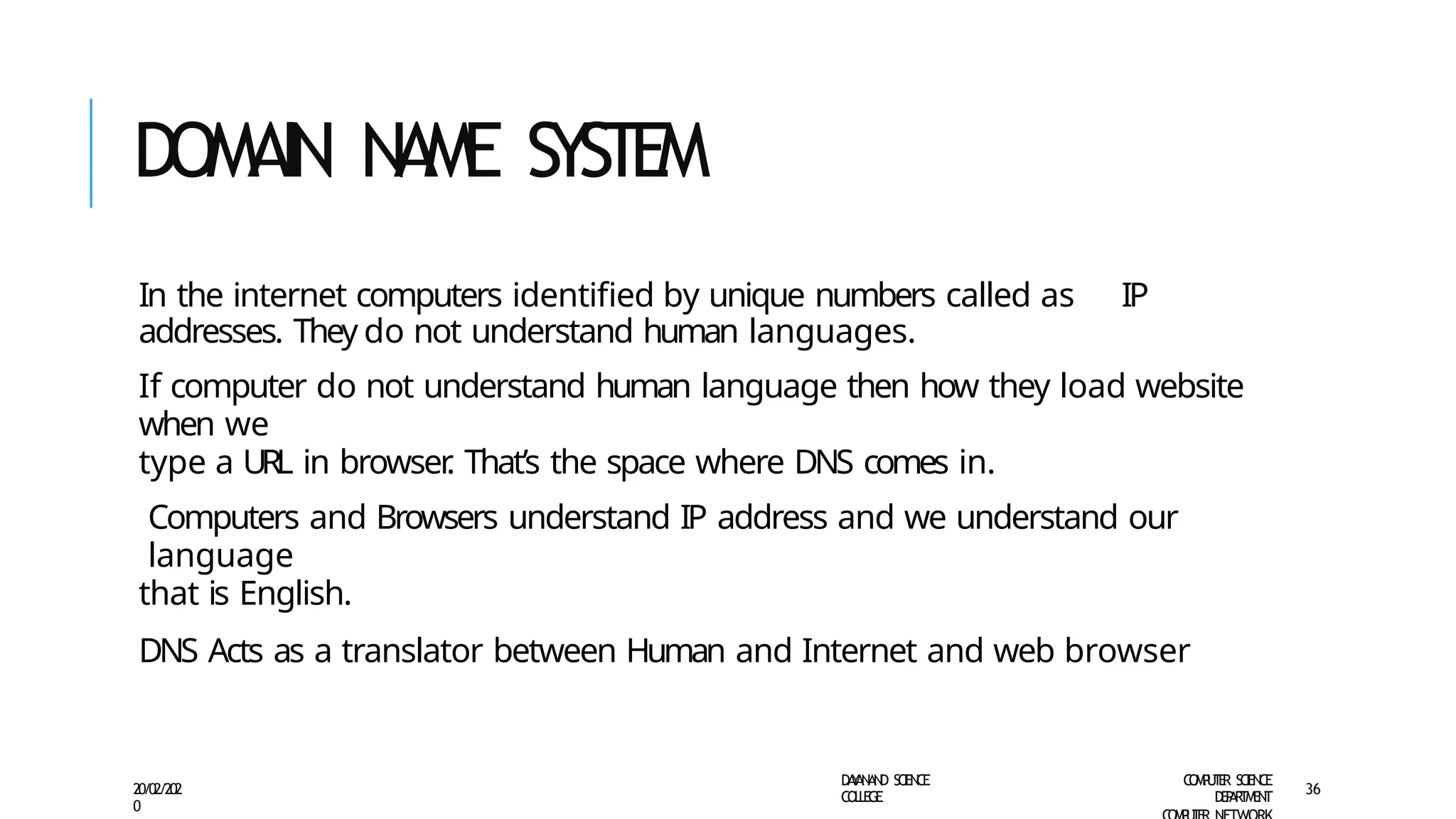
In the internet computers identified by unique numbers called as IP
addresses. They do not understand human languages.
If computer do not understand human language then how they load website
when we
type a URL in browser
. That’s the space where DNS comes in.
Computers and Browsers understand IP address and we understand our
language
that is English.
DNS Acts as a translator between Human and Internet and web browser
36.
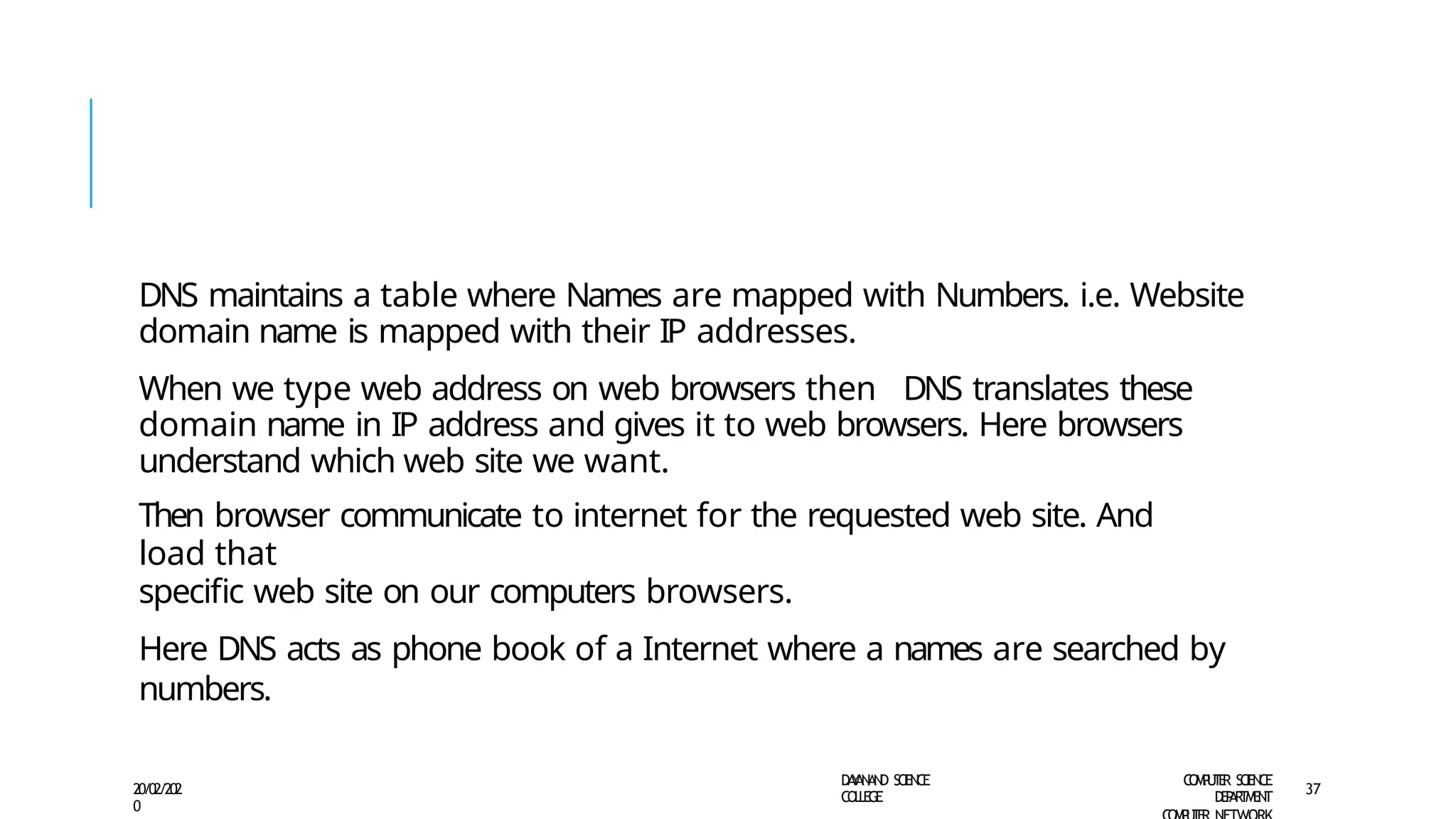
DNS maintains atable where Names are mapped with Numbers. i.e. Website
domain name is mapped with their IP addresses.
When we type web address on web browsers then DNS translates these
domain name in IP address and gives it to web browsers. Here browsers
understand which web site we want.
Then browser communicate to internet for the requested web site. And
load that
specific web site on our computers browsers.
Here DNS acts as phone book of a Internet where a names are searched by
numbers.
D
A
Y
A
N
A
N
D S
CI
E
N
CE
CO
L
L
E
G
E
C
O
M
P
U
T
E
R S
CIE
N
CE
D
E
P
A
R
T
M
E
N
T
20/02/202
0
37
37.
DNS SER
VERS
D
A
Y
A
N
A
N
D S
CI
E
N
CE
CO
L
L
E
G
E
C
O
M
P
U
T
E
RS
CIE
N
CE
D
E
P
A
R
T
M
E
N
T
20/02/202
0
38
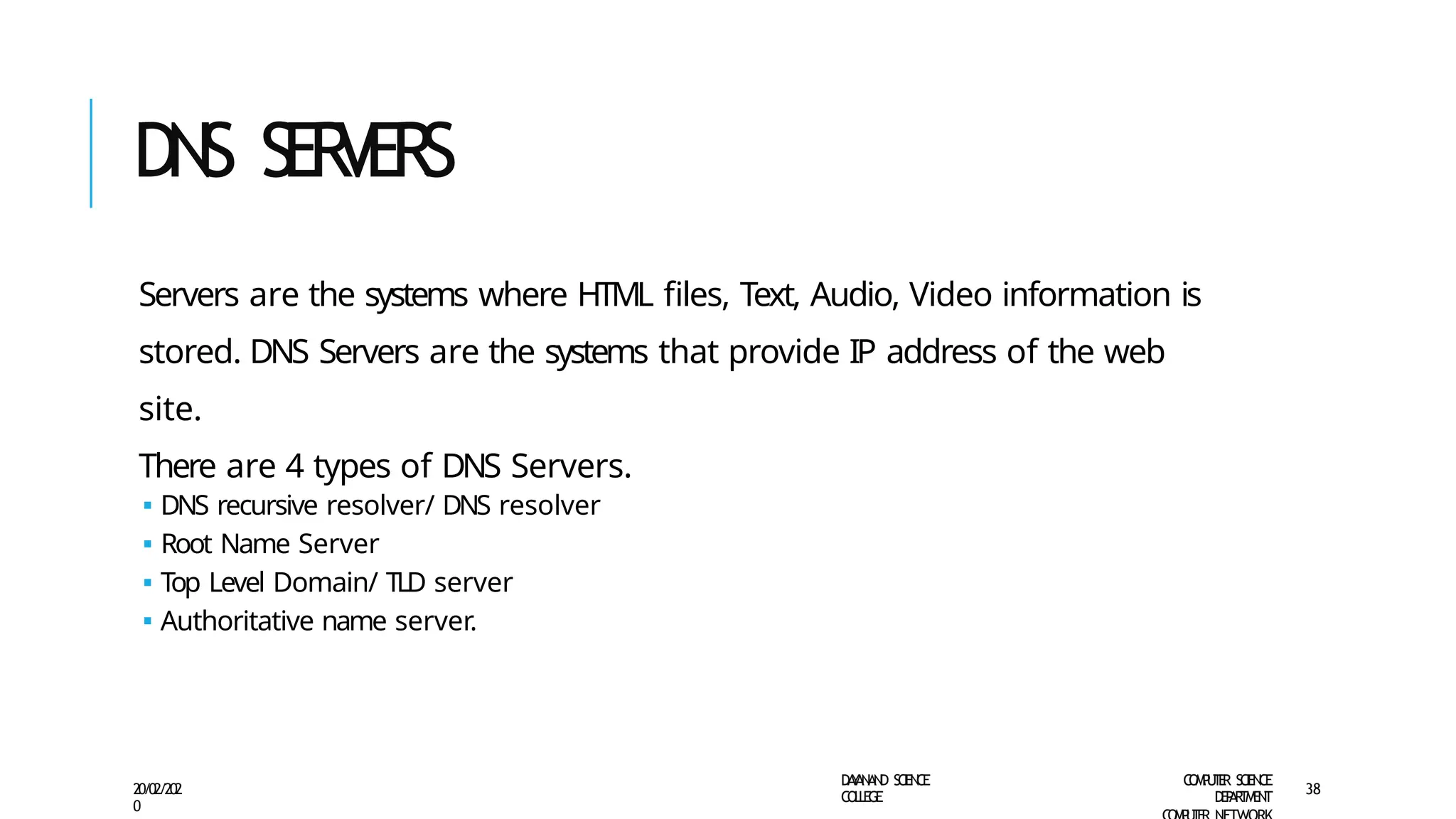
Servers are the systems where HTML files, Text, Audio, Video information is
stored. DNS Servers are the systems that provide IP address of the web
site.
There are 4 types of DNS Servers.
🢝 DNS recursive resolver/ DNS resolver
🢝 Root Name Server
🢝 Top Level Domain/ TLD server
🢝 Authoritative name server.
38.
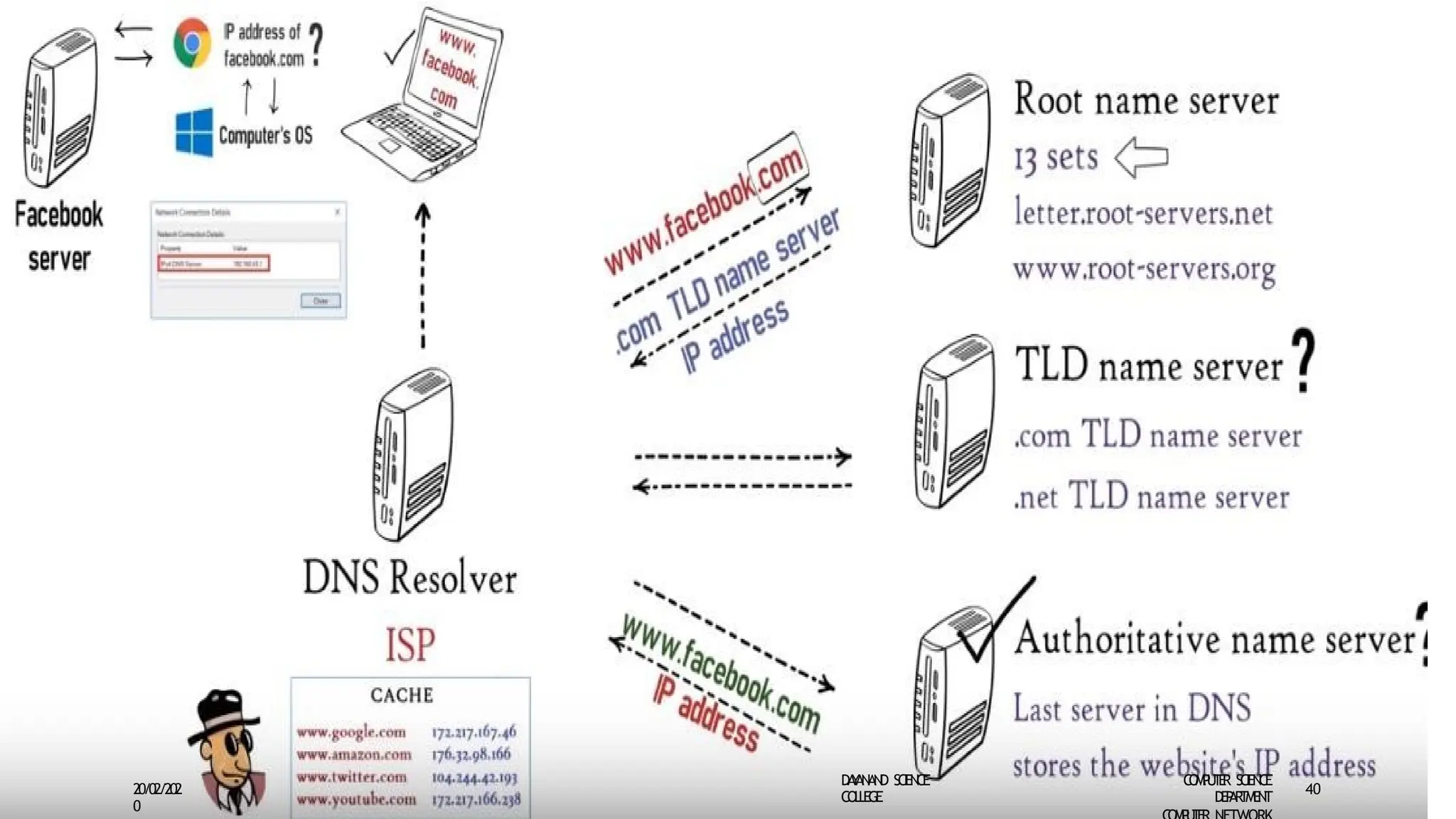
DNS resolver arethe Internet service provider that connect to the computer through
internet.
DNS Name servers: There are 13 sets of servers. Named as A to M except G where
g is used to store home page. Logically it is represented by letter
.root.server
.net
These servers are operated by 12 organizations
TLD name servers holds the all domain name like .com, .net, .in, .edu etc. eg. .com
TLD name server tolds the web browsers about all the websites who ends with .com
Authoritative name server is the last server who tolds the IP address of the web
site
D
A
Y
A
N
A
N
D S
CI
E
N
CE
CO
L
L
E
G
E
C
O
M
P
U
T
E
R S
CIE
N
CE
D
E
P
A
R
T
M
E
N
T
20/02/202
0
39
IP ADDRESSING
D
A
Y
A
N
A
N
D S
CI
E
N
CE
CO
L
L
E
G
E
C
O
M
P
U
T
E
RS
CIE
N
CE
D
E
P
A
R
T
M
E
N
T
20/02/202
0
41
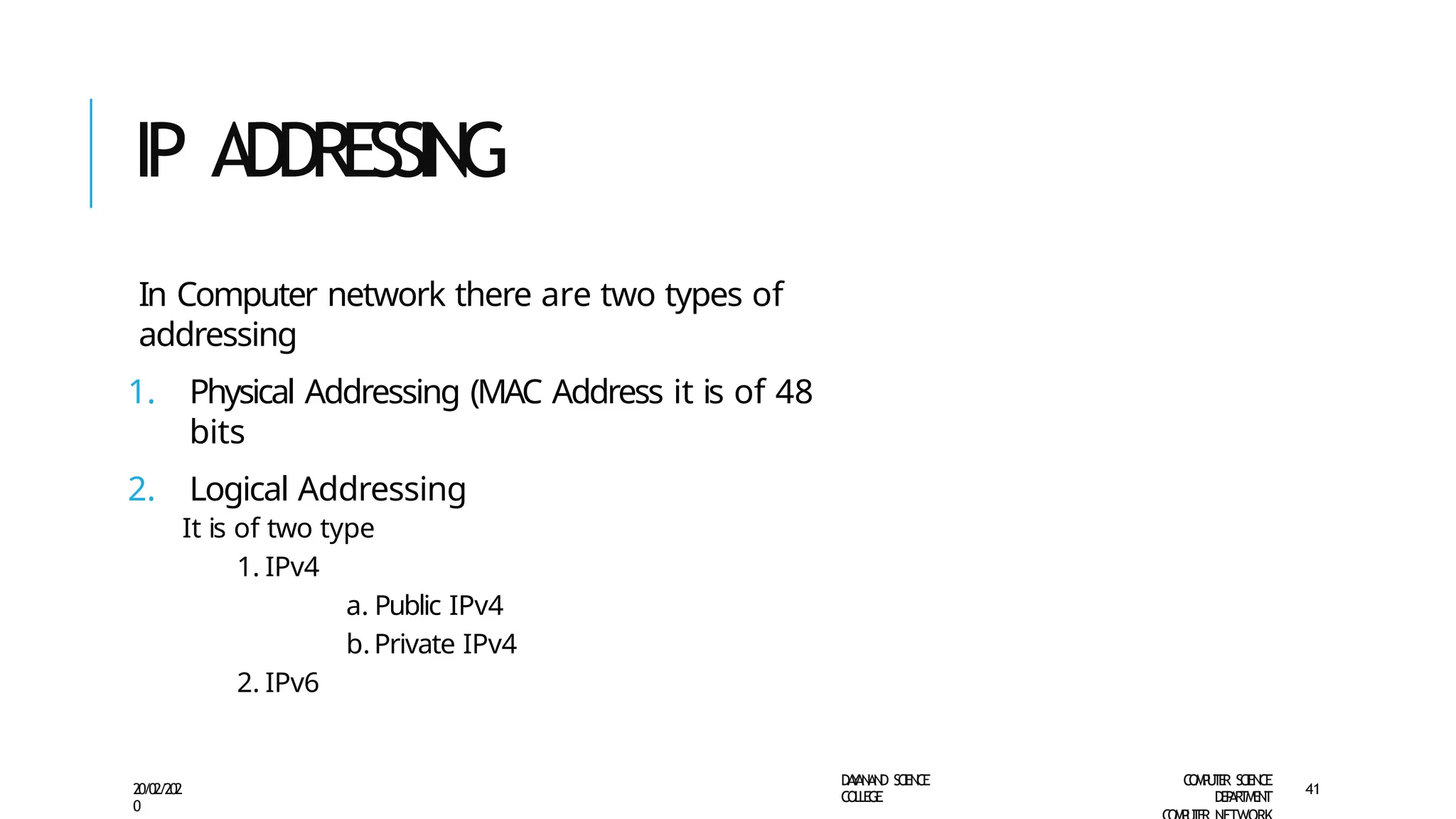
In Computer network there are two types of
addressing
1. Physical Addressing (MAC Address it is of 48
bits
2. Logical Addressing
It is of two type
1. IPv4
a. Public IPv4
b.Private IPv4
2. IPv6
41.
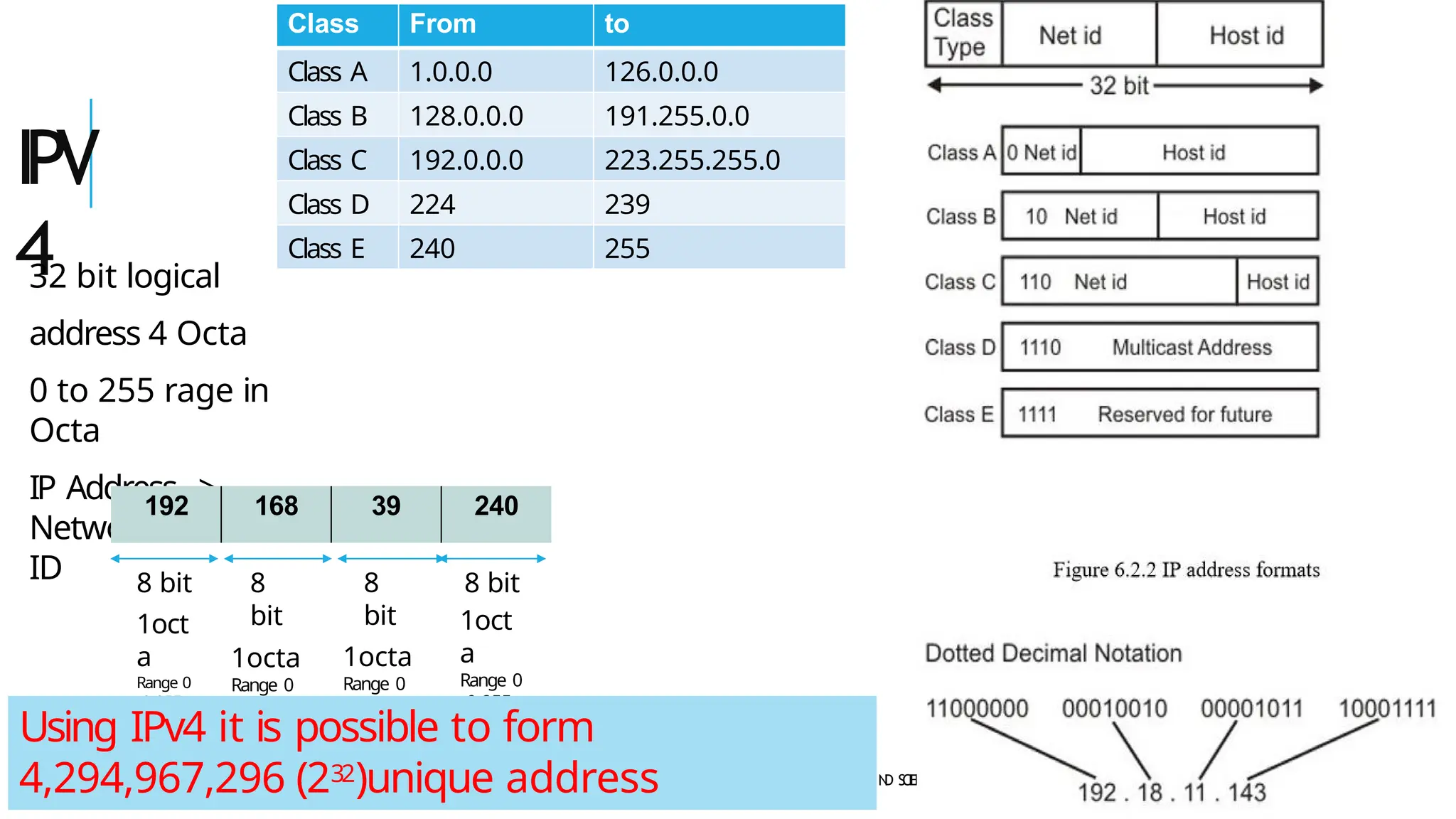
IPV
4
32 bit logical
address4 Octa
0 to 255 rage in
Octa
IP Address ->
Network ID + Host
ID
20/02/2020
D
A
Y
A
N
A
N
D S
CIE
N
CE COLLEGE C
O
M
P
U
T
E
R S
CIE
N
CE DEP
ARTMENT
C
O
M
P
U
T
E
R NETWORK 42
192 168 39 240
8 bit
1oct
a
Range 0
t0 255
8
bit
1octa
Range 0
t0 255
8
bit
1octa
Range 0
t0 255
8 bit
1oct
a
Range 0
t0 255
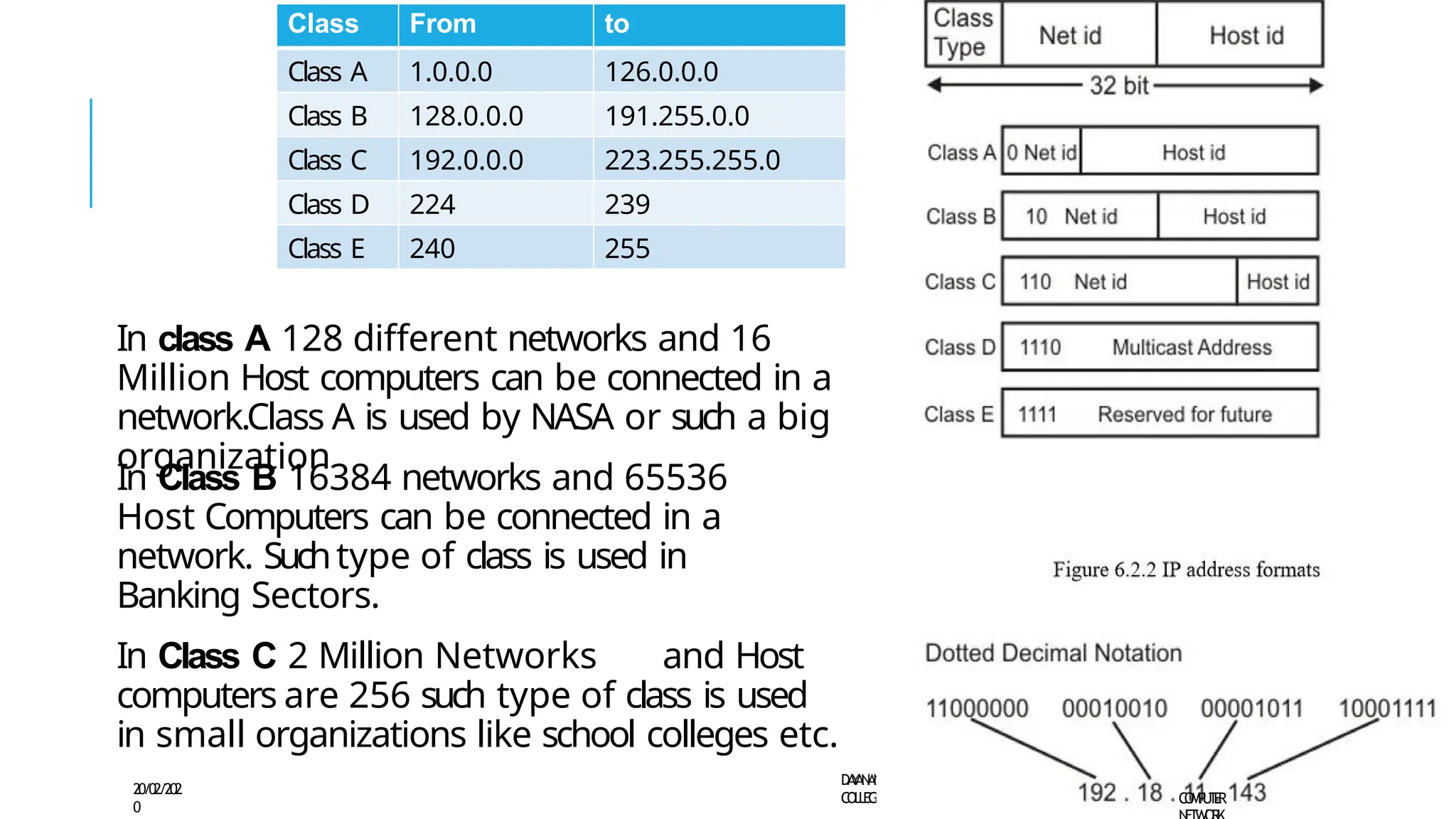
Class From to
Class A 1.0.0.0 126.0.0.0
Class B 128.0.0.0 191.255.0.0
Class C 192.0.0.0 223.255.255.0
Class D 224 239
Class E 240 255
Using IPv4 it is possible to form
4,294,967,296 (232)unique address
42.
In class A128 different networks and 16
Million Host computers can be connected in a
network.Class A is used by NASA or such a big
organization
In Class B 16384 networks and 65536
Host Computers can be connected in a
network. Suchtype of class is used in
Banking Sectors.
In Class C 2 Million Networks and Host
computers are 256 such type of class is used
in small organizations like school colleges etc.
20/02/202
0
D
A
Y
A
N
A
N
D S
CIE
N
CE
C
O
L
L
E
G
E
C
O
M
P
U
T
E
R S
CIE
N
CE
D
E
P
A
R
T
M
E
N
T
4
3
Class From to
Class A 1.0.0.0 126.0.0.0
Class B 128.0.0.0 191.255.0.0
Class C 192.0.0.0 223.255.255.0
Class D 224 239
Class E 240 255
C
O
M
P
U
T
E
R
43.
DETERMINING T
H
E N
E
T
W
O
R
KID AND
H
O
S
T ID
PART
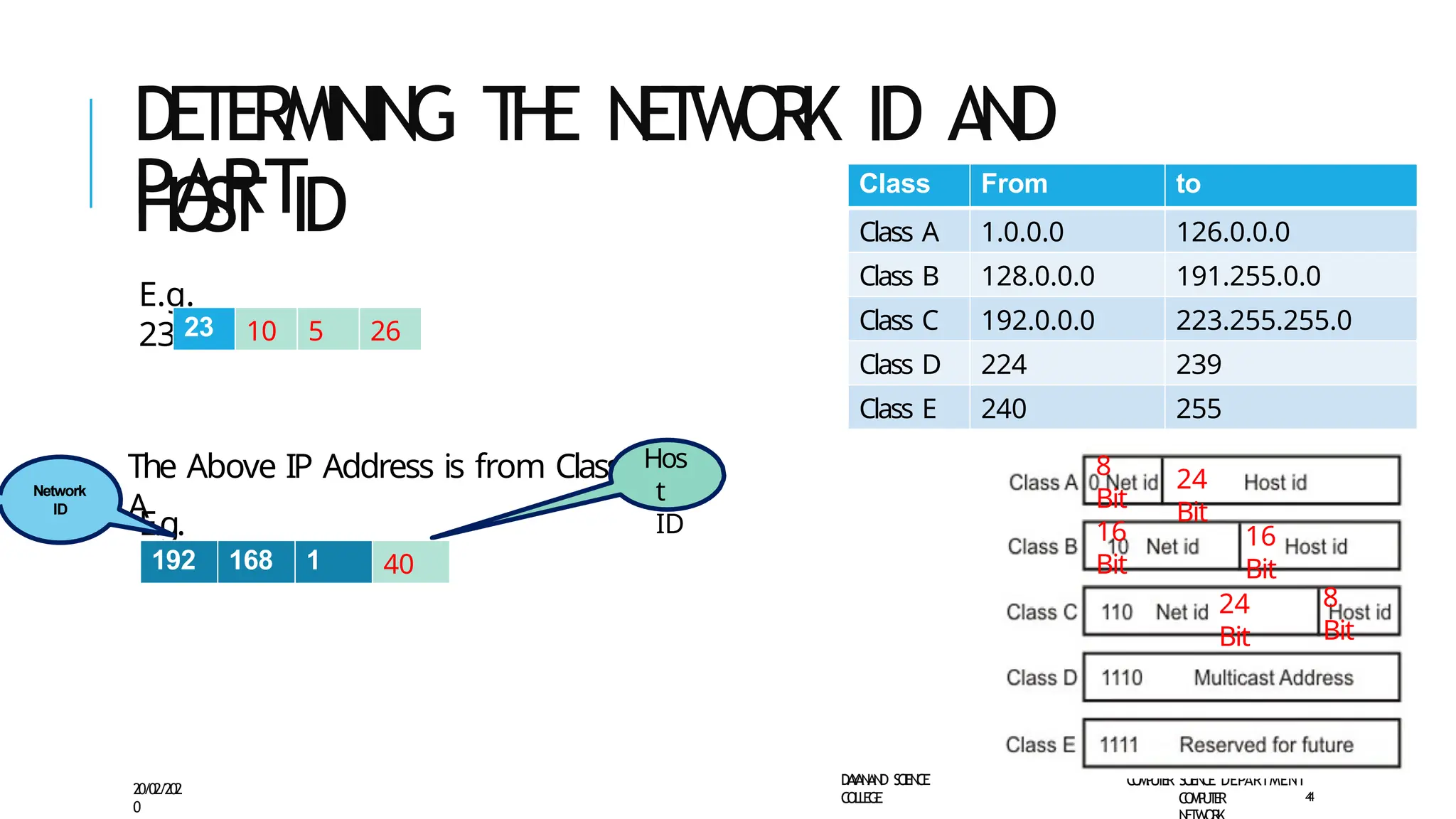
E.g.
23.10.5.26
The Above IP Address is from Class
A
E.g.
192.168.1.40
20/02/202
0
D
A
Y
A
N
A
N
D S
CIE
N
CE
C
O
L
L
E
G
E
C
O
M
P
U
T
E
R S
CI
E
N
CE DEPARTMENT
4
4
Class From to
Class A 1.0.0.0 126.0.0.0
Class B 128.0.0.0 191.255.0.0
Class C 192.0.0.0 223.255.255.0
Class D 224 239
Class E 240 255
23 10 5 26
Network
ID
Hos
t
ID
8
Bit
C
O
M
P
U
T
E
R
24
Bit
16
Bit
16
Bit
24
Bit
8
Bit
192 168 1 40
44.
IPV6
.
D
A
Y
A
N
A
N
D S
CI
E
N
CE
CO
L
L
E
G
E
C
O
M
P
U
T
E
R S
CIE
N
CE
D
E
P
A
R
T
M
E
N
T
20/02/202
0
46
Thenetwork layer that is present in use in commonly
referred to as IPv4. Although IPv4 is well designed and
has helped the internet to grow rapidly, it has some
deficiencies, Thesedeficiencies has made it unsuitable for
the fast growing internet. T
o overcome these deficiencies,
Internet Protocol, Version 6 protocol has been proposed
and it has evolved into a standard.
45.
IMPOR
T
ANT F
EA
T
U
RE
S O
FIPV6
AREHIGHLIGHTED B
E
L
O
W
D
A
Y
A
N
A
N
D S
CI
E
N
CE
CO
L
L
E
G
E
C
O
M
P
U
T
E
R S
CIE
N
CE
D
E
P
A
R
T
M
E
N
T
20/02/202
0
47
IPv6 uses 128-bit address instead of 32-bit address to provide larger address
space Uses more flexible header format, which simplifies and speeds up the
routing process Basic header followed by extended header
Resource Allocation options, which was not present in
IPv4 Provision of new/future protocol options
Support for security with the help of encryption and
authentication
Support for fragmentation at source
46.
IPV6 ADDRESSING M
E
T
H
O
D
D
A
Y
A
N
A
N
DS
CI
E
N
CE
CO
L
L
E
G
E
C
O
M
P
U
T
E
R S
CIE
N
CE
D
E
P
A
R
T
M
E
N
T
20/02/202
0
48
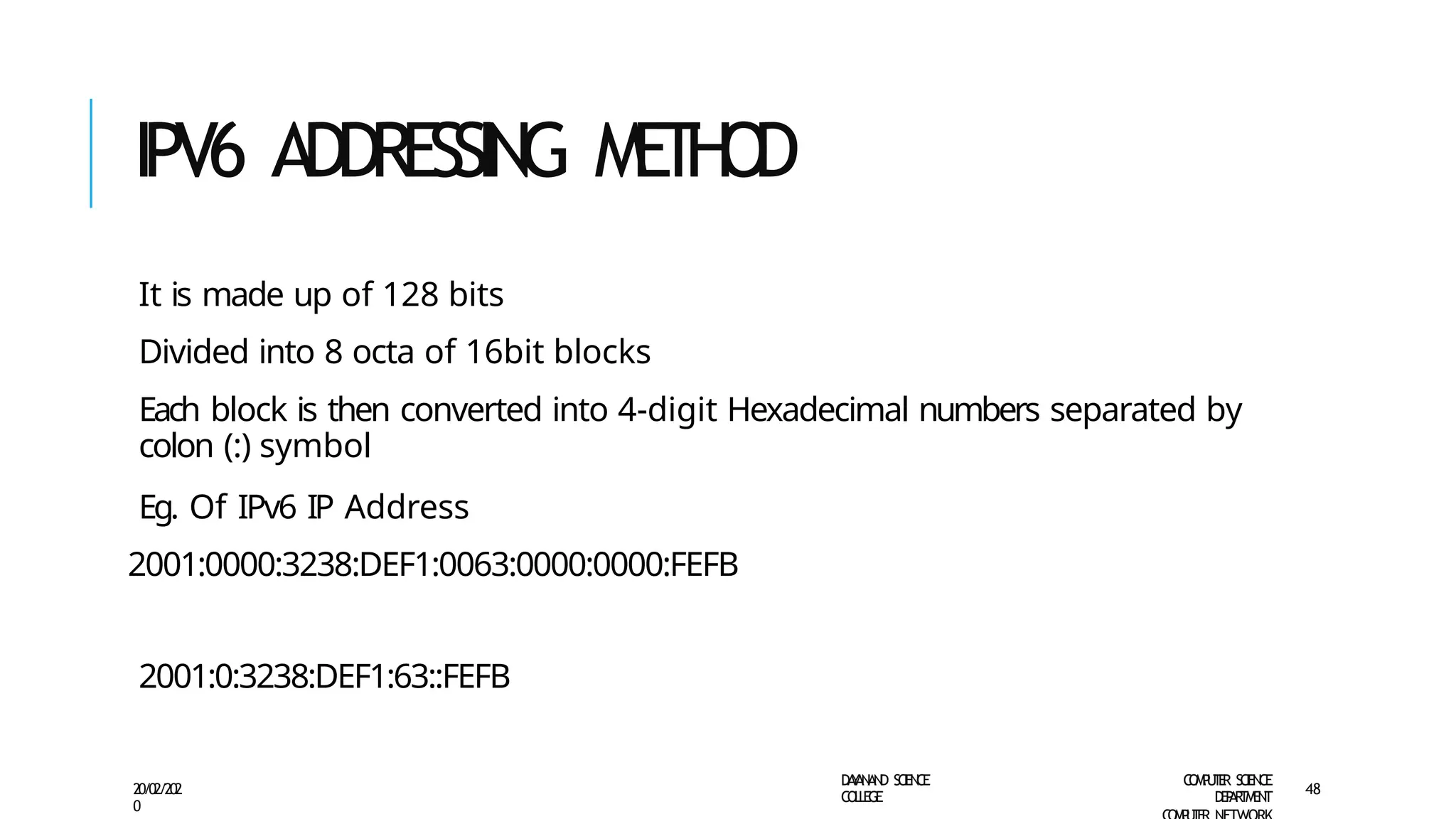
It is made up of 128 bits
Divided into 8 octa of 16bit blocks
Each block is then converted into 4-digit Hexadecimal numbers separated by
colon (:) symbol
Eg. Of IPv6 IP Address
2001:0000:3238:DEF1:0063:0000:0000:FEFB
2001:0:3238:DEF1:63::FEFB
47.
2
0
/
0
2/2
020
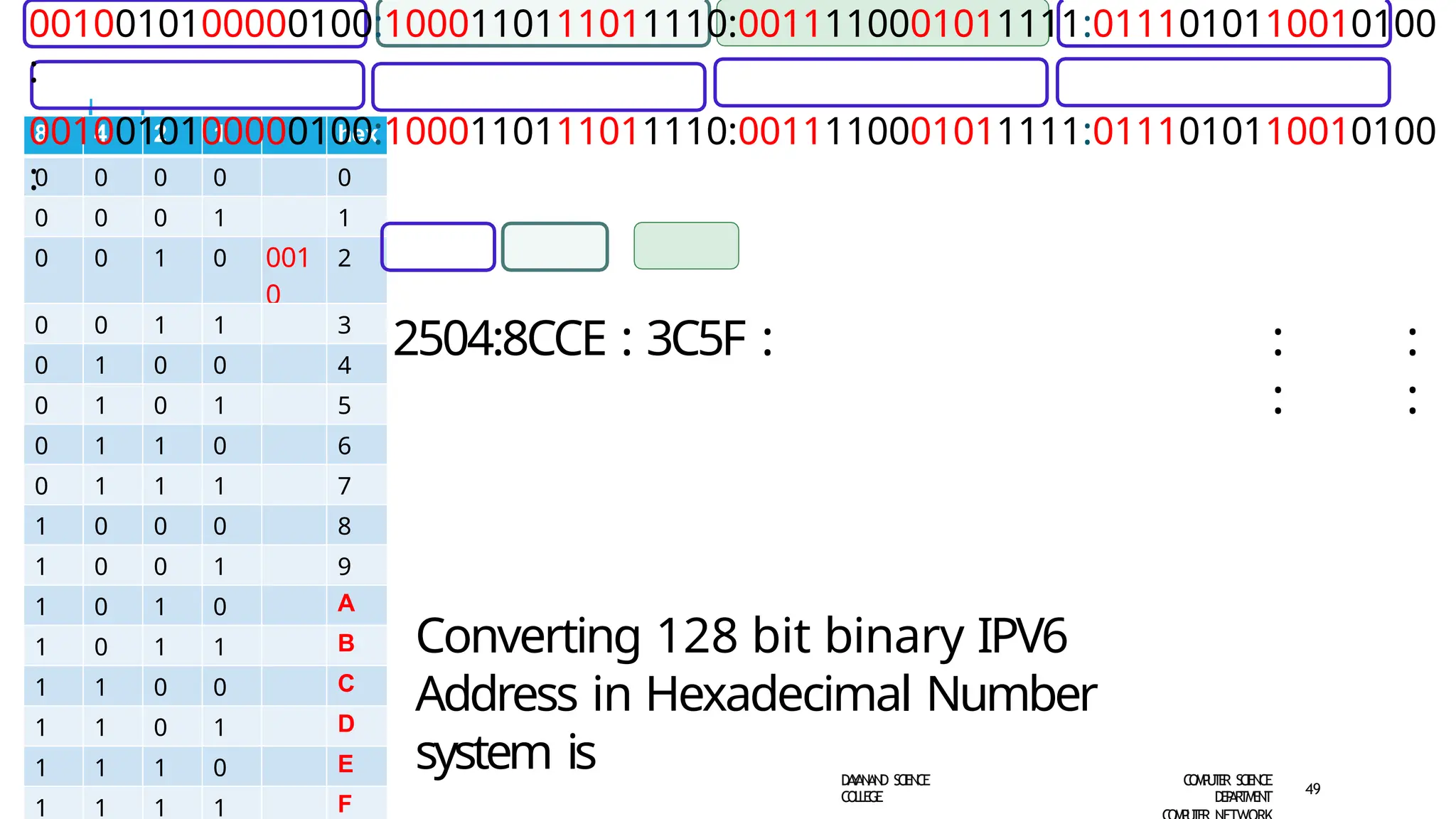
8 4 21 hex
0 0 0 0 0
0 0 0 1 1
0 0 1 0 001
0
2
0 0 1 1 3
0 1 0 0 4
0 1 0 1 5
0 1 1 0 6
0 1 1 1 7
1 0 0 0 8
1 0 0 1 9
1 0 1 0 A
1 0 1 1 B
1 1 0 0 C
1 1 0 1 D
1 1 1 0 E
1 1 1 1 F
0010010100000100:1000110111011110:0011110001011111:0111010110010100
:
0010010100000100:1000110111011110:0011110001011111:0111010110010100
:
2504:8CCE : 3C5F : : :
: :
Converting 128 bit binary IPV6
Address in Hexadecimal Number
system is D
A
Y
A
N
A
N
D S
CI
E
N
CE
CO
L
L
E
G
E
C
O
M
P
U
T
E
R S
CIE
N
CE
D
E
P
A
R
T
M
E
N
T
49
48.
IPV 6 HEADERF
O
R
M
A
T 40
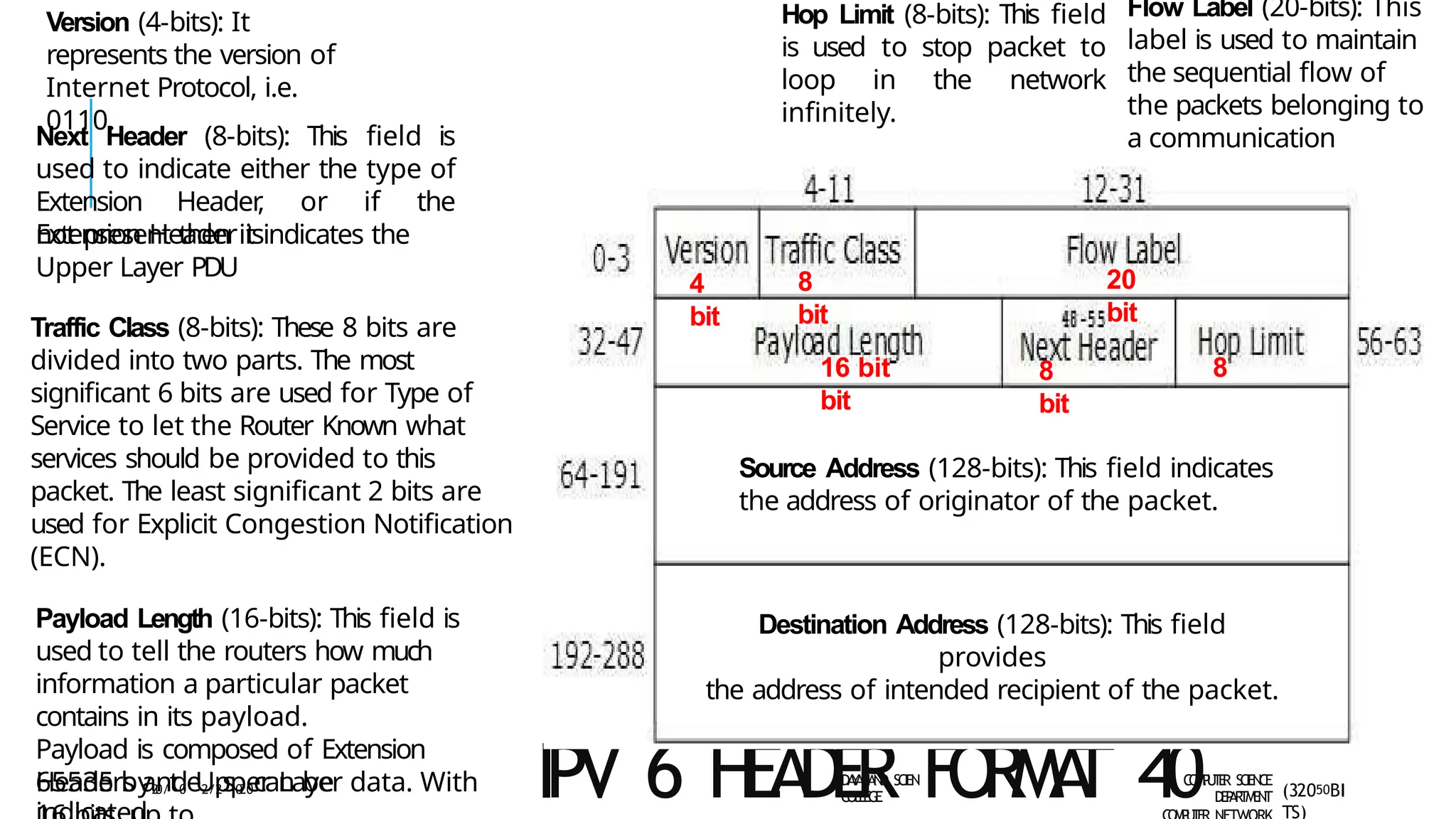
Version (4-bits): It
represents the version of
Internet Protocol, i.e.
0110.
65535 by2
0/t0e2/2s0
20can be D
A
Y
A
N
A
N
D SCIEN E
C
O
L
L
E
G
E
C
O
M
P
U
T
E
R S
CIE
N
CE
D
E
P
A
R
T
M
E
N
T (32050BI
TS)
Traffic Class (8-bits): These 8 bits are
divided into two parts. The most
significant 6 bits are used for Type of
Service to let the Router Known what
services should be provided to this
packet. The least significant 2 bits are
used for Explicit Congestion Notification
(ECN).
Flow Label (20-bits): This
label is used to maintain
the sequential flow of
the packets belonging to
a communication
Payload Length (16-bits): This field is
used to tell the routers how much
information a particular packet
contains in its payload.
Payload is composed of Extension
Headers and Upper Layer data. With
Next Header (8-bits): This field is
used to indicate either the type of
Extension Header
, or if the
Extension Header is
not present then it indicates the
Upper Layer PDU
Hop Limit (8-bits): This field
is used to stop packet to
loop in the network
infinitely.
Destination Address (128-bits): This field
provides
the address of intended recipient of the packet.
Source Address (128-bits): This field indicates
the address of originator of the packet.
4
bit
8
bit
20
bit
8
bit
16 bit 8
bit
49.
WIFI T
E
C
H
N
O
L
O
G
Y
D
A
Y
A
N
A
N
D S
CI
E
N
CE
CO
L
L
E
G
E
C
O
M
P
U
T
E
RS
CIE
N
CE
D
E
P
A
R
T
M
E
N
T
20/02/202
0
51
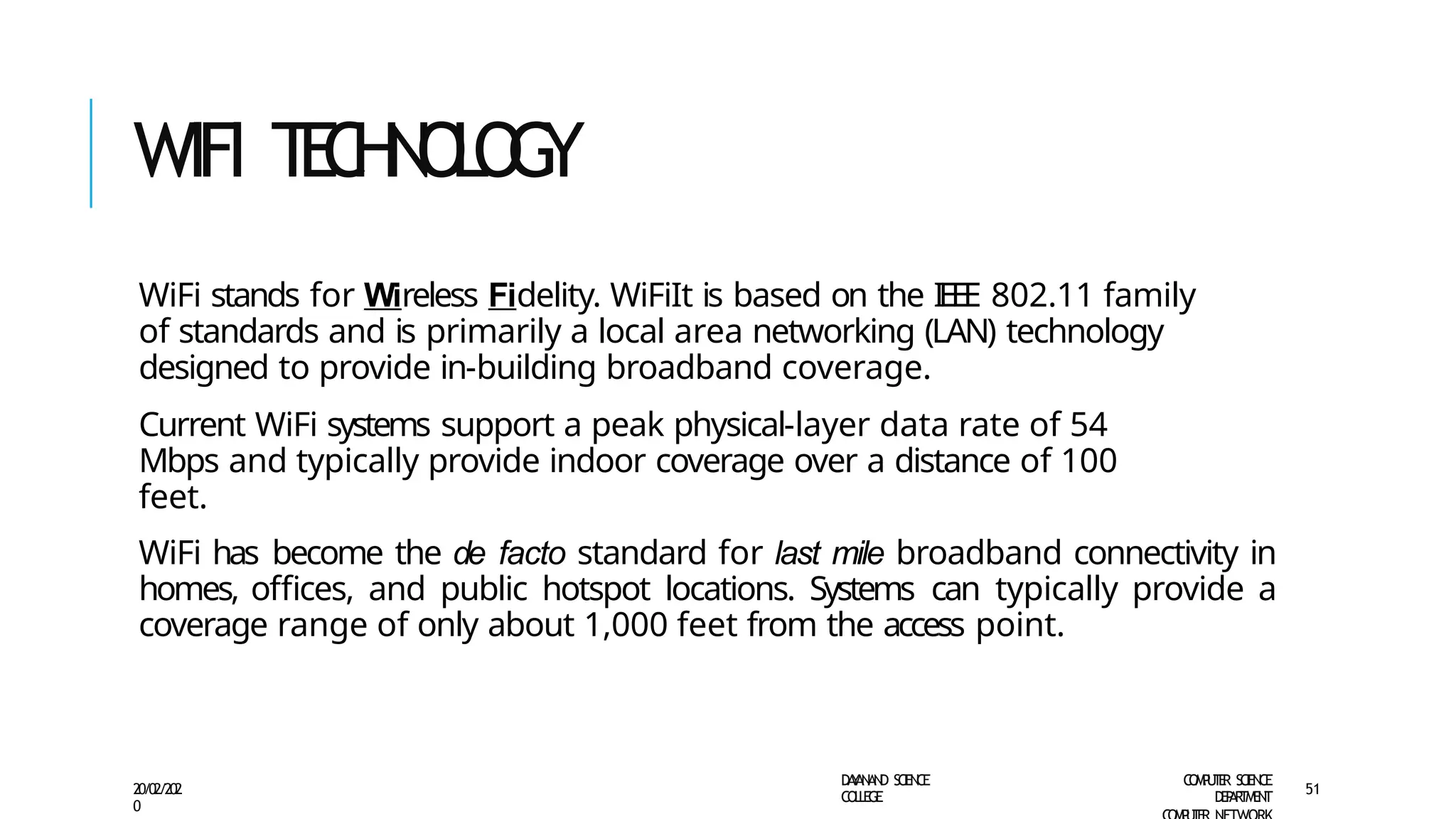
WiFi stands for Wireless Fidelity. WiFiIt is based on the IEEE 802.11 family
of standards and is primarily a local area networking (LAN) technology
designed to provide in-building broadband coverage.
Current WiFi systems support a peak physical-layer data rate of 54
Mbps and typically provide indoor coverage over a distance of 100
feet.
WiFi has become the de facto standard for last mile broadband connectivity in
homes, offices, and public hotspot locations. Systems can typically provide a
coverage range of only about 1,000 feet from the access point.
50.
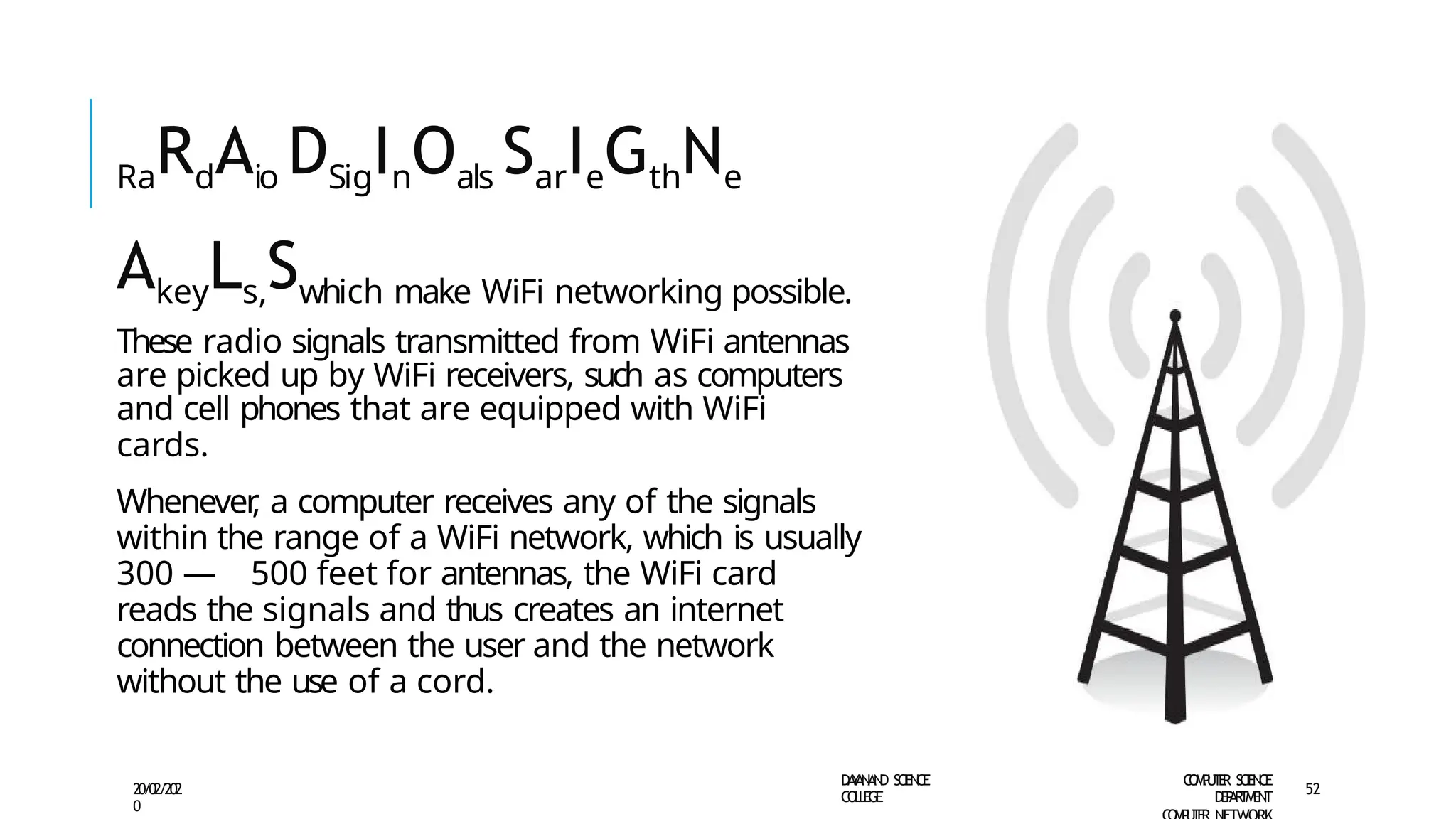
RaRdAio DSigInOals SarIeGthNe
AkeyLs,Swhichmake WiFi networking possible.
These radio signals transmitted from WiFi antennas
are picked up by WiFi receivers, such as computers
and cell phones that are equipped with WiFi
cards.
Whenever
, a computer receives any of the signals
within the range of a WiFi network, which is usually
300 — 500 feet for antennas, the WiFi card
reads the signals and thus creates an internet
connection between the user and the network
without the use of a cord.
D
A
Y
A
N
A
N
D S
CI
E
N
CE
CO
L
L
E
G
E
C
O
M
P
U
T
E
R S
CIE
N
CE
D
E
P
A
R
T
M
E
N
T
20/02/202
0
52
51.
WIFI
CARDS
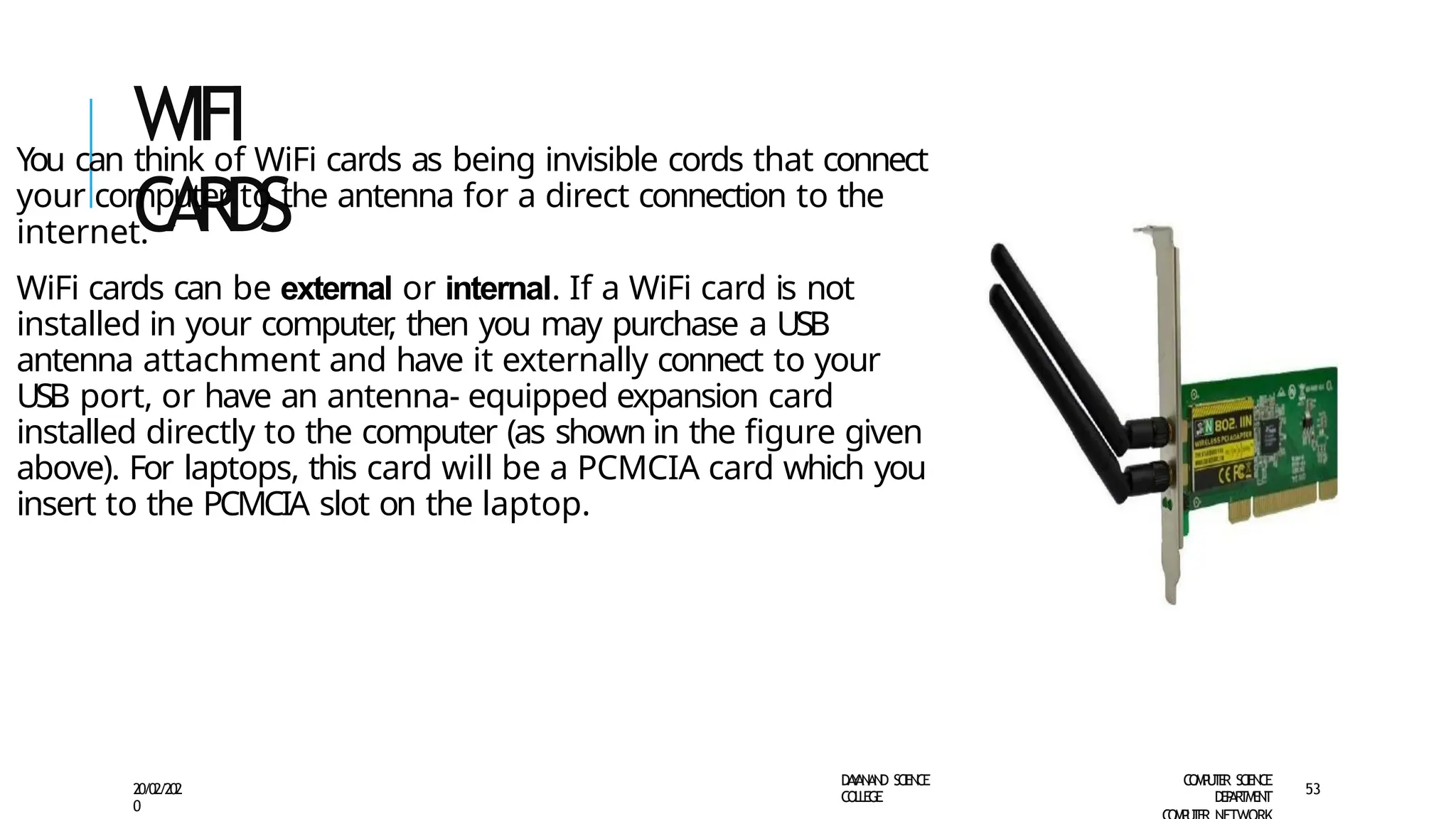
You can thinkof WiFi cards as being invisible cords that connect
your computer to the antenna for a direct connection to the
internet.
WiFi cards can be external or internal. If a WiFi card is not
installed in your computer
, then you may purchase a USB
antenna attachment and have it externally connect to your
USB port, or have an antenna- equipped expansion card
installed directly to the computer (as shown in the figure given
above). For laptops, this card will be a PCMCIA card which you
insert to the PCMCIA slot on the laptop.
D
A
Y
A
N
A
N
D S
CI
E
N
CE
CO
L
L
E
G
E
C
O
M
P
U
T
E
R S
CIE
N
CE
D
E
P
A
R
T
M
E
N
T
20/02/202
0
53
52.
INTRODUCTION T
O WI-FI& 4
G
T
ECH
N
OLOGY.
D
A
Y
A
N
A
N
D S
CI
E
N
CE
CO
L
L
E
G
E
C
O
M
P
U
T
E
R S
CIE
N
CE
D
E
P
A
R
T
M
E
N
T
20/02/202
0
54
WiFi Technology is a proficient used by mobiles, workplaces, home and computer
systems all around the world.
Newest entrenched wireless fidelity representations are outfitted by real time operating
systems that allow communication by means of serial ports so we can say that WiFi
Technology is a standard of communication among wireless devices and computers all
over the world.
The world’s leading WiFi Technology network is simply a name of freedom which permits
you to
connect your computer with any device as PDA without any expense of wires.
Just imagine you are sitting in a coffee shop and chatting with your friend for fun,
traveling with airport and in touch with your business, working in a office or taking tea
in company cafeteria and checking your today business status Now you can use internet
share your files making conference with your client and these all thing possible yes your
work and outing both are going and it is possible only with WiFi Technology.
53.
There are severalspecifications in the 802.11 family −
802.11 − This pertains to wireless LANs and provides 1 - or 2-Mbps transmission in
the 2.4- GHz band using either frequency-hopping spread spectrum (FHSS) or direct-
sequence spread spectrum (DSSS).
802.11a − This is an extension to 802.11 that pertains to wireless LANs and goes as
fast as 54 Mbps in the 5-GHz band. 802.11a employs the orthogonal frequency
division multiplexing (OFDM) encoding scheme as opposed to either FHSS or DSSS.
802.11b − The 802.11 high rate WiFi is an extension to 802.11 that pertains to
wireless LANs and yields a connection as fast as 11 Mbps transmission (with a
fallback to 5.5, 2, and 1 Mbps depending on strength of signal) in the 2.4-GHz
band. The 802.11b specification uses only DSSS. Note that 802.11b was actually an
amendment to the original 802.11 standard added in 1999 to permit wireless
functionality to be analogous to hard-wired Ethernet connections.
802.11g − This pertains to wireless LANs and provides 20+ Mbps in the 2.4-GHz
band.
D
A
Y
A
N
A
N
D S
CI
E
N
CE
CO
L
L
E
G
E
C
O
M
P
U
T
E
R S
CIE
N
CE
D
E
P
A
R
T
M
E
N
T
20/02/202
0
55



![]animation of multimedia systems in the graphics.ppt](https://cdn.slidesharecdn.com/ss_thumbnails/unit2animation1-250501183139-eeed060c-thumbnail.jpg?width=640&height=640&fit=bounds)


