Topic: ‘Transgression of Planetary Boundaries’
Concerned Faculty: Dr. P.C. Abhilash & Dr. Rajeev
Pratap
Presented By: Garima Bharti
M.Sc 2nd
year Environmental Sciences (Ecological
Sciences)
HUMAN ECOLOGY
PRESENTATION
Flow of Presentation
 Introduction
 Pressures on Earth
 Dawn of Anthropocene
 Framework
 Transgressed Planetary Boundaries
 Climate change
 Biodiversity Integration
 Land use change systems
 Biogeochemical Cycles
► What we can do?
1. Introduction
Humanity’s current Dilemma :
Transgression – going beyond generally accepted boundaries
► Period of stability & balance on earth has been disturbed by ‘Homo sapiens’.
► destabilization of earth processes.(due to population growth &
overconsumption of earth resources)
►Planetary Boundaries – concept involving Earth system processes that
contain environmental boundaries.
► concept introduced by ‘Johan Rockstrom’ & Will Steffen to define
the boundaries for a safe operating space for humanity.
► a precondition for sustainable development.
Now, the question is
how we are headed
towards this
destabilizing of earth
system processes?
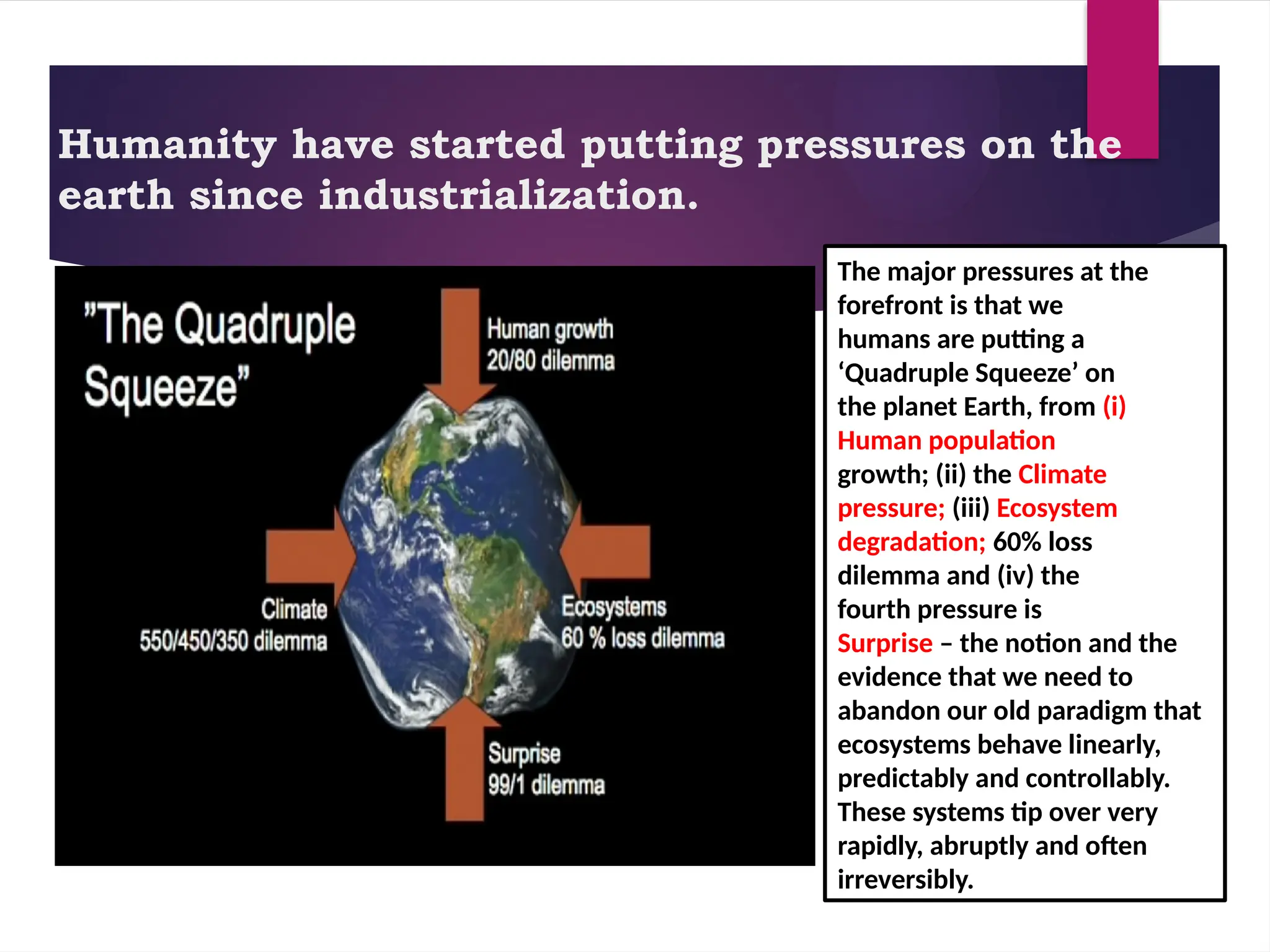
Humanity have started putting pressures on the
earth since industrialization.
The major pressures at the
forefront is that we
humans are putting a
‘Quadruple Squeeze’ on
the planet Earth, from (i)
Human population
growth; (ii) the Climate
pressure; (iii) Ecosystem
degradation; 60% loss
dilemma and (iv) the
fourth pressure is
Surprise – the notion and the
evidence that we need to
abandon our old paradigm that
ecosystems behave linearly,
predictably and controllably.
These systems tip over very
rapidly, abruptly and often
irreversibly.
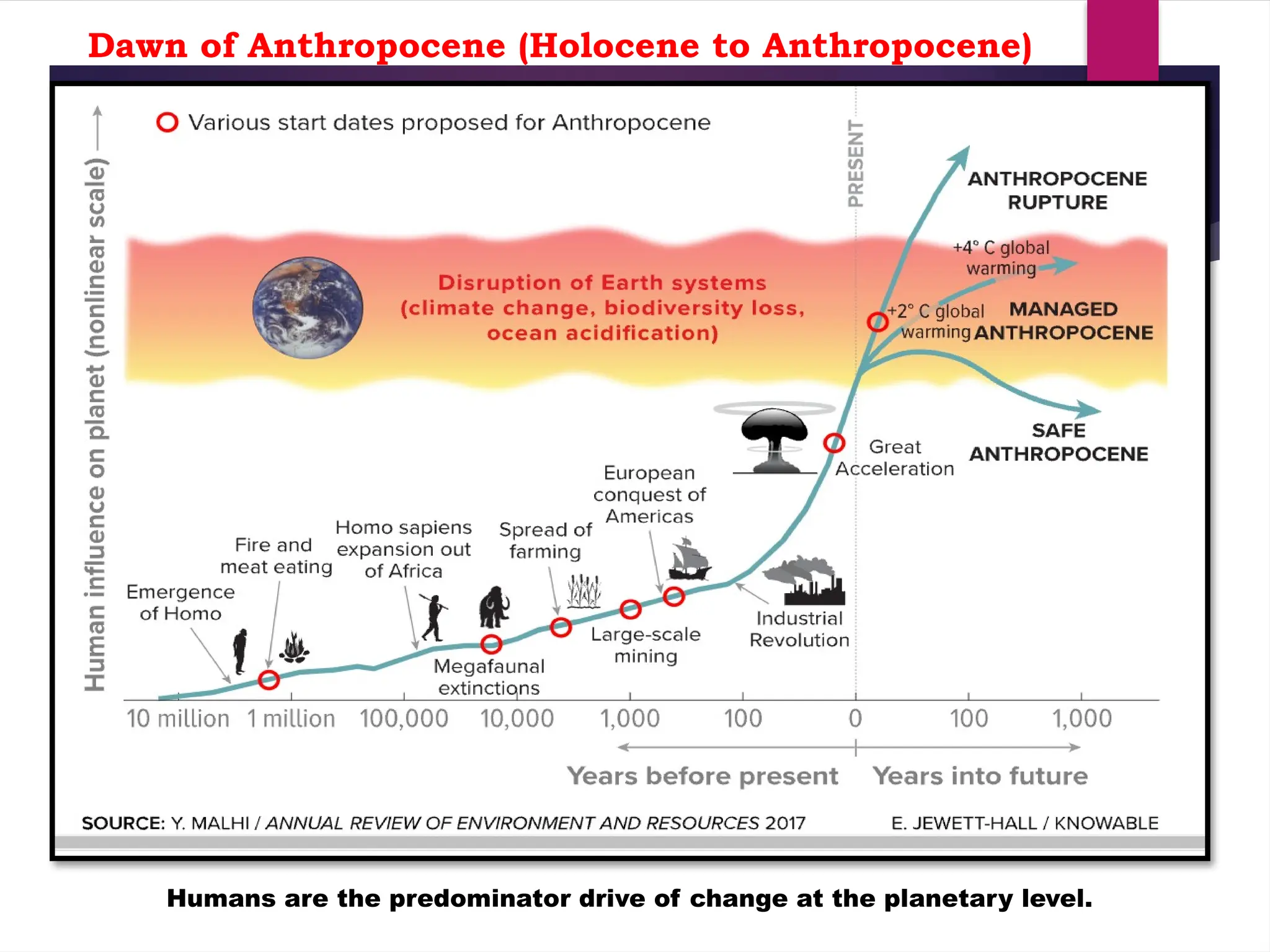
Dawn of Anthropocene (Holocene to Anthropocene)
Humans are the predominator drive of change at the planetary level.
Dawn of Anthropocene
 Modern humans have existed for about 200,000 years, but it
was “only in the last 10,000 years that we were able to develop
civilization as we know it,” Rockstrom said. “The very origins of
modern civilization, namely domestication of animals and
plants and the establishment of agriculture, happened in the
Holocene.”
 In fact, our transgressions of the nine planetary boundaries have
been so severe that geologists believe we have entered a new epoch
in the Earth’s history. The start of the Anthropocene — a human-
influenced period that scientists say was initiated somewhere
between 10,000 and 70 years ago — has been marked by rapid,
human-triggered increases in greenhouse gas emissions, large-scale
land-use change, extreme biodiversity loss, and massive global
consumption and pollution brought on by rapidly advancing
technology and a booming Homo sapiens population.
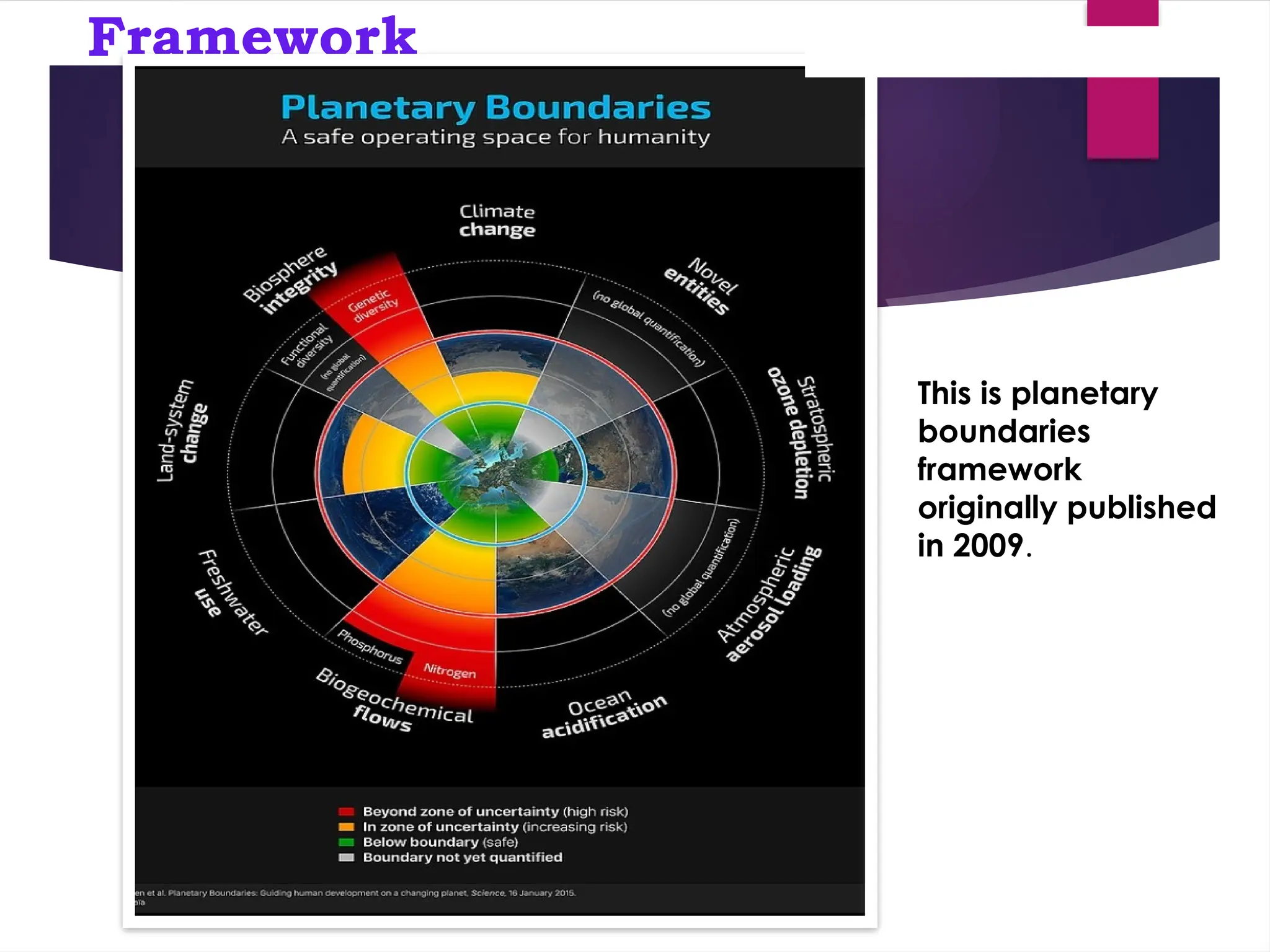
Framework
This is planetary
boundaries
framework
originally published
in 2009.
Framework (contd.)
• Stockholm resilience centre published Planetary boundaries Framework . According to the
framework, "transgressing one or more planetary boundaries may be deleterious or even
catastrophic due to the risk of crossing thresholds that will trigger non-linear, abrupt
environmental change within continental-scale to planetary-scale systems."[1]
The Earth system
process boundaries mark the safe zone for the planet to the extent that they are not crossed.
• As of 2009, two boundaries (biodiversity integrity &Biogeochemical flows) have already been
crossed, while others are in imminent danger of being crossed
• stability of these nine processes is essential.
• human activities have been pushing these boundaries to a threshold that could crash
civilization and endanger humanity.
• According to 2015 update, Four boundaries that has been existing outside the safe operating
zone for humanity are –
 Climate change
 Biodiversity integration
 Land-system change
 Biogeochemical cycles
Evidences and examples for 4
transgressed planetary boundaries
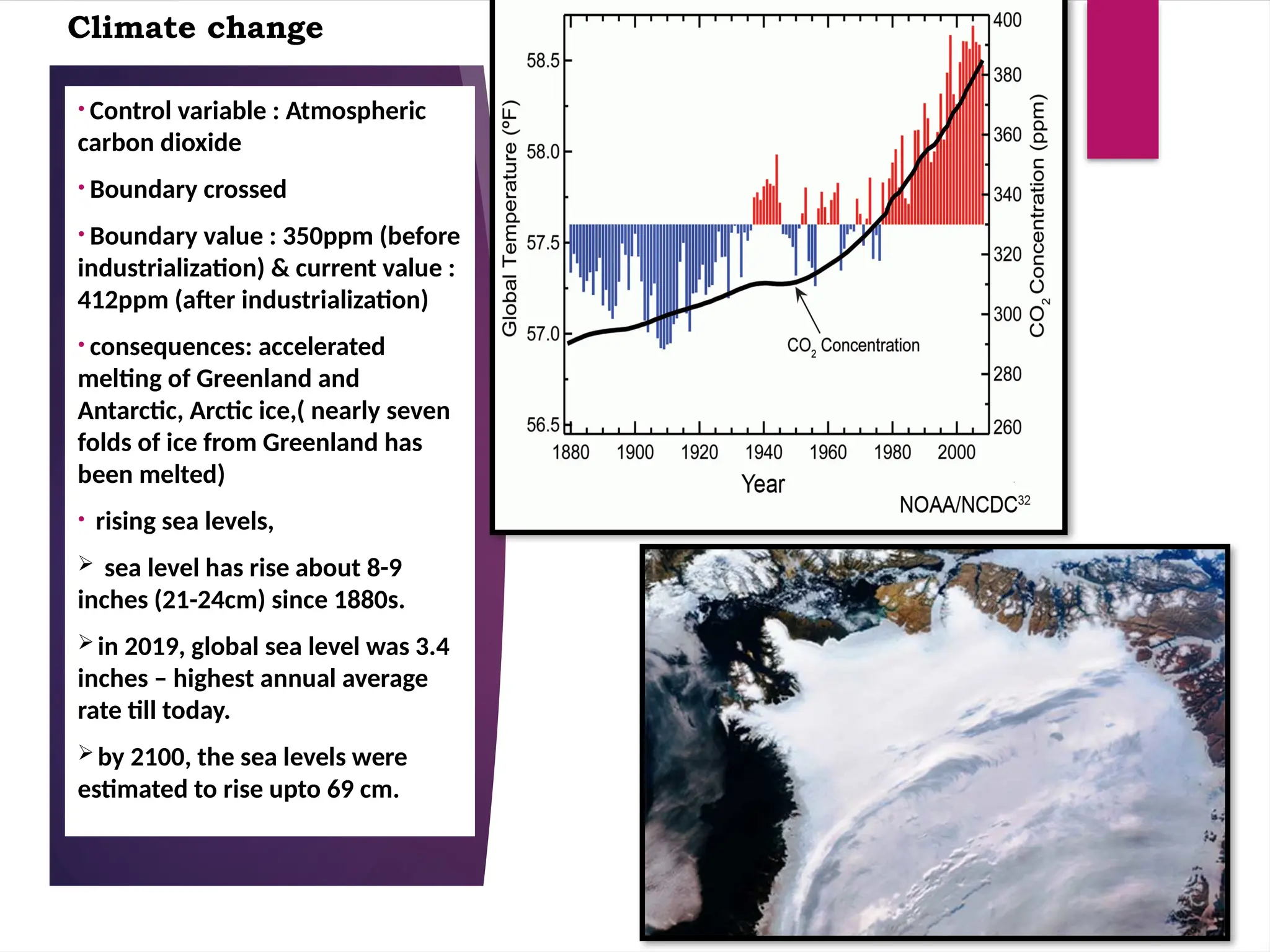
• Control variable : Atmospheric
carbon dioxide
• Boundary crossed
• Boundary value : 350ppm (before
industrialization) & current value :
412ppm (after industrialization)
• consequences: accelerated
melting of Greenland and
Antarctic, Arctic ice,( nearly seven
folds of ice from Greenland has
been melted)
• rising sea levels,
 sea level has rise about 8-9
inches (21-24cm) since 1880s.
 in 2019, global sea level was 3.4
inches – highest annual average
rate till today.
 by 2100, the sea levels were
estimated to rise upto 69 cm.
Climate change
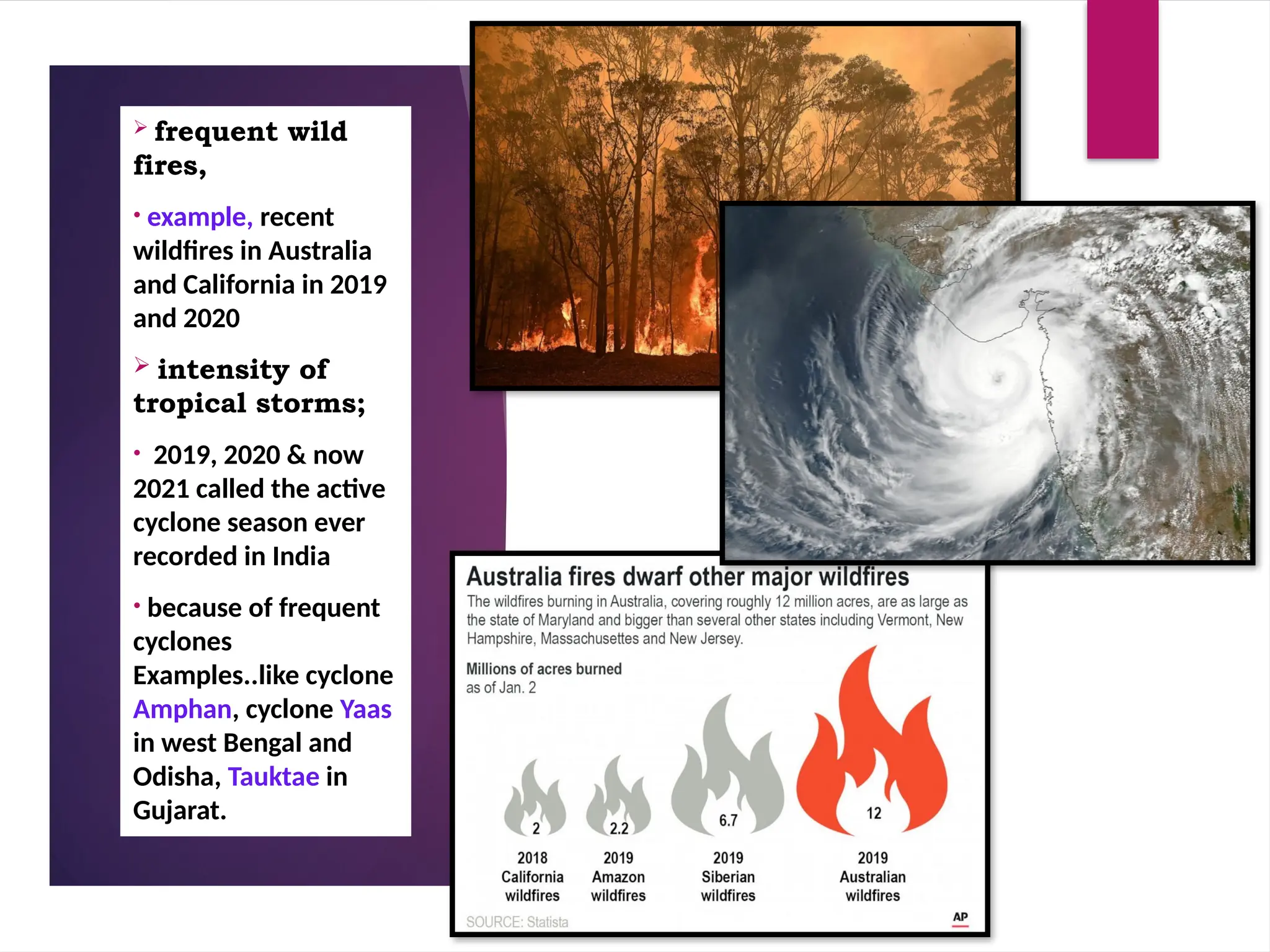
 frequent wild
fires,
• example, recent
wildfires in Australia
and California in 2019
and 2020
 intensity of
tropical storms;
• 2019, 2020 & now
2021 called the active
cyclone season ever
recorded in India
• because of frequent
cyclones
Examples..like cyclone
Amphan, cyclone Yaas
in west Bengal and
Odisha, Tauktae in
Gujarat.
Biodiversity Integrity
•
The increasing demand for food, water
and natural resources has been
causing severe biodiversity loss and
changes in ecosystem services.
Ecosystem damage and extinction can
be slowed by protecting the integrity
of living, enhancing habitat and
improving connectivity between
ecosystem.
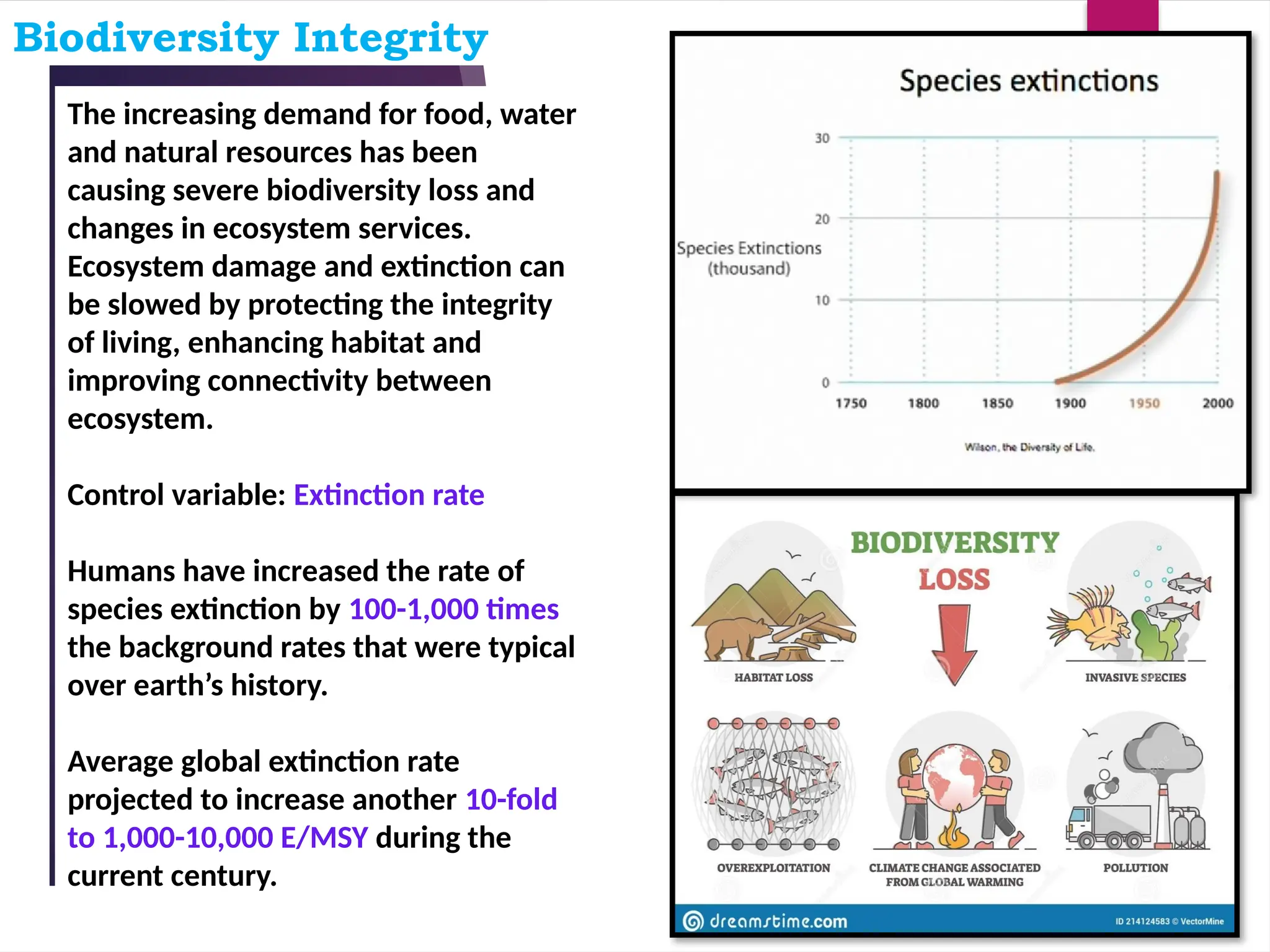
Control variable: Extinction rate
Humans have increased the rate of
species extinction by 100-1,000 times
the background rates that were typical
over earth’s history.
Average global extinction rate
projected to increase another 10-fold
to 1,000-10,000 E/MSY during the
current century.
• according to 2019 assessment by IPBES, 25% of plants and animals
totaling 1 million species worldwide are threatened with extinction.
• also 500 vertebrate species on the brink.
•According to WWF and the Zoological Society of London’s (ZSL) 2020
Living Planet Report, population sizes of mammals, birds, amphibians,
reptiles and fish declined by 68% on average between 1970 and 2016
— a strong alarm call.
Land system
change
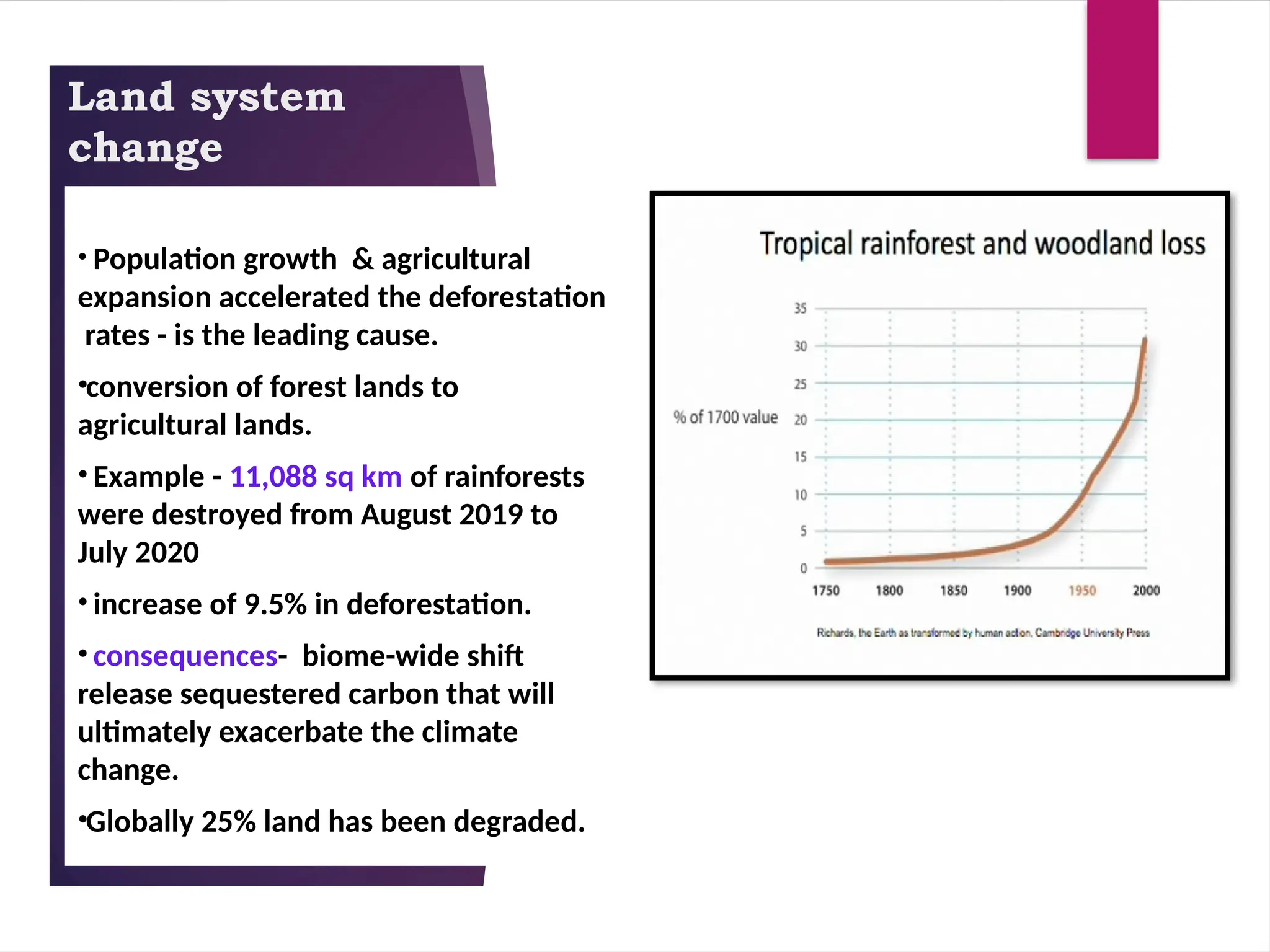
• Population growth & agricultural
expansion accelerated the deforestation
rates - is the leading cause.
•conversion of forest lands to
agricultural lands.
• Example - 11,088 sq km of rainforests
were destroyed from August 2019 to
July 2020
• increase of 9.5% in deforestation.
• consequences- biome-wide shift
release sequestered carbon that will
ultimately exacerbate the climate
change.
•Globally 25% land has been degraded.
Biogeochemical
Cycle
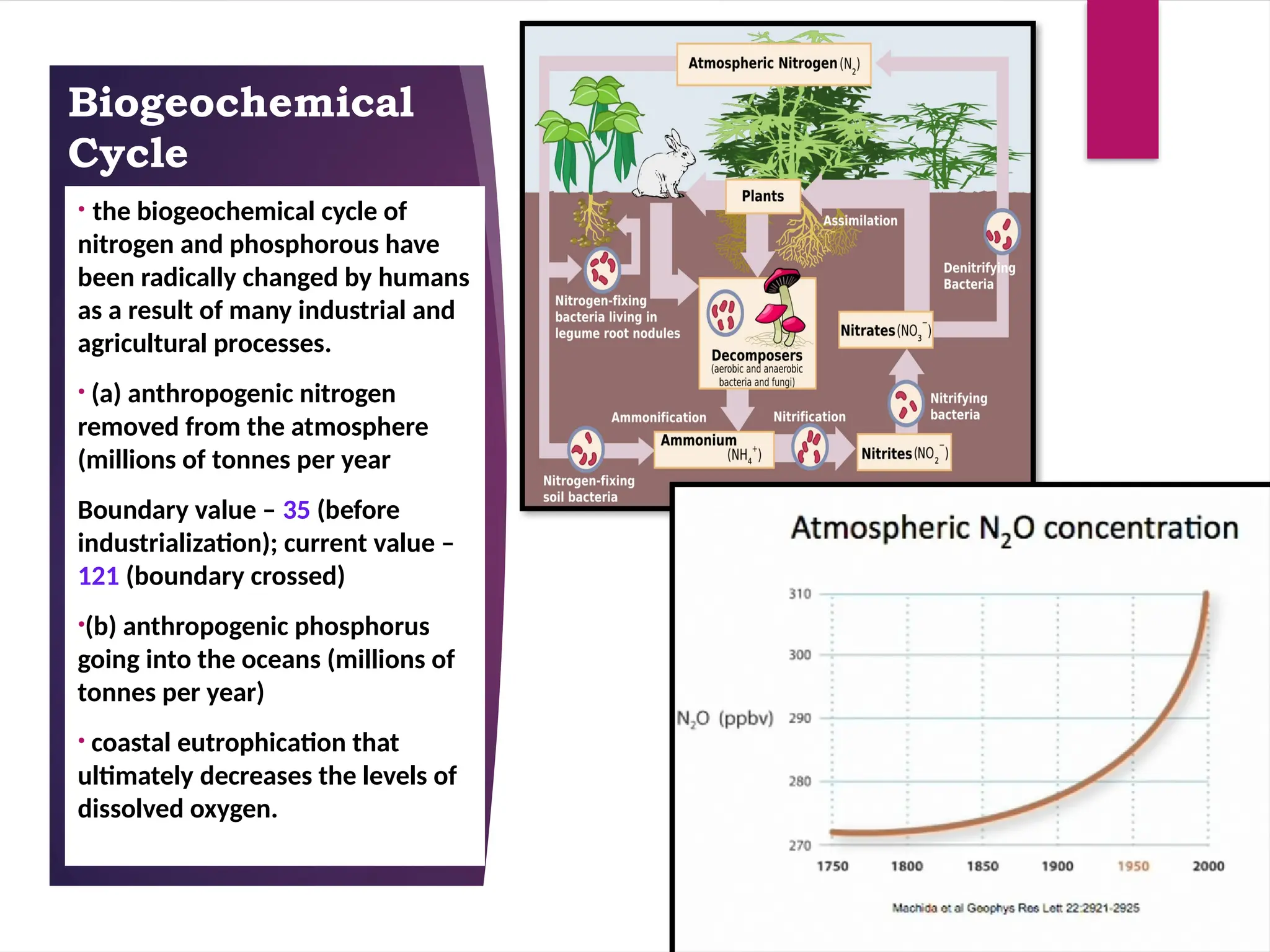
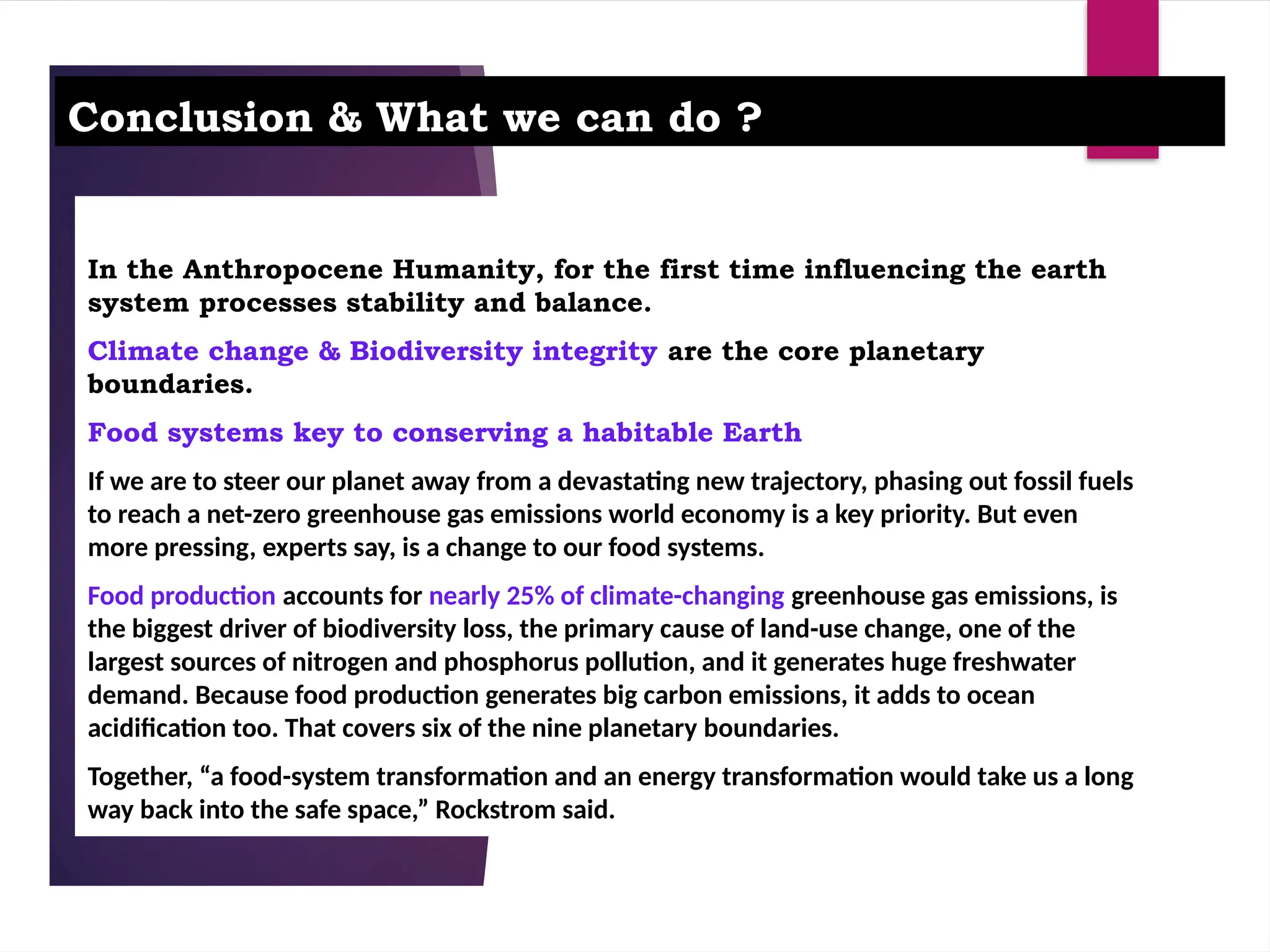
• the biogeochemical cycle of
nitrogen and phosphorous have
been radically changed by humans
as a result of many industrial and
agricultural processes.
• (a) anthropogenic nitrogen
removed from the atmosphere
(millions of tonnes per year
Boundary value – 35 (before
industrialization); current value –
121 (boundary crossed)
•(b) anthropogenic phosphorus
going into the oceans (millions of
tonnes per year)
• coastal eutrophication that
ultimately decreases the levels of
dissolved oxygen.
Conclusion & What we can do ?
In the Anthropocene Humanity, for the first time influencing the earth
system processes stability and balance.
Climate change & Biodiversity integrity are the core planetary
boundaries.
Food systems key to conserving a habitable Earth
If we are to steer our planet away from a devastating new trajectory, phasing out fossil fuels
to reach a net-zero greenhouse gas emissions world economy is a key priority. But even
more pressing, experts say, is a change to our food systems.
Food production accounts for nearly 25% of climate-changing greenhouse gas emissions, is
the biggest driver of biodiversity loss, the primary cause of land-use change, one of the
largest sources of nitrogen and phosphorus pollution, and it generates huge freshwater
demand. Because food production generates big carbon emissions, it adds to ocean
acidification too. That covers six of the nine planetary boundaries.
Together, “a food-system transformation and an energy transformation would take us a long
way back into the safe space,” Rockstrom said.
Reference:
 Steffen, W., Richardson, K., Rockstrom, J., Cornell, S. E.,
Fetzer, I., Bennett, E. M., … Sörlin, S. (2015). Planetary
boundaries: Guiding human development on a
changing planet. Science, 347(6223), 1259855.
doi:10.1126/science.1259855
 https://news.mongabay.com/2021/03/the-nine-
boundaries-humanity-must-respect-to-keep-the-
planet-habitable/

Transgression of Planetary Boundaries - Earth system processes.

  • 1.
    Topic: ‘Transgression ofPlanetary Boundaries’ Concerned Faculty: Dr. P.C. Abhilash & Dr. Rajeev Pratap Presented By: Garima Bharti M.Sc 2nd year Environmental Sciences (Ecological Sciences) HUMAN ECOLOGY PRESENTATION
  • 2.
    Flow of Presentation Introduction  Pressures on Earth  Dawn of Anthropocene  Framework  Transgressed Planetary Boundaries  Climate change  Biodiversity Integration  Land use change systems  Biogeochemical Cycles ► What we can do?
  • 3.
    1. Introduction Humanity’s currentDilemma : Transgression – going beyond generally accepted boundaries ► Period of stability & balance on earth has been disturbed by ‘Homo sapiens’. ► destabilization of earth processes.(due to population growth & overconsumption of earth resources) ►Planetary Boundaries – concept involving Earth system processes that contain environmental boundaries. ► concept introduced by ‘Johan Rockstrom’ & Will Steffen to define the boundaries for a safe operating space for humanity. ► a precondition for sustainable development.
  • 4.
    Now, the questionis how we are headed towards this destabilizing of earth system processes?
  • 5.
    Humanity have startedputting pressures on the earth since industrialization. The major pressures at the forefront is that we humans are putting a ‘Quadruple Squeeze’ on the planet Earth, from (i) Human population growth; (ii) the Climate pressure; (iii) Ecosystem degradation; 60% loss dilemma and (iv) the fourth pressure is Surprise – the notion and the evidence that we need to abandon our old paradigm that ecosystems behave linearly, predictably and controllably. These systems tip over very rapidly, abruptly and often irreversibly.
  • 6.
    Dawn of Anthropocene(Holocene to Anthropocene) Humans are the predominator drive of change at the planetary level.
  • 7.
    Dawn of Anthropocene Modern humans have existed for about 200,000 years, but it was “only in the last 10,000 years that we were able to develop civilization as we know it,” Rockstrom said. “The very origins of modern civilization, namely domestication of animals and plants and the establishment of agriculture, happened in the Holocene.”  In fact, our transgressions of the nine planetary boundaries have been so severe that geologists believe we have entered a new epoch in the Earth’s history. The start of the Anthropocene — a human- influenced period that scientists say was initiated somewhere between 10,000 and 70 years ago — has been marked by rapid, human-triggered increases in greenhouse gas emissions, large-scale land-use change, extreme biodiversity loss, and massive global consumption and pollution brought on by rapidly advancing technology and a booming Homo sapiens population.
  • 8.
  • 9.
    Framework (contd.) • Stockholmresilience centre published Planetary boundaries Framework . According to the framework, "transgressing one or more planetary boundaries may be deleterious or even catastrophic due to the risk of crossing thresholds that will trigger non-linear, abrupt environmental change within continental-scale to planetary-scale systems."[1] The Earth system process boundaries mark the safe zone for the planet to the extent that they are not crossed. • As of 2009, two boundaries (biodiversity integrity &Biogeochemical flows) have already been crossed, while others are in imminent danger of being crossed • stability of these nine processes is essential. • human activities have been pushing these boundaries to a threshold that could crash civilization and endanger humanity. • According to 2015 update, Four boundaries that has been existing outside the safe operating zone for humanity are –  Climate change  Biodiversity integration  Land-system change  Biogeochemical cycles
  • 10.
    Evidences and examplesfor 4 transgressed planetary boundaries
  • 11.
    • Control variable: Atmospheric carbon dioxide • Boundary crossed • Boundary value : 350ppm (before industrialization) & current value : 412ppm (after industrialization) • consequences: accelerated melting of Greenland and Antarctic, Arctic ice,( nearly seven folds of ice from Greenland has been melted) • rising sea levels,  sea level has rise about 8-9 inches (21-24cm) since 1880s.  in 2019, global sea level was 3.4 inches – highest annual average rate till today.  by 2100, the sea levels were estimated to rise upto 69 cm. Climate change
  • 12.
     frequent wild fires, •example, recent wildfires in Australia and California in 2019 and 2020  intensity of tropical storms; • 2019, 2020 & now 2021 called the active cyclone season ever recorded in India • because of frequent cyclones Examples..like cyclone Amphan, cyclone Yaas in west Bengal and Odisha, Tauktae in Gujarat.
  • 13.
    Biodiversity Integrity • The increasingdemand for food, water and natural resources has been causing severe biodiversity loss and changes in ecosystem services. Ecosystem damage and extinction can be slowed by protecting the integrity of living, enhancing habitat and improving connectivity between ecosystem. Control variable: Extinction rate Humans have increased the rate of species extinction by 100-1,000 times the background rates that were typical over earth’s history. Average global extinction rate projected to increase another 10-fold to 1,000-10,000 E/MSY during the current century.
  • 14.
    • according to2019 assessment by IPBES, 25% of plants and animals totaling 1 million species worldwide are threatened with extinction. • also 500 vertebrate species on the brink. •According to WWF and the Zoological Society of London’s (ZSL) 2020 Living Planet Report, population sizes of mammals, birds, amphibians, reptiles and fish declined by 68% on average between 1970 and 2016 — a strong alarm call.
  • 15.
    Land system change • Populationgrowth & agricultural expansion accelerated the deforestation rates - is the leading cause. •conversion of forest lands to agricultural lands. • Example - 11,088 sq km of rainforests were destroyed from August 2019 to July 2020 • increase of 9.5% in deforestation. • consequences- biome-wide shift release sequestered carbon that will ultimately exacerbate the climate change. •Globally 25% land has been degraded.
  • 16.
    Biogeochemical Cycle • the biogeochemicalcycle of nitrogen and phosphorous have been radically changed by humans as a result of many industrial and agricultural processes. • (a) anthropogenic nitrogen removed from the atmosphere (millions of tonnes per year Boundary value – 35 (before industrialization); current value – 121 (boundary crossed) •(b) anthropogenic phosphorus going into the oceans (millions of tonnes per year) • coastal eutrophication that ultimately decreases the levels of dissolved oxygen.
  • 17.
    Conclusion & Whatwe can do ? In the Anthropocene Humanity, for the first time influencing the earth system processes stability and balance. Climate change & Biodiversity integrity are the core planetary boundaries. Food systems key to conserving a habitable Earth If we are to steer our planet away from a devastating new trajectory, phasing out fossil fuels to reach a net-zero greenhouse gas emissions world economy is a key priority. But even more pressing, experts say, is a change to our food systems. Food production accounts for nearly 25% of climate-changing greenhouse gas emissions, is the biggest driver of biodiversity loss, the primary cause of land-use change, one of the largest sources of nitrogen and phosphorus pollution, and it generates huge freshwater demand. Because food production generates big carbon emissions, it adds to ocean acidification too. That covers six of the nine planetary boundaries. Together, “a food-system transformation and an energy transformation would take us a long way back into the safe space,” Rockstrom said.
  • 18.
    Reference:  Steffen, W.,Richardson, K., Rockstrom, J., Cornell, S. E., Fetzer, I., Bennett, E. M., … Sörlin, S. (2015). Planetary boundaries: Guiding human development on a changing planet. Science, 347(6223), 1259855. doi:10.1126/science.1259855  https://news.mongabay.com/2021/03/the-nine- boundaries-humanity-must-respect-to-keep-the- planet-habitable/