
Considering Cooperatives:
Democratic Workplaces &
Succession Planning
Carolyn Edsell-Vetter, AOLCP
President & Co-CEO
A Yard & A Half Landscaping Cooperative, Inc.
Waltham, MA

COOPERATIVE
Why are you here?
 Aspiring farmer or apprentice
 Need land
 Need capital (money)

 Farmer or landscaper looking to retire
 Owner who wants to go back to doing what you love -working in the business, rather than on the business
 Social entrepreneur
 Cooperative enthusiast
 Other??

COOPERATIVE
What do you want to learn?
 What are worker-owned cooperatives?
 What is the cooperative movement all about?
 When is a worker-coop an appropriate option for:





Joining together to raise capital and get access to land?
Building local economies?
Creating a more democratic workplace?
Succession planning?

 How can I start a coop or transition an existing privately-held
business to a worker-owned cooperative?
 What can I learn from the experience of other coop start-ups?

COOPERATIVE
Some Disclaimers…

COOPERATIVE
Some Disclaimers…
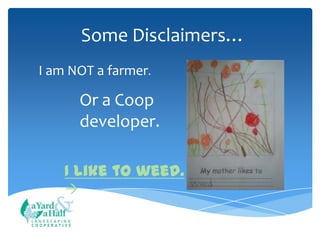
I am NOT a farmer.

COOPERATIVE
Some Disclaimers…
I am NOT a farmer.

Or a Coop
developer.

COOPERATIVE
Some Disclaimers…
I am NOT a farmer.

Or a Coop
developer.
I like to weed.

COOPERATIVE
So, why am I here?

COOPERATIVE
Access to Capital & Land

Inherited
Wealth

Expansion
Capital?

Limited
Production

Viable
Farmland

Expansion
Space?

Limited
Growth

Apprentice
Labor

Progressive
Wages?

Loss of
Skilled Labor

YES
Experienced
Young Farmer
with Access?

NO
CommercialScale Skilled
Laborer

Adapted from an essay at: https://medium.com/praxis-journal/ee5fd7fa9b3c
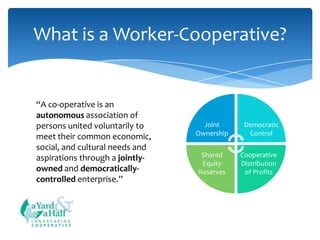
What is a Worker-Cooperative?

“A co-operative is an
autonomous association of
persons united voluntarily to
meet their common economic,
social, and cultural needs and
aspirations through a jointlyowned and democraticallycontrolled enterprise.”

COOPERATIVE

Joint
Ownership
Shared
Equity
Reserves

Democratic
Control
Cooperative
Distribution
of Profits
What is a Worker-Cooperative?

• Worker-owned – workers
finance the coop together
through an initial buy-in
• Worker-controlled on basis of
“One worker, one vote”
• Workers share surplus
• Worker-owner equity stays in
the coop as working capital

COOPERATIVE

Joint
Ownership
Shared
Equity
Reserves

Democratic
Control
Cooperative
Distribution
of Profits
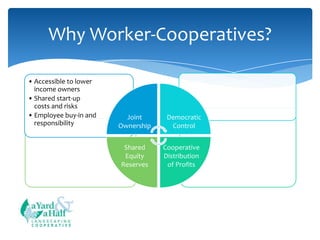
Why Worker-Cooperatives?

Joint
Ownership
Shared
Equity
Reserves

COOPERATIVE

Democratic
Control
Cooperative
Distribution
of Profits
Why Worker-Cooperatives?
• Accessible to lower
income owners
• Shared start-up
costs and risks
• Employee buy-in and
responsibility

Joint
Ownership
Shared
Equity
Reserves

COOPERATIVE

Democratic
Control
Cooperative
Distribution
of Profits
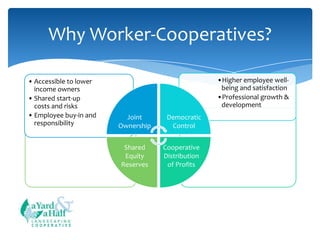
Why Worker-Cooperatives?
• Accessible to lower
income owners
• Shared start-up
costs and risks
• Employee buy-in and
responsibility

•Higher employee wellbeing and satisfaction
•Professional growth &
development
Joint
Ownership
Shared
Equity
Reserves

COOPERATIVE

Democratic
Control
Cooperative
Distribution
of Profits
Why Worker-Cooperatives?
• Accessible to lower
income owners
• Shared start-up
costs and risks
• Employee buy-in and
responsibility

•Higher employee wellbeing and satisfaction
•Professional growth &
development
Joint
Ownership
Shared
Equity
Reserves

COOPERATIVE

Democratic
Control
Cooperative
Distribution
of Profits

• Direct benefit from
personal labor
• Reinvestment in local
economies
• Stabilization of family
& community
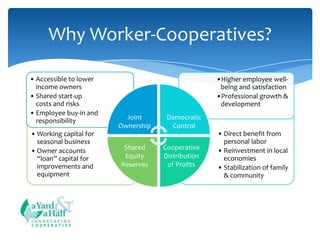
Why Worker-Cooperatives?
• Accessible to lower
income owners
• Shared start-up
costs and risks
• Employee buy-in and
responsibility
• Working capital for
seasonal business
• Owner accounts
“loan” capital for
improvements and
equipment

COOPERATIVE

•Higher employee wellbeing and satisfaction
•Professional growth &
development
Joint
Ownership
Shared
Equity
Reserves

Democratic
Control
Cooperative
Distribution
of Profits

• Direct benefit from
personal labor
• Reinvestment in local
economies
• Stabilization of family
& community
7 Cooperative Principles

COOPERATIVE
7 Cooperative Principles
1. Voluntary and open membership

A cooperatives is a voluntary organization, open to all people
able to use its services and willing to accept the
responsibilities of membership, without gender, social, racial,
political or religious discrimination.

COOPERATIVE
7 Cooperative Principles
1. Voluntary and open membership
2. Democratic member control

Cooperatives are democratic organizations controlled by their
members—those who buy the goods or use the services of
the cooperative—who actively participate in setting policies
and making decisions.

COOPERATIVE
7 Cooperative Principles
1. Voluntary and open membership
2. Democratic member control
3. Members’ economic participation

Members contribute equally to, and democratically control,
the capital of the cooperative. This benefits members in
proportion to the business they conduct with the cooperative
rather than on the capital invested.
7 Cooperative Principles
1.
2.
3.
4.

Voluntary and open membership
Democratic member control
Members’ economic participation
Autonomy and independence

Cooperatives are autonomous, self-help organizations
controlled by their members. If the co-op enters into
agreements with other organizations or raises capital from
external sources, it is done so based on terms that ensure
democratic control by the members and maintains the
cooperative’s autonomy.

COOPERATIVE
7 Cooperative Principles
1.
2.
3.
4.
5.

Voluntary and open membership
Democratic member control
Members’ economic participation
Autonomy and independence
Education, training, and information

Cooperatives provide education and training for
members, elected representatives, managers and employees so
they can contribute effectively to the development of their
cooperative. Members also inform the general public about the
nature and benefits of cooperatives.

COOPERATIVE
7 Cooperative Principles
1.
2.
3.
4.
5.
6.

Voluntary and open membership
Democratic member control
Members’ economic participation
Autonomy and independence
Education, training, and information
Cooperation among cooperatives

Cooperatives serve their members most effectively and
strengthen the cooperative movement by working together
through local, national, regional and international structures.

COOPERATIVE
7 Cooperative Principles
1.
2.
3.
4.
5.
6.
7.

Voluntary and open membership
Democratic member control
Members’ economic participation
Autonomy and independence
Education, training, and information
Cooperation among cooperatives
Concern for community

While focusing on member needs, cooperatives work for the
sustainable development of communities through policies and
programs accepted by the members.

COOPERATIVE
Our Story
A Yard & A Half Landscaping Cooperative, Inc.

COOPERATIVE
Who We Are

Joint
Ownership
Shared
Equity
Reserves

COOPERATIVE

Democratic
Control
Cooperative
Distribution
of Profits
Who We Are

Joint
Ownership
Shared
Equity
Reserves

COOPERATIVE

Democratic
Control
Cooperative
Distribution
of Profits
Who We Are

Joint
Ownership
Shared
Equity
Reserves

COOPERATIVE

Democratic
Control
Cooperative
Distribution
of Profits
Who We Are

Joint
Ownership
Shared
Equity
Reserves

COOPERATIVE

Democratic
Control
Cooperative
Distribution
of Profits
Why We Went Coop
Succession
Strategy
Leaving a
Legacy
The Workers
Become the
Owners

COOPERATIVE

Joint
Ownership
Shared
Equity
Reserves

Democratic
Control
Cooperative
Distribution
of Profits
Cooperative Structures
Incorporation, Governance,
and Management

COOPERATIVE
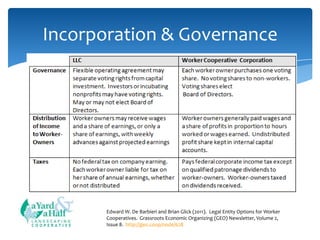
Incorporation & Governance

Joint
Ownership
Shared
Equity
Reserves

COOPERATIVE

Democratic
Control
Cooperative
Distribution
of Profits

Edward W. De Barbieri and Brian Glick (2011). Legal Entity Options for Worker
Cooperatives. Grassroots Economic Organizing (GEO) Newsletter, Volume 2,
Issue 8. http://geo.coop/node/628
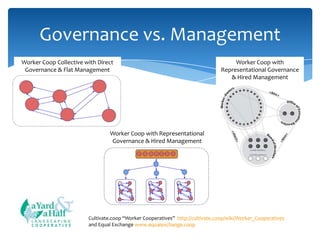
Governance vs. Management
Worker Coop Collective with Direct
Governance & Flat Management

Worker Coop with
Representational Governance
& Hired Management

Joint
Ownership

Democratic
Control

Worker Coop with Representational
Governance & Hired Management

Shared
Equity
Reserves

COOPERATIVE

Cooperative
Distribution
of Profits

Cultivate.coop “Worker Cooperatives” http://cultivate.coop/wiki/Worker_Cooperatives
and Equal Exchange www.equalexchange.coop
Getting Started
Options for Launching
a Worker-Cooperative

COOPERATIVE
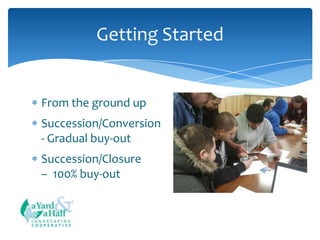
Getting Started

From the ground up
Succession/Conversion
- Gradual buy-out
Succession/Closure
– 100% buy-out

COOPERATIVE
From the Ground Up

Benefits
Equal footing - No seniority
Time for discernment
Lower start-up costs
Poor on paper

COOPERATIVE
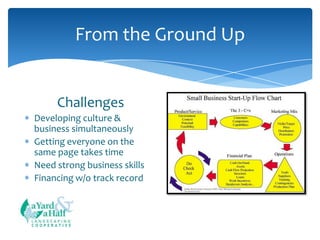
From the Ground Up

Challenges
Developing culture &
business simultaneously
Getting everyone on the
same page takes time
Need strong business skills
Financing w/o track record

COOPERATIVE
From the Ground Up
What You Need
Member commitment
Clear decision-making structure – who/what/how
Sound business plan w/ demonstrated market need
Internal & external resources (skills, labor, social capital, cash)
Business advisors who know coops (lawyer, accountant)
Ongoing member education

COOPERATIVE
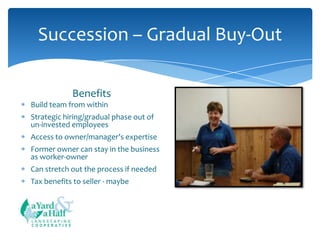
Succession – Gradual Buy-Out
Benefits
Build team from within
Strategic hiring/gradual phase out of
un-invested employees
Access to owner/manager’s expertise
Former owner can stay in the business
as worker-owner
Can stretch out the process if needed
Tax benefits to seller - maybe

COOPERATIVE
Succession – Gradual Buy-Out
Challenges
Personality conflicts if former
owner is top-down
Developing people, helping
owner get out of the way to
let others lead, while still
being present as a resource
Shifting habits, learning to
step up & speak up with
former boss

COOPERATIVE
Succession – Gradual Buy-Out
What You Need
Everything from “From the Ground Up,” plus:
Stable, committed workforce
Relatively open & democratic structure under former owner
Open & honest communication up and down throughout the
organization
Open books & transparency on part of the exiting owner
Independent valuation of the business and clear P&S
agreement early in the process

COOPERATIVE
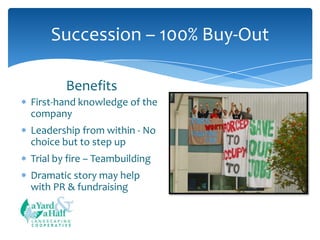
Succession – 100% Buy-Out
Benefits
First-hand knowledge of the
company

Leadership from within - No
choice but to step up
Trial by fire – Teambuilding

Dramatic story may help
with PR & fundraising

COOPERATIVE
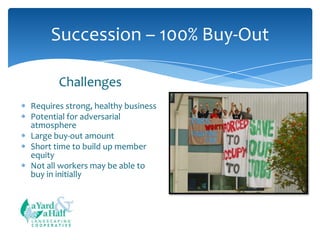
Succession – 100% Buy-Out
Challenges
Requires strong, healthy business
Potential for adversarial
atmosphere
Large buy-out amount
Short time to build up member
equity
Not all workers may be able to
buy in initially

COOPERATIVE
Succession – Gradual Buy-Out
What You Need
Everything from “Gradual Buy-Out” helps! Plus:
Core leadership group with strong management and operational skills
Early buy-in and trust from significant percentage of workers
Agreement about what will happen to owners who don’t want to become owners

Value for the cooperative purpose – ideally by both parties
Entrepreneurial spirit and energy
Good lawyers on both sides who are committed to help preserve the buyer/seller
relationship, if that is what is desired
Outside cooperative developer/ consultant especially helpful

COOPERATIVE
Lessons Learned
or “Hindsight is 20/20”

COOPERATIVE
Lessons Learned
Even if the owner intends to retire, structure the deal as a gradual buy-out.

Train everyone in democratic decision-making early-on. Agree about how decisions
will be made, and by whom, so that as you build your coop, you’re building
consensus, not resentments.
Focus on the soft skills: democratic participation, assertive communication,
addressing differences in race, class, gender, education level, immigration status
Get an independent valuation of the business early, including allocation of assets vs
intangibles (good will, customer lists, policies and procedures, logos, web
presence, intellectual property, etc.)
Seller should pay off all vehicles and equipment. Add these to the purchase price.
Even if your business has been operating successfully for years, do a new business
plan based on the cooperative’s goals and capacity.

Do cash flow projections, not just a budget.

COOPERATIVE
Where We Are Today
Funded over $600,000 for purchase and
working capital
Retired owner involved as non-voting board
member & mgmt consultant
Ongoing member education through
monthly big-picture meetings and 1:1 buddies
Training in democratic participation
Members engaged in committee work to
determine evaluation and compensation,
employee wellness programs, and member
development

COOPERATIVE
Next Steps
New England Co-op Networks
Valley Alliance of Worker Co-ops
Worker Owned and Run Co-op Network
of Greater Boston (WORC'N)

Larger Co-op Networks
International Cooperative Alliance
National Cooperative Business
Association
US Federation of Worker Cooperatives

COOPERATIVE

NE Technical Assistance Providers
CDS Cooperative
Cooperative Development Institute
Democracy At Work Network
ICA Group
Co-op News and Information Sources
American Worker Cooperative Blog
Grassroots Economic Organizing
Newsletter

Considering Cooperatives: Democratic Workplaces & Succession Planning

  • 1.
    Considering Cooperatives: Democratic Workplaces& Succession Planning Carolyn Edsell-Vetter, AOLCP President & Co-CEO A Yard & A Half Landscaping Cooperative, Inc. Waltham, MA COOPERATIVE
  • 2.
    Why are youhere?  Aspiring farmer or apprentice  Need land  Need capital (money)  Farmer or landscaper looking to retire  Owner who wants to go back to doing what you love -working in the business, rather than on the business  Social entrepreneur  Cooperative enthusiast  Other?? COOPERATIVE
  • 3.
    What do youwant to learn?  What are worker-owned cooperatives?  What is the cooperative movement all about?  When is a worker-coop an appropriate option for:     Joining together to raise capital and get access to land? Building local economies? Creating a more democratic workplace? Succession planning?  How can I start a coop or transition an existing privately-held business to a worker-owned cooperative?  What can I learn from the experience of other coop start-ups? COOPERATIVE
  • 4.
  • 5.
    Some Disclaimers… I amNOT a farmer. COOPERATIVE
  • 6.
    Some Disclaimers… I amNOT a farmer. Or a Coop developer. COOPERATIVE
  • 7.
    Some Disclaimers… I amNOT a farmer. Or a Coop developer. I like to weed.  COOPERATIVE
  • 8.
    So, why amI here? COOPERATIVE
  • 9.
    Access to Capital& Land Inherited Wealth Expansion Capital? Limited Production Viable Farmland Expansion Space? Limited Growth Apprentice Labor Progressive Wages? Loss of Skilled Labor YES Experienced Young Farmer with Access? NO CommercialScale Skilled Laborer Adapted from an essay at: https://medium.com/praxis-journal/ee5fd7fa9b3c
  • 10.
    What is aWorker-Cooperative? “A co-operative is an autonomous association of persons united voluntarily to meet their common economic, social, and cultural needs and aspirations through a jointlyowned and democraticallycontrolled enterprise.” COOPERATIVE Joint Ownership Shared Equity Reserves Democratic Control Cooperative Distribution of Profits
  • 11.
    What is aWorker-Cooperative? • Worker-owned – workers finance the coop together through an initial buy-in • Worker-controlled on basis of “One worker, one vote” • Workers share surplus • Worker-owner equity stays in the coop as working capital COOPERATIVE Joint Ownership Shared Equity Reserves Democratic Control Cooperative Distribution of Profits
  • 12.
  • 13.
    Why Worker-Cooperatives? • Accessibleto lower income owners • Shared start-up costs and risks • Employee buy-in and responsibility Joint Ownership Shared Equity Reserves COOPERATIVE Democratic Control Cooperative Distribution of Profits
  • 14.
    Why Worker-Cooperatives? • Accessibleto lower income owners • Shared start-up costs and risks • Employee buy-in and responsibility •Higher employee wellbeing and satisfaction •Professional growth & development Joint Ownership Shared Equity Reserves COOPERATIVE Democratic Control Cooperative Distribution of Profits
  • 15.
    Why Worker-Cooperatives? • Accessibleto lower income owners • Shared start-up costs and risks • Employee buy-in and responsibility •Higher employee wellbeing and satisfaction •Professional growth & development Joint Ownership Shared Equity Reserves COOPERATIVE Democratic Control Cooperative Distribution of Profits • Direct benefit from personal labor • Reinvestment in local economies • Stabilization of family & community
  • 16.
    Why Worker-Cooperatives? • Accessibleto lower income owners • Shared start-up costs and risks • Employee buy-in and responsibility • Working capital for seasonal business • Owner accounts “loan” capital for improvements and equipment COOPERATIVE •Higher employee wellbeing and satisfaction •Professional growth & development Joint Ownership Shared Equity Reserves Democratic Control Cooperative Distribution of Profits • Direct benefit from personal labor • Reinvestment in local economies • Stabilization of family & community
  • 17.
  • 18.
    7 Cooperative Principles 1.Voluntary and open membership A cooperatives is a voluntary organization, open to all people able to use its services and willing to accept the responsibilities of membership, without gender, social, racial, political or religious discrimination. COOPERATIVE
  • 19.
    7 Cooperative Principles 1.Voluntary and open membership 2. Democratic member control Cooperatives are democratic organizations controlled by their members—those who buy the goods or use the services of the cooperative—who actively participate in setting policies and making decisions. COOPERATIVE
  • 20.
    7 Cooperative Principles 1.Voluntary and open membership 2. Democratic member control 3. Members’ economic participation Members contribute equally to, and democratically control, the capital of the cooperative. This benefits members in proportion to the business they conduct with the cooperative rather than on the capital invested.
  • 21.
    7 Cooperative Principles 1. 2. 3. 4. Voluntaryand open membership Democratic member control Members’ economic participation Autonomy and independence Cooperatives are autonomous, self-help organizations controlled by their members. If the co-op enters into agreements with other organizations or raises capital from external sources, it is done so based on terms that ensure democratic control by the members and maintains the cooperative’s autonomy. COOPERATIVE
  • 22.
    7 Cooperative Principles 1. 2. 3. 4. 5. Voluntaryand open membership Democratic member control Members’ economic participation Autonomy and independence Education, training, and information Cooperatives provide education and training for members, elected representatives, managers and employees so they can contribute effectively to the development of their cooperative. Members also inform the general public about the nature and benefits of cooperatives. COOPERATIVE
  • 23.
    7 Cooperative Principles 1. 2. 3. 4. 5. 6. Voluntaryand open membership Democratic member control Members’ economic participation Autonomy and independence Education, training, and information Cooperation among cooperatives Cooperatives serve their members most effectively and strengthen the cooperative movement by working together through local, national, regional and international structures. COOPERATIVE
  • 24.
    7 Cooperative Principles 1. 2. 3. 4. 5. 6. 7. Voluntaryand open membership Democratic member control Members’ economic participation Autonomy and independence Education, training, and information Cooperation among cooperatives Concern for community While focusing on member needs, cooperatives work for the sustainable development of communities through policies and programs accepted by the members. COOPERATIVE
  • 25.
    Our Story A Yard& A Half Landscaping Cooperative, Inc. COOPERATIVE
  • 26.
  • 27.
  • 28.
  • 29.
  • 30.
    Why We WentCoop Succession Strategy Leaving a Legacy The Workers Become the Owners COOPERATIVE Joint Ownership Shared Equity Reserves Democratic Control Cooperative Distribution of Profits
  • 31.
  • 32.
    Incorporation & Governance Joint Ownership Shared Equity Reserves COOPERATIVE Democratic Control Cooperative Distribution ofProfits Edward W. De Barbieri and Brian Glick (2011). Legal Entity Options for Worker Cooperatives. Grassroots Economic Organizing (GEO) Newsletter, Volume 2, Issue 8. http://geo.coop/node/628
  • 33.
    Governance vs. Management WorkerCoop Collective with Direct Governance & Flat Management Worker Coop with Representational Governance & Hired Management Joint Ownership Democratic Control Worker Coop with Representational Governance & Hired Management Shared Equity Reserves COOPERATIVE Cooperative Distribution of Profits Cultivate.coop “Worker Cooperatives” http://cultivate.coop/wiki/Worker_Cooperatives and Equal Exchange www.equalexchange.coop
  • 34.
    Getting Started Options forLaunching a Worker-Cooperative COOPERATIVE
  • 35.
    Getting Started From theground up Succession/Conversion - Gradual buy-out Succession/Closure – 100% buy-out COOPERATIVE
  • 36.
    From the GroundUp Benefits Equal footing - No seniority Time for discernment Lower start-up costs Poor on paper COOPERATIVE
  • 37.
    From the GroundUp Challenges Developing culture & business simultaneously Getting everyone on the same page takes time Need strong business skills Financing w/o track record COOPERATIVE
  • 38.
    From the GroundUp What You Need Member commitment Clear decision-making structure – who/what/how Sound business plan w/ demonstrated market need Internal & external resources (skills, labor, social capital, cash) Business advisors who know coops (lawyer, accountant) Ongoing member education COOPERATIVE
  • 39.
    Succession – GradualBuy-Out Benefits Build team from within Strategic hiring/gradual phase out of un-invested employees Access to owner/manager’s expertise Former owner can stay in the business as worker-owner Can stretch out the process if needed Tax benefits to seller - maybe COOPERATIVE
  • 40.
    Succession – GradualBuy-Out Challenges Personality conflicts if former owner is top-down Developing people, helping owner get out of the way to let others lead, while still being present as a resource Shifting habits, learning to step up & speak up with former boss COOPERATIVE
  • 41.
    Succession – GradualBuy-Out What You Need Everything from “From the Ground Up,” plus: Stable, committed workforce Relatively open & democratic structure under former owner Open & honest communication up and down throughout the organization Open books & transparency on part of the exiting owner Independent valuation of the business and clear P&S agreement early in the process COOPERATIVE
  • 42.
    Succession – 100%Buy-Out Benefits First-hand knowledge of the company Leadership from within - No choice but to step up Trial by fire – Teambuilding Dramatic story may help with PR & fundraising COOPERATIVE
  • 43.
    Succession – 100%Buy-Out Challenges Requires strong, healthy business Potential for adversarial atmosphere Large buy-out amount Short time to build up member equity Not all workers may be able to buy in initially COOPERATIVE
  • 44.
    Succession – GradualBuy-Out What You Need Everything from “Gradual Buy-Out” helps! Plus: Core leadership group with strong management and operational skills Early buy-in and trust from significant percentage of workers Agreement about what will happen to owners who don’t want to become owners Value for the cooperative purpose – ideally by both parties Entrepreneurial spirit and energy Good lawyers on both sides who are committed to help preserve the buyer/seller relationship, if that is what is desired Outside cooperative developer/ consultant especially helpful COOPERATIVE
  • 45.
    Lessons Learned or “Hindsightis 20/20” COOPERATIVE
  • 46.
    Lessons Learned Even ifthe owner intends to retire, structure the deal as a gradual buy-out. Train everyone in democratic decision-making early-on. Agree about how decisions will be made, and by whom, so that as you build your coop, you’re building consensus, not resentments. Focus on the soft skills: democratic participation, assertive communication, addressing differences in race, class, gender, education level, immigration status Get an independent valuation of the business early, including allocation of assets vs intangibles (good will, customer lists, policies and procedures, logos, web presence, intellectual property, etc.) Seller should pay off all vehicles and equipment. Add these to the purchase price. Even if your business has been operating successfully for years, do a new business plan based on the cooperative’s goals and capacity. Do cash flow projections, not just a budget. COOPERATIVE
  • 47.
    Where We AreToday Funded over $600,000 for purchase and working capital Retired owner involved as non-voting board member & mgmt consultant Ongoing member education through monthly big-picture meetings and 1:1 buddies Training in democratic participation Members engaged in committee work to determine evaluation and compensation, employee wellness programs, and member development COOPERATIVE
  • 48.
    Next Steps New EnglandCo-op Networks Valley Alliance of Worker Co-ops Worker Owned and Run Co-op Network of Greater Boston (WORC'N) Larger Co-op Networks International Cooperative Alliance National Cooperative Business Association US Federation of Worker Cooperatives COOPERATIVE NE Technical Assistance Providers CDS Cooperative Cooperative Development Institute Democracy At Work Network ICA Group Co-op News and Information Sources American Worker Cooperative Blog Grassroots Economic Organizing Newsletter