Presentation to the Bank of America 2022 Defense Outlook
and Commercial Aerospace Forum
January 5, 2022
Eric J. Labs
National Security Division
The 2022 Outlook for Navy Shipbuilding:
An Uncertain Course for the Future Fleet
1
Relevant Reports by CBO
2
▪ Congressional Support for Shipbuilding
▪ Recent Navy Force Structure Assessments and Shipbuilding Plans
▪ Paying for the Navy’s Shipbuilding Plans
▪ Issues Concerning the Shipbuilding Industrial Base
Prospects for Building a Larger Fleet
3
Congressional Support for Shipbuilding
4
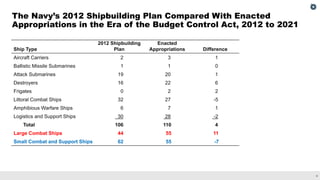
The Navy’s 2012 Shipbuilding Plan Compared With Enacted
Appropriations in the Era of the Budget Control Act, 2012 to 2021
Ship Type
2012 Shipbuilding
Plan
Enacted
Appropriations Difference
Aircraft Carriers 2 3 1
Ballistic Missile Submarines 1 1 0
Attack Submarines 19 20 1
Destroyers 16 22 6
Frigates 0 2 2
Littoral Combat Ships 32 27 -5
Amphibious Warfare Ships 6 7 1
Logistics and Support Ships 30 28 -2
Total 106 110 4
Large Combat Ships 44 55 11
Small Combat and Support Ships 62 55 -7
5
Figures for the HAC-D and SAC-D represent the amounts for shipbuilding in their respective appropriations, as ordered reported out of committee earlier this year.
HAC-D = House Appropriations Committee, Defense Appropriations Subcommittee; NDAA = National Defense Authorization Act for 2022; SAC-D = Senate Appropriations Committee,
Defense Appropriations Subcommittee.
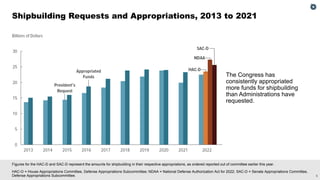
Shipbuilding Requests and Appropriations, 2013 to 2021
The Congress has
consistently appropriated
more funds for shipbuilding
than Administrations have
requested.
6
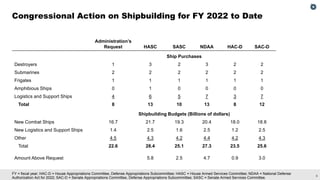
FY = fiscal year; HAC-D = House Appropriations Committee, Defense Appropriations Subcommittee; HASC = House Armed Services Committee; NDAA = National Defense
Authorization Act for 2022; SAC-D = Senate Appropriations Committee, Defense Appropriations Subcommittee; SASC = Senate Armed Services Committee.
Administration’s
Request HASC SASC NDAA HAC-D SAC-D
Ship Purchases
Destroyers 1 3 2 3 2 2
Submarines 2 2 2 2 2 2
Frigates 1 1 1 1 1 1
Amphibious Ships 0 1 0 0 0 0
Logistics and Support Ships 4 6 5 7 3 7
Total 8 13 10 13 8 12
Shipbuilding Budgets (Billions of dollars)
New Combat Ships 16.7 21.7 19.3 20.4 18.0 18.8
New Logistics and Support Ships 1.4 2.5 1.6 2.5 1.2 2.5
Other 4.5 4.3 4.2 4.4 4.2 4.3
Total 22.6 28.4 25.1 27.3 23.5 25.6
Amount Above Request 5.8 2.5 4.7 0.9 3.0
Congressional Action on Shipbuilding for FY 2022 to Date
7
Recent Navy Force Structure
Assessments and Shipbuilding Plans
8
FY = fiscal year.
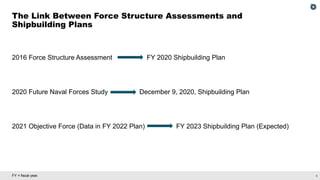
2016 Force Structure Assessment FY 2020 Shipbuilding Plan
2020 Future Naval Forces Study December 9, 2020, Shipbuilding Plan
2021 Objective Force (Data in FY 2022 Plan) FY 2023 Shipbuilding Plan (Expected)
The Link Between Force Structure Assessments and
Shipbuilding Plans
9
FNFS = Future Naval Forces Study; FSA = Force Structure Assessment; FY = fiscal year; n.a. = not applicable.
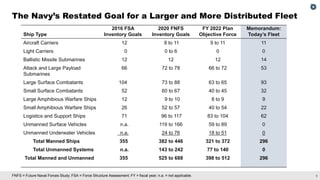
The Navy’s Restated Goal for a Larger and More Distributed Fleet
Ship Type
2016 FSA
Inventory Goals
2020 FNFS
Inventory Goals
FY 2022 Plan
Objective Force
Memorandum:
Today’s Fleet
Aircraft Carriers 12 8 to 11 9 to 11 11
Light Carriers 0 0 to 6 0 0
Ballistic Missile Submarines 12 12 12 14
Attack and Large Payload
Submarines
66 72 to 78 66 to 72 53
Large Surface Combatants 104 73 to 88 63 to 65 93
Small Surface Combatants 52 60 to 67 40 to 45 32
Large Amphibious Warfare Ships 12 9 to 10 8 to 9 9
Small Amphibious Warfare Ships 26 52 to 57 40 to 54 22
Logistics and Support Ships 71 96 to 117 83 to 104 62
Unmanned Surface Vehicles n.a. 119 to 166 59 to 89 0
Unmanned Underwater Vehicles n.a. 24 to 76 18 to 51 0
Total Manned Ships 355 382 to 446 321 to 372 296
Total Unmanned Systems n.a. 143 to 242 77 to 140 0
Total Manned and Unmanned 355 525 to 688 398 to 512 296
10
Source: Congressional Budget Office, An Analysis of the Navy’s Fiscal Year 2020 Shipbuilding Plan (October 2019), www.cbo.gov/publication/55685.
FY = fiscal year; SSBNs = ballistic missile submarines; SSGNs = guided missile submarines.
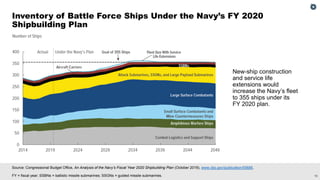
Inventory of Battle Force Ships Under the Navy’s FY 2020
Shipbuilding Plan
New-ship construction
and service life
extensions would
increase the Navy’s fleet
to 355 ships under its
FY 2020 plan.
11
Source: Congressional Budget Office, An Analysis of the Navy’s December 2020 Shipbuilding Plan (April 2021), www.cbo.gov/publication/57091.
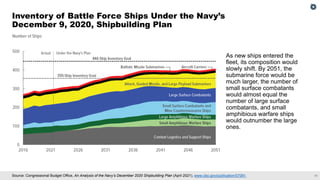
Inventory of Battle Force Ships Under the Navy’s
December 9, 2020, Shipbuilding Plan
As new ships entered the
fleet, its composition would
slowly shift. By 2051, the
submarine force would be
much larger, the number of
small surface combatants
would almost equal the
number of large surface
combatants, and small
amphibious warfare ships
would outnumber the large
ones.
12
Source: Congressional Budget Office, An Analysis of the Navy’s Fiscal Year 2022 Shipbuilding Plan (September 2021), www.cbo.gov/publication/57414. FY = fiscal year.
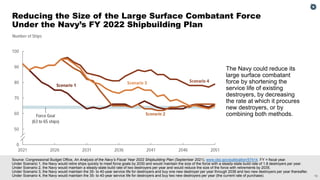
Under Scenario 1, the Navy would retire ships quickly to meet force goals by 2030 and would maintain the size of the force with a steady-state build rate of 1.8 destroyers per year.
Under Scenario 2, the Navy would maintain a steady-state build rate of two destroyers per year and would reduce the size of the force with retirements by 2035.
Under Scenario 3, the Navy would maintain the 35- to 40-year service life for destroyers and buy one new destroyer per year through 2036 and two new destroyers per year thereafter.
Under Scenario 4, the Navy would maintain the 35- to 40-year service life for destroyers and buy two new destroyers per year (the current rate of purchase).
Reducing the Size of the Large Surface Combatant Force
Under the Navy’s FY 2022 Shipbuilding Plan
The Navy could reduce its
large surface combatant
force by shortening the
service life of existing
destroyers, by decreasing
the rate at which it procures
new destroyers, or by
combining both methods.
13
Source: Congressional Budget Office, An Analysis of the Navy’s Fiscal Year 2022 Shipbuilding Plan (September 2021), www.cbo.gov/publication/57414.
FY = fiscal year.
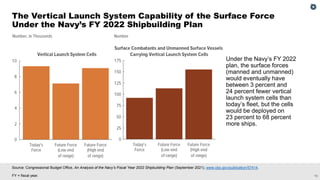
The Vertical Launch System Capability of the Surface Force
Under the Navy’s FY 2022 Shipbuilding Plan
Under the Navy’s FY 2022
plan, the surface forces
(manned and unmanned)
would eventually have
between 3 percent and
24 percent fewer vertical
launch system cells than
today’s fleet, but the cells
would be deployed on
23 percent to 68 percent
more ships.
14
DDG(X) = new guided missile destroyer; FY = fiscal year.
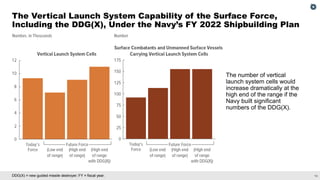
The Vertical Launch System Capability of the Surface Force,
Including the DDG(X), Under the Navy’s FY 2022 Shipbuilding Plan
The number of vertical
launch system cells would
increase dramatically at the
high end of the range if the
Navy built significant
numbers of the DDG(X).
15
Paying for the Navy’s Shipbuilding Plans
16
FY = fiscal year.
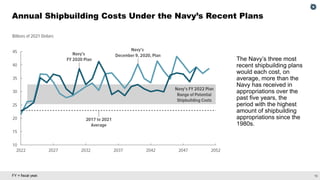
Annual Shipbuilding Costs Under the Navy’s Recent Plans
The Navy’s three most
recent shipbuilding plans
would each cost, on
average, more than the
Navy has received in
appropriations over the
past five years, the
period with the highest
amount of shipbuilding
appropriations since the
1980s.
17
Source: Congressional Budget Office, An Analysis of the Navy’s Fiscal Year 2022 Shipbuilding Plan (September 2021), www.cbo.gov/publication/57414.
FY = fiscal year; n.a. = not applicable.
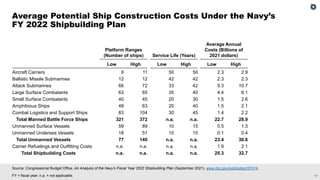
Average Potential Ship Construction Costs Under the Navy’s
FY 2022 Shipbuilding Plan
Platform Ranges
(Number of ships) Service Life (Years)
Average Annual
Costs (Billions of
2021 dollars)
Low High Low High Low High
Aircraft Carriers 9 11 50 50 2.3 2.9
Ballistic Missile Submarines 12 12 42 42 2.3 2.3
Attack Submarines 66 72 33 42 9.3 10.7
Large Surface Combatants 63 65 35 40 4.4 6.1
Small Surface Combatants 40 45 20 30 1.5 2.6
Amphibious Ships 48 63 20 40 1.5 2.1
Combat Logistics and Support Ships 83 104 30 45 1.4 2.2
Total Manned Battle Force Ships 321 372 n.a. n.a. 22.7 28.9
Unmanned Surface Vessels 59 89 10 15 0.5 1.3
Unmanned Undersea Vessels 18 51 10 15 0.1 0.4
Total Unmanned Vessels 77 140 n.a. n.a. 23.4 30.6
Carrier Refuelings and Outfitting Costs n.a. n.a. n.a. n.a. 1.9 2.1
Total Shipbuilding Costs n.a. n.a. n.a. n.a. 25.3 32.7
18
CG = guided missile cruiser; DD = destroyer; DDG = guided missile destroyer; DDG(X) = new guided missile destroyer; FFG(X) = new guided missile frigate; Flt = flight;
NRE = nonrecurring engineering (the onetime costs associated with developing the specific design of a ship or specific components).
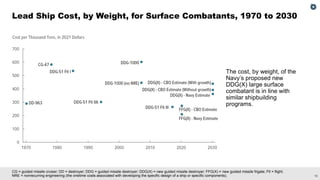
Lead Ship Cost, by Weight, for Surface Combatants, 1970 to 2030
The cost, by weight, of the
Navy’s proposed new
DDG(X) large surface
combatant is in line with
similar shipbuilding
programs.
19
SSBN = ballistic missile submarine; SSN = nuclear-powered attack submarine; SSN(X) = new nuclear-powered attack submarine.
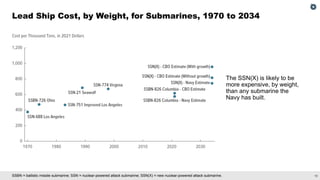
Lead Ship Cost, by Weight, for Submarines, 1970 to 2034
The SSN(X) is likely to be
more expensive, by weight,
than any submarine the
Navy has built.
20
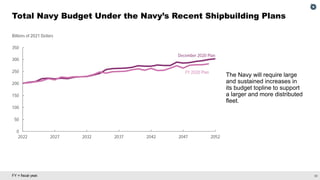
FY = fiscal year.
Total Navy Budget Under the Navy’s Recent Shipbuilding Plans
The Navy will require large
and sustained increases in
its budget topline to support
a larger and more distributed
fleet.
21
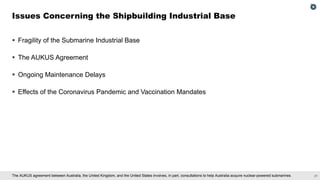
The AUKUS agreement between Australia, the United Kingdom, and the United States involves, in part, consultations to help Australia acquire nuclear-powered submarines.
▪ Fragility of the Submarine Industrial Base
▪ The AUKUS Agreement
▪ Ongoing Maintenance Delays
▪ Effects of the Coronavirus Pandemic and Vaccination Mandates
Issues Concerning the Shipbuilding Industrial Base