Presentation at the David Rogers Health Policy Colloquium,
Weill Cornell Medicine
March 20, 2024
Chapin White
Health Analysis Division
CBO’s Work on Health Care and
a Call for New Research
For more information about the colloquium, see https://weill.cornell.edu/rogers.
1
▪ A Brief Introduction to the Congressional Budget Office
▪ Health Care and the Federal Budget
▪ A Puzzle: The Recent Slowdown in Federal Health Care Spending
▪ A Call for New Research and Tools
Topics Covered in This Presentation
2
A Brief Introduction to the
Congressional Budget Office
3
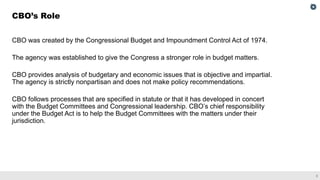
CBO was created by the Congressional Budget and Impoundment Control Act of 1974.
The agency was established to give the Congress a stronger role in budget matters.
CBO provides analysis of budgetary and economic issues that is objective and impartial.
The agency is strictly nonpartisan and does not make policy recommendations.
CBO follows processes that are specified in statute or that it has developed in concert
with the Budget Committees and Congressional leadership. CBO’s chief responsibility
under the Budget Act is to help the Budget Committees with the matters under their
jurisdiction.
CBO’s Role
4
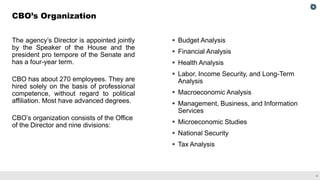
CBO’s Organization
The agency’s Director is appointed jointly
by the Speaker of the House and the
president pro tempore of the Senate and
has a four-year term.
CBO has about 270 employees. They are
hired solely on the basis of professional
competence, without regard to political
affiliation. Most have advanced degrees.
CBO’s organization consists of the Office
of the Director and nine divisions:
▪ Budget Analysis
▪ Financial Analysis
▪ Health Analysis
▪ Labor, Income Security, and Long-Term
Analysis
▪ Macroeconomic Analysis
▪ Management, Business, and Information
Services
▪ Microeconomic Studies
▪ National Security
▪ Tax Analysis
5
Health Care and the Federal Budget
6
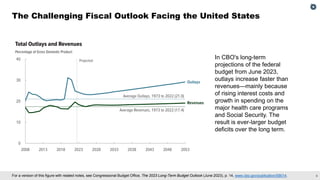
For a version of this figure with related notes, see Congressional Budget Office, The 2023 Long-Term Budget Outlook (June 2023), p. 14, www.cbo.gov/publication/59014.
The Challenging Fiscal Outlook Facing the United States
In CBO's long-term
projections of the federal
budget from June 2023,
outlays increase faster than
revenues—mainly because
of rising interest costs and
growth in spending on the
major health care programs
and Social Security. The
result is ever-larger budget
deficits over the long term.
7
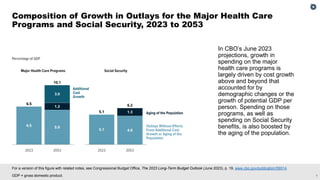
For a version of this figure with related notes, see Congressional Budget Office, The 2023 Long-Term Budget Outlook (June 2023), p. 19, www.cbo.gov/publication/59014.
GDP = gross domestic product.
Composition of Growth in Outlays for the Major Health Care
Programs and Social Security, 2023 to 2053
In CBO’s June 2023
projections, growth in
spending on the major
health care programs is
largely driven by cost growth
above and beyond that
accounted for by
demographic changes or the
growth of potential GDP per
person. Spending on those
programs, as well as
spending on Social Security
benefits, is also boosted by
the aging of the population.
8
For a version of this figure with related notes, see Congressional Budget Office, Federal Subsidies for Health Insurance: 2023 to 2033 (September 2023), p. 2,
www.cbo.gov/publication/59273.
CHIP = Children’s Health Insurance Program; GDP = gross domestic product; JCT = staff of the Joint Committee on Taxation.
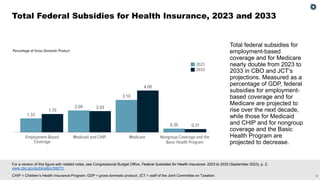
Total Federal Subsidies for Health Insurance, 2023 and 2033
Total federal subsidies for
employment-based
coverage and for Medicare
nearly double from 2023 to
2033 in CBO and JCT’s
projections. Measured as a
percentage of GDP, federal
subsidies for employment-
based coverage and for
Medicare are projected to
rise over the next decade,
while those for Medicaid
and CHIP and for nongroup
coverage and the Basic
Health Program are
projected to decrease.
9
For a version of this table with related notes, see Congressional Budget Office, Federal Budgetary Effects of the Activities of the Center for Medicare & Medicaid Innovation
(September 2023), p. 9, www.cbo.gov/publication/59274.
CMMI = The Center for Medicare & Medicaid Innovation.
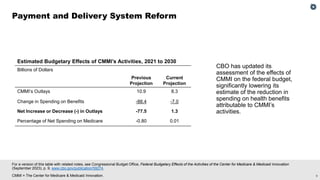
Payment and Delivery System Reform
CBO has updated its
assessment of the effects of
CMMI on the federal budget,
significantly lowering its
estimate of the reduction in
spending on health benefits
attributable to CMMI’s
activities.
Estimated Budgetary Effects of CMMI’s Activities, 2021 to 2030
Billions of Dollars
Previous
Projection
Current
Projection
CMMI’s Outlays 10.9 8.3
Change in Spending on Benefits -88.4 -7.0
Net Increase or Decrease (-) in Outlays -77.5 1.3
Percentage of Net Spending on Medicare -0.80 0.01
10
For a version of this table with related notes, see Congressional Budget Office, Budgetary Effects of Policies to Modify or Eliminate Medicaid’s Institutions for Mental Diseases
Exclusion (April 2023), p. 6, www.cbo.gov/publication/58962.
IMDs = institutions for mental diseases; SUD = substance use disorder; SUPPORT Act = The Substance Use-Disorder Prevention that Promotes Opioid Recovery and Treatment for
Patients and Communities Act, Public Law 115-271.
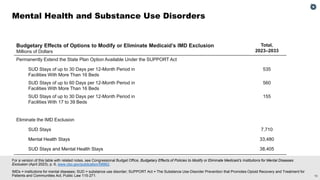
Mental Health and Substance Use Disorders
Budgetary Effects of Options to Modify or Eliminate Medicaid’s IMD Exclusion
Millions of Dollars
Total,
2023–2033
Permanently Extend the State Plan Option Available Under the SUPPORT Act
SUD Stays of up to 30 Days per 12-Month Period in
Facilities With More Than 16 Beds
535
SUD Stays of up to 60 Days per 12-Month Period in
Facilities With More Than 16 Beds
560
SUD Stays of up to 30 Days per 12-Month Period in
Facilities With 17 to 39 Beds
155
Eliminate the IMD Exclusion
SUD Stays 7,710
Mental Health Stays 33,480
SUD Stays and Mental Health Stays 38,405
11
For a version of this figure with related notes, see slide number 34 in Congressional Budget Office, “How CBO Estimated the Budgetary Impact of Key Prescription Drug Provisions in
the 2022 Reconciliation Act” (February 2023), www.cbo.gov/publication/58850.
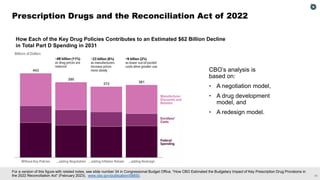
Prescription Drugs and the Reconciliation Act of 2022
How Each of the Key Drug Policies Contributes to an Estimated $62 Billion Decline
in Total Part D Spending in 2031
CBO’s analysis is
based on:
• A negotiation model,
• A drug development
model, and
• A redesign model.
12
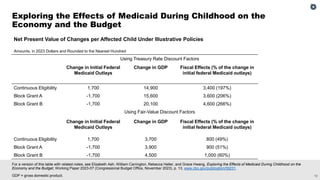
For a version of this table with related notes, see Elizabeth Ash, William Carrington, Rebecca Heller, and Grace Hwang, Exploring the Effects of Medicaid During Childhood on the
Economy and the Budget, Working Paper 2023-07 (Congressional Budget Office, November 2023), p. 13, www.cbo.gov/publication/59231.
GDP = gross domestic product.
Exploring the Effects of Medicaid During Childhood on the
Economy and the Budget
Net Present Value of Changes per Affected Child Under Illustrative Policies
Amounts, in 2023 Dollars and Rounded to the Nearest Hundred
Using Treasury Rate Discount Factors
Change in Initial Federal
Medicaid Outlays
Change in GDP Fiscal Effects (% of the change in
initial federal Medicaid outlays)
Continuous Eligibility 1,700 14,900 3,400 (197%)
Block Grant A -1,700 15,600 3,600 (206%)
Block Grant B -1,700 20,100 4,600 (266%)
Using Fair-Value Discount Factors
Change in Initial Federal
Medicaid Outlays
Change in GDP Fiscal Effects (% of the change in
initial federal Medicaid outlays)
Continuous Eligibility 1,700 3,700 800 (49%)
Block Grant A -1,700 3,900 900 (51%)
Block Grant B -1,700 4,500 1,000 (60%)
13
A Puzzle: The Recent Slowdown in
Federal Health Care Spending
14
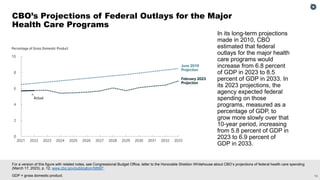
For a version of this figure with related notes, see Congressional Budget Office, letter to the Honorable Sheldon Whitehouse about CBO’s projections of federal health care spending
(March 17, 2023), p. 12, www.cbo.gov/publication/58997.
GDP = gross domestic product.
CBO’s Projections of Federal Outlays for the Major
Health Care Programs
In its long-term projections
made in 2010, CBO
estimated that federal
outlays for the major health
care programs would
increase from 6.8 percent
of GDP in 2023 to 8.5
percent of GDP in 2033. In
its 2023 projections, the
agency expected federal
spending on those
programs, measured as a
percentage of GDP, to
grow more slowly over that
10-year period, increasing
from 5.8 percent of GDP in
2023 to 6.9 percent of
GDP in 2033.
15
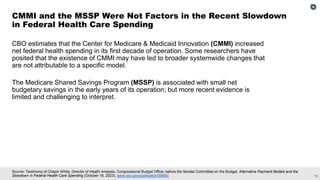
Source: Testimony of Chapin White, Director of Health Analysis, Congressional Budget Office, before the Senate Committee on the Budget, Alternative Payment Models and the
Slowdown in Federal Health Care Spending (October 18, 2023), www.cbo.gov/publication/59660.
CBO estimates that the Center for Medicare & Medicaid Innovation (CMMI) increased
net federal health spending in its first decade of operation. Some researchers have
posited that the existence of CMMI may have led to broader systemwide changes that
are not attributable to a specific model.
The Medicare Shared Savings Program (MSSP) is associated with small net
budgetary savings in the early years of its operation; but more recent evidence is
limited and challenging to interpret.
CMMI and the MSSP Were Not Factors in the Recent Slowdown
in Federal Health Care Spending
16
Data source: Centers for Medicare & Medicaid Services, “National Health Expenditure Data: NHE Summary, Including Share of GDP, CY 1960–2022 (ZIP)” (December 13, 2023),
https://www.cms.gov/files/zip/nhe-summary-including-share-gdp-cy-1960-2022.zip.
GDP = gross domestic product.
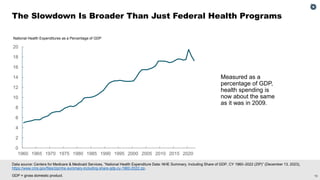
The Slowdown Is Broader Than Just Federal Health Programs
Measured as a
percentage of GDP,
health spending is
now about the same
as it was in 2009.
0
2
4
6
8
10
12
14
16
18
20
1960 1965 1970 1975 1980 1985 1990 1995 2000 2005 2010 2015 2020
National Health Expenditures as a Percentage of GDP
17
A Call for New Research and Tools
18
a. Congressional Budget Office, letter to the Honorable Sheldon Whitehouse about CBO’s projections of federal health care spending (March 17, 2023),
www.cbo.gov/publication/58997.
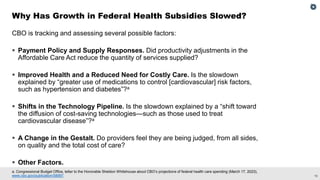
CBO is tracking and assessing several possible factors:
▪ Payment Policy and Supply Responses. Did productivity adjustments in the
Affordable Care Act reduce the quantity of services supplied?
▪ Improved Health and a Reduced Need for Costly Care. Is the slowdown
explained by “greater use of medications to control [cardiovascular] risk factors,
such as hypertension and diabetes”?a
▪ Shifts in the Technology Pipeline. Is the slowdown explained by a “shift toward
the diffusion of cost-saving technologies—such as those used to treat
cardiovascular disease”?a
▪ A Change in the Gestalt. Do providers feel they are being judged, from all sides,
on quality and the total cost of care?
▪ Other Factors.
Why Has Growth in Federal Health Subsidies Slowed?
19
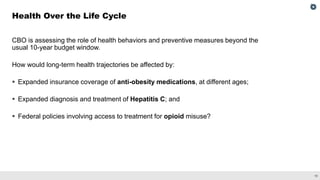
CBO is assessing the role of health behaviors and preventive measures beyond the
usual 10-year budget window.
How would long-term health trajectories be affected by:
▪ Expanded insurance coverage of anti-obesity medications, at different ages;
▪ Expanded diagnosis and treatment of Hepatitis C; and
▪ Federal policies involving access to treatment for opioid misuse?
Health Over the Life Cycle
20
CBO is assessing:
▪ The role of federal policy.
– Policies pushing providers out of independent practice.
– Policies pulling providers into larger systems.
▪ The role of factors outside of federal policy.
▪ Impacts on:
– Prices,
– Site of care, and
– Utilization patterns.
Provider Consolidation
21
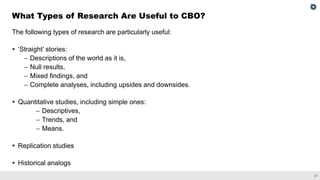
The following types of research are particularly useful:
▪ ‘Straight’ stories:
– Descriptions of the world as it is,
– Null results,
– Mixed findings, and
– Complete analyses, including upsides and downsides.
▪ Quantitative studies, including simple ones:
– Descriptives,
– Trends, and
– Means.
▪ Replication studies
▪ Historical analogs
What Types of Research Are Useful to CBO?
22
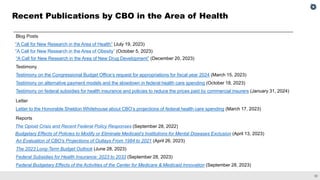
Recent Publications by CBO in the Area of Health
Blog Posts
“A Call for New Research in the Area of Health” (July 19, 2023)
“A Call for New Research in the Area of Obesity” (October 5, 2023)
“A Call for New Research in the Area of New Drug Development” (December 20, 2023)
Testimony
Testimony on the Congressional Budget Office’s request for appropriations for fiscal year 2024 (March 15, 2023)
Testimony on alternative payment models and the slowdown in federal health care spending (October 18, 2023)
Testimony on federal subsidies for health insurance and policies to reduce the prices paid by commercial insurers (January 31, 2024)
Letter
Letter to the Honorable Sheldon Whitehouse about CBO’s projections of federal health care spending (March 17, 2023)
Reports
The Opioid Crisis and Recent Federal Policy Responses (September 28, 2022)
Budgetary Effects of Policies to Modify or Eliminate Medicaid’s Institutions for Mental Diseases Exclusion (April 13, 2023)
An Evaluation of CBO’s Projections of Outlays From 1984 to 2021 (April 26, 2023)
The 2023 Long-Term Budget Outlook (June 28, 2023)
Federal Subsidies for Health Insurance: 2023 to 2033 (September 28, 2023)
Federal Budgetary Effects of the Activities of the Center for Medicare & Medicaid Innovation (September 28, 2023)
23
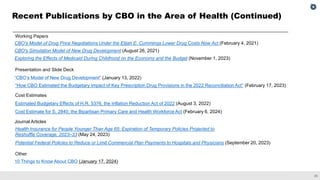
Recent Publications by CBO in the Area of Health (Continued)
Working Papers
CBO’s Model of Drug Price Negotiations Under the Elijah E. Cummings Lower Drug Costs Now Act (February 4, 2021)
CBO's Simulation Model of New Drug Development (August 26, 2021)
Exploring the Effects of Medicaid During Childhood on the Economy and the Budget (November 1, 2023)
Presentation and Slide Deck
“CBO’s Model of New Drug Development” (January 13, 2022)
“How CBO Estimated the Budgetary Impact of Key Prescription Drug Provisions in the 2022 Reconciliation Act” (February 17, 2023)
Cost Estimates
Estimated Budgetary Effects of H.R. 5376, the Inflation Reduction Act of 2022 (August 3, 2022)
Cost Estimate for S. 2840, the Bipartisan Primary Care and Health Workforce Act (February 6, 2024)
Journal Articles
Health Insurance for People Younger Than Age 65: Expiration of Temporary Policies Projected to
Reshuffle Coverage, 2023–33 (May 24, 2023)
Potential Federal Policies to Reduce or Limit Commercial Plan Payments to Hospitals and Physicians (September 20, 2023)
Other
10 Things to Know About CBO (January 17, 2024)
24
Non-CBO Publications
Philip G. Joyce, The Congressional Budget Office: Honest Numbers, Power, and Policymaking (Georgetown University
Press, 2011) https://press.georgetown.edu/Book/The-Congressional-Budget-Office.
Micah Hartman and others, “National Health Care Spending in 2022: Growth Similar to Prepandemic Rates,” Health Affairs,
vol. 43, no. 1 (December 2023), pp. 6–17, https://tinyurl.com/nzhfa47t.