



Personal Branding: The
Essential Key to a
Successful Job Search.
Greg David, President
Laka & Company
What personal branding is
NOT!
• Defining yourself by TITLE or
DEPARTMENT.
– Example: I am an accountant.
– Example: I am a computer programmer.
– Example: I am in sales.
– Example: I am an attorney.
What personal branding IS:
• Defining SME to capture attention,
create value, and define a critical
positive impact that you make.
– It is specific.
– It is positive in emotion.
– It is desirable for others to have.
– It makes your competition less desirable.
What personal branding IS:
• It consists of many small and not so
small items, it intertwines, and creates
an identity that you wish others to know
you for.
• Everything counts! Nothing is too small!
From your email address, to your
resume file name, to the online footprint
you manufacture. IT ALL COUNTS!
What personal branding IS:
• Branding is making yourself:
– RELEVANT to others.
– DESIRABLE to others.
– DIFFERENT than your ‘competition’.
The old search process. 
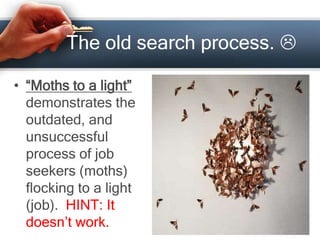
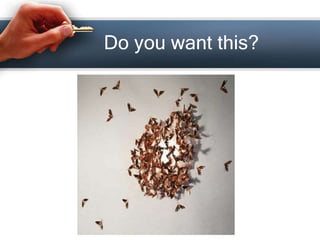
• “Moths to a light”
demonstrates the
outdated, and
unsuccessful
process of job
seekers (moths)
flocking to a light
(job). HINT: It
doesn’t work.
The new search process! 
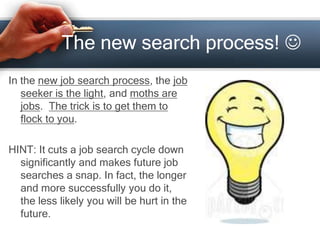
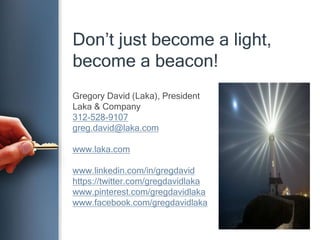
In the new job search process, the job
seeker is the light, and moths are
jobs. The trick is to get them to
flock to you.
HINT: It cuts a job search cycle down
significantly and makes future job
searches a snap. In fact, the longer
and more successfully you do it,
the less likely you will be hurt in the
future.
Personal Branding
BASICS: Where to start.
Defining Your BRAND.
• Who are you AND what do you do?
• Define Subject Matter Expertise (SME) ?
• What impact on others does it have?
• What pain do you eliminate?
• What benefit do you create?
• How do you help save time or money?
• How do you increase revenue or
profitability?
» Write down these bullets quickly!
Exercise One: Brainstorming.
• Use a legal pad to write down as many
answers to the questions on the previous
slide. Fill as many pages as you can.
Write quickly.
• You will need to do multiple drafts to make
your words and thoughts meaningful.
Write, define, refine.
» Challenge: Can you fill 10 pages? 20?
Exercise Two: Defining Your Market.
• What geographic markets need you?
• What industries need you?
• What size organizations need you?
• What organizations need you?
• What departments need you?
• What roles need you?
» You’ll need to research!
Exercise Three: Defining Your
Advantages.
• What is your SME (Subject Matter
Expertise)?
• How does it directly affect: increased
profit, customer satisfaction,
customer loyalty, improved revenue,
market share, lower costs, or
entrance into new markets?
» Advantages are skills.
Defining Your Weaknesses
• Comparatively---to others who do what you do-
---how are you poorly positioned?
– Years of experience?
– Cost?
– Risk of turnover or stagnation?
– Performance? Ease of managing?
– Ability to learn?
– Flexibility? Adaptability? Desire to grow?
– Past observed shortcomings?
– Are you a ‘moldable piece of clay’ or a ‘weed’?
» Weaknesses are bad habits.
An exercise NOT for the weak
BUT the STRONG!
• Contact multiple prior managers for real and
honest feedback to improve yourself, and the
value you bring to the table.
• Go to work on those issues immediately, and
be able to show tangible corrective action
taken.
• Stay with it for a minimum of one year or until it
becomes part of a NEW you.
Defining Your STRENGTHS.
• Comparatively---to others who do what you do-
---how are you PROPERLY positioned?
– Years of experience? Cost?
– Able to act as a ‘catalyst of change’?
– Performance? Past achievements?
– What are you learning at a rapid rate of speed?
– Flexibility? Adaptability? Desire to grow?
– How are you a ‘moldable piece of clay’ & not a
‘weed’?
» Strengths are a mix of positive competitive positioning and
positive habits.
Defining Your Tools
• Word based.
• Paper based.
• Media based.
• Technology based.
• Examples of work/portfolio based.
• Web based.
BRING Clear Substance
Quickly (CSQ):
• How easy is it for others to get their
questions answered about you?
• How well do you communicate?
• How quickly do you provide
substance that matters to others?
Defining WORD based
BRANDING.
• THINK: VERBAL & WRITTEN:
– Elevator speech.
– Value statement.
– Mission statement.
– Subject Matter Expertise (SME).
– Biography. Articles or books written.
– Speaking engagements.
Defining PAPER based BRANDING.
• THINK:
– Business cards. Handbills. Resumes.
– White papers, SME documentation.
– Articles written about you, items authored, etc.
– Examples of work.
– Positive past employment reviews. Awards.
– Certifications.
Defining MEDIA based BRANDING.
• THINK:
– CD’s.
– DVD’s.
– USB memory sticks.
– Virtual based presentations.
Defining TECHNOLOGY based
BRANDING.
• THINK:
– Email address and resume file name.
– Vcard (your electronic business card).
– Electronic signature.
– Set up of your PC and email product.
– PowerPoint, white paper, video, etc. ‘style’.
– “Follow me” phone service.
» Are you creating ‘an experience’ for the viewer?
Defining PORTFOLIO based
BRANDING.
• THINK:
– Examples of work.
– Letters of recommendation from past supervisors,
clients, etc.
– Employment reviews documentation.
– Letters of commendation and awards.
– White papers, SME documentation.
– Articles written about you, items authored, etc.
– Certifications.
Defining WEB based BRANDING.
• THINK: LinkedIn, Plaxo, Facebook,
Twitter, blogs/vlogs, websites, uploaded
content (video clips, presentations,
white papers, etc.).
• What is your web sized foot print and
what does it say about you?
• Can anyone even find you on the
Internet or web---what is your online
identity and visibility?
Your online identity and visibility:
0-100%?
• Vizibility’s Online Identity Calculator:
http://www.onlineidcalculator.com
Provides you advice on how to build a
stellar online identity that is aligned with
your real-world personal brand.
Niche sites to be on:
• www.eons.com (focused on
Boomers, founded by Monster.com
founder Jeff Taylor).
• www.partnerup.com (start up and
small business site---advice and right
time, right place job opportunities).
• www.Biznik.com (great social site to
demonstrate your SME).
More niche sites to be on:
• www.youngentrepreneur.com Filled
with great ideas, tips, and the
occasional connection to a new job.
• www.constantcontact.com Use email
campaigns to share your SME.
• www.gobignetwork.com You might
score big with a job at a startup.
‘Swiss Army Knife’ web sites:
• www.quintcareers.com 5 star job site.
• www.google.com search on ‘job search personal
branding’.
• www.employmentdigest.net
• www.about.com another terrific tool for a job
search.
• www.siteslike.com A MUST HAVE TOOL!
Steps to get started
Day One
• Complete ‘legal pad’ exercises to
define and refine YOUR branding.
– This can take 1-4 hours or more.
• Register with social & business
networking sites and create a profile.
– This can take 1-3 hours or more per
site.
Day Two
• Author/Re-author:
– Resume(s) and cover letters.
– Handbill.
– Business card.
• Have SME information on back of card.
» This will take 4-8 hours or more.
Day Three
• Set up/re-configure PC and email product to
accurately show your name.
• Set up/re-configure profiles on LinkedIn, Plaxo,
etc.
• Set up/re-configure XOBNI, GWABBIT, Act! or
Goldmine, and Skype (with video).
• Set up a reach me anywhere phone account.
» This will take 2-4 hours total time.
Day Four
• Write five draft ‘PowerPoint’
presentations on a topic in which you
are an SME.
– Write one every two hours.
– Simple and powerful in content.
– Needs to evoke interest, and capture
attention.
– Depending on topic, 5-20 slides.
Day Five
• Revise PowerPoint presentations until at
final edit.
• Have approved by an expert for quality of
content and to ensure grammatically
correct.
• Upload to public sites.
» This will take 2-4 hours total time.
Day Six
• Write five draft ‘articles’ on a topic in
which you are an SME.
– Write one every two hours.
– Simple and powerful in content.
– Needs to evoke interest, and capture
attention.
– Needs to impress, not alienate.
Day Seven
• Revise ‘articles’ until at final edit.
• Have approved by an expert for
quality of content and to ensure
grammatically correct.
• Upload to public sites.
Day Eight
• Mirroring your ‘articles’, develop an
outline to create a video based
version of your ‘articles’.
– This will take 30-60 minutes for each.
• Develop a script to use for each.
– This will take 60-90 minutes for each.
Day Nine
• With a backdrop in place and an assistant,
create the video clips.
– This should take 15-60 minutes per clip.
• If necessary, perform any necessary
editing of the video clips.
– This should take 0-60 minutes per clip.
• Upload video clips.
– This should take 15-60 minutes per clip.
Sites to upload SME info to:
• http://www.slideshare.net
• http://www.scribd.com
• http://www.docstoc.com
• http://www.readwriteweb.com
• http://www.calameo.com
• http://www.issuu.com
• http://www.smashwords.com
More sites to upload SME info to:
• http://www.youtube.com
• http://www.vimeo.com
• http://www.clipshack.com
• http://www.myspace.com
• http://www.slideboom.com
• http://www.slideserve.com
• http://www.powershow.com
Day 10
• Incorporate the links from all ‘articles’,
PowerPoint presentations, and
uploaded video clips into:
– Cover letter and resume.
– LinkedIn, Facebook, Twitter, Google+,
Pinterest.
– Make sure all uploaded content contains
links back to all other content.
Day 11
• Blog: Go to www.blogger.com or
another blogging site on the Internet
and create an account.
• You will need to write 3 times per
week to gain an audience.
Day 12
• Use the internet and library to become an
expert blogger and use sites like
http://www.bloggingtips.com to become
even better, learning from others mistakes,
and their successes.
• What do you have to blog daily or regularly
to help others? Keep it positive,
passionate, and help others learn more,
and more about you.
Day 13
• Twitter: http://www.twitter.com Set up your
account, profile, and what your Twitter
space will look like visually.
• Use the search feature to search on others
you want to follow, & do it!
• Make sure you link your Twitter, Blog, and
LinkedIn account to maximize exposure
and others following you.
Twitter: Helpful sites
• http://mashable.com/2009/05/20/twitter-
personal-brand/
• http://www.personalbrandingblog.com/twitt
er-personal-branding-checklist/
• http://altaeeblog.com/100-personal-
branding-experts-to-follow-on-twitter-in-
2010/
Day 14
• VLOGS: Take your blog to the next
level, and make it a video based blog.
– With audio and video based content,
you take the benefit of a blog to the next
level.
• http://desktopvideo.about.com/od/videoblog
ging/ht/howtovlog.htm
• http://www.youtube.com/watch?v=V3PXQ9
uxWFw
What to do daily & ongoing.
• When applying for particular jobs, reference
specific links to your virtual SME information
wherever applicable and in all cover letters or
emails.
• Contribute to your blog/vlog, Twitter, LinkedIn,
Facebook, Google+, Pinterest, etc. daily.
• Share original content and content from other
sources.
What to do weekly and
ongoing.
• Brainstorm daily on new, innovative
‘articles’, Power Points, and video
clips you can develop and add one
SME topic per week to your
collection.
• Read, read, read. Research,
research, research.
Use old fashioned ways to fuel
your success.
• Spread your branding message using
‘others focused’ vehicles.
– Kids based organizations, coaching, etc.
– Faith based organizations.
– Community based organizations.
– Teaching opportunities.
– Political office campaigns.
– Associations and not-for-profit groups.
– Fundraisers.
I don’t have the time to do
this!
• For the unemployed, take a look at
how they spend their time in a job
search. They have the time.
http://www.nytimes.com/interactive/2
009/07/31/business/20080801-
metrics-graphic.html
I don’t have the time to do
this!
• Measure the time you spend clicking,
applying, emailing your resume, and
measure your results at the end of a
week. Then a month.
• There is more than enough time to do
personal branding and the results are
far better!
I don’t have the time to do
this!
• If you are working, you are at a huge
disadvantage in a job search. You cannot
be as responsive, cannot interview as
easily, and cannot respond as nimbly.
• Personal branding makes the jobs come to
you. Just be savvy enough to hear the
knock of opportunity.
Recommended
Reading
• Me 2.0: Build a Powerful Brand to Achieve Career Success
by Dan Schawbel
• How YOU Are Like Shampoo for College Graduates: The
Complete Personal Branding System to Define, Position, and
Market Yourself and Land a Job You Love by Brenda Bence
• Storytelling about Your Brand: Online and Offline by
Bernadette Martin
• I'm in a Job Search--Now What???: Using LinkedIn,
Facebook, and Twitter as Part of Your Job Search Strategy
(Thinkaha) by Kristen Jacoway and Jason Alba
The real question is: What is it that
you want?
Do you want this?
Or do you want this?
On second thought…
Don’t just become a light,
become a beacon!
Gregory David (Laka), President
Laka & Company
312-528-9107
greg.david@laka.com
www.laka.com
www.linkedin.com/in/gregdavid
https://twitter.com/gregdavidlaka
www.pinterest.com/gregdavidlaka
www.facebook.com/gregdavidlaka

Personal Branding in a Job Search by Greg David of Gregory Laka and Company

  • 1.
    Personal Branding: The EssentialKey to a Successful Job Search. Greg David, President Laka & Company
  • 2.
    What personal brandingis NOT! • Defining yourself by TITLE or DEPARTMENT. – Example: I am an accountant. – Example: I am a computer programmer. – Example: I am in sales. – Example: I am an attorney.
  • 3.
    What personal brandingIS: • Defining SME to capture attention, create value, and define a critical positive impact that you make. – It is specific. – It is positive in emotion. – It is desirable for others to have. – It makes your competition less desirable.
  • 4.
    What personal brandingIS: • It consists of many small and not so small items, it intertwines, and creates an identity that you wish others to know you for. • Everything counts! Nothing is too small! From your email address, to your resume file name, to the online footprint you manufacture. IT ALL COUNTS!
  • 5.
    What personal brandingIS: • Branding is making yourself: – RELEVANT to others. – DESIRABLE to others. – DIFFERENT than your ‘competition’.
  • 6.
    The old searchprocess.  • “Moths to a light” demonstrates the outdated, and unsuccessful process of job seekers (moths) flocking to a light (job). HINT: It doesn’t work.
  • 7.
    The new searchprocess!  In the new job search process, the job seeker is the light, and moths are jobs. The trick is to get them to flock to you. HINT: It cuts a job search cycle down significantly and makes future job searches a snap. In fact, the longer and more successfully you do it, the less likely you will be hurt in the future.
  • 8.
  • 9.
    Defining Your BRAND. •Who are you AND what do you do? • Define Subject Matter Expertise (SME) ? • What impact on others does it have? • What pain do you eliminate? • What benefit do you create? • How do you help save time or money? • How do you increase revenue or profitability? » Write down these bullets quickly!
  • 10.
    Exercise One: Brainstorming. •Use a legal pad to write down as many answers to the questions on the previous slide. Fill as many pages as you can. Write quickly. • You will need to do multiple drafts to make your words and thoughts meaningful. Write, define, refine. » Challenge: Can you fill 10 pages? 20?
  • 11.
    Exercise Two: DefiningYour Market. • What geographic markets need you? • What industries need you? • What size organizations need you? • What organizations need you? • What departments need you? • What roles need you? » You’ll need to research!
  • 12.
    Exercise Three: DefiningYour Advantages. • What is your SME (Subject Matter Expertise)? • How does it directly affect: increased profit, customer satisfaction, customer loyalty, improved revenue, market share, lower costs, or entrance into new markets? » Advantages are skills.
  • 13.
    Defining Your Weaknesses •Comparatively---to others who do what you do- ---how are you poorly positioned? – Years of experience? – Cost? – Risk of turnover or stagnation? – Performance? Ease of managing? – Ability to learn? – Flexibility? Adaptability? Desire to grow? – Past observed shortcomings? – Are you a ‘moldable piece of clay’ or a ‘weed’? » Weaknesses are bad habits.
  • 14.
    An exercise NOTfor the weak BUT the STRONG! • Contact multiple prior managers for real and honest feedback to improve yourself, and the value you bring to the table. • Go to work on those issues immediately, and be able to show tangible corrective action taken. • Stay with it for a minimum of one year or until it becomes part of a NEW you.
  • 15.
    Defining Your STRENGTHS. •Comparatively---to others who do what you do- ---how are you PROPERLY positioned? – Years of experience? Cost? – Able to act as a ‘catalyst of change’? – Performance? Past achievements? – What are you learning at a rapid rate of speed? – Flexibility? Adaptability? Desire to grow? – How are you a ‘moldable piece of clay’ & not a ‘weed’? » Strengths are a mix of positive competitive positioning and positive habits.
  • 16.
    Defining Your Tools •Word based. • Paper based. • Media based. • Technology based. • Examples of work/portfolio based. • Web based.
  • 17.
    BRING Clear Substance Quickly(CSQ): • How easy is it for others to get their questions answered about you? • How well do you communicate? • How quickly do you provide substance that matters to others?
  • 18.
    Defining WORD based BRANDING. •THINK: VERBAL & WRITTEN: – Elevator speech. – Value statement. – Mission statement. – Subject Matter Expertise (SME). – Biography. Articles or books written. – Speaking engagements.
  • 19.
    Defining PAPER basedBRANDING. • THINK: – Business cards. Handbills. Resumes. – White papers, SME documentation. – Articles written about you, items authored, etc. – Examples of work. – Positive past employment reviews. Awards. – Certifications.
  • 20.
    Defining MEDIA basedBRANDING. • THINK: – CD’s. – DVD’s. – USB memory sticks. – Virtual based presentations.
  • 21.
    Defining TECHNOLOGY based BRANDING. •THINK: – Email address and resume file name. – Vcard (your electronic business card). – Electronic signature. – Set up of your PC and email product. – PowerPoint, white paper, video, etc. ‘style’. – “Follow me” phone service. » Are you creating ‘an experience’ for the viewer?
  • 22.
    Defining PORTFOLIO based BRANDING. •THINK: – Examples of work. – Letters of recommendation from past supervisors, clients, etc. – Employment reviews documentation. – Letters of commendation and awards. – White papers, SME documentation. – Articles written about you, items authored, etc. – Certifications.
  • 23.
    Defining WEB basedBRANDING. • THINK: LinkedIn, Plaxo, Facebook, Twitter, blogs/vlogs, websites, uploaded content (video clips, presentations, white papers, etc.). • What is your web sized foot print and what does it say about you? • Can anyone even find you on the Internet or web---what is your online identity and visibility?
  • 24.
    Your online identityand visibility: 0-100%? • Vizibility’s Online Identity Calculator: http://www.onlineidcalculator.com Provides you advice on how to build a stellar online identity that is aligned with your real-world personal brand.
  • 25.
    Niche sites tobe on: • www.eons.com (focused on Boomers, founded by Monster.com founder Jeff Taylor). • www.partnerup.com (start up and small business site---advice and right time, right place job opportunities). • www.Biznik.com (great social site to demonstrate your SME).
  • 26.
    More niche sitesto be on: • www.youngentrepreneur.com Filled with great ideas, tips, and the occasional connection to a new job. • www.constantcontact.com Use email campaigns to share your SME. • www.gobignetwork.com You might score big with a job at a startup.
  • 27.
    ‘Swiss Army Knife’web sites: • www.quintcareers.com 5 star job site. • www.google.com search on ‘job search personal branding’. • www.employmentdigest.net • www.about.com another terrific tool for a job search. • www.siteslike.com A MUST HAVE TOOL!
  • 28.
    Steps to getstarted
  • 29.
    Day One • Complete‘legal pad’ exercises to define and refine YOUR branding. – This can take 1-4 hours or more. • Register with social & business networking sites and create a profile. – This can take 1-3 hours or more per site.
  • 30.
    Day Two • Author/Re-author: –Resume(s) and cover letters. – Handbill. – Business card. • Have SME information on back of card. » This will take 4-8 hours or more.
  • 31.
    Day Three • Setup/re-configure PC and email product to accurately show your name. • Set up/re-configure profiles on LinkedIn, Plaxo, etc. • Set up/re-configure XOBNI, GWABBIT, Act! or Goldmine, and Skype (with video). • Set up a reach me anywhere phone account. » This will take 2-4 hours total time.
  • 32.
    Day Four • Writefive draft ‘PowerPoint’ presentations on a topic in which you are an SME. – Write one every two hours. – Simple and powerful in content. – Needs to evoke interest, and capture attention. – Depending on topic, 5-20 slides.
  • 33.
    Day Five • RevisePowerPoint presentations until at final edit. • Have approved by an expert for quality of content and to ensure grammatically correct. • Upload to public sites. » This will take 2-4 hours total time.
  • 34.
    Day Six • Writefive draft ‘articles’ on a topic in which you are an SME. – Write one every two hours. – Simple and powerful in content. – Needs to evoke interest, and capture attention. – Needs to impress, not alienate.
  • 35.
    Day Seven • Revise‘articles’ until at final edit. • Have approved by an expert for quality of content and to ensure grammatically correct. • Upload to public sites.
  • 36.
    Day Eight • Mirroringyour ‘articles’, develop an outline to create a video based version of your ‘articles’. – This will take 30-60 minutes for each. • Develop a script to use for each. – This will take 60-90 minutes for each.
  • 37.
    Day Nine • Witha backdrop in place and an assistant, create the video clips. – This should take 15-60 minutes per clip. • If necessary, perform any necessary editing of the video clips. – This should take 0-60 minutes per clip. • Upload video clips. – This should take 15-60 minutes per clip.
  • 38.
    Sites to uploadSME info to: • http://www.slideshare.net • http://www.scribd.com • http://www.docstoc.com • http://www.readwriteweb.com • http://www.calameo.com • http://www.issuu.com • http://www.smashwords.com
  • 39.
    More sites toupload SME info to: • http://www.youtube.com • http://www.vimeo.com • http://www.clipshack.com • http://www.myspace.com • http://www.slideboom.com • http://www.slideserve.com • http://www.powershow.com
  • 40.
    Day 10 • Incorporatethe links from all ‘articles’, PowerPoint presentations, and uploaded video clips into: – Cover letter and resume. – LinkedIn, Facebook, Twitter, Google+, Pinterest. – Make sure all uploaded content contains links back to all other content.
  • 41.
    Day 11 • Blog:Go to www.blogger.com or another blogging site on the Internet and create an account. • You will need to write 3 times per week to gain an audience.
  • 42.
    Day 12 • Usethe internet and library to become an expert blogger and use sites like http://www.bloggingtips.com to become even better, learning from others mistakes, and their successes. • What do you have to blog daily or regularly to help others? Keep it positive, passionate, and help others learn more, and more about you.
  • 43.
    Day 13 • Twitter:http://www.twitter.com Set up your account, profile, and what your Twitter space will look like visually. • Use the search feature to search on others you want to follow, & do it! • Make sure you link your Twitter, Blog, and LinkedIn account to maximize exposure and others following you.
  • 44.
    Twitter: Helpful sites •http://mashable.com/2009/05/20/twitter- personal-brand/ • http://www.personalbrandingblog.com/twitt er-personal-branding-checklist/ • http://altaeeblog.com/100-personal- branding-experts-to-follow-on-twitter-in- 2010/
  • 45.
    Day 14 • VLOGS:Take your blog to the next level, and make it a video based blog. – With audio and video based content, you take the benefit of a blog to the next level. • http://desktopvideo.about.com/od/videoblog ging/ht/howtovlog.htm • http://www.youtube.com/watch?v=V3PXQ9 uxWFw
  • 46.
    What to dodaily & ongoing. • When applying for particular jobs, reference specific links to your virtual SME information wherever applicable and in all cover letters or emails. • Contribute to your blog/vlog, Twitter, LinkedIn, Facebook, Google+, Pinterest, etc. daily. • Share original content and content from other sources.
  • 47.
    What to doweekly and ongoing. • Brainstorm daily on new, innovative ‘articles’, Power Points, and video clips you can develop and add one SME topic per week to your collection. • Read, read, read. Research, research, research.
  • 48.
    Use old fashionedways to fuel your success. • Spread your branding message using ‘others focused’ vehicles. – Kids based organizations, coaching, etc. – Faith based organizations. – Community based organizations. – Teaching opportunities. – Political office campaigns. – Associations and not-for-profit groups. – Fundraisers.
  • 49.
    I don’t havethe time to do this! • For the unemployed, take a look at how they spend their time in a job search. They have the time. http://www.nytimes.com/interactive/2 009/07/31/business/20080801- metrics-graphic.html
  • 50.
    I don’t havethe time to do this! • Measure the time you spend clicking, applying, emailing your resume, and measure your results at the end of a week. Then a month. • There is more than enough time to do personal branding and the results are far better!
  • 51.
    I don’t havethe time to do this! • If you are working, you are at a huge disadvantage in a job search. You cannot be as responsive, cannot interview as easily, and cannot respond as nimbly. • Personal branding makes the jobs come to you. Just be savvy enough to hear the knock of opportunity.
  • 52.
    Recommended Reading • Me 2.0:Build a Powerful Brand to Achieve Career Success by Dan Schawbel • How YOU Are Like Shampoo for College Graduates: The Complete Personal Branding System to Define, Position, and Market Yourself and Land a Job You Love by Brenda Bence • Storytelling about Your Brand: Online and Offline by Bernadette Martin • I'm in a Job Search--Now What???: Using LinkedIn, Facebook, and Twitter as Part of Your Job Search Strategy (Thinkaha) by Kristen Jacoway and Jason Alba
  • 53.
    The real questionis: What is it that you want?
  • 54.
  • 55.
    Or do youwant this?
  • 56.
  • 57.
    Don’t just becomea light, become a beacon! Gregory David (Laka), President Laka & Company 312-528-9107 greg.david@laka.com www.laka.com www.linkedin.com/in/gregdavid https://twitter.com/gregdavidlaka www.pinterest.com/gregdavidlaka www.facebook.com/gregdavidlaka