
Stand Out!
Marketing Yourself Effectively
to an Employer
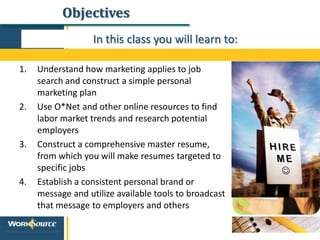
Objectives
In this class you will learn to:
1. Understand how marketing applies to job
search and construct a simple personal
marketing plan
2. Use O*Net and other online resources to find
labor market trends and research potential
employers
3. Construct a comprehensive master resume,
from which you will make resumes targeted to
specific jobs
4. Establish a consistent personal brand or
message and utilize available tools to broadcast
that message to employers and others
Today’s Job Search
a.k.a. We’re Not In Kansas Anymore, Toto!
This is a new world of job search.
What got you HERE…
…won’t get you THERE!
Insanity: doing the same thing over and over again
and expecting different results.
- Albert Einstein
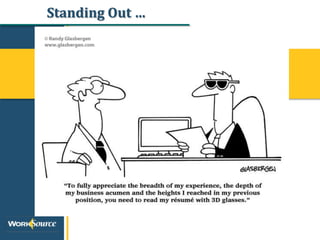
Standing Out …
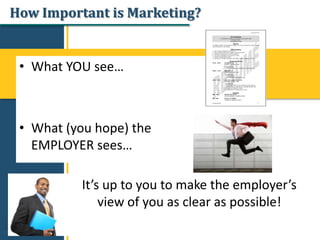
How Important is Marketing?
• What YOU see…
• What (you hope) the
EMPLOYER sees…
It’s up to you to make the employer’s
view of you as clear as possible!
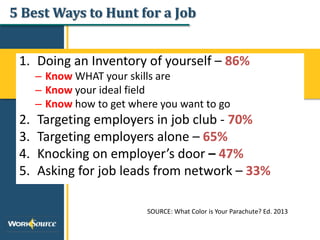
5 Best Ways to Hunt for a Job
1. Doing an Inventory of yourself – 86%
– Know WHAT your skills are
– Know your ideal field
– Know how to get where you want to go
2. Targeting employers in job club - 70%
3. Targeting employers alone – 65%
4. Knocking on employer’s door – 47%
5. Asking for job leads from network – 33%
SOURCE: What Color is Your Parachute? Ed. 2013
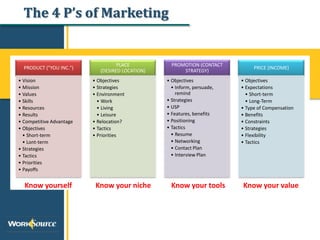
The 4 P’s of Marketing
PRODUCT ("YOU INC.")
• Vision
• Mission
• Values
• Skills
• Resources
• Results
• Competitive Advantage
• Objectives
• Short-term
• Lont-term
• Strategies
• Tactics
• Priorities
• Payoffs
PLACE
(DESIRED LOCATION)
• Objectives
• Strategies
• Environment
• Work
• Living
• Leisure
• Relocation?
• Tactics
• Priorities
PROMOTION (CONTACT
STRATEGY)
• Objectives
• Inform, persuade,
remind
• Strategies
• USP
• Features, benefits
• Positioning
• Tactics
• Resume
• Networking
• Contact Plan
• Interview Plan
PRICE (INCOME)
• Objectives
• Expectations
• Short-term
• Long-Term
• Type of Compensation
• Benefits
• Constraints
• Strategies
• Flexibility
• Tactics
Know yourself Know your niche Know your tools Know your value
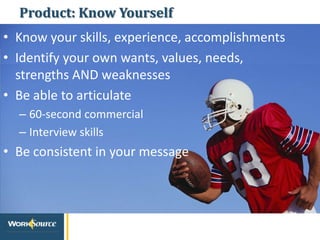
Product: Know Yourself
• Know your skills, experience, accomplishments
• Identify your own wants, values, needs,
strengths AND weaknesses
• Be able to articulate
– 60-second commercial
– Interview skills
• Be consistent in your message
Place: Know Your Niche
Where do you want to work?
What industry?
What job titles?
Targeted company?
What factors weigh into your decision?
Promotion: Know Your Tools
Cover Letters/Resumes
Business Cards
Phone Calling
Social Media
Where do members of your target
audience get their information?
Price: Know Your VALUE
“the creation of an asset that pertains to a particular
person…leading to a uniquely distinguishable, and
ideally memorable, impression.” --Wikipedia
This is sometimes known as a Unique Selling Proposition.
It’s your competitive advantage.
Personal Branding:
The Personal Brand
The Personal Brand
When developing your personal brand,
take into consideration your personal
values and vision.
Vision gives you meaning and purpose. It keeps you
from just going through the motions.
Values are the basis of your dreams and goals. Living a
life according to your personal values is critical to
achieving an overall sense of well-being and fulfillment.
Personal Branding:
EXERCISE: Your Values
To identify your core values,
select the 10 most important
from the examples given.
Add or re-word any until they
feel comfortable.
Then rank them.
Vision
• Vision gives you motivation
• Your vision can reflect your
values in action
Your Vision
What is your vision
of your future?
(Personal and
Professional)
Mission Statements
Businesses express their values and vision in the
form of mission statements designed to guide
the development of operational plans.
They guide what a company will do and how
they will accomplish it.
A personal mission statement provides clarity
and gives you a sense of purpose. It defines
who you are and what is important to you.
Everything you let
employers know about
you MUST agree with
your mission statement.
Mission Statements
I am an intelligent, ambitious person who takes pride in integrity,
responsibility, personal growth and lifelong learning. I will
fulfill my vision and dreams by creating exceptional results for
a medium to large sized marketing oriented company. I will
embrace challenge and pursue excellence throughout a career
in consumer goods marketing.
EXAMPLES:
I empower jobseekers with effective job search strategies.
Supporting jobseekers, letting them know they are not alone,
is my primary goal. I share empathy, not sympathy, and
provide tools for the jobseeker to overcome barriers and
achieve success.
NOTE: your mission is never static; it is always developing!
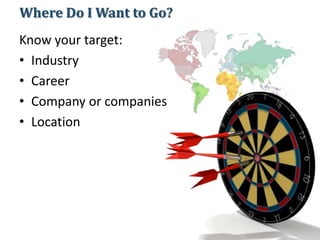
Where Do I Want to Go?
Know your target:
• Industry
• Career
• Company or companies
• Location
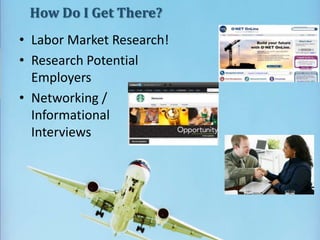
How Do I Get There?
• Labor Market Research!
• Research Potential
Employers
• Networking /
Informational
Interviews
Putting Your Plan to Action
• Know and articulate your selling points
• Find your targets
• Use your marketing tools to their fullest–
communicate on THEIR channels
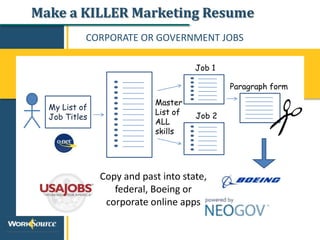
Make a KILLER Marketing Resume
My List of
Job Titles
Master
List of
ALL
skills
Job 2
Job 1
Paragraph form
Copy and past into state,
federal, Boeing or
corporate online apps
CORPORATE OR GOVERNMENT JOBS
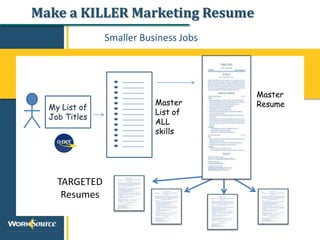
Make a KILLER Marketing Resume
My List of
Job Titles
Master
List of
ALL
skills
Master
Resume
TARGETED
Resumes
Smaller Business Jobs
Portfolios
Portfolios
 Targeted résumé
 Work samples that compliment résumé
 Letters of recommendation
 Customer or client testimonials
 Awards and honors
 Degrees and training certificates
 Education transcripts
 Licenses and certifications
 References
 Extra copies to leave with your contact
Include work
samples and
other items in
your folio.
Portfolios
 Split into sections employer understands
 Carefully limit items to include
 Create tabs for easy viewing:
 Certifications and Licenses
 Report Samples
 Project Samples
 Writing Samples
 Design Samples
 References
 Recommendations
 Education
Design your
portfolio’s
appearance.
Portfolios
 Portfolio will change with each
targeted employer or occupation
 First draft will be time consuming
 Select individuals to review draft
 Feedback: what best represents you,
what didn’t
 Make changes based on feedback
 Review your portfolio before every
interview; match materials to job
 Keep your portfolio up-to-date
 Shop portfolio around to contacts
 Create an online portfolio
Get feedback on
your draft.
Make changes.
Social Media
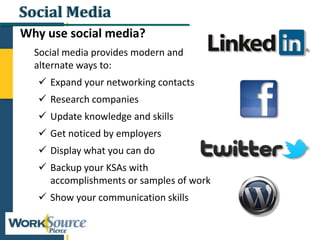
Why use social media?
Social media provides modern and
alternate ways to:
 Expand your networking contacts
 Research companies
 Update knowledge and skills
 Get noticed by employers
 Display what you can do
 Backup your KSAs with
accomplishments or samples of work
 Show your communication skills
Social Media
How to use social media…
 Protect your privacy.
 Think before you type.
 Become a trend setter.
 Keep current.
 Select friends, followers and
subscribers carefully.
 Create separate personal and
professional accounts.
 Cautiously choose images.
 Cleanup your past online activities.
 Share knowledge, ideas, leads and
connections.
Four Barriers Facing You
• Not knowing how /where to start
• Lacking direction or focus
• Low self-worth
• Lack of confidence in managing the
future
Developing a personal
marketing plan will go a
long way toward
breaking down those
barriers!

Marketing yourself online display

  • 1.
    Stand Out! Marketing YourselfEffectively to an Employer
  • 2.
    Objectives In this classyou will learn to: 1. Understand how marketing applies to job search and construct a simple personal marketing plan 2. Use O*Net and other online resources to find labor market trends and research potential employers 3. Construct a comprehensive master resume, from which you will make resumes targeted to specific jobs 4. Establish a consistent personal brand or message and utilize available tools to broadcast that message to employers and others
  • 3.
    Today’s Job Search a.k.a.We’re Not In Kansas Anymore, Toto! This is a new world of job search. What got you HERE… …won’t get you THERE! Insanity: doing the same thing over and over again and expecting different results. - Albert Einstein
  • 4.
  • 5.
    How Important isMarketing? • What YOU see… • What (you hope) the EMPLOYER sees… It’s up to you to make the employer’s view of you as clear as possible!
  • 6.
    5 Best Waysto Hunt for a Job 1. Doing an Inventory of yourself – 86% – Know WHAT your skills are – Know your ideal field – Know how to get where you want to go 2. Targeting employers in job club - 70% 3. Targeting employers alone – 65% 4. Knocking on employer’s door – 47% 5. Asking for job leads from network – 33% SOURCE: What Color is Your Parachute? Ed. 2013
  • 7.
    The 4 P’sof Marketing PRODUCT ("YOU INC.") • Vision • Mission • Values • Skills • Resources • Results • Competitive Advantage • Objectives • Short-term • Lont-term • Strategies • Tactics • Priorities • Payoffs PLACE (DESIRED LOCATION) • Objectives • Strategies • Environment • Work • Living • Leisure • Relocation? • Tactics • Priorities PROMOTION (CONTACT STRATEGY) • Objectives • Inform, persuade, remind • Strategies • USP • Features, benefits • Positioning • Tactics • Resume • Networking • Contact Plan • Interview Plan PRICE (INCOME) • Objectives • Expectations • Short-term • Long-Term • Type of Compensation • Benefits • Constraints • Strategies • Flexibility • Tactics Know yourself Know your niche Know your tools Know your value
  • 8.
    Product: Know Yourself •Know your skills, experience, accomplishments • Identify your own wants, values, needs, strengths AND weaknesses • Be able to articulate – 60-second commercial – Interview skills • Be consistent in your message
  • 9.
    Place: Know YourNiche Where do you want to work? What industry? What job titles? Targeted company? What factors weigh into your decision?
  • 10.
    Promotion: Know YourTools Cover Letters/Resumes Business Cards Phone Calling Social Media Where do members of your target audience get their information?
  • 11.
  • 12.
    “the creation ofan asset that pertains to a particular person…leading to a uniquely distinguishable, and ideally memorable, impression.” --Wikipedia This is sometimes known as a Unique Selling Proposition. It’s your competitive advantage. Personal Branding: The Personal Brand
  • 13.
    The Personal Brand Whendeveloping your personal brand, take into consideration your personal values and vision. Vision gives you meaning and purpose. It keeps you from just going through the motions. Values are the basis of your dreams and goals. Living a life according to your personal values is critical to achieving an overall sense of well-being and fulfillment. Personal Branding:
  • 14.
    EXERCISE: Your Values Toidentify your core values, select the 10 most important from the examples given. Add or re-word any until they feel comfortable. Then rank them.
  • 15.
    Vision • Vision givesyou motivation • Your vision can reflect your values in action Your Vision What is your vision of your future? (Personal and Professional)
  • 16.
    Mission Statements Businesses expresstheir values and vision in the form of mission statements designed to guide the development of operational plans. They guide what a company will do and how they will accomplish it. A personal mission statement provides clarity and gives you a sense of purpose. It defines who you are and what is important to you. Everything you let employers know about you MUST agree with your mission statement.
  • 17.
    Mission Statements I aman intelligent, ambitious person who takes pride in integrity, responsibility, personal growth and lifelong learning. I will fulfill my vision and dreams by creating exceptional results for a medium to large sized marketing oriented company. I will embrace challenge and pursue excellence throughout a career in consumer goods marketing. EXAMPLES: I empower jobseekers with effective job search strategies. Supporting jobseekers, letting them know they are not alone, is my primary goal. I share empathy, not sympathy, and provide tools for the jobseeker to overcome barriers and achieve success. NOTE: your mission is never static; it is always developing!
  • 19.
    Where Do IWant to Go? Know your target: • Industry • Career • Company or companies • Location
  • 20.
    How Do IGet There? • Labor Market Research! • Research Potential Employers • Networking / Informational Interviews
  • 21.
    Putting Your Planto Action • Know and articulate your selling points • Find your targets • Use your marketing tools to their fullest– communicate on THEIR channels
  • 22.
    Make a KILLERMarketing Resume My List of Job Titles Master List of ALL skills Job 2 Job 1 Paragraph form Copy and past into state, federal, Boeing or corporate online apps CORPORATE OR GOVERNMENT JOBS
  • 23.
    Make a KILLERMarketing Resume My List of Job Titles Master List of ALL skills Master Resume TARGETED Resumes Smaller Business Jobs
  • 24.
  • 25.
    Portfolios  Targeted résumé Work samples that compliment résumé  Letters of recommendation  Customer or client testimonials  Awards and honors  Degrees and training certificates  Education transcripts  Licenses and certifications  References  Extra copies to leave with your contact Include work samples and other items in your folio.
  • 26.
    Portfolios  Split intosections employer understands  Carefully limit items to include  Create tabs for easy viewing:  Certifications and Licenses  Report Samples  Project Samples  Writing Samples  Design Samples  References  Recommendations  Education Design your portfolio’s appearance.
  • 27.
    Portfolios  Portfolio willchange with each targeted employer or occupation  First draft will be time consuming  Select individuals to review draft  Feedback: what best represents you, what didn’t  Make changes based on feedback  Review your portfolio before every interview; match materials to job  Keep your portfolio up-to-date  Shop portfolio around to contacts  Create an online portfolio Get feedback on your draft. Make changes.
  • 28.
    Social Media Why usesocial media? Social media provides modern and alternate ways to:  Expand your networking contacts  Research companies  Update knowledge and skills  Get noticed by employers  Display what you can do  Backup your KSAs with accomplishments or samples of work  Show your communication skills
  • 29.
    Social Media How touse social media…  Protect your privacy.  Think before you type.  Become a trend setter.  Keep current.  Select friends, followers and subscribers carefully.  Create separate personal and professional accounts.  Cautiously choose images.  Cleanup your past online activities.  Share knowledge, ideas, leads and connections.
  • 30.
    Four Barriers FacingYou • Not knowing how /where to start • Lacking direction or focus • Low self-worth • Lack of confidence in managing the future Developing a personal marketing plan will go a long way toward breaking down those barriers!

Editor's Notes

  • #2 Housekeeping
  • #4 Today’s job search is much different from what it used to be even as little as 5 years ago. Success comes from understanding and accepting that fact.
  • #5 These days, it’s all about standing out. You have to separate yourself from the other jobseekers to be noticed by employers.
  • #7 Richard Bowles identified these top 5 means of hunting for a job, meaning if 100 people used ONLY that one means to find a job, the percentage shown is the number of people who succeed.
  • #8 Marketing can be broken down into 4 principles, known as the Four P’s of Marketing. Familiarity with these 4 principles and how they relate to you enable you to effectively market yourself based on your strengths and needs.
  • #13 Personal branding is the backbone of your marketing. Everything in your personal brand must agree.
  • #15 HANDOUT: Core Values Exercise (about 15 minutes???)
  • #16 Your vision is what motivates you. Ultimately, you want to spend your life doing something you believe in. Come to terms with what really motivates you.
  • #17 Articulate your vision and values in a mission statement. It is not quite the same as the professional summary in your resume, as the mission statement can speak to your life’s mission as well as your career. But your professional summary or profile can be extracted from your mission statement, as can your headline (used on your LinkedIn profile).
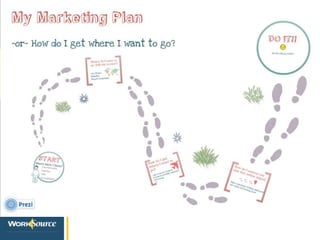
  • #19 This graphic links to another presentation on Prezi.com on making a personal marketing plan.
  • #20 Where do you want to go with your career? Here are some factors to keep in mind when weighing this decision.
  • #21 Half of making a good marketing plan is knowing what you have and want; the other half is knowing the same of the employer(s).
  • #25 Slide time: 5-10 Minutes
  • #26 Slide time: 15 Minutes
  • #27 Slide time: 15 Minutes
  • #28 Slide time: 15 Minutes
  • #29 Slide time: 8-15 Minutes
  • #30 Slide time: 8-15 Minutes