Testicular Pain
Saeed Al-Ghamdi
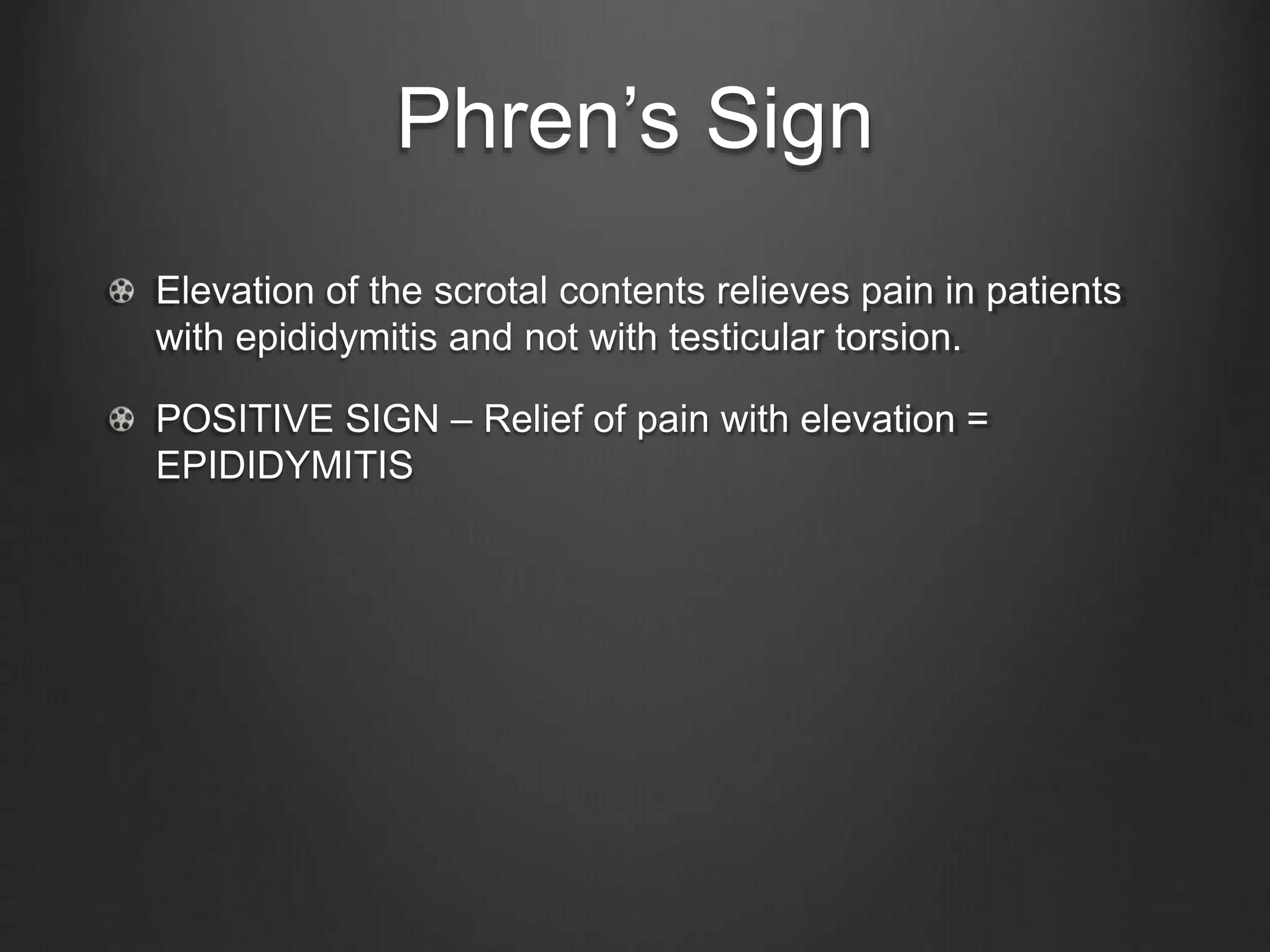
Anatomy of the Testis
Key Questions in the
History
Characteristic of the
pain
Recurrent pain suggests torsion
History of trauma
History of change in the
size of the testicle
Changes during Valsalva suggests
communicating hydrocoele or varicocele
Sexual history STD’s can cause epididymitis
Difficulty voiding urine Suggests intra-abdominal mass (hernia), UTI,
neurologic problems or spinal cord disease
Flank pain or Hematuria Suggests kidney stone with referred pain to
the scrotum
Abdominal pain with
diminished appetite,
nausea and vomiting
Suggests testicular torsion
Focused Exam
Inspection
Palpation
Cremasteric Reflex
Phren’s sign
Blue dot sign
Inspection
Inspect while the patient is standing – check the penis,
pubic hair and inguinal areas.
Inspect for ulcers, papules, pubic hair infestations or
lymphadenopathy
Inspection
The left testicle is
slighlty lower than the
right
Palpation
Roll the testicle between thumb and forefingers to look for
masses
Palpate for the epididymis and go up towards the
spermatic cord.
Transilluminate the scrotum if swelling is suspected.
Cremasteric Reflex
Stroking the upper thigh
results in elevation of
the ipsilateral testicle.
Usually present in boys
30 months to 12 years
Less reliable in
teenagers and infants
Phren’s Sign
Elevation of the scrotal contents relieves pain in patients
with epididymitis and not with testicular torsion.
POSITIVE SIGN – Relief of pain with elevation =
EPIDIDYMITIS
Blue Dot Sign
Almost always
suggestive of torsion of
the appendix testis.
Additional Tests
Test Purpose
Complete Blood Count Elevated WBC count in torsion
Test usually obtained for pre-
operative purposes
Urinalysis and Culture R/o UTI
Pyuria may be seen in Epididymitis
Gram stain, culture, rapid molecular
amplification testing of urethral
discharge
-or-
Nucleic amplification test of urine
R/o sexually transmitted diseases
Color Doppler Ultrasound of the
Scrotum
Check perfusion
R/o torsion if cannot be excluded on
clinical grounds
Differential Diagnosis
Testicular Torsion
Torsion of Appendix Testis
Epididymitis/Orchitis
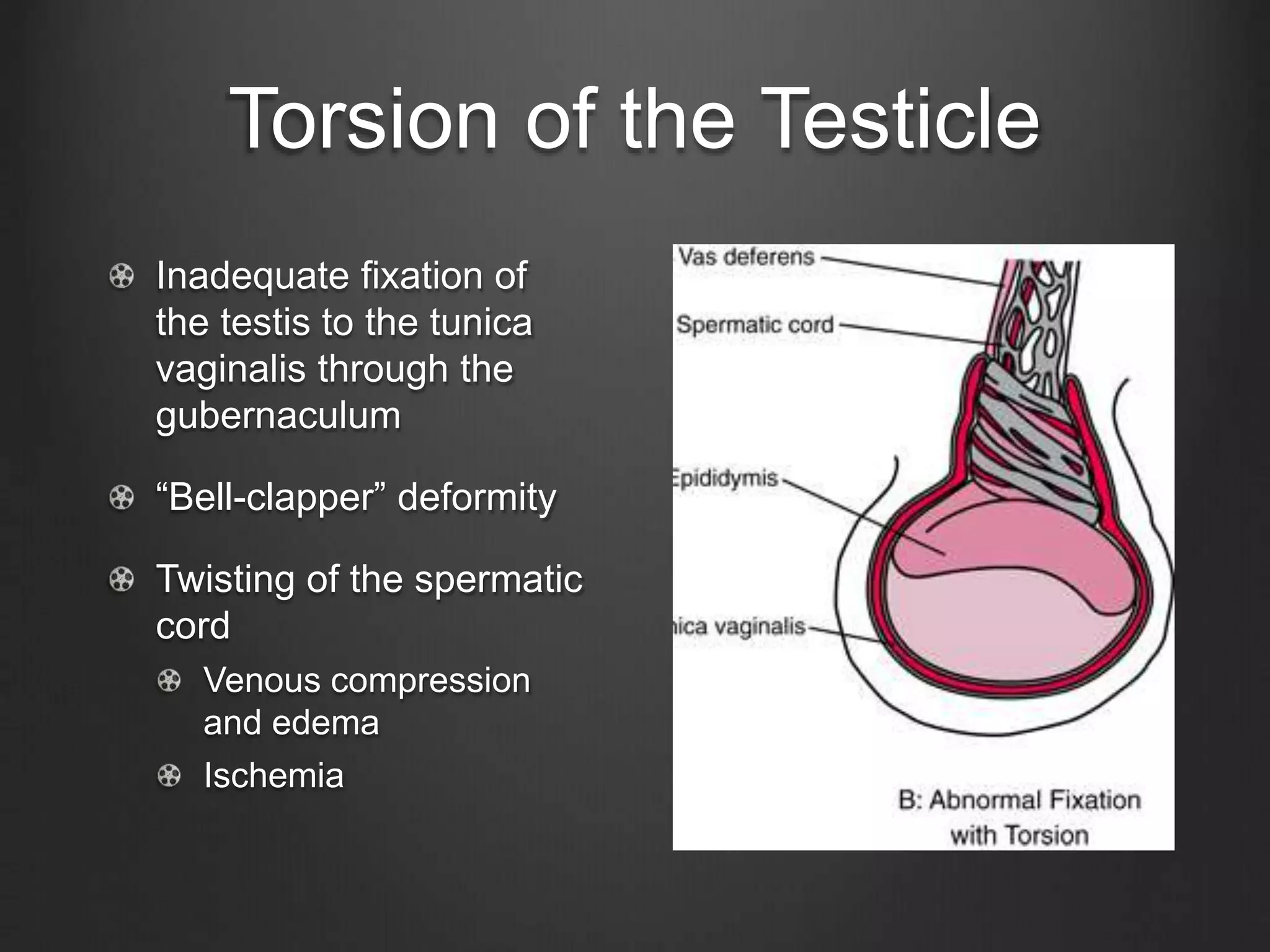
Torsion of the Testicle
Inadequate fixation of
the testis to the tunica
vaginalis through the
gubernaculum
“Bell-clapper” deformity
Twisting of the spermatic
cord
Venous compression
and edema
Ischemia
Torsion of the Testicle
Peak incidence in the neonatal period and the pubertal
period
~65% occur during the 12-18 year old range due to
increasing weight of the testicles
Torsion of the Testicle
Abrupt onset of severe
testicular or scrotal pain
<12 hours of duration
90% have associated
nausea and vomiting
Pain can be constant
unless the testicle is
torsing and detorsing
Most boys report a
previous episode in the
past
Torsion of the Testicle
Diagnosis is made clinically. Impression is stronger if
there are previous episodes
Doppler ultrasound should be done if there are uncertainty
in diagnosis
Manual detorsion (26-80% success) ((( in ER )))
Should be done by urologist
Patient should be sedated
Most effective before significant edema present
Rotate testicle up and away from midline (towards thigh)
Surgical detorsion with bilateral orchidopexy ((( in OR )))
Bilaterally correction required since deformity usually
bilaterally
Surgical correction required even if manually detorsed
Torsion of the Appendix Testis
Pedunculated shapes of
these structures
predispose them to
torsion
Occurs most commonly
in 7-12 year old boys
Torsion of the Appendix Testis
Pain is of sudden onset, similar to testicular torsion
The testicle is non-tender, but there is a tender localized
mass usually at the superior or inferior pole
(+) Blue dot sign – gangrenous appendix
Doppler ultrasound may be necessary to rule out testicular
torsion – will show a lesion of low echogenicity. Blood
flow to the affected area may be increased
Torsion of the Appendix Testis
Management
Bed rest, Analgesia, Scrotal Support
5-10 days out patient
Resolution Surgery
No follow-up
necessary
Removal of the appendage;
exploration of contralateral testis not
necessary
Epididymitis
Inflammation of the epididymis
Occur more frequently in late adolescent boys and even in
younger males who deny sexual activity.
Risk factors
Sexual activity
Heavy physical exertion
Direct trauma
Bacterial epididymitis – think of anatomical abnormalities
Epididymitis
(+) Sexual activity
Chlamydia
N. gonorrhea
E. coli
Viruses
(-) Sexual Activity
Mycoplasma
Enteroviruses
Adenovirus
Epididymitis
Acute or subacute onset
of testicular pain
History of urinary
frequency, dysuria, and
fever
Normal cremasteric
reflex, with negative
Prehn’s sign
Epididymitis
Doppler ultrasound may be necessary to rule out testicular
torsion
All patients should get a urinalysis and urine culture
Epididymitis
ADMSSION CRITERIA CHILDREN SEXUALLY ACTIVE
Doubt diagnosis
(?Torsion)
(+) Leukocytes in urine
Empiric antibiotics –
Bactrim*/Keflex*
Ceftriaxone x 1 +
Doxycycline x 10
days
Severe pain Ofloxacin
Immunocompromised (-) Leukocytes in urine
Supportive treatment
[NON-BACTERIAL]
Levofloxacin
Unreliable patient
Non-compliance
• It is equally important to treat sexual partners if an STD is the likely
cause.
• Supportive therapy: Scrotal support, bed rest and NSAIDS
Scrotal Swelling
Scrotal Swelling History & PE
Hydrocele • (+) Transillumination
• Increase in size during the day or with Valsalva
• If non-communicating, no change in size.
Varicocele • The spermatic cord has a “bag of worms” feeling
secondary to vessel dilation
• The varicoceles may be more palpable with
standing or with Valsalva
• (-) Transilluminate
Spermatocele • Painless, fluid filled cyst on the head of the
epididymis
• (+) Transillumination localized to the head of the
testis
Testicular CA • Firm, painless mass that does not transilluminate
• (+) Reactive hydrocele
Thank you!

Testicular pain in emergency

  • 1.
  • 2.
  • 3.
    Key Questions inthe History Characteristic of the pain Recurrent pain suggests torsion History of trauma History of change in the size of the testicle Changes during Valsalva suggests communicating hydrocoele or varicocele Sexual history STD’s can cause epididymitis Difficulty voiding urine Suggests intra-abdominal mass (hernia), UTI, neurologic problems or spinal cord disease Flank pain or Hematuria Suggests kidney stone with referred pain to the scrotum Abdominal pain with diminished appetite, nausea and vomiting Suggests testicular torsion
  • 4.
  • 5.
    Inspection Inspect while thepatient is standing – check the penis, pubic hair and inguinal areas. Inspect for ulcers, papules, pubic hair infestations or lymphadenopathy
  • 6.
    Inspection The left testicleis slighlty lower than the right
  • 7.
    Palpation Roll the testiclebetween thumb and forefingers to look for masses Palpate for the epididymis and go up towards the spermatic cord. Transilluminate the scrotum if swelling is suspected.
  • 8.
    Cremasteric Reflex Stroking theupper thigh results in elevation of the ipsilateral testicle. Usually present in boys 30 months to 12 years Less reliable in teenagers and infants
  • 9.
    Phren’s Sign Elevation ofthe scrotal contents relieves pain in patients with epididymitis and not with testicular torsion. POSITIVE SIGN – Relief of pain with elevation = EPIDIDYMITIS
  • 10.
    Blue Dot Sign Almostalways suggestive of torsion of the appendix testis.
  • 11.
    Additional Tests Test Purpose CompleteBlood Count Elevated WBC count in torsion Test usually obtained for pre- operative purposes Urinalysis and Culture R/o UTI Pyuria may be seen in Epididymitis Gram stain, culture, rapid molecular amplification testing of urethral discharge -or- Nucleic amplification test of urine R/o sexually transmitted diseases Color Doppler Ultrasound of the Scrotum Check perfusion R/o torsion if cannot be excluded on clinical grounds
  • 12.
    Differential Diagnosis Testicular Torsion Torsionof Appendix Testis Epididymitis/Orchitis
  • 13.
    Torsion of theTesticle Inadequate fixation of the testis to the tunica vaginalis through the gubernaculum “Bell-clapper” deformity Twisting of the spermatic cord Venous compression and edema Ischemia
  • 14.
    Torsion of theTesticle Peak incidence in the neonatal period and the pubertal period ~65% occur during the 12-18 year old range due to increasing weight of the testicles
  • 15.
    Torsion of theTesticle Abrupt onset of severe testicular or scrotal pain <12 hours of duration 90% have associated nausea and vomiting Pain can be constant unless the testicle is torsing and detorsing Most boys report a previous episode in the past
  • 16.
    Torsion of theTesticle Diagnosis is made clinically. Impression is stronger if there are previous episodes Doppler ultrasound should be done if there are uncertainty in diagnosis
  • 17.
    Manual detorsion (26-80%success) ((( in ER ))) Should be done by urologist Patient should be sedated Most effective before significant edema present Rotate testicle up and away from midline (towards thigh) Surgical detorsion with bilateral orchidopexy ((( in OR ))) Bilaterally correction required since deformity usually bilaterally Surgical correction required even if manually detorsed
  • 18.
    Torsion of theAppendix Testis Pedunculated shapes of these structures predispose them to torsion Occurs most commonly in 7-12 year old boys
  • 19.
    Torsion of theAppendix Testis Pain is of sudden onset, similar to testicular torsion The testicle is non-tender, but there is a tender localized mass usually at the superior or inferior pole (+) Blue dot sign – gangrenous appendix Doppler ultrasound may be necessary to rule out testicular torsion – will show a lesion of low echogenicity. Blood flow to the affected area may be increased
  • 20.
    Torsion of theAppendix Testis Management Bed rest, Analgesia, Scrotal Support 5-10 days out patient Resolution Surgery No follow-up necessary Removal of the appendage; exploration of contralateral testis not necessary
  • 21.
    Epididymitis Inflammation of theepididymis Occur more frequently in late adolescent boys and even in younger males who deny sexual activity. Risk factors Sexual activity Heavy physical exertion Direct trauma Bacterial epididymitis – think of anatomical abnormalities
  • 22.
    Epididymitis (+) Sexual activity Chlamydia N.gonorrhea E. coli Viruses (-) Sexual Activity Mycoplasma Enteroviruses Adenovirus
  • 23.
    Epididymitis Acute or subacuteonset of testicular pain History of urinary frequency, dysuria, and fever Normal cremasteric reflex, with negative Prehn’s sign
  • 24.
    Epididymitis Doppler ultrasound maybe necessary to rule out testicular torsion All patients should get a urinalysis and urine culture
  • 25.
    Epididymitis ADMSSION CRITERIA CHILDRENSEXUALLY ACTIVE Doubt diagnosis (?Torsion) (+) Leukocytes in urine Empiric antibiotics – Bactrim*/Keflex* Ceftriaxone x 1 + Doxycycline x 10 days Severe pain Ofloxacin Immunocompromised (-) Leukocytes in urine Supportive treatment [NON-BACTERIAL] Levofloxacin Unreliable patient Non-compliance • It is equally important to treat sexual partners if an STD is the likely cause. • Supportive therapy: Scrotal support, bed rest and NSAIDS
  • 26.
    Scrotal Swelling Scrotal SwellingHistory & PE Hydrocele • (+) Transillumination • Increase in size during the day or with Valsalva • If non-communicating, no change in size. Varicocele • The spermatic cord has a “bag of worms” feeling secondary to vessel dilation • The varicoceles may be more palpable with standing or with Valsalva • (-) Transilluminate Spermatocele • Painless, fluid filled cyst on the head of the epididymis • (+) Transillumination localized to the head of the testis Testicular CA • Firm, painless mass that does not transilluminate • (+) Reactive hydrocele
  • 27.

Editor's Notes

  • #3 Apart from the obvious, the tunica vaginalis and the epididymis are two structures often missed in the examination of the testicles. Understanding the normal anatomy can guide the clinician. The typical volume of an adult testis is 25 mL. It also typically measures 2-5 cm in height and 2-3 cm wide. The tunica vaginalis occupies the anterior 2/3 of the testicle, where it becomes a potential space for fluid collection. The epididymis, if palpable, can be located posterolaterally to the testis.
  • #18 17
  • #19 The appendix testis is a small vestigial structure on the anterosuperior aspect of the testis (which is an embryologic remnant of the Mullerian duct). The appendix epididymis is a small remnant of the Wolffian duct located at the head of the epididymis.
  • #26 Doxycycline is not approved for patients less than 8 years old Quinolones should not be used in patients <18 years old if an alternative is available. However, homosexual males practicing anal intercourse should be treated with antibiotics that cover for enteric coliforms – Ofloxacin/Levofloxacin is sufficient