

What Successful Test Automation is…
and Why it’s NOT Testing
Lee Barnes
Chief Quality Officer, Forte Group
About Me…
• Chief Quality Officer of Forte Group
• Involved in software quality and testing for over 25 years
• Most of that time focused on test automation and performance
testing
• Passionate about helping organizations build quality into their
applications
Email: lee.barnes@fortegrp.com
Twitter: @USI_LeeBarnes
LinkedIn: linkedin.com/in/leebarnes
Blog: utopiasolutions.com/blog1
@USI_LeeBarnes 2
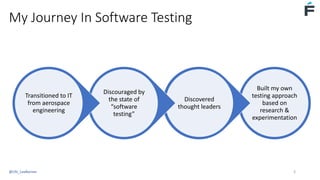
My Journey In Software Testing
Built my own
testing approach
based on
research &
experimentation
Discovered
thought leaders
Discouraged by
the state of
“software
testing”
Transitioned to IT
from aerospace
engineering
@USI_LeeBarnes 3
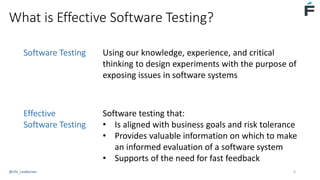
What is Effective Software Testing?
Software Testing Using our knowledge, experience, and critical
thinking to design experiments with the purpose of
exposing issues in software systems
Effective
Software Testing
Software testing that:
• Is aligned with business goals and risk tolerance
• Provides valuable information on which to make
an informed evaluation of a software system
• Supports of the need for fast feedback
@USI_LeeBarnes 4
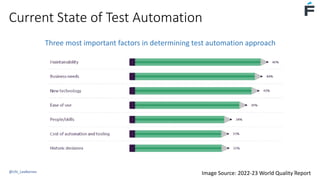
Current State of Test Automation
Image Source: 2022-23 World Quality Report
Three most important factors in determining test automation approach
@USI_LeeBarnes 5
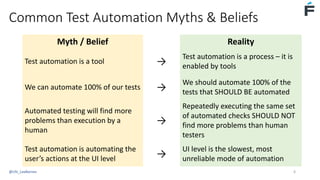
Common Test Automation Myths & Beliefs
Myth / Belief Reality
Test automation is a tool →
Test automation is a process – it is
enabled by tools
We can automate 100% of our tests →
We should automate 100% of the
tests that SHOULD BE automated
Automated testing will find more
problems than execution by a
human
→
Repeatedly executing the same set
of automated checks SHOULD NOT
find more problems than human
testers
Test automation is automating the
user’s actions at the UI level →
UI level is the slowest, most
unreliable mode of automation
@USI_LeeBarnes 6
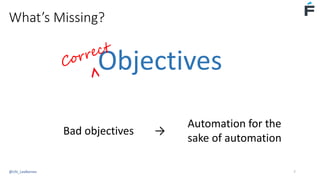
What’s Missing?
Objectives
Bad objectives
Automation for the
sake of automation
→
@USI_LeeBarnes 7
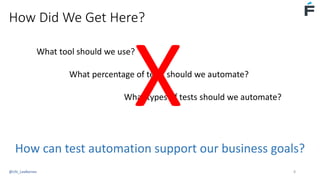
How Did We Get Here?
What tool should we use?
What percentage of tests should we automate?
What types of tests should we automate?
How can test automation support our business goals?
@USI_LeeBarnes 8
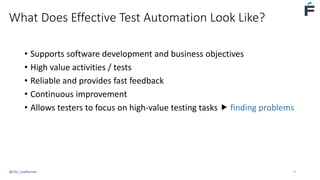
What Does Effective Test Automation Look Like?
• Supports software development and business objectives
• High value activities / tests
• Reliable and provides fast feedback
• Continuous improvement
• Allows testers to focus on high-value testing tasks  finding problems
@USI_LeeBarnes 9
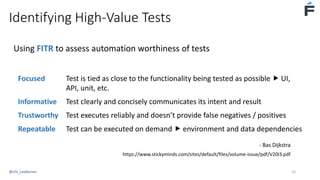
Identifying High-Value Tests
Using FITR to assess automation worthiness of tests
Focused Test is tied as close to the functionality being tested as possible  UI,
API, unit, etc.
Informative Test clearly and concisely communicates its intent and result
Trustworthy Test executes reliably and doesn’t provide false negatives / positives
Repeatable Test can be executed on demand  environment and data dependencies
- Bas Dijkstra
https://www.stickyminds.com/sites/default/files/volume-issue/pdf/V20I3.pdf
@USI_LeeBarnes 10
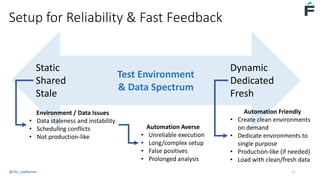
Setup for Reliability & Fast Feedback
Test Environment
& Data Spectrum
Static
Shared
Stale
Dynamic
Dedicated
Fresh
Environment / Data Issues
• Data staleness and instability
• Scheduling conflicts
• Not production-like
Automation Averse
• Unreliable execution
• Long/complex setup
• False positives
• Prolonged analysis
Automation Friendly
• Create clean environments
on demand
• Dedicate environments to
single purpose
• Production-like (if needed)
• Load with clean/fresh data
@USI_LeeBarnes 11
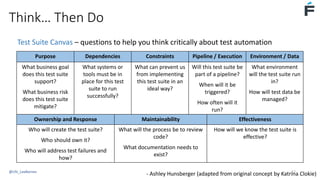
Think… Then Do
Purpose Dependencies Constraints Pipeline / Execution Environment / Data
What business goal
does this test suite
support?
What business risk
does this test suite
mitigate?
What systems or
tools must be in
place for this test
suite to run
successfully?
What can prevent us
from implementing
this test suite in an
ideal way?
Will this test suite be
part of a pipeline?
When will it be
triggered?
How often will it
run?
What environment
will the test suite run
in?
How will test data be
managed?
Ownership and Response Maintainability Effectiveness
Who will create the test suite?
Who should own it?
Who will address test failures and
how?
What will the process be to review
code?
What documentation needs to
exist?
How will we know the test suite is
effective?
Test Suite Canvas – questions to help you think critically about test automation
- Ashley Hunsberger (adapted from original concept by Katrina Clokie)
@USI_LeeBarnes 12
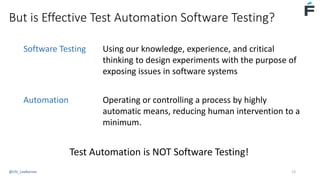
But is Effective Test Automation Software Testing?
Software Testing Using our knowledge, experience, and critical
thinking to design experiments with the purpose of
exposing issues in software systems
Automation Operating or controlling a process by highly
automatic means, reducing human intervention to a
minimum.
Test Automation is NOT Software Testing!
@USI_LeeBarnes 13
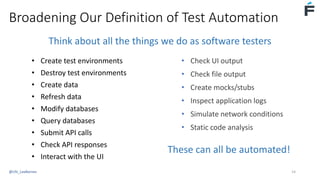
Broadening Our Definition of Test Automation
• Create test environments
• Destroy test environments
• Create data
• Refresh data
• Modify databases
• Query databases
• Submit API calls
• Check API responses
• Interact with the UI
• Check UI output
• Check file output
• Create mocks/stubs
• Inspect application logs
• Simulate network conditions
• Static code analysis
These can all be automated!
Think about all the things we do as software testers
@USI_LeeBarnes 14
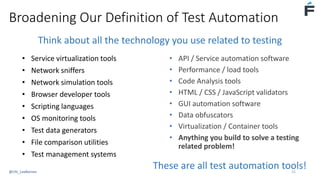
Broadening Our Definition of Test Automation
These are all test automation tools!
Think about all the technology you use related to testing
• Service virtualization tools
• Network sniffers
• Network simulation tools
• Browser developer tools
• Scripting languages
• OS monitoring tools
• Test data generators
• File comparison utilities
• Test management systems
• API / Service automation software
• Performance / load tools
• Code Analysis tools
• HTML / CSS / JavaScript validators
• GUI automation software
• Data obfuscators
• Virtualization / Container tools
• Anything you build to solve a testing
related problem!
@USI_LeeBarnes 15
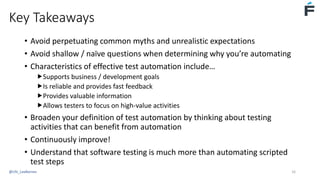
Key Takeaways
• Avoid perpetuating common myths and unrealistic expectations
• Avoid shallow / naïve questions when determining why you’re automating
• Characteristics of effective test automation include…
Supports business / development goals
Is reliable and provides fast feedback
Provides valuable information
Allows testers to focus on high-value activities
• Broaden your definition of test automation by thinking about testing
activities that can benefit from automation
• Continuously improve!
• Understand that software testing is much more than automating scripted
test steps
@USI_LeeBarnes 16
Continuing the Conversation
Lee Barnes
Chief Quality Officer
Forte Group
Email: lee.barnes@fortegrp.com
Twitter: @USI_LeeBarnes
LinkedIn: linkedin.com/in/leebarnes
@USI_LeeBarnes 17

Lee Barnes - What Successful Test Automation is.pdf

  • 1.
    What Successful TestAutomation is… and Why it’s NOT Testing Lee Barnes Chief Quality Officer, Forte Group
  • 2.
    About Me… • ChiefQuality Officer of Forte Group • Involved in software quality and testing for over 25 years • Most of that time focused on test automation and performance testing • Passionate about helping organizations build quality into their applications Email: lee.barnes@fortegrp.com Twitter: @USI_LeeBarnes LinkedIn: linkedin.com/in/leebarnes Blog: utopiasolutions.com/blog1 @USI_LeeBarnes 2
  • 3.
    My Journey InSoftware Testing Built my own testing approach based on research & experimentation Discovered thought leaders Discouraged by the state of “software testing” Transitioned to IT from aerospace engineering @USI_LeeBarnes 3
  • 4.
    What is EffectiveSoftware Testing? Software Testing Using our knowledge, experience, and critical thinking to design experiments with the purpose of exposing issues in software systems Effective Software Testing Software testing that: • Is aligned with business goals and risk tolerance • Provides valuable information on which to make an informed evaluation of a software system • Supports of the need for fast feedback @USI_LeeBarnes 4
  • 5.
    Current State ofTest Automation Image Source: 2022-23 World Quality Report Three most important factors in determining test automation approach @USI_LeeBarnes 5
  • 6.
    Common Test AutomationMyths & Beliefs Myth / Belief Reality Test automation is a tool → Test automation is a process – it is enabled by tools We can automate 100% of our tests → We should automate 100% of the tests that SHOULD BE automated Automated testing will find more problems than execution by a human → Repeatedly executing the same set of automated checks SHOULD NOT find more problems than human testers Test automation is automating the user’s actions at the UI level → UI level is the slowest, most unreliable mode of automation @USI_LeeBarnes 6
  • 7.
    What’s Missing? Objectives Bad objectives Automationfor the sake of automation → @USI_LeeBarnes 7
  • 8.
    How Did WeGet Here? What tool should we use? What percentage of tests should we automate? What types of tests should we automate? How can test automation support our business goals? @USI_LeeBarnes 8
  • 9.
    What Does EffectiveTest Automation Look Like? • Supports software development and business objectives • High value activities / tests • Reliable and provides fast feedback • Continuous improvement • Allows testers to focus on high-value testing tasks  finding problems @USI_LeeBarnes 9
  • 10.
    Identifying High-Value Tests UsingFITR to assess automation worthiness of tests Focused Test is tied as close to the functionality being tested as possible  UI, API, unit, etc. Informative Test clearly and concisely communicates its intent and result Trustworthy Test executes reliably and doesn’t provide false negatives / positives Repeatable Test can be executed on demand  environment and data dependencies - Bas Dijkstra https://www.stickyminds.com/sites/default/files/volume-issue/pdf/V20I3.pdf @USI_LeeBarnes 10
  • 11.
    Setup for Reliability& Fast Feedback Test Environment & Data Spectrum Static Shared Stale Dynamic Dedicated Fresh Environment / Data Issues • Data staleness and instability • Scheduling conflicts • Not production-like Automation Averse • Unreliable execution • Long/complex setup • False positives • Prolonged analysis Automation Friendly • Create clean environments on demand • Dedicate environments to single purpose • Production-like (if needed) • Load with clean/fresh data @USI_LeeBarnes 11
  • 12.
    Think… Then Do PurposeDependencies Constraints Pipeline / Execution Environment / Data What business goal does this test suite support? What business risk does this test suite mitigate? What systems or tools must be in place for this test suite to run successfully? What can prevent us from implementing this test suite in an ideal way? Will this test suite be part of a pipeline? When will it be triggered? How often will it run? What environment will the test suite run in? How will test data be managed? Ownership and Response Maintainability Effectiveness Who will create the test suite? Who should own it? Who will address test failures and how? What will the process be to review code? What documentation needs to exist? How will we know the test suite is effective? Test Suite Canvas – questions to help you think critically about test automation - Ashley Hunsberger (adapted from original concept by Katrina Clokie) @USI_LeeBarnes 12
  • 13.
    But is EffectiveTest Automation Software Testing? Software Testing Using our knowledge, experience, and critical thinking to design experiments with the purpose of exposing issues in software systems Automation Operating or controlling a process by highly automatic means, reducing human intervention to a minimum. Test Automation is NOT Software Testing! @USI_LeeBarnes 13
  • 14.
    Broadening Our Definitionof Test Automation • Create test environments • Destroy test environments • Create data • Refresh data • Modify databases • Query databases • Submit API calls • Check API responses • Interact with the UI • Check UI output • Check file output • Create mocks/stubs • Inspect application logs • Simulate network conditions • Static code analysis These can all be automated! Think about all the things we do as software testers @USI_LeeBarnes 14
  • 15.
    Broadening Our Definitionof Test Automation These are all test automation tools! Think about all the technology you use related to testing • Service virtualization tools • Network sniffers • Network simulation tools • Browser developer tools • Scripting languages • OS monitoring tools • Test data generators • File comparison utilities • Test management systems • API / Service automation software • Performance / load tools • Code Analysis tools • HTML / CSS / JavaScript validators • GUI automation software • Data obfuscators • Virtualization / Container tools • Anything you build to solve a testing related problem! @USI_LeeBarnes 15
  • 16.
    Key Takeaways • Avoidperpetuating common myths and unrealistic expectations • Avoid shallow / naïve questions when determining why you’re automating • Characteristics of effective test automation include… Supports business / development goals Is reliable and provides fast feedback Provides valuable information Allows testers to focus on high-value activities • Broaden your definition of test automation by thinking about testing activities that can benefit from automation • Continuously improve! • Understand that software testing is much more than automating scripted test steps @USI_LeeBarnes 16
  • 17.
    Continuing the Conversation LeeBarnes Chief Quality Officer Forte Group Email: lee.barnes@fortegrp.com Twitter: @USI_LeeBarnes LinkedIn: linkedin.com/in/leebarnes @USI_LeeBarnes 17