Test planning
• A plan is a document that provides a
framework or approach for achieving a set
of goals.
• Test plan is a detailed document that
describes the test strategy, objective ,
schedule ,estimation and deliverables
required for testing.
• Test plans tend to be more technically
oriented.
• A plan describes
 what specific tasks must be accomplished,
 who is responsible for each task,
 what tools, procedures, and techniques must be used,
 how much time and effort is needed, and
 what resources are essential.
 A plan also contains milestones.
Milestones are tangible events that are expected to
occur at a certain time in the project’s lifetime.
 Test Managers and Test planners are responsible for
test planning .
• Overall test objectives.
• What to test (scope of the tests).
• Who will test
• How to test
• When to test
• When to stop testing
Test Planner- high-level items
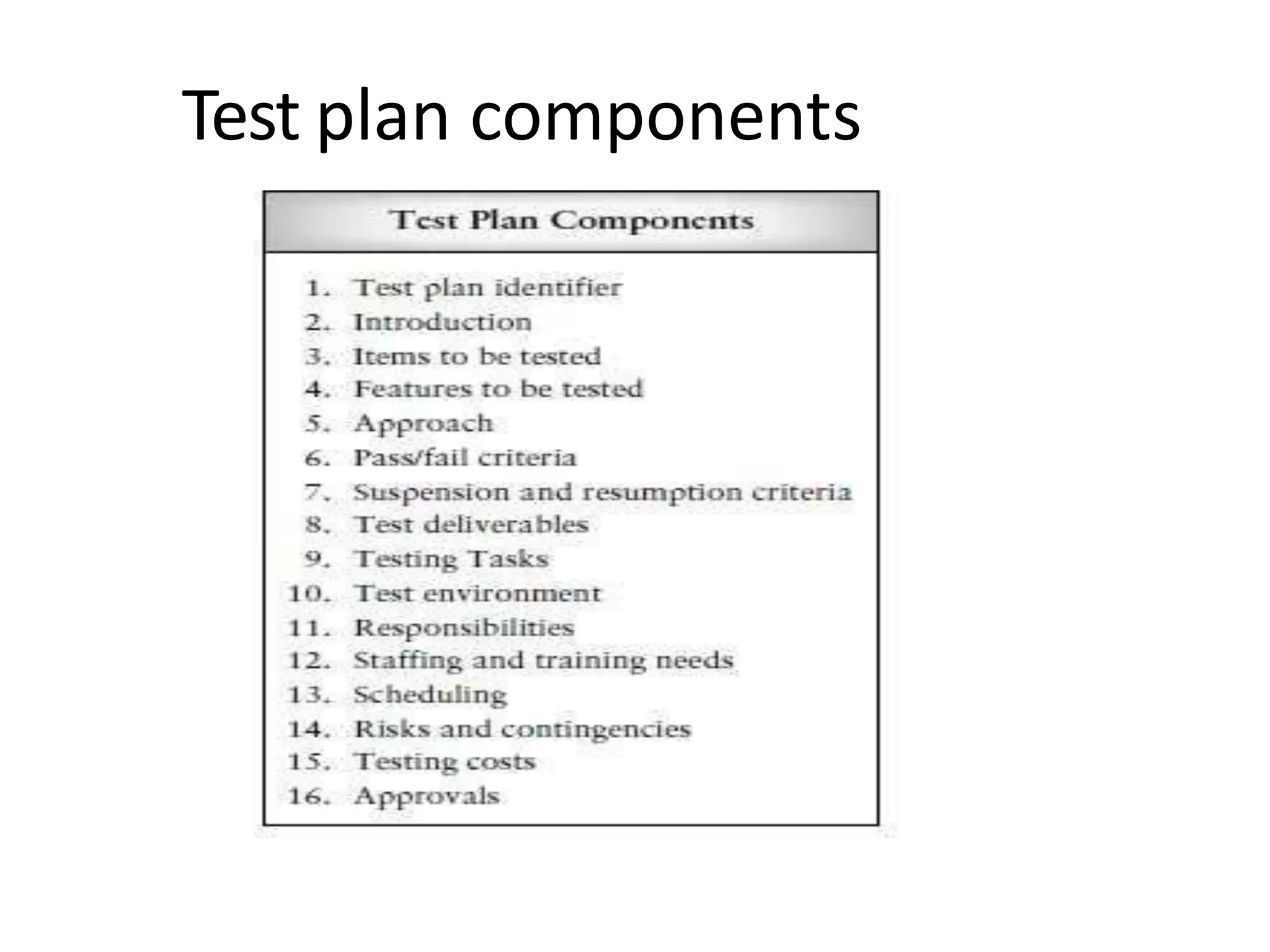
Test plan components
1 . Test Plan Identifier
• Organizational standards should describe the format
for the test plan identifier and how to specify versions.
2 . Introduction
• In this section the test planner gives an overall
description of the project, and the soft ware items and/or
features to be tested.
3 . Items to Be Tested
Procedures, classes, modules, libraries,
subsystems, and systems
4 . Features to Be Tested
Features may be described as distinguishing
characteristics of a software component or system.
- performance,reliability, portability, and functionality
requirements
5 . Approach
Provides broad coverage of the issues to be addressed
when testing the target software.
Testing activities are described.
6 . Item Pass/Fail Criteria
The tester must have a set of criteria to decide on
whether the test has been passed or failed upon
execution.
A failure occurs when the actual output produced by the
software does not agree with what was expected, under
the conditions specified by the test.
7 . Suspension and Resumption Criteria
Criteria to suspend and resume testing are
described
8 . Test Deliverables
• Deliverables - Test plan along with its
associated test design specifications,
test procedures, and test cases.
• Deliverables may also include other
documents that result from testing such as
test logs, test transmittal reports, test
incident reports, and a test summary
report.
9 . Testing Tasks
• A Work Breakdown Structure is a hierarchical or tree like
representation of all the tasks that are required to
complete a project.
10. The Testing Environment
- describes the software and hardware needs for the
testing effort
11. Responsibilities
The staff who will be responsible for test-related tasks
should be identified. This includes personnel who will
be:
• transmitting the software-under-test;
• developing test design specifications, and test cases;
• executing the tests and recording results;
• tracking and monitoring the test efforts;
• checking results;
• interacting with developers;
• managing and providing equipment;
• developing the test harnesses;
• interacting with the users/customers.
12.Staffing and Training Needs - describe the staff and
the skill levels needed
13.Scheduling - Task durations should be
established and recorded
14.Risks and Contingencies –
Risks should be: (i) identified,
(ii) evaluated
(iii) prioritized,
(iv) contingency plans should
be developed
.
15. Testing Costs
Test costs that should included in the plan are:
• costs of planning and designing the tests;
• costs of acquiring the hardware and software necessary for the
tests (includes development of the test harnesses);
• costs to support the test environment;
• costs of executing the tests;
• costs of recording and analyzing test results;
• Tear-down costs to restore the environment.
16. Approvals:
The test plan needs to have a clear approval process where
all stakeholders and project team members agree on the
goals of the testing effort and sign off on it.

Test planning AND concepts planning Test planning AND concepts planning

  • 1.
    Test planning • Aplan is a document that provides a framework or approach for achieving a set of goals. • Test plan is a detailed document that describes the test strategy, objective , schedule ,estimation and deliverables required for testing. • Test plans tend to be more technically oriented.
  • 2.
    • A plandescribes  what specific tasks must be accomplished,  who is responsible for each task,  what tools, procedures, and techniques must be used,  how much time and effort is needed, and  what resources are essential.  A plan also contains milestones. Milestones are tangible events that are expected to occur at a certain time in the project’s lifetime.  Test Managers and Test planners are responsible for test planning .
  • 3.
    • Overall testobjectives. • What to test (scope of the tests). • Who will test • How to test • When to test • When to stop testing Test Planner- high-level items
  • 4.
  • 5.
    1 . TestPlan Identifier • Organizational standards should describe the format for the test plan identifier and how to specify versions. 2 . Introduction • In this section the test planner gives an overall description of the project, and the soft ware items and/or features to be tested.
  • 6.
    3 . Itemsto Be Tested Procedures, classes, modules, libraries, subsystems, and systems 4 . Features to Be Tested Features may be described as distinguishing characteristics of a software component or system. - performance,reliability, portability, and functionality requirements 5 . Approach Provides broad coverage of the issues to be addressed when testing the target software. Testing activities are described.
  • 7.
    6 . ItemPass/Fail Criteria The tester must have a set of criteria to decide on whether the test has been passed or failed upon execution. A failure occurs when the actual output produced by the software does not agree with what was expected, under the conditions specified by the test. 7 . Suspension and Resumption Criteria Criteria to suspend and resume testing are described
  • 8.
    8 . TestDeliverables • Deliverables - Test plan along with its associated test design specifications, test procedures, and test cases. • Deliverables may also include other documents that result from testing such as test logs, test transmittal reports, test incident reports, and a test summary report.
  • 9.
    9 . TestingTasks • A Work Breakdown Structure is a hierarchical or tree like representation of all the tasks that are required to complete a project. 10. The Testing Environment - describes the software and hardware needs for the testing effort
  • 10.
    11. Responsibilities The staffwho will be responsible for test-related tasks should be identified. This includes personnel who will be: • transmitting the software-under-test; • developing test design specifications, and test cases; • executing the tests and recording results; • tracking and monitoring the test efforts; • checking results; • interacting with developers; • managing and providing equipment; • developing the test harnesses; • interacting with the users/customers.
  • 11.
    12.Staffing and TrainingNeeds - describe the staff and the skill levels needed 13.Scheduling - Task durations should be established and recorded 14.Risks and Contingencies – Risks should be: (i) identified, (ii) evaluated (iii) prioritized, (iv) contingency plans should be developed .
  • 12.
    15. Testing Costs Testcosts that should included in the plan are: • costs of planning and designing the tests; • costs of acquiring the hardware and software necessary for the tests (includes development of the test harnesses); • costs to support the test environment; • costs of executing the tests; • costs of recording and analyzing test results; • Tear-down costs to restore the environment. 16. Approvals: The test plan needs to have a clear approval process where all stakeholders and project team members agree on the goals of the testing effort and sign off on it.