TEST PLAN
A test plan is a document detailing a systematic approach to testing
a system such as a software.
Objectives
 To create a set of testing tasks.
 Assign resources to each testing task.
 Estimate completion time for each testing task.
 Document testing standards.
Purpose of preparing a Test Plan
 Validate the acceptability of a software product.
 Help the people outside the test group to understand
‘why’ and ‘how’ of product validation.
 A Test Plan should be
 thorough enough (Overall coverage of test to be
conducted)
 useful and understandable by the people inside and
outside the test group.
A document that describes the
 scope
 approach
 resources
 schedule
…of intended test activities.
Identifies the
 test items
 features to be tested
 testing tasks
 task allotment
 risks requiring contingency planning.
Scope
The areas to be tested by the QA team.
Specify the areas which are out of scope (screens,
database, mainframe processes etc).
Test Approach
Details on how the testing is to be performed.
Any specific strategy is to be followed for
testing (including configuration management).
Entry Criteria
Various steps to be performed before the start of a
test i.e. Pre-requisites.
E.g.
 Timely environment set up
 Starting the web server/app server
 Successful implementation of the latest build etc.
Resources
List of the people involved in the project and their
designation etc.
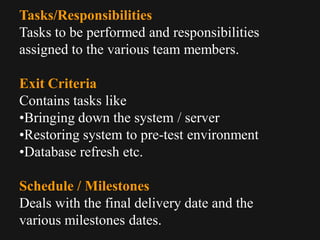
Tasks/Responsibilities
Tasks to be performed and responsibilities
assigned to the various team members.
Exit Criteria
Contains tasks like
•Bringing down the system / server
•Restoring system to pre-test environment
•Database refresh etc.
Schedule / Milestones
Deals with the final delivery date and the
various milestones dates.
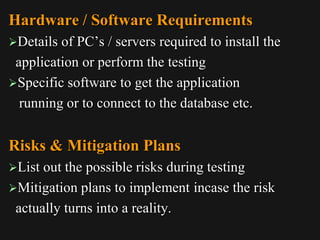
Hardware / Software Requirements
Details of PC’s / servers required to install the
application or perform the testing
Specific software to get the application
running or to connect to the database etc.
Risks & Mitigation Plans
List out the possible risks during testing
Mitigation plans to implement incase the risk
actually turns into a reality.
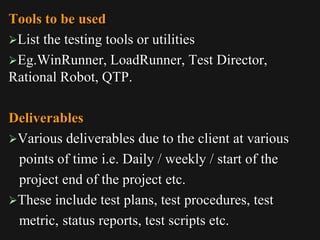
Tools to be used
List the testing tools or utilities
Eg.WinRunner, LoadRunner, Test Director,
Rational Robot, QTP.
Deliverables
Various deliverables due to the client at various
points of time i.e. Daily / weekly / start of the
project end of the project etc.
These include test plans, test procedures, test
metric, status reports, test scripts etc.
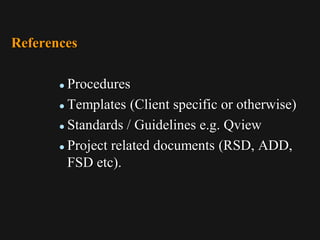
References
 Procedures
 Templates (Client specific or otherwise)
 Standards / Guidelines e.g. Qview
 Project related documents (RSD, ADD,
FSD etc).
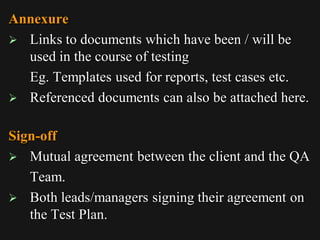
Annexure
 Links to documents which have been / will be
used in the course of testing
Eg. Templates used for reports, test cases etc.
 Referenced documents can also be attached here.
Sign-off
 Mutual agreement between the client and the QA
Team.
 Both leads/managers signing their agreement on
the Test Plan.
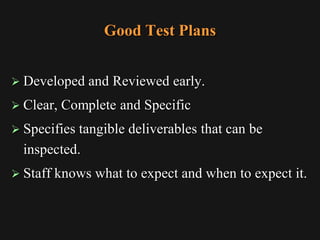
Good Test Plans
 Developed and Reviewed early.
 Clear, Complete and Specific
 Specifies tangible deliverables that can be
inspected.
 Staff knows what to expect and when to expect it.
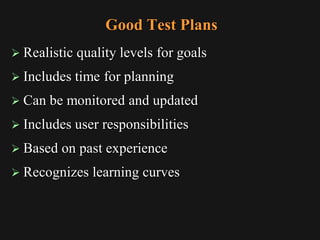
Good Test Plans
 Realistic quality levels for goals
 Includes time for planning
 Can be monitored and updated
 Includes user responsibilities
 Based on past experience
 Recognizes learning curves
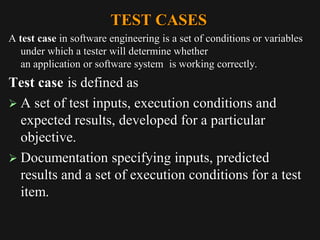
TEST CASES
A test case in software engineering is a set of conditions or variables
under which a tester will determine whether
an application or software system is working correctly.
Test case is defined as
 A set of test inputs, execution conditions and
expected results, developed for a particular
objective.
 Documentation specifying inputs, predicted
results and a set of execution conditions for a test
item.
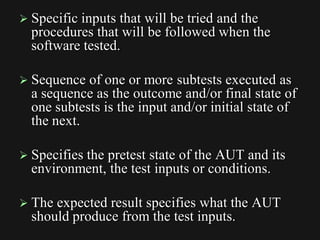
 Specific inputs that will be tried and the
procedures that will be followed when the
software tested.
 Sequence of one or more subtests executed as
a sequence as the outcome and/or final state of
one subtests is the input and/or initial state of
the next.
 Specifies the pretest state of the AUT and its
environment, the test inputs or conditions.
 The expected result specifies what the AUT
should produce from the test inputs.
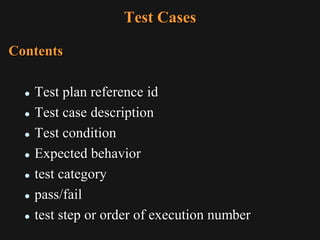
Test Cases
Contents
 Test plan reference id
 Test case description
 Test condition
 Expected behavior
 test category
 pass/fail
 test step or order of execution number
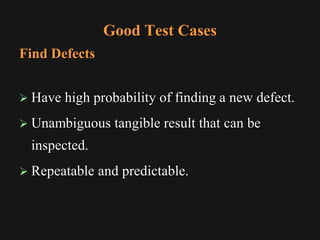
Good Test Cases
Find Defects
 Have high probability of finding a new defect.
 Unambiguous tangible result that can be
inspected.
 Repeatable and predictable.
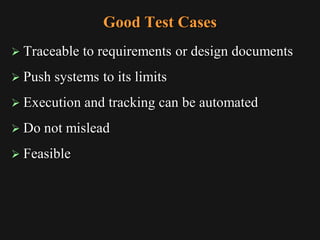
Good Test Cases
 Traceable to requirements or design documents
 Push systems to its limits
 Execution and tracking can be automated
 Do not mislead
 Feasible

testplan software testing planing tests.pdf

  • 1.
    TEST PLAN A testplan is a document detailing a systematic approach to testing a system such as a software. Objectives  To create a set of testing tasks.  Assign resources to each testing task.  Estimate completion time for each testing task.  Document testing standards.
  • 2.
    Purpose of preparinga Test Plan  Validate the acceptability of a software product.  Help the people outside the test group to understand ‘why’ and ‘how’ of product validation.  A Test Plan should be  thorough enough (Overall coverage of test to be conducted)  useful and understandable by the people inside and outside the test group.
  • 3.
    A document thatdescribes the  scope  approach  resources  schedule …of intended test activities. Identifies the  test items  features to be tested  testing tasks  task allotment  risks requiring contingency planning.
  • 4.
    Scope The areas tobe tested by the QA team. Specify the areas which are out of scope (screens, database, mainframe processes etc). Test Approach Details on how the testing is to be performed. Any specific strategy is to be followed for testing (including configuration management).
  • 5.
    Entry Criteria Various stepsto be performed before the start of a test i.e. Pre-requisites. E.g.  Timely environment set up  Starting the web server/app server  Successful implementation of the latest build etc. Resources List of the people involved in the project and their designation etc.
  • 6.
    Tasks/Responsibilities Tasks to beperformed and responsibilities assigned to the various team members. Exit Criteria Contains tasks like •Bringing down the system / server •Restoring system to pre-test environment •Database refresh etc. Schedule / Milestones Deals with the final delivery date and the various milestones dates.
  • 7.
    Hardware / SoftwareRequirements Details of PC’s / servers required to install the application or perform the testing Specific software to get the application running or to connect to the database etc. Risks & Mitigation Plans List out the possible risks during testing Mitigation plans to implement incase the risk actually turns into a reality.
  • 8.
    Tools to beused List the testing tools or utilities Eg.WinRunner, LoadRunner, Test Director, Rational Robot, QTP. Deliverables Various deliverables due to the client at various points of time i.e. Daily / weekly / start of the project end of the project etc. These include test plans, test procedures, test metric, status reports, test scripts etc.
  • 9.
    References  Procedures  Templates(Client specific or otherwise)  Standards / Guidelines e.g. Qview  Project related documents (RSD, ADD, FSD etc).
  • 10.
    Annexure  Links todocuments which have been / will be used in the course of testing Eg. Templates used for reports, test cases etc.  Referenced documents can also be attached here. Sign-off  Mutual agreement between the client and the QA Team.  Both leads/managers signing their agreement on the Test Plan.
  • 11.
    Good Test Plans Developed and Reviewed early.  Clear, Complete and Specific  Specifies tangible deliverables that can be inspected.  Staff knows what to expect and when to expect it.
  • 12.
    Good Test Plans Realistic quality levels for goals  Includes time for planning  Can be monitored and updated  Includes user responsibilities  Based on past experience  Recognizes learning curves
  • 13.
    TEST CASES A testcase in software engineering is a set of conditions or variables under which a tester will determine whether an application or software system is working correctly. Test case is defined as  A set of test inputs, execution conditions and expected results, developed for a particular objective.  Documentation specifying inputs, predicted results and a set of execution conditions for a test item.
  • 14.
     Specific inputsthat will be tried and the procedures that will be followed when the software tested.  Sequence of one or more subtests executed as a sequence as the outcome and/or final state of one subtests is the input and/or initial state of the next.  Specifies the pretest state of the AUT and its environment, the test inputs or conditions.  The expected result specifies what the AUT should produce from the test inputs.
  • 15.
    Test Cases Contents  Testplan reference id  Test case description  Test condition  Expected behavior  test category  pass/fail  test step or order of execution number
  • 16.
    Good Test Cases FindDefects  Have high probability of finding a new defect.  Unambiguous tangible result that can be inspected.  Repeatable and predictable.
  • 17.
    Good Test Cases Traceable to requirements or design documents  Push systems to its limits  Execution and tracking can be automated  Do not mislead  Feasible