




UST Global®, 20 Enterprise, Aliso Viejo CA 92656
Phone: (949) 716-8757 Fax: (949) 716-8396
www.ust-global.com
Authors:
Gregory Jose Gregory.jose@ust-global.com
Jusha Joseph Jusha.Joseph@ust-global.com
All trademarks are the property of their respective owners. UST Global® Copyright © 2014. All Rights Reserved.
TEST METRICS AND KPI’S
WHITE PAPER
UST Global®, 20 Enterprise, Aliso Viejo CA 92656
Phone: (949) 716-8757 Fax: (949) 716-8396
www.ust-global.com
Authors:
Gregory Jose Gregory.jose@ust-global.com
Jusha Joseph Jusha.Joseph@ust-global.com
This document serves as a guideline for understanding metrics and the Key performance indicators for a testing project.
Metrics are parameters or measures of quantitative assessment used for measurement, comparison or to track
performance or production. Software metric is a measure of some property of a piece of software or its specifications.
Defining and capturing a range of metrics allows them to be measured.
Key Performance Indicators (KPIs) are measurements defined to show the state of critical strategic goals or targets
the organization has set for itself. They are calculated by using sets or combinations of metrics. It’s a measure of
performance, commonly used to help an organization define and evaluate how successful it is in terms of making
progress towards its long-term organizational goals.
As a test team, one of the key deliverable is information that conveys the progress of test work and the testing status of
the project’s development items. Data of this type is vital to understand the current testing effort and review how it was
conducted previously and consider how to make improvements in the future. Various groups and individuals within
the organization and clients require this information in support of their own activities and decision making. It enables
organizations to improve the quality of management decision making by ensuring that reliable and secure information
and data is available throughout the Software lifecycle.
Metrics - Combination of two or more measures used to compare s/w processes, projects, and products. Set of metrics
derived from the data collected from past projects at the organization level. These baselines are used as a basis to arrive
at project specific quality goals or KPI’s.
Need for metrics in Testing and Quality analysis:
• To determine the quality and progress of testing.
• To calculate how much more time is required for the release
• To estimate the time needed to fix defects.
• Metrics help in deciding the scope of the product that can be released by considering the defect density across
modules, their importance to customers and impact analysis of those defects
Benefits of Metrics:
Abstract
What is Metrics?
All trademarks are the property of their respective owners. UST Global® Copyright © 2014. All Rights Reserved.
• Improve Productivity
• Meet on-time Delivery Commitment
• Reduce Development Cycle Time
• Improve Product Quality
• Reduce Cost of Quality
• Reduce Rework
• Improve profitability/ Reduce Cost Overruns
• Improving training Effectiveness
• Improving internal Satisfaction of
the associates
• Improve Customer Satisfaction Index
PROCESSFINANCE
PEOPLECUSTOMER
UST Global®, 20 Enterprise, Aliso Viejo CA 92656
Phone: (949) 716-8757 Fax: (949) 716-8396
www.ust-global.com
Authors:
Gregory Jose Gregory.jose@ust-global.com
Jusha Joseph Jusha.Joseph@ust-global.com
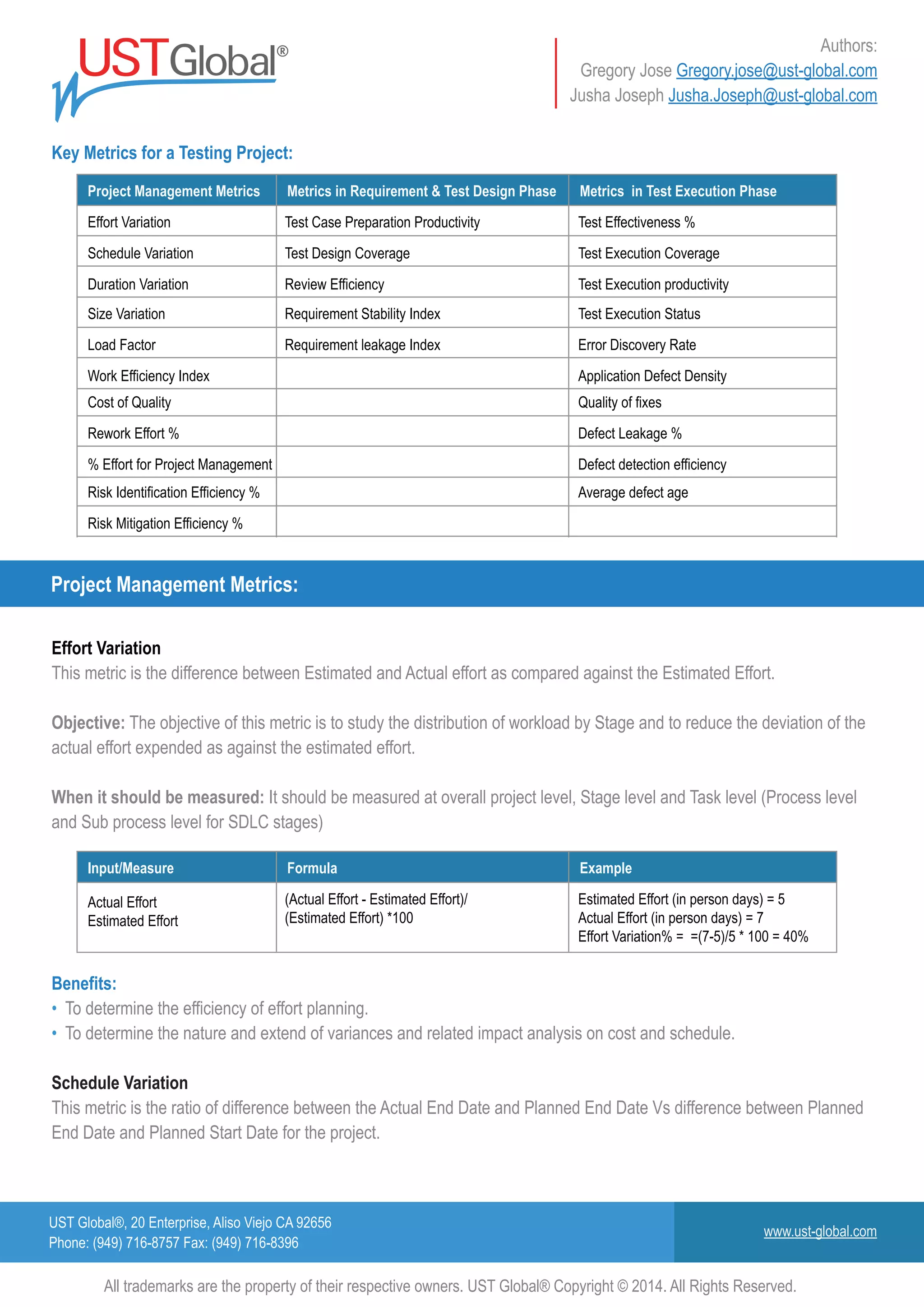
Key Metrics for a Testing Project:
Project Management Metrics:
All trademarks are the property of their respective owners. UST Global® Copyright © 2014. All Rights Reserved.
Project Management Metrics
Effort Variation
Schedule Variation
Duration Variation
Size Variation
Load Factor
Work Efficiency Index
Test Execution Status
Error Discovery Rate
Application Defect Density
Cost of Quality
Rework Effort %
% Effort for Project Management
Quality of fixes
Defect Leakage %
Defect detection efficiency
Risk Identification Efficiency %
Risk Mitigation Efficiency %
Average defect age
Requirement Stability Index
Requirement leakage Index
Test Case Preparation Productivity
Test Design Coverage
Review Efficiency
Test Effectiveness %
Test Execution Coverage
Test Execution productivity
Metrics in Requirement & Test Design Phase Metrics in Test Execution Phase
Input/Measure
Actual Effort
Estimated Effort
(Actual Effort - Estimated Effort)/
(Estimated Effort) *100
Estimated Effort (in person days) = 5
Actual Effort (in person days) = 7
Effort Variation% = =(7-5)/5 * 100 = 40%
Formula Example
Effort Variation
This metric is the difference between Estimated and Actual effort as compared against the Estimated Effort.
Objective: The objective of this metric is to study the distribution of workload by Stage and to reduce the deviation of the
actual effort expended as against the estimated effort.
When it should be measured: It should be measured at overall project level, Stage level and Task level (Process level
and Sub process level for SDLC stages)
Benefits:
• To determine the efficiency of effort planning.
• To determine the nature and extend of variances and related impact analysis on cost and schedule.
Schedule Variation
This metric is the ratio of difference between the Actual End Date and Planned End Date Vs difference between Planned
End Date and Planned Start Date for the project.
UST Global®, 20 Enterprise, Aliso Viejo CA 92656
Phone: (949) 716-8757 Fax: (949) 716-8396
www.ust-global.com
Authors:
Gregory Jose Gregory.jose@ust-global.com
Jusha Joseph Jusha.Joseph@ust-global.com
All trademarks are the property of their respective owners. UST Global® Copyright © 2014. All Rights Reserved.
Input/Measure
Actual End Date
Planned Start Date
Planned End Date
((Actual End date – Planned End date) /
(Planned End date - Planned Start date)) * 100
Planned Start Date = 1-Jan-13
Planned End Date = 31-Jan-13
Actual Start Date = 2-Jan-13
Actual End Date = 1-Feb-13
Schedule Variation % = (1 / 31) * 100 = 3.22%
Formula Example
Input/Measure
Actual End Date
Actual Start Date
Planned Start Date
Planned End Date
((Actual End Date – Actual Start Date) –
(Planned End Date – Planned Start Date)) /
(Planned End Date – Planned Start Date) * 100
Planned Start Date - 1-Jan-13
Planned End Date - 31-Jan-13
Actual Start Date - 2-Jan-13
Actual End Date - 1-Feb-13
Duration Variation % = ((31 –31)/ 31) *100 = 0 %
Formula Example
Objective: The objective of this metric is to reduce the schedule variation by tracking it from beginning stage of the
project through the end of the project, thereby reducing time overruns. Schedule Variation metric is mainly used as an
indicator for capability to meet milestones
When it should be measured: It should be measured at overall project level, Stage level and Task level (Process level
and Sub process level for SDLC stages). Schedule variation need to be calculated only when the stage is completed.
Benefits:
• Schedule variation metrics is mainly used as an indicator for capability to meet milestones.
Duration Variation
This metric is the difference between Total Planned Vs Actual duration for the project
Objective: The objective of this metric is same as schedule variation metrics i.e. to reduce the duration variation by
tracking it from beginning stage of the project through the end of the project, thereby reducing time overruns. Why we may
need both Duration Variation and Schedule Variation is that at times the task/stage may be finished within Planned
Duration (Delayed start compensated with delayed finish to the same extent as days it started late.) whereas it might have
exceeded the committed deadline, which is ultimately the schedule slippage.
When it should be measured: It should be measured at overall project level, Stage level and Task level (Process level
and Sub process level for SDLC stages). Duration variation need to be calculated only when the stage is completed.
Benefits:
• Schedule variation metrics is mainly used as an indicator for capability to meet milestones.
Size Variation
This metric is the difference between Estimated Size and Actual size as compared against Estimated Size.
Objective: This metric is used for Comparison of estimated size and the actual size of the project. Results of size
variation can be used to analyze reasons for schedule and duration variations and also can be considered for estimate
preparations in future.
UST Global®, 20 Enterprise, Aliso Viejo CA 92656
Phone: (949) 716-8757 Fax: (949) 716-8396
www.ust-global.com
Authors:
Gregory Jose Gregory.jose@ust-global.com
Jusha Joseph Jusha.Joseph@ust-global.com
All trademarks are the property of their respective owners. UST Global® Copyright © 2014. All Rights Reserved.
Input/Measure
Actual Size
Estimated Size
((Actual Size – Estimated Size) /
Estimated Size) * 100
Actual Size - 90 FP
Estimated Size - 100 FP
Size Variation % = ((90 – 100)/100) *100 = -10%
Formula Example
Input/Measure
Actual Effort
Allocated Effort
(Actual Effort / Allocated Effort) Actual Effort (in person days) = 100
No: Of Resources = 6
No: of days allocated = 20
Allocated Effort (Available effort * No of Resources)
in Person Days = 120 i.e (20*6)
Load Factor = 100/120 = 0.83
Formula Example
When it should be measured: It should be measured at overall project level and Task level.
Benefits:
• Schedule variation metrics is mainly used as an indicator for reasons of effort and schedule variations.
Load Factor
Load Factor is computed as ratio of Actual Effort expended in the project to Total Effort available to the project in terms of
number of resources allocated to the project for any given period.
Objective: The objective of this metric is to verify the resource allocation.
When it should be measured: It should be measured at overall project level.
Benefits:
• To know resource utilization in the project
• Helps to utilize the resources optimally.
Work Efficiency Index
Load Work Efficiency Index is the ratio of percentage of work completed to percentage of effort expended.
Objective: This metric is particularly important and mandatory for fixed bid/fixed duration projects, and close monitoring is
required to prevent effort overruns.
When it should be measured: It should be measured at overall project level.
UST Global®, 20 Enterprise, Aliso Viejo CA 92656
Phone: (949) 716-8757 Fax: (949) 716-8396
www.ust-global.com
Authors:
Gregory Jose Gregory.jose@ust-global.com
Jusha Joseph Jusha.Joseph@ust-global.com
All trademarks are the property of their respective owners. UST Global® Copyright © 2014. All Rights Reserved.
Input/Measure
Percentage of Work completed -
(Actual Effort) / (Actual Effort +
Effort required to complete
remaining work) * 100
Percentage of effort expended -
(Actual Effort/ Estimated Effort) *100
(Percentage of Work completed /
Percentage of effort expended)
Estimated Effort (in person days) = 10
Actual Effort (in person days) = 5
Effort Required to complete remaining work (in person days) = 7
%Work Completed = (5/(5+7))*100 = 41.66%
%Effort Expended = (5/10)*100 = 50%
Work Efficiency Index = (41.66 / 50) = 0.83
Formula Example
Category
Prevention Efforts to ensure product quality Defect Prevention. Metrics collection and Analysis, Training, process improvements.
Appraisal Discovering the condition of the
product
Reviews, Testing and product quality audits
Failures Cost Internal Failure: Quality failures
detected prior to product
shipment
External Failures: Quality
failures detected after product
shipment
Rework and retesting arising both due to internal and external failures
Definition Typical Costs for Software
Input/Measure
Effort spent on Prevention
Effort spent on Appraisal
Effort spent on Failure
Effort spent on Production
(Effort spent on Prevention + Effort spent on Appraisal + Effort spent on Failure) /
(Effort spent on Prevention + Effort spent on Appraisal + Effort spent on Failure +
Effort spent on Production) *100
Formula
Benefits:
• This metric is particularly important and mandatory for fixed bid/fixed duration projects, and close monitoring is required
to prevent effort overruns.
Cost of Quality
COQ basically consist of 3 types of cost - Prevention Cost, Appraisal Cost and Failure Cost. Failure Cost can be further
divided into Internal Failure and External Failure. Here the cost measure is in terms of Effort.
Objective: The objective of this metric is to measure the effort spent on reviews, testing and rework against the produc-
tion effort.
Definition of Cost of Quality Categories:
Benefits:
• This metric is useful to calculate the total effort spent for QA in a project.
Rework Effort %
Percentage of Effort expended on Rework activities in the project to overall Effort
UST Global®, 20 Enterprise, Aliso Viejo CA 92656
Phone: (949) 716-8757 Fax: (949) 716-8396
www.ust-global.com
Authors:
Gregory Jose Gregory.jose@ust-global.com
Jusha Joseph Jusha.Joseph@ust-global.com
All trademarks are the property of their respective owners. UST Global® Copyright © 2014. All Rights Reserved.
Input/Measure
Total Effort for Rework
Total Effort for Project
(Total Effort expended on Rework
across all stages)/ (Actual Overall
Project Effort) *100
Total Effort for Rework = 10 PD
Total Effort for Project = 200 PD
Rework Effort % =(10/200)*100= 5 %
Formula Example
Input/Measure
Effort for Project
Management
Total Effort for Project
(Effort expended for Project
Management activities)/
(Overall Project Effort) *100
Total Effort for Project Management = 10 PD
Total Effort for Project = 200 PD
Rework Effort % =(10/200)*100= 5 %
Formula Example
Input/Measure
Total no of Risks Identified
Total no of Unanticipated Risk
Occurred
(Total no of Risks Identified /(Total
no of risks identified + Total no of
Unanticipated Risk Occurred))*100
Total no of Risks Identified = 6
Total no of Unanticipated Risk Occurred = 2
Risk Identification Efficiency % = (6/8)*100 = 75%
Formula Example
Objective: Expending effort on Rework activities is inevitable in any project. Objective of this metrics is to monitor
that effort spent on Rework is kept as minimum as possible
When it should be measured: It should be measured at overall project level.
Benefits:
• Using this metrics actual effort for rework can be found and by analyzing this metrics actions can be taken to reduce
rework effort %
% Effort for Project Management
Project Management is an umbrella activity that is carried out throughout the project. Effort expended for Project Man-
agement activities to overall Project effort is computed as percentage figure.
When it should be measured: It should be measured at overall project level.
Benefits:
• This metrics is used to identify & of test management activities for a testing project.
Risk Identification Efficiency %
This metric determines the efficiency of identifying risk in a project. This helps in planning for the mitigation and
contingency to be carried out in a project. This metric is computed as Number of Risk identified to Number of Risk
occurred, expressed as percentage figure
When it should be measured: It should be measured at overall project level.
Benefits:
• This metric determines the efficiency of identifying risk in a project
• This helps in planning for the mitigation and contingency to be carried out in a project
UST Global®, 20 Enterprise, Aliso Viejo CA 92656
Phone: (949) 716-8757 Fax: (949) 716-8396
www.ust-global.com
Authors:
Gregory Jose Gregory.jose@ust-global.com
Jusha Joseph Jusha.Joseph@ust-global.com
All trademarks are the property of their respective owners. UST Global® Copyright © 2014. All Rights Reserved.
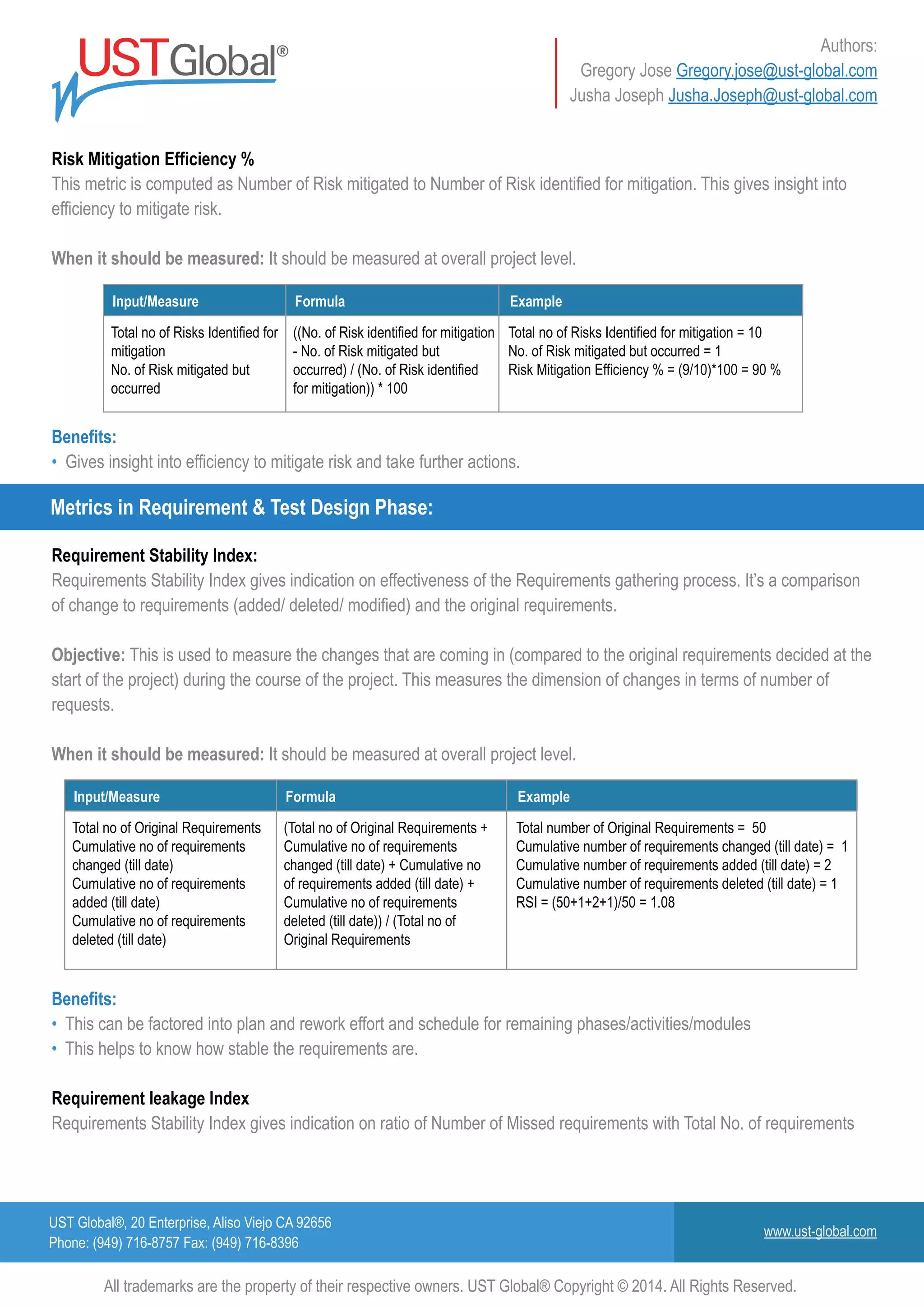
Input/Measure
Total no of Risks Identified for
mitigation
No. of Risk mitigated but
occurred
((No. of Risk identified for mitigation
- No. of Risk mitigated but
occurred) / (No. of Risk identified
for mitigation)) * 100
Total no of Risks Identified for mitigation = 10
No. of Risk mitigated but occurred = 1
Risk Mitigation Efficiency % = (9/10)*100 = 90 %
Formula Example
Input/Measure
Total no of Original Requirements
Cumulative no of requirements
changed (till date)
Cumulative no of requirements
added (till date)
Cumulative no of requirements
deleted (till date)
(Total no of Original Requirements +
Cumulative no of requirements
changed (till date) + Cumulative no
of requirements added (till date) +
Cumulative no of requirements
deleted (till date)) / (Total no of
Original Requirements
Total number of Original Requirements = 50
Cumulative number of requirements changed (till date) = 1
Cumulative number of requirements added (till date) = 2
Cumulative number of requirements deleted (till date) = 1
RSI = (50+1+2+1)/50 = 1.08
Formula Example
Risk Mitigation Efficiency %
This metric is computed as Number of Risk mitigated to Number of Risk identified for mitigation. This gives insight into
efficiency to mitigate risk.
When it should be measured: It should be measured at overall project level.
Requirement Stability Index:
Requirements Stability Index gives indication on effectiveness of the Requirements gathering process. It’s a comparison
of change to requirements (added/ deleted/ modified) and the original requirements.
Objective: This is used to measure the changes that are coming in (compared to the original requirements decided at the
start of the project) during the course of the project. This measures the dimension of changes in terms of number of
requests.
When it should be measured: It should be measured at overall project level.
Benefits:
• Gives insight into efficiency to mitigate risk and take further actions.
Benefits:
• This can be factored into plan and rework effort and schedule for remaining phases/activities/modules
• This helps to know how stable the requirements are.
Requirement leakage Index
Requirements Stability Index gives indication on ratio of Number of Missed requirements with Total No. of requirements
Metrics in Requirement & Test Design Phase:
UST Global®, 20 Enterprise, Aliso Viejo CA 92656
Phone: (949) 716-8757 Fax: (949) 716-8396
www.ust-global.com
Authors:
Gregory Jose Gregory.jose@ust-global.com
Jusha Joseph Jusha.Joseph@ust-global.com
All trademarks are the property of their respective owners. UST Global® Copyright © 2014. All Rights Reserved.
Input/Measure
Total No. of Initial
Requirements
Total No. of Missed
Requirements
(No. of Missed Requirements)/
(Total No. of Initial Requirements) *100
Total No. of Initial Requirements = 50
Total No. of Missed Requirements = 2
RLI = (2/50)*100 = 4
Formula Example
Input/Measure
Number of Review defects
Total number of Testing
Defects including customer
reported test defects
(Number of Review defects) / (Total
number of Review + Testing Defects
[including customer reported test
defects])*100
Number of Review defects = 10
Total number of Testing Defects including customer
reported test defects = 100
Review Efficiency% = (10/110)*100 = 9.09
Formula Example
Objective: Requirements Leakage Index gives indication on effectiveness of the Requirements elicitation process.
Requirements Leakage index is given by Number of Missed Requirements to Number of Total Requirements, expressed
as percentage figure. Here the missed requirements are those that were missed by the Project team during Requirements
Elicitation process
When it should be measured: It should be measured at overall project level.
Benefits:
• This helps to know effectiveness of the Requirements elicitation process.
Review Efficiency
It’s the ratio of number of review defects to total defects in software (review and testing)
Objective: This metric shows the efficiency of the review process. A higher ratio of Review Defects to Total Defects
indicates a very efficient Review Process. However, a lower ratio need not necessarily mean that the review is
inadequate. This may be due to frequent changes in scope, requirements etc. Typically, the review defects include all
reviews, starting from the Requirements Stage. All review comments that arise from the review of Code/unit / integration /
system test plans / procedures / cases shall be counted under Review defects. The total number of Defects includes all
the defects found in reviews and testing.
When it should be measured: It should be measured at overall project level and stage level.
Benefits:
• This helps to know effectiveness of the reviews performed and to improve the review process.
• Increase in review efficiency decrease the defect leakage to next stage.
Test Case Preparation Productivity
It determines the number of Test cases / Scripts that can be prepared per person days of effort.
Objective: To determine the test design productivity based on which future estimation can be done for the similar projects
When it should be measured: It should be measured during test design phase
UST Global®, 20 Enterprise, Aliso Viejo CA 92656
Phone: (949) 716-8757 Fax: (949) 716-8396
www.ust-global.com
Authors:
Gregory Jose Gregory.jose@ust-global.com
Jusha Joseph Jusha.Joseph@ust-global.com
All trademarks are the property of their respective owners. UST Global® Copyright © 2014. All Rights Reserved.
Input/Measure
No of Test Cases or Scripts
Prepared
Effort spent for Test Case/
Script preparation
(No of Test Cases or scripts)/
(Effort spent for Test Case/script
Preparation)
No of Test Cases or Scripts = 1000
Effort spent for Test Case preparation in PD = 100
Test Case Preparation Productivity =1000/100
Formula Example
Input/Measure
Total number of baselined
testable requirements
mapped to test cases
Total number of baselined
testable requirements
((Total number of testable
requirements mapped to test
cases or Scripts ) /(Total number
of baselined testable
requirements)*100
Total number of baselined testable requirements
mapped to test cases = 1100
Total number of baselined testable requirements =
1080
Design Coverage % =(1080/1100)*100
=98.18
Formula Example
Input/Measure
Total Number of defects found by test
team
Total Number of defects Rejected by
Customer
Total number of defects found by
customer during UAT
((Total no of application defects found by
test team -Total number of application
defects rejected by the customer)/( Total
no of application defects found by test
team + Total number of defects found
by customer during UAT))*100
Total Number of defects found by test team = 100
Total Number of defects Rejected by Customer = 10
Total number of defects found by customer during UAT = 2
Test Effectiveness % = ((100 -10)/(100 + 2))*100 = 88.23 %
Formula Example
Benefits:
• This helps to determine number of test cases prepared per person days of effort.
• If productivity is low due to reasons like too many changes to requirements, it helps us to factor the effort into the project
plan and re estimate the remaining activities/stages.
Test Design Coverage
This is to measure the percentage of test case coverage against the number of test requirements.
Objective: The objective of this metrics to measure the functional coverage of test cases designed.
When it should be measured: It should be measured during test design phase.
Test Effectiveness %
This metrics shows the efficiency of removing defects by internal Testing before delivering to customer. It determines
quality of defects logged.
Objective: The objective of this metrics is to determine the testing efficiency.
When it should be measured: It should be measured at end of every build or test execution phase.
Benefits:
• This metrics is used as an indicator of quality of test design and used to improve test coverage.
Metrics in Test Execution Phase:
UST Global®, 20 Enterprise, Aliso Viejo CA 92656
Phone: (949) 716-8757 Fax: (949) 716-8396
www.ust-global.com
Authors:
Gregory Jose Gregory.jose@ust-global.com
Jusha Joseph Jusha.Joseph@ust-global.com
All trademarks are the property of their respective owners. UST Global® Copyright © 2014. All Rights Reserved.
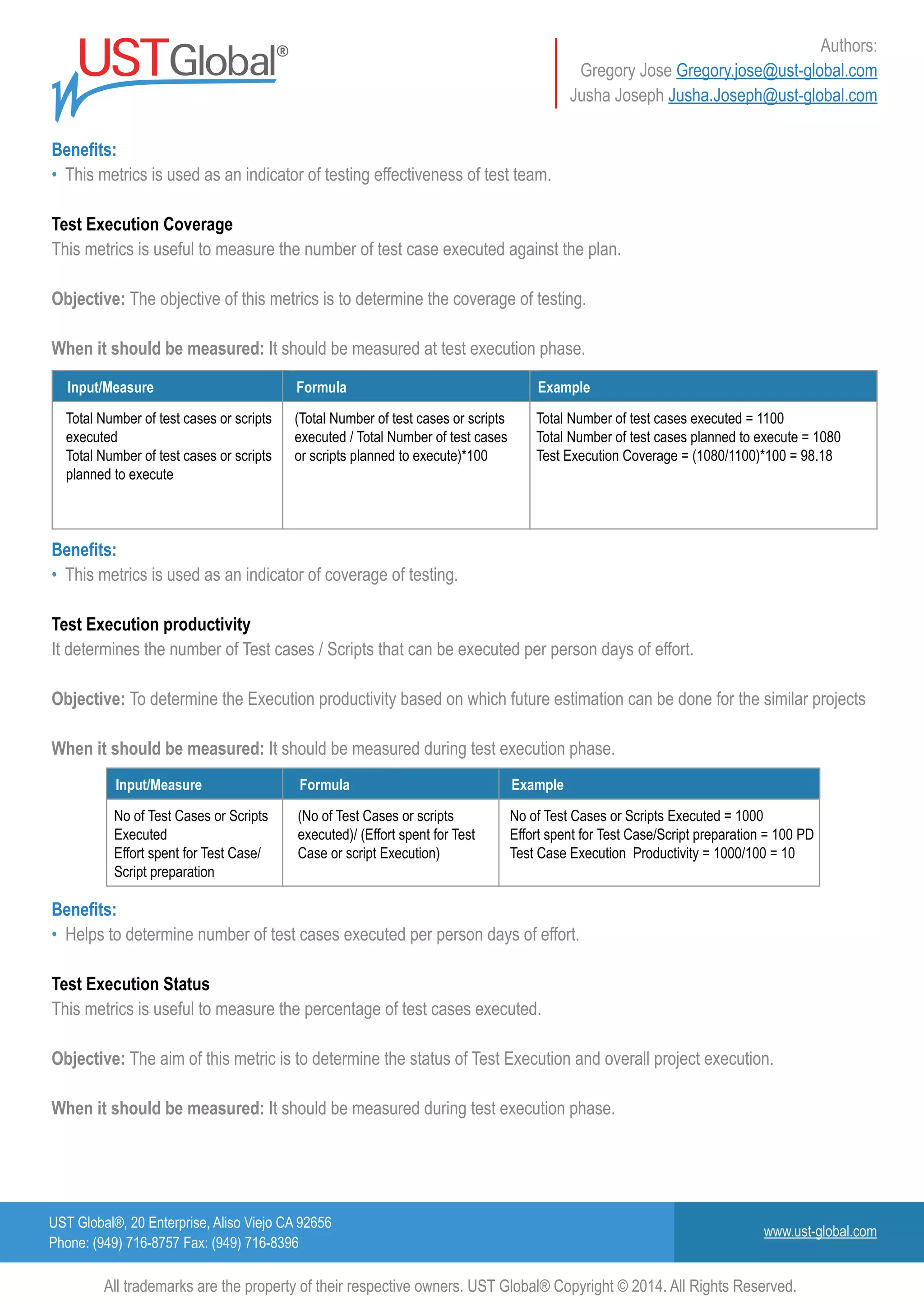
Input/Measure
No of Test Cases or Scripts
Executed
Effort spent for Test Case/
Script preparation
(No of Test Cases or scripts
executed)/ (Effort spent for Test
Case or script Execution)
No of Test Cases or Scripts Executed = 1000
Effort spent for Test Case/Script preparation = 100 PD
Test Case Execution Productivity = 1000/100 = 10
Formula Example
Input/Measure
Total Number of test cases or scripts
executed
Total Number of test cases or scripts
planned to execute
(Total Number of test cases or scripts
executed / Total Number of test cases
or scripts planned to execute)*100
Total Number of test cases executed = 1100
Total Number of test cases planned to execute = 1080
Test Execution Coverage = (1080/1100)*100 = 98.18
Formula Example
Benefits:
• This metrics is used as an indicator of testing effectiveness of test team.
Test Execution Coverage
This metrics is useful to measure the number of test case executed against the plan.
Objective: The objective of this metrics is to determine the coverage of testing.
When it should be measured: It should be measured at test execution phase.
Benefits:
• This metrics is used as an indicator of coverage of testing.
Test Execution productivity
It determines the number of Test cases / Scripts that can be executed per person days of effort.
Objective: To determine the Execution productivity based on which future estimation can be done for the similar projects
When it should be measured: It should be measured during test execution phase.
Benefits:
• Helps to determine number of test cases executed per person days of effort.
Test Execution Status
This metrics is useful to measure the percentage of test cases executed.
Objective: The aim of this metric is to determine the status of Test Execution and overall project execution.
When it should be measured: It should be measured during test execution phase.
UST Global®, 20 Enterprise, Aliso Viejo CA 92656
Phone: (949) 716-8757 Fax: (949) 716-8396
www.ust-global.com
Authors:
Gregory Jose Gregory.jose@ust-global.com
Jusha Joseph Jusha.Joseph@ust-global.com
All trademarks are the property of their respective owners. UST Global® Copyright © 2014. All Rights Reserved.
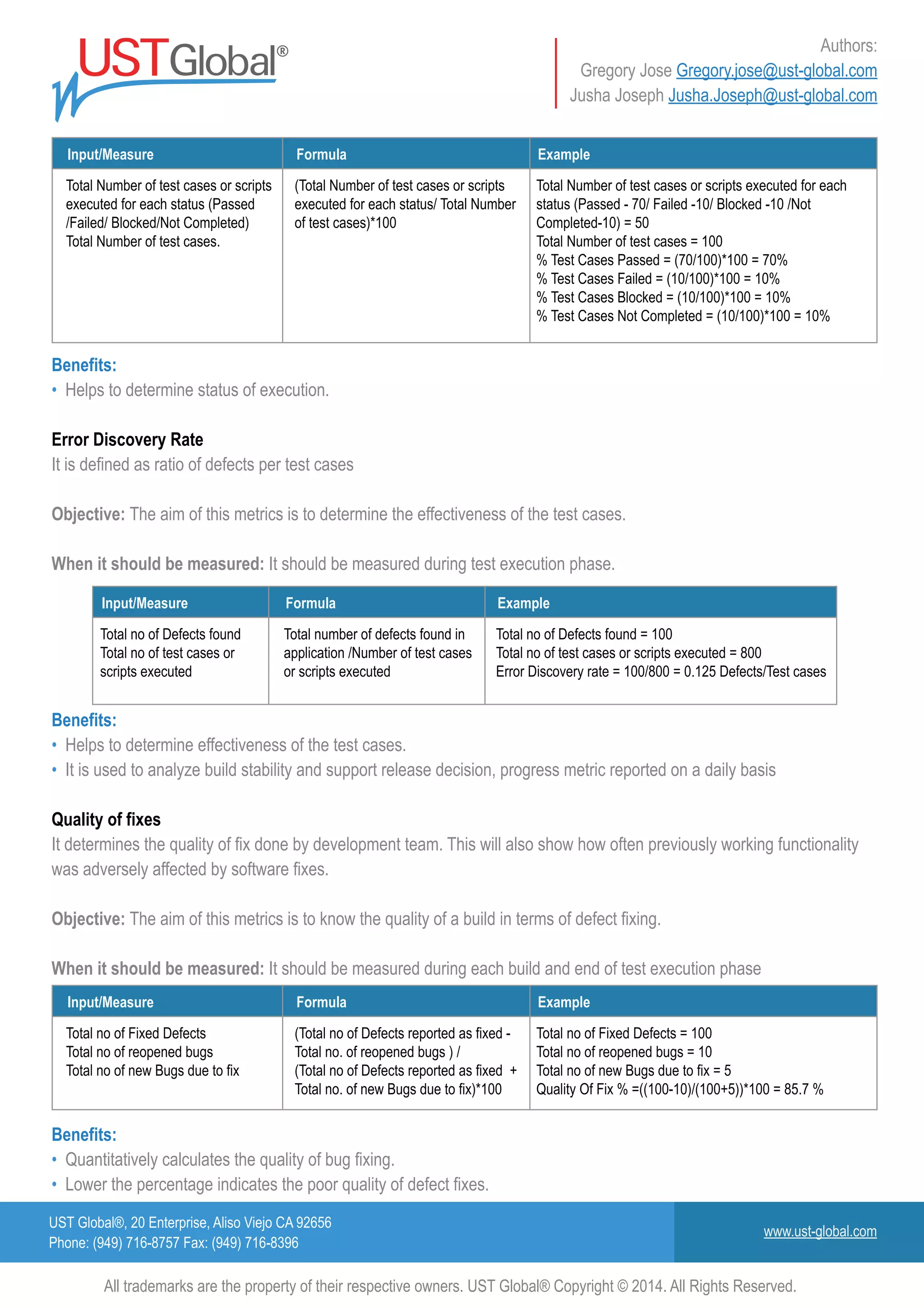
Input/Measure
Total no of Defects found
Total no of test cases or
scripts executed
Total number of defects found in
application /Number of test cases
or scripts executed
Total no of Defects found = 100
Total no of test cases or scripts executed = 800
Error Discovery rate = 100/800 = 0.125 Defects/Test cases
Formula Example
Input/Measure
Total Number of test cases or scripts
executed for each status (Passed
/Failed/ Blocked/Not Completed)
Total Number of test cases.
(Total Number of test cases or scripts
executed for each status/ Total Number
of test cases)*100
Total Number of test cases or scripts executed for each
status (Passed - 70/ Failed -10/ Blocked -10 /Not
Completed-10) = 50
Total Number of test cases = 100
% Test Cases Passed = (70/100)*100 = 70%
% Test Cases Failed = (10/100)*100 = 10%
% Test Cases Blocked = (10/100)*100 = 10%
% Test Cases Not Completed = (10/100)*100 = 10%
Formula Example
Input/Measure
Total no of Fixed Defects
Total no of reopened bugs
Total no of new Bugs due to fix
(Total no of Defects reported as fixed -
Total no. of reopened bugs ) /
(Total no of Defects reported as fixed +
Total no. of new Bugs due to fix)*100
Total no of Fixed Defects = 100
Total no of reopened bugs = 10
Total no of new Bugs due to fix = 5
Quality Of Fix % =((100-10)/(100+5))*100 = 85.7 %
Formula Example
Benefits:
• Helps to determine status of execution.
Error Discovery Rate
It is defined as ratio of defects per test cases
Objective: The aim of this metrics is to determine the effectiveness of the test cases.
When it should be measured: It should be measured during test execution phase.
Benefits:
• Helps to determine effectiveness of the test cases.
• It is used to analyze build stability and support release decision, progress metric reported on a daily basis
Quality of fixes
It determines the quality of fix done by development team. This will also show how often previously working functionality
was adversely affected by software fixes.
Objective: The aim of this metrics is to know the quality of a build in terms of defect fixing.
When it should be measured: It should be measured during each build and end of test execution phase
Benefits:
• Quantitatively calculates the quality of bug fixing.
• Lower the percentage indicates the poor quality of defect fixes.
UST Global®, 20 Enterprise, Aliso Viejo CA 92656
Phone: (949) 716-8757 Fax: (949) 716-8396
www.ust-global.com
Authors:
Gregory Jose Gregory.jose@ust-global.com
Jusha Joseph Jusha.Joseph@ust-global.com
All trademarks are the property of their respective owners. UST Global® Copyright © 2014. All Rights Reserved.
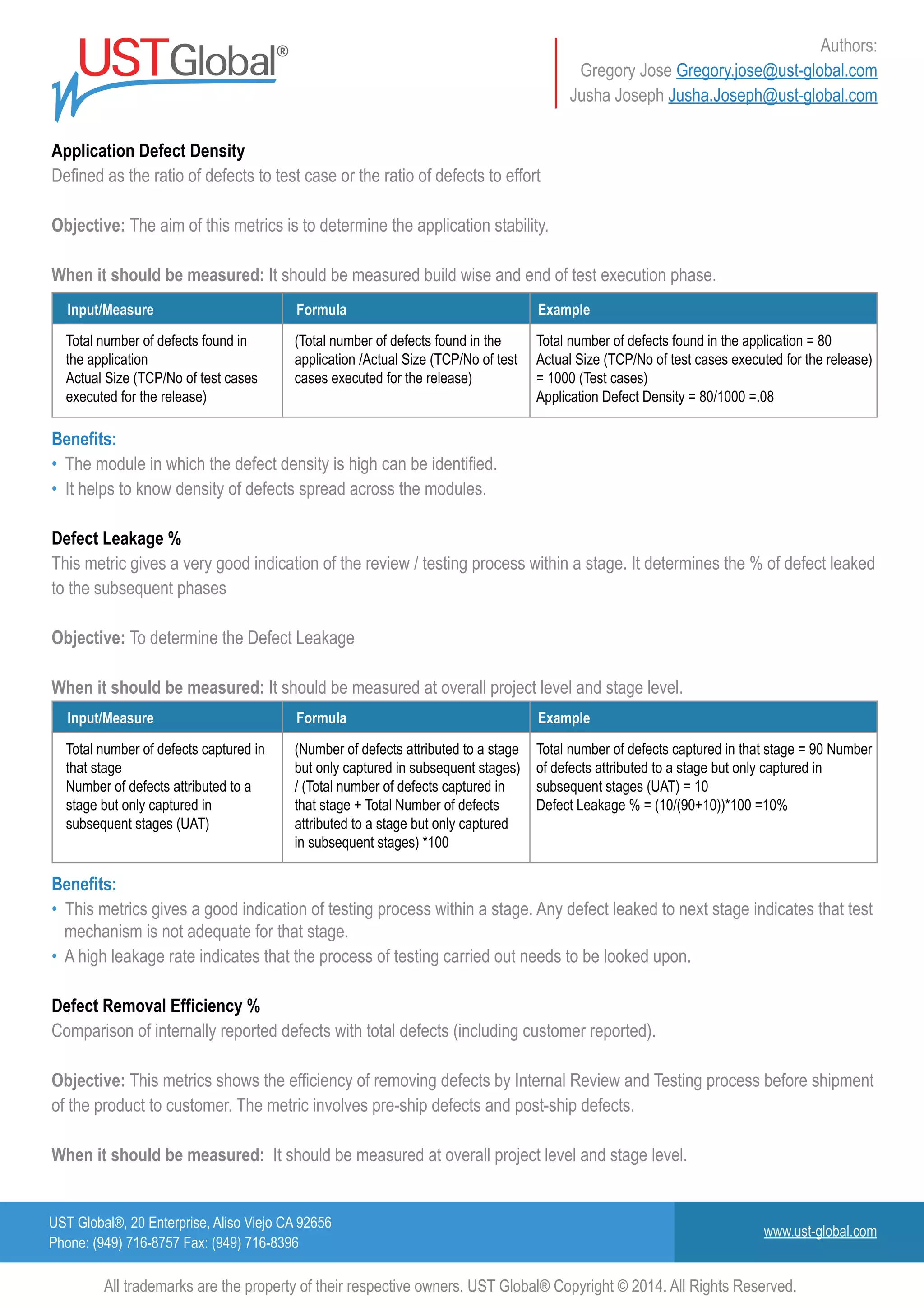
Input/Measure
Total number of defects found in
the application
Actual Size (TCP/No of test cases
executed for the release)
(Total number of defects found in the
application /Actual Size (TCP/No of test
cases executed for the release)
Total number of defects found in the application = 80
Actual Size (TCP/No of test cases executed for the release)
= 1000 (Test cases)
Application Defect Density = 80/1000 =.08
Formula Example
Input/Measure
Total number of defects captured in
that stage
Number of defects attributed to a
stage but only captured in
subsequent stages (UAT)
(Number of defects attributed to a stage
but only captured in subsequent stages)
/ (Total number of defects captured in
that stage + Total Number of defects
attributed to a stage but only captured
in subsequent stages) *100
Total number of defects captured in that stage = 90 Number
of defects attributed to a stage but only captured in
subsequent stages (UAT) = 10
Defect Leakage % = (10/(90+10))*100 =10%
Formula Example
Application Defect Density
Defined as the ratio of defects to test case or the ratio of defects to effort
Objective: The aim of this metrics is to determine the application stability.
When it should be measured: It should be measured build wise and end of test execution phase.
Benefits:
• The module in which the defect density is high can be identified.
• It helps to know density of defects spread across the modules.
Defect Leakage %
This metric gives a very good indication of the review / testing process within a stage. It determines the % of defect leaked
to the subsequent phases
Objective: To determine the Defect Leakage
When it should be measured: It should be measured at overall project level and stage level.
Benefits:
• This metrics gives a good indication of testing process within a stage. Any defect leaked to next stage indicates that test
mechanism is not adequate for that stage.
• A high leakage rate indicates that the process of testing carried out needs to be looked upon.
Defect Removal Efficiency %
Comparison of internally reported defects with total defects (including customer reported).
Objective: This metrics shows the efficiency of removing defects by Internal Review and Testing process before shipment
of the product to customer. The metric involves pre-ship defects and post-ship defects.
When it should be measured: It should be measured at overall project level and stage level.
UST Global®, 20 Enterprise, Aliso Viejo CA 92656
Phone: (949) 716-8757 Fax: (949) 716-8396
www.ust-global.com
Authors:
Gregory Jose Gregory.jose@ust-global.com
Jusha Joseph Jusha.Joseph@ust-global.com
All trademarks are the property of their respective owners. UST Global® Copyright © 2014. All Rights Reserved.
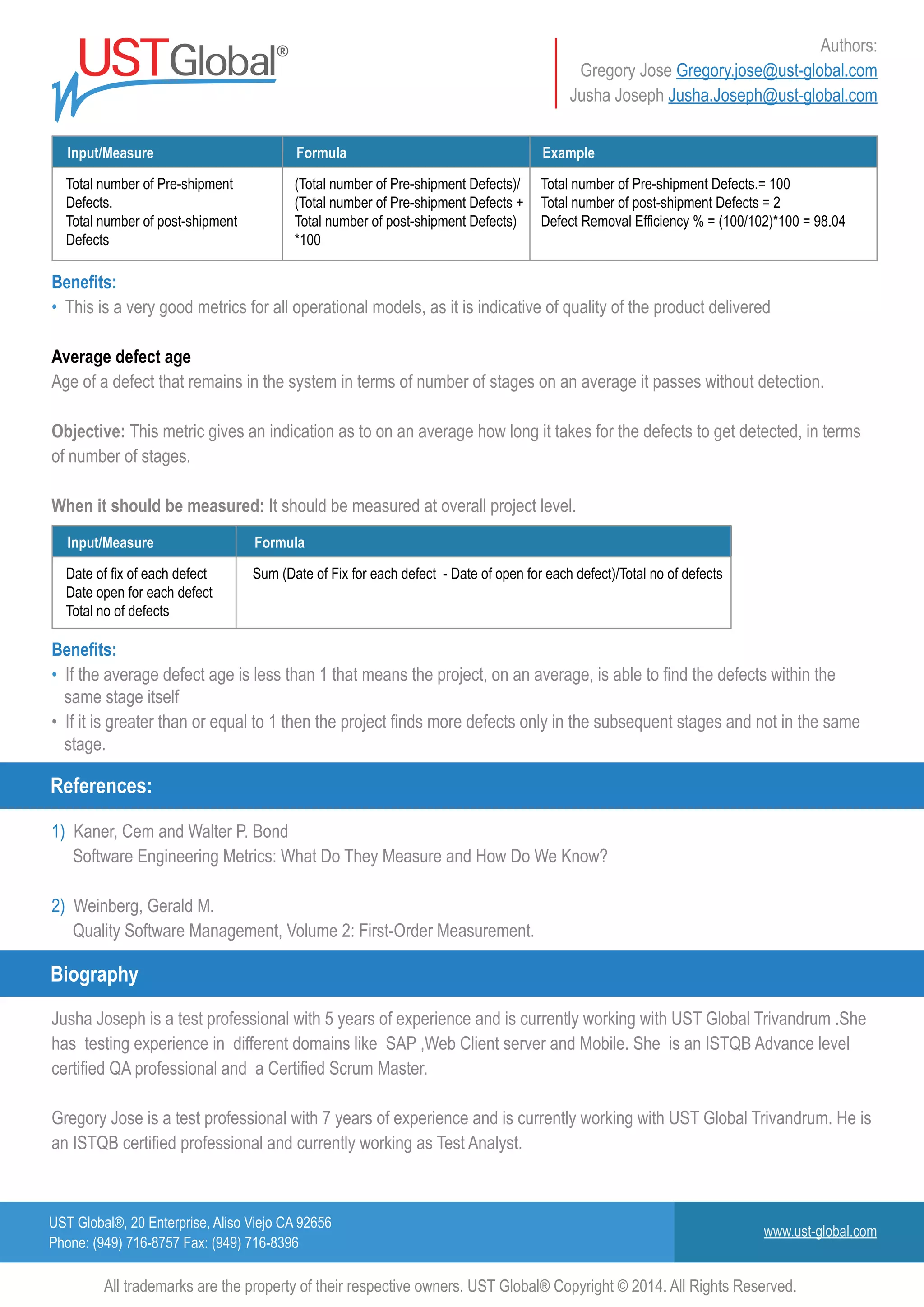
Input/Measure
Total number of Pre-shipment
Defects.
Total number of post-shipment
Defects
(Total number of Pre-shipment Defects)/
(Total number of Pre-shipment Defects +
Total number of post-shipment Defects)
*100
Total number of Pre-shipment Defects.= 100
Total number of post-shipment Defects = 2
Defect Removal Efficiency % = (100/102)*100 = 98.04
Formula Example
Input/Measure
Date of fix of each defect
Date open for each defect
Total no of defects
Sum (Date of Fix for each defect - Date of open for each defect)/Total no of defects
Formula
Benefits:
• This is a very good metrics for all operational models, as it is indicative of quality of the product delivered
Average defect age
Age of a defect that remains in the system in terms of number of stages on an average it passes without detection.
Objective: This metric gives an indication as to on an average how long it takes for the defects to get detected, in terms
of number of stages.
When it should be measured: It should be measured at overall project level.
Benefits:
• If the average defect age is less than 1 that means the project, on an average, is able to find the defects within the
same stage itself
• If it is greater than or equal to 1 then the project finds more defects only in the subsequent stages and not in the same
stage.
1) Kaner, Cem and Walter P. Bond
Software Engineering Metrics: What Do They Measure and How Do We Know?
2) Weinberg, Gerald M.
Quality Software Management, Volume 2: First-Order Measurement.
Jusha Joseph is a test professional with 5 years of experience and is currently working with UST Global Trivandrum .She
has testing experience in different domains like SAP ,Web Client server and Mobile. She is an ISTQB Advance level
certified QA professional and a Certified Scrum Master.
Gregory Jose is a test professional with 7 years of experience and is currently working with UST Global Trivandrum. He is
an ISTQB certified professional and currently working as Test Analyst.
References:
Biography

Test Metrics and KPIs

  • 1.
    UST Global®, 20Enterprise, Aliso Viejo CA 92656 Phone: (949) 716-8757 Fax: (949) 716-8396 www.ust-global.com Authors: Gregory Jose Gregory.jose@ust-global.com Jusha Joseph Jusha.Joseph@ust-global.com All trademarks are the property of their respective owners. UST Global® Copyright © 2014. All Rights Reserved. TEST METRICS AND KPI’S WHITE PAPER
  • 2.
    UST Global®, 20Enterprise, Aliso Viejo CA 92656 Phone: (949) 716-8757 Fax: (949) 716-8396 www.ust-global.com Authors: Gregory Jose Gregory.jose@ust-global.com Jusha Joseph Jusha.Joseph@ust-global.com This document serves as a guideline for understanding metrics and the Key performance indicators for a testing project. Metrics are parameters or measures of quantitative assessment used for measurement, comparison or to track performance or production. Software metric is a measure of some property of a piece of software or its specifications. Defining and capturing a range of metrics allows them to be measured. Key Performance Indicators (KPIs) are measurements defined to show the state of critical strategic goals or targets the organization has set for itself. They are calculated by using sets or combinations of metrics. It’s a measure of performance, commonly used to help an organization define and evaluate how successful it is in terms of making progress towards its long-term organizational goals. As a test team, one of the key deliverable is information that conveys the progress of test work and the testing status of the project’s development items. Data of this type is vital to understand the current testing effort and review how it was conducted previously and consider how to make improvements in the future. Various groups and individuals within the organization and clients require this information in support of their own activities and decision making. It enables organizations to improve the quality of management decision making by ensuring that reliable and secure information and data is available throughout the Software lifecycle. Metrics - Combination of two or more measures used to compare s/w processes, projects, and products. Set of metrics derived from the data collected from past projects at the organization level. These baselines are used as a basis to arrive at project specific quality goals or KPI’s. Need for metrics in Testing and Quality analysis: • To determine the quality and progress of testing. • To calculate how much more time is required for the release • To estimate the time needed to fix defects. • Metrics help in deciding the scope of the product that can be released by considering the defect density across modules, their importance to customers and impact analysis of those defects Benefits of Metrics: Abstract What is Metrics? All trademarks are the property of their respective owners. UST Global® Copyright © 2014. All Rights Reserved. • Improve Productivity • Meet on-time Delivery Commitment • Reduce Development Cycle Time • Improve Product Quality • Reduce Cost of Quality • Reduce Rework • Improve profitability/ Reduce Cost Overruns • Improving training Effectiveness • Improving internal Satisfaction of the associates • Improve Customer Satisfaction Index PROCESSFINANCE PEOPLECUSTOMER
  • 3.
    UST Global®, 20Enterprise, Aliso Viejo CA 92656 Phone: (949) 716-8757 Fax: (949) 716-8396 www.ust-global.com Authors: Gregory Jose Gregory.jose@ust-global.com Jusha Joseph Jusha.Joseph@ust-global.com Key Metrics for a Testing Project: Project Management Metrics: All trademarks are the property of their respective owners. UST Global® Copyright © 2014. All Rights Reserved. Project Management Metrics Effort Variation Schedule Variation Duration Variation Size Variation Load Factor Work Efficiency Index Test Execution Status Error Discovery Rate Application Defect Density Cost of Quality Rework Effort % % Effort for Project Management Quality of fixes Defect Leakage % Defect detection efficiency Risk Identification Efficiency % Risk Mitigation Efficiency % Average defect age Requirement Stability Index Requirement leakage Index Test Case Preparation Productivity Test Design Coverage Review Efficiency Test Effectiveness % Test Execution Coverage Test Execution productivity Metrics in Requirement & Test Design Phase Metrics in Test Execution Phase Input/Measure Actual Effort Estimated Effort (Actual Effort - Estimated Effort)/ (Estimated Effort) *100 Estimated Effort (in person days) = 5 Actual Effort (in person days) = 7 Effort Variation% = =(7-5)/5 * 100 = 40% Formula Example Effort Variation This metric is the difference between Estimated and Actual effort as compared against the Estimated Effort. Objective: The objective of this metric is to study the distribution of workload by Stage and to reduce the deviation of the actual effort expended as against the estimated effort. When it should be measured: It should be measured at overall project level, Stage level and Task level (Process level and Sub process level for SDLC stages) Benefits: • To determine the efficiency of effort planning. • To determine the nature and extend of variances and related impact analysis on cost and schedule. Schedule Variation This metric is the ratio of difference between the Actual End Date and Planned End Date Vs difference between Planned End Date and Planned Start Date for the project.
  • 4.
    UST Global®, 20Enterprise, Aliso Viejo CA 92656 Phone: (949) 716-8757 Fax: (949) 716-8396 www.ust-global.com Authors: Gregory Jose Gregory.jose@ust-global.com Jusha Joseph Jusha.Joseph@ust-global.com All trademarks are the property of their respective owners. UST Global® Copyright © 2014. All Rights Reserved. Input/Measure Actual End Date Planned Start Date Planned End Date ((Actual End date – Planned End date) / (Planned End date - Planned Start date)) * 100 Planned Start Date = 1-Jan-13 Planned End Date = 31-Jan-13 Actual Start Date = 2-Jan-13 Actual End Date = 1-Feb-13 Schedule Variation % = (1 / 31) * 100 = 3.22% Formula Example Input/Measure Actual End Date Actual Start Date Planned Start Date Planned End Date ((Actual End Date – Actual Start Date) – (Planned End Date – Planned Start Date)) / (Planned End Date – Planned Start Date) * 100 Planned Start Date - 1-Jan-13 Planned End Date - 31-Jan-13 Actual Start Date - 2-Jan-13 Actual End Date - 1-Feb-13 Duration Variation % = ((31 –31)/ 31) *100 = 0 % Formula Example Objective: The objective of this metric is to reduce the schedule variation by tracking it from beginning stage of the project through the end of the project, thereby reducing time overruns. Schedule Variation metric is mainly used as an indicator for capability to meet milestones When it should be measured: It should be measured at overall project level, Stage level and Task level (Process level and Sub process level for SDLC stages). Schedule variation need to be calculated only when the stage is completed. Benefits: • Schedule variation metrics is mainly used as an indicator for capability to meet milestones. Duration Variation This metric is the difference between Total Planned Vs Actual duration for the project Objective: The objective of this metric is same as schedule variation metrics i.e. to reduce the duration variation by tracking it from beginning stage of the project through the end of the project, thereby reducing time overruns. Why we may need both Duration Variation and Schedule Variation is that at times the task/stage may be finished within Planned Duration (Delayed start compensated with delayed finish to the same extent as days it started late.) whereas it might have exceeded the committed deadline, which is ultimately the schedule slippage. When it should be measured: It should be measured at overall project level, Stage level and Task level (Process level and Sub process level for SDLC stages). Duration variation need to be calculated only when the stage is completed. Benefits: • Schedule variation metrics is mainly used as an indicator for capability to meet milestones. Size Variation This metric is the difference between Estimated Size and Actual size as compared against Estimated Size. Objective: This metric is used for Comparison of estimated size and the actual size of the project. Results of size variation can be used to analyze reasons for schedule and duration variations and also can be considered for estimate preparations in future.
  • 5.
    UST Global®, 20Enterprise, Aliso Viejo CA 92656 Phone: (949) 716-8757 Fax: (949) 716-8396 www.ust-global.com Authors: Gregory Jose Gregory.jose@ust-global.com Jusha Joseph Jusha.Joseph@ust-global.com All trademarks are the property of their respective owners. UST Global® Copyright © 2014. All Rights Reserved. Input/Measure Actual Size Estimated Size ((Actual Size – Estimated Size) / Estimated Size) * 100 Actual Size - 90 FP Estimated Size - 100 FP Size Variation % = ((90 – 100)/100) *100 = -10% Formula Example Input/Measure Actual Effort Allocated Effort (Actual Effort / Allocated Effort) Actual Effort (in person days) = 100 No: Of Resources = 6 No: of days allocated = 20 Allocated Effort (Available effort * No of Resources) in Person Days = 120 i.e (20*6) Load Factor = 100/120 = 0.83 Formula Example When it should be measured: It should be measured at overall project level and Task level. Benefits: • Schedule variation metrics is mainly used as an indicator for reasons of effort and schedule variations. Load Factor Load Factor is computed as ratio of Actual Effort expended in the project to Total Effort available to the project in terms of number of resources allocated to the project for any given period. Objective: The objective of this metric is to verify the resource allocation. When it should be measured: It should be measured at overall project level. Benefits: • To know resource utilization in the project • Helps to utilize the resources optimally. Work Efficiency Index Load Work Efficiency Index is the ratio of percentage of work completed to percentage of effort expended. Objective: This metric is particularly important and mandatory for fixed bid/fixed duration projects, and close monitoring is required to prevent effort overruns. When it should be measured: It should be measured at overall project level.
  • 6.
    UST Global®, 20Enterprise, Aliso Viejo CA 92656 Phone: (949) 716-8757 Fax: (949) 716-8396 www.ust-global.com Authors: Gregory Jose Gregory.jose@ust-global.com Jusha Joseph Jusha.Joseph@ust-global.com All trademarks are the property of their respective owners. UST Global® Copyright © 2014. All Rights Reserved. Input/Measure Percentage of Work completed - (Actual Effort) / (Actual Effort + Effort required to complete remaining work) * 100 Percentage of effort expended - (Actual Effort/ Estimated Effort) *100 (Percentage of Work completed / Percentage of effort expended) Estimated Effort (in person days) = 10 Actual Effort (in person days) = 5 Effort Required to complete remaining work (in person days) = 7 %Work Completed = (5/(5+7))*100 = 41.66% %Effort Expended = (5/10)*100 = 50% Work Efficiency Index = (41.66 / 50) = 0.83 Formula Example Category Prevention Efforts to ensure product quality Defect Prevention. Metrics collection and Analysis, Training, process improvements. Appraisal Discovering the condition of the product Reviews, Testing and product quality audits Failures Cost Internal Failure: Quality failures detected prior to product shipment External Failures: Quality failures detected after product shipment Rework and retesting arising both due to internal and external failures Definition Typical Costs for Software Input/Measure Effort spent on Prevention Effort spent on Appraisal Effort spent on Failure Effort spent on Production (Effort spent on Prevention + Effort spent on Appraisal + Effort spent on Failure) / (Effort spent on Prevention + Effort spent on Appraisal + Effort spent on Failure + Effort spent on Production) *100 Formula Benefits: • This metric is particularly important and mandatory for fixed bid/fixed duration projects, and close monitoring is required to prevent effort overruns. Cost of Quality COQ basically consist of 3 types of cost - Prevention Cost, Appraisal Cost and Failure Cost. Failure Cost can be further divided into Internal Failure and External Failure. Here the cost measure is in terms of Effort. Objective: The objective of this metric is to measure the effort spent on reviews, testing and rework against the produc- tion effort. Definition of Cost of Quality Categories: Benefits: • This metric is useful to calculate the total effort spent for QA in a project. Rework Effort % Percentage of Effort expended on Rework activities in the project to overall Effort
  • 7.
    UST Global®, 20Enterprise, Aliso Viejo CA 92656 Phone: (949) 716-8757 Fax: (949) 716-8396 www.ust-global.com Authors: Gregory Jose Gregory.jose@ust-global.com Jusha Joseph Jusha.Joseph@ust-global.com All trademarks are the property of their respective owners. UST Global® Copyright © 2014. All Rights Reserved. Input/Measure Total Effort for Rework Total Effort for Project (Total Effort expended on Rework across all stages)/ (Actual Overall Project Effort) *100 Total Effort for Rework = 10 PD Total Effort for Project = 200 PD Rework Effort % =(10/200)*100= 5 % Formula Example Input/Measure Effort for Project Management Total Effort for Project (Effort expended for Project Management activities)/ (Overall Project Effort) *100 Total Effort for Project Management = 10 PD Total Effort for Project = 200 PD Rework Effort % =(10/200)*100= 5 % Formula Example Input/Measure Total no of Risks Identified Total no of Unanticipated Risk Occurred (Total no of Risks Identified /(Total no of risks identified + Total no of Unanticipated Risk Occurred))*100 Total no of Risks Identified = 6 Total no of Unanticipated Risk Occurred = 2 Risk Identification Efficiency % = (6/8)*100 = 75% Formula Example Objective: Expending effort on Rework activities is inevitable in any project. Objective of this metrics is to monitor that effort spent on Rework is kept as minimum as possible When it should be measured: It should be measured at overall project level. Benefits: • Using this metrics actual effort for rework can be found and by analyzing this metrics actions can be taken to reduce rework effort % % Effort for Project Management Project Management is an umbrella activity that is carried out throughout the project. Effort expended for Project Man- agement activities to overall Project effort is computed as percentage figure. When it should be measured: It should be measured at overall project level. Benefits: • This metrics is used to identify & of test management activities for a testing project. Risk Identification Efficiency % This metric determines the efficiency of identifying risk in a project. This helps in planning for the mitigation and contingency to be carried out in a project. This metric is computed as Number of Risk identified to Number of Risk occurred, expressed as percentage figure When it should be measured: It should be measured at overall project level. Benefits: • This metric determines the efficiency of identifying risk in a project • This helps in planning for the mitigation and contingency to be carried out in a project
  • 8.
    UST Global®, 20Enterprise, Aliso Viejo CA 92656 Phone: (949) 716-8757 Fax: (949) 716-8396 www.ust-global.com Authors: Gregory Jose Gregory.jose@ust-global.com Jusha Joseph Jusha.Joseph@ust-global.com All trademarks are the property of their respective owners. UST Global® Copyright © 2014. All Rights Reserved. Input/Measure Total no of Risks Identified for mitigation No. of Risk mitigated but occurred ((No. of Risk identified for mitigation - No. of Risk mitigated but occurred) / (No. of Risk identified for mitigation)) * 100 Total no of Risks Identified for mitigation = 10 No. of Risk mitigated but occurred = 1 Risk Mitigation Efficiency % = (9/10)*100 = 90 % Formula Example Input/Measure Total no of Original Requirements Cumulative no of requirements changed (till date) Cumulative no of requirements added (till date) Cumulative no of requirements deleted (till date) (Total no of Original Requirements + Cumulative no of requirements changed (till date) + Cumulative no of requirements added (till date) + Cumulative no of requirements deleted (till date)) / (Total no of Original Requirements Total number of Original Requirements = 50 Cumulative number of requirements changed (till date) = 1 Cumulative number of requirements added (till date) = 2 Cumulative number of requirements deleted (till date) = 1 RSI = (50+1+2+1)/50 = 1.08 Formula Example Risk Mitigation Efficiency % This metric is computed as Number of Risk mitigated to Number of Risk identified for mitigation. This gives insight into efficiency to mitigate risk. When it should be measured: It should be measured at overall project level. Requirement Stability Index: Requirements Stability Index gives indication on effectiveness of the Requirements gathering process. It’s a comparison of change to requirements (added/ deleted/ modified) and the original requirements. Objective: This is used to measure the changes that are coming in (compared to the original requirements decided at the start of the project) during the course of the project. This measures the dimension of changes in terms of number of requests. When it should be measured: It should be measured at overall project level. Benefits: • Gives insight into efficiency to mitigate risk and take further actions. Benefits: • This can be factored into plan and rework effort and schedule for remaining phases/activities/modules • This helps to know how stable the requirements are. Requirement leakage Index Requirements Stability Index gives indication on ratio of Number of Missed requirements with Total No. of requirements Metrics in Requirement & Test Design Phase:
  • 9.
    UST Global®, 20Enterprise, Aliso Viejo CA 92656 Phone: (949) 716-8757 Fax: (949) 716-8396 www.ust-global.com Authors: Gregory Jose Gregory.jose@ust-global.com Jusha Joseph Jusha.Joseph@ust-global.com All trademarks are the property of their respective owners. UST Global® Copyright © 2014. All Rights Reserved. Input/Measure Total No. of Initial Requirements Total No. of Missed Requirements (No. of Missed Requirements)/ (Total No. of Initial Requirements) *100 Total No. of Initial Requirements = 50 Total No. of Missed Requirements = 2 RLI = (2/50)*100 = 4 Formula Example Input/Measure Number of Review defects Total number of Testing Defects including customer reported test defects (Number of Review defects) / (Total number of Review + Testing Defects [including customer reported test defects])*100 Number of Review defects = 10 Total number of Testing Defects including customer reported test defects = 100 Review Efficiency% = (10/110)*100 = 9.09 Formula Example Objective: Requirements Leakage Index gives indication on effectiveness of the Requirements elicitation process. Requirements Leakage index is given by Number of Missed Requirements to Number of Total Requirements, expressed as percentage figure. Here the missed requirements are those that were missed by the Project team during Requirements Elicitation process When it should be measured: It should be measured at overall project level. Benefits: • This helps to know effectiveness of the Requirements elicitation process. Review Efficiency It’s the ratio of number of review defects to total defects in software (review and testing) Objective: This metric shows the efficiency of the review process. A higher ratio of Review Defects to Total Defects indicates a very efficient Review Process. However, a lower ratio need not necessarily mean that the review is inadequate. This may be due to frequent changes in scope, requirements etc. Typically, the review defects include all reviews, starting from the Requirements Stage. All review comments that arise from the review of Code/unit / integration / system test plans / procedures / cases shall be counted under Review defects. The total number of Defects includes all the defects found in reviews and testing. When it should be measured: It should be measured at overall project level and stage level. Benefits: • This helps to know effectiveness of the reviews performed and to improve the review process. • Increase in review efficiency decrease the defect leakage to next stage. Test Case Preparation Productivity It determines the number of Test cases / Scripts that can be prepared per person days of effort. Objective: To determine the test design productivity based on which future estimation can be done for the similar projects When it should be measured: It should be measured during test design phase
  • 10.
    UST Global®, 20Enterprise, Aliso Viejo CA 92656 Phone: (949) 716-8757 Fax: (949) 716-8396 www.ust-global.com Authors: Gregory Jose Gregory.jose@ust-global.com Jusha Joseph Jusha.Joseph@ust-global.com All trademarks are the property of their respective owners. UST Global® Copyright © 2014. All Rights Reserved. Input/Measure No of Test Cases or Scripts Prepared Effort spent for Test Case/ Script preparation (No of Test Cases or scripts)/ (Effort spent for Test Case/script Preparation) No of Test Cases or Scripts = 1000 Effort spent for Test Case preparation in PD = 100 Test Case Preparation Productivity =1000/100 Formula Example Input/Measure Total number of baselined testable requirements mapped to test cases Total number of baselined testable requirements ((Total number of testable requirements mapped to test cases or Scripts ) /(Total number of baselined testable requirements)*100 Total number of baselined testable requirements mapped to test cases = 1100 Total number of baselined testable requirements = 1080 Design Coverage % =(1080/1100)*100 =98.18 Formula Example Input/Measure Total Number of defects found by test team Total Number of defects Rejected by Customer Total number of defects found by customer during UAT ((Total no of application defects found by test team -Total number of application defects rejected by the customer)/( Total no of application defects found by test team + Total number of defects found by customer during UAT))*100 Total Number of defects found by test team = 100 Total Number of defects Rejected by Customer = 10 Total number of defects found by customer during UAT = 2 Test Effectiveness % = ((100 -10)/(100 + 2))*100 = 88.23 % Formula Example Benefits: • This helps to determine number of test cases prepared per person days of effort. • If productivity is low due to reasons like too many changes to requirements, it helps us to factor the effort into the project plan and re estimate the remaining activities/stages. Test Design Coverage This is to measure the percentage of test case coverage against the number of test requirements. Objective: The objective of this metrics to measure the functional coverage of test cases designed. When it should be measured: It should be measured during test design phase. Test Effectiveness % This metrics shows the efficiency of removing defects by internal Testing before delivering to customer. It determines quality of defects logged. Objective: The objective of this metrics is to determine the testing efficiency. When it should be measured: It should be measured at end of every build or test execution phase. Benefits: • This metrics is used as an indicator of quality of test design and used to improve test coverage. Metrics in Test Execution Phase:
  • 11.
    UST Global®, 20Enterprise, Aliso Viejo CA 92656 Phone: (949) 716-8757 Fax: (949) 716-8396 www.ust-global.com Authors: Gregory Jose Gregory.jose@ust-global.com Jusha Joseph Jusha.Joseph@ust-global.com All trademarks are the property of their respective owners. UST Global® Copyright © 2014. All Rights Reserved. Input/Measure No of Test Cases or Scripts Executed Effort spent for Test Case/ Script preparation (No of Test Cases or scripts executed)/ (Effort spent for Test Case or script Execution) No of Test Cases or Scripts Executed = 1000 Effort spent for Test Case/Script preparation = 100 PD Test Case Execution Productivity = 1000/100 = 10 Formula Example Input/Measure Total Number of test cases or scripts executed Total Number of test cases or scripts planned to execute (Total Number of test cases or scripts executed / Total Number of test cases or scripts planned to execute)*100 Total Number of test cases executed = 1100 Total Number of test cases planned to execute = 1080 Test Execution Coverage = (1080/1100)*100 = 98.18 Formula Example Benefits: • This metrics is used as an indicator of testing effectiveness of test team. Test Execution Coverage This metrics is useful to measure the number of test case executed against the plan. Objective: The objective of this metrics is to determine the coverage of testing. When it should be measured: It should be measured at test execution phase. Benefits: • This metrics is used as an indicator of coverage of testing. Test Execution productivity It determines the number of Test cases / Scripts that can be executed per person days of effort. Objective: To determine the Execution productivity based on which future estimation can be done for the similar projects When it should be measured: It should be measured during test execution phase. Benefits: • Helps to determine number of test cases executed per person days of effort. Test Execution Status This metrics is useful to measure the percentage of test cases executed. Objective: The aim of this metric is to determine the status of Test Execution and overall project execution. When it should be measured: It should be measured during test execution phase.
  • 12.
    UST Global®, 20Enterprise, Aliso Viejo CA 92656 Phone: (949) 716-8757 Fax: (949) 716-8396 www.ust-global.com Authors: Gregory Jose Gregory.jose@ust-global.com Jusha Joseph Jusha.Joseph@ust-global.com All trademarks are the property of their respective owners. UST Global® Copyright © 2014. All Rights Reserved. Input/Measure Total no of Defects found Total no of test cases or scripts executed Total number of defects found in application /Number of test cases or scripts executed Total no of Defects found = 100 Total no of test cases or scripts executed = 800 Error Discovery rate = 100/800 = 0.125 Defects/Test cases Formula Example Input/Measure Total Number of test cases or scripts executed for each status (Passed /Failed/ Blocked/Not Completed) Total Number of test cases. (Total Number of test cases or scripts executed for each status/ Total Number of test cases)*100 Total Number of test cases or scripts executed for each status (Passed - 70/ Failed -10/ Blocked -10 /Not Completed-10) = 50 Total Number of test cases = 100 % Test Cases Passed = (70/100)*100 = 70% % Test Cases Failed = (10/100)*100 = 10% % Test Cases Blocked = (10/100)*100 = 10% % Test Cases Not Completed = (10/100)*100 = 10% Formula Example Input/Measure Total no of Fixed Defects Total no of reopened bugs Total no of new Bugs due to fix (Total no of Defects reported as fixed - Total no. of reopened bugs ) / (Total no of Defects reported as fixed + Total no. of new Bugs due to fix)*100 Total no of Fixed Defects = 100 Total no of reopened bugs = 10 Total no of new Bugs due to fix = 5 Quality Of Fix % =((100-10)/(100+5))*100 = 85.7 % Formula Example Benefits: • Helps to determine status of execution. Error Discovery Rate It is defined as ratio of defects per test cases Objective: The aim of this metrics is to determine the effectiveness of the test cases. When it should be measured: It should be measured during test execution phase. Benefits: • Helps to determine effectiveness of the test cases. • It is used to analyze build stability and support release decision, progress metric reported on a daily basis Quality of fixes It determines the quality of fix done by development team. This will also show how often previously working functionality was adversely affected by software fixes. Objective: The aim of this metrics is to know the quality of a build in terms of defect fixing. When it should be measured: It should be measured during each build and end of test execution phase Benefits: • Quantitatively calculates the quality of bug fixing. • Lower the percentage indicates the poor quality of defect fixes.
  • 13.
    UST Global®, 20Enterprise, Aliso Viejo CA 92656 Phone: (949) 716-8757 Fax: (949) 716-8396 www.ust-global.com Authors: Gregory Jose Gregory.jose@ust-global.com Jusha Joseph Jusha.Joseph@ust-global.com All trademarks are the property of their respective owners. UST Global® Copyright © 2014. All Rights Reserved. Input/Measure Total number of defects found in the application Actual Size (TCP/No of test cases executed for the release) (Total number of defects found in the application /Actual Size (TCP/No of test cases executed for the release) Total number of defects found in the application = 80 Actual Size (TCP/No of test cases executed for the release) = 1000 (Test cases) Application Defect Density = 80/1000 =.08 Formula Example Input/Measure Total number of defects captured in that stage Number of defects attributed to a stage but only captured in subsequent stages (UAT) (Number of defects attributed to a stage but only captured in subsequent stages) / (Total number of defects captured in that stage + Total Number of defects attributed to a stage but only captured in subsequent stages) *100 Total number of defects captured in that stage = 90 Number of defects attributed to a stage but only captured in subsequent stages (UAT) = 10 Defect Leakage % = (10/(90+10))*100 =10% Formula Example Application Defect Density Defined as the ratio of defects to test case or the ratio of defects to effort Objective: The aim of this metrics is to determine the application stability. When it should be measured: It should be measured build wise and end of test execution phase. Benefits: • The module in which the defect density is high can be identified. • It helps to know density of defects spread across the modules. Defect Leakage % This metric gives a very good indication of the review / testing process within a stage. It determines the % of defect leaked to the subsequent phases Objective: To determine the Defect Leakage When it should be measured: It should be measured at overall project level and stage level. Benefits: • This metrics gives a good indication of testing process within a stage. Any defect leaked to next stage indicates that test mechanism is not adequate for that stage. • A high leakage rate indicates that the process of testing carried out needs to be looked upon. Defect Removal Efficiency % Comparison of internally reported defects with total defects (including customer reported). Objective: This metrics shows the efficiency of removing defects by Internal Review and Testing process before shipment of the product to customer. The metric involves pre-ship defects and post-ship defects. When it should be measured: It should be measured at overall project level and stage level.
  • 14.
    UST Global®, 20Enterprise, Aliso Viejo CA 92656 Phone: (949) 716-8757 Fax: (949) 716-8396 www.ust-global.com Authors: Gregory Jose Gregory.jose@ust-global.com Jusha Joseph Jusha.Joseph@ust-global.com All trademarks are the property of their respective owners. UST Global® Copyright © 2014. All Rights Reserved. Input/Measure Total number of Pre-shipment Defects. Total number of post-shipment Defects (Total number of Pre-shipment Defects)/ (Total number of Pre-shipment Defects + Total number of post-shipment Defects) *100 Total number of Pre-shipment Defects.= 100 Total number of post-shipment Defects = 2 Defect Removal Efficiency % = (100/102)*100 = 98.04 Formula Example Input/Measure Date of fix of each defect Date open for each defect Total no of defects Sum (Date of Fix for each defect - Date of open for each defect)/Total no of defects Formula Benefits: • This is a very good metrics for all operational models, as it is indicative of quality of the product delivered Average defect age Age of a defect that remains in the system in terms of number of stages on an average it passes without detection. Objective: This metric gives an indication as to on an average how long it takes for the defects to get detected, in terms of number of stages. When it should be measured: It should be measured at overall project level. Benefits: • If the average defect age is less than 1 that means the project, on an average, is able to find the defects within the same stage itself • If it is greater than or equal to 1 then the project finds more defects only in the subsequent stages and not in the same stage. 1) Kaner, Cem and Walter P. Bond Software Engineering Metrics: What Do They Measure and How Do We Know? 2) Weinberg, Gerald M. Quality Software Management, Volume 2: First-Order Measurement. Jusha Joseph is a test professional with 5 years of experience and is currently working with UST Global Trivandrum .She has testing experience in different domains like SAP ,Web Client server and Mobile. She is an ISTQB Advance level certified QA professional and a Certified Scrum Master. Gregory Jose is a test professional with 7 years of experience and is currently working with UST Global Trivandrum. He is an ISTQB certified professional and currently working as Test Analyst. References: Biography