Standard
                     exceptions
      •       What is the “exception” ?
      •       What can we do with it?
      •       What is the commands of library exception?
      •       How to use the library exception ?
      •       what is Exception specifications?


By mohamad al~hsan
“Exception” aha now I got it
                    what is it!!!!!

                 IT’s the   “‫“واسطه‬
            No!!! I’ll teal you what's
                 exception is.

By mody ma’ane
Exceptions
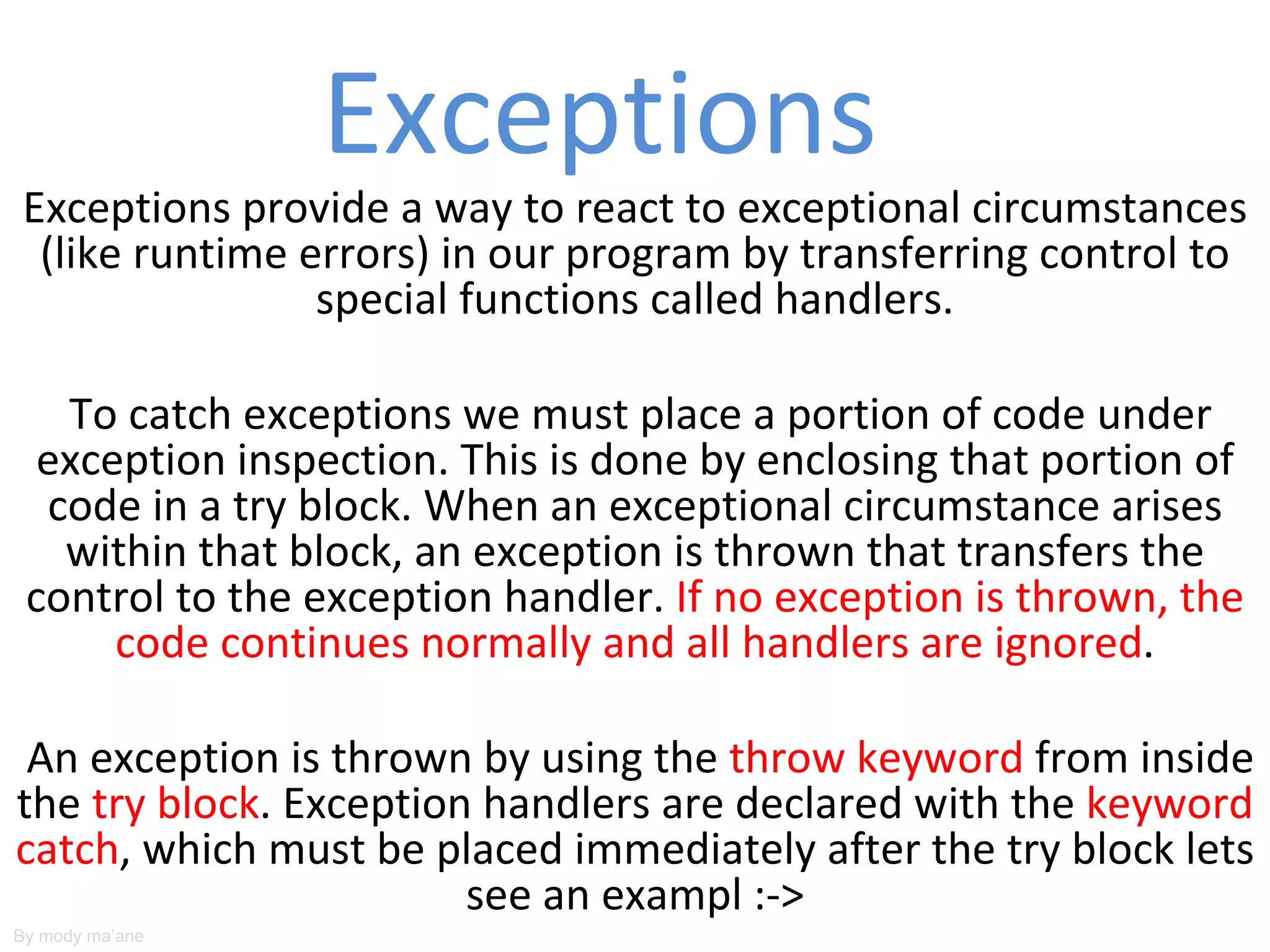
Exceptions provide a way to react to exceptional circumstances
 (like runtime errors) in our program by transferring control to
                special functions called handlers.

   To catch exceptions we must place a portion of code under
  exception inspection. This is done by enclosing that portion of
  code in a try block. When an exceptional circumstance arises
   within that block, an exception is thrown that transfers the
 control to the exception handler. If no exception is thrown, the
      code continues normally and all handlers are ignored.

 An exception is thrown by using the throw keyword from inside
the try block. Exception handlers are declared with the keyword
catch, which must be placed immediately after the try block lets
                        see an exampl :->
By mody ma’ane
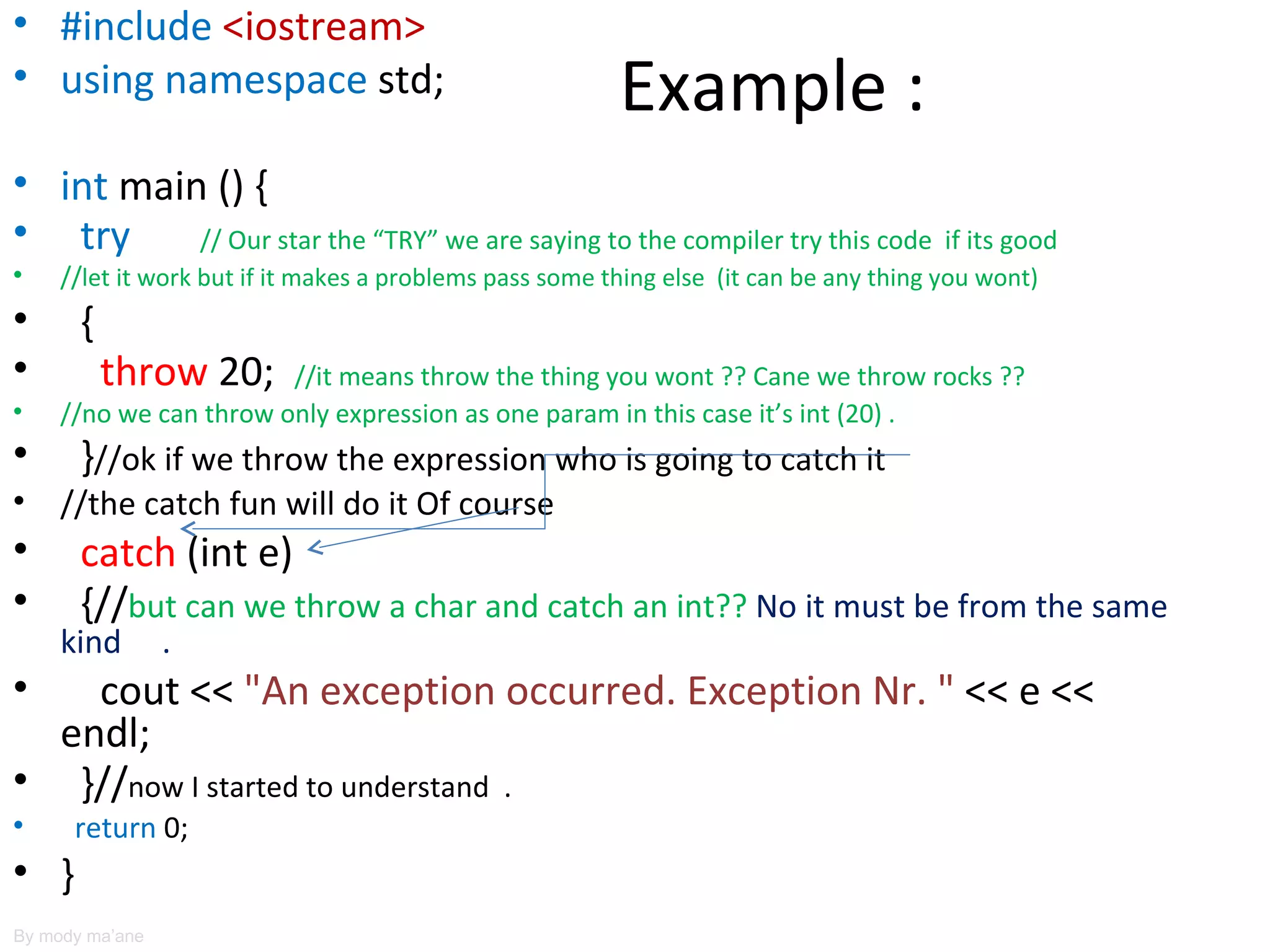
• #include <iostream>
• using namespace std;                                   Example :
• int main () {
• try     // Our star the “TRY” we are saying to the compiler try this code if its good
•    //let it work but if it makes a problems pass some thing else (it can be any thing you wont)
•      {
•          throw 20;    //it means throw the thing you wont ?? Cane we throw rocks ??
•    //no we can throw only expression as one param in this case it’s int (20) .
•      }//ok if we throw the expression who is going to catch it
•    //the catch fun will do it Of course
•      catch (int e)
•      {//but can we throw a char and catch an int?? No it must be from the same
     kind        .
•   cout << "An exception occurred. Exception Nr. " << e <<
  endl;
• }//now I started to understand .
•     return 0;
• }
By mody ma’ane
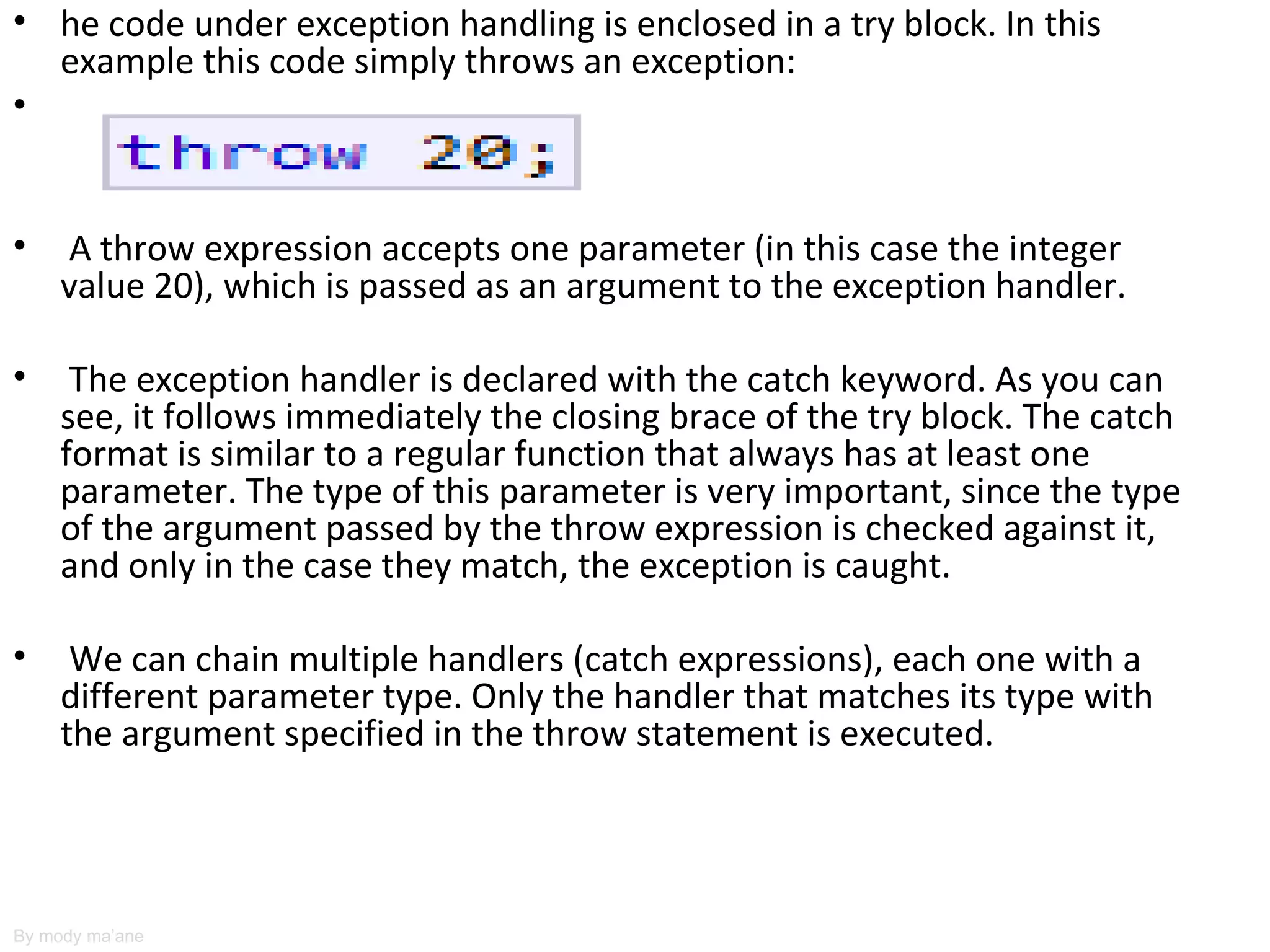
• he code under exception handling is enclosed in a try block. In this
  example this code simply throws an exception:
•


•    A throw expression accepts one parameter (in this case the integer
     value 20), which is passed as an argument to the exception handler.

•     The exception handler is declared with the catch keyword. As you can
     see, it follows immediately the closing brace of the try block. The catch
     format is similar to a regular function that always has at least one
     parameter. The type of this parameter is very important, since the type
     of the argument passed by the throw expression is checked against it,
     and only in the case they match, the exception is caught.

•     We can chain multiple handlers (catch expressions), each one with a
     different parameter type. Only the handler that matches its type with
     the argument specified in the throw statement is executed.


By mody ma’ane
Example
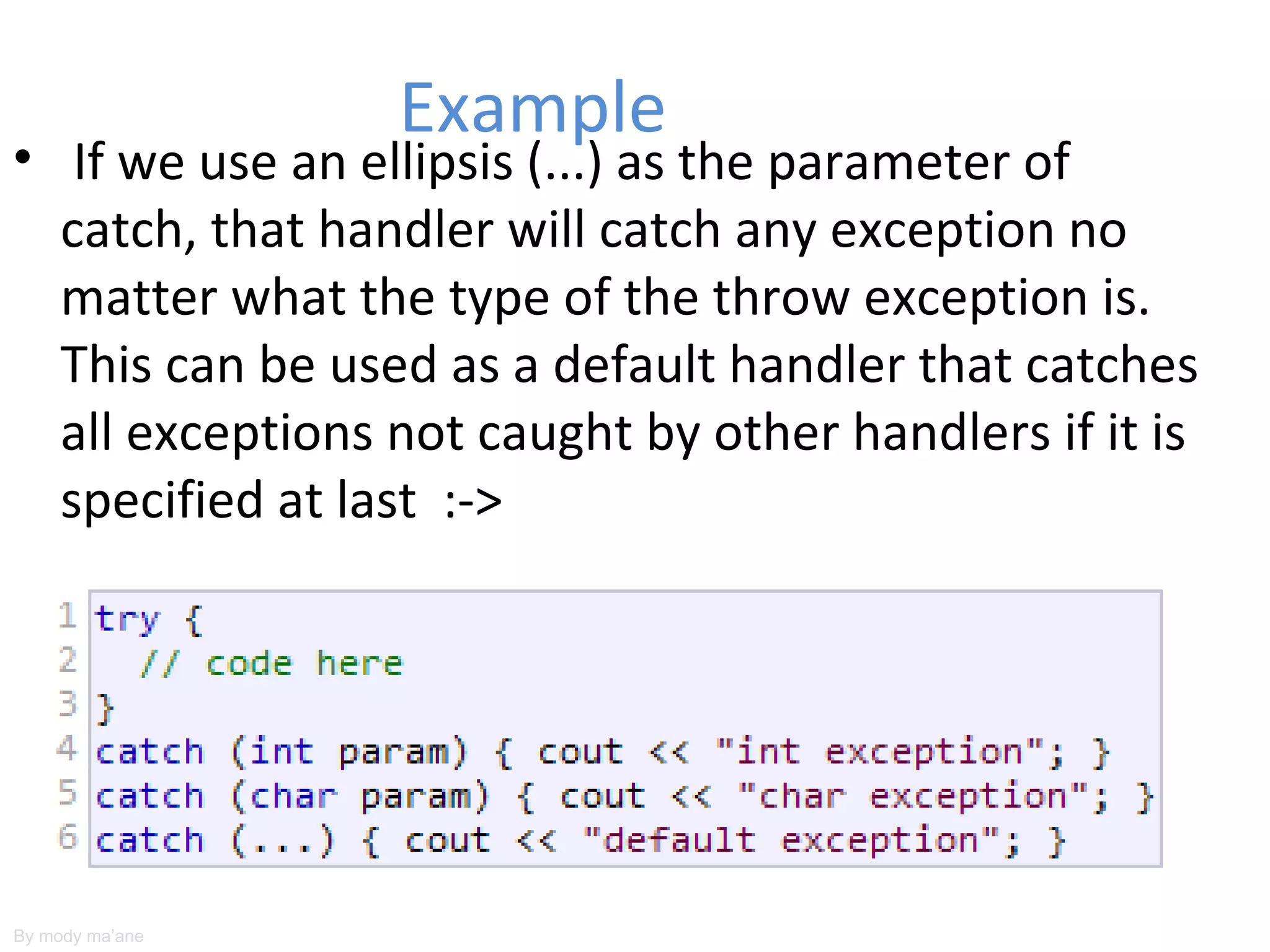
• If we use an ellipsis (...) as the parameter of
  catch, that handler will catch any exception no
  matter what the type of the throw exception is.
  This can be used as a default handler that catches
  all exceptions not caught by other handlers if it is
  specified at last :->


By mody ma’ane
•   In this case the last handler would catch any exception thrown with any parameter that
    is neither an int nor a char.

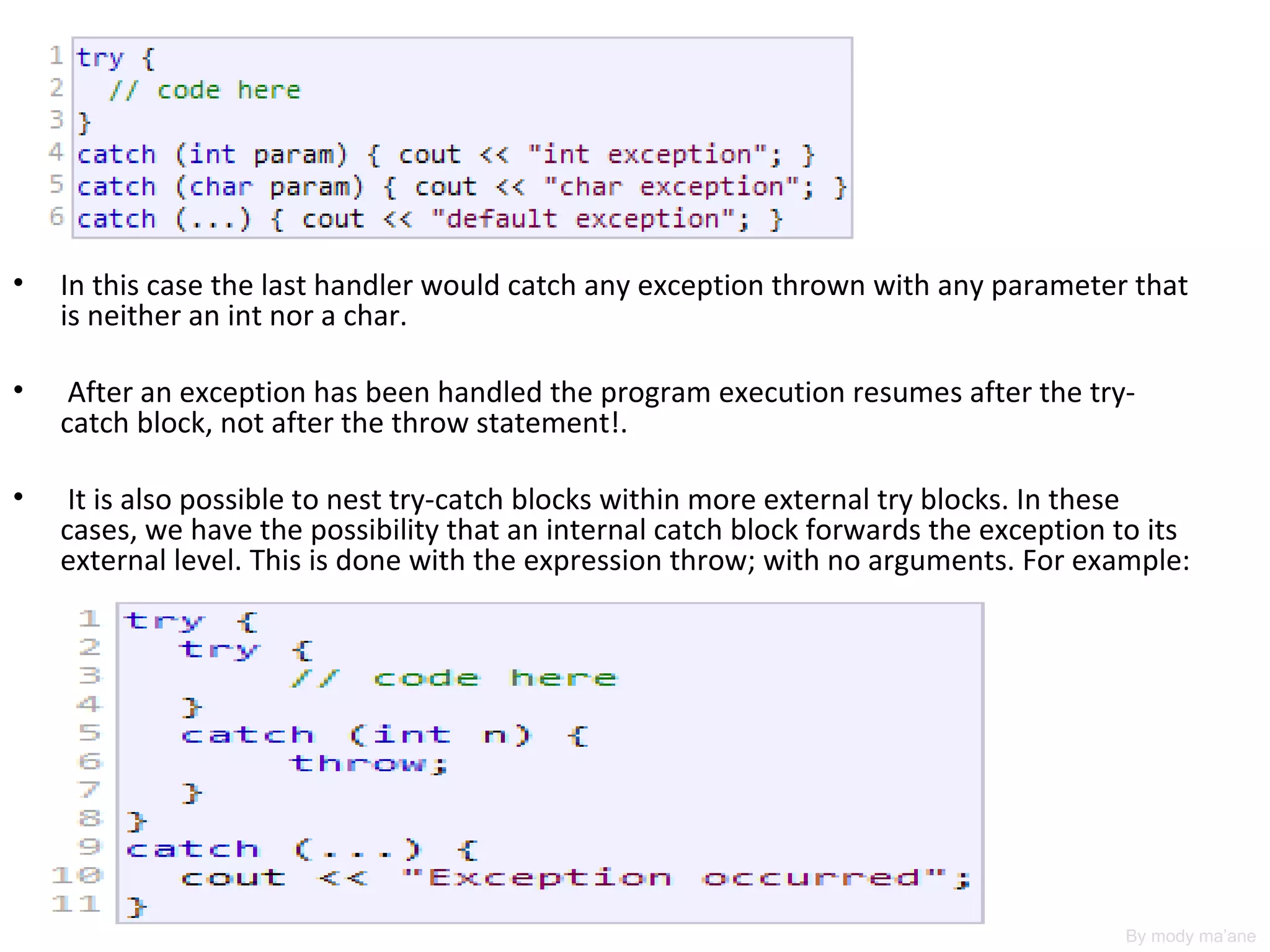
•    After an exception has been handled the program execution resumes after the try-
    catch block, not after the throw statement!.

•    It is also possible to nest try-catch blocks within more external try blocks. In these
    cases, we have the possibility that an internal catch block forwards the exception to its
    external level. This is done with the expression throw; with no arguments. For example:


                                                                                       By mody ma’ane
• Now I think you have an idea about the


                 “ Exception “
 Yes I think I started to make an idea
      about the whole thing.
          ok lets go on>>>
By mody ma’ane
The commands of library exception
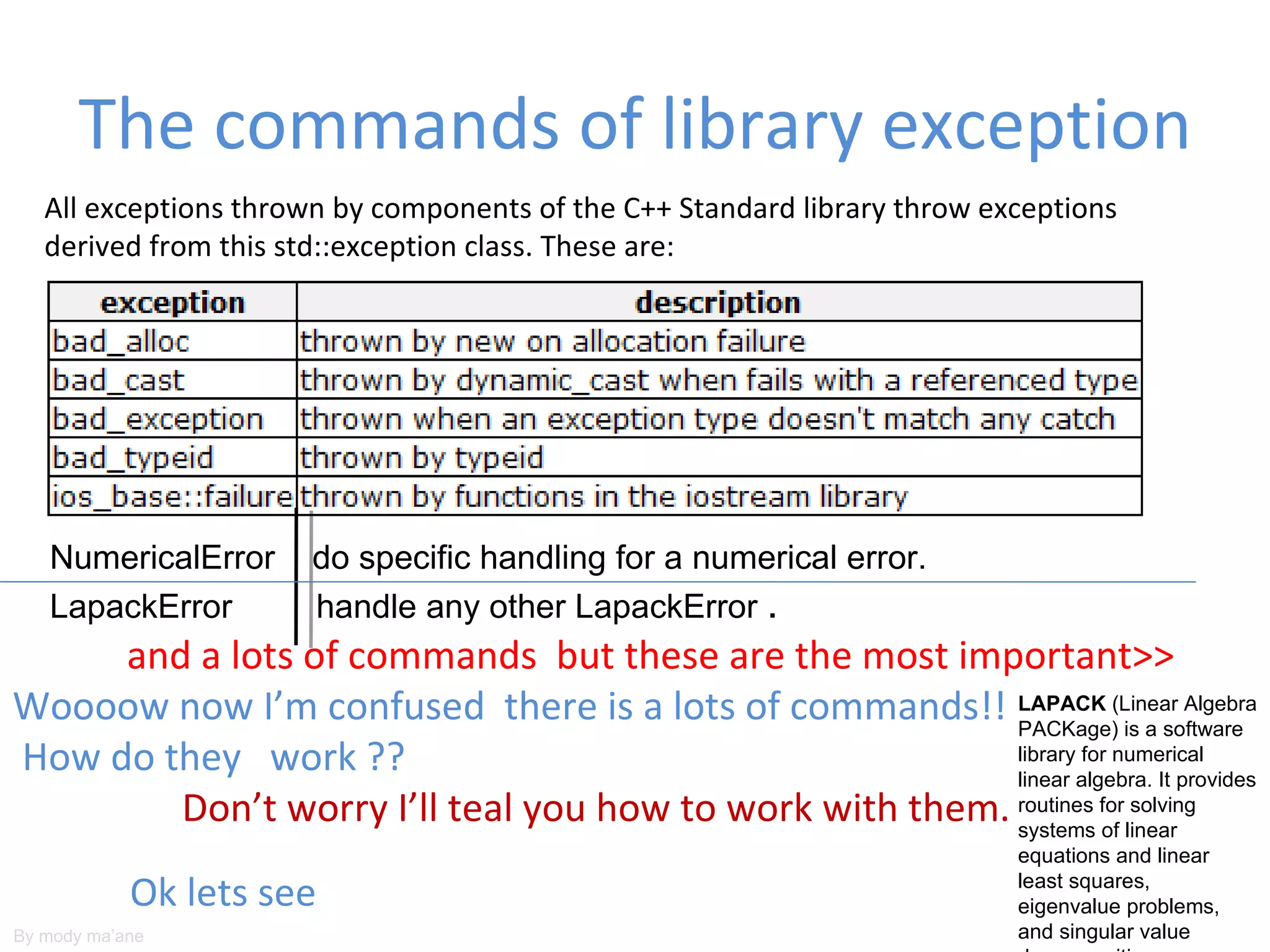
   All exceptions thrown by components of the C++ Standard library throw exceptions
   derived from this std::exception class. These are:


   NumericalError     do specific handling for a numerical error.
   LapackError        handle any other LapackError .
     and a lots of commands but these are the most important>>
Woooow now I’m confused there is a lots of commands!! LAPACK (Linear Algebra
                                                         PACKage) is a software
How do they work ??                                      library for numerical
                                                         linear algebra. It provides
        Don’t worry I’ll teal you how to work with them. routines forlinear
                                                         systems of
                                                                       solving

                                                                           equations and linear

            Ok lets see                                                    least squares,
                                                                           eigenvalue problems,
By mody ma’ane                                                             and singular value
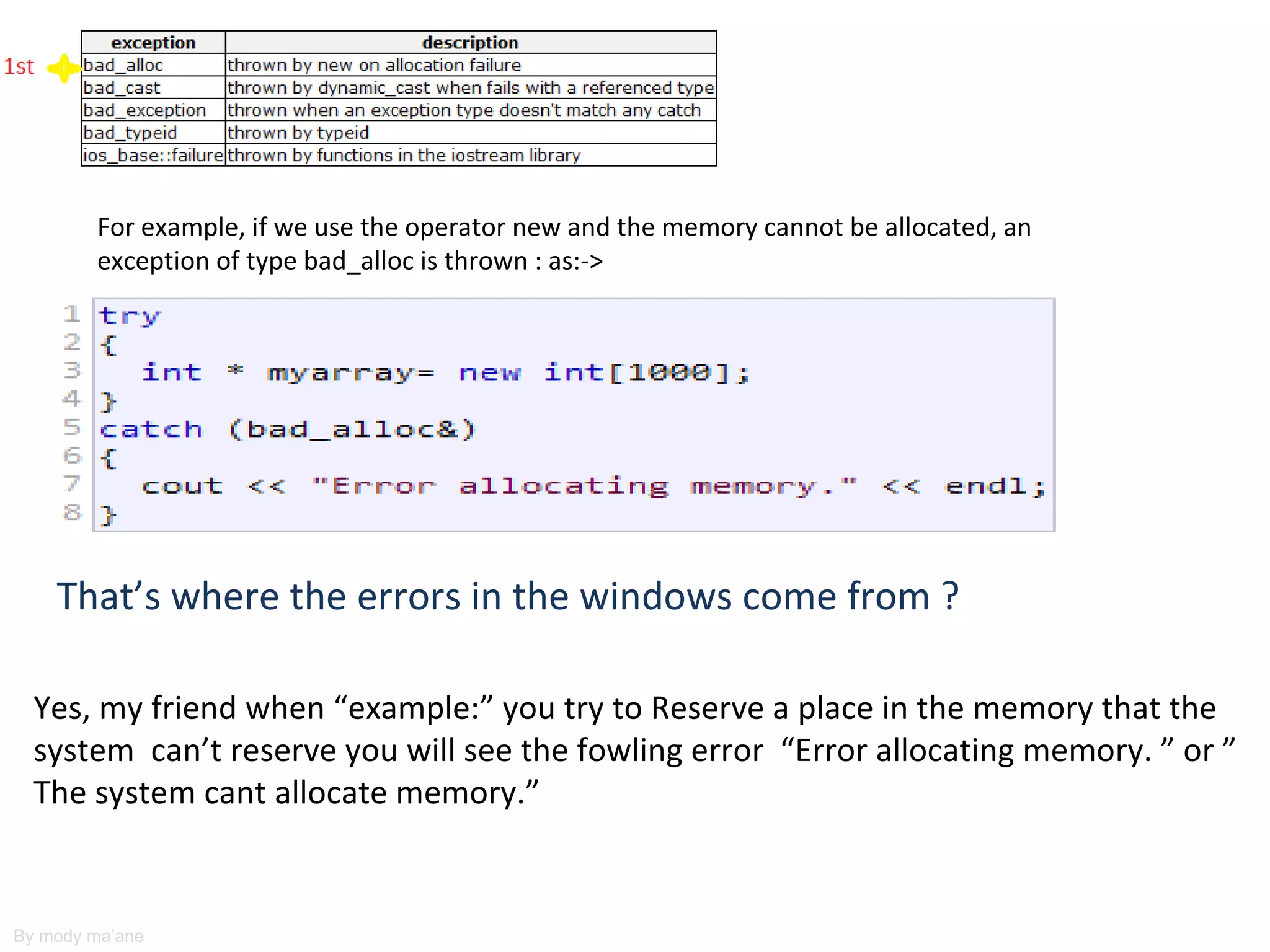
For example, if we use the operator new and the memory cannot be allocated, an
        exception of type bad_alloc is thrown : as:->


    That’s where the errors in the windows come from ?

  Yes, my friend when “example:” you try to Reserve a place in the memory that the
  system can’t reserve you will see the fowling error “Error allocating memory. ” or ”
  The system cant allocate memory.”


By mody ma’ane
• Remark

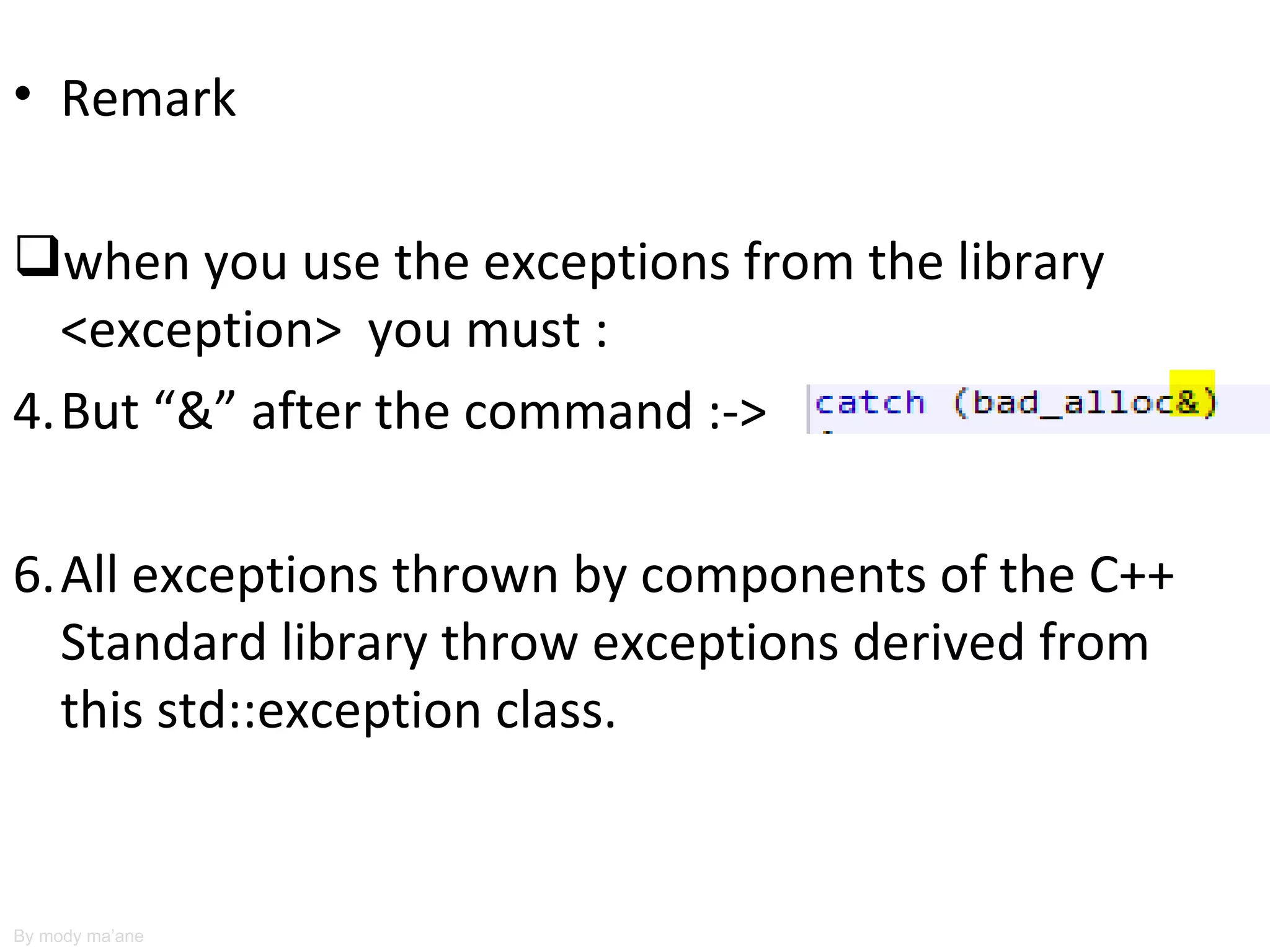
when you use the exceptions from the library
  <exception> you must :
4.But “&” after the command :->

6.All exceptions thrown by components of the C++
  Standard library throw exceptions derived from
  this std::exception class.


By mody ma’ane
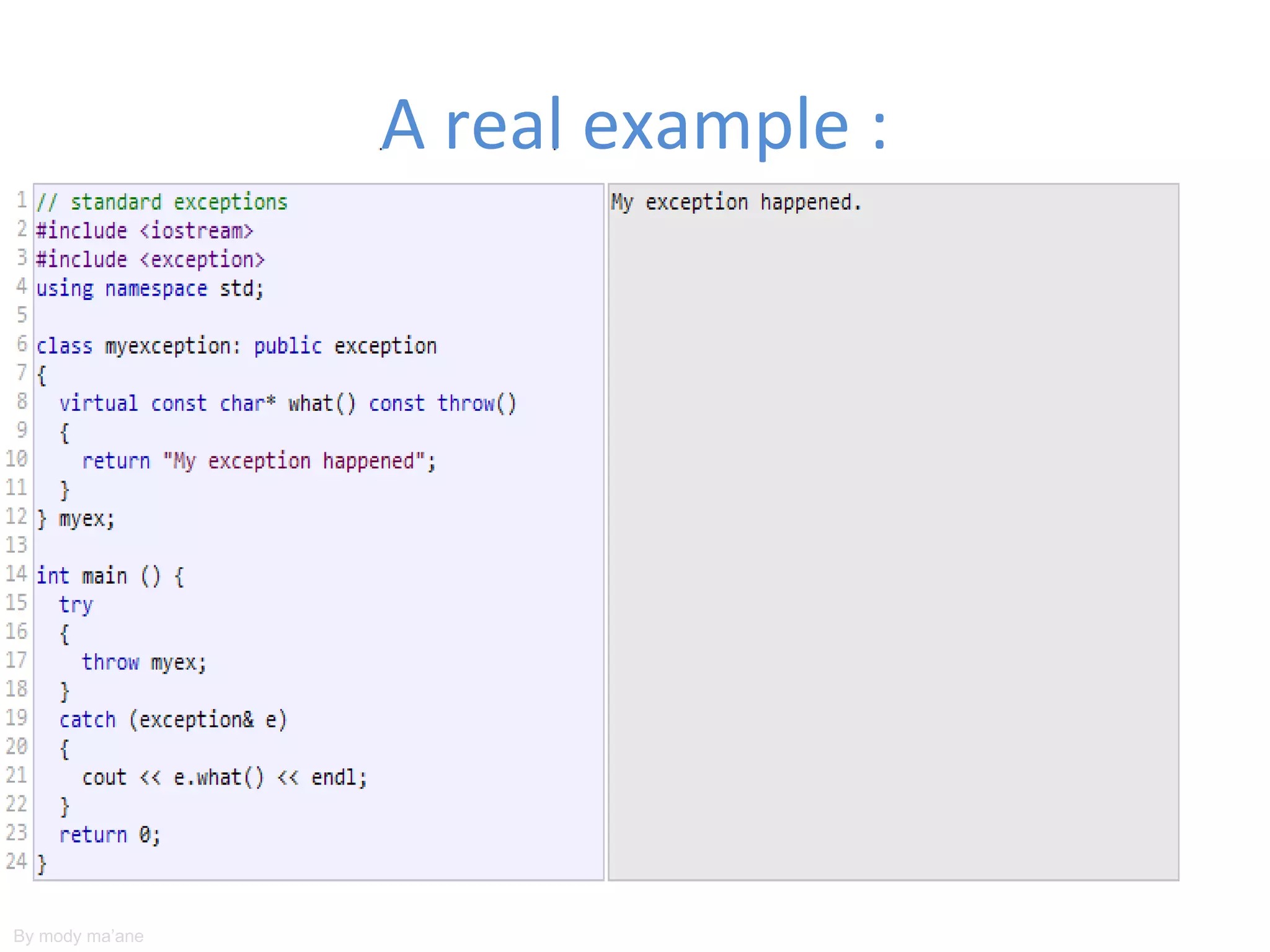
A real example :


By mody ma’ane
Exception specifications
   When declaring a function we can limit the exception type it might directly or
    indirectly throw by appending a throw suffix to the function declaration:
                        float myfunction (char param) throw (int);

 This declares a function called myfunction which takes one argument of type
char and returns an element of type float. The only exception that this function
might throw is an exception of type int. If it throws an exception with a different
   type, either directly or indirectly, it cannot be caught by a regular int-type
                                       handler.

  If this throw specifies is left empty with no type, this means the function is not
      allowed to throw exceptions. Functions with no throw specifier (regular
              functions) are allowed to throw exceptions with any type:
                 int myfunction (int param) throw(); // no exceptions allowed
              int myfunction (int param);      // all exceptions allowed

By mody ma’ane
Some error codes (numbers) we                                   G
                                                                           o
                      can use                                              o
      • 530 : No enough memory         •‘C' Packets error codes:           d
• 1021 : Error while validation of
                        parameter      • 407:Error while writing given     T
     • 510 : No enough space for       file                                h
          moving home directory        • 405:Error while opening given     i
   • 507 : Unable to update/read       file                                n
                         group file    • 406:Error while reading given
                                                                           g
        • 902 : Unable to get the      file
                                       • 411 :Unable to read socket        s
                  Container Root
                                       • 412 :Unable to write socket
• 911 : Error while parsing config     • C06 :(Unable to return required   T
                               file.                                       o
                                       value)
    • 1012 : Host name is invalid      • C08 :(Parse or Syntax error in
  • 1315 : Unable to get memory        the passed in CLIPS                 K
                       information     expressions)                        n
       • 'C++' Utility error codes:    • S00 :(Internal generic system
                                                                           o
 • 101:connection to agent failed      error)
                                                                           w
 • 100:unable to save the ssh key      • C01 :(Unable to create a
                                       system object)
By mody ma’ane
                                       • C04 :(This file unable to open)
Don by : ->
• Mohammad al hsan .->

•                 <-Mohammad Abu Zina .

• Loay kreshan .->

• Under the supervision of doctor
  ->Weal Al- qasas
Basically From:


By mody ma’ane

Standard exceptions

  • 1.
    Standard exceptions • What is the “exception” ? • What can we do with it? • What is the commands of library exception? • How to use the library exception ? • what is Exception specifications? By mohamad al~hsan
  • 2.
    “Exception” aha nowI got it what is it!!!!! IT’s the “‫“واسطه‬ No!!! I’ll teal you what's exception is. By mody ma’ane
  • 3.
    Exceptions Exceptions provide away to react to exceptional circumstances (like runtime errors) in our program by transferring control to special functions called handlers. To catch exceptions we must place a portion of code under exception inspection. This is done by enclosing that portion of code in a try block. When an exceptional circumstance arises within that block, an exception is thrown that transfers the control to the exception handler. If no exception is thrown, the code continues normally and all handlers are ignored. An exception is thrown by using the throw keyword from inside the try block. Exception handlers are declared with the keyword catch, which must be placed immediately after the try block lets see an exampl :-> By mody ma’ane
  • 4.
    • #include <iostream> •using namespace std; Example : • int main () { • try // Our star the “TRY” we are saying to the compiler try this code if its good • //let it work but if it makes a problems pass some thing else (it can be any thing you wont) • { • throw 20; //it means throw the thing you wont ?? Cane we throw rocks ?? • //no we can throw only expression as one param in this case it’s int (20) . • }//ok if we throw the expression who is going to catch it • //the catch fun will do it Of course • catch (int e) • {//but can we throw a char and catch an int?? No it must be from the same kind . • cout << "An exception occurred. Exception Nr. " << e << endl; • }//now I started to understand . • return 0; • } By mody ma’ane
  • 5.
    • he codeunder exception handling is enclosed in a try block. In this example this code simply throws an exception: • • A throw expression accepts one parameter (in this case the integer value 20), which is passed as an argument to the exception handler. • The exception handler is declared with the catch keyword. As you can see, it follows immediately the closing brace of the try block. The catch format is similar to a regular function that always has at least one parameter. The type of this parameter is very important, since the type of the argument passed by the throw expression is checked against it, and only in the case they match, the exception is caught. • We can chain multiple handlers (catch expressions), each one with a different parameter type. Only the handler that matches its type with the argument specified in the throw statement is executed. By mody ma’ane
  • 6.
    Example • If weuse an ellipsis (...) as the parameter of catch, that handler will catch any exception no matter what the type of the throw exception is. This can be used as a default handler that catches all exceptions not caught by other handlers if it is specified at last :-> By mody ma’ane
  • 7.
    In this case the last handler would catch any exception thrown with any parameter that is neither an int nor a char. • After an exception has been handled the program execution resumes after the try- catch block, not after the throw statement!. • It is also possible to nest try-catch blocks within more external try blocks. In these cases, we have the possibility that an internal catch block forwards the exception to its external level. This is done with the expression throw; with no arguments. For example: By mody ma’ane
  • 8.
    • Now Ithink you have an idea about the “ Exception “ Yes I think I started to make an idea about the whole thing. ok lets go on>>> By mody ma’ane
  • 9.
    The commands oflibrary exception All exceptions thrown by components of the C++ Standard library throw exceptions derived from this std::exception class. These are: NumericalError do specific handling for a numerical error. LapackError handle any other LapackError . and a lots of commands but these are the most important>> Woooow now I’m confused there is a lots of commands!! LAPACK (Linear Algebra PACKage) is a software How do they work ?? library for numerical linear algebra. It provides Don’t worry I’ll teal you how to work with them. routines forlinear systems of solving equations and linear Ok lets see least squares, eigenvalue problems, By mody ma’ane and singular value
  • 10.
    For example, ifwe use the operator new and the memory cannot be allocated, an exception of type bad_alloc is thrown : as:-> That’s where the errors in the windows come from ? Yes, my friend when “example:” you try to Reserve a place in the memory that the system can’t reserve you will see the fowling error “Error allocating memory. ” or ” The system cant allocate memory.” By mody ma’ane
  • 11.
    • Remark when youuse the exceptions from the library <exception> you must : 4.But “&” after the command :-> 6.All exceptions thrown by components of the C++ Standard library throw exceptions derived from this std::exception class. By mody ma’ane
  • 12.
    A real example: By mody ma’ane
  • 13.
    Exception specifications When declaring a function we can limit the exception type it might directly or indirectly throw by appending a throw suffix to the function declaration: float myfunction (char param) throw (int); This declares a function called myfunction which takes one argument of type char and returns an element of type float. The only exception that this function might throw is an exception of type int. If it throws an exception with a different type, either directly or indirectly, it cannot be caught by a regular int-type handler. If this throw specifies is left empty with no type, this means the function is not allowed to throw exceptions. Functions with no throw specifier (regular functions) are allowed to throw exceptions with any type: int myfunction (int param) throw(); // no exceptions allowed int myfunction (int param); // all exceptions allowed By mody ma’ane
  • 14.
    Some error codes(numbers) we G o can use o • 530 : No enough memory •‘C' Packets error codes: d • 1021 : Error while validation of parameter • 407:Error while writing given T • 510 : No enough space for file h moving home directory • 405:Error while opening given i • 507 : Unable to update/read file n group file • 406:Error while reading given g • 902 : Unable to get the file • 411 :Unable to read socket s Container Root • 412 :Unable to write socket • 911 : Error while parsing config • C06 :(Unable to return required T file. o value) • 1012 : Host name is invalid • C08 :(Parse or Syntax error in • 1315 : Unable to get memory the passed in CLIPS K information expressions) n • 'C++' Utility error codes: • S00 :(Internal generic system o • 101:connection to agent failed error) w • 100:unable to save the ssh key • C01 :(Unable to create a system object) By mody ma’ane • C04 :(This file unable to open)
  • 15.
    Don by :-> • Mohammad al hsan .-> • <-Mohammad Abu Zina . • Loay kreshan .-> • Under the supervision of doctor ->Weal Al- qasas Basically From: By mody ma’ane