What’s New in Dot net 3.5
•   Automatic Properties
•   Extension Methods
•   Object Initialization
•   Anonymous Types
•   Partial Methods
•   Type Inference
•   LINQ
•   Lambda Expression
•   Query Expression
•   All Together
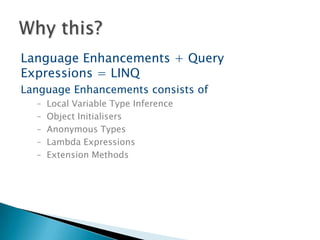
Language Enhancements + Query
Expressions = LINQ
Language Enhancements consists of
  –   Local Variable Type Inference
  –   Object Initialisers
  –   Anonymous Types
  –   Lambda Expressions
  –   Extension Methods
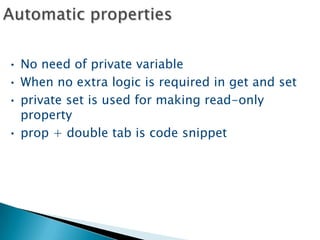
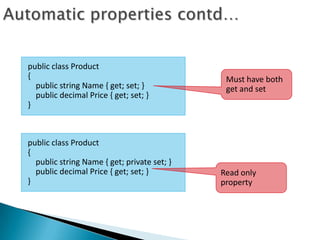
• No need of private variable
• When no extra logic is required in get and set
• private set is used for making read-only
  property
• prop + double tab is code snippet
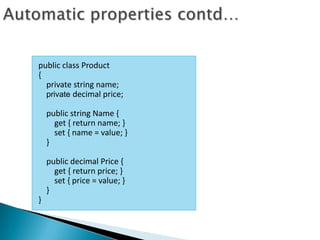
public class Product
{
  private string name;
  private decimal price;

    public string Name {
      get { return name; }
      set { name = value; }
    }

    public decimal Price {
      get { return price; }
      set { price = value; }
    }
}
public class Product
{                                             Must have both
  public string Name { get; set; }            get and set
  public decimal Price { get; set; }
}


public class Product
{
  public string Name { get; private set; }
  public decimal Price { get; set; }         Read only
}                                            property
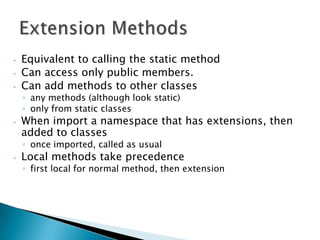
•   Equivalent to calling the static method
•   Can access only public members.
•   Can add methods to other classes
    ◦ any methods (although look static)
    ◦ only from static classes
•   When import a namespace that has extensions, then
    added to classes
    ◦ once imported, called as usual
•   Local methods take precedence
    ◦ first local for normal method, then extension
namespace MyStuff                              Extension
{                                              method
  public static class Extensions
  {
    public static string Concatenate(this IEnumerable<string> strings,
      string separator) {…}
  }
}

                                    Brings extensions into
  using MyStuff;                    scope
                                                             obj.Foo(x, y)
                                                             
string[] names = new string[] { "Axel", "Mia", "Niels" };    XXX.Foo(obj, x, y)
string s = names.Concatenate(", ");

                   IntelliSense!
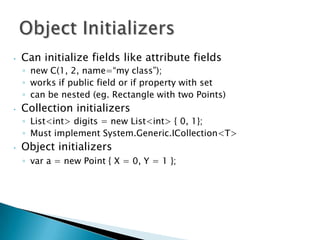
•   Can initialize fields like attribute fields
    ◦ new C(1, 2, name=“my class”);
    ◦ works if public field or if property with set
    ◦ can be nested (eg. Rectangle with two Points)
•   Collection initializers
    ◦ List<int> digits = new List<int> { 0, 1};
    ◦ Must implement System.Generic.ICollection<T>
•   Object initializers
    ◦ var a = new Point { X = 0, Y = 1 };
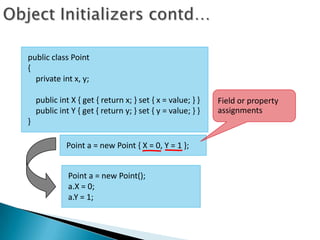
public class Point
{
  private int x, y;

    public int X { get { return x; } set { x = value; } }   Field or property
    public int Y { get { return y; } set { y = value; } }   assignments
}

             Point a = new Point { X = 0, Y = 1 };


              Point a = new Point();
              a.X = 0;
              a.Y = 1;
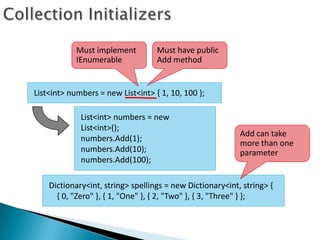
Must implement         Must have public
            IEnumerable            Add method


List<int> numbers = new List<int> { 1, 10, 100 };

             List<int> numbers = new
             List<int>();
                                                           Add can take
             numbers.Add(1);
                                                           more than one
             numbers.Add(10);                              parameter
             numbers.Add(100);

    Dictionary<int, string> spellings = new Dictionary<int, string> {
      { 0, "Zero" }, { 1, "One" }, { 2, "Two" }, { 3, "Three" } };
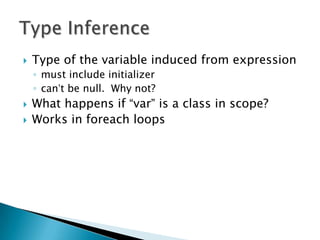
   Type of the variable induced from expression
    ◦ must include initializer
    ◦ can’t be null. Why not?
   What happens if “var” is a class in scope?
   Works in foreach loops
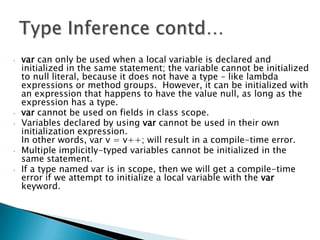
•   var can only be used when a local variable is declared and
    initialized in the same statement; the variable cannot be initialized
    to null literal, because it does not have a type – like lambda
    expressions or method groups. However, it can be initialized with
    an expression that happens to have the value null, as long as the
    expression has a type.
•   var cannot be used on fields in class scope.
•   Variables declared by using var cannot be used in their own
    initialization expression.
    In other words, var v = v++; will result in a compile-time error.
•   Multiple implicitly-typed variables cannot be initialized in the
    same statement.
•   If a type named var is in scope, then we will get a compile-time
    error if we attempt to initialize a local variable with the var
    keyword.
int i = 5;
string s = "Hello";
double d = 1.0;
int[] numbers = new int[] {1, 2, 3};
Dictionary<int,Order> orders = new
Dictionary<int,Order>();

var i = 5;
var s = "Hello";
var d = 1.0;
var numbers = new int[] {1, 2, 3};
var orders = new Dictionary<int,Order>();


   “The type on the
   right hand side”
•   var x = new {p1 = 10, p2 = “name”};
    ◦ x is of anonymous type
    ◦ type can’t be referred to by name in program
•   structural type equivalence
    ◦ two anonymous types can be compatible
•   implicitly typed arrays
    ◦ var a = new[] { 1, 10, 100, 1000 };
    ◦ must have consistent types
    ◦ or have implicit conversions
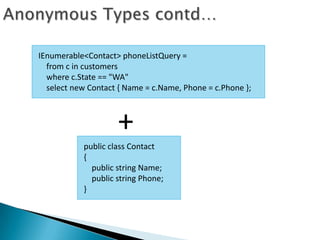
IEnumerable<Contact> phoneListQuery =
  from c in customers
  where c.State == "WA"
  select new Contact { Name = c.Name, Phone = c.Phone };


                    +
           public class Contact
           {
             public string Name;
             public string Phone;
           }
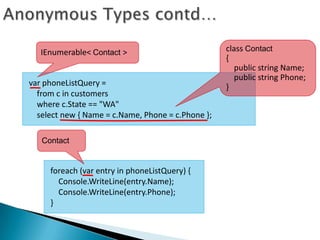
IEnumerable< Contact >                          class Contact
                                                   {
                                                      public string Name;
                                                      public string Phone;
var phoneListQuery =                               }
  from c in customers
  where c.State == "WA"
  select new { Name = c.Name, Phone = c.Phone };

   Contact


     foreach (var entry in phoneListQuery) {
       Console.WriteLine(entry.Name);
       Console.WriteLine(entry.Phone);
     }
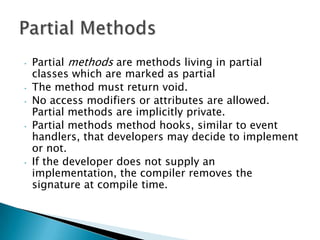
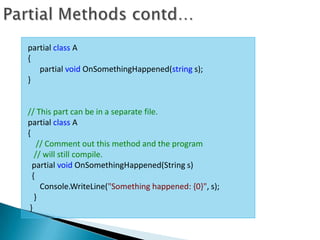
•   Partial methods are methods living in partial
    classes which are marked as partial
•   The method must return void.
•   No access modifiers or attributes are allowed.
    Partial methods are implicitly private.
•   Partial methods method hooks, similar to event
    handlers, that developers may decide to implement
    or not.
•   If the developer does not supply an
    implementation, the compiler removes the
    signature at compile time.
partial class A
{
   partial void OnSomethingHappened(string s);
}


// This part can be in a separate file.
partial class A
{
    // Comment out this method and the program
   // will still compile.
  partial void OnSomethingHappened(String s)
  {
     Console.WriteLine("Something happened: {0}", s);
   }
 }
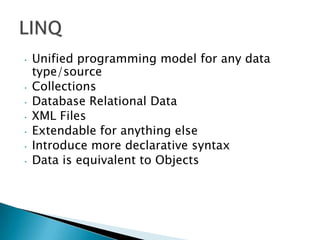
•   Unified programming model for any data
    type/source
•   Collections
•   Database Relational Data
•   XML Files
•   Extendable for anything else
•   Introduce more declarative syntax
•   Data is equivalent to Objects
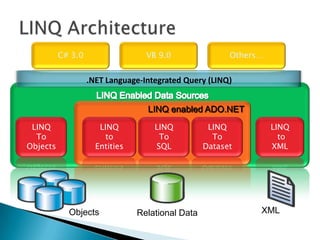
C# 3.0                  VB 9.0                Others…


                   .NET Language-Integrated Query (LINQ)


                                  LINQ enabled ADO.NET
 LINQ                 LINQ          LINQ           LINQ           LINQ
  To                    to           To             To              to
Objects              Entities       SQL           Dataset         XML


            Objects             Relational Data               XML
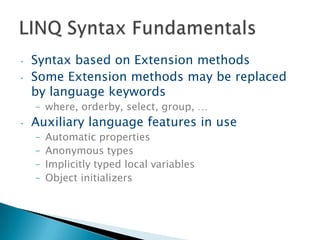
•   Syntax based on Extension methods
•   Some Extension methods may be replaced
    by language keywords
    – where, orderby, select, group, …
•   Auxiliary language features in use
    –   Automatic properties
    –   Anonymous types
    –   Implicitly typed local variables
    –   Object initializers
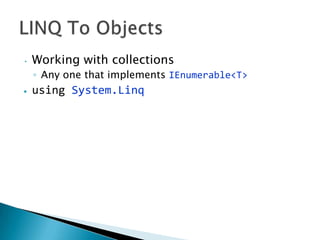
•   Working with collections
    ◦ Any one that implements IEnumerable<T>
•   using System.Linq
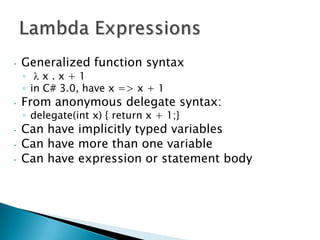
•   Generalized function syntax
    ◦    x.x+1
    ◦ in C# 3.0, have x => x + 1
•   From anonymous delegate syntax:
    ◦ delegate(int x) { return x + 1;}
•   Can have implicitly typed variables
•   Can have more than one variable
•   Can have expression or statement body
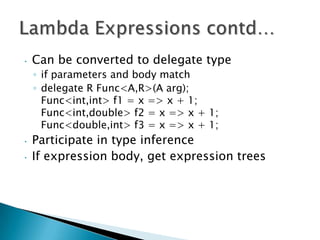
•   Can be converted to delegate type
    ◦ if parameters and body match
    ◦ delegate R Func<A,R>(A arg);
      Func<int,int> f1 = x => x + 1;
      Func<int,double> f2 = x => x + 1;
      Func<double,int> f3 = x => x + 1;
•   Participate in type inference
•   If expression body, get expression trees
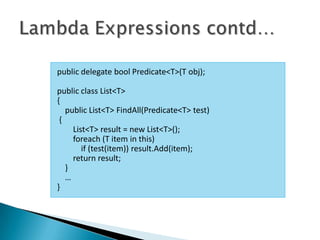
public delegate bool Predicate<T>(T obj);

public class List<T>
{
   public List<T> FindAll(Predicate<T> test)
 {
     List<T> result = new List<T>();
     foreach (T item in this)
        if (test(item)) result.Add(item);
     return result;
   }
   …
}
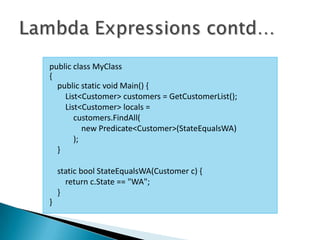
public class MyClass
{
  public static void Main() {
    List<Customer> customers = GetCustomerList();
    List<Customer> locals =
       customers.FindAll(
          new Predicate<Customer>(StateEqualsWA)
       );
  }

    static bool StateEqualsWA(Customer c) {
      return c.State == "WA";
    }
}
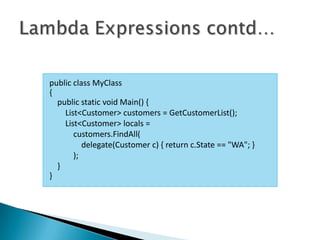
public class MyClass
{
  public static void Main() {
    List<Customer> customers = GetCustomerList();
    List<Customer> locals =
       customers.FindAll(
          delegate(Customer c) { return c.State == "WA"; }
       );
  }
}
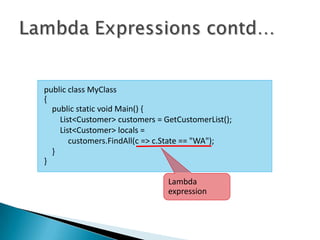
public class MyClass
{
  public static void Main() {
    List<Customer> customers = GetCustomerList();
    List<Customer> locals =
       customers.FindAll(c => c.State == "WA");
  }
}

                                Lambda
                                expression
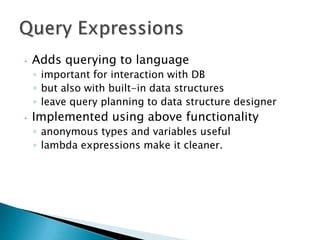
•   Adds querying to language
    ◦ important for interaction with DB
    ◦ but also with built-in data structures
    ◦ leave query planning to data structure designer
•   Implemented using above functionality
    ◦ anonymous types and variables useful
    ◦ lambda expressions make it cleaner.
Starts with
           from
                                   Zero or more
                                   from, join, let, wher
  from id in source                e, or orderby
{ from id in source |
  join id in source on expr equals expr [ into id ] |
  let id = expr |
  where condition |                      Ends with select
                                         or group by
  orderby ordering, ordering, … }
  select expr | group expr by key
[ into id query ]
                         Optional into
                         continuation
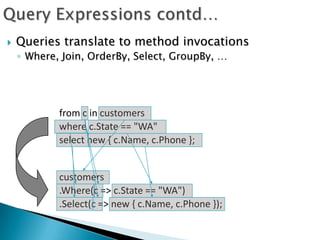
   Queries translate to method invocations
    ◦ Where, Join, OrderBy, Select, GroupBy, …


            from c in customers
            where c.State == "WA"
            select new { c.Name, c.Phone };


            customers
            .Where(c => c.State == "WA")
            .Select(c => new { c.Name, c.Phone });
Project     Select <expr>
Filter      Where <expr>, Distinct
Test        Any(<expr>), All(<expr>)
Join        <expr> Join <expr> On <expr> Equals <expr>
Group       Group By <expr>, <expr> Into <expr>, <expr>
            Group Join <decl> On <expr> Equals <expr> Into <expr>
Aggregate   Count(<expr>), Sum(<expr>), Min(<expr>), Max(<expr>),
            Avg(<expr>)
Partition   Skip [ While ] <expr>, Take [ While ] <expr>
Set         Union, Intersect, Except
Order       Order By <expr>, <expr> [ Ascending | Descending ]
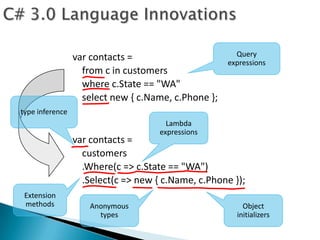
var contacts =                        Query
                                                     expressions
                   from c in customers
                   where c.State == "WA"
                   select new { c.Name, c.Phone };
type inference
                                       Lambda
                                     expressions
                 var contacts =
                   customers
                   .Where(c => c.State == "WA")
                   .Select(c => new { c.Name, c.Phone });
 Extension
 methods             Anonymous                           Object
                       types                           initializers
Linq Introduction

Linq Introduction

  • 1.
    What’s New inDot net 3.5
  • 2.
    Automatic Properties • Extension Methods • Object Initialization • Anonymous Types • Partial Methods • Type Inference • LINQ • Lambda Expression • Query Expression • All Together
  • 3.
    Language Enhancements +Query Expressions = LINQ Language Enhancements consists of – Local Variable Type Inference – Object Initialisers – Anonymous Types – Lambda Expressions – Extension Methods
  • 4.
    • No needof private variable • When no extra logic is required in get and set • private set is used for making read-only property • prop + double tab is code snippet
  • 5.
    public class Product { private string name; private decimal price; public string Name { get { return name; } set { name = value; } } public decimal Price { get { return price; } set { price = value; } } }
  • 6.
    public class Product { Must have both public string Name { get; set; } get and set public decimal Price { get; set; } } public class Product { public string Name { get; private set; } public decimal Price { get; set; } Read only } property
  • 7.
    Equivalent to calling the static method • Can access only public members. • Can add methods to other classes ◦ any methods (although look static) ◦ only from static classes • When import a namespace that has extensions, then added to classes ◦ once imported, called as usual • Local methods take precedence ◦ first local for normal method, then extension
  • 8.
    namespace MyStuff Extension { method public static class Extensions { public static string Concatenate(this IEnumerable<string> strings, string separator) {…} } } Brings extensions into using MyStuff; scope obj.Foo(x, y)  string[] names = new string[] { "Axel", "Mia", "Niels" }; XXX.Foo(obj, x, y) string s = names.Concatenate(", "); IntelliSense!
  • 9.
    Can initialize fields like attribute fields ◦ new C(1, 2, name=“my class”); ◦ works if public field or if property with set ◦ can be nested (eg. Rectangle with two Points) • Collection initializers ◦ List<int> digits = new List<int> { 0, 1}; ◦ Must implement System.Generic.ICollection<T> • Object initializers ◦ var a = new Point { X = 0, Y = 1 };
  • 10.
    public class Point { private int x, y; public int X { get { return x; } set { x = value; } } Field or property public int Y { get { return y; } set { y = value; } } assignments } Point a = new Point { X = 0, Y = 1 }; Point a = new Point(); a.X = 0; a.Y = 1;
  • 11.
    Must implement Must have public IEnumerable Add method List<int> numbers = new List<int> { 1, 10, 100 }; List<int> numbers = new List<int>(); Add can take numbers.Add(1); more than one numbers.Add(10); parameter numbers.Add(100); Dictionary<int, string> spellings = new Dictionary<int, string> { { 0, "Zero" }, { 1, "One" }, { 2, "Two" }, { 3, "Three" } };
  • 12.
    Type of the variable induced from expression ◦ must include initializer ◦ can’t be null. Why not?  What happens if “var” is a class in scope?  Works in foreach loops
  • 13.
    var can only be used when a local variable is declared and initialized in the same statement; the variable cannot be initialized to null literal, because it does not have a type – like lambda expressions or method groups. However, it can be initialized with an expression that happens to have the value null, as long as the expression has a type. • var cannot be used on fields in class scope. • Variables declared by using var cannot be used in their own initialization expression. In other words, var v = v++; will result in a compile-time error. • Multiple implicitly-typed variables cannot be initialized in the same statement. • If a type named var is in scope, then we will get a compile-time error if we attempt to initialize a local variable with the var keyword.
  • 14.
    int i =5; string s = "Hello"; double d = 1.0; int[] numbers = new int[] {1, 2, 3}; Dictionary<int,Order> orders = new Dictionary<int,Order>(); var i = 5; var s = "Hello"; var d = 1.0; var numbers = new int[] {1, 2, 3}; var orders = new Dictionary<int,Order>(); “The type on the right hand side”
  • 15.
    var x = new {p1 = 10, p2 = “name”}; ◦ x is of anonymous type ◦ type can’t be referred to by name in program • structural type equivalence ◦ two anonymous types can be compatible • implicitly typed arrays ◦ var a = new[] { 1, 10, 100, 1000 }; ◦ must have consistent types ◦ or have implicit conversions
  • 16.
    IEnumerable<Contact> phoneListQuery = from c in customers where c.State == "WA" select new Contact { Name = c.Name, Phone = c.Phone }; + public class Contact { public string Name; public string Phone; }
  • 17.
    IEnumerable< Contact > class Contact { public string Name; public string Phone; var phoneListQuery = } from c in customers where c.State == "WA" select new { Name = c.Name, Phone = c.Phone }; Contact foreach (var entry in phoneListQuery) { Console.WriteLine(entry.Name); Console.WriteLine(entry.Phone); }
  • 18.
    Partial methods are methods living in partial classes which are marked as partial • The method must return void. • No access modifiers or attributes are allowed. Partial methods are implicitly private. • Partial methods method hooks, similar to event handlers, that developers may decide to implement or not. • If the developer does not supply an implementation, the compiler removes the signature at compile time.
  • 19.
    partial class A { partial void OnSomethingHappened(string s); } // This part can be in a separate file. partial class A { // Comment out this method and the program // will still compile. partial void OnSomethingHappened(String s) { Console.WriteLine("Something happened: {0}", s); } }
  • 20.
    Unified programming model for any data type/source • Collections • Database Relational Data • XML Files • Extendable for anything else • Introduce more declarative syntax • Data is equivalent to Objects
  • 21.
    C# 3.0 VB 9.0 Others… .NET Language-Integrated Query (LINQ) LINQ enabled ADO.NET LINQ LINQ LINQ LINQ LINQ To to To To to Objects Entities SQL Dataset XML Objects Relational Data XML
  • 22.
    Syntax based on Extension methods • Some Extension methods may be replaced by language keywords – where, orderby, select, group, … • Auxiliary language features in use – Automatic properties – Anonymous types – Implicitly typed local variables – Object initializers
  • 23.
    Working with collections ◦ Any one that implements IEnumerable<T> • using System.Linq
  • 24.
    Generalized function syntax ◦ x.x+1 ◦ in C# 3.0, have x => x + 1 • From anonymous delegate syntax: ◦ delegate(int x) { return x + 1;} • Can have implicitly typed variables • Can have more than one variable • Can have expression or statement body
  • 25.
    Can be converted to delegate type ◦ if parameters and body match ◦ delegate R Func<A,R>(A arg); Func<int,int> f1 = x => x + 1; Func<int,double> f2 = x => x + 1; Func<double,int> f3 = x => x + 1; • Participate in type inference • If expression body, get expression trees
  • 26.
    public delegate boolPredicate<T>(T obj); public class List<T> { public List<T> FindAll(Predicate<T> test) { List<T> result = new List<T>(); foreach (T item in this) if (test(item)) result.Add(item); return result; } … }
  • 27.
    public class MyClass { public static void Main() { List<Customer> customers = GetCustomerList(); List<Customer> locals = customers.FindAll( new Predicate<Customer>(StateEqualsWA) ); } static bool StateEqualsWA(Customer c) { return c.State == "WA"; } }
  • 28.
    public class MyClass { public static void Main() { List<Customer> customers = GetCustomerList(); List<Customer> locals = customers.FindAll( delegate(Customer c) { return c.State == "WA"; } ); } }
  • 29.
    public class MyClass { public static void Main() { List<Customer> customers = GetCustomerList(); List<Customer> locals = customers.FindAll(c => c.State == "WA"); } } Lambda expression
  • 30.
    Adds querying to language ◦ important for interaction with DB ◦ but also with built-in data structures ◦ leave query planning to data structure designer • Implemented using above functionality ◦ anonymous types and variables useful ◦ lambda expressions make it cleaner.
  • 31.
    Starts with from Zero or more from, join, let, wher from id in source e, or orderby { from id in source | join id in source on expr equals expr [ into id ] | let id = expr | where condition | Ends with select or group by orderby ordering, ordering, … } select expr | group expr by key [ into id query ] Optional into continuation
  • 32.
    Queries translate to method invocations ◦ Where, Join, OrderBy, Select, GroupBy, … from c in customers where c.State == "WA" select new { c.Name, c.Phone }; customers .Where(c => c.State == "WA") .Select(c => new { c.Name, c.Phone });
  • 33.
    Project Select <expr> Filter Where <expr>, Distinct Test Any(<expr>), All(<expr>) Join <expr> Join <expr> On <expr> Equals <expr> Group Group By <expr>, <expr> Into <expr>, <expr> Group Join <decl> On <expr> Equals <expr> Into <expr> Aggregate Count(<expr>), Sum(<expr>), Min(<expr>), Max(<expr>), Avg(<expr>) Partition Skip [ While ] <expr>, Take [ While ] <expr> Set Union, Intersect, Except Order Order By <expr>, <expr> [ Ascending | Descending ]
  • 34.
    var contacts = Query expressions from c in customers where c.State == "WA" select new { c.Name, c.Phone }; type inference Lambda expressions var contacts = customers .Where(c => c.State == "WA") .Select(c => new { c.Name, c.Phone }); Extension methods Anonymous Object types initializers