



1© Copyright 2011 EMC Corporation. All rights reserved.
Mock your way with
Mockito
Are you mocking me ?
by Vitaly Polonetsky
June 2012
2© Copyright 2011 EMC Corporation. All rights reserved.
Mockito
Mocking framework that tastes really good
http://code.google.com/p/mockito/
3© Copyright 2011 EMC Corporation. All rights reserved.
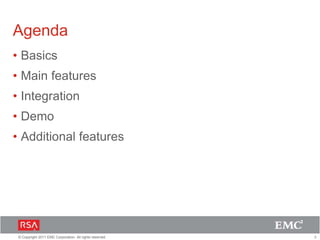
Agenda
• Basics
• Main features
• Integration
• Demo
• Additional features
4© Copyright 2011 EMC Corporation. All rights reserved.
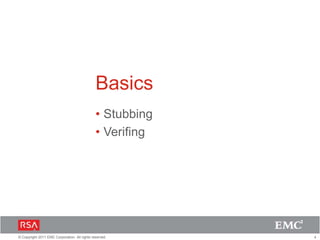
Basics
• Stubbing
• Verifing
5© Copyright 2011 EMC Corporation. All rights reserved.
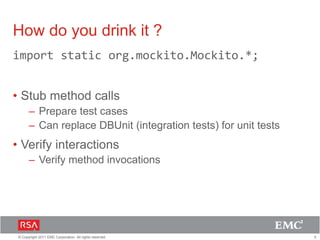
How do you drink it ?
import static org.mockito.Mockito.*;
• Stub method calls
– Prepare test cases
– Can replace DBUnit (integration tests) for unit tests
• Verify interactions
– Verify method invocations
6© Copyright 2011 EMC Corporation. All rights reserved.
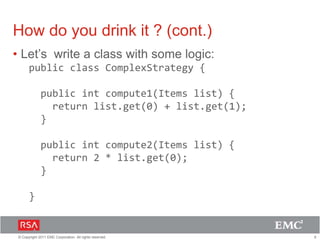
How do you drink it ? (cont.)
• Let’s write a class with some logic:
public class ComplexStrategy {
public int compute1(Items list) {
return list.get(0) + list.get(1);
}
public int compute2(Items list) {
return 2 * list.get(0);
}
}
7© Copyright 2011 EMC Corporation. All rights reserved.
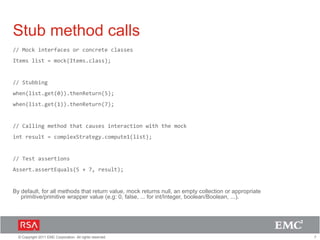
Stub method calls
// Mock interfaces or concrete classes
Items list = mock(Items.class);
// Stubbing
when(list.get(0)).thenReturn(5);
when(list.get(1)).thenReturn(7);
// Calling method that causes interaction with the mock
int result = complexStrategy.compute1(list);
// Test assertions
Assert.assertEquals(5 + 7, result);
By default, for all methods that return value, mock returns null, an empty collection or appropriate
primitive/primitive wrapper value (e.g: 0, false, ... for int/Integer, boolean/Boolean, ...).
8© Copyright 2011 EMC Corporation. All rights reserved.
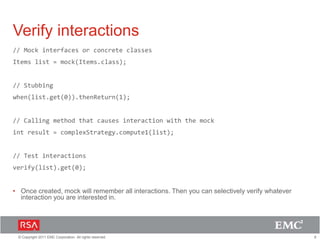
Verify interactions
// Mock interfaces or concrete classes
Items list = mock(Items.class);
// Stubbing
when(list.get(0)).thenReturn(1);
// Calling method that causes interaction with the mock
int result = complexStrategy.compute1(list);
// Test interactions
verify(list).get(0);
• Once created, mock will remember all interactions. Then you can selectively verify whatever
interaction you are interested in.
9© Copyright 2011 EMC Corporation. All rights reserved.
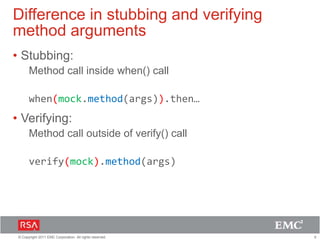
Difference in stubbing and verifying
method arguments
• Stubbing:
Method call inside when() call
when(mock.method(args)).then…
• Verifying:
Method call outside of verify() call
verify(mock).method(args)
10© Copyright 2011 EMC Corporation. All rights reserved.
Main features
• Argument matchers
• Number of interactions and
invocations
• Annotations
• Methods returning void
11© Copyright 2011 EMC Corporation. All rights reserved.
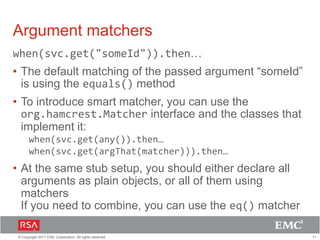
Argument matchers
when(svc.get("someId")).then…
• The default matching of the passed argument “someId”
is using the equals() method
• To introduce smart matcher, you can use the
org.hamcrest.Matcher interface and the classes that
implement it:
when(svc.get(any()).then…
when(svc.get(argThat(matcher))).then…
• At the same stub setup, you should either declare all
arguments as plain objects, or all of them using
matchers
If you need to combine, you can use the eq() matcher
12© Copyright 2011 EMC Corporation. All rights reserved.
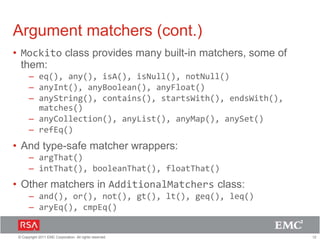
Argument matchers (cont.)
• Mockito class provides many built-in matchers, some of
them:
– eq(), any(), isA(), isNull(), notNull()
– anyInt(), anyBoolean(), anyFloat()
– anyString(), contains(), startsWith(), endsWith(),
matches()
– anyCollection(), anyList(), anyMap(), anySet()
– refEq()
• And type-safe matcher wrappers:
– argThat()
– intThat(), booleanThat(), floatThat()
• Other matchers in AdditionalMatchers class:
– and(), or(), not(), gt(), lt(), geq(), leq()
– aryEq(), cmpEq()
13© Copyright 2011 EMC Corporation. All rights reserved.
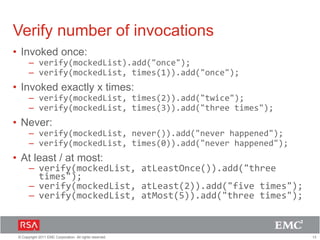
Verify number of invocations
• Invoked once:
– verify(mockedList).add("once");
– verify(mockedList, times(1)).add("once");
• Invoked exactly x times:
– verify(mockedList, times(2)).add("twice");
– verify(mockedList, times(3)).add("three times");
• Never:
– verify(mockedList, never()).add("never happened");
– verify(mockedList, times(0)).add("never happened");
• At least / at most:
– verify(mockedList, atLeastOnce()).add("three
times");
– verify(mockedList, atLeast(2)).add("five times");
– verify(mockedList, atMost(5)).add("three times");
14© Copyright 2011 EMC Corporation. All rights reserved.
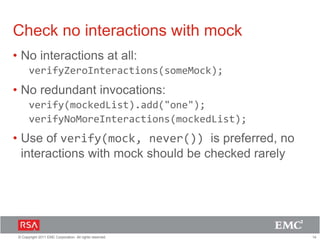
Check no interactions with mock
• No interactions at all:
verifyZeroInteractions(someMock);
• No redundant invocations:
verify(mockedList).add("one");
verifyNoMoreInteractions(mockedList);
• Use of verify(mock, never()) is preferred, no
interactions with mock should be checked rarely
15© Copyright 2011 EMC Corporation. All rights reserved.
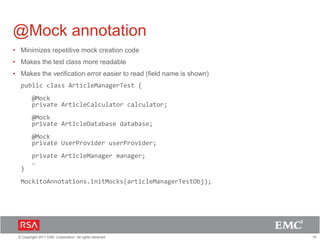
@Mock annotation
• Minimizes repetitive mock creation code
• Makes the test class more readable
• Makes the verification error easier to read (field name is shown)
public class ArticleManagerTest {
@Mock
private ArticleCalculator calculator;
@Mock
private ArticleDatabase database;
@Mock
private UserProvider userProvider;
private ArticleManager manager;
…
}
MockitoAnnotations.initMocks(articleManagerTestObj);
16© Copyright 2011 EMC Corporation. All rights reserved.
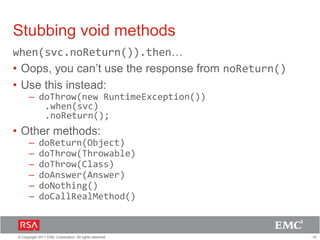
Stubbing void methods
when(svc.noReturn()).then…
• Oops, you can’t use the response from noReturn()
• Use this instead:
– doThrow(new RuntimeException())
.when(svc)
.noReturn();
• Other methods:
– doReturn(Object)
– doThrow(Throwable)
– doThrow(Class)
– doAnswer(Answer)
– doNothing()
– doCallRealMethod()
17© Copyright 2011 EMC Corporation. All rights reserved.
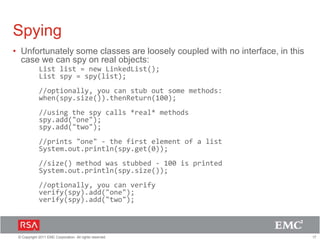
Spying
• Unfortunately some classes are loosely coupled with no interface, in this
case we can spy on real objects:
List list = new LinkedList();
List spy = spy(list);
//optionally, you can stub out some methods:
when(spy.size()).thenReturn(100);
//using the spy calls *real* methods
spy.add("one");
spy.add("two");
//prints "one" - the first element of a list
System.out.println(spy.get(0));
//size() method was stubbed - 100 is printed
System.out.println(spy.size());
//optionally, you can verify
verify(spy).add("one");
verify(spy).add("two");
18© Copyright 2011 EMC Corporation. All rights reserved.
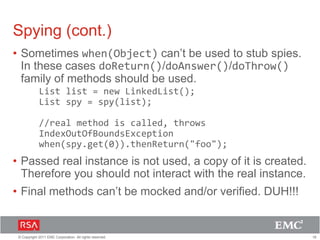
Spying (cont.)
• Sometimes when(Object) can’t be used to stub spies.
In these cases doReturn()/doAnswer()/doThrow()
family of methods should be used.
List list = new LinkedList();
List spy = spy(list);
//real method is called, throws
IndexOutOfBoundsException
when(spy.get(0)).thenReturn("foo");
• Passed real instance is not used, a copy of it is created.
Therefore you should not interact with the real instance.
• Final methods can’t be mocked and/or verified. DUH!!!
19© Copyright 2011 EMC Corporation. All rights reserved.
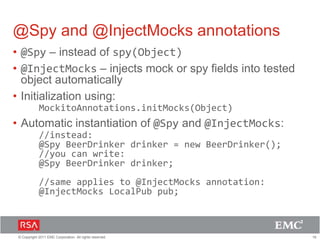
@Spy and @InjectMocks annotations
• @Spy – instead of spy(Object)
• @InjectMocks – injects mock or spy fields into tested
object automatically
• Initialization using:
MockitoAnnotations.initMocks(Object)
• Automatic instantiation of @Spy and @InjectMocks:
//instead:
@Spy BeerDrinker drinker = new BeerDrinker();
//you can write:
@Spy BeerDrinker drinker;
//same applies to @InjectMocks annotation:
@InjectMocks LocalPub pub;
20© Copyright 2011 EMC Corporation. All rights reserved.
Integration
• Straight forward using Spring
• JUnit runner
21© Copyright 2011 EMC Corporation. All rights reserved.
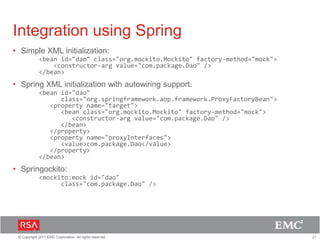
Integration using Spring
• Simple XML initialization:
<bean id="dao" class="org.mockito.Mockito" factory-method="mock">
<constructor-arg value="com.package.Dao" />
</bean>
• Spring XML initialization with autowiring support:
<bean id="dao"
class="org.springframework.aop.framework.ProxyFactoryBean">
<property name="target">
<bean class="org.mockito.Mockito" factory-method="mock">
<constructor-arg value="com.package.Dao" />
</bean>
</property>
<property name="proxyInterfaces">
<value>com.package.Dao</value>
</property>
</bean>
• Springockito:
<mockito:mock id="dao"
class="com.package.Dao" />
22© Copyright 2011 EMC Corporation. All rights reserved.
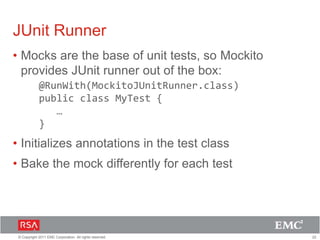
JUnit Runner
• Mocks are the base of unit tests, so Mockito
provides JUnit runner out of the box:
@RunWith(MockitoJUnitRunner.class)
public class MyTest {
…
}
• Initializes annotations in the test class
• Bake the mock differently for each test
23© Copyright 2011 EMC Corporation. All rights reserved.
Demo
• PolicyProviderSinglePolicyTest
• AABOAuthenticationProviderTest
24© Copyright 2011 EMC Corporation. All rights reserved.
Additional features
25© Copyright 2011 EMC Corporation. All rights reserved.
Additional features
• Verifying order of invocations
InOrder inOrder = inOrder(mock);
inOrder.verify(…
inOrder.verify(…
• Stubbing consecutive calls
when(mock.someMethod())
.thenThrow(new RuntimeException())
.thenReturn("foo");
• Stubbing with callbacks
– add implementation to mock method
26© Copyright 2011 EMC Corporation. All rights reserved.
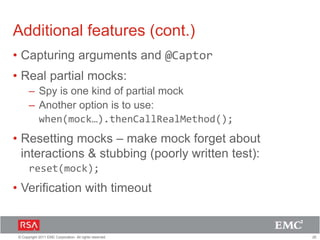
Additional features (cont.)
• Capturing arguments and @Captor
• Real partial mocks:
– Spy is one kind of partial mock
– Another option is to use:
when(mock…).thenCallRealMethod();
• Resetting mocks – make mock forget about
interactions & stubbing (poorly written test):
reset(mock);
• Verification with timeout
27© Copyright 2011 EMC Corporation. All rights reserved.
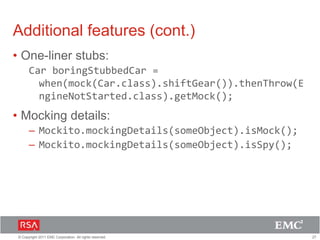
Additional features (cont.)
• One-liner stubs:
Car boringStubbedCar =
when(mock(Car.class).shiftGear()).thenThrow(E
ngineNotStarted.class).getMock();
• Mocking details:
– Mockito.mockingDetails(someObject).isMock();
– Mockito.mockingDetails(someObject).isSpy();
28© Copyright 2011 EMC Corporation. All rights reserved.
THANK YOUTHANK YOU

Mock your way with Mockito

  • 1.
    1© Copyright 2011EMC Corporation. All rights reserved. Mock your way with Mockito Are you mocking me ? by Vitaly Polonetsky June 2012
  • 2.
    2© Copyright 2011EMC Corporation. All rights reserved. Mockito Mocking framework that tastes really good http://code.google.com/p/mockito/
  • 3.
    3© Copyright 2011EMC Corporation. All rights reserved. Agenda • Basics • Main features • Integration • Demo • Additional features
  • 4.
    4© Copyright 2011EMC Corporation. All rights reserved. Basics • Stubbing • Verifing
  • 5.
    5© Copyright 2011EMC Corporation. All rights reserved. How do you drink it ? import static org.mockito.Mockito.*; • Stub method calls – Prepare test cases – Can replace DBUnit (integration tests) for unit tests • Verify interactions – Verify method invocations
  • 6.
    6© Copyright 2011EMC Corporation. All rights reserved. How do you drink it ? (cont.) • Let’s write a class with some logic: public class ComplexStrategy { public int compute1(Items list) { return list.get(0) + list.get(1); } public int compute2(Items list) { return 2 * list.get(0); } }
  • 7.
    7© Copyright 2011EMC Corporation. All rights reserved. Stub method calls // Mock interfaces or concrete classes Items list = mock(Items.class); // Stubbing when(list.get(0)).thenReturn(5); when(list.get(1)).thenReturn(7); // Calling method that causes interaction with the mock int result = complexStrategy.compute1(list); // Test assertions Assert.assertEquals(5 + 7, result); By default, for all methods that return value, mock returns null, an empty collection or appropriate primitive/primitive wrapper value (e.g: 0, false, ... for int/Integer, boolean/Boolean, ...).
  • 8.
    8© Copyright 2011EMC Corporation. All rights reserved. Verify interactions // Mock interfaces or concrete classes Items list = mock(Items.class); // Stubbing when(list.get(0)).thenReturn(1); // Calling method that causes interaction with the mock int result = complexStrategy.compute1(list); // Test interactions verify(list).get(0); • Once created, mock will remember all interactions. Then you can selectively verify whatever interaction you are interested in.
  • 9.
    9© Copyright 2011EMC Corporation. All rights reserved. Difference in stubbing and verifying method arguments • Stubbing: Method call inside when() call when(mock.method(args)).then… • Verifying: Method call outside of verify() call verify(mock).method(args)
  • 10.
    10© Copyright 2011EMC Corporation. All rights reserved. Main features • Argument matchers • Number of interactions and invocations • Annotations • Methods returning void
  • 11.
    11© Copyright 2011EMC Corporation. All rights reserved. Argument matchers when(svc.get("someId")).then… • The default matching of the passed argument “someId” is using the equals() method • To introduce smart matcher, you can use the org.hamcrest.Matcher interface and the classes that implement it: when(svc.get(any()).then… when(svc.get(argThat(matcher))).then… • At the same stub setup, you should either declare all arguments as plain objects, or all of them using matchers If you need to combine, you can use the eq() matcher
  • 12.
    12© Copyright 2011EMC Corporation. All rights reserved. Argument matchers (cont.) • Mockito class provides many built-in matchers, some of them: – eq(), any(), isA(), isNull(), notNull() – anyInt(), anyBoolean(), anyFloat() – anyString(), contains(), startsWith(), endsWith(), matches() – anyCollection(), anyList(), anyMap(), anySet() – refEq() • And type-safe matcher wrappers: – argThat() – intThat(), booleanThat(), floatThat() • Other matchers in AdditionalMatchers class: – and(), or(), not(), gt(), lt(), geq(), leq() – aryEq(), cmpEq()
  • 13.
    13© Copyright 2011EMC Corporation. All rights reserved. Verify number of invocations • Invoked once: – verify(mockedList).add("once"); – verify(mockedList, times(1)).add("once"); • Invoked exactly x times: – verify(mockedList, times(2)).add("twice"); – verify(mockedList, times(3)).add("three times"); • Never: – verify(mockedList, never()).add("never happened"); – verify(mockedList, times(0)).add("never happened"); • At least / at most: – verify(mockedList, atLeastOnce()).add("three times"); – verify(mockedList, atLeast(2)).add("five times"); – verify(mockedList, atMost(5)).add("three times");
  • 14.
    14© Copyright 2011EMC Corporation. All rights reserved. Check no interactions with mock • No interactions at all: verifyZeroInteractions(someMock); • No redundant invocations: verify(mockedList).add("one"); verifyNoMoreInteractions(mockedList); • Use of verify(mock, never()) is preferred, no interactions with mock should be checked rarely
  • 15.
    15© Copyright 2011EMC Corporation. All rights reserved. @Mock annotation • Minimizes repetitive mock creation code • Makes the test class more readable • Makes the verification error easier to read (field name is shown) public class ArticleManagerTest { @Mock private ArticleCalculator calculator; @Mock private ArticleDatabase database; @Mock private UserProvider userProvider; private ArticleManager manager; … } MockitoAnnotations.initMocks(articleManagerTestObj);
  • 16.
    16© Copyright 2011EMC Corporation. All rights reserved. Stubbing void methods when(svc.noReturn()).then… • Oops, you can’t use the response from noReturn() • Use this instead: – doThrow(new RuntimeException()) .when(svc) .noReturn(); • Other methods: – doReturn(Object) – doThrow(Throwable) – doThrow(Class) – doAnswer(Answer) – doNothing() – doCallRealMethod()
  • 17.
    17© Copyright 2011EMC Corporation. All rights reserved. Spying • Unfortunately some classes are loosely coupled with no interface, in this case we can spy on real objects: List list = new LinkedList(); List spy = spy(list); //optionally, you can stub out some methods: when(spy.size()).thenReturn(100); //using the spy calls *real* methods spy.add("one"); spy.add("two"); //prints "one" - the first element of a list System.out.println(spy.get(0)); //size() method was stubbed - 100 is printed System.out.println(spy.size()); //optionally, you can verify verify(spy).add("one"); verify(spy).add("two");
  • 18.
    18© Copyright 2011EMC Corporation. All rights reserved. Spying (cont.) • Sometimes when(Object) can’t be used to stub spies. In these cases doReturn()/doAnswer()/doThrow() family of methods should be used. List list = new LinkedList(); List spy = spy(list); //real method is called, throws IndexOutOfBoundsException when(spy.get(0)).thenReturn("foo"); • Passed real instance is not used, a copy of it is created. Therefore you should not interact with the real instance. • Final methods can’t be mocked and/or verified. DUH!!!
  • 19.
    19© Copyright 2011EMC Corporation. All rights reserved. @Spy and @InjectMocks annotations • @Spy – instead of spy(Object) • @InjectMocks – injects mock or spy fields into tested object automatically • Initialization using: MockitoAnnotations.initMocks(Object) • Automatic instantiation of @Spy and @InjectMocks: //instead: @Spy BeerDrinker drinker = new BeerDrinker(); //you can write: @Spy BeerDrinker drinker; //same applies to @InjectMocks annotation: @InjectMocks LocalPub pub;
  • 20.
    20© Copyright 2011EMC Corporation. All rights reserved. Integration • Straight forward using Spring • JUnit runner
  • 21.
    21© Copyright 2011EMC Corporation. All rights reserved. Integration using Spring • Simple XML initialization: <bean id="dao" class="org.mockito.Mockito" factory-method="mock"> <constructor-arg value="com.package.Dao" /> </bean> • Spring XML initialization with autowiring support: <bean id="dao" class="org.springframework.aop.framework.ProxyFactoryBean"> <property name="target"> <bean class="org.mockito.Mockito" factory-method="mock"> <constructor-arg value="com.package.Dao" /> </bean> </property> <property name="proxyInterfaces"> <value>com.package.Dao</value> </property> </bean> • Springockito: <mockito:mock id="dao" class="com.package.Dao" />
  • 22.
    22© Copyright 2011EMC Corporation. All rights reserved. JUnit Runner • Mocks are the base of unit tests, so Mockito provides JUnit runner out of the box: @RunWith(MockitoJUnitRunner.class) public class MyTest { … } • Initializes annotations in the test class • Bake the mock differently for each test
  • 23.
    23© Copyright 2011EMC Corporation. All rights reserved. Demo • PolicyProviderSinglePolicyTest • AABOAuthenticationProviderTest
  • 24.
    24© Copyright 2011EMC Corporation. All rights reserved. Additional features
  • 25.
    25© Copyright 2011EMC Corporation. All rights reserved. Additional features • Verifying order of invocations InOrder inOrder = inOrder(mock); inOrder.verify(… inOrder.verify(… • Stubbing consecutive calls when(mock.someMethod()) .thenThrow(new RuntimeException()) .thenReturn("foo"); • Stubbing with callbacks – add implementation to mock method
  • 26.
    26© Copyright 2011EMC Corporation. All rights reserved. Additional features (cont.) • Capturing arguments and @Captor • Real partial mocks: – Spy is one kind of partial mock – Another option is to use: when(mock…).thenCallRealMethod(); • Resetting mocks – make mock forget about interactions & stubbing (poorly written test): reset(mock); • Verification with timeout
  • 27.
    27© Copyright 2011EMC Corporation. All rights reserved. Additional features (cont.) • One-liner stubs: Car boringStubbedCar = when(mock(Car.class).shiftGear()).thenThrow(E ngineNotStarted.class).getMock(); • Mocking details: – Mockito.mockingDetails(someObject).isMock(); – Mockito.mockingDetails(someObject).isSpy();
  • 28.
    28© Copyright 2011EMC Corporation. All rights reserved. THANK YOUTHANK YOU