Tessa Perkins
stereotypes
Starter task
• What is a stereotype?
• What are the stereotypical ‘groups’ of people
that are within our college?
• Why do we stereotype people and groups of
people?
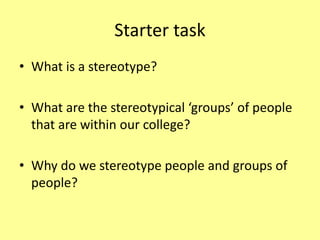
Guess the word I Googled to find these
stereotypes…
Stereotypes
• Stereotypes are assumptions we make based
on groups of people.
• How do we come to such conclusions? What
do we base our assumptions on?
• Are we always correct when we categorise
people in such ways?
Tessa Perkins
• Stereotyping is not a simple process and
contains a number of assumptions that can be
challenged.
• Perkins identifies 5 such assumptions;
- Stereotypes are not always negative (e.g. 'The
French are good cooks').
- They are not always about minority groups or
the less powerful ( e.g. 'upper class twits').
- They can be held about one's own group.
- They are not rigid or unchanging.
- They are not always false.
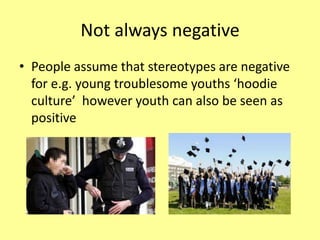
Not always negative
• People assume that stereotypes are negative
for e.g. young troublesome youths ‘hoodie
culture’ however youth can also be seen as
positive
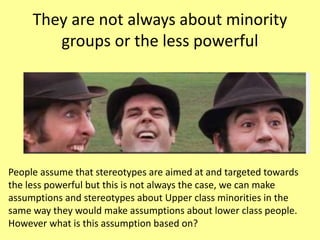
They are not always about minority
groups or the less powerful
People assume that stereotypes are aimed at and targeted towards
the less powerful but this is not always the case, we can make
assumptions and stereotypes about Upper class minorities in the
same way they would make assumptions about lower class people.
However what is this assumption based on?
They can be held about ones own
group
• For e.g. linking back to the starter task
collectively as a representation of people we
are based as a group within Wyke college,
within our own group we stereotyped people
demonstrating even though we all belong to
the same institution and hold the same
ideologies as a whole, within the group we
stereotype based on our assumptions. This
makes each of us feel part of the larger
community.
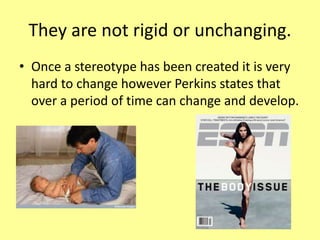
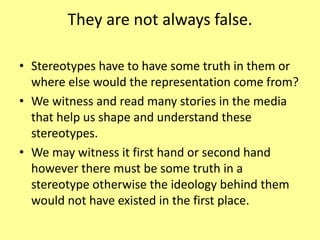
They are not rigid or unchanging.
• Once a stereotype has been created it is very
hard to change however Perkins states that
over a period of time can change and develop.
They are not always false.
• Stereotypes have to have some truth in them or
where else would the representation come from?
• We witness and read many stories in the media
that help us shape and understand these
stereotypes.
• We may witness it first hand or second hand
however there must be some truth in a
stereotype otherwise the ideology behind them
would not have existed in the first place.
Implications of stereotypes
• Stereotypes are always erroneous in content
(usually wrong).
• They are (negative) concepts.
• They are about groups with whom we have little or
no social contact; by implication therefore, they
are not held about ones own group- that’s a
stereotype of a stereotype. How can this be
reliable or believable?
• They are about minority or repressed groups most
of the time creating negative representation of the
lower class possibly giving the upper-class more
power.
Implications of stereotypes
• People either ‘hold’ stereotypes of a group (believe
them to be true) or do not. This can lead to negative
behavior or wrong assumptions.
• Because someone holds a stereotype of a group, his or
her behavior towards a member of that group can be
predicted. This can lead to unfair treatment of
members of society (celebrity BB white D)
• Stereotypes are an invaluable aid to understanding the
world and all stereotypes must have a bit of truth or
they would not have such an influence. Could we have
a world with out stereotypes?
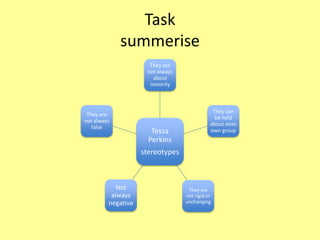
Task
summerise
Tessa
Perkins
stereotypes
They are
not always
about
minority
They can
be held
about ones
own group
They are
not rigid or
unchanging
Not
always
negative
They are
not always
false
Your opinion
• Are stereotypes fair?
• Is is possible not to stereotype people or
groups of people?
• How do they help us understand the world?
changes
• How has the media changed the stereotypes
of men and women?
• Is it possible for a stereotype to change 100%
• How do you think they may develop further?
What other changes may take place?
Exit pass
• What have I learnt in todays lesson?
• What have I found interesting?
• What did I not understand?
• http://serendip.brynmawr.edu/exchange/nod
e/11226

Tessa perkins 1415

  • 1.
  • 2.
    Starter task • Whatis a stereotype? • What are the stereotypical ‘groups’ of people that are within our college? • Why do we stereotype people and groups of people?
  • 3.
    Guess the wordI Googled to find these stereotypes…
  • 4.
    Stereotypes • Stereotypes areassumptions we make based on groups of people. • How do we come to such conclusions? What do we base our assumptions on? • Are we always correct when we categorise people in such ways?
  • 5.
    Tessa Perkins • Stereotypingis not a simple process and contains a number of assumptions that can be challenged. • Perkins identifies 5 such assumptions; - Stereotypes are not always negative (e.g. 'The French are good cooks'). - They are not always about minority groups or the less powerful ( e.g. 'upper class twits'). - They can be held about one's own group. - They are not rigid or unchanging. - They are not always false.
  • 6.
    Not always negative •People assume that stereotypes are negative for e.g. young troublesome youths ‘hoodie culture’ however youth can also be seen as positive
  • 7.
    They are notalways about minority groups or the less powerful People assume that stereotypes are aimed at and targeted towards the less powerful but this is not always the case, we can make assumptions and stereotypes about Upper class minorities in the same way they would make assumptions about lower class people. However what is this assumption based on?
  • 8.
    They can beheld about ones own group • For e.g. linking back to the starter task collectively as a representation of people we are based as a group within Wyke college, within our own group we stereotyped people demonstrating even though we all belong to the same institution and hold the same ideologies as a whole, within the group we stereotype based on our assumptions. This makes each of us feel part of the larger community.
  • 9.
    They are notrigid or unchanging. • Once a stereotype has been created it is very hard to change however Perkins states that over a period of time can change and develop.
  • 10.
    They are notalways false. • Stereotypes have to have some truth in them or where else would the representation come from? • We witness and read many stories in the media that help us shape and understand these stereotypes. • We may witness it first hand or second hand however there must be some truth in a stereotype otherwise the ideology behind them would not have existed in the first place.
  • 11.
    Implications of stereotypes •Stereotypes are always erroneous in content (usually wrong). • They are (negative) concepts. • They are about groups with whom we have little or no social contact; by implication therefore, they are not held about ones own group- that’s a stereotype of a stereotype. How can this be reliable or believable? • They are about minority or repressed groups most of the time creating negative representation of the lower class possibly giving the upper-class more power.
  • 12.
    Implications of stereotypes •People either ‘hold’ stereotypes of a group (believe them to be true) or do not. This can lead to negative behavior or wrong assumptions. • Because someone holds a stereotype of a group, his or her behavior towards a member of that group can be predicted. This can lead to unfair treatment of members of society (celebrity BB white D) • Stereotypes are an invaluable aid to understanding the world and all stereotypes must have a bit of truth or they would not have such an influence. Could we have a world with out stereotypes?
  • 13.
    Task summerise Tessa Perkins stereotypes They are not always about minority Theycan be held about ones own group They are not rigid or unchanging Not always negative They are not always false
  • 14.
    Your opinion • Arestereotypes fair? • Is is possible not to stereotype people or groups of people? • How do they help us understand the world?
  • 15.
    changes • How hasthe media changed the stereotypes of men and women? • Is it possible for a stereotype to change 100% • How do you think they may develop further? What other changes may take place?
  • 16.
    Exit pass • Whathave I learnt in todays lesson? • What have I found interesting? • What did I not understand?
  • 17.