Representation Theory
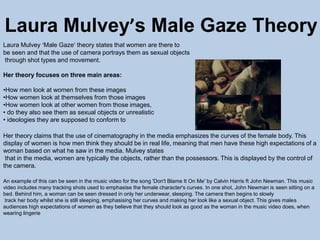
Laura Mulvey ‘Male Gaze’ theory states that women are there to
be seen and that the use of camera portrays them as sexual objects
through shot types and movement.
Her theory focuses on three main areas:
•How men look at women from these images
•How women look at themselves from those images
•How women look at other women from those images,
• do they also see them as sexual objects or unrealistic
• ideologies they are supposed to conform to
Her theory claims that the use of cinematography in the media emphasizes the curves of the female body. This
display of women is how men think they should be in real life, meaning that men have these high expectations of a
woman based on what he saw in the media. Mulvey states
that in the media, women are typically the objects, rather than the possessors. This is displayed by the control of
the camera.
An example of this can be seen in the music video for the song 'Don't Blame It On Me' by Calvin Harris ft John Newman. This music
video includes many tracking shots used to emphasise the female character's curves. In one shot, John Newman is seen sitting on a
bed. Behind him, a woman can be seen dressed in only her underwear, sleeping. The camera then begins to slowly
track her body whilst she is still sleeping, emphasising her curves and making her look like a sexual object. This gives males
audiences high expectations of women as they believe that they should look as good as the woman in the music video does, when
wearing lingerie
Laura Mulvey’s Male Gaze Theory
Richard Dyer’s ‘Star Theory’ is the idea that icons and celebrities are constructed by institutions for financial reasons and are built to
target a specific audience or group of people.
Dyer’s theory can be broken down into three sections:
•Audience and institutions
•Constructions
•Hegemony (Cultural Beliefs)
Audience and Institutions
Stars are made to make money for that purpose alone. Audiences want to consume what they think is the ideal (or made to believe
this is the ideal). The institution then modifies the stars image around the target audience. They make a star based on what they
think the audience want.
Constructions
The star is built for an audience and is not an actual person, a persona is created for the audience to identify with and so stars can
differentiate between different stars and why they like them or not.
Hegemony
This area describes leadership or dominance, especially by one state or social group over others. We relate to the star because they
have a feature that we admire or share with them. This develops from an admiration into an idolization. Dyer states “A star is an
image, not a real person that is constructed (as any other aspect of fiction is) out of a range of materials (e.g advertising magazines,
etc as well as films and music).
An example of this is the contests on the TV show America’s Next Top model.
At a certain stage of the competition, the models are given a make over. Stylists
and experts decide this makeover, the models do not have a say in which type
of makeover they receive. Many of the models cry when receiving their makeover
as they do not like it however they know that in order to progress further into the
competition and to become professional models, they must go through with it.
They are also made to complete different tasks in order to boost their status and
make appearances on television. This shows that institutions are constructing the
models.
Richard Dyer’s Star Theory
Stereotypes are not always negative
An example that shows this is with celebrities. Many celebrities are portrayed as very charitable and spend their time helping the less
fortunate. This is often considered a stereotype of a celebrity therefore not all stereotypes are negative. Another example is young
people. They are often portrayed as thugs and troublemakers within the media but they can also be stereotyped to be intelligent and
hard working as many graduated from University.
They are not always about minority groups or the less powerful
It is not just lower class people –whom are considered a minority group- that are stereotyped. Upper class people are also stereotyped
and considered to be ‘snobby’ and act like they are too good for others who are not from an upper class background. Another
example that shows that not only minority groups are stereotyped is white people. White people are not considered a minority but we
still get stereotyped.
They can be held about one’s own group
There are many stereotypes held within another stereotype such as with celebrities. There are stereotypes about celebrities however;
there are also stereotypes within these stereotypes such as the clean-cut celebrities and the ‘off the rails’ celebrities.
They are not rigid or unchanging
A stereotype is very hard to change however Perkins states that over period of time, a stereotype can change and develop. For
example, women used to be seen as housewives that stayed at home to look after children and to cook and clean. These days,
many women are the chief source of income as they work hard and are very successful in their jobs. This stereotype has obviously
changed and developed over time as women were not always this way.
They are not always false
Perkins states that stereotypes have to have some truth in them or where else would the representation come from? For example,
youths are stereotyped to be thugs that cause trouble. The news can prove this as many young people have been involved in violent
attacks against others so there may be some truth behind this stereotype. However, another stereotype about youths is that they are
hardworking and this is also proved by University graduates statistics.
•Stereotypes are not always negative
•They are not always about minority groups or
the less powerful
•They can be held about one’s own group
•They are not rigid or unchanging
•They are not always false
Stereotyping is not a simple process and
contains a number of assumptions that can be
challenged.
Perkins identifies five such assumptions:
Tessa Perkins

Representation Theory

  • 1.
  • 2.
    Laura Mulvey ‘MaleGaze’ theory states that women are there to be seen and that the use of camera portrays them as sexual objects through shot types and movement. Her theory focuses on three main areas: •How men look at women from these images •How women look at themselves from those images •How women look at other women from those images, • do they also see them as sexual objects or unrealistic • ideologies they are supposed to conform to Her theory claims that the use of cinematography in the media emphasizes the curves of the female body. This display of women is how men think they should be in real life, meaning that men have these high expectations of a woman based on what he saw in the media. Mulvey states that in the media, women are typically the objects, rather than the possessors. This is displayed by the control of the camera. An example of this can be seen in the music video for the song 'Don't Blame It On Me' by Calvin Harris ft John Newman. This music video includes many tracking shots used to emphasise the female character's curves. In one shot, John Newman is seen sitting on a bed. Behind him, a woman can be seen dressed in only her underwear, sleeping. The camera then begins to slowly track her body whilst she is still sleeping, emphasising her curves and making her look like a sexual object. This gives males audiences high expectations of women as they believe that they should look as good as the woman in the music video does, when wearing lingerie Laura Mulvey’s Male Gaze Theory
  • 3.
    Richard Dyer’s ‘StarTheory’ is the idea that icons and celebrities are constructed by institutions for financial reasons and are built to target a specific audience or group of people. Dyer’s theory can be broken down into three sections: •Audience and institutions •Constructions •Hegemony (Cultural Beliefs) Audience and Institutions Stars are made to make money for that purpose alone. Audiences want to consume what they think is the ideal (or made to believe this is the ideal). The institution then modifies the stars image around the target audience. They make a star based on what they think the audience want. Constructions The star is built for an audience and is not an actual person, a persona is created for the audience to identify with and so stars can differentiate between different stars and why they like them or not. Hegemony This area describes leadership or dominance, especially by one state or social group over others. We relate to the star because they have a feature that we admire or share with them. This develops from an admiration into an idolization. Dyer states “A star is an image, not a real person that is constructed (as any other aspect of fiction is) out of a range of materials (e.g advertising magazines, etc as well as films and music). An example of this is the contests on the TV show America’s Next Top model. At a certain stage of the competition, the models are given a make over. Stylists and experts decide this makeover, the models do not have a say in which type of makeover they receive. Many of the models cry when receiving their makeover as they do not like it however they know that in order to progress further into the competition and to become professional models, they must go through with it. They are also made to complete different tasks in order to boost their status and make appearances on television. This shows that institutions are constructing the models. Richard Dyer’s Star Theory
  • 4.
    Stereotypes are notalways negative An example that shows this is with celebrities. Many celebrities are portrayed as very charitable and spend their time helping the less fortunate. This is often considered a stereotype of a celebrity therefore not all stereotypes are negative. Another example is young people. They are often portrayed as thugs and troublemakers within the media but they can also be stereotyped to be intelligent and hard working as many graduated from University. They are not always about minority groups or the less powerful It is not just lower class people –whom are considered a minority group- that are stereotyped. Upper class people are also stereotyped and considered to be ‘snobby’ and act like they are too good for others who are not from an upper class background. Another example that shows that not only minority groups are stereotyped is white people. White people are not considered a minority but we still get stereotyped. They can be held about one’s own group There are many stereotypes held within another stereotype such as with celebrities. There are stereotypes about celebrities however; there are also stereotypes within these stereotypes such as the clean-cut celebrities and the ‘off the rails’ celebrities. They are not rigid or unchanging A stereotype is very hard to change however Perkins states that over period of time, a stereotype can change and develop. For example, women used to be seen as housewives that stayed at home to look after children and to cook and clean. These days, many women are the chief source of income as they work hard and are very successful in their jobs. This stereotype has obviously changed and developed over time as women were not always this way. They are not always false Perkins states that stereotypes have to have some truth in them or where else would the representation come from? For example, youths are stereotyped to be thugs that cause trouble. The news can prove this as many young people have been involved in violent attacks against others so there may be some truth behind this stereotype. However, another stereotype about youths is that they are hardworking and this is also proved by University graduates statistics. •Stereotypes are not always negative •They are not always about minority groups or the less powerful •They can be held about one’s own group •They are not rigid or unchanging •They are not always false Stereotyping is not a simple process and contains a number of assumptions that can be challenged. Perkins identifies five such assumptions: Tessa Perkins