Territorial Morphology
College Human Geography
2011
What is human territoriality?
Human territoriality is the attempt to
control what goes on in a specific
geographic area
A country’s sense of property and
attachment toward its territory, expressed
by its determination to keep it inviolable
and defended
What does sovereignty mean?
Sovereignty is the final authority over a
territory’s political and military affairs.
Authority to rule
Territorial morphology refers to…
Territorial morphology refers to the size,
shape and relative location of a state
(country)
This affects the potential for
communications and conflict with
neighbors
Morphology means “the form and
structure of an organism or one of its
parts”
Compact States
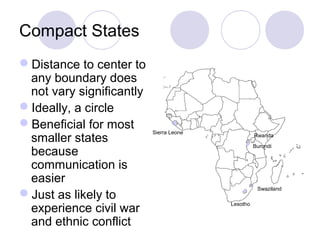
Distance to center to
any boundary does
not vary significantly
Ideally, a circle
Beneficial for most
smaller states
because
communication is
easier
Just as likely to
experience civil war
and ethnic conflict

Sierra Leone

Rwanda
Burundi

Swaziland
Lesotho
Fragmented States
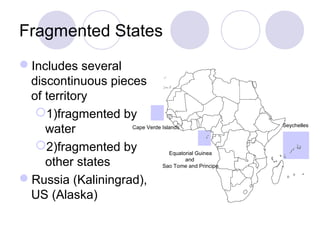
Includes several
discontinuous pieces
of territory
1)fragmented by
Cape Verde Islands
water
2)fragmented by
Equatorial Guinea
and
other states
Sao Tome and Principe
Russia (Kaliningrad),
US (Alaska)

Seychelles
Elongated States
States with a long
and narrow shape
Suffer from poor
internal
communications
Isolation of one
region from capital

Togo
Malawi
Protruded/Prorupt States
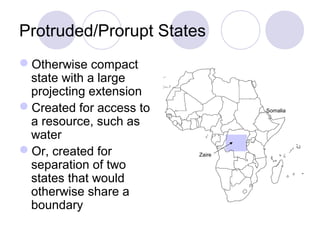
Otherwise compact
state with a large
projecting extension
Created for access to
a resource, such as
water
Or, created for
separation of two
states that would
otherwise share a
boundary

Somalia

Zaire
Perforated States
A state that
completely surrounds
another state
South Africa/Lesotho

South Africa
Boundaries…

a vertical plane that cuts
through the subsoil & airspace
(even outer space)
transcend soil, water, air
mark the limits of state
jurisdiction
Boundaries
differ in
morphological terms
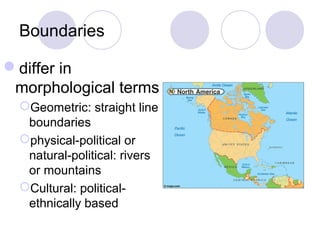
Geometric: straight line
boundaries
physical-political or
natural-political: rivers
or mountains
Cultural: politicalethnically based
Boundaries

are defined, delimited, and
then demarcated
Defined:legal document drawn up
Delimited:boundary put on a map
Demarcated:boundary marked on the
ground
Boundaries

are often a source of
dispute
Definitional Boundary Disputes

legal language in dispute
Locational Boundary Disputes

interpretation in dispute
Operational Boundary Disputes

functions of boundary in
dispute
Allocational Boundary Disputes

dispute over resources
Exclave and Enclave
Small outliers of territory which are
separated from the rest of the territory by
another state
The separated territory is referred to as an
exclave of the country it is associated with
If the piece of territory lies within another
country, it is known as an enclave of the
surrounding country
Naxcivan is an exclave of Azerbaijan
This is an enclave of Azerbaijan and an
exclave of Armenia
Genetic Boundaries: R. Hartshorne
Classifications of genetic boundaries include
antecedent types. These are boundaries that
were defined and delimited before the presentday human landscape developed. Subsequent
boundaries develop over a long-term and
generally involve intricate international treaties.
Relict boundaries are ones that no longer exist
but have left important imprints on the cultural
landscape. A superimposed boundary is one
that is forcibly drawn.
http://www.list.org/~mdoyle/issues.html

Territorial Morphology

  • 1.
  • 2.
    What is humanterritoriality? Human territoriality is the attempt to control what goes on in a specific geographic area A country’s sense of property and attachment toward its territory, expressed by its determination to keep it inviolable and defended
  • 3.
    What does sovereigntymean? Sovereignty is the final authority over a territory’s political and military affairs. Authority to rule
  • 4.
    Territorial morphology refersto… Territorial morphology refers to the size, shape and relative location of a state (country) This affects the potential for communications and conflict with neighbors Morphology means “the form and structure of an organism or one of its parts”
  • 5.
    Compact States Distance tocenter to any boundary does not vary significantly Ideally, a circle Beneficial for most smaller states because communication is easier Just as likely to experience civil war and ethnic conflict Sierra Leone Rwanda Burundi Swaziland Lesotho
  • 6.
    Fragmented States Includes several discontinuouspieces of territory 1)fragmented by Cape Verde Islands water 2)fragmented by Equatorial Guinea and other states Sao Tome and Principe Russia (Kaliningrad), US (Alaska) Seychelles
  • 7.
    Elongated States States witha long and narrow shape Suffer from poor internal communications Isolation of one region from capital Togo Malawi
  • 8.
    Protruded/Prorupt States Otherwise compact statewith a large projecting extension Created for access to a resource, such as water Or, created for separation of two states that would otherwise share a boundary Somalia Zaire
  • 9.
    Perforated States A statethat completely surrounds another state South Africa/Lesotho South Africa
  • 11.
    Boundaries… a vertical planethat cuts through the subsoil & airspace (even outer space) transcend soil, water, air mark the limits of state jurisdiction
  • 12.
    Boundaries differ in morphological terms Geometric:straight line boundaries physical-political or natural-political: rivers or mountains Cultural: politicalethnically based
  • 13.
    Boundaries are defined, delimited,and then demarcated Defined:legal document drawn up Delimited:boundary put on a map Demarcated:boundary marked on the ground
  • 14.
    Boundaries are often asource of dispute
  • 15.
  • 16.
  • 17.
  • 18.
  • 19.
    Exclave and Enclave Smalloutliers of territory which are separated from the rest of the territory by another state The separated territory is referred to as an exclave of the country it is associated with If the piece of territory lies within another country, it is known as an enclave of the surrounding country
  • 20.
    Naxcivan is anexclave of Azerbaijan
  • 21.
    This is anenclave of Azerbaijan and an exclave of Armenia
  • 22.
    Genetic Boundaries: R.Hartshorne Classifications of genetic boundaries include antecedent types. These are boundaries that were defined and delimited before the presentday human landscape developed. Subsequent boundaries develop over a long-term and generally involve intricate international treaties. Relict boundaries are ones that no longer exist but have left important imprints on the cultural landscape. A superimposed boundary is one that is forcibly drawn. http://www.list.org/~mdoyle/issues.html