Terminologies used in
Oral Pathology
Terminology/ Nomenclature
 Communication
 Documentation
 Description
 Classification/ categorization
Types
 General terms
 Clinical terms
 Histologic terms
Definition
Maximum expression in
minimum words
General terms
Provisional diagnosis
Diagnosis arrived at after
history taking and clinical
examination but before any
investigations.
Preliminary educated
assumption or guess as to the
nature or status of the
condition prior to the analysis
Differential diagnosis
Process of identifying a
particular disease process by
differentiating it from all other
pathologic processes that may
have similar signs and
symptoms or clinical course
Final Diagnosis
Diagnosis arrived after all the
data (History, clinical
examination and investigations )
has been collected, analyzed
and subjected to logical thought.
Prognosis
Prediction of the course,
duration and termination of a
disease and the likelihood of its
response to treatment
Investigations
Steps undertaken to confirm a
diagnosis which was established
following case history taking and
physical examination.
Laboratory Investigations
Extension of physical
examination in which tissue,
blood,urine, saliva or any other
specimen is obtained from the
patients body and subjected to
microscopic, biochemical,
microbiological or immunological
examination
Clinical terms
Inspection
Systematic visual
assessment of the patient
Palpation
Method of examining with the
hands using the sense of
touch
Percussion
Technique of striking the
tissues with the fingers or an
instrument so that the
examiner may listen to the
resulting sounds or note the
response of the patient to
such action
Auscultation
Technique of listening to
sounds produced in the body
using a stethoscope.
Lesion
Morphologically altered
tissue with objective signs of
disease
Symptom
Any change in the body or its
function that is perceptible to
the patient and may indicate a
disease.
Eg : Pain
Sign
Any change in the body or its
function that is perceptible to
a trained observer and may
indicate a specific disease.
Eg : Tenderness
Hypersensitivity
Exaggerated response to any
stimulus which otherwise
would not have caused the
same degree of response.
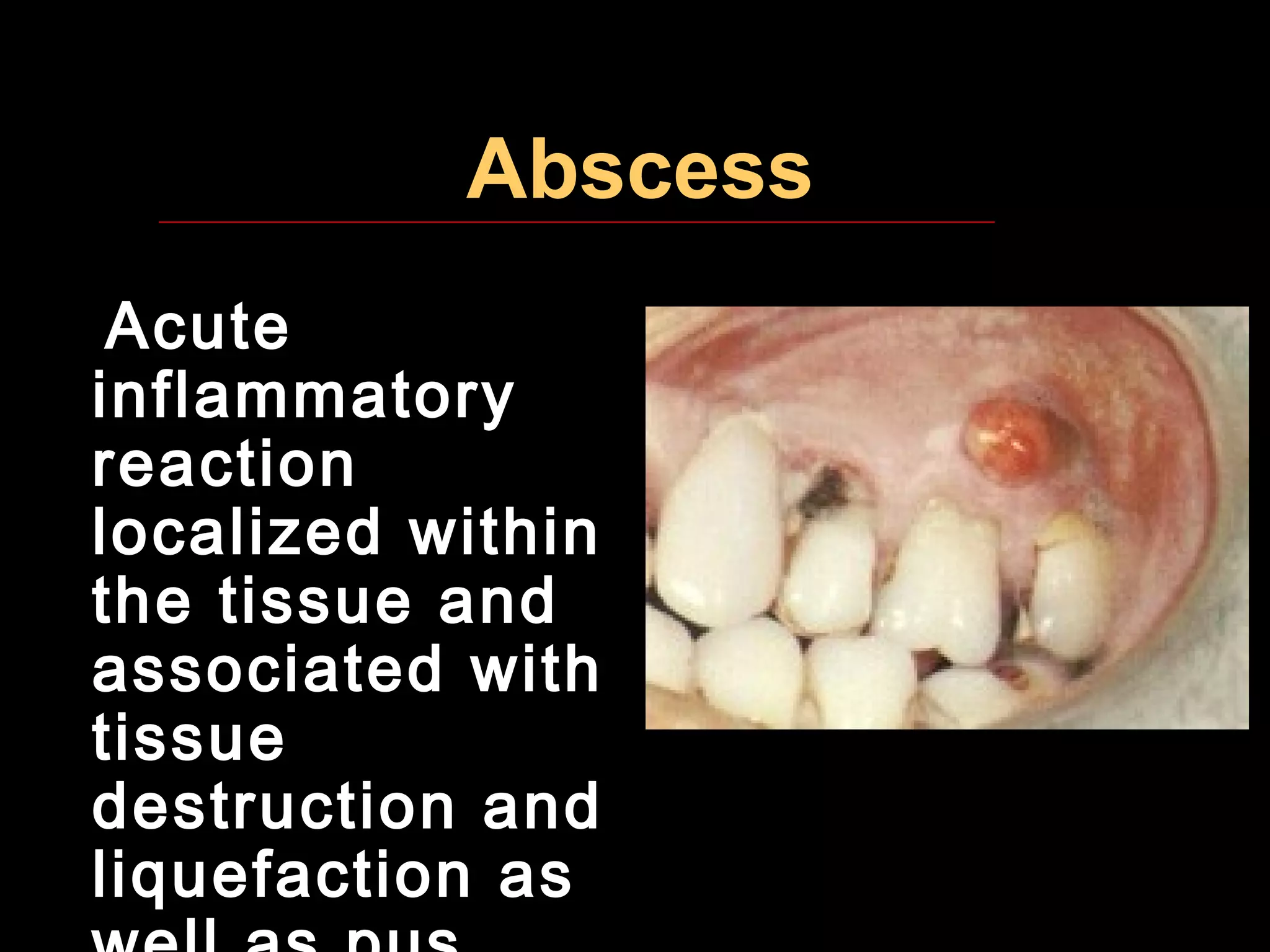
Abscess
Acute
inflammatory
reaction
localized within
the tissue and
associated with
tissue
destruction and
liquefaction as
Cellulitis
Acute inflammation which
spreads diffusely through the
tissue spaces and along
tissue planes and usually
suppurative in nature.
Exudate
It is the edema fluid
produced by certain
inflammatory reactions having
a higher specific gravity
(1.020 or higher) and a
higher protein content (1-6
gm/dl)
Transudate
It is the edema fluid produced
by certain noninflammatory
conditions having a low
specific gravity and a low
protein content
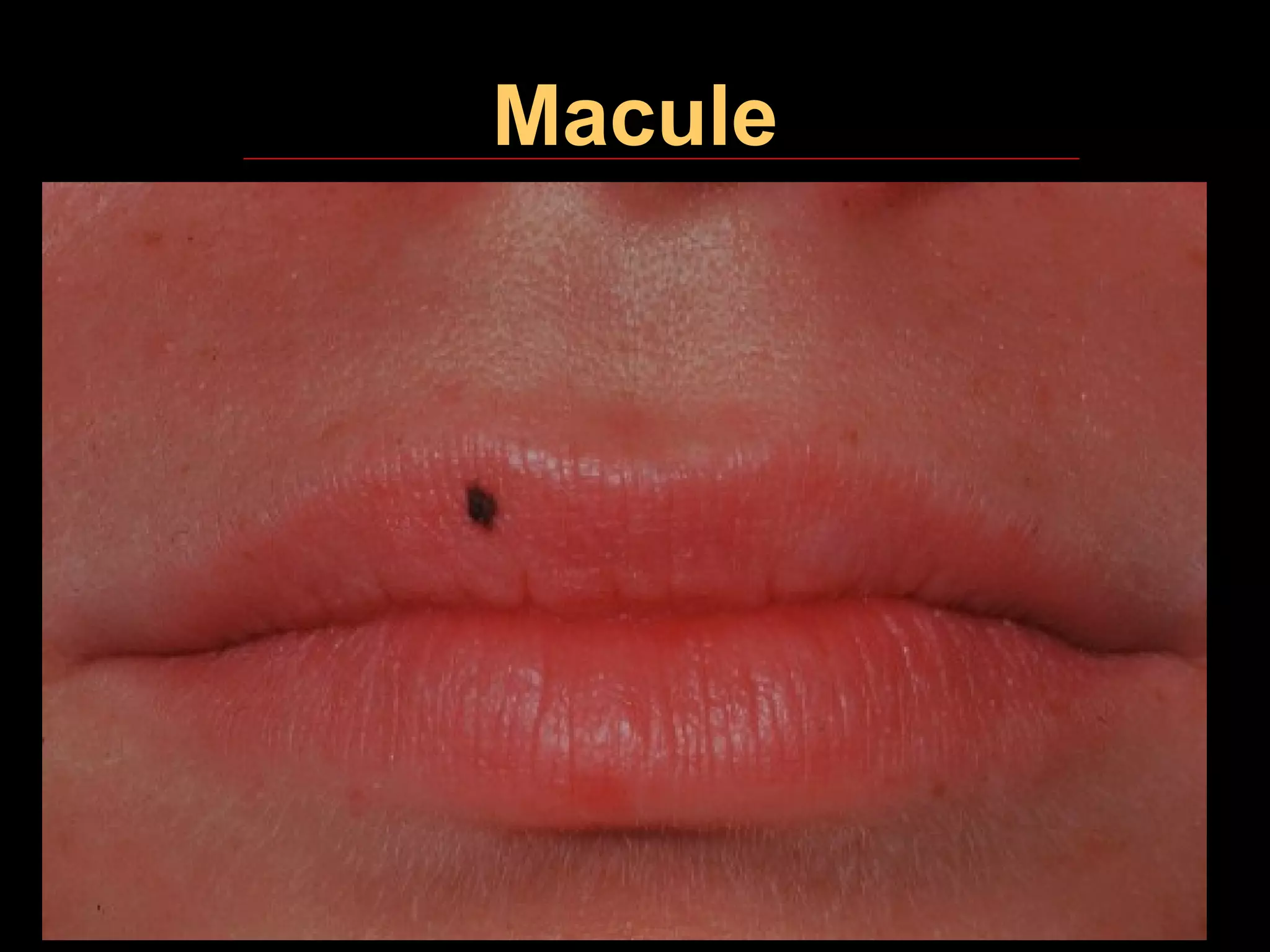
Macule
Well
circumscribed
flat area of
altered
coloration
varying in size
from a pinhead
to several cms
Macule
Macule/Patch
Papule
Small well
circumscribed
solid,elevated
lesion less than
5 mm in
diameter
Nodule
well
circumscribed
solid,elevated
lesion more
than
5 mm in
diameter
Nodule
Plaque
Vesicle
Small well
circumscribed
fluid filled lesion
less than 5 mm
in diameter
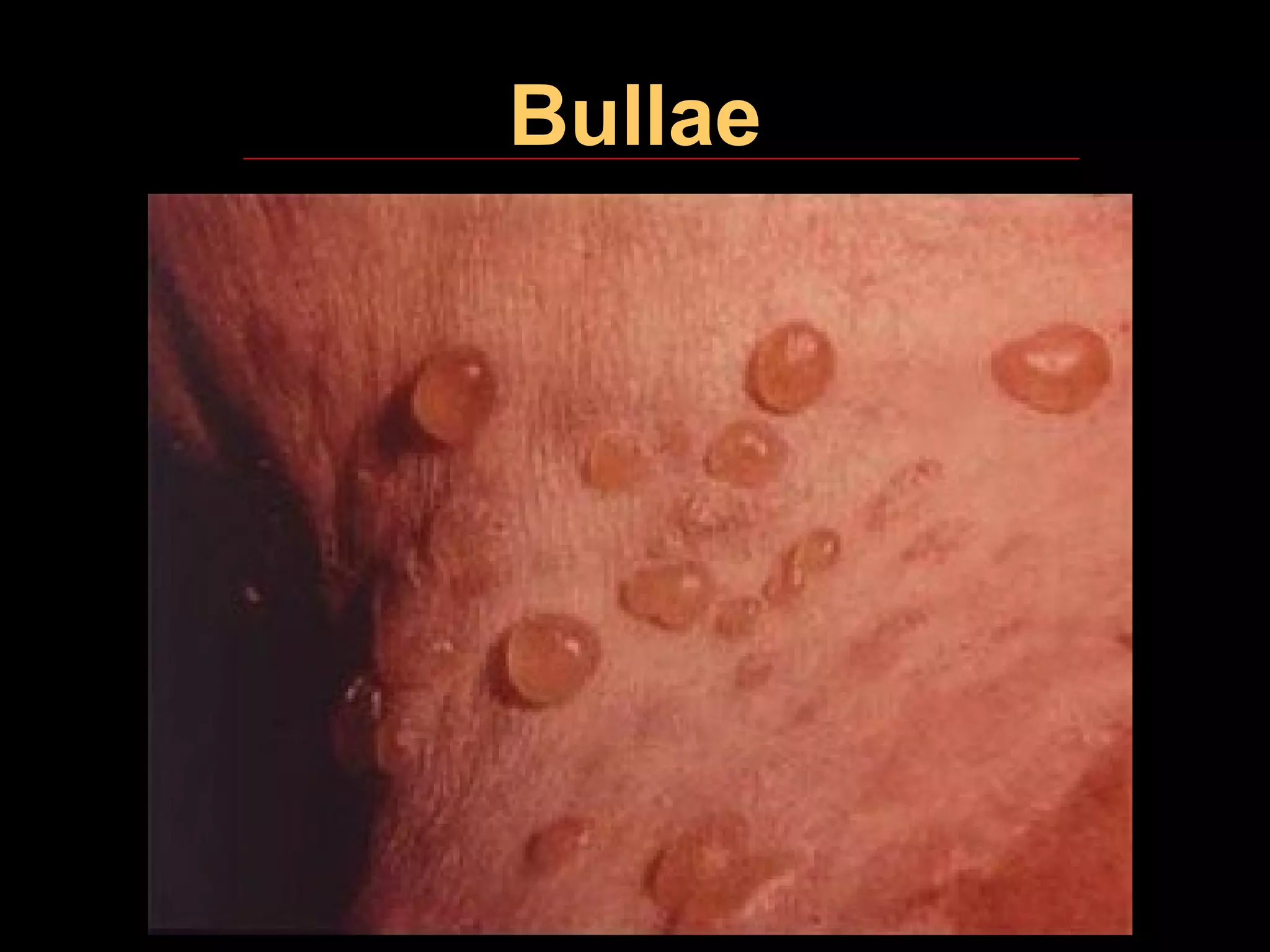
Bulla
well
circumscribed
fluid filled lesion
larger than 5
mm
in diameter
Bullae
Pustule
well
circumscribed
pus filled
lesion
smaller than 5
mm
in diameter
Erosion
Break in the
epithelium
extending to
but
not involving
the basal cell
layer
Erosion
Ulcer

Break in the continuity
of the entire epithelium
with the resultant
exposure of the
underlying connective
tissue
Ulcer
Sinus
•

Blind tract which connects a
cavity lined by granulation
tissue to the epithelial surface
Fistula
•

Communication between two
epithelium lined surfaces
Example:
Oro antral fistula
White lesion
•

Abnormal area of oral mucosa
which appears whiter than the
surrounding tissue and is usually
slightly raised, roughened or of a
different texture than the adjacent
normal tissue.
Keratotic White Lesion
•

White lesion of the oral cavity
which cannot be removed by
rubbing or scraping
Non Keratotic White Lesion
•

White lesion of the oral cavity
which can be removed by rubbing
or scraping
Premalignant lesion
•

Morphologically altered tissue
in which cancer is more likely
to occur than its apparently
normal counterpart
Eg: Leukoplakia
Premalignant Condition
•

Generalized state associated with
significantly increased risk of
developing cancer

Eg: Iron deficiency anemia
Hamartoma
• Tumour

like malformation
characterized by the presence of
particular histologic tissues in
improper proportions or distribution
with a prominent excess of one type
of tissue.

Eg: Haemangioma
Teratoma
•

True neoplasm made up of a number
of different types of tissues that are
not native to the area in which the
tumour occurs.
Choristoma
•

Microscopically normal cells present
in abnormal location

Eg: Fordyces granules
Neoplasm
•

Abnormal mass of tissue, the
growth of which exceeds and is
uncoordinated with that of the
normal tissue and persists in the
same excessive manner even after
the cessation of the stimulus that
evoked the change
Hypertrophy
•

Increase in the size of an organ or
tissue due to an increase in the
size of the cells
Example: Masseteric hypertrophy
Hyperplasia
•

Increase in the size of an organ or
tissue due to an increase in the
number of the cells
Example: Gingival hyperplasia
Hypoplasia
•

Incomplete development of an
organ or tissue
Example: Enamel hypoplasia
Aplasia
•

Complete failure of formation of
organ/tissue
Example: Condylar aplasia
Atrophy
•

Decrease in the size of an organ or
tissue after complete formation
Example: Papillary atrophy
Pedunculated
Pedunculated
Sessile
Sessile
Diffuse
Coalescing
Exophytic
Firm
Cheesy
Hard
Histologic terms
•
Hyperkeratosis
Thickening of the stratum corneum
Acanthosis
Thickening /Widening of the
stratum spinosum
Spongiosis
Intercellular edema
Acantholysis
Separation of cells in stratum
spinosum resulting in
intraepithelial split
Dysplasia
Irregular, atypical proliferative
changes in the epithelium in
response to chronic irritation or
inflammation
Anaplasia
Reversal of highly differentiated
cells into a less differentiated type
Metaplasis
• Is the reversible replacement of one
differentiated cell type with another mature
differentiated cell type
Metastasis
• Metastasis is a complex process that
involves the spread of a tumor or cancer to
distant parts of the body from its original
site
Mutation
• A relatively permanent change in
hereditary material involving either
a physical change in chromosome
relations or a biochemical change
in the codons that make up genes

Terminology used in oral pathology dental