PRESENTED BY
SAIED MAHMUD ZUBAYER
PGDCM, 1ST BATCH
ID-2015-01-06
“Efficient portfolio construction”
June 8, 2016
1
EXECUTIVE SUMMARY
Most investment portfolios are designed to meet a specific
future financial need—either a single goal or a multifaceted
set of objectives. To best meet that need, the investor must
establish a disciplined method of portfolio construction that
balances the potential risks and returns of various types of
investments.
This paper reviews my analysis into the investment decisions
involved in constructing a diversified portfolio. The term
“Construction of efficient portfolio” in common practice refers
to selection of securities and their continuous shifting in a
way that the holder gets maximum returns at the minimum
possible risk. A portfolio manager by the virtue of his
knowledge, background and experience helps his clients to
make investment in profitable avenues.
2
June 8, 2016
EXECUTIVE SUMMARY
This paper discusses how to create a diversified portfolio by focusing on
eight major steps:
 Calculating Portfolio Weight by Maximizing Theta without allowing short
sell
 Calculating Portfolio Weight by Maximizing Theta with allowing short sell
 Calculating Portfolio Weight by Minimizing Risk without allowing short
sell
 Calculating Portfolio Weight by Minimizing Risk with allowing short sell
 Calculating Portfolio Weight by Maximizing Portfolio Return for a given
Risk without allowing short sell
 Calculating Portfolio Weight by Maximizing Portfolio Return for a given
Risk with allowing short sell
 Calculating Portfolio Weight by Minimizing Risk for a given return without
allowing short sell
 Calculating Portfolio Weight by Minimizing Risk for a given return without
allowing short sell
3
June 8, 2016
INTRODUCTION:
Security analyzing and selection of portfolios and managing them in the
right manner helps in improving the investor’s awareness about the
trends and changes that exist in the market and helps the investors as a
very attractive avenue for investment. In these investments, generally
both rationale and emotional responses are involved. So, investing in
financial securities is considered to be one of the attractive areas for
investing and saving while it is also acknowledged to be one of the most
risky areas for investment. Creation of an optimum portfolio helps to
reduce risk, without sacrificing returns. Portfolio management deals with
the analysis of individual securities as well as with the theory and
practice of optimally combining securities into good portfolios. An
investor who understands the fundamental principles and analytical
aspects of portfolio management has a better chance of earning higher
returns.
It is widely accepted that investors should aim to maximize the level of
return for a given level of risk. Alternatively they aim at minimizing the
risk for a given level of return. This is done by constructing a portfolio of
assets which as a whole is subject to the investor’s risk appetite.
4
June 8, 2016
INTRODUCTION:
In this paper, 10 stocks from different sectors are taken for study.
The risk and return of all the stocks are studied individually.
Based on the study top five stocks are selected for forming
optimum portfolio. The final step in the process is to determine
the number of shares of each stock to be purchased. This method
helps us to carefully select the stocks and also the proportion of
investment to be made in each stock, thereby yielding higher
returns.
The study will start by providing an overview of efficient portfolio
construction to apply excel solver and its most important
elements, namely risk, return and diversification. Secondly, the
study will identify and discuss various alternative investments in
securities that are believed to hold the potential for better
diversification and move investors closer to attaining a true
market portfolio. Lastly, the study will attempt to prove the
hypothesis that these investments do hold the potential of
improving the diversification of existing portfolios.
5
June 8, 2016
OBJECTIVES OF THE STUDY:
The main objective of this project is to find the
optimum portfolio from the selected companies in
different sectors. At the end of the analysis a portfolio
of 10 stocks with maximum return for a given risk is
constructed which shows how much proportion of
money is to be invested in each security wholly taken
from different sectors.
These sectors are generally consistently performing
as these kinds of sectors are depended by the public
in a large extent. Main objective is to maximize the
value of theta which is the portfolio excess return for
each unit of portfolio risk.
6
June 8, 2016
OBJECTIVES OF THE STUDY:
Main objective is to maximize the value of theta which is the portfolio
excess return for each unit of portfolio risk.
7
June 8, 2016
OBJECTIVES OF THE STUDY:
Objective of the study are as under:
 Maximize Theta:
 When short sale is allowed
 When short sale is not allowed
 Minimize Risk:-
 When short sale is allowed
 When short sale is not allowed
 Maximize portfolio return for a given risk:
 When short sale is allowed
 When short sale is not allowed
 Minimize risk for a given return:
 When short sale is allowed
 When short sale is not allowed
8
June 8, 2016
BACKGROUND OF THE STUDY
This report entitled “Construction of Efficient Portfolio” is
prepared for the fulfillment of the course title Financial
Modeling, Course No. 304. Everybody earns and spends
money. But to optimize this earning & spending and to
accommodate the future uncertainties, inflation etc., there
needs to be proper planning & management of wealth.
Investment decision is one of major part of this management
of wealth. Because, sometimes may have enough money in
hand and sometimes not. If excess money is invested in a
proper manner, then it can encounter the problem during
deficit. Portfolio management is an important management
process of wealth, which maximizes the return for desirable
risk level. In portfolio management, emphasis is given on
the investment in the capital market. For this reason, study
on security market is so essential. Evaluating efficient
portfolio that maximize the return & minimize the risk
compare to other portfolio is very much important.
9
June 8, 2016
SCOPE OF THE STUDY:
I have prepared the assignment as a part of the
Course Study of Financial Modeling, Course
Code-D304. To achieve the objective it is
needed to collect the price of the different
companies. For achieving the objectives, the
study will be focused on different steps for
maximizing return on portfolio based on the
shares listed in Dhaka Stock Exchange Limited
considering the price, volume, P/E, EPS, Price
to book value ratio and other criteria of different
companies.
10
June 8, 2016
METHODOLOGY:
To attain the objective, I have collected the required data &
information for preparing the report. Those data & information
were collected from various sources & then analyzed. The
following are the sources of data and information:
 Collection of data & information:
 Secondary data & information:
 Observation & collection of data from DSE
 Conversation with the executives & officers of Dhaka stock
exchange Ltd.
 Collection of Annual Report of Listed companies from DSE library
 Monthly review of Dhaka Stock Exchange Ltd
 Several kind of academic Test-Book.
 Different publications regarding stock exchange function
 Price index
 Dividend information
 Right Information
11
June 8, 2016
LIMITATION OF THE STUDY
Some limitations that I have faced want to mention from report
preparation point of view.
 Shortcoming of practical experience to comprehend the conceptual
framework of this type of report.
 My sample for analysis includes only four year's data i.e. from July 2011
to June 2015, so, it may affect the result of the analysis.
 This study was limited only to the 10 companies. As a result it has a
narrow outlook of overall industry.
 The study is based on the secondary data collected from the published
annual report of the companies and website of DSE like www.dsebd.org.
So limitation of the secondary data will remain with the study.
 Every person has its own thinking and believes so in this research work
may include personal bias during the research work.
 Analytical tools, which are used in the study, may have their own
limitations, which may apply to this study too.
 It was very difficult to incorporate all the data in the report due to the
limitation from the organization and thus certain information is not
incorporated.
12
June 8, 2016
CONSTRUCTION OF THE EFFICIENT PORTFOLIO:
Efficient portfolios may contain any number of asset combinations.
We examine efficient asset allocation by using excel solver.
The make-up of any portfolio is subject to decisions being made on
one of three levels namely:
 The capital allocation decision – which refers to the choice
investors need to make between investing in a risk-free asset and
a risky asset portfolio.
 The asset allocation decision – which describes the distribution of
risky investments across different asset classes. (Construction of
the optimal risky asset portfolio).
 Security selection decision – which describes the choice of
particular securities held within each asset class
13
June 8, 2016
SECTOR SELECTION:
All data are collected from the based on trading
of Dhaka Stock Exchange Limited. There are 22
sectors in Dhaka Stock Exchange Limited.
Here, I selected the following Sectors based on
the previous positive performance in DSE:
Fuel and Power
Pharmaceuticals and Chemicals
Bank
Engineering
Food and Allied
14
June 8, 2016
SELECTION CRITERIA:
Here sector and shares are selected based on
the following issues:
Price Earning Ratio for the last Five years
Price to Book value ratio for the last five
years
Market Capitalization
Listed before January 01, 2011
Listed in Dhaka Stock Exchange Limited
Relative higher lower P/E ratio of the
companies with comparing market average.
15
June 8, 2016
ASSET SELECTION:
 Asset Selection:
 Fuel and Power
DESCO
TITASGAS
 Pharmaceuticals and Chemicals
The Ibn Sina
Square Pharma
Beximco Pharma
 Bank
The City Bank
Eastern Bank
 Engineering
BSRM Steel
Singer BD
 Food and Allied
Olympic BD
16
June 8, 2016
THE CALCULATION PROCESS:
17
June 8, 2016
ACCUMULATING PRICE FROM JULY 01, 2015 TO JUNE
30, 2015 Price of July, 2011
18
June 8, 2016
DIVIDEND ADJUSTMENT AND RETURN SERIES:
Formula of Return
Series
Return of
November,2011
19
June 8, 2016
ARRANGING MEAN RETURN:
Mean return for DESCO
20
June 8, 2016
CALCULATING CORRELATION MATRIX
 The correlation coefficient is a simple statistic that describes
the variability of asset returns relative to other assets for the
purpose of asset allocation. Determining how the asset
classes correlate is an important step in the process of
optimizing the allocation of assets. Without this normalized
form of the covariance, it would be very difficult to evaluate
the relative variability of asset returns.
 Asset allocation accounts for over 90% of success as an
investor. Assessing how assets complement one another is
a crucial step in the process of asset allocation.
 Correlation describes on a scale of -1 to +1 the relative
movement of two securities' prices or one security relative to
an index, with +1 being perfectly positively correlated, -1
being perfectly negatively correlated and 0 indicating no
correlation. The correlation coefficient, R, which is the
normalized form of the covariance, is a measure of relative
variation.
21
June 8, 2016
 Perfect positive correlation is like moving in lock step.
Perfectly positively correlated securities do not
complement each other and therefore provide no
diversification.
 Perfectly negatively correlated securities' prices move in
the opposite direction from each other by the exact same
amount. For example, if stock A and stock B are perfectly
negatively correlated, stock B will decline by 10% when
stock A rises 10% and stock A will decline by 15% when
stock B rises 15%. Perfectly negatively correlated
investments would provide 100% diversification, as they
would form a portfolio with zero variance, which translates
to zero risk. Unfortunately, in the real world such
investments don't exist, but there are a few assets that
tend to be negatively correlated to most other asset
classes. These assets provide excellent diversification.
CALCULATING CORRELATION MATRIX
22
June 8, 2016
CALCULATING CORRELATION MATRIX:
Correlation of DESCO
with itself
23
June 8, 2016
CALCULATING CORRELATION MATRIX:
Correlation of DESCO
with itself
24
June 8, 2016
CALCULATING AVERAGE MEAN RETURN:
Average Mean return of DESCO
25
June 8, 2016
CALCULATING RISK FREE RETURN
Calculating risk free return over
the last 5 years
26
June 8, 2016
TRANSPOSE THE AVERAGE MEAN RETURN TO THE
COVARIANCE MATRIX
27
June 8, 2016
CALCULATION OF INDIVIDUAL SECURITIES EXCESS
RETURN:
28
June 8, 2016
CALCULATING WEIGHT FACTOR IN COVARIANCE
MATRIX
Preparing the weight Vector
29
June 8, 2016
CALCULATION OF PORTFOLIO EXCESS RETURN:
Formula for portfolio Excess
return
Portfolio Excess Return
30
June 8, 2016
PREPARING THE COVARIANCE MATRIX:
Covariance of DESCO with itself
31
June 8, 2016
PREPARING THE COVARIANCE MATRIX:
Covariance of DESCO with
TITASGAS
32
June 8, 2016
CALCULATING PORTFOLIO VARIANCE
33
June 8, 2016
CALCULATING PORTFOLIO VARIANCE:
Portfolio Variance
34
June 8, 2016
CALCULATING PORTFOLIO STANDARD
DEVIATION
Portfolio Standard Deviation
35
June 8, 2016
CALCULATING THETA
Calculating Theta
36
June 8, 2016
CALCULATING TOTAL WEIGHT
37
June 8, 2016
CALCULATING MATRIX PORTFOLIO RETURN
Portfolio Return
38
June 8, 2016
PORTFOLIO CONSTRUCTION:
 Objectives:
 Maximize the Theta
 Ө= Rp-Rf/σp
 Here,
Ө=Theta, Rp= Portfolio Return, Rf= Risk free return,
σp = Standard Deviation of Portfolio return
 The Main objective in a portfolio construction is to
maximize the value of Theta (Ө) which is the portfolio
excess return for each unit of portfolio risk.
39
June 8, 2016
CONSTRUCTION THE FUNCTION
When short sell is allowed: Various
constraints may preclude a particular investor
from choosing portfolios on the efficient frontier,
however. Short sale restrictions are only one
possible constraint. Short sale is a usual
regulated type of market transaction. It involves
selling assets that are borrowed in expectation
of a fall in the assets’ price. When and if the
price declines, the investor buys an equivalent
number of assets at the new lower price and
returns to the lender the assets that were
borrowed.
40
June 8, 2016
CONSTRUCTION THE FUNCTION
When short sell is allowed:
Return: the general formula of expected return for n assets is:
where:
n= the number of securities;
Wi = the proportion of the funds invested in security i;
rirp= the return on ith security and portfolio p; and
E()=the expectation of the variable in the parentheses.
The return computation is nothing more than finding the weighted
average return of the securities included in the portfolio.
 
1
( )
n
P i i
i
E r w E r

 
1
n
i
i
w

 = 1.0;
41
June 8, 2016
CONSTRUCTION THE FUNCTION
 n= the number of securities;
 wi=the proportion of the funds invested in
security i;
 rirp= the return on ith security and portfolio p;
and
 E()=The expectation of the variable in the
parentheses.
 
1
( )
n
P i i
i
E r w E r

  wi >= 0
42
June 8, 2016
CONSTRUCTION THE FUNCTION
The variance of a single security is the expected value of the sum of the
squared deviations from the mean, and the standard deviation is the
square root of the variance. The variance of a portfolio combination of
securities is equal to the weighted average covariance of the returns on
its individual securities:
   2
1 1
Var Cov ,
n n
p p i j i j
i j
r w w r r
 
  
43
June 8, 2016
CONSTRUCTION THE FUNCTION
0
Z’
Z
A
P
V
Exp
ect
ed
Ret
urn
Standard Deviation
B
without short sales
with short sales
44
June 8, 2016
CONSTRUCTION THE FUNCTION
 The assumption of no short selling, investors could sell the lowest-return
asset B (here, we assume that ). If the number of short sales is
unrestricted, then by a continuous short selling of B and reinvesting in A
the investor could generate an infinite expected return. The efficient
frontier of unconstraint portfolio is shown in above Figure. The upper
bound of the highest-return portfolio would no longer be A but infinity
(shown by the arrow on the top of the efficient frontier). Likewise the
investor could short sell the highest-return security A and reinvest the
proceeds into the lowest-yield security, thereby generating a return less
than the return on the lowest-return assets. Given no restriction on the
amount of short selling, an infinitely negative return can be achieved,
thereby removing the lower bound of B on the efficient frontier. Hence,
short selling generally will increase the range of alternative investments
from the minimum-variance portfolio to plus or minus infinity.
 Relaxing the assumption of no short selling in this development of the
efficient frontier involves a modification of the analysis of the efficient
frontier of constraint (not allowed short sales). Next section, we
introduce the mathematical analysis of the efficient frontier with/without
short selling constraints by excel solver.
45
June 8, 2016
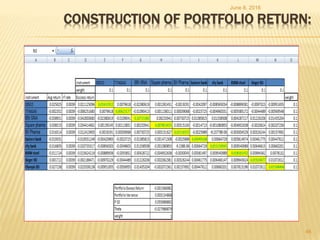
CONSTRUCTION OF PORTFOLIO RETURN:
46
June 8, 2016
EFFICIENT PORTFOLIOS IN EXCEL USING THE
SOLVER
 The solver is an Excel Add‐In created by Frontline Systems
(www.solver.com) that can be used to solve general optimization
problems that may be subject to certain kinds of constraints. In
this note we show how it can be used to find portfolios that
minimize risk subject to certain constraints.
 The solver add‐in must be activated before it can be used within
Excel. In Excel 2007, you activate addins by clicking on the office
button and then clicking on the Excel Options box at the bottom of
the menu.
 This opens the Excel options dialogue box. Click Add‐Ins, which
displays the available Add‐Ins for Excel. Make sure the Solver
Add‐In is an Active Application Add‐In.
47
June 8, 2016
EFFICIENT PORTFOLIOS IN EXCEL USING THE
SOLVER
48
June 8, 2016
CALCULATING PORTFOLIO WEIGHT BY MAXIMIZING THETA WITHOUT
ALLOWING SHORT SELL BY EXCEL SOLVER:
49
June 8, 2016
CALCULATING PORTFOLIO WEIGHT BY MAXIMIZING THETA WITH
ALLOWING SHORT SELL BY EXCEL SOLVER:
50
June 8, 2016
CALCULATING PORTFOLIO WEIGHT BY MINIMIZING RISK
WITHOUT ALLOWING SHORT SELL BY EXCEL SOLVER
51
June 8, 2016
CALCULATING PORTFOLIO WEIGHT BY MINIMIZING RISK WITH
ALLOWING SHORT SELL BY EXCEL SOLVER
52
June 8, 2016
CALCULATING PORTFOLIO WEIGHT BY MAXIMIZING PORTFOLIO
RETURN FOR A GIVEN RISK WITHOUT ALLOWING SHORT SELL
HERE, WE ASSUME THAT THE RISK RATE IS 8%
53
June 8, 2016
CALCULATING PORTFOLIO WEIGHT BY MAXIMIZING PORTFOLIO
RETURN FOR A GIVEN RISK WITH ALLOWING SHORT SELL
54
June 8, 2016
CALCULATING PORTFOLIO WEIGHT BY MINIMIZING RISK FOR A
GIVEN RETURN WITHOUT ALLOWING SHORT SELL
55
June 8, 2016
CALCULATING PORTFOLIO WEIGHT BY MINIMIZING RISK FOR A
GIVEN RETURN WITHOUT ALLOWING SHORT SELL
56
June 8, 2016
CONCLUSION
The objective of portfolio management is to create and maintain efficient
portfolios. Efficient portfolios are portfolios which yield the greatest
return for any given level of risk. Portfolio is collection of different
securities and assets by which we can satisfy the basic objective
“Maximize yield minimize risk”. Further we have to remember some
important investing rules which are related to the trading and set by the
concerned regulator.
Asset allocation accounts for over 90% of success as an investor, which
is why to need a means to allocate capital efficiently across a specific
set of assets. The Capital Allocation Line explains the basic procedure
for the allocation of capital and modern portfolio theory explains how to
identify the optimal allocation using mean-variance criteria to identify
what's known as the Efficient Frontier, a concept that was first described
by Harry Markowitz in 1952.
Portfolio diversification is the means by which investors minimize or
eliminate their exposure to company-specific risk, minimize or reduce
systematic risk and moderate the short-term effects of individual asset
class performance on portfolio value. In a well-conceived portfolio, this
can be accomplished at a minimal cost in terms of expected return.
Such a portfolio would be considered to be a well-diversified.
57
June 8, 2016
REFERENCES
 Efficient Portfolio Construction by Mahmood
Osman Imam, Professor of Finance, DU
 Website of the different listed Companies
 www.dsebd.org
 Annual Report of different listed Companies
 Research and Information Department of
DSE
 Corporate Finance by Stephen A. Ross
58
June 8, 2016
June 8, 2016
59

Term paper

  • 1.
    PRESENTED BY SAIED MAHMUDZUBAYER PGDCM, 1ST BATCH ID-2015-01-06 “Efficient portfolio construction” June 8, 2016 1
  • 2.
    EXECUTIVE SUMMARY Most investmentportfolios are designed to meet a specific future financial need—either a single goal or a multifaceted set of objectives. To best meet that need, the investor must establish a disciplined method of portfolio construction that balances the potential risks and returns of various types of investments. This paper reviews my analysis into the investment decisions involved in constructing a diversified portfolio. The term “Construction of efficient portfolio” in common practice refers to selection of securities and their continuous shifting in a way that the holder gets maximum returns at the minimum possible risk. A portfolio manager by the virtue of his knowledge, background and experience helps his clients to make investment in profitable avenues. 2 June 8, 2016
  • 3.
    EXECUTIVE SUMMARY This paperdiscusses how to create a diversified portfolio by focusing on eight major steps:  Calculating Portfolio Weight by Maximizing Theta without allowing short sell  Calculating Portfolio Weight by Maximizing Theta with allowing short sell  Calculating Portfolio Weight by Minimizing Risk without allowing short sell  Calculating Portfolio Weight by Minimizing Risk with allowing short sell  Calculating Portfolio Weight by Maximizing Portfolio Return for a given Risk without allowing short sell  Calculating Portfolio Weight by Maximizing Portfolio Return for a given Risk with allowing short sell  Calculating Portfolio Weight by Minimizing Risk for a given return without allowing short sell  Calculating Portfolio Weight by Minimizing Risk for a given return without allowing short sell 3 June 8, 2016
  • 4.
    INTRODUCTION: Security analyzing andselection of portfolios and managing them in the right manner helps in improving the investor’s awareness about the trends and changes that exist in the market and helps the investors as a very attractive avenue for investment. In these investments, generally both rationale and emotional responses are involved. So, investing in financial securities is considered to be one of the attractive areas for investing and saving while it is also acknowledged to be one of the most risky areas for investment. Creation of an optimum portfolio helps to reduce risk, without sacrificing returns. Portfolio management deals with the analysis of individual securities as well as with the theory and practice of optimally combining securities into good portfolios. An investor who understands the fundamental principles and analytical aspects of portfolio management has a better chance of earning higher returns. It is widely accepted that investors should aim to maximize the level of return for a given level of risk. Alternatively they aim at minimizing the risk for a given level of return. This is done by constructing a portfolio of assets which as a whole is subject to the investor’s risk appetite. 4 June 8, 2016
  • 5.
    INTRODUCTION: In this paper,10 stocks from different sectors are taken for study. The risk and return of all the stocks are studied individually. Based on the study top five stocks are selected for forming optimum portfolio. The final step in the process is to determine the number of shares of each stock to be purchased. This method helps us to carefully select the stocks and also the proportion of investment to be made in each stock, thereby yielding higher returns. The study will start by providing an overview of efficient portfolio construction to apply excel solver and its most important elements, namely risk, return and diversification. Secondly, the study will identify and discuss various alternative investments in securities that are believed to hold the potential for better diversification and move investors closer to attaining a true market portfolio. Lastly, the study will attempt to prove the hypothesis that these investments do hold the potential of improving the diversification of existing portfolios. 5 June 8, 2016
  • 6.
    OBJECTIVES OF THESTUDY: The main objective of this project is to find the optimum portfolio from the selected companies in different sectors. At the end of the analysis a portfolio of 10 stocks with maximum return for a given risk is constructed which shows how much proportion of money is to be invested in each security wholly taken from different sectors. These sectors are generally consistently performing as these kinds of sectors are depended by the public in a large extent. Main objective is to maximize the value of theta which is the portfolio excess return for each unit of portfolio risk. 6 June 8, 2016
  • 7.
    OBJECTIVES OF THESTUDY: Main objective is to maximize the value of theta which is the portfolio excess return for each unit of portfolio risk. 7 June 8, 2016
  • 8.
    OBJECTIVES OF THESTUDY: Objective of the study are as under:  Maximize Theta:  When short sale is allowed  When short sale is not allowed  Minimize Risk:-  When short sale is allowed  When short sale is not allowed  Maximize portfolio return for a given risk:  When short sale is allowed  When short sale is not allowed  Minimize risk for a given return:  When short sale is allowed  When short sale is not allowed 8 June 8, 2016
  • 9.
    BACKGROUND OF THESTUDY This report entitled “Construction of Efficient Portfolio” is prepared for the fulfillment of the course title Financial Modeling, Course No. 304. Everybody earns and spends money. But to optimize this earning & spending and to accommodate the future uncertainties, inflation etc., there needs to be proper planning & management of wealth. Investment decision is one of major part of this management of wealth. Because, sometimes may have enough money in hand and sometimes not. If excess money is invested in a proper manner, then it can encounter the problem during deficit. Portfolio management is an important management process of wealth, which maximizes the return for desirable risk level. In portfolio management, emphasis is given on the investment in the capital market. For this reason, study on security market is so essential. Evaluating efficient portfolio that maximize the return & minimize the risk compare to other portfolio is very much important. 9 June 8, 2016
  • 10.
    SCOPE OF THESTUDY: I have prepared the assignment as a part of the Course Study of Financial Modeling, Course Code-D304. To achieve the objective it is needed to collect the price of the different companies. For achieving the objectives, the study will be focused on different steps for maximizing return on portfolio based on the shares listed in Dhaka Stock Exchange Limited considering the price, volume, P/E, EPS, Price to book value ratio and other criteria of different companies. 10 June 8, 2016
  • 11.
    METHODOLOGY: To attain theobjective, I have collected the required data & information for preparing the report. Those data & information were collected from various sources & then analyzed. The following are the sources of data and information:  Collection of data & information:  Secondary data & information:  Observation & collection of data from DSE  Conversation with the executives & officers of Dhaka stock exchange Ltd.  Collection of Annual Report of Listed companies from DSE library  Monthly review of Dhaka Stock Exchange Ltd  Several kind of academic Test-Book.  Different publications regarding stock exchange function  Price index  Dividend information  Right Information 11 June 8, 2016
  • 12.
    LIMITATION OF THESTUDY Some limitations that I have faced want to mention from report preparation point of view.  Shortcoming of practical experience to comprehend the conceptual framework of this type of report.  My sample for analysis includes only four year's data i.e. from July 2011 to June 2015, so, it may affect the result of the analysis.  This study was limited only to the 10 companies. As a result it has a narrow outlook of overall industry.  The study is based on the secondary data collected from the published annual report of the companies and website of DSE like www.dsebd.org. So limitation of the secondary data will remain with the study.  Every person has its own thinking and believes so in this research work may include personal bias during the research work.  Analytical tools, which are used in the study, may have their own limitations, which may apply to this study too.  It was very difficult to incorporate all the data in the report due to the limitation from the organization and thus certain information is not incorporated. 12 June 8, 2016
  • 13.
    CONSTRUCTION OF THEEFFICIENT PORTFOLIO: Efficient portfolios may contain any number of asset combinations. We examine efficient asset allocation by using excel solver. The make-up of any portfolio is subject to decisions being made on one of three levels namely:  The capital allocation decision – which refers to the choice investors need to make between investing in a risk-free asset and a risky asset portfolio.  The asset allocation decision – which describes the distribution of risky investments across different asset classes. (Construction of the optimal risky asset portfolio).  Security selection decision – which describes the choice of particular securities held within each asset class 13 June 8, 2016
  • 14.
    SECTOR SELECTION: All dataare collected from the based on trading of Dhaka Stock Exchange Limited. There are 22 sectors in Dhaka Stock Exchange Limited. Here, I selected the following Sectors based on the previous positive performance in DSE: Fuel and Power Pharmaceuticals and Chemicals Bank Engineering Food and Allied 14 June 8, 2016
  • 15.
    SELECTION CRITERIA: Here sectorand shares are selected based on the following issues: Price Earning Ratio for the last Five years Price to Book value ratio for the last five years Market Capitalization Listed before January 01, 2011 Listed in Dhaka Stock Exchange Limited Relative higher lower P/E ratio of the companies with comparing market average. 15 June 8, 2016
  • 16.
    ASSET SELECTION:  AssetSelection:  Fuel and Power DESCO TITASGAS  Pharmaceuticals and Chemicals The Ibn Sina Square Pharma Beximco Pharma  Bank The City Bank Eastern Bank  Engineering BSRM Steel Singer BD  Food and Allied Olympic BD 16 June 8, 2016
  • 17.
  • 18.
    ACCUMULATING PRICE FROMJULY 01, 2015 TO JUNE 30, 2015 Price of July, 2011 18 June 8, 2016
  • 19.
    DIVIDEND ADJUSTMENT ANDRETURN SERIES: Formula of Return Series Return of November,2011 19 June 8, 2016
  • 20.
    ARRANGING MEAN RETURN: Meanreturn for DESCO 20 June 8, 2016
  • 21.
    CALCULATING CORRELATION MATRIX The correlation coefficient is a simple statistic that describes the variability of asset returns relative to other assets for the purpose of asset allocation. Determining how the asset classes correlate is an important step in the process of optimizing the allocation of assets. Without this normalized form of the covariance, it would be very difficult to evaluate the relative variability of asset returns.  Asset allocation accounts for over 90% of success as an investor. Assessing how assets complement one another is a crucial step in the process of asset allocation.  Correlation describes on a scale of -1 to +1 the relative movement of two securities' prices or one security relative to an index, with +1 being perfectly positively correlated, -1 being perfectly negatively correlated and 0 indicating no correlation. The correlation coefficient, R, which is the normalized form of the covariance, is a measure of relative variation. 21 June 8, 2016
  • 22.
     Perfect positivecorrelation is like moving in lock step. Perfectly positively correlated securities do not complement each other and therefore provide no diversification.  Perfectly negatively correlated securities' prices move in the opposite direction from each other by the exact same amount. For example, if stock A and stock B are perfectly negatively correlated, stock B will decline by 10% when stock A rises 10% and stock A will decline by 15% when stock B rises 15%. Perfectly negatively correlated investments would provide 100% diversification, as they would form a portfolio with zero variance, which translates to zero risk. Unfortunately, in the real world such investments don't exist, but there are a few assets that tend to be negatively correlated to most other asset classes. These assets provide excellent diversification. CALCULATING CORRELATION MATRIX 22 June 8, 2016
  • 23.
    CALCULATING CORRELATION MATRIX: Correlationof DESCO with itself 23 June 8, 2016
  • 24.
    CALCULATING CORRELATION MATRIX: Correlationof DESCO with itself 24 June 8, 2016
  • 25.
    CALCULATING AVERAGE MEANRETURN: Average Mean return of DESCO 25 June 8, 2016
  • 26.
    CALCULATING RISK FREERETURN Calculating risk free return over the last 5 years 26 June 8, 2016
  • 27.
    TRANSPOSE THE AVERAGEMEAN RETURN TO THE COVARIANCE MATRIX 27 June 8, 2016
  • 28.
    CALCULATION OF INDIVIDUALSECURITIES EXCESS RETURN: 28 June 8, 2016
  • 29.
    CALCULATING WEIGHT FACTORIN COVARIANCE MATRIX Preparing the weight Vector 29 June 8, 2016
  • 30.
    CALCULATION OF PORTFOLIOEXCESS RETURN: Formula for portfolio Excess return Portfolio Excess Return 30 June 8, 2016
  • 31.
    PREPARING THE COVARIANCEMATRIX: Covariance of DESCO with itself 31 June 8, 2016
  • 32.
    PREPARING THE COVARIANCEMATRIX: Covariance of DESCO with TITASGAS 32 June 8, 2016
  • 33.
  • 34.
  • 35.
    CALCULATING PORTFOLIO STANDARD DEVIATION PortfolioStandard Deviation 35 June 8, 2016
  • 36.
  • 37.
  • 38.
    CALCULATING MATRIX PORTFOLIORETURN Portfolio Return 38 June 8, 2016
  • 39.
    PORTFOLIO CONSTRUCTION:  Objectives: Maximize the Theta  Ө= Rp-Rf/σp  Here, Ө=Theta, Rp= Portfolio Return, Rf= Risk free return, σp = Standard Deviation of Portfolio return  The Main objective in a portfolio construction is to maximize the value of Theta (Ө) which is the portfolio excess return for each unit of portfolio risk. 39 June 8, 2016
  • 40.
    CONSTRUCTION THE FUNCTION Whenshort sell is allowed: Various constraints may preclude a particular investor from choosing portfolios on the efficient frontier, however. Short sale restrictions are only one possible constraint. Short sale is a usual regulated type of market transaction. It involves selling assets that are borrowed in expectation of a fall in the assets’ price. When and if the price declines, the investor buys an equivalent number of assets at the new lower price and returns to the lender the assets that were borrowed. 40 June 8, 2016
  • 41.
    CONSTRUCTION THE FUNCTION Whenshort sell is allowed: Return: the general formula of expected return for n assets is: where: n= the number of securities; Wi = the proportion of the funds invested in security i; rirp= the return on ith security and portfolio p; and E()=the expectation of the variable in the parentheses. The return computation is nothing more than finding the weighted average return of the securities included in the portfolio.   1 ( ) n P i i i E r w E r    1 n i i w   = 1.0; 41 June 8, 2016
  • 42.
    CONSTRUCTION THE FUNCTION n= the number of securities;  wi=the proportion of the funds invested in security i;  rirp= the return on ith security and portfolio p; and  E()=The expectation of the variable in the parentheses.   1 ( ) n P i i i E r w E r    wi >= 0 42 June 8, 2016
  • 43.
    CONSTRUCTION THE FUNCTION Thevariance of a single security is the expected value of the sum of the squared deviations from the mean, and the standard deviation is the square root of the variance. The variance of a portfolio combination of securities is equal to the weighted average covariance of the returns on its individual securities:    2 1 1 Var Cov , n n p p i j i j i j r w w r r      43 June 8, 2016
  • 44.
    CONSTRUCTION THE FUNCTION 0 Z’ Z A P V Exp ect ed Ret urn StandardDeviation B without short sales with short sales 44 June 8, 2016
  • 45.
    CONSTRUCTION THE FUNCTION The assumption of no short selling, investors could sell the lowest-return asset B (here, we assume that ). If the number of short sales is unrestricted, then by a continuous short selling of B and reinvesting in A the investor could generate an infinite expected return. The efficient frontier of unconstraint portfolio is shown in above Figure. The upper bound of the highest-return portfolio would no longer be A but infinity (shown by the arrow on the top of the efficient frontier). Likewise the investor could short sell the highest-return security A and reinvest the proceeds into the lowest-yield security, thereby generating a return less than the return on the lowest-return assets. Given no restriction on the amount of short selling, an infinitely negative return can be achieved, thereby removing the lower bound of B on the efficient frontier. Hence, short selling generally will increase the range of alternative investments from the minimum-variance portfolio to plus or minus infinity.  Relaxing the assumption of no short selling in this development of the efficient frontier involves a modification of the analysis of the efficient frontier of constraint (not allowed short sales). Next section, we introduce the mathematical analysis of the efficient frontier with/without short selling constraints by excel solver. 45 June 8, 2016
  • 46.
    CONSTRUCTION OF PORTFOLIORETURN: 46 June 8, 2016
  • 47.
    EFFICIENT PORTFOLIOS INEXCEL USING THE SOLVER  The solver is an Excel Add‐In created by Frontline Systems (www.solver.com) that can be used to solve general optimization problems that may be subject to certain kinds of constraints. In this note we show how it can be used to find portfolios that minimize risk subject to certain constraints.  The solver add‐in must be activated before it can be used within Excel. In Excel 2007, you activate addins by clicking on the office button and then clicking on the Excel Options box at the bottom of the menu.  This opens the Excel options dialogue box. Click Add‐Ins, which displays the available Add‐Ins for Excel. Make sure the Solver Add‐In is an Active Application Add‐In. 47 June 8, 2016
  • 48.
    EFFICIENT PORTFOLIOS INEXCEL USING THE SOLVER 48 June 8, 2016
  • 49.
    CALCULATING PORTFOLIO WEIGHTBY MAXIMIZING THETA WITHOUT ALLOWING SHORT SELL BY EXCEL SOLVER: 49 June 8, 2016
  • 50.
    CALCULATING PORTFOLIO WEIGHTBY MAXIMIZING THETA WITH ALLOWING SHORT SELL BY EXCEL SOLVER: 50 June 8, 2016
  • 51.
    CALCULATING PORTFOLIO WEIGHTBY MINIMIZING RISK WITHOUT ALLOWING SHORT SELL BY EXCEL SOLVER 51 June 8, 2016
  • 52.
    CALCULATING PORTFOLIO WEIGHTBY MINIMIZING RISK WITH ALLOWING SHORT SELL BY EXCEL SOLVER 52 June 8, 2016
  • 53.
    CALCULATING PORTFOLIO WEIGHTBY MAXIMIZING PORTFOLIO RETURN FOR A GIVEN RISK WITHOUT ALLOWING SHORT SELL HERE, WE ASSUME THAT THE RISK RATE IS 8% 53 June 8, 2016
  • 54.
    CALCULATING PORTFOLIO WEIGHTBY MAXIMIZING PORTFOLIO RETURN FOR A GIVEN RISK WITH ALLOWING SHORT SELL 54 June 8, 2016
  • 55.
    CALCULATING PORTFOLIO WEIGHTBY MINIMIZING RISK FOR A GIVEN RETURN WITHOUT ALLOWING SHORT SELL 55 June 8, 2016
  • 56.
    CALCULATING PORTFOLIO WEIGHTBY MINIMIZING RISK FOR A GIVEN RETURN WITHOUT ALLOWING SHORT SELL 56 June 8, 2016
  • 57.
    CONCLUSION The objective ofportfolio management is to create and maintain efficient portfolios. Efficient portfolios are portfolios which yield the greatest return for any given level of risk. Portfolio is collection of different securities and assets by which we can satisfy the basic objective “Maximize yield minimize risk”. Further we have to remember some important investing rules which are related to the trading and set by the concerned regulator. Asset allocation accounts for over 90% of success as an investor, which is why to need a means to allocate capital efficiently across a specific set of assets. The Capital Allocation Line explains the basic procedure for the allocation of capital and modern portfolio theory explains how to identify the optimal allocation using mean-variance criteria to identify what's known as the Efficient Frontier, a concept that was first described by Harry Markowitz in 1952. Portfolio diversification is the means by which investors minimize or eliminate their exposure to company-specific risk, minimize or reduce systematic risk and moderate the short-term effects of individual asset class performance on portfolio value. In a well-conceived portfolio, this can be accomplished at a minimal cost in terms of expected return. Such a portfolio would be considered to be a well-diversified. 57 June 8, 2016
  • 58.
    REFERENCES  Efficient PortfolioConstruction by Mahmood Osman Imam, Professor of Finance, DU  Website of the different listed Companies  www.dsebd.org  Annual Report of different listed Companies  Research and Information Department of DSE  Corporate Finance by Stephen A. Ross 58 June 8, 2016
  • 59.