PERFORMANCE EVALUATION OF MUTUAL FUND
BY
MAYANK MAKANI – IU1555550014
TABLE OF CONTENT
 Introduction
 Background of study
 Objective of study
 Research methodology
 Review of literature
 Data analysis
 Results and findings
 Conclusion
 References
Introduction
 Mutual funds are investment companies that pool money from investors at
large and offer to sell and buy back its shares on a continuous basis and use
the capital thus raised` to invest in securities of different companies.
 Process of investing in mutual fund
BACKGROUND OF THE STUDY
 Mutual Fund is a topic which is of enormous interest not only to
researchers all over the world, but also to investors. Mutual funds as
a medium-to-long term investment option are preferred as a suitable
investment option by investors. However, with several market
entrants the question is the choice of mutual fund. The study focuses
on this problem of mutual fund selection by investors. Though the
investment objectives define investor’s preference among fund types
(balanced, growth, dividend etc.) the choice of fund based on a
sponsor’s reputation remains to be probed. We focus on analyzing
the performance of mutual funds by using three models i.e. Sharpe,
Treyner and Jensen.
PROBLEM STATEMENT AND IMPORTANCE OF THE STUDY
 There are so many funds and schemes are available in mutual
fund market. Investors know that how much risk they can take.
Based on that they have to choose schemes.
 Problem is that chosen scheme provides the best return as
compare to the market and other schemes. For that certain
model available Sharpe’s model, Treynor’s model and Jenson’s
model. These models are suggested that which schemes
provide best return.
 Importance of the study is that a fund’s performance can be
judged with respects to investors’ expectation.
OBJECTIVES OF THE STUDY
 The primary object of the present project is to know about which
mutual funds gave highest performance in a short-term period.
 To know about types of mutual funds in detail.
 To know, which schemes gives highest return within one-year.
 To measure the growth oriented Mutual Fund are earning higher
returns than market Portfolio.
 To find the extent of diversification in the portfolio of securities of
sponsored mutual funds.
 To compare the performance of sponsored mutual funds using
traditional investment measures.
RESEARCH METHODOLOGY
 Research Design is the roadmap for carrying out the research activity in the
project. In our project of “Performance Evaluation of Mutual Fund” i have
carried out the research of which mutual fund is providing higher return by
comparing the returns of different mutual funds and i have also compared
whether the mutual fund can beat the market return or not.
For this research activity,
 I have selected 10 mutual funds from Indian market. All funds are in equity
growth category.
 Data has been collected from money control, value research online, and
mutual fund India web sites.
 Funds selected are mostly preferable by investors.
 Treasury bill rate of return is selected as risk free return, which is 8.5% p.a.
 Collected NAV of funds of each quarter for the year 2013 and define return.
 Defined standard deviation on the basis of Quarterly return.
 Found out average return.
 Defined beta of funds and market, S&P CNX Nifty index return is taken as
market return.
 Found out Treynor, Sharpe and Jensen ratio and performance.
 Finally we have given rank to mutual funds according to each ratio.
REVIEW OF LITERATURE`
 Dr. Rao, Narayan (2005), evaluated the performance of Indian Mutual
Fund Schemes in a bear market using relative performance index, risk-
return analysis, Treynor’s ratio, Sharpe’s ratio, Jensen’s measure, Fama’s
measure. The study finds that Medium Term Debt Funds were the best
performing funds during the bear period of September 98-April 2002 and 58
of 269 open ended mutual funds provided better returns than the overall
market returns.
 Panwar,Sharad and Dr. Madhumathi (2006), differences in
characteristics of public-sector sponsored & private-sector sponsored
mutual funds find the extent of diversification in the portfolio of securities
of public-sector sponsored and private-sector sponsored mutual funds and
compare the performance of public-sector sponsored and private-sector
sponsored mutual funds using traditional investment measures.
 Prof. Banerjee, Ashok et. Al (2007), Return Based Style Analysis (RBSA)
to evaluate equity mutual funds in India using quadratic optimization of an
asset class factor model proposed by William Sharpe and analysis of the
relative performance of the funds with respect to their style benchmarks.
Their study found that the mutual funds generated positive monthly returns
on the average, during the study period of January 2000 through June 2005.
The ELSS funds lagged the Growth funds or all funds taken together, with
respect to returns generated. The mean returns of the growth funds or all
funds were not only positive but also significant. The ELSS funds also
demonstrated marginally higher volatility (standard deviation) than the
Growth funds.
 Rao,D.N (2006), aimed at analyzing performance of select open-ended
equity mutual fund using Sharpe Ratio, Hypothesis testing and return based
on yield. The most important finding of the study had been that only four
Growth plans and one Dividend plan (5 out of the 42 plans studied) could
generate higher returns than that of the market which is contrary to the
general opinion prevailing in the Indian mutual fund market.
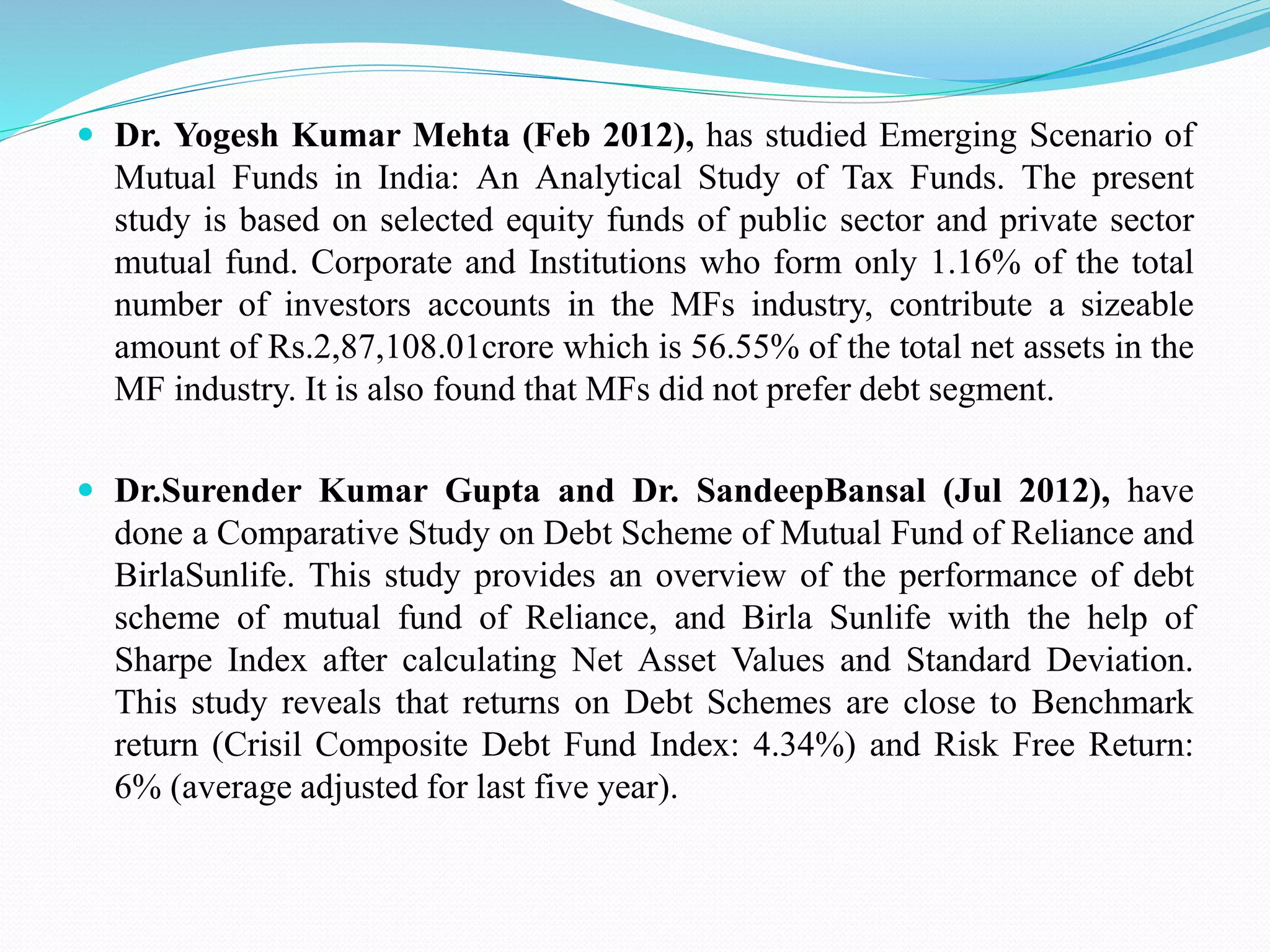
 Dr. Yogesh Kumar Mehta (Feb 2012), has studied Emerging Scenario of
Mutual Funds in India: An Analytical Study of Tax Funds. The present
study is based on selected equity funds of public sector and private sector
mutual fund. Corporate and Institutions who form only 1.16% of the total
number of investors accounts in the MFs industry, contribute a sizeable
amount of Rs.2,87,108.01crore which is 56.55% of the total net assets in the
MF industry. It is also found that MFs did not prefer debt segment.
 Dr.Surender Kumar Gupta and Dr. SandeepBansal (Jul 2012), have
done a Comparative Study on Debt Scheme of Mutual Fund of Reliance and
BirlaSunlife. This study provides an overview of the performance of debt
scheme of mutual fund of Reliance, and Birla Sunlife with the help of
Sharpe Index after calculating Net Asset Values and Standard Deviation.
This study reveals that returns on Debt Schemes are close to Benchmark
return (Crisil Composite Debt Fund Index: 4.34%) and Risk Free Return:
6% (average adjusted for last five year).
DATAANALYSIS
 Mutual fund performance can be analyzed through
performance measurement ratios which are use in portfolio
analysis. We here are using Treynor, Sharpe, and Jensen ratio to
evaluate mutual funds and rank accordingly. Composite
portfolio performance measures have the flexibility of
combining risk and return performance into a single value. The
most commonly used composite measures are: Treynor, Sharpe
and Jensen measures. While Treynor measures only the
systematic risk summarized by beta, Sharpe concentrates on
total risk of the mutual fund.
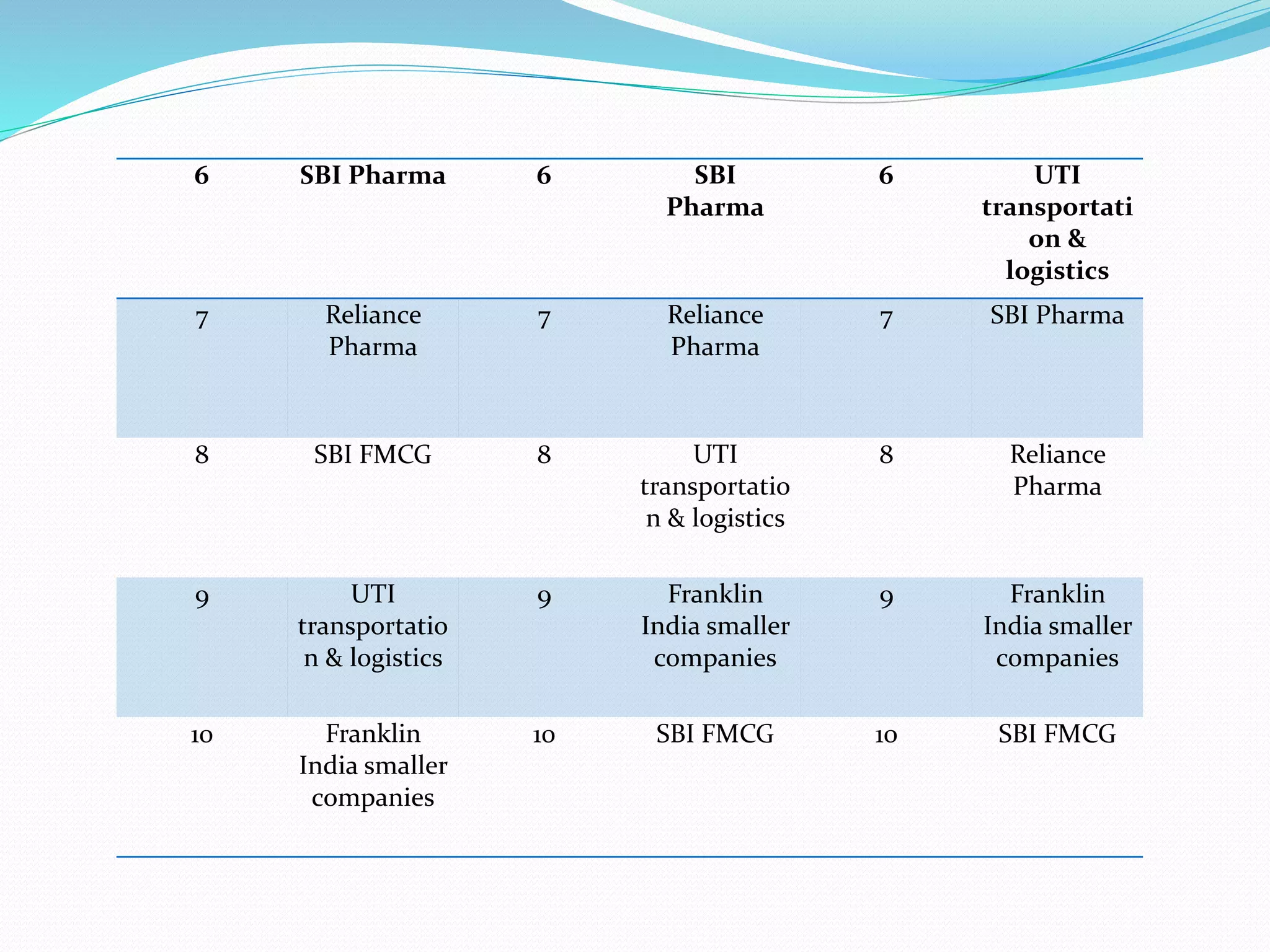
COMPARISION OF TREYNOR, SHARPE & JENSEN’S
INDEX
RANK TREYNOR RANK SHARPE RANK JENSEN
1 ICICI
prudential
technology
Reg
1 ICICI
prudential
export & other
services Reg
1 ICICI
prudential
technology
Reg
2 Birla sun life
new
millennium
2 Birla sun
lifenew
millennium
2 SBI IT
3 SBI IT 3 ICICI
prudential
technology
Reg
3 Franklin
InfoTech
4 ICICI
prudential
export & other
services Reg
4 SBI IT 4 Birla sun life
new
millennium
5 Franklin
InfoTech
5 Franklin
InfoTech
5 ICICI
prudential
export & other
services Reg
6 SBI Pharma 6 SBI
Pharma
6 UTI
transportati
on &
logistics
7 Reliance
Pharma
7 Reliance
Pharma
7 SBI Pharma
8 SBI FMCG 8 UTI
transportatio
n & logistics
8 Reliance
Pharma
9 UTI
transportatio
n & logistics
9 Franklin
India smaller
companies
9 Franklin
India smaller
companies
10 Franklin
India smaller
companies
10 SBI FMCG 10 SBI FMCG
RESULTS AND FINDINGS
 The study done on the performance evaluation of Indian mutual
funds was fruitful as all the objectives of the study were successfully
achieved. The following are the findings from this study.
 The schemes selected for the study gave returns in coordination with
the markets. When there was boom in the stock market the funds
gave positive returns a little more than what the market had given.
During the recessionary phase the markets declined steadily and so
did the fund returns. Overall the fund returns and the market returns,
for the period of 1 year taken into consideration for this study.
 Mostly all the mutual fund schemes are able to beat the market. That
means the schemes are well diversified.
 From the entire 10 schemes best scheme is ICICI prudential
technology Reg fund growth because in all the two models it stands
on 1st rank and also it provides good return.
CONCLUSION
 Mutual funds are one of the most highly growing products in
financial services market. Mutual funds are suitable for all types of
investors from risk adverse to risk bearer. Mutual funds have many
options of return, risk free return,constant return, market associated
returned. Mutual funds are suitable to all age of investors,
businessmen, salary person, etc.
 Performance evaluation measurement ratios i.e. Treynor’s, Sharpe’s
and Jensen’s are used by fund managers to take decision of
investment and to diversify portfolio.
 Mutual Fund is subject to market risk, analyzing particular fund
before investing.
 For high return invest in diversified funds, for tax saving invest in
ELSS equity funds, for moderate risk and return invest in balance
funds, for assure return invest in debt and liquid funds.
 As per our opinion, investor should invest around 30% in mutual
fund.
REFERENCE
 Reilly / Brown “Investments Analysis and Portfolio Management”, Ch 25
“Evaluation of Portfolio Performance” Page No: - 1040 – 1051
 Fisher and Jordan “Security analysis and portfolio management”, Ch 20
“Managed portfolio and performance measurements” Page No: - 663 - 677
 S. Kevin “Portfolio Management”, Ch 14 “Portfolio Evaluation” Page No: -
197 - 212
 Dr. Rao, Narayan “Performance Evaluation of Indian Mutual Funds”, paper
no.433100 and PP.1-24
 www.moneycontrol.com
 www.mutualfundsindia.com
 www.amfiindia.com
 www.ssrn.com
 www.articlebase.com
Performance evaluation of mutual fund

Performance evaluation of mutual fund

  • 1.
    PERFORMANCE EVALUATION OFMUTUAL FUND BY MAYANK MAKANI – IU1555550014
  • 2.
    TABLE OF CONTENT Introduction  Background of study  Objective of study  Research methodology  Review of literature  Data analysis  Results and findings  Conclusion  References
  • 3.
    Introduction  Mutual fundsare investment companies that pool money from investors at large and offer to sell and buy back its shares on a continuous basis and use the capital thus raised` to invest in securities of different companies.  Process of investing in mutual fund
  • 4.
    BACKGROUND OF THESTUDY  Mutual Fund is a topic which is of enormous interest not only to researchers all over the world, but also to investors. Mutual funds as a medium-to-long term investment option are preferred as a suitable investment option by investors. However, with several market entrants the question is the choice of mutual fund. The study focuses on this problem of mutual fund selection by investors. Though the investment objectives define investor’s preference among fund types (balanced, growth, dividend etc.) the choice of fund based on a sponsor’s reputation remains to be probed. We focus on analyzing the performance of mutual funds by using three models i.e. Sharpe, Treyner and Jensen.
  • 5.
    PROBLEM STATEMENT ANDIMPORTANCE OF THE STUDY  There are so many funds and schemes are available in mutual fund market. Investors know that how much risk they can take. Based on that they have to choose schemes.  Problem is that chosen scheme provides the best return as compare to the market and other schemes. For that certain model available Sharpe’s model, Treynor’s model and Jenson’s model. These models are suggested that which schemes provide best return.  Importance of the study is that a fund’s performance can be judged with respects to investors’ expectation.
  • 6.
    OBJECTIVES OF THESTUDY  The primary object of the present project is to know about which mutual funds gave highest performance in a short-term period.  To know about types of mutual funds in detail.  To know, which schemes gives highest return within one-year.  To measure the growth oriented Mutual Fund are earning higher returns than market Portfolio.  To find the extent of diversification in the portfolio of securities of sponsored mutual funds.  To compare the performance of sponsored mutual funds using traditional investment measures.
  • 7.
    RESEARCH METHODOLOGY  ResearchDesign is the roadmap for carrying out the research activity in the project. In our project of “Performance Evaluation of Mutual Fund” i have carried out the research of which mutual fund is providing higher return by comparing the returns of different mutual funds and i have also compared whether the mutual fund can beat the market return or not. For this research activity,  I have selected 10 mutual funds from Indian market. All funds are in equity growth category.  Data has been collected from money control, value research online, and mutual fund India web sites.  Funds selected are mostly preferable by investors.  Treasury bill rate of return is selected as risk free return, which is 8.5% p.a.
  • 8.
     Collected NAVof funds of each quarter for the year 2013 and define return.  Defined standard deviation on the basis of Quarterly return.  Found out average return.  Defined beta of funds and market, S&P CNX Nifty index return is taken as market return.  Found out Treynor, Sharpe and Jensen ratio and performance.  Finally we have given rank to mutual funds according to each ratio.
  • 9.
    REVIEW OF LITERATURE` Dr. Rao, Narayan (2005), evaluated the performance of Indian Mutual Fund Schemes in a bear market using relative performance index, risk- return analysis, Treynor’s ratio, Sharpe’s ratio, Jensen’s measure, Fama’s measure. The study finds that Medium Term Debt Funds were the best performing funds during the bear period of September 98-April 2002 and 58 of 269 open ended mutual funds provided better returns than the overall market returns.  Panwar,Sharad and Dr. Madhumathi (2006), differences in characteristics of public-sector sponsored & private-sector sponsored mutual funds find the extent of diversification in the portfolio of securities of public-sector sponsored and private-sector sponsored mutual funds and compare the performance of public-sector sponsored and private-sector sponsored mutual funds using traditional investment measures.
  • 10.
     Prof. Banerjee,Ashok et. Al (2007), Return Based Style Analysis (RBSA) to evaluate equity mutual funds in India using quadratic optimization of an asset class factor model proposed by William Sharpe and analysis of the relative performance of the funds with respect to their style benchmarks. Their study found that the mutual funds generated positive monthly returns on the average, during the study period of January 2000 through June 2005. The ELSS funds lagged the Growth funds or all funds taken together, with respect to returns generated. The mean returns of the growth funds or all funds were not only positive but also significant. The ELSS funds also demonstrated marginally higher volatility (standard deviation) than the Growth funds.  Rao,D.N (2006), aimed at analyzing performance of select open-ended equity mutual fund using Sharpe Ratio, Hypothesis testing and return based on yield. The most important finding of the study had been that only four Growth plans and one Dividend plan (5 out of the 42 plans studied) could generate higher returns than that of the market which is contrary to the general opinion prevailing in the Indian mutual fund market.
  • 11.
     Dr. YogeshKumar Mehta (Feb 2012), has studied Emerging Scenario of Mutual Funds in India: An Analytical Study of Tax Funds. The present study is based on selected equity funds of public sector and private sector mutual fund. Corporate and Institutions who form only 1.16% of the total number of investors accounts in the MFs industry, contribute a sizeable amount of Rs.2,87,108.01crore which is 56.55% of the total net assets in the MF industry. It is also found that MFs did not prefer debt segment.  Dr.Surender Kumar Gupta and Dr. SandeepBansal (Jul 2012), have done a Comparative Study on Debt Scheme of Mutual Fund of Reliance and BirlaSunlife. This study provides an overview of the performance of debt scheme of mutual fund of Reliance, and Birla Sunlife with the help of Sharpe Index after calculating Net Asset Values and Standard Deviation. This study reveals that returns on Debt Schemes are close to Benchmark return (Crisil Composite Debt Fund Index: 4.34%) and Risk Free Return: 6% (average adjusted for last five year).
  • 12.
    DATAANALYSIS  Mutual fundperformance can be analyzed through performance measurement ratios which are use in portfolio analysis. We here are using Treynor, Sharpe, and Jensen ratio to evaluate mutual funds and rank accordingly. Composite portfolio performance measures have the flexibility of combining risk and return performance into a single value. The most commonly used composite measures are: Treynor, Sharpe and Jensen measures. While Treynor measures only the systematic risk summarized by beta, Sharpe concentrates on total risk of the mutual fund.
  • 13.
    COMPARISION OF TREYNOR,SHARPE & JENSEN’S INDEX RANK TREYNOR RANK SHARPE RANK JENSEN 1 ICICI prudential technology Reg 1 ICICI prudential export & other services Reg 1 ICICI prudential technology Reg 2 Birla sun life new millennium 2 Birla sun lifenew millennium 2 SBI IT 3 SBI IT 3 ICICI prudential technology Reg 3 Franklin InfoTech 4 ICICI prudential export & other services Reg 4 SBI IT 4 Birla sun life new millennium 5 Franklin InfoTech 5 Franklin InfoTech 5 ICICI prudential export & other services Reg
  • 14.
    6 SBI Pharma6 SBI Pharma 6 UTI transportati on & logistics 7 Reliance Pharma 7 Reliance Pharma 7 SBI Pharma 8 SBI FMCG 8 UTI transportatio n & logistics 8 Reliance Pharma 9 UTI transportatio n & logistics 9 Franklin India smaller companies 9 Franklin India smaller companies 10 Franklin India smaller companies 10 SBI FMCG 10 SBI FMCG
  • 15.
    RESULTS AND FINDINGS The study done on the performance evaluation of Indian mutual funds was fruitful as all the objectives of the study were successfully achieved. The following are the findings from this study.  The schemes selected for the study gave returns in coordination with the markets. When there was boom in the stock market the funds gave positive returns a little more than what the market had given. During the recessionary phase the markets declined steadily and so did the fund returns. Overall the fund returns and the market returns, for the period of 1 year taken into consideration for this study.  Mostly all the mutual fund schemes are able to beat the market. That means the schemes are well diversified.  From the entire 10 schemes best scheme is ICICI prudential technology Reg fund growth because in all the two models it stands on 1st rank and also it provides good return.
  • 16.
    CONCLUSION  Mutual fundsare one of the most highly growing products in financial services market. Mutual funds are suitable for all types of investors from risk adverse to risk bearer. Mutual funds have many options of return, risk free return,constant return, market associated returned. Mutual funds are suitable to all age of investors, businessmen, salary person, etc.  Performance evaluation measurement ratios i.e. Treynor’s, Sharpe’s and Jensen’s are used by fund managers to take decision of investment and to diversify portfolio.
  • 17.
     Mutual Fundis subject to market risk, analyzing particular fund before investing.  For high return invest in diversified funds, for tax saving invest in ELSS equity funds, for moderate risk and return invest in balance funds, for assure return invest in debt and liquid funds.  As per our opinion, investor should invest around 30% in mutual fund.
  • 18.
    REFERENCE  Reilly /Brown “Investments Analysis and Portfolio Management”, Ch 25 “Evaluation of Portfolio Performance” Page No: - 1040 – 1051  Fisher and Jordan “Security analysis and portfolio management”, Ch 20 “Managed portfolio and performance measurements” Page No: - 663 - 677  S. Kevin “Portfolio Management”, Ch 14 “Portfolio Evaluation” Page No: - 197 - 212  Dr. Rao, Narayan “Performance Evaluation of Indian Mutual Funds”, paper no.433100 and PP.1-24  www.moneycontrol.com  www.mutualfundsindia.com  www.amfiindia.com  www.ssrn.com  www.articlebase.com