International Journal of Management (IJM), ISSN 0976 – 6502(Print), ISSN 0976 - 6510(Online), 
Volume 5, Issue 7, July (2014), pp. 81-87 © IAEME 
INTERNATIONAL JOURNAL OF MANAGEMENT (IJM) 
 
ISSN 0976-6502 (Print) 
ISSN 0976-6510 (Online) 
Volume 5, Issue 7, July (2014), pp. 81-87 
© IAEME: http://www.iaeme.com/IJM.asp 
Journal Impact Factor (2014): 7.2230 (Calculated by GISI) 
www.jifactor.com 
IJM 
© I A E M E 
STUDY ON PERFORMANCE EVALUATION OF MUTUAL FUND SCHEMES 
81 
 
IN INDIA 
A. Ramaraju 
Ph.D Research Scholar, Department of Business Administration, Khadir Mohideen College 
Adirampattinam, Thanjavur District, E Coast Rd, Tamil Nadu – 614701 
ABSTRACT 
Mutual fund industry is considered as one of the most dominant players in the world 
economy and is an important constituent of the financial sector and India is no exception. The 
industry has witnessed startling growth in terms of the products and services offered, returns 
churned, volumes generated and the international players who have contributed to this growth. 
Today the industry offers different schemes ranging from equity and debt to fixed income and money 
market. In the pre-recession period, this industry experienced significant growth thanks to the overall 
growth in GDP, Positive Business Climate and Optimistic Investor sentiment. But in the recession 
period, the industry witnessed the radical decline in the growth due to reversal of the above said 
factors .In the post recession period, the industry has been struggling to capture the missed place in 
the market and in the verge of introducing innovative strategies to overcome the issues being faced. 
This article deals with the changes occurred in the industry its impact in the Indian Financial Market. 
1. INTRODUCTION 
Due credit for this evolution can be given to the regulators for building an appropriate 
framework and to the fund houses for launching such different products. All these reasons have 
encouraged the traditional conservative investor, from parking fund in fixed deposits and 
government schemes to investing in other products giving higher returns. It is interesting to note that 
the major benefits of investing in a mutual funds is to capitalize on the opportunity of a 
professionally managed fund by a set of fund managers who apply their expertise in investment. This 
is beneficial to the investors who may not have the relevant knowledge and skill in investing. 
Besides investors have an opportunity to invest in a diversified basket of stocks at a relatively low 
price. Each investor owns a portion of the fund and hence shares the rise and fall in the value of the 
fund. A mutual fund may invest in stocks, cash, bonds or a combination of these. Mutual funds are 
considered as one of the best available investment options as compare to others alternatives. They are
International Journal of Management (IJM), ISSN 0976 – 6502(Print), ISSN 0976 - 6510(Online), 
Volume 5, Issue 7, July (2014), pp. 81-87 © IAEME 
 
very cost efficient and also easy to invest in. The biggest advantage of mutual funds is they provide 
diversification, by reducing risk  maximizing returns Consumer behavior from the marketing world 
and financial economics has brought together to the surface as an exciting area for study and 
research: behavioral finance. The realization that this is a serious subject is, however, barely 
dawning. Analysts seem to treat financial markets as an aggregate of statistical observations, 
technical and fundamental analysis. A rich view of research waits this sophisticated understanding of 
how financial markets are also affected by the 'financial behavior' of investors. With the reforms of 
industrial policy, public sector, financial sector and the many developments in the Indian money 
market and capital market, Mutual Funds which has become an important portal for the small 
investors, is also influenced by their financial behavior. From the researchers and academicians point 
of view, such a study will help in developing and expanding knowledge in this field. 
82 
 
The empirical results reported here reveal the fact that the mutual funds were not able to 
compensate the investors for the additional risk that they have taken by investing in the mutual 
funds. The study concludes that the influence of market factor was more severe during negative 
performance of the funds while the impact selectivity skills of fund managers was more than the 
other factors on the fund performance in times of generating positive return by the funds. It can also 
be observed from the study that selectivity, expected market risk and market return factors have 
shown closer correlation with the fund return. 
2. OBJECTIVES 
• To study the impact of various demographic factors on investors’ attitude towards mutual fund. 
• To find preference of investors about different investment avenue. 
• To analyze the investors awareness and perception regarding Mutual fund investment. 
3. RANKING AND PROFESSIONAL MANAGEMENT OF MUTUAL FUNDS 
Ranking 
Funds are ranked based upon their performance as a whole and performance against their 
peers by such companies as Morningstar which has an industry recognized rating system for mutual 
funds. They have a one-to-five star system in which five stars is the best. Usually the higher the rank, 
the higher the quality of the fund. For example Morningstar rates mutual funds from 1 to 5 stars 
based on how well they've performed (after adjusting for risk and accounting for sales charges) in 
comparison to similar funds. Within each Morningstar Category, the top 10% of funds receive 5 stars 
and the bottoms 10% receive 1 star. Funds are rated for up to three time periods: three-, five- and 10- 
years and these ratings are combined to produce an overall rating. Funds with less than three years of 
history are not rated. Ratings are objective, based entirely on a mathematical evaluation of past 
performance. The ratings are a useful tool for identifying funds worthy of further research, but 
should not be considered signals to buy or sell. 
Professional management 
Mutual funds use professional managers to make the decisions regarding which companies' 
securities should be bought and sold. The managers of the mutual fund decide how the pooled funds 
will be invested. Investment opportunities are abundant and complex. Fund managers are expected to 
know what is available, the risks and gains possible, the cost of acquiring and selling the 
investments, and the laws and regulations in the industry.
International Journal of Management (IJM), ISSN 0976 – 6502(Print), ISSN 0976 - 6510(Online), 
Volume 5, Issue 7, July (2014), pp. 81-87 © IAEME 
 
83 
4. RECESSION IN USA AND IN INDIA 
 
The US officially entered recession in 2007, but by all accounts India got to feel its effects 
much later, mostly courtesy it’s lesser dependence on exports as well as its highly regulated and 
conservative banking and financial system not having exposed itself to the kind of high-risk 
instruments dreamed up by the US investment banks. In India, the global financial crisis was striking 
the stock markets down from their all-time highs from early 2008. By mid-September, Sensex had 
fallen back to their November 2005 levels of just above 8,000 points. Recession is substantial decline 
in activity across the economy, lasting a longer period which is usually more than a few months. 
The mutual fund industry in India suffered a debilitating blow as a result of the global 
financial collapse too, with returns plummeting across the board. As Indian markets buckled in synch 
with the US markets, investors in mutual funds panicked and redemptions hit the roof -- debt funds, 
especially short-term funds, were the ones to suffer the worst on account of heavy redemptions (debt 
funds invest in fixed-income securities like corporate bonds, government bonds, debentures, 
commercial paper and certificates of deposits). 
5. OBTAINING RELEVANT VARIABLES USING PCA 
The collinearity statistics of the inputs clearly shows that the Variance Inflation Factor (VIF) 
for most of the inputs is greater than 5, indicating potential multi-collinearity problem. In order to 
identify relevant variables and redundant or irrelevant variables, PCA (Principal Component 
Analysis) technique is used. High value of KMO (0.804.05) indicates that a factor analysis is useful 
for the present data. The next step in the process is to decide about the number of factors to be 
derived. The rule of thumb is applied to choose the number of factors for which ‘Eigen values’ are 
greater than unity. The Component matrix so formed is further rotated orthogonally using Varimax 
algorithm which is the standard rotation method. Among the two factors identified, about 80% of the 
total variance was explained. The Scree plot obtained for the components best explains the 
prominence of the two factors. Using these two factors identified by PCA, the mutual funds are 
modeled using Artificial Neural Network. 
6. RECESSION PERIODS 
Hereon, researcher would cover our study in three phases. 
• Pre-recession (2006- 2007) 
• Recession (2008-mid 2009) 
• Post-recession (2009-2011) 
Pre-recession period (2006- 2007) 
The growth period for mutual fund industry first started during early 2005 with markets 
appreciating significantly. With 2006 approaching more towards 2007, markets rallied like never 
before. The financial year 2007-08 was a year of reckoning for the mutual fund industry in many 
ways. Most stocks were trading in green and all fund houses boasted of giving phenomenal returns 
with many funds outperforming markets. Equity markets were in the limelight. Investors who were 
not exposed to equity stocks suddenly infused funds. 
AUM grew considerably and fund houses were on a spree of launching new schemes. 
Below Figure shows all AUM’s have grown over the period of 2006-2008 growing ~2.5 times of 
INR 1956 bn in 2006 to ~INR 5000 bn in 2007 end.
International Journal of Management (IJM), ISSN 0976 – 6502(Print), ISSN 0976 - 6510(Online), 
Volume 5, Issue 7, July (2014), pp. 81-87 © IAEME 
 
84 
 
Figure 1: Period 2006-2008 
TABLE 1: Below table shows returns of large cap equity based schemes of our coverage of 10 
fund houses 
Study of above table suggests that returns from different schemes were in synchronization 
with the markets. When there was boom in the stock market the funds gave positive returns a little 
more than what the market had given. It can be easily concluded that most of the fund returns can be 
attributed to the market that is they were in direct correlation with the market. One should note that 
when markets were not in good shape  the going was not good, these schemes have
International Journal of Management (IJM), ISSN 0976 – 6502(Print), ISSN 0976 - 6510(Online), 
Volume 5, Issue 7, July (2014), pp. 81-87 © IAEME 
 
underperformed the market. This shows the supremacy of beta effect on these schemes i.e. 
outperforming when in bull phase and underperforming when in bear phase. 
85 
Recession period (2008-mid 2009) 
 
The mutual fund industry in India suffered a debilitating blow as a result of the global 
financial collapse, with returns plummeting across the board. As Indian markets buckled in synch 
with the US markets, investors in mutual funds panicked and redemptions hit the roof - debt funds, 
especially short-term funds, were the ones to suffer the worst on account of heavy redemptions (debt 
funds invest in fixed-income securities like corporate bonds, government bonds, debentures, 
commercial paper and certificates of deposits). 
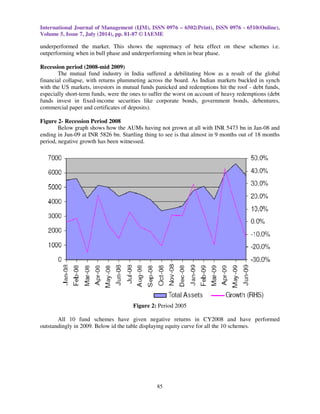
Figure 2- Recession Period 2008 
Below graph shows how the AUMs having not grown at all with INR 5473 bn in Jan-08 and 
ending in Jun-09 at INR 5826 bn. Startling thing to see is that almost in 9 months out of 18 months 
period, negative growth has been witnessed. 
Figure 2: Period 2005 
All 10 fund schemes have given negative returns in CY2008 and have performed 
outstandingly in 2009. Below id the table displaying equity curve for all the 10 schemes.
International Journal of Management (IJM), ISSN 0976 – 6502(Print), ISSN 0976 - 6510(Online), 
Volume 5, Issue 7, July (2014), pp. 81-87 © IAEME 
 
86 
 
Figure 3 
CONCLUSIONS 
A Mutual fund is the dynamic investment vehicle for today’s complex and modern financial 
scenario. We have seen the growing importance of mutual fund investment in India, when compared 
with other financial instruments. Investments in mutual funds are safer and also yields more returns 
due to proper portfolio management by the fund manager. Mutual fund are said to be the best 
channels for mobilizing the funds of the small investors an contribute significantly to the capital 
markets. The present study explains briefly about the mutual fund industry. The study also helps to 
understand the role of investment pattern and preferences of investors behind investing in mutual 
fund. 
REFERENCES 
1. Vidya Shankar, S., Mutual Funds - Emerging Trends in India, Chartered Secretary, Vol.20, 
No.8, 1990, 639-640. 
2. Shankar, V., (1996), Retailing Mutual Funds: A consumer product model”, The Hindu, 
24 July, 26. 
3. Citing Website, Association of Mutual Funds in India. 
4. Ramamurthy, B. M. and Reddy, S. (2005), “Recent Trends in Mutual Fund Industry”, SCMS 
1. Journal of Indian Management, Vol. 2, No. 3, pp.69-76. 
2. Badla, B S., and Garg, A. (2007), “Performance of Mutual Funds in India - An Empirical 
Study of Growth Schemes”, GITAM Journal of Management, Vo1. 5, No.4, pp.29-43. 
3. King, J.S. (2002), “Mutual Funds: Investment of Choice for Individual Investors?” Review of 
Business, Vol.23, No.3, pp.35-39. 
4. Prof. Abdul Noor Basha and G.V.satya sekhar, “A Critical View of Undisclosed Facts of 
Disclosed Fact Sheets: A Case Study of Benchmarking of Mutual Funds”, International
International Journal of Management (IJM), ISSN 0976 – 6502(Print), ISSN 0976 - 6510(Online), 
Volume 5, Issue 7, July (2014), pp. 81-87 © IAEME 
 
87 
 
Journal of Management (IJM), Volume 1, Issue 2, 2010, pp. 44 - 52, ISSN Print: 0976-6502, 
ISSN Online: 0976-6510. 
5. A.Vennila and Dr. R. Nandhagopal, “Study on Performance Evaluation of Mutual Fund 
Schemes in India During Pre-Recession, Recession and Post-Recession Period”, International 
Journal of Management (IJM), Volume 3, Issue 1, 2012, pp. 126 - 134, ISSN Print: 
0976-6502, ISSN Online: 0976-6510. 
6. Dr. K. Rakesh and V S M Srinivas, “Understanding Individual Investors Investment Behavior 
in Mutual Funds (A Study on Investors of North Coastal Andhra Pradesh)”, International 
Journal of Management (IJM), Volume 4, Issue 3, 2013, pp. 185 - 198, ISSN Print: 0976- 
6502, ISSN Online: 0976-6510. 
7. Sindhu.K.P and Dr. S.Rajitha Kumar, “Influence of Characteristics of Mutual Funds on 
Investment Decisions –A Study”, International Journal of Management (IJM), Volume 4, 
Issue 5, 2013, pp. 103 - 108, ISSN Print: 0976-6502, ISSN Online: 0976-6510. 
8. “Mutual Fund Year Book – (2000) “A joint publication of Association of Mutual Funds in 
India (AMFI) and Unit Trust of India – Institute of Capital Markets (UTIICM). “CRISIL 
Mutual Fund Year Book 2010” 
9. H SADHAK, “MUTUAL FUNDS IN INDIA”, 2E Marketing Strategies and Investment 
Practices: Second Edition. 
10. Sankaran, Sundar “Indian Mutual Funds Handbook” Austin Murphy. “Scientific Investment 
Analysis” Page no: 48. 
11. S. P. Umamaheswar Rao, “Mutual Fund Performance during Up and Down Market 
Conditions, in Review of Business”. 
12. www.valueresearchonline.com. 
13. www.moneycontrol.com. 
14. www.amfiindia.com.

10120140507008

  • 1.
    International Journal ofManagement (IJM), ISSN 0976 – 6502(Print), ISSN 0976 - 6510(Online), Volume 5, Issue 7, July (2014), pp. 81-87 © IAEME INTERNATIONAL JOURNAL OF MANAGEMENT (IJM) ISSN 0976-6502 (Print) ISSN 0976-6510 (Online) Volume 5, Issue 7, July (2014), pp. 81-87 © IAEME: http://www.iaeme.com/IJM.asp Journal Impact Factor (2014): 7.2230 (Calculated by GISI) www.jifactor.com IJM © I A E M E STUDY ON PERFORMANCE EVALUATION OF MUTUAL FUND SCHEMES 81 IN INDIA A. Ramaraju Ph.D Research Scholar, Department of Business Administration, Khadir Mohideen College Adirampattinam, Thanjavur District, E Coast Rd, Tamil Nadu – 614701 ABSTRACT Mutual fund industry is considered as one of the most dominant players in the world economy and is an important constituent of the financial sector and India is no exception. The industry has witnessed startling growth in terms of the products and services offered, returns churned, volumes generated and the international players who have contributed to this growth. Today the industry offers different schemes ranging from equity and debt to fixed income and money market. In the pre-recession period, this industry experienced significant growth thanks to the overall growth in GDP, Positive Business Climate and Optimistic Investor sentiment. But in the recession period, the industry witnessed the radical decline in the growth due to reversal of the above said factors .In the post recession period, the industry has been struggling to capture the missed place in the market and in the verge of introducing innovative strategies to overcome the issues being faced. This article deals with the changes occurred in the industry its impact in the Indian Financial Market. 1. INTRODUCTION Due credit for this evolution can be given to the regulators for building an appropriate framework and to the fund houses for launching such different products. All these reasons have encouraged the traditional conservative investor, from parking fund in fixed deposits and government schemes to investing in other products giving higher returns. It is interesting to note that the major benefits of investing in a mutual funds is to capitalize on the opportunity of a professionally managed fund by a set of fund managers who apply their expertise in investment. This is beneficial to the investors who may not have the relevant knowledge and skill in investing. Besides investors have an opportunity to invest in a diversified basket of stocks at a relatively low price. Each investor owns a portion of the fund and hence shares the rise and fall in the value of the fund. A mutual fund may invest in stocks, cash, bonds or a combination of these. Mutual funds are considered as one of the best available investment options as compare to others alternatives. They are
  • 2.
    International Journal ofManagement (IJM), ISSN 0976 – 6502(Print), ISSN 0976 - 6510(Online), Volume 5, Issue 7, July (2014), pp. 81-87 © IAEME very cost efficient and also easy to invest in. The biggest advantage of mutual funds is they provide diversification, by reducing risk maximizing returns Consumer behavior from the marketing world and financial economics has brought together to the surface as an exciting area for study and research: behavioral finance. The realization that this is a serious subject is, however, barely dawning. Analysts seem to treat financial markets as an aggregate of statistical observations, technical and fundamental analysis. A rich view of research waits this sophisticated understanding of how financial markets are also affected by the 'financial behavior' of investors. With the reforms of industrial policy, public sector, financial sector and the many developments in the Indian money market and capital market, Mutual Funds which has become an important portal for the small investors, is also influenced by their financial behavior. From the researchers and academicians point of view, such a study will help in developing and expanding knowledge in this field. 82 The empirical results reported here reveal the fact that the mutual funds were not able to compensate the investors for the additional risk that they have taken by investing in the mutual funds. The study concludes that the influence of market factor was more severe during negative performance of the funds while the impact selectivity skills of fund managers was more than the other factors on the fund performance in times of generating positive return by the funds. It can also be observed from the study that selectivity, expected market risk and market return factors have shown closer correlation with the fund return. 2. OBJECTIVES • To study the impact of various demographic factors on investors’ attitude towards mutual fund. • To find preference of investors about different investment avenue. • To analyze the investors awareness and perception regarding Mutual fund investment. 3. RANKING AND PROFESSIONAL MANAGEMENT OF MUTUAL FUNDS Ranking Funds are ranked based upon their performance as a whole and performance against their peers by such companies as Morningstar which has an industry recognized rating system for mutual funds. They have a one-to-five star system in which five stars is the best. Usually the higher the rank, the higher the quality of the fund. For example Morningstar rates mutual funds from 1 to 5 stars based on how well they've performed (after adjusting for risk and accounting for sales charges) in comparison to similar funds. Within each Morningstar Category, the top 10% of funds receive 5 stars and the bottoms 10% receive 1 star. Funds are rated for up to three time periods: three-, five- and 10- years and these ratings are combined to produce an overall rating. Funds with less than three years of history are not rated. Ratings are objective, based entirely on a mathematical evaluation of past performance. The ratings are a useful tool for identifying funds worthy of further research, but should not be considered signals to buy or sell. Professional management Mutual funds use professional managers to make the decisions regarding which companies' securities should be bought and sold. The managers of the mutual fund decide how the pooled funds will be invested. Investment opportunities are abundant and complex. Fund managers are expected to know what is available, the risks and gains possible, the cost of acquiring and selling the investments, and the laws and regulations in the industry.
  • 3.
    International Journal ofManagement (IJM), ISSN 0976 – 6502(Print), ISSN 0976 - 6510(Online), Volume 5, Issue 7, July (2014), pp. 81-87 © IAEME 83 4. RECESSION IN USA AND IN INDIA The US officially entered recession in 2007, but by all accounts India got to feel its effects much later, mostly courtesy it’s lesser dependence on exports as well as its highly regulated and conservative banking and financial system not having exposed itself to the kind of high-risk instruments dreamed up by the US investment banks. In India, the global financial crisis was striking the stock markets down from their all-time highs from early 2008. By mid-September, Sensex had fallen back to their November 2005 levels of just above 8,000 points. Recession is substantial decline in activity across the economy, lasting a longer period which is usually more than a few months. The mutual fund industry in India suffered a debilitating blow as a result of the global financial collapse too, with returns plummeting across the board. As Indian markets buckled in synch with the US markets, investors in mutual funds panicked and redemptions hit the roof -- debt funds, especially short-term funds, were the ones to suffer the worst on account of heavy redemptions (debt funds invest in fixed-income securities like corporate bonds, government bonds, debentures, commercial paper and certificates of deposits). 5. OBTAINING RELEVANT VARIABLES USING PCA The collinearity statistics of the inputs clearly shows that the Variance Inflation Factor (VIF) for most of the inputs is greater than 5, indicating potential multi-collinearity problem. In order to identify relevant variables and redundant or irrelevant variables, PCA (Principal Component Analysis) technique is used. High value of KMO (0.804.05) indicates that a factor analysis is useful for the present data. The next step in the process is to decide about the number of factors to be derived. The rule of thumb is applied to choose the number of factors for which ‘Eigen values’ are greater than unity. The Component matrix so formed is further rotated orthogonally using Varimax algorithm which is the standard rotation method. Among the two factors identified, about 80% of the total variance was explained. The Scree plot obtained for the components best explains the prominence of the two factors. Using these two factors identified by PCA, the mutual funds are modeled using Artificial Neural Network. 6. RECESSION PERIODS Hereon, researcher would cover our study in three phases. • Pre-recession (2006- 2007) • Recession (2008-mid 2009) • Post-recession (2009-2011) Pre-recession period (2006- 2007) The growth period for mutual fund industry first started during early 2005 with markets appreciating significantly. With 2006 approaching more towards 2007, markets rallied like never before. The financial year 2007-08 was a year of reckoning for the mutual fund industry in many ways. Most stocks were trading in green and all fund houses boasted of giving phenomenal returns with many funds outperforming markets. Equity markets were in the limelight. Investors who were not exposed to equity stocks suddenly infused funds. AUM grew considerably and fund houses were on a spree of launching new schemes. Below Figure shows all AUM’s have grown over the period of 2006-2008 growing ~2.5 times of INR 1956 bn in 2006 to ~INR 5000 bn in 2007 end.
  • 4.
    International Journal ofManagement (IJM), ISSN 0976 – 6502(Print), ISSN 0976 - 6510(Online), Volume 5, Issue 7, July (2014), pp. 81-87 © IAEME 84 Figure 1: Period 2006-2008 TABLE 1: Below table shows returns of large cap equity based schemes of our coverage of 10 fund houses Study of above table suggests that returns from different schemes were in synchronization with the markets. When there was boom in the stock market the funds gave positive returns a little more than what the market had given. It can be easily concluded that most of the fund returns can be attributed to the market that is they were in direct correlation with the market. One should note that when markets were not in good shape the going was not good, these schemes have
  • 5.
    International Journal ofManagement (IJM), ISSN 0976 – 6502(Print), ISSN 0976 - 6510(Online), Volume 5, Issue 7, July (2014), pp. 81-87 © IAEME underperformed the market. This shows the supremacy of beta effect on these schemes i.e. outperforming when in bull phase and underperforming when in bear phase. 85 Recession period (2008-mid 2009) The mutual fund industry in India suffered a debilitating blow as a result of the global financial collapse, with returns plummeting across the board. As Indian markets buckled in synch with the US markets, investors in mutual funds panicked and redemptions hit the roof - debt funds, especially short-term funds, were the ones to suffer the worst on account of heavy redemptions (debt funds invest in fixed-income securities like corporate bonds, government bonds, debentures, commercial paper and certificates of deposits). Figure 2- Recession Period 2008 Below graph shows how the AUMs having not grown at all with INR 5473 bn in Jan-08 and ending in Jun-09 at INR 5826 bn. Startling thing to see is that almost in 9 months out of 18 months period, negative growth has been witnessed. Figure 2: Period 2005 All 10 fund schemes have given negative returns in CY2008 and have performed outstandingly in 2009. Below id the table displaying equity curve for all the 10 schemes.
  • 6.
    International Journal ofManagement (IJM), ISSN 0976 – 6502(Print), ISSN 0976 - 6510(Online), Volume 5, Issue 7, July (2014), pp. 81-87 © IAEME 86 Figure 3 CONCLUSIONS A Mutual fund is the dynamic investment vehicle for today’s complex and modern financial scenario. We have seen the growing importance of mutual fund investment in India, when compared with other financial instruments. Investments in mutual funds are safer and also yields more returns due to proper portfolio management by the fund manager. Mutual fund are said to be the best channels for mobilizing the funds of the small investors an contribute significantly to the capital markets. The present study explains briefly about the mutual fund industry. The study also helps to understand the role of investment pattern and preferences of investors behind investing in mutual fund. REFERENCES 1. Vidya Shankar, S., Mutual Funds - Emerging Trends in India, Chartered Secretary, Vol.20, No.8, 1990, 639-640. 2. Shankar, V., (1996), Retailing Mutual Funds: A consumer product model”, The Hindu, 24 July, 26. 3. Citing Website, Association of Mutual Funds in India. 4. Ramamurthy, B. M. and Reddy, S. (2005), “Recent Trends in Mutual Fund Industry”, SCMS 1. Journal of Indian Management, Vol. 2, No. 3, pp.69-76. 2. Badla, B S., and Garg, A. (2007), “Performance of Mutual Funds in India - An Empirical Study of Growth Schemes”, GITAM Journal of Management, Vo1. 5, No.4, pp.29-43. 3. King, J.S. (2002), “Mutual Funds: Investment of Choice for Individual Investors?” Review of Business, Vol.23, No.3, pp.35-39. 4. Prof. Abdul Noor Basha and G.V.satya sekhar, “A Critical View of Undisclosed Facts of Disclosed Fact Sheets: A Case Study of Benchmarking of Mutual Funds”, International
  • 7.
    International Journal ofManagement (IJM), ISSN 0976 – 6502(Print), ISSN 0976 - 6510(Online), Volume 5, Issue 7, July (2014), pp. 81-87 © IAEME 87 Journal of Management (IJM), Volume 1, Issue 2, 2010, pp. 44 - 52, ISSN Print: 0976-6502, ISSN Online: 0976-6510. 5. A.Vennila and Dr. R. Nandhagopal, “Study on Performance Evaluation of Mutual Fund Schemes in India During Pre-Recession, Recession and Post-Recession Period”, International Journal of Management (IJM), Volume 3, Issue 1, 2012, pp. 126 - 134, ISSN Print: 0976-6502, ISSN Online: 0976-6510. 6. Dr. K. Rakesh and V S M Srinivas, “Understanding Individual Investors Investment Behavior in Mutual Funds (A Study on Investors of North Coastal Andhra Pradesh)”, International Journal of Management (IJM), Volume 4, Issue 3, 2013, pp. 185 - 198, ISSN Print: 0976- 6502, ISSN Online: 0976-6510. 7. Sindhu.K.P and Dr. S.Rajitha Kumar, “Influence of Characteristics of Mutual Funds on Investment Decisions –A Study”, International Journal of Management (IJM), Volume 4, Issue 5, 2013, pp. 103 - 108, ISSN Print: 0976-6502, ISSN Online: 0976-6510. 8. “Mutual Fund Year Book – (2000) “A joint publication of Association of Mutual Funds in India (AMFI) and Unit Trust of India – Institute of Capital Markets (UTIICM). “CRISIL Mutual Fund Year Book 2010” 9. H SADHAK, “MUTUAL FUNDS IN INDIA”, 2E Marketing Strategies and Investment Practices: Second Edition. 10. Sankaran, Sundar “Indian Mutual Funds Handbook” Austin Murphy. “Scientific Investment Analysis” Page no: 48. 11. S. P. Umamaheswar Rao, “Mutual Fund Performance during Up and Down Market Conditions, in Review of Business”. 12. www.valueresearchonline.com. 13. www.moneycontrol.com. 14. www.amfiindia.com.