

• Also known as
   i. Parkinson's,
   ii. Idiopathic parkinsonism,
   iii. Primary parkinsonism,
   iv. PD,
   v. Paralysis agitans

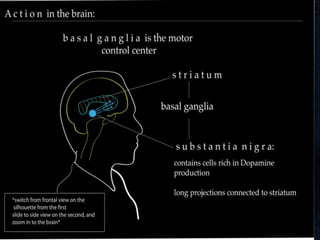
• a group of conditions called motor system disorders, which
  results from the death of dopamine-containing cells in the
  substantia nigra, a region of the midbrain.
• It can be passed down from generation to generation
• In today’s times, 1 out of 100 people that are over 60 years of
  age have Parkinson’s Disease.
• Additionally, there are about 1.5 million people in the United
  States who currently have this life-controlling disease
• Fifty eight percent of these 1.5 million people that have
  Parkinson’s Disease are men
• In Malaysia, based on year 2009,statistic has shown that
  26,786 people has been recorded to have Parkinson in interval
  of 5 years.
 Medical scientists have been treating Parkinson's for
thousands of years
 At the ancient time,Parkinson's disease are discussed
in Ayurveda since as early as 5000 BC- Kampavata
 A condition like Parkinson's disease also was
mentioned in Nei Ching
In Western medical literature it was described by
Galen as "shaking palsy“
In modern times, Parkinson's disease was first
formally recognized by James Parkinson's -"An Essay
on the Shaking Palsy"
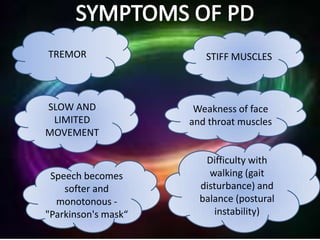
TREMOR                  STIFF MUSCLES


SLOW AND              Weakness of face
 LIMITED             and throat muscles
MOVEMENT

                        Difficulty with
 Speech becomes          walking (gait
    softer and         disturbance) and
  monotonous -         balance (postural
"Parkinson's mask“        instability)
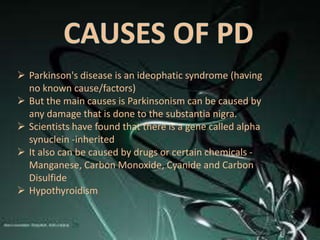
 Parkinson's disease is an ideophatic syndrome (having
  no known cause/factors)
 But the main causes is Parkinsonism can be caused by
  any damage that is done to the substantia nigra.
 Scientists have found that there is a gene called alpha
  synuclein -inherited
 It also can be caused by drugs or certain chemicals -
  Manganese, Carbon Monoxide, Cyanide and Carbon
  Disulfide
 Hypothyroidism
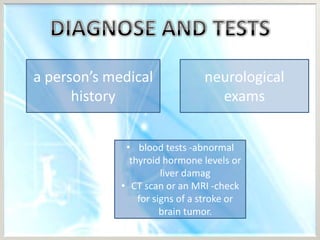
a person’s medical              neurological
      history                     exams


              • blood tests -abnormal
               thyroid hormone levels or
                       liver damag
             • CT scan or an MRI -check
                 for signs of a stroke or
                       brain tumor.
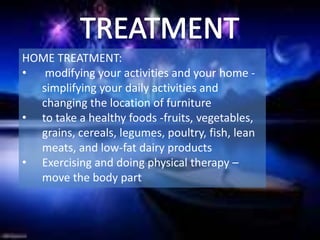
HOME TREATMENT:
• modifying your activities and your home -
  simplifying your daily activities and
  changing the location of furniture
• to take a healthy foods -fruits, vegetables,
  grains, cereals, legumes, poultry, fish, lean
  meats, and low-fat dairy products
• Exercising and doing physical therapy –
  move the body part
• No cure for PD
• Patients are given Levodopa combined with
  Carbidopa
   levodopa: to make dopamine and replenish the
brain's dwindling supply
  carbidopa: delays the conversion of levodopa into
dopamine until it reaches the brain
• In some cases, a surgery may be appropriate –if it did
  not responds to the drug
parkinson diseases

parkinson diseases

  • 3.
    • Also knownas i. Parkinson's, ii. Idiopathic parkinsonism, iii. Primary parkinsonism, iv. PD, v. Paralysis agitans • a group of conditions called motor system disorders, which results from the death of dopamine-containing cells in the substantia nigra, a region of the midbrain. • It can be passed down from generation to generation
  • 4.
    • In today’stimes, 1 out of 100 people that are over 60 years of age have Parkinson’s Disease. • Additionally, there are about 1.5 million people in the United States who currently have this life-controlling disease • Fifty eight percent of these 1.5 million people that have Parkinson’s Disease are men • In Malaysia, based on year 2009,statistic has shown that 26,786 people has been recorded to have Parkinson in interval of 5 years.
  • 5.
     Medical scientistshave been treating Parkinson's for thousands of years  At the ancient time,Parkinson's disease are discussed in Ayurveda since as early as 5000 BC- Kampavata  A condition like Parkinson's disease also was mentioned in Nei Ching In Western medical literature it was described by Galen as "shaking palsy“ In modern times, Parkinson's disease was first formally recognized by James Parkinson's -"An Essay on the Shaking Palsy"
  • 6.
    TREMOR STIFF MUSCLES SLOW AND Weakness of face LIMITED and throat muscles MOVEMENT Difficulty with Speech becomes walking (gait softer and disturbance) and monotonous - balance (postural "Parkinson's mask“ instability)
  • 7.
     Parkinson's diseaseis an ideophatic syndrome (having no known cause/factors)  But the main causes is Parkinsonism can be caused by any damage that is done to the substantia nigra.  Scientists have found that there is a gene called alpha synuclein -inherited  It also can be caused by drugs or certain chemicals - Manganese, Carbon Monoxide, Cyanide and Carbon Disulfide  Hypothyroidism
  • 8.
    a person’s medical neurological history exams • blood tests -abnormal thyroid hormone levels or liver damag • CT scan or an MRI -check for signs of a stroke or brain tumor.
  • 9.
    HOME TREATMENT: • modifyingyour activities and your home - simplifying your daily activities and changing the location of furniture • to take a healthy foods -fruits, vegetables, grains, cereals, legumes, poultry, fish, lean meats, and low-fat dairy products • Exercising and doing physical therapy – move the body part
  • 10.
    • No curefor PD • Patients are given Levodopa combined with Carbidopa levodopa: to make dopamine and replenish the brain's dwindling supply carbidopa: delays the conversion of levodopa into dopamine until it reaches the brain • In some cases, a surgery may be appropriate –if it did not responds to the drug