1 | P a g e
STUDY THE EFFECT OF ACIDS AND BASES ON THE
TENSILE STRENGTH
OF A FIBRE.
A Project Report
Submitted by
M Hariharan
CBSE GRADE XII - B
IN
Chemistry AT
VELAMMAL BODHI RESIDENTIAL SENIOR SECONDARY SCHOOL
ROLL NO:-
2023-24
2 | P a g e
BONAFIDE CERTIFICATE
This is to certify that M Hariharan of Grade XII-B, VELAMMAL BODHI RESIDENTIA;
SENIOR SECONDARY SCHOOL with Roll Number has compiled this Chemistry
project in partial fulfillment of the requirements as prescribed by CBSE in the year 2023-24.
Signature of the Teacher
In-charge
3 | P a g e
ACKNOWLEDGEMENT
I warmly acknowledge the continuous encouragement and timely suggestions offered by
our dear Principal ( ). I extend my hearty thanks for giving me the opportunity to make use
of the facilities available in the campus to carry out the project successfully.
I am highly indebted to ( ) & my lab teacher ( ) for the constant supervision, providing
necessary information and supporting in completing the project. I would like to express my
gratitude towards them for their kind co-operation and encouragement.
Finally I extend my gratefulness to one and all who are directly or indirectly involved in
the successful completion of this project work.
Signature of the
Candidate
4 | P a g e
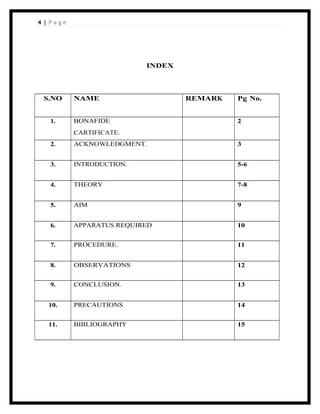
INDEX
S.NO NAME REMARK Pg No.
1. BONAFIDE
CARTIFICATE.
2
2. ACKNOWLEDGMENT. 3
3. INTRODUCTION. 5-6
4. THEORY 7-8
5. AIM 9
6. APPARATUS REQUIRED 10
7. PROCEDURE. 11
8. OBSERVATIONS 12
9. CONCLUSION. 13
10. PRECAUTIONS 14
11. BIBLIOGRAPHY 15
5 | P a g e
INTRODUCTION
Fibre is a class of materials that are continuous filaments or are in discrete elongated
pieces, similar to lengths of thread. A fiber is an elongated tapering thick-walled plant cell
that imparts elasticity, flexibility, and tensile strength. Tensile strength of fibres can be
determined by hanging weights tied to it and comparing the weight a string can hold.
Traditionally, natural fibers have been used in all cultures for making utilitarian products.
Different parts of the plant are used.
Fibers can be extracted from the bark (banana, jute, hemp, and ramie), stem (banana, palm,
and bamboo), leaf (palm, screw pine, sisal, agave), husk (coir), seeds (cotton), and grass
(sikki, madhurkati, benakati, munj). Animal fibers are obtained from a variety of animal
coats, and insect fibers from cocoons.
Even before the arrival of man-made fibers, manufacturers could create hundreds of
different kinds of fabrics, differing mainly by fiber content, weight, style of weave, or
sheen. Here are just a few of these historic fabrics, along with the natural fiber from which
they were originally made (nearly all can be made now with other fibers, either natural or
synthetic).They are very important in the biology of both plants and animals, for holding
tissues together.
Human uses for fibers are diverse. They can be spun into filaments, string, or rope, used
as a component of composite materials, or matted into sheets to make products such as
paper or felt. Fibers are often used in the manufacture of other materials. The strongest
engineering materials are generally made as fibers, for example carbon fiber and Ultra-
high-molecular- weight polyethylene. The history of man-made fibers is less than a
century old; until 1910, there were no synthetic or chemical fibers. Today, by mixing
different components, manufacturers can take the basic fibers listed below and make them
more waterproof or more absorbent, warmer or cooler, thicker or thinner, stiffer or more
supple.
6 | P a g e
Some, like polyester and spandex, combine well with natural fibers, making fabrics that
wrinkle less or are more form-fitting.
Synthetic fibers can often be produced very cheaply and in large amounts compared to
natural fibers, but for clothing natural fibres can give some benefits ,such as comfort ,over
their synthetic counterparts.
7 | P a g e
THEORY
Depending upon the source, various fibres can be categorized as:
 Animal fibre(e.g., silk and wool)
 Vegetable fibre(e.g., cotton and linen)
 Synthetic fibre(e.g., nylon and rayon)
Natural fibres can be classified according to their origin. The vegetable, or cellulose-base, class
includes such important fibres as cotton, flax, and jute; the animal, or protein-base, fibres include
wool,mohair, and silk; an important fibre in the mineral class is asbestos.The vegetable fibres can
be divided into smaller groups, based on their origin within the plant. Cotton, kapok, and coir are
examples of fibres originating as hairs borne on the seeds or inner walls of the fruit, where each fibre
consists of a single, long, narrow cell. Flax, hemp, jute, and ramie are bast fibres,
occurring in the inner bast tissue of certain plant stems and made up of overlapping cells. Abaca,
henequen, and sisal are fibres occurring as part of the fibro vascular system of the leaves.
Chemically, all vegetable fibres consist mainly of cellulose, although they also contain varying
amounts of such substances as hemicellulose, lignin, pectins, and waxes that must be removed or
reduced by processing. The animal fibres consist exclusively of proteins and, with the exception of
silk, constitute the furor hair that serves as the protective epidermal covering of animals. Silk
filaments are extruded by the larvae of moths and are used to spin their cocoons.
With the exception of mineral fibres, all natural fibres have an affinity for water in both liquid and
vapour form. This strong affinity produces swelling of the fibres connected with the uptake of water,
which facilitates dyeing in watery solutions.
Unlike most synthetic fibres, all natural fibres are nonthermoplastic—that is, they do not soften
when heat is applied. At temperatures below the point at which they will decompose, they show
little sensitivity to dry heat, and there is no shrinkage or high extensibility upon heating, nor do they
[15 become brittle if cooled to below freezing. Natural fibres tend to yellow upon exposure to
sunlight and moisture, and extended exposure results in loss of strength.
8 | P a g e
All natural fibres are particularly susceptible to microbial decomposition, including mildew and rot.
Cellulosic fibres are decomposed by aerobic bacteria (those that live only in oxygen) and fungi.
Cellulose mildews and decomposes rapidly at high humidity and high temperatures, especially in the
absence of light. Wool and silk are also subject to microbial decomposition by bacteria and molds.
Animal fibres are also subject to damage by moths and carpet beetles; termites and silverfish attack
cellulose fibres. Protection against both microbial damage and insect attacks can be obtained by
chemical modification of the fibre substrate; modern developments allow treatment of natural fibres
to make them essentially immune to such damage.
9 | P a g e
AIM :
To find the effect of acids and alkalies on tensile strength of cotton, silk and wool fibres.
APPARATUS REQUIRED :-
Cotton, wool, silk, polyester, hook, weight hanger, weights.
CHEMICAL REQUIREMENT:-
Hydrochloric acid( M/10) and sodium hydroxide(M/10 ).
PROCEDURE:-
1. Cut out equal length of cotton, wool and silk threads from given samples. The
threads should be nearly the same thickness.
2. Determine the tensile strength of each fibre as explained in experiment 1.
3. Soak a given thread into a dilute solution of sodium hydroxide for about 5 minutes.
4. Take it out of NaOH solution and wash it thoroughly with water and dry it in sun or
oven at 40°C.
5. Determine again the tensile strength of woolen thread as explained in experiment 1
6. Now take another piece of wool thread and soak it in hydrochloric acid for about 5
minutes. Take it out and wash thoroughly with water. Dry it and again determine its
tensile strength.
7. Repeat the above procedure for the sample of cotton and nylon fibres.
10 | P a g e
OBSERVATIONS :-
SI.N O Typeof fibre. Tensile strength of fibre(N) Before after soaking after
soaking Soaking.in NaOH. HCL.
1. cotton
2. wool
3. silk
4. polyester
CONCLUSION:
Conclusions drew from the experiment are :-
1. Alkalies decrease the tensile strength of woolen fibers.
2. Acids practically do not affect this fiber.
3. Tensile strength of cotton thread is decreased by acids and it remains unaffected by alkalis.
4. Nylon fiber is practically unaffected by both acids and alkalies.
PRECAUTIONS:
1. Thread must be of identical diameters.
2. Always take the same length of threads.
3. Add the weights in small amount very slowly.
11 | P a g e
BIBLIOGRAPHY:
 Comprehensive practical chemistry-XII
 Wikipedia
 Encyclopedia -Britannica Online Encyclopedia
 www.textileschool.com
 www.meritnation.com.
 http://cp.literature.agilent.com/litweb/ pdf/

tensile.docx

  • 1.
    1 | Pa g e STUDY THE EFFECT OF ACIDS AND BASES ON THE TENSILE STRENGTH OF A FIBRE. A Project Report Submitted by M Hariharan CBSE GRADE XII - B IN Chemistry AT VELAMMAL BODHI RESIDENTIAL SENIOR SECONDARY SCHOOL ROLL NO:- 2023-24
  • 2.
    2 | Pa g e BONAFIDE CERTIFICATE This is to certify that M Hariharan of Grade XII-B, VELAMMAL BODHI RESIDENTIA; SENIOR SECONDARY SCHOOL with Roll Number has compiled this Chemistry project in partial fulfillment of the requirements as prescribed by CBSE in the year 2023-24. Signature of the Teacher In-charge
  • 3.
    3 | Pa g e ACKNOWLEDGEMENT I warmly acknowledge the continuous encouragement and timely suggestions offered by our dear Principal ( ). I extend my hearty thanks for giving me the opportunity to make use of the facilities available in the campus to carry out the project successfully. I am highly indebted to ( ) & my lab teacher ( ) for the constant supervision, providing necessary information and supporting in completing the project. I would like to express my gratitude towards them for their kind co-operation and encouragement. Finally I extend my gratefulness to one and all who are directly or indirectly involved in the successful completion of this project work. Signature of the Candidate
  • 4.
    4 | Pa g e INDEX S.NO NAME REMARK Pg No. 1. BONAFIDE CARTIFICATE. 2 2. ACKNOWLEDGMENT. 3 3. INTRODUCTION. 5-6 4. THEORY 7-8 5. AIM 9 6. APPARATUS REQUIRED 10 7. PROCEDURE. 11 8. OBSERVATIONS 12 9. CONCLUSION. 13 10. PRECAUTIONS 14 11. BIBLIOGRAPHY 15
  • 5.
    5 | Pa g e INTRODUCTION Fibre is a class of materials that are continuous filaments or are in discrete elongated pieces, similar to lengths of thread. A fiber is an elongated tapering thick-walled plant cell that imparts elasticity, flexibility, and tensile strength. Tensile strength of fibres can be determined by hanging weights tied to it and comparing the weight a string can hold. Traditionally, natural fibers have been used in all cultures for making utilitarian products. Different parts of the plant are used. Fibers can be extracted from the bark (banana, jute, hemp, and ramie), stem (banana, palm, and bamboo), leaf (palm, screw pine, sisal, agave), husk (coir), seeds (cotton), and grass (sikki, madhurkati, benakati, munj). Animal fibers are obtained from a variety of animal coats, and insect fibers from cocoons. Even before the arrival of man-made fibers, manufacturers could create hundreds of different kinds of fabrics, differing mainly by fiber content, weight, style of weave, or sheen. Here are just a few of these historic fabrics, along with the natural fiber from which they were originally made (nearly all can be made now with other fibers, either natural or synthetic).They are very important in the biology of both plants and animals, for holding tissues together. Human uses for fibers are diverse. They can be spun into filaments, string, or rope, used as a component of composite materials, or matted into sheets to make products such as paper or felt. Fibers are often used in the manufacture of other materials. The strongest engineering materials are generally made as fibers, for example carbon fiber and Ultra- high-molecular- weight polyethylene. The history of man-made fibers is less than a century old; until 1910, there were no synthetic or chemical fibers. Today, by mixing different components, manufacturers can take the basic fibers listed below and make them more waterproof or more absorbent, warmer or cooler, thicker or thinner, stiffer or more supple.
  • 6.
    6 | Pa g e Some, like polyester and spandex, combine well with natural fibers, making fabrics that wrinkle less or are more form-fitting. Synthetic fibers can often be produced very cheaply and in large amounts compared to natural fibers, but for clothing natural fibres can give some benefits ,such as comfort ,over their synthetic counterparts.
  • 7.
    7 | Pa g e THEORY Depending upon the source, various fibres can be categorized as:  Animal fibre(e.g., silk and wool)  Vegetable fibre(e.g., cotton and linen)  Synthetic fibre(e.g., nylon and rayon) Natural fibres can be classified according to their origin. The vegetable, or cellulose-base, class includes such important fibres as cotton, flax, and jute; the animal, or protein-base, fibres include wool,mohair, and silk; an important fibre in the mineral class is asbestos.The vegetable fibres can be divided into smaller groups, based on their origin within the plant. Cotton, kapok, and coir are examples of fibres originating as hairs borne on the seeds or inner walls of the fruit, where each fibre consists of a single, long, narrow cell. Flax, hemp, jute, and ramie are bast fibres, occurring in the inner bast tissue of certain plant stems and made up of overlapping cells. Abaca, henequen, and sisal are fibres occurring as part of the fibro vascular system of the leaves. Chemically, all vegetable fibres consist mainly of cellulose, although they also contain varying amounts of such substances as hemicellulose, lignin, pectins, and waxes that must be removed or reduced by processing. The animal fibres consist exclusively of proteins and, with the exception of silk, constitute the furor hair that serves as the protective epidermal covering of animals. Silk filaments are extruded by the larvae of moths and are used to spin their cocoons. With the exception of mineral fibres, all natural fibres have an affinity for water in both liquid and vapour form. This strong affinity produces swelling of the fibres connected with the uptake of water, which facilitates dyeing in watery solutions. Unlike most synthetic fibres, all natural fibres are nonthermoplastic—that is, they do not soften when heat is applied. At temperatures below the point at which they will decompose, they show little sensitivity to dry heat, and there is no shrinkage or high extensibility upon heating, nor do they [15 become brittle if cooled to below freezing. Natural fibres tend to yellow upon exposure to sunlight and moisture, and extended exposure results in loss of strength.
  • 8.
    8 | Pa g e All natural fibres are particularly susceptible to microbial decomposition, including mildew and rot. Cellulosic fibres are decomposed by aerobic bacteria (those that live only in oxygen) and fungi. Cellulose mildews and decomposes rapidly at high humidity and high temperatures, especially in the absence of light. Wool and silk are also subject to microbial decomposition by bacteria and molds. Animal fibres are also subject to damage by moths and carpet beetles; termites and silverfish attack cellulose fibres. Protection against both microbial damage and insect attacks can be obtained by chemical modification of the fibre substrate; modern developments allow treatment of natural fibres to make them essentially immune to such damage.
  • 9.
    9 | Pa g e AIM : To find the effect of acids and alkalies on tensile strength of cotton, silk and wool fibres. APPARATUS REQUIRED :- Cotton, wool, silk, polyester, hook, weight hanger, weights. CHEMICAL REQUIREMENT:- Hydrochloric acid( M/10) and sodium hydroxide(M/10 ). PROCEDURE:- 1. Cut out equal length of cotton, wool and silk threads from given samples. The threads should be nearly the same thickness. 2. Determine the tensile strength of each fibre as explained in experiment 1. 3. Soak a given thread into a dilute solution of sodium hydroxide for about 5 minutes. 4. Take it out of NaOH solution and wash it thoroughly with water and dry it in sun or oven at 40°C. 5. Determine again the tensile strength of woolen thread as explained in experiment 1 6. Now take another piece of wool thread and soak it in hydrochloric acid for about 5 minutes. Take it out and wash thoroughly with water. Dry it and again determine its tensile strength. 7. Repeat the above procedure for the sample of cotton and nylon fibres.
  • 10.
    10 | Pa g e OBSERVATIONS :- SI.N O Typeof fibre. Tensile strength of fibre(N) Before after soaking after soaking Soaking.in NaOH. HCL. 1. cotton 2. wool 3. silk 4. polyester CONCLUSION: Conclusions drew from the experiment are :- 1. Alkalies decrease the tensile strength of woolen fibers. 2. Acids practically do not affect this fiber. 3. Tensile strength of cotton thread is decreased by acids and it remains unaffected by alkalis. 4. Nylon fiber is practically unaffected by both acids and alkalies. PRECAUTIONS: 1. Thread must be of identical diameters. 2. Always take the same length of threads. 3. Add the weights in small amount very slowly.
  • 11.
    11 | Pa g e BIBLIOGRAPHY:  Comprehensive practical chemistry-XII  Wikipedia  Encyclopedia -Britannica Online Encyclopedia  www.textileschool.com  www.meritnation.com.  http://cp.literature.agilent.com/litweb/ pdf/