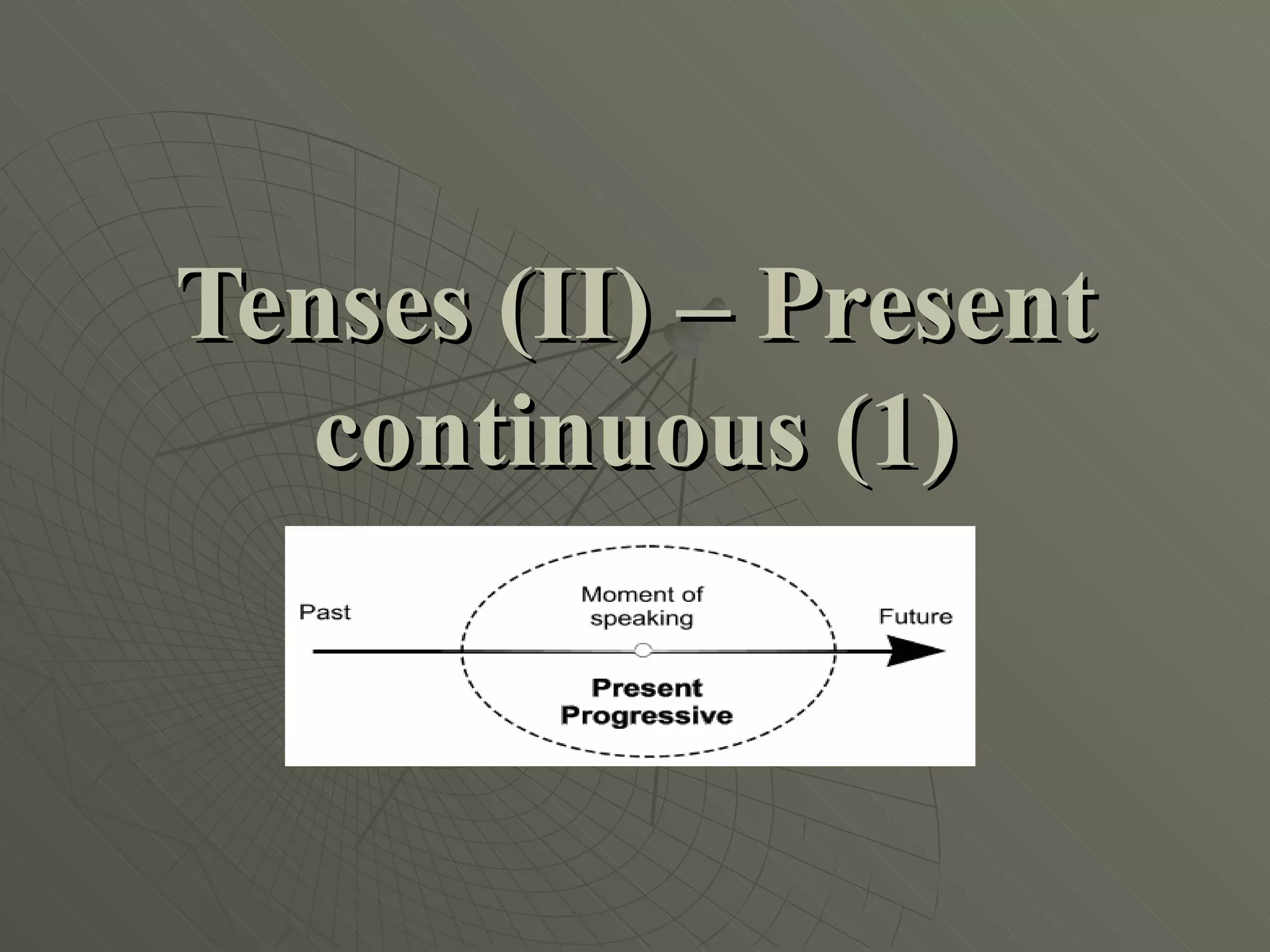
Tenses (II) – Present
   continuous (1)
Use
   Temporary events and actions.
    E.g: - I’m reading a mistery novel.
   To stress the repetetiveness of an action.
    E.g: - She’s always crying!
   Signal words:
     •   at the moment
     •   at this moment
     •   today
     •   now
     •   right now
     •   Listen!
     •   Look!
     •   (...)
Use
   Exceptions.
     • Silent e  is dropped (NOT APPLY FOR –ee)
       E.g: come – coming / agree – agreeing
     • After a short, stressed vowel  final consonant is doubled
       E.g: sit – sitting
     • After a vowel, the final consonant “l” is doubled
       E.g: travel - travelling
     • Final “ie”  becomes “y”
       lie - lying
Affirmative form
     I                am           “am”  I
     you              are          “is”  he, she, it and the
     he/she/it        is            singular form of nouns
     we               are
                                   “are”  you, we, they and
     you              are
                                    the plural form of nouns
     they             are


   Subject + verb “to be” + verb –ing + ...
    E.g: - I am watching TV.
Negative form
   We put “not” between the form of be and the verb –ing. (subject + verb “to
    be” + NOT + verb –ing + ...)
    E.g: I’m not watching TV.
Interrogative form
   We swop the places of subject and the form of be. (verb “to be” + subject +
    verb –ing + ...?)
    E.g: Are you watching TV?

Tenses (ii) present continuous (1)

  • 1.
    Tenses (II) –Present continuous (1)
  • 2.
    Use  Temporary events and actions. E.g: - I’m reading a mistery novel.  To stress the repetetiveness of an action. E.g: - She’s always crying!  Signal words: • at the moment • at this moment • today • now • right now • Listen! • Look! • (...)
  • 3.
    Use  Exceptions. • Silent e  is dropped (NOT APPLY FOR –ee) E.g: come – coming / agree – agreeing • After a short, stressed vowel  final consonant is doubled E.g: sit – sitting • After a vowel, the final consonant “l” is doubled E.g: travel - travelling • Final “ie”  becomes “y” lie - lying
  • 4.
    Affirmative form I am  “am”  I you are  “is”  he, she, it and the he/she/it is singular form of nouns we are  “are”  you, we, they and you are the plural form of nouns they are  Subject + verb “to be” + verb –ing + ... E.g: - I am watching TV.
  • 5.
    Negative form  We put “not” between the form of be and the verb –ing. (subject + verb “to be” + NOT + verb –ing + ...) E.g: I’m not watching TV.
  • 6.
    Interrogative form  We swop the places of subject and the form of be. (verb “to be” + subject + verb –ing + ...?) E.g: Are you watching TV?