Temporal Logic & Model 
Checking 
Dr. Jayaraj Poroor
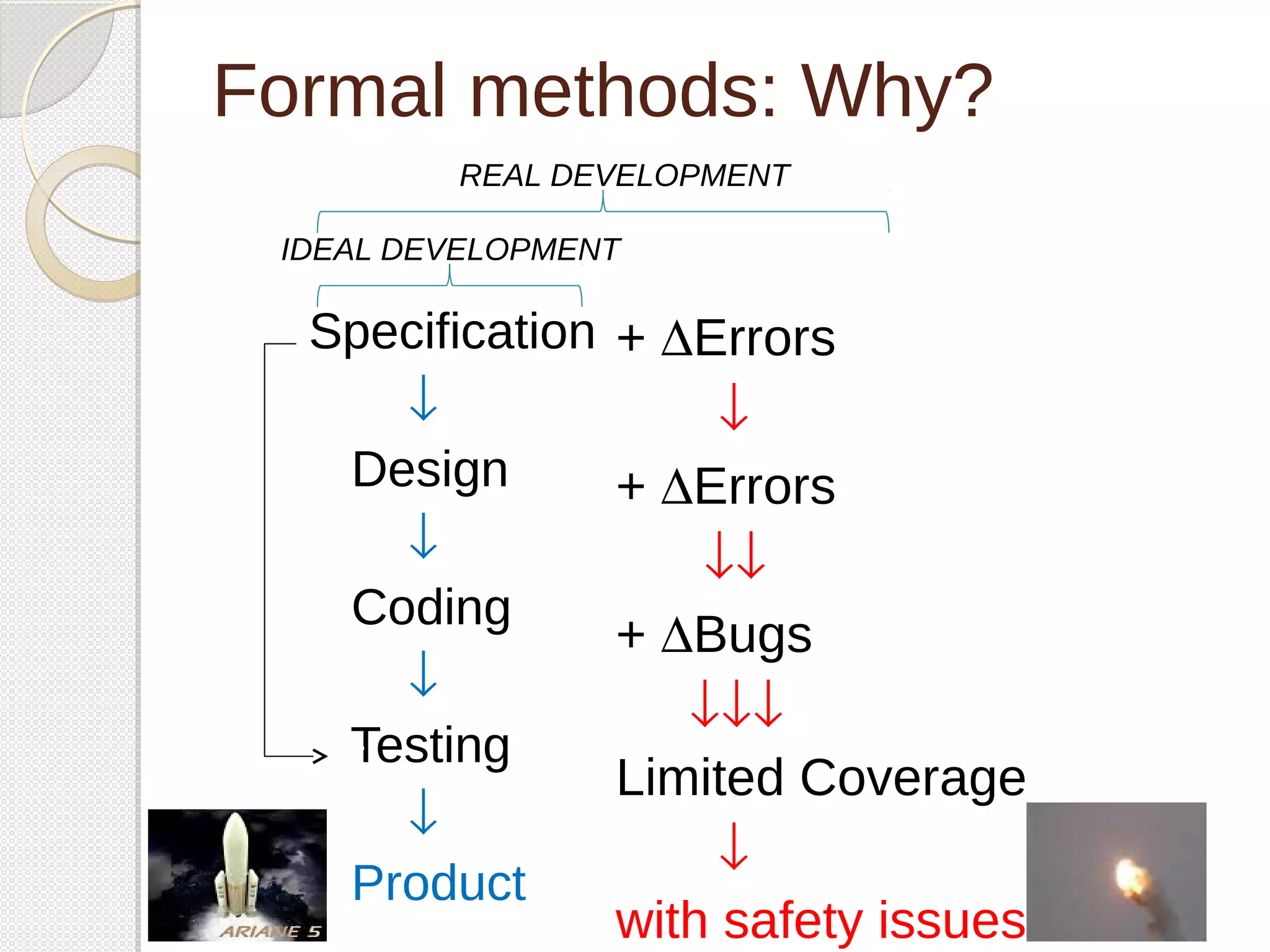
Formal methods: Why? 
REAL DEVELOPMENT 
IDEAL DEVELOPMENT 
Specification 
¯ 
Design 
¯ 
Coding 
¯ 
Testing 
¯ 
Product 
…. 
+ DErrors 
¯ 
+ DErrors 
¯¯ 
+ DBugs 
¯¯¯ 
Limited Coverage 
¯ 
with safety issues
Formal methods: Where? 
Life Critical Mission Critical 
Medical Devices 
Therac-25 
Space Vehicles 
Ariane-5 
Industrial Control 
Slammer Worm 
at Davis-Besse Plant 
• An Investigation of Therac-25 Accidents [Leveson, Turner, 93] 
• Ariane 5 Flight 501 Failure, Report by Inquiry Board [Lions, 96] 
• Slammer worm crashed Ohio nuke plant network, News Report 
[http://www.securityfocus.com/news/6767, 03]
Sentences (Syntax) and Models 
(Semantics) 
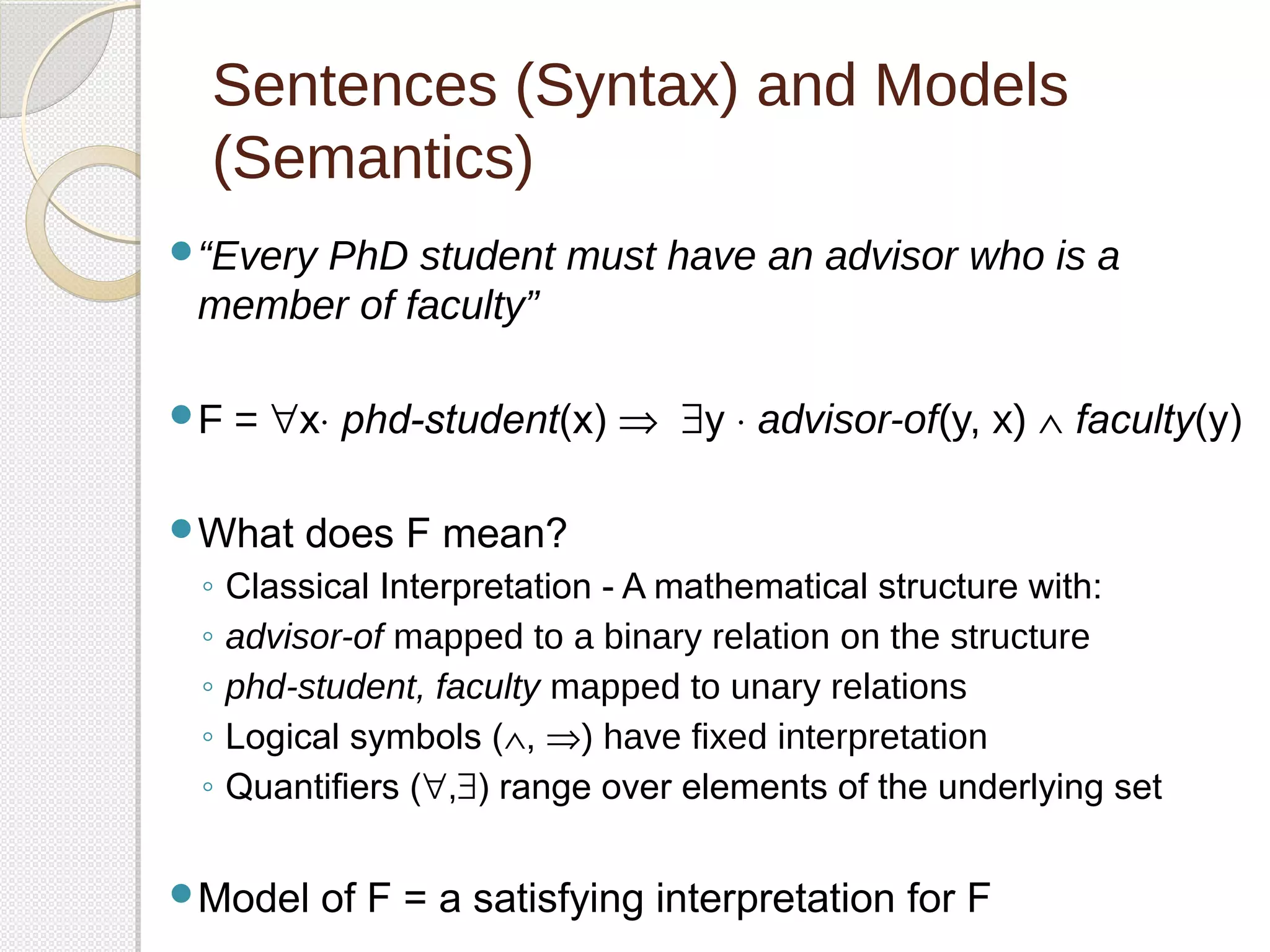
“Every PhD student must have an advisor who is a 
member of faculty” 
F = "x× phd-student(x) Þ $y × advisor-of(y, x) Ù faculty(y) 
What does F mean? 
◦ Classical Interpretation - A mathematical structure with: 
◦ advisor-of mapped to a binary relation on the structure 
◦ phd-student, faculty mapped to unary relations 
◦ Logical symbols (Ù, Þ) have fixed interpretation 
◦ Quantifiers (",$) range over elements of the underlying set 
Model of F = a satisfying interpretation for F
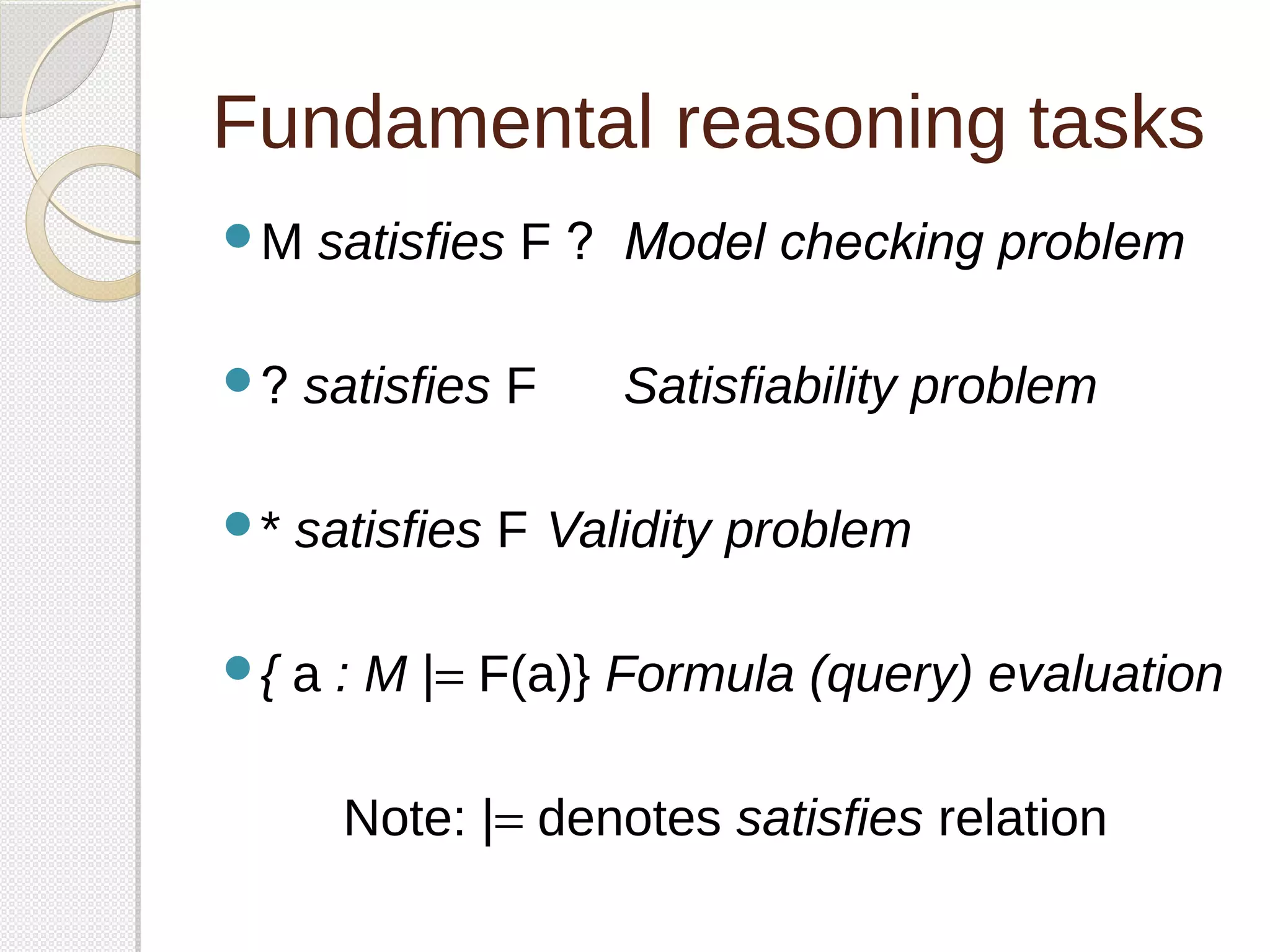
Fundamental reasoning tasks 
M satisfies F ? Model checking problem 
? satisfies F Satisfiability problem 
* satisfies F Validity problem 
{ a : M |= F(a)} Formula (query) evaluation 
Note: |= denotes satisfies relation
Modal Logic 
Modalities: Necessity, knowledge, belief, 
obligation, tense 
◦ Symbolic Logic [Lewis,32] 
Possible World Semantics 
◦ Kripke Structure 
Temporal Logic 
◦ Time and Modality [Prior,57] 
◦ Temporal modalities: always (), eventually ()
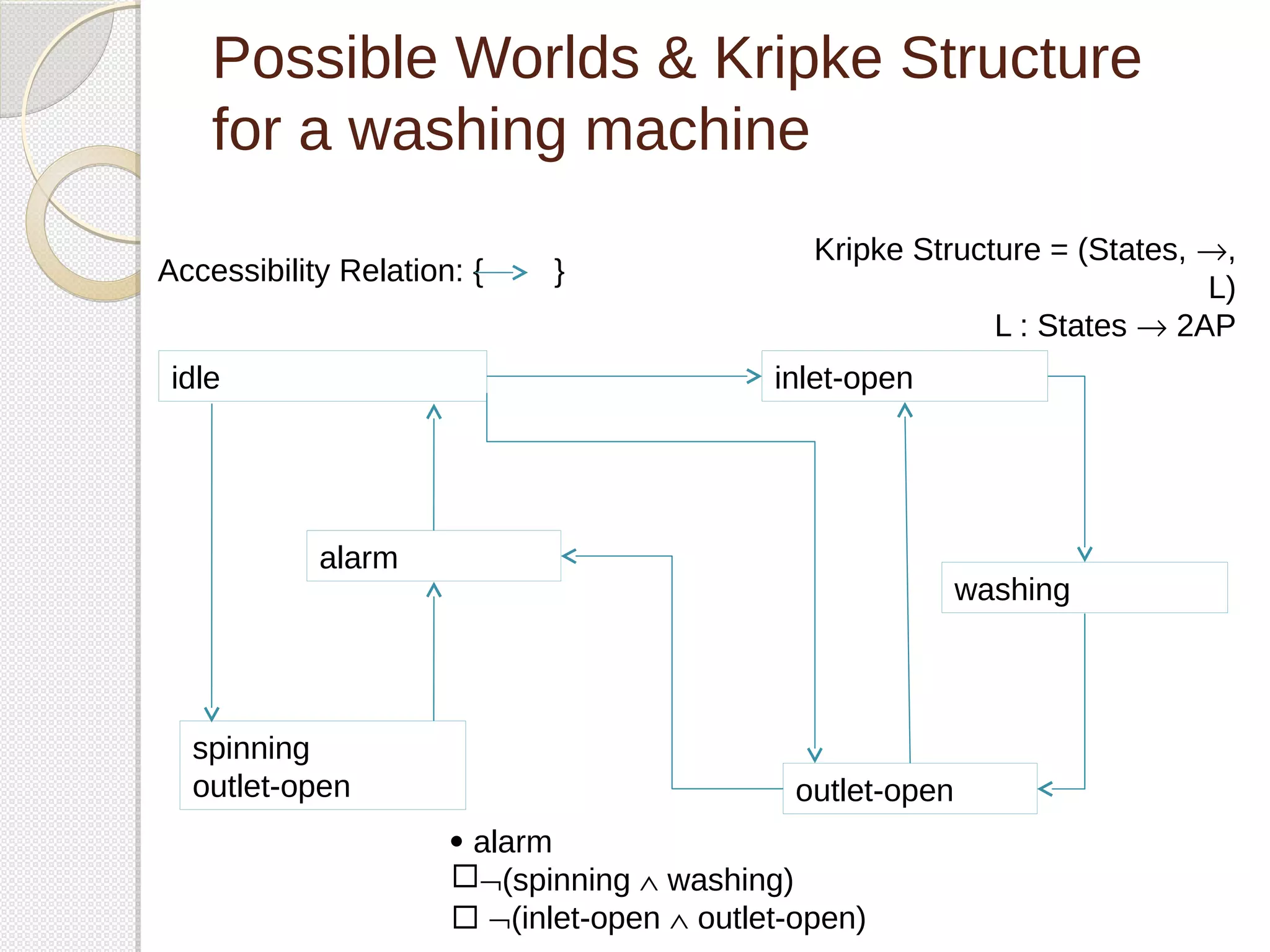
Possible Worlds & Kripke Structure 
for a washing machine 
idle 
spinning 
outlet-open 
Kripke Structure = (States, ®, 
washing 
Accessibility Relation: { } 
inlet-open 
outlet-open 
 alarm 
Ø(spinning Ù washing) 
 Ø(inlet-open Ù outlet-open) 
L) 
L : States ® 2AP 
alarm
Verification: Sequential Programs 
◦ Assigning Meanings to Programs [Floyd,67] 
◦ An Axiomatic basis for Computer 
Programming [Hoare, CACM69] (Hoare Logic) 
◦ Guarded commands, non-determinism and 
formal derivation of programs [Dijstra,75] 
(GCL)
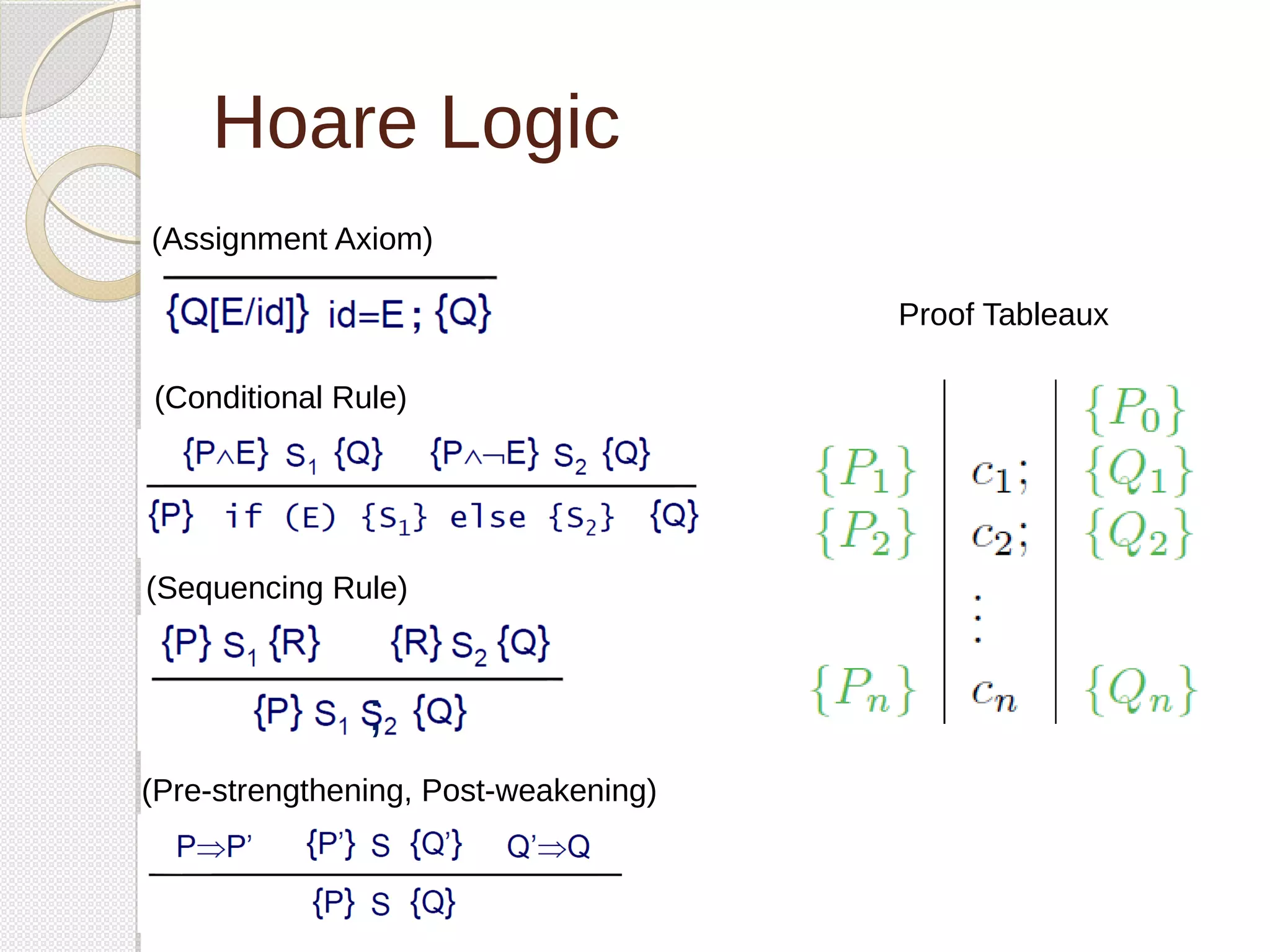
Hoare Logic 
(Assignment Axiom) 
(Conditional Rule) 
(Sequencing Rule) 
; 
Proof Tableaux 
(Pre-strengthening, Post-weakening)
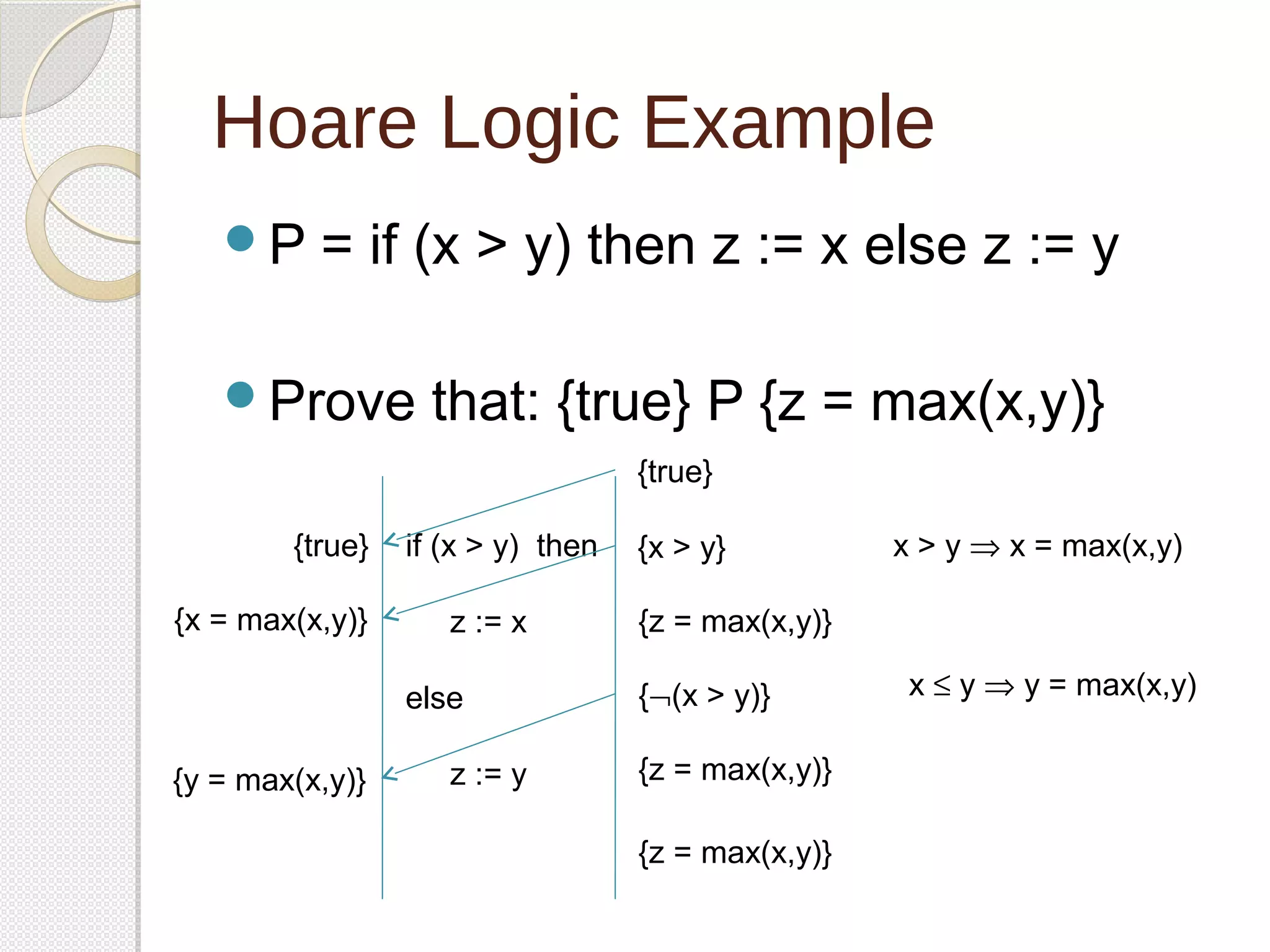
Hoare Logic Example 
P = if (x > y) then z := x else z := y 
Prove that: {true} P {z = max(x,y)} 
{true} if (x > y) then 
{x > y} 
{x = max(x,y)} {z = max(x,y)} 
z := x 
else 
z := y 
{true} 
{Ø(x > y)} 
{z = max(x,y)} 
{z = max(x,y)} 
{y = max(x,y)} 
x > y Þ x = max(x,y) 
x £ y Þ y = max(x,y)
Concurrency 
Simple pre-condition/post-condition 
assertions insufficient 
◦ Deadlocks, Data races, Starvation! 
◦ Need a language for expressing concurrency 
properties 
Cannot ignore intermediate steps! 
◦ P ; Q : Intermediate states of P & Q do not 
interleave/interact 
◦ P || Q : Intermediate states interleave/interact 
(in exponential number of ways)
Specifying properties of concurrent 
systems 
Language: Temporal Logic 
The Temporal Logic of Programs [Pnueli,77] (Linear Temporal Logic) 
Safety 
◦ something bad will never happen: 
◦  Ø(spinning Ù washing) 
Liveness 
◦ Something good will eventually happen: 
◦  alarm 
Fairness 
◦ Always something good will eventually happen 
◦   idle
Why Temporal Logics? 
Computational 
System 
Modal and 
Temporal 
Logics 
Operational 
Semantics models of 
Labelled Transition System 
(Kripke Structure) 
[Stirling03] http://www.fing.edu.uy/inco/eventos/wssa/
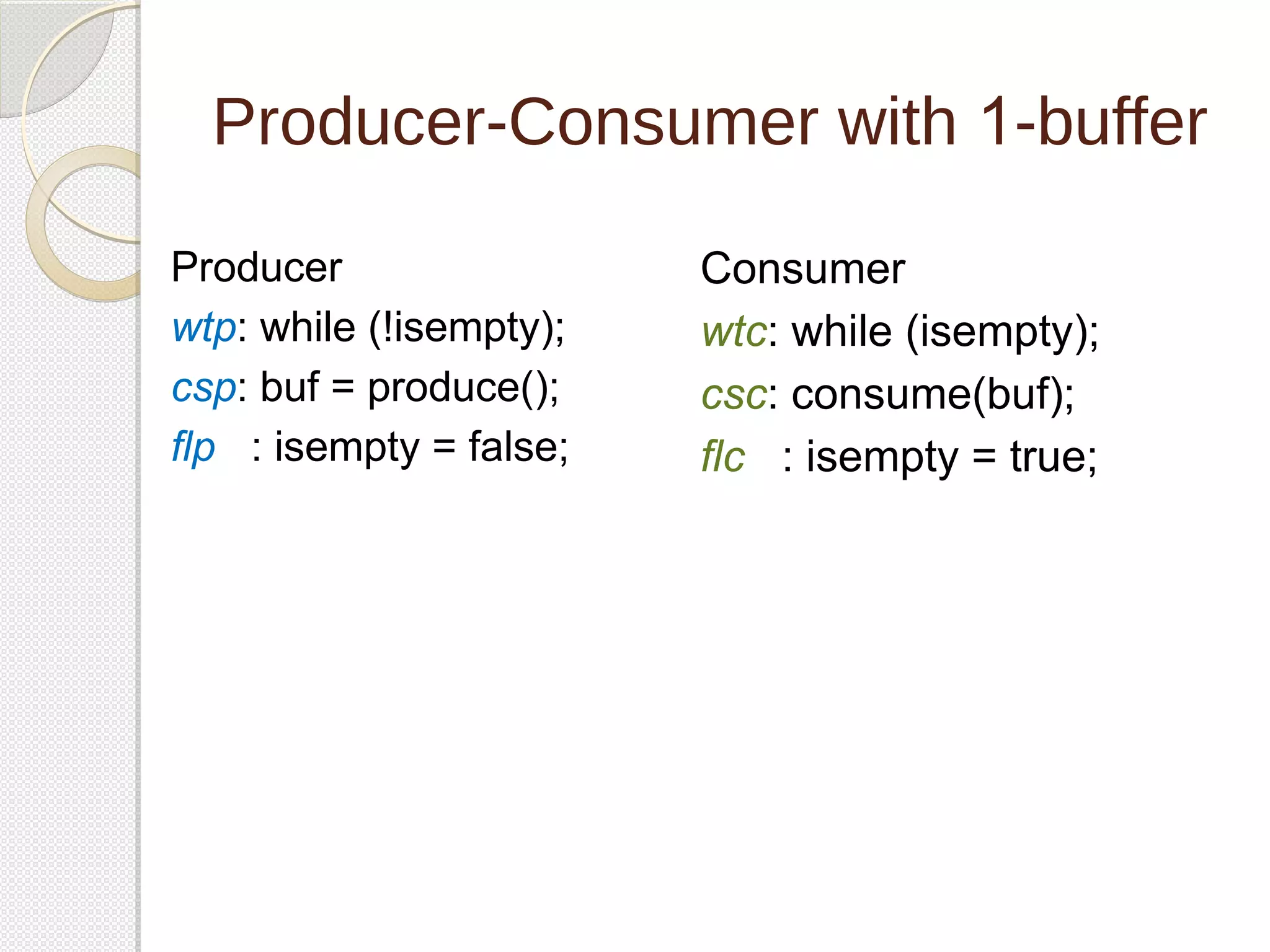
Producer-Consumer with 1-buffer 
Producer 
wtp: while (!isempty); 
csp: buf = produce(); 
flp : isempty = false; 
Consumer 
wtc: while (isempty); 
csc: consume(buf); 
flc : isempty = true;
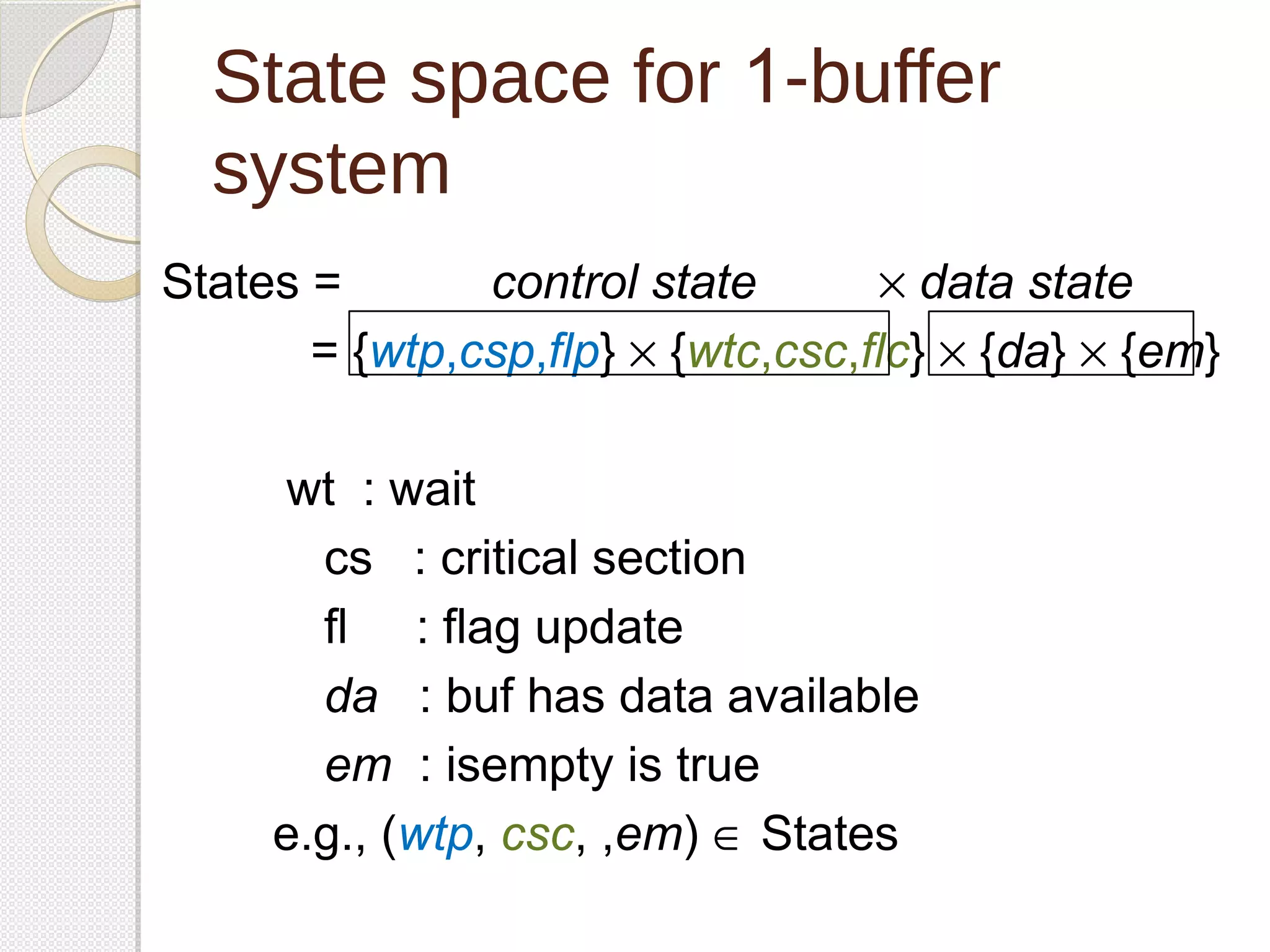
State space for 1-buffer 
system 
States = control state ´ data state 
= {wtp,csp,flp} ´ {wtc,csc,flc} ´ {da} ´ {em} 
wt : wait 
cs : critical section 
fl : flag update 
da : buf has data available 
em : isempty is true 
e.g., (wtp, csc, ,em) Î States
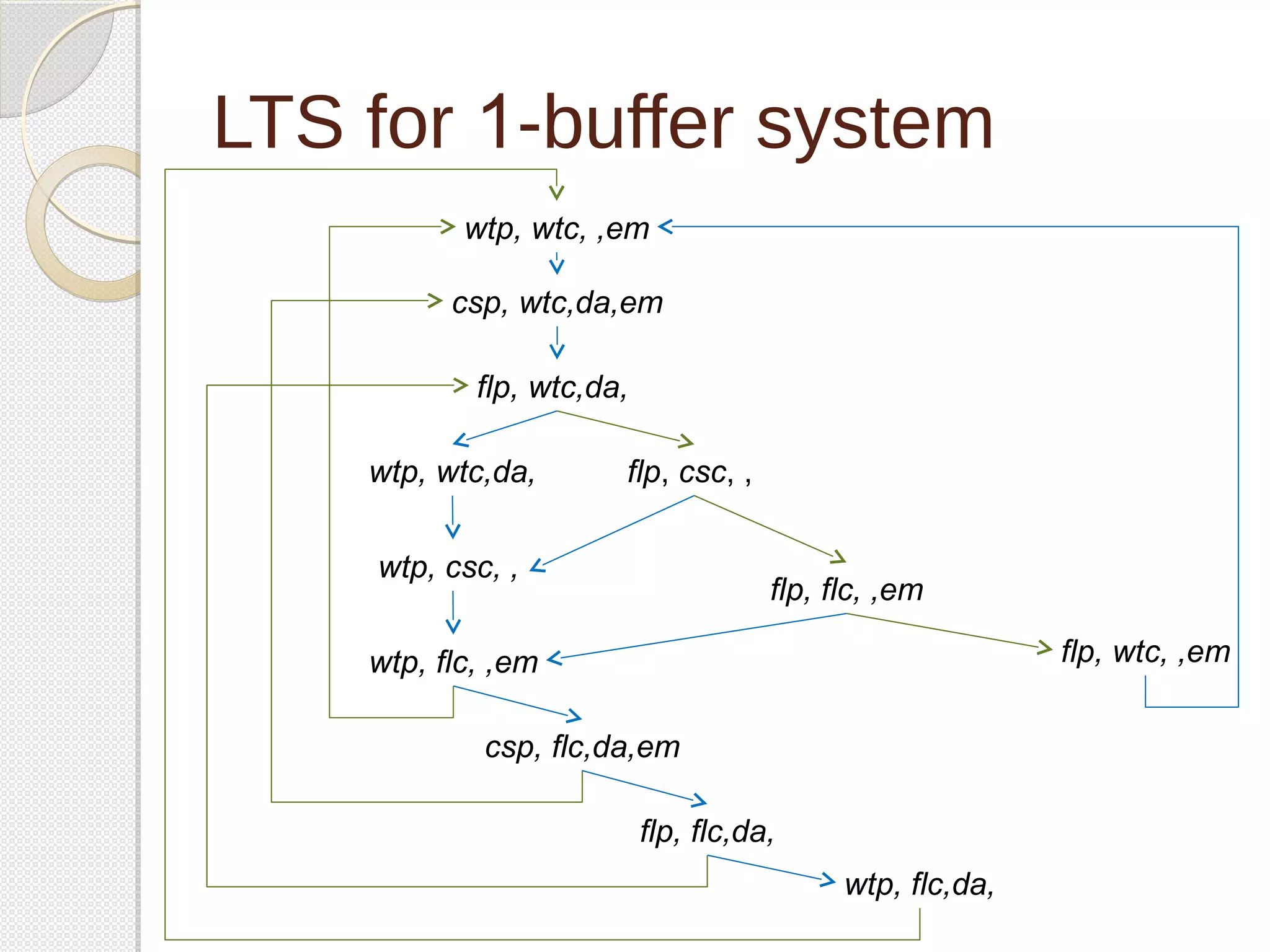
LTS for 1-buffer system 
wtp, wtc, ,em 
csp, wtc,da,em 
flp, wtc,da, 
wtp, wtc,da, flp, csc, , 
flp, flc, ,em 
wtp, csc, , 
wtp, flc, ,em flp, wtc, ,em 
csp, flc,da,em 
flp, flc,da, 
wtp, flc,da,
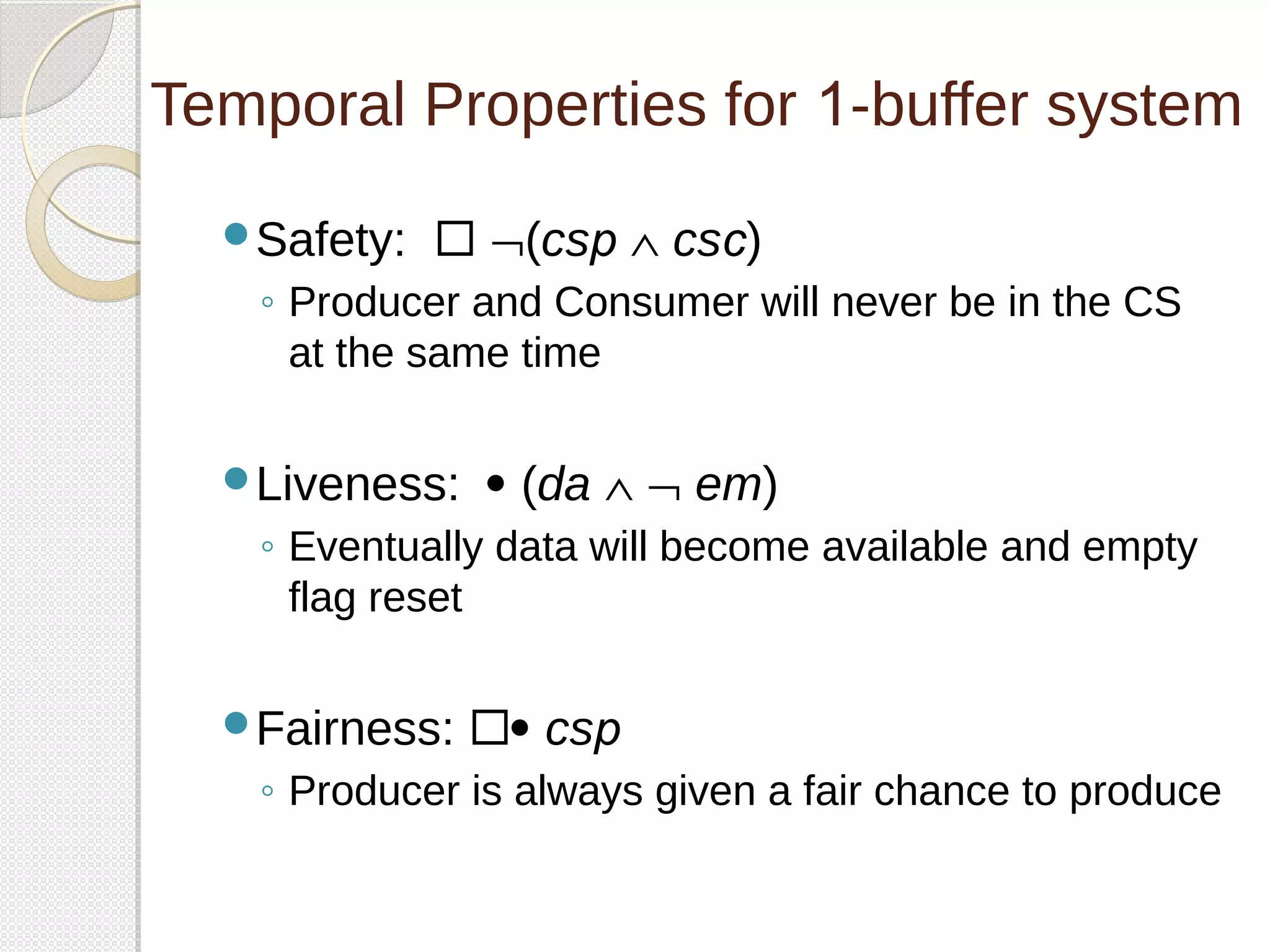
Temporal Properties for 1-buffer system 
Safety:  Ø(csp Ù csc) 
◦ Producer and Consumer will never be in the CS 
at the same time 
Liveness:  (da Ù Ø em) 
◦ Eventually data will become available and empty 
flag reset 
Fairness:  csp 
◦ Producer is always given a fair chance to produce
Model Checking 
Model checking: M |= F? 
Design & Synthesis of synchronization skeletons 
using branching temporal logic [Clarke &Emerson, 
81] 
Specification & Verification of Concurrent Systems in 
Cesar [Queille & Sifakis, 82] 
Automatic Verification of Finite-State Concurrent 
Systems using Temporal Logic Specifications 
[Clarke, Emerson, Sistla, TOPLAS86]
Computations of LTS 
Unfold LTS  ® Infinite tree of 
computations 
◦ Interleaved Semantics 
◦ Concurrency as non-determinism 
View of computations: Linear vs 
Branching 
◦ Linear Temporal Logic 
◦ Computational Tree Logic
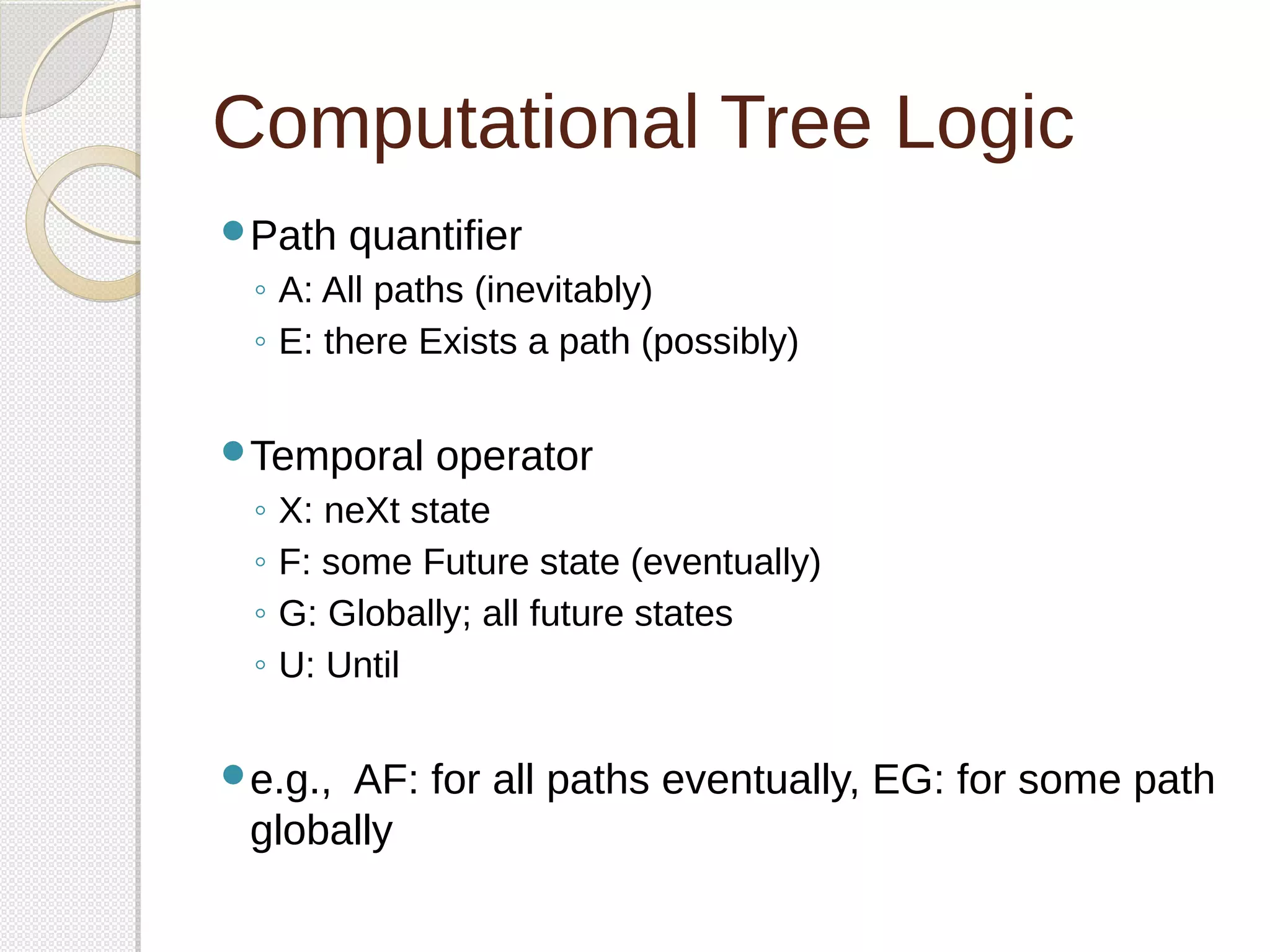
Computational Tree Logic 
Path quantifier 
◦ A: All paths (inevitably) 
◦ E: there Exists a path (possibly) 
Temporal operator 
◦ X: neXt state 
◦ F: some Future state (eventually) 
◦ G: Globally; all future states 
◦ U: Until 
e.g., AF: for all paths eventually, EG: for some path 
globally
CTL semantics 
s0 s0 
M,s0 |= AF p 
[Clarke, Emerson, Sistla, TOPLAS86] 
M 
s0 
M,s0 |= AG p 
M,s0 |= EF p
CTL examples 
Logic in Computer Science [Huth, Ryan, 04]
Computational Tree Logic 
f ::= T | F | p 
| Øf | fÙf | fÚf | f®f 
| AX f | EX f 
| AF f | EF f 
| AG f | EG f 
| A [f U f] | E [f U f] 
A: inevitably (along all paths) 
E : possibly (there exists a path) 
G: globally (always), F: in future (eventually) 
X: neXt state, U: until
Model Checking 
M |= F? 
SAT(M, f) : 2S 
◦ INPUT: 
CTL model M = (S, ®, L) 
CTL formula f 
◦ OUTPUT: 
Set of states (Í S)that satisfy f 
◦ Complexity: O(f . |S| . (|S| + |®|)) 
Logic in Computer Science [Huth, Ryan, 
04]
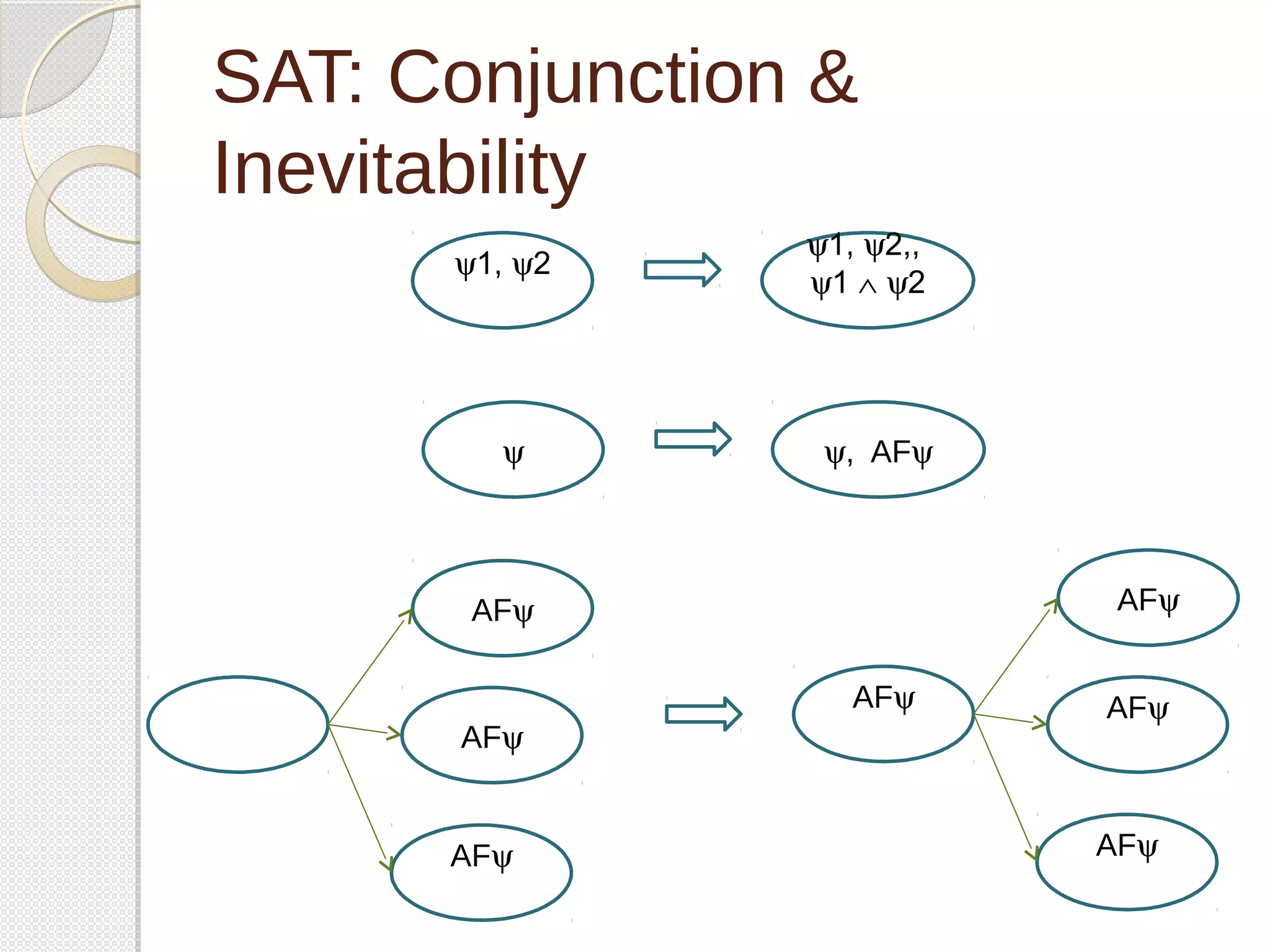
SAT: Conjunction & 
Inevitability 
y1, y2,, 
y1, y2 y1 Ù y2 
AFy 
AFy 
AFy 
AFy 
AFy 
AFy 
AFy 
y y, AFy
SAT: Possibly Until 
y1 
E[y1Uy2 
] 
y1, 
E[y1Uy2 
] 
E[y1Uy2 
] 
y2, 
E[y1Uy2 
] 
y2
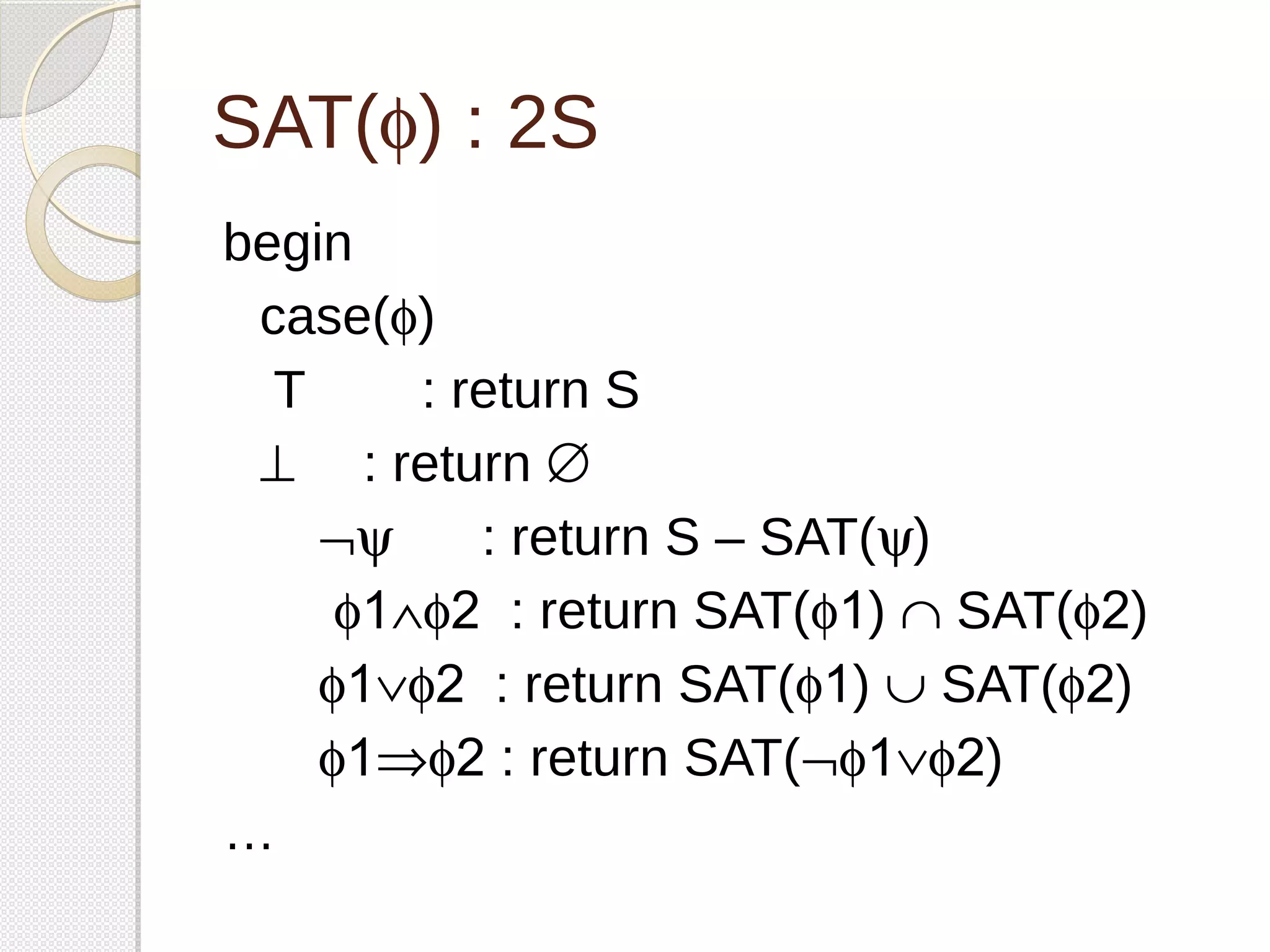
SAT(f) : 2S 
begin 
case(f) 
T : return S 
^ : return Æ 
Øy : return S – SAT(y) 
f1Ùf2 : return SAT(f1) Ç SAT(f2) 
f1Úf2 : return SAT(f1) È SAT(f2) 
f1Þf2 : return SAT(Øf1Úf2) 
…
SAT (case(f) cont.d) 
AFy : SATAF(y) 
E[f1Uf2] : SATEU(f1,f2) 
end case 
end
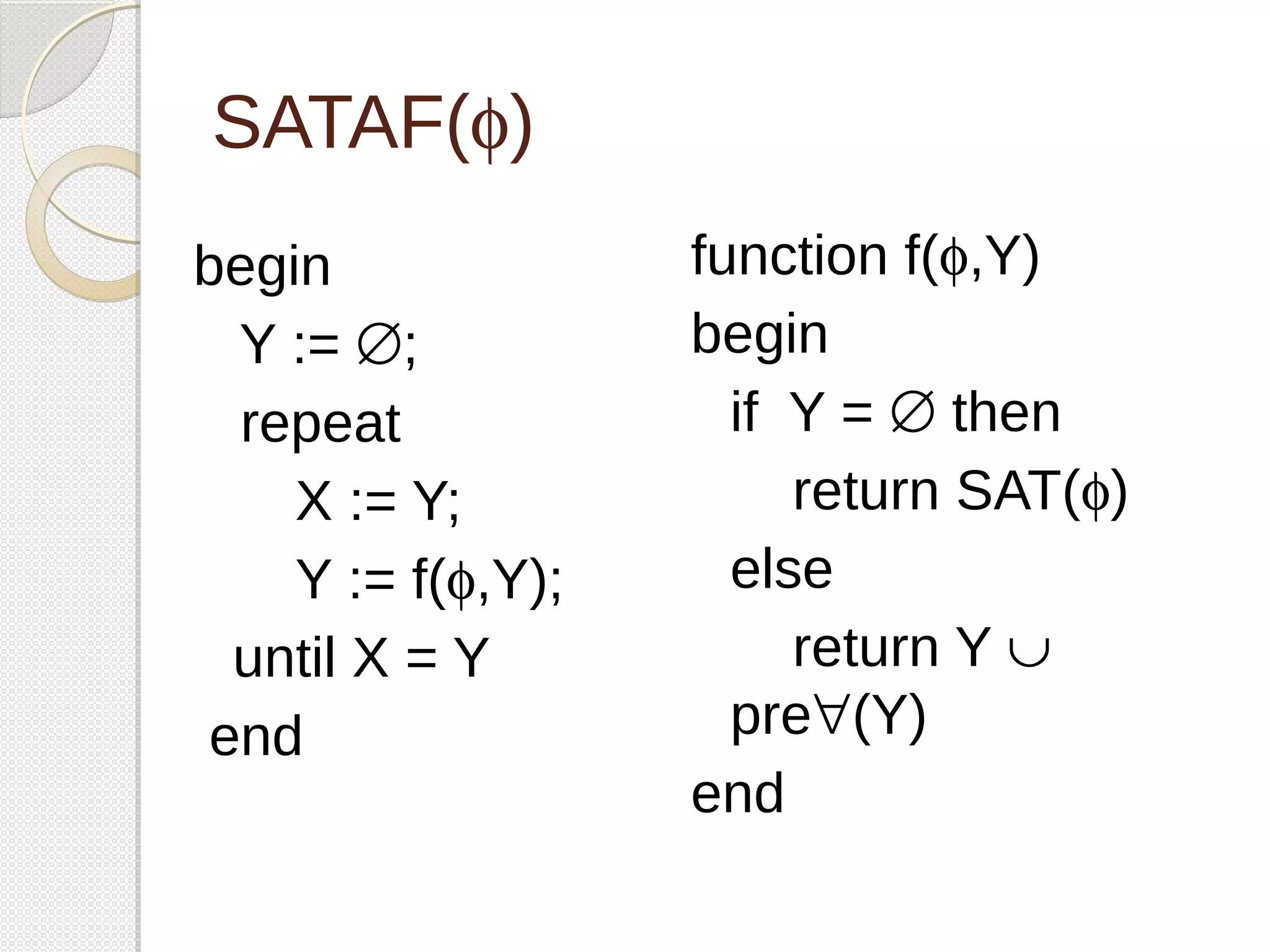
SATAF(f) 
function f(f,Y) 
begin 
if Y = Æ then 
return SAT(f) 
else 
return Y È 
pre"(Y) 
end 
begin 
Y := Æ; 
repeat 
X := Y; 
Y := f(f,Y); 
until X = Y 
end
Fixpoint characterization 
Consider, F: 2S ® 2S 
Formula are identified with their characteristic set 
◦ e.g. f denotes set of all states where f is true 
Subsets of S (Î2S) form complete lattice 
◦ Partial order: Í, Join: È, Meet: Ç 
Knaster-Tarski theorem 
◦ “Monotone functions on a complete lattice possess least 
and greatest fixpoints”: A lattice-theoretical fixpoint 
theorem and its applications [Tarski,55]
Fixpoint characterization: Eventually, 
Until 
EFf = mZ. f Ú EX Z 
AFf = mZ. f Ú AX Z 
E[y1Uy2] = mZ. y2 Ú (y1 Ù EX Z) 
A[y1Uy2] = mZ. y2 Ú (y1 Ù AX Z)
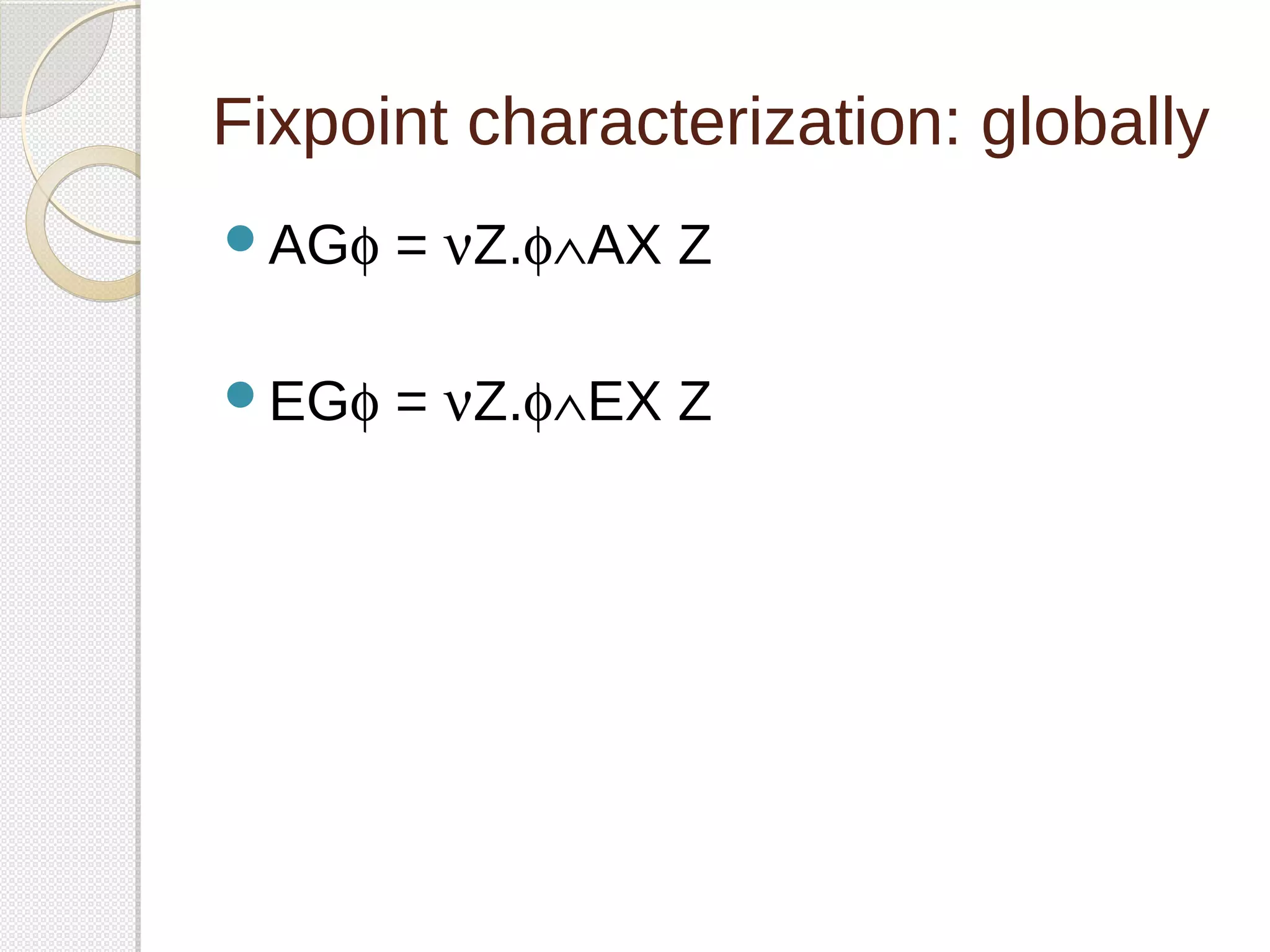
Fixpoint characterization: globally 
AGf = nZ.fÙAX Z 
EGf = nZ.fÙEX Z
LTL Model checking 
The complexity of propositional linear 
temporal logics [Sistla, Clarke, 85] 
Checking that finite state concurrent programs 
satisfy their linear specification, [Lichtenstein, 
Pnueli, POPL85] 
An automata-theoretic approach to automatic 
program verification [Vardi, Wolper, 86] 
◦ LTL to Buchi Automata
State explosion 
The state explosion problem [Clarke, Grumberg, 87] 
◦ Number of concurrent processes 
◦ Number of variables 
Partial-order reduction 
◦ An Introduction to Trace Theory [Mazurkiewicz,95] 
Symbolic Model Checking: 1020 states and beyond 
[Burch, Clarke, McMillan, Dill, Hwang, 92] 
◦ OBDD: Ordered Binary Decision Diagrams [Bryant,86] 
◦ m-Calculus: Finiteness is m-ineffable [Park,74] 
Abstraction 
Combining theorem-proving & model checking 
On-the-fly model checking
Some Tools 
SPIN/Promela 
◦ http://spinroot.com 
Java Pathfinder 
◦ http://javapathfinder.sourceforge.net/ 
NuSMV 
◦ http://nusmv.irst.itc.it/
Thank You 
Have a great day!

Temporal logic-model-checking

  • 1.
    Temporal Logic &Model Checking Dr. Jayaraj Poroor
  • 2.
    Formal methods: Why? REAL DEVELOPMENT IDEAL DEVELOPMENT Specification ¯ Design ¯ Coding ¯ Testing ¯ Product …. + DErrors ¯ + DErrors ¯¯ + DBugs ¯¯¯ Limited Coverage ¯ with safety issues
  • 3.
    Formal methods: Where? Life Critical Mission Critical Medical Devices Therac-25 Space Vehicles Ariane-5 Industrial Control Slammer Worm at Davis-Besse Plant • An Investigation of Therac-25 Accidents [Leveson, Turner, 93] • Ariane 5 Flight 501 Failure, Report by Inquiry Board [Lions, 96] • Slammer worm crashed Ohio nuke plant network, News Report [http://www.securityfocus.com/news/6767, 03]
  • 4.
    Sentences (Syntax) andModels (Semantics) “Every PhD student must have an advisor who is a member of faculty” F = "x× phd-student(x) Þ $y × advisor-of(y, x) Ù faculty(y) What does F mean? ◦ Classical Interpretation - A mathematical structure with: ◦ advisor-of mapped to a binary relation on the structure ◦ phd-student, faculty mapped to unary relations ◦ Logical symbols (Ù, Þ) have fixed interpretation ◦ Quantifiers (",$) range over elements of the underlying set Model of F = a satisfying interpretation for F
  • 5.
    Fundamental reasoning tasks M satisfies F ? Model checking problem ? satisfies F Satisfiability problem * satisfies F Validity problem { a : M |= F(a)} Formula (query) evaluation Note: |= denotes satisfies relation
  • 6.
    Modal Logic Modalities:Necessity, knowledge, belief, obligation, tense ◦ Symbolic Logic [Lewis,32] Possible World Semantics ◦ Kripke Structure Temporal Logic ◦ Time and Modality [Prior,57] ◦ Temporal modalities: always (), eventually ()
  • 7.
    Possible Worlds &Kripke Structure for a washing machine idle spinning outlet-open Kripke Structure = (States, ®, washing Accessibility Relation: { } inlet-open outlet-open  alarm Ø(spinning Ù washing)  Ø(inlet-open Ù outlet-open) L) L : States ® 2AP alarm
  • 8.
    Verification: Sequential Programs ◦ Assigning Meanings to Programs [Floyd,67] ◦ An Axiomatic basis for Computer Programming [Hoare, CACM69] (Hoare Logic) ◦ Guarded commands, non-determinism and formal derivation of programs [Dijstra,75] (GCL)
  • 9.
    Hoare Logic (AssignmentAxiom) (Conditional Rule) (Sequencing Rule) ; Proof Tableaux (Pre-strengthening, Post-weakening)
  • 10.
    Hoare Logic Example P = if (x > y) then z := x else z := y Prove that: {true} P {z = max(x,y)} {true} if (x > y) then {x > y} {x = max(x,y)} {z = max(x,y)} z := x else z := y {true} {Ø(x > y)} {z = max(x,y)} {z = max(x,y)} {y = max(x,y)} x > y Þ x = max(x,y) x £ y Þ y = max(x,y)
  • 11.
    Concurrency Simple pre-condition/post-condition assertions insufficient ◦ Deadlocks, Data races, Starvation! ◦ Need a language for expressing concurrency properties Cannot ignore intermediate steps! ◦ P ; Q : Intermediate states of P & Q do not interleave/interact ◦ P || Q : Intermediate states interleave/interact (in exponential number of ways)
  • 12.
    Specifying properties ofconcurrent systems Language: Temporal Logic The Temporal Logic of Programs [Pnueli,77] (Linear Temporal Logic) Safety ◦ something bad will never happen: ◦  Ø(spinning Ù washing) Liveness ◦ Something good will eventually happen: ◦  alarm Fairness ◦ Always something good will eventually happen ◦   idle
  • 13.
    Why Temporal Logics? Computational System Modal and Temporal Logics Operational Semantics models of Labelled Transition System (Kripke Structure) [Stirling03] http://www.fing.edu.uy/inco/eventos/wssa/
  • 14.
    Producer-Consumer with 1-buffer Producer wtp: while (!isempty); csp: buf = produce(); flp : isempty = false; Consumer wtc: while (isempty); csc: consume(buf); flc : isempty = true;
  • 15.
    State space for1-buffer system States = control state ´ data state = {wtp,csp,flp} ´ {wtc,csc,flc} ´ {da} ´ {em} wt : wait cs : critical section fl : flag update da : buf has data available em : isempty is true e.g., (wtp, csc, ,em) Î States
  • 16.
    LTS for 1-buffersystem wtp, wtc, ,em csp, wtc,da,em flp, wtc,da, wtp, wtc,da, flp, csc, , flp, flc, ,em wtp, csc, , wtp, flc, ,em flp, wtc, ,em csp, flc,da,em flp, flc,da, wtp, flc,da,
  • 17.
    Temporal Properties for1-buffer system Safety:  Ø(csp Ù csc) ◦ Producer and Consumer will never be in the CS at the same time Liveness:  (da Ù Ø em) ◦ Eventually data will become available and empty flag reset Fairness:  csp ◦ Producer is always given a fair chance to produce
  • 18.
    Model Checking Modelchecking: M |= F? Design & Synthesis of synchronization skeletons using branching temporal logic [Clarke &Emerson, 81] Specification & Verification of Concurrent Systems in Cesar [Queille & Sifakis, 82] Automatic Verification of Finite-State Concurrent Systems using Temporal Logic Specifications [Clarke, Emerson, Sistla, TOPLAS86]
  • 19.
    Computations of LTS Unfold LTS ® Infinite tree of computations ◦ Interleaved Semantics ◦ Concurrency as non-determinism View of computations: Linear vs Branching ◦ Linear Temporal Logic ◦ Computational Tree Logic
  • 20.
    Computational Tree Logic Path quantifier ◦ A: All paths (inevitably) ◦ E: there Exists a path (possibly) Temporal operator ◦ X: neXt state ◦ F: some Future state (eventually) ◦ G: Globally; all future states ◦ U: Until e.g., AF: for all paths eventually, EG: for some path globally
  • 21.
    CTL semantics s0s0 M,s0 |= AF p [Clarke, Emerson, Sistla, TOPLAS86] M s0 M,s0 |= AG p M,s0 |= EF p
  • 22.
    CTL examples Logicin Computer Science [Huth, Ryan, 04]
  • 23.
    Computational Tree Logic f ::= T | F | p | Øf | fÙf | fÚf | f®f | AX f | EX f | AF f | EF f | AG f | EG f | A [f U f] | E [f U f] A: inevitably (along all paths) E : possibly (there exists a path) G: globally (always), F: in future (eventually) X: neXt state, U: until
  • 24.
    Model Checking M|= F? SAT(M, f) : 2S ◦ INPUT: CTL model M = (S, ®, L) CTL formula f ◦ OUTPUT: Set of states (Í S)that satisfy f ◦ Complexity: O(f . |S| . (|S| + |®|)) Logic in Computer Science [Huth, Ryan, 04]
  • 25.
    SAT: Conjunction & Inevitability y1, y2,, y1, y2 y1 Ù y2 AFy AFy AFy AFy AFy AFy AFy y y, AFy
  • 26.
    SAT: Possibly Until y1 E[y1Uy2 ] y1, E[y1Uy2 ] E[y1Uy2 ] y2, E[y1Uy2 ] y2
  • 27.
    SAT(f) : 2S begin case(f) T : return S ^ : return Æ Øy : return S – SAT(y) f1Ùf2 : return SAT(f1) Ç SAT(f2) f1Úf2 : return SAT(f1) È SAT(f2) f1Þf2 : return SAT(Øf1Úf2) …
  • 28.
    SAT (case(f) cont.d) AFy : SATAF(y) E[f1Uf2] : SATEU(f1,f2) end case end
  • 29.
    SATAF(f) function f(f,Y) begin if Y = Æ then return SAT(f) else return Y È pre"(Y) end begin Y := Æ; repeat X := Y; Y := f(f,Y); until X = Y end
  • 30.
    Fixpoint characterization Consider,F: 2S ® 2S Formula are identified with their characteristic set ◦ e.g. f denotes set of all states where f is true Subsets of S (Î2S) form complete lattice ◦ Partial order: Í, Join: È, Meet: Ç Knaster-Tarski theorem ◦ “Monotone functions on a complete lattice possess least and greatest fixpoints”: A lattice-theoretical fixpoint theorem and its applications [Tarski,55]
  • 31.
    Fixpoint characterization: Eventually, Until EFf = mZ. f Ú EX Z AFf = mZ. f Ú AX Z E[y1Uy2] = mZ. y2 Ú (y1 Ù EX Z) A[y1Uy2] = mZ. y2 Ú (y1 Ù AX Z)
  • 32.
    Fixpoint characterization: globally AGf = nZ.fÙAX Z EGf = nZ.fÙEX Z
  • 33.
    LTL Model checking The complexity of propositional linear temporal logics [Sistla, Clarke, 85] Checking that finite state concurrent programs satisfy their linear specification, [Lichtenstein, Pnueli, POPL85] An automata-theoretic approach to automatic program verification [Vardi, Wolper, 86] ◦ LTL to Buchi Automata
  • 34.
    State explosion Thestate explosion problem [Clarke, Grumberg, 87] ◦ Number of concurrent processes ◦ Number of variables Partial-order reduction ◦ An Introduction to Trace Theory [Mazurkiewicz,95] Symbolic Model Checking: 1020 states and beyond [Burch, Clarke, McMillan, Dill, Hwang, 92] ◦ OBDD: Ordered Binary Decision Diagrams [Bryant,86] ◦ m-Calculus: Finiteness is m-ineffable [Park,74] Abstraction Combining theorem-proving & model checking On-the-fly model checking
  • 35.
    Some Tools SPIN/Promela ◦ http://spinroot.com Java Pathfinder ◦ http://javapathfinder.sourceforge.net/ NuSMV ◦ http://nusmv.irst.itc.it/
  • 36.
    Thank You Havea great day!