

Effective
Telephone
Skills
Blake Miller
Bass Pro Shops
• Switchboard
• 8 – 9 employees
• Small room
Training Objectives
• By the end of the training:
• Trainees will be able to effectively receive
telephone calls by using the four-step method.
• Trainees will be able to effectively talk with high
profile individuals.
Four-Step Method
1. Take a deep breath before answering the
phone (Obarski, 2014).
2. Use four answering courtesies (Kennedy Allbon
Tane, 2014).
3. Help the caller and listen attentively (Obarski,
2014).
4. Close the conversation (Kennedy Allbon Tane,
2014).
Step One
• Take a deep breath (Obarski, 2014).
• Organize thoughts before calls
• Helps sound alert and awake
• Prepare for the call
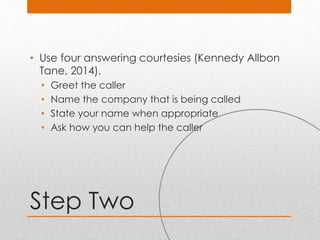
Step Two
• Use four answering courtesies (Kennedy Allbon
Tane, 2014).
• Greet the caller
• Name the company that is being called
• State your name when appropriate
• Ask how you can help the caller
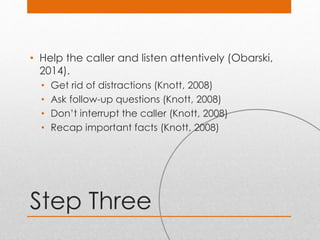
Step Three
• Help the caller and listen attentively (Obarski,
2014).
• Get rid of distractions (Knott, 2008)
• Ask follow-up questions (Knott, 2008)
• Don’t interrupt the caller (Knott, 2008)
• Recap important facts (Knott, 2008)
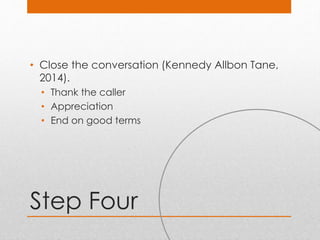
Step Four
• Close the conversation (Kennedy Allbon Tane,
2014).
• Thank the caller
• Appreciation
• End on good terms
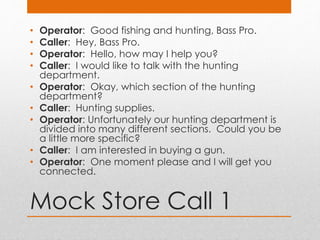
Mock Store Call 1
• Operator: Good fishing and hunting, Bass Pro.
• Caller: Hey, Bass Pro.
• Operator: Hello, how may I help you?
• Caller: I would like to talk with the hunting
department.
• Operator: Okay, which section of the hunting
department?
• Caller: Hunting supplies.
• Operator: Unfortunately our hunting department is
divided into many different sections. Could you be
a little more specific?
• Caller: I am interested in buying a gun.
• Operator: One moment please and I will get you
connected.
Mock Store Call 2
• Operator: Good fishing and hunting, Bass Pro.
• Caller: I would like to talk with the camping department please.
• Operator: One moment and I will get you connected.
• …later on
• Operator: Good fishing and hunting, Bass Pro.
• Caller: Yea, I wanted the camping department, but no one
answered. Is anyone working down there?
• Operator: I do apologize for that, but we are very busy. I am going
to put you on hold and try to get someone for you.
• Caller: Okay.
• (Places caller on hold. Gets an associate in camping on the
phone.)
• Operator: I have someone from our camping department on the
phone for you now.
• Caller: Thank you.
Activity One
• Use the tables as groups.
• Look at the corporate call script.
• Discuss in your groups where each step is being
applied and why.
• Could things be done differently? What?
• Feel free to write on the sheets.
Activity Two
• Take an envelope from your table.
• Find the envelope with the same number as
yours – pair up with that person.
• Read your cards to yourself.
• Find a location and sit back-to-back.
• Use your cell phones to create the
environment.
• Do the mock phone call – use the scripts for
help.
• Repeat.
Conclusion
• How did you feel while doing the mock phone
call? Why?
• Did you learn something new?
• Four-step process of answering a phone call.
• How can we use this information now?
• How can we use this information in the future?

Telephone skills training_power_point

  • 1.
  • 2.
    Bass Pro Shops •Switchboard • 8 – 9 employees • Small room
  • 4.
    Training Objectives • Bythe end of the training: • Trainees will be able to effectively receive telephone calls by using the four-step method. • Trainees will be able to effectively talk with high profile individuals.
  • 5.
    Four-Step Method 1. Takea deep breath before answering the phone (Obarski, 2014). 2. Use four answering courtesies (Kennedy Allbon Tane, 2014). 3. Help the caller and listen attentively (Obarski, 2014). 4. Close the conversation (Kennedy Allbon Tane, 2014).
  • 6.
    Step One • Takea deep breath (Obarski, 2014). • Organize thoughts before calls • Helps sound alert and awake • Prepare for the call
  • 7.
    Step Two • Usefour answering courtesies (Kennedy Allbon Tane, 2014). • Greet the caller • Name the company that is being called • State your name when appropriate • Ask how you can help the caller
  • 8.
    Step Three • Helpthe caller and listen attentively (Obarski, 2014). • Get rid of distractions (Knott, 2008) • Ask follow-up questions (Knott, 2008) • Don’t interrupt the caller (Knott, 2008) • Recap important facts (Knott, 2008)
  • 9.
    Step Four • Closethe conversation (Kennedy Allbon Tane, 2014). • Thank the caller • Appreciation • End on good terms
  • 10.
    Mock Store Call1 • Operator: Good fishing and hunting, Bass Pro. • Caller: Hey, Bass Pro. • Operator: Hello, how may I help you? • Caller: I would like to talk with the hunting department. • Operator: Okay, which section of the hunting department? • Caller: Hunting supplies. • Operator: Unfortunately our hunting department is divided into many different sections. Could you be a little more specific? • Caller: I am interested in buying a gun. • Operator: One moment please and I will get you connected.
  • 11.
    Mock Store Call2 • Operator: Good fishing and hunting, Bass Pro. • Caller: I would like to talk with the camping department please. • Operator: One moment and I will get you connected. • …later on • Operator: Good fishing and hunting, Bass Pro. • Caller: Yea, I wanted the camping department, but no one answered. Is anyone working down there? • Operator: I do apologize for that, but we are very busy. I am going to put you on hold and try to get someone for you. • Caller: Okay. • (Places caller on hold. Gets an associate in camping on the phone.) • Operator: I have someone from our camping department on the phone for you now. • Caller: Thank you.
  • 12.
    Activity One • Usethe tables as groups. • Look at the corporate call script. • Discuss in your groups where each step is being applied and why. • Could things be done differently? What? • Feel free to write on the sheets.
  • 13.
    Activity Two • Takean envelope from your table. • Find the envelope with the same number as yours – pair up with that person. • Read your cards to yourself. • Find a location and sit back-to-back. • Use your cell phones to create the environment. • Do the mock phone call – use the scripts for help. • Repeat.
  • 14.
    Conclusion • How didyou feel while doing the mock phone call? Why? • Did you learn something new? • Four-step process of answering a phone call. • How can we use this information now? • How can we use this information in the future?