


A2 TELEPHONE SKILLS
Aims
Provide a suitable greeting and farewell to callers
Aims
 Use the telephone effectively
 Transfer and/or place a call on hold
 Learn telephone phrases
 Take a written message
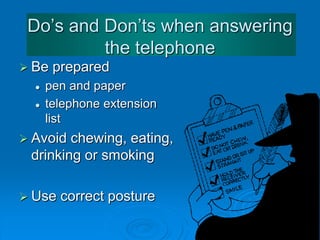
Do’s and Dont’s when answering
the telephone
 Be prepared
 pen and paper
 telephone extension
list
 Avoid chewing, eating,
drinking or smoking
 Use correct posture
Answer the call with a smile on
your face!
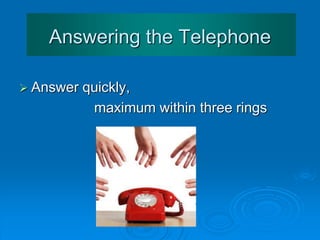
Answering the Telephone
 Answer quickly,
maximum within three rings
Answering the Telephone
Provide a greeting
 “Good Morning, Ans Waheed speaking”
 “Good Afternoon, this is Rob Trip
speaking”
 “Good Evening, Erasmus University,
Sumera van Dyk speaking.”
Answering the Telephone
 Identify the Department:
 Marketing Department: dealing with marketing and sales
 Operations: the flow once the customer has purchased
 Customer Service: ensuring that the Customer is always happy
 Human Resources Department: charged with finding, screening,
 recruiting and training job applicants
 Sales Department: Handling the Sale once it has reached that point
 in the process
 Accounting Department: manages the money flow
 Legal Department: works on all types of contracts. They usually
 create sales and employment contracts
Answering the Telephone
Identify yourself:
 “Astrid Brim speaking”
 “Patrick Parsley speaking”
NEVER SAY: You are speaking with XXXXX,
from (use of) of Delra Airlines.
Answering the Telephone
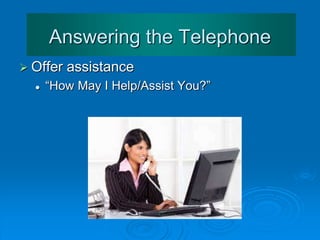
 Offer assistance
 “How May I Help/Assist You?”
Answering the Telephone
Some phrases:
• X speaking.
• Can I help you?
• Who's calling please?
• Who's speaking?
• How may I help/ assist you?
• Hold the line please.
• Could you hold on please?
• Just a moment please.
Answering the Telephone
Some more phrases:
• Thank you for holding.
• The line's free now ... I'll put you through.
• I'll connect you now / I'm connecting you now
• I'm afraid the line's engaged. Could you call back later?
• I'm afraid he's in a meeting at the moment.
• I'm sorry. He's out of the office today. /
He isn't in at the moment.
• I'm afraid we don't have a Mr./Mrs./Ms/Miss. ... here
• I'm sorry. There's nobody here by that name.
• Sorry. I think you've dialled the wrong number./
I'm afraid you've got the wrong number.
Answering the Telephone
• The line is very bad ... Could you speak up please?
• Could you repeat that please?
• I'm afraid I can't hear you.
• Sorry. I didn't catch that. Could you say it again please?
• Can I leave / take a message?
• Would you like to leave a message?
• Could you give him/her a message?
• Could you ask him/her to call me back?
• Could you tell him/her that I called?
• Could you give me your name please?
• Could you spell that please?
• What's your number please?
Answering the Telephone
 “Good Morning, Business Center, John speaking, How
may I help you?”
 Good afternoon, Business Center, Mara speaking,
what can I do for you?”
 “Good Afternoon, Finance, Fatima speaking, How
may I help you?”
 “Who would you like to speak to?”
Transferring or
Placing Calls on Hold
 Handle calls yourself where possible
 Transfer calls directly to the correct extension
Transferring or
Placing Calls on Hold
 Always ask if you can put the person on hold
and wait for the answer
Example: “Mr Mankell, the extension is busy,
may I please place your call on hold?
Transferring or
Placing Calls on Hold
 Explain delays
 “Thank you for holding, Mr Frost, the extension is still
busy, would you like to continue
holding or shall I ask
Mr Derrick to call you back
as soon as his extension
is free?”
Transferring or
Placing Calls on Hold
 Let the caller know:
 why you are transferring the call
 who they are being transferred to
Example: “Mr Mankell, I am transferring your call to
to Ms Tulip who will be able to assist you
in this regard.”
Transferring or
Placing Calls on Hold
 Always stay on the line until the transfer is complete!
 Explain to the person receiving
the call:
 why you are transferring the call
 who the caller is
Transferring a Call
 Examples:
 “Sarah, this is John, I have Mr. Frost on the line who
needs some information about Corporate Room
Rates.”
 “Good morning, Mr. Frost, this is Sarah. I understand
that you would like to know about our Corporate
Room Rates, is that correct?”
Transferring a Call
 Use guest’s name (personalise the call)
 Confirm understanding of the reason for the call
 Ask a closed question for confirmation
Example:
 Do you agree to that?
Taking Messages
 Message for…
 Name and title of caller
 Company name
 Telephone number
 Time and date of call
 Message
Taking Messages
 Action required
 Name/initials of person
 taking the message
 Repeat the message
back
Ending the Call
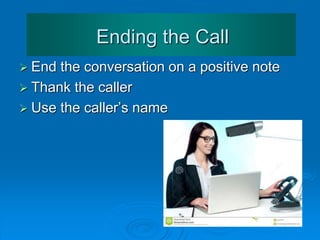
 End the conversation on a positive note
 Thank the caller
 Use the caller’s name
Ending the Call
 “Thank you for calling Mr Mankell, goodbye.”
 “Thank you for the booking, Mrs Armstrong,
we look forward to seeing you.”
 “Goodbye Ms Jamra and thank you for calling.”
THANK YOU !

Telephone skills A2 M. van Eijk

  • 1.
  • 2.
    Aims Provide a suitablegreeting and farewell to callers
  • 3.
    Aims  Use thetelephone effectively  Transfer and/or place a call on hold  Learn telephone phrases  Take a written message
  • 4.
    Do’s and Dont’swhen answering the telephone  Be prepared  pen and paper  telephone extension list  Avoid chewing, eating, drinking or smoking  Use correct posture
  • 5.
    Answer the callwith a smile on your face!
  • 6.
    Answering the Telephone Answer quickly, maximum within three rings
  • 7.
    Answering the Telephone Providea greeting  “Good Morning, Ans Waheed speaking”  “Good Afternoon, this is Rob Trip speaking”  “Good Evening, Erasmus University, Sumera van Dyk speaking.”
  • 8.
    Answering the Telephone Identify the Department:  Marketing Department: dealing with marketing and sales  Operations: the flow once the customer has purchased  Customer Service: ensuring that the Customer is always happy  Human Resources Department: charged with finding, screening,  recruiting and training job applicants  Sales Department: Handling the Sale once it has reached that point  in the process  Accounting Department: manages the money flow  Legal Department: works on all types of contracts. They usually  create sales and employment contracts
  • 9.
    Answering the Telephone Identifyyourself:  “Astrid Brim speaking”  “Patrick Parsley speaking” NEVER SAY: You are speaking with XXXXX, from (use of) of Delra Airlines.
  • 10.
    Answering the Telephone Offer assistance  “How May I Help/Assist You?”
  • 11.
    Answering the Telephone Somephrases: • X speaking. • Can I help you? • Who's calling please? • Who's speaking? • How may I help/ assist you? • Hold the line please. • Could you hold on please? • Just a moment please.
  • 12.
    Answering the Telephone Somemore phrases: • Thank you for holding. • The line's free now ... I'll put you through. • I'll connect you now / I'm connecting you now • I'm afraid the line's engaged. Could you call back later? • I'm afraid he's in a meeting at the moment. • I'm sorry. He's out of the office today. / He isn't in at the moment. • I'm afraid we don't have a Mr./Mrs./Ms/Miss. ... here • I'm sorry. There's nobody here by that name. • Sorry. I think you've dialled the wrong number./ I'm afraid you've got the wrong number.
  • 13.
    Answering the Telephone •The line is very bad ... Could you speak up please? • Could you repeat that please? • I'm afraid I can't hear you. • Sorry. I didn't catch that. Could you say it again please? • Can I leave / take a message? • Would you like to leave a message? • Could you give him/her a message? • Could you ask him/her to call me back? • Could you tell him/her that I called? • Could you give me your name please? • Could you spell that please? • What's your number please?
  • 14.
    Answering the Telephone “Good Morning, Business Center, John speaking, How may I help you?”  Good afternoon, Business Center, Mara speaking, what can I do for you?”  “Good Afternoon, Finance, Fatima speaking, How may I help you?”  “Who would you like to speak to?”
  • 15.
    Transferring or Placing Callson Hold  Handle calls yourself where possible  Transfer calls directly to the correct extension
  • 16.
    Transferring or Placing Callson Hold  Always ask if you can put the person on hold and wait for the answer Example: “Mr Mankell, the extension is busy, may I please place your call on hold?
  • 17.
    Transferring or Placing Callson Hold  Explain delays  “Thank you for holding, Mr Frost, the extension is still busy, would you like to continue holding or shall I ask Mr Derrick to call you back as soon as his extension is free?”
  • 18.
    Transferring or Placing Callson Hold  Let the caller know:  why you are transferring the call  who they are being transferred to Example: “Mr Mankell, I am transferring your call to to Ms Tulip who will be able to assist you in this regard.”
  • 19.
    Transferring or Placing Callson Hold  Always stay on the line until the transfer is complete!  Explain to the person receiving the call:  why you are transferring the call  who the caller is
  • 20.
    Transferring a Call Examples:  “Sarah, this is John, I have Mr. Frost on the line who needs some information about Corporate Room Rates.”  “Good morning, Mr. Frost, this is Sarah. I understand that you would like to know about our Corporate Room Rates, is that correct?”
  • 21.
    Transferring a Call Use guest’s name (personalise the call)  Confirm understanding of the reason for the call  Ask a closed question for confirmation Example:  Do you agree to that?
  • 22.
    Taking Messages  Messagefor…  Name and title of caller  Company name  Telephone number  Time and date of call  Message
  • 23.
    Taking Messages  Actionrequired  Name/initials of person  taking the message  Repeat the message back
  • 24.
    Ending the Call End the conversation on a positive note  Thank the caller  Use the caller’s name
  • 25.
    Ending the Call “Thank you for calling Mr Mankell, goodbye.”  “Thank you for the booking, Mrs Armstrong, we look forward to seeing you.”  “Goodbye Ms Jamra and thank you for calling.”
  • 26.