Customer Service
Agenda
 The concept
 Who is the customer?
 Customers’ expectation
 Qualifications of the CSR
 Call flow
 Start a phone call
 Kinds of transfer
 Qualities of voice
Agenda
 Elements of voice
 Probing and questioning skills
 Listening skills
 Good Customer Service is all about
delighting customers.
THE CONCEPT
 Excellent customer service = exceed the
customer's expectations.
 Good customer service is all about
bringing customers back.
Who is a Customer?
 A person who wants his/her expectations
fulfilled
 A person who needs appreciation and
understanding just as much as we do
 A human being with emotions and feelings
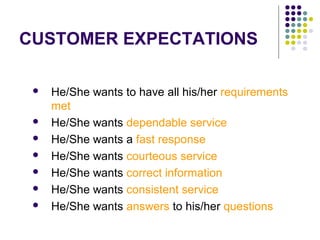
CUSTOMER EXPECTATIONS
 He/She wants to have all his/her requirements
met
 He/She wants dependable service
 He/She wants a fast response
 He/She wants courteous service
 He/She wants correct information
 He/She wants consistent service
 He/She wants answers to his/her questions
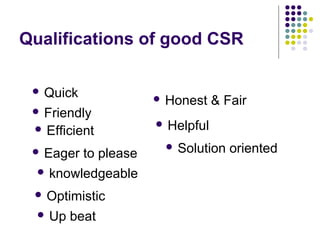
Qualifications of good CSR
 Quick
 Eager to please
 knowledgeable
 Optimistic
 Up beat
 Friendly
 Efficient
 Honest & Fair
 Helpful
 Solution oriented
Qualifications of good CSR…
(cont’d)
 Able to understand the customer’s requests
 Solution oriented
 Giving the customer a feeling of
importance and confidence
 Speak clearly
 Listen attentively
Call Flow Greeting
Security check
Identify concerns
Provide solutions
Gain agreement
Hold
Closing
Extra mile Transfer
(summarize)
1- Inbound
Call Flow
2- Outbound
Greeting
Information + sign post
Define yourself/company Give directions: Why did you call?
What are you going to say on the call
Educate + identify concerns
Tell him/her about the item you’re selling What he/she is looking for
Provide solutions
Gain agreement
Extra mile
Closing
Start a phone call
 1st
ring
IVR Interactive Voice Response
 Smile
 Greeting / company introduced
 Introduce yourself
 Offer help
Start a phone call…(cont’d)
 Listening / acknowledging (paraphrasing)
 Hold procedure
 You’ve to seek customer’s permission
 You need to give a valid reason for the
customer to put him on hold
 To give a time frame
 Thank the customer
Start a phone call…(cont’d)
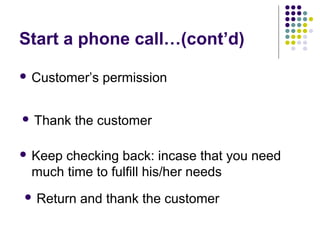
 Keep checking back: incase that you need
much time to fulfill his/her needs
 Return and thank the customer
 Customer’s permission
Kinds Of Transfer
 Cold transfer
 The customer had a problem, he/she
reached the wrong department
 Direct transfer will force the customer to
repeat the whole process
Kinds Of Transfer…(cont’d)
 Warm transfer
 The customer had a problem, he/she
reached the wrong department
 I briefed the problem to other department
 The customer won’t repeat all call
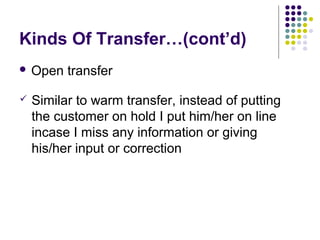
 Open transfer
Kinds Of Transfer…(cont’d)
 Similar to warm transfer, instead of putting
the customer on hold I put him/her on line
incase I miss any information or giving
his/her input or correction
Closing
 Summarize
 Provide an extra service
 Highlight the +ve things you’ve done
Qualities of voice
 Clarity
 Conversational tone (intonation/ don’t
sound like machines
 Expressiveness
 Alertness
 Pleasantness (smile)
Elements of voice
 Pitch
 Pace (match the pace of the customer
 Volume :
 Right placement for the mic (2 fingers ahead
from your mouth)
 Too far from the mouth, the customer won’t
hear clearly
Elements of voice…(cont’d)
 Energy
 Tone (warm / friendly)
 Articulation
Probing and questioning skills
 Types of questions
Open – ended Questions
Aim to get someone talking
Are useful when you want general information
For example,
“How may I help you?”
“Why do you say that?”
“What happened?”
Probing and questioning skills
Close - ended Questions
Aim to limit talking to control direction of conversation.
Are useful when you want specific information.
For example,
“Is there anything else I can assist you with?”
“Am I speaking with Mr. Smith?”
“Have you checked your weight this morning?”
Probing and questioning skills
Alternate Choice Questions:
This question type provides choices for the caller to choose from.
 These questions are useful when dealing with difficult callers.
For example,
“I could mail this to you or would you prefer me to fax the information?”
Probing and questioning skills
Basic questions
These are the introduction to your conversation.
They tell you whom you are speaking with and allow you
to access a customer’s profile.
For example,
“May I have address and telephone number.”
“May I know your Doctors name?”
Probing and questioning skills
Verification Questions
These enable you to verify the identity of the customer and hence preserve
confidentiality of the customer’s information.
These questions normally focus on information that is personal to the
customer such as date of birth, social security number, etc.
For example,
“May I have your date of birth for verification purposes?”
Fact-finding Questions
Probing and questioning skills
You ask effective fact-finding questions to get a clear picture of the exact
problem of the customer.
Fact-finding questions are mostly open-ended
For example,
“When would you like to fix the appointment?”
Listening skills
 Acknowledgment
Acknowledging involves two things:
1. Recognizing that the customer is an important person
2. Communicating to the customers that you understand their situation
How to acknowledge:
Use customer’s name:
 Using the customer’s name helps to personalize the call and also build rapport.
 Do not over use the customer’s name as it tends to get irritating after
sometime.
 Acknowledge by using:
Listening skills…(cont’d)
 I can appreciate what you’re saying.
 I can see why you’re upset.
 I can hear that you’re annoyed.
 I understand your concern
 Assurance
Listening skills…(cont’d)
Communicating to the customer that you can resolve
his/her concern.
Here are a few examples of assurances:
 “I’ll personally take care of this for you.”
 “I’ll make sure this reaches you before Mondays.”
 “I can take care of that for you”
Communicating to the customers that you understand
their situation.
Listening skills…(cont’d)
 Assertiveness
being honest with yourself and with others
being able to say what you want, need and feel but not at
the expense of other people’s feelings
understanding the other person’s point of view
behaving in a logical, rational (not emotional) manner
Listening skills…(cont’d)
The benefits of being assertive are that you are able to:
handle others with confidence and courtesy
handle any encounter with efficiency, no matter how
difficult
leave other people with a positive impression of you and
your organization
say the right thing in the right way
feel satisfied with the outcome of a situation

Customer service

  • 1.
  • 2.
    Agenda  The concept Who is the customer?  Customers’ expectation  Qualifications of the CSR  Call flow  Start a phone call  Kinds of transfer  Qualities of voice
  • 3.
    Agenda  Elements ofvoice  Probing and questioning skills  Listening skills
  • 4.
     Good CustomerService is all about delighting customers. THE CONCEPT  Excellent customer service = exceed the customer's expectations.  Good customer service is all about bringing customers back.
  • 5.
    Who is aCustomer?  A person who wants his/her expectations fulfilled  A person who needs appreciation and understanding just as much as we do  A human being with emotions and feelings
  • 6.
    CUSTOMER EXPECTATIONS  He/Shewants to have all his/her requirements met  He/She wants dependable service  He/She wants a fast response  He/She wants courteous service  He/She wants correct information  He/She wants consistent service  He/She wants answers to his/her questions
  • 7.
    Qualifications of goodCSR  Quick  Eager to please  knowledgeable  Optimistic  Up beat  Friendly  Efficient  Honest & Fair  Helpful  Solution oriented
  • 8.
    Qualifications of goodCSR… (cont’d)  Able to understand the customer’s requests  Solution oriented  Giving the customer a feeling of importance and confidence  Speak clearly  Listen attentively
  • 9.
    Call Flow Greeting Securitycheck Identify concerns Provide solutions Gain agreement Hold Closing Extra mile Transfer (summarize) 1- Inbound
  • 10.
    Call Flow 2- Outbound Greeting Information+ sign post Define yourself/company Give directions: Why did you call? What are you going to say on the call Educate + identify concerns Tell him/her about the item you’re selling What he/she is looking for Provide solutions Gain agreement Extra mile Closing
  • 11.
    Start a phonecall  1st ring IVR Interactive Voice Response  Smile  Greeting / company introduced  Introduce yourself  Offer help
  • 12.
    Start a phonecall…(cont’d)  Listening / acknowledging (paraphrasing)  Hold procedure  You’ve to seek customer’s permission  You need to give a valid reason for the customer to put him on hold  To give a time frame
  • 13.
     Thank thecustomer Start a phone call…(cont’d)  Keep checking back: incase that you need much time to fulfill his/her needs  Return and thank the customer  Customer’s permission
  • 14.
    Kinds Of Transfer Cold transfer  The customer had a problem, he/she reached the wrong department  Direct transfer will force the customer to repeat the whole process
  • 15.
    Kinds Of Transfer…(cont’d) Warm transfer  The customer had a problem, he/she reached the wrong department  I briefed the problem to other department  The customer won’t repeat all call
  • 16.
     Open transfer KindsOf Transfer…(cont’d)  Similar to warm transfer, instead of putting the customer on hold I put him/her on line incase I miss any information or giving his/her input or correction
  • 17.
    Closing  Summarize  Providean extra service  Highlight the +ve things you’ve done
  • 18.
    Qualities of voice Clarity  Conversational tone (intonation/ don’t sound like machines  Expressiveness  Alertness  Pleasantness (smile)
  • 19.
    Elements of voice Pitch  Pace (match the pace of the customer  Volume :  Right placement for the mic (2 fingers ahead from your mouth)  Too far from the mouth, the customer won’t hear clearly
  • 20.
    Elements of voice…(cont’d) Energy  Tone (warm / friendly)  Articulation
  • 21.
    Probing and questioningskills  Types of questions Open – ended Questions Aim to get someone talking Are useful when you want general information For example, “How may I help you?” “Why do you say that?” “What happened?”
  • 22.
    Probing and questioningskills Close - ended Questions Aim to limit talking to control direction of conversation. Are useful when you want specific information. For example, “Is there anything else I can assist you with?” “Am I speaking with Mr. Smith?” “Have you checked your weight this morning?”
  • 23.
    Probing and questioningskills Alternate Choice Questions: This question type provides choices for the caller to choose from.  These questions are useful when dealing with difficult callers. For example, “I could mail this to you or would you prefer me to fax the information?”
  • 24.
    Probing and questioningskills Basic questions These are the introduction to your conversation. They tell you whom you are speaking with and allow you to access a customer’s profile. For example, “May I have address and telephone number.” “May I know your Doctors name?”
  • 25.
    Probing and questioningskills Verification Questions These enable you to verify the identity of the customer and hence preserve confidentiality of the customer’s information. These questions normally focus on information that is personal to the customer such as date of birth, social security number, etc. For example, “May I have your date of birth for verification purposes?”
  • 26.
    Fact-finding Questions Probing andquestioning skills You ask effective fact-finding questions to get a clear picture of the exact problem of the customer. Fact-finding questions are mostly open-ended For example, “When would you like to fix the appointment?”
  • 27.
    Listening skills  Acknowledgment Acknowledginginvolves two things: 1. Recognizing that the customer is an important person 2. Communicating to the customers that you understand their situation How to acknowledge: Use customer’s name:  Using the customer’s name helps to personalize the call and also build rapport.  Do not over use the customer’s name as it tends to get irritating after sometime.
  • 28.
     Acknowledge byusing: Listening skills…(cont’d)  I can appreciate what you’re saying.  I can see why you’re upset.  I can hear that you’re annoyed.  I understand your concern
  • 29.
     Assurance Listening skills…(cont’d) Communicatingto the customer that you can resolve his/her concern. Here are a few examples of assurances:  “I’ll personally take care of this for you.”  “I’ll make sure this reaches you before Mondays.”  “I can take care of that for you” Communicating to the customers that you understand their situation.
  • 30.
    Listening skills…(cont’d)  Assertiveness beinghonest with yourself and with others being able to say what you want, need and feel but not at the expense of other people’s feelings understanding the other person’s point of view behaving in a logical, rational (not emotional) manner
  • 31.
    Listening skills…(cont’d) The benefitsof being assertive are that you are able to: handle others with confidence and courtesy handle any encounter with efficiency, no matter how difficult leave other people with a positive impression of you and your organization say the right thing in the right way feel satisfied with the outcome of a situation