TELA Case Study
Customer Usage Pattern Analysis V/s Revenue maximization.
By:
Amrapalli Karan
Kamalika Some
Krishanu Mukherjee
Somenath Sit
Agenda
Business Problem:
To Maximise Revenues on the
Customer Usage patterns
through Analytics.
Snapshot
Usage Patterns
Usage Patterns v/s Revenue
Revenue maximization
Smart Analytics
Challenges
Way Forward
Snapshot
Who is this Telecom Super consumer??
❖ The telecom super consumer typically is a tech-savvy, urban smartphone user and
utilizes 3 times more data than regular consumers.
❖ Based on data usage habits, the smartphone users are segmented into 3 groups –
heavy, medium and light.
❖ While the top 33% and the bottom 33% constitute heavy and light users respectively,
the remaining are considered medium users, on data usage.
Who is Telecom Super consumer??
Snapshot
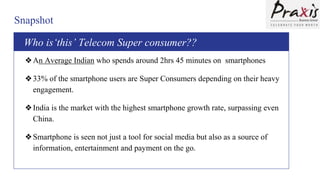
❖An Average Indian who spends around 2hrs 45 minutes on smartphones
❖33% of the smartphone users are Super Consumers depending on their heavy
engagement.
❖India is the market with the highest smartphone growth rate, surpassing even
China.
❖Smartphone is seen not just a tool for social media but also as a source of
information, entertainment and payment on the go.
Who is‘this’ Telecom Super consumer??
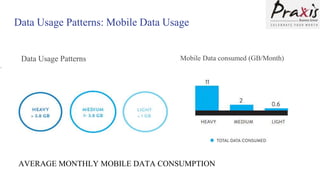
Data Usage Patterns: Mobile Data Usage
Challenge 3Data Usage Patterns Mobile Data consumed (GB/Month)
AVERAGE MONTHLY MOBILE DATA CONSUMPTION
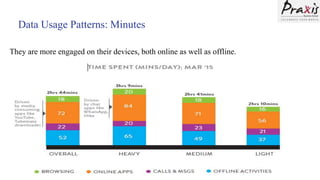
Data Usage Patterns: Minutes
They are more engaged on their devices, both online as well as offline.
.
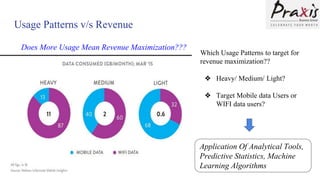
Usage Patterns v/s Revenue
Does More Usage Mean Revenue Maximization???
Which Usage Patterns to target for
revenue maximization??
❖ Heavy/ Medium/ Light?
❖ Target Mobile data Users or
WIFI data users?
Application Of Analytical Tools,
Predictive Statistics, Machine
Learning Algorithms
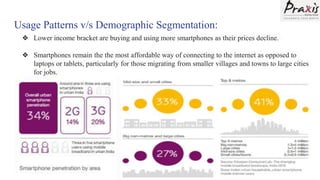
Usage Patterns v/s Demographic Segmentation:
Challenge 3
❖ Lower income bracket are buying and using more smartphones as their prices decline.
❖ Smartphones remain the the most affordable way of connecting to the internet as opposed to
laptops or tablets, particularly for those migrating from smaller villages and towns to large cities
for jobs.
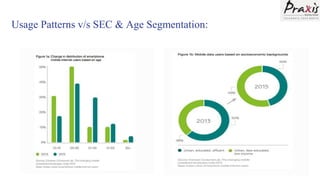
Usage Patterns v/s SEC & Age Segmentation:
Challenge 3
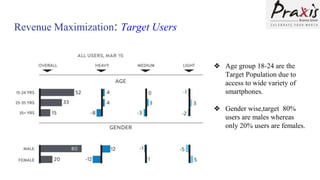
Revenue Maximization: Target Users
❖ Age group 18-24 are the
Target Population due to
access to wide variety of
smartphones.
❖ Gender wise,target 80%
users are males whereas
only 20% users are females.
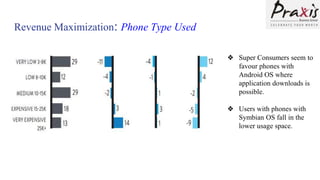
Revenue Maximization: Phone Type Used
❖ Super Consumers seem to
favour phones with
Android OS where
application downloads is
possible.
❖ Users with phones with
Symbian OS fall in the
lower usage space.
Revenue Maximization: App Store Usage
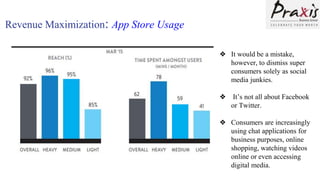
❖ It would be a mistake,
however, to dismiss super
consumers solely as social
media junkies.
❖ It’s not all about Facebook
or Twitter.
❖ Consumers are increasingly
using chat applications for
business purposes, online
shopping, watching videos
online or even accessing
digital media.
Revenue Maximization: Mobile Payment App Usage
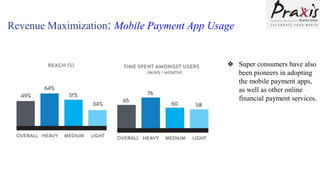
❖ Super consumers have also
been pioneers in adopting
the mobile payment apps,
as well as other online
financial payment services.
Smart Analytics
❖ Telecom organizations know everything about their customers and are collecting vast
amounts of data.
❖ The integration of customer intelligence, behavior segmentation and real-time promotion
execution can increase sales, increase promotional effectiveness, reduce costs and increase
market share.
To Decrease Churn and Reduce Risks
❖ Combined with billing analysis, drop-call analysis and sentiment analysis of their customers it can give
Telco's the possibility to bring down churn rates by knowing upfront what is going to happen.
❖ Predictive analytics can automatically warn when action is required to prevent a customer from going to
the competitor by offering a tailor-made deal just in time.Eg. T-Mobile reduced its churn by 50% in one
quarter.
❖ Big data tools can also be used to reduce losses from customer or dealer commission fraud.
Smart Analytics
Innovate and Build Smarter Networks
● Network traffic is increasing to double digits due to better positioning and the rollout of 4G
worldwide.
● Algorithms could be used to monitor and analyze network traffic data in real-time, thereby
optimizing routing and quality of services while decreasing outings and increasing customer
satisfaction.
● Optimization of the average network quality, coverage and deployment over time can be
achieved.
Contd..
Smart Analytics
Innovate and Build Smarter Networks
● Real-time data from tracking all connected devices on the network can be combined with public
data sets about events that happen in real-time.
● Sensors in the network, can monitor the equipment and notify if an action or maintenance is
necessary.
● Big data tools can be used to easily identify problems, perform real-time troubleshooting and
quickly fix network performance issues, which will improve network quality and lower operating
costs.
Smart Analytics
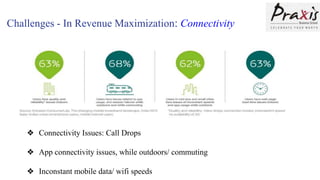
Challenges - In Revenue Maximization: Connectivity
❖ Connectivity Issues: Call Drops
❖ App connectivity issues, while outdoors/ commuting
❖ Inconstant mobile data/ wifi speeds
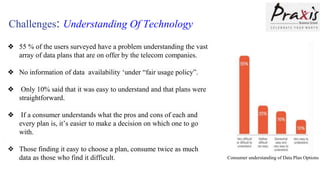
Challenges: Understanding Of Technology
Consumer understanding of Data Plan Options
❖ 55 % of the users surveyed have a problem understanding the vast
array of data plans that are on offer by the telecom companies.
❖ No information of data availability ‘under “fair usage policy”.
❖ Only 10% said that it was easy to understand and that plans were
straightforward.
❖ If a consumer understands what the pros and cons of each and
every plan is, it’s easier to make a decision on which one to go
with.
❖ Those finding it easy to choose a plan, consume twice as much
data as those who find it difficult.
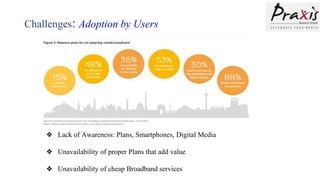
Challenges: Adoption by Users
❖ Lack of Awareness: Plans, Smartphones, Digital Media
❖ Unavailability of proper Plans that add value
❖ Unavailability of cheap Broadband services
Way Forward
➔ Given the inordinate amounts of time spent on their phones, super consumers are also
the biggest consumers of applications, games and other digital media.
➔ They spend 50% percent more time on app stores than other smartphone users.
➔ While data network reliability and performance are the key drivers of internet usage,
ease of navigation and app usability are also important.
➔ Innovative and smart pricing strategies for apps will also help drive penetration and
usage among the super consumers.
➔ Analytics can help to identify “Which plans to sell”, “Which customers to target”,
“How to minimize revenue leakage” , “Next best Offer” through predictive models and
statistical application.

Telecom Analytics

  • 1.
    TELA Case Study CustomerUsage Pattern Analysis V/s Revenue maximization. By: Amrapalli Karan Kamalika Some Krishanu Mukherjee Somenath Sit
  • 2.
    Agenda Business Problem: To MaximiseRevenues on the Customer Usage patterns through Analytics. Snapshot Usage Patterns Usage Patterns v/s Revenue Revenue maximization Smart Analytics Challenges Way Forward
  • 3.
    Snapshot Who is thisTelecom Super consumer?? ❖ The telecom super consumer typically is a tech-savvy, urban smartphone user and utilizes 3 times more data than regular consumers. ❖ Based on data usage habits, the smartphone users are segmented into 3 groups – heavy, medium and light. ❖ While the top 33% and the bottom 33% constitute heavy and light users respectively, the remaining are considered medium users, on data usage. Who is Telecom Super consumer??
  • 4.
    Snapshot ❖An Average Indianwho spends around 2hrs 45 minutes on smartphones ❖33% of the smartphone users are Super Consumers depending on their heavy engagement. ❖India is the market with the highest smartphone growth rate, surpassing even China. ❖Smartphone is seen not just a tool for social media but also as a source of information, entertainment and payment on the go. Who is‘this’ Telecom Super consumer??
  • 5.
    Data Usage Patterns:Mobile Data Usage Challenge 3Data Usage Patterns Mobile Data consumed (GB/Month) AVERAGE MONTHLY MOBILE DATA CONSUMPTION
  • 6.
    Data Usage Patterns:Minutes They are more engaged on their devices, both online as well as offline. .
  • 7.
    Usage Patterns v/sRevenue Does More Usage Mean Revenue Maximization??? Which Usage Patterns to target for revenue maximization?? ❖ Heavy/ Medium/ Light? ❖ Target Mobile data Users or WIFI data users? Application Of Analytical Tools, Predictive Statistics, Machine Learning Algorithms
  • 8.
    Usage Patterns v/sDemographic Segmentation: Challenge 3 ❖ Lower income bracket are buying and using more smartphones as their prices decline. ❖ Smartphones remain the the most affordable way of connecting to the internet as opposed to laptops or tablets, particularly for those migrating from smaller villages and towns to large cities for jobs.
  • 9.
    Usage Patterns v/sSEC & Age Segmentation: Challenge 3
  • 10.
    Revenue Maximization: TargetUsers ❖ Age group 18-24 are the Target Population due to access to wide variety of smartphones. ❖ Gender wise,target 80% users are males whereas only 20% users are females.
  • 11.
    Revenue Maximization: PhoneType Used ❖ Super Consumers seem to favour phones with Android OS where application downloads is possible. ❖ Users with phones with Symbian OS fall in the lower usage space.
  • 12.
    Revenue Maximization: AppStore Usage ❖ It would be a mistake, however, to dismiss super consumers solely as social media junkies. ❖ It’s not all about Facebook or Twitter. ❖ Consumers are increasingly using chat applications for business purposes, online shopping, watching videos online or even accessing digital media.
  • 13.
    Revenue Maximization: MobilePayment App Usage ❖ Super consumers have also been pioneers in adopting the mobile payment apps, as well as other online financial payment services.
  • 14.
    Smart Analytics ❖ Telecomorganizations know everything about their customers and are collecting vast amounts of data. ❖ The integration of customer intelligence, behavior segmentation and real-time promotion execution can increase sales, increase promotional effectiveness, reduce costs and increase market share. To Decrease Churn and Reduce Risks ❖ Combined with billing analysis, drop-call analysis and sentiment analysis of their customers it can give Telco's the possibility to bring down churn rates by knowing upfront what is going to happen. ❖ Predictive analytics can automatically warn when action is required to prevent a customer from going to the competitor by offering a tailor-made deal just in time.Eg. T-Mobile reduced its churn by 50% in one quarter. ❖ Big data tools can also be used to reduce losses from customer or dealer commission fraud.
  • 15.
    Smart Analytics Innovate andBuild Smarter Networks ● Network traffic is increasing to double digits due to better positioning and the rollout of 4G worldwide. ● Algorithms could be used to monitor and analyze network traffic data in real-time, thereby optimizing routing and quality of services while decreasing outings and increasing customer satisfaction. ● Optimization of the average network quality, coverage and deployment over time can be achieved. Contd..
  • 16.
    Smart Analytics Innovate andBuild Smarter Networks ● Real-time data from tracking all connected devices on the network can be combined with public data sets about events that happen in real-time. ● Sensors in the network, can monitor the equipment and notify if an action or maintenance is necessary. ● Big data tools can be used to easily identify problems, perform real-time troubleshooting and quickly fix network performance issues, which will improve network quality and lower operating costs.
  • 17.
  • 18.
    Challenges - InRevenue Maximization: Connectivity ❖ Connectivity Issues: Call Drops ❖ App connectivity issues, while outdoors/ commuting ❖ Inconstant mobile data/ wifi speeds
  • 19.
    Challenges: Understanding OfTechnology Consumer understanding of Data Plan Options ❖ 55 % of the users surveyed have a problem understanding the vast array of data plans that are on offer by the telecom companies. ❖ No information of data availability ‘under “fair usage policy”. ❖ Only 10% said that it was easy to understand and that plans were straightforward. ❖ If a consumer understands what the pros and cons of each and every plan is, it’s easier to make a decision on which one to go with. ❖ Those finding it easy to choose a plan, consume twice as much data as those who find it difficult.
  • 20.
    Challenges: Adoption byUsers ❖ Lack of Awareness: Plans, Smartphones, Digital Media ❖ Unavailability of proper Plans that add value ❖ Unavailability of cheap Broadband services
  • 21.
    Way Forward ➔ Giventhe inordinate amounts of time spent on their phones, super consumers are also the biggest consumers of applications, games and other digital media. ➔ They spend 50% percent more time on app stores than other smartphone users. ➔ While data network reliability and performance are the key drivers of internet usage, ease of navigation and app usability are also important. ➔ Innovative and smart pricing strategies for apps will also help drive penetration and usage among the super consumers. ➔ Analytics can help to identify “Which plans to sell”, “Which customers to target”, “How to minimize revenue leakage” , “Next best Offer” through predictive models and statistical application.