
Protecting Data Revenues:  Positioning Telcos for growthTelecom revenues are declining. Data revenues have been critical for Telcos which have successfully followed a “walled garden” approach. But with Google and Apple, their revenues are fast declining. How should Telcos counter this threat from online players and retain a share of data revenues. Prepared By Charan Puneet Singh
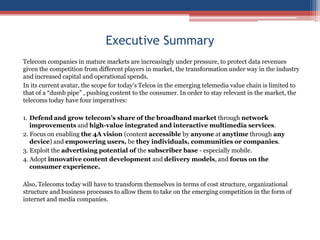
Executive SummaryTelecom companies in mature markets are increasingly under pressure, to protect data revenues given the competition from different players in market, the transformation under way in the industry and increased capital and operational spends. In its current avatar, the scope for today’s Telcos in the emerging telemedia value chain is limited to that of a “dumb pipe” , pushing content to the consumer. In order to stay relevant in the market, the telecoms today have four imperatives:1.	Defend and grow telecom’s share of the broadband market through network improvements and high-value integrated and interactive multimedia services.2. Focus on enabling the 4A vision (content accessible by anyone at anytime through any device) and empowering users, be they individuals, communities or companies.3. Exploit the advertising potential of the subscriber base - especially mobile.4. Adopt innovative content development and delivery models, and focus on the consumer experience.Also, Telecoms today will have to transform themselves in terms of cost structure, organizational structure and business processes to allow them to take on the emerging competition in the form of internet and media companies.
ROADMAP FOR PRESENTATIONUnderstanding the factors at playKey Recommendations
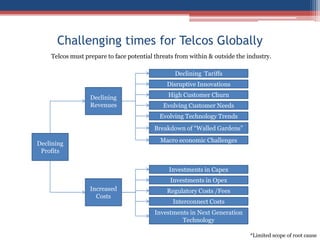
Challenging times for Telcos GloballyTelcos must prepare to face potential threats from within & outside the industry. Declining  TariffsDisruptive Innovations Declining RevenuesHigh Customer ChurnEvolving Customer Needs Evolving Technology Trends Breakdown of “Walled Gardens”Declining ProfitsMacro economic ChallengesInvestments in Capex Investments in OpexIncreased CostsRegulatory Costs /FeesInterconnect CostsInvestments in Next Generation Technology *Limited scope of root cause
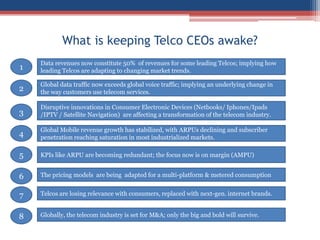
What is keeping Telco CEOs awake?Data revenues now constitute 50%  of revenues for some leading Telcos; implying how leading Telcos are adapting to changing market trends.  1Global data traffic now exceeds global voice traffic; implying an underlying change in the way customers use telecom services.2Disruptive innovations in Consumer Electronic Devices (Netbooks/ Iphones/Ipads /IPTV / Satellite Navigation)  are affecting a transformation of the telecom industry.3Global Mobile revenue growth has stabilized, with ARPUs declining and subscriber penetration reaching saturation in most industrialized markets.   4KPIs like ARPU are becoming redundant; the focus now is on margin (AMPU)5The pricing models  are being  adapted for a multi-platform & metered consumption 6Telcos are losing relevance with consumers, replaced with next-gen. internet brands.7Globally, the telecom industry is set for M&A; only the big and bold will survive.8
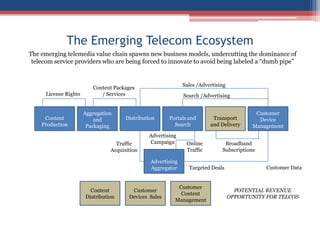
The Emerging Telecom EcosystemThe emerging telemedia value chain spawns new business models, undercutting the dominance of telecom service providers who are being forced to innovate to avoid being labeled a “dumb pipe” Sales /AdvertisingContent Packages / ServicesLicense RightsSearch /AdvertisingContent ProductionAggregation and PackagingDistributionPortals and SearchTransport and DeliveryCustomer Device ManagementAdvertising CampaignOnline TrafficBroadband SubscriptionsTraffic AcquisitionAdvertising AggregatorCustomer Data Targeted DealsContent DistributionCustomer Devices  SalesCustomer Content ManagementPOTENTIAL REVENUE OPPORTUNITY FOR TELCOS
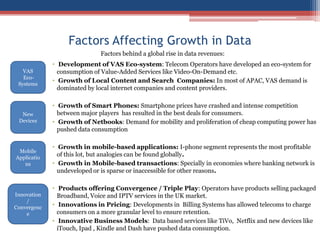
Factors Affecting Growth in Data Factors behind a global rise in data revenues: Development of VAS Eco-system: Telecom Operators have developed an eco-system for consumption of Value-Added Services like Video-On-Demand etc.
 Growth of Local Content and Search  Companies: In most of APAC, VAS demand is dominated by local internet companies and content providers.
 Growth of Smart Phones: Smartphone prices have crashed and intense competition between major players  has resulted in the best deals for consumers.
 Growth of Netbooks: Demand for mobility and proliferation of cheap computing power has pushed data consumption
Growth in mobile-based applications: I-phone segment represents the most profitable of this lot, but analogies can be found globally.
 Growth in Mobile-based transactions: Specially in economies where banking network is undeveloped or is sparse or inaccessible for other reasons.
 Products offering Convergence / Triple Play: Operators have products selling packaged Broadband, Voice and IPTV services in the UK market.
 Innovations in Pricing: Developments in  Billing Systems has allowed telecoms to charge consumers on a more granular level to ensure retention.
Innovative Business Models:  Data based services like TiVo,  Netflix and new devices like iTouch, Ipad , Kindle and Dash have pushed data consumption.VAS   Eco- SystemsNew DevicesMobile ApplicationsInnovation / Convergence
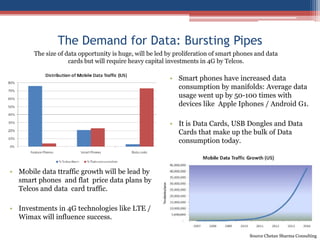
The Demand for Data: Bursting PipesThe size of data opportunity is huge, will be led by proliferation of smart phones and data cards but will require heavy capital investments in 4G by Telcos.Smart phones have increased data consumption by manifolds: Average data usage went up by 50-100 times with devices like  Apple Iphones / Android G1.
It is Data Cards, USB Dongles and Data Cards that make up the bulk of Data consumption today.
Mobile data ttraffic growth will be lead by smart phones  and flat  price data plans by Telcos and data  card traffic.
Investments in 4G technologies like LTE / Wimax will influence success.Source Chetan Sharma Consulting
ROADMAP FOR PRESENTATIONKey RecommendationsUnderstanding the factors at play
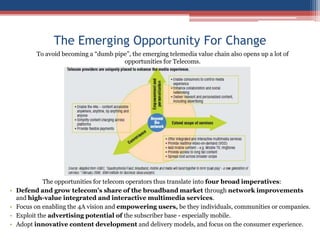
The Emerging Opportunity For ChangeTo avoid becoming a “dumb pipe”, the emerging telemedia value chain also opens up a lot of opportunities for Telecoms. The opportunities for telecom operators thus translate into four broad imperatives:Defend and grow telecom’s share of the broadband market through network improvements and high-value integrated and interactive multimedia services.Focus on enabling the 4A vision and empowering users, be they individuals, communities or companies.Exploit the advertising potential of the subscriber base - especially mobile.Adopt innovative content development and delivery models, and focus on the consumer experience.
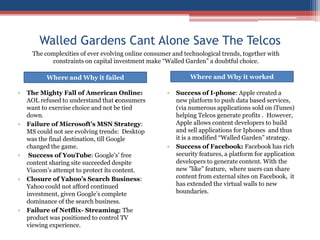
Walled Gardens Cant Alone Save The Telcos The complexities of ever evolving online consumer and technological trends, together with constraints on capital investment make “Walled Garden” a doubtful choice.Where and Why it workedWhere and Why it failedThe Mighty Fall of American Online:  AOL refused to understand that consumers want to exercise choice and not be tied down.  Failure of Microsoft’s MSN Strategy: MS could not see evolving trends:  Desktop was the final destination, till Google changed the game. Success of YouTube: Google's’ free content sharing site succeeded despite Viacom’s attempt to protect its content.Closure of Yahoo’s Search Business: Yahoo could not afford continued investment, given Google’s complete dominance of the search business.Failure of Netflix- Streaming: The product was positioned to control TV viewing experience.Success of I-phone: Apple created a  new platform to push data based services, (via numerousapplications sold on iTunes) helping Telcos generate profits .  However, Apple allows content developers to build and sell applications for Iphones  and thus it is a modified “Walled Garden” strategy.
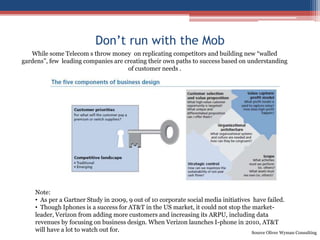
Success of Facebook: Facebook has rich security features, a platform for application developers to generate content. With the new ”like” feature,  where users can share content from external sites on Facebook,  it has extended the virtual walls to new boundaries.  Don’t run with the Mob While some Telecom s throw money  on replicating competitors and building new “walled gardens”, few  leading companies are creating their own paths to success based on understanding of customer needs . Note:   As per a Gartner Study in 2009, 9 out of 10 corporate social media initiatives  have failed.
  Though Iphones is a success for AT&T in the US market, it could not stop the market-leader, Verizon from adding more customers and increasing its ARPU, including data revenues by focusing on business design. When Verizon launches I-phone in 2010, AT&T will have a lot to watch out for. Source Oliver Wyman Consulting
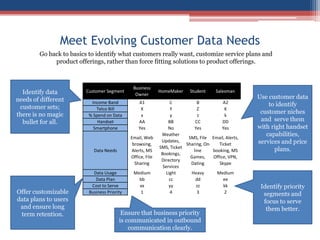
Meet Evolving Customer Data NeedsGo back to basics to identify what customers really want, customize service plans and product offerings, rather than force fitting solutions to product offerings.Identify data needs of different customer sets; there is no magic bullet for all.Use customer data to identify customer niches and  serve them with right handset capabilities, services and price plans.Identify priority segments and focus to serve them better.Offer customizable data plans to users and ensure long term retention. Ensure that business priority is communicated in outbound communication clearly.

Protecting data revenues

  • 1.
    Protecting Data Revenues: Positioning Telcos for growthTelecom revenues are declining. Data revenues have been critical for Telcos which have successfully followed a “walled garden” approach. But with Google and Apple, their revenues are fast declining. How should Telcos counter this threat from online players and retain a share of data revenues. Prepared By Charan Puneet Singh
  • 2.
    Executive SummaryTelecom companiesin mature markets are increasingly under pressure, to protect data revenues given the competition from different players in market, the transformation under way in the industry and increased capital and operational spends. In its current avatar, the scope for today’s Telcos in the emerging telemedia value chain is limited to that of a “dumb pipe” , pushing content to the consumer. In order to stay relevant in the market, the telecoms today have four imperatives:1. Defend and grow telecom’s share of the broadband market through network improvements and high-value integrated and interactive multimedia services.2. Focus on enabling the 4A vision (content accessible by anyone at anytime through any device) and empowering users, be they individuals, communities or companies.3. Exploit the advertising potential of the subscriber base - especially mobile.4. Adopt innovative content development and delivery models, and focus on the consumer experience.Also, Telecoms today will have to transform themselves in terms of cost structure, organizational structure and business processes to allow them to take on the emerging competition in the form of internet and media companies.
  • 3.
    ROADMAP FOR PRESENTATIONUnderstandingthe factors at playKey Recommendations
  • 4.
    Challenging times forTelcos GloballyTelcos must prepare to face potential threats from within & outside the industry. Declining TariffsDisruptive Innovations Declining RevenuesHigh Customer ChurnEvolving Customer Needs Evolving Technology Trends Breakdown of “Walled Gardens”Declining ProfitsMacro economic ChallengesInvestments in Capex Investments in OpexIncreased CostsRegulatory Costs /FeesInterconnect CostsInvestments in Next Generation Technology *Limited scope of root cause
  • 5.
    What is keepingTelco CEOs awake?Data revenues now constitute 50% of revenues for some leading Telcos; implying how leading Telcos are adapting to changing market trends. 1Global data traffic now exceeds global voice traffic; implying an underlying change in the way customers use telecom services.2Disruptive innovations in Consumer Electronic Devices (Netbooks/ Iphones/Ipads /IPTV / Satellite Navigation) are affecting a transformation of the telecom industry.3Global Mobile revenue growth has stabilized, with ARPUs declining and subscriber penetration reaching saturation in most industrialized markets. 4KPIs like ARPU are becoming redundant; the focus now is on margin (AMPU)5The pricing models are being adapted for a multi-platform & metered consumption 6Telcos are losing relevance with consumers, replaced with next-gen. internet brands.7Globally, the telecom industry is set for M&A; only the big and bold will survive.8
  • 6.
    The Emerging TelecomEcosystemThe emerging telemedia value chain spawns new business models, undercutting the dominance of telecom service providers who are being forced to innovate to avoid being labeled a “dumb pipe” Sales /AdvertisingContent Packages / ServicesLicense RightsSearch /AdvertisingContent ProductionAggregation and PackagingDistributionPortals and SearchTransport and DeliveryCustomer Device ManagementAdvertising CampaignOnline TrafficBroadband SubscriptionsTraffic AcquisitionAdvertising AggregatorCustomer Data Targeted DealsContent DistributionCustomer Devices SalesCustomer Content ManagementPOTENTIAL REVENUE OPPORTUNITY FOR TELCOS
  • 7.
    Factors Affecting Growthin Data Factors behind a global rise in data revenues: Development of VAS Eco-system: Telecom Operators have developed an eco-system for consumption of Value-Added Services like Video-On-Demand etc.
  • 8.
    Growth ofLocal Content and Search Companies: In most of APAC, VAS demand is dominated by local internet companies and content providers.
  • 9.
    Growth ofSmart Phones: Smartphone prices have crashed and intense competition between major players has resulted in the best deals for consumers.
  • 10.
    Growth ofNetbooks: Demand for mobility and proliferation of cheap computing power has pushed data consumption
  • 11.
    Growth in mobile-basedapplications: I-phone segment represents the most profitable of this lot, but analogies can be found globally.
  • 12.
    Growth inMobile-based transactions: Specially in economies where banking network is undeveloped or is sparse or inaccessible for other reasons.
  • 13.
    Products offeringConvergence / Triple Play: Operators have products selling packaged Broadband, Voice and IPTV services in the UK market.
  • 14.
    Innovations inPricing: Developments in Billing Systems has allowed telecoms to charge consumers on a more granular level to ensure retention.
  • 15.
    Innovative Business Models: Data based services like TiVo, Netflix and new devices like iTouch, Ipad , Kindle and Dash have pushed data consumption.VAS Eco- SystemsNew DevicesMobile ApplicationsInnovation / Convergence
  • 16.
    The Demand forData: Bursting PipesThe size of data opportunity is huge, will be led by proliferation of smart phones and data cards but will require heavy capital investments in 4G by Telcos.Smart phones have increased data consumption by manifolds: Average data usage went up by 50-100 times with devices like Apple Iphones / Android G1.
  • 17.
    It is DataCards, USB Dongles and Data Cards that make up the bulk of Data consumption today.
  • 18.
    Mobile data ttrafficgrowth will be lead by smart phones and flat price data plans by Telcos and data card traffic.
  • 19.
    Investments in 4Gtechnologies like LTE / Wimax will influence success.Source Chetan Sharma Consulting
  • 20.
    ROADMAP FOR PRESENTATIONKeyRecommendationsUnderstanding the factors at play
  • 21.
    The Emerging OpportunityFor ChangeTo avoid becoming a “dumb pipe”, the emerging telemedia value chain also opens up a lot of opportunities for Telecoms. The opportunities for telecom operators thus translate into four broad imperatives:Defend and grow telecom’s share of the broadband market through network improvements and high-value integrated and interactive multimedia services.Focus on enabling the 4A vision and empowering users, be they individuals, communities or companies.Exploit the advertising potential of the subscriber base - especially mobile.Adopt innovative content development and delivery models, and focus on the consumer experience.
  • 22.
    Walled Gardens CantAlone Save The Telcos The complexities of ever evolving online consumer and technological trends, together with constraints on capital investment make “Walled Garden” a doubtful choice.Where and Why it workedWhere and Why it failedThe Mighty Fall of American Online: AOL refused to understand that consumers want to exercise choice and not be tied down. Failure of Microsoft’s MSN Strategy: MS could not see evolving trends: Desktop was the final destination, till Google changed the game. Success of YouTube: Google's’ free content sharing site succeeded despite Viacom’s attempt to protect its content.Closure of Yahoo’s Search Business: Yahoo could not afford continued investment, given Google’s complete dominance of the search business.Failure of Netflix- Streaming: The product was positioned to control TV viewing experience.Success of I-phone: Apple created a new platform to push data based services, (via numerousapplications sold on iTunes) helping Telcos generate profits . However, Apple allows content developers to build and sell applications for Iphones and thus it is a modified “Walled Garden” strategy.
  • 23.
    Success of Facebook:Facebook has rich security features, a platform for application developers to generate content. With the new ”like” feature, where users can share content from external sites on Facebook, it has extended the virtual walls to new boundaries. Don’t run with the Mob While some Telecom s throw money on replicating competitors and building new “walled gardens”, few leading companies are creating their own paths to success based on understanding of customer needs . Note: As per a Gartner Study in 2009, 9 out of 10 corporate social media initiatives have failed.
  • 24.
    ThoughIphones is a success for AT&T in the US market, it could not stop the market-leader, Verizon from adding more customers and increasing its ARPU, including data revenues by focusing on business design. When Verizon launches I-phone in 2010, AT&T will have a lot to watch out for. Source Oliver Wyman Consulting
  • 25.
    Meet Evolving CustomerData NeedsGo back to basics to identify what customers really want, customize service plans and product offerings, rather than force fitting solutions to product offerings.Identify data needs of different customer sets; there is no magic bullet for all.Use customer data to identify customer niches and serve them with right handset capabilities, services and price plans.Identify priority segments and focus to serve them better.Offer customizable data plans to users and ensure long term retention. Ensure that business priority is communicated in outbound communication clearly.
  • 26.
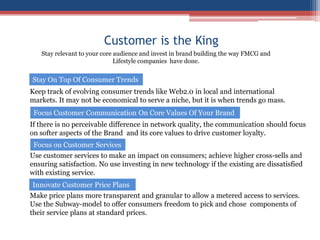
    Customer is theKingStay relevant to your core audience and invest in brand building the way FMCG and Lifestyle companies have done.Stay On Top Of Consumer TrendsKeep track of evolving consumer trends like Web2.0 in local and international markets. It may not be economical to serve a niche, but it is when trends go mass.Focus Customer Communication On Core Values Of Your BrandIf there is no perceivable difference in network quality, the communication should focus on softer aspects of the Brand and its core values to drive customer loyalty. Focus on Customer Services Use customer services to make an impact on consumers; achieve higher cross-sells and ensuring satisfaction. No use investing in new technology if the existing are dissatisfied with existing service.Innovate Customer Price Plans Make price plans more transparent and granular to allow a metered access to services. Use the Subway-model to offer consumers freedom to pick and chose components of their service plans at standard prices.
  • 27.
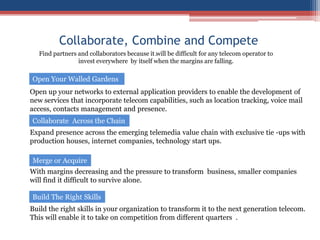
    Collaborate, Combine andCompete.Find partners and collaborators because it will be difficult for any telecom operator to invest everywhere by itself when the margins are falling.Open Your Walled Gardens Open up your networks to external application providers to enable the development of new services that incorporate telecom capabilities, such as location tracking, voice mail access, contacts management and presence. Collaborate Across the ChainExpand presence across the emerging telemedia value chain with exclusive tie -ups with production houses, internet companies, technology start ups. Merge or AcquireWith margins decreasing and the pressure to transform business, smaller companies will find it difficult to survive alone. Build The Right SkillsBuild the right skills in your organization to transform it to the next generation telecom. This will enable it to take on competition from different quarters .
  • 28.
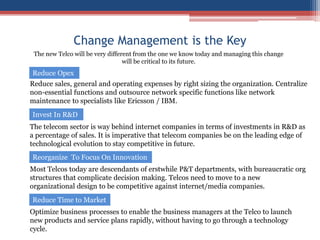
    Change Management isthe KeyThe new Telco will be very different from the one we know today and managing this change will be critical to its future.Reduce Opex Reduce sales, general and operating expenses by right sizing the organization. Centralize non-essential functions and outsource network specific functions like network maintenance to specialists like Ericsson / IBM. Invest In R&D The telecom sector is way behind internet companies in terms of investments in R&D as a percentage of sales. It is imperative that telecom companies be on the leading edge of technological evolution to stay competitive in future.Reorganize To Focus On InnovationMost Telcos today are descendants of erstwhile P&T departments, with bureaucratic org structures that complicate decision making. Telcos need to move to a new organizational design to be competitive against internet/media companies.Reduce Time to MarketOptimize business processes to enable the business managers at the Telco to launch new products and service plans rapidly, without having to go through a technology cycle.
  • 29.
  • 30.
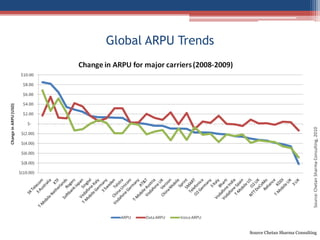
    Global ARPU TrendsSourceChetan Sharma Consulting
  • 31.
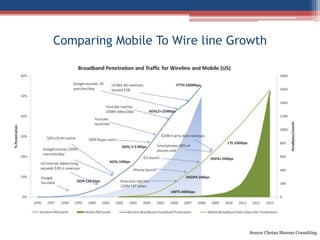
    Comparing Mobile ToWire line GrowthSource Chetan Sharma Consulting
  • 32.
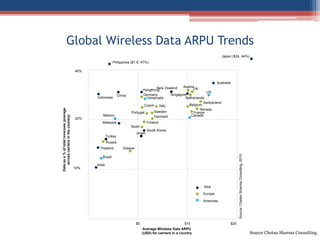
    Global Wireless DataARPU TrendsSource Chetan Sharma Consulting
  • 33.
  • 34.
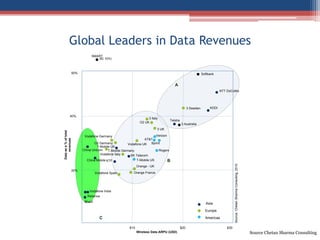
    Global Leaders inData RevenuesSource Chetan Sharma Consulting
  • 35.
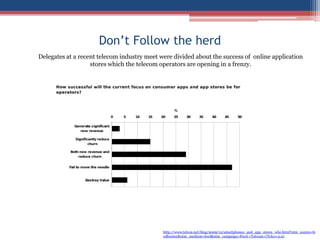
    Don’t Follow theherdDelegates at a recent telecom industry meet were divided about the success of online application stores which the telecom operators are opening in a frenzy.http://www.telco2.net/blog/2009/12/smartphones_and_app_stores_whe.html?utm_source=feedburner&utm_medium=feed&utm_campaign=Feed:+Telco20+(Telco+2.0)
  • 36.
    References:“THE ENTERPRISE OFTHE FUTURE – TELECOM INDUSTRY EDITION” IBM GLOBAL CEO Study “ Managing Growth and Profits in Yettobyte Era” Chetan Sharma Consultants“A Future In Content(ion): Can Telecom Providers Win A Share Of The Digital Content Market? “IBM Global Business Services “The Upside for Telecom Operators: Turning strategic threats into growth opportunities”Oliver Wyman
  • 37.
    ContactCharan Puneet Singh
AccountManager - APAC Region
ThoughtWorksStudiosConnect on Linkedin