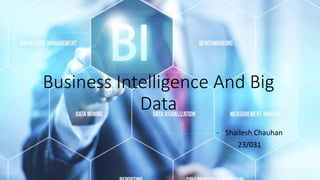

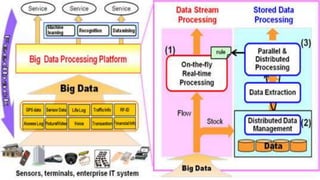



Business Intelligence And Big
Data
- Shailesh Chauhan
23/031
INTRODUCTION
What Is Business Intelligence
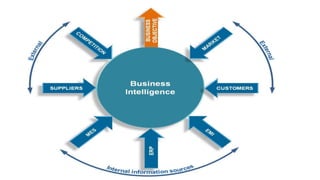
• Business Intelligence (BI) are the set of strategies, processes, applications, data,
products, technologies and technical architectures which are used to support
the collection, analysis, presentation and dissemination of business
information.
• BI technologies provide historical, current and predictive views of business
operations.
• Common functions of business intelligence technologies are reporting, online
analytical processing, analytics, data mining, process mining, complex event
processing etc.
• The goal is to allow for the easy interpretation of these big data. Identifying
new opportunities and implementing an effective strategy based on insights
can provide businesses with a competitive market advantage and long-term
stability.
CONTD…..
Business intelligence is made up of an increasing number of components
including:
• Multidimensional aggregation and allocation
• Denormalization, tagging and standardization
• Realtime reporting with analytical alert
• A method of interfacing with unstructured data sources
• Group consolidation, budgeting and rolling forecasts
• Statistical inference and probabilistic simulation
• Key performance indicators optimization
• Version control and process management
• Open item management
What Is Big Data
• Big data is a term for data sets that are so large or complex that
traditional data processing applications are inadequate to deal with
them.
• Challenges include analysis, capture, data curation, search, sharing,
storage, transfer, visualization, querying, updating and information
privacy.
• The term "big data" refers to the use of predictive analytics, user
behavior analytics, or certain other advanced data analytics methods
that extract value from data, and seldom to a particular size of data
set.
CONTD..
• Analysis of data sets can find new correlations to "spot business trends, prevent
diseases, combat crime and so on".
• Data sets grow rapidly - in part because they are increasingly gathered by cheap and
numerous information-sensing mobile devices, aerial (remote sensing), software logs,
cameras, microphones, radio-frequency identification (RFID) readers and wireless
sensor networks.
• The world's technological per-capita capacity to store information has roughly
doubled every 40 months since the 1980s; as of 2012, every day 2.5 exabytes
(2.5×10¹⁸) of data is generated. One question for large enterprises is determining
who should own big-data initiatives that affect the entire organization.
• Relational database management systems and desktop statistics- and visualization-
packages often have difficulty handling big data. The work may require "massively
parallel software running on tens, hundreds, or even thousands of servers".
Tool/Relation Between Business Intelligence
and Big Data
• First Commandment: Thou Shalt Not Move Big Data
• Second Commandment: Thou Shalt Not Steal!…Or Violate Corporate Security
Policy
• Third Commandment: Thou Shalt Not Pay for Each User, Nor Every Gigabyte
• Fourth Commandment: Thou Shalt Covet Thy Neighbor’s Visualizations
• Fifth Commandment: Thou Shalt Analyze Thy Data In Its Natural Form
• Sixth Commandment: Thou Shalt Not Wait Endlessly For Thine Results
• Seventh Commandment: Thou Shalt Not Build Reports, But Apps Instead
• Eighth Commandment: Thou Shalt Use Intelligent Tools
• Ninth Commandment: Thou Shalt Go Beyond The Basics
• Tenth Commandment: Thou Shalt Not Just Stand There On the Shore of the
Data Lake Waiting for a Data Scientist To Do the Work
Business Intelligence
Advantages
• Facilitate the reporting service
• Facilitate budgeting
• Facilitating forecasting
• Facilitate the promotional efforts
Disadvantages
• Business Intelligence (BI) systems could take a lot of costs in term of monetary
expenses and human resource.
- For example, it is costly for small companies to buy or develop the relevant
Business Intelligence (BI) tools and even they have the Business Intelligence (BI)
tools in hand, the company needs to have the professionals for the training and
maintaining purposes.
• Secondly, the use of Business Intelligence (BI) tools could also expose the
company information to various risks.
-For example, as we have mentioned above, Intelligence (BI) could be done in
the third party reporting environment and users with the related authorization
could get access to the information that they are empowered to view.
BIG DATA
Advantages
• It allows businesses to detect errors and fraud quickly. This significantly mitigates against
losses.
• It provides major advantages from a competitive standpoint. Real-time analysis allows
businesses to develop more effective strategies towards competitors in less time,
offering deep insight into consumer trends and sales.
• In addition, data collected is valuable and offers businesses a chance to improve profits
and customer service.
• Perhaps the greatest argument in favor of real-time analysis of big data is that it may be
used to provide cutting-edge healthcare.
• Proponents of big data point out that healthcare organizations can use electronic medical
records and data from wearables to prevent deadly hospital infections,
-For example. To these proponents, privacy cannot trump the lives big data might save.
Disadvantages
• The logistical issue
Companies hoping to use big data will need to modify their entire approach as data
flowing into the company becomes constant rather than periodic: this mandates
major strategic changes for many businesses.
• Real-time big data
It demands the ability to conduct sophisticated analyses; companies who fail to do
this correctly open themselves up to implementing entirely incorrect strategies
organization-wide. Furthermore, many currently used data tools are not able to
handle real-time analysis.
• Privacy
-Civil liberties advocates have attacked the use of big data from license plate
scanners and drones, for example. The idea is that authorities should not be able to
circumvent constitutional protections against unreasonable searches.
Business intelligence and big data

Business intelligence and big data

  • 1.
    Business Intelligence AndBig Data - Shailesh Chauhan 23/031
  • 2.
  • 4.
    What Is BusinessIntelligence • Business Intelligence (BI) are the set of strategies, processes, applications, data, products, technologies and technical architectures which are used to support the collection, analysis, presentation and dissemination of business information. • BI technologies provide historical, current and predictive views of business operations. • Common functions of business intelligence technologies are reporting, online analytical processing, analytics, data mining, process mining, complex event processing etc. • The goal is to allow for the easy interpretation of these big data. Identifying new opportunities and implementing an effective strategy based on insights can provide businesses with a competitive market advantage and long-term stability.
  • 5.
    CONTD….. Business intelligence ismade up of an increasing number of components including: • Multidimensional aggregation and allocation • Denormalization, tagging and standardization • Realtime reporting with analytical alert • A method of interfacing with unstructured data sources • Group consolidation, budgeting and rolling forecasts • Statistical inference and probabilistic simulation • Key performance indicators optimization • Version control and process management • Open item management
  • 7.
    What Is BigData • Big data is a term for data sets that are so large or complex that traditional data processing applications are inadequate to deal with them. • Challenges include analysis, capture, data curation, search, sharing, storage, transfer, visualization, querying, updating and information privacy. • The term "big data" refers to the use of predictive analytics, user behavior analytics, or certain other advanced data analytics methods that extract value from data, and seldom to a particular size of data set.
  • 8.
    CONTD.. • Analysis ofdata sets can find new correlations to "spot business trends, prevent diseases, combat crime and so on". • Data sets grow rapidly - in part because they are increasingly gathered by cheap and numerous information-sensing mobile devices, aerial (remote sensing), software logs, cameras, microphones, radio-frequency identification (RFID) readers and wireless sensor networks. • The world's technological per-capita capacity to store information has roughly doubled every 40 months since the 1980s; as of 2012, every day 2.5 exabytes (2.5×10¹⁸) of data is generated. One question for large enterprises is determining who should own big-data initiatives that affect the entire organization. • Relational database management systems and desktop statistics- and visualization- packages often have difficulty handling big data. The work may require "massively parallel software running on tens, hundreds, or even thousands of servers".
  • 9.
    Tool/Relation Between BusinessIntelligence and Big Data • First Commandment: Thou Shalt Not Move Big Data • Second Commandment: Thou Shalt Not Steal!…Or Violate Corporate Security Policy • Third Commandment: Thou Shalt Not Pay for Each User, Nor Every Gigabyte • Fourth Commandment: Thou Shalt Covet Thy Neighbor’s Visualizations • Fifth Commandment: Thou Shalt Analyze Thy Data In Its Natural Form • Sixth Commandment: Thou Shalt Not Wait Endlessly For Thine Results • Seventh Commandment: Thou Shalt Not Build Reports, But Apps Instead • Eighth Commandment: Thou Shalt Use Intelligent Tools • Ninth Commandment: Thou Shalt Go Beyond The Basics • Tenth Commandment: Thou Shalt Not Just Stand There On the Shore of the Data Lake Waiting for a Data Scientist To Do the Work
  • 10.
  • 11.
    Advantages • Facilitate thereporting service • Facilitate budgeting • Facilitating forecasting • Facilitate the promotional efforts
  • 12.
    Disadvantages • Business Intelligence(BI) systems could take a lot of costs in term of monetary expenses and human resource. - For example, it is costly for small companies to buy or develop the relevant Business Intelligence (BI) tools and even they have the Business Intelligence (BI) tools in hand, the company needs to have the professionals for the training and maintaining purposes. • Secondly, the use of Business Intelligence (BI) tools could also expose the company information to various risks. -For example, as we have mentioned above, Intelligence (BI) could be done in the third party reporting environment and users with the related authorization could get access to the information that they are empowered to view.
  • 13.
  • 14.
    Advantages • It allowsbusinesses to detect errors and fraud quickly. This significantly mitigates against losses. • It provides major advantages from a competitive standpoint. Real-time analysis allows businesses to develop more effective strategies towards competitors in less time, offering deep insight into consumer trends and sales. • In addition, data collected is valuable and offers businesses a chance to improve profits and customer service. • Perhaps the greatest argument in favor of real-time analysis of big data is that it may be used to provide cutting-edge healthcare. • Proponents of big data point out that healthcare organizations can use electronic medical records and data from wearables to prevent deadly hospital infections, -For example. To these proponents, privacy cannot trump the lives big data might save.
  • 15.
    Disadvantages • The logisticalissue Companies hoping to use big data will need to modify their entire approach as data flowing into the company becomes constant rather than periodic: this mandates major strategic changes for many businesses. • Real-time big data It demands the ability to conduct sophisticated analyses; companies who fail to do this correctly open themselves up to implementing entirely incorrect strategies organization-wide. Furthermore, many currently used data tools are not able to handle real-time analysis. • Privacy -Civil liberties advocates have attacked the use of big data from license plate scanners and drones, for example. The idea is that authorities should not be able to circumvent constitutional protections against unreasonable searches.