Station #1:
• At this station you will:
1. Fill out information on eruptions
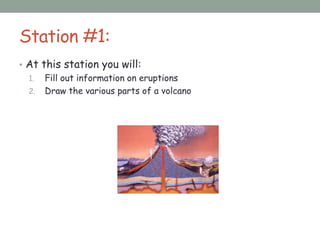
2. Draw the various parts of a volcano
Volcanoes in General
What is an eruption?
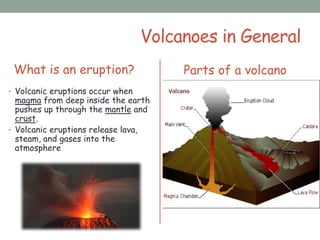
• Volcanic eruptions occur when
magma from deep inside the earth
pushes up through the mantle and
crust.
• Volcanic eruptions release lava,
steam, and gases into the
atmosphere
Parts of a volcano
Station #2:
• At this station you will:
1. Describe the different classification of volcanoes
2. Write down examples of volcanoes that are active, dormant,
or extinct
3. Complete a math problem on eruptions
Volcanoes in General
Dormant: Has not
erupted for some
time, but is expected
to erupt in the future
Classifying
volcanoes
Active: One eruption
in the last 10,000 yrs.
Extinct: Has not
erupted in the past
10,000 yrs. and is not
expected to erupt
again
Kilauea Volcano, Hawaii
Mount Ararat, Turkey
Morne Diablotins, Dominica
PROBLEM#1
Some volcanoes erupt on a regular
schedule. Scientists believe that Yellowstone
National Park in Wyoming sits on top of a
supervolcano that first erupted 2 million years ago.
They believe that it has erupted every 700,000
years since.
The Eyjafjallajokull volcano in southern
Iceland erupted on March 20,2010. This was the
same day it erupted 200 years earlier.
If a volcano erupted in the year 1055 for
the first time and has erupted every 225 years
since, how may times has it erupted since 1055?
What was the most recent year it erupted? When
is the next eruption due if it continues to erupt on
schedule?
Station #3:
• At this station you will:
1. Describe the VEI scale
2. Discover how volcanoes are described based on the VEI
3. Determine if other planets have volcanoes
4. Research on the computer
5. Complete the math problem on Io
Volcanoes in General
Plotting the Power?
The Volcanic Explosivity Index
(VEI) scale is used to plot the
power of a volcano.
VEI = 0
Nonexplosive underwater volcanoes called
seamounts score a “0” on the VEI scale
Loihi Seamount pictured above.
VEI = 8
Volcanoes that score an “8” on the VEI
scale are referred to as supervolcanoes
Ash/debris
cover from
Yellowstone
Volcanoes in GeneralDootherplanetshave
volcanoes?
Venus
Mercury
Mars
Venus is covered in volcanoes
that are potentially still active!
Craters caused by volcanic
eruptions also cover the surface
of Mercury and are believed to
be extinct.
Volcanoes on Mars are 10 to 100
times larger than those on Earth.
Olympus Mons is the largest in
the solar system.
PROBLEM#2
Jupiter‟s moon Io is home to all types of volcanic
activity. Scientists have observed eruptive centers,
which are locations of major volcanic activity, as well as
depressions in the ground called paterae. Io also has
many lava flows. The following chart is a list of seven
lava flows on Io. Use the chart to answer the questions
below.
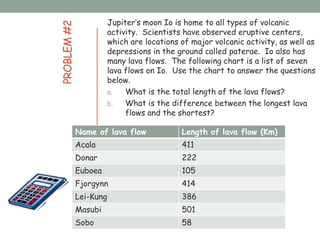
a. What is the total length of the lava flows?
b. What is the difference between the longest lava
flows and the shortest?
Name of lava flow Length of lava flow (Km)
Acala 411
Donar 222
Euboea 105
Fjorgynn 414
Lei-Kung 386
Masubi 501
Sobo 58
Station #4:
• At this station you will:
1. Differentiate between explosive and non-explosive eruptions
by filling out the chart
2. Research an example of a seamount
3. Complete the math problem on traveling volcanic ash
Non-Explosive Eruptions
Non-explosive eruptions are
the most common type of
eruption.
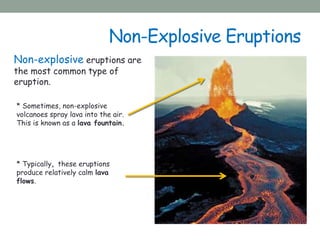
* Sometimes, non-explosive
volcanoes spray lava into the air.
This is known as a lava fountain.
* Typically, these eruptions
produce relatively calm lava
flows.
Non-Explosive Eruptions
Non-explosive Eruptions
• The Northwest region of the United
States and the sea floor is covered
from lava of non-explosive eruptions
• Seamounts account for more than
20% of the Earth‟s volcanoes
Estimated locations of
seamounts throughout the
Earth‟s oceans.
Explosive Eruptions
Explosive eruptions are rare
compared to non-explosive
eruptions.
• Clouds of hot debris, ash, and gas
rapidly shoot out of the volcano
• Effects of explosive eruptions can
be incredibly destructive
• Can demolish an entire mountainside
Example: Mount St. Helens
before and after split picture.
Explosive Eruptions
Explosive Eruptions
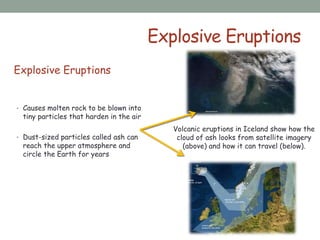
• Causes molten rock to be blown into
tiny particles that harden in the air
• Dust-sized particles called ash can
reach the upper atmosphere and
circle the Earth for years
Volcanic eruptions in Iceland show how the
cloud of ash looks from satellite imagery
(above) and how it can travel (below).
PROBLEM#3
A new volcano erupted for the first time on June 4,
2011 in Chile. Ash from the volcano reached the
Australian island of Tasmania on June 13. If
Tasmania and Chile are about 6,000 miles apart,
how many miles did the ash cloud travel each day?
Station #5:
• At this station you will:
1. Sketch different parts of the volcano that are involved in
magma storage and eruptions
2. Determine what components of magma influence the level of
explosivity
3. Research on „Volcano Explorer‟ how viscosity and gas
concentration influence the eruption -
http://kids.discovery.com/games/build-play/volcano-explorer
Magma
Where is magma located?
• Magma is stored in a deep
underground section of the Earth
that feeds the volcano known as the
magma chamber
• Magma rises from the magma
chamber through cracks in the
Earth‟s crust known as vents
• Magma is released from the vents
during an eruption
** The key to explosive eruptions lies in the
silica, water, and gas content of the magma**
What makes
up magma?
The composition
of magma
determines
whether or not
an eruption is
explosive.
Magma
Station #6:
• At this station you will:
1. Describe how water and silica influence magma
2. Discover various lava types
3. Use your textbook or the internet to determine the viscosity
of the various lava types
4. Complete the math problem on Krakatoa and sound
Magma
High Water Content High Silica Content
• Water that is dissolved in
magma quickly turns to gas and
expands during an eruption
• The rapid change causes an
explosion
* Similar to shaking a can of soda
and then opening*
• Silica-rich magma is extremely
stiff and flows slowly
• The magma hardens in the
vents and causes pressure to
build up
• The build up of pressure, gas,
and magma causes an explosion
There are several types of lava:
Aa
(Brittle crust)
Pahoehoe
(Rounded wrinkles)
Pillow lava
(Underwater formation, rounded lumps)
Blocky lava
(Sharp-edged chunks)
Magma will be
considered lava if
it is liquid and
flowing from the
volcanic vent.
** Non-explosive
eruptions produce
mostly lava **
Magma and Lava
PROBLEM#4
The speed of sound is a measure of how fast sound
waves travel. Sound waves travel at different
speeds through air or through liquid. If the sound
of Krakatoa volcano traveled through the air at
720 miles an hour; how far did it travel in 1 minute?
How far did the sound travel in 2.8 hours?
Station #7:
• At this station you will:
1. Describe when magma is considered pyroclastic material
2. Describe pyroclastic flows and the dangers
3. Watch a clip from Dante‟s Peak and determine something
realistic and dramatized in the movie
Four types of pyroclastic material:
Volcanic Bombs
(Large magma blobs)
Volcanic Blocks
(Large pieces of solid rock)
Lapilli
(“Little rocks”)
Volcanic ash
(Majority of material
caused by rapid expansion of gas)
Magma will be
considered
pyroclastic
material if it is
blasted into the
air and hardens.
** Explosive
eruptions produce
mostly pyroclastic
material **
Magma and Pyroclastic Material
Pyroclastic flows are produced when enormous
amounts of hot ash, dust, and gases are
ejected from a volcano.Pyroclastic
flow is particularly
dangerous because it
can travel faster than
hurricane force
winds!
Pyroclastic Flow
Above: Pyroclastic flow of the 1991
eruption of Mount Pinatubo in the Philippines
Station #8:
• At this station you will:
1. Describe the benefits of volcanoes
2. Complete the math problem on researching volcanoes
** You will only have benefits filled out on the table by the end
of this station, hazards are at station #9 **
BENEFITS
Volcano Hazards and Benefits
Information about the Earth
Volcanologists and other scientists can gain information
about the Earth‟s interior.
Geothermal heat
The underground heat can be harnessed to heat water and
to power cities.
Rich soil to grow crops
Some volcanic soils are rich in minerals that can help grow
rice, vegetables, and fruit crops.
Rock for materials/products
Building materials such as cement and concrete blocks can
be made from rocks such as pumice. It is also used to make
cleaners, soaps, and cosmetics.
PROBLEM#5
Robots have been used to work in areas such as
Mount Erebus in Antarctica, the southernmost
active volcano on earth. Suppose it costs $3.14
million to operate one robot for one year in
Antarctica. It costs $3.14 million for two
volcanologists including their equipment to do the
same job. The cost of their equipment is $2.12
million . How much does it cost for one
volcanologist to work for a year in Antarctica, not
including equipment?
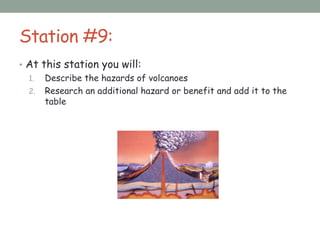
Station #9:
• At this station you will:
1. Describe the hazards of volcanoes
2. Research an additional hazard or benefit and add it to the
table
HAZARDS Volcano Hazards and Benefits
Climate Change
The volcanic ash and gases that spread throughout
the atmosphere can alter the average global
temperature.
Loss of life
Volcanoes have killed more than 225,000 people
during the past 400 years.
Cost of destruction
The cost of destruction by volcanoes is almost
impossible to calculate since the damage caused to
the environment may not be known for years.
Station #10:
• At this station you will:
1. Describe characteristics of three volcano types
2. Sketch the volcano types
3. Write an example of each volcano type
Shield
Volcanoes:
Shield volcanoes are
built of layers of lava
from non-explosive
eruptions.
Types of Volcanoes
• Runny lava
• Spreads over a wide area
• Gently sloping sides
Mauna Kea in Hawaii is the tallest mountain on Earth
Cinder Cone
Volcanoes:
Made from pyroclastic
material produced
from moderately
explosive eruptions.
Types of Volcanoes
• Typically occur in clusters
• Small
• Erupt for a short time
• Steep slopes
Paricutin erupted for only nine years
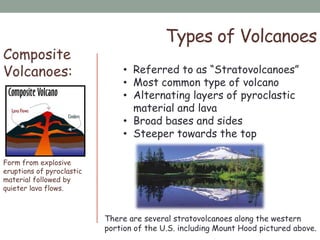
Composite
Volcanoes:
Form from explosive
eruptions of pyroclastic
material followed by
quieter lava flows.
Types of Volcanoes
• Referred to as “Stratovolcanoes”
• Most common type of volcano
• Alternating layers of pyroclastic
material and lava
• Broad bases and sides
• Steeper towards the top
There are several stratovolcanoes along the western
portion of the U.S. including Mount Hood pictured above.
Station #11:
• At this station you will:
1. Describe landforms formed from volcanic activity
2. Sketch the various landforms
3. Research an example of each landform using the Internet
Volcanic activity
may produce
other landforms:
Other Volcanic Landforms
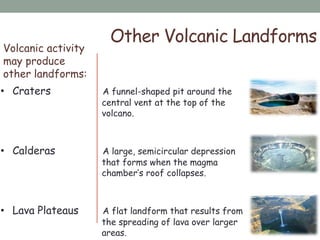
• Craters A funnel-shaped pit around the
central vent at the top of the
volcano.
• Calderas A large, semicircular depression
that forms when the magma
chamber‟s roof collapses.
• Lava Plateaus A flat landform that results from
the spreading of lava over larger
areas.
End of stations
• Below are warm-ups used the two days following the
stations.
WARM-UP:
• Discuss the difference between lava
and pyroclastic material
• List as many types of lava and
pyroclastic material that you can
There are several types of lava:
Aa
(Brittle crust)
Pahoehoe
(Rounded wrinkles)
Pillow lava
(Underwater formation, rounded lumps)
Blocky lava
(Sharp-edged chunks)
Magma will be
considered lava if
it is liquid and
flowing from the
volcanic vent.
** Non-explosive
eruptions produce
mostly lava **
Magma and Lava
Four types of pyroclastic material:
Volcanic Bombs
(Large magma blobs)
Volcanic Blocks
(Large pieces of solid rock)
Lapilli
(“Little rocks”)
Volcanic ash
(Majority of material
caused by rapid expansion of gas)
Magma will be
considered
pyroclastic
material if it is
blasted into the
air and hardens.
** Explosive
eruptions produce
mostly pyroclastic
material **
Magma and Pyroclastic Material
Directions:
1. Use the Play-doh to construct the three types of volcanoes
2. Designate one color to be lava and the other to be pyroclastic
material
3. Construct the volcano and then sketch your drawing on your
paper
-- Please keep the play-doh in separate colors!
** Underneath your drawing list the types of eruptions that must
occur for those volcano types to form **
Shield Volcano
• Made of runny lava
• Large areas covered
• Gently sloping dome
• Largest (by area covered) and flattest
• Loosely arranged
• Usually are in clusters
• Not very high
• Made of cinders, bombs, ash, dust
• Smallest and steepest type of volcano
Cinder Cone
Volcano
Composite
Volcano
• Made of alternate layers of cinders and lava
• Tallest of all volcano types (medium-sized
base)
• Broad bases and sides
• Steeper towards the top

Volcano stations

  • 1.
    Station #1: • Atthis station you will: 1. Fill out information on eruptions 2. Draw the various parts of a volcano
  • 2.
    Volcanoes in General Whatis an eruption? • Volcanic eruptions occur when magma from deep inside the earth pushes up through the mantle and crust. • Volcanic eruptions release lava, steam, and gases into the atmosphere Parts of a volcano
  • 3.
    Station #2: • Atthis station you will: 1. Describe the different classification of volcanoes 2. Write down examples of volcanoes that are active, dormant, or extinct 3. Complete a math problem on eruptions
  • 4.
    Volcanoes in General Dormant:Has not erupted for some time, but is expected to erupt in the future Classifying volcanoes Active: One eruption in the last 10,000 yrs. Extinct: Has not erupted in the past 10,000 yrs. and is not expected to erupt again Kilauea Volcano, Hawaii Mount Ararat, Turkey Morne Diablotins, Dominica
  • 5.
    PROBLEM#1 Some volcanoes erupton a regular schedule. Scientists believe that Yellowstone National Park in Wyoming sits on top of a supervolcano that first erupted 2 million years ago. They believe that it has erupted every 700,000 years since. The Eyjafjallajokull volcano in southern Iceland erupted on March 20,2010. This was the same day it erupted 200 years earlier. If a volcano erupted in the year 1055 for the first time and has erupted every 225 years since, how may times has it erupted since 1055? What was the most recent year it erupted? When is the next eruption due if it continues to erupt on schedule?
  • 6.
    Station #3: • Atthis station you will: 1. Describe the VEI scale 2. Discover how volcanoes are described based on the VEI 3. Determine if other planets have volcanoes 4. Research on the computer 5. Complete the math problem on Io
  • 7.
    Volcanoes in General Plottingthe Power? The Volcanic Explosivity Index (VEI) scale is used to plot the power of a volcano. VEI = 0 Nonexplosive underwater volcanoes called seamounts score a “0” on the VEI scale Loihi Seamount pictured above. VEI = 8 Volcanoes that score an “8” on the VEI scale are referred to as supervolcanoes Ash/debris cover from Yellowstone
  • 8.
    Volcanoes in GeneralDootherplanetshave volcanoes? Venus Mercury Mars Venusis covered in volcanoes that are potentially still active! Craters caused by volcanic eruptions also cover the surface of Mercury and are believed to be extinct. Volcanoes on Mars are 10 to 100 times larger than those on Earth. Olympus Mons is the largest in the solar system.
  • 9.
    PROBLEM#2 Jupiter‟s moon Iois home to all types of volcanic activity. Scientists have observed eruptive centers, which are locations of major volcanic activity, as well as depressions in the ground called paterae. Io also has many lava flows. The following chart is a list of seven lava flows on Io. Use the chart to answer the questions below. a. What is the total length of the lava flows? b. What is the difference between the longest lava flows and the shortest? Name of lava flow Length of lava flow (Km) Acala 411 Donar 222 Euboea 105 Fjorgynn 414 Lei-Kung 386 Masubi 501 Sobo 58
  • 10.
    Station #4: • Atthis station you will: 1. Differentiate between explosive and non-explosive eruptions by filling out the chart 2. Research an example of a seamount 3. Complete the math problem on traveling volcanic ash
  • 11.
    Non-Explosive Eruptions Non-explosive eruptionsare the most common type of eruption. * Sometimes, non-explosive volcanoes spray lava into the air. This is known as a lava fountain. * Typically, these eruptions produce relatively calm lava flows.
  • 12.
    Non-Explosive Eruptions Non-explosive Eruptions •The Northwest region of the United States and the sea floor is covered from lava of non-explosive eruptions • Seamounts account for more than 20% of the Earth‟s volcanoes Estimated locations of seamounts throughout the Earth‟s oceans.
  • 13.
    Explosive Eruptions Explosive eruptionsare rare compared to non-explosive eruptions. • Clouds of hot debris, ash, and gas rapidly shoot out of the volcano • Effects of explosive eruptions can be incredibly destructive • Can demolish an entire mountainside Example: Mount St. Helens before and after split picture.
  • 14.
    Explosive Eruptions Explosive Eruptions •Causes molten rock to be blown into tiny particles that harden in the air • Dust-sized particles called ash can reach the upper atmosphere and circle the Earth for years Volcanic eruptions in Iceland show how the cloud of ash looks from satellite imagery (above) and how it can travel (below).
  • 15.
    PROBLEM#3 A new volcanoerupted for the first time on June 4, 2011 in Chile. Ash from the volcano reached the Australian island of Tasmania on June 13. If Tasmania and Chile are about 6,000 miles apart, how many miles did the ash cloud travel each day?
  • 16.
    Station #5: • Atthis station you will: 1. Sketch different parts of the volcano that are involved in magma storage and eruptions 2. Determine what components of magma influence the level of explosivity 3. Research on „Volcano Explorer‟ how viscosity and gas concentration influence the eruption - http://kids.discovery.com/games/build-play/volcano-explorer
  • 17.
    Magma Where is magmalocated? • Magma is stored in a deep underground section of the Earth that feeds the volcano known as the magma chamber • Magma rises from the magma chamber through cracks in the Earth‟s crust known as vents • Magma is released from the vents during an eruption
  • 18.
    ** The keyto explosive eruptions lies in the silica, water, and gas content of the magma** What makes up magma? The composition of magma determines whether or not an eruption is explosive. Magma
  • 19.
    Station #6: • Atthis station you will: 1. Describe how water and silica influence magma 2. Discover various lava types 3. Use your textbook or the internet to determine the viscosity of the various lava types 4. Complete the math problem on Krakatoa and sound
  • 20.
    Magma High Water ContentHigh Silica Content • Water that is dissolved in magma quickly turns to gas and expands during an eruption • The rapid change causes an explosion * Similar to shaking a can of soda and then opening* • Silica-rich magma is extremely stiff and flows slowly • The magma hardens in the vents and causes pressure to build up • The build up of pressure, gas, and magma causes an explosion
  • 21.
    There are severaltypes of lava: Aa (Brittle crust) Pahoehoe (Rounded wrinkles) Pillow lava (Underwater formation, rounded lumps) Blocky lava (Sharp-edged chunks) Magma will be considered lava if it is liquid and flowing from the volcanic vent. ** Non-explosive eruptions produce mostly lava ** Magma and Lava
  • 22.
    PROBLEM#4 The speed ofsound is a measure of how fast sound waves travel. Sound waves travel at different speeds through air or through liquid. If the sound of Krakatoa volcano traveled through the air at 720 miles an hour; how far did it travel in 1 minute? How far did the sound travel in 2.8 hours?
  • 23.
    Station #7: • Atthis station you will: 1. Describe when magma is considered pyroclastic material 2. Describe pyroclastic flows and the dangers 3. Watch a clip from Dante‟s Peak and determine something realistic and dramatized in the movie
  • 24.
    Four types ofpyroclastic material: Volcanic Bombs (Large magma blobs) Volcanic Blocks (Large pieces of solid rock) Lapilli (“Little rocks”) Volcanic ash (Majority of material caused by rapid expansion of gas) Magma will be considered pyroclastic material if it is blasted into the air and hardens. ** Explosive eruptions produce mostly pyroclastic material ** Magma and Pyroclastic Material
  • 25.
    Pyroclastic flows areproduced when enormous amounts of hot ash, dust, and gases are ejected from a volcano.Pyroclastic flow is particularly dangerous because it can travel faster than hurricane force winds! Pyroclastic Flow Above: Pyroclastic flow of the 1991 eruption of Mount Pinatubo in the Philippines
  • 26.
    Station #8: • Atthis station you will: 1. Describe the benefits of volcanoes 2. Complete the math problem on researching volcanoes ** You will only have benefits filled out on the table by the end of this station, hazards are at station #9 **
  • 27.
    BENEFITS Volcano Hazards andBenefits Information about the Earth Volcanologists and other scientists can gain information about the Earth‟s interior. Geothermal heat The underground heat can be harnessed to heat water and to power cities. Rich soil to grow crops Some volcanic soils are rich in minerals that can help grow rice, vegetables, and fruit crops. Rock for materials/products Building materials such as cement and concrete blocks can be made from rocks such as pumice. It is also used to make cleaners, soaps, and cosmetics.
  • 28.
    PROBLEM#5 Robots have beenused to work in areas such as Mount Erebus in Antarctica, the southernmost active volcano on earth. Suppose it costs $3.14 million to operate one robot for one year in Antarctica. It costs $3.14 million for two volcanologists including their equipment to do the same job. The cost of their equipment is $2.12 million . How much does it cost for one volcanologist to work for a year in Antarctica, not including equipment?
  • 29.
    Station #9: • Atthis station you will: 1. Describe the hazards of volcanoes 2. Research an additional hazard or benefit and add it to the table
  • 30.
    HAZARDS Volcano Hazardsand Benefits Climate Change The volcanic ash and gases that spread throughout the atmosphere can alter the average global temperature. Loss of life Volcanoes have killed more than 225,000 people during the past 400 years. Cost of destruction The cost of destruction by volcanoes is almost impossible to calculate since the damage caused to the environment may not be known for years.
  • 31.
    Station #10: • Atthis station you will: 1. Describe characteristics of three volcano types 2. Sketch the volcano types 3. Write an example of each volcano type
  • 32.
    Shield Volcanoes: Shield volcanoes are builtof layers of lava from non-explosive eruptions. Types of Volcanoes • Runny lava • Spreads over a wide area • Gently sloping sides Mauna Kea in Hawaii is the tallest mountain on Earth
  • 33.
    Cinder Cone Volcanoes: Made frompyroclastic material produced from moderately explosive eruptions. Types of Volcanoes • Typically occur in clusters • Small • Erupt for a short time • Steep slopes Paricutin erupted for only nine years
  • 34.
    Composite Volcanoes: Form from explosive eruptionsof pyroclastic material followed by quieter lava flows. Types of Volcanoes • Referred to as “Stratovolcanoes” • Most common type of volcano • Alternating layers of pyroclastic material and lava • Broad bases and sides • Steeper towards the top There are several stratovolcanoes along the western portion of the U.S. including Mount Hood pictured above.
  • 35.
    Station #11: • Atthis station you will: 1. Describe landforms formed from volcanic activity 2. Sketch the various landforms 3. Research an example of each landform using the Internet
  • 36.
    Volcanic activity may produce otherlandforms: Other Volcanic Landforms • Craters A funnel-shaped pit around the central vent at the top of the volcano. • Calderas A large, semicircular depression that forms when the magma chamber‟s roof collapses. • Lava Plateaus A flat landform that results from the spreading of lava over larger areas.
  • 37.
    End of stations •Below are warm-ups used the two days following the stations.
  • 38.
    WARM-UP: • Discuss thedifference between lava and pyroclastic material • List as many types of lava and pyroclastic material that you can
  • 39.
    There are severaltypes of lava: Aa (Brittle crust) Pahoehoe (Rounded wrinkles) Pillow lava (Underwater formation, rounded lumps) Blocky lava (Sharp-edged chunks) Magma will be considered lava if it is liquid and flowing from the volcanic vent. ** Non-explosive eruptions produce mostly lava ** Magma and Lava
  • 40.
    Four types ofpyroclastic material: Volcanic Bombs (Large magma blobs) Volcanic Blocks (Large pieces of solid rock) Lapilli (“Little rocks”) Volcanic ash (Majority of material caused by rapid expansion of gas) Magma will be considered pyroclastic material if it is blasted into the air and hardens. ** Explosive eruptions produce mostly pyroclastic material ** Magma and Pyroclastic Material
  • 41.
    Directions: 1. Use thePlay-doh to construct the three types of volcanoes 2. Designate one color to be lava and the other to be pyroclastic material 3. Construct the volcano and then sketch your drawing on your paper -- Please keep the play-doh in separate colors! ** Underneath your drawing list the types of eruptions that must occur for those volcano types to form **
  • 42.
    Shield Volcano • Madeof runny lava • Large areas covered • Gently sloping dome • Largest (by area covered) and flattest • Loosely arranged • Usually are in clusters • Not very high • Made of cinders, bombs, ash, dust • Smallest and steepest type of volcano Cinder Cone Volcano Composite Volcano • Made of alternate layers of cinders and lava • Tallest of all volcano types (medium-sized base) • Broad bases and sides • Steeper towards the top