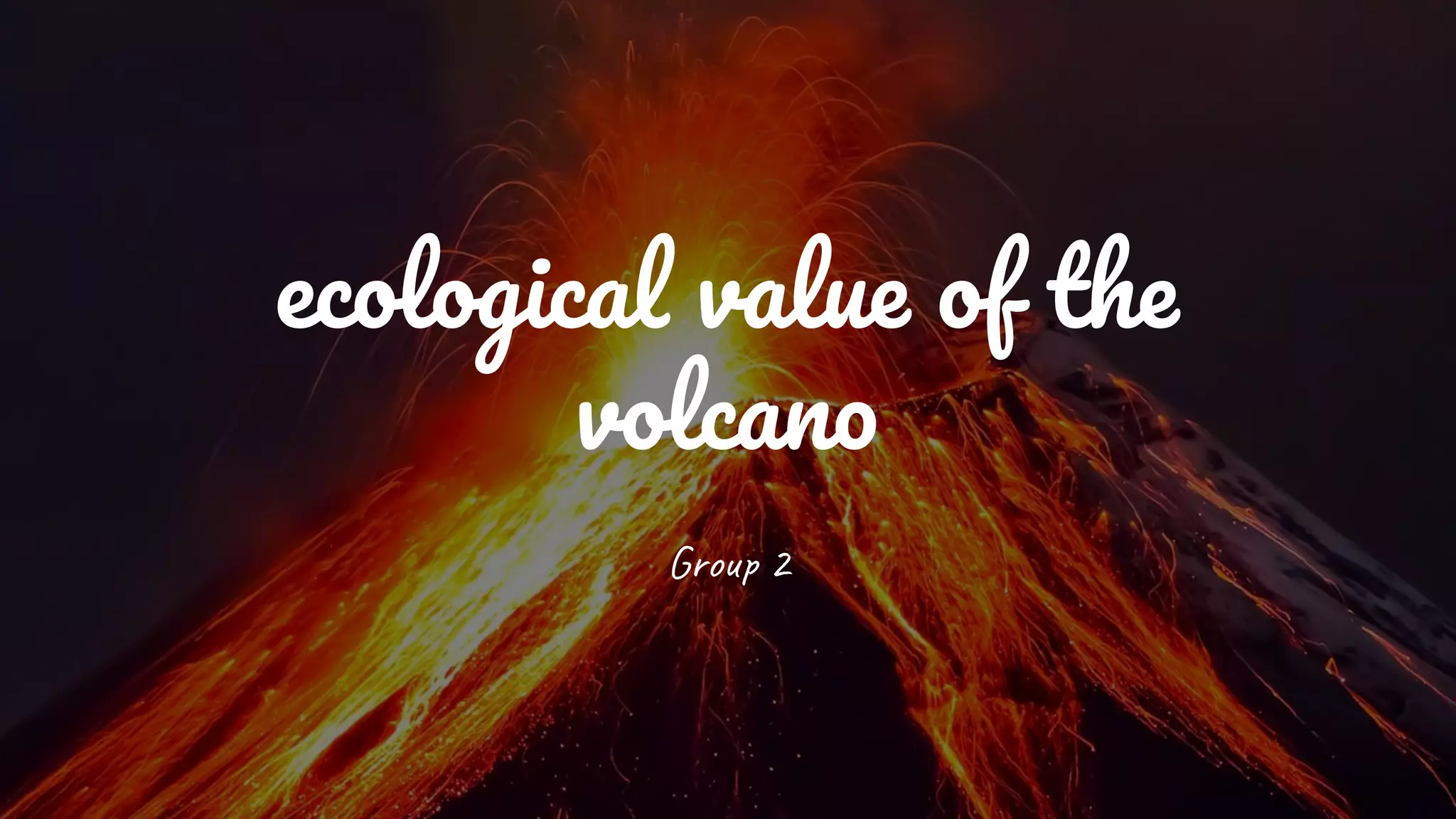
ecological value of the
volcano
Group 2
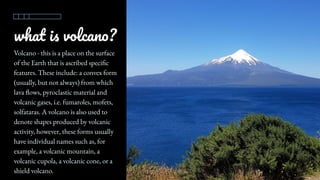
what is volcano?
Volcano - this is a place on the surface
of the Earth that is ascribed specific
features. These include: a convex form
(usually, but not always) from which
lava flows, pyroclastic material and
volcanic gases, i.e. fumaroles, mofets,
solfataras. A volcano is also used to
denote shapes produced by volcanic
activity, however, these forms usually
have individual names such as, for
example, a volcanic mountain, a
volcanic cupola, a volcanic cone, or a
shield volcano.
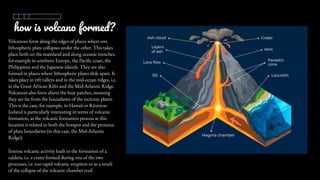
how is volcano formed?
Volcanoes form along the edges of places where one
lithospheric plate collapses under the other. This takes
place both on the mainland and along oceanic trenches,
for example in southern Europe, the Pacific coast, the
Philippines and the Japanese islands. They are also
formed in places where lithospheric plates slide apart. It
takes place in rift valleys and in the mid-ocean ridges, i.e.
in the Great African Rifts and the Mid-Atlantic Ridge.
Volcanoes also form above the heat patches, meaning
they are far from the boundaries of the tectonic plates.
This is the case, for example, in Hawaii or Réunion.
Iceland is particularly interesting in terms of volcanic
formation, as the volcanic formation process at this
location is related to both the hotspot and the presence
of plate boundaries (in this case, the Mid-Atlantic
Ridge).
Intense volcanic activity leads to the formation of a
caldera, i.e. a crater formed during one of the two
processes, i.e. too rapid volcanic eruption or as a result
of the collapse of the volcanic chamber roof.
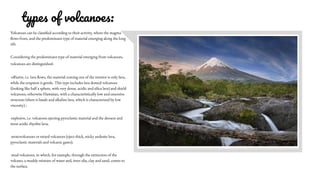
types of volcanoes:
Volcanoes can be classified according to their activity, where the magma
flows from, and the predominant type of material emerging along the long
rift.
Considering the predominant type of material emerging from volcanoes,
volcanoes are distinguished:
-effusive, i.e. lava flows, the material coming out of the interior is only lava,
while the eruption is gentle. This type includes lava domed volcanoes
(looking like half a sphere, with very dense, acidic and silica lava) and shield
volcanoes, otherwise Hawaiian, with a characteristically low and extensive
structure (there is basalt and alkaline lava, which is characterized by low
viscosity) ;
-explosive, i.e. volcanoes ejecting pyroclastic material and the densest and
most acidic rhyolite lava;
-stratovolcanoes or mixed volcanoes (eject thick, sticky andesite lava,
pyroclastic materials and volcanic gases);
-mud volcanoes, in which, for example, through the extinction of the
volcano, a muddy mixture of water and, inter alia, clay and sand, comes to
the surface.
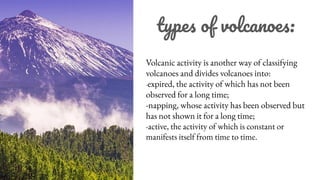
types of volcanoes:
Volcanic activity is another way of classifying
volcanoes and divides volcanoes into:
-expired, the activity of which has not been
observed for a long time;
-napping, whose activity has been observed but
has not shown it for a long time;
-active, the activity of which is constant or
manifests itself from time to time.
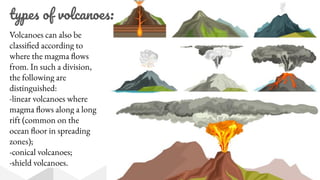
Volcanoes can also be
classified according to
where the magma flows
from. In such a division,
the following are
distinguished:
-linear volcanoes where
magma flows along a long
rift (common on the
ocean floor in spreading
zones);
-conical volcanoes;
-shield volcanoes.
types of volcanoes:
The influence of
volcanoes on the Earth:
Through the emission of ash and volcanic gases, volcanoes can influence the formation of
various phenomena, as well as the climate of the region or even the entire planet. The
predominant components of volcanic emissions are most often water vapor, carbon
dioxide and sulfur dioxide. However, their composition can significantly differ between
volcanoes. However, in smaller amounts, carbon monoxide, hydrogen, organic
compounds, volatile metal chlorides and halons. Large emissions of these substances
during eruptions may form condensation nuclei which, under the influence of a strong
rising current, may cause the formation of specific Cumulus flammagenitus clouds.
Strong volcanic eruptions are able to introduce volcanic gases and ash into the
stratosphere at significant altitudes (16-32 km). And the most significant impact on the
climate is the prolonged presence in the stratosphere of sulphate aerosol (droplets of
sulfuric acid that is formed by combining sulfur dioxide and water). This causes an
increase in the solar radiation reflected outside the Earth, which leads to a decrease in the
average temperature of the Earth's surface until the gravitational fall of the aerosol from
the atmosphere. In addition, volcanic eruptions can destroy the ozone layer.
Volcanic eruptions are natural factors that lead to the formation of acid rain. It occurs
when hydrogen chloride, sulfur dioxide and selenium compounds are dissolved in water,
forming cloud drops, and then raindrops. Acid rain caused by volcanic eruptions, as a
rule, differs in composition from acid rain caused by human activity. Acid rain can result
in acidification of surface waters and the area where they occur.
the largest volcanic
eruptions
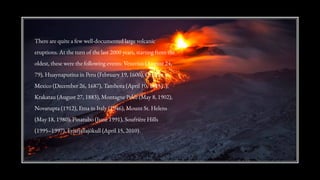
There are quite a few well-documented large volcanic
eruptions. At the turn of the last 2000 years, starting from the
oldest, these were the following events: Vesuvius (August 24,
79), Huaynaputina in Peru (February 19, 1600), Orizaba in
Mexico (December 26, 1687), Tambora (April 10, 1815) .),
Krakatau (August 27, 1883), Montagne Pelée (May 8, 1902),
Novarupta (1912), Etna in Italy (1946), Mount St. Helens
(May 18, 1980), Pinatubo (June 1991), Soufrière Hills
(1995–1997), Eyjafjallajökull (April 15, 2010).
the largest and the highest volcanoes in the world:
Volcanoes of the Earth are located mainly in the areas of alpine carcinogenicity,
they are less often found in other areas. The so-called Fiery Ring of the Pacific,
which stretches around the Pacific Ocean, has the most (over 90%) active
volcanoes. On the other hand, the volcanic activity of these places is located in
three zones, i.e. in the spreading zone, in the subduction zone and in the so-called
hot spots.
The largest volcanoes on Earth are Mauna Loa and the Tamu Massif, while
the highest volcanoes on Earth are: Ojos del Salado (in Chile / Argentina,
6,880 m above sea level), Llullaillaco (in Chile / Argentina, 6,723 m above
sea level), Antofalla (in Argentina, 6,450 m above sea level) above sea level),
Láscar (in Chile, 5990 m above sea level), Cotopaxi (in Ecuador, 5897 m
above sea level) and Kilimanjaro (Kibo peak in Tanzania, 5895 m above sea
level).
the largest and the highest volcanoes in the world:
The largest volcanoes in Africa are Kilimanjaro (in Tanzania, 5895 m above sea level), Meru (in
Tanzania, 4570 m above sea level) and Cameroon (in Cameroon, 4094 m above sea level). The largest
volcanoes in South America are Ojos del Salado (in Argentina, 6,880 m), Llullaillaco (in Argentina /
Chile, 6,739 m), Antofalla (in Argentina, 6,450 m), Guallatira (in Chile, 6,060 m) and Láscar (in Chile,
5992 m asl), while in North America Orizaba (in Mexico, 5700 m asl), Popocatépetl (in Mexico, 5452 m
asl), Rainier (in the USA, 4390 m asl), Wrangel Mountain (in the USA, 4270 m above sea level) and
Colima (in Mexico, 4265 m above sea level).
Antarctica can be proud of the Erebus volcano (on Ross Island, 3794 m above sea
level). Asia abounds in these structures, the largest of which are Mount Elbrus (in
Russia, 5642 m asl), Ararat (in Turkey, 5165 m asl), Kluczewska Sopka (in Russia, 4957
m asl), Mount Fuji (in Japan / Honshu, 3776 m above sea level) and Semeru (in
Indonesia, 3680 m above sea level). There are several active volcanoes in Europe,
especially in Italy and Iceland, and the largest of them are Mount Etna (in Italy, 3,340
meters above sea level), Beerenberg (in Norway, 2,277 meters above sea level),
Hvannadalshnukur (in Iceland, 2,119 meters above sea level) , Grimsvötn (in Iceland,
1719 m above sea level) and Askja (in Iceland, 1510 m above sea level).
Extraterrestrial
volcanoes
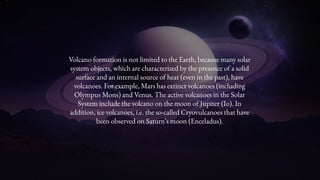
Volcano formation is not limited to the Earth, because many solar
system objects, which are characterized by the presence of a solid
surface and an internal source of heat (even in the past), have
volcanoes. For example, Mars has extinct volcanoes (including
Olympus Mons) and Venus. The active volcanoes in the Solar
System include the volcano on the moon of Jupiter (Io). In
addition, ice volcanoes, i.e. the so-called Cryovulcanoes that have
been observed on Saturn's moon (Enceladus).
thanks for watching :D

Ecological value of the volcano

  • 1.
    ecological value ofthe volcano Group 2
  • 2.
    what is volcano? Volcano- this is a place on the surface of the Earth that is ascribed specific features. These include: a convex form (usually, but not always) from which lava flows, pyroclastic material and volcanic gases, i.e. fumaroles, mofets, solfataras. A volcano is also used to denote shapes produced by volcanic activity, however, these forms usually have individual names such as, for example, a volcanic mountain, a volcanic cupola, a volcanic cone, or a shield volcano.
  • 3.
    how is volcanoformed? Volcanoes form along the edges of places where one lithospheric plate collapses under the other. This takes place both on the mainland and along oceanic trenches, for example in southern Europe, the Pacific coast, the Philippines and the Japanese islands. They are also formed in places where lithospheric plates slide apart. It takes place in rift valleys and in the mid-ocean ridges, i.e. in the Great African Rifts and the Mid-Atlantic Ridge. Volcanoes also form above the heat patches, meaning they are far from the boundaries of the tectonic plates. This is the case, for example, in Hawaii or Réunion. Iceland is particularly interesting in terms of volcanic formation, as the volcanic formation process at this location is related to both the hotspot and the presence of plate boundaries (in this case, the Mid-Atlantic Ridge). Intense volcanic activity leads to the formation of a caldera, i.e. a crater formed during one of the two processes, i.e. too rapid volcanic eruption or as a result of the collapse of the volcanic chamber roof.
  • 4.
    types of volcanoes: Volcanoescan be classified according to their activity, where the magma flows from, and the predominant type of material emerging along the long rift. Considering the predominant type of material emerging from volcanoes, volcanoes are distinguished: -effusive, i.e. lava flows, the material coming out of the interior is only lava, while the eruption is gentle. This type includes lava domed volcanoes (looking like half a sphere, with very dense, acidic and silica lava) and shield volcanoes, otherwise Hawaiian, with a characteristically low and extensive structure (there is basalt and alkaline lava, which is characterized by low viscosity) ; -explosive, i.e. volcanoes ejecting pyroclastic material and the densest and most acidic rhyolite lava; -stratovolcanoes or mixed volcanoes (eject thick, sticky andesite lava, pyroclastic materials and volcanic gases); -mud volcanoes, in which, for example, through the extinction of the volcano, a muddy mixture of water and, inter alia, clay and sand, comes to the surface.
  • 5.
    types of volcanoes: Volcanicactivity is another way of classifying volcanoes and divides volcanoes into: -expired, the activity of which has not been observed for a long time; -napping, whose activity has been observed but has not shown it for a long time; -active, the activity of which is constant or manifests itself from time to time.
  • 6.
    Volcanoes can alsobe classified according to where the magma flows from. In such a division, the following are distinguished: -linear volcanoes where magma flows along a long rift (common on the ocean floor in spreading zones); -conical volcanoes; -shield volcanoes. types of volcanoes:
  • 7.
    The influence of volcanoeson the Earth: Through the emission of ash and volcanic gases, volcanoes can influence the formation of various phenomena, as well as the climate of the region or even the entire planet. The predominant components of volcanic emissions are most often water vapor, carbon dioxide and sulfur dioxide. However, their composition can significantly differ between volcanoes. However, in smaller amounts, carbon monoxide, hydrogen, organic compounds, volatile metal chlorides and halons. Large emissions of these substances during eruptions may form condensation nuclei which, under the influence of a strong rising current, may cause the formation of specific Cumulus flammagenitus clouds. Strong volcanic eruptions are able to introduce volcanic gases and ash into the stratosphere at significant altitudes (16-32 km). And the most significant impact on the climate is the prolonged presence in the stratosphere of sulphate aerosol (droplets of sulfuric acid that is formed by combining sulfur dioxide and water). This causes an increase in the solar radiation reflected outside the Earth, which leads to a decrease in the average temperature of the Earth's surface until the gravitational fall of the aerosol from the atmosphere. In addition, volcanic eruptions can destroy the ozone layer. Volcanic eruptions are natural factors that lead to the formation of acid rain. It occurs when hydrogen chloride, sulfur dioxide and selenium compounds are dissolved in water, forming cloud drops, and then raindrops. Acid rain caused by volcanic eruptions, as a rule, differs in composition from acid rain caused by human activity. Acid rain can result in acidification of surface waters and the area where they occur.
  • 8.
  • 9.
    There are quitea few well-documented large volcanic eruptions. At the turn of the last 2000 years, starting from the oldest, these were the following events: Vesuvius (August 24, 79), Huaynaputina in Peru (February 19, 1600), Orizaba in Mexico (December 26, 1687), Tambora (April 10, 1815) .), Krakatau (August 27, 1883), Montagne Pelée (May 8, 1902), Novarupta (1912), Etna in Italy (1946), Mount St. Helens (May 18, 1980), Pinatubo (June 1991), Soufrière Hills (1995–1997), Eyjafjallajökull (April 15, 2010).
  • 10.
    the largest andthe highest volcanoes in the world: Volcanoes of the Earth are located mainly in the areas of alpine carcinogenicity, they are less often found in other areas. The so-called Fiery Ring of the Pacific, which stretches around the Pacific Ocean, has the most (over 90%) active volcanoes. On the other hand, the volcanic activity of these places is located in three zones, i.e. in the spreading zone, in the subduction zone and in the so-called hot spots. The largest volcanoes on Earth are Mauna Loa and the Tamu Massif, while the highest volcanoes on Earth are: Ojos del Salado (in Chile / Argentina, 6,880 m above sea level), Llullaillaco (in Chile / Argentina, 6,723 m above sea level), Antofalla (in Argentina, 6,450 m above sea level) above sea level), Láscar (in Chile, 5990 m above sea level), Cotopaxi (in Ecuador, 5897 m above sea level) and Kilimanjaro (Kibo peak in Tanzania, 5895 m above sea level).
  • 11.
    the largest andthe highest volcanoes in the world: The largest volcanoes in Africa are Kilimanjaro (in Tanzania, 5895 m above sea level), Meru (in Tanzania, 4570 m above sea level) and Cameroon (in Cameroon, 4094 m above sea level). The largest volcanoes in South America are Ojos del Salado (in Argentina, 6,880 m), Llullaillaco (in Argentina / Chile, 6,739 m), Antofalla (in Argentina, 6,450 m), Guallatira (in Chile, 6,060 m) and Láscar (in Chile, 5992 m asl), while in North America Orizaba (in Mexico, 5700 m asl), Popocatépetl (in Mexico, 5452 m asl), Rainier (in the USA, 4390 m asl), Wrangel Mountain (in the USA, 4270 m above sea level) and Colima (in Mexico, 4265 m above sea level). Antarctica can be proud of the Erebus volcano (on Ross Island, 3794 m above sea level). Asia abounds in these structures, the largest of which are Mount Elbrus (in Russia, 5642 m asl), Ararat (in Turkey, 5165 m asl), Kluczewska Sopka (in Russia, 4957 m asl), Mount Fuji (in Japan / Honshu, 3776 m above sea level) and Semeru (in Indonesia, 3680 m above sea level). There are several active volcanoes in Europe, especially in Italy and Iceland, and the largest of them are Mount Etna (in Italy, 3,340 meters above sea level), Beerenberg (in Norway, 2,277 meters above sea level), Hvannadalshnukur (in Iceland, 2,119 meters above sea level) , Grimsvötn (in Iceland, 1719 m above sea level) and Askja (in Iceland, 1510 m above sea level).
  • 12.
  • 13.
    Volcano formation isnot limited to the Earth, because many solar system objects, which are characterized by the presence of a solid surface and an internal source of heat (even in the past), have volcanoes. For example, Mars has extinct volcanoes (including Olympus Mons) and Venus. The active volcanoes in the Solar System include the volcano on the moon of Jupiter (Io). In addition, ice volcanoes, i.e. the so-called Cryovulcanoes that have been observed on Saturn's moon (Enceladus).
  • 14.