http://www.flickr.com/photos/michaelloudon/808561268/in/set-72157600818891681/
•What is a lava plateau?
• What is a volcanic plug?
• What are basalt columns?
http://www.flickr.com/photos/67165210@N00/240741910/
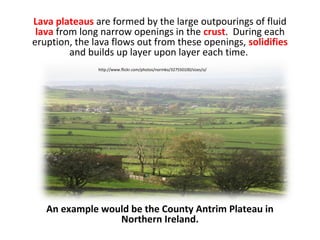
Lava plateaus are formed by the large outpourings of fluid
lava from long narrow openings in the crust. During each
eruption, the lava flows out from these openings, solidifies
and builds up layer upon layer each time.
An example would be the County Antrim Plateau in
Northern Ireland.
http://www.flickr.com/photos/normko/327550100/sizes/o/
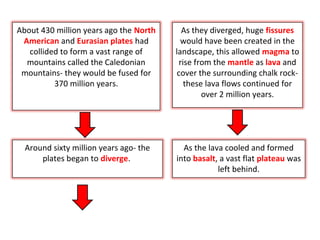
About 430 million years ago the North
American and Eurasian plates had
collided to form a vast range of
mountains called the Caledonian
mountains- they would be fused for
370 million years.
Around sixty million years ago- the
plates began to diverge.
As they diverged, huge fissures
would have been created in the
landscape, this allowed magma to
rise from the mantle as lava and
cover the surrounding chalk rock-
these lava flows continued for
over 2 million years.
As the lava cooled and formed
into basalt, a vast flat plateau was
left behind.
http://www.flickr.com/photos/michaelloudon/808561268/in/set-
72157600818891681/
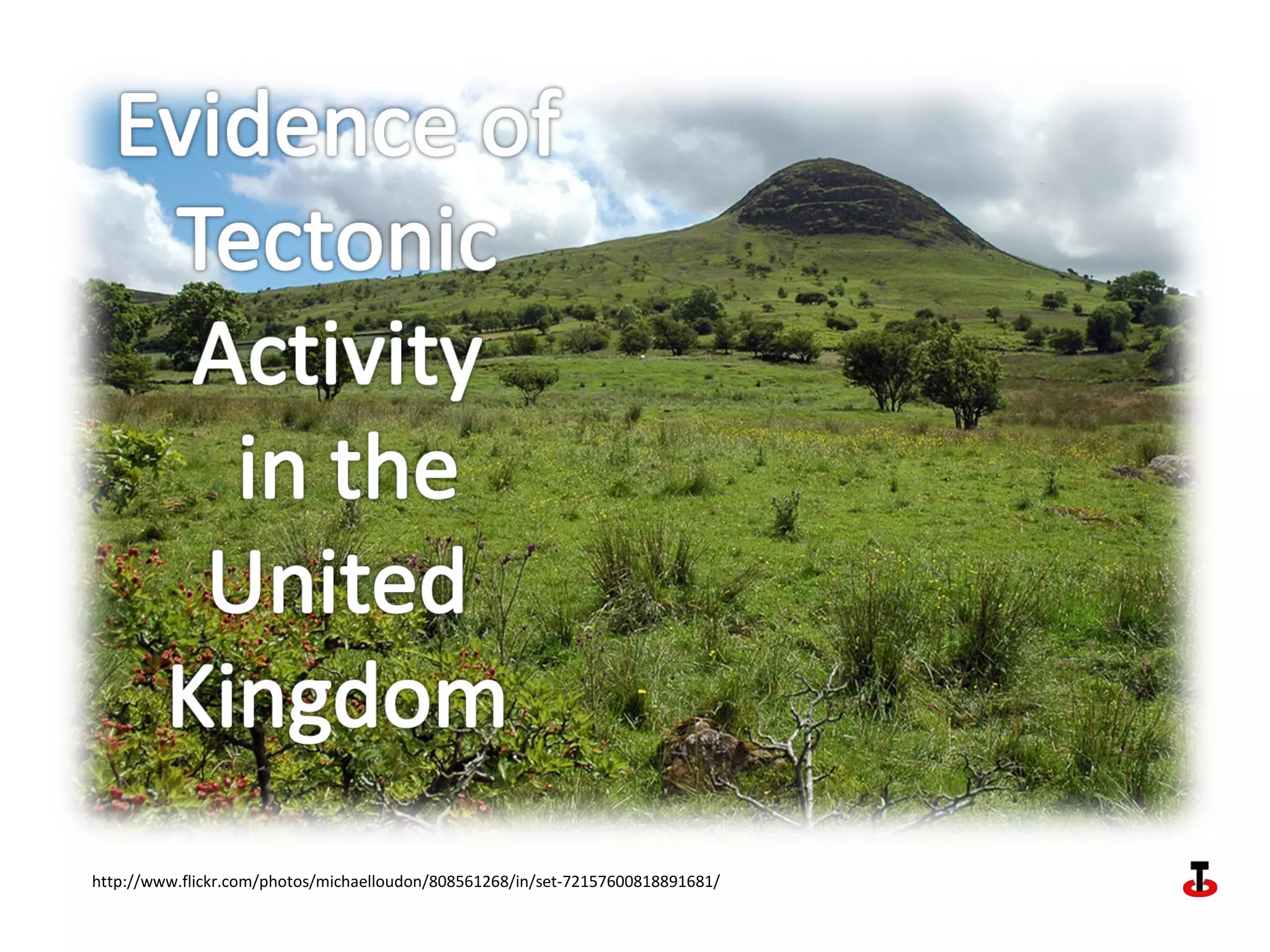
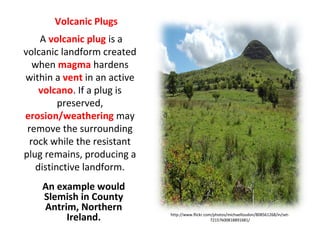
Volcanic Plugs
An example would
Slemish in County
Antrim, Northern
Ireland.
A volcanic plug is a
volcanic landform created
when magma hardens
within a vent in an active
volcano. If a plug is
preserved,
erosion/weathering may
remove the surrounding
rock while the resistant
plug remains, producing a
distinctive landform.
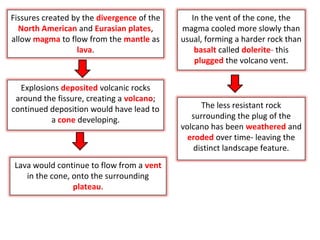
Fissures created by the divergence of the
North American and Eurasian plates,
allow magma to flow from the mantle as
lava.
Explosions deposited volcanic rocks
around the fissure, creating a volcano;
continued deposition would have lead to
a cone developing.
Lava would continue to flow from a vent
in the cone, onto the surrounding
plateau.
In the vent of the cone, the
magma cooled more slowly than
usual, forming a harder rock than
basalt called dolerite- this
plugged the volcano vent.
The less resistant rock
surrounding the plug of the
volcano has been weathered and
eroded over time- leaving the
distinct landscape feature.
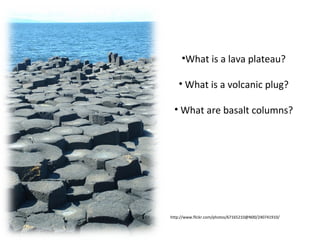
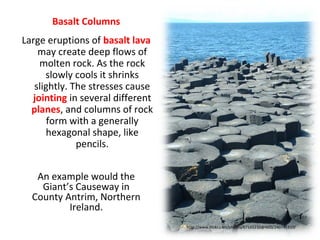
Basalt Columns
An example would the
Giant’s Causeway in
County Antrim, Northern
Ireland.
http://www.flickr.com/photos/67165210@N00/240741910/
Large eruptions of basalt lava
may create deep flows of
molten rock. As the rock
slowly cools it shrinks
slightly. The stresses cause
jointing in several different
planes, and columns of rock
form with a generally
hexagonal shape, like
pencils.
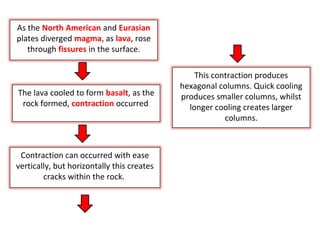
As the North American and Eurasian
plates diverged magma, as lava, rose
through fissures in the surface.
The lava cooled to form basalt, as the
rock formed, contraction occurred.
Contraction can occurred with ease
vertically, but horizontally this creates
cracks within the rock.
This contraction produces
hexagonal columns. Quick cooling
produces smaller columns, whilst
longer cooling creates larger
columns.

Tectonicsuk

  • 1.
  • 2.
    •What is alava plateau? • What is a volcanic plug? • What are basalt columns? http://www.flickr.com/photos/67165210@N00/240741910/
  • 3.
    Lava plateaus areformed by the large outpourings of fluid lava from long narrow openings in the crust. During each eruption, the lava flows out from these openings, solidifies and builds up layer upon layer each time. An example would be the County Antrim Plateau in Northern Ireland. http://www.flickr.com/photos/normko/327550100/sizes/o/
  • 4.
    About 430 millionyears ago the North American and Eurasian plates had collided to form a vast range of mountains called the Caledonian mountains- they would be fused for 370 million years. Around sixty million years ago- the plates began to diverge. As they diverged, huge fissures would have been created in the landscape, this allowed magma to rise from the mantle as lava and cover the surrounding chalk rock- these lava flows continued for over 2 million years. As the lava cooled and formed into basalt, a vast flat plateau was left behind.
  • 5.
    http://www.flickr.com/photos/michaelloudon/808561268/in/set- 72157600818891681/ Volcanic Plugs An examplewould Slemish in County Antrim, Northern Ireland. A volcanic plug is a volcanic landform created when magma hardens within a vent in an active volcano. If a plug is preserved, erosion/weathering may remove the surrounding rock while the resistant plug remains, producing a distinctive landform.
  • 6.
    Fissures created bythe divergence of the North American and Eurasian plates, allow magma to flow from the mantle as lava. Explosions deposited volcanic rocks around the fissure, creating a volcano; continued deposition would have lead to a cone developing. Lava would continue to flow from a vent in the cone, onto the surrounding plateau. In the vent of the cone, the magma cooled more slowly than usual, forming a harder rock than basalt called dolerite- this plugged the volcano vent. The less resistant rock surrounding the plug of the volcano has been weathered and eroded over time- leaving the distinct landscape feature.
  • 7.
    Basalt Columns An examplewould the Giant’s Causeway in County Antrim, Northern Ireland. http://www.flickr.com/photos/67165210@N00/240741910/ Large eruptions of basalt lava may create deep flows of molten rock. As the rock slowly cools it shrinks slightly. The stresses cause jointing in several different planes, and columns of rock form with a generally hexagonal shape, like pencils.
  • 8.
    As the NorthAmerican and Eurasian plates diverged magma, as lava, rose through fissures in the surface. The lava cooled to form basalt, as the rock formed, contraction occurred. Contraction can occurred with ease vertically, but horizontally this creates cracks within the rock. This contraction produces hexagonal columns. Quick cooling produces smaller columns, whilst longer cooling creates larger columns.