Shelley Wright was able to turn her 
classroom into one where her 
students decided what and how they 
were going to learn. They also 
collaborated to raise over $20,000 for 
Schools for Schools. An awesome 
feat for a small town school class of 
25 kids and a great way to learn skills 
imperative for them to be successful 
for the rest of their lives. 
The question becomes: 
“How do you set standards and measure success 
of 21st century skills in our schools?”
Click here Click here 
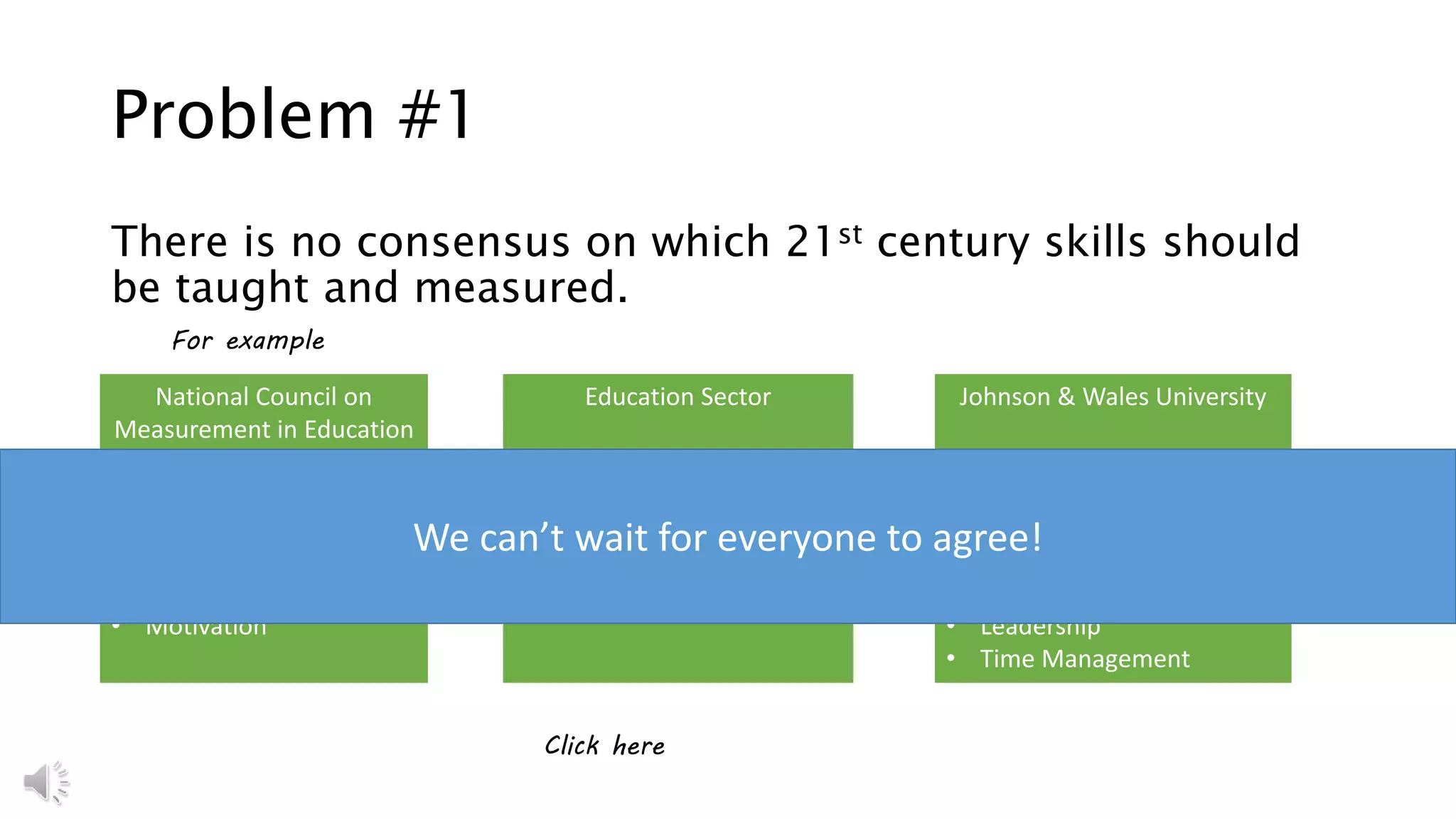
Problem #1 
There is no consensus on which 21st century skills should 
be taught and measured. 
National Council on 
Measurement in Education 
• Critical Thinking 
• Creativity 
• Collaboration 
• Metacognition 
• Motivation 
Education Sector 
• Creative Thinking 
• Evaluate 
• Analyze Information 
Johnson & Wales University 
• Communication 
• Organizational 
• Computer 
• Interpersonal 
• Critical Thinking 
• Leadership 
• Time Management 
For example 
We can’t wait for everyone to agree! 
Click here
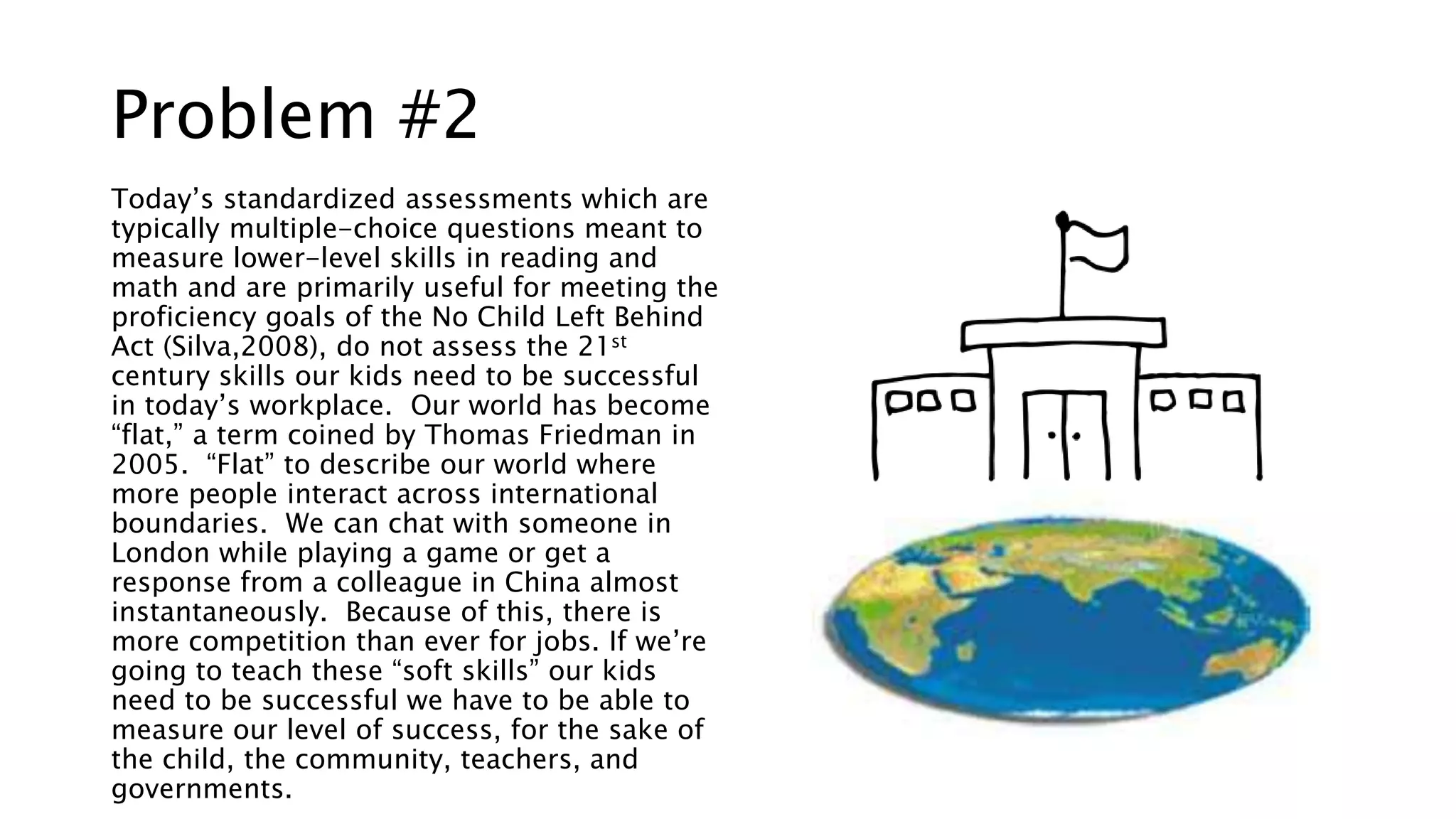
Problem #2 
Today’s standardized assessments which are 
typically multiple-choice questions meant to 
measure lower-level skills in reading and 
math and are primarily useful for meeting the 
proficiency goals of the No Child Left Behind 
Act (Silva,2008), do not assess the 21st 
century skills our kids need to be successful 
in today’s workplace. Our world has become 
“flat,” a term coined by Thomas Friedman in 
2005. “Flat” to describe our world where 
more people interact across international 
boundaries. We can chat with someone in 
London while playing a game or get a 
response from a colleague in China almost 
instantaneously. Because of this, there is 
more competition than ever for jobs. If we’re 
going to teach these “soft skills” our kids 
need to be successful we have to be able to 
measure our level of success, for the sake of 
the child, the community, teachers, and 
governments.
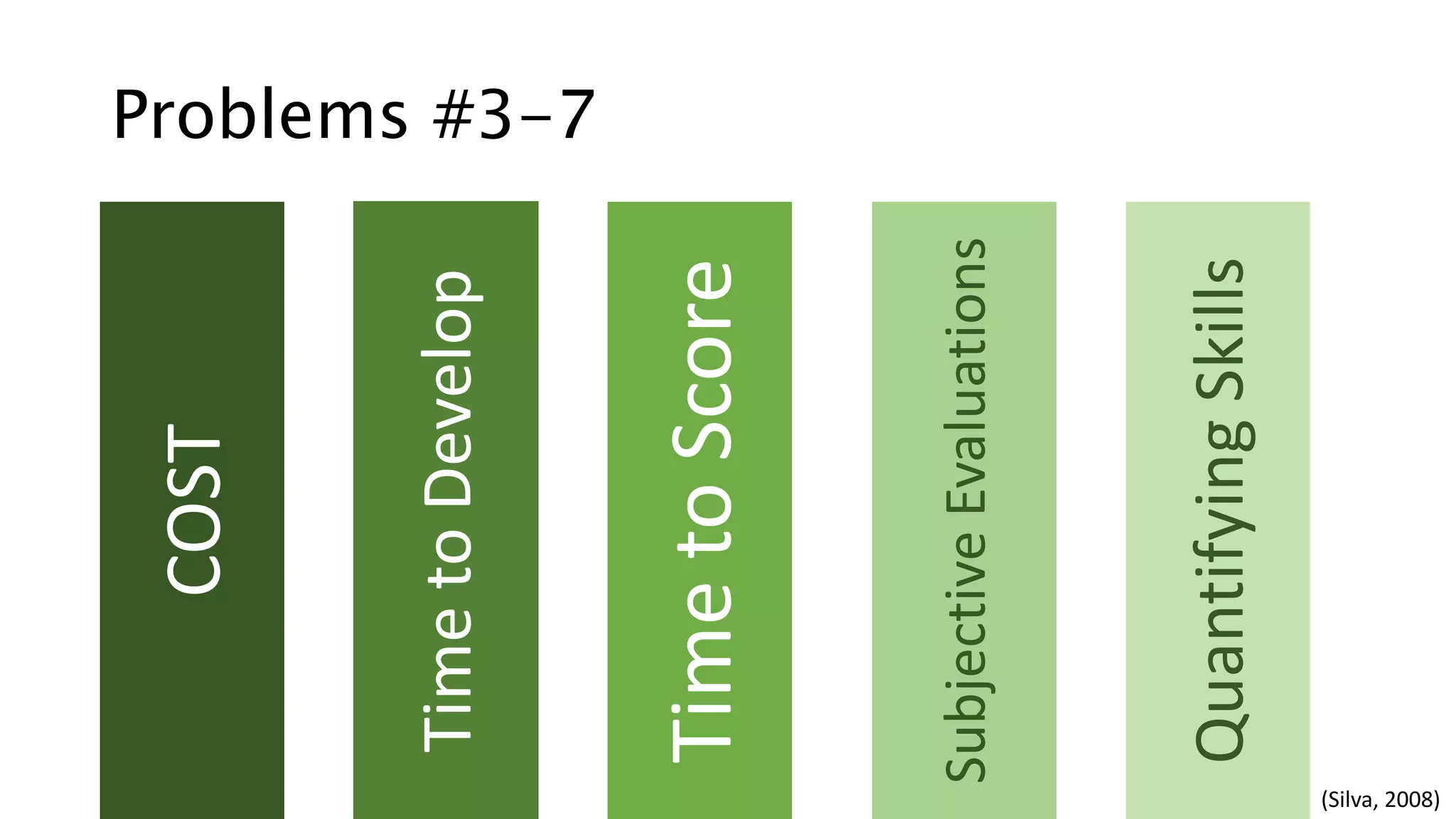
COST 
Time to Develop 
Time to Score 
Subjective Evaluations 
Quantifying Skills 
Problems #3-7 
(Silva, 2008)
Where do we begin? 
With something we know…
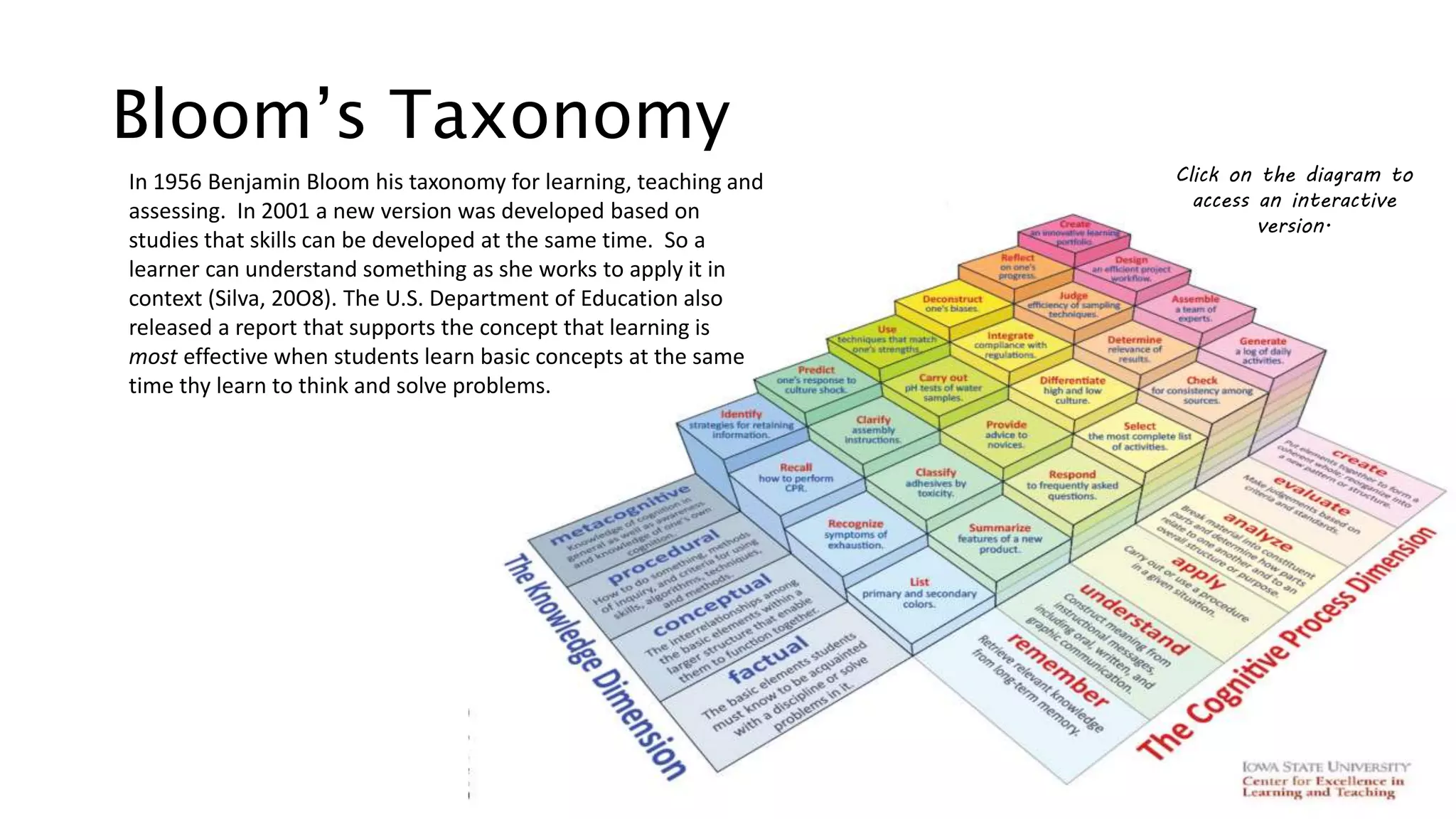
Bloom’s Taxonomy 
In 1956 Benjamin Bloom his taxonomy for learning, teaching and 
assessing. In 2001 a new version was developed based on 
studies that skills can be developed at the same time. So a 
learner can understand something as she works to apply it in 
context (Silva, 20O8). The U.S. Department of Education also 
released a report that supports the concept that learning is 
most effective when students learn basic concepts at the same 
time thy learn to think and solve problems. 
Click on the diagram to 
access an interactive 
version.
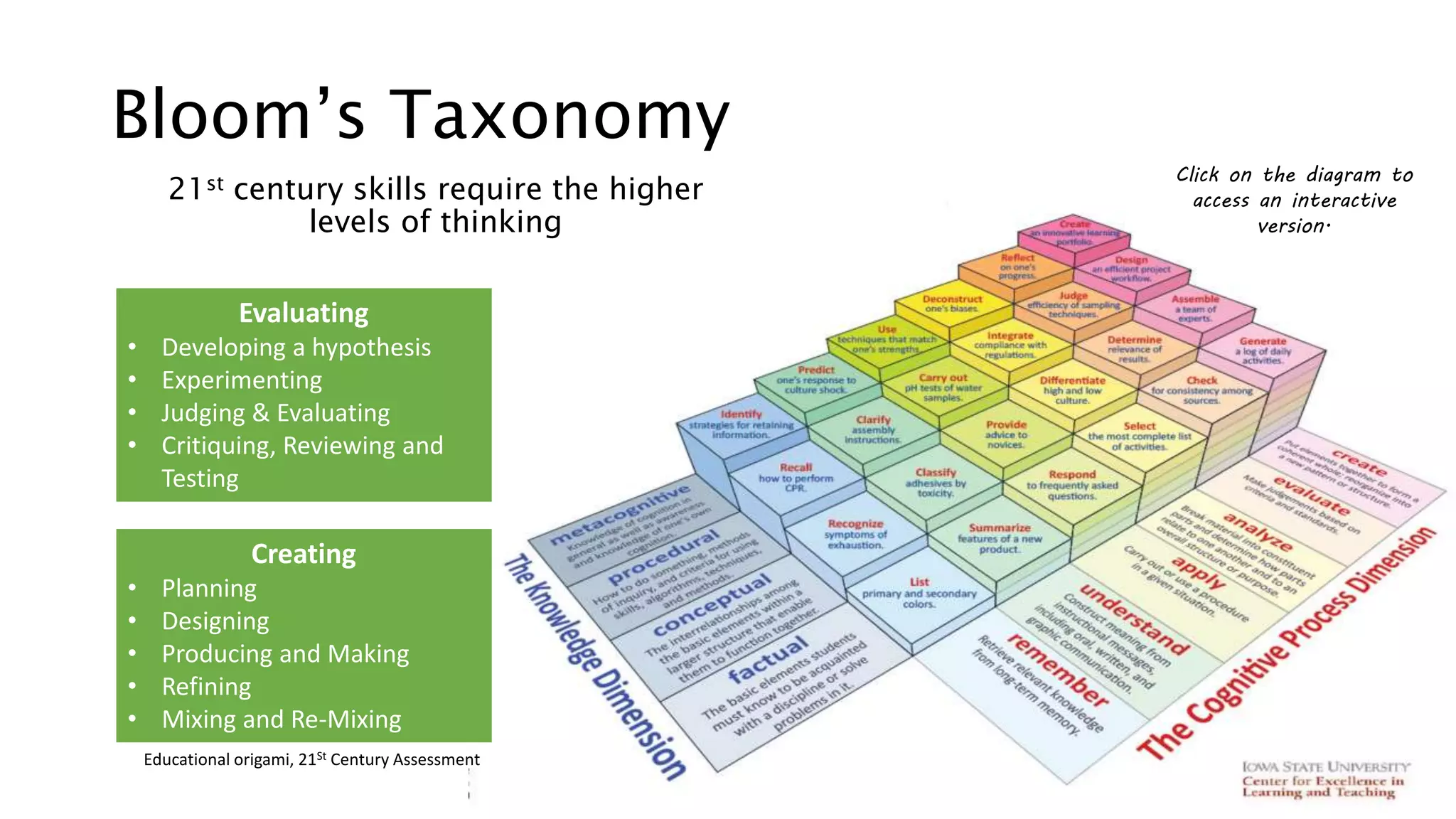
Bloom’s Taxonomy 
Click on the diagram to 
access an interactive 
version. 
21st century skills require the higher 
levels of thinking 
Evaluating 
• Developing a hypothesis 
• Experimenting 
• Judging & Evaluating 
• Critiquing, Reviewing and 
Creating 
Testing 
• Planning 
• Designing 
• Producing and Making 
• Refining 
• Mixing and Re-Mixing 
Educational origami, 21St Century Assessment
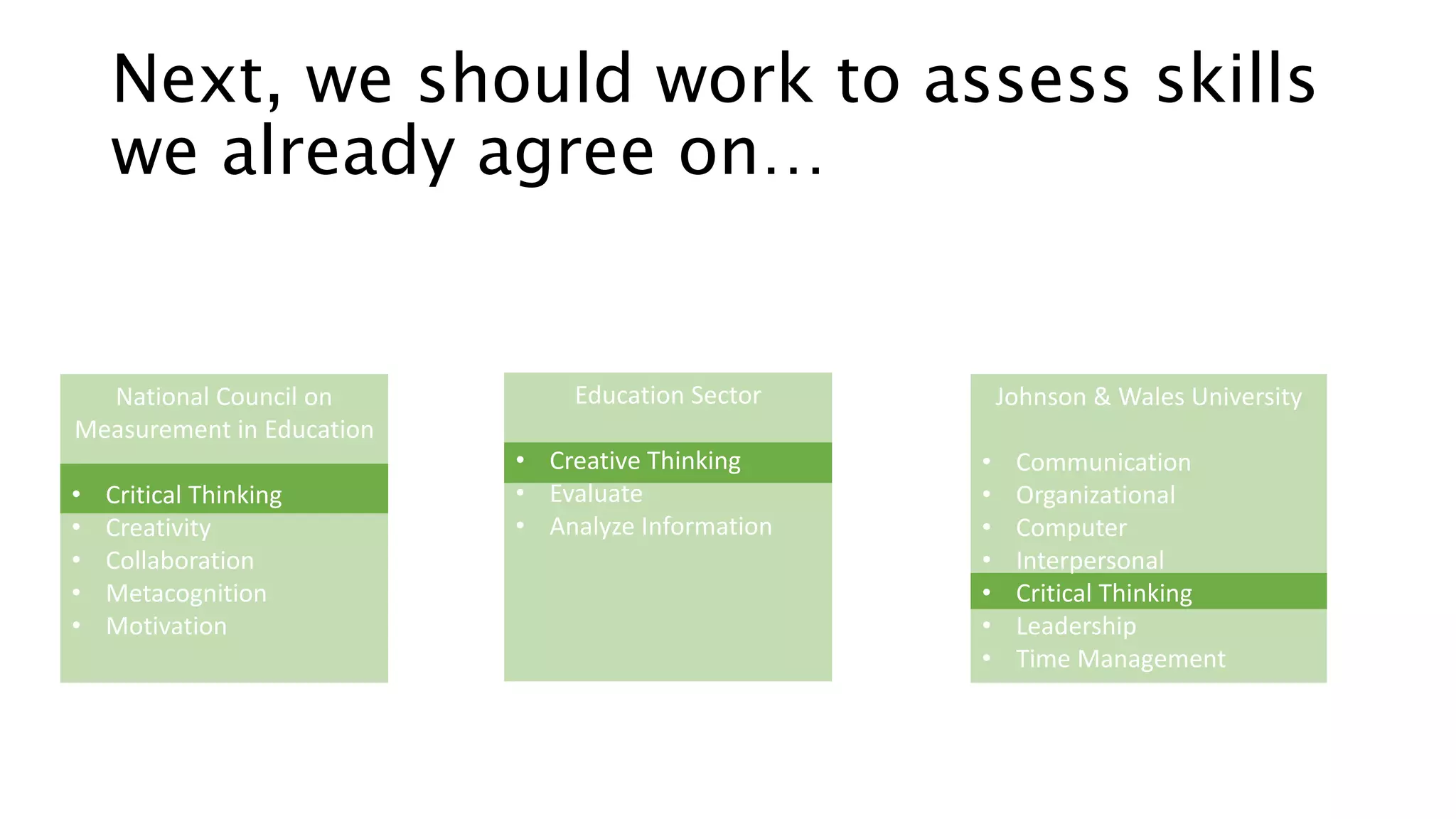
Next, we should work to assess skills 
we already agree on… 
National Council on 
Measurement in Education 
• Critical Thinking 
• Creativity 
• Collaboration 
• Metacognition 
• Motivation 
Education Sector 
• Creative Thinking 
• Evaluate 
• Analyze Information 
Johnson & Wales University 
• Communication 
• Organizational 
• Computer 
• Interpersonal 
• Critical Thinking 
• Leadership 
• Time Management
Incorporate them into teaching basic 
skills 
Classrooms should more closely reflect the real 
world. In a work environment problems arise 
everyday and we have to figure them out. Why 
not create an environment in the classroom that 
teaches students to do the same? Develop 
assessments that require a demonstration of the 
learning objectives, but allow students to figure 
out how to “prove” they met the objective 
(Marcinek, 2010). Encourage feedback and 
discussion around the topic and have students 
“grade” each other according to a specified 
rubric. Refer back to Shelley Wright’s TED talk 
(slide 1), one student who rarely spoke in class 
was the one who asked for donations for the 
project allowing a more real world assessment 
to be made (Wright, 2013).
Project-Based Learning 
(PBL) 
1 Real World Connection 
2 Core to Learning 
3 Structured Collaboration 
4 Student Driven 
5 Multifaceted Assessment 
(Edutopia,2014) 
Click here to 
watch Edutopia’s 
5-part video 
series on PBL 
Project based learning is the instructional model for an 
expedition. It is a different way of teaching important standards-aligned 
basic skills within an interdisciplinary unit that takes 
student learning well beyond the basics (Bremer & Laliberte, 
2014). In project-based learning the assessment is not a test at 
the end of the unit, it’s embedded in the instruction 
(Edutopia,2014). Embedded assessment may include checking in 
with students to confirm understanding, presentation to outside 
participants, the development of portfolios, or defending a 
project (Woolfolk, 2013). The project Assessment and Teaching 
of 21st Century Skills (ATC21S) has proposed to include 
technology in assessments to measure collaboration and other 
hard-to-quantify skills (Futures, 2012). While this is more costly 
than most schools can consider, it is a move in the right 
direction. With Microsoft’s initiative to provide technology to all 
this may, someday, be a viable option for assessments.
Develop Formative Evaluations 
A typical classroom assessment consists of a test at 
the end of a unit, final exams, and occasionally a 
project and/or a presentation, all for an individual 
grade. This is summative assessment and focuses on 
the individual and an end grade (Woolfolk, 2013). A 
formative assessment, by comparison, focus on 
improvement. They are used for a student to guide 
their own learning, to realize what works and what 
doesn’t and make adjustments accordingly, 
metacognition. They are also to improve and 
instructor’s teaching. “Any teacher who uses test 
dominantly to determine whether students get high 
or low grades should receive a solid F in classroom 
assessment” (Woolfolk, p. 549). According to 
Edutopia, peer feedback is the most beneficial and 
important form of formative assessment (Edutopia, 
2014) and encourages collaboration and 
improvements in learning and comprehension.
Summative Evaluations still have a 
place 
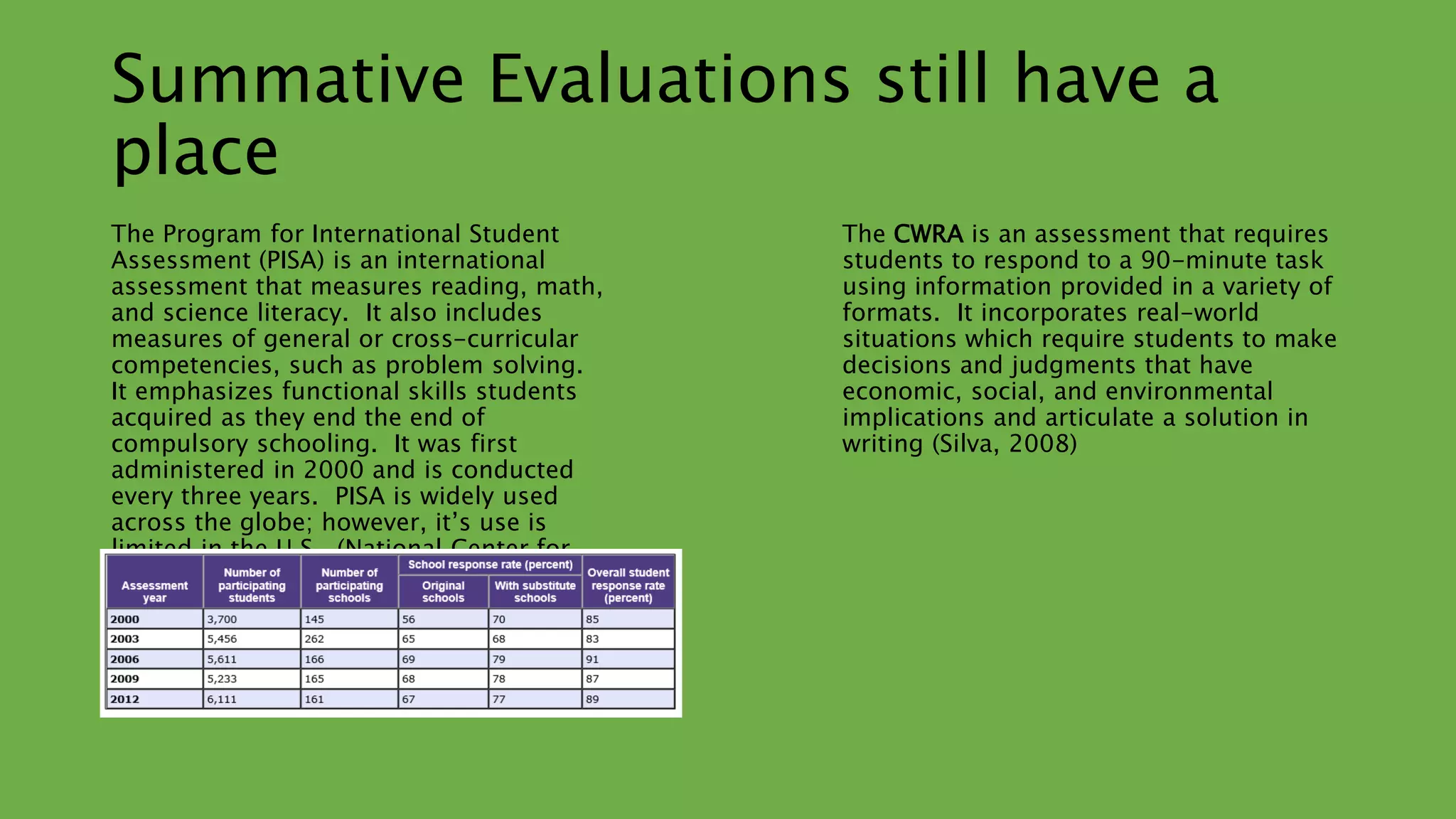
The Program for International Student 
Assessment (PISA) is an international 
assessment that measures reading, math, 
and science literacy. It also includes 
measures of general or cross-curricular 
competencies, such as problem solving. 
It emphasizes functional skills students 
acquired as they end the end of 
compulsory schooling. It was first 
administered in 2000 and is conducted 
every three years. PISA is widely used 
across the globe; however, it’s use is 
limited in the U.S. (National Center for 
Education Statistics) 
The CWRA is an assessment that requires 
students to respond to a 90-minute task 
using information provided in a variety of 
formats. It incorporates real-world 
situations which require students to make 
decisions and judgments that have 
economic, social, and environmental 
implications and articulate a solution in 
writing (Silva, 2008)
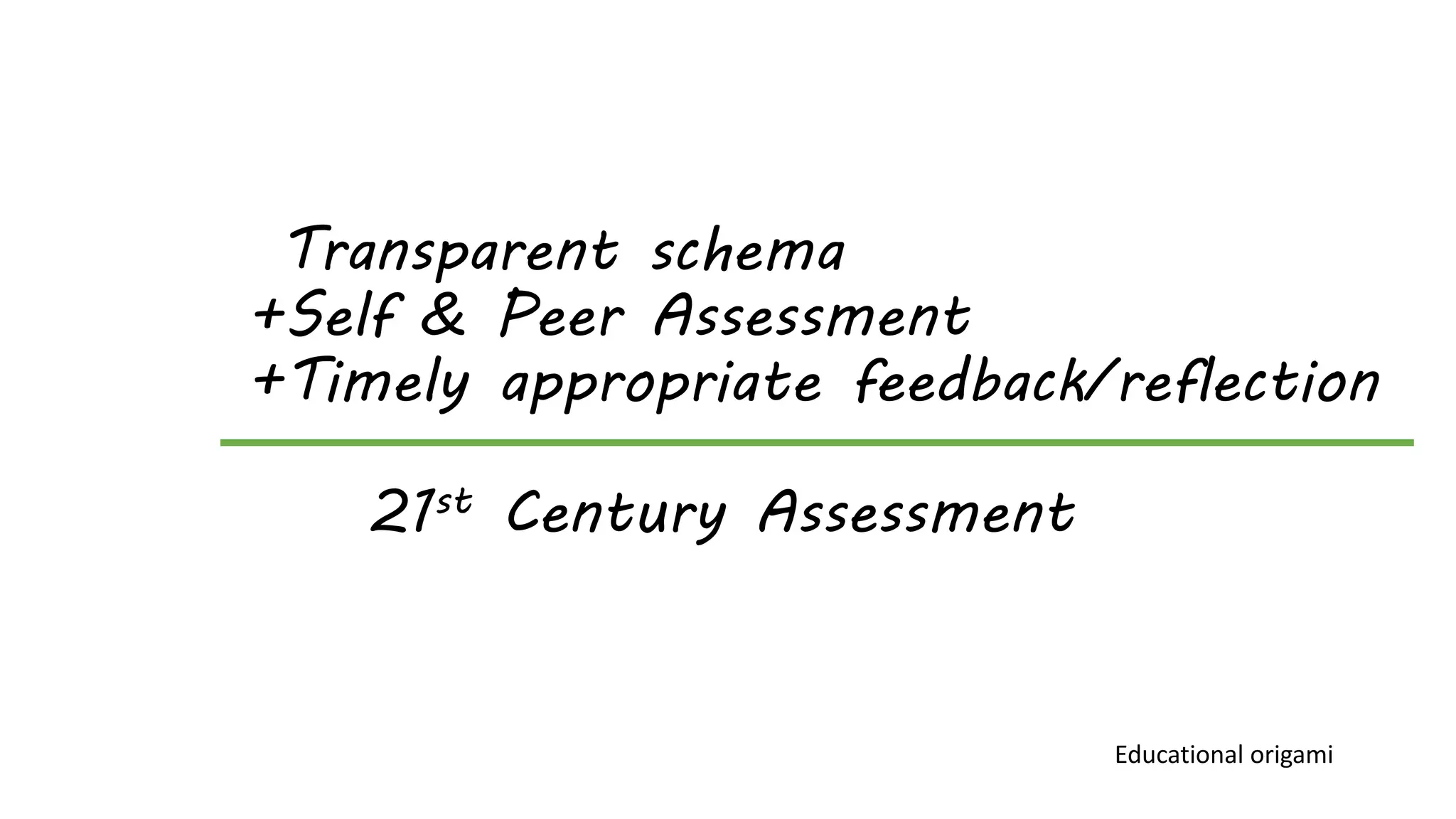
Transparent schema 
+Self & Peer Assessment 
+Timely appropriate feedback/reflection 
21st Century Assessment 
Educational origami
References 
Bremer, E. and Laiberte, L. (2014) Using PBL Assessments to Develop 21st Century Citizenship. 
Partnership for 21st Century Skills. July 28, 2014, V.1, issue 6, No. 15 retrieved from: 
http://www.p21.org/news-events/p21blog/1467 
educational origami, 21st Century Assessment. Retrieved from: 
http://edorigami.wikispaces.com/21st+Century+Assessment 
Friedman, T.L. (2005). The World is flat: A brief history of the twenty-first century, New York, NY: 
Farrar, Straus and Giroux. 
Futures. (2012) Finding and Measuring 21st Century Skills. Microsoft Europe. Retrieved from: 
http://www.microsoft.eu/2012/09/14/finding-and-measuring-21st-century-skills/ 
Marcinek, A. (2010) Reinventing Assessment for the 21st Century. Retrieved from Edutopia 
http://www.edutopia.org/reinvent-assessment-21st-century 
National Center for Education Statistics Frequently Asked Questions 
http://nces.ed.gov/surveys/pisa/faq.asp#3 
Partnership for 21st Century Skills http://www.p21.org/ 
Resnick,L.B. (1999) Making America Smarter, Education Week Century Series 18(40) (June16,1999), 
38-40. 
Silva, E. Measuring Skills for the 21st Century. Education Sector Reports. November 2008. 
Washington, D.C. 
Zhao,Y. 2010. Preparing Globally Competent Teachers: A Ne Imperative for Teacher Education. 
Journal of Teacher Education November 10, 2010. http://jte.sagepub.com/content/61/5/422

How do we set standards and assess 21st century skills

  • 1.
    Shelley Wright wasable to turn her classroom into one where her students decided what and how they were going to learn. They also collaborated to raise over $20,000 for Schools for Schools. An awesome feat for a small town school class of 25 kids and a great way to learn skills imperative for them to be successful for the rest of their lives. The question becomes: “How do you set standards and measure success of 21st century skills in our schools?”
  • 2.
    Click here Clickhere Problem #1 There is no consensus on which 21st century skills should be taught and measured. National Council on Measurement in Education • Critical Thinking • Creativity • Collaboration • Metacognition • Motivation Education Sector • Creative Thinking • Evaluate • Analyze Information Johnson & Wales University • Communication • Organizational • Computer • Interpersonal • Critical Thinking • Leadership • Time Management For example We can’t wait for everyone to agree! Click here
  • 3.
    Problem #2 Today’sstandardized assessments which are typically multiple-choice questions meant to measure lower-level skills in reading and math and are primarily useful for meeting the proficiency goals of the No Child Left Behind Act (Silva,2008), do not assess the 21st century skills our kids need to be successful in today’s workplace. Our world has become “flat,” a term coined by Thomas Friedman in 2005. “Flat” to describe our world where more people interact across international boundaries. We can chat with someone in London while playing a game or get a response from a colleague in China almost instantaneously. Because of this, there is more competition than ever for jobs. If we’re going to teach these “soft skills” our kids need to be successful we have to be able to measure our level of success, for the sake of the child, the community, teachers, and governments.
  • 4.
    COST Time toDevelop Time to Score Subjective Evaluations Quantifying Skills Problems #3-7 (Silva, 2008)
  • 5.
    Where do webegin? With something we know…
  • 6.
    Bloom’s Taxonomy In1956 Benjamin Bloom his taxonomy for learning, teaching and assessing. In 2001 a new version was developed based on studies that skills can be developed at the same time. So a learner can understand something as she works to apply it in context (Silva, 20O8). The U.S. Department of Education also released a report that supports the concept that learning is most effective when students learn basic concepts at the same time thy learn to think and solve problems. Click on the diagram to access an interactive version.
  • 7.
    Bloom’s Taxonomy Clickon the diagram to access an interactive version. 21st century skills require the higher levels of thinking Evaluating • Developing a hypothesis • Experimenting • Judging & Evaluating • Critiquing, Reviewing and Creating Testing • Planning • Designing • Producing and Making • Refining • Mixing and Re-Mixing Educational origami, 21St Century Assessment
  • 8.
    Next, we shouldwork to assess skills we already agree on… National Council on Measurement in Education • Critical Thinking • Creativity • Collaboration • Metacognition • Motivation Education Sector • Creative Thinking • Evaluate • Analyze Information Johnson & Wales University • Communication • Organizational • Computer • Interpersonal • Critical Thinking • Leadership • Time Management
  • 9.
    Incorporate them intoteaching basic skills Classrooms should more closely reflect the real world. In a work environment problems arise everyday and we have to figure them out. Why not create an environment in the classroom that teaches students to do the same? Develop assessments that require a demonstration of the learning objectives, but allow students to figure out how to “prove” they met the objective (Marcinek, 2010). Encourage feedback and discussion around the topic and have students “grade” each other according to a specified rubric. Refer back to Shelley Wright’s TED talk (slide 1), one student who rarely spoke in class was the one who asked for donations for the project allowing a more real world assessment to be made (Wright, 2013).
  • 10.
    Project-Based Learning (PBL) 1 Real World Connection 2 Core to Learning 3 Structured Collaboration 4 Student Driven 5 Multifaceted Assessment (Edutopia,2014) Click here to watch Edutopia’s 5-part video series on PBL Project based learning is the instructional model for an expedition. It is a different way of teaching important standards-aligned basic skills within an interdisciplinary unit that takes student learning well beyond the basics (Bremer & Laliberte, 2014). In project-based learning the assessment is not a test at the end of the unit, it’s embedded in the instruction (Edutopia,2014). Embedded assessment may include checking in with students to confirm understanding, presentation to outside participants, the development of portfolios, or defending a project (Woolfolk, 2013). The project Assessment and Teaching of 21st Century Skills (ATC21S) has proposed to include technology in assessments to measure collaboration and other hard-to-quantify skills (Futures, 2012). While this is more costly than most schools can consider, it is a move in the right direction. With Microsoft’s initiative to provide technology to all this may, someday, be a viable option for assessments.
  • 11.
    Develop Formative Evaluations A typical classroom assessment consists of a test at the end of a unit, final exams, and occasionally a project and/or a presentation, all for an individual grade. This is summative assessment and focuses on the individual and an end grade (Woolfolk, 2013). A formative assessment, by comparison, focus on improvement. They are used for a student to guide their own learning, to realize what works and what doesn’t and make adjustments accordingly, metacognition. They are also to improve and instructor’s teaching. “Any teacher who uses test dominantly to determine whether students get high or low grades should receive a solid F in classroom assessment” (Woolfolk, p. 549). According to Edutopia, peer feedback is the most beneficial and important form of formative assessment (Edutopia, 2014) and encourages collaboration and improvements in learning and comprehension.
  • 12.
    Summative Evaluations stillhave a place The Program for International Student Assessment (PISA) is an international assessment that measures reading, math, and science literacy. It also includes measures of general or cross-curricular competencies, such as problem solving. It emphasizes functional skills students acquired as they end the end of compulsory schooling. It was first administered in 2000 and is conducted every three years. PISA is widely used across the globe; however, it’s use is limited in the U.S. (National Center for Education Statistics) The CWRA is an assessment that requires students to respond to a 90-minute task using information provided in a variety of formats. It incorporates real-world situations which require students to make decisions and judgments that have economic, social, and environmental implications and articulate a solution in writing (Silva, 2008)
  • 13.
    Transparent schema +Self& Peer Assessment +Timely appropriate feedback/reflection 21st Century Assessment Educational origami
  • 14.
    References Bremer, E.and Laiberte, L. (2014) Using PBL Assessments to Develop 21st Century Citizenship. Partnership for 21st Century Skills. July 28, 2014, V.1, issue 6, No. 15 retrieved from: http://www.p21.org/news-events/p21blog/1467 educational origami, 21st Century Assessment. Retrieved from: http://edorigami.wikispaces.com/21st+Century+Assessment Friedman, T.L. (2005). The World is flat: A brief history of the twenty-first century, New York, NY: Farrar, Straus and Giroux. Futures. (2012) Finding and Measuring 21st Century Skills. Microsoft Europe. Retrieved from: http://www.microsoft.eu/2012/09/14/finding-and-measuring-21st-century-skills/ Marcinek, A. (2010) Reinventing Assessment for the 21st Century. Retrieved from Edutopia http://www.edutopia.org/reinvent-assessment-21st-century National Center for Education Statistics Frequently Asked Questions http://nces.ed.gov/surveys/pisa/faq.asp#3 Partnership for 21st Century Skills http://www.p21.org/ Resnick,L.B. (1999) Making America Smarter, Education Week Century Series 18(40) (June16,1999), 38-40. Silva, E. Measuring Skills for the 21st Century. Education Sector Reports. November 2008. Washington, D.C. Zhao,Y. 2010. Preparing Globally Competent Teachers: A Ne Imperative for Teacher Education. Journal of Teacher Education November 10, 2010. http://jte.sagepub.com/content/61/5/422

Editor's Notes

  • #4 Gthisi sladkfa;l ja;fljads;fja;lkfja;dlkfja;dslkfja;sdlfkja;sdlkfj