By Vanessa Begay Technology in the Classroom
Who am I teaching the lesson to? Who benefits from the lesson taught? Whose prior knowledge and cultural experience are best matched to the most important principles of the lesson and whose are excluded? How can I implement the Navajo culture into the lesson? Assessing Prior Knowledge
Look for ways to spark an interest  Social interactions at the beginning helps students focus in on the lesson Communication in a circle before they work on the technology tool(s) Step by step instruction on what artifacts students will create Extra time to look into the technologies Completed artifact will be saved on the desktop and/or sent to teacher If time permits, students will present their artifacts Planning Instruction
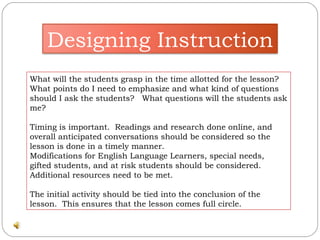
What will the students grasp in the time allotted for the lesson?  What points do I need to emphasize and what kind of questions should I ask the students?  What questions will the students ask me? Timing is important.  Readings and research done online, and overall anticipated conversations should be considered so the lesson is done in a timely manner.  Modifications for English Language Learners, special needs, gifted students, and at risk students should be considered.  Additional resources need to be met. The initial activity should be tied into the conclusion of the lesson.  This ensures that the lesson comes full circle. Designing Instruction
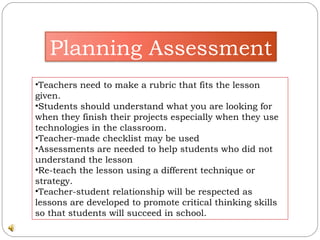
Teachers need to make a rubric that fits the lesson given.  Students should understand what you are looking for when they finish their projects especially when they use technologies in the classroom.  Teacher-made checklist may be used Assessments are needed to help students who did not understand the lesson  Re-teach the lesson using a different technique or strategy.  Teacher-student relationship will be respected as lessons are developed to promote critical thinking skills so that students will succeed in school.  Planning Assessment
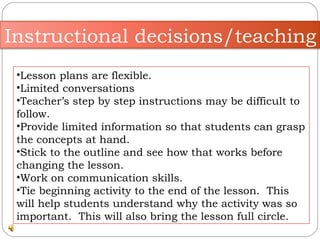
Lesson plans are flexible.  Limited conversations  Teacher’s step by step instructions may be difficult to follow.  Provide limited information so that students can grasp the concepts at hand.  Stick to the outline and see how that works before changing the lesson.  Work on communication skills.  Tie beginning activity to the end of the lesson.  This will help students understand why the activity was so important.  This will also bring the lesson full circle. Instructional decisions/teaching
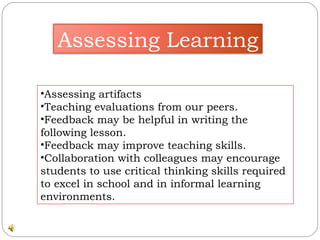
Assessing artifacts  Teaching evaluations from our peers.  Feedback may be helpful in writing the following lesson.  Feedback may improve teaching skills.  Collaboration with colleagues may encourage students to use critical thinking skills required to excel in school and in informal learning environments.  Assessing Learning

Technology in the classroom

  • 1.
    By Vanessa BegayTechnology in the Classroom
  • 2.
    Who am Iteaching the lesson to? Who benefits from the lesson taught? Whose prior knowledge and cultural experience are best matched to the most important principles of the lesson and whose are excluded? How can I implement the Navajo culture into the lesson? Assessing Prior Knowledge
  • 3.
    Look for waysto spark an interest Social interactions at the beginning helps students focus in on the lesson Communication in a circle before they work on the technology tool(s) Step by step instruction on what artifacts students will create Extra time to look into the technologies Completed artifact will be saved on the desktop and/or sent to teacher If time permits, students will present their artifacts Planning Instruction
  • 4.
    What will thestudents grasp in the time allotted for the lesson? What points do I need to emphasize and what kind of questions should I ask the students? What questions will the students ask me? Timing is important. Readings and research done online, and overall anticipated conversations should be considered so the lesson is done in a timely manner. Modifications for English Language Learners, special needs, gifted students, and at risk students should be considered. Additional resources need to be met. The initial activity should be tied into the conclusion of the lesson. This ensures that the lesson comes full circle. Designing Instruction
  • 5.
    Teachers need tomake a rubric that fits the lesson given. Students should understand what you are looking for when they finish their projects especially when they use technologies in the classroom. Teacher-made checklist may be used Assessments are needed to help students who did not understand the lesson Re-teach the lesson using a different technique or strategy. Teacher-student relationship will be respected as lessons are developed to promote critical thinking skills so that students will succeed in school. Planning Assessment
  • 6.
    Lesson plans areflexible. Limited conversations Teacher’s step by step instructions may be difficult to follow. Provide limited information so that students can grasp the concepts at hand. Stick to the outline and see how that works before changing the lesson. Work on communication skills. Tie beginning activity to the end of the lesson. This will help students understand why the activity was so important. This will also bring the lesson full circle. Instructional decisions/teaching
  • 7.
    Assessing artifacts Teaching evaluations from our peers. Feedback may be helpful in writing the following lesson. Feedback may improve teaching skills. Collaboration with colleagues may encourage students to use critical thinking skills required to excel in school and in informal learning environments. Assessing Learning