Unlock data possibilities
Analytics for All: Data as an enabler of
decision making across the business
Dan DiFilippo
Global & US Data and Analytics Leader
May 26, 2016
PwC
Do you have any regrets about
Big Decisions you’ve made?
2
PwC
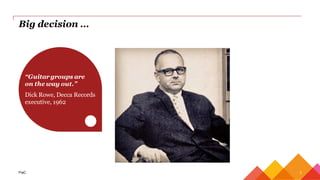
Big decision …
3
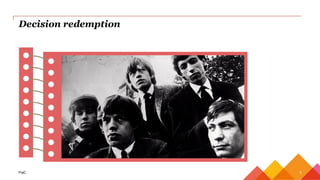
“Guitar groups are
on the way out.”
Dick Rowe, Decca Records
executive, 1962
PwC
Really?
4
PwC
Decision redemption
5
PwC
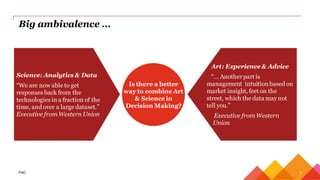
Big ambivalence …
6
Science: Analytics & Data
“We are now able to get
responses back from the
technologies in a fraction of the
time, and over a large dataset.”
Executive from Western Union
Art: Experience & Advice
“… Another part is
management intuition based on
market insight, feet on the
street, which the data may not
tell you.”
Executive from Western
Union
Is there a better
way to combine Art
& Science in
Decision Making?
PwC
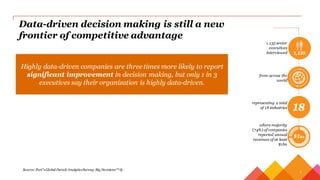
Data-driven decision making is still a new
frontier of competitive advantage
1,135 senior
executives
interviewed
from across the
world
representing a total
of 18 industries
where majority
(74%) of companies
reported annual
revenues of at least
$1bn
Highly data-driven companies are three times more likely to report
significant improvement in decision making, but only 1 in 3
executives say their organization is highly data-driven.
Source: PwC’sGlobal Data& AnalyticsSurvey: Big Decisions™®
7
PwC
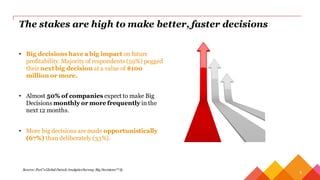
The stakes are high to make better, faster decisions
• Big decisions have a big impact on future
profitability. Majority of respondents (59%) pegged
their next big decision at a value of $100
million or more.
• Almost 50% of companies expect to make Big
Decisions monthly or more frequently in the
next 12 months.
• More big decisions are made opportunistically
(67%) than deliberately (33%).
Source: PwC’sGlobal Data& AnalyticsSurvey: Big Decisions™®
8
PwC
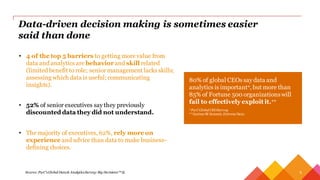
Data-driven decision making is sometimes easier
said than done
• 4 of the top 5 barriers to getting more value from
data and analytics are behaviorand skill related
(limited benefit to role; senior management lacks skills;
assessingwhich data is useful; communicating
insights).
• 52% of senior executives say they previously
discounted data they did not understand.
• The majority of executives, 62%, rely more on
experience and advice than data to make business-
defining choices.
Source: PwC’sGlobal Data& AnalyticsSurvey: Big Decisions™® 9
80% of global CEOs say data and
analytics is important*, but more than
85% of Fortune 500 organizationswill
fail to effectively exploit it.**
*PwCGlobal CEOSurvey
**GartnerBI Summit, ExtremeData
PwC
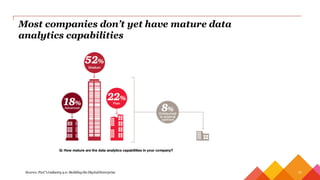
Most companies don’t yet have mature data
analytics capabilities
Source: PwC’sIndustry4.0: BuildingtheDigitalEnterprise 10
11
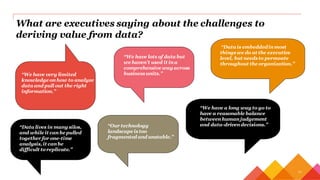
What are executives saying about the challenges to
deriving value from data?
“We have very limited
knowledge onhow to analyze
data and pull out the right
information.”
“We have lots of data but
we haven’t used it ina
comprehensive way across
businessunits.”
“We have a long way to go to
have a reasonable balance
betweenhumanjudgement
and data-drivendecisions.”“Our technology
landscape istoo
fragmented and unstable.”
“Data is embeddedinmost
thingswe do at the executive
level, but needs to permeate
throughout the organization.”
“Data lives in many silos,
and while it canbe pulled
together for one-time
analysis, it canbe
difficult toreplicate.”
12
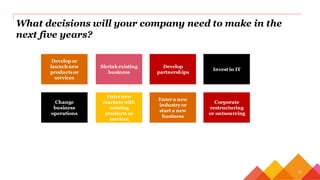
What decisions will your company need to make in the
next five years?
Develop or
launch new
products or
services
Shrinkexisting
business
Develop
partnerships
Entera new
industry or
start a new
business
Invest in IT
Change
business
operations
Enternew
markets with
existing
products or
services
Corporate
restructuring
or outsourcing
13
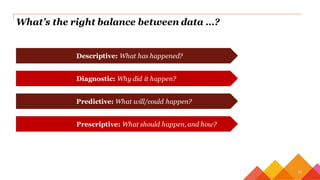
What’s the right balance between data …?
Descriptive: What has happened?
Diagnostic: Why did it happen?
Predictive: What will/could happen?
Prescriptive: What should happen, and how?
14
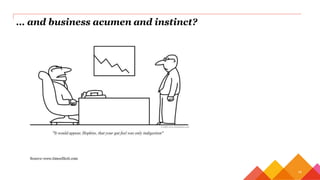
… and business acumen and instinct?
Source:www.timoelliott.com
PwC
In summary …
• Big decisions get made and revisited by senior
executives more than you might think.
• Big decisions often have ‘hot state’ as opposed
to ‘planned’ motivators.
• Executives valueexperience and intuitionmore
than quantitative factors when making big
decisions.
• Barriers to data-driven decisionmaking cited
by executives focus on behavior, skills, and data
quality issues.
Source: PwC’sGlobal Data& AnalyticsSurvey: Big Decisions™® 15
PwC
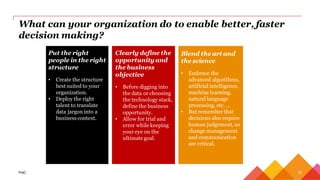
What can your organization do to enable better, faster
decision making?
16
Put the right
people in the right
structure
• Create the structure
best suited to your
organization.
• Deploy the right
talent to translate
data jargon into a
business context.
Clearly define the
opportunity and
the business
objective
• Before digging into
the data or choosing
the technology stack,
define the business
opportunity.
• Allow for trial and
error while keeping
your eye on the
ultimate goal.
Blend the art and
the science
• Embrace the
advanced algorithms,
artificial intelligence,
machine learning,
natural language
processing, etc. …
• But remember that
decisions also require
human judgement, so
change management
and communication
are critical.
Example
Thank you
© 2016 PwC. All rights reserved. PwC refers to the US member firm or one of its subsidiaries
or affiliates, and may sometimes refer to the PwC network. Each member firm is a separate
legal entity. Please see www.pwc.com/structure for further details.

Pwc data analytics

  • 1.
    Unlock data possibilities Analyticsfor All: Data as an enabler of decision making across the business Dan DiFilippo Global & US Data and Analytics Leader May 26, 2016
  • 2.
    PwC Do you haveany regrets about Big Decisions you’ve made? 2
  • 3.
    PwC Big decision … 3 “Guitargroups are on the way out.” Dick Rowe, Decca Records executive, 1962
  • 4.
  • 5.
  • 6.
    PwC Big ambivalence … 6 Science:Analytics & Data “We are now able to get responses back from the technologies in a fraction of the time, and over a large dataset.” Executive from Western Union Art: Experience & Advice “… Another part is management intuition based on market insight, feet on the street, which the data may not tell you.” Executive from Western Union Is there a better way to combine Art & Science in Decision Making?
  • 7.
    PwC Data-driven decision makingis still a new frontier of competitive advantage 1,135 senior executives interviewed from across the world representing a total of 18 industries where majority (74%) of companies reported annual revenues of at least $1bn Highly data-driven companies are three times more likely to report significant improvement in decision making, but only 1 in 3 executives say their organization is highly data-driven. Source: PwC’sGlobal Data& AnalyticsSurvey: Big Decisions™® 7
  • 8.
    PwC The stakes arehigh to make better, faster decisions • Big decisions have a big impact on future profitability. Majority of respondents (59%) pegged their next big decision at a value of $100 million or more. • Almost 50% of companies expect to make Big Decisions monthly or more frequently in the next 12 months. • More big decisions are made opportunistically (67%) than deliberately (33%). Source: PwC’sGlobal Data& AnalyticsSurvey: Big Decisions™® 8
  • 9.
    PwC Data-driven decision makingis sometimes easier said than done • 4 of the top 5 barriers to getting more value from data and analytics are behaviorand skill related (limited benefit to role; senior management lacks skills; assessingwhich data is useful; communicating insights). • 52% of senior executives say they previously discounted data they did not understand. • The majority of executives, 62%, rely more on experience and advice than data to make business- defining choices. Source: PwC’sGlobal Data& AnalyticsSurvey: Big Decisions™® 9 80% of global CEOs say data and analytics is important*, but more than 85% of Fortune 500 organizationswill fail to effectively exploit it.** *PwCGlobal CEOSurvey **GartnerBI Summit, ExtremeData
  • 10.
    PwC Most companies don’tyet have mature data analytics capabilities Source: PwC’sIndustry4.0: BuildingtheDigitalEnterprise 10
  • 11.
    11 What are executivessaying about the challenges to deriving value from data? “We have very limited knowledge onhow to analyze data and pull out the right information.” “We have lots of data but we haven’t used it ina comprehensive way across businessunits.” “We have a long way to go to have a reasonable balance betweenhumanjudgement and data-drivendecisions.”“Our technology landscape istoo fragmented and unstable.” “Data is embeddedinmost thingswe do at the executive level, but needs to permeate throughout the organization.” “Data lives in many silos, and while it canbe pulled together for one-time analysis, it canbe difficult toreplicate.”
  • 12.
    12 What decisions willyour company need to make in the next five years? Develop or launch new products or services Shrinkexisting business Develop partnerships Entera new industry or start a new business Invest in IT Change business operations Enternew markets with existing products or services Corporate restructuring or outsourcing
  • 13.
    13 What’s the rightbalance between data …? Descriptive: What has happened? Diagnostic: Why did it happen? Predictive: What will/could happen? Prescriptive: What should happen, and how?
  • 14.
    14 … and businessacumen and instinct? Source:www.timoelliott.com
  • 15.
    PwC In summary … •Big decisions get made and revisited by senior executives more than you might think. • Big decisions often have ‘hot state’ as opposed to ‘planned’ motivators. • Executives valueexperience and intuitionmore than quantitative factors when making big decisions. • Barriers to data-driven decisionmaking cited by executives focus on behavior, skills, and data quality issues. Source: PwC’sGlobal Data& AnalyticsSurvey: Big Decisions™® 15
  • 16.
    PwC What can yourorganization do to enable better, faster decision making? 16 Put the right people in the right structure • Create the structure best suited to your organization. • Deploy the right talent to translate data jargon into a business context. Clearly define the opportunity and the business objective • Before digging into the data or choosing the technology stack, define the business opportunity. • Allow for trial and error while keeping your eye on the ultimate goal. Blend the art and the science • Embrace the advanced algorithms, artificial intelligence, machine learning, natural language processing, etc. … • But remember that decisions also require human judgement, so change management and communication are critical. Example
  • 17.
    Thank you © 2016PwC. All rights reserved. PwC refers to the US member firm or one of its subsidiaries or affiliates, and may sometimes refer to the PwC network. Each member firm is a separate legal entity. Please see www.pwc.com/structure for further details.