Shiva Ram Khatiwoda
Health System Models
1
Goals of Health System
• There are about 200 nations on our planet,
and each nation devises its own set of
arrangements for meeting the three basic
goals of Health care system:
– I. Keeping people healthy
– II. Treating the sick
– III. Protecting families against financial ruin from
medical bills.
Health System Models
Healthcare delivery (Health System) models :
1. The Beveridge model
2. Bismarck model
3. National Health Insurance model
4. The out-of-pocket model
3
The Beveridge (NHS) Model
4
The Beveridge (NHS) Model
• Named after William Beveridge, the daring social reformer
who designed Britain’s National Health Service (NHS).
• In this system, health care is provided and financed by the
government through tax payments,
• Many, but not all, hospitals and clinics are owned by the
government; some doctors are government employees,
but there are also private doctors who collect their fees
from the government.
• In Britain, you never get a doctor’s bill.
• These systems tend to have low costs per capita, because
the government, as the sole payer, controls what doctors
can do and what they can charge.
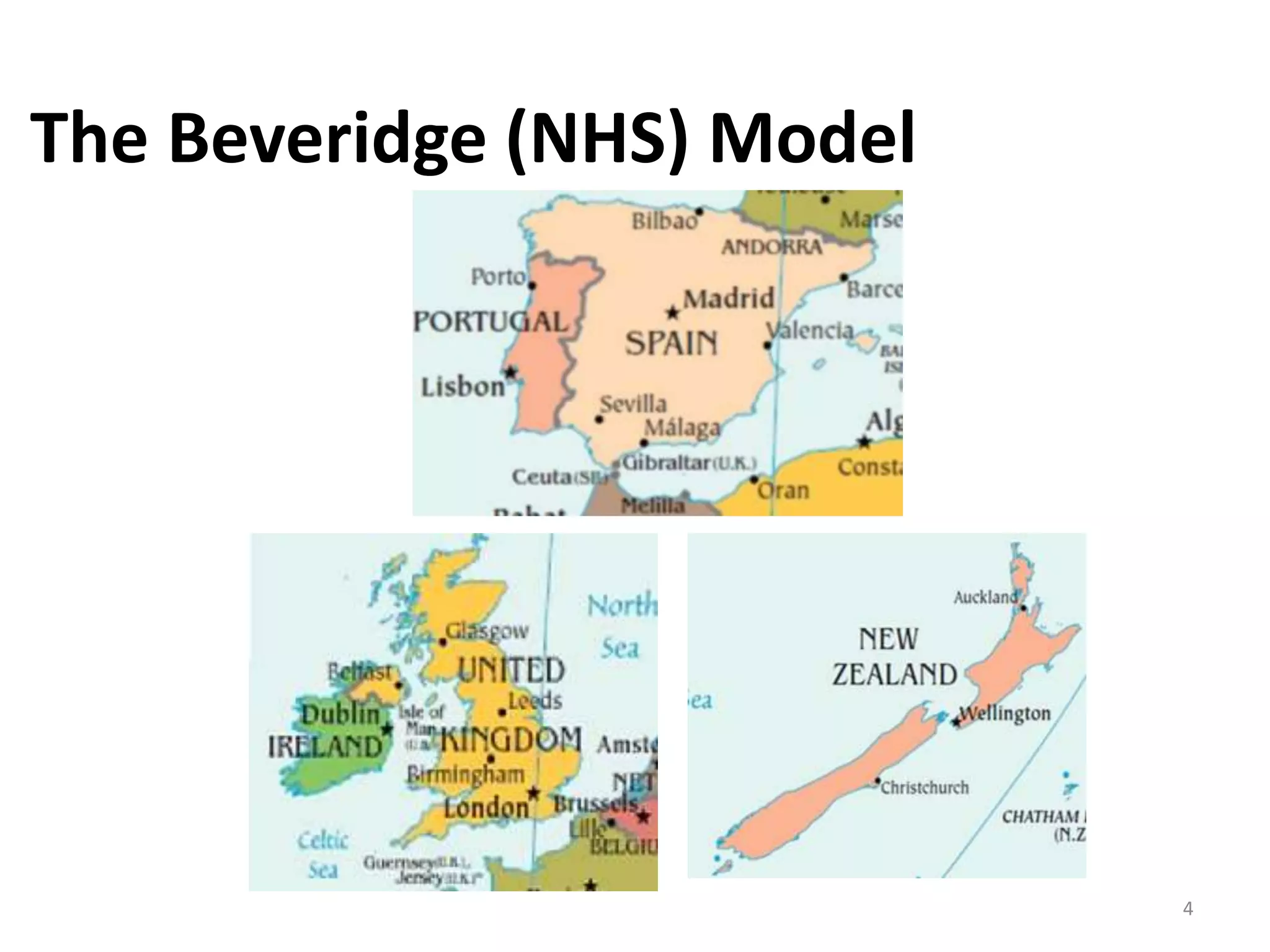
• Example – UK, Spain, New Zealand
5
6
The Bismarck Model
The Bismarck Model
• Named after the Prussian Chancellor Otto von
Bismarck, who invented the welfare state as part of the
unification of Germany in the 19th century.
• Usually financed jointly by employers and employees
through payroll deduction.
• Bismarck-type health insurance plans have to cover
everybody
• Non-profit making insurance
• Doctors and hospitals tend to be private in Bismarck
countries.
• Examples –Germany, France, Belgium, Netherlands,
Switzerland, Japan
7
8
The National Health Insurance
Model
The National Health Insurance Model
• Has elements of both Beveridge and Bismarck.
• It uses private-sector providers, but payment comes
from a government-run insurance program that every
citizen pays into.
• Since there’s no need for marketing, no financial
motive to deny claims and no profit, these universal
insurance programs tend to be cheaper and much
simpler administratively
• The classic NHI system is found in Canada, but some
newly industrialized countries - Taiwan and South
Korea, for example - have also adopted the NHI model.
9
The Out-of-Pocket Model
• Only the developed, industrialized countries - perhaps
40 of the world’s 200 countries - have established
health care systems.
• In other countries they have out of pocket model.
• The basic rule in such countries is that the rich get
medical care; the poor stay sick or die.
• Most of the nations on the planet are too poor and
too disorganized to provide any kind of mass medical
care.
• Hospitals and doctors are mostly private 10
The Out-of-Pocket Model
• Example – Many underdeveloped countries
of Africa, South America and Asia including -
Nepal, India, and China
11
Mixed models
• Some elements of different models may be
included in some countries.
• This may also be a in transitional phase.
• For example – some services provided free,
some with subsidies, some social/national
insurance, and some out-of-pocket.
12
Another way of categorization of
Health system model
1. Free market –
2. Welfare state –
3. Socialist state -
4. Underdeveloped -
5. Transitional –
Thank You
14

Health system models

  • 1.
  • 2.
    Goals of HealthSystem • There are about 200 nations on our planet, and each nation devises its own set of arrangements for meeting the three basic goals of Health care system: – I. Keeping people healthy – II. Treating the sick – III. Protecting families against financial ruin from medical bills.
  • 3.
    Health System Models Healthcaredelivery (Health System) models : 1. The Beveridge model 2. Bismarck model 3. National Health Insurance model 4. The out-of-pocket model 3
  • 4.
  • 5.
    The Beveridge (NHS)Model • Named after William Beveridge, the daring social reformer who designed Britain’s National Health Service (NHS). • In this system, health care is provided and financed by the government through tax payments, • Many, but not all, hospitals and clinics are owned by the government; some doctors are government employees, but there are also private doctors who collect their fees from the government. • In Britain, you never get a doctor’s bill. • These systems tend to have low costs per capita, because the government, as the sole payer, controls what doctors can do and what they can charge. • Example – UK, Spain, New Zealand 5
  • 6.
  • 7.
    The Bismarck Model •Named after the Prussian Chancellor Otto von Bismarck, who invented the welfare state as part of the unification of Germany in the 19th century. • Usually financed jointly by employers and employees through payroll deduction. • Bismarck-type health insurance plans have to cover everybody • Non-profit making insurance • Doctors and hospitals tend to be private in Bismarck countries. • Examples –Germany, France, Belgium, Netherlands, Switzerland, Japan 7
  • 8.
    8 The National HealthInsurance Model
  • 9.
    The National HealthInsurance Model • Has elements of both Beveridge and Bismarck. • It uses private-sector providers, but payment comes from a government-run insurance program that every citizen pays into. • Since there’s no need for marketing, no financial motive to deny claims and no profit, these universal insurance programs tend to be cheaper and much simpler administratively • The classic NHI system is found in Canada, but some newly industrialized countries - Taiwan and South Korea, for example - have also adopted the NHI model. 9
  • 10.
    The Out-of-Pocket Model •Only the developed, industrialized countries - perhaps 40 of the world’s 200 countries - have established health care systems. • In other countries they have out of pocket model. • The basic rule in such countries is that the rich get medical care; the poor stay sick or die. • Most of the nations on the planet are too poor and too disorganized to provide any kind of mass medical care. • Hospitals and doctors are mostly private 10
  • 11.
    The Out-of-Pocket Model •Example – Many underdeveloped countries of Africa, South America and Asia including - Nepal, India, and China 11
  • 12.
    Mixed models • Someelements of different models may be included in some countries. • This may also be a in transitional phase. • For example – some services provided free, some with subsidies, some social/national insurance, and some out-of-pocket. 12
  • 13.
    Another way ofcategorization of Health system model 1. Free market – 2. Welfare state – 3. Socialist state - 4. Underdeveloped - 5. Transitional –
  • 14.

Editor's Notes

  • #6 Funded by government - just like the police force or the public library.