Introduction Interference Exploitation by Design Interference Management “Alto apprendistato”
Techniques for interference mitigation
in satellite communications
Yuri Zanettini
SPADiC Lab
Dept. of Engin. and Arch.
University of Parma
Parma, Italy
March 14, 2018
1/32 Techniques for interference mitigationin satellite communications Yuri Zanettini
Introduction Interference Exploitation by Design Interference Management “Alto apprendistato”
Outline
1 Introduction
2 Interference Exploitation by Design
3 Interference Management
4 “Alto apprendistato”
2/32 Techniques for interference mitigationin satellite communications Yuri Zanettini
Introduction Interference Exploitation by Design Interference Management “Alto apprendistato”
Statement of the problem
Interference intentionally introduced by design
Aggressive demand for higher satellite throughput
HD and UHD video transmission
Standardization of new transmission protocols
New symbol rate and roll-off value
Limited frequency bands availability
Change of paradigm
from interference avoidance to interference management and
exploitation
Interference by multiple access
IoT networks are developing fast
Low-cost devices
No time-slotted transmissions
Packet collisions
3/32 Techniques for interference mitigationin satellite communications Yuri Zanettini
Introduction Interference Exploitation by Design Interference Management “Alto apprendistato”
Outline
1 Introduction
2 Interference Exploitation by Design
3 Interference Management
4 “Alto apprendistato”
4/32 Techniques for interference mitigationin satellite communications Yuri Zanettini
Introduction Interference Exploitation by Design Interference Management “Alto apprendistato”
Two-carrier Scenario
Channel model
Satellite transponder
IMUX OMUXTWTA
x(t) s(t)
w(t)
y(t)
Symbols from QPSK to 64APSK, possibly predistorted
x(t) =
k
x
(1)
k p(t − kTs)e−j2πF t
+
k
x
(2)
k p(t − kTs)ej2πF t
p(t) RRC with roll-off α = 10%
DVB-S2 channel model
[1] ETSI EN 302 307-2 Digital Video Broadcasting (DVB),“Second generation framing structure, channel coding and modulation systems
for Broadcasting, Interactive Services, News Gathering and other broadband satellite applications, Part II: S2-Extensions (DVB-S2X),”
Available on ETSI web site (http://www.etsi.org).
5/32 Techniques for interference mitigationin satellite communications Yuri Zanettini
Introduction Interference Exploitation by Design Interference Management “Alto apprendistato”
Applied Techniques
Frequency packing
F
Rs
BOMUX
Two carriers per transponder
BOMUX = 500 MHz
We optimize the symbol rate Rs and the frequency spacing F
Figure of merit
Achievable spectral efficiency
ASE =
IR
TsBOMUX
[bit/s/Hz]
[2] D. M. Arnold, H. A. Loeliger, P. O. Vontobel, A. Kavˇci´c and W. Zeng, “Simulation-Based Computation of Information Rates for
Channels With Memory,” IEEE Trans. Inform. Theory, vol. 52, pp. 3498–3508, Aug. 2006.
6/32 Techniques for interference mitigationin satellite communications Yuri Zanettini
Introduction Interference Exploitation by Design Interference Management “Alto apprendistato”
Applied Techniques
Transmitter side
Multicarrier data predistorter
Mitigation of the non-linear intermodulation distortion
Iterative processing
Time-varying constellations
Stage 1 Stage 2
a1
aU
a
(0)
1
a
(0)
U
a
(2)
1
a
(2)
U
a
(S)
1
a
(S)
U
a
(1)
1
a
(1)
U
a
(S-1)
1
a
(S-1)
U
Stage S
[3] B. F. Beidas, R. I. Shesadri and N. Becker, “Multicarrier Successive Predistortion for Nonlinear Satellite Systems,” IEEE Trans.
Commun., vol. 63, pp. 1373–1382, Apr. 2015
7/32 Techniques for interference mitigationin satellite communications Yuri Zanettini
Introduction Interference Exploitation by Design Interference Management “Alto apprendistato”
Applied Techniques
Transmitter side
Predistorted constellations
Computed for each carrier
Minimizing error between undistorted symbols and estimator output
a(s+1)
u = ˆa(s)
u − µ(s)
au − ˆa(s)
u
a1
aU
a
(s)
1
a
(s)
U
a
(s+1)
1
a
(s+1)
U
µ(s)
ˆa
(s)
1
ˆa
(s)
U
Channel
Output
Estimator
−
−
Stage s
[3] B. F. Beidas, R. I. Shesadri and N. Becker, “Multicarrier Successive Predistortion for Nonlinear Satellite Systems,” IEEE Trans.
Commun., vol. 63, pp. 1373–1382, Apr. 2015
7/32 Techniques for interference mitigationin satellite communications Yuri Zanettini
Introduction Interference Exploitation by Design Interference Management “Alto apprendistato”
Applied Techniques
Receiver side
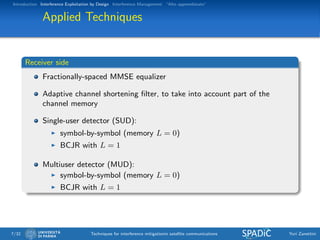
Fractionally-spaced MMSE equalizer
Adaptive channel shortening filter, to take into account part of the
channel memory
Single-user detector (SUD):
symbol-by-symbol (memory L = 0)
BCJR with L = 1
Multiuser detector (MUD):
symbol-by-symbol (memory L = 0)
BCJR with L = 1
7/32 Techniques for interference mitigationin satellite communications Yuri Zanettini
Introduction Interference Exploitation by Design Interference Management “Alto apprendistato”
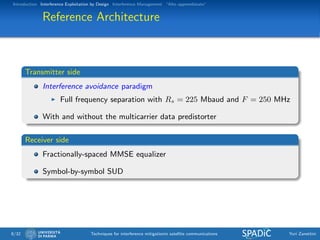
Reference Architecture
Transmitter side
Interference avoidance paradigm
Full frequency separation with Rs = 225 Mbaud and F = 250 MHz
With and without the multicarrier data predistorter
Receiver side
Fractionally-spaced MMSE equalizer
Symbol-by-symbol SUD
8/32 Techniques for interference mitigationin satellite communications Yuri Zanettini
Introduction Interference Exploitation by Design Interference Management “Alto apprendistato”
Numerical Results
SUD detector
0
1
2
3
4
5
6
−10 −5 0 5 10 15 20 25
ASE[bit/s/Hz]
Psat/N [dB]
Ref., no pred.
Ref., pred.
L = 0, no pred.
L = 0, pred.
L = 1, no pred.
L = 1, pred.
Memory L = 0 and
L = 1
Symbols up to 64APSK
Optimization:
Symbol rate
Frequency spacing
IBO
Comparison with and
without the predistorter
Maximum ASE when
signals slightly overlapped
SUD L = 1 – pred. SUD L = 1 – no pred.
Psat/N0 [dB] M Rs [Mbaud] F [MHz] IBO [dB] M Rs [Mbaud] F [MHz] IBO [dB]
15 64 250 275 3 64 275 275 6
20 64 275 275 6 64 275 275 9
25 64 325 325 6 64 325 350 12
9/32 Techniques for interference mitigationin satellite communications Yuri Zanettini
Introduction Interference Exploitation by Design Interference Management “Alto apprendistato”
Numerical Results
MUD detector
0
1
2
3
4
5
6
−10 −5 0 5 10 15 20 25
ASE[bit/s/Hz]
Psat/N [dB]
Ref., no pred.
Ref., pred.
L = 0, no pred.
L = 0, pred.
L = 1, no pred.
L = 1, pred.
Memory L = 0 and
L = 1
Symbols up to 16APSK
Optimization:
Symbol rate
Frequency spacing
IBO
Comparison with and
without the predistorter
Maximum ASE when
signals perfectly
overlapped
MUD L = 0 – pred. MUD L = 0 – no pred.
Psat/N0 [dB] M Rs [Mbaud] F [MHz] IBO [dB] M Rs [Mbaud] F [MHz] IBO [dB]
15 16 525 0 0 8 525 0 6
20 16 525 0 3 16 525 0 9
25 16 525 0 3 16 525 0 12
10/32 Techniques for interference mitigationin satellite communications Yuri Zanettini
Introduction Interference Exploitation by Design Interference Management “Alto apprendistato”
Numerical Results
SUD and MUD detectors with memory L = 0
0
1
2
3
4
5
6
−10 −5 0 5 10 15 20 25
ASE[bit/s/Hz]
Psat/N [dB]
Ref., no pred.
Ref., pred.
SUD, no pred.
SUD, pred.
MUD, no pred.
MUD, pred.
Comparison between
SUD and MUD
Memory L = 0
SUD: symbols up to
64APSK
MUD: symbols up to
16APSK
Gains of 2.5 ÷ 4 dB over
reference scheme
11/32 Techniques for interference mitigationin satellite communications Yuri Zanettini
Introduction Interference Exploitation by Design Interference Management “Alto apprendistato”
Numerical Results
SUD and MUD detectors with memory L = 1
0
1
2
3
4
5
6
−10 −5 0 5 10 15 20 25
ASE[bit/s/Hz]
Psat/N [dB]
Ref., no pred.
Ref., pred.
SUD, no pred.
SUD, pred.
MUD, no pred.
MUD, pred.
Comparison between
SUD and MUD
Memory L = 1
SUD: symbols up to
64APSK
MUD: symbols up to
16APSK
Gains of 1 bit/s/Hz over
reference scheme
12/32 Techniques for interference mitigationin satellite communications Yuri Zanettini
Introduction Interference Exploitation by Design Interference Management “Alto apprendistato”
Numerical Results
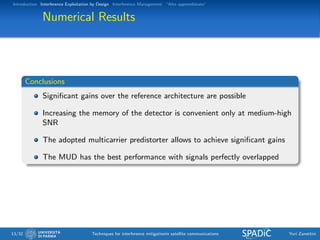
Conclusions
Significant gains over the reference architecture are possible
Increasing the memory of the detector is convenient only at medium-high
SNR
The adopted multicarrier predistorter allows to achieve significant gains
The MUD has the best performance with signals perfectly overlapped
13/32 Techniques for interference mitigationin satellite communications Yuri Zanettini
Introduction Interference Exploitation by Design Interference Management “Alto apprendistato”
Outline
1 Introduction
2 Interference Exploitation by Design
3 Interference Management
4 “Alto apprendistato”
14/32 Techniques for interference mitigationin satellite communications Yuri Zanettini
Introduction Interference Exploitation by Design Interference Management “Alto apprendistato”
LoRaWAN Network
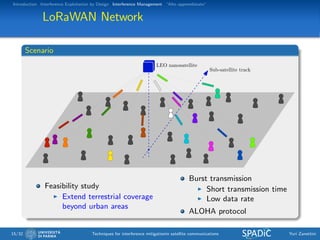
Scenario
LEO nanosatellite
Sub-satellite track
Feasibility study
Extend terrestrial coverage
beyond urban areas
Burst transmission
Short transmission time
Low data rate
ALOHA protocol
15/32 Techniques for interference mitigationin satellite communications Yuri Zanettini
Introduction Interference Exploitation by Design Interference Management “Alto apprendistato”
LoRaWAN Network
Channel model
The complex envelope of the received signal at the Cubesat is
r(t) = ejθ(t)
N
i=1
γi(t)si(t − τi)ej[2π(νi+αit/2)t+φi(t)]
+ w(t)
where
N is the number of active transmitters on a given frequency band
and on a given swath,
si(t − τi) is the message transmitted by the i-th active user,
γi(t) its complex gain/attenuation,
νi its Doppler shift,
αi its Doppler rate,
θ(t) the receive phase noise,
φi(t) the corrisponding phase noise at the transmitter (indipendent
of the phase noise process θ(t)),
τi the relative delays of packets transmitted by different users,
w(t) the additive white Gaussian noise.
16/32 Techniques for interference mitigationin satellite communications Yuri Zanettini
Introduction Interference Exploitation by Design Interference Management “Alto apprendistato”
LoRaWAN Network
Complex attenuation
Depending on the users’ positions, the corresponding gains γi and
Doppler impairments νi and αi are computed
The gains γi take into account
The radiation pattern of antennas
Path loss (Friis formula)
Shadowing, modelled as Bernoulli random variable
Miscellaneous losses (O2 absorption, polarization mismatch,
connectors losses, etc)
16/32 Techniques for interference mitigationin satellite communications Yuri Zanettini
Introduction Interference Exploitation by Design Interference Management “Alto apprendistato”
LoRaWAN Network
Doppler effect
The Doppler shift and Doppler rate are computed as
ν(t) = −f0
c
REd sin(∆ψ(t)) cos cos−1 RE
d
cos(θ) −θ
vsat
d
R2
E+d2−2REd cos(∆ψ(t)) cos cos−1 RE
d
cos(θ) −θ
α(t) = d
dt
ν(t)
Doppler shift has to be cumulated with oscillator frequency instability
Doppler rate comparable to the frequency separation between symbols
[4] I. Ali, N. Al-Dhahir, J. E. Hershey, “Doppler characterization for LEO satellites”, IEEE Trans. Commun., vol. 46, pp. 309–313, Mar. 1998.
16/32 Techniques for interference mitigationin satellite communications Yuri Zanettini
Introduction Interference Exploitation by Design Interference Management “Alto apprendistato”
Transmitters
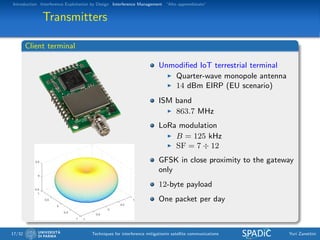
Client terminal
Unmodified IoT terrestrial terminal
Quarter-wave monopole antenna
14 dBm EIRP (EU scenario)
ISM band
863.7 MHz
LoRa modulation
B = 125 kHz
SF = 7 ÷ 12
GFSK in close proximity to the gateway
only
12-byte payload
One packet per day
17/32 Techniques for interference mitigationin satellite communications Yuri Zanettini
Introduction Interference Exploitation by Design Interference Management “Alto apprendistato”
Receiver
Cubesat
Expandable modular
architecture
1U: 10 × 10 × 10 cm
Proposed receiver
Directional antennas (helical, G ≈ 12.4 dB)
Different swaths
[5] G. Colavolpe, T. Foggi, M. Ricciulli, Y. Zanettini, “Reception of LoRa signals from LEO satellites”, patent assigned to Inmarsat, sent
to the patent attorney for further processing.
18/32 Techniques for interference mitigationin satellite communications Yuri Zanettini
Introduction Interference Exploitation by Design Interference Management “Alto apprendistato”
Numerical Results
Assumptions
All users are uniformly distributed within the entire FoV
No interference coming from other services in the same unlicensed
bandwidth is considered
Link budget
CNR values required to achieve a BER = 10−5
over AWGN channel and
in absence of interfering signals and packet collisions
PFSK
b ≈ 2SF −1
Q
C
N
2SF
rc
SF 7 8 9 10 11 12
C/N [dB] −6.9 −9.7 −12.5 −15.3 −18.1 −20.9
Distribution of SFs
SF 7 8 9 10 11 12
p 0 16/31 8/31 4/31 2/31 1/31
19/32 Techniques for interference mitigationin satellite communications Yuri Zanettini
Introduction Interference Exploitation by Design Interference Management “Alto apprendistato”
Numerical Results
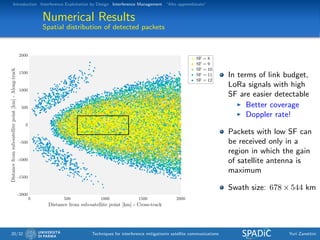
Spatial distribution of detected packets
In terms of link budget,
LoRa signals with high
SF are easier detectable
Better coverage
Doppler rate!
Packets with low SF can
be received only in a
region in which the gain
of satellite antenna is
maximum
Swath size: 678 × 544 km
20/32 Techniques for interference mitigationin satellite communications Yuri Zanettini
Introduction Interference Exploitation by Design Interference Management “Alto apprendistato”
Numerical Results
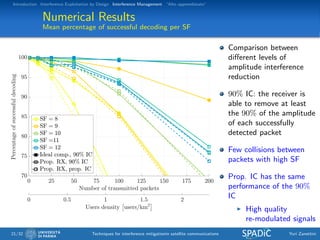
Mean percentage of successful decoding per SF
Comparison between
different levels of
amplitude interference
reduction
90% IC: the receiver is
able to remove at least
the 90% of the amplitude
of each successfully
detected packet
Few collisions between
packets with high SF
Prop. IC has the same
performance of the 90%
IC
High quality
re-modulated signals
21/32 Techniques for interference mitigationin satellite communications Yuri Zanettini
Introduction Interference Exploitation by Design Interference Management “Alto apprendistato”
Numerical Results
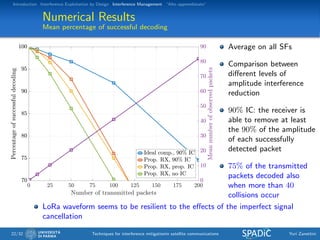
Mean percentage of successful decoding
Average on all SFs
Comparison between
different levels of
amplitude interference
reduction
90% IC: the receiver is
able to remove at least
the 90% of the amplitude
of each successfully
detected packet
75% of the transmitted
packets decoded also
when more than 40
collisions occur
LoRa waveform seems to be resilient to the effects of the imperfect signal
cancellation
22/32 Techniques for interference mitigationin satellite communications Yuri Zanettini
Introduction Interference Exploitation by Design Interference Management “Alto apprendistato”
Numerical Results
Conclusions
The designed receiver for LoRa signals is able to cope with the main
impairments related to a LEO satellite reception (Doppler shift and
Doppler rate) and is also able to exploit interference cancellation
The receiver has a very high robustness to interference (the intrinsic
robustness of the modulation format is not degraded)
The interference cancellation scheme is able to significantly improve the
overall performance
It is reasonable to assume that this modulation format, with the designed
receiver, is suitable for satellite-based applications
23/32 Techniques for interference mitigationin satellite communications Yuri Zanettini
Introduction Interference Exploitation by Design Interference Management “Alto apprendistato”
Outline
1 Introduction
2 Interference Exploitation by Design
3 Interference Management
4 “Alto apprendistato”
24/32 Techniques for interference mitigationin satellite communications Yuri Zanettini
Introduction Interference Exploitation by Design Interference Management “Alto apprendistato”
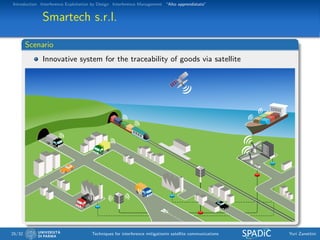
Smartech s.r.l.
Scenario
Innovative system for the traceability of goods via satellite
25/32 Techniques for interference mitigationin satellite communications Yuri Zanettini
Introduction Interference Exploitation by Design Interference Management “Alto apprendistato”
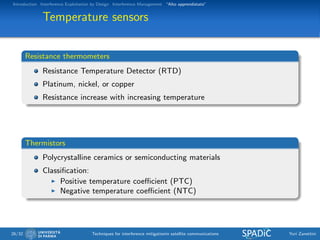
Temperature sensors
Resistance thermometers
Resistance Temperature Detector (RTD)
Platinum, nickel, or copper
Resistance increase with increasing temperature
Thermistors
Polycrystalline ceramics or semiconducting materials
Classification:
Positive temperature coefficient (PTC)
Negative temperature coefficient (NTC)
26/32 Techniques for interference mitigationin satellite communications Yuri Zanettini
Introduction Interference Exploitation by Design Interference Management “Alto apprendistato”
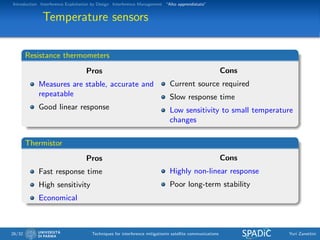
Temperature sensors
Resistance thermometers
Pros
Measures are stable, accurate and
repeatable
Good linear response
Cons
Current source required
Slow response time
Low sensitivity to small temperature
changes
Thermistor
Pros
Fast response time
High sensitivity
Economical
Cons
Highly non-linear response
Poor long-term stability
26/32 Techniques for interference mitigationin satellite communications Yuri Zanettini
Introduction Interference Exploitation by Design Interference Management “Alto apprendistato”
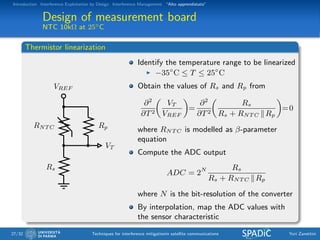
Design of measurement board
NTC 10kΩ at 25◦C
Thermistor linearization
VREF
VT
Rp
Rs
RNT C
Identify the temperature range to be linearized
−35◦
C ≤ T ≤ 25◦
C
Obtain the values of Rs and Rp from
∂2
∂T2
VT
VREF
=
∂2
∂T2
Rs
Rs + RNT C Rp
=0
where RNT C is modelled as β-parameter
equation
Compute the ADC output
ADC = 2N Rs
Rs + RNT C Rp
where N is the bit-resolution of the converter
By interpolation, map the ADC values with
the sensor characteristic
27/32 Techniques for interference mitigationin satellite communications Yuri Zanettini
Introduction Interference Exploitation by Design Interference Management “Alto apprendistato”
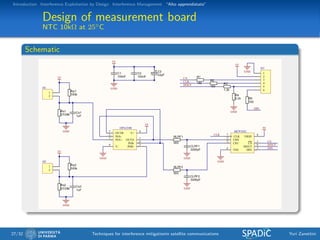
Design of measurement board
NTC 10kΩ at 25◦C
Schematic
27/32 Techniques for interference mitigationin satellite communications Yuri Zanettini
Introduction Interference Exploitation by Design Interference Management “Alto apprendistato”
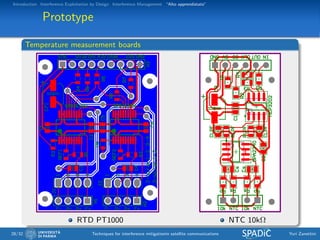
Prototype
Temperature measurement boards
RTD PT1000 NTC 10kΩ
28/32 Techniques for interference mitigationin satellite communications Yuri Zanettini
Introduction Interference Exploitation by Design Interference Management “Alto apprendistato”
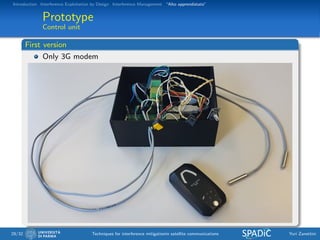
Prototype
Control unit
First version
Only 3G modem
29/32 Techniques for interference mitigationin satellite communications Yuri Zanettini
Introduction Interference Exploitation by Design Interference Management “Alto apprendistato”
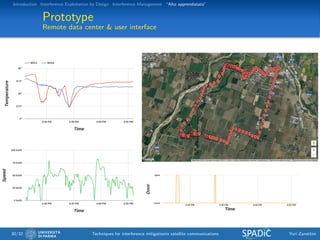
Prototype
Remote data center & user interface
30/32 Techniques for interference mitigationin satellite communications Yuri Zanettini
Introduction Interference Exploitation by Design Interference Management “Alto apprendistato”
Publications
Conferences
A. Ugolini, M. Ricciulli, Y. Zanettini, G. Colavolpe, “Advanced
transceiver schemes for next generation high rate telemetry,” Proc. 8th
Advanced Satellite Multimedia Systems Conference and 14th Signal
Processing for Space Communications Workshop (ASMS/SPSC 2016),
Palma de Mallorca, Spain, September 2016, pp. 112-119.
A. Ugolini, Y. Zanettini, A. Piemontese, A. Vanelli-Coralli and G.
Colavolpe, “Efficient satellite systems based on interference management
and exploitation,” 50th Asilomar Conference on Signals, Systems and
Computers (ASILOMAR 2016), Pacific Grove, California, USA,
November 2016.
31/32 Techniques for interference mitigationin satellite communications Yuri Zanettini
Introduction Interference Exploitation by Design Interference Management “Alto apprendistato”
Publications
Journals
G. Colavolpe, T. Foggi, M. Ricciulli, Y. Zanettini, “Reception of LoRa
signals from LEO satellites,” manuscript under prep.
G. Colavolpe, A. Ugolini, Y. Zanettini, “On multiuser detection in
multicarrier DVB-S2X systems,” IEEE Trans. on Aerospace and Electronic
Systems, manuscript under prep.
S. Cioni, G. Colavolpe, V. Mignone, A. Modenini, A. Morello, M. Ricciulli,
A. Ugolini, Y. Zanettini, “Transmission parameters optimization and
receiver architectures for DVB-S2X systems,” International Journal of
Satellite Communications and Networking, vol. 34, pp. 337-350,
May/June 2016. Article first published online: June 2015.
Patents
G. Colavolpe, T. Foggi, M. Ricciulli, Y. Zanettini, “Reception of LoRa
signals from LEO satellites”, assigned to Inmarsat, sent to the patent
attorney for further processing.
32/32 Techniques for interference mitigationin satellite communications Yuri Zanettini

Techniques for interference mitigation in satellite communications

  • 1.
    Introduction Interference Exploitationby Design Interference Management “Alto apprendistato” Techniques for interference mitigation in satellite communications Yuri Zanettini SPADiC Lab Dept. of Engin. and Arch. University of Parma Parma, Italy March 14, 2018 1/32 Techniques for interference mitigationin satellite communications Yuri Zanettini
  • 2.
    Introduction Interference Exploitationby Design Interference Management “Alto apprendistato” Outline 1 Introduction 2 Interference Exploitation by Design 3 Interference Management 4 “Alto apprendistato” 2/32 Techniques for interference mitigationin satellite communications Yuri Zanettini
  • 3.
    Introduction Interference Exploitationby Design Interference Management “Alto apprendistato” Statement of the problem Interference intentionally introduced by design Aggressive demand for higher satellite throughput HD and UHD video transmission Standardization of new transmission protocols New symbol rate and roll-off value Limited frequency bands availability Change of paradigm from interference avoidance to interference management and exploitation Interference by multiple access IoT networks are developing fast Low-cost devices No time-slotted transmissions Packet collisions 3/32 Techniques for interference mitigationin satellite communications Yuri Zanettini
  • 4.
    Introduction Interference Exploitationby Design Interference Management “Alto apprendistato” Outline 1 Introduction 2 Interference Exploitation by Design 3 Interference Management 4 “Alto apprendistato” 4/32 Techniques for interference mitigationin satellite communications Yuri Zanettini
  • 5.
    Introduction Interference Exploitationby Design Interference Management “Alto apprendistato” Two-carrier Scenario Channel model Satellite transponder IMUX OMUXTWTA x(t) s(t) w(t) y(t) Symbols from QPSK to 64APSK, possibly predistorted x(t) = k x (1) k p(t − kTs)e−j2πF t + k x (2) k p(t − kTs)ej2πF t p(t) RRC with roll-off α = 10% DVB-S2 channel model [1] ETSI EN 302 307-2 Digital Video Broadcasting (DVB),“Second generation framing structure, channel coding and modulation systems for Broadcasting, Interactive Services, News Gathering and other broadband satellite applications, Part II: S2-Extensions (DVB-S2X),” Available on ETSI web site (http://www.etsi.org). 5/32 Techniques for interference mitigationin satellite communications Yuri Zanettini
  • 6.
    Introduction Interference Exploitationby Design Interference Management “Alto apprendistato” Applied Techniques Frequency packing F Rs BOMUX Two carriers per transponder BOMUX = 500 MHz We optimize the symbol rate Rs and the frequency spacing F Figure of merit Achievable spectral efficiency ASE = IR TsBOMUX [bit/s/Hz] [2] D. M. Arnold, H. A. Loeliger, P. O. Vontobel, A. Kavˇci´c and W. Zeng, “Simulation-Based Computation of Information Rates for Channels With Memory,” IEEE Trans. Inform. Theory, vol. 52, pp. 3498–3508, Aug. 2006. 6/32 Techniques for interference mitigationin satellite communications Yuri Zanettini
  • 7.
    Introduction Interference Exploitationby Design Interference Management “Alto apprendistato” Applied Techniques Transmitter side Multicarrier data predistorter Mitigation of the non-linear intermodulation distortion Iterative processing Time-varying constellations Stage 1 Stage 2 a1 aU a (0) 1 a (0) U a (2) 1 a (2) U a (S) 1 a (S) U a (1) 1 a (1) U a (S-1) 1 a (S-1) U Stage S [3] B. F. Beidas, R. I. Shesadri and N. Becker, “Multicarrier Successive Predistortion for Nonlinear Satellite Systems,” IEEE Trans. Commun., vol. 63, pp. 1373–1382, Apr. 2015 7/32 Techniques for interference mitigationin satellite communications Yuri Zanettini
  • 8.
    Introduction Interference Exploitationby Design Interference Management “Alto apprendistato” Applied Techniques Transmitter side Predistorted constellations Computed for each carrier Minimizing error between undistorted symbols and estimator output a(s+1) u = ˆa(s) u − µ(s) au − ˆa(s) u a1 aU a (s) 1 a (s) U a (s+1) 1 a (s+1) U µ(s) ˆa (s) 1 ˆa (s) U Channel Output Estimator − − Stage s [3] B. F. Beidas, R. I. Shesadri and N. Becker, “Multicarrier Successive Predistortion for Nonlinear Satellite Systems,” IEEE Trans. Commun., vol. 63, pp. 1373–1382, Apr. 2015 7/32 Techniques for interference mitigationin satellite communications Yuri Zanettini
  • 9.
    Introduction Interference Exploitationby Design Interference Management “Alto apprendistato” Applied Techniques Receiver side Fractionally-spaced MMSE equalizer Adaptive channel shortening filter, to take into account part of the channel memory Single-user detector (SUD): symbol-by-symbol (memory L = 0) BCJR with L = 1 Multiuser detector (MUD): symbol-by-symbol (memory L = 0) BCJR with L = 1 7/32 Techniques for interference mitigationin satellite communications Yuri Zanettini
  • 10.
    Introduction Interference Exploitationby Design Interference Management “Alto apprendistato” Reference Architecture Transmitter side Interference avoidance paradigm Full frequency separation with Rs = 225 Mbaud and F = 250 MHz With and without the multicarrier data predistorter Receiver side Fractionally-spaced MMSE equalizer Symbol-by-symbol SUD 8/32 Techniques for interference mitigationin satellite communications Yuri Zanettini
  • 11.
    Introduction Interference Exploitationby Design Interference Management “Alto apprendistato” Numerical Results SUD detector 0 1 2 3 4 5 6 −10 −5 0 5 10 15 20 25 ASE[bit/s/Hz] Psat/N [dB] Ref., no pred. Ref., pred. L = 0, no pred. L = 0, pred. L = 1, no pred. L = 1, pred. Memory L = 0 and L = 1 Symbols up to 64APSK Optimization: Symbol rate Frequency spacing IBO Comparison with and without the predistorter Maximum ASE when signals slightly overlapped SUD L = 1 – pred. SUD L = 1 – no pred. Psat/N0 [dB] M Rs [Mbaud] F [MHz] IBO [dB] M Rs [Mbaud] F [MHz] IBO [dB] 15 64 250 275 3 64 275 275 6 20 64 275 275 6 64 275 275 9 25 64 325 325 6 64 325 350 12 9/32 Techniques for interference mitigationin satellite communications Yuri Zanettini
  • 12.
    Introduction Interference Exploitationby Design Interference Management “Alto apprendistato” Numerical Results MUD detector 0 1 2 3 4 5 6 −10 −5 0 5 10 15 20 25 ASE[bit/s/Hz] Psat/N [dB] Ref., no pred. Ref., pred. L = 0, no pred. L = 0, pred. L = 1, no pred. L = 1, pred. Memory L = 0 and L = 1 Symbols up to 16APSK Optimization: Symbol rate Frequency spacing IBO Comparison with and without the predistorter Maximum ASE when signals perfectly overlapped MUD L = 0 – pred. MUD L = 0 – no pred. Psat/N0 [dB] M Rs [Mbaud] F [MHz] IBO [dB] M Rs [Mbaud] F [MHz] IBO [dB] 15 16 525 0 0 8 525 0 6 20 16 525 0 3 16 525 0 9 25 16 525 0 3 16 525 0 12 10/32 Techniques for interference mitigationin satellite communications Yuri Zanettini
  • 13.
    Introduction Interference Exploitationby Design Interference Management “Alto apprendistato” Numerical Results SUD and MUD detectors with memory L = 0 0 1 2 3 4 5 6 −10 −5 0 5 10 15 20 25 ASE[bit/s/Hz] Psat/N [dB] Ref., no pred. Ref., pred. SUD, no pred. SUD, pred. MUD, no pred. MUD, pred. Comparison between SUD and MUD Memory L = 0 SUD: symbols up to 64APSK MUD: symbols up to 16APSK Gains of 2.5 ÷ 4 dB over reference scheme 11/32 Techniques for interference mitigationin satellite communications Yuri Zanettini
  • 14.
    Introduction Interference Exploitationby Design Interference Management “Alto apprendistato” Numerical Results SUD and MUD detectors with memory L = 1 0 1 2 3 4 5 6 −10 −5 0 5 10 15 20 25 ASE[bit/s/Hz] Psat/N [dB] Ref., no pred. Ref., pred. SUD, no pred. SUD, pred. MUD, no pred. MUD, pred. Comparison between SUD and MUD Memory L = 1 SUD: symbols up to 64APSK MUD: symbols up to 16APSK Gains of 1 bit/s/Hz over reference scheme 12/32 Techniques for interference mitigationin satellite communications Yuri Zanettini
  • 15.
    Introduction Interference Exploitationby Design Interference Management “Alto apprendistato” Numerical Results Conclusions Significant gains over the reference architecture are possible Increasing the memory of the detector is convenient only at medium-high SNR The adopted multicarrier predistorter allows to achieve significant gains The MUD has the best performance with signals perfectly overlapped 13/32 Techniques for interference mitigationin satellite communications Yuri Zanettini
  • 16.
    Introduction Interference Exploitationby Design Interference Management “Alto apprendistato” Outline 1 Introduction 2 Interference Exploitation by Design 3 Interference Management 4 “Alto apprendistato” 14/32 Techniques for interference mitigationin satellite communications Yuri Zanettini
  • 17.
    Introduction Interference Exploitationby Design Interference Management “Alto apprendistato” LoRaWAN Network Scenario LEO nanosatellite Sub-satellite track Feasibility study Extend terrestrial coverage beyond urban areas Burst transmission Short transmission time Low data rate ALOHA protocol 15/32 Techniques for interference mitigationin satellite communications Yuri Zanettini
  • 18.
    Introduction Interference Exploitationby Design Interference Management “Alto apprendistato” LoRaWAN Network Channel model The complex envelope of the received signal at the Cubesat is r(t) = ejθ(t) N i=1 γi(t)si(t − τi)ej[2π(νi+αit/2)t+φi(t)] + w(t) where N is the number of active transmitters on a given frequency band and on a given swath, si(t − τi) is the message transmitted by the i-th active user, γi(t) its complex gain/attenuation, νi its Doppler shift, αi its Doppler rate, θ(t) the receive phase noise, φi(t) the corrisponding phase noise at the transmitter (indipendent of the phase noise process θ(t)), τi the relative delays of packets transmitted by different users, w(t) the additive white Gaussian noise. 16/32 Techniques for interference mitigationin satellite communications Yuri Zanettini
  • 19.
    Introduction Interference Exploitationby Design Interference Management “Alto apprendistato” LoRaWAN Network Complex attenuation Depending on the users’ positions, the corresponding gains γi and Doppler impairments νi and αi are computed The gains γi take into account The radiation pattern of antennas Path loss (Friis formula) Shadowing, modelled as Bernoulli random variable Miscellaneous losses (O2 absorption, polarization mismatch, connectors losses, etc) 16/32 Techniques for interference mitigationin satellite communications Yuri Zanettini
  • 20.
    Introduction Interference Exploitationby Design Interference Management “Alto apprendistato” LoRaWAN Network Doppler effect The Doppler shift and Doppler rate are computed as ν(t) = −f0 c REd sin(∆ψ(t)) cos cos−1 RE d cos(θ) −θ vsat d R2 E+d2−2REd cos(∆ψ(t)) cos cos−1 RE d cos(θ) −θ α(t) = d dt ν(t) Doppler shift has to be cumulated with oscillator frequency instability Doppler rate comparable to the frequency separation between symbols [4] I. Ali, N. Al-Dhahir, J. E. Hershey, “Doppler characterization for LEO satellites”, IEEE Trans. Commun., vol. 46, pp. 309–313, Mar. 1998. 16/32 Techniques for interference mitigationin satellite communications Yuri Zanettini
  • 21.
    Introduction Interference Exploitationby Design Interference Management “Alto apprendistato” Transmitters Client terminal Unmodified IoT terrestrial terminal Quarter-wave monopole antenna 14 dBm EIRP (EU scenario) ISM band 863.7 MHz LoRa modulation B = 125 kHz SF = 7 ÷ 12 GFSK in close proximity to the gateway only 12-byte payload One packet per day 17/32 Techniques for interference mitigationin satellite communications Yuri Zanettini
  • 22.
    Introduction Interference Exploitationby Design Interference Management “Alto apprendistato” Receiver Cubesat Expandable modular architecture 1U: 10 × 10 × 10 cm Proposed receiver Directional antennas (helical, G ≈ 12.4 dB) Different swaths [5] G. Colavolpe, T. Foggi, M. Ricciulli, Y. Zanettini, “Reception of LoRa signals from LEO satellites”, patent assigned to Inmarsat, sent to the patent attorney for further processing. 18/32 Techniques for interference mitigationin satellite communications Yuri Zanettini
  • 23.
    Introduction Interference Exploitationby Design Interference Management “Alto apprendistato” Numerical Results Assumptions All users are uniformly distributed within the entire FoV No interference coming from other services in the same unlicensed bandwidth is considered Link budget CNR values required to achieve a BER = 10−5 over AWGN channel and in absence of interfering signals and packet collisions PFSK b ≈ 2SF −1 Q C N 2SF rc SF 7 8 9 10 11 12 C/N [dB] −6.9 −9.7 −12.5 −15.3 −18.1 −20.9 Distribution of SFs SF 7 8 9 10 11 12 p 0 16/31 8/31 4/31 2/31 1/31 19/32 Techniques for interference mitigationin satellite communications Yuri Zanettini
  • 24.
    Introduction Interference Exploitationby Design Interference Management “Alto apprendistato” Numerical Results Spatial distribution of detected packets In terms of link budget, LoRa signals with high SF are easier detectable Better coverage Doppler rate! Packets with low SF can be received only in a region in which the gain of satellite antenna is maximum Swath size: 678 × 544 km 20/32 Techniques for interference mitigationin satellite communications Yuri Zanettini
  • 25.
    Introduction Interference Exploitationby Design Interference Management “Alto apprendistato” Numerical Results Mean percentage of successful decoding per SF Comparison between different levels of amplitude interference reduction 90% IC: the receiver is able to remove at least the 90% of the amplitude of each successfully detected packet Few collisions between packets with high SF Prop. IC has the same performance of the 90% IC High quality re-modulated signals 21/32 Techniques for interference mitigationin satellite communications Yuri Zanettini
  • 26.
    Introduction Interference Exploitationby Design Interference Management “Alto apprendistato” Numerical Results Mean percentage of successful decoding Average on all SFs Comparison between different levels of amplitude interference reduction 90% IC: the receiver is able to remove at least the 90% of the amplitude of each successfully detected packet 75% of the transmitted packets decoded also when more than 40 collisions occur LoRa waveform seems to be resilient to the effects of the imperfect signal cancellation 22/32 Techniques for interference mitigationin satellite communications Yuri Zanettini
  • 27.
    Introduction Interference Exploitationby Design Interference Management “Alto apprendistato” Numerical Results Conclusions The designed receiver for LoRa signals is able to cope with the main impairments related to a LEO satellite reception (Doppler shift and Doppler rate) and is also able to exploit interference cancellation The receiver has a very high robustness to interference (the intrinsic robustness of the modulation format is not degraded) The interference cancellation scheme is able to significantly improve the overall performance It is reasonable to assume that this modulation format, with the designed receiver, is suitable for satellite-based applications 23/32 Techniques for interference mitigationin satellite communications Yuri Zanettini
  • 28.
    Introduction Interference Exploitationby Design Interference Management “Alto apprendistato” Outline 1 Introduction 2 Interference Exploitation by Design 3 Interference Management 4 “Alto apprendistato” 24/32 Techniques for interference mitigationin satellite communications Yuri Zanettini
  • 29.
    Introduction Interference Exploitationby Design Interference Management “Alto apprendistato” Smartech s.r.l. Scenario Innovative system for the traceability of goods via satellite 25/32 Techniques for interference mitigationin satellite communications Yuri Zanettini
  • 30.
    Introduction Interference Exploitationby Design Interference Management “Alto apprendistato” Temperature sensors Resistance thermometers Resistance Temperature Detector (RTD) Platinum, nickel, or copper Resistance increase with increasing temperature Thermistors Polycrystalline ceramics or semiconducting materials Classification: Positive temperature coefficient (PTC) Negative temperature coefficient (NTC) 26/32 Techniques for interference mitigationin satellite communications Yuri Zanettini
  • 31.
    Introduction Interference Exploitationby Design Interference Management “Alto apprendistato” Temperature sensors Resistance thermometers Pros Measures are stable, accurate and repeatable Good linear response Cons Current source required Slow response time Low sensitivity to small temperature changes Thermistor Pros Fast response time High sensitivity Economical Cons Highly non-linear response Poor long-term stability 26/32 Techniques for interference mitigationin satellite communications Yuri Zanettini
  • 32.
    Introduction Interference Exploitationby Design Interference Management “Alto apprendistato” Design of measurement board NTC 10kΩ at 25◦C Thermistor linearization VREF VT Rp Rs RNT C Identify the temperature range to be linearized −35◦ C ≤ T ≤ 25◦ C Obtain the values of Rs and Rp from ∂2 ∂T2 VT VREF = ∂2 ∂T2 Rs Rs + RNT C Rp =0 where RNT C is modelled as β-parameter equation Compute the ADC output ADC = 2N Rs Rs + RNT C Rp where N is the bit-resolution of the converter By interpolation, map the ADC values with the sensor characteristic 27/32 Techniques for interference mitigationin satellite communications Yuri Zanettini
  • 33.
    Introduction Interference Exploitationby Design Interference Management “Alto apprendistato” Design of measurement board NTC 10kΩ at 25◦C Schematic 27/32 Techniques for interference mitigationin satellite communications Yuri Zanettini
  • 34.
    Introduction Interference Exploitationby Design Interference Management “Alto apprendistato” Prototype Temperature measurement boards RTD PT1000 NTC 10kΩ 28/32 Techniques for interference mitigationin satellite communications Yuri Zanettini
  • 35.
    Introduction Interference Exploitationby Design Interference Management “Alto apprendistato” Prototype Control unit First version Only 3G modem 29/32 Techniques for interference mitigationin satellite communications Yuri Zanettini
  • 36.
    Introduction Interference Exploitationby Design Interference Management “Alto apprendistato” Prototype Remote data center & user interface 30/32 Techniques for interference mitigationin satellite communications Yuri Zanettini
  • 37.
    Introduction Interference Exploitationby Design Interference Management “Alto apprendistato” Publications Conferences A. Ugolini, M. Ricciulli, Y. Zanettini, G. Colavolpe, “Advanced transceiver schemes for next generation high rate telemetry,” Proc. 8th Advanced Satellite Multimedia Systems Conference and 14th Signal Processing for Space Communications Workshop (ASMS/SPSC 2016), Palma de Mallorca, Spain, September 2016, pp. 112-119. A. Ugolini, Y. Zanettini, A. Piemontese, A. Vanelli-Coralli and G. Colavolpe, “Efficient satellite systems based on interference management and exploitation,” 50th Asilomar Conference on Signals, Systems and Computers (ASILOMAR 2016), Pacific Grove, California, USA, November 2016. 31/32 Techniques for interference mitigationin satellite communications Yuri Zanettini
  • 38.
    Introduction Interference Exploitationby Design Interference Management “Alto apprendistato” Publications Journals G. Colavolpe, T. Foggi, M. Ricciulli, Y. Zanettini, “Reception of LoRa signals from LEO satellites,” manuscript under prep. G. Colavolpe, A. Ugolini, Y. Zanettini, “On multiuser detection in multicarrier DVB-S2X systems,” IEEE Trans. on Aerospace and Electronic Systems, manuscript under prep. S. Cioni, G. Colavolpe, V. Mignone, A. Modenini, A. Morello, M. Ricciulli, A. Ugolini, Y. Zanettini, “Transmission parameters optimization and receiver architectures for DVB-S2X systems,” International Journal of Satellite Communications and Networking, vol. 34, pp. 337-350, May/June 2016. Article first published online: June 2015. Patents G. Colavolpe, T. Foggi, M. Ricciulli, Y. Zanettini, “Reception of LoRa signals from LEO satellites”, assigned to Inmarsat, sent to the patent attorney for further processing. 32/32 Techniques for interference mitigationin satellite communications Yuri Zanettini