Global perspective for technical
textiles in India
 India's specialty fabric and nonwoven industry is
fragmented and still in its infancy, with no state-of-
the-art technology in place compared to global
players
 Textile industry is also undergoing a major
reorientation from apparel to specialty fabric
applications.
Global perspective for technical
textiles in India
 The focus of the government is upgrading the
infrastructure where geosynthetics are used and
increasing the use of automotive textiles(non
woven)
 . Other niche areas: safety and
protective(defense), medical textiles, agricultural
textiles like nets, shading and mulch and filter
fabrics
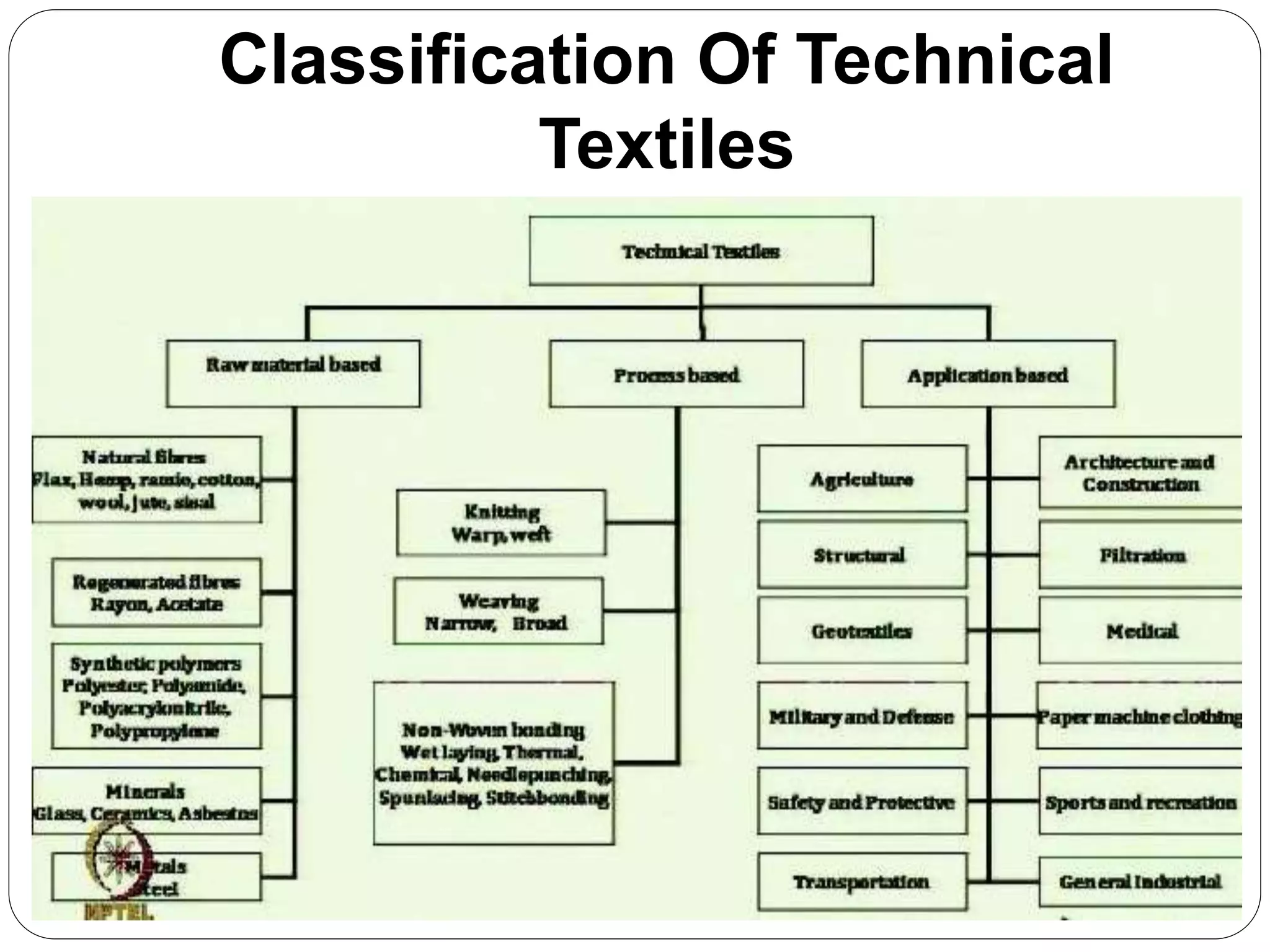
Classification Of Technical
Textiles
Application Areas Of Technical
Textiles
 Techtextil, one leading international trade
exhibition organization for technical textiles, they
have classified the technical textiles in 12 main
areas of technical textiles
 Agrotech: agriculture, aquaculture, horticulture
and forestry
 Buildtech: building and construction
 Clothtech: technical components for footwear or
clothing
 Geotech: geotextiles and civil engineering
 Hometech: technical components of furniture,
floor covering, household textiles
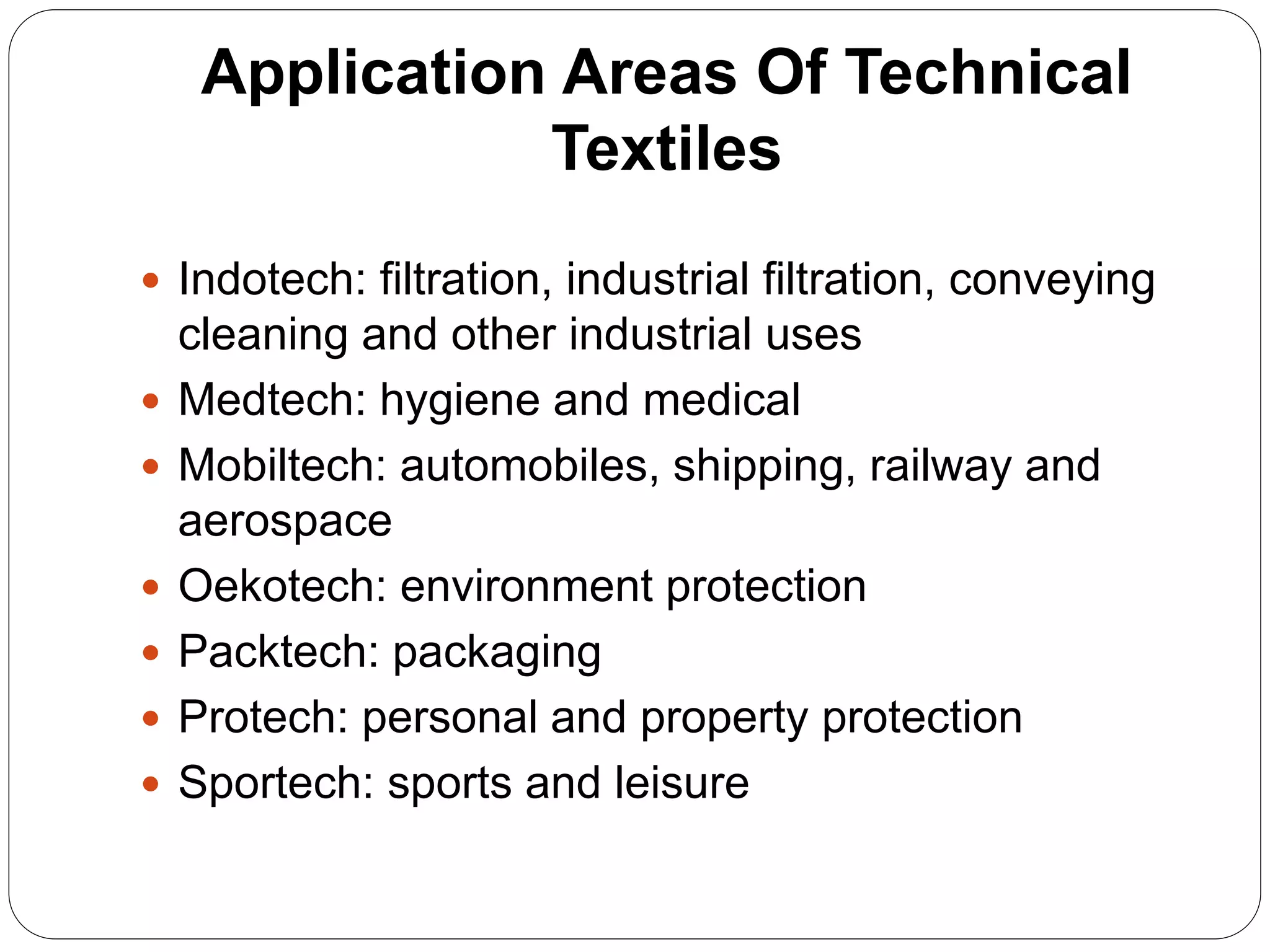
Application Areas Of Technical
Textiles
 Indotech: filtration, industrial filtration, conveying
cleaning and other industrial uses
 Medtech: hygiene and medical
 Mobiltech: automobiles, shipping, railway and
aerospace
 Oekotech: environment protection
 Packtech: packaging
 Protech: personal and property protection
 Sportech: sports and leisure
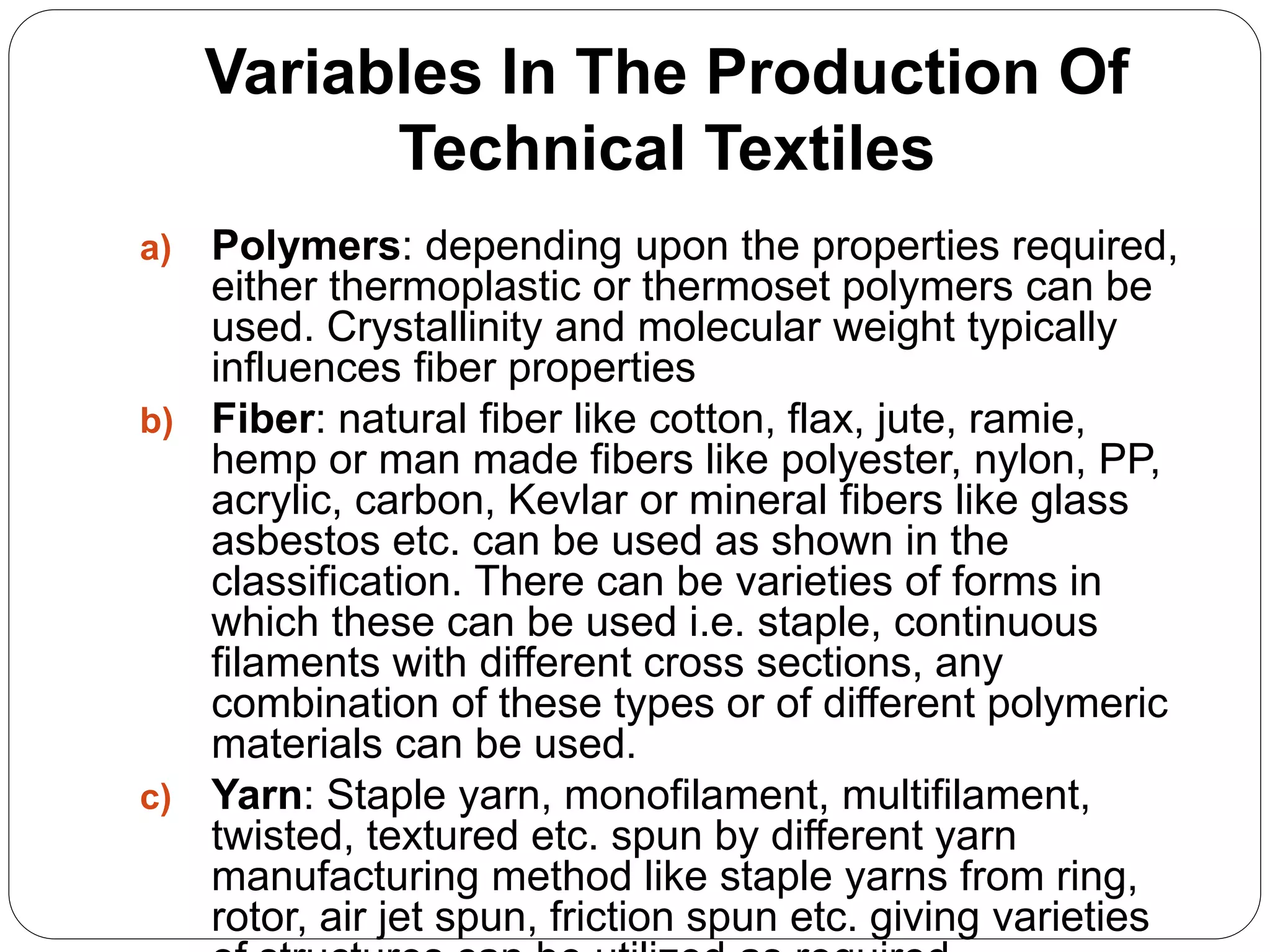
Variables In The Production Of
Technical Textiles
a) Polymers: depending upon the properties required,
either thermoplastic or thermoset polymers can be
used. Crystallinity and molecular weight typically
influences fiber properties
b) Fiber: natural fiber like cotton, flax, jute, ramie,
hemp or man made fibers like polyester, nylon, PP,
acrylic, carbon, Kevlar or mineral fibers like glass
asbestos etc. can be used as shown in the
classification. There can be varieties of forms in
which these can be used i.e. staple, continuous
filaments with different cross sections, any
combination of these types or of different polymeric
materials can be used.
c) Yarn: Staple yarn, monofilament, multifilament,
twisted, textured etc. spun by different yarn
manufacturing method like staple yarns from ring,
rotor, air jet spun, friction spun etc. giving varieties
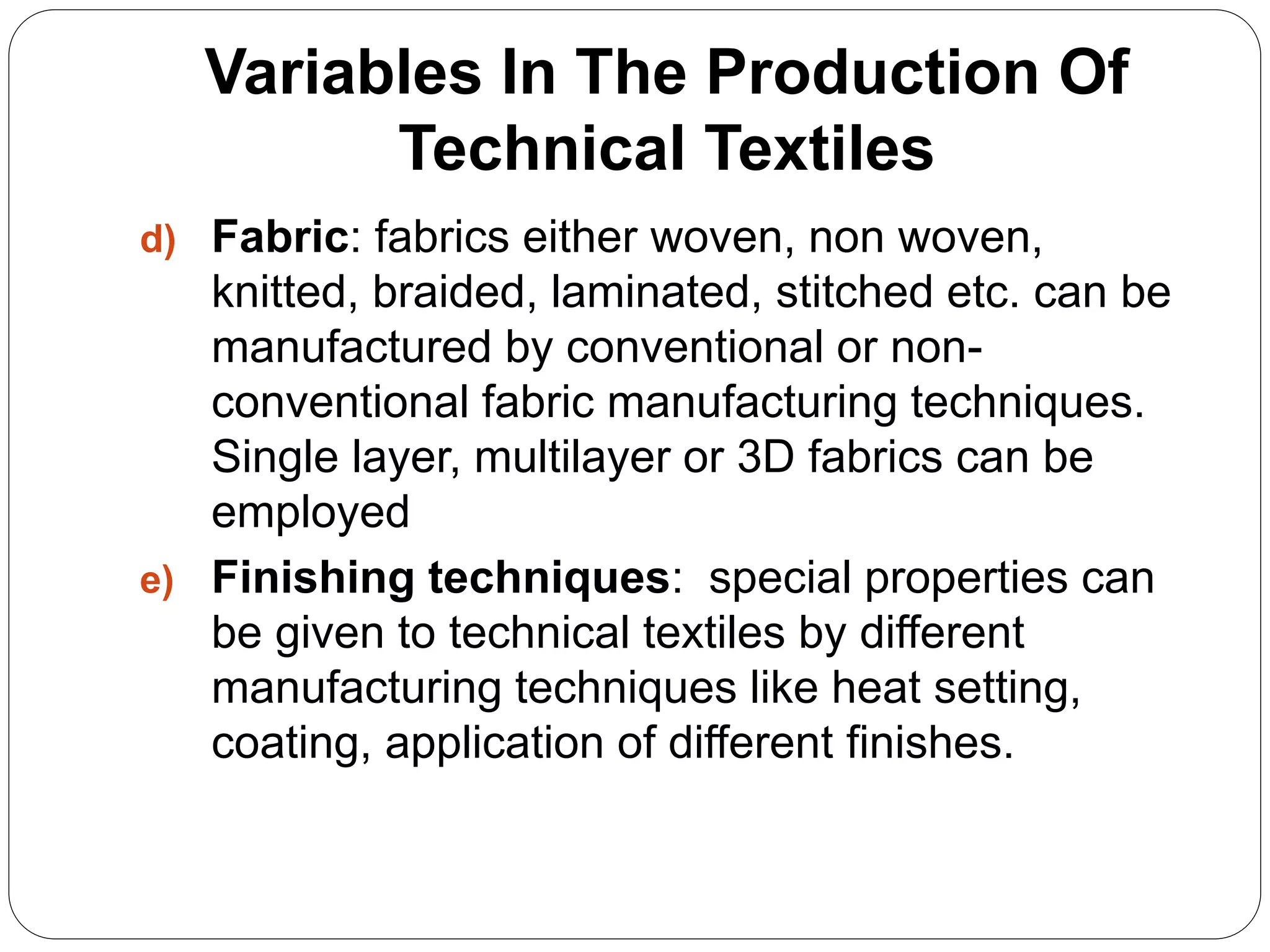
Variables In The Production Of
Technical Textiles
d) Fabric: fabrics either woven, non woven,
knitted, braided, laminated, stitched etc. can be
manufactured by conventional or non-
conventional fabric manufacturing techniques.
Single layer, multilayer or 3D fabrics can be
employed
e) Finishing techniques: special properties can
be given to technical textiles by different
manufacturing techniques like heat setting,
coating, application of different finishes.
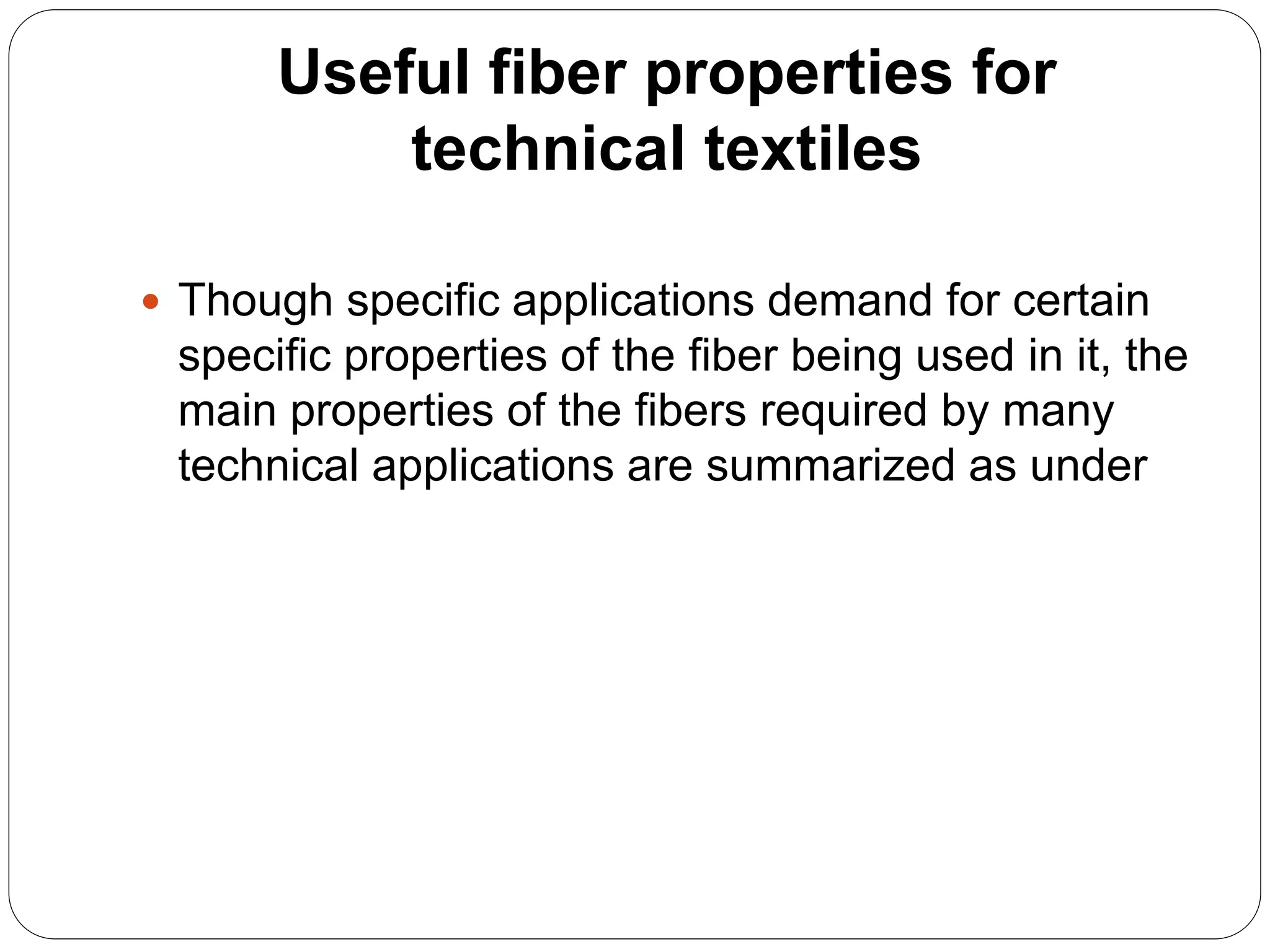
Useful fiber properties for
technical textiles
 Though specific applications demand for certain
specific properties of the fiber being used in it, the
main properties of the fibers required by many
technical applications are summarized as under

Introduction totextiles-1.pptx

  • 2.
    Global perspective fortechnical textiles in India  India's specialty fabric and nonwoven industry is fragmented and still in its infancy, with no state-of- the-art technology in place compared to global players  Textile industry is also undergoing a major reorientation from apparel to specialty fabric applications.
  • 3.
    Global perspective fortechnical textiles in India  The focus of the government is upgrading the infrastructure where geosynthetics are used and increasing the use of automotive textiles(non woven)  . Other niche areas: safety and protective(defense), medical textiles, agricultural textiles like nets, shading and mulch and filter fabrics
  • 4.
  • 5.
    Application Areas OfTechnical Textiles  Techtextil, one leading international trade exhibition organization for technical textiles, they have classified the technical textiles in 12 main areas of technical textiles  Agrotech: agriculture, aquaculture, horticulture and forestry  Buildtech: building and construction  Clothtech: technical components for footwear or clothing  Geotech: geotextiles and civil engineering  Hometech: technical components of furniture, floor covering, household textiles
  • 6.
    Application Areas OfTechnical Textiles  Indotech: filtration, industrial filtration, conveying cleaning and other industrial uses  Medtech: hygiene and medical  Mobiltech: automobiles, shipping, railway and aerospace  Oekotech: environment protection  Packtech: packaging  Protech: personal and property protection  Sportech: sports and leisure
  • 7.
    Variables In TheProduction Of Technical Textiles a) Polymers: depending upon the properties required, either thermoplastic or thermoset polymers can be used. Crystallinity and molecular weight typically influences fiber properties b) Fiber: natural fiber like cotton, flax, jute, ramie, hemp or man made fibers like polyester, nylon, PP, acrylic, carbon, Kevlar or mineral fibers like glass asbestos etc. can be used as shown in the classification. There can be varieties of forms in which these can be used i.e. staple, continuous filaments with different cross sections, any combination of these types or of different polymeric materials can be used. c) Yarn: Staple yarn, monofilament, multifilament, twisted, textured etc. spun by different yarn manufacturing method like staple yarns from ring, rotor, air jet spun, friction spun etc. giving varieties
  • 8.
    Variables In TheProduction Of Technical Textiles d) Fabric: fabrics either woven, non woven, knitted, braided, laminated, stitched etc. can be manufactured by conventional or non- conventional fabric manufacturing techniques. Single layer, multilayer or 3D fabrics can be employed e) Finishing techniques: special properties can be given to technical textiles by different manufacturing techniques like heat setting, coating, application of different finishes.
  • 9.
    Useful fiber propertiesfor technical textiles  Though specific applications demand for certain specific properties of the fiber being used in it, the main properties of the fibers required by many technical applications are summarized as under