Luminaires – An Overview:
Facts, Basics and Considerations

 Target Audience:
 Facility managers, Procurement managers,
 Technical managers, Maintenance managers
 and General Lighting enthusiasts

     Light-Ref.com The unbiased lighting reference source

                              http://www.light-ref.com © 2012
Luminaire Overview – Objectives

The purpose of this outline is to provide an overview
and to familiarize the decision maker with the key
considerations when evaluating a lighting solution

Luminaire Overview Topics:

a. Luminaire classification
b. Luminaire technical aspects
c. Luminaire functional aspects

        Light-Ref.com The unbiased lighting reference source

                                 http://www.light-ref.com © 2012   2
Module 2
Luminaire Technical Aspects


  Light-Ref.com The unbiased lighting reference source

                           http://www.light-ref.com © 2012
Luminaire – Technical Aspects
As with the infamous saying of Wilhelm Leibniz that ”… a lion
be can spotted by it toenail…”, so a quality luminaire can be
spotted by its technical attributes.

  A given luminaire carries several types of technical
  information that is to be overviewed in this section while
  addressing relevant IEC standards:
   IP Rating (Ingress Protection Code)
   IK Rating (Mechanical Impact Code)
   tC max (Operating Temperature)
   Mounting Codes
   IEC Standards

           Light-Ref.com The unbiased lighting reference source

                                    http://www.light-ref.com © 2012   4
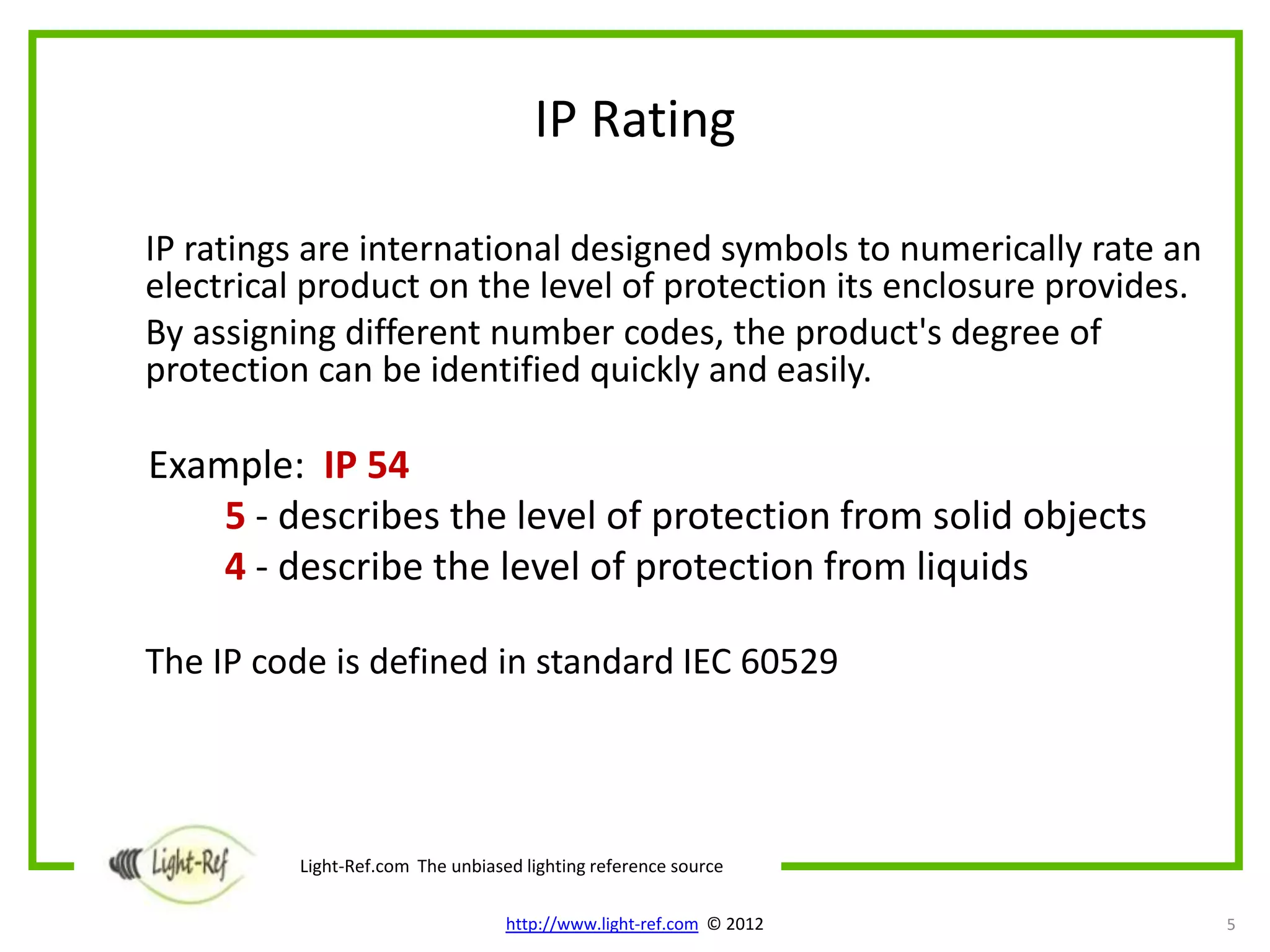
IP Rating

IP ratings are international designed symbols to numerically rate an
electrical product on the level of protection its enclosure provides.
By assigning different number codes, the product's degree of
protection can be identified quickly and easily.

Example: IP 54
    5 - describes the level of protection from solid objects
    4 - describe the level of protection from liquids

The IP code is defined in standard IEC 60529


          Light-Ref.com The unbiased lighting reference source

                                   http://www.light-ref.com © 2012      5
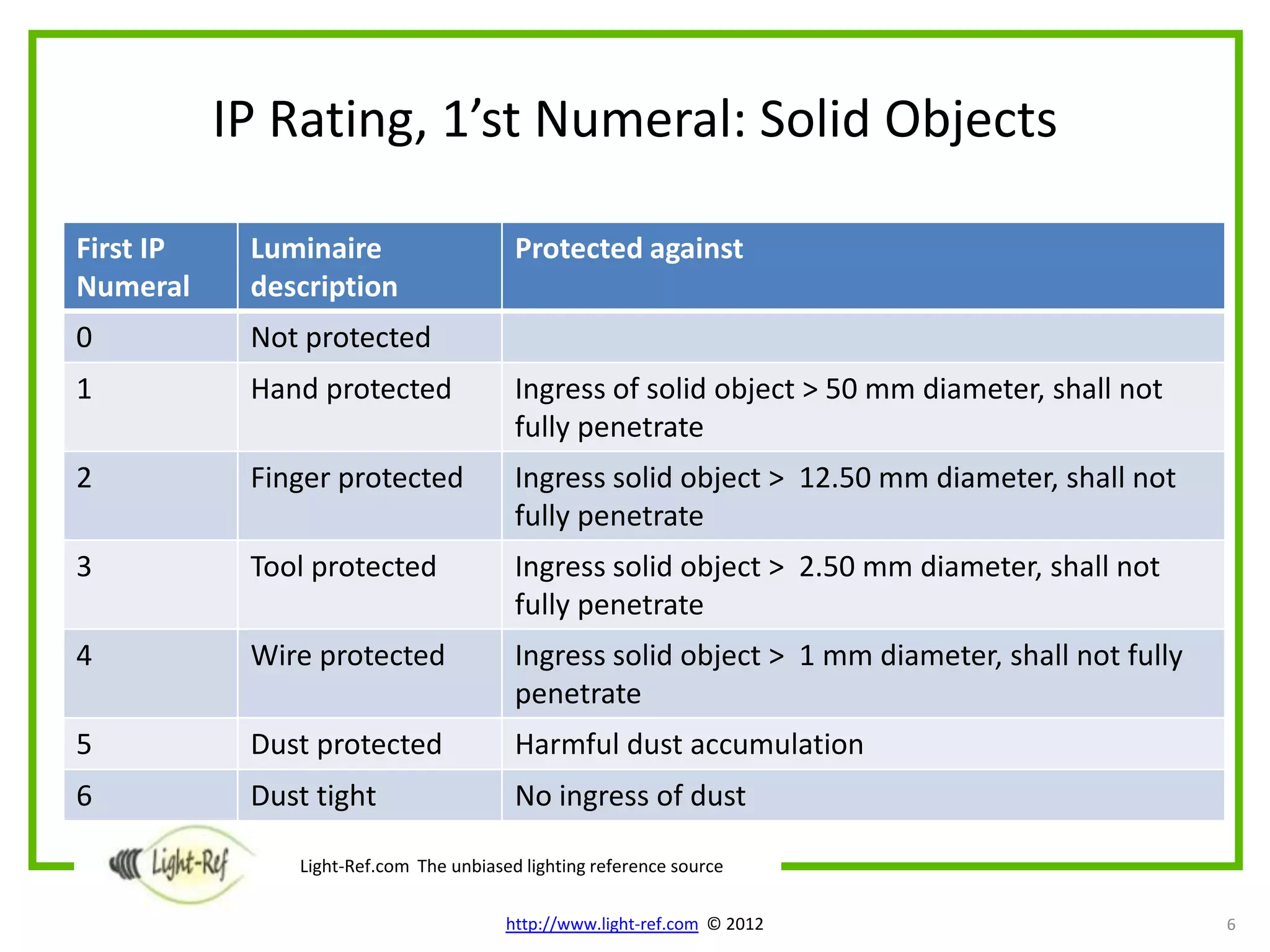
IP Rating, 1’st Numeral: Solid Objects

First IP    Luminaire                    Protected against
Numeral     description
0           Not protected
1           Hand protected               Ingress of solid object > 50 mm diameter, shall not
                                         fully penetrate
2           Finger protected             Ingress solid object > 12.50 mm diameter, shall not
                                         fully penetrate
3           Tool protected               Ingress solid object > 2.50 mm diameter, shall not
                                         fully penetrate
4           Wire protected               Ingress solid object > 1 mm diameter, shall not fully
                                         penetrate
5           Dust protected               Harmful dust accumulation
6           Dust tight                   No ingress of dust

               Light-Ref.com The unbiased lighting reference source

                                        http://www.light-ref.com © 2012                          6
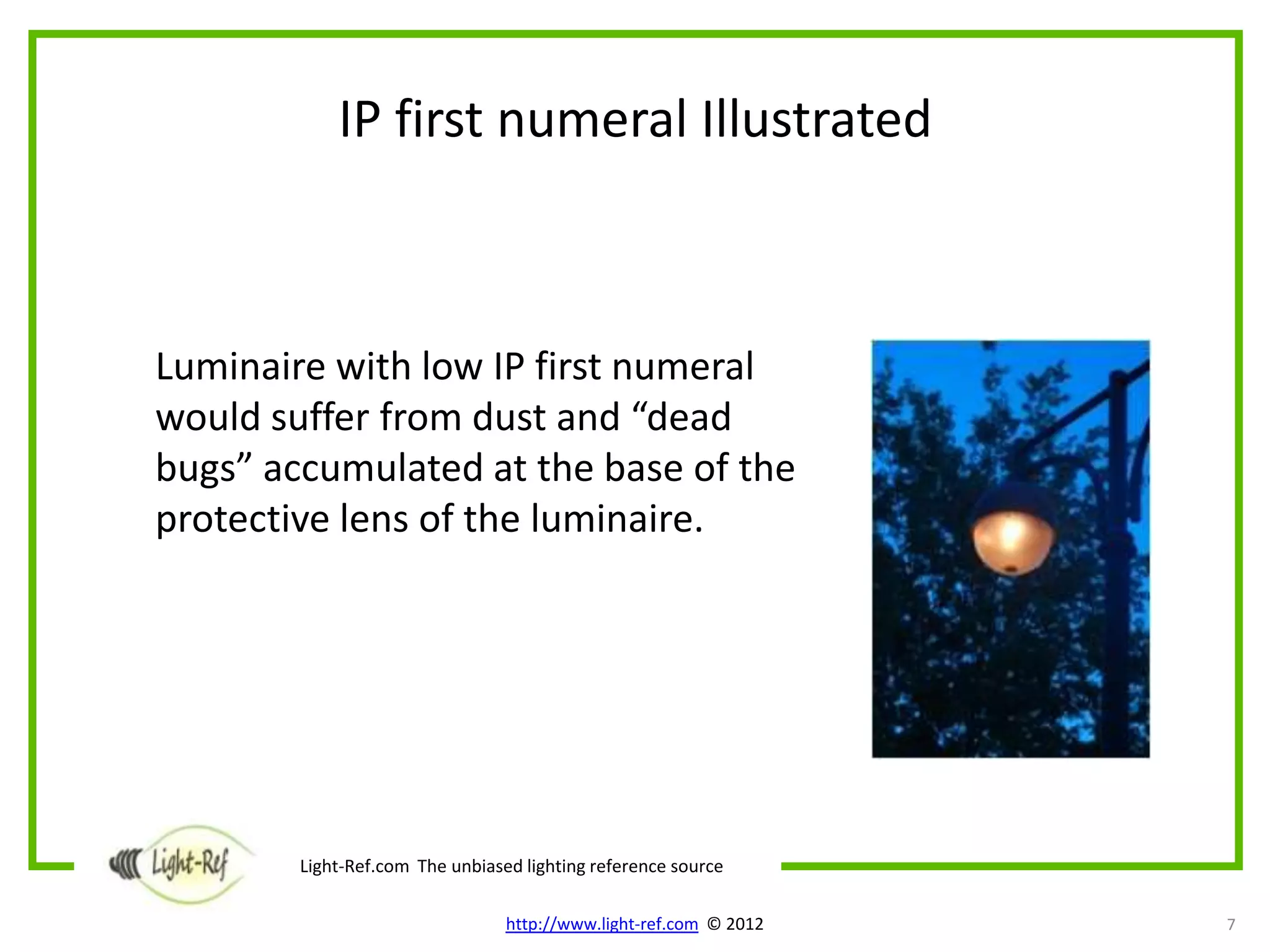
IP first numeral Illustrated


Luminaire with low IP first numeral
would suffer from dust and “dead
bugs” accumulated at the base of the
protective lens of the luminaire.


        Light-Ref.com The unbiased lighting reference source

                                 http://www.light-ref.com © 2012   7
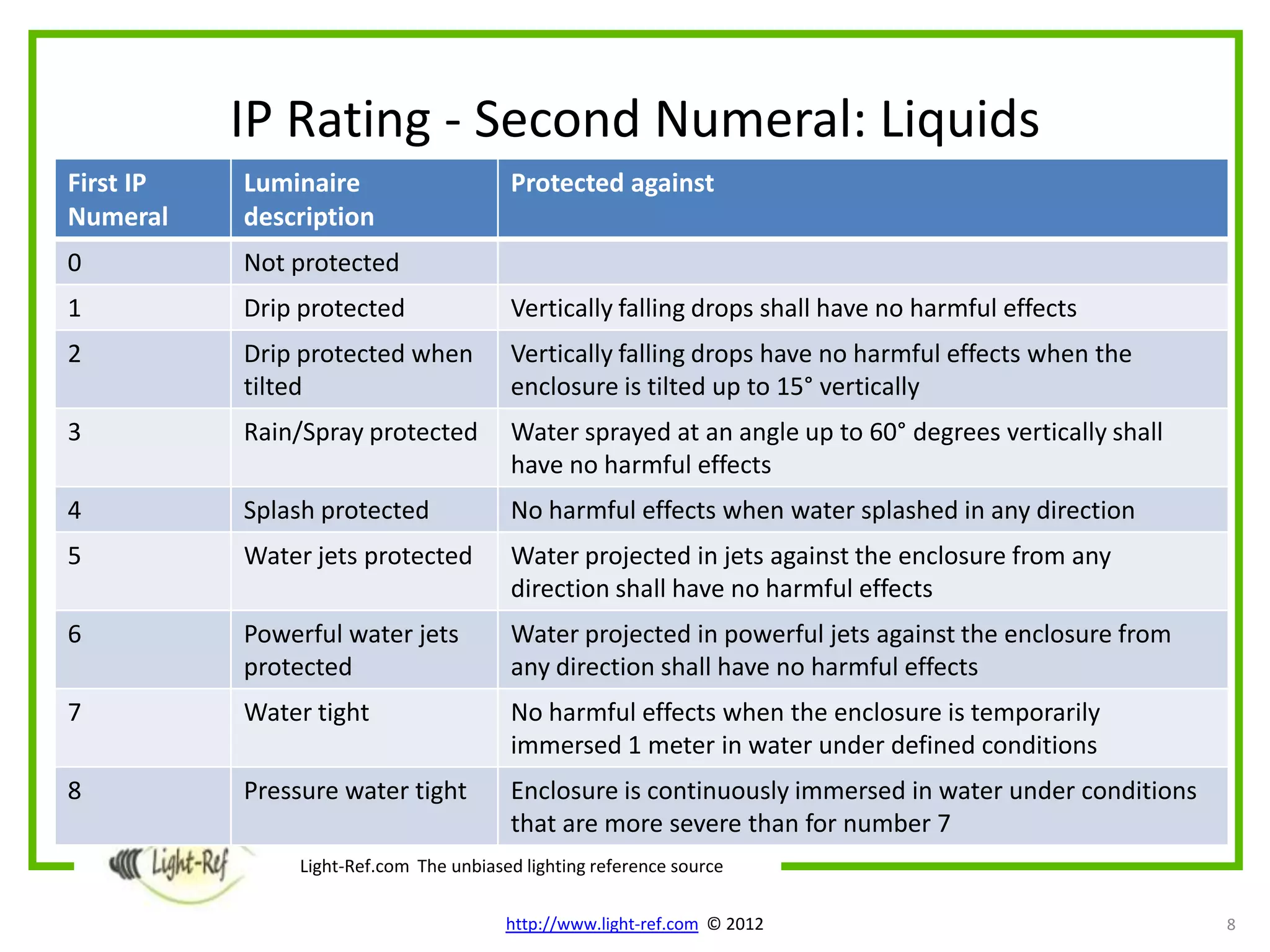
IP Rating - Second Numeral: Liquids
First IP   Luminaire                     Protected against
Numeral    description
0          Not protected
1          Drip protected                Vertically falling drops shall have no harmful effects
2          Drip protected when           Vertically falling drops have no harmful effects when the
           tilted                        enclosure is tilted up to 15° vertically
3          Rain/Spray protected          Water sprayed at an angle up to 60° degrees vertically shall
                                         have no harmful effects
4          Splash protected              No harmful effects when water splashed in any direction
5          Water jets protected          Water projected in jets against the enclosure from any
                                         direction shall have no harmful effects
6          Powerful water jets           Water projected in powerful jets against the enclosure from
           protected                     any direction shall have no harmful effects
7          Water tight                   No harmful effects when the enclosure is temporarily
                                         immersed 1 meter in water under defined conditions
8          Pressure water tight          Enclosure is continuously immersed in water under conditions
                                         that are more severe than for number 7
                Light-Ref.com The unbiased lighting reference source

                                         http://www.light-ref.com © 2012                                8
Mechanical IK Rating

The IK rating specifies the level of mechanical protection the
enclosure provides and is measured in joules (J).

The IK code is defined in standard IEC 622662


          Light-Ref.com The unbiased lighting reference source

                                   http://www.light-ref.com © 2012   9
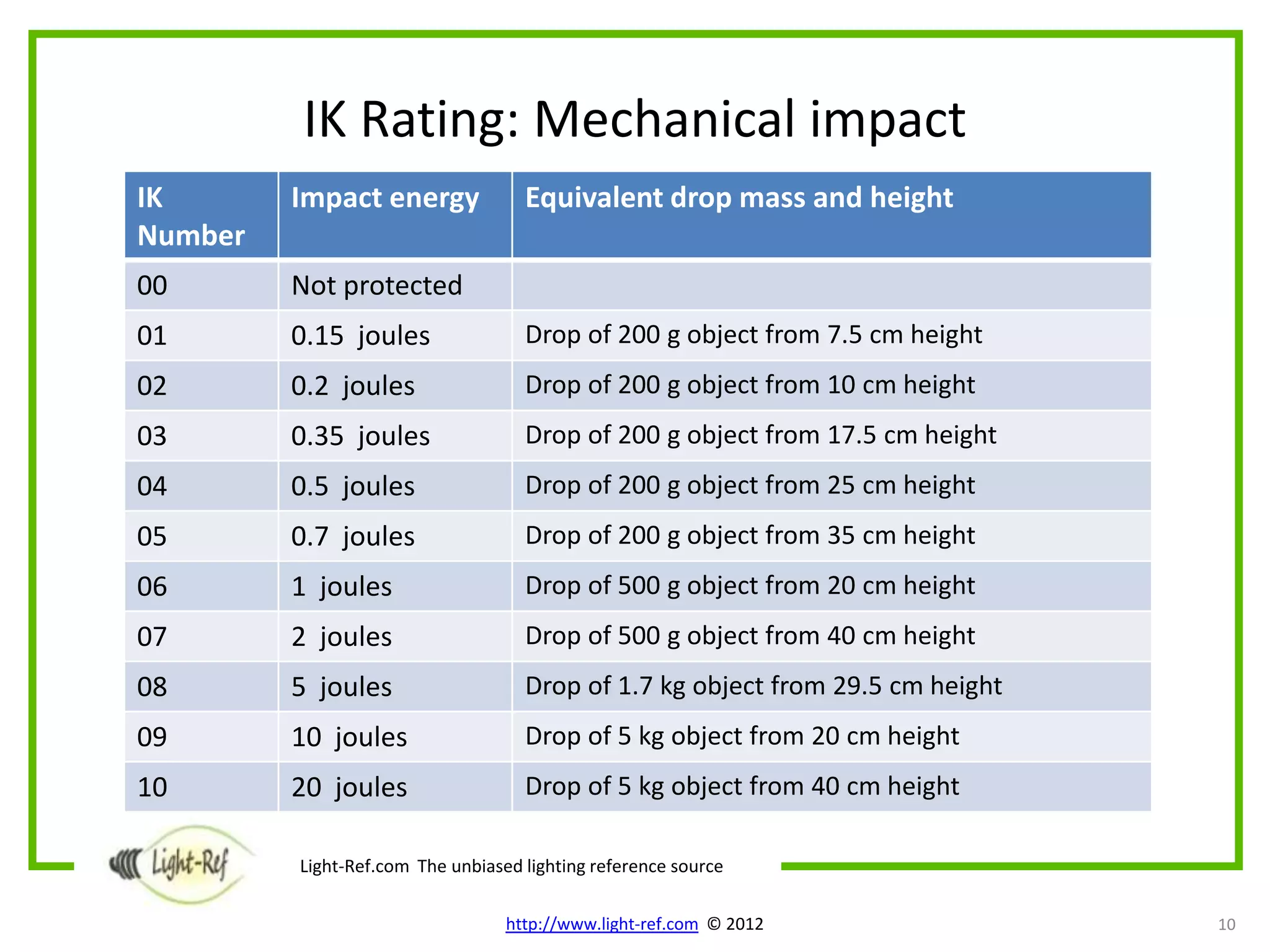
IK Rating: Mechanical impact
IK       Impact energy              Equivalent drop mass and height
Number
00       Not protected
01       0.15 joules                Drop of 200 g object from 7.5 cm height
02       0.2 joules                 Drop of 200 g object from 10 cm height
03       0.35 joules                Drop of 200 g object from 17.5 cm height
04       0.5 joules                 Drop of 200 g object from 25 cm height
05       0.7 joules                 Drop of 200 g object from 35 cm height
06       1 joules                   Drop of 500 g object from 20 cm height
07       2 joules                   Drop of 500 g object from 40 cm height
08       5 joules                   Drop of 1.7 kg object from 29.5 cm height
09       10 joules                  Drop of 5 kg object from 20 cm height
10       20 joules                  Drop of 5 kg object from 40 cm height

         Light-Ref.com The unbiased lighting reference source

                                  http://www.light-ref.com © 2012               10
Luminaire Operating Temperature –
                   tC max
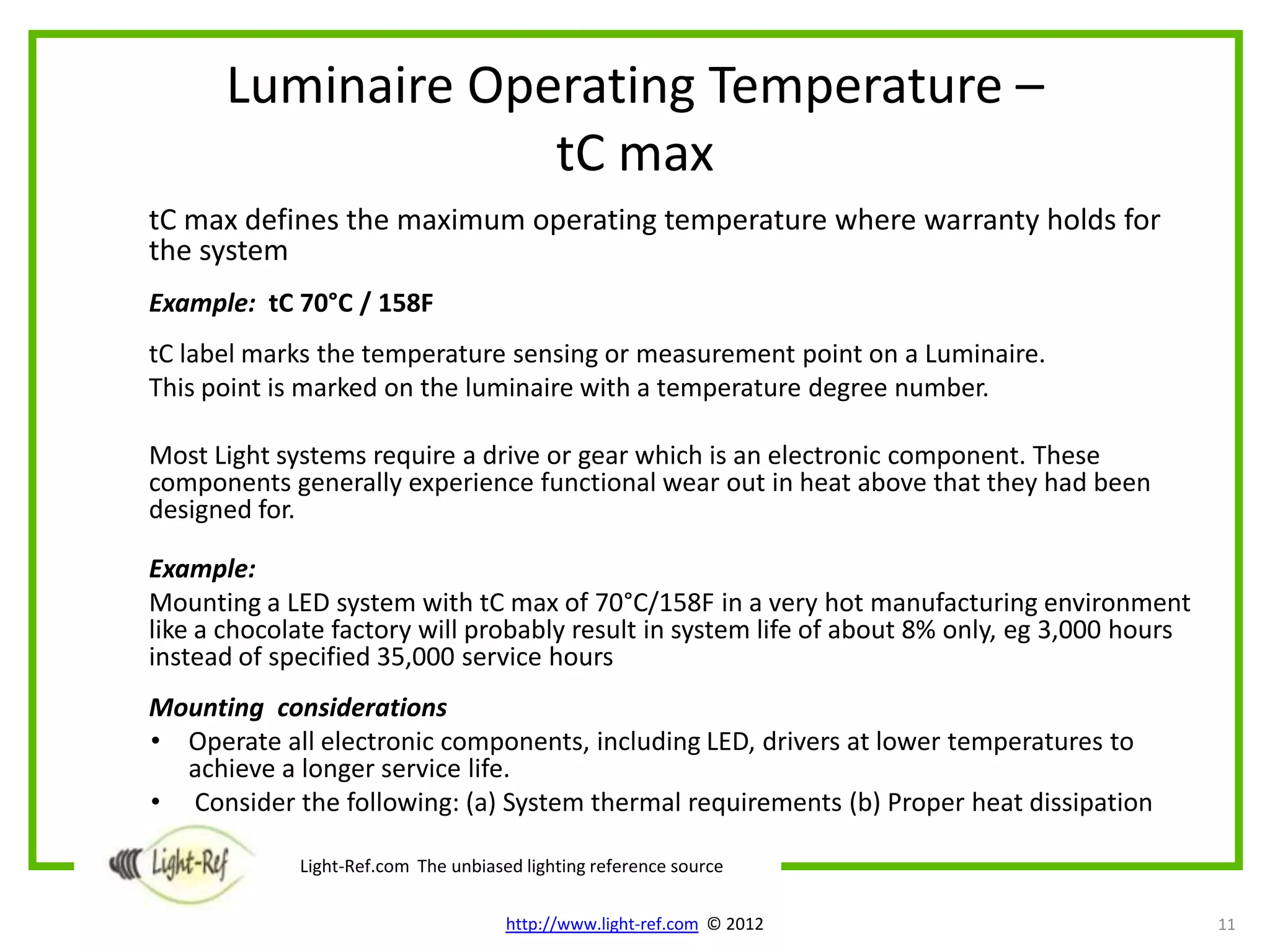
tC max defines the maximum operating temperature where warranty holds for
the system
Example: tC 70°C / 158F
tC label marks the temperature sensing or measurement point on a Luminaire.
This point is marked on the luminaire with a temperature degree number.

Most Light systems require a drive or gear which is an electronic component. These
components generally experience functional wear out in heat above that they had been
designed for.

Example:
Mounting a LED system with tC max of 70°C/158F in a very hot manufacturing environment
like a chocolate factory will probably result in system life of about 8% only, eg 3,000 hours
instead of specified 35,000 service hours
Mounting considerations
• Operate all electronic components, including LED, drivers at lower temperatures to
  achieve a longer service life.
• Consider the following: (a) System thermal requirements (b) Proper heat dissipation

             Light-Ref.com The unbiased lighting reference source

                                      http://www.light-ref.com © 2012                           11
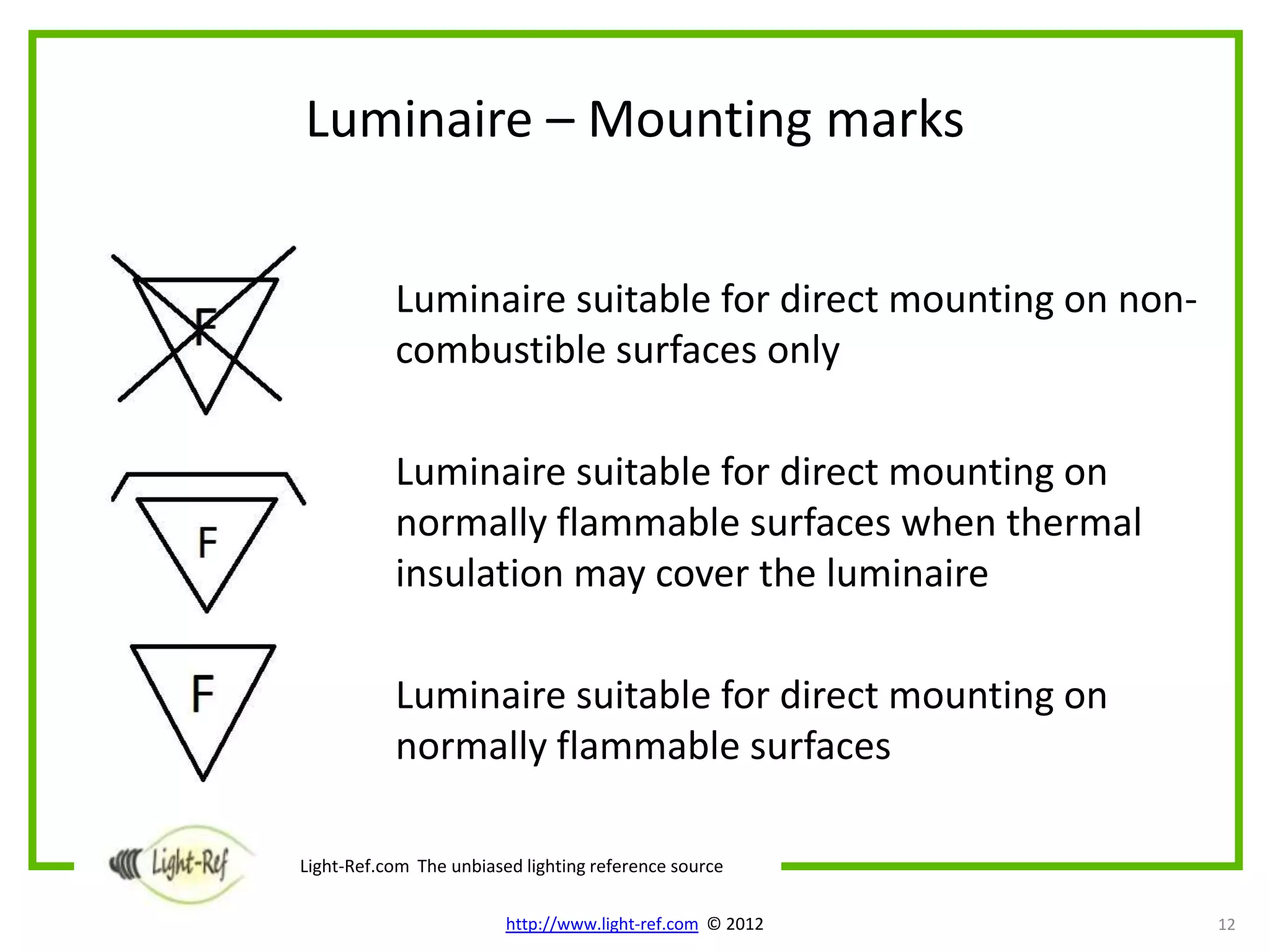
Luminaire – Mounting marks


           Luminaire suitable for direct mounting on non-
           combustible surfaces only

           Luminaire suitable for direct mounting on
           normally flammable surfaces when thermal
           insulation may cover the luminaire

           Luminaire suitable for direct mounting on
           normally flammable surfaces

Light-Ref.com The unbiased lighting reference source

                         http://www.light-ref.com © 2012    12
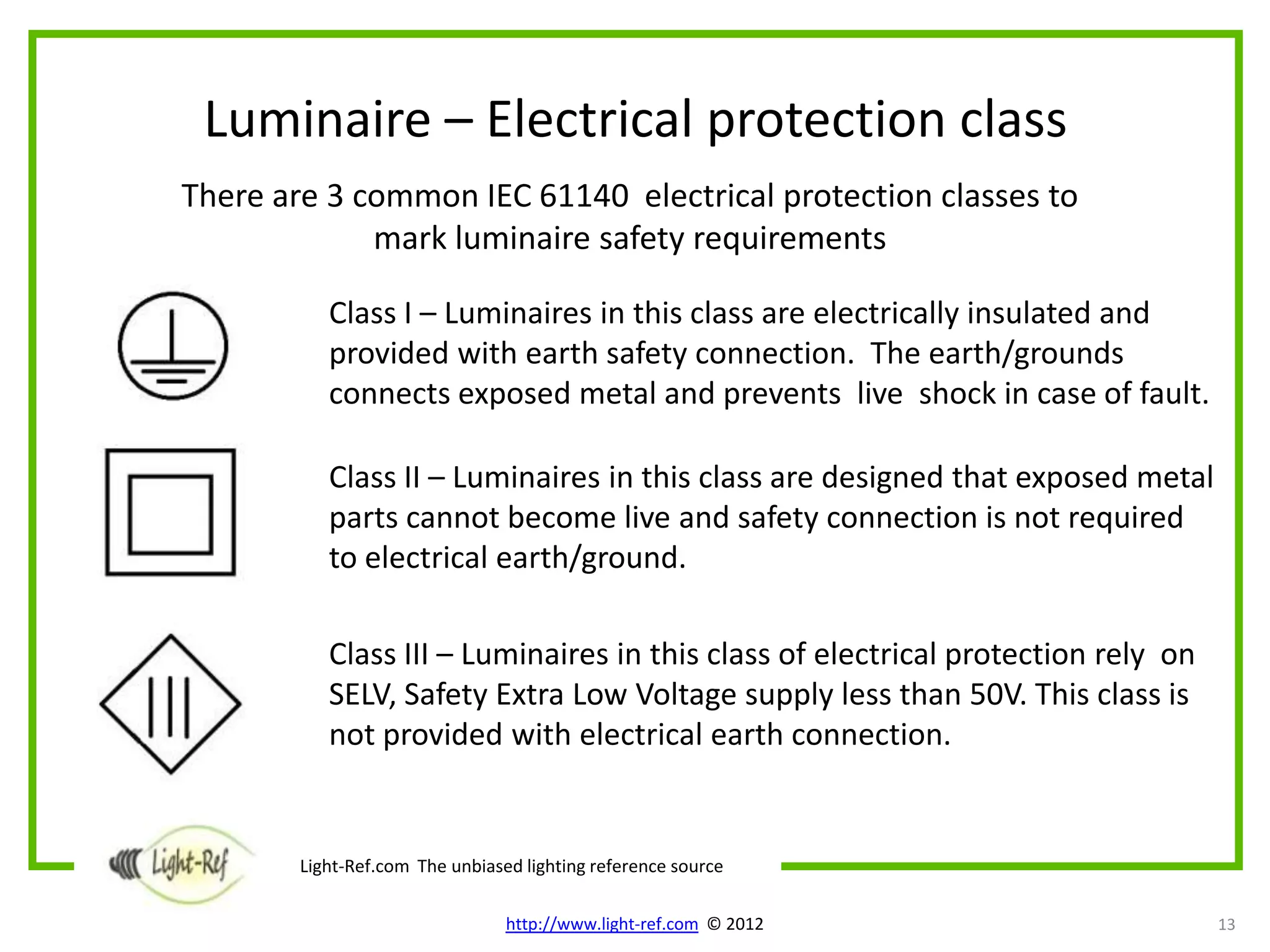
Luminaire – Electrical protection class
There are 3 common IEC 61140 electrical protection classes to
             mark luminaire safety requirements

           Class I – Luminaires in this class are electrically insulated and
           provided with earth safety connection. The earth/grounds
           connects exposed metal and prevents live shock in case of fault.

           Class II – Luminaires in this class are designed that exposed metal
           parts cannot become live and safety connection is not required
           to electrical earth/ground.

           Class III – Luminaires in this class of electrical protection rely on
           SELV, Safety Extra Low Voltage supply less than 50V. This class is
           not provided with electrical earth connection.


        Light-Ref.com The unbiased lighting reference source

                                 http://www.light-ref.com © 2012                   13
Luminaire – Standards
Standard IEC 60598 specifies general requirements for luminaires, incorporating various
aspects of light systems addressing operation for voltage up to 1000 V. The standard
addresses classification, marking, mechanical construction and electrical construction.
Fixtures for specific locations have specific standards like – Blast Proof, Emergency Lighting, Street and High
Lighting, Cold Storage Lighting, Underwater and more.
In many cases luminaries comprise of the fixture and the ballast. There are usually ballast specific standards that
address Safety and Electro Magnetic Emission.
IEC 61347 – Low Voltage Directive (LVD) standard
Standard IEC 61347 specifies safety requirements for electronic control gear for use on AC and DC supplies up to
1000V at 50 Hz or 60 Hz. Refer to standards IEC 60081 and IEC 60901 for other fluorescent lamps for high-
frequency operation. The standard addresses test conditions when dimming; safety aspects of construction
requirements and limits for HF leakage currents.
IEC 61347 Annex B defines general and safety requirements applicable to thermally protected lamp control gear.
IEC 61347 Annex C defines general and safety requirements for electronic lamp control gear with means of
protection against overheating.

IEC61000-3-2 - Electromagnetic Compatibility (EMC) - Low-Frequency Standards
Standard specifies limitation of harmonic components of the input current impressed on the public low-voltage
supply system.

EN 55015       - Standard specifies limits and addresses both the Radiated Emissions and Conducted Emissions,
defines limits of radio disturbance characteristics of electrical lighting and similar equipment. Radiated emissions
are measure in db against the norm as defined in the standard.

                    Light-Ref.com The unbiased lighting reference source

                                             http://www.light-ref.com © 2012                                      14
The End

Luminaires by Light-Ref.com
  Light-Ref.com The unbiased lighting reference source

                           http://www.light-ref.com © 2012

Luminaires – Module 2 Technical Aspects

  • 1.
    Luminaires – AnOverview: Facts, Basics and Considerations Target Audience: Facility managers, Procurement managers, Technical managers, Maintenance managers and General Lighting enthusiasts Light-Ref.com The unbiased lighting reference source http://www.light-ref.com © 2012
  • 2.
    Luminaire Overview –Objectives The purpose of this outline is to provide an overview and to familiarize the decision maker with the key considerations when evaluating a lighting solution Luminaire Overview Topics: a. Luminaire classification b. Luminaire technical aspects c. Luminaire functional aspects Light-Ref.com The unbiased lighting reference source http://www.light-ref.com © 2012 2
  • 3.
    Module 2 Luminaire TechnicalAspects Light-Ref.com The unbiased lighting reference source http://www.light-ref.com © 2012
  • 4.
    Luminaire – TechnicalAspects As with the infamous saying of Wilhelm Leibniz that ”… a lion be can spotted by it toenail…”, so a quality luminaire can be spotted by its technical attributes. A given luminaire carries several types of technical information that is to be overviewed in this section while addressing relevant IEC standards:  IP Rating (Ingress Protection Code)  IK Rating (Mechanical Impact Code)  tC max (Operating Temperature)  Mounting Codes  IEC Standards Light-Ref.com The unbiased lighting reference source http://www.light-ref.com © 2012 4
  • 5.
    IP Rating IP ratingsare international designed symbols to numerically rate an electrical product on the level of protection its enclosure provides. By assigning different number codes, the product's degree of protection can be identified quickly and easily. Example: IP 54 5 - describes the level of protection from solid objects 4 - describe the level of protection from liquids The IP code is defined in standard IEC 60529 Light-Ref.com The unbiased lighting reference source http://www.light-ref.com © 2012 5
  • 6.
    IP Rating, 1’stNumeral: Solid Objects First IP Luminaire Protected against Numeral description 0 Not protected 1 Hand protected Ingress of solid object > 50 mm diameter, shall not fully penetrate 2 Finger protected Ingress solid object > 12.50 mm diameter, shall not fully penetrate 3 Tool protected Ingress solid object > 2.50 mm diameter, shall not fully penetrate 4 Wire protected Ingress solid object > 1 mm diameter, shall not fully penetrate 5 Dust protected Harmful dust accumulation 6 Dust tight No ingress of dust Light-Ref.com The unbiased lighting reference source http://www.light-ref.com © 2012 6
  • 7.
    IP first numeralIllustrated Luminaire with low IP first numeral would suffer from dust and “dead bugs” accumulated at the base of the protective lens of the luminaire. Light-Ref.com The unbiased lighting reference source http://www.light-ref.com © 2012 7
  • 8.
    IP Rating -Second Numeral: Liquids First IP Luminaire Protected against Numeral description 0 Not protected 1 Drip protected Vertically falling drops shall have no harmful effects 2 Drip protected when Vertically falling drops have no harmful effects when the tilted enclosure is tilted up to 15° vertically 3 Rain/Spray protected Water sprayed at an angle up to 60° degrees vertically shall have no harmful effects 4 Splash protected No harmful effects when water splashed in any direction 5 Water jets protected Water projected in jets against the enclosure from any direction shall have no harmful effects 6 Powerful water jets Water projected in powerful jets against the enclosure from protected any direction shall have no harmful effects 7 Water tight No harmful effects when the enclosure is temporarily immersed 1 meter in water under defined conditions 8 Pressure water tight Enclosure is continuously immersed in water under conditions that are more severe than for number 7 Light-Ref.com The unbiased lighting reference source http://www.light-ref.com © 2012 8
  • 9.
    Mechanical IK Rating TheIK rating specifies the level of mechanical protection the enclosure provides and is measured in joules (J). The IK code is defined in standard IEC 622662 Light-Ref.com The unbiased lighting reference source http://www.light-ref.com © 2012 9
  • 10.
    IK Rating: Mechanicalimpact IK Impact energy Equivalent drop mass and height Number 00 Not protected 01 0.15 joules Drop of 200 g object from 7.5 cm height 02 0.2 joules Drop of 200 g object from 10 cm height 03 0.35 joules Drop of 200 g object from 17.5 cm height 04 0.5 joules Drop of 200 g object from 25 cm height 05 0.7 joules Drop of 200 g object from 35 cm height 06 1 joules Drop of 500 g object from 20 cm height 07 2 joules Drop of 500 g object from 40 cm height 08 5 joules Drop of 1.7 kg object from 29.5 cm height 09 10 joules Drop of 5 kg object from 20 cm height 10 20 joules Drop of 5 kg object from 40 cm height Light-Ref.com The unbiased lighting reference source http://www.light-ref.com © 2012 10
  • 11.
    Luminaire Operating Temperature– tC max tC max defines the maximum operating temperature where warranty holds for the system Example: tC 70°C / 158F tC label marks the temperature sensing or measurement point on a Luminaire. This point is marked on the luminaire with a temperature degree number. Most Light systems require a drive or gear which is an electronic component. These components generally experience functional wear out in heat above that they had been designed for. Example: Mounting a LED system with tC max of 70°C/158F in a very hot manufacturing environment like a chocolate factory will probably result in system life of about 8% only, eg 3,000 hours instead of specified 35,000 service hours Mounting considerations • Operate all electronic components, including LED, drivers at lower temperatures to achieve a longer service life. • Consider the following: (a) System thermal requirements (b) Proper heat dissipation Light-Ref.com The unbiased lighting reference source http://www.light-ref.com © 2012 11
  • 12.
    Luminaire – Mountingmarks Luminaire suitable for direct mounting on non- combustible surfaces only Luminaire suitable for direct mounting on normally flammable surfaces when thermal insulation may cover the luminaire Luminaire suitable for direct mounting on normally flammable surfaces Light-Ref.com The unbiased lighting reference source http://www.light-ref.com © 2012 12
  • 13.
    Luminaire – Electricalprotection class There are 3 common IEC 61140 electrical protection classes to mark luminaire safety requirements Class I – Luminaires in this class are electrically insulated and provided with earth safety connection. The earth/grounds connects exposed metal and prevents live shock in case of fault. Class II – Luminaires in this class are designed that exposed metal parts cannot become live and safety connection is not required to electrical earth/ground. Class III – Luminaires in this class of electrical protection rely on SELV, Safety Extra Low Voltage supply less than 50V. This class is not provided with electrical earth connection. Light-Ref.com The unbiased lighting reference source http://www.light-ref.com © 2012 13
  • 14.
    Luminaire – Standards StandardIEC 60598 specifies general requirements for luminaires, incorporating various aspects of light systems addressing operation for voltage up to 1000 V. The standard addresses classification, marking, mechanical construction and electrical construction. Fixtures for specific locations have specific standards like – Blast Proof, Emergency Lighting, Street and High Lighting, Cold Storage Lighting, Underwater and more. In many cases luminaries comprise of the fixture and the ballast. There are usually ballast specific standards that address Safety and Electro Magnetic Emission. IEC 61347 – Low Voltage Directive (LVD) standard Standard IEC 61347 specifies safety requirements for electronic control gear for use on AC and DC supplies up to 1000V at 50 Hz or 60 Hz. Refer to standards IEC 60081 and IEC 60901 for other fluorescent lamps for high- frequency operation. The standard addresses test conditions when dimming; safety aspects of construction requirements and limits for HF leakage currents. IEC 61347 Annex B defines general and safety requirements applicable to thermally protected lamp control gear. IEC 61347 Annex C defines general and safety requirements for electronic lamp control gear with means of protection against overheating. IEC61000-3-2 - Electromagnetic Compatibility (EMC) - Low-Frequency Standards Standard specifies limitation of harmonic components of the input current impressed on the public low-voltage supply system. EN 55015 - Standard specifies limits and addresses both the Radiated Emissions and Conducted Emissions, defines limits of radio disturbance characteristics of electrical lighting and similar equipment. Radiated emissions are measure in db against the norm as defined in the standard. Light-Ref.com The unbiased lighting reference source http://www.light-ref.com © 2012 14
  • 15.
    The End Luminaires byLight-Ref.com Light-Ref.com The unbiased lighting reference source http://www.light-ref.com © 2012