


LED lighting – An Overview of the
Technology & Terms
Illumis Lights - The brand behind the brand
White LEDs have grown enormously popular from their use in LED televisions,
cell phones, automobiles, and general lighting.
What is an LED?
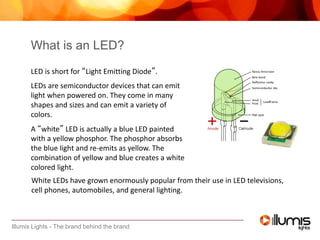
LED is short for “Light Emitting Diode”.
LEDs are semiconductor devices that can emit
light when powered on. They come in many
shapes and sizes and can emit a variety of
colors.
A “white” LED is actually a blue LED painted
with a yellow phosphor. The phosphor absorbs
the blue light and re-emits as yellow. The
combination of yellow and blue creates a white
colored light.
Illumis Lights - The brand behind the brand
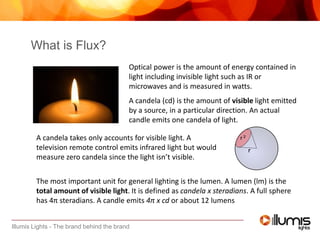
The most important unit for general lighting is the lumen. A lumen (lm) is the
total amount of visible light. It is defined as candela x steradians. A full sphere
has 4π steradians. A candle emits 4π x cd or about 12 lumens
What is Flux?
Optical power is the amount of energy contained in
light including invisible light such as IR or
microwaves and is measured in watts.
A candela (cd) is the amount of visible light emitted
by a source, in a particular direction. An actual
candle emits one candela of light.
A candela takes only accounts for visible light. A
television remote control emits infrared light but would
measure zero candela since the light isn’t visible.
What came before LED?
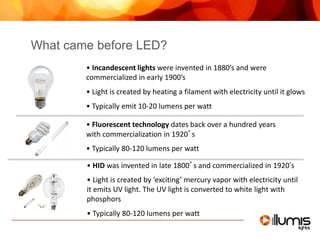
• Incandescent lights were invented in 1880’s and were
commercialized in early 1900’s
• Light is created by heating a filament with electricity until it glows
• Typically emit 10-20 lumens per watt
• HID was invented in late 1800’s and commercialized in 1920’s
• Light is created by ‘exciting’ mercury vapor with electricity until
it emits UV light. The UV light is converted to white light with
phosphors
• Typically 80-120 lumens per watt
• Fluorescent technology dates back over a hundred years
with commercialization in 1920’s
• Typically 80-120 lumens per watt
Illumis Lights - The brand behind the brand
Heat doesn’t determine the color of an LED so instead LED color is described by
correlating it to traditional light sources.
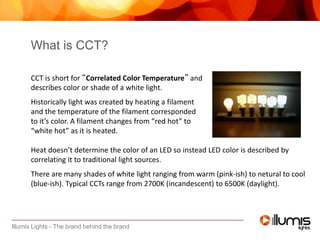
There are many shades of white light ranging from warm (pink-ish) to netural to cool
(blue-ish). Typical CCTs range from 2700K (incandescent) to 6500K (daylight).
What is CCT?
CCT is short for “Correlated Color Temperature” and
describes color or shade of a white light.
Historically light was created by heating a filament
and the temperature of the filament corresponded
to it’s color. A filament changes from “red hot” to
“white hot” as it is heated.
Illumis Lights - The brand behind the brand
What is Color Binning?
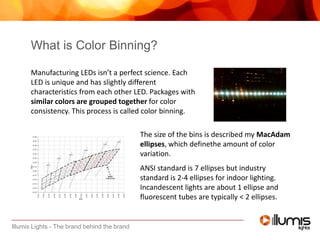
Manufacturing LEDs isn’t a perfect science. Each
LED is unique and has slightly different
characteristics from each other LED. Packages with
similar colors are grouped together for color
consistency. This process is called color binning.
The size of the bins is described my MacAdam
ellipses, which definethe amount of color
variation.
ANSI standard is 7 ellipses but industry
standard is 2-4 ellipses for indoor lighting.
Incandescent lights are about 1 ellipse and
fluorescent tubes are typically < 2 ellipses.
Illumis Lights - The brand behind the brand
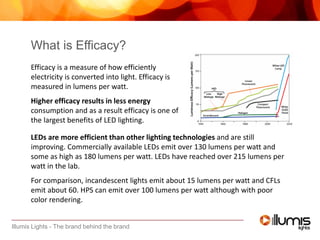
LEDs are more efficient than other lighting technologies and are still
improving. Commercially available LEDs emit over 130 lumens per watt and
some as high as 180 lumens per watt. LEDs have reached over 215 lumens per
watt in the lab.
For comparison, incandescent lights emit about 15 lumens per watt and CFLs
emit about 60. HPS can emit over 100 lumens per watt although with poor
color rendering.
What is Efficacy?
Efficacy is a measure of how efficiently
electricity is converted into light. Efficacy is
measured in lumens per watt.
Higher efficacy results in less energy
consumption and as a result efficacy is one of
the largest benefits of LED lighting.
Illumis Lights - The brand behind the brand
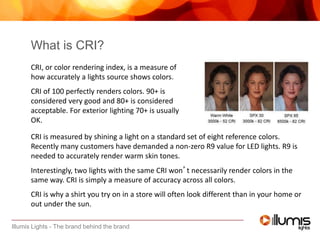
CRI is measured by shining a light on a standard set of eight reference colors.
Recently many customers have demanded a non-zero R9 value for LED lights. R9 is
needed to accurately render warm skin tones.
Interestingly, two lights with the same CRI won’t necessarily render colors in the
same way. CRI is simply a measure of accuracy across all colors.
CRI is why a shirt you try on in a store will often look different than in your home or
out under the sun.
What is CRI?
CRI, or color rendering index, is a measure of
how accurately a lights source shows colors.
CRI of 100 perfectly renders colors. 90+ is
considered very good and 80+ is considered
acceptable. For exterior lighting 70+ is usually
OK.
Illumis Lights - The brand behind the brand
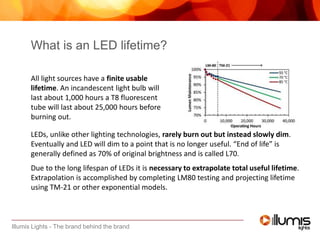
LEDs, unlike other lighting technologies, rarely burn out but instead slowly dim.
Eventually and LED will dim to a point that is no longer useful. “End of life” is
generally defined as 70% of original brightness and is called L70.
Due to the long lifespan of LEDs it is necessary to extrapolate total useful lifetime.
Extrapolation is accomplished by completing LM80 testing and projecting lifetime
using TM-21 or other exponential models.
What is an LED lifetime?
All light sources have a finite usable
lifetime. An incandescent light bulb will
last about 1,000 hours a T8 fluorescent
tube will last about 25,000 hours before
burning out.
Illumis Lights - The brand behind the brand
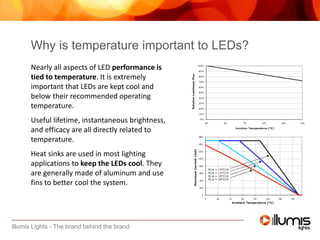
Why is temperature important to LEDs?
Nearly all aspects of LED performance is
tied to temperature. It is extremely
important that LEDs are kept cool and
below their recommended operating
temperature.
Useful lifetime, instantaneous brightness,
and efficacy are all directly related to
temperature.
Heat sinks are used in most lighting
applications to keep the LEDs cool. They
are generally made of aluminum and use
fins to better cool the system.
Illumis Lights - The brand behind the brand
What are the electrical characteristics of LEDs?
LEDs don’t follow ohms law. Current flow is
exponentially related to voltage meaning that a
relatively small change in voltage causes a large
change in current.
For this reason constant current drivers are used
with most LED lighting systems. CC drivers ensure
that an LED is supplied with the proper amount of
power for reliable, high performance operation.
LED drivers connect directly to mains voltage are rated to work at various
voltages. European countries operate at 240V while the US operates at 120V,
240V, and sometimes 277V.
Illumis Lights - The brand behind the brand

LED Overview Presentation

  • 1.
    LED lighting –An Overview of the Technology & Terms
  • 2.
    Illumis Lights -The brand behind the brand White LEDs have grown enormously popular from their use in LED televisions, cell phones, automobiles, and general lighting. What is an LED? LED is short for “Light Emitting Diode”. LEDs are semiconductor devices that can emit light when powered on. They come in many shapes and sizes and can emit a variety of colors. A “white” LED is actually a blue LED painted with a yellow phosphor. The phosphor absorbs the blue light and re-emits as yellow. The combination of yellow and blue creates a white colored light.
  • 3.
    Illumis Lights -The brand behind the brand The most important unit for general lighting is the lumen. A lumen (lm) is the total amount of visible light. It is defined as candela x steradians. A full sphere has 4π steradians. A candle emits 4π x cd or about 12 lumens What is Flux? Optical power is the amount of energy contained in light including invisible light such as IR or microwaves and is measured in watts. A candela (cd) is the amount of visible light emitted by a source, in a particular direction. An actual candle emits one candela of light. A candela takes only accounts for visible light. A television remote control emits infrared light but would measure zero candela since the light isn’t visible.
  • 4.
    What came beforeLED? • Incandescent lights were invented in 1880’s and were commercialized in early 1900’s • Light is created by heating a filament with electricity until it glows • Typically emit 10-20 lumens per watt • HID was invented in late 1800’s and commercialized in 1920’s • Light is created by ‘exciting’ mercury vapor with electricity until it emits UV light. The UV light is converted to white light with phosphors • Typically 80-120 lumens per watt • Fluorescent technology dates back over a hundred years with commercialization in 1920’s • Typically 80-120 lumens per watt
  • 5.
    Illumis Lights -The brand behind the brand Heat doesn’t determine the color of an LED so instead LED color is described by correlating it to traditional light sources. There are many shades of white light ranging from warm (pink-ish) to netural to cool (blue-ish). Typical CCTs range from 2700K (incandescent) to 6500K (daylight). What is CCT? CCT is short for “Correlated Color Temperature” and describes color or shade of a white light. Historically light was created by heating a filament and the temperature of the filament corresponded to it’s color. A filament changes from “red hot” to “white hot” as it is heated.
  • 6.
    Illumis Lights -The brand behind the brand What is Color Binning? Manufacturing LEDs isn’t a perfect science. Each LED is unique and has slightly different characteristics from each other LED. Packages with similar colors are grouped together for color consistency. This process is called color binning. The size of the bins is described my MacAdam ellipses, which definethe amount of color variation. ANSI standard is 7 ellipses but industry standard is 2-4 ellipses for indoor lighting. Incandescent lights are about 1 ellipse and fluorescent tubes are typically < 2 ellipses.
  • 7.
    Illumis Lights -The brand behind the brand LEDs are more efficient than other lighting technologies and are still improving. Commercially available LEDs emit over 130 lumens per watt and some as high as 180 lumens per watt. LEDs have reached over 215 lumens per watt in the lab. For comparison, incandescent lights emit about 15 lumens per watt and CFLs emit about 60. HPS can emit over 100 lumens per watt although with poor color rendering. What is Efficacy? Efficacy is a measure of how efficiently electricity is converted into light. Efficacy is measured in lumens per watt. Higher efficacy results in less energy consumption and as a result efficacy is one of the largest benefits of LED lighting.
  • 8.
    Illumis Lights -The brand behind the brand CRI is measured by shining a light on a standard set of eight reference colors. Recently many customers have demanded a non-zero R9 value for LED lights. R9 is needed to accurately render warm skin tones. Interestingly, two lights with the same CRI won’t necessarily render colors in the same way. CRI is simply a measure of accuracy across all colors. CRI is why a shirt you try on in a store will often look different than in your home or out under the sun. What is CRI? CRI, or color rendering index, is a measure of how accurately a lights source shows colors. CRI of 100 perfectly renders colors. 90+ is considered very good and 80+ is considered acceptable. For exterior lighting 70+ is usually OK.
  • 9.
    Illumis Lights -The brand behind the brand LEDs, unlike other lighting technologies, rarely burn out but instead slowly dim. Eventually and LED will dim to a point that is no longer useful. “End of life” is generally defined as 70% of original brightness and is called L70. Due to the long lifespan of LEDs it is necessary to extrapolate total useful lifetime. Extrapolation is accomplished by completing LM80 testing and projecting lifetime using TM-21 or other exponential models. What is an LED lifetime? All light sources have a finite usable lifetime. An incandescent light bulb will last about 1,000 hours a T8 fluorescent tube will last about 25,000 hours before burning out.
  • 10.
    Illumis Lights -The brand behind the brand Why is temperature important to LEDs? Nearly all aspects of LED performance is tied to temperature. It is extremely important that LEDs are kept cool and below their recommended operating temperature. Useful lifetime, instantaneous brightness, and efficacy are all directly related to temperature. Heat sinks are used in most lighting applications to keep the LEDs cool. They are generally made of aluminum and use fins to better cool the system.
  • 11.
    Illumis Lights -The brand behind the brand What are the electrical characteristics of LEDs? LEDs don’t follow ohms law. Current flow is exponentially related to voltage meaning that a relatively small change in voltage causes a large change in current. For this reason constant current drivers are used with most LED lighting systems. CC drivers ensure that an LED is supplied with the proper amount of power for reliable, high performance operation. LED drivers connect directly to mains voltage are rated to work at various voltages. European countries operate at 240V while the US operates at 120V, 240V, and sometimes 277V.
  • 12.
    Illumis Lights -The brand behind the brand