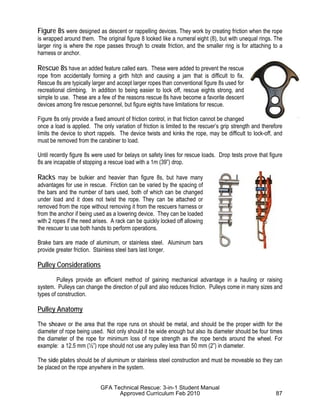
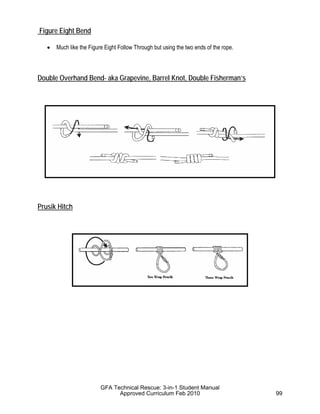
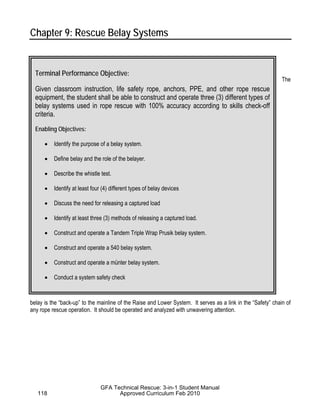
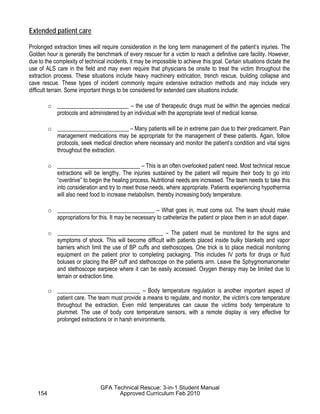
Technical Rescue:
Introduction to Technical Rescue,
Core Qualifications, and
Rope Techniques
STUDENT MANUALS
GFA revisions July 2008
Katrina Deployment
Patient Pick-off
Highline Operation
Breaching & Breaking
Patient Pick-off
Introduction to
Technical Rescue
STUDENT MANUAL
GFA revision March 2008
GFA Technical Rescue: 3-in-1 Student Manual
Approved Curriculum Feb 2010 3
Table of Contents
Preface
Acknowledgements
Schedule
Terminal Performance Objectives
* Note: Some subjects listed below can be cross referenced to the text:
“High Angle Rescue Techniques 3rd Edition” (HART). The associated chapter is also noted.
Technical Rescue Operations
Chapter 1: Requirements and Safety
General Requirements
Entrant Requirements
Minimum Requirements
Course Safety Rules
Chapter 2: The Rescue Technician and NFPA Standards
NFPA 1670
NFPA 1006
NFPA 1983
Job Performance Requirements- overview
Chapter 3: Technical Operations
(All subjects indicated with an * can be referenced to HART, Chapter 11, unless otherwise noted)
*Preplanning
*Scene Size up
*Scene Management
*Incident Management
Search & Rescue
USAR Markings
Search & Rescue Methodology
Types of Searches
Hazard Recognition & Mitigation
Hazard Recognition
Hazard Mitigation
Safety Considerations in USAR
Basic Stabilization (Cribbing)
Emergency Shoring
Shoring Considerations
Types of Cribbing
Cribbing Strength
Wedges & Shims
Constructing Cribbing Bases
Periodic Inspection
*Ground Support Operations for Helicopter Activities ……………………………… (HART, Chapter 21)
4
GFA Technical Rescue: 3-in-1 Student Manual
Approved Curriculum Feb 2010
Equipment, Selection, Care, and Maintenance
Chapter 4: General Equipment for Technical Rescue
(All subjects indicated with an * can be referenced to HART, Chapter 2, unless otherwise noted)
Personal Responsibility Code
*Headgear
*Clothing
*Gloves
Personal Protective Equipment – The NFPA 1951 (USAR) Ensemble
*Personal Protective Equipment – Additional Items
*Harnesses
Personal items required for USAR members
Basic Rescue Equipment – FEMA USAR Categories
General inspection and maintenance of Technical Gear
Chapter 5: Life Safety Rope & Software
(All subjects indicated with an * can be referenced to HART, Chapter 3, unless otherwise noted)
NFPA 1983
*Rope Materials
*Rope Construction
*Rope Elongation
*Rope Size and Strength
*Rope Care ………………………………………………………………...………… (HART, Chapter 4)
*Rope Inspection and Retirement …………………………………………………. (HART, Chapter 4)
*Accessory Cord
*Webbing Materials
*Webbing Construction
*Webbing Size and Strength
*Webbing Care, Inspection and Retirement ……………………………………… (HART, Chapter 4)
Chapter 6: Hardware Equipment
(All subjects indicated with an * can be referenced to HART, Chapter 5, unless otherwise noted)
*Carabiner Considerations
*Carabiner Anatomy
*Basic Carabiner Shapes
*Non-locking vs. Locking Gates
*Carabiner Materials
*Carabiner Size and Strength …
*Carabiner Care and Inspection
*Screw Link Considerations
*Rope Grab/ Ascender Considerations
*Descender Considerations
*Pulley Considerations
*Pulley Anatomy
*Types of Pulleys)
*Belay Devices)
*Edge Protection …………………………………………………………………….. (HART, Chapter 4)
Portable Anchors
*Miscellaneous Hardware…………………………………………………………… (HART, Chapter 7)
*Litters/ Patient Packaging …………………………………………………………. (HART, Chapter 15)
GFA Technical Rescue: 3-in-1 Student Manual
Approved Curriculum Feb 2010 5
Introduction to Knots & Anchors
Chapter 7: Ties, Knots, Bends and Hitches
(All subjects indicated with an * can be referenced to HART, Chapter 6, unless otherwise noted)
*Knot Terminology
*Finer Points of Knot Tying
*Dressing a Knot
*Backing up Knots
*Knot Efficiencies
*Knots
*Bends
*Hitches
Chapter 8: Single Point Anchors
(All subjects indicated with an * can be referenced to HART, Chapter 7, unless otherwise noted)
*Anchor Terminology
*Types of Anchors
*Good Anchor Placement
*Single Point Anchors (Direct Attachment)
*Single Point Anchors (In-direct Attachment)
Anchor Strength and Torque
*Backing up an Anchor
*Vector Forces Applied to Anchors
Directional Forces Applied to Deviations
Focal Points
*What if there are no anchors?
*Vehicles as Anchors
Belay Systems
Chapter 10: Rescue Belay Systems
*Terminology …………………………………………………………………………. (HART, Chapter 8)
*Belay Considerations ………………………………………………………………. (HART, Chapter 8)
*Münter Belay ………………………………………………………………………… (HART, Chapter 8)
*540º Rescue Belay …………………………………………………………………. (HART, Chapter 13)
*Tandem Triple Wrap Prusik Belay ………………………………………………… (HART, Chapter 13)
*Radium 3:1 Release Hitch …………………………………………………………. (HART, Chapter 13)
Hierarchy of Risk
Fixed Brake Lower Systems
Chapter 11: Fixed Brake Lower Systems
(All subjects indicated with an * can be referenced to HART, Chapter 17, unless otherwise noted)
*Lowering System Operations and Commands
*Considerations for Rigging Fixed Brake Lowering System
*Managing the Edge
*Descent Control Options
*Tie off Options
6
GFA Technical Rescue: 3-in-1 Student Manual
Approved Curriculum Feb 2010
Skills Sheets: Check-off Criteria
Appendix
NIOSH Report: Preventing Worker Deaths from Uncontrolled Release of Electrical, Mechanical,
and Other Types of Hazardous Energy (Lock out - Tag out)
GFA Technical Rescue: 3-in-1 Student Manual
Approved Curriculum Feb 2010 7
Preface
Technical Rescue is often times a high risk operation for a low frequency of occurrence. Often times
hours and hours are spent learning technical skills; however, without regular practice, skill degradation will occur.
Ideally, regular practice drills, scenarios and hands-on training within the department would be available for all
levels of training and departmental procedures would be in place to retain skills. However, in reality it is often
times up the individual to strive above and beyond the norm to retain skills that are of most interest.
Since Job Performance Requirements are written to encompass minimum requirements, the ideal goal of mastery
of difficult to achieve without focusing on a particular specialty. Below are a few considerations that may help
each rescuer as they strive to become a technician:
--Cautions- Technical Rescue is inherently dangerous. Safety is paramount.
--Time- Technical Rescue requires many hours of hands-on practice and training.
--Strive to understand multiple applications of skills and “why” specific techniques are used.
--Keep skills sharp- If you don’t use it, you’ll lose it!
--Continual education- Skills used in rescue may transfer to, or be transferred from other interests. Rock climbing
skills are often used in Tower Rescue. Arborist workers use some of the same concepts found in vertical
climbing techniques. Specific techniques may be very different, but the basic concepts can be transferred to
many others technical skills.
--Learn from different sources.
--Practice individually, and as a team.
Acknowledgements
Without the following, none of the GFA programs would be available:
-- All the people that have worked to develop this program.
-- Testers and professionals dedicated to the betterment of gear and techniques.
-- The instructors that teach and mentor others.
-- The rescuers that make it happen.
8
GFA Technical Rescue: 3-in-1 Student Manual
Approved Curriculum Feb 2010
Introduction to Technical Rescue: 48 hrs
Day 1 Day 2 Day 3 Day 4 Day 5 Day 6
08:00
08:30
Registration,
Course Overview,
Introductions
Morning
Review &
Skills Practice
Written Exam
09:00
Helicopter
Op’s
Morning
Review &
Skills Practice
Morning
Review &
Skills Practice
Morning
Review &
Skills Practice
09:30
NFPA Standards
& The Rescue
Technician
10:00
Lowering
Systems:
Overview
10:30
Technical
Operations
Intro to
Anchors &
Belays:
Overview
11:00
11:30
Equipment for
Technical Rescue
Anchors and
Belays
Practice
Stations
Lowering
Systems
Ground
Practice
Lowering
System
Operations
Rotation III
Student Run
Scenarios
Small Groups
Skills Check-
offs
12:00
12:30
Lunch Lunch Lunch Lunch Lunch Lunch
13:00
13:30
Building Markings
& SAR
Techniques
14:00
Hazard
Recognition &
Cribbing
14:30
15:00
Rope & Rope
Related
Equipment SCAM
15:30
16:00
16:30
Anchors and
Belays
Practice
Stations
Catch a
Falling Load
Lowering
System
Operations
Rotations I &
II
Instructor Run
Scenarios
Small Groups
Student Run
Scenario
Large Group
Skills Check-
offs
17:00-
completion
Knots, Bends &
Hitches
Presentation &
Student Practice
Questions,
clean up
Questions,
clean up
Questions,
clean up
Questions,
clean up
Demob
Evaluations
Bay/ Trees Tower/ Cliff
Classroom
GFA Technical Rescue: 3-in-1 Student Manual
Approved Curriculum Feb 2010 9
Terminal Performance Objectives
• Given classroom instruction, the student will be able to identify the critical points of NFPA standards 1670,
1006, and 1983 and how they pertain to a technical rescue team versus the individual rescuer.
• Given classroom instruction and/or rescue scenarios, the student will be able to perform safe practices
during a technical operation as outlined by NFPA 1006 Professional Qualifications.
• Given classroom instruction and general equipment, the student will be able to identify equipment, and
demonstrate inspection and maintenance recommendations with 100% accuracy according to skills
check-off criteria.
• Given classroom instruction and personal protective equipment, the student will be able to identify
equipment, and demonstrate inspection and maintenance recommendations with 100% accuracy
according to skills check-off criteria.
• Given classroom instruction and rescue rope and software, the student will be able to identify equipment,
and demonstrate inspection and maintenance recommendations with 100% accuracy according to skills
check-off criteria.
• Given classroom instruction and hardware equipment, the student will be able to identify equipment, and
demonstrate inspection and maintenance recommendations with 100% accuracy according to skills
check-off criteria.
• Given classroom instruction, life safety rope, webbing and accessory cord, the student shall be able to
demonstrate proper tying of knots likely to be used in rescue incidents, such that ties are recognizable,
dressed and backed-up when needed with 100% accuracy according to skills check-off criteria.
• Given classroom instruction, life safety rope, and other auxiliary rope rescue equipment, the student will
be able to construct a single point anchor likely to be used during a rope rescue incident that meets or
exceeds the expected load while maintaining integrity throughout operations with 100% accuracy
according to skills check-off criteria.
• Given classroom instruction, life safety rope, anchors, PPE, and other rope rescue equipment, the student
shall be able to construct and operate three (3) different types of belay systems used in rope rescue with
100% accuracy according to skills check-off criteria.
• Given an anchor, life safety ropes, descent control devices, and auxiliary rope rescue equipment, the
student will be able to construct and operate a fixed brake lower system with 100% accuracy according to
skills check-off criteria.
10
GFA Technical Rescue: 3-in-1 Student Manual
Approved Curriculum Feb 2010
Technical Operations
GFA Technical Rescue: 3-in-1 Student Manual
Approved Curriculum Feb 2010 11
Chapter 1: Requirements and Safety
The Georgia Fire Academy (GFA) has reviewed the current standards related to technical rescue
programs according to the National Fire Protection Association. In reviewing those standards, each student
should meet certain requirements prior to training, and perform skills during training, to practice as an active
technical rescuer.
General Requirements
Rescue Technicians shall complete all activities in the safest possible manner and shall follow national,
federal, state, provincial, and local safety standard as they apply to the rescue technician.
Entrant Requirements
1) Age requirements- Each student shall be at least 18 years of age.
2) Medical requirements- First Responder or Equivalent, inclusive of current First Aid & CPR.
3) Minimum physical fitness- Each student shall be in good to excellent physical fitness. Student with
special needs or physical concerns should alert the instructor so the best treatment can be provided
should an issue arise; i.e. allergies to bee stings, diabetes, etc.
4) Prerequisite knowledge- NIMS 700, NIMS 100.
5) Members of specialized teams will be given priority in advanced technical training over firefighters that
are not active as a member of a responding technical rescue team.
Minimum Requirements
For certification, as a Rescue Technician, the student shall perform all of the job performance
requirements in NFPA 1006 Chapter 5 (Core Skills) and all job performance requirements listed in the NFPA 1006
Chapter specific to their choice of discipline (Discipline Skills.) These requirements are the skills needed for
minimum job performance as the rescue technician. Should a student be unable to complete all of the specified
skills, then the student is not eligible to become certified as a Rescue Technician, according to NFPA standards.
This course will introduce the minimum job performance requirements necessary to perform technical rescue
operations for fire service and other emergency response personnel. An Introduction to Technical Rescue will
train individuals the knowledge, skills, and duties needed to perform as part of a technical rescue team member,
using the general requirements established by National Fire Protection Agency (NFPA) 1006, Professional
Qualifications. Performance testing will evaluate general skills such as managing site operations, basic victim
movement, equipment inspection and maintenance, and foundational techniques to utilize ropes and fundamental
rigging.
Attendance Policy- Students must attend and participate in 90% of the course in order to receive GFA credit. No
more than 4 hrs of an excused absence are allowed during the course for completion.
Written Test Policy- Students must attain a minimum score of 70% on a written exam delivered by the Georgia
Fire Academy.
Performance Test Policy- Students must perform, complete and pass every skill as part of there performance
testing administered by Georgia Fire Academy. Records of performance testing will be held in office of Georgia
Firefighters Standards and Training Council as well as in GFA records.
12
GFA Technical Rescue: 3-in-1 Student Manual
Approved Curriculum Feb 2010
Course Safety Rules
Safety is of the utmost importance at all times. Technical Rescue is inherently dangerous. Safety in a
technical operation should be a primary focus during all training and operations. Follow these safety
considerations when participating in this program.
General Safety:
• Be safe in all your actions- act responsibly.
• Use proper lifting techniques when handling heavy rescue equipment.
• Horseplay will not be tolerated.
Instructor and student roles:
• The instructor is in charge and responsible for overall safety.
• The student is responsible for personal and team member safety.
• All elements of a load supporting operation must be inspected by an instructor prior to use.
PPE:
• Approved helmet must be worn by everyone within 10 meters (30’) of vertical rope work, or when
falling objects are likely.
• Approved class III harness must be worn during rappelling, lowering and raising operations.
• Gloves should be worn when handling a rope in movement.
• Safety glasses, goggles, ear protection or other special PPE may be needed during operations.
• Have an instructor or two other students inspect proper harness donning before beginning vertical
exercises.
Equipment:
• Rescue equipment will be inspected before, during and after daily use.
• Equipment will be inventoried before and after class.
• Damaged or suspect equipment will be given to the rescue course coordinator, or Logistics
Instructor, for preliminary inspection. The course coordinator may temporarily retire equipment for
the class until a more detailed inspection is possible.
• Abused hardware or hardware dropped from an extreme height resulting in obvious damage,
must be taken out of service immediately Tagged, Marked or Destroyed and delivered to the
course coordinator, or Logistics Instructor, upon conclusion of the training.
• No type of tobacco use within 15 meters (50ft) of any nylon, polyester or other soft goods.
• No knives around loaded ropes.
• Avoid stepping on, or dragging, ropes and other software.
• Secure loose items which may become entangled in descent devices or other snagging
obstacles.
GFA Technical Rescue: 3-in-1 Student Manual
Approved Curriculum Feb 2010 13
Environment:
• Establish safety zones when potential hazards are present.
• Establish safety lines, and remain secure during operations.
• Everyone must be secured to an anchor a body lengths distance from an edge, unless protected by a
handrail or parapet wall.
• Secure equipment when it may be knocked or kicked over an edge.
• Secure equipment to avoid loss or damage.
• Point out any potential hazards to an instructor and other students.
Communications:
• Follow the chain of command.
• Use “GATE-CHECK” and touch method when inspecting carabiner components of systems.
• Use “STOP, STOP, STOP” command to cease all operations IMMEDIATELY.
• Use the universal warning call: “ROCK!” whenever you notice any falling object.
• Ask questions if you have any rescue or safety-related concerns.
14
GFA Technical Rescue: 3-in-1 Student Manual
Approved Curriculum Feb 2010
Terminal Performance Objective:
Given classroom instruction, the student will be able to identify the critical points
of NFPA standards 1670, 1006, and 1983 and how they pertain to a technical
rescue team versus the individual rescuer.
Enabling Objectives:
• Identify the scope and purpose of NFPA 1670
• List the 3 levels of operational capability for technical search and rescue incidents
• List the 7 different disciplines identified by NFPA 1670
• Identify the scope and purpose of NFPA 1006
• Define “Rescue Technician” according to NFPA 1006
• List the 9 technical rescue disciplines currently addressed by NFPA 1006
• Identify the aspect of rescue covered by NFPA 1983
Chapter 2: NFPA Standards and the Rescue Technician
National Fire Protection Association (NFPA) is committed to advocating consensus codes and standards
and providing research and education for fire and related safety issues. A nonprofit membership organization,
NFPA has over 65,000 members and is staffed by over 5,000 volunteers. Many of these volunteers are part of
technical committees. These committees work hard to develop standards which prompt a high level of safety to
which all fire service personnel and organizations are held accountable. Currently there are three (3) standards
which directly applied to technical rescue efforts that should be addressed as part of becoming a rescue
technician. An overview of whom these standards are meant to address, and the intent of each standard, is vital
in knowing which standard to reference more specific details when needed.
Each standard is dynamic, in that it evolves and changes with each revision. The information in this chapter is
based upon the most current version of the standard. Future revisions may change, or address additional areas of
interest, and it is up to each person and department to revisit standards as they evolve.
GFA Technical Rescue: 3-in-1 Student Manual
Approved Curriculum Feb 2010 15
NFPA 1670
Prepared by the Technical Committee on Technical Rescue, and issued by the NFPA Standards Council,
the NFPA 1670 document addresses standards on Operations and Training for Technical Search and Rescue
Incidents. Originally, developed in 1994, the most recent version if this standard was approved and adopted in
January 2004.
Each NFPA standard identifies a scope, or whom it applies to, and a purpose. The scope of “this standard shall
identify and establish levels of functional capability for conducting operations at technical search and rescue
incidents while minimizing threats to rescuers” (1.1.1). This standard goes on to state, “the requirements of this
standard shall apply to organizations that provide response to technical search and rescue incidents…” (1.1.2)
That means that that if your organization, whether it is EMS, Law Enforcement, Emergency Management
agencies, or any group that responds to certain technical rescue incidents, whether they respond independently or
in conjunction with the Fire Department, should prepare to at least the minimum level of functional capability. The
scope of NFPA 1670 is to IDENTIFY and ESTABLISH levels of functional capabilities for agencies that provide
response.
The purpose, or the intent, of NFPA 1670 is “to assist the authority having jurisdiction (AHJ) in:
• assessing a technical search and rescue hazard within the response area,
• to identify the level of operational capability, and
• to establish operational criteria.” (1.2.1)
Now some of you might be asking WHO is the AHJ? This terminology is found throughout NFPA 1670 and many
NFPA documents. The “AHJ” refers to the organization, committee, or person that makes the decision and
enforces the rules for your team, department or agency. The AHJ is responsible for approving equipment and
materials, and also in charge of implementing departmental procedures.
The purpose of NFPA 1670 is to assist the decision making personnel for an organization to assess preparation
and response readiness for a technical search and rescue incident.
NFPA 1670 goes on to state, “the AHJ shall establish levels of operational capability needed to conduct
operations at a technical search and rescue incidents safely and effectively, based on:
• hazard identification
• risk management
• training level of personnel, and
• availability of internal and external resources” (4.1.1)
By assessing these criteria, the AHJ can decide at which level it wants to be able to perform operations at a
scene, and “shall establish written standard operating procedures” consistent with the chosen level. (4.1.2)
There are _________ identified levels of operational capabilities for a technical
search and rescue incident.
16
GFA Technical Rescue: 3-in-1 Student Manual
Approved Curriculum Feb 2010
Awareness
Operations
Tech
Technician Level- “This level represents the capability of organizations to
respond to technical search and rescue incidents, to identity hazards, use
equipment, and apply advanced techniques specified in this standard
necessary to coordinate, perform, and supervise technical search and
rescue incidents” (4.1.2-3)
Operations Level- “This level represents the capability of organizations to
respond to technical search and rescue incidents and to identify hazards,
use equipment and apply limited techniques specific in this standard to
support and participate in technical search and rescue incidents”
(4.1.2-2)
Awareness Level- “This level represents the minimum
capabilities of organizations that provide response technical
search and rescue incidents” (4.1.2-1)
“The minimum training for an organization shall be at the _____________ level”
(4.1.7.1.1)
NFPA 1670 identifies the need for a certain level of training, proper documentation, SOP’s, hazard
identification, risk assessment, incident response planning, equipment, safety, fitness, etc. The various
levels of preparedness within each of these areas, is what should be assessed for each organization.
Based on a needs assessment, the AHJ shall provide the proper support to function to the planned level of
operation.
Since the specialized needs to operate at the highest level of operational capabilities are difficult to
maintain, the AHJ can choose to operate at a particular level for discipline X, and then a DIFFERENT level
of operations for discipline Y. So what are the different disciplines identified by NFPA 1670?
Currently NFPA 1670 addresses 7 different rescue disciplines. They are as follows:
1) ____________________________________
2) ____________________________________
3) ____________________________________
4) ____________________________________
5) ____________________________________
6) ____________________________________
7) ____________________________________
NFPA 1670 is a guideline for organizations to train and
operate at the identified desired level of response
capability for technical search and rescue incidents.
GFA Technical Rescue: 3-in-1 Student Manual
Approved Curriculum Feb 2010 17
Most of these disciplines identify a working environment and so the standard correlates specific concerns
that are found in those environments. Rope Rescue, is a little different since it is not an environment
specifically. That section deals with techniques that can be applied to a variety of environments. Because
of that, Rope Rescue becomes a discipline that should be covered prior to exploring specific environments.
NFPA 1670 incorporates an entire matrix of requirements and compliances before moving on the next level
due to the close association of readiness. For example, in order for a team to be able to function at an
OPERATIONS LEVEL CONFINED SPACE INCIDENT, they must also be fully capable of responding to an
Operations Level Rope, Awareness Level Confined Space Incident, Awareness Level Trench Excavation,
trained in Hazardous Materials, a first responder, etc. It becomes increasing more complex as you move
up to the peak of the pyramid, each level and discipline building on the prior.
If your agency’s desired level of functionality is at the Technician Level Response for a Trench Incident,
then the agency should have written plans and procedures for identifications of hazards, formulating a plan,
implementing a plan, obtaining resources, training personnel, and testing and re-evaluations. Training is
only one aspect that should be considered when choosing a level of operational capability.
A team may have the BEST structural engineers from Cal-Tech, but if that team doesn’t have the
equipment to shore up a building collapse, then they can’t operate at the scene at a technician level
response team. Inversely… if a team has preplans in place, the needed equipment and manpower- but
doesn’t have the training, then they can’t operate at as a technician level response team either. In order to
function at an incident… it takes a team that is prepared, in more areas than just equipment or people, to
function and operate together.
The criteria “TRAINING of PERSONNEL” is one area that the Georgia Fire Academy (GFA) can provide.
But the GFA can NOT say that by training YOU, as an individual, to a certain level… it makes your TEAM
ready to respond.
NFPA 1670 focuses on organizations working to achieve a particular level of competency to operate at
several different technical disciplines. It is not meant to address individual rescuer skills or qualifications.
NFPA 1006
Prepared by the Technical Committee on Rescue Technician Professional Qualifications, released
by the Technical Correlating Committee on Professional Qualifications, and issued by the NFPA Standards
Council, NFPA 1006 addresses standards for Rescue Technician Professional Qualifications.
Originally, developed in 1994, the most recent version if this standard was approved and adopted in
January 2003.
The scope of NFPA 1006 “establishes the minimum job performance requirements necessary for fire
service and other emergency response personnel who perform technical rescue operations” (1.1).
Training is only one part of Team Response
Readiness and Functional Capabilities
according to NFPA 1670.
18
GFA Technical Rescue: 3-in-1 Student Manual
Approved Curriculum Feb 2010
The purpose of NFPA 1006 “is to specify the minimum job performance requirements for service as a
rescuer in an emergency response organization. It is not the intent of this standard to restrict any
jurisdiction from exceeding these minimum requirements (1.2). Each of the listed “performance objectives,
shall be performed safely, completely and in its entirety” (1.3.1).
This standard is aimed to the rescuer to assure skill proficiency. There are many actions involved by each
participant to PERFORM certain requirements and to DEMONSTRATE specific skills and objectives. You
as a rescuer, have minimum requirements that need to be met for certifications. The person trained to a
level to meet minimum job performance requirements and has the ability to perform objectives safely,
completely and in its entirety is referred to as a Rescue Technician. There are no intermediary levels
identified for individual that meet some of the requirements. An individual can NOT be certified to Rope
Rescue Operations according to NFPA 1006. The term “operations” and “awareness” refers to an
organizational capability according to NFPA 1670 and is also reference in NFPA 472 Hazardous Materials,
but these intermediary levels of performance are not identified by NFPA 1006. Only the Rescue Technician
is defined by this standard.
NFPA 1006 defines a minimum requirement “for certification. The rescue technician shall perform all of
the job performance requirements in Chapter 5 and all job performances listed in at least one of the
specialty areas” covered in Chapters 6 through 14 (4.3). Chapter 5 refers to general job performance
requirements and can be considered CORE skills. Chapters 6-14 refer to discipline specific job
performance requirements. This philosophy is referenced as a “core plus one” approach to become
compliant to the standard.
Since the only level of professional qualification identified by NFPA 1006 is that of a technician, many
reference a specific discipline when clarifying personal skills; i.e. Rope Rescue Technician or Trench
Rescue Technician. There are no prerequisites that state an individual must become a technician of one
particular discipline before becoming a technician of a different discipline. Only that a core set of skills
much be performed plus the discipline specific skills.
NFPA 1006 identifies the requirements that YOU as a rescuer should know.
Not the team… but the personal skills YOU, as a rescuer,
should be able to demonstrate.
Rescue Technician = Core + 1
GFA Technical Rescue: 3-in-1 Student Manual
Approved Curriculum Feb 2010 19
technician
novice
?
†
?
†
?
†
Currently, NFPA 1006 addresses nine (9) different disciplines. They are:
1) ____________________________________
2) ____________________________________
3) ____________________________________
4) ____________________________________
5) ____________________________________
6) ____________________________________
7) ____________________________________
8) ____________________________________
9) ____________________________________
These nine (9) areas follow similar environments included in NFPA 1670 with a few additional areas. Each
one of the disciplines is covered in their own Chapters and each identifies several performance objectives
that cover general requirements, requisite knowledge, and requisite skills. There is a core amount of
information needed by all the disciplines, and then the specific area of specialization.
From this, GFA and GFA instructors can train individual skills, evaluate individual performance and test
personal understanding, even though the activity may take several people to perform. For this reason,
GFA has chosen NFPA 1006 as the standard to train to for all open enrollment courses. An individual can
be evaluated by measurable criteria and certified once he/she performs all the needed skills.
Reminder: NFPA 1006 established minimum job performance requirements. This does not mean that
once certified to a technician level, the rescuer is always able to perform to a needed level of competency.
It does not mean that once you achieve technician that the learning process is over. The skills and
knowledge involved in the above listed disciplines are usually high technicality in comparison the low
frequency of use. Retention of knowledge and regression of abilities are viable concerns for individual
qualifications. For that reason it is strongly encouraged to regularly do self assessments of skills and
knowledge. Where do you rank on the continuum of knowledge? Where you rank and the end of a course
and where you rank a year later will be different as your skills will diminish.
When assessing your personal skills, you should ask yourself if you want to “just get by” or if you want to
know your skills and know them well. How well do you want to be able to perform on the scene… how well
do you want to help your team perform? How well do you want to know this stuff? Well enough to be able
to DO it?? Or just enough to get a piece of paper that says you can do it??
20
GFA Technical Rescue: 3-in-1 Student Manual
Approved Curriculum Feb 2010
The term TECHNICIAN is used both to describe an individual’s performance and a team capability in two
separate standards... but that does not mean a team standard and an individual standard are synonymous
with each other. This may explain why these two standards have been misinterpreted or misrepresented in
the past. It is often confusing when reading the standards to fight through some complicated language and
an awkward layout. It is understandable that a misinterpretation may have lead to the misnomer that these
standards could be meshed or lumped together as one and called “the rescue standard.” A better
understanding of the overall intent of the standard aids the organization and individual to know where to
reference information when specific questions arise.
NFPA 1983
NFPA 1983 is the standard on Life Safety Rope and Equipment for Emergency Services. It
was prepared by the Technical Committee on Special Operations Protective Clothing and Equipment,
released by the Technical Correlating Committee on Fire and Emergency Services Protective Clothing and
Equipment, and acted on by the National Fire Protection Association. The most recent edition was
approved in 2006.
The NFPA 1983 standard is primarily utilized by _______________________ for minimum
design performance, testing and certification requirements.
This standard is not a “use” standard, but instead is good reference to use for understanding the equipment
used in the industry. NFPA 1983 identifies labeling, design and construction requirements, performance
and testing requirements for system components.
This standard does not identify system safety factors or how to use equipment and gear. If you are
interested in knowing the minimum breaking strength of a particular class of rope, then refer to NPFA 1983.
If you want to know testing procedures for a class III harness, then NFPA 1983 is your bedtime reading
material.
Summary
Each NFPA standards establishes a scope and purpose for who the standard affects and the intent
of the standard. Each person involved with technical rescue should be able to now identify the critical
points of NFPA standards 1670, 1006, and 1983 and how each standard pertains to a technical rescue
team versus the individual rescuer.
NFPA standards are sort of like an atlas for our industry. Each standard is a different map for a specific
area in the fire service. We choose the destination, and the standard provides a path of how to achieve our
• NFPA 1670 addresses standards on Operations and Training for Technical Search and Rescue
Incidents.
• NFPA 1006 addresses standards for Rescue Technician Professional Qualifications.
• NFPA 1983 is the standard on Life Safety Rope and Equipment for Emergency Services.
GFA Technical Rescue: 3-in-1 Student Manual
Approved Curriculum Feb 2010 21
desired destination. There are many ways to interpreter the map, but if we are unable to take a closer look
at the details of the map, we can get lost. If we just grab any map available, without knowing which map to
reference… then we will stay lost even with our best efforts to orient ourselves.
It’s the same with standards. You need to familiarize yourself and your department well enough to know
which standard to reference for direction. Does your map need to guide your team? Does your map need
to tell you what you are personally responsible for knowing? Do you need a map that gives you the
answers about gear? By taking a closer look at each of these standards, NFPA 1670, 1006 and 1983, we
have a better idea of how to get to our designation and how to do the best possible job.
22
GFA Technical Rescue: 3-in-1 Student Manual
Approved Curriculum Feb 2010
Ch 5- Job Performance Requirements = Core Skills
5.1- General Requirements
The below general job performance requirements shall be met prior to certification as a
rescue technician.
5.2- Site Operations
5.2.1- * Identify the needed support resources
5.2.2- * Size up the rescue incident
5.2.3- * Manage incident hazards
5.2.4- * Manage resources in a rescue incident
5.2.5- * Conduct a Search
5.2.6- * Perform ground support operations for helicopter activities
5.2.7- * Terminate the incident
5.3- Victim Management
5.3.1- * Access a victim
5.3.2- Assess a victim
5.3.3- Stabilize the victim
5.3.4- Triage victims
5.3.5- Package an ill or injured victim
5.3.6- Move a victim in a low-angle environment
5.3.7- Transfer a victim to emergency medical services (EMS)
5.4- Maintenance
5.4.1- * Inspect and maintain hazard-specific personal protective equipment
5.4.2- * Inspect and maintain rescue equipment
5.5- Ropes- Rigging
5.5.1- * Tie knots, bends, and hitches
5.5.2- * Construct a single-point anchor system
5.5.3- Construct a simple rope mechanical advantage system
5.5.4- Direct a team in the operation of a simple rope mechanical advantage system
5.5.5- * Construct a lowering system
5.5.6- * Direct a lowering system
5.5.7- * Construct a belay system
5.5.8- * Operate a belay system
5.5.9- * Belay a falling load
5.5.10- * Conduct a system safety check
Job Performance Requirements
The below information is an overview of the general requirements to work toward becoming a
Rescue Technician according to NFPA 1006- Standards for Rescue Technician Professional Qualifications.
Refer to the full standard for more specific details of each of these points. JPRs with an asterisk “*” denote
skills that will be performed and tested as part of this course.
GFA Technical Rescue: 3-in-1 Student Manual
Approved Curriculum Feb 2010 23
Terminal Performance Objective:
Given classroom instruction and/or rescue scenarios, the student will be able to
perform safe practices during technical operations as outlined by NFPA 1006
Professional Qualifications.
Enabling Objectives:
• Identify needed support resources
• Size up the rescue scene
• Manage incident hazards
• Manage resources in a rescue incident
• Conduct a search
• Perform ground support operations for helicopter activities
• Terminate the incident
Chapter 3: Technical Operations
Technical operations are inherently difficult to control and dangerous to maintain safety while
conducting operations. There are several phases to rescue incident that each participant should know. Far
too often are safety and efficiency compromised because many personnel are geared toward a later phase
of response; the rescue operation. This chapter details the knowledge and skills needed for site operations
throughout the entire rescue incident. This information can be adapted to each type of rescue incident
whether it takes place in the high angle environment, confined space environment, or any other technical
rescue setting.
Preplanning
Emergency scenes are, from the rescuer’s view, primarily management problems and communication
problems. Preplanning is the key to mitigate these management problems. Its goal is to identify historical
and future problem areas and to develop plans to deal with this area.
24
GFA Technical Rescue: 3-in-1 Student Manual
Approved Curriculum Feb 2010
As required by NFPA 1670, a risk analysis (what is likelihood of incident occurring) and hazard assessment
of your community must be done to focus on the most likely rescue scenarios. Once this is done you can
begin the preplanning process in general, and then identify specific locations or historical incidents where
rescues may occur.
What type of hazards do we take into consideration?
1. Utilities
2. Hazmat (nuclear, biological, chemical)
3. Confined Space
4. Environmental (weather)
5. Structural
6. Terrain
7. Water (flowing/standing)
How can we prepare for/mitigate these hazards?
1. Preplanning
2. Regulation/Policy changes
3. Educational Campaigns
Jurisdictional Hazard Assessment:
It is the agency or organizations responsibility to identify, plan and prepare for technical incidents within
their jurisdiction. Many organizations have been lured into believing “it won’t happen here”. The time to
prepare does not occur AFTER the incident has occurred.
Hazard analysis can begin with determining likelihood/ probability of occurrence vs. the risk to responders.
Incidents that have a high probability of occurrence with high risk to responders will take precedence over
incidents with low probability of occurrence with low risk to responders. Each organization should evaluate
their jurisdiction and determine their level of commitment to potential incidents. Some organizations may
elect to address the response issue through mutual aid.
Site Specific Preplans should include:
1) ____________________________________
2) ____________________________________
3) ____________________________________
4) ____________________________________
5) ____________________________________
6) ____________________________________
7) ____________________________________
8) ____________________________________
GFA Technical Rescue: 3-in-1 Student Manual
Approved Curriculum Feb 2010 25
Scene Size- Up
What is a Size-Up?
The ongoing process of evaluating a situation to determine what has happened, what is likely to happen,
and what resources will be needed to resolve the situation (IFSTA F.D. Company Officer)
- an ongoing evaluation of the emergency incident
- guides the decision making process
- continuously done by all rescuers
- it is a critical component of a successful rescue and will lead to the ultimate success/failure of a
rescue
Four Questions to Constantly Ask during an Operation
1. ____________________________________
Get a good mental picture of the incident. If possible, walk around the incident site to gather as
much information as possible. This will help you get a better glimpse of the “big” picture and
possibly identify immediate threats to you, your team and victims.
2. ____________________________________
Is the incident going to get worse if we don’t intervene? Has the situation resolved itself? Many
technical incidents may appear to be stabile at first glance, only to realize that the original
cause of the incident has precipitated other hazards. A responder will need some experience
to be able to answer this question with some form of accuracy. Your response will be based on
past experiences, whether actual or simulated.
3. _____________________________________
What resources will be needed to mitigate the incident? Expect extended response times if you
are using some form of Mutual Aid to cover the assignment. Regional, State & Federal
resources will take even longer! Call for resources as soon as you recognize the need for
them.
4. ______________________________________
As emergency responders, we inherently have a desire to “do something”. We want to help.
That’s our nature. It is also the reason that responders die every year when responding to
technical incidents. These “statistics” make attempts to “do something” without proper training
or equipment, often resulting in injuries & deaths. Sometimes the best course of action is to
take a cautious approach and await the arrival of additional resources. Secure the site, shut
down equipment or utilities, coach the walking wounded to a collection point for triage/
treatment. These are all tasks that can be accomplished with relative safety.
Keep in mind that these questions should be constantly evaluated throughout the incident & during every
operation.
26
GFA Technical Rescue: 3-in-1 Student Manual
Approved Curriculum Feb 2010
Scene Management
Establish a Command Structure
Someone has to be in charge…. Everyone knows the outcome of “too many Chiefs, not enough
Indians”. There is a time to lead and a time to follow. Understand your position in the command
structure and operate accordingly.
Establish Work Zones
Essentially, incident operational zones (hazard zones) are either safe or dangerous.
Safe areas, away from the incident site, are often referred to as the Cold Zone. Here, personnel can
await assignment, rehab, and conduct administrative functions of command. Additionally, there may be
safe areas identified within a hazardous area. Often, theses safe havens are referred to as safety
zones.
Areas that pose danger to responders are referred to as the Hot Zone. This area will require proper
protective gear, equipment and training in order for a team to operate safely. Personnel who do not
possess the appropriate gear or training should not be allowed to operate within the Hot Zone.
The Warm Zone is actually a transition area from the Cold to Hot zones. Many functions can occur in
the warm zone. Often, support operations (Triage, Tool Staging, Cutting operations for Shoring Teams,
Decontamination) will take place in the Warm Zone. Protective equipment requirements may be
reduced from levels of protection within the Hot Zone.
Develop, communicate, execute & reevaluate the rescue plan
Your rescue plan will be based on available information that you have obtained when sizing up the
incident or operational site. This plan will need to be communicated, either written or verbal, with
personnel responsible for executing the plan.
Victims who are ambulatory usually do not need to be rescued. Use non-essential personnel to assist
ambulatory victims to a triage area. Victims who are unable to assist themselves will need to be
located and accessed. This process may prove to be difficult due to terrain, hazards, weather or high
noise environments.
Victims that are relatively easy to reach will need to be removed first. This will lessen the burden on
search teams operating in the immediate area and lower anxiety levels of all involved parties. Again,
depending on the complexity of their entrapment, use non-essential personnel to perform these tasks.
Victims who are entrapped will require the use of skilled and equipped responders. Access the victim
as soon as possible and begin your triage and treatment protocols. The goal is to stabilize the victim
and prepare them for extraction to awaiting medical personnel who can provide more definitive care.
Advanced medical care will be limited at best in the harsh environments posed by most technical
rescue incidents.
Extraction methods are considered Clean or Dirty. Clean rescues refer to situations that allow for the
“by the book” methods of patient care, packaging and removal. Clean rescues usually involve stable
patients, in environments that are stable and pose no additional threat to the team or patient. Dirty
Rescues involve either deteriorating patients or environmental conditions that pose an immediate threat
to the team and/ or patient.
REMEMBER - Extraction methods will be based on several factors:
1) Patient condition
2) Hazards or threats to wellbeing of the patient and team
3) Time – Limited resources or personnel. Fatigue of the rescuers.
GFA Technical Rescue: 3-in-1 Student Manual
Approved Curriculum Feb 2010 27
Scene Management – Points to consider
Command functions should follow the NIMS format. This provides the groundwork for other responding
agencies to work into the system.
Personal Accountability Reports (PARs) are an important component of safety at any hazardous
incident. PAR checks should be performed when:
– Something has changed
– A benchmark has been made
– Significant event has occurred
– Periodically for personal safety
REMEMBER – YOU have a personal responsibility for the safety and wellbeing of you and your team
members. Accountability starts with YOU. Don’t use the excuse of “they didn’t ask me for PAR, so I
didn’t think it was important”. Keep your supervisor informed!!!
A Situation Report (SIT-REP) is given whenever conditions have changed, you have completed a task
or met an objective. Your supervisor may call for a SIT-REP periodically to check the progress of your
team. This is also a good time to conduct a PAR.
There are many resources that are available through Mutual aid. Keep in mind that these resources will
take time to arrive, therefore you should request them as soon as the need is recognized. Local/
Regional resources may take several hours to mobilized and arrive. State and Federal resources will
take 24 hours, or more, to arrive with sufficient manpower to be functional.
Incident Management
Purpose: As mandated by law, public safety agencies were
required to adopt the National Incident Management System for
emergency scenes.
Facilitates multi-agency operations. Can be used to manage
emergency incidents and non-emergency events.
NIMS allows for the successful management of a scene and is
flexible enough to be utilized at small-scale scenes or expand to
larger incidents.
It utilizes specific positions in the organizational chart, which are
responsible for pre-assigned missions.
Span of Control- It is difficult to oversee all activity during an
incident and impossible on a large scale operation. A better
course of action is possible when organizing into smaller groups
for better accountability and to better disseminate information.
Usually a group size ranging from 3-7 personnel is reasonable
to manage.
28
GFA Technical Rescue: 3-in-1 Student Manual
Approved Curriculum Feb 2010
What does the Incident Commander do?
What does the Operations Chief do?
What does the Planning Chief do?
What does the Logistics Chief do?
What does the Finance Chief do?
Common Designators for Special Operations Teams
Strike Teams
Has specific number of __________ units, with a leader and common
communications.
Give an example of a Strike Team:
Task Forces
Has ____________ units with a leader and common communications.
Give an example of a Task Force:
GFA Technical Rescue: 3-in-1 Student Manual
Approved Curriculum Feb 2010 29
Single Resource
Can be a Unit, Company or Individual.
Give an example of a Single Resource:
Other Special Ops activities/ areas
Air Operations are becoming increasingly common in special operations and large scale disasters.
Refer to material contained in this section on Landing Zones and Short haul operations for further
discussion.
Staging areas are necessary when large deployments of equipment and personnel have occurred.
Staging is most effective when placed away from the incident or operation. Two forms of staging
may be used to facilitate rapid deployment of resources to the incident site.
- Primary Staging Point – is used for the assembly of apparatus, equipment and
personnel. These resources are kept in a ready, but relaxed state. Resources are
available for deployment, but mobilization will take some time.
- Forward Staging Point – is usually at the incident or operational site. Resources are
immediately available for deployment and able to mobilize rapidly.
Incident Facilities common to Special Operations
Common facilities at large scale incidents include the Incident Command Post, Staging Areas, Bases,
Camps, Helibases and Helispots. These will be identified with posted signs, markers, flags and special
symbols on maps.
Draw the Symbols for these facilities
Command Post (ICP)
Staging areas
Base
Camps
Helibase
Helispots
30
GFA Technical Rescue: 3-in-1 Student Manual
Approved Curriculum Feb 2010
The IAP (Incident Action Plan)
All incidents have an IAP, regardless of the sized or complexity. Most day-to-day incidents
have verbal IAP’s. Larger, more complex incidents usually have an IAP that is written. In
most cases, these written IAP’s are developed 12 – 24 hours in advance of their
implementation. For that reason, crews operating in the field need to relay any changes in
conditions to the command post as soon as possible. Written IAP’s need to be generalized
and not confine a team to a particular procedure or specific objective.
Terminating the operation
Whether terminating the incident or the operation, many things must be addressed.
In many cases the incident site needs to be left undisturbed, barring any rescue efforts, so
the appropriate investigating agency can collect information and perform an investigation.
- Does the incident involve an act of terrorism? If so the FBI must be informed
and will likely operate under a unified command system.
- Is the incident a result of a criminal act? The local police, sheriffs department,
or state bureau of investigation may be called to conduct an investigation.
- Did the incident take place at a construction or industrial site? OSHA
representatives may be required to complete a follow-up report.
Debrief crews or the team at the site if possible. The debrief should be short in duration
and will typically address:
- Any injuries incurred by rescuers?
- Assignments in regards to documenting the incident and the requirements of the
documentation
- Safety issues that need to be discussed while the team can physically see the site
- Address any equipment issues – particularly items that are out of service
- Demobilize the team, return equipment to working condition
The incident critique should take place with all affected members. This usually involves a
written report (either formal or informal) along with constructive discussion of methods of
improvement, outstanding performance, training and SOP issues that may need to be
addressed.
GFA Technical Rescue: 3-in-1 Student Manual
Approved Curriculum Feb 2010 31
Documentation of the incident should be consistent and factual. It is likely that the report
will be used in court if the incident involves a formal or criminal investigation.
Take the lessons learned and revisit the teams training program. Did their training meet
the needs of this particular incident? What can be done to improve team performance?
Does the agency need to invest in additional equipment or training? What about the
organizations SOP’s? Did the SOP limit the team to a particular way of doing things?
Search & Rescue
USAR Marking System
Information gathered by search and reconnaissance personnel must be represented in a
standardized fashion to ensure uniformity and clarity. The USAR marking system is divided into 3
sections.
1. Structure/Hazards Marking
2. Search Assessment Marking
3. Victim Location Marking System
The following activities should be performed prior to beginning search & rescue operations.
1. Identify buildings individually (by address, physical location, etc.)
2. General triage to separate buildings that offer the highest potential for viable rescue
opportunities.
3. Hazard assessment and hazard marking of any building prior to search & rescue
operations.
4. Search and rescue marking of a building
Structure/Hazards Marking System
The structure/ hazards marking system is a standardized marking system to identify structures in a
specific area and any hazards found within or near the structure. The system is intended to be the
National Standard system for evaluating, identifying, and marking buildings. It is designed to help
identify, select and prioritize the buildings with the largest probability of success with respect to
finding and rescuing victims.
It is important that information related to building identification, conditions, hazards and victim
status are posted in a standardized fashion. The theme of search & rescue must be to save
trapped victims while minimizing the risk to the victim and the rescue team. Structure hazards
identified during initial size up activities, and throughout the incident, should be noted.
A 2 foot x 2 foot square box is outlined at any entrance accessible for entry into any structure.
Aerosol cans of International Orange spray paint are to be used for this purpose. An arrow should
be placed next to the 2’ x 2’ orange box indicating the direction of the safe entrance, unless the
entrance is next to the orange box. It is essential to mark ALL normal entry points of a building to
32
GFA Technical Rescue: 3-in-1 Student Manual
Approved Curriculum Feb 2010
ensure that personnel approaching the building can identify that it has been evaluated and discern
its condition. Put the date, time, hazardous material conditions and team or company identifier
outside the box on the right hand side. (This information should be made with lumber crayon or
lumber chalk.)
All personnel must be aware of the possibility of, and look for other structure/hazard markings that
may be on the inside of the building. Such as interior rooms, hallways, etc. Every time an
assessment is performed throughout the mission a new TIME, DATE and ID entry will be indicated
below the previous entry or a completely new marking box will be made, if the original information
is now incorrect.
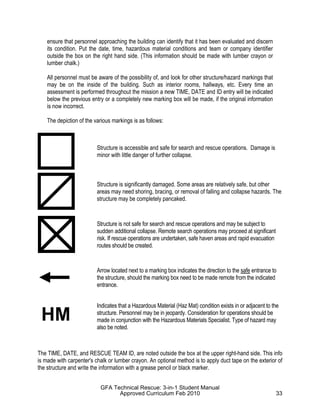
The depiction of the various markings is as follows:
Structure is accessible and safe for search and rescue operations. Damage is
minor with little danger of further collapse.
Structure is significantly damaged. Some areas are relatively safe, but other
areas may need shoring, bracing, or removal of falling and collapse hazards. The
structure may be completely pancaked.
Structure is not safe for search and rescue operations and may be subject to
sudden additional collapse. Remote search operations may proceed at significant
risk. If rescue operations are undertaken, safe haven areas and rapid evacuation
routes should be created.
Arrow located next to a marking box indicates the direction to the safe entrance to
the structure, should the marking box need to be made remote from the indicated
entrance.
HM
Indicates that a Hazardous Material (Haz Mat) condition exists in or adjacent to the
structure. Personnel may be in jeopardy. Consideration for operations should be
made in conjunction with the Hazardous Materials Specialist. Type of hazard may
also be noted.
The TIME, DATE, and RESCUE TEAM ID, are noted outside the box at the upper right-hand side. This info
is made with carpenter's chalk or lumber crayon. An optional method is to apply duct tape on the exterior of
the structure and write the information with a grease pencil or black marker.
GFA Technical Rescue: 3-in-1 Student Manual
Approved Curriculum Feb 2010 33
8/16/05 1310 hrs.
HM - natural gas
GA-TF 1
The example indicates that a safe point of entry exists above the marking (possibly a window, upper floor,
etc.). The single slash means the structure may require some shoring and bracing. The assessment was
made on August 15, 2005, at 1:10 PM. There is an apparent indication of natural gas in the structure. The
evaluation was made by Task Force 1 from the State of Georgia.
Search Assessment Marking System
This marking system is employed during and after the search of a structure for potential victims and is used
in conjunction with the Structure and Hazards marking system.
Search Markings must be easy to make, easy to read and easy to understand. To be easily seen the
search mark must be large and of a contrasting color to the background surface. Orange spray paint seems
to be the most easily seen color on most backgrounds. Survey line marking or downward spray cans are
the easiest to apply paint marks. Lumber chalk or lumber crayons should be used to mark additional
information inside the search mark itself because they are easier to write with than spray paint.
A large distinct marking will be made outside the main entrance of each building or structure searched. This
"Main Entrance" search marking will be completed in two steps.
First, a large (approx. 2') single slash shall be made near the main entrance at the start of the search.
Second, after the search of the entire structure has been completed a second large slash shall be drawn in
the opposite direction forming an "X".
GA-TF1 Single slash drawn upon entry to a structure or area indicates search operations
are currently in progress. The TF identifier is posted as indicated.
G A -T F 1
Crossing slash drawn upon personnel exit from the structure or area.
34
GFA Technical Rescue: 3-in-1 Student Manual
Approved Curriculum Feb 2010
Specific information will be placed in all four quadrants of the Main Entrance "X" summarizing the entire
search of the structure.
• The left quadrant is for the Rescue Team Identifier.
• The top quadrant is for the date and time the search was completed.
• The right quadrant is for any significant hazards located in the structure.
• The bottom quadrant is for the number of "LIVE" or "DEAD" victims still inside the structure. Use a
“0” in the bottom quadrant if no victims are inside the structure.
X
GA-TF1
LEFT QUADRANT - Task Force identifier
X
7/15/07
1400 hr
TOP QUADRANT - Time and date that the Task Force personnel left the
structure.
XRATS RIGHT QUADRANT - Personal hazards.
X
2 - LIVE
3 - DEAD
BOTTOM QUADRANT - Number of live and dead victims still inside the
structure. ["0" = no victims]
During the search function, while inside the structure, a large single slash shall be made upon entry of
each room or area. After the search of the room or area has been completed a second large slash shall be
drawn in the opposite direction forming an "X". The only information placed in any of the "X" quadrants
while inside the structure shall be that pertaining to any significant hazards or the number of "LIVE" or
"DEAD" victims.
As with the Structure/Hazards Evaluation, it is important that markings are made specific to each area of
entry or separate part of the building. If an area is searched and no victims are found, it must be noted with
GFA Technical Rescue: 3-in-1 Student Manual
Approved Curriculum Feb 2010 35
an X. It is also important that situation updates be noted as they are available, to reduce needless
duplication of search efforts. Previous search markings would be crossed out and a new marking would be
placed next to it with the most recent information.
Victim Markings
A victim location mark (“V”) will be placed near each victim within each confined space/ area. The “V” is
intended to be about 2 feet high and located as near the victim as practicable. An arrow may be added to
indicate the exact victim location.
The unit/ team identifier should be included. This will better define the specific location and condition of
each victim.
Search personnel shall use International Orange colored spray paint, or crayon, to mark the exact location
of a victim. It could be made on a nearby wall, or directly on a piece of rubble. In addition, surveyors tape
may be used as a flag to denote the appropriate area, in conjunction with the spray paint marking. This
series of markings is used to indicate the location and condition of each victim that is discovered on the
site.
• A circle is added when the victim is confirmed.
• A horizontal line (through the center of the “V”) is added if the victim is confirmed to be
dead.
• A large “X” is drawn completely through the circle after the victim has been removed.
36
GFA Technical Rescue: 3-in-1 Student Manual
Approved Curriculum Feb 2010
•
GFA Technical Rescue: 3-in-1 Student Manual
Approved Curriculum Feb 2010 37
Search & Rescue (SAR) Methodology
When search teams go into the field, they are usually assigned a search area and a search technique they
are expected to use. As a trained searcher you need to understand these search techniques, their purpose
and some considerations while performing searches.
Search procedures should be methodical and planned. Random search methods are ineffective, waste
valuable resources and prolong efforts to locate and extract victims. This ensures consistency in search
team performance, improves effectiveness of the search, and lessens needless duplication of search
efforts.
When referring to technical rescue, there are two basic types of searches: Land/ Wilderness and Urban
(USAR) searches. Each type of environment requires very different equipment, search techniques and
procedures. We will discuss some basic information for both types of environments. First, let’s look at some
common search terminology.
SAR Terminology
Search Area - When search teams begin looking for a person (search subject), they often draw lines on a
map to divide the world into search areas. These areas will then get labeled, such as A, B, C, D, etc. or 1,
2, 3, 4, etc. When teams are sent into the field to look for the person, they are assigned a search area and
given a map of that area.
Point Last Seen (PLS) - This is the point on the map where the person was last spotted by a witness with
a positive identification. It might be a trailhead, hunting camp, office space, work area, etc. If you know for
certain the person was seen at their desk before the incident occurred, then you have a place to begin your
search. In the case of a Land search, if the hunter was last seen at his vehicle, two hours ago, you now
have a place to begin your search. You also know about how far the person might be able to travel in two
hours, which helps limit your search area.
Last Known Position (LKP) - During a search, clues will turn up about the person. Occasionally, the clue
will be solid enough to be reasonably certain the search subject left it. For example, if the person is hiking a
trail and searchers have a good unique shoe print, a tracker can often find the same print along the trail, at
a stream bed, etc. and know beyond a shadow of a doubt that the person left the clue. Since the LKP is
more recent than the PLS, you basically have a new starting point for your search. Knowing just these two
points allows you to determine, general direction of travel, approximate speed of travel, etc.
Probability of Detection (POD) - POD is the likelihood of finding the search subject in a given search area
with the technique used. Different search methods typically yield different PODs.
For example, imagine someone lost a silver dollar coin in a child’s sandbox. When you begin looking for it,
you simply shuffled the sand around hoping it would turn up. Your probability of detection for this hasty
search might be 25%. In other words, 25% of the time, this hasty search would have turned up the lost
coin. But it didn’t. So, you begin digging a little deeper, looking a little harder, etc., but still with no definite
technique. When you finish, you might begin asking the person if they were sure they lost it in the sandbox.
Now, you’re 50% sure it isn’t in the box. So, you search a third time. But, this time you approach the search
with a more structured approach. You draw some large blocks in the sand and run your fingers through
38
GFA Technical Rescue: 3-in-1 Student Manual
Approved Curriculum Feb 2010
each "grid" looking for the coin. When you’ve searched the entire sandbox you declare, I’m 75% sure the
coin isn’t in there. Finally, you divide each large block in the sand, into smaller blocks and search each
block by screening the sand through a wire mesh. Sure enough, you discover the coin. It was in there all
along.
Each of the above search techniques carries with it a "probability of detection". The more thorough the
search technique, the higher the POD. However, the more thorough the search technique, the longer it will
take you to complete the search of the same area. Managing a search is usually a balancing act between
POD and search time.
Land/ Wilderness Search
Equipment
The equipment required for personnel involved in Land Searches is very different from that of USAR search
teams. Maps, handheld GPS units and compasses are common to the personal equipment caches of a
wilderness search team member. Clothing should be suitable for the environment and weather conditions.
A method to communicate with aircraft involved in the search effort should also be considered. Food, water
and basic first aid should be kept in your pack also.
Wilderness Search Techniques
Bastard Search
In the search and rescue community, a "bastard" search refers to looking in all the obvious places and
assuming the person wasn’t really lost to begin with (or found his own way out and simply went home). The
name originates from what the searchers typically call the person after they’ve spent hours and hours
crawling through the woods, only to find the "victim" at home watching baseball and eating chips.
For example, a teenager goes out hunting for the day and doesn’t return by dark. His family calls out
search and rescue who spends the entire night searching the woods for him. Then, in the wee hours of the
morning, the boy shows up at home alive and well. In reality, the hunting story was fabricated so he could
get out of doing chores and spend the day with his girlfriend.
So, by assigning a team to quickly search the likely places the person would go, you can often eliminate a
search before it really begins. And, while the name might not be the most flattering, it is a search result that
SAR teams don’t mind, because it means the victim is safe and sound.
Some key considerations if you are assigned to a bastard search area intelligence and speed. You need to
get the latest information about what the person’s plans were, what they planned to do later in the day,
where they are staying, who their friends are in the local area, who they might have met recently, etc. You
also need to move quickly. Using vehicles and radios to communicate quickly with the command post is
paramount because it allows search planners to quickly rule out obvious areas. As always, you should be
alert for clues, both discovered clues and comments from people who know the person. For example, if you
go to the person’s tent to check on them, you might chat a minute with the people in the tent next door, only
to discover the lost person had an argument with their parents earlier that day. This changes the dynamics
of the search effort considerably.
A technique that is very simple, but may yield significant results, is to leave a note. If the person isn’t home,
then leave a note on the door telling them they are the subject of a Lost Person Search and to please call
555-555-1234 if they discover this note. These simple notes have paid off more than once when the person
showed up later at home (or their vehicle, etc.) and discovered they were reported as "missing".
GFA Technical Rescue: 3-in-1 Student Manual
Approved Curriculum Feb 2010 39
Containment Search
When a search team first arrives on the scene, they usually know the "point last seen" of the victim. It might
be a trail head, a camp ground or someone’s front yard, but they do have a place to start. In theory, you
can determine the maximum area you need to search by starting at that point, determining how fast the
person is traveling (say 2 miles per hour), and how long it’s been since you last saw him there. So, what
you end up with is a circle with the point last seen in the center because you don’t know for sure which
direction the person went or if they continued moving in that direction or not.
So, it is easy to see how the potential search area can get very large in a short time. So, the best search
teams make containment of the victim the first, high priority, because it immediately limits how far the
person can travel without being discovered.
Containment is a simple job nearly anyone can do, regardless of physical conditioning. For example, you
might have two or three people positioned along on a long straight road. If the search subject crosses the
road, they’ll spot him. Bridges, wide creeks and open fields often offer the same confinement ability with a
minimum of manpower.
By confining the search subject, even if you only have the manpower to confine them on one or two sides,
you immediately limit the area which needs to be searched. Again, confinement is an area of search which
is usually very well suited to people who want to help but otherwise cannot due to some physical disability
or age.
The containment team doesn’t really have a POD, since you are basically waiting for the search subject to
run into you. However, unlike the other teams, you need to be 100% certain that the lost person doesn’t get
past you without being spotted. And, while this team will likely experience many hours of boredom while
waiting, it is important they stay focused.
People assigned to the confinement team are sometimes given secondary tasks such as radio relay, first
aid station, food/water resupply, etc. for teams which are deeper into the field. If you are assigned to a
confinement team, you might suggest other duties you could perform while stationed there.
The Key considerations on this type of team are to make sure the person doesn’t get past you, and report
in regularly (via radio or messenger) that the lost person hasn’t been spotted.
Hasty Search
A Hasty Team search will usually consist of ten to twelve highly trained searchers. This team will be
dropped into a virgin search area and will quickly spread out in pairs looking for clues or the lost person in
obvious places. The goal of a hasty team is to move quickly through the search area, almost at a slow jog
to check cliffs, wells, tangle hazards, caves, ditches, etc. where a person might be injured or might have
stopped to rest. If a lost person is conscious, even if they are injured and unable to move, the hasty team
should detect them as they pass through the area. They members of a hasty team are not directed to move
along a certain path or in a given direction. They are usually given free reign over how they move through
the territory. They might spend a few minutes checking an old barn, but move at almost a run across an
open field. The idea is to cover the ground. This is why it is so important to use trained searchers, because
they are usually much more in tuned with what clues to look for and how to quickly spot footprints, broken
branches (tracking signs), etc.
The purpose of the hasty team is to bring a rapid end to a search. By putting a well trained team into a high
probability area, the search leaders are hoping to find the victim with a quick pass. If the person is truly just
wandering around in the woods, then the hasty team will find them and bring the search to an end.
The expected probability of detection for a hasty team may vary somewhat based on the skill level of the
team members and the ruggedness of the search area. However, for a well trained team, search leaders
might expect a probability of detection of 30-40% for a hasty team. Meaning, if the hasty team comes back
empty, then there is a 30-40% chance that the victim isn’t there. However, there may be a 70% chance that
an unconscious and injured victim is there.
40
GFA Technical Rescue: 3-in-1 Student Manual
Approved Curriculum Feb 2010
Grid Search
A Grid search is what the public usually thinks of when they think of a lost person search. They picture a
long line of people marching like soldiers across an open field. Because of the manpower involved, this is
usually the search method of last resort. Trained grid searchers are taught to move slowly and deliberately
through an area in a straight line. It is important for each searcher to maintain their spacing with the person
on each side. It is also important NOT to take the path of least resistance, such as walking around a large
patch of thorns. Unfortunately, that’s where lost people (especially children) usually get caught if they
wander around in the dark. Grid searchers rarely find the victim; however, they almost always find any and
all clues which might be in the area, assuming the searchers are reminded to be clue conscious. Typically,
the grid search team leader and radio operator will try to locate themselves in the center of the line. This
way, they can quickly communicate and provide guidance to anyone up and down the line. When a large
number of searchers are involved, it may be necessary to use "squad leaders" up and down the line as
well.
Search leaders will often use this method as a last resort to gather every possible clue available. They will
also use this method when searching for evidence in a criminal investigation, such as a gun, shell casings,
personal effects, etc.
In very large searches, which have attracted regional or national attention, grid searches are often used in
low probability areas for the express purpose of giving people something to do. Sometimes Citizens show
up "just to help". You must give them something to do or it becomes a public relations problem. You might
pick an out-of-the-way search area and assign one or two trained searchers as leaders. This allows the
public to feel like they assisted and contributed, as well as getting those areas thoroughly searched.
Key considerations for this type of search team include keeping the proper spacing (don’t spread out or
bunch up), walk slowly and deliberately while watching for clues and try to stay in a line with the rest of the
group.
Choke Point Search
Depending upon the lost person’s skills and the terrain, some searches lend themselves to choke point
searches. If your search area includes a large river with only a few bridges, then you have an excellent
opportunity for a choke point search. Think of this as a roadblock rather than a search. A small team is
assigned to cover the choke point, to ensure that if the lost person attempts to pass through that point, you
can identify him.
Any places where you can identify a definite choke point, then you have an opportunity to apply this
technique. Keep in mind however, that if you are searching for someone who is actively evading searchers,
then choke points become much more difficult to define since the search subject may be willing to swim
across rivers or climb or descend cliffs.
Like search containment, this type of search lends itself well to people with less mobility who can sit in an
area and observe.
Track Trap Search
A track trap is a spot which will capture the fact that a person passed through the area. For example, if you
walk along a beach, you leave footprints. Even if you "cover your tracks" there is still evidence that
someone has passed through the area. There are many natural track traps, which include river and stream
banks, trails with excessive mud or dust, thorn bush thickets and even sand pits.
In areas prone to lost person searches, like national parks, it is common for SAR teams to build track traps
along major trails to help in search efforts. They might bring in a few loads of sand and place it in low spots
along the trail. This sand pit captures a record of anyone passing down the trail. Then, if a search develops,
the trained trackers in the area can immediately go to these known track traps and compare the prints
against a known print of the lost person.
GFA Technical Rescue: 3-in-1 Student Manual
Approved Curriculum Feb 2010 41
One "trick" tracking teams will sometimes use in a search is to go out and "rake" the known track traps
before the lost person has a chance to cross them. This quickly eliminates many of the false tracks that the
team might later have to rule out.
In order to be involved in this type of search technique, it is customary to have some proficiency in man
tracking and reading sign. However, you may find yourself attached to a team like this to act as a radio
operator, driver, etc.
Urban/ Disaster Search
Equipment
Maps, building blueprints and compasses are common to the personal equipment caches of a USAR
search team member. Flagging tape and marking equipment will be needed throughout the search process.
PPE/ clothing should be suitable for the environment, task and weather conditions. Hydration, some limited
food supplies and basic first aid should be kept in your pack also.
Urban Search Techniques
Hasty Search
This is a quick and efficient search by small teams that travel quickly to the likely spots and by the route of
least resistance. A hasty search is generally the first tactic used in the early hours and days of a search.
The hope is the subject is still alive and responsive. Most search missions end within the first day or two
and never get past the hasty search mode. Search Dogs are commonly used for hasty searches. Aerial
reconnaissance and search missions may also be used for large-scale disasters.
Primary Search
This is a more organized yet rapid search of an area. Small teams of are assigned an area. One person
guides on a physical feature such as a building, floor, hallway or the team is given a compass bearing to
follow. The other two-team members guide off that person and search an area to either side, roaming
through the adjoining room(s) while following the path of least resistance, checking likely spots. Density of
the debris dictates how far apart searchers may be and the distance will fluctuate depending on visibility.
This is a very efficient search tactic, used while the subject is still believed to be responsive and will answer
to voice checks.
Secondary Search
This is a thorough search method but not very efficient. It requires a large number of people to cover a
relatively small area with a high probability of detection. It is used in the later stages of a search when the
chance the subject is down and not responsive has increased.
Evidence Search
This is used only on evidence searches. This is a very thorough search, with team members shoulder to
shoulder on hands and knees, looking for small evidence items such as weapons, bullet casings, bone
fragments, etc.
USAR Search Considerations
• Rescue the maximum number of victims, with minimum risk to rescuers.
• Priority with live victims; dead are noted and removed later
• Initially, rescue victims who are easy to get to, extricate, and evacuate
42
GFA Technical Rescue: 3-in-1 Student Manual
Approved Curriculum Feb 2010
• Size up EACH structure before entering
• Surround structure and check for both victims and safety problems
• Look for structure/search markings
• Look through windows, doors, and openings for victims and hazards before entering.
Hazard Recognition & Mitigation
Typical Hazards
Emergency incidents are fraught with a multitude of hazards to both emergency personnel and victims. Not
all hazards are easily recognized and often require special training, equipment and the addition of personal
experience to safely detect and mitigate. These hazards include, but are not limited to:
1. Gravity
2. Collapse/ Stability
3. Electrical
4. Pneumatic/ Pressurized
5. Temperature – Cold/ Hot
6. Atmospheric
7. Engulfment
8. Mechanical
9. Chemical/ Bio
Hazard Recognition
The ability to recognize and detect hazards is paramount to our safety. Dispatch information and the initial
report of first arriving units will assist us in determining what hazards either currently exist, or have the
potential to exist.
Much information can be gained through our knowledge of the type of incident. The dispatch of
emergency services to assist in the rescue of a person unconscious inside a storage tank will likely suggest
this is a confined space emergency and will require us to monitor for atmospheric and hazardous energy
hazards.
The location of an incident will also help us to gain some insight toward any potential hazards. A fire
occurring at a chemical plant may suggest there is a likelihood of the involvement of hazardous chemicals,
requiring us to monitor for toxins and provide protective clothing and decontamination for response
personnel.
Once on site, we may use hazard detection equipment to assist us in identifying our operational zones,
level of protective equipment and incident stability. Some of this equipment includes:
• Atmospheric monitors
• Litmus Paper (pH paper)
• AC/ Voltage detectors
• Thermal imagers
Each rescuer’s Situational Awareness needs to be high throughout the incident. Rescue personnel need
to resist tunnel vision and be aware of the potential hazards that have been undetected or that may be
created due to our rescue efforts. One example of this is at structural collapse incidents. Often, the
stabilization of one area will result in destabilization of another.
GFA Technical Rescue: 3-in-1 Student Manual
Approved Curriculum Feb 2010 43
Hazard Mitigation
All hazards, or potential hazards, must be addressed after they have been detected or identified. The
team’s hazard mitigation plan will be based on the answer to the following questions:
Can the hazard be avoided?
It may be possible to mark the area, post a lookout or block the area and deny entry, in order to protect
individuals from the hazard.
Can we remove the hazard?
If it can not be avoided, can it be removed? The procedures used for hazard removal include:
• Hazardous energy, machinery - Lockout/ Tagout procedures
• Hazardous Atmosphere - Ventilation techniques
• Collapse - Stabilization techniques
• Chemical/ Bio – Decontamination of the operational site
Can we shelter ourselves from the hazard?
We may seek methods to shelter ourselves from the hazard if a viable rescue effort needs to be made and
the hazard can not be safely removed or avoided. This includes:
• Hazardous Atmosphere, Chemical/ Bio - Protective clothing and SCBA, Decontamination
• Gravity - Placement of fall protection
• Collapse – Provide for safe haven/ safety zone
See also – Appendix material provided by NIOSH on Lockout/ Tagout Procedures
General Rescuer Safety Procedures
Rescue work, by its very nature, is inherently dangerous. Responders must constantly perform risk/ benefit
analysis and determine the teams actions based on the reality of the outcome.
Risk nothing to save nothing
Risk a life to SAVE a life
Risk little to save a little
Rescuer and Team safety begins with YOU. Here are some general guidelines to follow to ensure the
safety of you and your teammates.
1. Wear your safety equipment/ PPE (hard hat, ropes, pry bar, first aid kit, etc.)
2. Carry tools for the job
3. Be aware of safety and health risks around the disaster site
4. Use the Buddy system/ Work in teams of two or more
5. Always have communication – radio, voice, visual or runners
6. Establish evacuation and entrapment signals
7. Assign a Safety Officer to the operation and EACH team
8. Review evacuation techniques before entering a hazardous site
9. Follow safety precautions for lifting and moving objects
44
GFA Technical Rescue: 3-in-1 Student Manual
Approved Curriculum Feb 2010
Emergency Signaling & Evacuation
Emergency signaling and evacuation procedures must be understood and immediately recognized. Alerting
devices shall be used to sound the appropriate signals as follows:
• Cease Operation All Quiet 1 long signal (3 seconds)
• Evacuate the Area 3 short signals (1 second each), followed by pause, repeated until all members
are accounted for
• Resume Operations 1 long and 1 short signal
Basic Stabilization Techniques
Emergency shoring
Agencies respond to many types of technical incidents that require the use of stabilization/ shoring
techniques. Typically, we think of shoring and stabilization techniques in use at car accidents, structural
collapses and trench rescue emergencies. This program will focus on the most basic emergency shoring
technique, cribbing. Other techniques for the stabilization of collapsed structures, excavations or heavy
machinery will be discussed, demonstrated and practiced in programs dedicated to those specific
disciplines.
Stabilization techniques are based on one primary objective: to properly
receive, transmit and redirect the load.
Shoring considerations
Personnel assigned the task of shoring must first consider the weight of the material to be stabilized or
shored. This can prove to be difficult in most situations. Estimation will have to be made based on the sized
of the load, density, whether the load is partially supported somewhere else and the loads center of gravity.
These estimations are a product of understanding the weights of materials to be stabilized, measurements
and personal experience.
Many unseen forces can act on an object. Vertical, Horizontal/ Lateral, Tension, Compression and Torsion
Forces will dictate how and where you will stabilize a load.
Material used for Stabilization
Stabilization materials are typically made from lumber used in construction and framing. However, at the
scene of a disaster, there may be other suitable materials that can be used to make temporary cribbing.
Any material with a hard flat surface can be used. The requirements for improvised cribbing are:
• The material must be flat on both surfaces.
• The material must be able to withstand the weight it will have to support.
Dimensional lumber is the most common form of material used for cribbing and constructing emergency
shores. There are several types of lumber available to your rescue team. There are two major categories of
wood that are available to use today, they are hardwoods and softwoods. These names really tell us
more about the type of tree the lumber comes from than the wood itself. For example, balsa wood, the
GFA Technical Rescue: 3-in-1 Student Manual
Approved Curriculum Feb 2010 45
easily cut and lightweight wood we all used as kids, comes from a hardwood tree. These names do not
necessarily mean that hardwoods are hard or softwoods are soft.
Hardwoods come from broad leaf trees that lose their leaves during the winter months. The wood is
generally heavy and close grained. Oak and maple are two examples of the common types available.
These types of lumber are generally expensive and very heavy to work with they are not well suited for our
needs as a rescue team.
Softwoods come from trees with needle like or scale like leaves that stay on the tree all year. The most
popular species of softwoods are Douglas-fir, Western hemlock, white fir and spruce. Pound for pound
Douglas-fir is one of the strongest woods available. Douglas fir and yellow fir–A strong medium density,
medium to course textured softwood. It is widely used for plywood and dimensional lumber and timbers in a
variety of building construction situations. For these reasons Douglas-fir is the choice of lumber for use with
your rescue team. It is strong, readily available, and inexpensive and stores well. Of course you utilize
whatever you can in a real scenario, but bear in mind types of lumber may have lower supporting strength.
Each piece of lumber delivered by a reputable mill should have a grade stamp. This stamp is to certify that
the piece of material meets quality control standards set by the lumber grading associations. The grades
we will be looking for are No. 1, No 2, stud grade, and construction grade. The utility grade should not be
used, because of knots or splits; therefore it may not be strong enough in some situations.
Common lumber sizes used
The following is a list of lumber that if at all possible should be carried on your apparatus and some of the
more common uses for each.
2 x 4–this size lumber can be used in box cribbing, as diagonal and cross bracing for shores, various size
cleats and filler blocks.
2 x 6–Can be used for diagonal wall braces, box cribbing, cleats, cross bracing and horizontal bracing for
shoring.
2 x 8–Although not commonly used, they are excellent for "sleepers" or "mud sills” when shoring is being
erected on soft ground. They can also be used as diagonal wall braces.
4 x 4–The most common size of shoring lumber your team will be utilizing. Box cribbing, "T" shore, window
shore, door shore, vertical shore and horizontal shores can all be constructed with 4 x 4's.
4 x 6–Generally used in larger type buildings or where substantial holding power is necessary. They can be
used as door and window shores if heavier loads are anticipated.
6 x 6–Normally used in heavier constructed buildings where the loads will be much greater. Such as an all
concrete or concrete and steel structures. They are good for use as box cribbing, horizontal and vertical
shores.
Plywood – The plywood can be used for numerous items, gusset plates, cribbing spacers, wall plating for
shores, in trench rescue, as work platforms and saw horses.
The distance between the load and the point it is to be transferred to must also be taken into account. Just
stacking up blocks of wood to “fill in” the space is likely ineffective and, in most cases, Dangerous. Longer
distances will require a larger base for cribbing. A good rule of thumb is to keep cribbing height under three-
times the width of the cribbing base (most teams limit it to two times the cribbing width). This only applies to
cribbing. Shoring techniques for building collapse uses a different approach that is not discussed in this
class.
46
GFA Technical Rescue: 3-in-1 Student Manual
Approved Curriculum Feb 2010
Types of cribbing
_____________________ – Constructed by placing layers of wood, side-by-side,
and 90° to the last layer. (Creates multiple pillars)
_____________________ – Constructed by placing 3 members parallel to each
other with the next layer of 3 members 90° to the last layer (Creates 9 pillars)
_____________________ – Constructed by placing 2 members parallel to each
other with the next layer of 2 members 90° to the last layer (Creates 4 pillars)
Cribbing Strength
Wood strength will vary greatly depending on species, closeness of grain, knots,
age and condition. We generally give yellow pine a 500 psi compression strength
rating as a conservative number in respect to the woods ability to resist forces in
compression (cross grain). When determining the weight capacity of a cribbing
base you can safely consider each square inch of wood contact will hold 500
pounds of force. The true width of a 4X4 is 3.5 inches. When using 4X4’s to
construct a box crib each corner has a maximum of 3.5 inches X 3.5 inches (12.25
square inches) of contact with the load. So long as the corners form a solid
column, from the load to the ground, each corner of the box crib can support 6125
lbs (12.25 X 500). If we were to use 6X6 lumber (actually 5.5 inches in width) it
would support 15,125 lbs per corner. Remember, these are conservative numbers
used to take into account the possibility of defects in the material.
Box Cribbing Strengths – If load is on all 4 corners
4X4 = 24,000 lbs capacity
6X6 = 60,000 lbs capacity
Crosstie Cribbing Strengths – If load is on all 9 points of contact
4X4 = 54,000 lbs capacity
6X6 = 135,000 lbs capacity
Wedges & Shims
Wedges are normally used in pairs, when properly joined or "married" together they are excellent tools for
filling gaps and transferring loads. They are easily adjustable, and can be tightened just enough to transfer
loads without lifting them. Moving unstable loads can have serious consequences in an operation. The use
of wedges will be extensive in all types of shoring operations, interior, exterior, as well any type of void
shoring and stabilization. A good wedge that will fit properly and "marries" together snugly is one in which
the length of the wedge is only five to six times as long as its thickness. Wedges constructed with too sharp
an angle will not hold properly and can easily slip out. The width of the wedges you will be using should be
the same thickness as that of the materials you are working with. This will make for a much smoother
operation. The wedges can be pre-made and carried on your apparatus or they can be cut in the field.
Generally it is much better if you have a preset cache of wedges on hand. It will take time to cut the wedges
to size, however it can be done with a little bit of effort. The lumber can be cut with a small chain saw with a
sharp blade or a 10 1/4" circular saw, this size saw is necessary if you wish to cut a 2"x4" or 4"x4" in one
pass. If you use a smaller diameter circular saw you will have to make two passes and many times your
GFA Technical Rescue: 3-in-1 Student Manual
Approved Curriculum Feb 2010 47
cuts will not line up, rendering your wedges almost useless as they will not fit together properly nor will they
tighten up sufficiently to be effective.
Shims are simply single wedges used to take up space or change the angle of weight thrust. Shims are
typically used to change the angle of a cribbing base in order to tighten firmly against the loads surface.
Constructing cribbing bases
Shims can be used on un-level surfaces to provide
a level surface to start on. Shims can also be used to
change the angle of thrust for the cribbing columns in the event the
load is angled, or not square with the cribbing blocks.
Narrow openings may make it difficult to place a square cribbing
base. Use other geometrical shapes, such as triangles or
parallelograms to get cribbing into tight places. The main priority is
to keep the cribbing column in line between the ground and the
load.
Some additional points to consider:
• Start with a solid base. Make it as level as possible.
• Cribbing height should not exceed 3 times the width of the
cribbing base.
• Never stack cribbing blocks more than 2 high (in the same direction)
• Keep fingers clear when placing cribbing blocks. Use a second piece of cribbing, or a tool, to slide
cribbing into place.
• Keep the “columns” in line with the load
Periodic inspection and Adjustment
There will likely be a need to adjust your cribbing throughout the incident as loads are shifted, settled or
changed. Someone should be assigned the task of periodic inspection and adjustment of cribbing bases
Wrong way to
“marry” wedges
Right way to
“marry” wedges
48
GFA Technical Rescue: 3-in-1 Student Manual
Approved Curriculum Feb 2010
due to ongoing changes in loads and the forces applied to them. The changes in forces are directly linked
to debris or material removal, vibration from operating equipment, the added weight of rescuers and
equipment or the addition of new forces from other stabilization efforts. The use of “married” wedges to
tighten the cribbing base is preferred. This ensures that full contact is made with the load. Shims should be
used sparingly due to the limited amount of contact to the load that they provide.
GFA Technical Rescue: 3-in-1 Student Manual
Approved Curriculum Feb 2010 49
Ground Support for Helicopter Operations
Search and Rescue: A Primer …………….By Jim Segerstrom
When discussing the pros and cons of helicopter rescue, you are talking about the provision of highly
technical training and equipment on an aircraft that can cost millions of dollars, to accomplish a highly
specialized, and in fact dangerous task, only a few times each year. In any accountant's ledger, this
would appear to be a poor return on investment.
Despite an admirable success record, rescue mishaps occur each year involving helicopters. These
are usually highly publicized. When it comes to helicopter rescue, the old saying applies: "When you do
something right, nobody remembers. When you do something wrong, nobody forgets."
Such incidents have led to an industry-wide effort to provide improved equipment and techniques that
will make helicopter rescue safer and simpler.
Some of the forums where manufacturers, pilots and end users gather to exchange information and
develop techniques include the Office of Aircraft Safety of the Department of the Interior, the Short-
Haul Working Group, the safety and rescue conferences held bi-annually by the Marine Survival
Training Center of the University of Southwestern Louisiana and the North American Helicopter Rescue
Working Group, the North American Technical Rescue Symposium, and the Airborne Law Enforcement
Association.
At the federal level, regulatory agencies are taking a hands-off, "wait and see" position. Current FAA
regulations specify two categories of helicopters in the non-military area: Part 91 helicopters are those
operated by public agencies and are not-for-profit. Part 133 helicopters are those operated by the
private sector, theoretically for profit.
Part 133 operators are required to conform to stringent safety requirements. These regulations are very
specific about which private helicopters can perform rescues and under what circumstances. Public
service aircraft are not required to conform to part 133 safety requirements, and, as long as they don't
charge for service, can perform search and rescue operations within the performance characteristics of
their helicopter and equipment.
These differences continue to create controversy within the helicopter industry. The public sector
operators contend that they are able to fulfill the task with minimal fiscal impact on taxpayers. The
private operators contend that they are more suited to the task as so many of them perform duties such
as long-line reference flying on a day-to-day basis rather than very occasionally, and that the
helicopters they are flying meet more stringent safety requirements.
Another area of consideration is the role of military helicopters in rescue operations. The public
perception is that the Army, Air Force, Navy and Coast Guard have fleets of specially fitted helicopters
and highly trained personnel who are ready to perform search and rescue at a moment's notice. Again,
the truth is far from the perception.
50
GFA Technical Rescue: 3-in-1 Student Manual
Approved Curriculum Feb 2010
The only immediately available and dedicated helicopters in the military for civilian operations are in the
Army and the Coast Guard. Some units of the regular Army, the Army Reserve and active-duty units of
the National Guard provide air ambulance services to the civilian population through the MAST
program, Military Assistance to Safety and Traffic. The Coast Guard has around 90 helicopters in its
fleet, whose primary mission is airborne law enforcement, but all of which are equipped for a dual
mission in search and rescue.
The Navy, regular Army, Marine Corps and Air Force all have helicopters equipped for SAR operations.
Availability of these aircraft depends on local arrangements, pre-determined "Memoranda of
Understanding" between agencies and military units, and the assignment of the aircraft to support local
authority through the national military dispatch system for Inland Search and Rescue, which usually
has to be accessed by state authorities. The procedure can be ponderous, and can cause significant
delays.
It should be apparent at this point that getting a rescue helicopter to a scene takes substantial planning.
Ground rescue teams need to be well-versed on the performance characteristics of the helicopters they
might be using; cross-train frequently with them; have good landing zone management and signaling
skills, and pre-determined communications; and have good initial information about on-board
emergency procedures, and rescue and on-board firefighting information on those aircraft.
There are three general "sizes" of helicopters regardless of their use: small, medium and large. All are
used for SAR.
Small helicopters are generally used for transportation, but also find applications such as airborne law
enforcement.
Medium helicopters are usually described as "utility" aircraft--having one or two engines, capable of
holding up to 10 passengers, and able to lift heavier loads.
Large helicopters are just that--capable of lifting heavy loads, frequently used for airborne firefighting,
or for lifting large numbers of passengers. The SAR applications of each size depend on their FAA
“type," location and equipment. Virtually all have another primary role, with SAR being secondary.
The "consensus" standard for the utilization of helicopters for search and rescue has started to form in
recent years, as all groups involved have exchanged information.
While subject to individual opinion, the general opinion is that the following represents low- to high-risk
uses of helicopters for SAR:
Transportation and search: Helicopters are airplanes with a main rotor acting as a spinning "wing" to
provide lift. They are most efficient when moving forward. It is obvious that the safest use of the aircraft
is to find the victim from the air and then fly a rescue team to the site, where they can disembark and
utilize other technical rescue systems to rescue the victim.
Short-haul rescues: A "short-haul" rescue involves suspending a rescue "system," usually cable or
ropes, under the helicopter, then picking up a victim from the rescue site and flying him, generally
attended by a rescuer on the end of this line, the shortest possible distance to where he can be
transferred to a ground vehicle, or where the helicopter can land for the victim to be placed inside for
further transportation to definitive care.
GFA Technical Rescue: 3-in-1 Student Manual
Approved Curriculum Feb 2010 51
Short-haul is considered the simplest and safest of the rescue applications, exposing the crew and
aircraft to minimum risk for the shortest time, and requiring the smallest amount of annual training and
expertise.
Having stated that, helicopter authorities are currently prepared to argue indefinitely about issues such
as which aircraft can perform short-hauls; what is a "safe system"; when a rescuer should attend the
victim at the end of the line; what is the appropriate length for the system; how much time and training
the pilot and crew chief should have in long-line reference flying; and how the system should be
attached to, and releasable from, the helicopter. Such controversies are beyond the scope of this
article.
One skid and "toe in" landings: This technique involves literally hovering in contact with the ground, a
rock or car in the middle of the river, or a pinnacle or ledge on a mountain. Pilots often prefer this
technique as it gives them both horizontal and vertical reference to their surroundings. Rescuers
frequently find this maneuver hazardous and scary. The dangers are: sudden shifts in the balance or
"center of gravity" of the helicopter, and the fact that there is no margin for error or escape for those on
the ground in the event of a mishap.
Hoist operations: Most military rescue helicopters, and some civilian SAR helicopters, are hoist-
equipped. Either electrical or hydraulic hoists deploy a small, strong cable out to several hundred feet,
and are capable of lifting loads of up to 600 lbs back to the aircraft at a rate of 60 feet per minute or
faster. While seemingly foolproof, hoist operations present substantial hazards. In the past year, there
have been a couple of hoist failures--the cable spooling off the hoist in one instance, and the cable
parting in another. There have also been repeated incidents involving hoist failures and mechanical
problems. On the one hand, manufacturers point out quite legitimately that properly maintained hoists
have a tremendous safety record, with few mishaps. On the other hand, end users have started
exploring alternatives. Navy rescue helicopters in California and Nevada utilize a second top-rope
belay during hoist operations. Many European helicopters now come with two hoists. In California, the
Sky Hook Corporation is marketing an auxiliary hoist which uses static rescue rope. This back-up hoist
is currently being evaluated by many helicopter units, including those of the military.
Helicopter rappelling. Also very controversial, helicopter rappelling is a quick way to insert rescuers to
evaluate a scene on the ground. The helicopter can then utilize one of the above methods to extricate
victims and rescuers. Rappelling, regardless of when it is used in SAR, is considered by many to be the
most dangerous rope skill, leading to more fatalities than any others.
In helicopters, it is difficult, often impossible, to provide the rappeller a top-rope belay. The lines
sometimes get snagged in ground obstacles. Victims on the ground have grabbed the rope and
stopped the rappel. Rappellers have lost control of the rappel, turning themselves into what some
aircrew generously describe as "ground darts." Sometimes rappellers get their gloves, clothing, even
their hair, caught in the rappel device, necessitating either a lower from the helicopter, or cutting of the
line. While exciting, rappelling from the aircraft requires rigorous and frequent training.
Helicopter Rescue Checklist
As the unit leader, ask yourself these questions the next time you consider using a helicopter for a
rescue:
1. Have we cross-trained with this helicopter? Does it have the equipment and training to meet
the task we are asking of it?
52
GFA Technical Rescue: 3-in-1 Student Manual
Approved Curriculum Feb 2010
2. Do we have good communications with the helicopter crew?
3. Do I have a good landing zone, a designated landing zone manager and safety officer? Are we
prepared at the scene to rescue the crew in the event of a crash?
4. Is the weather adequate or is it deteriorating? (Minimums en route and at the scene are 1/2
mile horizontal and a 500 foot ceiling.)
5. Is there a safer way for the rescue to be effected on the ground?
6. Is this a rescue or body recovery?
7. Am I doing this to keep ground rescuers from having to exert themselves?
8. Is the patient stable or deteriorating?
9. Is this call being driven by an increasing sense of urgency?
This article is dedicated to those SAR personnel who stay the course, whether paid or volunteer.
Jim Segerstrom is founder and current vice president for operations for Elk Grove, CA-based Rescue 3
International. A credentialed college instructor, he worked as a paramedic for 17 years, and has written
several texts and articles on rescue. He is a 24-year member of the Tuolumne County, California
Sheriff's Search and Rescue Team, where he is the current technical team leader.
Air Medical Transport and Establishing an LZ
(The below information was provided by Life Force and available at http://www.lzontheweb.com/moreinfo.htm)
WHEN TO CALL FOR AIR TRANSPORT
The decision to call for air medical transport is a medical decision based not only on the patient’s condition,
but also to include the accessibility of the accident site or hospital facilities, the time saved verses ground
transport, the patient’s exposure time to the transport environment and level of expertise.
INFORMATION NEEDED WHEN REQUESTING AIR SUPPORT
When requesting air support, the caller should be prepared to provide the following essential information to
the Communication Specialist.
• Name / agency of caller
• Callback number
• Nature of emergency
• Number of patients (if known)
• Exact location
• Radio frequency and call sign of LZ command
Helpful Information:
• Highway name/number, nearest crossroads
• Nearest Community / City
• Terrain Reference
GFA Technical Rescue: 3-in-1 Student Manual
Approved Curriculum Feb 2010 53
• Landmarks, such as: Churches, Water towers, Golf courses, Radio towers, Schools, Railroad
tracks, Ponds, creeks, etc, GPS coordinates if available
LANDING ZONE CRITERIA
• Landing zone must be 100’X100’ during
the day; 125’X125’ at night.
• Must be free of obstacles, hazards and
debris.
• Site should be firm, avoiding slopes greater
than 5 degrees.
• If at all possible, soft sand of dirt landing
sites should be wet down while AIR
SUPPORT is enroute.
• KEEP LZ’S AS CLOSE TO THE ACTUAL
SCENE AS POSSIBLE
SETTING UP THE LZ
Determine wind direction and estimated speed. Identify all obstacles.
Mark the landing zone (LZ) with the appropriate equipment.
Walk the entire outer perimeter of the LZ. Make sure all debris is either removed or secured. Mark all
obstacles to allow easy identification from the air.
Inspect the inner area of the LZ by walking in a similar manner as in Step 5 until you cover the entire area.
Remove all loose debris.
From the center of the LZ, survey the entire area. Look first for any ground level obstacles which may have
been overlooked and secure them. Next, beginning at ground level and slowly looking upwards, rotate
yourself 360 degrees and note all elevated obstacles/hazards (wires, power poles, trees, etc.).
Move to the outer perimeter, with your back to the wind and face the center of the LZ, check for obstacles
once more, prepare for helicopter arrival.
PREPARE FOR ARRIVAL OF HELICOPTER
ALL PERSONNEL INVOLVED WITH LZ SECURITY MUST BE PREPARED FOR HIGH WINDS AND
NOISE. HELMETS MUST BE SECURED WITH CHIN STRAP AND BLAST SHIELD DOWN, TURN-OUT
GEAR SECURED, COLLARS UP.
Once the aircraft calls for LZ Officer, identify yourself and give location of the LZ in relation to the incident.
Next give LZ brief (wind direction, speed and description of all obstacles/hazards).
As the helicopter maneuvers into the LZ, watch for sudden appearances of undetected obstacles/hazards.
If such factors threaten the aircraft or safety of the scene then give the ABORT instructions.
54
GFA Technical Rescue: 3-in-1 Student Manual
Approved Curriculum Feb 2010
When the LZ Commander has a visual contact on the aircraft, they should give their location related to
clock position. A proper guide to use is in what relation your position is to the inbound aircraft.
Once the helicopter has landed, make sure you position yourself in front of the aircraft (12 o’clock) at 10-15
yards from the rotor disk.
Make sure the tail rotor guard is in proper position at the rear of the helicopter (6 o’clock, 10-15 yards
minimum from the tail rotor). If side guards are available, their respective positions at 9 and 3 o’clock, 10-15
yards from the rotor disk.
The flight crew will exit the helicopter and make contact with you and obtain any details not relayed during
their response.
Manage LZ activities. Do not allow anyone or any vehicle to rush or approach the helicopter without flight
crew approval.
PREPARE FOR DEPARTURE OF HELICOPTER
Keeping eye contact with the pilot, give the "thumbs up" signal when loading is complete and all support
personnel are clear of the primary LZ. This signal, coupled with internal communications with the aircraft
crew members will allow the pilot to begin start up or take off procedures.
Once the helicopter has cleared the LZ, make a quick overhaul of the area. Look for any equipment or
medical supplies that may have been left behind.
Dismantle LZ markers, reassign personnel. Close LZ.
GFA Technical Rescue: 3-in-1 Student Manual
Approved Curriculum Feb 2010 55
Equipment Selection, Care, and Maintenance
Always follow the manufacturer’s recommendations for use and care for all equipment.
56
GFA Technical Rescue: 3-in-1 Student Manual
Approved Curriculum Feb 2010
Terminal Performance Objective:
Given classroom instruction and general equipment likely to be used in a technical
rescue incident, the student will be able to identify equipment, and demonstrate
inspection and maintenance recommendations with 100% accuracy according to skills
check-off criteria
Enabling Objectives:
• Identify appropriate personal protective equipment (PPE), likely to be used in a technical
rescue incident according to NFPA 1951.
• Discuss the various levels of an ensemble protection and the limitations of PPE.
• Inspect PPE likely to be used in a technical rescue incident.
• Demonstrate proper maintenance techniques for PPE likely to be used in a technical
rescue incident.
• Discuss the applications of portable/ hand tools in technical rescue.
• Identify appropriate software, hardware and personal life safety equipment likely to be
used in a technical rescue incident according to NFPA 1983.
• Discuss limitations of software, hardware and personal life safety equipment.
• Inspect software, hardware and personal life safety equipment likely to be used in a
technical rescue incident
Terminal Performance Objective:
Given classroom instruction and personal protective equipment, the student will be able
to identify equipment, and demonstrate inspection and maintenance recommendations
with 100% accuracy according to skills check-off criteria.
Enabling Objectives:
• Identify appropriate personal protective equipment (PPE), likely to be used in a technical
rescue incident.
• Discuss limitations of PPE
• Inspect PPE likely to be used in a technical rescue incident
• Demonstrate proper maintenance techniques for PPE likely to be used in a technical
rescue incident.
Chapter 4: General Equipment for Technical Rescue
GFA Technical Rescue: 3-in-1 Student Manual
Approved Curriculum Feb 2010 57
“True technicians understand their equipment’s purpose,
operation, strengths and weaknesses”
Personal Responsibility Code
1. Firefighting and Emergency Response are inherently dangerous
activities requiring proper training in their hazards and the use of
extreme caution at all times.
2. It is your responsibility to read and understand any user's instructions
provided with any piece of equipment you may be called upon to use.
3. It is your responsibility to know that you have been properly trained in
Firefighting and/or Emergency Response and in the use, precautions,
and care of any equipment you may be called upon to use.
4. It is your responsibility to be in proper physical condition and to
maintain the personal skill level required to operate any equipment
you may be called upon to use.
5. It is your responsibility to know that your equipment is in operable
condition and has been maintained in accordance with the
manufacturer's instructions.
6. Failure to follow these guidelines may result in death, burns or other
severe injury.
Provided by the Fire and Emergency Manufacturers and Services Association (FEMSA)
Personal Protective Equipment – Get Comfortable - Be Protected!
Choosing the correct clothing and personal equipment while working in the technical rescue environment
aids the rescuer in comfort, efficiency and most importantly, safety. Standard Fire Suppression PPE may
not the best choice when conducting a rescue or practice scenario while operating in a technical
environment. Mobility, weight, protection, comfort and functionality are among of the many considerations
to address when choosing appropriate PPE for the rescue technician.
Headgear
This is one of the most critical pieces of personal protective equipment. Not only does a helmet protect the
user from falling objects, but also to helps reduce the risk if head injury in case of a fall. There are several
types of helmets on the market for “safety” use but a helmet designed for riding a bicycle is designed to
perform differently that one for swift water rescue, or for construction. A helmet that is used in the high
angle environment should be specifically designed for high angle work.
Below are a few critical and optional features that should be considered when choosing an appropriate
helmet for technical rescue:
• Secure Chin Strap: elastic is not suitable
58
GFA Technical Rescue: 3-in-1 Student Manual
Approved Curriculum Feb 2010
• Impact resistant shell
• Three point suspension
• Suspension system that will absorb and disperse energy absorption
• Certified to an industry standard- i.e. UIAA, CEN, NFPA
• Lightweight- optional
• Vented- optional
• Brim or visor- optional
Clothing
Clothing should protect you against adverse environmental conditions and provide maximum comfort for
any activity. Appropriate clothing should allow for flexibility while working but not be overly loose.
Loose clothing should be avoided since it can become an entanglement hazard or become snagged while
working around moving ropes and equipment.
Clothing should be rugged and suited to the weather of the incident. As with any active sport, the comfort
and health of the participant may be affected by their clothing choice. If temperature needs call for warm
or cool clothing, a concern is insulation from wetness. This may be from rain or sweat, but wetness against
the skin causes body heat to be lost quickly. Synthetic materials, like nylon and polyester, wick sweat and
moisture away from the body to the outside of the garment to dry more quickly. For all their benefits,
synthetic fibers are also combustible and may not be suited for some technical operations. Use common
sense when selecting your clothing.
Footwear should provide comfort, protection and good traction. Boots are preferred in the technical rescue
setting since they provide support to the ankles and protect the feet from sharp obstacles. The sole should
be rugged and have good traction to aid the rescuer from potentially slick areas as well as to avoid trip
hazards. Keep in mind that USAR boots are designed to be used in extreme environments and are
designed to be very rugged. This requirement adds weight to the boot. Heavy, extremely rugged boots may
not be suited for use in wilderness environments, where long hikes and carry outs are common.
Gloves
Gloves are a must in the technical rescue environment. Gloves are needed to protect the hands from
abrasion and burns when handling moving ropes, conducting void searches, operating equipment and aid
in grip ability. However, glove selection should be based on the task being performed. A good glove for a
rope rescue technician is light in weight and provides lots of flexibility and good dexterity while protecting
the hand but will not provide adequate protection for burning/ cutting operations. During rope operations it
is important for the rescuer to be able to tie knots and maneuver ropes without having tot take the glove off.
Good protection on the palm of the glove is ideal for rappelling and lowering operations. Thicker, more
rugged gloves are ideal for void search and breaking/ breeching operations. Since gloves are so important
throughout any technical operation, consider carrying two pairs; one for light to moderate work and a
second pair for more rugged use. It’s always a good idea to keep an additional set of gloves for back up.
You may want to acquire a special keeper to secure gloves to your pack or harness when they are not in
use.
GFA Technical Rescue: 3-in-1 Student Manual
Approved Curriculum Feb 2010 59
Personal Protective Equipment – The NFPA 1951 (USAR) Ensemble
NFPA 1951 is the Standard on Protective Ensembles for Technical Rescue Incidents. Like NFPA 1983, this
standard is intended as a manufactures guideline in the design, performance, labeling and testing of
ensemble components used in technical rescue environments. The standard allows for three different
levels of protection:
a. ____________________
b. _____________________/______________________
c. ____________________
The Utility Garment is designed to be used at technical rescue incidents where the user is not in danger of
exposure to chemicals, blood borne pathogens or body fluids. This would include most tasks performed at
a technical rescue incident such as: rigging, breaking/ breeching, shoring or void search.
The Rescue/ Recovery Garment gives the user an additional layer of protection in the event of exposure to
some common chemicals (diesel fuel, battery acid), blood borne pathogens or body fluids.
The CBRN component provides protection from common chemical warfare agents to include blister and
nerve agents.
The purchaser will need to specify what level of protection they require in their garment. Some garment
manufactures provide a layering option, where the protection given by the garment is increased by the
addition of another layer. Some 1951 compliant garments also carry dual or triple certifications and can be
used for other incidents such as wildfires or EMS calls.
The ensemble components addressed in the 1951 standard include:
- Helmet
- Goggle
- Gloves
- Boots
- Coat (Can be constructed as a coverall)
- Pant (Can be constructed as a coverall)
Personal Protective Equipment – Additional Items
Many hazards exist at a technical rescue incident. The rescuer needs to consider the importance of
protecting themselves not only from burns or lacerations, but also form flying debris, air borne dusts,
inhalation hazards and the bodily fluids of their patients.
1. Eye Protection should meet ANSI Z-87 requirements
2. Hearing protection (90 decibels is OSHA limit)
3. Respiratory Protection
a. Air Purifying Respirators (APR)
b. Powered APR’s
c. Self Contained Breathing Apparatus (SCBA)
d. Supplied Air Breathing Apparatus (SABA)
e. Specialized Respiratory Protection (Rebreathers)
60
GFA Technical Rescue: 3-in-1 Student Manual
Approved Curriculum Feb 2010
4. Body Substance Isolation
a. Gowns
b. Masks
c. Gloves
d. Eyewear
e. Coverall – disposable
Harnesses
There are many types of harnesses available on the market that fit the needs of a wide variety of
uses. There are many styles harness designed for a variety of body types. There is no one harness that is
perfect for every body type, just as no one standard exists for specific user groups. Many standards have
been established that apply to the construction and design of manufactured harnesses. Where as some
standards apply to recreational climbers (UIAA and CEN) other standards apply to industrial use (ANSI)
and for the fire service (NFPA.)
NFPA 1983 establishes the criteria that manufactures must meet when designing a life safety harness.
NFPA 1983 references many concerns including: testing information, product labeling, material choices and
many other design issues.
According to NFPA 1983, a harness is designed to fasten around the waist and around thighs or under
buttocks. This standard categorizes harnesses into three (3) groups:
Class I: A light duty seat harness meant for emergency escape and light duty work by one person
with a design load of 1.33kN (300lbf.)
Class II: A seat harness meant for heavy duty work by one person or in rescue situations with a
design load of 2.67 kN (600lbf), in which another person’s weight may be added in the course of
the rescue
Class III: A full body harness meant for fall protection from falls and for use in rescues in which
inversion might occur with a design load of 2.67 kN (600lbf.)
GFA Technical Rescue: 3-in-1 Student Manual
Approved Curriculum Feb 2010 61
According to NFPA 1983, a belt is designed to fasten only around the waist and is categorized as one of
two types:
Ladder Belt: A belt intended for use as a positioning device for a person on a ladder.
Escape Belt: A belt intended for use by the wearer as an emergency self-rescue device.
Selection and Donning Harnesses
Even the most carefully designed and cushioned harness won’t be comfortable if it is too big or too
small, nor will it be secure. If the harness is sized too large they can slide up onto your lower ribs,
compressing your diaphragm and leaving you gasping for air. A loose harness slips, chafes, and, in a fall,
will likely cause more injury to the rescuer. When worn too small they can compress your hips and legs,
reducing mobility. If a harness is too tight, it will restrict movement and/or pinch. The waist strap/ belt of
harnesses should sit snugly over the hip bones. Most rescue harnesses are designed to ride low on the
pelvis. Be sure that it is not so tight that it interferes with your breathing.
Inspection of Harnesses
Retire a harness when it shows visible signs of wear such as fading or abrasion or after it has held
a severe fall. Over time, the webbing will get fuzzy from normal wear. This is OK. Be suspicious, though, of
wear to the stitching or excessive wear to the attachment points.
Protect your harness from direct sunlight and heat and from nylon-damaging substances such as acids,
alkalis, oxidizing agents, and bleach. Hand wash a dirty harness in cool water with a mild soap. Allow it to
dry in a shaded area.
Long-term missions - personal gear
Some additional personal protection issues that are commonly overlooked, but are common on
62
GFA Technical Rescue: 3-in-1 Student Manual
Approved Curriculum Feb 2010
extended operations include protection from UV, Dry Skin, Chaffing, Heat/ Cold, Dehydration and
insect bites. It is good practice to keep the following items with your personal rescue gear:
• Lip Balm/ Lotion
• Insect repellant
• Sunscreen
• Allergen cream (Poison Ivy)
• Extra gloves
• Thick socks
• Neck gator (Cold)
• Head cover (Hot)
Light Source
Technical Rescues do not always happen during the day or in open areas. Nighttime and/or enclosed area
operations are common. A personal light source is important for each rescuer. A light should be hands-
free and should be mountable onto the rescuers helmet. With many of the new styles of headlamp now
available, there are many options from which to choose. When choosing a light source consider the
following:
• Intensity of beam
• Life of battery
• Type of battery and ease of replacement
• Waterproof ability
• Adjustable beam- i.e. Flood beam vs. focused beam
• LED, halogen, xenon, or standard bulb
• Durability
• Intrinsically safe parts
Hydration
Staying hydrated during active rescue operations can be a challenge. Becoming dehydrated can
impair judgment and cause diminished body functions. Some of the ways that dehydration can cause
problems include:
• Depletion of energy reserves
• Impaired problem solving
• difficulty regulating body temperature
• Headaches
• Muscle Cramps
• Heat exhaustion
Whether the user prefers to have a wearable hydration system, or a water bottle near by, staying hydrated
throughout the rescue operation is a must.
GFA Technical Rescue: 3-in-1 Student Manual
Approved Curriculum Feb 2010 63
Personal items required for USAR members
Additional personal equipment and items are REQUIRED for deployments to FEMA disasters. Each
team member needs to ensure they have the following items in their personal gear bag:
• Light sticks
• Utility line (nylon)
• Particle mask (M-95)
• Mosquito netting
• Knee pads
• Elbow pads
• Insect repellant
• Full face respirator
• Half face respirator
• Sunscreen
• Ball cap/ hat
• Boots
• Flashlight
• Hearing protection
• Helmet – Rescue type
• Helmet light
• Knife/ Combo tool
• Leather work gloves
• Lip balm
• Rain gear
• Safety Glasses
• Uniforms – pants, shirt, light jacket
• Bandannas
• Hydration bag/ pack (bladder type)
• Shorts – BDU type
• Cold weather items to include; Socks,
gator, Wool cap, Cold weather gloves,
expedition long underwear, Heavy
sweater/ sweatshirt & Jacket
• Underwear
• Socks
• Tee shirts
• Toiletry kit to include hygiene and personal
items
• Personal tool kit
• Nomex hood
• Field operations guide (FOG) manual
Basic Rescue Equipment – FEMA USAR Categories
Category Example(s) (fill-in)
1. Hand Tools _________________________________________
2. Pneumatic tools _________________________________________
3. Electric Powered tools _________________________________________
4. Hydraulic Powered tools _________________________________________
5. Gas Powered tools _________________________________________
6. Electrical _________________________________________
7. Heavy Rigging _________________________________________
8. Safety _________________________________________
64
GFA Technical Rescue: 3-in-1 Student Manual
Approved Curriculum Feb 2010
9. Communications _________________________________________
10. Miscellaneous Items _________________________________________
General inspection and maintenance
It is important that you periodically inspect, clean, service and maintain your equipment and personal gear.
The maintenance of technical rescue equipment is often overlooked due, in part, to a low number of
responses to technical incidents. However, one can not argue the importance of maintaining your
equipment, regardless of the lack of use.
Equipment that sits idle in a compartment will not function properly if it is not inspected and operated
periodically. Always follow manufactures recommendations when cleaning and maintaining your gear.
Some cleaning chemicals are incompatible with today’s specialized materials and fabrics. Some items
require annual testing by qualified service personnel. Again, always follow the manufacturer’s suggestions
and do not hesitate to contact them with any questions you may have.
GFA Technical Rescue: 3-in-1 Student Manual
Approved Curriculum Feb 2010 65
Terminal Performance Objective:
Given classroom instruction and rescue rope and software, the student will be able to
identify equipment, and demonstrate inspection and maintenance recommendations
with 100% accuracy according to skills check-off criteria.
Enabling Objectives:
• Identify appropriate rope and software, likely to be used in a technical rescue incident.
• Discuss limitations of rope and software.
• Inspect rope and software likely to be used in a technical rescue incident
• Demonstrate proper maintenance techniques for rope and software likely to be used in a
technical rescue incident.
Chapter 5: Life Safety Rope and Software
The equipment needs for rope rescue include many types of gear, and “software” includes some of the
most variable choices as well as some of the most commonly replaced items. Software includes ropes,
webbing accessory cord rigging strap, and even harnesses. This chapter focuses on general basics of
equipment itself. Always read the manufacturer’s information for each specific type of equipment and
follow their recommendations for use, care and inspection.
NFPA 1983
Often times misquoted or interpreted, NFPA 1983, Standard on Life Safety Rope and Equipment for
Emergency Services, is instrumental in the design, performance, testing and labeling of many software and
hardware items commonly used in technical rescue. The scope of the standard applies to the design,
performance, testing, and certifications requirements for life safety rope, escape rope, water rescue
throwlines, life safety harnesses, belts, and auxiliary equipment for emergency services personnel. The
purpose of this standard is to establish minimum levels of performance for these items. Nowhere in the
standard does it address when, or how, to use rope and rope related equipment. Use of this equipment is
left to the discretion of the Authority having Jurisdiction (AHJ).
NFPA 1983 outlines the minimum performance requirements of rope and associated equipment based on
two (2) design loads; Light Use and General Use.
Light Use items are intended for design loads of ___________ lbs. or less
66
GFA Technical Rescue: 3-in-1 Student Manual
Approved Curriculum Feb 2010
General Use items are intended for design loads of ____________ lbs. or less
Not all items used in rope rescue work are addressed by NFPA 1983. It is the responsibility of the user to
read and become familiar with this standard and its application.
Obviously, an instrumental component of rope rescue is rope. There are many types available on the
market for a wide variety of uses. Chose an appropriate life line based on the different materials,
construction, strengths and care.
Rope Materials
The long history of rope, and its range of materials and raw goods that are used to construct rope,
have resulted in a wide variety of uses. For many years, ropes were made of natural fibers such as
manila, hemp, and sisal. The process involved weaving plant fibers together to make the rope but since
the fibers are short and inconsistent, so is the strength and reliability. Plant fibers will also tend to rot over
time. Natural fiber ropes do not have sufficient strength in manageable sizes to safely hold live loads. Any
rescue team still using natural fiber ropes today is risking liability from rope failure.
In recent history, around World War II, synthetic materials were developed and used to mass produce
ropes. Synthetic fibers such as nylon and polyester have now become the standard for life safety rope
and rescue use. Synthetic materials are made in a controllable environment that proves to result in a much
stronger, lighter, and more reliable alternative to the previous means of making rope. In addition, synthetic
fibers do not rot or degrade with age like natural materials.
Several different types of synthetic material are used to make ropes today. As technology develops, so
does the complexity of material and construction that result in different rope characteristics and how rope
performs. Some of the recent materials include but are not limited to: nylon, polyester, polypropylene,
polyethylene, HMPE (extended chain, high-modulus polyethylene), and aramids.
Rope materials for rescue use need to balance many considerations such as safety, strength, flexibility,
usability, elongation and costs. Most commonly, nylon and or polyester materials are the choice for rescue
ropes.
Rope Construction
Other than the material, the type of construction determines
how a rope performs and the manner in which it can be used. Some
of the common types of construction are:
• Laid- twisted or hawser lay
• Plaited- bundles of fibers plaited together
• Braided- solid or hallow
• Double Braid- also call braid-on-braid
• Kernmantle- Core plus sheath construction
Kernmantle construction is the best choice for rescue use today. The
“kern” or the core of the rope is protected by a “mantle” or sheath
covering. The sheath serves to protect the core from dirt, abrasion,
Example of Kernmantle Construction
GFA Technical Rescue: 3-in-1 Student Manual
Approved Curriculum Feb 2010 67
sunlight and other environmental factors that may degrade the high core strength. Kernmantle construction
produces a rope that is strong and durable yet easy to handle. This construction resist damage better than
other construction types and does not untwist when weighted like other constructions types.
68
GFA Technical Rescue: 3-in-1 Student Manual
Approved Curriculum Feb 2010
Rope Elongation
The amount a rope stretches when loaded is known as elongation. Some ropes have a high
amount of elongation to “give” in case of an abrupt fall, whereas other ropes have very little stretch. Ropes
can be categorized into three (3) main groups: dynamic, static and low stretch. Many manufacturers
measure elongation by varying criteria. Some testing utilizes a fixed load amount and some by a
percentage of the breaking strength. Review the testing method when comparing manufacturer test data.
________________________ ropes have the highest elongation of the three categories, or the represent
the most “stretchy” types of kernmantle rope. Dynamic ropes offer a lot of stretch or shock absorption in
case a rope is suddenly loaded as in the case of a falling climber. For this reason, dynamic rope is the
choice for rock climbers or mountaineers when a fall is likely. Acting much like a spring, or a long rubber
band, a dynamic rope can stretch up to 60% before breaking. This allows the fallen climber a lower arrest
force and therefore a more gentle impact on the climber’s body, anchors and climber’s equipment.
Most rescue scenarios do not typically have a high potential for sudden loading (when performed properly)
and generally the stretchy characteristic of a dynamic rope is not preferable for rescue use. There are
special operations, such as lead climbing for a tower rescue that would be an exception to the rule.
________________________ rope refers to a rope with very little stretch or low elongation. The Cordage
Institute measures elongation based on a criteria that uses 10% of the manufacturer’s advertised minimum
breaking strength. Cordage Institute Standard CI 1801-98 defines static rope as:
When a static rope is used for raising or lowering a load, the transfer of energy is more efficient and
therefore preferred for rescue work. Static ropes also tend to have a thicker, more abrasion resistant
sheath than dynamic ropes. A thicker and tighter braided sheath on a rope may be more difficult to handle
and tie, but the benefits of greater abrasion resistance outweigh the lessened flexibility.
________________________ rope is a rope with slightly more elongation that a static rope, but less than
dynamic rope. CI1801-98 defines it as:
There are fewer ropes that fall into this in-between category of elongation, but it is worth mentioning since
they variety of rescue rope choices grow.
Static Rope- A rope with a maximum elongation of
6% at 10% of its minimum breaking strength.
Low Stretch Rope- A rope with an elongation greater than 6%
and less than 10% at 10% of its minimum breaking strength.
GFA Technical Rescue: 3-in-1 Student Manual
Approved Curriculum Feb 2010 69
Manufacturers Advertised Relative Rope Strengths
Rope Size and Strength
The tensile strength of a rope is directly related to the amount of material used in the construction.
A larger rope will be stronger than a thinner rope if comparing similar materials and construction types.
Most rescue rope in service today measures 12.5 mm (1/2”) and approximately 40kN (9,000lbf) tensile
stretch. Some rescue teams may use a 16 mm (5/8”) rope for the greater breaking strength, but the larger
rope costs more, weighs more, and is harder to handle. In addition most hardware has a maximum
diameter range of 12.5mm (1/2”) and therefore special hardware must be used to match the rope diameter
if increased. There is little need to use a rope larger than 12.5mm (1/2”) since today’s manufacturing
standards exceeds the minimum strength requirement for rescue size loads.
In fact, many teams also use a smaller diameter static kernmantle rope, 11mm (7/16”), for rescue
operations. Each team should make decisions based on environment, safety factors, and the teams rescue
needs according to standard operating procedures.
NFPA
Standard
Diameter Min / Max Min Strength kN
(lbf)
Elongation Min /
Max
Use
Escape 7.5mm (19/64”) / <9.5mm
(3/8”)
13.5kN (3034lbf) 1% / 10% Escape
Light-use 9.5mm (3/8”) / <13mm*
(7/16”)
20kN (4496lbf) 1% / 10% Lifeline
General-use 13mm* (1/2”) / 16mm (5/8”) 40kN (8992lbf) 1% / 10% Lifeline
Throwline 7mm (19/64”) / <9.5mm
(3/8”)
13kN (2923lbf) Must float Throwline
Reminder: 1kN=224.8lbf
Diameter Min Strength kN (lbf) Elongation Use NFPA rating Weight lb/100ft
7.5mm (19/64”) 15.57kN (3280lbf) Static Escape Escape --
9mm (11/32”) 19.35kN (4350lbf) Static Lifeline Escape 3.5
10mm (9/23”) 25.4kN (5700lbf) Static Light-use 4.9
11mm (7/16”) 29.1kN (6550lbf) Static Lifeline Light-use 5.4
12.5mm (1/2”) 41.8kN (9400lbf) Static Lifeline General Use 6.9
16mm (5/8”) 66.7kN (15000lbf) Static Lifeline General Use 10.75
7mm 9.3kN (2100lbf) Low Stretch Prusik Cord -- --
8mm 14kN (3150lbf) Low Stretch Prusik Cord -- --
7mm 8.45kN (1900lbf) Throwline -- 2.3
10mm 16.01kN (3600lbf) Throwline Throwline 4.1
Source: Pigeon Mountain Industries Ropes & Equipment Catalog #205
NFPA 1983-2001ed- Life Safety Rope Performance Requirements
70
GFA Technical Rescue: 3-in-1 Student Manual
Approved Curriculum Feb 2010
Rope Care
Proper care for ropes and software extends the life of the product as well as maintaining optimum
performance. Rope is the life line of the operations and yet it is a soft good that can sustain damage easily
if it undergoes improper use or care. Each department should establish standard operating procedures for
maintenance, inspection and retirement.
Distinguish each rope with some sort of identification system. Whether ropes are color coded by use,
length, year purchased, or some other criteria, each rope should be marked individually in some manner.
Departmental procedure can establish the system, but marking each rope will aid in both keeping a history
and inventory of the rope cache. Rope manufacturers have a variety of marking possibilities rope tags that
can be placed on each end of the rope. This can be done by color dipping the ends, using heat shrink
tubing, or even marking the end with tape. The marking system can be as simple as a letter that
corresponds to a specific rope log, or as complicated as noting the length of the rope, department name,
and date placed in service.
A middle mark is optional but is sometimes helpful when setting up some rescue systems. Any rope
marking should be done with material that has been approved by the rope manufacturer to avoid potentially
dangerous damage to rope strands.
A Rope Log is a record of use and should be a part of the regular care for each rope as well as other
equipment. A log should be review regularly and updated with each use. A good rope log should include
information like:
• Type, size, length, color, and manufacturer of rope
• Identification system
• Date placed in service
• Dates and conditions the rope was used
• Inspection results
• Other comments as needed
GFA Technical Rescue: 3-in-1 Student Manual
Approved Curriculum Feb 2010 71
Below is and example of a rope log in progress. It is important that entries are made for each rope after
use and when returned to storage. Failure to remain diligent to this results in a rope of questionable history
and a level of uncertainty in product reliability.
Store Rope properly in a place where is it protected from harm. There are several ways to store
rope. Whether rope is stored in a bag or coiled, be sure that it is clean and dry before placing into
storage. Make sure the storage place is a clean area that is dark and dry. Avoid storing on a
concrete floor, or near chemical, fumes or gases.
Washing Rope and maintaining good care prolongs the use of the rope, makes for easier
inspection, and assures it is ready for service. Dirt obviously affects the appearance of the rope,
however, the most serious effect is that particles of grit and dirt work damage sheath yarn as it
stretches and flexes. Additionally, the dirt on the surface will accelerate wear on hardware such as
rappel devices, much the same as sandpaper. When washing rope FOLLOW MANUFACTURERS
RECOMMENDATIONS. Remember to allow your ropes to thoroughly dry before returning them to
storage.
72
GFA Technical Rescue: 3-in-1 Student Manual
Approved Curriculum Feb 2010
Above information provided by customer service at Pigeon Mountain Industries, 2005.
Below are a few frequently asked questions to a rope manufacturer and their response.
Cleaning Ropes and Gear
Q: How should I wash my PMI Rope?
A: There area several options. You can use running water with a stiff bristle brush or a rope washer
available from PMI. You can soak the rope in a tub of water with a mild soap, such as PMI Rope Soap.
Be sure to rinse thoroughly with clear water. We sell a mesh rope bag that can be used to hold up to
250 feet (76 m) of ½ in (12 mm) rope, or the equivalent volume of rope, webbing, etc. while you wash it
in a front load washing machine. Use a small amount of mild laundry soap (such as Ivory Snow) or PMI
Rope Soap and a normal wash cycle. Ordinary laundry detergent, that may contain bleach, should not be
used on life safety gear. Rinse thoroughly and air dry. A front load washing machine is preferred for
using this Mesh Rope Bag. If you are using a top load washer, try washing smaller amounts of rope or
webbing at a time. Never use a top load washer to wash rope/webbing that is not in a wash bag. Air dry
the rope in a cool, dark place, making sure that it is completely dry before storage. Never dry your ropes
in direct sunlight or lying on a concrete slab. A little fabric softener can be used in the rinse if the rope
has become stiff. Remember that excess fabric softener can make to rope extra slippery.
Q: Will hot water damage my rope?
A: The quick answer is “NO”. Water within the temperature range that humans normally consider hot to
cold will not damage the synthetic fibers used to make ropes and webbing. However, elevated
temperature will speed the effect of chemicals that would be harmful to your rope at lower temperatures,
so it is important to only use mild, low pH soap such as Ivory Snow or PMI Rope Soap when washing
synthetic ropes and webbing.
Q: How often should I wash my PMI rope?
A: Since washing a rope will remove some to the lubricant used in making the fibers and also cause some
shrinkage of the rope, repeated washing tends to stiffen a rope. Therefore, we recommend that you was
your PMI rope only when it needs it. If your rope gets stiff with washing/age, try using a little laundry
fabric softener in the rinse water.
Q: My rope was exposed to blood/body fluids. How can I clean it without damaging it?
A: Keeping in mind that undiluted household bleach is known to damage nylon ropes, NFPA calls for
using a dilute solution of household bleach to clean rescue gear exposed to blood borne pathogens. Add
60 ml of household bleach per 4 liters of tap water. That’s about one quarter (1/4 ) cup per gallon of
water. Be aware that some commercial bleach solutions are stronger than the 1.5% that is
typical for household bleach. Soak the gear in the dilute solution for ten minutes then rinse
thoroughly with tap water. It might be a good idea to soak the gear in tap water for the same amount of
time it soaked in the bleach solution. Allow the gear to thoroughly dry in a cool place before storing it.
Never dry your ropes in direct sunlight or lying on a concrete slab. Never store ropes and gear wet.
GFA Technical Rescue: 3-in-1 Student Manual
Approved Curriculum Feb 2010 73
Damage to ropes can occur from many environmental factors and service use including: heat, sunlight,
wear, harmful substances, overloading, and improper storage to name a few. The user should be aware of
the following potentially damaging concerns:
Heat:
• High temperatures will damage rope.
• Nylon has a melting temperature of 480ºF and potential sticky point of 250ºF
• Polyester has a melting temperature of 500ºF and a potential sticky point of 275ºF
• Heat fusion results from two pieces of synthetic material rubbing together (nylon on nylon). Rig
ropes so they do not make contact to create heat fusion. Hold ropes away from one another
with pulleys or edge rollers. Pad stationary rope where moving rope runs across it.
• All rappel devices operate through friction of the rope across the device. This results in heat
buildup, which increases with the speed of the rappel. There is no place for fast (flash) rappels
in rescue operations.
Sunlight:
• Nylon and polyester will degrade under prolonged exposure to sunlight and UV exposure.
Wear:
• Abrasion is a major cause of rope wear which is caused by friction. Use edge protection to
lessen friction and to lower the amount of abrasion as much as possible.
• Dirt and grit causes wear to the rope and can damage the yarn. Avoid needless dragging of a
rope on the ground, and avoid stepping on a rope.
• Damaged from falling objects such as rocks, heavy, or sharp objects.
Harmful Substances:
• Chemical, fumes and gases from harmful chemicals will damage nylon and polyester rope.
• Avoid acids, bleaches, alkali (soot), and other strong chemicals.
Overloading:
• Overloading a rope creates internal damage.
• Occurs from improper usage, and exceeding the ropes working load such as towing vehicles,
lifting heavy objects.
• Impact loads can overload rope.
Improper Storage:
• Knots left in the rope will eventually weaken portions of the rope yarn.
• Storing rope in wet or damp areas will promote the growth of mold or mildew. This will not
damage the rope, but it will be very messy and slippery to use.
• Rope stored where it can be exposed to vehicle exhaust systems, fumes or residue from
storage batteries compartments will degrade.
• Rope left on the floor can be damaged. Concrete floors contain damaging acids.
74
GFA Technical Rescue: 3-in-1 Student Manual
Approved Curriculum Feb 2010
Rope Inspection and Retirement
Rope Inspection is the follow up to rope care and important to include in a rope log of use.
Inspection should be ongoing and for the life of the rope, and quick inspection can be performed at any
time before and during use. After use, a more thorough inspection should be practiced that includes a
visual and tactical review. As a minimum, you should perform the following checks:
Visual Inspection:
• Discoloration: Could indicate UV, sun or chemical damage (particularly brown, gray, or green.)
• Glazing: Glossy marks could indicate heat fusion damage.
• Exposed core fibers: Indicates damage to the sheath.
• Lack of uniformity in diameter: May indicate damage to the core.
• Excessive fraying: May indicate broken sheath bundles.
Tactile Inspection:
• Feel by running the rope slowly through your ungloved hands while bagging
• Hold the rope in a loop and see if it is a uniform radius around the entire bend.
• Inconsistency in texture and stiffness. An inconsistency in the bend may be the result of a soft spot
that indicates core damage.
• Obvious changes in diameter. If enough core strands are broken, there will be a localized change
in the diameter of the rope usually indicated by a depression or hourglass shape that can be felt.
• Contamination with dirt and grit.
ASTM F-1740 is a full guide for inspection of nylon, polyester, or nylon/polyester blend for kernmantle
ropes. See Appendix A for a copy of this standard. After inspection is complete, if there is any damage to
the rope, it should be considered for retirement.
Rope Retirement is subjective since the only reliable measurement of rope strength is a result of pull
testing a rope to destruction. Determining a retirement scheduled based on hours used, or number of
years in service is essential for safety. If at any time in service a rope fails the inspection it should be
retired.
The rope should be retired immediately if:
• strength may have been compromised during use
• rope is subjected to excessive loading or impact forces
• rope is visually damaged
• exposure to heat or direct flame
• exposure to chemicals or chemical by-products
• rope is older than 10 years of age, regardless of use and history
• history of use is suspect
• loss in faith of product
If there is any doubt about the safety or serviceability of the rope, it should be taken out of service. It
should be marked “NOT FOR LIFE SAFETY” or cut into small pieces for practice tie ropes.
GFA Technical Rescue: 3-in-1 Student Manual
Approved Curriculum Feb 2010 75
Information provided by customer service at Pigeon Mountain Industries, 2005.
Subject: Life expectancy of ropes - climbing and rescue
Q: What is the life expectancy of climbing (dynamic) and rescue ropes?
A: PMI, BEAL ROPES, and others recommend that any dynamic rope more than 7 years old should not be
used.
Testing does indicate loss of energy absorption ability for dynamic ropes greater than 7 years old. As one
example, we've drop tested a 10+ year old UIAA rated dyn. rope here in our drop tower. It held the first
drop test, and then totally failed on the 2nd. The day it was made it had to hold at least 5-falls in this
same test to get the UIAA label.
Nylon is in fact a relatively stable material under "ideal" conditions. However, it is important to realize
that all modern-day dynamic ropes have nylon core yarns that have been heat-altered to some degree to
increase their elongation. It is true that the nylon will retain its original tensile strength and elongation
properties for more than 10 years under "ideal" conditions, but these "heat altered" yarns can not retain
this higher elongation forever.
PMI recommends a 10-year maximum lifespan for our rescue (static) ropes. This is in part because the
nylon in these ropes has NOT been altered with heat.
Rope Retirement Criteria
Retirement of a life safety rope is a serious decision – one that your life (or the lives of others) may
depend upon.
Criteria for rope retirement may differ somewhat depending upon what future use and application the
rope is likely to be subjected to, but in general a rope that does not look right, does not feel right, or that
you simply do not feel right about, should be retired. For information on performing visual and tactile
rope inspection, consult ASTM 17xx.
If a rope passes visual and tactile inspection by an experienced rope technician, chances are that the
core is still intact. However, just because a rope is not severed does not mean that the rope is not
compromised. Consider what impact forces or high loads the rope might have been subjected to.
Rope professionals rely on strength, knotability, abrasion resistance and force absorption, to name a few.
Any time a piece of equipment experiences uncontrolled loading, we have to assume that it has affected
that piece of equipment in some way. The only way to measure the true effects of any incident is
through destructive testing of the rope... which is not exactly a practical solution!
When a determination is made to retire an otherwise healthy-appearing rope for reasons of uncontrolled
loading or high forces, you may also want to consider retiring other equipment that was involved in the
incident. In general, we at PMI recommend a very conservative approach. If there is any doubt as to the
serviceability of a rope (or other equipment) it should be retired. As cavers, climbers, rescuers and rope
access technicians, we believe that a key to our own safety is good decision making in the field on the
part of vertical technicians everywhere.
76
GFA Technical Rescue: 3-in-1 Student Manual
Approved Curriculum Feb 2010
Accessory Cord
Accessory cord is basically a smaller diameter rope that is used when a regular rope is overkill for
a job. Ranging in size from 3mm to 9mm, accessory cord is usually more supple and flexible than static
rope. The handle of the rope tends to feel more like a small dynamic rope, although the elongation would
be less than a dynamic rope and more than a static rope. The easy knotability of accessory cord makes it
ideal for friction hitches, such as a prusik or helical. Because the sheath is thinner than a static rope,
accessory cord should be inspected often for wear and damage. Most often 8mm or 9mm accessory cord
is used for prusiks on 12.5mm (1/2”) static rope.
Webbing Materials
Webbing may be preferred over rope in some uses, since webbing is
lighter, more compact and costs less. It is constructed in a manner that is
more wide and flat than its rope counterpart, and therefore may be more
abrasion resistance and less likely to ‘roll off’ an object in some situations.
Webbing is available in a wide array of colors. Your department may adopt a
color code system to quickly identify the length or age of the webbing.
Webbing can be made from a variety of materials but the most common
materials used for rescue are nylon and polyester, just like rope. The
characteristics of nylon and polyester are favorable for rescue use due to its
strength, durability and costs. Material characteristics of webbing will be
consistent with life safety ropes made of the same raw goods.
Webbing Construction
Webbing construction does not fall within NFPA standards and can be made on several types of
loom machines. Many webbing manufacturers refer to military specifications for performance standards or
as a reference for needed strength requirements. Webbing construction for fire-rescue operations is
usually made as flat or tubular webbing.
Tubular webbing is easily identified because of the hollow center,
or tube-type construction. Popular among recreational sport users,
the tubular construction results in a lightweight webbing that is both
strong and easy to handle due to the supple texture. Tubular
webbing is webbing is commonly available in a wide array of colors,
and is cost efficient.
Shuttle Loom versus Needle Loom: Historically, tubular webbing was woven to meet military
specifications that designated ‘critical use’ as a Class 1, or shuttle loom construction. The spiraling weave
formed a continuous tube throughout the length of nylon material. For years, only shuttle loom construction
met military specifications. As technology progressed, a Needle Loom process became more efficient and
cost effective than the alternative Shuttle Loom option. The Needle Loom constructed a flat weave of nylon
that was folded with a finished stitched edge to form a tube. It was once feared that this new style of
construction incorporated an edge that was woven with a chain stitch that could easily unravel and
therefore not deemed safe for critical use or life support. Once this was identified, the chain stitched edge
was redesigned to have a locked stitch which would not unravel.
GFA Technical Rescue: 3-in-1 Student Manual
Approved Curriculum Feb 2010 77
Today, both types of construction pass the criteria and military specifications for critical use. Class 1A
Needle Loom webbing incorporates a locked stitched edge and meets the required specifications for
military use. In fact, Needle Loom Webbing is now more commonly found because of the efficiency and
reliability of the newer technology. No longer is there a need to worry about unraveling or unstitched
edges.
Flat Webbing is thicker, stronger, and more abrasion resistant than its tubular counterpart. The increased
strength of flat webbing is often preferred in harsh and abrasive environments, for use in technical rigging,
and in heavy rescue situations. Since the solid flat woven construction incorporates more nylon, flat
webbing weighs slightly more and can be more difficult to handle than tubular construction.
Webbing Size and Strength
Webbing ranges in width and thickness according to a variety of needs. Webbing width can be
found as small as 12.5mm (1/2”) or as wide as 150mm (6”) and in varying strengths. In rope rescue and
high angle work, 25mm (1”) webbing is most common for rigging applications but up to 50mm (2”) widths
are used in harnesses and manufactured anchor straps. Below are some common sizes and strengths.
Width Material Construction Min Strength (lbf) Mil Spec Use
1” (25mm) Nylon Tubular 4000 lbf Mil-W-5625 Rigging
2” (50mm) Nylon Tubular 8000 lbf Mil-W-5625 Harnesses
1” (25mm) Nylon Flat 6000 lbf Mil-W-4088 Rigging
1-15/16” (49mm) Nylon or Polyester Flat 4500-6000 lbf Mil-W-4088 Seatbelt type
1-23/32” (44mm) Nylon Flat 9500 lbf Mil-W-4088 Anchor Straps
Webbing Care, Inspection and Retirement
Since most of the webbing used in rope rescue is made of nylon, like our ropes, then care for the
gear in the same manner. Refer the sections Rope Care and Rope Inspection and Retirement above for
more details.
EQUIPMENT INSPECTION LOG
ITEM #___________ DATE IN SERVICE
BRAND/MODEL________________________ SIZE
DATE HOW USED or MAINTAINED COMMENTS NAME
78
GFA Technical Rescue: 3-in-1 Student Manual
Approved Curriculum Feb 2010
Terminal Performance Objective:
Given classroom instruction and hardware equipment, the student will be able to identify
equipment, and demonstrate inspection and maintenance recommendations with 100%
accuracy according to skills check-off criteria.
Enabling Objectives:
• Identify appropriate hardware, likely to be used in a technical rescue incident.
• Discuss limitations of hardware.
• Inspect hardware likely to be used in a technical rescue incident
• Demonstrate proper maintenance techniques for hardware likely to be used in a technical
rescue incident.
Chapter 6: Hardware Equipment
Rope, webbing, PPE and other software make up much of the equipment used in Technical
Rescue Operations. However, other equipment constructed from metal, or hardware, is another critical
link in the systems used in rescue.
Carabiner Considerations
Carabiners are the connectors that link rope rescue components together, to make a rope rescue
system. Carabiners are available in a variety of sizes, shapes, materials and with other special features
that effect strength and intended use. When choosing the type of carabiner for your needed application,
take into consideration the strength of the overall system is only as strong as its weakest link…. whether
that is a carabiner, rope, knot or otherwise.
GFA Technical Rescue: 3-in-1 Student Manual
Approved Curriculum Feb 2010 79
Carabiner Anatomy
Types of Latches
major
axis
minor axis
working
space
___________________
____________________
locking
sleeve
___________________
latch
keylock latch pin & slot latch
___________________
80
GFA Technical Rescue: 3-in-1 Student Manual
Approved Curriculum Feb 2010
Basic Carabiner Shapes
Carabiners are designed and manufactured in a wide variety of shapes that have evolved from a
variety of specific uses.
Oval: Originally, an oval shaped carabiner was designed which dispersed the load evenly between the
spine and the gate sides of the carabiner. No matter how many items are connected with an oval shaped
carabiner, when needed, the loaded item will rotate to the middle radius of the top and the bottom of the
carabiner.
D- Shaped: An evolution in design slightly elongated the spine of the earlier oval carabiner creating a “D”
shape. This change diverts the load away from the gate and closer to the spine, resulting in greater
strength.
Modified “D”: A variation of the D-shape design which features a larger working space toward the nose
end of the carabiner. Sometime called an “Offset D” shape, this created a wiser gate opening making it
easier to load or connect component together.
Pear: Also called HMS which is short for Halbmastwurfsicherung; a German word meaning loop and a
half. Translated, the HMS shape is specially design to accommodate a münter hitch. The larger oval
working space allows the münter hitch to “flip” back and forth smoothly when changing direction.
Twisted: Specially designed to change the orientation 90 degrees to avoid rope rubbing against a surface.
Occasionally needed in circumstances when rigging would be cleaner if running perpendicular to the
normal orientation.
Oval D -shape Mod “D” or
Offset “D”
Pear or
HMS
Twisted 3-D Other Specialty Shapes
GFA Technical Rescue: 3-in-1 Student Manual
Approved Curriculum Feb 2010 81
Non-locking vs. Locking Gates
Non-locking carabiners allow the gate to open easily,
which may be a needed feature for recreational climbers, but
often not preferred for live-load movement or in rescue
applications. To counteract accidental opening, the practice of
using two carabiners “opposite and opposed” was common.
Now, locking carabiners offer the same security (if not more)
while using a single carabiner which is both lighter and more
convenient.
Locking Carabiners feature a sleeve that covers the gate and nose or latch of the
carabiner that locks the gate closed. The locking sleeve does not add strength to the
carabiner, but rather ensures the gate remains closed during normal operations.
Although rare, the locking sleeve can slowly untwist during use, caused by vibrations
or from rubbing against an object. For that reason, a locking carabiner should be
checked when on a moving load or when conditions are likely to create the locking
sleeve to move from closed position.
To reinforce the locking sleeve, there are newer versions available other than the
screw-gate design described above. Now, automatically locking carabiners that are
spring loaded to keep the locking sleeve in place over the closed latch. These auto-locking carabiners
need a two-step or three-step motion to open the gate, and automatically shut and lock when released.
Many industrial applications require a three-step auto-locking gate to prevent accidental opening.
The coordinated effort and good dexterity to operate this type of carabiner becomes a disadvantage if the
carabiner is used often during operations. In addition, many are designed for right-handed rescuers
making it even more difficult to operate one-handed for many. Dirt and grind, although a concern from
most locking gates, can inhibit the spring mechanism from closing fully. Just like with any specialty gear,
auto-locking carabiners have their place and are ideal in some working conditions, but are not best choice
in other situations.
Carabiner Materials
Carabiners are found in a range of materials including steel, aluminum, and titanium. Typically
steel carabiners are used in rescue for their increase strength and durability although aluminum carabiners
are used by some mountaineering and wilderness rescue teams.
Advantages of Aluminum Alloy:
• Significantly lighter weight
• Does not rust
• Less expensive than steel
Disadvantages of Aluminum Alloy:
• The locking mechanism of some aluminum designs eventually may wear out
• Sever shock loading may cause permanent damage
• Usually weaker than comparable steel designs
82
GFA Technical Rescue: 3-in-1 Student Manual
Approved Curriculum Feb 2010
Advantages of Steel:
• The locking mechanism may hold up better than aluminum version
• Hold up better under sever shock loading
• Usually stronger than aluminum
Disadvantages of Steel:
• Heavier than aluminum
• More expensive
• Will rust unless plated
• Requires more maintenance
A Brief History of Steel Carabiners, as we know it
(Provided by SMC)
Low-carbon steel is believed to have been the material of choice for early carabiners, due to its
availability and its workability by hand-forging and other hand-tool shaping and finishing operations.
Later on, carabiners were also made from high-carbon steel, which made it possible to increase their
strength with a simple heat-treating process.
Some examples of these early carabiners still exist today in various collections. The ones we have seen
are all bare steel with a certain amount of rust on their exposed surfaces, so they probably never
received a protective surface treatment such as paint or electroplating.
During World War II, new aluminum alloys were developed that are stronger than low-carbon steel. This
made possible the production of the first aluminum carabiners which, due to their light weight, opened
up many mountain climbing opportunities, particularly on big walls. However, steel carabiners continued
to be produced in Europe and most of them had a plated finish. The heat-treated steel models were
stronger than aluminum carabiners, and all of the steel carabiners were more abrasion resistant than
those made from aluminum.
SMC designed and produced its first steel carabiners in 1982, in response to requests from the
developing rescue industry. These carabiners were made from alloy steel in both heat-treated and non-
heat-treated versions. Two sizes were made, one somewhat larger than the European climbing carabiner
models and the second one even larger. In 1991, we designed a new, light-weight alloy steel carabiner
which is also heat-treated, and an all-stainless steel carabiner of the same size and weight. All SMC alloy
steel carabiners have an electroplated finish.
Carabiner Size and Strength
The strength of carabiners very from make, model, type, material, etc… Be aware of what variation you
have in use and use it correctly. Some general rules that apply to common to most carabiners include:
• Load along its long axis (the further toward the nose, the weaker the carabiner becomes)
• Loading along its minor axis will typically reduce the strength by 70%
• Avoid 3-way loading- typically reduces strength by 30%
GFA Technical Rescue: 3-in-1 Student Manual
Approved Curriculum Feb 2010 83
NFPA 1983 MBS Requirements
• Light use carabiners and snap-links with the gate closed, shall have a major axis
minimum breaking strength of at least ________ kN (6069 lbf.)
• General use carabiners and snap-links with the gate closed, shall have a major axis
minimum breaking strength of at least ________ kN (8992 lbf.)
Carabiner Care and Inspection
Care and Maintenance of Steel Carabiners
(SMC's recommendations)
ALTHOUGH A STEEL CARABINER IS NOT, IN ITSELF, INHERENTLY DANGEROUS, AS SOON AS IT IS PUT
INTO USE BY APPLYING A LOAD OR FORCE OF ANY KIND, SERIOUS INJURY OR DEATH CAN RESULT
FROM ITS MISUSE, OR MISUSE OF ANY OTHER EQUIPMENT TO WHICH THE CARABINER IS
CONNECTED. FOR YOUR OWN HEALTH AND SAFETY, ALL USERS OF CARABINERS SHOULD OBTAIN
PERSONAL INSTRUCTION FROM A QUALIFIED INSTRUCTOR IN ALL PHASES OF THEIR USE. WHAT
FOLLOWS IS PROVIDED FOR INFORMATIONAL, CARE AND MAINTENANCE PURPOSES ONLY, AND IS
NOT A SUBSTITUTE FOR PROPER INSTRUCTION.
INSPECTION, CARE AND MAINTENANCE
Both corrosion and physical damage can reduce the strength of a steel carabiner. However, some types
of damage are unavoidable in certain rescue situations and other abusive applications. Sooner or later,
this damage will adversely affect the performance of the carabiner. A good care and maintenance
program requires careful inspection of steel carabiners, after abusive use, in order to determine what
damage may have occurred.
CORROSION
Plated finishes are now commonly used on carbon and alloy steel carabiners to protect them from surface
oxidation (rusting). These finishes are expensive, particularly due to the environmental protection
requirements which the plater must comply with in the United States. However, the plating is soft and
easily damaged in use. Also, it can be worn through where different parts of the carabiner rub together,
such as the gate pivot area or between the threaded locking knob and the gate. Once the underlying
steel is exposed, it may rust. This is most likely when exposed to corrosive environments which include
such diverse things as chemicals in some industrial plants, acid rain, salt-water atmosphere, and even
sweaty hands. Alloy steel containing chromium, as used in SMC carabiners, is less susceptible to rust than
carbon steel but is not immune to it.
To protect carbon and alloy steel carabiners from rusting, clean and dry them after each use to remove
dirt and moisture. Apply a generous amount of a good preservative, such as LPS1, to the entire gate
surface including the cross-pins, gate pivoting area and under the locking knob. Inspect the body of the
carabiner for damage to the plated finish and apply preservative there also, then wipe off the surplus
from all of the carabiner's exposed surfaces. We suggest LPS1 because it will penetrate into tiny spaces
and get between steel surfaces and the moisture that attacks them.
In normal use, stainless steel carabiners are usually free from the corrosion problems of those made from
carbon and alloy steel. However, stainless steel is often chosen for use in harsh and corrosive
environments. It is advisable to test any situation in which there is the possibility of unacceptable
corrosive attack, in order to satisfy yourself that the carabiner may be safely used for that application.
Stainless steel carabiners should also be cleaned and dried after use to remove dirt and moisture. Apply
LPS1 to the gate pivot area and locking knob threads for lubrication, and then wipe off the surplus.
There are types of corrosion other than surface oxidation that can affect steel carabiners, but they are
84
GFA Technical Rescue: 3-in-1 Student Manual
Approved Curriculum Feb 2010
much less common and usually do not occur in use if the parts have been properly made. They normally
take place within the structure of the metal as a result of complex technical phenomena. One of the
purposes of the inspection described below, for visible physical damage, is to detect cracks or other
unacceptable conditions that may have been caused by such phenomena.
PHYSICAL DAMAGE
Steel is generally more resistant to physical damage than aluminum, but the various steels used in
carabiners also vary in this respect, depending upon their type and quality. Carbon steel is the most
easily damaged, alloy steel and stainless steel are more resistant to damage, and heat-treated alloy steel
is the best. For these three types, there is also a corresponding increase in strength and load carrying
capacity. It is important to choose carabiners made from steel that is capable of withstanding the level of
abuse and loading to which they will be subjected in your application. This is a necessary prerequisite to
a good care program.
The gate mechanism, including the tab on each end of the body, is the weakest part of any carabiner and
this is where damage from physical abuse can usually be detected first. Check the gate carefully for signs
of excessive side-loading, such as rough pivoting action, bent tabs, etc. If the gate has been side-loaded
without the locking knob closed, it is often forced into the open position, leaving a mark on the inside
surface of one of the tabs at the opening end. Also look for cracks in the gate tabs radiating out from the
pin hole to the edge of the tab.
Both cross-pins in the gate should be checked for visible physical damage, looseness and proper
positioning. If the pin at the opening end is damaged, the hook that it engages on the end of the body
will often be damaged, also. The spring, and the small metal paddle that actuates it, often escape
physical damage, but damage to the gate or body in this area can interfere with their smooth action
when the gate is closing, so gate-closing action is another important check. This includes a visual
examination of the spring and paddle for proper function and freedom from damage or foreign material
that may interfere with their action.
The body, being the largest part of the carabiner, usually takes most of the general physical abuse (as
opposed to overload abuse). Carefully inspect for plating damage and for cracks or gouges on the tabs at
both ends of the body. If the body has been loaded with the gate open, its shape can be distorted so
that the cross-pin at the opening end of the gate does not seat properly. Compare it with a new
carabiner, if necessary, for proper gate closure.
All sharp edges found anywhere on the carabiner should be smoothed with a fine abrasive, particularly
around scratches and gouges, so that they will not damage rope or webbing in subsequent use.
CONCLUSION
After inspection, consider your findings and also the usage history of your steel carabiners. Retire any
carabiner if you are not fully satisfied that it will meet the needs of your intended use. Store steel
carabiners in a dry place.
For further help on the care and maintenance of steel carabiners, consult with a well-qualified instructor
in the use of rescue and climbing equipment. Through experience and personal training, that person will
know how to best use steel carabiners without unnecessarily damaging them, and will be able to
recognize equipment that has served its useful life and should be retired.
Please Read Our Warranties, Disclaimers & Warnings
© 2005 Seattle Manufacturing Corporation
GFA Technical Rescue: 3-in-1 Student Manual
Approved Curriculum Feb 2010 85
Screw Link Considerations
Screw links, or quick links, are an alternative connector to carabiners that many be used in rope
systems. Triangular or semicircular screw links are used in place of carabiners where three-way loading is
necessary. The locking sleeve on a screw links is more durable than the locking sleeve on a carabiner but
can be more cumbersome to open and close.
Many links are commonly found in local hardware stores, and that appears similar but should not be used
as part of a rescue cache. These links do not compare in strength and do not undergo the testing criteria
needed to be considered rescue rated. As with any other gear, screw links should be purchased at a
reputable gear supplier.
Advantages:
• Nearly impossible to accidentally
open when closed properly
• Inexpensive
• Strong
• Compact
Disadvantages:
• Must be screwed all the way
closed for strength
• Slow to open and close due the number of turns required
Rope Grabs/ Ascender Considerations
Mechanical rope grab & ascenders use a camming principle to “pinch” the rope to capture progress
or position the load. Most rope grabs used in rescue work are usually designed with a smooth cam
footprint, which lessens the potential to damage the rope under heavy load. Ascenders are commonly used
for personal use to climb rope or provide fall protection. It should be noted that mechanical rope grabs and
ascenders will likely damage rope under extreme load or shock loading. Mechanical rope grabs that meet
NFPA 1983 requirements must be able to hold a 2400# load without slippage or damage to the rope.
Descender Considerations
Descenders use friction in one way or another to control the rate of descent of a rappel or when
lowering loads. Consider the following when choosing a type of descent device:
• Expected Load Capacity
• Ease of friction adjustment while in use
• Distance to lower
• Type of rope used
• Material the descender is constructed of
86
GFA Technical Rescue: 3-in-1 Student Manual
Approved Curriculum Feb 2010
Figure 8s were designed as descent or rappelling devices. They work by creating friction when the rope
is wrapped around them. The original figure 8 looked like a numeral eight (8), but with unequal rings. The
larger ring is where the rope passes through to create friction, and the smaller ring is for attaching to a
harness or anchor.
Rescue 8s have an added feature called ears. These were added to prevent the rescue
rope from accidentally forming a girth hitch and causing a jam that is difficult to fix.
Rescue 8s are typically larger and accept larger ropes than conventional figure 8s used for
recreational climbing. In addition to being easier to lock off, rescue eights strong, and
simple to use. These are a few of the reasons rescue 8s have become a favorite descent
devices among fire rescue personnel, but figure eights have limitations for rescue.
Figure 8s only provide a fixed amount of friction control, in that friction cannot be changed
once a load is applied. The only variation of friction is limited to the rescuer’s grip strength and therefore
limits the device to short rappels. The device twists and kinks the rope, may be difficult to lock-off, and
must be removed from the carabiner to load.
Until recently figure 8s were used for belays on safety lines for rescue loads. Drop tests prove that figure
8s are incapable of stopping a rescue load with a 1m (39”) drop.
Racks may be bulkier and heavier than figure 8s, but have many
advantages for use in rescue. Friction can be varied by the spacing of
the bars and the number of bars used, both of which can be changed
under load and it does not twist the rope. They can be attached or
removed from the rope without removing it from the rescuers harness or
from the anchor if being used as a lowering device. They can be loaded
with 2 ropes if the need arises. A rack can be quickly locked off allowing
the rescuer to use both hands to perform operations.
Brake bars are made of aluminum, or stainless steel. Aluminum bars
provide greater friction. Stainless steel bars last longer.
Pulley Considerations
Pulleys provide an efficient method of gaining mechanical advantage in a hauling or raising
system. Pulleys can change the direction of pull and also reduces friction. Pulleys come in many sizes and
types of construction.
Pulley Anatomy
The sheave or the area that the rope runs on should be metal, and should be the proper width for the
diameter of rope being used. Not only should it be wide enough but also its diameter should be four times
the diameter of the rope for minimum loss of rope strength as the rope bends around the wheel. For
example: a 12.5 mm (½”) rope should not use any pulley less than 50 mm (2”) in diameter.
The side plates should be of aluminum or stainless steel construction and must be moveable so they can
be placed on the rope anywhere in the system.
GFA Technical Rescue: 3-in-1 Student Manual
Approved Curriculum Feb 2010 87
The axles should be firmly attached with rounded bolt heads to prevent damage to other rescue system
components. The axle bearing should be a sealed ball bearing or bushing type so it turns freely.
Types of Pulleys
Prusik Minding Pulleys (PMPs) are designed to allow prusiks to
self-tend, making it useful for brake systems and mechanical
advantage pulley systems.
Knot Passing Pulleys are larger pulleys with an oversized sheave
designed to allow a knot to pass, or to allow multiply lines to feed
through the pulley at the same time. This can occur when multiple
ropes are tied together to reach an extreme distance or when multiple
tracks are rigged for highline operations.
Double sheave pulleys are valuable for setting up parallel systems or for increasing mechanical
advantage. Some double sheave pulleys have a becket. The becket is used as an attachment point for
rope or other system components to assist in cleaning up the rigging components and limit friction on a
reeved mechanical advantage system.
Pulleys need to be kept clean and free of any sharp edges or nicks and burrs. These can be lightly filed or
sanded off. Make sure the bolts holding everything together are tight, and that the sheave and side plates
rotate freely. The becket should be checked for wear and elongation, which indicate excessive loading,
and the pulley should be discarded if any such defects are found.
Belay Device Considerations
Mechanical belay devices have come to vogue in rope rescue work. Many agencies like the
simplicity and ease of duplication that these devices have shown. You must know what the device is rated
for (“G” or “L”) and the rope size it is designed to work with.
PMP
Knot Passing
88
GFA Technical Rescue: 3-in-1 Student Manual
Approved Curriculum Feb 2010
Advantages:
• Simple to use
• Easy to understand
• May have multiple functions
Disadvantages:
• Cost $$$
• Will not work with multiple diameters of rope. Is designed for a particular rope diameter.
• Can be “finicky” to operate
• Performance may be reduced by mud or ice
Edge protection is used to protect equipment from edges that may cause damage. Types of edge
protection include the following:
• 90º edge roller
• All terrain edge protector (ATEP)
• Rope pad
• Pieces of carpet (Use the backing material to face against the rope. It is usually made of jute. The
“fluffy” side is usually a nylon product and will melt and adhere to the rope)
Portable Anchor Considerations
There are many types of portable anchors that have been made available on the market over the
past decade. Portable anchors include bipods, tripods, quadpods and multipods. NFPA 1983 also
addresses the requirements for these devices and categorizes them as either “G” or “L” rated. More
information regarding portable anchors is delivered during the GFA class Technical Rescue: Core
Qualifications.
Miscellaneous Hardware
Rigging Plates serve as a collection point for attaching pieces of equipment. They have multiple
attachment holes making systems easier to manage and less confusing. Most plates are rated at 44 kN
(9900 lbf).
Rigging rings are widely used in basket stretcher rigging and for multi-directional connection points. A
12.7 mm ½ inch ring is rated at 133 kN (30,000 lbf).
Swivels are used to allow 360° movement of a component in a rope system. Swivels can solve some
rigging problems where rope or equipment alignment is distorted by twisting or deflection. However, they
are considered a luxury item in rigging. Most twisting or deflection issues can be easily addressed through
better rigging practices
GFA Technical Rescue: 3-in-1 Student Manual
Approved Curriculum Feb 2010 89
Packaging Equipment
Litters are not covered in NFPA 1983. These devices are
usually classified as rigid or flexible.
Rigid litters consist of rigid structural members that
support or cradle the load. Flexible litters consist of flexible
structural components that usually require a backboard or
rigid component be encased in the litter to provide support
for lifting the patient. Both devices have advantages and
disadvantages. More information regarding Patient
Packaging and Litters is delivered during the GFA class
Technical Rescue: Core Qualifications.
Rigid Litter
90
GFA Technical Rescue: 3-in-1 Student Manual
Approved Curriculum Feb 2010
Introduction to Knots & Anchors
GFA Technical Rescue: 3-in-1 Student Manual
Approved Curriculum Feb 2010 91
Terminal Performance Objective:
Given classroom instruction, life safety rope, webbing and accessory cord, the student
shall be able to demonstrate proper tying of knots likely to be used in rescue incidents,
such that ties are recognizable, dressed and backed-up when needed with 100%
accuracy according to skills check-off criteria.
Enabling Objectives:
• Discuss knot terminology.
• Discuss reasons for dressing a knot.
• Identify knot efficiency.
• Demonstrate the following knots:
Overhand Knot
Figure Eight
Figure Eight on a Bight
Figure Eight Follow Through
Double Figure Eight Knot
Inline Figure Eight
Bowline with safety (Yosemite acceptable)
Butterfly Knot
Running Double Overhand (a back up knot tied on itself)
Square Knot (with back up)
Figure Eight Bend
Double Overhand Bend (Double Fisherman’s Knot, Barrel) in 8mm cord
Prusik Hitch (3 wrap) in 8 mm cord on rescue rope
Münter Hitch
Girth Hitch
Handcuff Hitch
Ring Bend (Water Knot) in webbing
Hasty Harness (Improvised Harness)
Clove Hitch (with overhand safety) in webbing
Chapter 7: Ties, Knots, Bends and Hitches
92
GFA Technical Rescue: 3-in-1 Student Manual
Approved Curriculum Feb 2010
“A knot… is either exactly right or it is hopelessly wrong.”
--Clifford W. Ashley
Knots are a key link in Rope Rescue Systems. Rescuers should frequently practice and develop efficient
knot tying skills until they can tie knots in the dark, when cold, and tired. Tying knots should be a skill that
is proficient and automatic. A knot is most frequently the weakest part of a system even when properly
tied. Therefore an improperly tied knot or incorrect choice of knot could result in system failure. Knots
should be standardized so everyone on the team can readily identify and easily perform system safety
checks.
Knot Terminology
A Knot [or tie] is a fastening, including bights, bends and hitches, made by tying together lengths
of rope or webbing is a prescribed way. (NFPA 1006 - 3.3.90)
Types of Knots or Ties:
• ___________ A tie that remains in place
• ___________ A tie that joins two ropes or rope ends
• ___________ A tie that attaches or wraps around an object
to remain in place. When the object is removed, the tie will
fall apart.
• Back-up Knot (also called a safety knot) - A second knot
used to secure the tail of a primary knot; also known as a safety or keeper.
Parts of a knot:
1. ________________ formed by simply bending the rope back on itself, keeping the
sides parallel
2. ________________ formed by crossing one side of a bight over the other
3. ________________ formed by further bending one side of a loop, keeping both
sides parallel similar to the bight
Finer Points of Knot Tying
A knot should be compact, neat and well dressed. The bight should be large enough to
accommodate whatever is going into the bight. Practice with the same size rope that you would use during
GFA Technical Rescue: 3-in-1 Student Manual
Approved Curriculum Feb 2010 93
and actual operation. Know how much rope it take to tie the most common knots so it becomes automatic
when needed.
Dressing a Knot
To complete the proper tying if a knot, it should be dressed. Dressing a knot ensures the strands
are uncrossed, and compact, aligned and in order. A properly dressed knot makes identifying it correctly
much easier.
Backing Up Knots
• Often times redundant
• Overhand will suffice in webbing but double overhand preferred in rope
• Should be tied close to primary knot
• Does not increase strength
• Only for knots that may come ‘untied’
• Back-up knot are needed for bowline, square, and clove hitch or when Spectra or Kevlar is tied.
Knot Efficiency
In general, knots reduce the strength of a rope by 33% or one-third and knots in webbing reduce its
strength by 50% or one-half.
94
GFA Technical Rescue: 3-in-1 Student Manual
Approved Curriculum Feb 2010
Overhand
Figure Eight
Figure Eight on a Bight
GFA Technical Rescue: 3-in-1 Student Manual
Approved Curriculum Feb 2010 95
Figure Eight Follow Through
Double Figure Eight
In-line Figure Eight
96
GFA Technical Rescue: 3-in-1 Student Manual
Approved Curriculum Feb 2010
Bowline
Butterfly
Note: GFA testing prefers
a double overhand safety
or a Yosemite tie-off for
the bowline. Not an
overhand as shown.
GFA Technical Rescue: 3-in-1 Student Manual
Approved Curriculum Feb 2010 97
Double Overhand
Square
98
GFA Technical Rescue: 3-in-1 Student Manual
Approved Curriculum Feb 2010
Figure Eight Bend
• Much like the Figure Eight Follow Through but using the two ends of the rope.
Double Overhand Bend- aka Grapevine, Barrel Knot, Double Fisherman’s
Prusik Hitch
GFA Technical Rescue: 3-in-1 Student Manual
Approved Curriculum Feb 2010 99
Münter Hitch
100
GFA Technical Rescue: 3-in-1 Student Manual
Approved Curriculum Feb 2010
Girth Hitch
Ring Bend- Water Knot
Clove Hitch
Note: GFA testing prefers
a double overhand safety
in rope or an overhand in
webbing for a clove hitch.
GFA Technical Rescue: 3-in-1 Student Manual
Approved Curriculum Feb 2010 101
Radium Release Hitch
102
GFA Technical Rescue: 3-in-1 Student Manual
Approved Curriculum Feb 2010
Terminal Performance Objective:
Given classroom instruction, life safety rope, and other auxiliary rope rescue equipment,
the student will be able to construct a single point anchor likely to be used during a rope
rescue incident that meets or exceeds the expected load while maintaining integrity
throughout operations with 100% accuracy according to skills check-off criteria.
Enabling Objectives:
• Discuss different types of anchors generally available for rescue operations.
• Evaluate anchors for strength, location and surface contour.
• Discuss the potential for force multiplication at the anchor.
• Identify the focal and potential for the use of deviations.
• Construct a single point anchor using a method of direct attachment.
• Construct at least three (3) types of single point anchors using methods of indirect attachment.
• Identify the need(s) to back up an anchor.
• Construct a pre-tension back tie
• Construct a pre-tension back tie over distance.
• Construct an anchor extension.
• Conduct a system safety check.
• Load an anchor system before use to assure integrity is maintained.
Chapter 8: Single Point Anchors
Anchors are the means of securing the ropes and other elements of the high angle system to something solid.
Anchoring is to the high angle system as a foundation is to a building. Without suitable and secure anchors, the
remainder of the system (ropes, hardware, and other gear) is in danger of failure, no matter how well established.
Anchors are the foundation for rescue rigging and identification of a good anchor placement and reliability is an
acquired skill that takes practice.
GFA Technical Rescue: 3-in-1 Student Manual
Approved Curriculum Feb 2010 103
Anchor Terminology
Anchor Point - A single secure connection for an anchor. It could be a large tree, or rock around which you tie an
anchor with rope or webbing, or crack in a rock where you insert pro.
Anchor System - Multiple anchor points rigged in such a way that together they provide a structurally sound
anchor.
Backup Anchor - An additional independent anchor(s), that provides protection in case the initial anchor fails.
Bombproof Anchor - An anchor that will not fail under any conceivable load.
Directional- technique for repositioning a rope at a more favorable angle.
Focal- the point in space where forces originate or terminate
Types of Anchors
Whatever their nature, the selection of secure anchors is very much dependent on good judgment, which is
developed through experience and practice. No matter what environment you are in, certain selection criteria
remain common. An anchor must be able to sustain the greatest anticipated force on the entire system. If the
potential anchor will not sustain the anticipated forces, then it must be abandoned for another more substantial
one, or teamed with one or more anchor points.
Natural Anchors
• Trees and rocks are most commonly used.
• Check root structure and that trees are alive
• Check rock and boulders to assure solid attachment to
ground
• Natural anchors are sometimes hard to rate holding
strength
• May need to backup natural anchors
Anchors on Structures- In urban or industrial settings, it will be
necessary to establish anchors on building components or
structural elements.
Anchor points specifically constructed to support high loads are:
• Structural columns
• Projections of structural beams
• Supports of large machinery
• Anchors for window cleaning equipment.
Inherently weak structural features are:
• Vents constructed of sheet metal
• Gutters and downspouts
• Brickwork without bulk, such as small chimneys.
Deteriorated materials are:
104
GFA Technical Rescue: 3-in-1 Student Manual
Approved Curriculum Feb 2010
• Corroded metals
• Weathered stonework
• Deteriorated mortar in brickwork
Artificial and Man-Made Anchors- Practice and experience is a must for good placement
• Pickets-
o useful when not other anchors are available
o strength dependant on many factors including soil condition and picket placement
• Bolts-
o can take time but relatively high strength when place correctly
o can pinpoint exact attachment point
o good placement dependant of rock quality
• Rock Pro- Cams, chocks, nuts, etc.
o most rated below rope strength
o correct placement is an acquired skill
• Vehicles-
o limited placement
o strong but can be tricky to rig well
o mobile anchor- who has the keys?
• Stemples-
o length of wood or pipe used as a wedge
o can roll or rotate out of position even if rigged properly if forces are deviated
• Tripods-
o generally require level ground
o load should fall within footprint unless back tied properly
o discussed more in Height Advantage
Good Anchor Placement
Remember why you are choosing anchor points. They need to address the rigging problem. Under ideal
conditions, the anchor would be close and directly above the subject being rescued. Good anchor placement will
allow the main line and belay line run parallel to each other and perpendicular to the edge. Good anchor
placement will minimize difficulty in bringing the patient over the edge. The anchor point should be highly secure,
and allow enough room for the edge attendants and litter attendant to work effectively.
There are always exceptions to the general rules and some circumstances where the anchor might be preferable
off to the side:
• Conditions where rocks or other dangerous objects might fall on the rescue subject.
• Where there are conditions between the anchor point and the rescue subject that could endanger
rescuers or damage equipment - i.e., a fire out a window or the presence of a hostile or deranged person,
loose soil, rocks, etc.
Choosing appropriate anchors points and rigging them well can create a smooth working system or create an
environment that is difficult to work in and maneuver. Identifying good anchors is a skill that is learned through
practice and experience.
GFA Technical Rescue: 3-in-1 Student Manual
Approved Curriculum Feb 2010 105
Single Point Anchor (Direct Attachment)
Rigging direct to an anchor is connecting the rope of a mainline directly to the chosen anchor. This can
be done as simply and quickly as tying a bowling around a tree, although there are more appropriate methods of
rigging directly to an anchor for rescue operations. Setting up a direct anchor is fast and easy and utilizes
minimum gear. A disadvantage is the system is “fixed” and can not be adjusted when loaded. This sort of anchor
set up is common for edge lines, and rappel lines or when rope itself is not expected to move as in a raise or lower
system. Keep in mind, however, every rope has two ends. You may find that you are limited in equipment,
therefore you may need to rig your anchor point with one end of the rope and use the other for your rope system.
You can rig directly to anchor points by:
Bowline with safety - Fast, simple and effective. The bowline knot is one of the most common methods of direct
attachment for rope enthusiast.
Figure eight follow through – Simple and effective. It takes some time to complete this direct attachment method
because of the adjustments that will likely need to be made to properly retrace the knot.
High Strength Tie Off or Tensionless Hitch- One of the best choices for direct attachment to an anchor. This
method relies on surface friction between the rope and anchor and does not of tying to the anchor retains full
strength of the rope used.
• Maintains 100% of available rope strength by using friction to secure itself instead of a knot.
• The anchor needs to be round as possible; this can be accomplished by padding the anchor.
• The anchor needs to be at least 10 times the size of the rope being used.
• The anchor must be bombproof. If used for height advantage a back-tie should be considered, but do not
interlace webbing and hitch due to the torque effect.
• Very quick to rig.
How to tie: (see diagram)
• Make three (3) wraps minimum around the anchor. More
wraps may be needed depending on the surface or the
size of the object, i.e. steel pole
• Secured end or rope in one of a variety of ways:
o Preferred: place a carabiner over the standing
part of the rope
o Alternative: Tie a bowline with a safety or figure
eight follow through around the standing part of
the rope (as shown left)
• Rope should run tangent to the anchor to which it is tied.
The mainline should not deviate to maintain full rope
strength
high strength tie off
106
GFA Technical Rescue: 3-in-1 Student Manual
Approved Curriculum Feb 2010
Single Point Anchor (In-Direct Attachment)
Rigging directly to the anchor is a quick and easy choice for some applications when the rope is not
expected to be in motion or have movement. However, rescue operations often time need to have flexibility for
movement and change in the system. In-direct rigging allows for more options in rigging to anchors. Most
common is a webbing interface with the anchor. This also can prove to less costly if the anchor choice many
damage the software, such as a sticky sapped pine or greasy vehicle axle.
Webbing retains almost full strength when wrapped around a small object, so using webbing to wrap around a
small radius is a good choice. 40 kN can be suspended from the two ends of 20 kN webbing draped over a
carabiner. Webbing is also resistant to abrasion and a good for wrapping around rough rock or other rough
features.
A Ring Bend (water knot or overhand bend) is preferred, but webbing strength is reduced by about 50% at the
knot. The knot must be well-dressed and the load should be diverted from the knot as much as possible.
Minimizing the amount of load placed on the knot will extend the strength of the rigging as much as possible.
Girth Hitch (Choker):
• Reduces the webbing strength by 25% and
can multiply forces in the system.
• Nylon-on-nylon can self-destruct an anchor.
• Considered "bad form" for rescue rigging but
might be suitable for lighter loads.
• Approximate Average Strength (not 3 sigma)
in 1”tubular webbing: 23.16kN (5207lbf)
• Approximate Average Strength (not 3 sigma)
in 1” flat webbing 40.70kN (9149lbf)????
.
GFA Technical Rescue: 3-in-1 Student Manual
Approved Curriculum Feb 2010 107
Basket Hitch Attachments:
• Basket rigging can provide up to 4 times the
strength of the webbing if the knot is out of the
system depending on the angle.
• Useful when pre-sewn or pre-tied slings are
available.
• Place the knot at the back of the anchor (away from
the load) to minimize load on the weakest point
• Usually requires a delta link to avoid triangular
loading on a carabiner
• Approximate Average Strength (not 3 sigma) in 1”tubular webbing:
43.68kN (9820lbf) at 90 degrees.
• Approximate Average Strength (not 3 sigma) in 1” flat webbing 60.11kN
(13,513lbf) at 90 degrees.
Double Wrap Basket Hitch:
• Passes around the anchor twice leaving a layer to grab the anchor to prevent unwanted movement.
• Knot placed in front of anchor.
• Failure point is usually in on of the bight at the connection point, so strength would be similar to the basket
hitch, depending on angles.
Wrap/ Pull Attachments:
Wrap 1 Pull 1:
• Wraps around the anchor once, tied with a ring bend.
• Knot placed in rear of anchor.
• This is often NOT sufficient for rescue systems, and it is recommended to avoid it for a rescue load.
• Approximate Average Strength (not 3 sigma) in 1”tubular webbing: 22.59kN (5079lbf)
• Approximate Average Strength (not 3 sigma) in 1” flat webbing 30.52kN (6861lbf)
108
GFA Technical Rescue: 3-in-1 Student Manual
Approved Curriculum Feb 2010
Wrap 2 Pull 1:
• Wraps around the anchor twice, and tied with a ring bend. Pull one layer and leave one layer to grab the
anchor to prevent unwanted movement.
• Knot placed in front of anchor.
• This is often NOT sufficient for most rescue systems, and it is recommended to use a strong attachment
option.
• Approximate Average Strength (not 3 sigma) in 1”tubular webbing: 27.45kN (6171lbf)
• Approximate Average Strength (not 3 sigma) in 1” flat webbing 39.16kN (8803lbf)
Wrap 2 Pull 2:
• Wraps around the anchor twice, and tied with a ring bend. Both layers are pulled to connection point.
• Knot placed in rear of anchor.
• Approximate Average Strength (not 3 sigma) in 1”tubular webbing: 44.51kN (10,006lbf)
• Approximate Average Strength (not 3 sigma) in 1” flat webbing 51.71kN (11,625lbf)
Wrap 3 Pull 2:
• Passes around the anchor three times
leaving a layer to grab the anchor to
prevent unwanted movement.
• Put bend (knot) against the tree/rock on
side toward load. In this position, it will
experience very little force and be easy to
untie
• Knot placed in front of anchor.
• Excellent configuration for most rescue needs
• Approximate Average Strength (not 3 sigma) in 1”tubular
webbing: 46.75kN (10,509lbf)
• Approximate Average Strength (not 3 sigma) in 1” flat webbing
47.08kN (10,583lbf)
• Use webbing long enough to complete the wraps, or switch to
rope. Tying multiple pieces of webbing together to create a
W3P2 results in loaded knots, and defeats the purpose of the
technique
HSTO – Retains _________% of the ropes strength.
Basket Hitch ≈ MBS is _________kN in 1 flat webbing with 90° angle
Wrap 1/ Pull 1 ≈ MBS is _________kN in flat webbing
Wrap 2/ Pull 2 ≈ MBS is _________kN in flat webbing
Wrap 3/ Pull 2 ≈ MBS is _________ kN in flat webbing
GFA Technical Rescue: 3-in-1 Student Manual
Approved Curriculum Feb 2010 109
Anchor Strength and Torque
Anchors should be at least as strong and the system they are supposed to
support, but depending on how and where you rig, the anchor can result in varying
strengths depending on how forces are applied.
Torque is a moment of force that is transfer to the based of an anchor and can result
in multiplied forces.
Torque = Force x Distance
Anchor low to maintain optimum anchor
strength. When anchoring high is
needed, it should be done with
considerations of the multiplied forces
involved.
Backing up an Anchor
When is it needed to back up an anchor? Any time the strength of the chosen anchor is questionable.
Can the anchor support any load that could conceivably be placed on it? If the answer to that is “yes” then it may
be referred to as a bombproof anchor. But if the answer is “no” then a rescuer should consider backing up the
anchor. Also, identify if the goal to back up the anchor rigging or to back up the anchor itself?
Supporting a weak anchor- The method to back up a weak anchor will depend on many variable including:
• the condition of the anchor points
• do not back up to a weaker anchor
• nature of the rescue operation
• load and stresses involved in the system
• other available anchors (stronger available? in line with primary?)
• deviation from intended direction (15º rule)
• minimize slack between primary and secondary- or better yet consider sharing the load
Pretension back-ties are a very useful method for applying “counter forces” and stabilizing rigging points, and are
generally a simple 3:1 mechanical advantage system that does not utilize pulleys. Pulleys are not needed since
this mechanical advantage system is not set in motion. Once it is in place it remains set (other than the
occasional re-tensioning that many be needed of off-set rope creep)
110
GFA Technical Rescue: 3-in-1 Student Manual
Approved Curriculum Feb 2010
Back-ties:
• connect the primary anchor to another anchor point
• stabilize the anchor point by backing it up or eliminating torque
• ideally are in line with the load
If a back-tie is needed, but an anchor is not in line with the primary anchor by 15º, then multiple back-ties will be
needed to serve as component forces to make sure the resultant is in line with the primary anchor.
• Anchor slings are interlaced (weaved) around the primary anchor attachment and then anchored to a
separate anchor.
• Connection between the anchors is made with a 3:1 mechanical advantage system without pulleys; using
a prusik or knot to maintain tension.
• Both anchors are acted on at one time when the load is applied.
• Primary anchor is now withstanding forces in compression and not torque.
• It may be necessary to re-tension the back-tie between operations.
Pretension Back-tie
GFA Technical Rescue: 3-in-1 Student Manual
Approved Curriculum Feb 2010 111
Vector Forces Applied to Anchors Interfaces
The anchor interface is a critical component of
rescue systems and it has significant
implication of how forces are distributed. The
angle between the “legs” in an anchor system
defines how forces are distributed from the load
to the anchor. The angle also defines if the
forces are multiplied or divided at the anchor.
Force vectors at the anchor interface is
applicable to both single point anchors and
multi-point anchor systems. The single point
attachment techniques discussed in class are very strong and designed to
compensate for wide angles. These angles become more of a concern when
multiple fixed anchors are used together to create an anchor system. The forces
are drastically multiplied when two fixed points are joined and then force is
applied to the center of the span, much like a highline system. Reference the
illustration below:
Do we care about this angle?
?
Sliding “X” or Two Point LDA
Some angles that should be memorized
as they apply to Vector Forces:
112
GFA Technical Rescue: 3-in-1 Student Manual
Approved Curriculum Feb 2010
Directional Forces Applied at Deviations
Try to select anchors that will be in line with the
direction of pull (load). Consider what will happen
if the direction of pull changes.
• Impact load
• Pendulum
However, there are times when the direction of the
load and available anchors do not fall into the same
line of sight. The technique to deviate a rope into a
more favorable position is called a directional.
Directionals may be used, and the same
principles that applies to anchor interfaces, apply
any time a loaded rope is deviated from a straight
line. A deviation of a directional can take more
force than the primary anchor depending on the
angle, but in general, deviations see a limited
amount of force multiplication.
The primary difference is that directionals are
pulled at the end of a fixed system, not the center.
Fill in the Blanks:
GFA Technical Rescue: 3-in-1 Student Manual
Approved Curriculum Feb 2010 113
Focal Points
A focal is the point in a system where all the forces offset each other. Focals are:
• an intersection where multiple system components merge
• a radiation point where forces terminate or originate
• a point that could be in free space and utilize guides, pre-tensioned back-ties, or front-ties
• often times experience forces in three (3) dimensions
What if there are no anchors?
Anchor Extensions
Sometimes there do not appear to be suitable anchors close by, but an object further away than ideal can
be used. Running lengths of rope a far distance can serve to extend the work area, and are called anchor
extensions. Anchor extensions are very useful as long as the amount of anchor strength is preserved and stretch
through the extension is reduced as much as possible. Only static ropes should be used as an anchor extension
and they should be double, tripled or more the entire length of the extension to reduce rope stretch.
Picket Holdfast
Pickets used in rescue work are typically made of 1” cold rolled
steel rods, flat at one end, pointed at the other and are 3 to 5 feet in
length. They should be driven into the ground 2/3rds of total length
at approximately 15° angle. The beveled end will aid in driving the
picket into hard ground. The distance between pickets should be
approximately the length of the picket. This will be dependant on soil
composition. Pickets are placed in line in the direction of the loading. The can be secured together with lashing
(windlass) to improve the holdfast strength.
Lashing and Tensioning the Picket Holdfast
Lashing the pickets together provides added strength. To properly lash pickets, use webbing to place tension
Under load, equal and opposite
forces offset each other here
114
GFA Technical Rescue: 3-in-1 Student Manual
Approved Curriculum Feb 2010
between each picket. The webbing is tied using clove hitches and
half hitches. Start at the bottom of the rear picket and go to the top
of the front picket. Make a minimum of 3 wraps between the
pickets. Finish off with a clove hitch with a safety at either picket.
Tension is applied to the lashing by twisting the wraps with
another picket, rebar, etc. Proper tensioning results in an
integrated transfer of the load from one picket to another. Be sure
not to over tension the lashing. Twist until the top of the forward
picket moves then secure the item used to form the twist in the
lashing.
The strength of a picket holdfast depends on the
following:
• How it is driven into the ground.
• The diameter and kind of stake used.
• The holding power of the ground.
• The depth to which the stake is driven.
• The angle of the stake.
• The angle of the rope or guy line to the ground.
A combination steel picket holdfast provides more strength than wood and rope combinations. A multiple picket
holdfast forms a stronger holdfast than does a single picket holdfast. To make a multiple holdfast, two or more
pickets are driven into the ground in any desired combination and are lashed together.
The principal part of strength for a multiple picket holdfast is in the strength of the first (front) picket. To increase the surface
area of the first picket against the ground, three pickets are driven into the ground close to each other and lashed together.
They are then lashed to a second picket group that is lashed to a third picket.
Vehicles as Anchors
Likely scenarios for slope evacuations include autos over embankments, sledding accidents, and obese
patient transports from dwellings with narrow outside stairways. Many of these incidents will be in locations that
are immediately adjacent to roadways where fire service vehicles will be parked. Rescuers should familiarize
themselves with acceptable anchor points in fire service vehicles that could be used in the event of such a need.
If any vehicle is to be used as an anchor, it must be locked out and tagged out before use. Beware of anchoring
to ornamental “Brite work,” mirrors, etc.
• Vehicle start up and movement must be prevented by:
o Removing keys or otherwise disabling the vehicle to prevent movement.
o Tagging with a high visibility sign or tag in the driver’s position to advise the vehicle is not to
be moved.
• Place manual transmission vehicles are left in gear, and automatics in park.
• Engage the parking brake.
• Place wheel chocks in conspicuous locations at wheels to prevent movement.
• Three bight wheel anchors are the most secure and less likely to fail.
• Anchors through holes in the rim and around the tire may expose anchor material to brake dust;
however, there is some potential for contamination from bearing grease or for brake lines to be
damaged. This is the most secure wheel anchor.
GFA Technical Rescue: 3-in-1 Student Manual
Approved Curriculum Feb 2010 115
• Three bight anchors can be placed through moused tow hooks (hooks with the opening closed off
with tape, twine, or wire to prevent anchor materials from coming unhooked).
• Three bight anchor through tow “eye” brackets.
• Three bight anchor around leaf springs, axles, frame components. (Watch for brake lines.)
• Three bight around “B” posts and roll bars with padding to prevent damage to painted surfaces.
Modified Trucker’s Hitch
General Information
• An excellent hitch to secure anything.
• The proper safety with a half hitch (on a bight) and an overhand on a bight.
• Requires two anchor points.
How to tie: (see diagram)
• Secure one end of the rope to item to be secured using an appropriate knot.
• While facing the object to be secured, form an inline eight in the rope.
• Run the other end of the rope around the anchor.
• Place the end of the rope or a bight through the loop of the inline eight.
• Pull rope to make taut and secure with two half hitches, around the single rope.
• Leave at least 10 cm (4”) tail after the last half hitch.
• Half hitches should be next to the knot it is backing up.
Note: GFA testing prefers
a half hitch and an
overhand for a safety on a
trucker’s hitch.
116
GFA Technical Rescue: 3-in-1 Student Manual
Approved Curriculum Feb 2010
Belay Systems
GFA Technical Rescue: 3-in-1 Student Manual
Approved Curriculum Feb 2010 117
Terminal Performance Objective:
Given classroom instruction, life safety rope, anchors, PPE, and other rope rescue
equipment, the student shall be able to construct and operate three (3) different types of
belay systems used in rope rescue with 100% accuracy according to skills check-off
criteria.
Enabling Objectives:
• Identify the purpose of a belay system.
• Define belay and the role of the belayer.
• Describe the whistle test.
• Identify at least four (4) different types of belay devices
• Discuss the need for releasing a captured load
• Identify at least three (3) methods of releasing a captured load.
• Construct and operate a Tandem Triple Wrap Prusik belay system.
• Construct and operate a 540 belay system.
• Construct and operate a münter belay system.
• Conduct a system safety check
Chapter 9: Rescue Belay Systems
The
belay is the “back-up” to the mainline of the Raise and Lower System. It serves as a link in the “Safety” chain of
any rope rescue operation. It should be operated and analyzed with unwavering attention.
118
GFA Technical Rescue: 3-in-1 Student Manual
Approved Curriculum Feb 2010
Terminology
Belay: to provide protection against a fall by handling an unloaded rope (Belay Line) in such a manner that it may
be taken in or let out as another person climbs, rappels, or ascends a fixed rope or is raised, lowered, or
transported, yet be secure to hold this load in case of failure of the main support line (mainline).
Belay Considerations
What sort of system is being backed-up? Is the system one that supports a rescuer rappelling to access a
patient? Or is system a highline? The choice of belay that is used to back-up a system may depend on many
factors. Whatever the technique, the following points should be addressed:
• The weight of the rescuer and victim (load) will be on the load line during normal operation. If failure of
any part of the load line system occurs, the load will be transferred to, and be arrested by the belay line.
• Belay should work in raising and lowering operations and transition between the two easily.
• The belay line should be attached to separate anchors.
• The belay line should be rigged as close as possible to the load line.
• A rescue belay should minimize stopping distance
• Limit peak force to acceptable levels
• Belay line should not pass through pulleys or directionals.
• Belay line should run the most direct path to the load being belayed
• Pass the whistle test
• Pass the drop tests
Münter Belay
A technique that can be utilized when belaying an
anticipated load less than 300lbf. When properly
applied, this technique is fast, easy, requires minimum
gear and is very affective.
Advantages:
• Minimum Equipment
• Fast to Set Up
• Easy to Use
• Easy to Release
Disadvantages:
• It is not a self actuating belay. The belayer
must be alert at all times!
• Not suitable for loads heavier than 300#
GFA Technical Rescue: 3-in-1 Student Manual
Approved Curriculum Feb 2010 119
540 º Rescue Belay
Advantages:
• Less Equipment
• Easy to Use
• Easy to Release
Disadvantages:
• Specialized equipment that has only one use
• Device is expensive
• may “trip” frequently if operator is not smooth
Tandem Triple Wrap Prusik Belay
General info about Prusiks Hitches
• 2 Wraps for personal use.
• 3 Wraps for rescue work
• Tandem triple (3) wraps are used for belays (and tensioning
highlines.)
Advantages:
• Tests have shown that when built properly, the tandem prusik
belay is very effective in arresting falls with minimum amount of
travel distance before the load comes to a stop. This minimum
travel distance will in turn minimize the impact loading on the
rescuer/victim.
• Inexpensive, light weight, versatile
Disadvantages:
• Takes a little more talent to correctly apply
• Wide variation in the type of Prusik material and the ability of the people that use them.
• Must incorporate releasable feature
A single prusik will hold (1-1.25 meters), but tandem prusiks have more material touching rope and provide greater
safety proficiency (1.75-2.50 meters). Tandem prusiks are required where you have a “high” load application
(belay, highline).
120
GFA Technical Rescue: 3-in-1 Student Manual
Approved Curriculum Feb 2010
Slip force of prusiks
Prusiks are designed to grab the rope and generally will slip when forces reach a
certain amount. A single 8mm prusik loop on 12.7mm (½”) rope with a three
wrap hitch may slip at 7– 11kN. Tandem prusik 8mm prusik loops on 12.7mm
(½”) rope with a three wrap hitch will typically slip at a slightly higher force around
7.5– 12kN.
GFA Technical Rescue: 3-in-1 Student Manual
Approved Curriculum Feb 2010 121
Radium 3: 1 Release Hitch
When using a tandem prusik belay, a release hitch should be used to allow operations to proceed should the
prusik “catch” at any time.
The Radium 3:1Release Hitch (RRH) serves several distinct features:
• the ability to withstand a rescue-sized shock force
• release-device extension after enduring a rescue-sized shock load
• the ability to release tension with control after enduring a rescue-sized shock load
• suitable release distance
• high static breaking strength
• low tying complexity
• ease of inspection
• ease of release
• ease of tying-off again after release
• the “hands-off” test
The following is a description of the Radium 3:1 Release Hitch.
Material Required:
10 m of 8 mm NLSK rope
2 carabiners
How to Tie: (see diagram)
1) Tie a figure of 8 on a bight and clip it into the load-side carabiner on its spine side.
2) Clip the standing part of the cord up through the anchor carabiner, back down through the load carabiner;
3) Bring back up to the anchor carabiner and tie a Münter Hitch onto the anchor carabiner on its gate side.
4) Ensure that the Münter Hitch is in the release position with the in-feed rope towards the gate side of the
carabiner.
5) Secure the Radium RH by using a bight to tie a half hitch around the entire stem BELOW the Münter
Hitch, and then back it up with an overhand safety, again around the entire stem below the half-hitch.
6) Tie a figure of 8 on a bight at the other end and clip it to a secure anchor if desired to meet the hands-off
test.
It is not recommended to clip second figure 8 on a bight into the anchor carabiner as there is already the bight and
the Münter Hitch on this carabiner. Clip the figure 8 into the anchor, or some other suitable attachment point, with
a third carabiner so it will not interfere with the RRH should it come under sudden tension during a fall.
When completely tied, 10-15 cm (4”- 6”) is a reasonable length.
122
GFA Technical Rescue: 3-in-1 Student Manual
Approved Curriculum Feb 2010
Radium Release Hitch
GFA Technical Rescue: 3-in-1 Student Manual
Approved Curriculum Feb 2010 123
Sizes and Variations Evaluated: RRH tied with 8 mm NLSK cord
Performance: Excellent
Notes Regarding each Factor:
• The Radium 3:1 RH withstood a rescue-size shock force with an average peak force of 14.7kN and none
or only very mild glazing.
• Post drop, Radium 3:1 RH extended 6 cm or 63%.
• It was easy to undo the Radium 3:1 RH tie-off and start lowering.
• The Radium 3:1 RH has about 3 m of release distance.
• The Radium 3:1 RH tied with 8 mm NLSK had a minimum static breaking strength of 35.6 kN which is
greater than the 10:1 safety factor.
• The Radium 3:1 RH is easy to tie. The requirement to place the in-feeding rope of the Münter Hitch
against the gate side of the carabiner has been specified to ensure that in-feeding rope will not bind
between the Münter Hitch and change of direction wrap from the 3:1.
• The Radium 3:1 RH can be easily inspected after being tied.
• The Radium 3:1 RH is easy and smooth to releases, requiring no more than 25 N on tail tension over the
range of rescue-size loads.
• The Radium 3:1 RH can be easily tied-off after having been released partway.
• The Radium 3:1 RH is made of common rescue materials. Being able to be made out of 8 mm cord is a
distinct advantage as there are other things made from the same material (prusik loops, Purcell prusiks,
other LRH).
• Another nice feature of the Radium 3:1 RH is that it is very easy to reset in the field. Instead of re-tying, it
can be left in place and slack pulled easily back through, adjusted and tied-off ready to be used again.
Depending on the forces the device had to endure is the determining factor if the same device is used or
replaced.
• The Radium 3:1 RH can meet the “hands-off” test if the terminating end is also clipped to a secure anchor.
Summation of the Radium 3:1 Release Hitch:
Pros: Easy to tie, inspect and tie-off after release
Compact and can be made out of 8 mm cord, same as Tandem prusik
Release distance > 3.0 m
Easy to reset in the field
No wraps to be removed
Cons: None identified
Safety Concerns: None identified
The Radium 3:1 RH was specifically developed as a result of the analysis, building upon the pros of other hitches,
while at the same time, trying to eliminate several cons. A consideration of the Radium 3:1 RH is that it has had
limited field use to date and thus there may be operational factors (advantages and disadvantages) that have yet
to be identified. Final selection of a release device is up to each rescue team based on their individual needs.
(Results from BCCRT Testing)
124
GFA Technical Rescue: 3-in-1 Student Manual
Approved Curriculum Feb 2010
Fall arrest
"Technique using PPE to arrest a fall"
Fall Restraint
"Technique using PPE to prevent a worker moving
into area of fall potential"
Fall Restraint
"Technique using PPE to prevent a worker moving
into area of fall potential"
Hierarchy of Risk- How likely is a fall to occur?
When discussing fall protection the phrase "hierarchy of risk" is often
referred to. This is basically a sliding scale of preference, based on risk
and practicality, where certain measures to prevent workers falling are
deemed less risky and therefore more desirable than others. The key to
all safe systems of work, regardless of their position in the hierarchy, is a
well trained quality work force. Top of the hierarchy is the installation of
permanent fixed access such as walkways or gantries. This is appropriate
where a site must be accessed on a regular basis for routine
maintenance. This is a preventive measure and has zero training
implications. Second in the hierarchy is the installation of temporary
working platforms, these include; scaffolding (which has its own risk
implications in the construction phase), cradles, mobile platforms, etc.
Factors such as the duration and nature of the task must be considered when
assessing the practicality and cost effectiveness of a major temporary structure.
For some tasks, e.g. installation of steelwork, the access method may actually
interfere with the smooth running of the job. Apart from the construction of
scaffolding the training requirements of these access methods is minimal. Where
neither of the above options are practical then the use of personal suspension
equipment and work positioning techniques may be adopted. The main
consideration is the practicality of carrying out the task in question from suspension
equipment.
Often hybrid techniques can be used where a scaffolder who is trained in rope
access techniques can construct a minimal platform at the worksite, this can then be
accessed using personal suspension equipment and the work carried out from a
stable platform with a back-up rope system. The training implications of this type of
work technique are the greatest amongst the available methods; however, if
correctly carried out with adequate levels of supervision then they can prove
extremely safe and efficient. Bottom of the hierarchy is the use of fall arrest
equipment to catch a falling worker. In these cases it is often difficult to accurately
predict the level of risk to the worker during all stages of the operation. The
implications of a fall are very much dependent on the location of the fall, obstructions
that may be hit during a fall and the rescue capabilities of the work team to
successfully recover a fallen and injured worker.
Information is non exhaustive. Refer to the other pages as well as to the user’s instructions and technical notices.
Technical training is essential.
Copyright © Petzl 2003
Work positioning
"Technique using PPE in tension to support a
worker in such a way as to prevent a fall"
GFA Technical Rescue: 3-in-1 Student Manual
Approved Curriculum Feb 2010 125
Fixed Brake Lower Systems
126
GFA Technical Rescue: 3-in-1 Student Manual
Approved Curriculum Feb 2010
Terminal Performance Objective:
Given an anchor, life safety ropes, descent control devices, and auxiliary rope rescue equipment, the
student will be able to construct and operate a fixed brake lower system with 100% accuracy according
to skills check-off criteria.
Enabling Objectives:
• Operate three (3) types of lowering devices (i.e. rack, münter, figure eight)
• Practice commands during operation of lowering system.
• Place edge protection while tethered.
• Discuss techniques for edge transitions.
• Direct personnel to construct a lowering system.
• Manage the movement of a load.
• Analyze lowering system and descent control device for efficient when lowering a single
person vs. two person load.
• Demonstrate holding a load in place with control.
• Conduct a system safety check
Chapter 10: Fixed Brake Lower Systems
GFA Technical Rescue: 3-in-1 Student Manual
Approved Curriculum Feb 2010 127
Identify the components of the system below:
128
GFA Technical Rescue: 3-in-1 Student Manual
Approved Curriculum Feb 2010
Lower System Operation and Commands
Command Response
Roll
Call
Belay Ready?................................................Ready on Belay! (device unlocked and in hand)
or
Standby! (give indication of timeneeded)
Mainline Ready?...........................................Ready on Mainline! (device unlocked and in hand)
or
Standby! (give indication of time needed)
Edge Ready?.................................................Ready on Edge!
Rescuer Ready?...........................................Rescuer Ready!
Positioning
the
Load
Load the System! (out to plumb point or prep for edge transition)
Slack on Mainline! (if needed to approach the edge, as necessary)
Tension on Mainline!(if slack was given during edge approach)
Tensioning
the
system
Vector Mainline! (1 or 2 people deflect the mainline, and no rope is let through the rack.)
Release Vector! (slowly)
Line is loaded!
Lower on Mainline!.......................................Lowering on Main!
*Rescuers needs: Commands should be specific to the needs of the attendant, such as speed, belay,
and indication of progress.
Termination
Rescuer on the Ground!
Off Mainline!
Off Belay! (free and clear of drop zone)
Additional
Commands
Stop, Stop, Stop!!! (can be given by anyone, it means ‘freeze’)
Tension (too much slack, take up)
Slack (too much tension, need more rope).
Rig for Raise! (initiate change from lower to raise).
GFA Technical Rescue: 3-in-1 Student Manual
Approved Curriculum Feb 2010 129
Calling commands
Generally, one person should be assigned to call the commands. That person may vary depending on the
situation. A litter with patient should only move when the litter attendant (and patient) is ready. The Haul, Set,
Reset series of commands may be issued by different persons on the haul team, depending on who can best
observe the need for the next stage in the hauling process. Some situations require the placement of an individual
between the edge manager ad the operation team to relay commands. High noise environments may require the
use of hand signals or whistle signals to relay operational commands. In either case all affected team members
will need to be briefed prior to the start of an operation whenever abnormal communication procedures are used.
Some hand signals used in rope operations:
• Closed fist – STOP
• Thumb up – OK, Affirmative
• Thumb down – Negative
• Index finger up, circle motion – Up, Haul (faster circular motion = Up fast)
• Index finger down, circle motion – Down, Lower (faster circular motion = Down fast)
• Index finger intermittently touching Thumb – Small increment, a little bit, real slow
Some whistle signals used in rope operations:
S – Stop = One Blast
U – Up = Two Blasts
D – Down = Three Blasts
O – Off rope = Four Blasts
T – Trouble = Continued (LONG) Blast
When do you redo a roll call? The operation should not begin until ALL participants are ready. There is no need
to continue roll call if someone is not prepared. Once roll call is complete and the operation begins, all participants
should have 100% of their attention on the operation. Should a “stop” be called, there is no need to revisit roll call
unless an extended period of time passes.
130
GFA Technical Rescue: 3-in-1 Student Manual
Approved Curriculum Feb 2010
Considerations for Rigging Fixed Brake Lower Systems
• Rig where haul team has room to work
• Rig where haul team can use gravity to their advantage (use a change of direction if needed)
• Rig where haul team can work safely
• Give the litter room for a good “landing”. 10’ of landing space is a good objective (but you’ll need to take
what you can get)
• Minimize friction and protect the rope at friction points. Use Edge rollers and padding.
• Use compact knots (short bights) – some rescues have space restrictions
• Rig to maximize haul length (and minimize the number or resets)
• Avoid over-rigging— use the least complex system that will do the job
Managing the Edge
• High anchor points or directionals for the mainline ONLY (provides for ease of launch or reception)
• Set a plumb point before connecting and loading the mainline.
• Edge tenders can approach the edge but not cross the edge unless on a personal ascending system to
move up or down as needed.
• Use tag lines to control litter orientation.
GFA Technical Rescue: 3-in-1 Student Manual
Approved Curriculum Feb 2010 131
Descend Control Options:
Advantages / Disadvantages
Figure 8 vs. Rack
Straight Eye vs. Twisted Eye (90º)
Aluminum Bars vs. Stainless Bars
132
GFA Technical Rescue: 3-in-1 Student Manual
Approved Curriculum Feb 2010
Advantages / Disadvantages
Open Frame vs. Closed Frame
Tubular Bars vs. “U” Shaped Bars
Top Bar Options
GFA Technical Rescue: 3-in-1 Student Manual
Approved Curriculum Feb 2010 133
hard lock-off
Tie-off Options
Securing the rack can be accomplished in many ways.
Consider why the rack is being “locked off” and if the operator
of the rack could be distracted or moved to a different station
during the operation. If a rack is fixed to an anchor, such as
in a lowering operation, then a very secure tie-off should be
used, often times referred to as a hard lock-off. This
method incorporates wrapping the rope long the frame and
tying a half hitch and an overhand knot above the rack.
In rappelling operations the rack is directly attached to the
rescuer and travels with him/her. At times, the rescuer may
need to stop quickly and use both hands to aid the patient or
fellow rescuer. In this case, a quick tie-off might be
appropriate. This method is easiest when the rack has a
hyper bar and the rescuer can quickly tie a half hitch to hold
him/her in place. This method of tying off is not as secure as
the above option and should be only used when the rack is
under complete supervision.
When in doubt, practice a hard lock- off. quick tie-off
134
GFA Technical Rescue: 3-in-1 Student Manual
Approved Curriculum Feb 2010
Technical Rescue:
Core Qualifications
STUDENT MANUAL
GFA revision January 2008
GFA Technical Rescue: 3-in-1 Student Manual
Approved Curriculum Feb 2010 135
136
GFA Technical Rescue: 3-in-1 Student Manual
Approved Curriculum Feb 2010
Table of Contents
Preface
Acknowledgements
Schedule
Terminal Performance Objectives
* Note: Some subjects listed below can be cross referenced to the text:
“High Angle Rescue Techniques 3rd Edition” (HART). The associated chapter is also noted.
Technical Rescue Operations
Chapter 1: Requirements and Safety
General Requirements
Entrant Requirements
Minimum Requirements
Course Safety Rules
Patient Care
Chapter 2: Patient Care & Medical Considerations
(All subjects indicated with an * can be referenced to HART, Chapter 12)
*Medical Preplanning
The Decision to Rescue
*Causes of Emergencies & the Hazardous Environment
*Medical Issues in Technical Rescue
*Extended Patient Care
*General Rescue/ Medical Principals
Chapter 3: Litters in Technical Rescue
(All subjects indicated with an * can be referenced to HART, Chapter 15)
*Rigged Litters
*Two Piece Litters
*Flexible Litters
*Litter Options
Chapter 4: Patient Packaging
(All subjects indicated with an * can be referenced to HART, Chapter 15)
*Patient Packaging and Considerations
*Movement Considerations
A Diagram of Patient Packaging
Chapter 5: Litter Tending
(All subjects indicated with an * can be referenced to HART, Chapter 17)
*Litter Tending
Methods of Attachment for the Attendant
*Litter Attendant Positioning
GFA Technical Rescue: 3-in-1 Student Manual
Approved Curriculum Feb 2010 137
Vertical Operations
Chapter 6: Mechanical Advantage
(All subjects indicated with an * can be referenced to HART, Chapter 18)
Work & Mechanical Advantage
Levers
Inclined Planes
*Mechanical Advantage & Ropes
*Mechanical Advantage & Ropes - Terminology
*Types of Mechanical Advantage
*Mechanical Advantage System Components
Mechanical Advantage Problems - Exercise
*Pulley Efficiencies
*Pulley & Carabiner Comparison
Chapter 7: Vertical Haul Systems
(All subjects indicated with an * can be referenced to HART, Chapter 18)
*Considerations for Rigging Haul Systems
*Managing the Edge
Calling Commands
Changing over a loaded system
Chapter 8: Slope Haul Systems
(All subjects indicated with an * can be referenced to HART, Chapter 16)
*Terrain Evaluation
*Rigging the litter for sloped terrain
*Hauling the Litter in Sloped Terrain
*Litter bearer attachment methods
Chapter 9: Portable Height Advantage
Commercial Devices
Alternative Uses for Fire Service Ladders
Other Uses for Fire Service Ladders
Skills Sheets: Check-off Criteria
Appendix
138
GFA Technical Rescue: 3-in-1 Student Manual
Approved Curriculum Feb 2010
Preface
Technical Rescue is often times a high risk operation for a low frequency of occurrence. Often times hours
and hours are spent learning technical skills; however, without regular practice, skill degradation will occur. Ideally,
regular practice drills, scenarios and hands-on training within the department would be available for all levels of
training and departmental procedures would be in place to retain skills. However, in reality it is often times up the
individual to strive above and beyond the norm to retain skills that are of most interest.
Since Job Performance Requirements are written to encompass minimum requirements, the ideal goal of mastery of
difficult to achieve without focusing on a particular specialty. Below are a few considerations that may help each
rescuer as they strive to become a technician:
--Cautions- Technical Rescue is inherently dangerous. Safety is paramount.
--Time- Technical Rescue requires many hours of hands-on practice and training.
--Strive to understand multiple applications of skills and “why” specific techniques are used.
--Keep skills sharp- If you don’t use it, you’ll lose it!
--Continual education- Skills used in rescue may transfer to, or be transferred from other interests. Rock climbing skills
are often used in Tower Rescue. Arborist workers use some of the same concepts found in vertical climbing
techniques. Specific techniques may be very different, but the basic concepts can be transferred to many others
technical skills.
--Learn from different sources.
--Practice individually, and as a team.
Acknowledgements
Without the following, none of the GFA programs would be available:
-- All the people that have worked to develop this program.
-- Testers and professionals dedicated to the betterment of gear and techniques.
-- The instructors that teach and mentor others.
-- The rescuers that make it happen.
GFA Technical Rescue: 3-in-1 Student Manual
Approved Curriculum Feb 2010 139
140
GFA Technical Rescue: 3-in-1 Student Manual
Approved Curriculum Feb 2010
Technical Rescue Core Qualifications: 48 hrs
Day 1 Day 2 Day 3 Day 4 Day 5 Day 6
08:00
08:30
Written Exam
09:00
Registration,
Course
Overview,
Introductions
Intro Course
Review
Morning
Review &
Skills Practice
Morning
Review &
Skills Practice
Morning
Review &
Skills Practice
Morning
Review &
Skills Practice
09:30
Changeover
Loaded Sys.
10:00
Medical
Considerations
in Technical
Rescue
Mech.
Advantage:
Overview
Litter Tending:
Overview
10:30 Litters Lecture
11:00
11:30
Patient
Packaging:
Overview &
Practice
Mech.
Advantage:
Practice
Stations
Litter Tending:
Practice
Slope Ops with
Portable
Anchors
&
Vertical Ops
using Portable
Anchors
Student Run
Scenarios
Small Groups
Skills
Check-offs
12:00
12:30
Lunch Lunch Lunch Lunch Lunch Lunch
13:00
13:30
14:00
14:30
15:00
15:30
16:00
16:30
Patient
Packaging:
Practice
Lowering
Operations with
Litters
Hauling
Operations
without Litters
Hauling
Operations
with Litters
Vertical Ops
with Litter
Tender
&
Portable
Anchors:
Overview &
Practice
Slope Ops with
Portable
Anchors
&
Vertical Ops
using Portable
Anchors
Student Run
Scenario
Large Group
Skills
Check-offs
17:00-
Finish
Questions
clean up
Questions
clean up
Questions
clean up
Questions
clean up
Questions
clean up
Demob &
Evaluations
Tower/ Cliff or Slope
Bay/ Trees
Classroom
GFA Technical Rescue: 3-in-1 Student Manual
Approved Curriculum Feb 2010 141
Terminal Performance Objectives
1. Given classroom instruction, demonstration, technical rescue scenarios, and limited medical equipment, the
student will be able to assess the need for patient packaging and recommend needed patient treatment(s)
appropriate for the patient and environmental circumstances with 100% accuracy according to skills check-off
criteria.
2. Given classroom instruction, the student will be able to identify a variety of patient packaging devices likely to
be utilized in a technical rescue operation with 100% accuracy according to skills check-off criteria
3. Given classroom instruction, demonstration, a rigid litter, auxiliary litter packaging equipment and technical
rescue scenarios, the student will be able to package a patient in preparation for movement in a low and high
angle setting likely to be utilized in a technical rescue operation with 100% accuracy according to skills check-
off criteria
4. Given classroom instruction, demonstration, and general equipment likely to be used in a technical rescue
incident, the student will be able to build and operate 3 types of simple mechanical advantage systems likely
to be used in a technical rescue with 100% accuracy according to skills check-off criteria
5. Given classroom instruction, demonstration, rescue scenarios, and general equipment likely to be used in a
technical rescue incident, the student will be able build and operate a vertical haul system likely to be used in
a technical rescue with 100% accuracy according to skills check-off criteria
6. Given classroom instruction and general equipment likely to be used in a technical rescue incident, the student
will be able to evacuate a patient from sloped terrain without further injuring the patient or rescuers, with 100%
accuracy according to skills check-off criteria
7. Given classroom instruction, demonstration, a tripod and rescue equipment, the student will be able build and
use at least two types of portable height advantage likely to be used in a technical rescue with 100% accuracy
according to skills check-off criteria.
8. Given classroom instruction and rescue equipment, the student will be able to tend a litter in a vertical
technical rescue operation, with 100% accuracy according to skills check-off criteria.
9. Given classroom instruction, demonstration, a loaded raising and/ or lowering system, and auxiliary rescue
equipment, the student shall safely demonstrate changing the systems components to affect the direction of
travel of the load with 100% accuracy according to skills check-off criteria
142
GFA Technical Rescue: 3-in-1 Student Manual
Approved Curriculum Feb 2010
Technical Rescue Operations
GFA Technical Rescue: 3-in-1 Student Manual
Approved Curriculum Feb 2010 143
144
GFA Technical Rescue: 3-in-1 Student Manual
Approved Curriculum Feb 2010
Chapter 1: Requirements and Safety
The Georgia Fire Academy (GFA) has reviewed the current standards related to technical rescue programs
according to the National Fire Protection Association. In reviewing those standards, each student should meet certain
requirements prior to training, and perform skills during training, to practice as an active technical rescuer.
General Requirements
Rescue Technicians shall complete all activities in the safest possible manner and shall follow national,
federal, state, provincial, and local safety standard as they apply to the rescue technician.
Entrant Requirements
1) Age requirements- Each student shall be at least 18 years of age.
2) Medical requirements- First Responder or Equivalent, inclusive of current First Aid & CPR.
3) Minimum physical fitness- Each student shall be in good to excellent physical fitness. Student with special
needs or physical concerns should alert the instructor so the best treatment can be provided should an issue
arise; i.e. allergies to bee stings, diabetes, etc.
4) Prerequisite knowledge- Introduction to Technical Rescue or Intro to TR Skills Challenge
5) Members of specialized teams will be given priority in advanced technical training over firefighters that are
not active as a member of a responding technical rescue team.
Minimum Requirements
For certification, as a Rescue Technician, the student shall perform all of the job performance requirements
in NFPA 1006 Chapter 5 (Core Skills) and all job performance requirements listed in the NFPA 1006 Chapter specific
to their choice of discipline (Discipline Skills.) These requirements are the skills needed for minimum job performance
as the rescue technician. Should a student be unable to complete all of the specified skills, then the student is not
eligible to become certified as a Rescue Technician, according to NFPA standards.
This course continues to build upon the skills practiced in the GFA- Introduction to Technical Rescue course. This
course will introduce more minimum job performance requirements and continue to build the necessary skills to
perform technical rescue operations for fire service and other emergency response personnel. Technical Rescue Core
Qualifications will train individuals the knowledge, skills, and duties needed to perform as part of a technical rescue
team member, using the general requirements established by National Fire Protection Agency (NFPA) 1006,
Professional Qualifications. Performance testing will evaluate general skills such as victim movement, patient
packaging, and basic techniques to utilize ropes systems used in sloped and high angle settings.
Attendance Policy- Students must attend and participate in 90% of the course in order to receive GFA credit. No
more than 4 hrs of an excused absence are allowed during the course for completion.
Written Test Policy- Students must attain a minimum score of 70% on a written exam delivered by the Georgia Fire
Academy.
Performance Test Policy- Students must perform, complete and pass every skill as part of there performance testing
administered by Georgia Fire Academy. Records of performance testing will be held in office of Georgia Firefighters
Standards and Training Council as well as in GFA records.
GFA Technical Rescue: 3-in-1 Student Manual
Approved Curriculum Feb 2010 145
Course Safety Rules
Safety is of the utmost importance at all times. Technical Rescue is inherently dangerous. Safety in a
technical operation should be a primary focus during all training and operations. Follow these safety considerations
when participating in this program.
General Safety:
• Be safe in all your actions- act responsibly.
• Use proper lifting techniques when handling heavy rescue equipment.
• Horseplay will not be tolerated.
Instructor and student roles:
• The instructor is in charge and responsible for overall safety.
• The student is responsible for personal and team member safety.
• All elements of a load supporting operation must be inspected by an instructor prior to use.
PPE:
• Approved helmet must be worn by everyone within 10 meters (30’) of vertical rope work, or when
falling objects are likely.
• Approved class III harness must be worn during rappelling, lowering and raising operations.
• Gloves should be worn when handling a rope in movement.
• Safety glasses, goggles, ear protection or other special PPE may be needed during operations.
• Have an instructor or two other students inspect proper harness donning before beginning vertical
exercises.
Equipment:
• Rescue equipment will be inspected before, during and after daily use.
• Equipment will be inventoried before and after class.
• Damaged or suspect equipment will be given to the rescue course coordinator, or Logistics Instructor,
for preliminary inspection. The course coordinator may temporarily retire equipment for the class until
a more detailed inspection is possible.
• Abused hardware or hardware dropped from an extreme height resulting in obvious damage, must be
taken out of service immediately Tagged, Marked or Destroyed and delivered to the course
coordinator, or Logistics Instructor, upon conclusion of the training.
• No type of tobacco use within 15 meters (50ft) of any nylon, polyester or other soft goods.
• No knives around loaded ropes.
• Avoid stepping on, or dragging, ropes and other software.
• Secure loose items which may become entangled in descent devices or other snagging obstacles.
146
GFA Technical Rescue: 3-in-1 Student Manual
Approved Curriculum Feb 2010
Environment:
• Establish safety zones when potential hazards are present.
• Establish safety lines, and remain secure during operations.
• Everyone must be secured to an anchor a body lengths distance from an edge, unless protected by a handrail
or parapet wall.
• Secure equipment when it may be knocked or kicked over an edge.
• Secure equipment to avoid loss or damage.
• Point out any potential hazards to an instructor and other students.
Communications:
• Follow the chain of command.
• Use “GATE-CHECK” and touch method when inspecting carabiner components of systems.
• Use “STOP, STOP, STOP” command to cease all operations IMMEDIATELY.
• Use the universal warning call: “ROCK!” whenever you notice any falling object.
• Ask questions if you have any rescue or safety-related concerns.
GFA Technical Rescue: 3-in-1 Student Manual
Approved Curriculum Feb 2010 147
148
GFA Technical Rescue: 3-in-1 Student Manual
Approved Curriculum Feb 2010
Patient Care
GFA Technical Rescue: 3-in-1 Student Manual
Approved Curriculum Feb 2010 149
150
GFA Technical Rescue: 3-in-1 Student Manual
Approved Curriculum Feb 2010
Terminal Performance Objective:
Given classroom instruction, demonstration, technical rescue scenarios, and limited
medical equipment, the student will be able to assess the need for patient packaging
and recommend needed patient treatment(s) appropriate for the patient and
environmental circumstances with 100% accuracy according to skills check-off criteria.
Enabling Objectives:
• Assess a victim so that injuries are identified, treatment priorities are established while
minimizing risks to the rescuers.
• Stabilize and provide basic life support to the victim suitable for the given environmental
conditions.
• Triage victims if/when multiple victims exist to prioritize resources and victim management.
• Identify special medical techniques that may be used when long term incidents are anticipated.
• Discuss special medical problems that may arise for the victim in technical rescue operations.
Chapter 2: Patient Care and Medical Considerations
Medical pre-planning
Preparing for the care of a victim during a technical rescue must begin prior to the occurrence of the incident. Scenario
based training can guide a team in the development of medical protocols and identify team needs. Teams must
identify equipment needs vs. applicability to specialized incidents. Consideration toward team member medical skill
levels plays an integral part in recognizing team capability. Strong medical control, on the part of a sponsoring
physician, is paramount. This will help to substantiate and enact the team’s medical protocols.
The Decision to Rescue
Hazard assessment will dictate the team’s tactical objectives. Teams must ensure there are no additional collapse
hazards prior to entry into areas such as a trench or structural collapse. These areas must first be shored and secured.
Utilization of lockout/ tagout procedures must be taken to secure any hazardous form of energy. This includes
electrical, pneumatic, hydraulic and pressurized sources. Teams must assess fall potential and protect rescuers from
this hazard by providing for fall protection. Atmospheric conditions must be at acceptable levels or controlled through
ventilation of the space or respiratory protection. Protection from environmental conditions including hot, cold, humid or
dry environments must be considered due to their effects on long-term exposure. Engulfment hazards may include
loose materials or liquids which can entrap a rescuer. Retrieval lines or flotation devices should be considered as a
means of protection for these engulfment hazards.
GFA Technical Rescue: 3-in-1 Student Manual
Approved Curriculum Feb 2010 151
Team members must be highly trained and competent. Certification in a particular technical skill does not merit
competency. Skills must be practiced and mastered in a multitude of environments. Experience may be gained
through realistic, scenario based exercised that challenge the rescuers skills. Physical stamina is imperative
for members of a highly proficient technical rescue team.
The team must assess its medical equipment for __________, ____________ and
_______________ in a technical environment.
Conditions surrounding most technical rescue incidents are not conducive to the fragile nature of most “street”
EMS equipment. A hasty medical kit should be assembled in a durable, waterproof case. The contents of this
kit should provide for BLS level care to give the first arriving rescuers the ability to provide care for injuries that
are considered life threatening. Resist the urge to cram the medical kit full of un-needed medical supplies. Try
to stock materials that have multiple uses. One example it the use of 4X4 gauze. Place a couple of large
bandages or abdominal dressings that can be cut into smaller pieces instead of packing the medical kit full of
4X4’s.
Determine: rescue or recovery? This will dictate the tactical objectives for the team. Team members should be
informed of the intent to perform rescue or the realization that no amount of training or equipment will
overcome the inevitable. Recovery operations will need to move at a cautious pace vs. rescue operations
where tactical operations may need to employ less than desirable (by the book) techniques in order to save
the patients life.
Once a decision has been made to attempt the rescue…
Safety of the rescuers should be top priority. Hazard isolation and mitigation is necessary in order for the team
to enter into the hazard zone to begin medical care. Patient stabilization, when possible, will buy more time for
the team to setup for the most effective method of extraction. The patient’s condition, whether stable or
deteriorating, will drive extraction methods. Unstable patients will need to be extracted quickly, using simple
methods and techniques such as the application of a hasty harness vs. packaging a patient in a litter. Stable
patients will allow the team more time to establish more efficient extraction methods that utilize the team’s
equipment and skill to perform the extraction.
Causes of emergencies
_________________ ______________________ account for the majority of
technical incidents.
Whether the environment was unforeseen (bomb blows up building), not perceived as a threat (cave with bad
air) or was predictable (un-shored trench), the environment is likely to have cause the victims medical
complications. The result is either traumatic or medical issues due to the impact of the hazardous
environment.
Dealing with a hazardous environment
Focus on the isolation of the hazard(s). For patients who are not breathing consider the possibility of
immediate extraction. It does no good to “set up shop” inside a hazardous environment. Alternative extraction
152
GFA Technical Rescue: 3-in-1 Student Manual
Approved Curriculum Feb 2010
methods must be considered. These include rapid extraction methods such as hasty harnesses, handcuff
hitches, drags and carries. Spinal precaution and resuscitation efforts should take place outside the space and
do not take precedence over removal from an IDLH environment that is uncontrollable.
Trauma Victims
Airway and C-spine control is important and should be applied to patients who are stable and in a suitable
environment. Focus on the ABC’s of patient care and seek out additional injuries that may become life threatening.
Don’t overlook medical issues. The patient may have sustained traumatic injuries due to a medical problem. Look
for traumatic injuries that may be secondary to the medical condition. The inverse is also an important
consideration.
Most rescuers focus on the trauma and fail to recognize ____-________________
____________________ conditions.
Medical Emergencies
Common medical emergencies include heat/ cold exposure, neurological emergencies, cardiac emergencies and
fatigue. There is a limited amount of care that can be given for most medical emergencies in the technical rescue
environment. However, some medical conditions can, and should, be treated onsite. One common medical
condition is hypoglycemia. This can easily be detected and treated at the BLS level. Some medical emergencies
may treatable on site which will allow for a less technical extraction.
Suspension Trauma (Harness suspension pathology)
This potentially fatal condition occurs when a person hangs, motionless, in a seat harness for a long period of
time. The reduction in venous return, due to constriction, results in poor cardiac output, deoxygenated blood and
an increase in acid levels within the blood stream. It can occur within minutes and is dictated by the individual’s
mental state, build, physical condition and medical history. Outside influences that will also affect an individual’s
response include cold or wet climates as well as high temperature and humid environments. Both, which affect
fluid loss or vasoconstriction. Victims must be lowered quickly and removed from the harness. Care should be
taken to handle these patients gently due to the possibility of the condition progressing to Crush Syndrome.
If the victim is conscious, have them try to move their extremities to facilitate blood flow. Not much movement is
required. You can direct the patient to simply flex their toes or shuffle their feet. Another simple and effective
technique is to lower a rope with a loop that the patient can use to stand up in to relieve pressure from their
harness. This will buy the team some time to complete the rigging of their rescue system.
Crush Syndrome (Compartment syndrome)
Like suspension trauma, crush syndrome results from restriction of blood flow from the affected body part and
results in increased acid levels within the blood stream. This condition is usually the result of entrapment of the
victim. The affected body part is under constant pressure, resulting in the tourniquet effect. Care should be taken
to handle these patients gently in an effort to minimize the rapid return of deoxygenated and acidic blood back into
the cardiac system. The unfavorable effects of Crush syndrome include renal failure, cardiac dysrhythmias or
vasodilatation (low blood pressure). Patient care should be under the direction of an on site physician.
GFA Technical Rescue: 3-in-1 Student Manual
Approved Curriculum Feb 2010 153
Extended patient care
Prolonged extraction times will require consideration in the long term management of the patient’s injuries. The
Golden hour is generally the benchmark of every rescuer for a victim to reach a definitive care facility. However,
due to the complexity of technical incidents, it may be impossible to achieve this goal. Certain situations dictate the
use of ALS care in the field and may even require that physicians be onsite to treat the victim throughout the
extraction process. These situations include heavy machinery extrication, trench rescue, building collapse and
cave rescue. These types of incident commonly require extensive extraction methods and may include very
difficult terrain. Some important things to be considered for extended care situations include:
o _________________________ – the use of therapeutic drugs must be within the agencies medical
protocols and administered by an individual with the appropriate level of medical license.
o _________________________ – Many patients will be in extreme pain due to their predicament. Pain
management medications may be appropriate for the management of these patients. Again, follow
protocols, seek medical direction where necessary and monitor the patient’s condition and vital signs
throughout the extraction.
o _____________________________ – This is an often overlooked patient need. Most technical rescue
extractions will be lengthy. The injuries sustained by the patient will require their body to go into
“overdrive” to begin the healing process. Nutritional needs are increased. The team needs to take this
into consideration and try to meet those needs, where appropriate. Patients experiencing hypothermia
will also need food to increase metabolism, thereby increasing body temperature.
o __________________________________ – What goes in, must come out. The team should make
appropriations for this. It may be necessary to catheterize the patient or place them in an adult diaper.
o _____________________________________ – The patient must be monitored for the signs and
symptoms of shock. This will become difficult with patients placed inside bulky blankets and vapor
barriers which limit the use of BP cuffs and stethoscopes. One trick is to place medical monitoring
equipment on the patient prior to completing packaging. This includes IV ports for drugs or fluid
boluses or placing the BP cuff and stethoscope on the patients arm. Leave the Sphygmomanometer
and stethoscope earpiece where it can be easily accessed. Oxygen therapy may be limited due to
terrain or extraction time.
o _____________________________ – Body temperature regulation is another important aspect of
patient care. The team must provide a means to regulate, and monitor, the victim’s core temperature
throughout the extraction. Even mild temperatures can cause the victims body temperature to
plummet. The use of body core temperature sensors, with a remote display is very effective for
prolonged extractions or in harsh environments.
154
GFA Technical Rescue: 3-in-1 Student Manual
Approved Curriculum Feb 2010
General Rescue/ Medical Principals
• Protect the patient from further injury
• Not all injuries require treatment before rescue
• Advanced care will likely conflict with technical rescue extraction methods and are difficult to perform in
this environment
• Good BLS is safer and more effective than poor ALS
• Alternative methods of extraction should be considered for deteriorating patients
• Rescuers should anticipate and prepare for patient care problems that may arise during extraction
Point to ponder
“It does no good to perform an impressive rescue and kill the patient.”
Do not fail to recognize the importance of good BLS care coupled with the utilization of basic rescuer skills to effect a
successful patient extraction. All the training and equipment in the world will not overcome poor decision making.
GFA Technical Rescue: 3-in-1 Student Manual
Approved Curriculum Feb 2010 155
156
GFA Technical Rescue: 3-in-1 Student Manual
Approved Curriculum Feb 2010
Terminal Performance Objective:
Given classroom instruction, the student will be able to identify a variety of patient
packaging devices likely to be utilized in a technical rescue operation with 100%
accuracy according to skills check-off criteria.
Enabling Objectives:
• Identify a minimum of 3 types of rigid litters.
• Identify a minimum of 2 types of flexible litters.
• Identify at least 3 advantages and disadvantages of a rigid litter as compared to a flexible litter.
• Identify general testing and strengths requirements of a MilSpec litter.
Chapter 3: Litters in Technical Rescue
Patient movement in a technical rescue often times requires the use of a litter in either a low angle or high angle
setting. There are several types of immobilization techniques and transportation devices that may be utilized to
transfer a victim to an ambulance or helicopter. Below are few of the common types of devices used in technical
rescue. There are many other types of immobilization devices available, so it is important to practice with the types of
devices that your agency uses.
What ever the brand, type or style, a litter used in rescue should provide theses basic functions for the injured victim:
_____________________ + ________________ + ___________________
GFA Technical Rescue: 3-in-1 Student Manual
Approved Curriculum Feb 2010 157
Traverse Litter
Cascade
Toboggan
Litter
Rigid Litters
Metal Basket Litters:
• Often called a “Stokes” basket litter reminiscent of an
early design by Charles Stokes.
• The word “basket” suggests a litter that the patient is
placed “into” to protect the patient from falling out,
rather that on top of such as a backboard.
• Usually constructed with a wire, metal or stainless
frame, and covered with a metal, plastic or chicken
wire mesh.
• Newer models may be constructed of a titanium tubing
which are extremely light weight but more expensive
than the traditional metal basket litter.
• Basket Litter may be rectangular or tapered at one
end
• Some backboards may not fit into tapered basket litters.
• Some models have leg dividers, which can not accommodate a backboard.
• Traditional shapes may be difficult or impossible to maneuver in confined space environments.
• Care should be taken when using mesh basket litters to protect the patient from objects that may poke or
impale through the mesh from the bottom of the litter.
• Blankets may be used to provide added protection, and warmth as needed.
• Verify connections points as different manufacturer recommend only specific areas to be used when lifting
the litter vertically or horizontally.
• MilSpec refers to a design load more than a testing criterion. 2500# must be raised and held in place.
NFPA does not.
• Most popular brands include: Traverse, Cascade Toboggan, Ferno and Junkin Safety Appliance Co.
158
GFA Technical Rescue: 3-in-1 Student Manual
Approved Curriculum Feb 2010
Ferno Litter
Traverse
Break-Apart Litter
Plastic Basket Litters:
• Either all plastic except for a metal top rail, or may have a metal steel frame (much like a metal basket
litter) with a plastic shell.
• Plastic Litters are usually not as strong as a metal basket litter.
• Plastic litters should not be exposed to UV for long periods of time- the UV will degrade the high density
polyethylene and cause it to become brittle. Even though newer models have addressed this issue in
material choices, older models are ‘particularly susceptible to this type of deteriorations, and the plastic
may fracture when stresses under extremely cold conditions.’
• Usually weighs less than a metal basket litter.
• Solid bottom allows it to slide easily over terrain
such as rock and snow.
• Provide more protection for the patient on
rough terrain.
• Should never be used in short haul operations-
the solid bottom will create high spin rotation
cause by helicopter rotor wash.
• Most popular brands include: Ferno
Washington 71 and Junkin JSA-200.
Two Piece or Break-Apart Litters
• A metal or plastic basket litter that is designed to be split into two sections.
• Popular among wilderness and mountain rescue groups for easy transport to the patient.
• Also uses less space to store or pack into a vehicle.
• May rejoin using a pin or threaded connection.
GFA Technical Rescue: 3-in-1 Student Manual
Approved Curriculum Feb 2010 159
Sked Flexible Litter
Flexible Litters
• Unlike basket litter, a flexible litter does not have the rigid frame or structure.
• Instead, a flexible litter wraps around the patient like a cocoon.
• Easy to work with in confined spaces.
• Can also be used a tough drag sheet in mass casualty situations or for decontamination in hazmat
environments.
• Very lightweight
• Can be stored or carried in a compact backpack.
• Adaptable for a reasonable cost.
• Can not be used with most litter wheels.
• Not rigid enough to be carried by two people at either end.
• Spinal immobilization must be used to provide rigidity or when planning to vertically lift a patient. A
short board, such as an OSS or KED can be used.
• Most popular brand is a Sked Litter.
160
GFA Technical Rescue: 3-in-1 Student Manual
Approved Curriculum Feb 2010
Litter Shield
Litter Wheel
Litter Options
• A litter shield covers the patient from falling debris and other environmental hazards.
• A litter wheel makes transportation over horizontal and sloped terrain easy and requires fewer
rescuers than manually carrying the litter.
• Floatation collars or side devices can be attached to some litters to provide some flotation in
watery environments.
GFA Technical Rescue: 3-in-1 Student Manual
Approved Curriculum Feb 2010 161
162
GFA Technical Rescue: 3-in-1 Student Manual
Approved Curriculum Feb 2010
Terminal Performance Objective:
Given classroom instruction, demonstration, a rigid litter, auxiliary litter packaging
equipment and technical rescue scenarios, the student will be able to package a patient
in preparation for movement in a low and high angle setting likely to be utilized in a
technical rescue operation with 100% accuracy according to skills check-off criteria.
Enabling Objectives:
• Package an ill or injured victim appropriate for the environmental conditions while minimizing
potential further injury.
• Demonstrate a minimum of three (3) different techniques to move a litter without further injury
to the patient or the rescuers.
• Move a victim in a low-angle or high angle setting until rescuers and victim are removed from
the environmental hazard.
• Transfer a victim to EMS for continued or advance medical care, and discuss the ethics
associated with patient confidentiality.
Chapter 4: Patient Packaging
When an injured person is unable to evacuate under his/her own power, or with some assistance, packaging the
patient in a litter of some sort may be needed. Come concerns that should be considered include:
• Protecting the subject from physical and environmental hazards.
• Provide from the subject’s comfort.
• Physically stabilize the subject to prevent harmful movement.
• Protect medical equipment, such as IV’s or access site for IV’s and bandages.
Patient Packaging
Blanket Wrapping:
• Helps prevent shock
• Pads wire mesh to enhance comfort
• Helps protect patient from falling debris & undercarriage intrusions
• Adds a sense of security (gives the patient a warm and fuzzy feeling all over)
GFA Technical Rescue: 3-in-1 Student Manual
Approved Curriculum Feb 2010 163
Patient Protection”
• Vapor barrier is placed first.
Protects patient form wet or
contaminated environments. (off
set to one side)
• Blankets/ thermal protection is
placed next (“T” method)
• Fold over top corners to allow
space for victims head to be
visible.
• Fold over short side of barrier/
blanket first and overlay the long
side & tuck it in to limit debris and
water entrapment.
Packaging Considerations:
• Pad the voids, i.e. between ankles under knees, small of back.
• Cervical immobilization should be performed, where appropriate, when spinal injury is suspected.
• Head protection is needed for movement through the technical environment. When spinal immobilization
is needed, consider a patient shield since a helmet may further injury.
• Eye protection such as goggle or safety glasses should also be used to protect the patient’s eyes from the
inevitable debris that will fall during extraction.
• For unconscious patients, keep arms secured inside litter, especially down to the elbows. Conscious and
cooperative patients may resist having their arms lashed down. Take into consideration the patient’s level
of cooperation when determining how you will secure their upper extremities. Remind patients to keep
their arms inside the litter and avoid grabbing anything droning movement.
• Patient placement in the litter should be centered and slightly toward the head of the basket. Keep at least
a hand width between the top of the victims head/ helmet and the main frame rail.
• Lashing can be done with 1” tubular or flat webbing.
• Lashing should be tight and conform to the patient without restricting airway, circulation or creating
potential for further injury.
• Subject should be physically stable so that he/she does not fall out regardless of the angle or direction of
litter movement.
• Packaging should be compartmentalized such that access to torso or legs is possible without untying the
entire package.
• Place medical monitoring equipment where it can easily be accessed.
Blankets –
T Method
Vapor Barrier –
Offset to one side
164
GFA Technical Rescue: 3-in-1 Student Manual
Approved Curriculum Feb 2010
• Begin with 2- 25’ or 30’ lengths
of webbing
• Girth webbing on a rib or sub
frame approximately at the
center of the litter or at the
patients waist
• Using the upper halves of webbing,
cross at the waist and then cross the
chest/ upper body
• Avoiding the collar bone, use a
truckers hitch to cinch and terminate
the lashing
Movement Considerations
• Try to keep litter movement smooth whether on the ground or in the air, avoid bouncing and jolting.
• Head of the patient should remain above the feet, unless shock or special considerations are needed.
• Remember – the patient has a name, use it. Write it on a piece of tape and place it near the head so it’s
easily seen by other rescuers. This is a small courtesy that will go a long way in lowering the patient’s
anxiety.
A Diagram of Patient Packaging:
Fig. 1
Fig. 2
Girth
Girth
Trucker’s
Hitch
Trucker’s
Hitch
GFA Technical Rescue: 3-in-1 Student Manual
Approved Curriculum Feb 2010 165
• Using the lower halves of the 25’ webbing,
cross the thighs of the patient,
• then loop the closest foot from the interior,
under the foot and outside,
• across the shin of the opposite leg,
• back toward the foot of the basket
• use a truckers hitch to cinch and terminate the
lashing.
Fig. 3
Fig. 4
Half Hitch
each foot
Trucker’s
Hitch
166
GFA Technical Rescue: 3-in-1 Student Manual
Approved Curriculum Feb 2010
• Repeat on the opposite side.
Fig. 5
Girth
Girth
Trucker’s
Trucker’s Trucker’s
Trucker’s
GFA Technical Rescue: 3-in-1 Student Manual
Approved Curriculum Feb 2010 167
Horizontal Spider attachment
• With Webbing:
o Tie a frost knot with two legs with a 12 and 15 ft piece of webbing.
o Each long bight is attached to the liter via carabiners. May use a direct tie method to limit carabiner
use.
o 12 ft spider is attached to the upper portion of the litter.
o 15 ft spider is attached to the lower portion of the litter.
o May need to use triangular screw links to prevent cross loading of the attachment to the mainline.
o One screw link for attachment to belay and another for attachment to the mainline. Screw link on each
line will pass through BOTH bights at the frost knot.
• Rope: Pre- tied rope spider. No dead legs. Adjustable.
o Each spider consists of rope and accessory cord. Usually made of 10mm rope and 6 mm cord.
o Designed to prevent dead legs when adjusted.
o Rig one spider at the upper portion of the litter and the other to the lower portion.
o Make attachments with carabiners.
o Can be rigged to “clamshell” for quicker removal of patient from the litter. Rig one spider to one side of
the litter and the other spider to the opposite side of the litter.
o One carabiner is used for attachment to belay and another for attachment to the mainline. Carabiner
on each line will pass through BOTH bights on the rope spiders.
Vertical Bridle attachment using rope
• Rope should be ≈ 25 – 30 ft long
• Fig 8 on bight or Butterfly tied in center of rope – small hole
• Keep knot CLOSE to mainframe
• Wrap each leg around a minimum of three structural components of the litter. (One leg on the left side, the
other on the right side of the litter mainframe)
• Structural components = Mainframe, Runners, Ribs
• Secure each leg to mainframe with clove hitch and a half hitch – above patient’s navel, close to nipple line.
• Pull the legs of rope back to the head of the litter and tie a Fig 8 on the end of each leg to match the position of
the first knot.
• Knot on the mainframe is the high attachment point. Knots on the two legs are your low attachment points.
• Mainline and Belay line attachments will depend on the type of edge transition.
Belay line attachment
• The belay line will be terminated at the spider or bridle attachment.
• A long tail will ONLY be required when there is a litter tender and will be terminated at the tenders harness.
• No harness is required for the patient. The litter is considered as the patients harness.
168
GFA Technical Rescue: 3-in-1 Student Manual
Approved Curriculum Feb 2010
Tagline attachments
• Using one end of rope. Tie a Double
Loop Fig 8 with long loops.
o Each loop is attached to the
mainframe with carabiners.
o The wider the bights are the
more stable the tagline. This
will prevent rolling of flipping.
• Using two ropes. Provides better
control. Use direct attachment method –
Bowline or Clove hitch
GFA Technical Rescue: 3-in-1 Student Manual
Approved Curriculum Feb 2010 169
170
GFA Technical Rescue: 3-in-1 Student Manual
Approved Curriculum Feb 2010
Terminal Performance Objective:
Given classroom instruction and rescue equipment, the student will be able to tend a
litter in a vertical technical rescue operation, with 100% accuracy according to skills
check-off criteria.
Enabling Objectives:
• Demonstrate tending a litter rigged in a vertical orientation during a vertical operation.
• Demonstrate tending a litter rigged in a horizontal orientation during a vertical operation.
Chapter 5: Litter Tending
Litter Tending
Some rescue extractions require that a rescuer (attendant) remain with the patient at all times to monitor their health,
provide reassurance, shield them from environmental hazards and communicate the patient’s needs to the rescue
team. The attendant may also be required to remain with the victim during vertical operations. The ability to provide
medical care while suspended on a rope system is limited, at best, to general BLS monitoring and airway
maintenance. The attendant will have to provide for their own protection while being moved through the vertical
environment. All while providing a smooth ride for the patient, maintaining litter orientation, communicating to the
rescue team and preventing the litter from striking obstructions. Taglines should be employed as the team’s first
measure of avoiding obstacles. Litter tending should be used as a last resort when taglines or fixed line rope skills are
not feasible or possible. Litter tending is a tough job for the attendant and the rescue team performing the Haul/ Lower
operations. It is equipment intensive and requires proficiency in edge transition and attendant positioning skills.
Methods of Attachment
The method of attachment for a litter tender will employ the mini-haul as their main attachment and a long tail from the
belay line as the attendants belay. The mini-haul should be attached to the mainline with a prusik or mechanical rope
grab. Attachment should be approximately 18 inches above the terminal knot, at the litter attachment point. The
position of the mini-haul on the mainline can be varied prior to load suspension. Depending on height help availability,
the mini-haul may need to be as low as possible on the mainline. The rescuers belay is attached to the rescuer via a
long tail from the belay line. An inline knot is connected to the litter harness with approx. 4- 6 feet of tail “tied in short”
with a prusik at the rescuers harness. The prusik will need to be adjusted on the belay as the rescuer moves up and
down on the mini-haul.
GFA Technical Rescue: 3-in-1 Student Manual
Approved Curriculum Feb 2010 171
For the attendant to perform their duties, the best posture is a natural one for sitting in seat harness. For horizontal
litter orientation the attendant should position themselves below the litter with the litter a few inches above their lap.
The litter should not rest on the attendant’s lap or legs. This will restrict movement. The attendant should grasp the
mainframe at the closest rail to help maneuver the litter. If the litter is against the wall, the attendant should place their
feet against the wall to gain some leverage to pull the litter away from the wall by grasping the nearest rails. This will
keep the litter from bumping against the wall and snagging.
The attendant’s position will vary when encountering lips or undercuts.
• The attendant will need to be above the basket when transitioning an
undercut.
• The attendant will need to be below the basket when transitioning a lip.
For vertical litter orientations, the attendant should position then selves
along side or straddle the litter.
For horizontal litter orientations, if the attendant needs to roll the patient
(such as to clear the airway), the litter can be rolled toward the attendant.
• The attendant reaches across with one hand, grasps the opposite rail,
and pulls it over toward the attendant to roll the litter and patient.
172
GFA Technical Rescue: 3-in-1 Student Manual
Approved Curriculum Feb 2010
Vertical Operations
GFA Technical Rescue: 3-in-1 Student Manual
Approved Curriculum Feb 2010 173
174
GFA Technical Rescue: 3-in-1 Student Manual
Approved Curriculum Feb 2010
Terminal Performance Objective:
Given classroom instruction, demonstration, and general equipment likely to be used in
a technical rescue incident, the student will be able to build and operate 3 types of
simple mechanical advantage systems likely to be used in a technical rescue with 100%
accuracy according to skills check-off criteria.
Enabling Objectives:
• Identify general rules specific to simple mechanical advantage rope systems.
• Build and operate a 2:1, 3:1, and 4:1/5:1 Block and Tackle.
• Assess where the best placement for a progress capture devices would be located.
• Direct the team in the operation of a simple mechanical rope system.
• Discuss factors that may affect the efficiency of a mechanical advantage rope system.
Chapter 6: Mechanical Advantage
Work and Mechanical Advantage
Man first started using machines to make work easier and faster. How much easier and faster a machine makes your
work is the mechanical advantage of that machine. In science terms, the mechanical advantage is the number of times
a machine multiplies your effort force. Let’s look at some types of simple machines that make our job easier…
A Lever is a simple machine consisting of a rigid bar that rotates about a fixed point, called a fulcrum. Levers affect the
effort, or force, needed to do a certain amount of work, and are used to lift heavy objects. To move an object with a
lever, force is applied to one end of the lever, and the object to be moved (referred to as the resistance or load) is
usually located at the other end of the lever, with the fulcrum somewhere between the two. By varying the distances
between the force and the fulcrum and between the load and the fulcrum, the amount of effort needed to move the
load can be decreased, making the job easier.
Physicists classify the lever as one of the four simple machines used to do work. (The other three are the pulley, the
wheel and axle, and the inclined plane.) Work is defined in physics as the result of a force, such as a person lifting that
moves an object over a distance. A common example of a lever is the seesaw. The human arm is also a lever, where
the elbow is the fulcrum and the muscles apply the force.
GFA Technical Rescue: 3-in-1 Student Manual
Approved Curriculum Feb 2010 175
A lever makes work easier by reducing the force needed to move a load. Work, in physics, is the product of the force
used to lift a load, multiplied by the distance the force, or effort, is applied. This relationship can be written
mathematically as:
Work = Force × Distance
The amount of work needed to move an object a given distance always remains the same except when friction is
present. The lever, like all simple machines, makes doing work easier by reducing the force needed to move an object.
In order to reduce the force needed, the distance over which the force is applied must be increased.
To increase this distance, the load to be moved must be close to the fulcrum and the force must be applied far from
the fulcrum. A good example is a seesaw. The force of a smaller person can balance and even lift the load of a larger
person as the smaller person moves farther away from the fulcrum.
The mechanical advantage (MA) of a lever tells how much the lever magnifies effort. The greater the MA, the less the
effort needed to move a load. The MA of a lever is the ratio of the distance the force travels to the distance the load
travels. In practical terms, the MA is the distance of the force to the fulcrum divided by the distance of the load to the
fulcrum. Depending on the class of lever and the location of the fulcrum, the MA may be less than or greater than 1.
Types of levers
There are three different classes of levers, depending on the arrangement of the force, the load, and the fulcrum along
the lever bar. Each class of lever affects force in a different way, and each class has different applications.
The class 1 lever has the fulcrum between the force and the load, as in
a seesaw. When two people of equal weight use the seesaw, they
position themselves an equal distance from the fulcrum, and the system
is balanced. When a heavier person sits on one end, that person usually
moves toward the center, which gives a mechanical advantage to the
lighter person so that the system is again in balance. It is possible for a
class 1 lever to have a significant mechanical advantage.
The class 2 lever has the fulcrum at one end, the force at the other end,
and the load in the middle. A common example is the wheelbarrow,
where the wheel is the fulcrum, the load rests within the box, and the
force is the lift supplied by the user. A class 2 lever always has a
mechanical advantage of greater than 1. To reduce the force required by
the user even more, the best wheelbarrow design is one where the
wheel is directly under the load, reducing the distance from the load to
the fulcrum almost to zero.
176
GFA Technical Rescue: 3-in-1 Student Manual
Approved Curriculum Feb 2010
A class 3 lever has the fulcrum at one end, the load at the other end,
and the force in the middle. The human forearm is a class 3 lever. The
class 3 lever always has a mechanical advantage of less than 1,
because the load travels a greater distance than the force travels.
Consequently, the work requires more effort than would ordinarily be
needed. Although they boost the amount of effort needed, class 3 levers
are useful for increasing the speed at which a load is moved. A baseball
bat and an aerial device are also examples of class 3 levers, with which
a greater effort results in a smaller load moving at a greater speed.
Inclined plane
An Inclined plane or a ramp is one of the basic machines. It reduces the force necessary to move a load a certain
distance upward by providing a path for the load to move at a low angle to the ground. This lessens the needed force
but increases the distance involved, so that the amount of work stays the same.
Examples are ramps, sloping roads, chisels, hatchets, plows, air hammers, carpenter's planes and wedges.
The inclined plane is used to reduce the force necessary to overcome the force of gravity when elevating or lowering a
heavy object. By changing the angle of the ramp one can usefully vary the force necessary to raise or lower a load.
The most simplistic example of an inclined plane is a sloped surface; for example a roadway to bridge a height
difference. The ramp makes it easier to move a physical body vertically by extending the distance traveled horizontally
(run) to achieve the desired elevation change (rise).
In civil engineering the slope or ratio of rise/run is often referred to as a grade or gradient. Others may also call it tilt.
Other simple machines based on the inclined plane include the blade, in which two inclined planes placed back to
back allow the two parts of the cut object to move apart using less force than would be needed to pull them apart in
opposite directions.
If an object is put on an inclined plane it will move more easily if the force of friction is decreased. This can be
accomplished by simply putting sand, or by using a liquid to make the surface slick, between the surface of the inclined
plane and the load.
GFA Technical Rescue: 3-in-1 Student Manual
Approved Curriculum Feb 2010 177
Mechanical Advantage and Ropes
Conditions can change through the course of raising a load; steepness of terrain may change, more haulers become
available, more ropes become available as the load is raised, or a knot may have to be passed. Efficiency is achieved
by having knowledge and skill to be flexible enough to recognize what practical and simple changes can be made
during an operation when the conditions change. Knowledge provides understanding, skill provides ability, practice
provides proficiency, and from these, together with experience, comes judgment.
Mechanical Advantage and Ropes - Terminology
• Mechanical Advantage (M/A) - force created through mechanical means, including but not limited to a
system of levers, gearing, or ropes and pulleys; usually creating an output force greater than the input force
and expressed in terms of a ratio of output force to input force.
o Ideal M/A - what the MA would be in a world without friction.
o Theoretical MA - MA is calculated when predicting the friction loss due to pulleys
o Actual MA - the true resultant of mechanical advantage under full operation. Measured under working
conditions.
• Traveling (Moving) Pulley - a pulley, in a system that moves with the load, also called a movable pulley and
will creates mechanical advantage. The movable pulley reduces the effort required to lift a load.
• Stationary (Fixed) Pulley - a pulley in the system that does not move with the load also called a static pulley;
it will be attached to an anchor and will not create mechanical advantage. The same amount of force is still
required, but may be applied in another direction. The main benefit of a static pulley is that it changes the
direction of the required force.
• Pulley System - combination of fixed and traveling pulleys and rope used to create mechanical advantage.
• Progress Capture Device (PCD) – a prusik or cam utilized to hold the load while the system is reset and to
catch the load if the haul team should stumble, etc. May also called a “ratchet” or “brake.”
• Haul Cam - a prusik or cam used to grab onto the rope which is extended to the load. It serves as a point of
purchase for the haul system to pull.
• Throw Distance - the distance that a pulley system collapses between resets.
• Reset - as a pulley system is pulled on, it collapses to the point where one (1) or more of the traveling pulleys
meet the stationary pulleys. At this point the load cannot be pulled up any further. The term reset describes
the act of re-expanding the pulley system to its original dimension so that pulling may continue.
• Two-blocked – during hauling operations this term is used to describe when the traveling pulleys, in a MA
system, have collapsed into the fixed pulleys, requiring a reset.
• Piggybacking - a method of attaching one pulley system onto another, or attaching an independent pulley
system onto a static line.
178
GFA Technical Rescue: 3-in-1 Student Manual
Approved Curriculum Feb 2010
Types of Mechanical Advantage Systems
Rope and pulley systems fall within three categories, simple, compound or complex. Each category has criteria to
follow when identifying a mechanical advantage system. Most pulley systems can be rigged either by using the
mainline itself or using a separate rope, which attaches to the mainline. While most pulley systems used in rope rescue
will be either simple or compound, rescuers still need to be able to recognize and understand the advantages and
disadvantages of all types of pulley systems. Compound and Complex MA will be discussed and applied in the Rope
Techniques Program.
Rules for Simple Systems
• Constructed from one (1) rope
• The system contains one (1) or more moving pulleys
• All the traveling pulleys move toward the anchor at the same rate/ speed
• All traveling (moving) pulleys result in mechanical advantage
• Fixed pulleys attached to the anchor only change the rope’s direction (they do NOT add mechanical
advantage)
• If the rope end/ knot is attached to the load, the IMA is “odd” (e.g. 3:1, 5:1)
• If the rope end/ knot is attached to the anchor, the IMA is “even” (e.g. 4:1, 2:1)
• You count the number of support lines attached to the load to determine
the Ideal Mechanical Advantage
Mechanical Advantage System Components
Stationary Pulley
The picture aside illustrates a stationary pulley. It is fixed, in that the pulley doesn’t
change position when the rope is pulled. The tension on the rope is equal to the weight
of the object. This tension is the same all along the rope. In order for the weight and
pulley to remain in equilibrium, the person holding the end of the rope must pull down
with a (input) force that is equal in magnitude to the tension on the rope. The input
force is equal to the weight, as shown in the picture.
Traveling Pulley
A traveling pulley refers to a pulley that changes position, or moves, when a haul is
initiated. As the rope is pulled up, the pulley also moves up. The load is supported
by both the rope end attached to the anchor and the end held by the person. Each
side of the rope is supporting the weight, so each side carries only half the weight.
The force needed to move the pulley attached to the load in this example is ½ the
weight. The mechanical advantage of this system is 2 (two).
GFA Technical Rescue: 3-in-1 Student Manual
Approved Curriculum Feb 2010 179
How long does the rope have to be?
The amount of rope required to haul a load a given distance is determined by the systems IMA. If the IMA is
2:1 then the team will have to pull 2 feet of rope for every 1 foot the load travels. Likewise, a 6:1 IMA system
will require 6 feet of rope to be hauled to move the load 1 foot.
This information can be important in determining the type of MA system your team will construct and use
based on the amount of available rope and equipment.
Identify the mechanical advantage of these simple systems:
Anchor Load
180
GFA Technical Rescue: 3-in-1 Student Manual
Approved Curriculum Feb 2010
Exercise: Answer the following mechanical advantage problems using any/all the methods of determining mechanical
advantage, identify the type of system, and note if a change of direction is used.
GFA Technical Rescue: 3-in-1 Student Manual
Approved Curriculum Feb 2010 181
182
GFA Technical Rescue: 3-in-1 Student Manual
Approved Curriculum Feb 2010
Pulley Efficiencies
The more efficient pulley should be placed at the _______________ side of the MA system.
The type of pulleys used can dramatically affect the mechanical advantage of a system when in operation. The size of
the pulley, type of bearing and the condition of the pulley area few of the factors to consider when choosing a pulley.
Size of pulley - 1", 2", 4"?
Smaller sheaved pulleys are lighter, easier to carry, but result in more friction. Larger sheaved pulleys are heavier and
more expensive. Larger pulleys are considered more efficient because they reduce internal rope friction. Larger
Pulleys also help in retaining most of the rope’s original strength.
o 4 times the diameter of the rope is good for rescue (on nylon)
o 4 X ½” rope diameter = 2” sheave size
Know your sheave size. Most 2" pulleys are really 1-1/2" when you measure the diameter of the sheave channel.
Pulley sheaves are made for certain sizes of rope. Sheaves that are too narrow will cause the rope to bind between
the side plates.
Specialty Pulleys
Double pulleys are used to replace 2 pulleys in MA systems that require 2 pulleys at one end of the system. One
example is a simple 4:1. Often, placing two single sheave pulleys side by side in a carabiner will result in each pulley
being canted to the side, resulting in added friction due to the rope rubbing against the side plates of the pulleys. The
use of a double sheave pulley will prevent this from occurring. However, the use of double sheave pulleys can inhibit
changing MA or passing knots during an operation.
Knot passing pulleys have a wide sheave and longer side plates which allow knots to pass through pulley. It’s best to
limit the need to pass knots during rescue operations because of time consumption. It’s always better to rig your
systems where there is no need to pass a knot through the MA system.
Pulley and Carabiner Comparison
The choice of the equipment used in a mechanical advantage system can drastically change the efficiency of the
system. To determine the THEORETICAL MA you need to multiply IDEAL MA by the percentage of efficiency of each
pulley, or carabiner, that the rope contacts throughout the system.
o Sealed ball bearing (2" is about 95% efficient).
o Non-sealed bushing requires oiling and cleaning (2" is about 75% efficient.
o Full of dirt? This can drop pulley efficiency to 50% or less.
o A carabiner is rated at about 66% or 2/3 efficient. (Poor choice).
The chart below compares the ideal MA, vs. theoretical MA, when using pulleys and carabiners.
System constructed with: Ideal M/A Efficiency Factor Theoretical M/A
Carabiners (½“ Dia.) 3:1 ≈ 0.66 2.09
Oilite Pulleys 3:1 ≈ 0.75 2.31
Ball bearing Pulleys 3:1 ≈ 0.95 2:85
Frictionless 3:1 1.00 3:1
GFA Technical Rescue: 3-in-1 Student Manual
Approved Curriculum Feb 2010 183
184
GFA Technical Rescue: 3-in-1 Student Manual
Approved Curriculum Feb 2010
Terminal Performance Objective:
Given classroom instruction, demonstration, rescue scenarios, and general equipment
likely to be used in a technical rescue incident, the student will be able build and operate
a vertical haul system likely to be used in a technical rescue with 100% accuracy
according to skills check-off criteria.
Enabling Objectives:
• Identify the components of a haul system.
• Build and operate a vertical haul system.
• Demonstrate proper commands when operating a vertical haul system.
• Perform a system safety check.
• Discuss environmental factors that may affect the choice of system and efficiency of a haul
system.
Terminal Performance Objective:
Given classroom instruction, demonstration, a loaded raising and/ or lowering system,
and auxiliary rescue equipment, the student shall safely demonstrate changing the
systems components to affect the direction of travel of the load with 100% accuracy
according to skills check-off criteria
Enabling Objectives:
• Identify the need to perform a system changeover while under tension.
• Discuss the procedures for changing loaded rope system components to function from a
lower operation to a raise operation and visa versa.
• Demonstrate changing over the system from a raising system to a lower system.
• Demonstrate changing over the system from a lower system to a raising system.
Chapter 7: Vertical Haul Systems
GFA Technical Rescue: 3-in-1 Student Manual
Approved Curriculum Feb 2010 185
Considerations for Rigging Haul Systems
The team must first consider the anticipated
load, number of available haul team members
and the environment that rescuers will be
working in. This will determine the IMA that the
team will use. If possible rig where the haul team
has room to work and can use gravity to their
advantage (use a change of direction if needed).
Rig where haul team can work and move safely.
Avoid over-rigging— use the least complex
system that will do the job.
Be sure to give the litter room for a good
“landing.” Ten foot of landing space is a good
objective but you’ll have to take what you can
get in some confined space settings.
Minimize friction in your haul system and protect
the rope at friction points. This will become
extremely important for operations where
equipment and/ or manpower are limited.
Make your system as efficient as possible. Use compact knots (short bights) to maximize the use of height
advantage. Rig to maximize your systems throw (haul distance) to minimize the number or resets.
STOP when you feel abnormal resistance in your haul system. You can easily overload the system by adding more
haul team members. Look for and fix the friction problems, consider lightening the load, or change system
components. Once this is done, then add more haulers carefully and thoughtfully! You only need to have enough
haulers to move the load with some resistance. Adding too many haul team members can result in overstressing the
system.
Managing the Edge
Litter orientation will be based on a few factors. Patient condition or
anxiety, obstacles, the availability of height advantage and edge transition
problems are a few points to consider. Litters rigged in vertical orientation
will facilitate easier edge transitions where no high help exists. Most
victims will be apprehensive and are more comfortable taking the ride in a
litter that is horizontal. Use taglines to control the litter if they are feasible.
Litter attendants only add weight to the system and complicate
operations. Look for an alternative to litter tending if the situation allows.
Use of edge tenders can be helpful for large loads or tough edge
transitions. Edge tenders may require fall protection for edges without
parapet walls or substantial hand rails.
High help will provide for ease of launch or reception of the load. High
help or high directionals are for the mainline ONLY. The belay should run
along the natural ground to provide the highest level of protection for the
load.
186
GFA Technical Rescue: 3-in-1 Student Manual
Approved Curriculum Feb 2010
Calling commands
Generally, one person should be assigned to call the commands. That person may vary depending on the situation. A
litter with patient should only move when the litter attendant (and patient) is ready. The Haul, Set, Reset series of
commands may be issued by different persons on the haul team, depending on who can best observe the need for the
next stage in the hauling process. Some situations require the placement of an individual between the edge manager
ad the operation team to relay commands. High noise environments may require the use of hand signals or whistle
signals to relay operational commands. In either case all affected team members will need to be briefed prior to the
start of an operation whenever abnormal communication procedures are used.
Some hand signals used in rope operations:
• Closed fist – STOP
• Thumb up – OK, Affirmative
• Thumb down – Negative
• Index finger up, circle motion – Up, Haul (faster circular motion = Up fast)
• Index finger down, circle motion – Down, Lower (faster circular motion = Down fast)
• Index finger intermittently touching Thumb – Small increment, a little bit, real slow
Some whistle signals used in rope operations:
S – Stop = One Blast
U – Up = Two Blasts
D – Down = Three Blasts
O – Off rope = Four Blasts
T – Trouble = Continued (LONG) Blast
When do you redo a roll call? The operation should not begin until ALL participants are ready. There is no need to
continue roll call if someone is not prepared. Once roll call is complete and the operation begins, all participants
should have 100% of their attention on the operation. Should a “stop” be called, there is no need to revisit roll call
unless an extended period of time passes.
GFA Technical Rescue: 3-in-1 Student Manual
Approved Curriculum Feb 2010 187
Lowering Operational Commands
Command Response
Roll
Call
Belay Ready?................................................Ready on Belay! (device unlocked and in hand)
or
Standby! (give indication of timeneeded)
Mainline Ready?...........................................Ready on Mainline! (device unlocked and in hand)
or
Standby! (give indication of time needed)
Edge Ready?.................................................Ready on Edge!
Rescuer Ready?...........................................Rescuer Ready!
Positioning
the
Load
Load the System! (out to plumb point or prep for edge transition)
Slack on Mainline! (if needed to approach the edge, as necessary)
Tension on Mainline!(if slack was given during edge approach)
Tensioning
the
system
Vector Mainline! (1 or 2 people deflect the mainline, and no rope is let through the rack.)
Release Vector! (slowly)
Line is loaded!
Lower on Mainline!.......................................Lowering on Main!
*Rescuers needs: Commands should be specific to the needs of the attendant, such as speed, belay,
and indication of progress.
Termination
Rescuer on the Ground!
Off Mainline!
Off Belay! (free and clear of drop zone)
Additional
Commands
Stop, Stop, Stop!!! (can be given by anyone, it means ‘freeze’)
Tension (too much slack, take up)
Slack (too much tension, need more rope).
Rig for Raise! (initiate change from lower to raise).
188
GFA Technical Rescue: 3-in-1 Student Manual
Approved Curriculum Feb 2010
Hauling Operational Commands
Command Response
Roll
Call
Belay Ready?................................................Ready on Belay! (device unlocked and in hand)
or
Standby! (give indication of timeneeded)
Mainline Ready?...........................................Ready on Mainline! (Haul team in position)
or
Standby! (give indication of time needed)
Edge Ready?.................................................Ready on Edge!
Rescuer Ready?...........................................Rescuer on Belay & Ready for Raise!
Positioning
the
Load
Load the System! (out to plumb point or prep for edge transition)
Slack on Mainline! (if needed to adjust position of the load, as necessary)
Tension on Mainline! (if slack was given)
Tensioning
the
system
Tension on Mainline! (1 or 2 people deflect the mainline, and no rope is let through the rack.)
Haul on Mainline! (slowly)
Stop – Set – Reset – Haul (to be determined by haul team. DO NOT REDO ROLLCALL. Operation
carries on)
*Rescuers needs: Commands should be specific to the needs of the attendant, such as speed, belay,
and indication of progress.
Termination
Load at the Edge! (stop – set – reset for final haul, as necessary)
Load on the ground!
Off Mainline!
Off Belay! (free and clear of drop zone)
Additional
Commands
Stop, Stop, Stop!!! (can be given by anyone, it means ‘freeze’)
Tension (too much slack, take up)
Slack (too much tension, need more rope).
Rig for Lower! (initiate change from lower to raise).
Reverse Haul! (used to initiate the reversal of the mechanical advantage system to lower the load)
GFA Technical Rescue: 3-in-1 Student Manual
Approved Curriculum Feb 2010 189
Changeover Loaded Systems
During a rope rescue the need may arise to change the system from a lower to a haul, or visa versa, while the system
is under tension. A team based pick-off of a stranded or injured victim is one example of a need for this particular skill.
Changeover considerations:
• The changeover should be expected. If lowering to a stranded conscious victim, prepare for them to suddenly
grab the rescuer or load onto the system.
• Increased load (taking on another person) will result in a potential need for higher MA or increased friction in
the descent control device.
• Pre-rig or place equipment at the system anchor in preparation for the changeover.
• Rigging plates or rings used at the mainline anchor may aid in changeover efficiency.
Procedure for changeover - Lower system to haul system
• Lower the load to position. Hold stop or lock-off on all bars.
• Double up a short length of webbing and attach to the mainline anchor. Make sure the webbing is long enough
to extend past the rack and secure it to the mainline with a prusik.
• Safety check the newly established PCD.
• Lower the load onto the extension until there is enough slack to de-rig and remove the rack.
• When changing to a 3:1 Z-Rig replace he rack with a directional pulley and PCD. Finish the Z-Rig with the MA
pulley and haul cam. Complete system safety check. You are ready to haul (remove the extended PCD and
webbing as necessary).
• OR, if you are using a piggyback system for hauling, you can simply attach your MA block and tackle system
onto the mainline, using the extended PCD as your system PCD.
Procedure for changeover - Haul to Lower with Z-Rig
• Haul the load to position. Set the PCD in your haul system.
• Option # 1 - Bypass the system PCD with a partially collapsed mini-haul attached to the mainline anchor.
Attach the mini-haul to the tensioned mainline. Perform safety check of the min-haul. Haul on the mini – haul
resulting in slack on the systems PCD. Set the min-haul PCD. The mini-haul now has the load. Remove the
haul system components and rig the rack behind the mini-haul. Rig all bars on the rack and hold stop or lock-
off. Safety check the rack and system components. Haul slightly on the mini-haul to release its PCD. Reverse
haul on the mini-haul until the load is held by the rack. Slacken the mini-haul and begin lowering on the haul
line to confirm proper rigging. Release the mini-haul from the mainline and continue the lower
• Option # 2 - Bypass the system PCD with a doubled up short length of webbing attached to the mainline
anchor. Extend the webbing past the systems PCD and secure it to the mainline with a three wrap prusik.
Safety check the newly established PCD. Haul on the mainline to release tension on the mainline’s PCD.
“SET” the extended PCD while you haul on the system. Be sure to “mind” the systems PCD to obtain slack on
the systems PCD. The PCD on the webbing extension now has the load. Remove the haul systems directional
pulley and PCD. LEAVE THE MA PULLEY ATTACHED TO THE MAINLINE. Rig the rack behind the PCD
extension. Rig all bars on the rack and lock-off. Safety check the rack and system components. Haul on the
systems MA resulting in slack at the extended PCD. “Mind” the PCD while you reverse haul until the load is
held by the rack. Remove the MA pulley and rope grab from the mainline. Begin lowering on the haul line to
confirm proper rigging. Release the extended PCD from the mainline and continue the lower
190
GFA Technical Rescue: 3-in-1 Student Manual
Approved Curriculum Feb 2010
Changeovers in piggybacked systems
Changeover is much simpler when a MA system is piggybacked onto the mainline because it takes less time and
minimal equipment is required. The PCD is already in place and slack can be provided by the tensioning of the MA
system, allowing the descent control device to be placed behind the systems PCD.
GFA Technical Rescue: 3-in-1 Student Manual
Approved Curriculum Feb 2010 191
192
GFA Technical Rescue: 3-in-1 Student Manual
Approved Curriculum Feb 2010
Terminal Performance Objective:
Given classroom instruction and general equipment likely to be used in a technical
rescue incident, the student will be able to evacuate a patient from sloped terrain
without further injuring the patient or rescuers, with 100% accuracy according to skills
check-off criteria.
Enabling Objectives:
• Identify dangers of slope operations.
• Discuss when rope system(s) are needed in a sloped environment.
• Demonstrate tending a litter in a sloped environment.
Chapter 8: Slope Haul Systems
Terrain Evaluation
• Designate a few rescuers to scout ahead to clear terrain and debris as needed if possible.
• Medical care should be given to the patient during evacuation.
• Determine the consequences of moving on sloped terrain.
• Examine the risk involved in the environment to determine if a belay is needed or if a mainline and belay are
needed.
Within the state of Georgia many rescues occur in areas where patients can be transferred to the transport vehicle on
a rolling, wheeled stretcher over pavement or, at worst, by performing a flat carry of a patient for a short distance on a
backboard or in a basket stretcher.
However, rescuers can become conditioned to using these transfer mediums and may attempt to use these
techniques in inappropriate circumstances, with less than desirable results. The slope of terrain and the condition of
the walking surface have a similar impact on the need for rope systems to support patient transfer operations.
Likewise, a degree of technical expertise is required to construct and manage such a system.
Rescuers may carry a basket stretcher up small rise with little or no difficulty under dry weather conditions but find the
same slope almost impossible to climb after periods of rain or snow. Therefore, knowledge of how to read and
anticipate the impact of angle of terrain under varied weather conditions is essential to a successful patient transfer
operation.
GFA Technical Rescue: 3-in-1 Student Manual
Approved Curriculum Feb 2010 193
Flat terrain - 0 - 15 degrees off of a horizontal plane (see diagram)
Carries require five to six litter tenders walking upright with one foot in front of the other and scouts ahead of the litter
bearers to select a route of travel, warn of obstacles and hazards in the path, and assist with passing over any
obstacles encountered.
No external rope systems are required.
Footing is adequate for balance such that
litter bearers can focus on carrying the litter,
without fear of dropping it, instead of using
their hands to reach for handholds and
struggling to maintain balance and footing.
No tie-ins are required for tenders. Since the
litter tenders are able to walk upright with one
foot in front of the other, tenders have no
need to be tied to a system to help them walk
or to maintain balance and footing.
Litter tenders carry around 100% of the
rescue load instead of having the load
partially or completely supported by a rope.
Risk of falling injury is minimal. Aside from
normal risks of tripping and falling, there is no
significant threat of a fall at this inclination.
Low angle terrain - 15 - 40 degrees off of a horizontal plane (see diagram)
Carries require five to six litter tenders walking upright with some degree of difficulty due to the incline. Litter tenders
may have a need to side step or walk in a slightly forward leaning attitude to aid in balance and footing.
A belay line attached to the litter is required for added safety. As the difficulty of walking increases, the need to use
hands and careful foot placement also increases. In these circumstances, a safety line or belay may be desirable in
the event that the litter is dropped.
No tie-ins are required for bearers. Since litter bearers are, for the most part, able to walk without reaching for
handholds, they do not have a need for a rope system to protect them from falling or to assist with moving the litter
uphill.
Anchor system for the belay line is required. The use of a simple anchor system is adequate for this minimal loading
application.
Litter tenders carry 100% of the rescue load as they did on flat terrain. With an increase in the angle of inclination,
there is some risk of minor injury as a result of falls.
194
GFA Technical Rescue: 3-in-1 Student Manual
Approved Curriculum Feb 2010
Steep angle – 40 – 60 degrees (see diagram)
Carries require three to four litter tenders walking upright with a little more degree of difficulty due to the incline. Litter
tenders may have a need to walk in a slightly leaning back into the system to aid in balance and footing.
A belay line attached to the litter is required for added safety. As the difficulty of walking increases, the need to use
hands and careful foot placement also increases.
In these circumstances, tie-ins are required for tenders. Since litter tenders are, for the most part, leaning back into
the rope system and allowing the rope to carry the load there is a need for two lines attached to the litter. This can be
in the form of a drop loop system. Where as each line supports only ½ of the total load. A belay may also be
considered depending on circumstances and the outcome of an unforeseeable system failure.
Always use a strong and sound anchor system. This sort of system can create high forces at the anchor. With an
increase in the angle of inclination, there is extreme risk of major injury as a result of falls. Therefore there is the need
for a two rope system. Rope carries close to 100% of the rescue load, plus the litter tenders.
High angle (vertical) - 60 - 90 degrees (see diagram)
Use high angle rescue techniques taught for this degree of terrain. Limit the number of litter bearers to a minimum of 3
and consider the use of separate rope systems and belays for both the litter and litter team members.
Rigging the Litter for Sloped Terrain
The litter will be rigged for vertical using techniques taught in this course. The secondary attachment on the litter bridle
can be used of a belay attachment or simply tucked away if a belay is not needed for the litter.
Hauling the Litter in Sloped Terrain
Litter ascent using a “Caterpillar Pass”
• This method is used on slopes where no rope systems or only a single belay system are necessary.
• Position sufficient rescuers on both sides of the basket stretcher facing each other.
• Rescuers carefully lift the basket and pass the basket up the slope.
• As the basket leaves the hands of the rescuers that are positioned farthest down the slope they climb to a
position at the head of the line, closest to the top of the slope, to receive the litter and pass it on from that
position.
• If a belay is being used, slack is taken up as the basket ascends the slope.
Litter ascent using a 1:1 counter balance system
• Establish a belay line if needed using adequate anchor system.
• Attach a separate haul line with anchor to the head of the basket.
• Place a PMP (prusik minding pulley) at the anchor and run the rope though it.
• Using sufficient rescuers to carry the basket, on command from the litter captain, all necessary/available
personnel pull the rope down the slope as the basket and bearers move up the slope. This must be a
smooth pull to avoid patient discomfort.
GFA Technical Rescue: 3-in-1 Student Manual
Approved Curriculum Feb 2010 195
(Picture source: HART- Hudson/ Vines)
Litter ascent of a slope using a 3:1 z rig
• Rescuers at the top of the embankment lock off the lowering system and change to a raise system using a
3:1 mechanical advantage hauling system.
• The rope of the first rescuer down the slope is changed to a belay.
• The litter bearers, one each at the three o’clock, nine o’clock, and six o’clock positions lift the basket, lean
back, and allow the hauling system to pull them up.
Communications during litter slope evacuation evolutions:
The Control is responsible for the communications for the lower operation. This person relays messages to and from
the rescuer and other team members. However, when hauling up the embankment, one of the litter tenders must be
in charge of the “HAUL” command.
Litter bearer attachment methods
The methods of attachment of the litter bearers will depend on the level of inclination and the number of litter bearers
to be used. Generally, no more than 4 litter bearers are required to safely lift and transport the load. 3 litter bearers will
usually suffice for the majority of slope operations. In either case, the decision on the number of litter bears and the
haul system to be used will be based on the degree of inclination.
In all cases, the litter bearer will attach themselves to the litter’s mainframe by using a long and short prusik, hitched
together, or the short Purcell prusik from their personal climbing system (if available). The long prusik is hitched or
girthed around the mainframe, at the point where the litter bearer will position themselves for the carry. The short
prusik is hitched around both strands of the long prusik and both prusik bights are attached directly to the litter bearer’s
harness with a carabiner. Adjustment is achieved by sliding the short prusik up or down along the long prusik.
Additional adjustments can be made by making additional wraps around the hand rail with the long prusik or around
the carabiners spine with the short prusik. The Purcell prusik is attached by girth hitching the bight to the mainframe
and attaching the foot-loop to the bearers harness. The foot-loop can be easily adjusted to take up, or let out, the
distance between the bearer and the litter.
A second point of attachment is not required of each litter bearer if a belay is attached to the litter. The mainframe of
any reputable litter manufacturer is sufficient to support the load of each litter bearer in a slope operation.
196
GFA Technical Rescue: 3-in-1 Student Manual
Approved Curriculum Feb 2010
Terminal Performance Objective:
Given classroom instruction, demonstration, a tripod and rescue equipment, the student
will be able build and use at least two types of portable height advantage likely to be
used in t a technical rescue with 100% accuracy according to skills check-off criteria.
Enabling Objectives:
• Construct a Ladder Gin.
• Construct a Ladder A-Frame.
• Demonstrate proper techniques for the set up and use of a commercial tripod.
• Identify at least three advantages of using “high help” of any sort of height advantage.
Chapter 9: Portable Height Advantage
The edge is routinely the most difficult area to maneuver and typically has some sort of obstacle to overcome. Gaining
height advantage at the edge makes for a smoother and easier edge transition. Using a commercial tripod is one
option, but if a commercial tripod is not available, then constructing a form of a monopod, bipod or tripod could be
another choice.
The forces generated and applied must be understood when suspending loads from portable anchors. Each type of
anchor has specific “rules” for how forces can be applied. The applied force must stay within the portable anchors
construction features that counteract these forces. If, for instance, you pull the load outside of the triangle formed by
the tripod base, it will fall over unless properly back tied.
No matter the choice, artificial “high help” is only
helpful when rigged soundly and properly.
Commercial Devices
There are many forms of commercially available portable anchors. NFPA 1983 does address portable anchors and
provides for the certification of a Light-use and General-use portable anchor. However, not all commercial devices can
meet these stringent requirements. Some forms of commercial portable anchors include tripods, bipods and quad
pods. Many manufactures provide equipment that can meet many needs of the rescue team in regards to portable
anchor application. It is always best practice to read and comply with the manufactures suggestions when constructing
and applying any form of portable anchor. Load limits will vary with the configuration and extension of the device.
Some commercial tripods can be converted into mono-pods, quad-pods or multi-pods. Each configuration has its own
GFA Technical Rescue: 3-in-1 Student Manual
Approved Curriculum Feb 2010 197
set of “rules” on how forces can, and can not, be applied. It is important to understand and prepare for these various
forces. The use of back-ties may be required to secure the legs or head of the device and counteract applied forces.
Most devices can be extended to provide a higher attachment. Keep in mind that the rating of the device may vary with
extension. Usually, the higher the device is extended, the lower the rated capacity. Generally, these devices should be
setup on a level surface. However, it is permitted to offset the tripod legs to maintain plumb. The rating will be based
on the longest leg.
Setup of a Commercial Tripod
• Follow manufacturer’s guidelines for assembly
and operation.
• General guidelines:
o Assemble away from hole or edge. Attach
MA or rope system and then extend. Carry to
hole and perform final adjustments.
o Secure the legs with chains/ rope or
webbing.
o Some commercial devices provide
attachment points to secure the legs to limit
movement and counteract forces.
Tripods are diverse in design and use. Some tripods are designed for spanning a distance above a hole and some are
designed for a variety of different height advantage applications. Round legs, square legs, height adjustments and
winch capabilities are just a few of the options available when selecting a commercial tripod.
198
GFA Technical Rescue: 3-in-1 Student Manual
Approved Curriculum Feb 2010
Alternative uses for Fire Service Ladders
Many forms of portable anchors are available on most fire service apparatus. An improvised high directional or
portable anchor can be safely constructed with some training, a little ingenuity and equipment. There are many forms
of materials that can be safely used to construct bipods, tripods and mono-poles as high help. This class will focus on
the dying science of using fire service ground ladders as an alternative for constructing and operating a portable
anchor.
Aerial Apparatus
The use of an aerial device as a high directional has become common practice for many departments throughout the
country. However, aerials were not designed to perform like a crane, where the load is suspended below the boom and
lifted up and down or swung to the left or right. To treat an aerial device in this manner can place undue stress on the
boom and is potentially hazardous to the aerial device and the crews operating under and around it. It is best to setup
the aerial boom above the point of departure, lock the apparatus controls and affix a high directional pulley to the
ladder frame to facilitate its use in rope rescue. 
When using an aerial, or any other high directional, the team must understand that the forces applied to the directional
anchor can exceed the weight of the load. Directional anchors can see up to 2 times the load on the rope system.
Therefore, the aerials load rating must be known and measures taken ensure the forces applied to the aerial are within
parameters. An aerial tip load chart is usually posted at the turntable controls and should be consulted before
proceeding with any operation involving the use of an aerial as a high directional. Make sure the tip can support at
least twice the anticipated load before using an aerial as a high directional anchor.
Some general guidelines should be followed when rigging and using aerials for rope rescue operations:
ƒ Limit load size. Most aerials can not support the forces generated by a directional pulley when
a patient and attendant is suspended below. Use taglines to clear obstructions.
ƒ Keep forces inline with the center of the boom/ aerial and NEVER side load the aerial.
Prevent loads from swinging outside plumb of the high directional. Absolute control of the
loads position beneath the aerial is critical. Tagline attendants should not move the litter into a
position that side loads the aerial.
ƒ NEVER use the aerial to move the patient/ load.
ƒ The belay should NOT be run through the high directional. The aerial probably will not have
enough strength to sustain a shock load should a mainline failure occur. Consider not using a
belay if the belay poses a greater hazard to the operation.
WHAT DO AERIAL MANUFACTURERS SAY?
Rob Haldeman from American LaFrance released a statement about using the company's LTI family of
aerials for a HDAP in a high-angle rescue system. "We know that people are using the aerials in this
way; we want to educate the industry about the concerns and hazards involved in using our aerials and
platforms for high-angle rescue operations," Haldeman says.
First, a determination must be made as to the unit's tip capacity. A load chart has been supplied and is
mounted at each aerial control station. The load chart will identify the maximum tip load of the ladder
or platform. Because most situations that require these techniques occur in remote areas, it is assumed
that the ladder will be a full or near-full extension. In this case, no additional tip capacity can be
figured.
GFA Technical Rescue: 3-in-1 Student Manual
Approved Curriculum Feb 2010 199
The manual supplied with your unit specifically warns that the ladder/platform is not to be used as a
crane (lifting personnel and objects). These units were not designed for that type of loading.
In an emergency situation or a training exercise, you can use your aerial for a low- or high-angle rescue
without risk to the ladder, if you follow these guidelines:
1. The weight of the equipment and personnel at the tip or suspended from it must not exceed the
tip-load rating. See the load chart at the turntable console for this figure;
2. Use only approved procedures and techniques consistent with high-angle rescue;
3. Only personnel previously trained in high-angle rescue techniques should be involved in the
procedure;
4. The attachment point for aerial ladder apparatus must be equally distributed from each side of
the ladder fly section and from at least two rungs; preferably two points on each side of the
ladder tip around both rung and rung rail. Platform units are optionally equipped with
detachable or swing-out arms for tie-off of rigging for high angle operations. NOTE: Individual
or combined loading of arms must be deducted from platform payload rating; and
5. A tether line should be attached to the stretcher or other personnel/loading to minimize
swaying. NOTE: It is very important that the stretcher be kept as still as possible, not only for
the passenger's safety but to avoid putting unusual stresses on the ladder. Even if the tip load
rating is not exceeded, a swinging object of any type produces additional loading. The ladder
was not designed for this type of loading and extreme care must be taken throughout the
procedure.
Provided by Tom Pendley, FireRescue Magazine, August 2002
Ladder Gin – One person load
A ladder gin is an upright ladder that is supported at the top by 2 guidelines to keep it in a near vertical position and
equipped with a rope or pulley system for lowering or hoisting a load. It is designed to lift or lower loads vertically and
requires that the load remain directly below the directional pulley and inline with the ladder. It is very versatile and can
be set up in various areas using many forms of footing techniques such as against vehicles, curbs, etc. The Gin can
be built with straight or extension ladders. When using extension ladders ensure the fly section is lashed to the bed
section for added safety. This system is limited to the load rating of the ladders. As a rule of thumb, anchor systems
should be at a 45 degree angle from the middle of the ladder and at a distance of three times the length of the ladder
being supported.
Ladder Gin
200
GFA Technical Rescue: 3-in-1 Student Manual
Approved Curriculum Feb 2010
To Construct the Ladder Gin:
• Lay ladder on the ground, extend to the desired height and
lash the fly to the bed section.
• The two guidelines should be secured to the tip of the ladder
with clove hitches to legs opposite the guideline anchors.
You can use one rope to construct the two guidelines. It
must be long enough to reach the anchor points. Leave a
dead leg between the clove hitches long enough to be used
to secure the high directional pulley.
• You will need two ropes for guidelines if a single rope is not
long enough to do this. Secure each end of the single ropes
to the beams, opposite their anchors, with clove hitches and
a safety. Make a bridle for the directional attachment using
webbing by encircling the ladder with a prettied loop of
approximately 15 feet of webbing. Pull one side of the
webbing through the space between the top two ladder
rungs to form a basket hitch and make the necessary
attachments.
• Attach the mechanical advantage system.
• Locate your guideline anchors at 45° angles to the ladder.
The distance should be at least 3 times the height of the directional attachment. You can drive pickets if
necessary.
• The guidelines should be secured to the anchors so the lengths can be adjusted easily. The guidelines can
also be used to assist in lifting the ladder
• Several persons should lift the top of the ladder and “walk” it up by hand until the ladder is slightly off vertical.
The base of each leg should be footed when lifting.
• Tension the guidelines until the ladder is slightly off-center, and then secure using prusiks or a trucker’s hitch.
• Drive pickets next to the beams of the ladder and secure them to the beams by lashing with webbing. This will
prevent beams from moving.
• If necessary, attach a bottom directional pulley using a webbing bridle. The bottom directional should be
positioned to limit friction in the system.
• An improvised method of lowering can be accomplished by wrapping the mainline around 2 or three ladder
rungs.
GFA Technical Rescue: 3-in-1 Student Manual
Approved Curriculum Feb 2010 201
Ladder A-Frame – Load limited to rating of ladder(s)
A Ladder A-Frame is made by lashing two ladders together with webbing/rope and utilizes a directional pulley or
mechanical advantage system suspended from the intersection. The A-Frame is most stable with four guidelines, but
in certain circumstances, two can be used. It can be used as a vertical height advantage over a hole or as a high
directional at or near an edge. The applied force must remain within the beams of the ladder for maximum strength.
The A-Frame can also be built using round poles, timbers, steel bars, etc. The strength of the A-Frame will depend on
the materials used in its construction and the intended purpose of the A-Frame.
To Construct the Ladder A-Frame:
• Lay the ladders on their side, tips mated together and base spread apart approximately 2/3 the length of the
ladder.
• Lash the tips together with webbing.
• At least 2 ropes will be needed for a 4 guideline system. Find the center of each rope and clove hitch onto the
crossed beams of the ladders at the top.
• Guidelines should “oppose” each other. Resulting in the beams being pulled together.
• Attach the high directional/ MA system to a bridle at the top of the A-frame. Bridle should be secured to or
around the beams of the ladder. A webbing bridle can be used to accomplish this.
• Anchors should be opposing and diagonal to the A-frame, at 45° angles. Anchors should be positioned at
least a distance of 3 times the height of the directional attachment on the A-Frame.
• Attachment of the guidelines will follow same procedure as a Ladder Gin.
• Make final adjustments then use webbing to tie beams together at the base to limit movement.
Other uses for fire service ladders
Fire service ladders can be used to provide many other forms of high help where commercial portable anchors do not
exist or are ineffective. The application of FIRE SERVICE RATED ladders as high help is considered safe for use with
single person loads in rope rescue operations. Loads applied to the ladders will need to be placed equally onto the
ladders beams for maximum strength.
202
GFA Technical Rescue: 3-in-1 Student Manual
Approved Curriculum Feb 2010
Exterior leaning ladders can be used to provide a high help above a window, or opening, to facilitate the removal of a
victim from an upper floor that is accessible with a ground ladder. The ladder is placed above the window or point of
departure and a directional pulley is affixed via a webbing bridle secured to the beams of the ladder. The belay should be
anchored in a position at or above the point of departure. The ladder can be tied off or footed by at least 2 rescuers,
depending on the intent and duration of the operation.
Interior leaning ladders can be used in situations where ground ladders will not reach the position above the point of
departure. These ladders will be leaned against the header of the window or point of departure and a directional pulley is
affixed via a webbing bridle secured to the beams of the ladder. The belay should be anchored in a position at or above
the point of departure. The ladder can be tied off or footed by at least 2 rescuers, depending on the intent and duration of
the operation. The angle of the ladder will dictate the kick-out force of the ladders base.
Cantilever ladders and Ladder Jibs are used in situations where the victim’s location is further than ground ladders will
reach and the use of an interior leaning ladder is not feasible. This incorporates the use of the ladder as a lever and
requires that the ladder be AT LEAST 14 FEET IN LENGTH. The tip of the ladder is rigged with a webbing bridle and
high directional pulley. The tip is then placed outside the window or over the roof edge. NO MORE THAN 1 RUNG
FROM THE EDGE OF THE SUPPORTING STRUCTURE TO THE BRIDLE is extended over the edge. A 6:1 ratio is
used for the weight at the base of the ladder compared to the load at the tip. (if the load is 300# - the ladder base is 12
feet from the edge [fulcrum] with the bridle 2 feet out past the edge = 6:1 IMA. You will need at least 300# at the base of
the ladder to counterbalance the load.)
Some “alternative” uses for Fire Service ladders – Taken from Rescue Systems I Student Manual 1996
GFA Technical Rescue: 3-in-1 Student Manual
Approved Curriculum Feb 2010 203
204
GFA Technical Rescue: 3-in-1 Student Manual
Approved Curriculum Feb 2010
Technical Rescue:
Rope Techniques
STUDENT MANUAL
GFA revision March 2008
GFA Technical Rescue: 3-in-1 Student Manual
Approved Curriculum Feb 2010 205
206
GFA Technical Rescue: 3-in-1 Student Manual
Approved Curriculum Feb 2010
Table of Contents
Preface
Introduction
Acknowledgements
Schedule
Terminal Performance Objectives
Technical Rescue Operations
Chapter 1: Requirements and Safety …………………………………………………………………
General Requirements …………………………………………………………………………..
Entrant Requirements ……………………………………………………………………………
Minimum Requirements ………………………………………………………………………….
Course Safety Rules ……………………………………………………………………………..
Mythbusters
Advanced Anchors
Advanced Mechanical Advantage
Knot Passing
Fixed Line Systems
GFA Technical Rescue: 3-in-1 Student Manual
Approved Curriculum Feb 2010 207
Pick-offs
Highlines
Skills Sheets: Check-off Criteria
Appendix
208
GFA Technical Rescue: 3-in-1 Student Manual
Approved Curriculum Feb 2010
Preface
Technical Rescue is often times a high risk operation for a low frequency of occurrence. Often
times hours and hours are spent learning technical skills; however, without regular practice, skill
degradation will occur. Ideally, regular practice drills, scenarios and hands-on training within the
department would be available for all levels of training and departmental procedures would be in place to
retain skills. However, in reality it is often times up the individual to strive above and beyond the norm to
retain skills that are of most interest.
Since Job Performance Requirements are written to encompass minimum requirements, the ideal goal of
mastery of difficult to achieve without focusing on a particular specialty. Below are a few considerations
that may help each rescuer as they strive to become a technician:
--Cautions- Technical Rescue is inherently dangerous. Safety is paramount.
--Time- Technical Rescue requires many hours of hands-on practice and training.
--Strive to understand multiple applications of skills and “why” specific techniques are used.
--Keep skills sharp- If you don’t use it, you’ll lose it!
--Continual education- Skills used in rescue may transfer to, or be transferred from other interests. Rock
climbing skills are often used in Tower Rescue. Arborist workers use some of the same concepts
found in vertical climbing techniques. Specific techniques may be very different, but the basic concepts
can be transferred to many others technical skills.
--Learn from different sources.
--Practice individually, and as a team.
Acknowledgements
Without the following, none of the GFA programs would be available:
-- All the people that have worked to develop this program.
-- Testers and professionals dedicated to the betterment of gear and techniques.
-- The instructors that teach and mentor others.
-- The rescuers that make it happen.
GFA Technical Rescue: 3-in-1 Student Manual
Approved Curriculum Feb 2010 209
Technical Rescue: Rope Techniques 48 hrs
Day 1 Day 2 Day 3 Day 4 Day 5 Day 6
08:00
Registration, Morning Morning Morning Morning Written
08:30
Orientation,
Review, PPE
Check
Review Review Review Review Exam
09:00
Mythbusting
Advanced
Mechanical Highlines:
09:30
Fact or
Fiction?
Advantage
Overview
Fixed Line
Systems
Litter
Tending w/
overview
10:00
Advanced
Rappels &
Ascending
high point
directional
Skills
Check-offs
10:30
Advanced
Anchors
Mechanical
Advantage
11:00
Forces on
Anchors
Final
Scenarios
11:30
Practice
Stations
12:00 Lunch Lunch Lunch Lunch Lunch Lunch
12:30
13:00
Knot
Passing
13:30
overview
14:00
Raise / Lower
14:30
Practice using
multipoint
anchors
Knot
Passing
Changeovers
&
Self Rescue
Pick-offs:
Rescuer &
Team Based
Final
Scenarios
Skills
Check-offs
15:00
Practice
Stations
15:30
16:00
Inventory,
Inspect,
16:30
& Clean up
Equipment
17:00-
completion
Questions,
clean up
Questions,
clean up
Questions,
clean up
Questions,
clean up
Questions,
clean up
Questions,
Demob
210
GFA Technical Rescue: 3-in-1 Student Manual
Approved Curriculum Feb 2010
Technical Rescue Operations
GFA Technical Rescue: 3-in-1 Student Manual
Approved Curriculum Feb 2010 211
212
GFA Technical Rescue: 3-in-1 Student Manual
Approved Curriculum Feb 2010
Technical Rescue Operations
The Georgia Fire Academy (GFA) has reviewed the current standards related to technical rescue
programs according to the National Fire Protection Association. In reviewing those standards, each
student should meet certain requirements prior to training, and perform skills during training, to practice as
an active technical rescuer.
General Requirements
Rescue Technicians shall complete all activates in the safest possible manner and shall follow
national, federal, state, provincial, and local safety standard as they apply to the rescue technician.
Entrant Requirements
1) Age requirements- Each student shall be at least 18 years of age.
2) Medical requirements- First Responder or Equivalent, inclusive of current First Aid & CPR.
3) Minimum physical fitness- Each student shall be in good to excellent physical fitness. Student
with special needs or physical concerns should alert the instructor so the best treatment can be
provided should an issue arise; i.e. allergies to bee stings, diabetes, etc.
4) Prerequisite knowledge- Introduction to Technical Rescue or Intro to TR Skills Challenge AND
Technical Rescue: Core Qualifications or Technical Rescue: Core Qualifications Skills Challenge
5) Members of specialized teams will be given priority in advanced technical training over
firefighters that are not active as a member of a responding technical rescue team.
Minimum Requirements
For certification, as a Rescue Technician, the student shall perform all of the job performance
requirements in NFPA 1006 Chapter 5 (Core Skills) and all job performance requirements listed in the
NFPA 1006 Chapter specific to their choice of discipline (Discipline Skills.) These requirements are the
skills needed for minimum job performance as the rescue technician. Should a student be unable to
complete all of the specified skills, then the student is not eligible to become certified as a Rescue
Technician, according to NFPA standards.
This course continues to build upon the skills practiced in the GFA- Introduction to Technical Rescue
course. This course will introduce more minimum job performance requirements and continue to build the
necessary to perform technical rescue operations for fire service and other emergency response personnel.
Technical Rescue Core Qualifications will train individuals the knowledge, skills, and duties needed to
perform as part of a technical rescue team member, using the general requirements established by
National Fire Protection Agency (NFPA) 1006, Professional Qualifications.
Attendance Policy- Students must attend and participate in 90% of the course in order to receive GFA
credit. No more than 4hrs of an excused absence are allowed during the course for completion.
Written Test Policy- Students must attain a minimum score of 70% on a written exam delivered by the
Georgia Fire Academy.
Performance Test Policy- Students must perform, complete and pass every skill as part of there
performance testing administered by Georgia Fire Academy. Records of performance testing will be held in
office of Georgia Firefighters Standards and Training Council as well as in GFA records.
Course Safety Rules
GFA Technical Rescue: 3-in-1 Student Manual
Approved Curriculum Feb 2010 213
Safety is of the utmost importance at all times. Technical Rescue is inherently dangerous. Safety
in a technical operation should be a primary focus during all training and operations. Follow these safety
considerations when participating in this program.
General Safety:
• Be safe in all your actions- act responsibly.
• Use proper lifting techniques when handling heavy rescue equipment.
• Horseplay will not be tolerated.
Instructor and student roles:
• The instructor is in charge and responsible for overall safety.
• The student is responsible for personal and team member safety.
• All elements of a load supporting operation must be inspected by an instructor prior to use.
PPE:
• Approved helmet must be worn by everyone within 10 meters (30’) of vertical rope work, or
when falling objects are likely.
• Approved class III harness must be worn during rappelling, lowering and raising
operations.
• Gloves should be worn when handling a rope in movement.
• Safety glasses, goggles, ear protection or other special PPE may be needed during
operations.
• Have an instructor or two other students inspect proper harness donning before beginning
vertical exercises.
Equipment:
• Rescue equipment will be inspected before, during and after daily use.
• Equipment will be inventoried before and after class.
• Damaged or suspect equipment will be given to the rescue course coordinator for
preliminary inspection. The course coordinator may temporarily retire equipment for the
class until a more detailed inspection is possible.
• Abused hardware or hardware dropped from an extreme height resulting in obvious
damage, must be taken out of service immediately and delivered to the course coordinator
upon conclusion of the training.
• No type of tobacco use within 15 meters (50ft) of any nylon, polyester or other soft goods.
• No knives around loaded ropes.
• Avoid stepping on, or dragging, ropes and other software.
• Secure loose items which may become entangled in descent devices or other snagging
obstacles.
214
GFA Technical Rescue: 3-in-1 Student Manual
Approved Curriculum Feb 2010
Environment:
• Establish safety zones when potential hazards are present.
• Establish safety lines, and remain secure during operations.
• Everyone must be secured to an anchor a body lengths distance from an edge.
• Secure equipment when it may be knocked or kicked over an edge.
• Secure equipment to avoid loss or damage.
• Point out any potential hazards to an instructor and other students.
Communications:
• Follow the chain of command.
• Use “GATE-CHECK” and touch method when inspecting carabiner components of
systems.
• Use “STOP, STOP, STOP” command to cease all operations IMMEDIATELY.
• Use the universal warning call: “ROCK!” whenever you notice any falling object.
• Ask questions if you have any rescue or safety-related concerns.
GFA Technical Rescue: 3-in-1 Student Manual
Approved Curriculum Feb 2010 215
216
GFA Technical Rescue: 3-in-1 Student Manual
Approved Curriculum Feb 2010
Mythbusters
GFA Technical Rescue: 3-in-1 Student Manual
Approved Curriculum Feb 2010 217
218
GFA Technical Rescue: 3-in-1 Student Manual
Approved Curriculum Feb 2010
Fact or Fiction?
Urban Legends Perpetuated in Rope Rescue
1) Color Coding of Webbing
2) Belays are mandatory? What does NFPA say?
3) Mechanical Advantage and the rule of 12s
4) Stepping on Rope- tobacco, varmits, wet/dry
5) Knot Safties and “bad” knots
6) Shuttle Loom Webbing
7) Dropping Carabiners
8) LRH in the belay
9) 1 person vs 2 person
GFA Technical Rescue: 3-in-1 Student Manual
Approved Curriculum Feb 2010 219
10) T3WP: Lengths of prusiks
11) Single Point Anchors and Single Loops of Webbing
12) Hardware on Hardware/ Opposing Carabiners
13) Terminology-
a. Knot
b. Webbing
c. Pig
d. Mini haul/ jigger
e. Pre-rig
14) Leaving Knots Tied
15) Where to clip a belay
16) Plastic litter & patient attachment
220
GFA Technical Rescue: 3-in-1 Student Manual
Approved Curriculum Feb 2010
Advanced Anchors
GFA Technical Rescue: 3-in-1 Student Manual
Approved Curriculum Feb 2010 221
222
GFA Technical Rescue: 3-in-1 Student Manual
Approved Curriculum Feb 2010
Multiple Loops, 2 Point LDA
Advanced Anchors
Multi Point Anchors
In situations where a single anchor point may not suffice for strength, placement or a variety of
other reasons, a multi-point anchor may be used.
Self Equalizing Anchors (SEA’s) - Also called Self Adjusting Anchors, this technique was thought to be a
good solution for rigging multiple anchors when conceptually the legs of the rigging would adjust under
load. After testing, it was found that the anchors never truly “equalized,” and the name was modified to
better describe the rigging as load “distributing.”
Load Distributing Anchors (LDA’s)- “An anchor system established from two or more anchor points that:
1) maintain near equal loading on the anchor points despite direction changes on the mainline
rope, and
2) re-established near equal loading on remaining anchor points if any one of them fails.
One time referred to as Self Equalizing Anchors (SEA’s).”
Two Point Load Distributing Anchor
• Two anchors are gathered together
• A sling is tied into a loop and is used to gather the two anchor
points.
• Utilize the use of a twist in the webbing. This method of
attachment should assist in preventing total system failure if one
anchor is lost.
• The load is distributed between
the anchors during horizontal
movement.
• Angles should be minimized when
possible. The angle between the
legs of the webbing will directly
determine the amount of force
applied to each anchor.
• Forced will multiple as the angle is
increased.
• LDA’s should used with full
understanding that forces on each
anchor can easily total MORE
than 100% of the original load.
• This is NOT a load equalizing
system
Sliding “X” or Two Point LDA
GFA Technical Rescue: 3-in-1 Student Manual
Approved Curriculum Feb 2010 223
High Angle Rescue Techniques; Vines & Hudson
“It is critical that all rescuers realize that LDAs are not for casual use in
rescue. Because of their complexity and potential for failure, these
systems should be used only when there are no other options such as
load sharing or extending anchors.” (Page 92)
(Also note additional warning on page 94)
Three Point Load Distributing Anchor
• Same as the two point, but utilizing three separate anchor points.
• May be used when two anchors are not sufficient.
LDA’s seem like a good solution for rigging multiple anchors, but in reality, they should only be used if
absolutely necessary. Some disadvantages for using LDA’s include:
• High potential for shock load if one anchor fails
• Catastrophic readjustment is the last thing needed when anchor point are tenuous to begin with
• Forced will multiple as the angle is increased.
• LDA’s should used with full understanding that forces on each anchor can easily total MORE than
100% of the original load.
Continuous Loop, Three Point LDA Multiple Loops, Three Point LDA
224
GFA Technical Rescue: 3-in-1 Student Manual
Approved Curriculum Feb 2010
Load Sharing Anchors (LSA’s)- “An anchor system established from two or more anchor points that
distributes the load among the anchor points but does not adjust to direction changes on the main line.”
• Each leg is fixed and does not adjust under load
• Can be rigged to share load among multiple points
• Minimizes impact if one point of anchor should fail
• Determine the direction needed and adjust the rigging for that direction
• Turn an LDA into an LSA by either:
o tie the legs together
o tie an overhand knot in each individual leg
• Used when a single anchor is not considered bombproof, anchors are not in line and no horizontal
movement is anticipated.
• Two anchors are gathered together with individual slings and attached to the system with
carabiners.
• Both anchors share the load as long as the direction of pull remains consistent. If horizontal
movement occurs, the entire load will be shifted to a single anchor point.
• Keep angle(s) minimized to reduce force multiplication at each anchor.
Three Point LSA using cordelette
Two Point LSA using
individual slings
Two Point LSA
using a double
Figure Eight
GFA Technical Rescue: 3-in-1 Student Manual
Approved Curriculum Feb 2010 225
Forces Applied to Anchors
As a reminder:
Deviations or Directionals may create increased forces up to 200% of the load. However, Vector Forces
can multiple at the anchors much more. This is the case when multi-point anchors are used or when
highlines are rigged.
Reference the drawing below:
Vector Forces
Multiple Quickly!
226
GFA Technical Rescue: 3-in-1 Student Manual
Approved Curriculum Feb 2010
Mechanical Advantage
GFA Technical Rescue: 3-in-1 Student Manual
Approved Curriculum Feb 2010 227
228
GFA Technical Rescue: 3-in-1 Student Manual
Approved Curriculum Feb 2010
Mechanical Advantage Systems
Mechanical Advantage Terminology
• Mechanical Advantage (M/A)- force created through mechanical means, including but not limited
to a system of levers, gearing, or ropes and pulleys; usually creating an output force greater than
the input force and expressed in terms of a ratio of output force to input force.
o Ideal M/A - what the M/A would be in a world without friction.
o Theoretical MA- MA is calculated when predicting the friction loss due to pulleys
o Actual MA- the true resultant of mechanical advantage under full operation. Measured
under working conditions.
• Traveling (Moving) Pulley- a pulley, in a system that moves with the load, also called a movable
pulley and will creates mechanical advantage. The movable pulley reduces the effort required to
lift a load.
• Stationary (Fixed) Pulley- a pulley, in the system, that does not move with the load, also called a
static pulley; it will be attached to an anchor and will not create mechanical advantage. The same
amount of force is still required, but may be applied in another direction. The main benefit of a
static pulley is that it changes the direction of the required force.
• Pulley System- combination of fixed and traveling pulleys and rope used to create mechanical
advantage.
• Progress Capture Device (PCD)– a prusik or cam utilized to hold the load while the system is
reset and to catch the load if the haul team should stumble, etc. May also called a “ratchet” or
“brake.”
• Haul Cam- a prusik or cam used to grab onto the rope which is extended to the load. It serves as
a point of purchase for the haul system to pull.
• Throw Distance- the distance that a pulley system collapses between resets.
• Reset- as a pulley system is pulled on, it collapses to the point where one (1) or more of the
traveling pulleys meet the stationary pulleys. At this point the load cannot be pulled up any further.
The term reset describes the act of re-expanding the pulley system to its original dimension so that
pulling may continue.
• Piggybacking- a method of attaching one pulley system onto another, or attaching an
independent pulley system onto a static line.
GFA Technical Rescue: 3-in-1 Student Manual
Approved Curriculum Feb 2010 229
Types of Mechanical Advantage Systems
Rope and pulley systems fall within three categories, simple, compound or complex. Each category
has criteria to follow when identifying a mechanical advantage system. Most pulley systems can be rigged
either by using the mainline itself or using a separate rope, which attaches to the mainline. While most
pulley systems used in rope rescue will be either simple or compound, rescuers still need to be able to
recognize and understand the advantages and disadvantages of all types of pulley systems.
Rules for Simple Systems
• One (1) rope
• One (1) or more moving pulleys
• All the traveling pulleys move toward the anchor at the same rate
• Traveling (moving) pulleys result in mechanical advantage
• Pulleys attached to the anchor only change the rope’s direction (they do NOT add mechanical
advantage)
• If the rope end is attached to the load, the IMA is “odd” (eg. 3:1, 5:1)
• If the rope end is attached to the anchor, the IMA is “even” (eg. 4:1, 2:1)
• Count the support lines = IMA
Stationary Pulley
The picture aside illustrates a stationary pulley. It is fixed, in that the pulley doesn’t
move when the rope is pulled. The tension on the rope is equal to the weight of the
object. This tension is the same all along the rope. In order for the weight and
pulley to remain in equilibrium, the person holding the end of the rope must pull
down with a (input) force that is equal in magnitude to the tension on the rope. The
input force is equal to the weight, as shown in the picture.
Traveling Pulley
A traveling pulley refers to a pulley that is movable. As
the rope is pulled up, the pulley also moves up. The load
is supported by both the rope end attached to the anchor
and the end held by the person. Each side of the rope is
supporting the weight, so each side carries only half the
weight. The force needed to move the pulley attached to
the load in this example is ½ the weight. The mechanical
advantage of this system is 2 (two).
230
GFA Technical Rescue: 3-in-1 Student Manual
Approved Curriculum Feb 2010
Rules for Compound Systems
• Compound systems are comprised of two or more simple systems acting upon each other
• One (1) or more ropes
• Minimum of two (2) traveling pulleys required.
• Traveling pulleys move toward the anchor, but not all at different rates
• A compound system’s IMA is the product of the simple systems from which it is constructed (e.g., a
2:1 acting on a 3:1 = a 6:1)
• Longer throw distances per reset can be accomplished by positioning the anchor pulley(s) of the
last (closest to the hauler) far enough back to allow each simple pulley system to collapse at the
same time.
• Compound systems are useful because they can provide greater mechanical advantage than
simple systems for the same number of pulleys, thereby reducing overall friction loss for the same
Ideal Mechanical Advantage.
• Attempt to rig with no rope drag
• Adjust system efficiency in the knots at the anchors
GFA Technical Rescue: 3-in-1 Student Manual
Approved Curriculum Feb 2010 231
Compound Systems- Count the mechanical advantage of the separate systems, and then multiply to
identify the total mechanical advantage.
Identify the Ideal Mechanical Advantage of the compound systems below:
232
GFA Technical Rescue: 3-in-1 Student Manual
Approved Curriculum Feb 2010
Rules for Complex Systems
• Neither simple nor compound system.
• Two (2) or more moving pulleys moving toward each other
• With the exception of a few common systems, complex systems are not often seen being used in
rescue work. Typically, similar objectives can be met using simple or compound systems.
• There is no one definition that characterizes all complex systems due to their great diversity.
• MA can only be determined by counting “T’s”
Counting “T’s”
Determining mechanical advantage of pulley systems can be accomplished in a number of ways,
but one method that works for every type of system is to “Count Units of Tension” to determine the output
force. Counting units of tension works for all systems and provides other important information such as the
maximum force applied to each component of the system.
The basis of counting units of tension goes back to the basic
pulley theory. If one (1) unit of force is suspended on the end
of the rope going through a pulley there must be 1 unit of
force on the other end of the rope to hold it in equilibrium.
One (1) unit of force on each side puts two (2) units of force
on the pulley that is attached to the anchor or load. If the
pulley is attached to a prusik that is connected to a segment
of rope within the pulley system, these units of tension are
added to the units that are already on that segment. The sum
of the units of tension at the output end is the mechanical
advantage of the system. Start at the point of input force
giving the line a value of one (1) “T” (one unit of tension).
Moving along the haul line toward the load, as we come to a
pulley, we must understand that the forces on each side of
the pulley will be equal, while the point to which the pulley is
attached, will take the load from both sides of the pulley.
Therefore the device connecting the pulley to the haul line
transfers the units of tension on the pulley. Simply add the
units of tension that are applied to the load and you have the
mechanical advantage of the system. It works by determining
the units of tension on each segment of rope in the system.
The actual value of 1 unit of tension varies as the actual input
and output force change. The minimum unit of tension is
determined by the load being hauled and by the mechanical
advantage of the system. The maximum unit of tension is
determined by the maximum input force applied to the system.
GFA Technical Rescue: 3-in-1 Student Manual
Approved Curriculum Feb 2010 233
234
GFA Technical Rescue: 3-in-1 Student Manual
Approved Curriculum Feb 2010
Exercise: Answer the following mechanical advantage problems using any/all the methods of determining
mechanical advantage, identify the type of system (simple, compound or complex) and note if a change of
direction is used.
GFA Technical Rescue: 3-in-1 Student Manual
Approved Curriculum Feb 2010 235
236
GFA Technical Rescue: 3-in-1 Student Manual
Approved Curriculum Feb 2010
GFA Technical Rescue: 3-in-1 Student Manual
Approved Curriculum Feb 2010 237
Pulley Efficiencies
The type of pulleys used can dramatically affect the mechanical advantage of a system when in
operation. The size of the pulley, type of bearing and condition area few of the factors to consider when
choosing a pulley.
• Size of pulley - 1", 2", 4"?
o Smaller = lighter, easier to carry, but more friction
o Larger = heavier, more expensive, retains most of the rope’s original strength and
minimizes friction
o Larger radius bend reduces internal rope friction.
o 4 times the diameter of the rope is good for rescue (on nylon)
ƒ 4 X ½” rope diameter = 2” sheave size
ƒ Know your sheave size. (Most 2" are really 1-1/2")
ƒ Pulley sheaves are made for certain sizes of rope. Too narrow and the rope will
bind between the side plates.
• Double pulleys
o Used for simple 4:1, etc.
o replaces 2 pulleys for 1
o can inhibit changing MA during an operation
• Knot passing pulley
o Wide sheave and longer side plates allow knots to pass through pulley
o In rescue it is best not to have to pass a knot.
o Have a rope long enough if possible.
• Construction of a pulley.
o Sealed ball bearing (2" is about 95% efficient).
o Non-sealed bushing requires oiling and cleaning (2" is about 85% efficient.
o Full of dirt? This can drop pulley efficiency to 50% or less.
o A carabiner is rated at about 50% efficient. (Poor choice).
Pulley and Carabiner Comparison
Consider that the choice of the equipment used in a mechanical advantage system can drastically
change the efficiency of the system. Multiply IDEAL M/A by the percentage of efficiency to calculate the
theoretical MA.
The chart below compares the ideal m/a, vs. theoretical m/a, when using pulleys and carabiners.
Ideal M/A Efficiency Factor Theoretical M/A
Carabiner 3:1 .66 1.98
Oilite pulley 3:1 .75 2.42
Ball bearing Pulley 3:1 .95 2:75
Frictionless 3:1 1.00 3:1
238
GFA Technical Rescue: 3-in-1 Student Manual
Approved Curriculum Feb 2010
Does Pulley Placement make a Difference in Efficiency?
Compute the TMA of the two systems below.
Mechanical Advantage Problem Answers
1) 3:1 Simple system
2) 3:1 with COD Simple system
3) 2:1 Simple system
4) 4:1 Simple system
5) 4:1 Compound system
6) 6:1 Simple system
7) 6:1 with COD Simple system
8) 2:1 COD Simple system
9) 54:1 with COD Compound system
10) 162:1 with COD Compound system
11) 30:1 Complex system
12) 36:1 with COD Compound system
13) 4:1 Simple system
14) 4:1 with COD Simple system
15) 10:1 Complex system
16) 2:1 with COD Simple system
17) 3:1 Simple system
18) 6:1 Compound system
GFA Technical Rescue: 3-in-1 Student Manual
Approved Curriculum Feb 2010 239
Knot Passing
240
GFA Technical Rescue: 3-in-1 Student Manual
Approved Curriculum Feb 2010
GFA Technical Rescue: 3-in-1 Student Manual
Approved Curriculum Feb 2010 241
Knot Passing
Passing a Knot in the Mainline when Raising
Passing a knot is about a weight transfer and compact rigging. There are many ways to pass a knot with a
loaded system. Which ever method is chosen, a competent team should practice it often since the subtle
maneuvers can make this skill smooth or complicated quickly.
Below is one method that minimizes extending anchors or losing working space once the knot is passed.
Step 1:
Once the knot has cleared
the edge, begin actions to
pass the knot.
Step 2:
Move the haul cam in front
of the knot, leaving as
much working space as
possible.
Step 3:
Add a LONG prusik, PMP
and carabiner to the
mainline on the load side
of the knot but behind the
haul cam. A length of
webbing may be needed
at the anchor to extend
the working distance.
242
GFA Technical Rescue: 3-in-1 Student Manual
Approved Curriculum Feb 2010
Step 4:
Move the LONG prusik
and pulley as close the
knot as possible. Be
prepared to clip the
carabiner into the anchor
as soon as it is able to
reach.
Step 5:
If the knot stops at the
initial pulley, continue
hauling as the hauling
pulley will continue to
serve as a 2:1MA. Once
the new prusik reaches
the anchor, connect it to
become the new active
PCD. Then remove the
initial PCD and PMP.
GFA Technical Rescue: 3-in-1 Student Manual
Approved Curriculum Feb 2010 243
Step 6:
The knot will continue to
travel the distance of the
haul system. The haul
cam and pulley can be
maneuvered around the
knot as needed.
Step 7:
The knot is passed and
operations can continue.
Note: When passing a
knot on a raising system,
try to avoid over
complication such as
passing the knot while
maneuvering an edge
transition.
244
GFA Technical Rescue: 3-in-1 Student Manual
Approved Curriculum Feb 2010
Passing a Knot in the Mainline while Lowering
Below is one method that utilizes a Radium Release Hitch to pass a know when lowering.
(Hand holding tension on rack has been omitted for clarity)
GFA Technical Rescue: 3-in-1 Student Manual
Approved Curriculum Feb 2010 245
Belay When Raising
Belay When Lowering
246
GFA Technical Rescue: 3-in-1 Student Manual
Approved Curriculum Feb 2010
Fixed Line Systems
GFA Technical Rescue: 3-in-1 Student Manual
Approved Curriculum Feb 2010 247
248
GFA Technical Rescue: 3-in-1 Student Manual
Approved Curriculum Feb 2010
hard lock-off
Rappelling
Although rappelling is thought of as a recreational sport, it is often used in rescue. Rappelling safely is
an important rescuer skill that could allow quick access to a patient during a rescue operation.
Maneuverability in the vertical environment is important for all rescuers and rappelling and ascending are
the means to move up and down rope for vertical work.
Considerations for Rappelling
Proper PPE:
• Proper Harness Fit
• Gloves
• Helmet
• Boots with good traction
Practice Good Techniques:
• Good Posture and Stance
• Control
• Attachment to Harness
Descend Control Options:
• Figure 8
• Munter
• Rack
• Other commercial descenders
Tie-off Options
Securing the rack can be accomplished in many ways. Consider
why the rack is being “locked off” and if the operator of the rack
could be distracted or moved to a different station during the
operation. If a rack is fixed to an anchor, such as in a lowering
operation, then a very secure tie-off should be used, often times
referred to as a hard lock-off. This method incorporates wrapping
the rope long the frame and tying an overhand knot above the rack.
In rappelling operations the rack is directly attached to the rescuer
and travels with him/her. At times, the rescuer may need to stop
quickly and use both hands to aid the patient or fellow rescuer. In
this case, a quick tie-off might be appropriate. This method is
easiest when the rack has a hyperbar and the rescuer can quickly
tie a half hitch to hold him/her in place. This method of tying off is
not as secure as the above option and should be only used when
the rack is under complete supervision.
When in doubt, practice a hard lock- off.
quick tie-off
GFA Technical Rescue: 3-in-1 Student Manual
Approved Curriculum Feb 2010 249
Early Version Jumar
Ascending
Rappelling works with gravity to aid the rescuer to move in the vertical environment, but only in one
direction. Working to overcome gravity and having the freedom to maneuver anywhere while ‘on rope’
requires basic skills, good technique, and lots of practice. A Rope Technician should learn the skills
needed to safely rappel and ascend rope, as well as be able to change from up and down mode at any
time.
“Ascending is means of moving up a fixed rope using wither mechanical devices or friction hitches
attached with slings to the climber’s body.” There are many types of climbing systems that are used to
ascend a fixed rope and so each person should consider many factors when choosing the manner that
he/she should climb. A few considerations include:
• Length of climb
• Size of climber
• Climber agility and fitness
• Frequency of climbing
• Type of gear available
• Terrain to climb
• Safety
Friction Hitches and Mechanical Ascenders
Prusik Hitch- There are several types of friction hitches that can be tied around the rope that grab to hold
weight or to capture progress. One of the most commonly known is the Prusik Hitch. Originally presented
as a means to self-rescue from a crevasse, Dr. Karl Prusik presented the concept of this “new knot” and its
potential application(s) in a 1931.
Many climbers use the Prusik Hitch is a good basic means of
learning to ascend rope, and since the Prusik Hitch is already
used throughout modern rope rescue operations in other
places, and most are familiar with how to tie the hitch. It takes
minimal gear to climb using prusiks, but can be difficult even
when the best technique is practiced.
Purcell Prusiks- The Purcell Prusik System was developed by members of the Columbia Mountain
Rescue Group in British Columbia, and named for the Purcell Mountains surrounding the region. This
method of climbing built on the Prusik Hitch and establishes a few additional guidelines for proportional
lengths and tying methods that could assist the rescuer to climb as well as be used in other applications.
Mechanical Ascenders- Mechanical ascenders work by using a specially
design cam that presses against the rope to prevent the ascender from
sliding downward. There are many different designs and styles but nearly all
move freely when moved upward and “grab” again when loaded with a
downward pull. One of the earliest styles of mechanical ascenders was call
the Jumar, named after Adolph Jusi and Walter Marti. Jusi was studying
eagles for the Swiss Government, and needed an ascender so Marti
developed the first Jumar ascender.
250
GFA Technical Rescue: 3-in-1 Student Manual
Approved Curriculum Feb 2010
Modern Yellow Jumars
Ascenders with a toothed cam, such as the early Jumar, are
commonly used for personal use or used for lighter loads. Some
are designed with a handle for easy grip ability, while some are
without handles and are used in climbing systems.
Little could they have known that the result would be a classic style still
used today and the name Jumar would not only represent many brands
of ascenders but also become a verb used among climber’s jargon.
Often times you hear the term “jumaring” in reference to a wide array of
climbing styles. The classic yellow frame of the Jumar is still among
some of the most popular brand of ascenders sold today.
As the Swiss-made ascender increased in popularity, many other
manufacturers began making their own style of ascenders and rope
grabs. These mechanical devices gained in popularity quickly as an
alternative to climbing instead of the previous friction hitch option(s).
Most mechanical ascenders can be described as one of two styles:
toothed cam or pinned cam with shell.
This style of ascender, often referred to as a rope grab, works by
squeezing the rope between the shell a pivoting cam, which is held in
place by a pin. Some examples include the Gibbs brand rope grabs,
the Petzl Rescucender and the PMI Progressor.
Pinned Cam with Shell
Toothed Cam
GFA Technical Rescue: 3-in-1 Student Manual
Approved Curriculum Feb 2010 251
Mechanical ascenders can make ascending a rope much easier than climbing
with friction hitches or “knots.” Be informed about the capabilities of the type of
ascender, rope grab, or friction hitch when choosing the best climbing techniques
for you. Since many mechanical ascenders and rope grabs have been designed
for personal use, or lighter load limits, they may not be appropriate for use in
hauling systems or for rescue-sized loads. Follow the manufacturer’s
recommendations and practice with gear in a controlled environment before
attempting to use it a height or deciding to use equipment for the first time while in
rescue mode.
Common Types of Climbing Systems
Not long ago climbing systems were homemade and concocted from whatever lengths of rope
were around and any ascenders the climber might already own. Now, there are a number of different types
of climbing systems commercially available. Learning some about each system, how it is used, and why it
evolved may help in choosing the best type of system for your use. This is by no means a comprehensive
look at all the types of climbing systems used, but rather a sample of the varieties, styles and techniques
commonly used.
Sit-Stand Climbing Systems- aptly named for the motion that the climber makes to ascend the rope. The
climber will sit while positioning a lower ascender to raise his/her feet and then stand up and push upward
an upper ascender to gain progress before sitting again to repeat the process. Some specific climbing
systems that use this technique include:
• 3-Knot
o Prusik Hitches or other type of friction
hitches
o Easy to Tie
o Uses Minimum Gear
o Great for Short Distances
o Difficult for Larger Climbers
o Slow Method of Climbing
o Adjust knots to chin, mid thigh and knee
• Purcell Prusiks
o Sized for Height of the Climber
o Utilizes a Short, Medium and Long
Prusik
o Adjustable Foot Loop
o Great for Short Distances
o Difficult for Larger Climbers
o Slow Method of Climbing
3-Knot
Purcell Prusiks
252
GFA Technical Rescue: 3-in-1 Student Manual
Approved Curriculum Feb 2010
Texas
System
Frog System
• Texas System
o Mechanical Sit-Stand
o Uses two (2) primary ascenders attached to the
climber’s harness using slings, webbing or rope
o Can use single or double foot loops for lower
ascender
o Easier to move ascenders than knots
o Better for short to medium distances
o Easy to “down climb” or reposition
o May be difficult for top heavy climbers
o Requires some gear but inexpensive for an
ascending system
• Frog System
o Most efficient of sit-stand systems when used properly
o Most common climbing system in the world
o Lower ascender is position on the chest, and automatically
rises with the climber
o Must be sized to the climber
o Low attachment seat harness is essential for maximum
efficiency
o May be difficult for top heavy climbers
o More gear intensive than other sit-stand systems but much
lighter and less bulky than ropewalkers
o The skilled frogger can negotiate the most difficult obstacles
and climb very long distances.
Sit-Stand Systems are among the most widely used climbing systems and can be very versatile. Nearly
any work at height or in the vertical environment can be accomplished when mastering good climbing
techniques and utilizing a sit-stand system.
GFA Technical Rescue: 3-in-1 Student Manual
Approved Curriculum Feb 2010 253
Double
Bungie
Ropewalker
Mitchell
Ropewalker
Rope Walker Systems- A Rope Walker System is more specialized and was built for speed and long
distance climbing. The climber remains in an upright position and “walks” up the rope, using very little
upper body strength. Smaller steps are used than the long strides demonstrated in a sit-stand system.
Some would compare a ropewalker system to the workout it takes to walk up stairs whereas a sit-stand
system is more like practicing squats or deep knee bends. Two of the more common ropewalker systems
include:
• Mitchell Ropewalker System
o Uses a double chest roller to aid the climber to stay upright
o Ascenders are in the climber’s hands
o Easiest system to position and “down climb”
o Very flexible system
• Double Bungie Rope Walker System
o Fastest climbing system in the world
o uses a single or double chest roller to aid
the climbers upright posture
o completely hands-free climbing
o best option for top heavy users
o ascenders automatically progress as
climber moves
o expensive and gear intensive
o great for long distances
o ideal in open areas or free space
o more difficult to maneuver obstacles since ascenders
are low or out of reach
Current world records for speed climbing rope:
Category Time Name Year Set
Men's Mechanical 120m 4:06.7 Jeremy Brown 1995
Women's Mechanical 120m 4:07.1 Berta Kirchman 1995
Men's Classic 3-knot 120m 7:06.2 Nate Brown 2001
Women's Classic 3-knot 120m 9:45.5 Leah Brown 1995
254
GFA Technical Rescue: 3-in-1 Student Manual
Approved Curriculum Feb 2010
Basic Techniques for Ascending Rope
Purpose:
• Self rescue
• Basket tending
Equipment Needed:
• Personal Purcell Prusiks
• Carabiners
• Class 3 harness all other PPE
Using Purcell Prusiks to ascend rope:
• Attach the chest prusik to the mainline. Then attach the chest prusik to the chest D ring of
your class III harness with a carabiner.
• Attach the long foot prusik to the mainline below the chest prusik. Place your right foot in the
foot loop of the long foot prusik and adjust the foot loop. Make sure the round turns of the
prusik are on the inside of your foot.
• Attach the short foot prusik to the mainline below the long foot prusik. Place your left foot in
the foot loop of the short foot prusik and adjust the foot loop. Make sure the round turns of the
prusik are on the inside of your foot.
• Stand up and slide the chest prusik up the rope as far as possible.
• Then slowly sit down until the chest prusik is holding your weight.
• Pick up feet and slide upward feet prusiks. Once set use your legs to stand up and quickly
slide up the chest prusik while it is not weighted.
• Slowly sit down again until the chest prusik holds.
• Continue this movement until desired location is reached.
• Reverse steps above to move down a rope with Purcell Prusiks.
Performing a changeover from ascending to rappelling on a rack:
• With your weight on the chest prusik, slide the lower prusiks down as far as possible.
• Load the rack (which is attached to the pelvic harness) in the slack between the chest and leg
prusiks.
• Lock and tie off the rack
• Transfer your weight to the leg prusiks and pull yourself up to release the chest prusik by
pulling it down toward the rack.
• With your weight now transferred to the rack, remove your prusiks. Note: keep them with you.
You may need them again.
• Untie/unlock the rack and rappel.
Performing a changeover from a rappelling to ascending using Purcell Prusiks:
• Lock and tie the rack.
• Place the chest prusik on the rope above the rack.
• Place the leg prusiks below the rack.
• Transfer your weight to the chest prusik by using your legs to pull your weight up while minding
the chest prusik.
• With your weight in the chest prusik, remove the rack.
GFA Technical Rescue: 3-in-1 Student Manual
Approved Curriculum Feb 2010 255
Pick-offs
256
GFA Technical Rescue: 3-in-1 Student Manual
Approved Curriculum Feb 2010
GFA Technical Rescue: 3-in-1 Student Manual
Approved Curriculum Feb 2010 257
Pick-Offs
Pick-off Rescue Considerations
• Pick-off rescue is generally performed when the patient is stranded or slightly injured.
• Usually done without the use of a litter.
• Involves the attachment of the patient directly to the rescuer’s rope system.
• The rescuer and patient then rappels or is lowered to safety.
• Pick-offs sometimes require the rescuer to get above the patient to set up rope systems.
• Usually involves one or two rescuers in direct contact with the patient.
• Other rescuers will be needed for essential tasks such as raise/lower operations, belaying,
edge managing.
• Personnel available for rescue.
• If the patient will be rappelled or lowered to the ground, rescue personnel must be at the arrival
site.
• Additional personnel may be needed for further immobilization, medical treatment and
evacuation of the patient.
One rescuer pick-off
• Rescuer may have to apply a harness to the patient. This means having to work at the
patient’s level, and then be raised back into position.
• Once the patient is attached to the system, the rescuer must help the patient out of the
window, over ledge, etc. without impact loading the system or injuring the patient.
Two rescuer pick-off
• Increases the personnel needed, but operation is sometimes made safer, and easier.
• The first rescuer makes first contact, assesses the patient condition, and applies a harness if
needed.
• The second rescuer rappels or is lowered into position, just close enough to make the
attachments.
• The first rescuer helps with the attachments if needed, and then assists the patient out of the
window, over ledge, etc.
• The second rescuer is able to stay stabilized on the wall.
258
GFA Technical Rescue: 3-in-1 Student Manual
Approved Curriculum Feb 2010
Rappel vs. Lower
Rappels
• Rappelling requires the rescuer to control the descent device.
• Panicked patient can and often will grab the rappel line. Stopping the rescue and may injure
themselves or the rescuer. Carrying the rope attached to rescuer’s harness will be necessary
to prevent.
• Could hit the patient when throwing the rope over the edge. Carrying the rope attached to
rescuer’s harness will be necessary to prevent.
• Rappel rescue may be required if there is not a good line of sight of the patient or limited
communication between rescuer and edge person.
• Descent device must be tied off for hands free operations.
Rescuer rigging (rappels)
• Belay line must be attached to the rescuer’s chest harness.
• Rappel line must be attached to waist harness via the rescue rack.
• The transfer sling or MAPS is attached to the brake rack via a carabiner or to the mainline via
a prusik.
• DO NOT ATTACH DIRECTLY TO THE HARNESS!!!
Patient rigging (rappels)
• The transfer sling or MAPS is attached to the patient’s waist harness. (The transfer sling will be
the first thing attached to the patient)
• Belay line must be attached to the patient’s chest harness.
Lowers
General Information
• Rescuer does not have to worry about control of descent device.
• Provides hands free operation throughout the rescue.
• If patient panics and jumps onto the rescuer, there is no worry about losing control of the
descent device.
Rescuer rigging (lowers)
• Belay line must be attached to the rescuer’s chest harness.
• Lower line must be attached to waist harness.
• The transfer sling or MAPS is attached directly to the lower line via a carabiner or to the
mainline via a prusik.
• DO NOT ATTACH DIRECTLY TO THE HARNESS!!!
Patient rigging (lowers)
• 1) The transfer sling or MAPS is attached to the patient’s waist harness.
• 2) Belay line must be attached to the patient’s chest harness.
GFA Technical Rescue: 3-in-1 Student Manual
Approved Curriculum Feb 2010 259
Pick-off Techniques- Surface Pick-off
General Information:
• Surface pick-off involves the rescue of a person from a window, floor below, deck, ledge, or
other surface that can support the person’s load.
• A surface pick-off is best performed as a lowering operation.
Procedure:
• The rescuer is lowered to secure the patient, to attach a harness if needed and explain what is
being done/rescue procedures to the patient.
• The rescuer can then be lowered to into position, close enough to make attachments.
• Use pick-off strap as a reference point
• Position is critical if rappelling.
• If rescuer gets too low, a haul system can raise the rescuer back into position.
• If rappelling, lock-off descent device
• Prepare for a two-person load (load 6 bars).
• If patient is still out of reach, rescuer may invert (turn upside down). Inverting will allow the
rescuer to remain above the patient and extend reach low enough to make necessary
attachments.
• Avoid lying backwards in the harness to invert, this will place a strain on the lower back and
could lead to injury.
o Pull knees to chest and roll slowly to the side to invert.
o Wrap legs and feet around the lines to stabilize yourself.
• Attach mainline and belay to patient’s harnesses.
• Check all carabiners with the hands-on method (GATE CHECK).
• Return to the upright position, place patient’s weigh on system.
• Signal/advice edge that rescuer is ready to be lowered/raised. If rappelling signal edge (ON
RAPPEL) prior to descending.
• Move patient to a safe area. It is not always necessary to evacuate the patient to the ground
to reach a safe area.
• During lowering or hauling, the rescuer keeps the patient away from obstructions to prevent
snagging. If rappelling this may be difficult.
• Once on the ground/safe area, the rescuer and patient detach from the system and
appropriate transfer of the patient should be made.
Pick-off Techniques- Line transfer pick-off
General Information
• Line transfer pick-off involves the patient to be removed from the line on which he or she is
suspended.
• One method is to lower the rescuer, attach patient to rescuer’s system. Then the rescue team
places a haul system to the lowering line and raises enough to unload the patient’s line.
Rescuer detaches patient’s line. The load can then be placed back on the lower system and
the patient lowered to safety.
• Another method is to use a short simple mechanical advantage system to haul the patient’s
weigh off the line instead of a transfer sling.
260
GFA Technical Rescue: 3-in-1 Student Manual
Approved Curriculum Feb 2010
Procedure:
• The rescuer rappels or is lowered into position. Be sure the transfer system is connected at
the proper attachment point.
• Attach the transfer system and belay line to the patient’s harness.
• Rescuer hauls with the system to transfer the patient’s weight to the rescuer’s line, and then
disconnects the patient’s line. Haul the patient as high as needed.
• Check all attachments (GATE CHECK), and detach the patient’s line.
• All other procedures are identical to the surface pick-off.
GFA Technical Rescue: 3-in-1 Student Manual
Approved Curriculum Feb 2010 261
Highlines
262
GFA Technical Rescue: 3-in-1 Student Manual
Approved Curriculum Feb 2010
GFA Technical Rescue: 3-in-1 Student Manual
Approved Curriculum Feb 2010 263
Highlines
Highlines in Rescue
The term ‘highline’ (often inappropriately referred to as a ‘Tyrolean Telpher, or Tension Traverse’) --- refers
to a system that uses a track rope (mainline) to suspend a load over a span. Highlines can be much more
practical for rescue work than is commonly assumed.
Highlines came from mountaineering, then adapted for use by the fire service. The mountaineers used
11.1mm (7/16”) rope because of its abundance and lightweight. When 12.5mm (½”) rope became
available, it became more commonplace for rescue activities in the United States due to NFPA 1983.
Highlines can be suspended from two points close to the same level, or between two points which one is at
a higher level. Though there are many ways to categorize highlines, a distinction is drawn between
horizontal, sloping and steep highlines. Horizontal highline is one that has 0 - 10° change in angle
between end stations. Sloping highline has 10 - 45° angle between end stations; and a steep highline has
an angle greater than 45°.
Highlines are typically used to bypass obstacles, avoid hazardous and difficult terrain, emergency
evacuation and tactical operations.
Operating Concerns:
• One of the difficulties in rigging a highline is getting the opposite side rigged. Someone must
walk, climb, crawl, or swim across the barrier with the rope.
• Setting up a highline can be time consuming since it entails overcoming the very problem that
initiated the highline operation.
• A highline requires teamwork and good communications to rig and operate.
• Perhaps more than any other rope system, highlines have the potential to overstress the rope,
equipment and anchors
• If improperly performed, the track line tensioning process can easily generate enough force to
cause catastrophic failure
• Because of the forces involved, anchoring is critical in setting up a highline. All anchors should
be backed up
• Use high strength tie-offs whenever possible to reduce sharp bends in the rope
• Many fire departments tend to carry limited lengths of rope 30 - 90meters (100’ to 300’)
• Highline operations, depending on distance of anchors from the edge, plus other rigging
requirements, longer sections are needed
• This is not a operation in which tying ropes together for a track line are an option
• Low-stretch kernmantle rope is preferred for its low-stretch qualities
• It should be minimum of 11.1mm (7/16”) in diameter; 12.5mm (½”) is more commonly used in
the US
• It is possible to work from one side or both. Having personnel at both sides of the system
gives more flexibility in performing various tasks required to operate the system.
• It is sometimes necessary to reach a victim beneath the highline. It is possible to rig the
system to accomplish this procedure, but will not be covered in this class.
264
GFA Technical Rescue: 3-in-1 Student Manual
Approved Curriculum Feb 2010
Elements of a Highline:
Track line
• Since this line determines the path of travel, it is called the track line
• The closer the angle of the track line approaches 180 degrees, the more the downward forces
are multiplied. Slack in the line is needed to decrease the forces on the anchors
• The elevation of the load can be accomplished without increasing the load on the system by
adding a second track line. This will spread the load and reduce the resulting sag. This also
can provide an added belay should one of the lines fail but, only if separate anchors are used
on the second track line
Lower / Belay line
• This line serves two purposes
o It is used to belay the load; thus a belay system (tandem prusik belay) should be
placed on the line.
o In a horizontal highline it is used to control the speed of the load by using a descent
control device (rescue rack). The lower effect will only be present until the load
reaches the center of the track line.
• Due to the sag and stretch in the rope at the center point, the load will start “uphill” toward the
far side. Then the rope will be acting as a belay line.
• In a sloping highline, the lowering effect will be present until the load nears the bottom.
• This line can be used on either the control or anchor side of the highline dependant on the
need.
Haul / Belay line
• This line can also serve two purposes
o It is used to belay the load; thus a belay system (tandem prusik belay) should be
placed on the line.
o This line can also be used in horizontal highline to haul the load. Once the load
reaches the center of the track line, the load will need to be hauled the rest of the way
due to the sag and stretch of the rope this could be difficult, so a simple MAPS should
be placed on the line.
• This line can be used on either the control or anchor side of the highline dependant on the
need.
Load
• This may include a litter with the patient and possibly a litter tender.
• In other cases, the load may be one person, a rescuer or equipment.
Pulleys
• The load is attached to the track line by a pulley, which travels along the track line.
• Tandem pulleys may be used to create less of a bend in the rope and spread the load over a
wider area in the rope.
Anchor side
• This is the side the track line is anchored.
GFA Technical Rescue: 3-in-1 Student Manual
Approved Curriculum Feb 2010 265
Control side
• This is the side that the track line is tensioned.
266
GFA Technical Rescue: 3-in-1 Student Manual
Approved Curriculum Feb 2010
Track Line Tensioning
Tensioning the track line serves three main purposes:
• Minimizes the effort it requires to get from one side to the other.
• Maximizes the rope’s length.
• Maintains clearance around obstructions.
Tensioning of the highline system:
• Use ONLY ONE PULLER to tension the track line in preparation for loading (pre-tensioning).
Use a 2:1 MA to tension the unweighted 11mm (7/16”) track line or a 3:1 MA for an
unweighted 12.5mm (1/2”) track line. Failure to follow this rule could overstress the track line
when weight is hung on it and cause system failure.
• After the load is hanging from the track line, additional pullers may be used to help tension the
line and lift the litter over edge, obstructions, etc. Up to a total of 3 pullers can be used on the
6:1 system on 12.5mm (1/2”) rope using a multiple of 18. The tension should be backed off
again when the obstruction is passed. Again, ONLY use the extra pullers when the load is
already hanging from the highline.
• The above rules also apply to twin track highlines.
• The maximum practical length of a highline in the field is 100 meters. Longer highlines are
possible, but require extensive pre-engineering and precise measurements and above all
training.
GFA Technical Rescue: 3-in-1 Student Manual
Approved Curriculum Feb 2010 267
Steps in Constructing a Highline
• Before proceeding, have all equipment in order.
• Select an appropriate site (considerations would include):
o As narrow a span as possible.
o Room on both sides to rig/derig load and for personnel to get on and off.
o Availability of strong and high enough anchors.
• All personnel should be briefed on the operation. Then get second team to the far side.
• Get the far side rope across.
o This may be one of the most difficult parts of the operation.
o If it is a horizontal highline the following approaches may be necessary.
ƒ A line gun may be used. This involves shooting over a small line, and then
the end of the track line is attached and pulled across.
ƒ Use of a weighted messenger line that is just thrown from control side to
anchor side.
ƒ Personnel may have to cross over and trail the rope behind them.
ƒ If in an urban setting and a line gun is not feasible;
• Lower the far side end of the track line to the ground.
• Someone pulls the end to the base of the structure on the other side.
• The far side drops a haul line to the ground. The ropes are tied together and then the team
pulls up the track line.
• Rig high directionals and focal points, flake out ropes and place in high directionals then ferry
ropes across.
• Have the team on the anchor side anchor their end of the track line using a high strength hitch
and attach tagline to messenger cord. Attach tagline to messenger cord.
• Have the anchor side team to establish an anchor for the tagline system and attach the rope.
• The control side team pulls the track line until the proper amount of slack is taken out.
• On the control side establish the anchor for the tagline and attach to the carriage pulley.
• Control side pulls the tagline back. On the control side, secure the end of the tagline to the
carriage pulley so it does not slip over the edge.
268
GFA Technical Rescue: 3-in-1 Student Manual
Approved Curriculum Feb 2010
• Have slack removed from the tagline.
• Rig the litter or the single person that is going to be the load.
• Before placing the load on the system, recheck equipment, including anchors on both sides
and then pretension the track line.
• Set the load on the track line. Make certain the taglines are under control.
• Have the litter attendant attach him/herself to the litter system.
• Make sure all persons are ready.
• When all persons are ready, the control will use predetermined signals to communicate with
the others. The control will remain in control unless control is passed to someone in a better
position to control the operations.
• When the litter attendant or person attached to the carriage pulley is in a secure position, he
notifies the edge person.
• After the operation is complete, terminate operation.
GFA Technical Rescue: 3-in-1 Student Manual
Approved Curriculum Feb 2010 269
270
GFA Technical Rescue: 3-in-1 Student Manual
Approved Curriculum Feb 2010
Appendix
Student Manual Appendix Material
Information gathered from various resources
Student Manual Appendix Material
Information gathered from various resources
DISCLAIMER
Mention of any company or product does not constitute endorsement by the
National Institute for Occupational Safety and Health.
Copies of this and other NIOSH documents are available from
National Institute for Occupational Safety and Health
Publications Dissemination
4676 Columbia Parkway
Cincinnati, OH 45226–1998
Fax number: (513) 533–8573
Telephone number: 1–800–35–NIOSH (1–800–356–4674)
E-mail: pubstaft@cdc.gov
To receive other information about occupational safety and health problems,
call 1–800–35–NIOSH (1–800–356–4674), or visit the NIOSH Web site at
www.cdc.gov/niosh
DHHS (NIOSH) Publication No. 99–110
July 1999
This document is in the public domain and may be freely copied or reprinted.
Student Manual Appendix Material
Information gathered from various resources
Preventing Worker Deaths from Uncontrolled Release of
Electrical, Mechanical, and Other Types of Hazardous Energy
Take the following steps to protect yourself if you
install or service equipment and systems:
•Follow OSHA regulations.
•Identify and label all sources of hazardous
energy.
•Before beginning work, do the following:
1. De-energize all sources of hazardous
energy:
— Disconnect or shut down engines or
motors.
— De-energize electrical circuits.
— Block fluid (gas or liquid) flow in
hydraulic or pneumatic systems.
— Block machine parts against motion.
2. Block or dissipate stored energy:
— Discharge capacitors.
— Release or block springs that are
under compression or tension.
— Vent fluids from pressure vessels,
tanks, or accumulators— but never
vent toxic, flammable, or explosive
substances directly into the atmo-
sphere.
3. Lockout and tagout all forms of
hazardous energy— including electrical
breaker panels, control valves, etc.
4. Make sure that only one key exists for
each of your assigned locks and that
only you hold that key.
5. Verify by test and/or observation that
all energy sources are de-energized.
6. Inspect repair work before removing
yourlockandactivatingtheequipment.
7. Make sure that only you remove your
assigned lock.
8. Make sure that you and your co-
workers are clear of danger points
before re-energizing the system.
•Participate in all training programs offered by
your employers.
Please tear out and post. Distribute copies to workers. See back of sheet to order complete Alert.
WARNING!
Workers who install or service equipment and systems may be
injured or killed by the uncontrolled release of hazardous energy.
Reprinted with permission of IDESCO Corporation, © 1999.
Only the worker who installs a lock and tag should
remove them after work is complete and inspected.
Student Manual Appendix Material
Information gathered from various resources
For additional information, see NIOSH Alert: Preventing Worker
Injuries and Deaths from Hazardous Energy Release [DHHS
(NIOSH)Publication No. 99–110. Single copies of the Alert are avail-
able free from the following:
National Institute for Occupational Safety and Health
Publications Dissemination
4676 Columbia Parkway
Cincinnati, OH 45226–1998
Fax number: (513) 533–8573
Phone number: 1–800–35–NIOSH (1–800–356–4674)
E-mail: pubstaft@cdc.gov
U.S. Department of Health and Human Services
Public Health Service
Centers for Disease Control and Prevention
National Institute for Occupational Safety and Health
Student Manual Appendix Material
Information gathered from various resources
Preventing Worker Deaths from Uncontrolled Release of
Electrical, Mechanical, and Other Types of Hazardous Energy
The National Institute for Occupational
Safety and Health (NIOSH) requests
assistance in preventing the death or
injury of workers exposed to the unex-
pected or uncontrolled release of haz-
ardous energy. In this Alert, hazardous
energy is any type of energy in suffi-
cient quantity to cause injury to a
worker. Common sources of hazardous
energy include electricity, mechanical
motion, pressurized air, and hot and
cold temperatures. Hazardous energy
releases may occur during the installa-
tion, maintenance, service, or repair of
machines, equipment, processes, or
systems. Investigations conducted as
part of the NIOSH Fatality Assessment
and Control Evaluation (FACE) Pro-
gram suggest that developing and
following hazardous energy control
procedures could prevent worker
injuries and fatalities.
This Alert describes five fatal incidents
in which workers contacted uncon-
trolled hazardous energy during instal-
lation, maintenance, service, or repair
work. To prevent such deaths, the rec-
ommendations in this Alert should be
followed by every employer, manager,
supervisor, and worker who installs,
maintains, services, or repairs ma-
chines, equipment, processes, or sys-
tems. NIOSH requests that trade journal
editors, safety and health officials, and
others responsible for worker safety
and health bring this Alert to the atten-
tion of employers and workers who are
at risk.
1
WARNING!
Workers who install or service equipment and systems may be
injured or killed by the uncontrolled release of hazardous energy.
Reprinted with permission of IDESCO Corporation, © 1999.
Only the worker who installs a lock and tag should
remove them after work is complete and inspected.
Student Manual Appendix Material
Information gathered from various resources
BACKGROUND
Number of Workers Killed
No detailed national data are available on
the number of workers killed each year by
contact with uncontrolled hazardous energy.
However, during the period 1982–1997,
NIOSH investigated 1,281 fatal incidents as
part of their FACE Program. Of these, 152
involved installation, maintenance, service,
or repair tasks on or near machines, equip-
ment, processes, or systems. Because the
FACE program was active in only 20 States
between 1982 and 1997, these fatalities
represent only a portion of the U.S. workers
who were killed by contact with uncon-
trolled hazardous energy.
Contributing Factors
Review of these 152 incidents suggests
that three related factors contributed to
these fatalities:
•Failure to completely de-energize, iso-
late, block, and/or dissipate the energy
source (82% of the incidents, or 124 of
152)
•Failure to lockout and tagout energy
control devices and isolation points af-
ter de-energization (11% of the inci-
dents, or 17 of 152)
•Failure to verify that the energy source
was de-energized before beginning
work (7% of the incidents, or 11 of 152)
In a study conducted by the United Auto
Workers (UAW), 20% of the fatalities (83 of
414) that occurred among their members
between 1973 and 1995 were attributed to
inadequate hazardous energy control pro-
cedures— specifically, lockout/tagout pro-
cedures. The energy sources involved in
these fatalities included kinetic, potential,
electrical, and thermal energy [UAW
1997].
CURRENT OSHA
REGULATIONS
Current Occupational Safety and Health
Administration (OSHA) standards for
general industry are established to pre-
vent injuries and fatalities from contact with
hazardous energy [29 CFR*
1910.147].
This standard requires employers to “
es-
tablish a program consisting of energy con-
trol procedures, employee training and
periodic inspections to ensure that before
any employee performs any servicing or
maintenance on a machine or equipment
where the unexpected energizing, start up
or release of stored energy could occur
and cause injury, the machine or equip-
ment shall be isolated from the energy
source, and rendered inoperative.”
Other OSHA standards for general industry
cite the need for de-energizing electrical
energy and locking and tagging electrical
circuits and equipment before performing
maintenance and servicing tasks. The fol-
lowing OSHA standards contain lock-
out/tagout-related requirements:
1910.146 Permit-Required Confined
Spaces
1910.177 Servicing Multi-Piece and
Single Piece Rim Wheels
1910.178 Powered Industrial Trucks
1910.179 Overhead and Gantry
Cranes
*Code of Federal Regulations. See CFR in
references.
2 Hazardous Energy
Student Manual Appendix Material
Information gathered from various resources
1910.181 Derricks
1910.213 Woodworking Machinery
1910.217 Mechanical Power
Presses
1910.218 Forging Machines
1910.261 Pulp, Paper, and
Paperboard Mills
1910.262 Textiles
1910.263 Bakery Equipment
1910.265 Sawmills
1910.269 Electric Power
Generation, Transmission,
and Distribution
1910.272 Grain Handling
1910.305 Wiring Methods,
Components, and
Equipment for General Use
1910.306 Specific Purpose
Equipment and
Installations
1910.333 Selection and Use of Work
Practices
OSHA standards for construction also con-
tain requirements for protecting workers
from electrical hazards [29 CFR 1926.416
and 29 CFR 1926.417]. These standards
require that workers exposed to any part of
an electrical power circuit be protected
through de-energizing and grounding of
the circuit or through appropriate guarding.
These standards also require that all
de-energized circuits be rendered inopera-
ble and tagged out.
FORMS OF HAZARDOUS
ENERGY
Workers may be exposed to hazardous
energy in several forms and combinations
during installation, maintenance, service,
or repair work. A comprehensive hazard-
ous energy control program should ad-
dress all forms of hazardous energy
[NIOSH 1983]:
•Kinetic (mechanical) energy in the
moving parts of mechanical systems
•Potential energy stored in pressure
vessels, gas tanks, hydraulic or pneu-
matic systems, and springs (potential
energy can be released as hazardous
kinetic energy)
•Electrical energy from generated elec-
trical power, static sources, or electri-
cal storage devices (such as batteries
or capacitors)
•Thermal energy (high or low temperature)
resulting from mechanical work, radia-
tion, chemical reaction, or electrical
resistance
CASE REPORTS
As part of the FACE Program from 1982
through 1997, NIOSH investigated 152
fatal incidents in which workers contacted
uncontrolled hazardous energy. The follow-
ing case reports summarize five of these
investigations.
Case No. 1— Uncontrolled Kinetic
Energy
A 25-year-old male worker at a concrete
pipe manufacturing facilitydied from injuries
Hazardous Energy 3
Student Manual Appendix Material
Information gathered from various resources
he received while cleaning a ribbon-type
concrete mixer. The victim’
s daily tasks
included cleaning out the concrete mixer at
the end of the shift. The clean-out procedure
was to shut off the power at the breaker
panel (approximately 35 feet from the mixer),
push the toggle switch by the mixer to
make sure that the power was off, and then
enter the mixer to clean it.
No one witnessed the event, but investiga-
tors concluded that the mixer operator had
shut off the main breaker and then made
a telephone call instead of following the
normal procedure for checking the mixer
before anyone entered it. The victim did not
know that the operator had de-energized
the mixer at the breaker. Thinking he was
turning the mixer off, he activated the
breaker switch and energized the mixer.
The victim then entered the mixer and be-
gan cleaning without first pushing the tog-
gle switch to make sure that the equipment
was de-energized. The mixer operator re-
turned from making his telephone call and
pushed the toggle switch to check that
the mixer was de-energized. The mixer
started, and the operator heard the victim
scream. He went immediately to the main
breaker panel and shut off the mixer.
Within 30 minutes, the emergency medical
service (EMS) transported the victim to a
local hospital and then to a local trauma
center. He died approximately 4 hours later
[NIOSH 1995].
Case No. 2— Uncontrolled
Electrical Energy
A 53-year-old journeyman wireman was
electrocuted when he contacted two
energized, 6.9 -kilovolt buss terminals. The
victim and two coworkers (all contract
employees) were installing electrical
components of a sulfur dioxide emission
control system in a 14-compartment switch
house.
The circuit breaker protecting the internal
buss†
within the switch house had been
tripped out and marked with a tag— but it
had not been secured by locking. This pro-
cedure was consistent with the hazardous
energy control procedures of the power
plant.
The victim and his coworkers were wiping
down the individual compartments before a
prestartup inspection by power plant per-
sonnel. Without the knowledge of the vic-
tim and his coworkers, power plant
personnel had energized the internal buss
in the switch house. When the victim began
to wipe down one of the compartments at
the south end of the switch house, he con-
tacted the A-phase buss terminal with his
right hand and the C-phase buss terminal
with his left hand. This act completed a
path between phases, and the victim was
electrocuted.
A coworker walking past the victim during
the incident was blown backward by the
arcing and received first-degree flash
burns on his face and neck. A second
coworker at the north end of the switch
house heard the explosion and came to
help. He notified the contractor’
s safety co-
ordinator by radio and requested EMS.
The EMS responded in about 15 minutes
and transported the victim to a local hospi-
tal emergency room where he was pro-
nounced dead [NIOSH 1994].
†A conducting bar, rod, or tube that carries heavy
currents to supply several electric circuits.
4 Hazardous Energy
Student Manual Appendix Material
Information gathered from various resources
Case No. 3— Uncontrolled Kinetic
Energy
A 38-year-old worker at a county sanitary
landfill died after falling into a large trash
compactor used to bale cardboard for
recycling. The cardboard was lifted 20 feet
by a belt conveyor and fed through a 20-
by 44-inch opening into a hopper. The
hopper had automatic controls that acti-
vated the baler when enough material col-
lected in the baling chamber. When the
baler was activated, material in the cham-
ber was compressed by a ram that entered
the chamber from the side. Excess mate-
rial above the chamber was trimmed by a
shearer.
On the day of the incident, cardboard
jammed at the conveyor discharge open-
ing. Without stopping, de-energizing, or
locking out the equipment, the victim rode
the conveyor up to the discharge opening
to clear the jam. He fell into the hopper and
the baling cycle was automatically acti-
vated, amputating his legs. The victim bled
to death before he could be removed from
the machine [Colorado Department of Pub-
lic Health and Environment 1994].
Case No. 4— Uncontrolled
Potential Energy
The 32-year-old owner of a heavy equip-
ment maintenance business died after a
wheel and tire assembly exploded during
repair work. The victim was removing the
assembly from a test roller when it ex-
ploded and struck him with the flying split
rim of the wheel.
The test roller was a large, two-wheeled
cart that carried about 60,000 pounds of
concrete weights. The roller was used in
highway construction to test road surfaces
for proper compaction.
The victim had been working as a subcon-
tractor to repair the wheel and tire assem-
bly, which had been smoking earlier in the
day and was believed to be rubbing against
the concrete weights. The assembly con-
sisted of a two-piece outside rim and an in-
side ring retainer that was held together
and mounted on the axle by 20 wheel bolts
and nuts. Normal air pressure for the mounted
tire was 70 psi.
The victim raised and blocked the roller.
Without discharging the air from the tire
and using no personal protective equip-
ment, he began to remove the wheel nuts
using a pneumatic impact wrench. He had
no training or experience with this type of
work or in the servicing of this type of
wheel. He did not realize that only some of
the bolts held the wheel tire assembly to
the axle. The remainder held the outer half
of the rim to the inside half, securing the tire
to the wheel. As the victim removed the
nineteenth wheel nut, the pressurized air in
the tire discharged explosively, causing the
split rim to fly off the wheel and strike him.
He died from cerebral contusions and lac-
erations [Minnesota Department of Health
1992].
Case No. 5— Uncontrolled Kinetic
and Thermal Energy
A 33-year-old janitorial worker died after
he was trapped inside a linen dryer at a
hospital laundry while cleaning plastic
debris from the inside of the dryer drum.
The cleaning task (which usually took
15 minutes to an hour) involved propping
open the door to the dryer with a piece of
wood and entering the 4- by 8-foot dryer
drum. The melted debris was removed by
scraping and chiseling it with screwdrivers
and chisels. The dryer was part of an auto-
mated system that delivered wet laundry
from the washer through an overhead
Hazardous Energy 5
Student Manual Appendix Material
Information gathered from various resources
conveyor to the dryer, where it was dried
during a 6-minute cycle with air tempera-
tures of 217Eto 230EF. The system control
panel was equipped with an error light that
was activated if the dryer door was open,
indicating that the dryer was out of service.
On the night of the incident, the victim
propped the door open and entered the
dryer drum without de-energizing or
locking out the dryer. He began to clean
the inside of the drum. Although the error
light had been activated when the door
was propped open, the signal was
misinterpreted by a coworker, who restarted
the system. When the system was re-
started, the overhead conveyor delivered a
200-pound load of wet laundry to the
dryer— knocking out the wooden door prop,
trapping the victim inside, and automatically
starting the drying cycle. The victim re-
mained trapped inside until the cycle was
completed and was discovered when the
load was discharged from the dryer. He
died thirty minutes later of severe burns
and blunt head trauma [Massachusetts
Department of Public Health 1992].
CONCLUSIONS
Review of the NIOSH FACE data indicates
that three related factors contribute to in-
juries and deaths that occur when workers
perform installation, maintenance, service,
or repair work near hazardous energy
sources:
•Failure to completely de-energize, iso-
late, block, and/or dissipate the haz-
ardous energy source
•Failure to lockout and tagout energy
control devices and isolation points af-
ter the hazardous energy source has
been de-energized
•Failure to verify that the hazardous en-
ergy source was de-energized before
beginning work
These fatalities could have been prevented
if comprehensive hazardous energy con-
trol procedures had been implemented
and followed.
RECOMMENDATIONS
NIOSH recommends that employers im-
plement the following steps to prevent inju-
ries and deaths of workers who must work
with hazardous energy in their jobs:
1. Comply with OSHA regulations.
2. Develop and implement a hazardous
energy control program.
3. Identify and label all hazardous energy
sources.
4. De-energize, isolate, block, and/or dis-
sipate all forms of hazardous energy
before work begins.
5. Establish lockout/tagout programs that
— require workers to secure energy
control devices with their own indi-
vidually assigned locks and
keys— only one key for each lock
the worker controls;‡
‡Use of master keys should be reserved for un-
usual circumstances when the worker is absent
from the workplace. However, if master keys are
necessary, keep them under supervisory control.
List the proper procedures for using them in the
written program for controlling hazardousenergy.
6 Hazardous Energy
Student Manual Appendix Material
Information gathered from various resources
— require that each lock used to se-
cure an energy control device be
clearly labeled with durable tags to
identify the worker assigned to the
lock;
— make sure that the worker who in-
stalls a lock is the one who re-
moves it after all work has been
completed; and
— if work is not completed when the
shift changes, workers arriving on
shift should apply their locks
before departing workers remove
their locks.
6. Verify by test and/or observation that
all energy sources are de-energized
before work begins.
7. Inspect repair work before reactivating
the equipment.
8. Make sure that all workers are clear of
danger points before re-energizing the
system.
9. Train ALL workers in the basic con-
cepts of hazardous energy control.
10. Include a hazardous energy control
program with any confined-space en-
try program.
11. Encourage manufacturers to design
machines and systems that make it
easy to control hazardous energy.
These recommendations are described in
more detail in the following sections.
1. Comply with OSHA regulations.
Employers and workers must comply with
OSHA regulations for controlling hazardous
energy during maintenance and installation
work (see 29 CFR 1910.146, 1910.147,
1910.177, 1910.178, 1910.179, 1910.181,
1910.213, 1910.217, 1910.218, 1910.261,
1910.262, 1910.263, 1910.265, 1910.269,
1910.272, 1910.305, 1910.306, 1910.333,
1926.416, and 1926.417). OSHA stan-
dards and accepted safe work practices
require employers to ensure that all hazard-
ous energy sources are de-energized be-
fore work begins. If these sources cannotbe
de-energized, OSHA requires employers to
protect workers with insulation, guarding,
and appropriate personal protective
equipment.
2. Implement a hazardous energy
control program.
Employers should develop and implement
a written hazardous energy control pro-
gram that, at a minimum,
— describes safe work procedures,
— establishes formal lockout/tagout
procedures,
— trains all employees in the program,
and
— enforces the use of the procedures
(including disciplinary action for
failure to follow them).
Hazardous energy control programs
should outline the following safe work
practices:
• Identify tasks that may expose workers
to hazardous energy.
• Identify and de-energize all hazardous
energy sources, including those in ad-
jacent equipment.
Hazardous Energy 7
Student Manual Appendix Material
Information gathered from various resources
• Lockout and tagout all energy-isolating
devices to prevent inadvertent or unau-
thorized reactivation or startup.
• Isolate, block, and/or dissipate all haz-
ardous sources of stored or residual
energy, including those in adjacent
equipment.
• Before beginning to work, verify energy
isolation and de-energization, includ-
ing that in adjacent equipment or en-
ergy sources.
• After work is complete, verify that all
personnel are clear of danger points
before re-energizing the system.
Hazardous energy control among work
groups must be coordinated when multiple
employers are involved in large projects
and when shift changes occur during such
activities. Outside contractors should work
with the facility owner to make sure that an
adequate hazardous energy control pro-
gram is implemented specifically for con-
tract workers.
3. Identify and label all hazardous
energy sources.
Employers should use jobsite surveys to
ensure that all hazardous energy sources
(including those in adjacent equipment)
are identified before beginning any in-
stallation, maintenance, service, or repair
tasks. Hazardous energy includes mechan-
ical motion, potential or stored energy, elec-
trical energy, thermal energy, and chemical
reactions. Energy-isolating devices such as
breaker panels and control valves should
be clearly labeled [NIOSH 1983].
4. De-energize, isolate, block, and/or dis-
sipate all forms of hazardous energy.
All forms of hazardous energy should be
de-energized, isolated, blocked, and/or
dissipated before workers begin any instal-
lation, maintenance, service, or repair
work. The method of energy control de-
pends on the form of energy involved and
the available means to control it. Energy is
considered to be isolated or blocked
when its flow or use cannot occur
[NIOSH 1983].
To isolate or block energy, take the follow-
ing steps:
• Disconnect or shut down engines or
motors that power mechanical systems.
• De-energize electrical circuits by dis-
connecting the power source from the
circuit.
• Block fluid (gas, liquid, or vapor) flow in
hydraulic, pneumatic, or steam sys-
tems by using control valves or by cap-
ping or blanking§
the lines.
• Block machine parts against motion
that might result from gravity (falling).
Some forms of energy must also be dissi-
pated after a system has been
de-energized. System components such
as electrical capacitors, hydraulic accumu-
lators, or air reservoirs may retain sufficient
energy to cause serious injury or
death— even though the component has
been de-energized, isolated, or blocked
from the system and locked out.
Energy can be dissipated by taking the fol-
lowing steps:
•Vent fluids from pressure vessels, tanks,
or accumulators until internal pressure
§Lines can be blanked by inserting a solid plate be-
tween the flanges of a joint.
8 Hazardous Energy
Student Manual Appendix Material
Information gathered from various resources
is at atmospheric levels. However, do
not vent vessels or tanks containing
toxic, flammable, or explosive substances
directly to the atmosphere.
•Discharge capacitors by grounding.
•Release or block springs that are un-
der tension or compression.
•Dissipate inertial forces by allowing
the system to come to a complete
stop after the machine or equipment
has been shut down and isolated from
its energy sources.
5. Establish lockout/tagout programs
requiring individually assigned
locks and keys to secure energy
control devices.
Lockout/tagout programs should be based
on the principle of only one key for each
lock the worker controls.**
This means the
following:
— Workers are assigned individual
locks operable by only one key for
use in securing energy control de-
vices (breaker panels, control
valves, manual override switches,
etc.).
— Each worker maintains custody of
the key for each of his or her as-
signed locks.**
**Use of master keys should be reserved for un-
usual circumstances when the worker is absent
from the workplace. However, if master keys are
necessary, keep them under supervisory control.
List the proper procedures for using them in the
written program for controlling hazardousenergy.
— Each lock is labeled with a durable
tag or other means that identifies
its owner.
— When work is performed by more
than one worker, each worker
applies his or her own lock to the
energy-securing device. Scissors-
type hasps made of hardened
steel are available to facilitate the
use of more than one lock to se-
cure an energy control device.
— All de-energized circuits and sys-
tems are clearly labeled with dura-
ble tags.
— The worker who installs a lock is
the one who removes it after all
work has been completed [NIOSH
1988].
— If work is not complete when the
shift changes, workers arriving on
shift apply their locks before depart-
ing workers remove their locks.
Because tags can be easily removed, they
are not a substitute for locks. Workers are
safest with a program that uses both locks
and warning tags to prevent systems from
being inadvertently re-energized [NIOSH
1988].
6. Verify that all energy sources are
de-energized before work begins.
Employers should establish and enforce
company policies requiring workers to
verify that all energy sources are
de-energized before work begins. This verifi-
cation should ensure that all energy sources
(including stored energy) are controlled
(that is, de-energized, isolated, blocked,
and/or dissipated) before work begins. Ap-
propriate testing equipment should be re-
quired as needed.
Hazardous Energy 9
Student Manual Appendix Material
Information gathered from various resources
7. Inspect repair work before re-
energizing the equipment.
To ensure that equipment will operate as
expected when it is re-energized, em-
ployers should require qualified persons to
inspect completed installation, mainte-
nance, service, or repair work. The inspec-
tion should verify that installation, repairs,
and modifications were performed cor-
rectly and that the correct replacement
parts were used. When equivalent or up-
dated parts must be substituted for original
parts, the system may need to be modified.
Re-energized equipment should be closely
monitored for several operating cycles to
ensure that it is functioning correctly and
safely.
8. Make sure that all persons are clear
of danger points before re-energizing
the system.
Employers should develop procedures to
verify that all persons are clear of danger
points before re-energizing the system.
Locks and tags should be removed only by
the workers who installed them— and only
after workers have been cleared from the
danger points. This may require visual in-
spections and searches of areas around
machinery or electrical circuits to assure
that workers will not be exposed to the re-
lease of hazardous energy when equip-
ment is re-energized. Workers should be
informed about impending equipment
start-up with warning devices they can see
and hear. Such devices will help assure
that workers are clear before equipment is
re-energized.
9. Train workers in the basic concepts
of hazardous energy control.
Employers should train ALL workers in
the basic concepts of hazardous energy
control, including energy isolation,
locking and tagging of control devices, ver-
ifying de-energization, and clearing danger
points before re-energizing equipment.
Workers whose duties involve installation,
maintenance, service, or repair work
should be trained in the detailed control
procedures required for their particular
equipment. This training should enable
workers to identify tasks that might expose
them to hazardous energy and the effec-
tive methods for its control.
10. Include a hazardous energy control
program with any confined-space
entry program.
When work requires entry into confined
spaces such as utility vaults or tanks, em-
ployers should incorporate a hazardous
energy control program as part of their
confined-space entry program— according
to OSHA standards [29 CFR 1910.146 and
1910.147] and published NIOSH guide-
lines [NIOSH 1979, 1987].
11. Design machines and systems that
make it easy to control hazardous
energy.
Employers should encourage manufactur-
ers to design control valves, switches, and
equipment that are easy to access and
lockout.
ACKNOWLEDGMENTS
Principal contributors to this Alert were
Paul Moore and Tim Pizatella of the NIOSH
Division of Safety Research (DSR). Injury
data were provided by the Health and
Safety Department, International Union,
United Auto Workers (UAW). Cases pre-
sented in this Alert were contributed by
Georjean Madery, formerly of the Minne-
sota Department of Health; Lyle McKenzie,
Colorado Department of Health; and Jon
10 Hazardous Energy
Student Manual Appendix Material
Information gathered from various resources
Lifvergren, formerly of the Massachusetts
Department of Health. Stephanie Pratt,
DSR, provided data analysis, and Larry
Reed, Division of Physical Sciences and
Engineering, provided many helpful com-
ments and suggestions. Dwayne Smith,
formerly of DSR, provided the first working
draft of this Alert.
Please direct comments, questions, or re-
quests for additional information to the fol-
lowing:
Dr. Nancy A. Stout, Director
Division of Safety Research
National Institute for Occupational Safety
and Health
1095 Willowdale Road
Morgantown, West Virginia 26505–2888
Telephone: 304–285–5894; or call
1–800–35–NIOSH (1–800–356–4674).
We greatly appreciate your help in protect-
ing the safety and health of U.S. workers.
Linda Rosenstock, M.D., M.P.H.
Director, National Institute for
Occupational Safety and Health
Centers for Disease Control and
Prevention
REFERENCES
CFR. Code of Federal regulations. Wash-
ington, DC: U.S. Government Printing Of-
fice, Office of the Federal Register.
Colorado Department of Public Health and
Environment [1994]. Thirty-eight-year-old
recycling technician dies as a result of inju-
ries sustained when he fell into a cardboard
compactor. Denver, CO: Colorado Depart-
ment of Health and Environment, Colorado
Fatality Assessment and Control Evalua-
tion (FACE) Report No. 94CO029.
Massachusetts Department of Public
Health [1992]. Custodian dies in a confined
space in a hospital laundry. Boston, MA:
Massachusetts Department of Public
Health, Massachusetts Fatality Assess-
ment and Control Evaluation (MA FACE)
Report No. 91–02.
Minnesota Department of Health [1992].
Owner of heavy equipment maintenance
business dies after being struck by an
exploding split rim of a test roller tire.
Minneapolis, MN: Minnesota Department of
Health, Minnesota Fatality Assessment and
Control Evaluation (MN FACE) Report
No. MN9208.
NIOSH [1979]. Criteria for a recommended
standard: working in confined spaces.
Morgantown, WV: U.S. Department of
Health, Education, and Welfare, Public
Health Service, Center for Disease Con-
trol, National Institute for Occupational
Safety and Health, DHEW (NIOSH) Publi-
cation No. 80–106.
NIOSH [1983]. Guidelines for controlling
hazardous energy during maintenance
and servicing. Morgantown, WV: U.S. De-
partment of Health and Human Services,
Public Health Service, Centers for Disease
Control, National Institute for Occupational
Safety and Health, DHHS (NIOSH) Publi-
cation No. 83–125.
NIOSH [1987]. A guide to safety in confined
spaces. Morgantown, WV: U.S. Depart-
ment of Health and Human Services, Pub-
lic Health Service, Centers for Disease
Control, National Institute for Occupational
Hazardous Energy 11
Student Manual Appendix Material
Information gathered from various resources
Safety and Health, DHHS (NIOSH) Publi-
cation No. 87–113.
NIOSH [1988]. NIOSH testimony on the
Occupational Safety and Health Adminis-
tration’
s proposed rule on the control of
hazardous energy sources (lockout/tagout),
September 8, 1988, OSHA Docket
No. S–012A. Cincinnati, OH: U.S. Depart-
ment of Health and Human Services, Pub-
lic Health Service, Centers for Disease
Control, National Institute for Occupational
Safety and Health.
NIOSH [1994]. Journeyman wireman elec-
trocuted after contacting energized
switchgear components at power
plant— West Virginia. Morgantown, WV:
U.S. Department of Health and Human
Services, Public Health Service, Centers
for Disease Control and Prevention,
National Institute for Occupational Safety
and Health, Fatality Assessment and Con-
trol Evaluation (FACE) Report No. 94–10.
NIOSH [1995]. Laborer fatally injured while
cleaning concrete mixer— Tennessee.
Morgantown, WV: U.S. Department of
Health and Human Services, Public Health
Service, Centers for Disease Control and
Prevention, National Institute for Occupa-
tional Safety and Health, Fatality Assess-
ment and Control Evaluation (FACE)
Report No. 95–12.
UAW [1997]. An analysis of trends in fatal
injuries related to lock-out failure in
UAW-represented worker populations.
Detroit MI: International Union, United Au-
tomobile, Aerospace and Agricultural Im-
plement Workers of America— UAW, UAW
Health and Safety Department.
12 Hazardous Energy
Student Manual Appendix Material
Information gathered from various resources
Student Manual Appendix Material
Information gathered from various resources
ICS MAP/CHART DISPLAY SYMBOLOGY
MINIMUM RECOMMENDED
Proposed Boom
BLACK
Completed Boom
X X X Absorbent Material
10
RED Aug 9 Hazard Origin
1430
Incident Command Post
Incident Base
HOLT Camp (Identify by Name)
REDFERN
Staging Area (Identify by Name)
BLUE Joint Information Center
Helispot (Location & Number)
Helibase
Mobile Relay
OPTIONAL
Police Station
Telephone
Fire Station
BLUE Mobile Weather Unit
Emergency Operations Center
Fire Aid Section
Hospital
ORANGE
Oil Spread Prediction
BLACK Actual Oil or
Chemical Plume
[I] [I I] Branches (Initially numbered
clockwise from Incident origin)
(A) (B) Divisions (Initially lettered clockwise
from Incident origin)
BLACK Division Boundary
Branch Boundary
W/10 1600 9/7 Wind Speed and Direction
Safety/Security Zone
Boat Ramp
TO BE USED ON INCIDENT BRIEFING AND ACTION PLAN
MAPS/CHARTS
1
EOC
P
T
F
X
B
C
R
JIC
H
1 hr
4 hr
5 hr
3 hr
2 hr
1
S
All overlays must contain
registration marks. These
may consist of identified road
intersections township/range
coordinates, map corners etc.
Student Manual Appendix Material
Information gathered from various resources
Student Manual Appendix Material
Information gathered from various resources
215 ICS 9-86
NFES 1338
OPERATIONAL PLANNING WORKSHEET
1. INCIDENT NAME 3. OPERATIONAL PERIOD
(DATE/TIME)
10. PREPARED BY (NAME AND POSITION)
2. DATE PREPARED
TIME PREPARED
4.
DIVISION
OR
OTHER
LOCATION
5.
WORK ASSIGNMENTS
6. RESOURCES BY TYPE
(SHOW STRIKE TEAM AS ST)
7.
REPORTING
LOCATION
8.
REQUESTED
ARRIVAL
TIME
RESOURCE
TYPE
REQ
HAVE
NEED
REQ
HAVE
NEED
REQ
HAVE
NEED
REQ
HAVE
NEED
REQ
HAVE
NEED
REQ
HAVE
NEED
REQ
HAVE
NEED
REQ
HAVE
NEED
9.
TOTAL RESOURCES REQUIRED
TOTAL RESOURCES ON HAND
TOTAL RESOURCES NEEDED
SINGLE
RESOURCES STRIKE
TEAMS
Student Manual Appendix Material
Information gathered from various resources
Student Manual Appendix Material
Information gathered from various resources
Student Manual Appendix Material
Information gathered from various resources
Student Manual Appendix Material
Information gathered from various resources
Student Manual Appendix Material
Information gathered from various resources
Student Manual Appendix Material
Information gathered from various resources
Student Manual Appendix Material
Information gathered from various resources
Student Manual Appendix Material
Information gathered from various resources
Student Manual Appendix Material
Information gathered from various resources
PAGE 2
6. SUMMARY OF CURRENT ACTIONS
ICS 201 (12/93)
NFES 1325
Student Manual Appendix Material
Information gathered from various resources
PAGE 1
5. PREPARED BY (NAME AND POSITION)
INCIDENT BRIEFING
1. INCIDENT NAME 2. DATE
PREPARED
3. TIME
PREPARED
4. MAP SKETCH
ICS 201 (12/93)
NFES 1325
Student Manual Appendix Material
Information gathered from various resources
DEMOBILIZATION CHECKOUT
1. INCIDENT NAME/NUMBER 2. DATE/TIME 3. DEMOB NO.
4. UNIT/PERSONNEL RELEASED
5. TRANSPORTATION TYPE/NO.
6. ACTUAL RELEASE DATE/TIME
8. DESTINATION
7. MANIFEST YES NO
NUMBER
9. AREA/AGENCY/REGION NOTIFIED
NAME
DATE
10. UNIT LEADER RESPONSIBLE FOR COLLECTING PERFORMANCE RATING
11. UNIT/PERSONNEL YOU AND YOUR RESOURCES HAVE BEEN RELEASED SUBJECT TO SIGNOFF FROM THE FOLLOWING:
(DEMOB. UNIT LEADER CHECK APPROPRIATE BOX)
LOGISTICS SECTION
SUPPLY UNIT
COMMUNICATIONS UNIT
FACILITIES UNIT
GROUND SUPPORT UNIT LEADER
PLANNING SECTION
DOCUMENTATION UNIT
FINANCE/ADMINISTRATION SECTION
TIME UNIT
OTHER
12. REMARKS
ICS-221
221 ICS 1/83
NFES 1353 INSTRUCTIONS ON BACK
Student Manual Appendix Material
Information gathered from various resources
© Cascade Toboggan Rescue Equipment Company, 2001. All rights reserved 1
Cascade Toboggan Model 200 Advance Series Rescue Litter
Destructive Testing Results
June 27, 2000
Student Manual Appendix Material
Information gathered from various resources
© Cascade Toboggan Rescue Equipment Company, 2001. All rights reserved 2
Cascade Toboggan Product Testing
Conducted at Rigging for Rescue in Invermere, BC Canada
June 27, 2000
Intensive testing was conducted on the Cascade Toboggan Model 200 Advance Series
Rescue Litter on June 27, 2000 at Rigging for Rescue in Invermere, BC Canada. The
primary purpose of the testing was to determine the strengths and weaknesses of the
Cascade Toboggan Model 200 Advance Rescue Litter and ancillary products. All testing
was conducted by and under the supervision of Kirk and Katie Mauthner, the principals
of Rigging for Rescue (RfR).
Detailed below are the test results. All tests with the exception of the One Meter Drop
Test were conducted to a point of product failure. The results of these tests are provided
for informational purposes only. Because the dangerous and varied nature which these
products may be used for, Cascade Toboggan makes no claims regarding the products
breaking strength, useful load, safety factors or intended use.
TEST ONE – CTM200 Distributed Load Over Litter Bed in a Horizontal Orientation.
In this test the CTM200 was placed in a
Slow Pull Device (SPD) whereby the ram
of the SPD applied force directly to the
bed of the litter at the point representing
the litter’s center of gravity under a
specially made static harness constructed
of heavy gauge chain and attached to the
litter with steel carabiners. The distance
from the top of the litter harness to the
litter in the front was 74.5 inches; 77.5
inches in the rear.
A rigid backboard was manufactured to place in the bottom of the litter to distribute the
load of the SPD across the length of the litter. The footprint of the backboard was 60
inches by 11.25 inches. The distance from the center of the ram to the end of the litter
was 47.25 inches and from the head of the litter to the ram was 34.75 inches.
Results and Observations
Force was applied gradually over a period
of 32 seconds. Approximately 15 seconds
into the test the litter sustained a downward
load of 39.84kN. At this point the
carabiner attached to right forward railing
sheared through the railing. Force then
dropped to approximately 22kN before
climbing back to approximately 30kN
when the left front railing sheared through
Student Manual Appendix Material
Information gathered from various resources
© Cascade Toboggan Rescue Equipment Company, 2001. All rights reserved 3
the bracket closest to the carabiner. At this point, the litter, while badly damaged was
still attached to the litter harness by three of four attachment points. After several more
seconds it was determined the litter had sustained enough damage to render it inoperable.
Absolutely no damage was done to the 1
FastlockTM
System and the remnants of the litter
were disassembled at the completion of the test.
TEST TWO - CTM200 Non-Distributed Load Over Litter Bed in a Horizontal
Orientation (smaller footprint, simulation of pinpoint load at center of gravity).
Test Two is identical in all respects to Test One with the exception that the footprint of
where a load was applied was reduced to an 18 inch by 11.25 inch area directly over the
center of gravity of the litter as it was attached to the static litter harness.
Results and Observations
Force was applied gradually over a period of 40
seconds. Approximately 11 seconds into the test
the litters sustained a downward load of 10kN.
The litter then flexed and at approximately 28
seconds into the test failed at a sustained force of
10.06kN. The central point of failure occurred
where the litter railing connected the
1
FastLockTM
Coupler. The litter itself remained
in one piece, but was considered to be
inoperable.
TEST THREE - CTM200 End to End Pull
This test was designed to simulate the impact of load placed on the CTM200 if placed in
an end to end “Inline” pull. The CTM200 was
placed in the SPD and rigged with a 3 point
inline litter harness as specified by the
Technical Rescue Riggers Guide published by
Rick Lipke. The litter harness was constructed
of 11mm static Kernmantle rope.
Results and Observations
Force was applied gradually over a period of 28
seconds. At approximately 15 seconds force
built up to 16.55kN. The first point of failure
occurred where the nose railing bracket
connected to the shell of the litter. The litter
maintained structural integrity at a sustained
force in excess of 15 kN until both the left and
Student Manual Appendix Material
Information gathered from various resources
© Cascade Toboggan Rescue Equipment Company, 2001. All rights reserved 4
right railing brackets at the nose were pulled from the shell and one end of the litter
railing sheared from the FastLockTM
System. It was observed that the litter was still in
one piece and could be considered functional although patient integrity could have been
compromised. It was also observed that the railing of the litter was the cause of central
failure due to buckling.
TEST FOUR – One Meter Drop
This test simulated a sudden,
unexpected drop of the litter and the
impact it could sustain from such a
drop. The litter was rigged in a static
litter bridle constructed of heavy
gauge chain and attached to the litter
with steel carabiners. The distance
from the top of the litter harness to
the litter in the front was 41 inches,
38 inches in the rear and 33.5 inches
from the axis of the bridle to the
railing of the litter at its center of
gravity. The litter harness was then
attached to three meters of 11mm
static rope. The static rope was
folded and tied to contain one meter of slack that could be instantly loosed to simulate the
drop. The CTM 200 as tested weighed 19 lbs and was loaded with a Rescue Randy
weighing 173 pounds for a total weight of 197 pounds. The litter was hoisted up a drop
tower for the test.
Results and Observations
The CTM200 bounced slightly (approximately 3 inches) upon impact at the bottom of the
rope. Impact was measured at 6.52kN. There was a very slight flex at the midpoint of
the litter on impact. There was no damage to any part of the litter or railing.
TEST FIVE – Slow pull of CTM200 Vertical Pull Brackets
This test was conducted to determine the failure strength of
the CTM200 configured with Vertical Pull Brackets used in a
vertical raise or lower configuration. The nose end of the
litter was used and was bolted to the SPD. A static bridle was
attached to the Vertical Pull Brackets and attached to the SPD
at a distance of 39.25 inches from the load. The width
between the Vertical Pull Brackets was 20 inches.
Student Manual Appendix Material
Information gathered from various resources
© Cascade Toboggan Rescue Equipment Company, 2001. All rights reserved 5
Results and Observations
Force was applied over a period of 12 seconds. Peak force applied was 34.58kN at which
time large sections of the litter shell cracked and allowed the Vertical Pull Brackets to
move forward. As the Vertical Pull Brackets moved forward against the litter railing
brackets, force was transferred to the litter railing ultimately causing it to buckle.
TEST SIX – CTM200 Litter Railing Bracket Pull Out
Each CTM200 Rescue Litter contains 14 Railing Brackets. This test was conducted
simply to determine the “pullout” strength of the CTM200 Railing Bracket from the litter
shell. A panel of fiberglass of the same composition as the litter shell was mounted to
the SPD. Force was then applied to the Railing Bracket until failure.
Results and Observations
Force was applied and at 15.03 kN the litter Railing Bracket pulled out of the fiberglass
panel.
Student Manual Appendix Material
Information gathered from various resources
© Cascade Toboggan Rescue Equipment Company, 2001. All rights reserved 6
General Observations and Conclusions
In most cases the strength of the Cascade Toboggan Model 200 Advance Series Rescue
Litter greatly surpassed the expectations of the manufacturer and satisfied the
requirements of all testing specifications. The fiberglass shell proved to be extremely
tough and able to withstand a great deal of punishment. The new Cascade Toboggan
FastlockTM
System was never damaged in any of the tests and proved to be of superior
strength.
Areas that were noted for improvement were the strength of the litter railing and the
rivets used to assemble the product. Since these tests were conducted, many changes
have been made to the CTM200. The galvanized mild steel railing has been replaced
with 5/8 T304 stainless steel with a tensile strength of 92,100 psi. Steel hollow barrel
style rivets have been replaced with solid aircraft grade aluminum pressed rivets with a
shear strength of 28,000 psi and stainless steel rivets with a tensile strength of 1,300psi
and shear strenth of 1,150psi. The new pressed rivets also greatly improve the finish on
the interior of the CTM200.
________________________________________________________________________
The CTM200 is an excellent choice for all high incline, backcountry and general rescue
operations. Cascade Toboggan will continue to improve upon its designs and test them
thoroughly to ensure only the safest products of the highest quality are introduced for
dedicated professionals to use.
1. The CTM200 FastLockTM
System is comprised of a laser cut stainless steel
interlocking bedplate and two FastLockTM
Couplers machined from 6061 T6 Series
aluminum, hard anodized with Teflon on each rail of the CTM200.
For more information please contact Dana Jordan at Cascade Toboggan Rescue
Equipment Company. Phone: (425) 888-6922 Fax: (425) 888-6945 or
Cascadetoboggan.com.
This document may be shared, but may not be used in any fashion that could be construed as
detrimental to the publisher and in no way implies guarantees or warrantees of product of any kind.
Student Manual Appendix Material
Information gathered from various resources
MARCH 2003 OHS
Will Your Safety Harness Kill You?
Workers and emergency response personnel must be trained to
recognize the risks of suspension trauma.
by Bill Weems and Phil Bishop
I was surprisingly comfortable with my legs dangling relaxed beneath me,
and my arms outstretched in a posture that must have resembled a
crucifixion. I had no feeling of stress and mused as to why this was
considered dangerous. I felt I could stay in this position for a long time.
Three minutes later, maybe less, I wondered why I suddenly felt so hot. The
next thing I knew, they were reviving me from unconsciousness.
I had just experienced what could be deadly for your workers who use safety
harnesses. Fortunately for me, my suspension trauma occurred in the safe
environment of the research ward of University of Texas Medical Branch
Hospital at Galveston, Texas, where I was the first subject in a NASA
experiment studying orthostatic intolerance in astronauts. Your workers
won’t be so lucky.
Harness-Induced Death
Wide ranges of situations require safety harnesses of various types. Workers
requiring fall protection, workers entering many confined spaces, mountain
climbers, deer hunters in elevated stands, and cave explorers all try to
protect themselves through the use of safety harnesses, belts, and seats.
What is little known however, is that these harnesses can also kill.
Harnesses can become deadly whenever a worker is suspended for durations
over five minutes in an upright posture, with the legs relaxed straight
beneath the body. This can occur in many different situations in industry. A
carpenter working alone is caught in mid-fall by his safety harness, only to
die 15 minutes later from suspension trauma. An electrical worker is
lowered into a shaft after testing for toxic gases. He is lowered on a cable
and is positioned at the right level to repair a junction box. After five
minutes he is unconscious--but his buddies tending the line don’t realize it,
and 15 minutes later a dead body is hauled out.
The cause of this problem is called “suspension trauma.” Fall protection
researchers have recognized this phenomenon for decades. Despite this, data
have not been collected on the extent of the problem; most users of fall
Student Manual Appendix Material
Information gathered from various resources
protection equipment, rescue personnel, and safety and health professionals
remain unaware of the hazard.
Suspension Trauma
Suspension trauma death is caused by orthostatic incompetence (also called
orthostatic intolerance). Orthostatic incompetence can occur any time a
person is required to stand quietly for prolonged periods and may be
worsened by heat and dehydration. It is most commonly encountered in
military parades where soldiers must stand at attention for prolonged
periods. Supervisors can prevent it by training soldiers to keep their knees
slightly bent so the leg muscles are engaged in maintaining posture.
What happens in orthostatic incompetence is that the legs are immobile with
a worker in an upright posture. Gravity pulls blood into the lower legs,
which have a very large storage capacity. Enough blood eventually
accumulates so that return blood flow to the right chamber of the heart is
reduced. The heart can only pump the blood available, so the heart’s output
begins to fall. The heart speeds up to maintain sufficient blood flow to the
brain, but if the blood supply to the heart is restricted enough, beating faster
is ineffective, and the body abruptly slows the heart.
In most instances this solves the problem by causing the worker to faint,
which typically results in slumping to the ground where the legs, the heart,
and the brain are on the same level. Blood is now returned to the heart and
the worker typically recovers quickly. In a harness, however, the worker
can’t fall into a horizontal posture, so the reduced heart rate causes the
brain’s blood supply to fall below the critical level.
Orthostatic incompetence doesn’t occur to us very often because it requires
that the legs remain relaxed, straight, and below heart level. If the leg
muscles are contracting in order to maintain balance and support the body,
the muscles press against the leg veins. This compression, together with
well-placed one-way valves, helps pump blood back to the heart. If the
upper-legs are horizontal, as when we sit quietly, the vertical pumping
distance is greatly reduced, so there are no problems.
In suspension trauma, several unfortunate things occur that aggravate the
problem. First, the worker is suspended in an upright posture with legs
dangling. Second, the safety harness straps exert pressure on leg veins,
compressing them and reducing blood flow back to the heart. Third, the
harness keeps the worker in an upright position, regardless of loss of
consciousness, which is what kills workers.
Student Manual Appendix Material
Information gathered from various resources
Phases of Fall Protection
There are four phases of fall protection: Before the fall, at fall arrest,
suspension, and post-fall rescue. Each phase presents unique safety
challenges. Suspension trauma can be influenced by all aspects of the fall, so
they are all important. As with many aspects of safety, increasing the safety
in one phase can compromise the safety of the others. Whatever training
workers have received will determine how they respond to different phases.
Here is a brief discussion of each aspect of fall protection.
Before the fall
The key issue of fall protection before the fall is compliance. If a harness is
too uncomfortable, too inconvenient, or interferes too much with task
completion, workers may not use the equipment or may modify it (illegally)
to make it more tolerable. A second major point is the length of the
attachment lanyard, or, how far can a worker fall before his fall is arrested?
The longer the fall, the greater the stress on the body will be when the fall is
arrested. The shorter the lanyard, the more often it will have to be
repositioned when workers are mobile. A moveable safe anchor is one
solution, but this situation is only occasionally available.
Fall arrest
The whole concept of fall protection is that workers who fall will be stopped
by the tethering system. The longer the attachment lanyard, the greater the
acceleration time during the fall and the greater the stress on the body at
arrest. Unfortunately, the posture of the falling worker is unpredictable.
Depending on the harness attachment point and the position of the worker’s
body at arrest, different harness attachments offer different advantages. An
attachment near the shoulders means that any drag from the lanyard will
serve to position the worker’s body in an upright position so the forces are
distributed from head to foot. The head is somewhat protected if the legs and
body precede it in the fall, but this offers some disadvantages after the fall
arrest is completed.
Suspension
Many safety professionals naturally assume that, once a fall has been
arrested, the fall protection system has successfully completed its job.
Unfortunately, this is not the case. A worker suspended in an upright
position with the legs dangling in a harness of any type is subject to
suspension trauma.
Student Manual Appendix Material
Information gathered from various resources
Fall victims can slow the onset of suspension trauma by pushing down
vigorously with the legs, by positioning their body in a horizontal or slight
leg-high position, or by standing up. Harness design and fall injuries may
prevent these actions, however.
Rescue
Rescue must come rapidly to minimize the dangers of suspension trauma.
The circumstances together with the lanyard attachment point will determine
the possibilities of self-rescue. In situations where self-rescue is not likely to
be possible, workers must be supervised at all times. Regardless of whether
a worker can self-rescue or must rely upon others, time is of the essence
because a worker may lose consciousness in only a few minutes.
If a worker is suspended long enough to lose consciousness, rescue
personnel must be careful in handling such a person or the rescued worker
may die anyway. This post-rescue death is apparently caused by the heart’s
inability to tolerate the abrupt increase in blood flow to the right heart after
removal from the harness. Current recommended procedures are to take
from 30 to 40 minutes to move the victim from kneeling to a sitting to a
supine position.
Interference Among Phases
An arrest harness attachment on the front of the body facilitates self-rescue
after a fall. However, a front attachment means the arresting lanyard may be
in the way for many work tasks. An attachment point near the center of
gravity (CG) makes post-fall body positioning much easier and increases the
likelihood that a fallen worker will not be suspended in an upright vertical
position.
Yet a front near-CG attachment point can greatly increase the bending stress
on the spine at the instant of arrest, raising the possibility that the arrest itself
results in serious injury. The most protective harnesses for suspension can be
the least comfortable.
Recommendations
Safety harnesses save many lives and injuries. However, continual vigilance
is needed to train and supervise workers to ensure harnesses are used safely.
All phases of fall protection need to be examined for each particular
application. Workers and emergency response personnel must be trained to
recognize the risks of suspension trauma.
Before the potential fall:
Student Manual Appendix Material
Information gathered from various resources
1) Workers should never be permitted to work alone in a harness.
2) Rope/cable tenders must make certain the harness user is conscious at
all times.
3) Time in suspension should be limited to under five minutes. Longer
suspensions must have foothold straps or means for putting weight on
the legs.
4) Harnesses should be selected for specific applications and must
consider: compliance (convenience), potential arrest injury, and
suspension trauma.
5) Tie-off lanyards should be anchored as high and tight as work permits.
After a fall:
1) Workers should be trained to try to move their legs in the harness and
try to push against any footholds.
2) Workers hanging in a harness should be trained to try to get their legs
as high as possible and their heads as close to horizontal as possible
(this is nearly impossible with many commercial harnesses in use
today).
3) It the worker is suspended upright, emergency measures must be
taken to remove the worker from suspension or move the fallen
worker into a horizontal posture, or at least to a sitting position.
4) All personnel should be trained that suspension in an upright
condition for longer than five minutes can be fatal.
For harness rescues:
1) The victim should not be suspended in a vertical (upright) posture
with the legs dangling straight. Victims should be kept as nearly
horizontal as possible, or at least in a sitting position.
2) Rescuers should be trained that victims who are suspended vertically
before rescue are in a potentially fatal situation.
3) Rescuers must be aware that post-rescue death may occur if victims
are moved to a horizontal position too rapidly.
Recommendations on harnesses:
1) It may be advantageous in some circumstances to locate the lanyard or
tie-off attachment of the harness as near to the body’s center of
gravity as possible to reduce the whiplash and other trauma when a
fall is arrested. This also facilitates moving legs upward and head
downward while suspended.
Student Manual Appendix Material
Information gathered from various resources
2) Front (stomach or chest) rather than rear (back) harness lanyard
attachment points will aid uninjured workers in self-rescue. This is
crucial if workers are not closely supervised.
3) Any time a worker must spend time hanging in a harness, a harness
with a seat rather than straps alone should be used to help position the
upper legs horizontally.
4) A gradual arrest device should be employed to lessen deceleration
injuries.
5) Workers should get supervised (because this is dangerous) experience
at hanging in the harness they will be using. [OHS endbug]
Bill Weems (bweems@ccs.ua.edu) and Phil Bishop are at the University of
Alabama, in Tuscaloosa, Ala. Dr. Weems is an industrial hygienist. He
directs Safe State, the OSHA consultation agency for small business in
Alabama. Dr. Bishop is an ergonomist. He teaches and conducts research in
the physiology of human performance.
Reference
Seddon, Paul. Harness Suspension: review and evaluation of existing
information. Health and Safety Executive. Research Report 451/2002. 104
pp.
Pull quotes:
All personnel should be trained that suspension in an upright condition for
longer than five minutes can be fatal.
Depending on the harness attachment point and the position of the worker’s
body at arrest, different harness attachments offer different advantages.
Fall victims can slow the onset of suspension trauma by pushing down
vigorously with the legs, by positioning their body in a horizontal or slight
leg-high position, or by standing up.
Student Manual Appendix Material
Information gathered from various resources
FireRescue Magazine
August 2002
Vol. 20 Issue 8
Sky-High Anchors
By Tom Pendley
Tech rescue reaches new heights with cranes & aerials
PHOTOS, ILLUSTRATIONS TOM PENDLEY
Student Manual Appendix Material
Information gathered from various resources
The urban setting harbors a lot of hazardous and challenging high-
angle rescue potential. Large construction sites, for example, can
present obstacles such as excavations with complex concrete forms
and rebar reinforcement structure, elevated work areas on steel
structures and freeway bridge projects. Other urban sites with difficult
access may include water towers, bridges and holding tanks.
Rescuers can usually reach a victim in these locations by climbing, but
moving the patient to a safe area can take a long time and expose
rescuers to significant hazards. An onsite crane or fire department
aerial apparatus can prove valuable by providing rescuers a high
directional anchor point (HDAP) for the technical rescue system.
An HDAP can simplify and expedite movement of the patient packaging
device, but many hazards and concerns exist that rescuers must
address in order to perform this type of rescue safely.
Student Manual Appendix Material
Information gathered from various resources
DIRECTIONAL ANCHORS
When using rope retrieval systems, we resist the
force of gravity. Plumb refers to a resistance angle
perpendicular to, or 90 degrees from, level ground.
When an object hangs freely from a string or a
rope, it will always seek the natural plumb line
directly below the point to which it is attached.
Fall line describes the point where a rope system
runs over an edge and down into a vertical drop.
The rope system changes direction as it goes over
the edge and into the fall line. The fall line is
essentially a plumb line except that it is influenced
by obstacles, such as slope angle and tag lines. On
the mountain, the edge is one of the most difficult
parts of a high-angle operation. We like to get the
rope up off the ground at the edge with some type
of high directional (HD). Example: an A-frame
placed at the edge or an overhead structural beam
at the edge. A high directional at or near the edge
makes moving the litter and attendant over the
edge much easier than if the main rope simply
runs over a roller on the ground at the edge.
If the rescue package at the rope's end moves out of the fall line due
to attendant movement or some other force, gravity will naturally
want to return it to the fall line with a pendulum swing. In some cases,
it's not ideal to locate the natural fall line below the main anchor. If
you place a directional anchor for the main rope out of the fall line,
you can create a directed fall line and prevent the rescue package
from swinging into the old fall line.
A critical point: A change of direction can place more force on the
directional anchor than the actual weight of the load attached to the
end of the rope. A maximum force of 200 percent of the load is
possible if the rope angle entering and leaving the directional pulley is
zero degrees. As this angle increases, the force on the directional
anchor diminishes. (For example, at 90 degrees, the force on the
directional anchor drops to approximately 140 percent of the load.)
All aerials and cranes
feature a capacity
chart mounted at the
control station. The
equipment operator
should do a dry run
with the aerial or
crane to ensure it has
sufficient tip capacity
to do the job.
Remember, the force
exerted on the high
directional equals
double the load.
Student Manual Appendix Material
Information gathered from various resources
AERIALS AS HIGH DIRECTIONALS
Virtually every jurisdiction with multi-story
structures has an aerial apparatus. Using an
aerial apparatus or a crane to reach a difficult-
to-access patient can greatly reduce the time
necessary to affect a rescue. However, keep in
mind most aerial apparatus were not designed
to perform like a crane — i.e., suspend a load
from some point on the aerial, then hoist it up
or down and/or swing it left or right with the
hydraulic or winch system.
Overloading an aerial by lifting loads with
hydraulic systems could result in a
catastrophic boom collapse. Also, OSHA
regulations prohibit hoisting or swinging
people with a crane unless they ride inside a
certified personnel platform (a man basket).
OSHA 29 CFR 1910.180 (h) (3) (v) standard
for crawler, locomotive and truck cranes
states, "No hoisting, lowering, swinging, or
traveling shall be done while anyone is on the
load or hook." The standard speaks to the
hook and boom movement, not a manually
operated rope system attached to it.
There is a difference between using an aerial
as a crane and using it as an HDAP. Using an aerial as an HDAP means
the anchor is safely attached to the outer fly section or the bottom of
the platform. The main line is then placed in a pulley and connected to
the HDAP, the aerial is moved into position above the desired fall line
and the control platform is locked out and tagged with a do-not-
operate label so no one will move it.
You can use cranes similarly. Attach the HDAP to the hook with a rated
anchor strap or webbing. Place the main line in a pulley and attach it
to the HDAP. Then, position the hook above the desired fall line, lock
the control panel out and secure any mechanical winch locks.
Once you decide to use an aerial for a HDAP, give some thought to
apparatus placement. Closer placement to the load will allow steeper
elevation and less extension of the aerial, resulting in greater load
capacity. The angle of the apparatus in relation to the location of the
Unless your aerial has a
built in anchor point near
the tip (some Metz aerials
do), you need to create an
anchor point at the tip
(never tie off to two
sections at once). Lay the
20' webbing over both
rails and then bring the
ends up through the
adjacent rails. Tie the
webbing with a standard
water bend.
Student Manual Appendix Material
Information gathered from various resources
load is also important. Try to park so the aerial will line up with one of
the outriggers.. This will help with rigging a change of direction in the
system in line with the aerial to prevent side loading and to allow for a
working area for raising and lowering operations.
Once you spot the rig and deploy the
outriggers, take the aerial up and
position it above the load. Be sure to
leave about 10 feet of clearance above
any obstruction. Adequate clearance is
important so the rescue package has
room to move between the obstruction
and the HDAP. If there is not enough
clearance, rescuers may feel pressured
to raise the aerial up, which is
prohibited and dangerous while a
person is suspended from it.
AERIAL- OR CRANE-TIP CAPACITY
Once the aerial is in position, the
apparatus operator must determine the
unit's tip capacity. Using the capacity
chart as a reference, determine if the
unit can support twice the weight of the
intended load. If the unit is within its
rated capacity for the operation, the
team can proceed with rigging.
RIGGING THE AERIAL
Bring the aerial in and down to the
level position or lower (if possible) in
order to rig the HDAP. Lay the webbing
— a 20' piece of 1" tubular webbing
works well — over the aerial's main
rails between two rungs about two or
three rungs from the tip. Next, bring the ends up through the adjacent
rungs and tie a water bend. Pull the top two loops down, collect the
bottom two loops and fasten each set of loops with a steel carabiner.
Connect a rigging plate to the two carabiners and then attach the
directional pulley with the main line in it to the rigging plate.
Pull the two upper sections down
between the second and third
rungs and clip both loops with a
steel carabiner. Clip both lower
loops with a carabiner, bring the
carabiners together and connect
them to a rigging plate. Check for
sharp edges, and then attach the
high directional pulley to the
plate.
Student Manual Appendix Material
Information gathered from various resources
Place the main line into the high directional
pulley and tie the end of the main line to the
litter bridle yoke with a standard tie-in method
— a doubled long tail bowline, for example.
THE BELAY
Using a second rope to belay the load is
considered standard, but it can be difficult to
belay as usual using a standard belay
technique. Initially you might consider rigging
a second pulley at the high directional and
belaying from the base of the ladder or crane.
In most cases, however, the aerial will have
barely enough capacity to support the load,
and it couldn't withstand any type of shock
load if the main line or anchor failed for some
reason.
Therefore, you must belay from a separate
anchor point in a good position. Make every
effort to establish a sound belay for the
patient, but do not belay through the high
directional point. Unfortunately, this can
present one of your operation's biggest
challenges. Some may consider it technical-
rescue blasphemy to recommend not using a
belay in certain situations. However, if the
belay itself poses a greater hazard than
having no belay, go without a belay or an
attendant and minimize time spent in the
vertical.
Tip: To speed things up on belay rigging, pre-
rig the belay line into the litter yoke with the
main line. Place the rope bag with necessary
hardware into the basket and send it up to
the rescuers at the accident site (if the litter
or patient packaging device is not already there) so they can quickly
set the anchor (if possible) and remain ready to belay once the patient
is packaged.
This midmount aerial
does not offer designated
anchor points near the
turntable. The outrigger
makes an ideal directional
anchor, but it’s critical
that the working line
aligns with the center of
the aerial to prevent side
load. Here, a second
directional (the yellow
rope) redirects the
working line on center
with the aerial.
Anchor the belay from a
point above the load if
possible. In this operation,
a roof vent structure was
used to anchor the belay
for the single-person load
Student Manual Appendix Material
Information gathered from various resources
POSITION THE HDAP
Once you've completed rigging the aerial,
move the aerial or hook into position. Let rope
flow freely through the system until the HDAP
sits above the load. Then, the haul team can
place a ratchet on the main line and prepare
to set up an MA system. Do not set up the MA
system until the HDAP is in position.
TO ATTEND OR NOT TO ATTEND
Placing a rescuer on the litter as a litter
attendant effectively doubles your load, which
may climb to nearly 1,000 lbs. at the HDAP.
Many aerials simply can't support that large a
load. Two tag lines held by rescuers near the
base of the aerial typically offer the best way
to guide the single-person load and control
sway. In the urban setting, most situations do
not require an attendant. Good technique
should accomplish patient evacuation in just a
few minutes once you lift them into the air.
LOW DIRECTIONAL ANCHORS (CHANGE
OF DIRECTION)
Side pull on an aerial or crane can cause
catastrophic boom failure. Apply good
technique to avoid this. To keep the system in
line with the aerial/boom and create a good
control area for the system, place a directional anchor at ground level
somewhere on the apparatus. The foot of an outrigger makes a solid
directional anchor, as do designated anchor points at the rear of the
rig. This is when careful thought during rig placement comes into play.
THE SYSTEM
Even though most situations only require lowering, experience has
proven you will usually need to raise at least a few feet sometime
during the operation. It may be more efficient to hoist the empty
basket to the patient site without any mechanical advantage. Once the
rescuers with the patient start packaging build a 3:1 MA system
(either integral to the main line or ganged onto it) and use the MA to
both raise and lower.
To lower with an MA system, tell the haul team to prepare to lower
and give the command, "Man the ratchet." The rescuer assigned to the
A 5:1 MA system is used
to both raise and lower
the load. Lowering with
an MA system is easy,
and it eliminates the need
to switch over from a
raise to a lower. Here, the
system is ganged onto
the working line with a
ratchet man at the main
anchor. To lower, the
ratchet man holds back or
minds the pulley as the
haulers lower the load.
Student Manual Appendix Material
Information gathered from various resources
ratchet (the ratchet is the rope grab device attached to the working
line ant the main anchor in order to check the forward progress of the
load) should hold it back from locking once the tension is off and
report, "Ratchet manned, ready to lower." Then you can command the
haul team to lower slowly. The tag line teams should work together to
keep the load stable and clear of obstacles.
When the MA system draws near full extension, give the commands,
"Stop," "Set the ratchet" and "Reset." Move the MA haul grab/prusik
back to the anchor by hand to reset the system for lower. Once reset,
repeat the lower commands and continue lowering.
CRANE-HOOK SETUP
If you plan to use a crane hook for your HDAP,
there are some special considerations. If the
hook or load block is more than a few feet
from the top of the boom (cable reeled out),
movement of the fall line will result when the
main line is tensioned. This can present a big
problem in some situations. The solution:
Either keep the hook in the fully up position,
or place the hook where you want it and rig
an opposition line (usually a 3:1 MA) exactly
opposite the direction of pull on the main line.
Thus, you can position the HDAP into the
desired fall line by adjusting tension on the
opposition line. Caution: When using
opposition systems on a crane hook, ensure
side force does not occur on the hook gate.
Attaching all systems to a rigging plate
hanging from the hook usually prevents this
problem. A backup strap can be rigged between the anchor plate and
the cable or hook block in case you are concerned that the primary
anchor could slip off the hook.
This 150-ton crawler
crane features a 130'
lattice boom that allows it
to reach a large area.
Tracks allow the crane to
move quickly around the
construction site.
Student Manual Appendix Material
Information gathered from various resources
This rescue team used a 60-ton,
rough-terrain crane to provide a
HDAP over the center of an
abandoned mine shaft. In this
case, the belay also changed
direction at the hook because the
crane capacity was more than 20
times the hook load.
Student Manual Appendix Material
Information gathered from various resources
CONCLUSION
Using available aerials and cranes for HDAPs can greatly speed up the
technical evacuation of an injured person from a challenging location
in the urban setting. This remains another tool for the trained rescue
team that practices to maintain proficiency. Use it wisely and
appropriately and within the limits of the team and the apparatus.
Outriggers tend to give truck
cranes higher capacity than
crawlers. This rig features a
230-ton capacity and a 220'
lattice boom.
This hook block belongs to a
150-ton crane. Weighing in at
650 lbs., it offers a substantial
anchor point.
Student Manual Appendix Material
Information gathered from various resources
The crane operator must be able
to see the boom-mounted
inclinometer to ensure they stay
within the crane’s capacity.
Rescue Editor Tom Pendley is a captain/paramedic with the Peoria
(Ariz.) Fire Department and a member of its technical rescue team.
Pendley teaches technical rescue for the Phoenix Fire Department and
is currently a technical rescue instructor for the Arizona State Fire
Marshal's office. He also is the author of The Essential Technical
Rescue Field Operations Guide. He can be reached at 623-533-1234,
desertrescue@aol.com.
GLOSSARY
Student Manual Appendix Material
Information gathered from various resources
• Angle indicator — A visual indicator of the boom's inclination
angle. It's mounted on the boom in view of the operator.
• Auxiliary hoist — A supplemental hoisting unit of lighter
capacity and usually higher speed than the main hoist.
• Boom — The steel arm of the crane that holds the load. Comes
in either a solid telescoping style or a lattice steel style.
• Counterweight — Large weights mounted at the back of the
crane. Also refers to the hook or shackle and weight suspended
from the auxiliary hoist rope.
• Jib — The lattice structure attached to the end of the boom. The
jib gives the crane more reach but lowers its capacity.
• Lift — The maximum height the hook rises above the floor.
• Load block — The assembly of hook or shackle, swivel, bearing,
sheaves, pins, and frame suspended by the hoist.
• Load chart — The chart for each individual crane that shows
maximum capacity at different boom angles and extensions.
• Main hoist — The hoist mechanism for lifting the maximum-
rated load.
• Outriggers — Comprised of the beam (the leg of the outrigger)
and the pad (the foot).
• Rope — Wire rope in the crane world.
• Whip — The auxiliary hoist.
WHAT DO LADDER MANUFACTURERS SAY?
Rob Haldeman from American LaFrance released a statement about
using the company's LTI family of aerials for a HDAP in a high-angle
rescue system. "We know that people are using the aerials in this way;
we want to educate the industry about the concerns and hazards
involved in using our aerials and platforms for high-angle rescue
operations," Haldeman says.
First, a determination must be made as to the unit's tip capacity. A
load chart has been supplied and is mounted at each aerial control
station. The load chart will identify the maximum tip load of the ladder
or platform. Because most situations that require these techniques
occur in remote areas, it is assumed that the ladder will be a full or
near-full extension. In this case, no additional tip capacity can be
Student Manual Appendix Material
Information gathered from various resources
figured.
The manual supplied with your unit specifically warns that the
ladder/platform is not to be used as a crane (lifting personnel and
objects). These units were not designed for that type of loading.
In an emergency situation or a training exercise, you can use your
aerial for a low- or high-angle rescue without risk to the ladder, if you
follow these guidelines:
1. The weight of the equipment and personnel at the tip or
suspended from it must not exceed the tip-load rating. See the
load chart at the turntable console for this figure;
2. Use only approved procedures and techniques consistent with
high-angle rescue;
3. Only personnel previously trained in high-angle rescue
techniques should be involved in the procedure;
4. The attachment point for aerial ladder apparatus must be equally
distributed from each side of the ladder fly section and from at
least two rungs; preferably two points on each side of the ladder
tip around both rung and rung rail. Platform units are optionally
equipped with detachable or swing-out arms for tie-off of rigging
for high angle operations. NOTE: Individual or combined loading
of arms must be deducted from platform payload rating; and
5. A tether line should be attached to the stretcher or other
personnel/loading to minimize swaying. NOTE: It is very
important that the stretcher be kept as still as possible, not only
for the passenger's safety but to avoid putting unusual stresses
on the ladder. Even if the tip load rating is not exceeded, a
swinging object of any type produces additional loading. The
ladder was not designed for this type of loading and extreme
care must be taken throughout the procedure.
Student Manual Appendix Material
Information gathered from various resources
Appendix A
TYING PERSONAL PURCELL PRUSIKS
Student Manual Appendix Material
Information gathered from various resources
Student Manual Appendix Material
Information gathered from various resources
Student Manual Appendix Material
Information gathered from various resources
Student Manual Appendix Material
Information gathered from various resources
Appendix B
This information was featured on FireRescue’s website at the following address:
http://www.firerescue1.com/rescue/frmagazine/9594/
Test Your Knowledge:
How Much Abuse Can Your Rope Handle?
As a firefighter, you learned early (and possibly with embarrassment) to avoid
stepping or driving on ropes. The idea makes sense: Stepping on or driving over
rope can force tiny particles of debris into the rope’s core and cause abrasion and
fiber damage. Fire instructors in Ohio decided to perform a nonscientific "backyard
test" to determine whether abusing rope decreases its strength. Among other
things, they fashioned a doormat from 10mm rope and installed it in a high-traffic
area of a fire station, and they drove over a rope bight repeatedly with a van and a
45,000-lb. fire engine. Then they tested tensile strength against a set of brand-new
rope samples. What do you think the results were?
a. Tensile strength in the abused ropes was 30% lower than the new rope
b. Tensile strength in the abused ropes was 50% lower than the new rope
c. There was virtually no difference in tensile strength between the abused and new
ropes
d. Firefighters refused to step on the rope doormat, voiding the test
ANSWERS:
The correct answers are C and D. OK, the test wasn’t voided … but the firefighters
in the test station did go out of their way to avoid stepping on the rope doormat,
either out of superstition or well-practiced habit. Surprised? For the full report, see
"Don’t Tread on Me!" by Jim Kovach, in the May 2003 issue of FireRescue. (Despite
the results, the authors do not recommend stepping on rope unless avoiding doing
so would endanger a firefighter’s safety. Be sure to read the full test conditions and
disclaimer.)
Student Manual Appendix Material
Information gathered from various resources
DAMAGE FROM STEPPING ON YOUR ROPE
Several years ago the German Alpine Club investigated the damage to ropes caused by stepping on them with
boots. They concluded that a rope could not be noticably damaged by such action. However, they did not do
away with German tradition - the guilty party still has to pay for a beer. Similar tests were performed using
crampons.
Boot test: A 90° angel iron was used as the edge and a multifall rope (minimum number of nine falls) draped
over the edge. A person weighing 80 kg stepped on the rope and rolled three time back and forth with full
body weight. This process was repeated 13 times at a spacing of 1.5 cm. The rope then underwent the UIAA
drop test. The damaged area was placed at the orifice, the carabiner edge of the test apparatus. In another
test the damaged area was placed in the free length of the rope. In both instances the number of falls held
was still nine.
While one cannot say that stepping on the rope did not cause damage, one can say that it is negligible.
Crampon test: This test was more difficult to execute. An 80 kg person stepped on the rope with new
crampons, which rested on a stone surface and twisted the foot. While the rope cross section deformed, the
crampon point was not able to penetrate the rope. In order to be more certain, the crampon point was
hammered into the rope until the point could be felt on the other side. The mantle fibes were then removed
with a hard pointy tool until the tip of the crampon was visible (see figure). This was again done 13 times at a
spacing of 1.5 cm. The test results were the same as above - the rope still held nine falls.
With regular crampon use and no obious damage to the mantle, there is no need to retire a rope, if a climber
steps on it with a crampon. Keep in mind that these tests are done on a rock base. Stepping on a rope in
snow can well be ignored. In almost every instance, the rope rolls sideways and because of the soft base,
there cannot be any penetration.
Some ice climbers sharpen the points of their crampons like a knife, much sharper than when they are
purchased. The test was repeated with such a crampon point, which not only had a very sharp point but also
sharp edges like a knife. This point penetrated the rope with the same ease as a pointed, sharp knife. The
result: the rope held only four falls. While this is of some concern, a rope is still unlikely to be cut over a rock
edge after such damage occurs. Furthermore, the damaged area has to be over such an edge, an unlikely
event. Again it is questionable whether this damage could be reproduced when stepping on the rope in snow.
The conclusion is that damage to a rope by stepping on it has been clearly exaggerated, even with crampons.
Student Manual Appendix Material
Information gathered from various resources
Tension in Rope and Load on Anchor vs. Interior Angle Between two Anchor Points for
a 300 Pound Load (see Sheet 1)
-
100
200
300
400
500
600
700
800
900
1,000
0 20 40 60 80 100 120 140 160 180
Suspension Angle, Degrees
Rigging
Load
per
Side,
Pounds Appendix C
Student Manual Appendix Material
Information gathered from various resources
Appendix D
MARCH 2003 OHS
Will Your Safety Harness Kill You?
Workers and emergency response personnel must be trained to recognize the risks
of suspension trauma.
by Bill Weems and Phil Bishop
I was surprisingly comfortable with my legs dangling relaxed beneath me,
and my arms outstretched in a posture that must have resembled a
crucifixion. I had no feeling of stress and mused as to why this was
considered dangerous. I felt I could stay in this position for a long time.
Three minutes later, maybe less, I wondered why I suddenly felt so hot. The
next thing I knew, they were reviving me from unconsciousness. I had just
experienced what could be deadly for your workers who use safety
harnesses. Fortunately for me, my suspension trauma occurred in the safe
environment of the research ward of University of Texas Medical Branch
Hospital at Galveston, Texas, where I was the first subject in a NASA
experiment studying orthostatic intolerance in astronauts. Your workers
won’t be so lucky.
Harness-Induced Death
Wide ranges of situations require safety harnesses of various types. Workers
requiring fall protection, workers entering many confined spaces, mountain
climbers, deer hunters in elevated stands, and cave explorers all try to
protect themselves through the use of safety harnesses, belts, and seats.
What is little known however, is that these harnesses can also kill.
Harnesses can become deadly whenever a worker is suspended for durations
over five minutes in an upright posture, with the legs relaxed straight
beneath the body. This can occur in many different situations in industry. A
carpenter working alone is caught in mid-fall by his safety harness, only to
die 15 minutes later from suspension trauma. An electrical worker is lowered
into a shaft after testing for toxic gases. He is lowered on a cable and is
positioned at the right level to repair a junction box. After five minutes he is
unconscious—but his buddies tending the line don’t realize it, and 15
minutes later a dead body is hauled out.
The cause of this problem is called “suspension trauma.” Fall protection
researchers have recognized this phenomenon for decades. Despite this,
data have not been collected on the extent of the problem; most users of fall
protection equipment, rescue personnel, and safety and health professionals
remain unaware of the hazard.
Suspension Trauma
Student Manual Appendix Material
Information gathered from various resources
Suspension trauma death is caused by orthostatic incompetence (also called
orthostatic intolerance). Orthostatic incompetence can occur any time a
person is required to stand quietly for prolonged periods and may be
worsened by heat and dehydration. It is most commonly encountered in
military parades where soldiers must stand at attention for prolonged
periods. Supervisors can prevent it by training soldiers to keep their knees
slightly bent so the leg muscles are engaged in maintaining posture.
What happens in orthostatic incompetence is that the legs are immobile with
a worker in an upright posture. Gravity pulls blood into the lower legs, which
have a very large storage capacity. Enough blood eventually accumulates so
that return blood flow to the right chamber of the heart is reduced. The
heart can only pump the blood available, so the heart’s output begins to fall.
The heart speeds up to maintain sufficient blood flow to the brain, but if the
blood supply to the heart is restricted enough, beating faster is ineffective,
and the body abruptly slows the heart.
In most instances this solves the problem by causing the worker to faint,
which typically results in slumping to the ground where the legs, the heart,
and the brain are on the same level. Blood is now returned to the heart and
the worker typically recovers quickly. In a harness, however, the worker
can’t fall into a horizontal posture, so the reduced heart rate causes the
brain’s blood supply to fall below the critical level.
Orthostatic incompetence doesn’t occur to us very often because it requires
that the legs remain relaxed, straight, and below heart level. If the leg
muscles are contracting in order to maintain balance and support the body,
the muscles press against the leg veins. This compression, together with
well-placed one-way valves, helps pump blood back to the heart. If the
upper-legs are horizontal, as when we sit quietly, the vertical pumping
distance is greatly reduced, so there are no problems.
In suspension trauma, several unfortunate things occur that aggravate the
problem. First, the worker is suspended in an upright posture with legs
dangling. Second, the safety harness straps exert pressure on leg veins,
compressing them and reducing blood flow back to the heart. Third, the
harness keeps the worker in an upright position, regardless of loss of
consciousness, which is what kills workers.
Phases of Fall Protection
There are four phases of fall protection: Before the fall, at fall arrest,
suspension, and post-fall rescue. Each phase presents unique safety
challenges. Suspension trauma can be influenced by all aspects of the fall,
so they are all important. As with many aspects of safety, increasing the
safety in one phase can compromise the safety of the others. Whatever
Student Manual Appendix Material
Information gathered from various resources
training workers have received will determine how they respond to different
phases. Here is a brief discussion of each aspect of fall protection.
1.1.1.1.1.1.1.1.1 Before the fall
The key issue of fall protection before the fall is compliance. If a
harness is
too uncomfortable, too inconvenient, or interferes too much with task
completion, workers may not use the equipment or may modify it
(illegally)
to make it more tolerable. A second major point is the length of the
attachment lanyard, or, how far can a worker fall before his fall is
arrested?
The longer the fall, the greater the stress on the body will be when the
fall is
arrested. The shorter the lanyard, the more often it will have to be
repositioned when workers are mobile. A moveable safe anchor is one
solution, but this situation is only occasionally available.
1.1.1.1.1.1.1.1.2 Fall arrest
The whole concept of fall protection is that workers who fall will be
stopped
by the tethering system. The longer the attachment lanyard, the
greater the
acceleration time during the fall and the greater the stress on the body
at
arrest. Unfortunately, the posture of the falling worker is
unpredictable.
Depending on the harness attachment point and the position of the
worker’s
body at arrest, different harness attachments offer different
advantages. An
attachment near the shoulders means that any drag from the lanyard
will
serve to position the worker’s body in an upright position so the forces
are
distributed from head to foot. The head is somewhat protected if the
legs and
body precede it in the fall, but this offers some disadvantages after the
fall
arrest is completed.
1.1.1.1.1.1.1.1.3 Suspension
Many safety professionals naturally assume that, once a fall has been
arrested, the fall protection system has successfully completed its job.
Student Manual Appendix Material
Information gathered from various resources
Unfortunately, this is not the case. A worker suspended in an upright
position with the legs dangling in a harness of any type is subject to
suspension trauma.
Fall victims can slow the onset of suspension trauma by pushing down
vigorously with the legs, by positioning their body in a horizontal or
slight
leg-high position, or by standing up. Harness design and fall injuries
may
prevent these actions, however.
1.1.1.1.1.1.1.1.4 Rescue
Rescue must come rapidly to minimize the dangers of suspension
trauma.
The circumstances together with the lanyard attachment point will
determine
the possibilities of self-rescue. In situations where self-rescue is not
likely to
be possible, workers must be supervised at all times. Regardless of
whether
a worker can self-rescue or must rely upon others, time is of the
essence
because a worker may lose consciousness in only a few minutes.
If a worker is suspended long enough to lose consciousness, rescue
personnel must be careful in handling such a person or the rescued
worker
may die anyway. This post-rescue death is apparently caused by the
heart’s
inability to tolerate the abrupt increase in blood flow to the right heart
after
removal from the harness. Current recommended procedures are to
take
from 30 to 40 minutes to move the victim from kneeling to a sitting to
a
supine position.
1.1.1.1.1.1.1.1.5 Interference Among Phases
An arrest harness attachment on the front of the body facilitates self-
rescue
after a fall. However, a front attachment means the arresting lanyard
may be
in the way for many work tasks. An attachment point near the center
of
gravity (CG) makes post-fall body positioning much easier and
Student Manual Appendix Material
Information gathered from various resources
increases the
likelihood that a fallen worker will not be suspended in an upright
vertical
position.
Yet a front near-CG attachment point can greatly increase the bending
stress
on the spine at the instant of arrest, raising the possibility that the arrest
itself
results in serious injury. The most protective harnesses for suspension
can be
the least comfortable.
1.1.1.1.1.1.1.1.6 Recommendations
Safety harnesses save many lives and injuries. However, continual
vigilance
is needed to train and supervise workers to ensure harnesses are used
safely.
All phases of fall protection need to be examined for each particular
application. Workers and emergency response personnel must be
trained to
recognize the risks of suspension trauma.
Before the potential fall:
• Workers should never be permitted to work alone in a harness.
• Rope/cable tenders must make certain the harness user is
conscious at all times.
• Time in suspension should be limited to under five minutes.
Longer suspensions must have foothold straps or means for
putting weight on the legs.
• Harnesses should be selected for specific applications and must
consider:
o compliance (convenience)
o potential arrest injury
o suspension trauma
• Tie-off lanyards should be anchored as high and tight as work
permits.
After a fall:
• Workers should be trained to try to move their legs in the
harness and try to push against any footholds.
• Workers hanging in a harness should be trained to try to get
their legs as high as possible and their heads as close to
Student Manual Appendix Material
Information gathered from various resources
horizontal as possible (this is nearly impossible with many
commercial harnesses in use today).
• It the worker is suspended upright, emergency measures must
be taken to remove the worker from suspension or move the
fallen worker into a horizontal posture, or at least to a sitting
position.
• All personnel should be trained that suspension in an upright
condition for longer than five minutes can be fatal.
For harness rescues:
• The victim should not be suspended in a vertical (upright)
posture with the legs dangling straight. Victims should be kept
as nearly horizontal as possible, or at least in a sitting position.
• Rescuers should be trained that victims who are suspended
vertically before rescue are in a potentially fatal situation.
• Rescuers must be aware that post-rescue death may occur if
victims are moved to a horizontal position too rapidly.
Recommendations on harnesses:
• It may be advantageous in some circumstances to locate the
lanyard or tie-off attachment of the harness as near to the
body’s center of gravity as possible to reduce the whiplash and
other trauma when a fall is arrested. This also facilitates moving
legs upward and head downward while suspended.
• Front (stomach or chest) rather than rear (back) harness lanyard
attachment points will aid uninjured workers in self-rescue. This
is crucial if workers are not closely supervised.
• Any time a worker must spend time hanging in a harness, a
harness with a seat rather than straps alone should be used to
help position the upper legs horizontally.
• A gradual arrest device should be employed to lessen
deceleration injuries.
• Workers should get supervised (because this is dangerous)
experience at hanging in the harness they will be using.
Bill Weems (bweems@ccs.ua.edu) and Phil Bishop are at the
University of
Alabama, in Tuscaloosa, Ala. Dr. Weems is an industrial hygienist. He
directs Safe State, the OSHA consultation agency for small business in
Alabama. Dr. Bishop is an ergonomist. He teaches and conducts
research in the physiology of human performance.
Reference
Student Manual Appendix Material
Information gathered from various resources
Seddon, Paul. Harness Suspension: review and evaluation of existing
information. Health and Safety Executive. Research Report 451/2002.
104 pp.
Pull quotes:
All personnel should be trained that suspension in an upright condition
for longer than five minutes can be fatal. Depending on the harness
attachment point and the position of the worker’s body at arrest,
different harness attachments offer different advantages. Fall victims
can slow the onset of suspension trauma by pushing down
vigorously with the legs, by positioning their body in a horizontal or
slight leg-high position, or by standing up.
Student Manual Appendix Material
Information gathered from various resources

Technical Rescue.pdf

  • 1.
    Technical Rescue: Introduction toTechnical Rescue, Core Qualifications, and Rope Techniques STUDENT MANUALS GFA revisions July 2008 Katrina Deployment Patient Pick-off Highline Operation Breaching & Breaking Breaching & Breaking Patient Pick-off
  • 3.
    Introduction to Technical Rescue STUDENTMANUAL GFA revision March 2008 GFA Technical Rescue: 3-in-1 Student Manual Approved Curriculum Feb 2010 3
  • 4.
    Table of Contents Preface Acknowledgements Schedule TerminalPerformance Objectives * Note: Some subjects listed below can be cross referenced to the text: “High Angle Rescue Techniques 3rd Edition” (HART). The associated chapter is also noted. Technical Rescue Operations Chapter 1: Requirements and Safety General Requirements Entrant Requirements Minimum Requirements Course Safety Rules Chapter 2: The Rescue Technician and NFPA Standards NFPA 1670 NFPA 1006 NFPA 1983 Job Performance Requirements- overview Chapter 3: Technical Operations (All subjects indicated with an * can be referenced to HART, Chapter 11, unless otherwise noted) *Preplanning *Scene Size up *Scene Management *Incident Management Search & Rescue USAR Markings Search & Rescue Methodology Types of Searches Hazard Recognition & Mitigation Hazard Recognition Hazard Mitigation Safety Considerations in USAR Basic Stabilization (Cribbing) Emergency Shoring Shoring Considerations Types of Cribbing Cribbing Strength Wedges & Shims Constructing Cribbing Bases Periodic Inspection *Ground Support Operations for Helicopter Activities ……………………………… (HART, Chapter 21) 4 GFA Technical Rescue: 3-in-1 Student Manual Approved Curriculum Feb 2010
  • 5.
    Equipment, Selection, Care,and Maintenance Chapter 4: General Equipment for Technical Rescue (All subjects indicated with an * can be referenced to HART, Chapter 2, unless otherwise noted) Personal Responsibility Code *Headgear *Clothing *Gloves Personal Protective Equipment – The NFPA 1951 (USAR) Ensemble *Personal Protective Equipment – Additional Items *Harnesses Personal items required for USAR members Basic Rescue Equipment – FEMA USAR Categories General inspection and maintenance of Technical Gear Chapter 5: Life Safety Rope & Software (All subjects indicated with an * can be referenced to HART, Chapter 3, unless otherwise noted) NFPA 1983 *Rope Materials *Rope Construction *Rope Elongation *Rope Size and Strength *Rope Care ………………………………………………………………...………… (HART, Chapter 4) *Rope Inspection and Retirement …………………………………………………. (HART, Chapter 4) *Accessory Cord *Webbing Materials *Webbing Construction *Webbing Size and Strength *Webbing Care, Inspection and Retirement ……………………………………… (HART, Chapter 4) Chapter 6: Hardware Equipment (All subjects indicated with an * can be referenced to HART, Chapter 5, unless otherwise noted) *Carabiner Considerations *Carabiner Anatomy *Basic Carabiner Shapes *Non-locking vs. Locking Gates *Carabiner Materials *Carabiner Size and Strength … *Carabiner Care and Inspection *Screw Link Considerations *Rope Grab/ Ascender Considerations *Descender Considerations *Pulley Considerations *Pulley Anatomy *Types of Pulleys) *Belay Devices) *Edge Protection …………………………………………………………………….. (HART, Chapter 4) Portable Anchors *Miscellaneous Hardware…………………………………………………………… (HART, Chapter 7) *Litters/ Patient Packaging …………………………………………………………. (HART, Chapter 15) GFA Technical Rescue: 3-in-1 Student Manual Approved Curriculum Feb 2010 5
  • 6.
    Introduction to Knots& Anchors Chapter 7: Ties, Knots, Bends and Hitches (All subjects indicated with an * can be referenced to HART, Chapter 6, unless otherwise noted) *Knot Terminology *Finer Points of Knot Tying *Dressing a Knot *Backing up Knots *Knot Efficiencies *Knots *Bends *Hitches Chapter 8: Single Point Anchors (All subjects indicated with an * can be referenced to HART, Chapter 7, unless otherwise noted) *Anchor Terminology *Types of Anchors *Good Anchor Placement *Single Point Anchors (Direct Attachment) *Single Point Anchors (In-direct Attachment) Anchor Strength and Torque *Backing up an Anchor *Vector Forces Applied to Anchors Directional Forces Applied to Deviations Focal Points *What if there are no anchors? *Vehicles as Anchors Belay Systems Chapter 10: Rescue Belay Systems *Terminology …………………………………………………………………………. (HART, Chapter 8) *Belay Considerations ………………………………………………………………. (HART, Chapter 8) *Münter Belay ………………………………………………………………………… (HART, Chapter 8) *540º Rescue Belay …………………………………………………………………. (HART, Chapter 13) *Tandem Triple Wrap Prusik Belay ………………………………………………… (HART, Chapter 13) *Radium 3:1 Release Hitch …………………………………………………………. (HART, Chapter 13) Hierarchy of Risk Fixed Brake Lower Systems Chapter 11: Fixed Brake Lower Systems (All subjects indicated with an * can be referenced to HART, Chapter 17, unless otherwise noted) *Lowering System Operations and Commands *Considerations for Rigging Fixed Brake Lowering System *Managing the Edge *Descent Control Options *Tie off Options 6 GFA Technical Rescue: 3-in-1 Student Manual Approved Curriculum Feb 2010
  • 7.
    Skills Sheets: Check-offCriteria Appendix NIOSH Report: Preventing Worker Deaths from Uncontrolled Release of Electrical, Mechanical, and Other Types of Hazardous Energy (Lock out - Tag out) GFA Technical Rescue: 3-in-1 Student Manual Approved Curriculum Feb 2010 7
  • 8.
    Preface Technical Rescue isoften times a high risk operation for a low frequency of occurrence. Often times hours and hours are spent learning technical skills; however, without regular practice, skill degradation will occur. Ideally, regular practice drills, scenarios and hands-on training within the department would be available for all levels of training and departmental procedures would be in place to retain skills. However, in reality it is often times up the individual to strive above and beyond the norm to retain skills that are of most interest. Since Job Performance Requirements are written to encompass minimum requirements, the ideal goal of mastery of difficult to achieve without focusing on a particular specialty. Below are a few considerations that may help each rescuer as they strive to become a technician: --Cautions- Technical Rescue is inherently dangerous. Safety is paramount. --Time- Technical Rescue requires many hours of hands-on practice and training. --Strive to understand multiple applications of skills and “why” specific techniques are used. --Keep skills sharp- If you don’t use it, you’ll lose it! --Continual education- Skills used in rescue may transfer to, or be transferred from other interests. Rock climbing skills are often used in Tower Rescue. Arborist workers use some of the same concepts found in vertical climbing techniques. Specific techniques may be very different, but the basic concepts can be transferred to many others technical skills. --Learn from different sources. --Practice individually, and as a team. Acknowledgements Without the following, none of the GFA programs would be available: -- All the people that have worked to develop this program. -- Testers and professionals dedicated to the betterment of gear and techniques. -- The instructors that teach and mentor others. -- The rescuers that make it happen. 8 GFA Technical Rescue: 3-in-1 Student Manual Approved Curriculum Feb 2010
  • 9.
    Introduction to TechnicalRescue: 48 hrs Day 1 Day 2 Day 3 Day 4 Day 5 Day 6 08:00 08:30 Registration, Course Overview, Introductions Morning Review & Skills Practice Written Exam 09:00 Helicopter Op’s Morning Review & Skills Practice Morning Review & Skills Practice Morning Review & Skills Practice 09:30 NFPA Standards & The Rescue Technician 10:00 Lowering Systems: Overview 10:30 Technical Operations Intro to Anchors & Belays: Overview 11:00 11:30 Equipment for Technical Rescue Anchors and Belays Practice Stations Lowering Systems Ground Practice Lowering System Operations Rotation III Student Run Scenarios Small Groups Skills Check- offs 12:00 12:30 Lunch Lunch Lunch Lunch Lunch Lunch 13:00 13:30 Building Markings & SAR Techniques 14:00 Hazard Recognition & Cribbing 14:30 15:00 Rope & Rope Related Equipment SCAM 15:30 16:00 16:30 Anchors and Belays Practice Stations Catch a Falling Load Lowering System Operations Rotations I & II Instructor Run Scenarios Small Groups Student Run Scenario Large Group Skills Check- offs 17:00- completion Knots, Bends & Hitches Presentation & Student Practice Questions, clean up Questions, clean up Questions, clean up Questions, clean up Demob Evaluations Bay/ Trees Tower/ Cliff Classroom GFA Technical Rescue: 3-in-1 Student Manual Approved Curriculum Feb 2010 9
  • 10.
    Terminal Performance Objectives •Given classroom instruction, the student will be able to identify the critical points of NFPA standards 1670, 1006, and 1983 and how they pertain to a technical rescue team versus the individual rescuer. • Given classroom instruction and/or rescue scenarios, the student will be able to perform safe practices during a technical operation as outlined by NFPA 1006 Professional Qualifications. • Given classroom instruction and general equipment, the student will be able to identify equipment, and demonstrate inspection and maintenance recommendations with 100% accuracy according to skills check-off criteria. • Given classroom instruction and personal protective equipment, the student will be able to identify equipment, and demonstrate inspection and maintenance recommendations with 100% accuracy according to skills check-off criteria. • Given classroom instruction and rescue rope and software, the student will be able to identify equipment, and demonstrate inspection and maintenance recommendations with 100% accuracy according to skills check-off criteria. • Given classroom instruction and hardware equipment, the student will be able to identify equipment, and demonstrate inspection and maintenance recommendations with 100% accuracy according to skills check-off criteria. • Given classroom instruction, life safety rope, webbing and accessory cord, the student shall be able to demonstrate proper tying of knots likely to be used in rescue incidents, such that ties are recognizable, dressed and backed-up when needed with 100% accuracy according to skills check-off criteria. • Given classroom instruction, life safety rope, and other auxiliary rope rescue equipment, the student will be able to construct a single point anchor likely to be used during a rope rescue incident that meets or exceeds the expected load while maintaining integrity throughout operations with 100% accuracy according to skills check-off criteria. • Given classroom instruction, life safety rope, anchors, PPE, and other rope rescue equipment, the student shall be able to construct and operate three (3) different types of belay systems used in rope rescue with 100% accuracy according to skills check-off criteria. • Given an anchor, life safety ropes, descent control devices, and auxiliary rope rescue equipment, the student will be able to construct and operate a fixed brake lower system with 100% accuracy according to skills check-off criteria. 10 GFA Technical Rescue: 3-in-1 Student Manual Approved Curriculum Feb 2010
  • 11.
    Technical Operations GFA TechnicalRescue: 3-in-1 Student Manual Approved Curriculum Feb 2010 11
  • 12.
    Chapter 1: Requirementsand Safety The Georgia Fire Academy (GFA) has reviewed the current standards related to technical rescue programs according to the National Fire Protection Association. In reviewing those standards, each student should meet certain requirements prior to training, and perform skills during training, to practice as an active technical rescuer. General Requirements Rescue Technicians shall complete all activities in the safest possible manner and shall follow national, federal, state, provincial, and local safety standard as they apply to the rescue technician. Entrant Requirements 1) Age requirements- Each student shall be at least 18 years of age. 2) Medical requirements- First Responder or Equivalent, inclusive of current First Aid & CPR. 3) Minimum physical fitness- Each student shall be in good to excellent physical fitness. Student with special needs or physical concerns should alert the instructor so the best treatment can be provided should an issue arise; i.e. allergies to bee stings, diabetes, etc. 4) Prerequisite knowledge- NIMS 700, NIMS 100. 5) Members of specialized teams will be given priority in advanced technical training over firefighters that are not active as a member of a responding technical rescue team. Minimum Requirements For certification, as a Rescue Technician, the student shall perform all of the job performance requirements in NFPA 1006 Chapter 5 (Core Skills) and all job performance requirements listed in the NFPA 1006 Chapter specific to their choice of discipline (Discipline Skills.) These requirements are the skills needed for minimum job performance as the rescue technician. Should a student be unable to complete all of the specified skills, then the student is not eligible to become certified as a Rescue Technician, according to NFPA standards. This course will introduce the minimum job performance requirements necessary to perform technical rescue operations for fire service and other emergency response personnel. An Introduction to Technical Rescue will train individuals the knowledge, skills, and duties needed to perform as part of a technical rescue team member, using the general requirements established by National Fire Protection Agency (NFPA) 1006, Professional Qualifications. Performance testing will evaluate general skills such as managing site operations, basic victim movement, equipment inspection and maintenance, and foundational techniques to utilize ropes and fundamental rigging. Attendance Policy- Students must attend and participate in 90% of the course in order to receive GFA credit. No more than 4 hrs of an excused absence are allowed during the course for completion. Written Test Policy- Students must attain a minimum score of 70% on a written exam delivered by the Georgia Fire Academy. Performance Test Policy- Students must perform, complete and pass every skill as part of there performance testing administered by Georgia Fire Academy. Records of performance testing will be held in office of Georgia Firefighters Standards and Training Council as well as in GFA records. 12 GFA Technical Rescue: 3-in-1 Student Manual Approved Curriculum Feb 2010
  • 13.
    Course Safety Rules Safetyis of the utmost importance at all times. Technical Rescue is inherently dangerous. Safety in a technical operation should be a primary focus during all training and operations. Follow these safety considerations when participating in this program. General Safety: • Be safe in all your actions- act responsibly. • Use proper lifting techniques when handling heavy rescue equipment. • Horseplay will not be tolerated. Instructor and student roles: • The instructor is in charge and responsible for overall safety. • The student is responsible for personal and team member safety. • All elements of a load supporting operation must be inspected by an instructor prior to use. PPE: • Approved helmet must be worn by everyone within 10 meters (30’) of vertical rope work, or when falling objects are likely. • Approved class III harness must be worn during rappelling, lowering and raising operations. • Gloves should be worn when handling a rope in movement. • Safety glasses, goggles, ear protection or other special PPE may be needed during operations. • Have an instructor or two other students inspect proper harness donning before beginning vertical exercises. Equipment: • Rescue equipment will be inspected before, during and after daily use. • Equipment will be inventoried before and after class. • Damaged or suspect equipment will be given to the rescue course coordinator, or Logistics Instructor, for preliminary inspection. The course coordinator may temporarily retire equipment for the class until a more detailed inspection is possible. • Abused hardware or hardware dropped from an extreme height resulting in obvious damage, must be taken out of service immediately Tagged, Marked or Destroyed and delivered to the course coordinator, or Logistics Instructor, upon conclusion of the training. • No type of tobacco use within 15 meters (50ft) of any nylon, polyester or other soft goods. • No knives around loaded ropes. • Avoid stepping on, or dragging, ropes and other software. • Secure loose items which may become entangled in descent devices or other snagging obstacles. GFA Technical Rescue: 3-in-1 Student Manual Approved Curriculum Feb 2010 13
  • 14.
    Environment: • Establish safetyzones when potential hazards are present. • Establish safety lines, and remain secure during operations. • Everyone must be secured to an anchor a body lengths distance from an edge, unless protected by a handrail or parapet wall. • Secure equipment when it may be knocked or kicked over an edge. • Secure equipment to avoid loss or damage. • Point out any potential hazards to an instructor and other students. Communications: • Follow the chain of command. • Use “GATE-CHECK” and touch method when inspecting carabiner components of systems. • Use “STOP, STOP, STOP” command to cease all operations IMMEDIATELY. • Use the universal warning call: “ROCK!” whenever you notice any falling object. • Ask questions if you have any rescue or safety-related concerns. 14 GFA Technical Rescue: 3-in-1 Student Manual Approved Curriculum Feb 2010
  • 15.
    Terminal Performance Objective: Givenclassroom instruction, the student will be able to identify the critical points of NFPA standards 1670, 1006, and 1983 and how they pertain to a technical rescue team versus the individual rescuer. Enabling Objectives: • Identify the scope and purpose of NFPA 1670 • List the 3 levels of operational capability for technical search and rescue incidents • List the 7 different disciplines identified by NFPA 1670 • Identify the scope and purpose of NFPA 1006 • Define “Rescue Technician” according to NFPA 1006 • List the 9 technical rescue disciplines currently addressed by NFPA 1006 • Identify the aspect of rescue covered by NFPA 1983 Chapter 2: NFPA Standards and the Rescue Technician National Fire Protection Association (NFPA) is committed to advocating consensus codes and standards and providing research and education for fire and related safety issues. A nonprofit membership organization, NFPA has over 65,000 members and is staffed by over 5,000 volunteers. Many of these volunteers are part of technical committees. These committees work hard to develop standards which prompt a high level of safety to which all fire service personnel and organizations are held accountable. Currently there are three (3) standards which directly applied to technical rescue efforts that should be addressed as part of becoming a rescue technician. An overview of whom these standards are meant to address, and the intent of each standard, is vital in knowing which standard to reference more specific details when needed. Each standard is dynamic, in that it evolves and changes with each revision. The information in this chapter is based upon the most current version of the standard. Future revisions may change, or address additional areas of interest, and it is up to each person and department to revisit standards as they evolve. GFA Technical Rescue: 3-in-1 Student Manual Approved Curriculum Feb 2010 15
  • 16.
    NFPA 1670 Prepared bythe Technical Committee on Technical Rescue, and issued by the NFPA Standards Council, the NFPA 1670 document addresses standards on Operations and Training for Technical Search and Rescue Incidents. Originally, developed in 1994, the most recent version if this standard was approved and adopted in January 2004. Each NFPA standard identifies a scope, or whom it applies to, and a purpose. The scope of “this standard shall identify and establish levels of functional capability for conducting operations at technical search and rescue incidents while minimizing threats to rescuers” (1.1.1). This standard goes on to state, “the requirements of this standard shall apply to organizations that provide response to technical search and rescue incidents…” (1.1.2) That means that that if your organization, whether it is EMS, Law Enforcement, Emergency Management agencies, or any group that responds to certain technical rescue incidents, whether they respond independently or in conjunction with the Fire Department, should prepare to at least the minimum level of functional capability. The scope of NFPA 1670 is to IDENTIFY and ESTABLISH levels of functional capabilities for agencies that provide response. The purpose, or the intent, of NFPA 1670 is “to assist the authority having jurisdiction (AHJ) in: • assessing a technical search and rescue hazard within the response area, • to identify the level of operational capability, and • to establish operational criteria.” (1.2.1) Now some of you might be asking WHO is the AHJ? This terminology is found throughout NFPA 1670 and many NFPA documents. The “AHJ” refers to the organization, committee, or person that makes the decision and enforces the rules for your team, department or agency. The AHJ is responsible for approving equipment and materials, and also in charge of implementing departmental procedures. The purpose of NFPA 1670 is to assist the decision making personnel for an organization to assess preparation and response readiness for a technical search and rescue incident. NFPA 1670 goes on to state, “the AHJ shall establish levels of operational capability needed to conduct operations at a technical search and rescue incidents safely and effectively, based on: • hazard identification • risk management • training level of personnel, and • availability of internal and external resources” (4.1.1) By assessing these criteria, the AHJ can decide at which level it wants to be able to perform operations at a scene, and “shall establish written standard operating procedures” consistent with the chosen level. (4.1.2) There are _________ identified levels of operational capabilities for a technical search and rescue incident. 16 GFA Technical Rescue: 3-in-1 Student Manual Approved Curriculum Feb 2010
  • 17.
    Awareness Operations Tech Technician Level- “Thislevel represents the capability of organizations to respond to technical search and rescue incidents, to identity hazards, use equipment, and apply advanced techniques specified in this standard necessary to coordinate, perform, and supervise technical search and rescue incidents” (4.1.2-3) Operations Level- “This level represents the capability of organizations to respond to technical search and rescue incidents and to identify hazards, use equipment and apply limited techniques specific in this standard to support and participate in technical search and rescue incidents” (4.1.2-2) Awareness Level- “This level represents the minimum capabilities of organizations that provide response technical search and rescue incidents” (4.1.2-1) “The minimum training for an organization shall be at the _____________ level” (4.1.7.1.1) NFPA 1670 identifies the need for a certain level of training, proper documentation, SOP’s, hazard identification, risk assessment, incident response planning, equipment, safety, fitness, etc. The various levels of preparedness within each of these areas, is what should be assessed for each organization. Based on a needs assessment, the AHJ shall provide the proper support to function to the planned level of operation. Since the specialized needs to operate at the highest level of operational capabilities are difficult to maintain, the AHJ can choose to operate at a particular level for discipline X, and then a DIFFERENT level of operations for discipline Y. So what are the different disciplines identified by NFPA 1670? Currently NFPA 1670 addresses 7 different rescue disciplines. They are as follows: 1) ____________________________________ 2) ____________________________________ 3) ____________________________________ 4) ____________________________________ 5) ____________________________________ 6) ____________________________________ 7) ____________________________________ NFPA 1670 is a guideline for organizations to train and operate at the identified desired level of response capability for technical search and rescue incidents. GFA Technical Rescue: 3-in-1 Student Manual Approved Curriculum Feb 2010 17
  • 18.
    Most of thesedisciplines identify a working environment and so the standard correlates specific concerns that are found in those environments. Rope Rescue, is a little different since it is not an environment specifically. That section deals with techniques that can be applied to a variety of environments. Because of that, Rope Rescue becomes a discipline that should be covered prior to exploring specific environments. NFPA 1670 incorporates an entire matrix of requirements and compliances before moving on the next level due to the close association of readiness. For example, in order for a team to be able to function at an OPERATIONS LEVEL CONFINED SPACE INCIDENT, they must also be fully capable of responding to an Operations Level Rope, Awareness Level Confined Space Incident, Awareness Level Trench Excavation, trained in Hazardous Materials, a first responder, etc. It becomes increasing more complex as you move up to the peak of the pyramid, each level and discipline building on the prior. If your agency’s desired level of functionality is at the Technician Level Response for a Trench Incident, then the agency should have written plans and procedures for identifications of hazards, formulating a plan, implementing a plan, obtaining resources, training personnel, and testing and re-evaluations. Training is only one aspect that should be considered when choosing a level of operational capability. A team may have the BEST structural engineers from Cal-Tech, but if that team doesn’t have the equipment to shore up a building collapse, then they can’t operate at the scene at a technician level response team. Inversely… if a team has preplans in place, the needed equipment and manpower- but doesn’t have the training, then they can’t operate at as a technician level response team either. In order to function at an incident… it takes a team that is prepared, in more areas than just equipment or people, to function and operate together. The criteria “TRAINING of PERSONNEL” is one area that the Georgia Fire Academy (GFA) can provide. But the GFA can NOT say that by training YOU, as an individual, to a certain level… it makes your TEAM ready to respond. NFPA 1670 focuses on organizations working to achieve a particular level of competency to operate at several different technical disciplines. It is not meant to address individual rescuer skills or qualifications. NFPA 1006 Prepared by the Technical Committee on Rescue Technician Professional Qualifications, released by the Technical Correlating Committee on Professional Qualifications, and issued by the NFPA Standards Council, NFPA 1006 addresses standards for Rescue Technician Professional Qualifications. Originally, developed in 1994, the most recent version if this standard was approved and adopted in January 2003. The scope of NFPA 1006 “establishes the minimum job performance requirements necessary for fire service and other emergency response personnel who perform technical rescue operations” (1.1). Training is only one part of Team Response Readiness and Functional Capabilities according to NFPA 1670. 18 GFA Technical Rescue: 3-in-1 Student Manual Approved Curriculum Feb 2010
  • 19.
    The purpose ofNFPA 1006 “is to specify the minimum job performance requirements for service as a rescuer in an emergency response organization. It is not the intent of this standard to restrict any jurisdiction from exceeding these minimum requirements (1.2). Each of the listed “performance objectives, shall be performed safely, completely and in its entirety” (1.3.1). This standard is aimed to the rescuer to assure skill proficiency. There are many actions involved by each participant to PERFORM certain requirements and to DEMONSTRATE specific skills and objectives. You as a rescuer, have minimum requirements that need to be met for certifications. The person trained to a level to meet minimum job performance requirements and has the ability to perform objectives safely, completely and in its entirety is referred to as a Rescue Technician. There are no intermediary levels identified for individual that meet some of the requirements. An individual can NOT be certified to Rope Rescue Operations according to NFPA 1006. The term “operations” and “awareness” refers to an organizational capability according to NFPA 1670 and is also reference in NFPA 472 Hazardous Materials, but these intermediary levels of performance are not identified by NFPA 1006. Only the Rescue Technician is defined by this standard. NFPA 1006 defines a minimum requirement “for certification. The rescue technician shall perform all of the job performance requirements in Chapter 5 and all job performances listed in at least one of the specialty areas” covered in Chapters 6 through 14 (4.3). Chapter 5 refers to general job performance requirements and can be considered CORE skills. Chapters 6-14 refer to discipline specific job performance requirements. This philosophy is referenced as a “core plus one” approach to become compliant to the standard. Since the only level of professional qualification identified by NFPA 1006 is that of a technician, many reference a specific discipline when clarifying personal skills; i.e. Rope Rescue Technician or Trench Rescue Technician. There are no prerequisites that state an individual must become a technician of one particular discipline before becoming a technician of a different discipline. Only that a core set of skills much be performed plus the discipline specific skills. NFPA 1006 identifies the requirements that YOU as a rescuer should know. Not the team… but the personal skills YOU, as a rescuer, should be able to demonstrate. Rescue Technician = Core + 1 GFA Technical Rescue: 3-in-1 Student Manual Approved Curriculum Feb 2010 19
  • 20.
    technician novice ? † ? † ? † Currently, NFPA 1006addresses nine (9) different disciplines. They are: 1) ____________________________________ 2) ____________________________________ 3) ____________________________________ 4) ____________________________________ 5) ____________________________________ 6) ____________________________________ 7) ____________________________________ 8) ____________________________________ 9) ____________________________________ These nine (9) areas follow similar environments included in NFPA 1670 with a few additional areas. Each one of the disciplines is covered in their own Chapters and each identifies several performance objectives that cover general requirements, requisite knowledge, and requisite skills. There is a core amount of information needed by all the disciplines, and then the specific area of specialization. From this, GFA and GFA instructors can train individual skills, evaluate individual performance and test personal understanding, even though the activity may take several people to perform. For this reason, GFA has chosen NFPA 1006 as the standard to train to for all open enrollment courses. An individual can be evaluated by measurable criteria and certified once he/she performs all the needed skills. Reminder: NFPA 1006 established minimum job performance requirements. This does not mean that once certified to a technician level, the rescuer is always able to perform to a needed level of competency. It does not mean that once you achieve technician that the learning process is over. The skills and knowledge involved in the above listed disciplines are usually high technicality in comparison the low frequency of use. Retention of knowledge and regression of abilities are viable concerns for individual qualifications. For that reason it is strongly encouraged to regularly do self assessments of skills and knowledge. Where do you rank on the continuum of knowledge? Where you rank and the end of a course and where you rank a year later will be different as your skills will diminish. When assessing your personal skills, you should ask yourself if you want to “just get by” or if you want to know your skills and know them well. How well do you want to be able to perform on the scene… how well do you want to help your team perform? How well do you want to know this stuff? Well enough to be able to DO it?? Or just enough to get a piece of paper that says you can do it?? 20 GFA Technical Rescue: 3-in-1 Student Manual Approved Curriculum Feb 2010
  • 21.
    The term TECHNICIANis used both to describe an individual’s performance and a team capability in two separate standards... but that does not mean a team standard and an individual standard are synonymous with each other. This may explain why these two standards have been misinterpreted or misrepresented in the past. It is often confusing when reading the standards to fight through some complicated language and an awkward layout. It is understandable that a misinterpretation may have lead to the misnomer that these standards could be meshed or lumped together as one and called “the rescue standard.” A better understanding of the overall intent of the standard aids the organization and individual to know where to reference information when specific questions arise. NFPA 1983 NFPA 1983 is the standard on Life Safety Rope and Equipment for Emergency Services. It was prepared by the Technical Committee on Special Operations Protective Clothing and Equipment, released by the Technical Correlating Committee on Fire and Emergency Services Protective Clothing and Equipment, and acted on by the National Fire Protection Association. The most recent edition was approved in 2006. The NFPA 1983 standard is primarily utilized by _______________________ for minimum design performance, testing and certification requirements. This standard is not a “use” standard, but instead is good reference to use for understanding the equipment used in the industry. NFPA 1983 identifies labeling, design and construction requirements, performance and testing requirements for system components. This standard does not identify system safety factors or how to use equipment and gear. If you are interested in knowing the minimum breaking strength of a particular class of rope, then refer to NPFA 1983. If you want to know testing procedures for a class III harness, then NFPA 1983 is your bedtime reading material. Summary Each NFPA standards establishes a scope and purpose for who the standard affects and the intent of the standard. Each person involved with technical rescue should be able to now identify the critical points of NFPA standards 1670, 1006, and 1983 and how each standard pertains to a technical rescue team versus the individual rescuer. NFPA standards are sort of like an atlas for our industry. Each standard is a different map for a specific area in the fire service. We choose the destination, and the standard provides a path of how to achieve our • NFPA 1670 addresses standards on Operations and Training for Technical Search and Rescue Incidents. • NFPA 1006 addresses standards for Rescue Technician Professional Qualifications. • NFPA 1983 is the standard on Life Safety Rope and Equipment for Emergency Services. GFA Technical Rescue: 3-in-1 Student Manual Approved Curriculum Feb 2010 21
  • 22.
    desired destination. Thereare many ways to interpreter the map, but if we are unable to take a closer look at the details of the map, we can get lost. If we just grab any map available, without knowing which map to reference… then we will stay lost even with our best efforts to orient ourselves. It’s the same with standards. You need to familiarize yourself and your department well enough to know which standard to reference for direction. Does your map need to guide your team? Does your map need to tell you what you are personally responsible for knowing? Do you need a map that gives you the answers about gear? By taking a closer look at each of these standards, NFPA 1670, 1006 and 1983, we have a better idea of how to get to our designation and how to do the best possible job. 22 GFA Technical Rescue: 3-in-1 Student Manual Approved Curriculum Feb 2010
  • 23.
    Ch 5- JobPerformance Requirements = Core Skills 5.1- General Requirements The below general job performance requirements shall be met prior to certification as a rescue technician. 5.2- Site Operations 5.2.1- * Identify the needed support resources 5.2.2- * Size up the rescue incident 5.2.3- * Manage incident hazards 5.2.4- * Manage resources in a rescue incident 5.2.5- * Conduct a Search 5.2.6- * Perform ground support operations for helicopter activities 5.2.7- * Terminate the incident 5.3- Victim Management 5.3.1- * Access a victim 5.3.2- Assess a victim 5.3.3- Stabilize the victim 5.3.4- Triage victims 5.3.5- Package an ill or injured victim 5.3.6- Move a victim in a low-angle environment 5.3.7- Transfer a victim to emergency medical services (EMS) 5.4- Maintenance 5.4.1- * Inspect and maintain hazard-specific personal protective equipment 5.4.2- * Inspect and maintain rescue equipment 5.5- Ropes- Rigging 5.5.1- * Tie knots, bends, and hitches 5.5.2- * Construct a single-point anchor system 5.5.3- Construct a simple rope mechanical advantage system 5.5.4- Direct a team in the operation of a simple rope mechanical advantage system 5.5.5- * Construct a lowering system 5.5.6- * Direct a lowering system 5.5.7- * Construct a belay system 5.5.8- * Operate a belay system 5.5.9- * Belay a falling load 5.5.10- * Conduct a system safety check Job Performance Requirements The below information is an overview of the general requirements to work toward becoming a Rescue Technician according to NFPA 1006- Standards for Rescue Technician Professional Qualifications. Refer to the full standard for more specific details of each of these points. JPRs with an asterisk “*” denote skills that will be performed and tested as part of this course. GFA Technical Rescue: 3-in-1 Student Manual Approved Curriculum Feb 2010 23
  • 24.
    Terminal Performance Objective: Givenclassroom instruction and/or rescue scenarios, the student will be able to perform safe practices during technical operations as outlined by NFPA 1006 Professional Qualifications. Enabling Objectives: • Identify needed support resources • Size up the rescue scene • Manage incident hazards • Manage resources in a rescue incident • Conduct a search • Perform ground support operations for helicopter activities • Terminate the incident Chapter 3: Technical Operations Technical operations are inherently difficult to control and dangerous to maintain safety while conducting operations. There are several phases to rescue incident that each participant should know. Far too often are safety and efficiency compromised because many personnel are geared toward a later phase of response; the rescue operation. This chapter details the knowledge and skills needed for site operations throughout the entire rescue incident. This information can be adapted to each type of rescue incident whether it takes place in the high angle environment, confined space environment, or any other technical rescue setting. Preplanning Emergency scenes are, from the rescuer’s view, primarily management problems and communication problems. Preplanning is the key to mitigate these management problems. Its goal is to identify historical and future problem areas and to develop plans to deal with this area. 24 GFA Technical Rescue: 3-in-1 Student Manual Approved Curriculum Feb 2010
  • 25.
    As required byNFPA 1670, a risk analysis (what is likelihood of incident occurring) and hazard assessment of your community must be done to focus on the most likely rescue scenarios. Once this is done you can begin the preplanning process in general, and then identify specific locations or historical incidents where rescues may occur. What type of hazards do we take into consideration? 1. Utilities 2. Hazmat (nuclear, biological, chemical) 3. Confined Space 4. Environmental (weather) 5. Structural 6. Terrain 7. Water (flowing/standing) How can we prepare for/mitigate these hazards? 1. Preplanning 2. Regulation/Policy changes 3. Educational Campaigns Jurisdictional Hazard Assessment: It is the agency or organizations responsibility to identify, plan and prepare for technical incidents within their jurisdiction. Many organizations have been lured into believing “it won’t happen here”. The time to prepare does not occur AFTER the incident has occurred. Hazard analysis can begin with determining likelihood/ probability of occurrence vs. the risk to responders. Incidents that have a high probability of occurrence with high risk to responders will take precedence over incidents with low probability of occurrence with low risk to responders. Each organization should evaluate their jurisdiction and determine their level of commitment to potential incidents. Some organizations may elect to address the response issue through mutual aid. Site Specific Preplans should include: 1) ____________________________________ 2) ____________________________________ 3) ____________________________________ 4) ____________________________________ 5) ____________________________________ 6) ____________________________________ 7) ____________________________________ 8) ____________________________________ GFA Technical Rescue: 3-in-1 Student Manual Approved Curriculum Feb 2010 25
  • 26.
    Scene Size- Up Whatis a Size-Up? The ongoing process of evaluating a situation to determine what has happened, what is likely to happen, and what resources will be needed to resolve the situation (IFSTA F.D. Company Officer) - an ongoing evaluation of the emergency incident - guides the decision making process - continuously done by all rescuers - it is a critical component of a successful rescue and will lead to the ultimate success/failure of a rescue Four Questions to Constantly Ask during an Operation 1. ____________________________________ Get a good mental picture of the incident. If possible, walk around the incident site to gather as much information as possible. This will help you get a better glimpse of the “big” picture and possibly identify immediate threats to you, your team and victims. 2. ____________________________________ Is the incident going to get worse if we don’t intervene? Has the situation resolved itself? Many technical incidents may appear to be stabile at first glance, only to realize that the original cause of the incident has precipitated other hazards. A responder will need some experience to be able to answer this question with some form of accuracy. Your response will be based on past experiences, whether actual or simulated. 3. _____________________________________ What resources will be needed to mitigate the incident? Expect extended response times if you are using some form of Mutual Aid to cover the assignment. Regional, State & Federal resources will take even longer! Call for resources as soon as you recognize the need for them. 4. ______________________________________ As emergency responders, we inherently have a desire to “do something”. We want to help. That’s our nature. It is also the reason that responders die every year when responding to technical incidents. These “statistics” make attempts to “do something” without proper training or equipment, often resulting in injuries & deaths. Sometimes the best course of action is to take a cautious approach and await the arrival of additional resources. Secure the site, shut down equipment or utilities, coach the walking wounded to a collection point for triage/ treatment. These are all tasks that can be accomplished with relative safety. Keep in mind that these questions should be constantly evaluated throughout the incident & during every operation. 26 GFA Technical Rescue: 3-in-1 Student Manual Approved Curriculum Feb 2010
  • 27.
    Scene Management Establish aCommand Structure Someone has to be in charge…. Everyone knows the outcome of “too many Chiefs, not enough Indians”. There is a time to lead and a time to follow. Understand your position in the command structure and operate accordingly. Establish Work Zones Essentially, incident operational zones (hazard zones) are either safe or dangerous. Safe areas, away from the incident site, are often referred to as the Cold Zone. Here, personnel can await assignment, rehab, and conduct administrative functions of command. Additionally, there may be safe areas identified within a hazardous area. Often, theses safe havens are referred to as safety zones. Areas that pose danger to responders are referred to as the Hot Zone. This area will require proper protective gear, equipment and training in order for a team to operate safely. Personnel who do not possess the appropriate gear or training should not be allowed to operate within the Hot Zone. The Warm Zone is actually a transition area from the Cold to Hot zones. Many functions can occur in the warm zone. Often, support operations (Triage, Tool Staging, Cutting operations for Shoring Teams, Decontamination) will take place in the Warm Zone. Protective equipment requirements may be reduced from levels of protection within the Hot Zone. Develop, communicate, execute & reevaluate the rescue plan Your rescue plan will be based on available information that you have obtained when sizing up the incident or operational site. This plan will need to be communicated, either written or verbal, with personnel responsible for executing the plan. Victims who are ambulatory usually do not need to be rescued. Use non-essential personnel to assist ambulatory victims to a triage area. Victims who are unable to assist themselves will need to be located and accessed. This process may prove to be difficult due to terrain, hazards, weather or high noise environments. Victims that are relatively easy to reach will need to be removed first. This will lessen the burden on search teams operating in the immediate area and lower anxiety levels of all involved parties. Again, depending on the complexity of their entrapment, use non-essential personnel to perform these tasks. Victims who are entrapped will require the use of skilled and equipped responders. Access the victim as soon as possible and begin your triage and treatment protocols. The goal is to stabilize the victim and prepare them for extraction to awaiting medical personnel who can provide more definitive care. Advanced medical care will be limited at best in the harsh environments posed by most technical rescue incidents. Extraction methods are considered Clean or Dirty. Clean rescues refer to situations that allow for the “by the book” methods of patient care, packaging and removal. Clean rescues usually involve stable patients, in environments that are stable and pose no additional threat to the team or patient. Dirty Rescues involve either deteriorating patients or environmental conditions that pose an immediate threat to the team and/ or patient. REMEMBER - Extraction methods will be based on several factors: 1) Patient condition 2) Hazards or threats to wellbeing of the patient and team 3) Time – Limited resources or personnel. Fatigue of the rescuers. GFA Technical Rescue: 3-in-1 Student Manual Approved Curriculum Feb 2010 27
  • 28.
    Scene Management –Points to consider Command functions should follow the NIMS format. This provides the groundwork for other responding agencies to work into the system. Personal Accountability Reports (PARs) are an important component of safety at any hazardous incident. PAR checks should be performed when: – Something has changed – A benchmark has been made – Significant event has occurred – Periodically for personal safety REMEMBER – YOU have a personal responsibility for the safety and wellbeing of you and your team members. Accountability starts with YOU. Don’t use the excuse of “they didn’t ask me for PAR, so I didn’t think it was important”. Keep your supervisor informed!!! A Situation Report (SIT-REP) is given whenever conditions have changed, you have completed a task or met an objective. Your supervisor may call for a SIT-REP periodically to check the progress of your team. This is also a good time to conduct a PAR. There are many resources that are available through Mutual aid. Keep in mind that these resources will take time to arrive, therefore you should request them as soon as the need is recognized. Local/ Regional resources may take several hours to mobilized and arrive. State and Federal resources will take 24 hours, or more, to arrive with sufficient manpower to be functional. Incident Management Purpose: As mandated by law, public safety agencies were required to adopt the National Incident Management System for emergency scenes. Facilitates multi-agency operations. Can be used to manage emergency incidents and non-emergency events. NIMS allows for the successful management of a scene and is flexible enough to be utilized at small-scale scenes or expand to larger incidents. It utilizes specific positions in the organizational chart, which are responsible for pre-assigned missions. Span of Control- It is difficult to oversee all activity during an incident and impossible on a large scale operation. A better course of action is possible when organizing into smaller groups for better accountability and to better disseminate information. Usually a group size ranging from 3-7 personnel is reasonable to manage. 28 GFA Technical Rescue: 3-in-1 Student Manual Approved Curriculum Feb 2010
  • 29.
    What does theIncident Commander do? What does the Operations Chief do? What does the Planning Chief do? What does the Logistics Chief do? What does the Finance Chief do? Common Designators for Special Operations Teams Strike Teams Has specific number of __________ units, with a leader and common communications. Give an example of a Strike Team: Task Forces Has ____________ units with a leader and common communications. Give an example of a Task Force: GFA Technical Rescue: 3-in-1 Student Manual Approved Curriculum Feb 2010 29
  • 30.
    Single Resource Can bea Unit, Company or Individual. Give an example of a Single Resource: Other Special Ops activities/ areas Air Operations are becoming increasingly common in special operations and large scale disasters. Refer to material contained in this section on Landing Zones and Short haul operations for further discussion. Staging areas are necessary when large deployments of equipment and personnel have occurred. Staging is most effective when placed away from the incident or operation. Two forms of staging may be used to facilitate rapid deployment of resources to the incident site. - Primary Staging Point – is used for the assembly of apparatus, equipment and personnel. These resources are kept in a ready, but relaxed state. Resources are available for deployment, but mobilization will take some time. - Forward Staging Point – is usually at the incident or operational site. Resources are immediately available for deployment and able to mobilize rapidly. Incident Facilities common to Special Operations Common facilities at large scale incidents include the Incident Command Post, Staging Areas, Bases, Camps, Helibases and Helispots. These will be identified with posted signs, markers, flags and special symbols on maps. Draw the Symbols for these facilities Command Post (ICP) Staging areas Base Camps Helibase Helispots 30 GFA Technical Rescue: 3-in-1 Student Manual Approved Curriculum Feb 2010
  • 31.
    The IAP (IncidentAction Plan) All incidents have an IAP, regardless of the sized or complexity. Most day-to-day incidents have verbal IAP’s. Larger, more complex incidents usually have an IAP that is written. In most cases, these written IAP’s are developed 12 – 24 hours in advance of their implementation. For that reason, crews operating in the field need to relay any changes in conditions to the command post as soon as possible. Written IAP’s need to be generalized and not confine a team to a particular procedure or specific objective. Terminating the operation Whether terminating the incident or the operation, many things must be addressed. In many cases the incident site needs to be left undisturbed, barring any rescue efforts, so the appropriate investigating agency can collect information and perform an investigation. - Does the incident involve an act of terrorism? If so the FBI must be informed and will likely operate under a unified command system. - Is the incident a result of a criminal act? The local police, sheriffs department, or state bureau of investigation may be called to conduct an investigation. - Did the incident take place at a construction or industrial site? OSHA representatives may be required to complete a follow-up report. Debrief crews or the team at the site if possible. The debrief should be short in duration and will typically address: - Any injuries incurred by rescuers? - Assignments in regards to documenting the incident and the requirements of the documentation - Safety issues that need to be discussed while the team can physically see the site - Address any equipment issues – particularly items that are out of service - Demobilize the team, return equipment to working condition The incident critique should take place with all affected members. This usually involves a written report (either formal or informal) along with constructive discussion of methods of improvement, outstanding performance, training and SOP issues that may need to be addressed. GFA Technical Rescue: 3-in-1 Student Manual Approved Curriculum Feb 2010 31
  • 32.
    Documentation of theincident should be consistent and factual. It is likely that the report will be used in court if the incident involves a formal or criminal investigation. Take the lessons learned and revisit the teams training program. Did their training meet the needs of this particular incident? What can be done to improve team performance? Does the agency need to invest in additional equipment or training? What about the organizations SOP’s? Did the SOP limit the team to a particular way of doing things? Search & Rescue USAR Marking System Information gathered by search and reconnaissance personnel must be represented in a standardized fashion to ensure uniformity and clarity. The USAR marking system is divided into 3 sections. 1. Structure/Hazards Marking 2. Search Assessment Marking 3. Victim Location Marking System The following activities should be performed prior to beginning search & rescue operations. 1. Identify buildings individually (by address, physical location, etc.) 2. General triage to separate buildings that offer the highest potential for viable rescue opportunities. 3. Hazard assessment and hazard marking of any building prior to search & rescue operations. 4. Search and rescue marking of a building Structure/Hazards Marking System The structure/ hazards marking system is a standardized marking system to identify structures in a specific area and any hazards found within or near the structure. The system is intended to be the National Standard system for evaluating, identifying, and marking buildings. It is designed to help identify, select and prioritize the buildings with the largest probability of success with respect to finding and rescuing victims. It is important that information related to building identification, conditions, hazards and victim status are posted in a standardized fashion. The theme of search & rescue must be to save trapped victims while minimizing the risk to the victim and the rescue team. Structure hazards identified during initial size up activities, and throughout the incident, should be noted. A 2 foot x 2 foot square box is outlined at any entrance accessible for entry into any structure. Aerosol cans of International Orange spray paint are to be used for this purpose. An arrow should be placed next to the 2’ x 2’ orange box indicating the direction of the safe entrance, unless the entrance is next to the orange box. It is essential to mark ALL normal entry points of a building to 32 GFA Technical Rescue: 3-in-1 Student Manual Approved Curriculum Feb 2010
  • 33.
    ensure that personnelapproaching the building can identify that it has been evaluated and discern its condition. Put the date, time, hazardous material conditions and team or company identifier outside the box on the right hand side. (This information should be made with lumber crayon or lumber chalk.) All personnel must be aware of the possibility of, and look for other structure/hazard markings that may be on the inside of the building. Such as interior rooms, hallways, etc. Every time an assessment is performed throughout the mission a new TIME, DATE and ID entry will be indicated below the previous entry or a completely new marking box will be made, if the original information is now incorrect. The depiction of the various markings is as follows: Structure is accessible and safe for search and rescue operations. Damage is minor with little danger of further collapse. Structure is significantly damaged. Some areas are relatively safe, but other areas may need shoring, bracing, or removal of falling and collapse hazards. The structure may be completely pancaked. Structure is not safe for search and rescue operations and may be subject to sudden additional collapse. Remote search operations may proceed at significant risk. If rescue operations are undertaken, safe haven areas and rapid evacuation routes should be created. Arrow located next to a marking box indicates the direction to the safe entrance to the structure, should the marking box need to be made remote from the indicated entrance. HM Indicates that a Hazardous Material (Haz Mat) condition exists in or adjacent to the structure. Personnel may be in jeopardy. Consideration for operations should be made in conjunction with the Hazardous Materials Specialist. Type of hazard may also be noted. The TIME, DATE, and RESCUE TEAM ID, are noted outside the box at the upper right-hand side. This info is made with carpenter's chalk or lumber crayon. An optional method is to apply duct tape on the exterior of the structure and write the information with a grease pencil or black marker. GFA Technical Rescue: 3-in-1 Student Manual Approved Curriculum Feb 2010 33
  • 34.
    8/16/05 1310 hrs. HM- natural gas GA-TF 1 The example indicates that a safe point of entry exists above the marking (possibly a window, upper floor, etc.). The single slash means the structure may require some shoring and bracing. The assessment was made on August 15, 2005, at 1:10 PM. There is an apparent indication of natural gas in the structure. The evaluation was made by Task Force 1 from the State of Georgia. Search Assessment Marking System This marking system is employed during and after the search of a structure for potential victims and is used in conjunction with the Structure and Hazards marking system. Search Markings must be easy to make, easy to read and easy to understand. To be easily seen the search mark must be large and of a contrasting color to the background surface. Orange spray paint seems to be the most easily seen color on most backgrounds. Survey line marking or downward spray cans are the easiest to apply paint marks. Lumber chalk or lumber crayons should be used to mark additional information inside the search mark itself because they are easier to write with than spray paint. A large distinct marking will be made outside the main entrance of each building or structure searched. This "Main Entrance" search marking will be completed in two steps. First, a large (approx. 2') single slash shall be made near the main entrance at the start of the search. Second, after the search of the entire structure has been completed a second large slash shall be drawn in the opposite direction forming an "X". GA-TF1 Single slash drawn upon entry to a structure or area indicates search operations are currently in progress. The TF identifier is posted as indicated. G A -T F 1 Crossing slash drawn upon personnel exit from the structure or area. 34 GFA Technical Rescue: 3-in-1 Student Manual Approved Curriculum Feb 2010
  • 35.
    Specific information willbe placed in all four quadrants of the Main Entrance "X" summarizing the entire search of the structure. • The left quadrant is for the Rescue Team Identifier. • The top quadrant is for the date and time the search was completed. • The right quadrant is for any significant hazards located in the structure. • The bottom quadrant is for the number of "LIVE" or "DEAD" victims still inside the structure. Use a “0” in the bottom quadrant if no victims are inside the structure. X GA-TF1 LEFT QUADRANT - Task Force identifier X 7/15/07 1400 hr TOP QUADRANT - Time and date that the Task Force personnel left the structure. XRATS RIGHT QUADRANT - Personal hazards. X 2 - LIVE 3 - DEAD BOTTOM QUADRANT - Number of live and dead victims still inside the structure. ["0" = no victims] During the search function, while inside the structure, a large single slash shall be made upon entry of each room or area. After the search of the room or area has been completed a second large slash shall be drawn in the opposite direction forming an "X". The only information placed in any of the "X" quadrants while inside the structure shall be that pertaining to any significant hazards or the number of "LIVE" or "DEAD" victims. As with the Structure/Hazards Evaluation, it is important that markings are made specific to each area of entry or separate part of the building. If an area is searched and no victims are found, it must be noted with GFA Technical Rescue: 3-in-1 Student Manual Approved Curriculum Feb 2010 35
  • 36.
    an X. Itis also important that situation updates be noted as they are available, to reduce needless duplication of search efforts. Previous search markings would be crossed out and a new marking would be placed next to it with the most recent information. Victim Markings A victim location mark (“V”) will be placed near each victim within each confined space/ area. The “V” is intended to be about 2 feet high and located as near the victim as practicable. An arrow may be added to indicate the exact victim location. The unit/ team identifier should be included. This will better define the specific location and condition of each victim. Search personnel shall use International Orange colored spray paint, or crayon, to mark the exact location of a victim. It could be made on a nearby wall, or directly on a piece of rubble. In addition, surveyors tape may be used as a flag to denote the appropriate area, in conjunction with the spray paint marking. This series of markings is used to indicate the location and condition of each victim that is discovered on the site. • A circle is added when the victim is confirmed. • A horizontal line (through the center of the “V”) is added if the victim is confirmed to be dead. • A large “X” is drawn completely through the circle after the victim has been removed. 36 GFA Technical Rescue: 3-in-1 Student Manual Approved Curriculum Feb 2010
  • 37.
    • GFA Technical Rescue:3-in-1 Student Manual Approved Curriculum Feb 2010 37
  • 38.
    Search & Rescue(SAR) Methodology When search teams go into the field, they are usually assigned a search area and a search technique they are expected to use. As a trained searcher you need to understand these search techniques, their purpose and some considerations while performing searches. Search procedures should be methodical and planned. Random search methods are ineffective, waste valuable resources and prolong efforts to locate and extract victims. This ensures consistency in search team performance, improves effectiveness of the search, and lessens needless duplication of search efforts. When referring to technical rescue, there are two basic types of searches: Land/ Wilderness and Urban (USAR) searches. Each type of environment requires very different equipment, search techniques and procedures. We will discuss some basic information for both types of environments. First, let’s look at some common search terminology. SAR Terminology Search Area - When search teams begin looking for a person (search subject), they often draw lines on a map to divide the world into search areas. These areas will then get labeled, such as A, B, C, D, etc. or 1, 2, 3, 4, etc. When teams are sent into the field to look for the person, they are assigned a search area and given a map of that area. Point Last Seen (PLS) - This is the point on the map where the person was last spotted by a witness with a positive identification. It might be a trailhead, hunting camp, office space, work area, etc. If you know for certain the person was seen at their desk before the incident occurred, then you have a place to begin your search. In the case of a Land search, if the hunter was last seen at his vehicle, two hours ago, you now have a place to begin your search. You also know about how far the person might be able to travel in two hours, which helps limit your search area. Last Known Position (LKP) - During a search, clues will turn up about the person. Occasionally, the clue will be solid enough to be reasonably certain the search subject left it. For example, if the person is hiking a trail and searchers have a good unique shoe print, a tracker can often find the same print along the trail, at a stream bed, etc. and know beyond a shadow of a doubt that the person left the clue. Since the LKP is more recent than the PLS, you basically have a new starting point for your search. Knowing just these two points allows you to determine, general direction of travel, approximate speed of travel, etc. Probability of Detection (POD) - POD is the likelihood of finding the search subject in a given search area with the technique used. Different search methods typically yield different PODs. For example, imagine someone lost a silver dollar coin in a child’s sandbox. When you begin looking for it, you simply shuffled the sand around hoping it would turn up. Your probability of detection for this hasty search might be 25%. In other words, 25% of the time, this hasty search would have turned up the lost coin. But it didn’t. So, you begin digging a little deeper, looking a little harder, etc., but still with no definite technique. When you finish, you might begin asking the person if they were sure they lost it in the sandbox. Now, you’re 50% sure it isn’t in the box. So, you search a third time. But, this time you approach the search with a more structured approach. You draw some large blocks in the sand and run your fingers through 38 GFA Technical Rescue: 3-in-1 Student Manual Approved Curriculum Feb 2010
  • 39.
    each "grid" lookingfor the coin. When you’ve searched the entire sandbox you declare, I’m 75% sure the coin isn’t in there. Finally, you divide each large block in the sand, into smaller blocks and search each block by screening the sand through a wire mesh. Sure enough, you discover the coin. It was in there all along. Each of the above search techniques carries with it a "probability of detection". The more thorough the search technique, the higher the POD. However, the more thorough the search technique, the longer it will take you to complete the search of the same area. Managing a search is usually a balancing act between POD and search time. Land/ Wilderness Search Equipment The equipment required for personnel involved in Land Searches is very different from that of USAR search teams. Maps, handheld GPS units and compasses are common to the personal equipment caches of a wilderness search team member. Clothing should be suitable for the environment and weather conditions. A method to communicate with aircraft involved in the search effort should also be considered. Food, water and basic first aid should be kept in your pack also. Wilderness Search Techniques Bastard Search In the search and rescue community, a "bastard" search refers to looking in all the obvious places and assuming the person wasn’t really lost to begin with (or found his own way out and simply went home). The name originates from what the searchers typically call the person after they’ve spent hours and hours crawling through the woods, only to find the "victim" at home watching baseball and eating chips. For example, a teenager goes out hunting for the day and doesn’t return by dark. His family calls out search and rescue who spends the entire night searching the woods for him. Then, in the wee hours of the morning, the boy shows up at home alive and well. In reality, the hunting story was fabricated so he could get out of doing chores and spend the day with his girlfriend. So, by assigning a team to quickly search the likely places the person would go, you can often eliminate a search before it really begins. And, while the name might not be the most flattering, it is a search result that SAR teams don’t mind, because it means the victim is safe and sound. Some key considerations if you are assigned to a bastard search area intelligence and speed. You need to get the latest information about what the person’s plans were, what they planned to do later in the day, where they are staying, who their friends are in the local area, who they might have met recently, etc. You also need to move quickly. Using vehicles and radios to communicate quickly with the command post is paramount because it allows search planners to quickly rule out obvious areas. As always, you should be alert for clues, both discovered clues and comments from people who know the person. For example, if you go to the person’s tent to check on them, you might chat a minute with the people in the tent next door, only to discover the lost person had an argument with their parents earlier that day. This changes the dynamics of the search effort considerably. A technique that is very simple, but may yield significant results, is to leave a note. If the person isn’t home, then leave a note on the door telling them they are the subject of a Lost Person Search and to please call 555-555-1234 if they discover this note. These simple notes have paid off more than once when the person showed up later at home (or their vehicle, etc.) and discovered they were reported as "missing". GFA Technical Rescue: 3-in-1 Student Manual Approved Curriculum Feb 2010 39
  • 40.
    Containment Search When asearch team first arrives on the scene, they usually know the "point last seen" of the victim. It might be a trail head, a camp ground or someone’s front yard, but they do have a place to start. In theory, you can determine the maximum area you need to search by starting at that point, determining how fast the person is traveling (say 2 miles per hour), and how long it’s been since you last saw him there. So, what you end up with is a circle with the point last seen in the center because you don’t know for sure which direction the person went or if they continued moving in that direction or not. So, it is easy to see how the potential search area can get very large in a short time. So, the best search teams make containment of the victim the first, high priority, because it immediately limits how far the person can travel without being discovered. Containment is a simple job nearly anyone can do, regardless of physical conditioning. For example, you might have two or three people positioned along on a long straight road. If the search subject crosses the road, they’ll spot him. Bridges, wide creeks and open fields often offer the same confinement ability with a minimum of manpower. By confining the search subject, even if you only have the manpower to confine them on one or two sides, you immediately limit the area which needs to be searched. Again, confinement is an area of search which is usually very well suited to people who want to help but otherwise cannot due to some physical disability or age. The containment team doesn’t really have a POD, since you are basically waiting for the search subject to run into you. However, unlike the other teams, you need to be 100% certain that the lost person doesn’t get past you without being spotted. And, while this team will likely experience many hours of boredom while waiting, it is important they stay focused. People assigned to the confinement team are sometimes given secondary tasks such as radio relay, first aid station, food/water resupply, etc. for teams which are deeper into the field. If you are assigned to a confinement team, you might suggest other duties you could perform while stationed there. The Key considerations on this type of team are to make sure the person doesn’t get past you, and report in regularly (via radio or messenger) that the lost person hasn’t been spotted. Hasty Search A Hasty Team search will usually consist of ten to twelve highly trained searchers. This team will be dropped into a virgin search area and will quickly spread out in pairs looking for clues or the lost person in obvious places. The goal of a hasty team is to move quickly through the search area, almost at a slow jog to check cliffs, wells, tangle hazards, caves, ditches, etc. where a person might be injured or might have stopped to rest. If a lost person is conscious, even if they are injured and unable to move, the hasty team should detect them as they pass through the area. They members of a hasty team are not directed to move along a certain path or in a given direction. They are usually given free reign over how they move through the territory. They might spend a few minutes checking an old barn, but move at almost a run across an open field. The idea is to cover the ground. This is why it is so important to use trained searchers, because they are usually much more in tuned with what clues to look for and how to quickly spot footprints, broken branches (tracking signs), etc. The purpose of the hasty team is to bring a rapid end to a search. By putting a well trained team into a high probability area, the search leaders are hoping to find the victim with a quick pass. If the person is truly just wandering around in the woods, then the hasty team will find them and bring the search to an end. The expected probability of detection for a hasty team may vary somewhat based on the skill level of the team members and the ruggedness of the search area. However, for a well trained team, search leaders might expect a probability of detection of 30-40% for a hasty team. Meaning, if the hasty team comes back empty, then there is a 30-40% chance that the victim isn’t there. However, there may be a 70% chance that an unconscious and injured victim is there. 40 GFA Technical Rescue: 3-in-1 Student Manual Approved Curriculum Feb 2010
  • 41.
    Grid Search A Gridsearch is what the public usually thinks of when they think of a lost person search. They picture a long line of people marching like soldiers across an open field. Because of the manpower involved, this is usually the search method of last resort. Trained grid searchers are taught to move slowly and deliberately through an area in a straight line. It is important for each searcher to maintain their spacing with the person on each side. It is also important NOT to take the path of least resistance, such as walking around a large patch of thorns. Unfortunately, that’s where lost people (especially children) usually get caught if they wander around in the dark. Grid searchers rarely find the victim; however, they almost always find any and all clues which might be in the area, assuming the searchers are reminded to be clue conscious. Typically, the grid search team leader and radio operator will try to locate themselves in the center of the line. This way, they can quickly communicate and provide guidance to anyone up and down the line. When a large number of searchers are involved, it may be necessary to use "squad leaders" up and down the line as well. Search leaders will often use this method as a last resort to gather every possible clue available. They will also use this method when searching for evidence in a criminal investigation, such as a gun, shell casings, personal effects, etc. In very large searches, which have attracted regional or national attention, grid searches are often used in low probability areas for the express purpose of giving people something to do. Sometimes Citizens show up "just to help". You must give them something to do or it becomes a public relations problem. You might pick an out-of-the-way search area and assign one or two trained searchers as leaders. This allows the public to feel like they assisted and contributed, as well as getting those areas thoroughly searched. Key considerations for this type of search team include keeping the proper spacing (don’t spread out or bunch up), walk slowly and deliberately while watching for clues and try to stay in a line with the rest of the group. Choke Point Search Depending upon the lost person’s skills and the terrain, some searches lend themselves to choke point searches. If your search area includes a large river with only a few bridges, then you have an excellent opportunity for a choke point search. Think of this as a roadblock rather than a search. A small team is assigned to cover the choke point, to ensure that if the lost person attempts to pass through that point, you can identify him. Any places where you can identify a definite choke point, then you have an opportunity to apply this technique. Keep in mind however, that if you are searching for someone who is actively evading searchers, then choke points become much more difficult to define since the search subject may be willing to swim across rivers or climb or descend cliffs. Like search containment, this type of search lends itself well to people with less mobility who can sit in an area and observe. Track Trap Search A track trap is a spot which will capture the fact that a person passed through the area. For example, if you walk along a beach, you leave footprints. Even if you "cover your tracks" there is still evidence that someone has passed through the area. There are many natural track traps, which include river and stream banks, trails with excessive mud or dust, thorn bush thickets and even sand pits. In areas prone to lost person searches, like national parks, it is common for SAR teams to build track traps along major trails to help in search efforts. They might bring in a few loads of sand and place it in low spots along the trail. This sand pit captures a record of anyone passing down the trail. Then, if a search develops, the trained trackers in the area can immediately go to these known track traps and compare the prints against a known print of the lost person. GFA Technical Rescue: 3-in-1 Student Manual Approved Curriculum Feb 2010 41
  • 42.
    One "trick" trackingteams will sometimes use in a search is to go out and "rake" the known track traps before the lost person has a chance to cross them. This quickly eliminates many of the false tracks that the team might later have to rule out. In order to be involved in this type of search technique, it is customary to have some proficiency in man tracking and reading sign. However, you may find yourself attached to a team like this to act as a radio operator, driver, etc. Urban/ Disaster Search Equipment Maps, building blueprints and compasses are common to the personal equipment caches of a USAR search team member. Flagging tape and marking equipment will be needed throughout the search process. PPE/ clothing should be suitable for the environment, task and weather conditions. Hydration, some limited food supplies and basic first aid should be kept in your pack also. Urban Search Techniques Hasty Search This is a quick and efficient search by small teams that travel quickly to the likely spots and by the route of least resistance. A hasty search is generally the first tactic used in the early hours and days of a search. The hope is the subject is still alive and responsive. Most search missions end within the first day or two and never get past the hasty search mode. Search Dogs are commonly used for hasty searches. Aerial reconnaissance and search missions may also be used for large-scale disasters. Primary Search This is a more organized yet rapid search of an area. Small teams of are assigned an area. One person guides on a physical feature such as a building, floor, hallway or the team is given a compass bearing to follow. The other two-team members guide off that person and search an area to either side, roaming through the adjoining room(s) while following the path of least resistance, checking likely spots. Density of the debris dictates how far apart searchers may be and the distance will fluctuate depending on visibility. This is a very efficient search tactic, used while the subject is still believed to be responsive and will answer to voice checks. Secondary Search This is a thorough search method but not very efficient. It requires a large number of people to cover a relatively small area with a high probability of detection. It is used in the later stages of a search when the chance the subject is down and not responsive has increased. Evidence Search This is used only on evidence searches. This is a very thorough search, with team members shoulder to shoulder on hands and knees, looking for small evidence items such as weapons, bullet casings, bone fragments, etc. USAR Search Considerations • Rescue the maximum number of victims, with minimum risk to rescuers. • Priority with live victims; dead are noted and removed later • Initially, rescue victims who are easy to get to, extricate, and evacuate 42 GFA Technical Rescue: 3-in-1 Student Manual Approved Curriculum Feb 2010
  • 43.
    • Size upEACH structure before entering • Surround structure and check for both victims and safety problems • Look for structure/search markings • Look through windows, doors, and openings for victims and hazards before entering. Hazard Recognition & Mitigation Typical Hazards Emergency incidents are fraught with a multitude of hazards to both emergency personnel and victims. Not all hazards are easily recognized and often require special training, equipment and the addition of personal experience to safely detect and mitigate. These hazards include, but are not limited to: 1. Gravity 2. Collapse/ Stability 3. Electrical 4. Pneumatic/ Pressurized 5. Temperature – Cold/ Hot 6. Atmospheric 7. Engulfment 8. Mechanical 9. Chemical/ Bio Hazard Recognition The ability to recognize and detect hazards is paramount to our safety. Dispatch information and the initial report of first arriving units will assist us in determining what hazards either currently exist, or have the potential to exist. Much information can be gained through our knowledge of the type of incident. The dispatch of emergency services to assist in the rescue of a person unconscious inside a storage tank will likely suggest this is a confined space emergency and will require us to monitor for atmospheric and hazardous energy hazards. The location of an incident will also help us to gain some insight toward any potential hazards. A fire occurring at a chemical plant may suggest there is a likelihood of the involvement of hazardous chemicals, requiring us to monitor for toxins and provide protective clothing and decontamination for response personnel. Once on site, we may use hazard detection equipment to assist us in identifying our operational zones, level of protective equipment and incident stability. Some of this equipment includes: • Atmospheric monitors • Litmus Paper (pH paper) • AC/ Voltage detectors • Thermal imagers Each rescuer’s Situational Awareness needs to be high throughout the incident. Rescue personnel need to resist tunnel vision and be aware of the potential hazards that have been undetected or that may be created due to our rescue efforts. One example of this is at structural collapse incidents. Often, the stabilization of one area will result in destabilization of another. GFA Technical Rescue: 3-in-1 Student Manual Approved Curriculum Feb 2010 43
  • 44.
    Hazard Mitigation All hazards,or potential hazards, must be addressed after they have been detected or identified. The team’s hazard mitigation plan will be based on the answer to the following questions: Can the hazard be avoided? It may be possible to mark the area, post a lookout or block the area and deny entry, in order to protect individuals from the hazard. Can we remove the hazard? If it can not be avoided, can it be removed? The procedures used for hazard removal include: • Hazardous energy, machinery - Lockout/ Tagout procedures • Hazardous Atmosphere - Ventilation techniques • Collapse - Stabilization techniques • Chemical/ Bio – Decontamination of the operational site Can we shelter ourselves from the hazard? We may seek methods to shelter ourselves from the hazard if a viable rescue effort needs to be made and the hazard can not be safely removed or avoided. This includes: • Hazardous Atmosphere, Chemical/ Bio - Protective clothing and SCBA, Decontamination • Gravity - Placement of fall protection • Collapse – Provide for safe haven/ safety zone See also – Appendix material provided by NIOSH on Lockout/ Tagout Procedures General Rescuer Safety Procedures Rescue work, by its very nature, is inherently dangerous. Responders must constantly perform risk/ benefit analysis and determine the teams actions based on the reality of the outcome. Risk nothing to save nothing Risk a life to SAVE a life Risk little to save a little Rescuer and Team safety begins with YOU. Here are some general guidelines to follow to ensure the safety of you and your teammates. 1. Wear your safety equipment/ PPE (hard hat, ropes, pry bar, first aid kit, etc.) 2. Carry tools for the job 3. Be aware of safety and health risks around the disaster site 4. Use the Buddy system/ Work in teams of two or more 5. Always have communication – radio, voice, visual or runners 6. Establish evacuation and entrapment signals 7. Assign a Safety Officer to the operation and EACH team 8. Review evacuation techniques before entering a hazardous site 9. Follow safety precautions for lifting and moving objects 44 GFA Technical Rescue: 3-in-1 Student Manual Approved Curriculum Feb 2010
  • 45.
    Emergency Signaling &Evacuation Emergency signaling and evacuation procedures must be understood and immediately recognized. Alerting devices shall be used to sound the appropriate signals as follows: • Cease Operation All Quiet 1 long signal (3 seconds) • Evacuate the Area 3 short signals (1 second each), followed by pause, repeated until all members are accounted for • Resume Operations 1 long and 1 short signal Basic Stabilization Techniques Emergency shoring Agencies respond to many types of technical incidents that require the use of stabilization/ shoring techniques. Typically, we think of shoring and stabilization techniques in use at car accidents, structural collapses and trench rescue emergencies. This program will focus on the most basic emergency shoring technique, cribbing. Other techniques for the stabilization of collapsed structures, excavations or heavy machinery will be discussed, demonstrated and practiced in programs dedicated to those specific disciplines. Stabilization techniques are based on one primary objective: to properly receive, transmit and redirect the load. Shoring considerations Personnel assigned the task of shoring must first consider the weight of the material to be stabilized or shored. This can prove to be difficult in most situations. Estimation will have to be made based on the sized of the load, density, whether the load is partially supported somewhere else and the loads center of gravity. These estimations are a product of understanding the weights of materials to be stabilized, measurements and personal experience. Many unseen forces can act on an object. Vertical, Horizontal/ Lateral, Tension, Compression and Torsion Forces will dictate how and where you will stabilize a load. Material used for Stabilization Stabilization materials are typically made from lumber used in construction and framing. However, at the scene of a disaster, there may be other suitable materials that can be used to make temporary cribbing. Any material with a hard flat surface can be used. The requirements for improvised cribbing are: • The material must be flat on both surfaces. • The material must be able to withstand the weight it will have to support. Dimensional lumber is the most common form of material used for cribbing and constructing emergency shores. There are several types of lumber available to your rescue team. There are two major categories of wood that are available to use today, they are hardwoods and softwoods. These names really tell us more about the type of tree the lumber comes from than the wood itself. For example, balsa wood, the GFA Technical Rescue: 3-in-1 Student Manual Approved Curriculum Feb 2010 45
  • 46.
    easily cut andlightweight wood we all used as kids, comes from a hardwood tree. These names do not necessarily mean that hardwoods are hard or softwoods are soft. Hardwoods come from broad leaf trees that lose their leaves during the winter months. The wood is generally heavy and close grained. Oak and maple are two examples of the common types available. These types of lumber are generally expensive and very heavy to work with they are not well suited for our needs as a rescue team. Softwoods come from trees with needle like or scale like leaves that stay on the tree all year. The most popular species of softwoods are Douglas-fir, Western hemlock, white fir and spruce. Pound for pound Douglas-fir is one of the strongest woods available. Douglas fir and yellow fir–A strong medium density, medium to course textured softwood. It is widely used for plywood and dimensional lumber and timbers in a variety of building construction situations. For these reasons Douglas-fir is the choice of lumber for use with your rescue team. It is strong, readily available, and inexpensive and stores well. Of course you utilize whatever you can in a real scenario, but bear in mind types of lumber may have lower supporting strength. Each piece of lumber delivered by a reputable mill should have a grade stamp. This stamp is to certify that the piece of material meets quality control standards set by the lumber grading associations. The grades we will be looking for are No. 1, No 2, stud grade, and construction grade. The utility grade should not be used, because of knots or splits; therefore it may not be strong enough in some situations. Common lumber sizes used The following is a list of lumber that if at all possible should be carried on your apparatus and some of the more common uses for each. 2 x 4–this size lumber can be used in box cribbing, as diagonal and cross bracing for shores, various size cleats and filler blocks. 2 x 6–Can be used for diagonal wall braces, box cribbing, cleats, cross bracing and horizontal bracing for shoring. 2 x 8–Although not commonly used, they are excellent for "sleepers" or "mud sills” when shoring is being erected on soft ground. They can also be used as diagonal wall braces. 4 x 4–The most common size of shoring lumber your team will be utilizing. Box cribbing, "T" shore, window shore, door shore, vertical shore and horizontal shores can all be constructed with 4 x 4's. 4 x 6–Generally used in larger type buildings or where substantial holding power is necessary. They can be used as door and window shores if heavier loads are anticipated. 6 x 6–Normally used in heavier constructed buildings where the loads will be much greater. Such as an all concrete or concrete and steel structures. They are good for use as box cribbing, horizontal and vertical shores. Plywood – The plywood can be used for numerous items, gusset plates, cribbing spacers, wall plating for shores, in trench rescue, as work platforms and saw horses. The distance between the load and the point it is to be transferred to must also be taken into account. Just stacking up blocks of wood to “fill in” the space is likely ineffective and, in most cases, Dangerous. Longer distances will require a larger base for cribbing. A good rule of thumb is to keep cribbing height under three- times the width of the cribbing base (most teams limit it to two times the cribbing width). This only applies to cribbing. Shoring techniques for building collapse uses a different approach that is not discussed in this class. 46 GFA Technical Rescue: 3-in-1 Student Manual Approved Curriculum Feb 2010
  • 47.
    Types of cribbing _____________________– Constructed by placing layers of wood, side-by-side, and 90° to the last layer. (Creates multiple pillars) _____________________ – Constructed by placing 3 members parallel to each other with the next layer of 3 members 90° to the last layer (Creates 9 pillars) _____________________ – Constructed by placing 2 members parallel to each other with the next layer of 2 members 90° to the last layer (Creates 4 pillars) Cribbing Strength Wood strength will vary greatly depending on species, closeness of grain, knots, age and condition. We generally give yellow pine a 500 psi compression strength rating as a conservative number in respect to the woods ability to resist forces in compression (cross grain). When determining the weight capacity of a cribbing base you can safely consider each square inch of wood contact will hold 500 pounds of force. The true width of a 4X4 is 3.5 inches. When using 4X4’s to construct a box crib each corner has a maximum of 3.5 inches X 3.5 inches (12.25 square inches) of contact with the load. So long as the corners form a solid column, from the load to the ground, each corner of the box crib can support 6125 lbs (12.25 X 500). If we were to use 6X6 lumber (actually 5.5 inches in width) it would support 15,125 lbs per corner. Remember, these are conservative numbers used to take into account the possibility of defects in the material. Box Cribbing Strengths – If load is on all 4 corners 4X4 = 24,000 lbs capacity 6X6 = 60,000 lbs capacity Crosstie Cribbing Strengths – If load is on all 9 points of contact 4X4 = 54,000 lbs capacity 6X6 = 135,000 lbs capacity Wedges & Shims Wedges are normally used in pairs, when properly joined or "married" together they are excellent tools for filling gaps and transferring loads. They are easily adjustable, and can be tightened just enough to transfer loads without lifting them. Moving unstable loads can have serious consequences in an operation. The use of wedges will be extensive in all types of shoring operations, interior, exterior, as well any type of void shoring and stabilization. A good wedge that will fit properly and "marries" together snugly is one in which the length of the wedge is only five to six times as long as its thickness. Wedges constructed with too sharp an angle will not hold properly and can easily slip out. The width of the wedges you will be using should be the same thickness as that of the materials you are working with. This will make for a much smoother operation. The wedges can be pre-made and carried on your apparatus or they can be cut in the field. Generally it is much better if you have a preset cache of wedges on hand. It will take time to cut the wedges to size, however it can be done with a little bit of effort. The lumber can be cut with a small chain saw with a sharp blade or a 10 1/4" circular saw, this size saw is necessary if you wish to cut a 2"x4" or 4"x4" in one pass. If you use a smaller diameter circular saw you will have to make two passes and many times your GFA Technical Rescue: 3-in-1 Student Manual Approved Curriculum Feb 2010 47
  • 48.
    cuts will notline up, rendering your wedges almost useless as they will not fit together properly nor will they tighten up sufficiently to be effective. Shims are simply single wedges used to take up space or change the angle of weight thrust. Shims are typically used to change the angle of a cribbing base in order to tighten firmly against the loads surface. Constructing cribbing bases Shims can be used on un-level surfaces to provide a level surface to start on. Shims can also be used to change the angle of thrust for the cribbing columns in the event the load is angled, or not square with the cribbing blocks. Narrow openings may make it difficult to place a square cribbing base. Use other geometrical shapes, such as triangles or parallelograms to get cribbing into tight places. The main priority is to keep the cribbing column in line between the ground and the load. Some additional points to consider: • Start with a solid base. Make it as level as possible. • Cribbing height should not exceed 3 times the width of the cribbing base. • Never stack cribbing blocks more than 2 high (in the same direction) • Keep fingers clear when placing cribbing blocks. Use a second piece of cribbing, or a tool, to slide cribbing into place. • Keep the “columns” in line with the load Periodic inspection and Adjustment There will likely be a need to adjust your cribbing throughout the incident as loads are shifted, settled or changed. Someone should be assigned the task of periodic inspection and adjustment of cribbing bases Wrong way to “marry” wedges Right way to “marry” wedges 48 GFA Technical Rescue: 3-in-1 Student Manual Approved Curriculum Feb 2010
  • 49.
    due to ongoingchanges in loads and the forces applied to them. The changes in forces are directly linked to debris or material removal, vibration from operating equipment, the added weight of rescuers and equipment or the addition of new forces from other stabilization efforts. The use of “married” wedges to tighten the cribbing base is preferred. This ensures that full contact is made with the load. Shims should be used sparingly due to the limited amount of contact to the load that they provide. GFA Technical Rescue: 3-in-1 Student Manual Approved Curriculum Feb 2010 49
  • 50.
    Ground Support forHelicopter Operations Search and Rescue: A Primer …………….By Jim Segerstrom When discussing the pros and cons of helicopter rescue, you are talking about the provision of highly technical training and equipment on an aircraft that can cost millions of dollars, to accomplish a highly specialized, and in fact dangerous task, only a few times each year. In any accountant's ledger, this would appear to be a poor return on investment. Despite an admirable success record, rescue mishaps occur each year involving helicopters. These are usually highly publicized. When it comes to helicopter rescue, the old saying applies: "When you do something right, nobody remembers. When you do something wrong, nobody forgets." Such incidents have led to an industry-wide effort to provide improved equipment and techniques that will make helicopter rescue safer and simpler. Some of the forums where manufacturers, pilots and end users gather to exchange information and develop techniques include the Office of Aircraft Safety of the Department of the Interior, the Short- Haul Working Group, the safety and rescue conferences held bi-annually by the Marine Survival Training Center of the University of Southwestern Louisiana and the North American Helicopter Rescue Working Group, the North American Technical Rescue Symposium, and the Airborne Law Enforcement Association. At the federal level, regulatory agencies are taking a hands-off, "wait and see" position. Current FAA regulations specify two categories of helicopters in the non-military area: Part 91 helicopters are those operated by public agencies and are not-for-profit. Part 133 helicopters are those operated by the private sector, theoretically for profit. Part 133 operators are required to conform to stringent safety requirements. These regulations are very specific about which private helicopters can perform rescues and under what circumstances. Public service aircraft are not required to conform to part 133 safety requirements, and, as long as they don't charge for service, can perform search and rescue operations within the performance characteristics of their helicopter and equipment. These differences continue to create controversy within the helicopter industry. The public sector operators contend that they are able to fulfill the task with minimal fiscal impact on taxpayers. The private operators contend that they are more suited to the task as so many of them perform duties such as long-line reference flying on a day-to-day basis rather than very occasionally, and that the helicopters they are flying meet more stringent safety requirements. Another area of consideration is the role of military helicopters in rescue operations. The public perception is that the Army, Air Force, Navy and Coast Guard have fleets of specially fitted helicopters and highly trained personnel who are ready to perform search and rescue at a moment's notice. Again, the truth is far from the perception. 50 GFA Technical Rescue: 3-in-1 Student Manual Approved Curriculum Feb 2010
  • 51.
    The only immediatelyavailable and dedicated helicopters in the military for civilian operations are in the Army and the Coast Guard. Some units of the regular Army, the Army Reserve and active-duty units of the National Guard provide air ambulance services to the civilian population through the MAST program, Military Assistance to Safety and Traffic. The Coast Guard has around 90 helicopters in its fleet, whose primary mission is airborne law enforcement, but all of which are equipped for a dual mission in search and rescue. The Navy, regular Army, Marine Corps and Air Force all have helicopters equipped for SAR operations. Availability of these aircraft depends on local arrangements, pre-determined "Memoranda of Understanding" between agencies and military units, and the assignment of the aircraft to support local authority through the national military dispatch system for Inland Search and Rescue, which usually has to be accessed by state authorities. The procedure can be ponderous, and can cause significant delays. It should be apparent at this point that getting a rescue helicopter to a scene takes substantial planning. Ground rescue teams need to be well-versed on the performance characteristics of the helicopters they might be using; cross-train frequently with them; have good landing zone management and signaling skills, and pre-determined communications; and have good initial information about on-board emergency procedures, and rescue and on-board firefighting information on those aircraft. There are three general "sizes" of helicopters regardless of their use: small, medium and large. All are used for SAR. Small helicopters are generally used for transportation, but also find applications such as airborne law enforcement. Medium helicopters are usually described as "utility" aircraft--having one or two engines, capable of holding up to 10 passengers, and able to lift heavier loads. Large helicopters are just that--capable of lifting heavy loads, frequently used for airborne firefighting, or for lifting large numbers of passengers. The SAR applications of each size depend on their FAA “type," location and equipment. Virtually all have another primary role, with SAR being secondary. The "consensus" standard for the utilization of helicopters for search and rescue has started to form in recent years, as all groups involved have exchanged information. While subject to individual opinion, the general opinion is that the following represents low- to high-risk uses of helicopters for SAR: Transportation and search: Helicopters are airplanes with a main rotor acting as a spinning "wing" to provide lift. They are most efficient when moving forward. It is obvious that the safest use of the aircraft is to find the victim from the air and then fly a rescue team to the site, where they can disembark and utilize other technical rescue systems to rescue the victim. Short-haul rescues: A "short-haul" rescue involves suspending a rescue "system," usually cable or ropes, under the helicopter, then picking up a victim from the rescue site and flying him, generally attended by a rescuer on the end of this line, the shortest possible distance to where he can be transferred to a ground vehicle, or where the helicopter can land for the victim to be placed inside for further transportation to definitive care. GFA Technical Rescue: 3-in-1 Student Manual Approved Curriculum Feb 2010 51
  • 52.
    Short-haul is consideredthe simplest and safest of the rescue applications, exposing the crew and aircraft to minimum risk for the shortest time, and requiring the smallest amount of annual training and expertise. Having stated that, helicopter authorities are currently prepared to argue indefinitely about issues such as which aircraft can perform short-hauls; what is a "safe system"; when a rescuer should attend the victim at the end of the line; what is the appropriate length for the system; how much time and training the pilot and crew chief should have in long-line reference flying; and how the system should be attached to, and releasable from, the helicopter. Such controversies are beyond the scope of this article. One skid and "toe in" landings: This technique involves literally hovering in contact with the ground, a rock or car in the middle of the river, or a pinnacle or ledge on a mountain. Pilots often prefer this technique as it gives them both horizontal and vertical reference to their surroundings. Rescuers frequently find this maneuver hazardous and scary. The dangers are: sudden shifts in the balance or "center of gravity" of the helicopter, and the fact that there is no margin for error or escape for those on the ground in the event of a mishap. Hoist operations: Most military rescue helicopters, and some civilian SAR helicopters, are hoist- equipped. Either electrical or hydraulic hoists deploy a small, strong cable out to several hundred feet, and are capable of lifting loads of up to 600 lbs back to the aircraft at a rate of 60 feet per minute or faster. While seemingly foolproof, hoist operations present substantial hazards. In the past year, there have been a couple of hoist failures--the cable spooling off the hoist in one instance, and the cable parting in another. There have also been repeated incidents involving hoist failures and mechanical problems. On the one hand, manufacturers point out quite legitimately that properly maintained hoists have a tremendous safety record, with few mishaps. On the other hand, end users have started exploring alternatives. Navy rescue helicopters in California and Nevada utilize a second top-rope belay during hoist operations. Many European helicopters now come with two hoists. In California, the Sky Hook Corporation is marketing an auxiliary hoist which uses static rescue rope. This back-up hoist is currently being evaluated by many helicopter units, including those of the military. Helicopter rappelling. Also very controversial, helicopter rappelling is a quick way to insert rescuers to evaluate a scene on the ground. The helicopter can then utilize one of the above methods to extricate victims and rescuers. Rappelling, regardless of when it is used in SAR, is considered by many to be the most dangerous rope skill, leading to more fatalities than any others. In helicopters, it is difficult, often impossible, to provide the rappeller a top-rope belay. The lines sometimes get snagged in ground obstacles. Victims on the ground have grabbed the rope and stopped the rappel. Rappellers have lost control of the rappel, turning themselves into what some aircrew generously describe as "ground darts." Sometimes rappellers get their gloves, clothing, even their hair, caught in the rappel device, necessitating either a lower from the helicopter, or cutting of the line. While exciting, rappelling from the aircraft requires rigorous and frequent training. Helicopter Rescue Checklist As the unit leader, ask yourself these questions the next time you consider using a helicopter for a rescue: 1. Have we cross-trained with this helicopter? Does it have the equipment and training to meet the task we are asking of it? 52 GFA Technical Rescue: 3-in-1 Student Manual Approved Curriculum Feb 2010
  • 53.
    2. Do wehave good communications with the helicopter crew? 3. Do I have a good landing zone, a designated landing zone manager and safety officer? Are we prepared at the scene to rescue the crew in the event of a crash? 4. Is the weather adequate or is it deteriorating? (Minimums en route and at the scene are 1/2 mile horizontal and a 500 foot ceiling.) 5. Is there a safer way for the rescue to be effected on the ground? 6. Is this a rescue or body recovery? 7. Am I doing this to keep ground rescuers from having to exert themselves? 8. Is the patient stable or deteriorating? 9. Is this call being driven by an increasing sense of urgency? This article is dedicated to those SAR personnel who stay the course, whether paid or volunteer. Jim Segerstrom is founder and current vice president for operations for Elk Grove, CA-based Rescue 3 International. A credentialed college instructor, he worked as a paramedic for 17 years, and has written several texts and articles on rescue. He is a 24-year member of the Tuolumne County, California Sheriff's Search and Rescue Team, where he is the current technical team leader. Air Medical Transport and Establishing an LZ (The below information was provided by Life Force and available at http://www.lzontheweb.com/moreinfo.htm) WHEN TO CALL FOR AIR TRANSPORT The decision to call for air medical transport is a medical decision based not only on the patient’s condition, but also to include the accessibility of the accident site or hospital facilities, the time saved verses ground transport, the patient’s exposure time to the transport environment and level of expertise. INFORMATION NEEDED WHEN REQUESTING AIR SUPPORT When requesting air support, the caller should be prepared to provide the following essential information to the Communication Specialist. • Name / agency of caller • Callback number • Nature of emergency • Number of patients (if known) • Exact location • Radio frequency and call sign of LZ command Helpful Information: • Highway name/number, nearest crossroads • Nearest Community / City • Terrain Reference GFA Technical Rescue: 3-in-1 Student Manual Approved Curriculum Feb 2010 53
  • 54.
    • Landmarks, suchas: Churches, Water towers, Golf courses, Radio towers, Schools, Railroad tracks, Ponds, creeks, etc, GPS coordinates if available LANDING ZONE CRITERIA • Landing zone must be 100’X100’ during the day; 125’X125’ at night. • Must be free of obstacles, hazards and debris. • Site should be firm, avoiding slopes greater than 5 degrees. • If at all possible, soft sand of dirt landing sites should be wet down while AIR SUPPORT is enroute. • KEEP LZ’S AS CLOSE TO THE ACTUAL SCENE AS POSSIBLE SETTING UP THE LZ Determine wind direction and estimated speed. Identify all obstacles. Mark the landing zone (LZ) with the appropriate equipment. Walk the entire outer perimeter of the LZ. Make sure all debris is either removed or secured. Mark all obstacles to allow easy identification from the air. Inspect the inner area of the LZ by walking in a similar manner as in Step 5 until you cover the entire area. Remove all loose debris. From the center of the LZ, survey the entire area. Look first for any ground level obstacles which may have been overlooked and secure them. Next, beginning at ground level and slowly looking upwards, rotate yourself 360 degrees and note all elevated obstacles/hazards (wires, power poles, trees, etc.). Move to the outer perimeter, with your back to the wind and face the center of the LZ, check for obstacles once more, prepare for helicopter arrival. PREPARE FOR ARRIVAL OF HELICOPTER ALL PERSONNEL INVOLVED WITH LZ SECURITY MUST BE PREPARED FOR HIGH WINDS AND NOISE. HELMETS MUST BE SECURED WITH CHIN STRAP AND BLAST SHIELD DOWN, TURN-OUT GEAR SECURED, COLLARS UP. Once the aircraft calls for LZ Officer, identify yourself and give location of the LZ in relation to the incident. Next give LZ brief (wind direction, speed and description of all obstacles/hazards). As the helicopter maneuvers into the LZ, watch for sudden appearances of undetected obstacles/hazards. If such factors threaten the aircraft or safety of the scene then give the ABORT instructions. 54 GFA Technical Rescue: 3-in-1 Student Manual Approved Curriculum Feb 2010
  • 55.
    When the LZCommander has a visual contact on the aircraft, they should give their location related to clock position. A proper guide to use is in what relation your position is to the inbound aircraft. Once the helicopter has landed, make sure you position yourself in front of the aircraft (12 o’clock) at 10-15 yards from the rotor disk. Make sure the tail rotor guard is in proper position at the rear of the helicopter (6 o’clock, 10-15 yards minimum from the tail rotor). If side guards are available, their respective positions at 9 and 3 o’clock, 10-15 yards from the rotor disk. The flight crew will exit the helicopter and make contact with you and obtain any details not relayed during their response. Manage LZ activities. Do not allow anyone or any vehicle to rush or approach the helicopter without flight crew approval. PREPARE FOR DEPARTURE OF HELICOPTER Keeping eye contact with the pilot, give the "thumbs up" signal when loading is complete and all support personnel are clear of the primary LZ. This signal, coupled with internal communications with the aircraft crew members will allow the pilot to begin start up or take off procedures. Once the helicopter has cleared the LZ, make a quick overhaul of the area. Look for any equipment or medical supplies that may have been left behind. Dismantle LZ markers, reassign personnel. Close LZ. GFA Technical Rescue: 3-in-1 Student Manual Approved Curriculum Feb 2010 55
  • 56.
    Equipment Selection, Care,and Maintenance Always follow the manufacturer’s recommendations for use and care for all equipment. 56 GFA Technical Rescue: 3-in-1 Student Manual Approved Curriculum Feb 2010
  • 57.
    Terminal Performance Objective: Givenclassroom instruction and general equipment likely to be used in a technical rescue incident, the student will be able to identify equipment, and demonstrate inspection and maintenance recommendations with 100% accuracy according to skills check-off criteria Enabling Objectives: • Identify appropriate personal protective equipment (PPE), likely to be used in a technical rescue incident according to NFPA 1951. • Discuss the various levels of an ensemble protection and the limitations of PPE. • Inspect PPE likely to be used in a technical rescue incident. • Demonstrate proper maintenance techniques for PPE likely to be used in a technical rescue incident. • Discuss the applications of portable/ hand tools in technical rescue. • Identify appropriate software, hardware and personal life safety equipment likely to be used in a technical rescue incident according to NFPA 1983. • Discuss limitations of software, hardware and personal life safety equipment. • Inspect software, hardware and personal life safety equipment likely to be used in a technical rescue incident Terminal Performance Objective: Given classroom instruction and personal protective equipment, the student will be able to identify equipment, and demonstrate inspection and maintenance recommendations with 100% accuracy according to skills check-off criteria. Enabling Objectives: • Identify appropriate personal protective equipment (PPE), likely to be used in a technical rescue incident. • Discuss limitations of PPE • Inspect PPE likely to be used in a technical rescue incident • Demonstrate proper maintenance techniques for PPE likely to be used in a technical rescue incident. Chapter 4: General Equipment for Technical Rescue GFA Technical Rescue: 3-in-1 Student Manual Approved Curriculum Feb 2010 57
  • 58.
    “True technicians understandtheir equipment’s purpose, operation, strengths and weaknesses” Personal Responsibility Code 1. Firefighting and Emergency Response are inherently dangerous activities requiring proper training in their hazards and the use of extreme caution at all times. 2. It is your responsibility to read and understand any user's instructions provided with any piece of equipment you may be called upon to use. 3. It is your responsibility to know that you have been properly trained in Firefighting and/or Emergency Response and in the use, precautions, and care of any equipment you may be called upon to use. 4. It is your responsibility to be in proper physical condition and to maintain the personal skill level required to operate any equipment you may be called upon to use. 5. It is your responsibility to know that your equipment is in operable condition and has been maintained in accordance with the manufacturer's instructions. 6. Failure to follow these guidelines may result in death, burns or other severe injury. Provided by the Fire and Emergency Manufacturers and Services Association (FEMSA) Personal Protective Equipment – Get Comfortable - Be Protected! Choosing the correct clothing and personal equipment while working in the technical rescue environment aids the rescuer in comfort, efficiency and most importantly, safety. Standard Fire Suppression PPE may not the best choice when conducting a rescue or practice scenario while operating in a technical environment. Mobility, weight, protection, comfort and functionality are among of the many considerations to address when choosing appropriate PPE for the rescue technician. Headgear This is one of the most critical pieces of personal protective equipment. Not only does a helmet protect the user from falling objects, but also to helps reduce the risk if head injury in case of a fall. There are several types of helmets on the market for “safety” use but a helmet designed for riding a bicycle is designed to perform differently that one for swift water rescue, or for construction. A helmet that is used in the high angle environment should be specifically designed for high angle work. Below are a few critical and optional features that should be considered when choosing an appropriate helmet for technical rescue: • Secure Chin Strap: elastic is not suitable 58 GFA Technical Rescue: 3-in-1 Student Manual Approved Curriculum Feb 2010
  • 59.
    • Impact resistantshell • Three point suspension • Suspension system that will absorb and disperse energy absorption • Certified to an industry standard- i.e. UIAA, CEN, NFPA • Lightweight- optional • Vented- optional • Brim or visor- optional Clothing Clothing should protect you against adverse environmental conditions and provide maximum comfort for any activity. Appropriate clothing should allow for flexibility while working but not be overly loose. Loose clothing should be avoided since it can become an entanglement hazard or become snagged while working around moving ropes and equipment. Clothing should be rugged and suited to the weather of the incident. As with any active sport, the comfort and health of the participant may be affected by their clothing choice. If temperature needs call for warm or cool clothing, a concern is insulation from wetness. This may be from rain or sweat, but wetness against the skin causes body heat to be lost quickly. Synthetic materials, like nylon and polyester, wick sweat and moisture away from the body to the outside of the garment to dry more quickly. For all their benefits, synthetic fibers are also combustible and may not be suited for some technical operations. Use common sense when selecting your clothing. Footwear should provide comfort, protection and good traction. Boots are preferred in the technical rescue setting since they provide support to the ankles and protect the feet from sharp obstacles. The sole should be rugged and have good traction to aid the rescuer from potentially slick areas as well as to avoid trip hazards. Keep in mind that USAR boots are designed to be used in extreme environments and are designed to be very rugged. This requirement adds weight to the boot. Heavy, extremely rugged boots may not be suited for use in wilderness environments, where long hikes and carry outs are common. Gloves Gloves are a must in the technical rescue environment. Gloves are needed to protect the hands from abrasion and burns when handling moving ropes, conducting void searches, operating equipment and aid in grip ability. However, glove selection should be based on the task being performed. A good glove for a rope rescue technician is light in weight and provides lots of flexibility and good dexterity while protecting the hand but will not provide adequate protection for burning/ cutting operations. During rope operations it is important for the rescuer to be able to tie knots and maneuver ropes without having tot take the glove off. Good protection on the palm of the glove is ideal for rappelling and lowering operations. Thicker, more rugged gloves are ideal for void search and breaking/ breeching operations. Since gloves are so important throughout any technical operation, consider carrying two pairs; one for light to moderate work and a second pair for more rugged use. It’s always a good idea to keep an additional set of gloves for back up. You may want to acquire a special keeper to secure gloves to your pack or harness when they are not in use. GFA Technical Rescue: 3-in-1 Student Manual Approved Curriculum Feb 2010 59
  • 60.
    Personal Protective Equipment– The NFPA 1951 (USAR) Ensemble NFPA 1951 is the Standard on Protective Ensembles for Technical Rescue Incidents. Like NFPA 1983, this standard is intended as a manufactures guideline in the design, performance, labeling and testing of ensemble components used in technical rescue environments. The standard allows for three different levels of protection: a. ____________________ b. _____________________/______________________ c. ____________________ The Utility Garment is designed to be used at technical rescue incidents where the user is not in danger of exposure to chemicals, blood borne pathogens or body fluids. This would include most tasks performed at a technical rescue incident such as: rigging, breaking/ breeching, shoring or void search. The Rescue/ Recovery Garment gives the user an additional layer of protection in the event of exposure to some common chemicals (diesel fuel, battery acid), blood borne pathogens or body fluids. The CBRN component provides protection from common chemical warfare agents to include blister and nerve agents. The purchaser will need to specify what level of protection they require in their garment. Some garment manufactures provide a layering option, where the protection given by the garment is increased by the addition of another layer. Some 1951 compliant garments also carry dual or triple certifications and can be used for other incidents such as wildfires or EMS calls. The ensemble components addressed in the 1951 standard include: - Helmet - Goggle - Gloves - Boots - Coat (Can be constructed as a coverall) - Pant (Can be constructed as a coverall) Personal Protective Equipment – Additional Items Many hazards exist at a technical rescue incident. The rescuer needs to consider the importance of protecting themselves not only from burns or lacerations, but also form flying debris, air borne dusts, inhalation hazards and the bodily fluids of their patients. 1. Eye Protection should meet ANSI Z-87 requirements 2. Hearing protection (90 decibels is OSHA limit) 3. Respiratory Protection a. Air Purifying Respirators (APR) b. Powered APR’s c. Self Contained Breathing Apparatus (SCBA) d. Supplied Air Breathing Apparatus (SABA) e. Specialized Respiratory Protection (Rebreathers) 60 GFA Technical Rescue: 3-in-1 Student Manual Approved Curriculum Feb 2010
  • 61.
    4. Body SubstanceIsolation a. Gowns b. Masks c. Gloves d. Eyewear e. Coverall – disposable Harnesses There are many types of harnesses available on the market that fit the needs of a wide variety of uses. There are many styles harness designed for a variety of body types. There is no one harness that is perfect for every body type, just as no one standard exists for specific user groups. Many standards have been established that apply to the construction and design of manufactured harnesses. Where as some standards apply to recreational climbers (UIAA and CEN) other standards apply to industrial use (ANSI) and for the fire service (NFPA.) NFPA 1983 establishes the criteria that manufactures must meet when designing a life safety harness. NFPA 1983 references many concerns including: testing information, product labeling, material choices and many other design issues. According to NFPA 1983, a harness is designed to fasten around the waist and around thighs or under buttocks. This standard categorizes harnesses into three (3) groups: Class I: A light duty seat harness meant for emergency escape and light duty work by one person with a design load of 1.33kN (300lbf.) Class II: A seat harness meant for heavy duty work by one person or in rescue situations with a design load of 2.67 kN (600lbf), in which another person’s weight may be added in the course of the rescue Class III: A full body harness meant for fall protection from falls and for use in rescues in which inversion might occur with a design load of 2.67 kN (600lbf.) GFA Technical Rescue: 3-in-1 Student Manual Approved Curriculum Feb 2010 61
  • 62.
    According to NFPA1983, a belt is designed to fasten only around the waist and is categorized as one of two types: Ladder Belt: A belt intended for use as a positioning device for a person on a ladder. Escape Belt: A belt intended for use by the wearer as an emergency self-rescue device. Selection and Donning Harnesses Even the most carefully designed and cushioned harness won’t be comfortable if it is too big or too small, nor will it be secure. If the harness is sized too large they can slide up onto your lower ribs, compressing your diaphragm and leaving you gasping for air. A loose harness slips, chafes, and, in a fall, will likely cause more injury to the rescuer. When worn too small they can compress your hips and legs, reducing mobility. If a harness is too tight, it will restrict movement and/or pinch. The waist strap/ belt of harnesses should sit snugly over the hip bones. Most rescue harnesses are designed to ride low on the pelvis. Be sure that it is not so tight that it interferes with your breathing. Inspection of Harnesses Retire a harness when it shows visible signs of wear such as fading or abrasion or after it has held a severe fall. Over time, the webbing will get fuzzy from normal wear. This is OK. Be suspicious, though, of wear to the stitching or excessive wear to the attachment points. Protect your harness from direct sunlight and heat and from nylon-damaging substances such as acids, alkalis, oxidizing agents, and bleach. Hand wash a dirty harness in cool water with a mild soap. Allow it to dry in a shaded area. Long-term missions - personal gear Some additional personal protection issues that are commonly overlooked, but are common on 62 GFA Technical Rescue: 3-in-1 Student Manual Approved Curriculum Feb 2010
  • 63.
    extended operations includeprotection from UV, Dry Skin, Chaffing, Heat/ Cold, Dehydration and insect bites. It is good practice to keep the following items with your personal rescue gear: • Lip Balm/ Lotion • Insect repellant • Sunscreen • Allergen cream (Poison Ivy) • Extra gloves • Thick socks • Neck gator (Cold) • Head cover (Hot) Light Source Technical Rescues do not always happen during the day or in open areas. Nighttime and/or enclosed area operations are common. A personal light source is important for each rescuer. A light should be hands- free and should be mountable onto the rescuers helmet. With many of the new styles of headlamp now available, there are many options from which to choose. When choosing a light source consider the following: • Intensity of beam • Life of battery • Type of battery and ease of replacement • Waterproof ability • Adjustable beam- i.e. Flood beam vs. focused beam • LED, halogen, xenon, or standard bulb • Durability • Intrinsically safe parts Hydration Staying hydrated during active rescue operations can be a challenge. Becoming dehydrated can impair judgment and cause diminished body functions. Some of the ways that dehydration can cause problems include: • Depletion of energy reserves • Impaired problem solving • difficulty regulating body temperature • Headaches • Muscle Cramps • Heat exhaustion Whether the user prefers to have a wearable hydration system, or a water bottle near by, staying hydrated throughout the rescue operation is a must. GFA Technical Rescue: 3-in-1 Student Manual Approved Curriculum Feb 2010 63
  • 64.
    Personal items requiredfor USAR members Additional personal equipment and items are REQUIRED for deployments to FEMA disasters. Each team member needs to ensure they have the following items in their personal gear bag: • Light sticks • Utility line (nylon) • Particle mask (M-95) • Mosquito netting • Knee pads • Elbow pads • Insect repellant • Full face respirator • Half face respirator • Sunscreen • Ball cap/ hat • Boots • Flashlight • Hearing protection • Helmet – Rescue type • Helmet light • Knife/ Combo tool • Leather work gloves • Lip balm • Rain gear • Safety Glasses • Uniforms – pants, shirt, light jacket • Bandannas • Hydration bag/ pack (bladder type) • Shorts – BDU type • Cold weather items to include; Socks, gator, Wool cap, Cold weather gloves, expedition long underwear, Heavy sweater/ sweatshirt & Jacket • Underwear • Socks • Tee shirts • Toiletry kit to include hygiene and personal items • Personal tool kit • Nomex hood • Field operations guide (FOG) manual Basic Rescue Equipment – FEMA USAR Categories Category Example(s) (fill-in) 1. Hand Tools _________________________________________ 2. Pneumatic tools _________________________________________ 3. Electric Powered tools _________________________________________ 4. Hydraulic Powered tools _________________________________________ 5. Gas Powered tools _________________________________________ 6. Electrical _________________________________________ 7. Heavy Rigging _________________________________________ 8. Safety _________________________________________ 64 GFA Technical Rescue: 3-in-1 Student Manual Approved Curriculum Feb 2010
  • 65.
    9. Communications _________________________________________ 10.Miscellaneous Items _________________________________________ General inspection and maintenance It is important that you periodically inspect, clean, service and maintain your equipment and personal gear. The maintenance of technical rescue equipment is often overlooked due, in part, to a low number of responses to technical incidents. However, one can not argue the importance of maintaining your equipment, regardless of the lack of use. Equipment that sits idle in a compartment will not function properly if it is not inspected and operated periodically. Always follow manufactures recommendations when cleaning and maintaining your gear. Some cleaning chemicals are incompatible with today’s specialized materials and fabrics. Some items require annual testing by qualified service personnel. Again, always follow the manufacturer’s suggestions and do not hesitate to contact them with any questions you may have. GFA Technical Rescue: 3-in-1 Student Manual Approved Curriculum Feb 2010 65
  • 66.
    Terminal Performance Objective: Givenclassroom instruction and rescue rope and software, the student will be able to identify equipment, and demonstrate inspection and maintenance recommendations with 100% accuracy according to skills check-off criteria. Enabling Objectives: • Identify appropriate rope and software, likely to be used in a technical rescue incident. • Discuss limitations of rope and software. • Inspect rope and software likely to be used in a technical rescue incident • Demonstrate proper maintenance techniques for rope and software likely to be used in a technical rescue incident. Chapter 5: Life Safety Rope and Software The equipment needs for rope rescue include many types of gear, and “software” includes some of the most variable choices as well as some of the most commonly replaced items. Software includes ropes, webbing accessory cord rigging strap, and even harnesses. This chapter focuses on general basics of equipment itself. Always read the manufacturer’s information for each specific type of equipment and follow their recommendations for use, care and inspection. NFPA 1983 Often times misquoted or interpreted, NFPA 1983, Standard on Life Safety Rope and Equipment for Emergency Services, is instrumental in the design, performance, testing and labeling of many software and hardware items commonly used in technical rescue. The scope of the standard applies to the design, performance, testing, and certifications requirements for life safety rope, escape rope, water rescue throwlines, life safety harnesses, belts, and auxiliary equipment for emergency services personnel. The purpose of this standard is to establish minimum levels of performance for these items. Nowhere in the standard does it address when, or how, to use rope and rope related equipment. Use of this equipment is left to the discretion of the Authority having Jurisdiction (AHJ). NFPA 1983 outlines the minimum performance requirements of rope and associated equipment based on two (2) design loads; Light Use and General Use. Light Use items are intended for design loads of ___________ lbs. or less 66 GFA Technical Rescue: 3-in-1 Student Manual Approved Curriculum Feb 2010
  • 67.
    General Use itemsare intended for design loads of ____________ lbs. or less Not all items used in rope rescue work are addressed by NFPA 1983. It is the responsibility of the user to read and become familiar with this standard and its application. Obviously, an instrumental component of rope rescue is rope. There are many types available on the market for a wide variety of uses. Chose an appropriate life line based on the different materials, construction, strengths and care. Rope Materials The long history of rope, and its range of materials and raw goods that are used to construct rope, have resulted in a wide variety of uses. For many years, ropes were made of natural fibers such as manila, hemp, and sisal. The process involved weaving plant fibers together to make the rope but since the fibers are short and inconsistent, so is the strength and reliability. Plant fibers will also tend to rot over time. Natural fiber ropes do not have sufficient strength in manageable sizes to safely hold live loads. Any rescue team still using natural fiber ropes today is risking liability from rope failure. In recent history, around World War II, synthetic materials were developed and used to mass produce ropes. Synthetic fibers such as nylon and polyester have now become the standard for life safety rope and rescue use. Synthetic materials are made in a controllable environment that proves to result in a much stronger, lighter, and more reliable alternative to the previous means of making rope. In addition, synthetic fibers do not rot or degrade with age like natural materials. Several different types of synthetic material are used to make ropes today. As technology develops, so does the complexity of material and construction that result in different rope characteristics and how rope performs. Some of the recent materials include but are not limited to: nylon, polyester, polypropylene, polyethylene, HMPE (extended chain, high-modulus polyethylene), and aramids. Rope materials for rescue use need to balance many considerations such as safety, strength, flexibility, usability, elongation and costs. Most commonly, nylon and or polyester materials are the choice for rescue ropes. Rope Construction Other than the material, the type of construction determines how a rope performs and the manner in which it can be used. Some of the common types of construction are: • Laid- twisted or hawser lay • Plaited- bundles of fibers plaited together • Braided- solid or hallow • Double Braid- also call braid-on-braid • Kernmantle- Core plus sheath construction Kernmantle construction is the best choice for rescue use today. The “kern” or the core of the rope is protected by a “mantle” or sheath covering. The sheath serves to protect the core from dirt, abrasion, Example of Kernmantle Construction GFA Technical Rescue: 3-in-1 Student Manual Approved Curriculum Feb 2010 67
  • 68.
    sunlight and otherenvironmental factors that may degrade the high core strength. Kernmantle construction produces a rope that is strong and durable yet easy to handle. This construction resist damage better than other construction types and does not untwist when weighted like other constructions types. 68 GFA Technical Rescue: 3-in-1 Student Manual Approved Curriculum Feb 2010
  • 69.
    Rope Elongation The amounta rope stretches when loaded is known as elongation. Some ropes have a high amount of elongation to “give” in case of an abrupt fall, whereas other ropes have very little stretch. Ropes can be categorized into three (3) main groups: dynamic, static and low stretch. Many manufacturers measure elongation by varying criteria. Some testing utilizes a fixed load amount and some by a percentage of the breaking strength. Review the testing method when comparing manufacturer test data. ________________________ ropes have the highest elongation of the three categories, or the represent the most “stretchy” types of kernmantle rope. Dynamic ropes offer a lot of stretch or shock absorption in case a rope is suddenly loaded as in the case of a falling climber. For this reason, dynamic rope is the choice for rock climbers or mountaineers when a fall is likely. Acting much like a spring, or a long rubber band, a dynamic rope can stretch up to 60% before breaking. This allows the fallen climber a lower arrest force and therefore a more gentle impact on the climber’s body, anchors and climber’s equipment. Most rescue scenarios do not typically have a high potential for sudden loading (when performed properly) and generally the stretchy characteristic of a dynamic rope is not preferable for rescue use. There are special operations, such as lead climbing for a tower rescue that would be an exception to the rule. ________________________ rope refers to a rope with very little stretch or low elongation. The Cordage Institute measures elongation based on a criteria that uses 10% of the manufacturer’s advertised minimum breaking strength. Cordage Institute Standard CI 1801-98 defines static rope as: When a static rope is used for raising or lowering a load, the transfer of energy is more efficient and therefore preferred for rescue work. Static ropes also tend to have a thicker, more abrasion resistant sheath than dynamic ropes. A thicker and tighter braided sheath on a rope may be more difficult to handle and tie, but the benefits of greater abrasion resistance outweigh the lessened flexibility. ________________________ rope is a rope with slightly more elongation that a static rope, but less than dynamic rope. CI1801-98 defines it as: There are fewer ropes that fall into this in-between category of elongation, but it is worth mentioning since they variety of rescue rope choices grow. Static Rope- A rope with a maximum elongation of 6% at 10% of its minimum breaking strength. Low Stretch Rope- A rope with an elongation greater than 6% and less than 10% at 10% of its minimum breaking strength. GFA Technical Rescue: 3-in-1 Student Manual Approved Curriculum Feb 2010 69
  • 70.
    Manufacturers Advertised RelativeRope Strengths Rope Size and Strength The tensile strength of a rope is directly related to the amount of material used in the construction. A larger rope will be stronger than a thinner rope if comparing similar materials and construction types. Most rescue rope in service today measures 12.5 mm (1/2”) and approximately 40kN (9,000lbf) tensile stretch. Some rescue teams may use a 16 mm (5/8”) rope for the greater breaking strength, but the larger rope costs more, weighs more, and is harder to handle. In addition most hardware has a maximum diameter range of 12.5mm (1/2”) and therefore special hardware must be used to match the rope diameter if increased. There is little need to use a rope larger than 12.5mm (1/2”) since today’s manufacturing standards exceeds the minimum strength requirement for rescue size loads. In fact, many teams also use a smaller diameter static kernmantle rope, 11mm (7/16”), for rescue operations. Each team should make decisions based on environment, safety factors, and the teams rescue needs according to standard operating procedures. NFPA Standard Diameter Min / Max Min Strength kN (lbf) Elongation Min / Max Use Escape 7.5mm (19/64”) / <9.5mm (3/8”) 13.5kN (3034lbf) 1% / 10% Escape Light-use 9.5mm (3/8”) / <13mm* (7/16”) 20kN (4496lbf) 1% / 10% Lifeline General-use 13mm* (1/2”) / 16mm (5/8”) 40kN (8992lbf) 1% / 10% Lifeline Throwline 7mm (19/64”) / <9.5mm (3/8”) 13kN (2923lbf) Must float Throwline Reminder: 1kN=224.8lbf Diameter Min Strength kN (lbf) Elongation Use NFPA rating Weight lb/100ft 7.5mm (19/64”) 15.57kN (3280lbf) Static Escape Escape -- 9mm (11/32”) 19.35kN (4350lbf) Static Lifeline Escape 3.5 10mm (9/23”) 25.4kN (5700lbf) Static Light-use 4.9 11mm (7/16”) 29.1kN (6550lbf) Static Lifeline Light-use 5.4 12.5mm (1/2”) 41.8kN (9400lbf) Static Lifeline General Use 6.9 16mm (5/8”) 66.7kN (15000lbf) Static Lifeline General Use 10.75 7mm 9.3kN (2100lbf) Low Stretch Prusik Cord -- -- 8mm 14kN (3150lbf) Low Stretch Prusik Cord -- -- 7mm 8.45kN (1900lbf) Throwline -- 2.3 10mm 16.01kN (3600lbf) Throwline Throwline 4.1 Source: Pigeon Mountain Industries Ropes & Equipment Catalog #205 NFPA 1983-2001ed- Life Safety Rope Performance Requirements 70 GFA Technical Rescue: 3-in-1 Student Manual Approved Curriculum Feb 2010
  • 71.
    Rope Care Proper carefor ropes and software extends the life of the product as well as maintaining optimum performance. Rope is the life line of the operations and yet it is a soft good that can sustain damage easily if it undergoes improper use or care. Each department should establish standard operating procedures for maintenance, inspection and retirement. Distinguish each rope with some sort of identification system. Whether ropes are color coded by use, length, year purchased, or some other criteria, each rope should be marked individually in some manner. Departmental procedure can establish the system, but marking each rope will aid in both keeping a history and inventory of the rope cache. Rope manufacturers have a variety of marking possibilities rope tags that can be placed on each end of the rope. This can be done by color dipping the ends, using heat shrink tubing, or even marking the end with tape. The marking system can be as simple as a letter that corresponds to a specific rope log, or as complicated as noting the length of the rope, department name, and date placed in service. A middle mark is optional but is sometimes helpful when setting up some rescue systems. Any rope marking should be done with material that has been approved by the rope manufacturer to avoid potentially dangerous damage to rope strands. A Rope Log is a record of use and should be a part of the regular care for each rope as well as other equipment. A log should be review regularly and updated with each use. A good rope log should include information like: • Type, size, length, color, and manufacturer of rope • Identification system • Date placed in service • Dates and conditions the rope was used • Inspection results • Other comments as needed GFA Technical Rescue: 3-in-1 Student Manual Approved Curriculum Feb 2010 71
  • 72.
    Below is andexample of a rope log in progress. It is important that entries are made for each rope after use and when returned to storage. Failure to remain diligent to this results in a rope of questionable history and a level of uncertainty in product reliability. Store Rope properly in a place where is it protected from harm. There are several ways to store rope. Whether rope is stored in a bag or coiled, be sure that it is clean and dry before placing into storage. Make sure the storage place is a clean area that is dark and dry. Avoid storing on a concrete floor, or near chemical, fumes or gases. Washing Rope and maintaining good care prolongs the use of the rope, makes for easier inspection, and assures it is ready for service. Dirt obviously affects the appearance of the rope, however, the most serious effect is that particles of grit and dirt work damage sheath yarn as it stretches and flexes. Additionally, the dirt on the surface will accelerate wear on hardware such as rappel devices, much the same as sandpaper. When washing rope FOLLOW MANUFACTURERS RECOMMENDATIONS. Remember to allow your ropes to thoroughly dry before returning them to storage. 72 GFA Technical Rescue: 3-in-1 Student Manual Approved Curriculum Feb 2010
  • 73.
    Above information providedby customer service at Pigeon Mountain Industries, 2005. Below are a few frequently asked questions to a rope manufacturer and their response. Cleaning Ropes and Gear Q: How should I wash my PMI Rope? A: There area several options. You can use running water with a stiff bristle brush or a rope washer available from PMI. You can soak the rope in a tub of water with a mild soap, such as PMI Rope Soap. Be sure to rinse thoroughly with clear water. We sell a mesh rope bag that can be used to hold up to 250 feet (76 m) of ½ in (12 mm) rope, or the equivalent volume of rope, webbing, etc. while you wash it in a front load washing machine. Use a small amount of mild laundry soap (such as Ivory Snow) or PMI Rope Soap and a normal wash cycle. Ordinary laundry detergent, that may contain bleach, should not be used on life safety gear. Rinse thoroughly and air dry. A front load washing machine is preferred for using this Mesh Rope Bag. If you are using a top load washer, try washing smaller amounts of rope or webbing at a time. Never use a top load washer to wash rope/webbing that is not in a wash bag. Air dry the rope in a cool, dark place, making sure that it is completely dry before storage. Never dry your ropes in direct sunlight or lying on a concrete slab. A little fabric softener can be used in the rinse if the rope has become stiff. Remember that excess fabric softener can make to rope extra slippery. Q: Will hot water damage my rope? A: The quick answer is “NO”. Water within the temperature range that humans normally consider hot to cold will not damage the synthetic fibers used to make ropes and webbing. However, elevated temperature will speed the effect of chemicals that would be harmful to your rope at lower temperatures, so it is important to only use mild, low pH soap such as Ivory Snow or PMI Rope Soap when washing synthetic ropes and webbing. Q: How often should I wash my PMI rope? A: Since washing a rope will remove some to the lubricant used in making the fibers and also cause some shrinkage of the rope, repeated washing tends to stiffen a rope. Therefore, we recommend that you was your PMI rope only when it needs it. If your rope gets stiff with washing/age, try using a little laundry fabric softener in the rinse water. Q: My rope was exposed to blood/body fluids. How can I clean it without damaging it? A: Keeping in mind that undiluted household bleach is known to damage nylon ropes, NFPA calls for using a dilute solution of household bleach to clean rescue gear exposed to blood borne pathogens. Add 60 ml of household bleach per 4 liters of tap water. That’s about one quarter (1/4 ) cup per gallon of water. Be aware that some commercial bleach solutions are stronger than the 1.5% that is typical for household bleach. Soak the gear in the dilute solution for ten minutes then rinse thoroughly with tap water. It might be a good idea to soak the gear in tap water for the same amount of time it soaked in the bleach solution. Allow the gear to thoroughly dry in a cool place before storing it. Never dry your ropes in direct sunlight or lying on a concrete slab. Never store ropes and gear wet. GFA Technical Rescue: 3-in-1 Student Manual Approved Curriculum Feb 2010 73
  • 74.
    Damage to ropescan occur from many environmental factors and service use including: heat, sunlight, wear, harmful substances, overloading, and improper storage to name a few. The user should be aware of the following potentially damaging concerns: Heat: • High temperatures will damage rope. • Nylon has a melting temperature of 480ºF and potential sticky point of 250ºF • Polyester has a melting temperature of 500ºF and a potential sticky point of 275ºF • Heat fusion results from two pieces of synthetic material rubbing together (nylon on nylon). Rig ropes so they do not make contact to create heat fusion. Hold ropes away from one another with pulleys or edge rollers. Pad stationary rope where moving rope runs across it. • All rappel devices operate through friction of the rope across the device. This results in heat buildup, which increases with the speed of the rappel. There is no place for fast (flash) rappels in rescue operations. Sunlight: • Nylon and polyester will degrade under prolonged exposure to sunlight and UV exposure. Wear: • Abrasion is a major cause of rope wear which is caused by friction. Use edge protection to lessen friction and to lower the amount of abrasion as much as possible. • Dirt and grit causes wear to the rope and can damage the yarn. Avoid needless dragging of a rope on the ground, and avoid stepping on a rope. • Damaged from falling objects such as rocks, heavy, or sharp objects. Harmful Substances: • Chemical, fumes and gases from harmful chemicals will damage nylon and polyester rope. • Avoid acids, bleaches, alkali (soot), and other strong chemicals. Overloading: • Overloading a rope creates internal damage. • Occurs from improper usage, and exceeding the ropes working load such as towing vehicles, lifting heavy objects. • Impact loads can overload rope. Improper Storage: • Knots left in the rope will eventually weaken portions of the rope yarn. • Storing rope in wet or damp areas will promote the growth of mold or mildew. This will not damage the rope, but it will be very messy and slippery to use. • Rope stored where it can be exposed to vehicle exhaust systems, fumes or residue from storage batteries compartments will degrade. • Rope left on the floor can be damaged. Concrete floors contain damaging acids. 74 GFA Technical Rescue: 3-in-1 Student Manual Approved Curriculum Feb 2010
  • 75.
    Rope Inspection andRetirement Rope Inspection is the follow up to rope care and important to include in a rope log of use. Inspection should be ongoing and for the life of the rope, and quick inspection can be performed at any time before and during use. After use, a more thorough inspection should be practiced that includes a visual and tactical review. As a minimum, you should perform the following checks: Visual Inspection: • Discoloration: Could indicate UV, sun or chemical damage (particularly brown, gray, or green.) • Glazing: Glossy marks could indicate heat fusion damage. • Exposed core fibers: Indicates damage to the sheath. • Lack of uniformity in diameter: May indicate damage to the core. • Excessive fraying: May indicate broken sheath bundles. Tactile Inspection: • Feel by running the rope slowly through your ungloved hands while bagging • Hold the rope in a loop and see if it is a uniform radius around the entire bend. • Inconsistency in texture and stiffness. An inconsistency in the bend may be the result of a soft spot that indicates core damage. • Obvious changes in diameter. If enough core strands are broken, there will be a localized change in the diameter of the rope usually indicated by a depression or hourglass shape that can be felt. • Contamination with dirt and grit. ASTM F-1740 is a full guide for inspection of nylon, polyester, or nylon/polyester blend for kernmantle ropes. See Appendix A for a copy of this standard. After inspection is complete, if there is any damage to the rope, it should be considered for retirement. Rope Retirement is subjective since the only reliable measurement of rope strength is a result of pull testing a rope to destruction. Determining a retirement scheduled based on hours used, or number of years in service is essential for safety. If at any time in service a rope fails the inspection it should be retired. The rope should be retired immediately if: • strength may have been compromised during use • rope is subjected to excessive loading or impact forces • rope is visually damaged • exposure to heat or direct flame • exposure to chemicals or chemical by-products • rope is older than 10 years of age, regardless of use and history • history of use is suspect • loss in faith of product If there is any doubt about the safety or serviceability of the rope, it should be taken out of service. It should be marked “NOT FOR LIFE SAFETY” or cut into small pieces for practice tie ropes. GFA Technical Rescue: 3-in-1 Student Manual Approved Curriculum Feb 2010 75
  • 76.
    Information provided bycustomer service at Pigeon Mountain Industries, 2005. Subject: Life expectancy of ropes - climbing and rescue Q: What is the life expectancy of climbing (dynamic) and rescue ropes? A: PMI, BEAL ROPES, and others recommend that any dynamic rope more than 7 years old should not be used. Testing does indicate loss of energy absorption ability for dynamic ropes greater than 7 years old. As one example, we've drop tested a 10+ year old UIAA rated dyn. rope here in our drop tower. It held the first drop test, and then totally failed on the 2nd. The day it was made it had to hold at least 5-falls in this same test to get the UIAA label. Nylon is in fact a relatively stable material under "ideal" conditions. However, it is important to realize that all modern-day dynamic ropes have nylon core yarns that have been heat-altered to some degree to increase their elongation. It is true that the nylon will retain its original tensile strength and elongation properties for more than 10 years under "ideal" conditions, but these "heat altered" yarns can not retain this higher elongation forever. PMI recommends a 10-year maximum lifespan for our rescue (static) ropes. This is in part because the nylon in these ropes has NOT been altered with heat. Rope Retirement Criteria Retirement of a life safety rope is a serious decision – one that your life (or the lives of others) may depend upon. Criteria for rope retirement may differ somewhat depending upon what future use and application the rope is likely to be subjected to, but in general a rope that does not look right, does not feel right, or that you simply do not feel right about, should be retired. For information on performing visual and tactile rope inspection, consult ASTM 17xx. If a rope passes visual and tactile inspection by an experienced rope technician, chances are that the core is still intact. However, just because a rope is not severed does not mean that the rope is not compromised. Consider what impact forces or high loads the rope might have been subjected to. Rope professionals rely on strength, knotability, abrasion resistance and force absorption, to name a few. Any time a piece of equipment experiences uncontrolled loading, we have to assume that it has affected that piece of equipment in some way. The only way to measure the true effects of any incident is through destructive testing of the rope... which is not exactly a practical solution! When a determination is made to retire an otherwise healthy-appearing rope for reasons of uncontrolled loading or high forces, you may also want to consider retiring other equipment that was involved in the incident. In general, we at PMI recommend a very conservative approach. If there is any doubt as to the serviceability of a rope (or other equipment) it should be retired. As cavers, climbers, rescuers and rope access technicians, we believe that a key to our own safety is good decision making in the field on the part of vertical technicians everywhere. 76 GFA Technical Rescue: 3-in-1 Student Manual Approved Curriculum Feb 2010
  • 77.
    Accessory Cord Accessory cordis basically a smaller diameter rope that is used when a regular rope is overkill for a job. Ranging in size from 3mm to 9mm, accessory cord is usually more supple and flexible than static rope. The handle of the rope tends to feel more like a small dynamic rope, although the elongation would be less than a dynamic rope and more than a static rope. The easy knotability of accessory cord makes it ideal for friction hitches, such as a prusik or helical. Because the sheath is thinner than a static rope, accessory cord should be inspected often for wear and damage. Most often 8mm or 9mm accessory cord is used for prusiks on 12.5mm (1/2”) static rope. Webbing Materials Webbing may be preferred over rope in some uses, since webbing is lighter, more compact and costs less. It is constructed in a manner that is more wide and flat than its rope counterpart, and therefore may be more abrasion resistance and less likely to ‘roll off’ an object in some situations. Webbing is available in a wide array of colors. Your department may adopt a color code system to quickly identify the length or age of the webbing. Webbing can be made from a variety of materials but the most common materials used for rescue are nylon and polyester, just like rope. The characteristics of nylon and polyester are favorable for rescue use due to its strength, durability and costs. Material characteristics of webbing will be consistent with life safety ropes made of the same raw goods. Webbing Construction Webbing construction does not fall within NFPA standards and can be made on several types of loom machines. Many webbing manufacturers refer to military specifications for performance standards or as a reference for needed strength requirements. Webbing construction for fire-rescue operations is usually made as flat or tubular webbing. Tubular webbing is easily identified because of the hollow center, or tube-type construction. Popular among recreational sport users, the tubular construction results in a lightweight webbing that is both strong and easy to handle due to the supple texture. Tubular webbing is webbing is commonly available in a wide array of colors, and is cost efficient. Shuttle Loom versus Needle Loom: Historically, tubular webbing was woven to meet military specifications that designated ‘critical use’ as a Class 1, or shuttle loom construction. The spiraling weave formed a continuous tube throughout the length of nylon material. For years, only shuttle loom construction met military specifications. As technology progressed, a Needle Loom process became more efficient and cost effective than the alternative Shuttle Loom option. The Needle Loom constructed a flat weave of nylon that was folded with a finished stitched edge to form a tube. It was once feared that this new style of construction incorporated an edge that was woven with a chain stitch that could easily unravel and therefore not deemed safe for critical use or life support. Once this was identified, the chain stitched edge was redesigned to have a locked stitch which would not unravel. GFA Technical Rescue: 3-in-1 Student Manual Approved Curriculum Feb 2010 77
  • 78.
    Today, both typesof construction pass the criteria and military specifications for critical use. Class 1A Needle Loom webbing incorporates a locked stitched edge and meets the required specifications for military use. In fact, Needle Loom Webbing is now more commonly found because of the efficiency and reliability of the newer technology. No longer is there a need to worry about unraveling or unstitched edges. Flat Webbing is thicker, stronger, and more abrasion resistant than its tubular counterpart. The increased strength of flat webbing is often preferred in harsh and abrasive environments, for use in technical rigging, and in heavy rescue situations. Since the solid flat woven construction incorporates more nylon, flat webbing weighs slightly more and can be more difficult to handle than tubular construction. Webbing Size and Strength Webbing ranges in width and thickness according to a variety of needs. Webbing width can be found as small as 12.5mm (1/2”) or as wide as 150mm (6”) and in varying strengths. In rope rescue and high angle work, 25mm (1”) webbing is most common for rigging applications but up to 50mm (2”) widths are used in harnesses and manufactured anchor straps. Below are some common sizes and strengths. Width Material Construction Min Strength (lbf) Mil Spec Use 1” (25mm) Nylon Tubular 4000 lbf Mil-W-5625 Rigging 2” (50mm) Nylon Tubular 8000 lbf Mil-W-5625 Harnesses 1” (25mm) Nylon Flat 6000 lbf Mil-W-4088 Rigging 1-15/16” (49mm) Nylon or Polyester Flat 4500-6000 lbf Mil-W-4088 Seatbelt type 1-23/32” (44mm) Nylon Flat 9500 lbf Mil-W-4088 Anchor Straps Webbing Care, Inspection and Retirement Since most of the webbing used in rope rescue is made of nylon, like our ropes, then care for the gear in the same manner. Refer the sections Rope Care and Rope Inspection and Retirement above for more details. EQUIPMENT INSPECTION LOG ITEM #___________ DATE IN SERVICE BRAND/MODEL________________________ SIZE DATE HOW USED or MAINTAINED COMMENTS NAME 78 GFA Technical Rescue: 3-in-1 Student Manual Approved Curriculum Feb 2010
  • 79.
    Terminal Performance Objective: Givenclassroom instruction and hardware equipment, the student will be able to identify equipment, and demonstrate inspection and maintenance recommendations with 100% accuracy according to skills check-off criteria. Enabling Objectives: • Identify appropriate hardware, likely to be used in a technical rescue incident. • Discuss limitations of hardware. • Inspect hardware likely to be used in a technical rescue incident • Demonstrate proper maintenance techniques for hardware likely to be used in a technical rescue incident. Chapter 6: Hardware Equipment Rope, webbing, PPE and other software make up much of the equipment used in Technical Rescue Operations. However, other equipment constructed from metal, or hardware, is another critical link in the systems used in rescue. Carabiner Considerations Carabiners are the connectors that link rope rescue components together, to make a rope rescue system. Carabiners are available in a variety of sizes, shapes, materials and with other special features that effect strength and intended use. When choosing the type of carabiner for your needed application, take into consideration the strength of the overall system is only as strong as its weakest link…. whether that is a carabiner, rope, knot or otherwise. GFA Technical Rescue: 3-in-1 Student Manual Approved Curriculum Feb 2010 79
  • 80.
    Carabiner Anatomy Types ofLatches major axis minor axis working space ___________________ ____________________ locking sleeve ___________________ latch keylock latch pin & slot latch ___________________ 80 GFA Technical Rescue: 3-in-1 Student Manual Approved Curriculum Feb 2010
  • 81.
    Basic Carabiner Shapes Carabinersare designed and manufactured in a wide variety of shapes that have evolved from a variety of specific uses. Oval: Originally, an oval shaped carabiner was designed which dispersed the load evenly between the spine and the gate sides of the carabiner. No matter how many items are connected with an oval shaped carabiner, when needed, the loaded item will rotate to the middle radius of the top and the bottom of the carabiner. D- Shaped: An evolution in design slightly elongated the spine of the earlier oval carabiner creating a “D” shape. This change diverts the load away from the gate and closer to the spine, resulting in greater strength. Modified “D”: A variation of the D-shape design which features a larger working space toward the nose end of the carabiner. Sometime called an “Offset D” shape, this created a wiser gate opening making it easier to load or connect component together. Pear: Also called HMS which is short for Halbmastwurfsicherung; a German word meaning loop and a half. Translated, the HMS shape is specially design to accommodate a münter hitch. The larger oval working space allows the münter hitch to “flip” back and forth smoothly when changing direction. Twisted: Specially designed to change the orientation 90 degrees to avoid rope rubbing against a surface. Occasionally needed in circumstances when rigging would be cleaner if running perpendicular to the normal orientation. Oval D -shape Mod “D” or Offset “D” Pear or HMS Twisted 3-D Other Specialty Shapes GFA Technical Rescue: 3-in-1 Student Manual Approved Curriculum Feb 2010 81
  • 82.
    Non-locking vs. LockingGates Non-locking carabiners allow the gate to open easily, which may be a needed feature for recreational climbers, but often not preferred for live-load movement or in rescue applications. To counteract accidental opening, the practice of using two carabiners “opposite and opposed” was common. Now, locking carabiners offer the same security (if not more) while using a single carabiner which is both lighter and more convenient. Locking Carabiners feature a sleeve that covers the gate and nose or latch of the carabiner that locks the gate closed. The locking sleeve does not add strength to the carabiner, but rather ensures the gate remains closed during normal operations. Although rare, the locking sleeve can slowly untwist during use, caused by vibrations or from rubbing against an object. For that reason, a locking carabiner should be checked when on a moving load or when conditions are likely to create the locking sleeve to move from closed position. To reinforce the locking sleeve, there are newer versions available other than the screw-gate design described above. Now, automatically locking carabiners that are spring loaded to keep the locking sleeve in place over the closed latch. These auto-locking carabiners need a two-step or three-step motion to open the gate, and automatically shut and lock when released. Many industrial applications require a three-step auto-locking gate to prevent accidental opening. The coordinated effort and good dexterity to operate this type of carabiner becomes a disadvantage if the carabiner is used often during operations. In addition, many are designed for right-handed rescuers making it even more difficult to operate one-handed for many. Dirt and grind, although a concern from most locking gates, can inhibit the spring mechanism from closing fully. Just like with any specialty gear, auto-locking carabiners have their place and are ideal in some working conditions, but are not best choice in other situations. Carabiner Materials Carabiners are found in a range of materials including steel, aluminum, and titanium. Typically steel carabiners are used in rescue for their increase strength and durability although aluminum carabiners are used by some mountaineering and wilderness rescue teams. Advantages of Aluminum Alloy: • Significantly lighter weight • Does not rust • Less expensive than steel Disadvantages of Aluminum Alloy: • The locking mechanism of some aluminum designs eventually may wear out • Sever shock loading may cause permanent damage • Usually weaker than comparable steel designs 82 GFA Technical Rescue: 3-in-1 Student Manual Approved Curriculum Feb 2010
  • 83.
    Advantages of Steel: •The locking mechanism may hold up better than aluminum version • Hold up better under sever shock loading • Usually stronger than aluminum Disadvantages of Steel: • Heavier than aluminum • More expensive • Will rust unless plated • Requires more maintenance A Brief History of Steel Carabiners, as we know it (Provided by SMC) Low-carbon steel is believed to have been the material of choice for early carabiners, due to its availability and its workability by hand-forging and other hand-tool shaping and finishing operations. Later on, carabiners were also made from high-carbon steel, which made it possible to increase their strength with a simple heat-treating process. Some examples of these early carabiners still exist today in various collections. The ones we have seen are all bare steel with a certain amount of rust on their exposed surfaces, so they probably never received a protective surface treatment such as paint or electroplating. During World War II, new aluminum alloys were developed that are stronger than low-carbon steel. This made possible the production of the first aluminum carabiners which, due to their light weight, opened up many mountain climbing opportunities, particularly on big walls. However, steel carabiners continued to be produced in Europe and most of them had a plated finish. The heat-treated steel models were stronger than aluminum carabiners, and all of the steel carabiners were more abrasion resistant than those made from aluminum. SMC designed and produced its first steel carabiners in 1982, in response to requests from the developing rescue industry. These carabiners were made from alloy steel in both heat-treated and non- heat-treated versions. Two sizes were made, one somewhat larger than the European climbing carabiner models and the second one even larger. In 1991, we designed a new, light-weight alloy steel carabiner which is also heat-treated, and an all-stainless steel carabiner of the same size and weight. All SMC alloy steel carabiners have an electroplated finish. Carabiner Size and Strength The strength of carabiners very from make, model, type, material, etc… Be aware of what variation you have in use and use it correctly. Some general rules that apply to common to most carabiners include: • Load along its long axis (the further toward the nose, the weaker the carabiner becomes) • Loading along its minor axis will typically reduce the strength by 70% • Avoid 3-way loading- typically reduces strength by 30% GFA Technical Rescue: 3-in-1 Student Manual Approved Curriculum Feb 2010 83
  • 84.
    NFPA 1983 MBSRequirements • Light use carabiners and snap-links with the gate closed, shall have a major axis minimum breaking strength of at least ________ kN (6069 lbf.) • General use carabiners and snap-links with the gate closed, shall have a major axis minimum breaking strength of at least ________ kN (8992 lbf.) Carabiner Care and Inspection Care and Maintenance of Steel Carabiners (SMC's recommendations) ALTHOUGH A STEEL CARABINER IS NOT, IN ITSELF, INHERENTLY DANGEROUS, AS SOON AS IT IS PUT INTO USE BY APPLYING A LOAD OR FORCE OF ANY KIND, SERIOUS INJURY OR DEATH CAN RESULT FROM ITS MISUSE, OR MISUSE OF ANY OTHER EQUIPMENT TO WHICH THE CARABINER IS CONNECTED. FOR YOUR OWN HEALTH AND SAFETY, ALL USERS OF CARABINERS SHOULD OBTAIN PERSONAL INSTRUCTION FROM A QUALIFIED INSTRUCTOR IN ALL PHASES OF THEIR USE. WHAT FOLLOWS IS PROVIDED FOR INFORMATIONAL, CARE AND MAINTENANCE PURPOSES ONLY, AND IS NOT A SUBSTITUTE FOR PROPER INSTRUCTION. INSPECTION, CARE AND MAINTENANCE Both corrosion and physical damage can reduce the strength of a steel carabiner. However, some types of damage are unavoidable in certain rescue situations and other abusive applications. Sooner or later, this damage will adversely affect the performance of the carabiner. A good care and maintenance program requires careful inspection of steel carabiners, after abusive use, in order to determine what damage may have occurred. CORROSION Plated finishes are now commonly used on carbon and alloy steel carabiners to protect them from surface oxidation (rusting). These finishes are expensive, particularly due to the environmental protection requirements which the plater must comply with in the United States. However, the plating is soft and easily damaged in use. Also, it can be worn through where different parts of the carabiner rub together, such as the gate pivot area or between the threaded locking knob and the gate. Once the underlying steel is exposed, it may rust. This is most likely when exposed to corrosive environments which include such diverse things as chemicals in some industrial plants, acid rain, salt-water atmosphere, and even sweaty hands. Alloy steel containing chromium, as used in SMC carabiners, is less susceptible to rust than carbon steel but is not immune to it. To protect carbon and alloy steel carabiners from rusting, clean and dry them after each use to remove dirt and moisture. Apply a generous amount of a good preservative, such as LPS1, to the entire gate surface including the cross-pins, gate pivoting area and under the locking knob. Inspect the body of the carabiner for damage to the plated finish and apply preservative there also, then wipe off the surplus from all of the carabiner's exposed surfaces. We suggest LPS1 because it will penetrate into tiny spaces and get between steel surfaces and the moisture that attacks them. In normal use, stainless steel carabiners are usually free from the corrosion problems of those made from carbon and alloy steel. However, stainless steel is often chosen for use in harsh and corrosive environments. It is advisable to test any situation in which there is the possibility of unacceptable corrosive attack, in order to satisfy yourself that the carabiner may be safely used for that application. Stainless steel carabiners should also be cleaned and dried after use to remove dirt and moisture. Apply LPS1 to the gate pivot area and locking knob threads for lubrication, and then wipe off the surplus. There are types of corrosion other than surface oxidation that can affect steel carabiners, but they are 84 GFA Technical Rescue: 3-in-1 Student Manual Approved Curriculum Feb 2010
  • 85.
    much less commonand usually do not occur in use if the parts have been properly made. They normally take place within the structure of the metal as a result of complex technical phenomena. One of the purposes of the inspection described below, for visible physical damage, is to detect cracks or other unacceptable conditions that may have been caused by such phenomena. PHYSICAL DAMAGE Steel is generally more resistant to physical damage than aluminum, but the various steels used in carabiners also vary in this respect, depending upon their type and quality. Carbon steel is the most easily damaged, alloy steel and stainless steel are more resistant to damage, and heat-treated alloy steel is the best. For these three types, there is also a corresponding increase in strength and load carrying capacity. It is important to choose carabiners made from steel that is capable of withstanding the level of abuse and loading to which they will be subjected in your application. This is a necessary prerequisite to a good care program. The gate mechanism, including the tab on each end of the body, is the weakest part of any carabiner and this is where damage from physical abuse can usually be detected first. Check the gate carefully for signs of excessive side-loading, such as rough pivoting action, bent tabs, etc. If the gate has been side-loaded without the locking knob closed, it is often forced into the open position, leaving a mark on the inside surface of one of the tabs at the opening end. Also look for cracks in the gate tabs radiating out from the pin hole to the edge of the tab. Both cross-pins in the gate should be checked for visible physical damage, looseness and proper positioning. If the pin at the opening end is damaged, the hook that it engages on the end of the body will often be damaged, also. The spring, and the small metal paddle that actuates it, often escape physical damage, but damage to the gate or body in this area can interfere with their smooth action when the gate is closing, so gate-closing action is another important check. This includes a visual examination of the spring and paddle for proper function and freedom from damage or foreign material that may interfere with their action. The body, being the largest part of the carabiner, usually takes most of the general physical abuse (as opposed to overload abuse). Carefully inspect for plating damage and for cracks or gouges on the tabs at both ends of the body. If the body has been loaded with the gate open, its shape can be distorted so that the cross-pin at the opening end of the gate does not seat properly. Compare it with a new carabiner, if necessary, for proper gate closure. All sharp edges found anywhere on the carabiner should be smoothed with a fine abrasive, particularly around scratches and gouges, so that they will not damage rope or webbing in subsequent use. CONCLUSION After inspection, consider your findings and also the usage history of your steel carabiners. Retire any carabiner if you are not fully satisfied that it will meet the needs of your intended use. Store steel carabiners in a dry place. For further help on the care and maintenance of steel carabiners, consult with a well-qualified instructor in the use of rescue and climbing equipment. Through experience and personal training, that person will know how to best use steel carabiners without unnecessarily damaging them, and will be able to recognize equipment that has served its useful life and should be retired. Please Read Our Warranties, Disclaimers & Warnings © 2005 Seattle Manufacturing Corporation GFA Technical Rescue: 3-in-1 Student Manual Approved Curriculum Feb 2010 85
  • 86.
    Screw Link Considerations Screwlinks, or quick links, are an alternative connector to carabiners that many be used in rope systems. Triangular or semicircular screw links are used in place of carabiners where three-way loading is necessary. The locking sleeve on a screw links is more durable than the locking sleeve on a carabiner but can be more cumbersome to open and close. Many links are commonly found in local hardware stores, and that appears similar but should not be used as part of a rescue cache. These links do not compare in strength and do not undergo the testing criteria needed to be considered rescue rated. As with any other gear, screw links should be purchased at a reputable gear supplier. Advantages: • Nearly impossible to accidentally open when closed properly • Inexpensive • Strong • Compact Disadvantages: • Must be screwed all the way closed for strength • Slow to open and close due the number of turns required Rope Grabs/ Ascender Considerations Mechanical rope grab & ascenders use a camming principle to “pinch” the rope to capture progress or position the load. Most rope grabs used in rescue work are usually designed with a smooth cam footprint, which lessens the potential to damage the rope under heavy load. Ascenders are commonly used for personal use to climb rope or provide fall protection. It should be noted that mechanical rope grabs and ascenders will likely damage rope under extreme load or shock loading. Mechanical rope grabs that meet NFPA 1983 requirements must be able to hold a 2400# load without slippage or damage to the rope. Descender Considerations Descenders use friction in one way or another to control the rate of descent of a rappel or when lowering loads. Consider the following when choosing a type of descent device: • Expected Load Capacity • Ease of friction adjustment while in use • Distance to lower • Type of rope used • Material the descender is constructed of 86 GFA Technical Rescue: 3-in-1 Student Manual Approved Curriculum Feb 2010
  • 87.
    Figure 8s weredesigned as descent or rappelling devices. They work by creating friction when the rope is wrapped around them. The original figure 8 looked like a numeral eight (8), but with unequal rings. The larger ring is where the rope passes through to create friction, and the smaller ring is for attaching to a harness or anchor. Rescue 8s have an added feature called ears. These were added to prevent the rescue rope from accidentally forming a girth hitch and causing a jam that is difficult to fix. Rescue 8s are typically larger and accept larger ropes than conventional figure 8s used for recreational climbing. In addition to being easier to lock off, rescue eights strong, and simple to use. These are a few of the reasons rescue 8s have become a favorite descent devices among fire rescue personnel, but figure eights have limitations for rescue. Figure 8s only provide a fixed amount of friction control, in that friction cannot be changed once a load is applied. The only variation of friction is limited to the rescuer’s grip strength and therefore limits the device to short rappels. The device twists and kinks the rope, may be difficult to lock-off, and must be removed from the carabiner to load. Until recently figure 8s were used for belays on safety lines for rescue loads. Drop tests prove that figure 8s are incapable of stopping a rescue load with a 1m (39”) drop. Racks may be bulkier and heavier than figure 8s, but have many advantages for use in rescue. Friction can be varied by the spacing of the bars and the number of bars used, both of which can be changed under load and it does not twist the rope. They can be attached or removed from the rope without removing it from the rescuers harness or from the anchor if being used as a lowering device. They can be loaded with 2 ropes if the need arises. A rack can be quickly locked off allowing the rescuer to use both hands to perform operations. Brake bars are made of aluminum, or stainless steel. Aluminum bars provide greater friction. Stainless steel bars last longer. Pulley Considerations Pulleys provide an efficient method of gaining mechanical advantage in a hauling or raising system. Pulleys can change the direction of pull and also reduces friction. Pulleys come in many sizes and types of construction. Pulley Anatomy The sheave or the area that the rope runs on should be metal, and should be the proper width for the diameter of rope being used. Not only should it be wide enough but also its diameter should be four times the diameter of the rope for minimum loss of rope strength as the rope bends around the wheel. For example: a 12.5 mm (½”) rope should not use any pulley less than 50 mm (2”) in diameter. The side plates should be of aluminum or stainless steel construction and must be moveable so they can be placed on the rope anywhere in the system. GFA Technical Rescue: 3-in-1 Student Manual Approved Curriculum Feb 2010 87
  • 88.
    The axles shouldbe firmly attached with rounded bolt heads to prevent damage to other rescue system components. The axle bearing should be a sealed ball bearing or bushing type so it turns freely. Types of Pulleys Prusik Minding Pulleys (PMPs) are designed to allow prusiks to self-tend, making it useful for brake systems and mechanical advantage pulley systems. Knot Passing Pulleys are larger pulleys with an oversized sheave designed to allow a knot to pass, or to allow multiply lines to feed through the pulley at the same time. This can occur when multiple ropes are tied together to reach an extreme distance or when multiple tracks are rigged for highline operations. Double sheave pulleys are valuable for setting up parallel systems or for increasing mechanical advantage. Some double sheave pulleys have a becket. The becket is used as an attachment point for rope or other system components to assist in cleaning up the rigging components and limit friction on a reeved mechanical advantage system. Pulleys need to be kept clean and free of any sharp edges or nicks and burrs. These can be lightly filed or sanded off. Make sure the bolts holding everything together are tight, and that the sheave and side plates rotate freely. The becket should be checked for wear and elongation, which indicate excessive loading, and the pulley should be discarded if any such defects are found. Belay Device Considerations Mechanical belay devices have come to vogue in rope rescue work. Many agencies like the simplicity and ease of duplication that these devices have shown. You must know what the device is rated for (“G” or “L”) and the rope size it is designed to work with. PMP Knot Passing 88 GFA Technical Rescue: 3-in-1 Student Manual Approved Curriculum Feb 2010
  • 89.
    Advantages: • Simple touse • Easy to understand • May have multiple functions Disadvantages: • Cost $$$ • Will not work with multiple diameters of rope. Is designed for a particular rope diameter. • Can be “finicky” to operate • Performance may be reduced by mud or ice Edge protection is used to protect equipment from edges that may cause damage. Types of edge protection include the following: • 90º edge roller • All terrain edge protector (ATEP) • Rope pad • Pieces of carpet (Use the backing material to face against the rope. It is usually made of jute. The “fluffy” side is usually a nylon product and will melt and adhere to the rope) Portable Anchor Considerations There are many types of portable anchors that have been made available on the market over the past decade. Portable anchors include bipods, tripods, quadpods and multipods. NFPA 1983 also addresses the requirements for these devices and categorizes them as either “G” or “L” rated. More information regarding portable anchors is delivered during the GFA class Technical Rescue: Core Qualifications. Miscellaneous Hardware Rigging Plates serve as a collection point for attaching pieces of equipment. They have multiple attachment holes making systems easier to manage and less confusing. Most plates are rated at 44 kN (9900 lbf). Rigging rings are widely used in basket stretcher rigging and for multi-directional connection points. A 12.7 mm ½ inch ring is rated at 133 kN (30,000 lbf). Swivels are used to allow 360° movement of a component in a rope system. Swivels can solve some rigging problems where rope or equipment alignment is distorted by twisting or deflection. However, they are considered a luxury item in rigging. Most twisting or deflection issues can be easily addressed through better rigging practices GFA Technical Rescue: 3-in-1 Student Manual Approved Curriculum Feb 2010 89
  • 90.
    Packaging Equipment Litters arenot covered in NFPA 1983. These devices are usually classified as rigid or flexible. Rigid litters consist of rigid structural members that support or cradle the load. Flexible litters consist of flexible structural components that usually require a backboard or rigid component be encased in the litter to provide support for lifting the patient. Both devices have advantages and disadvantages. More information regarding Patient Packaging and Litters is delivered during the GFA class Technical Rescue: Core Qualifications. Rigid Litter 90 GFA Technical Rescue: 3-in-1 Student Manual Approved Curriculum Feb 2010
  • 91.
    Introduction to Knots& Anchors GFA Technical Rescue: 3-in-1 Student Manual Approved Curriculum Feb 2010 91
  • 92.
    Terminal Performance Objective: Givenclassroom instruction, life safety rope, webbing and accessory cord, the student shall be able to demonstrate proper tying of knots likely to be used in rescue incidents, such that ties are recognizable, dressed and backed-up when needed with 100% accuracy according to skills check-off criteria. Enabling Objectives: • Discuss knot terminology. • Discuss reasons for dressing a knot. • Identify knot efficiency. • Demonstrate the following knots: Overhand Knot Figure Eight Figure Eight on a Bight Figure Eight Follow Through Double Figure Eight Knot Inline Figure Eight Bowline with safety (Yosemite acceptable) Butterfly Knot Running Double Overhand (a back up knot tied on itself) Square Knot (with back up) Figure Eight Bend Double Overhand Bend (Double Fisherman’s Knot, Barrel) in 8mm cord Prusik Hitch (3 wrap) in 8 mm cord on rescue rope Münter Hitch Girth Hitch Handcuff Hitch Ring Bend (Water Knot) in webbing Hasty Harness (Improvised Harness) Clove Hitch (with overhand safety) in webbing Chapter 7: Ties, Knots, Bends and Hitches 92 GFA Technical Rescue: 3-in-1 Student Manual Approved Curriculum Feb 2010
  • 93.
    “A knot… iseither exactly right or it is hopelessly wrong.” --Clifford W. Ashley Knots are a key link in Rope Rescue Systems. Rescuers should frequently practice and develop efficient knot tying skills until they can tie knots in the dark, when cold, and tired. Tying knots should be a skill that is proficient and automatic. A knot is most frequently the weakest part of a system even when properly tied. Therefore an improperly tied knot or incorrect choice of knot could result in system failure. Knots should be standardized so everyone on the team can readily identify and easily perform system safety checks. Knot Terminology A Knot [or tie] is a fastening, including bights, bends and hitches, made by tying together lengths of rope or webbing is a prescribed way. (NFPA 1006 - 3.3.90) Types of Knots or Ties: • ___________ A tie that remains in place • ___________ A tie that joins two ropes or rope ends • ___________ A tie that attaches or wraps around an object to remain in place. When the object is removed, the tie will fall apart. • Back-up Knot (also called a safety knot) - A second knot used to secure the tail of a primary knot; also known as a safety or keeper. Parts of a knot: 1. ________________ formed by simply bending the rope back on itself, keeping the sides parallel 2. ________________ formed by crossing one side of a bight over the other 3. ________________ formed by further bending one side of a loop, keeping both sides parallel similar to the bight Finer Points of Knot Tying A knot should be compact, neat and well dressed. The bight should be large enough to accommodate whatever is going into the bight. Practice with the same size rope that you would use during GFA Technical Rescue: 3-in-1 Student Manual Approved Curriculum Feb 2010 93
  • 94.
    and actual operation.Know how much rope it take to tie the most common knots so it becomes automatic when needed. Dressing a Knot To complete the proper tying if a knot, it should be dressed. Dressing a knot ensures the strands are uncrossed, and compact, aligned and in order. A properly dressed knot makes identifying it correctly much easier. Backing Up Knots • Often times redundant • Overhand will suffice in webbing but double overhand preferred in rope • Should be tied close to primary knot • Does not increase strength • Only for knots that may come ‘untied’ • Back-up knot are needed for bowline, square, and clove hitch or when Spectra or Kevlar is tied. Knot Efficiency In general, knots reduce the strength of a rope by 33% or one-third and knots in webbing reduce its strength by 50% or one-half. 94 GFA Technical Rescue: 3-in-1 Student Manual Approved Curriculum Feb 2010
  • 95.
    Overhand Figure Eight Figure Eighton a Bight GFA Technical Rescue: 3-in-1 Student Manual Approved Curriculum Feb 2010 95
  • 96.
    Figure Eight FollowThrough Double Figure Eight In-line Figure Eight 96 GFA Technical Rescue: 3-in-1 Student Manual Approved Curriculum Feb 2010
  • 97.
    Bowline Butterfly Note: GFA testingprefers a double overhand safety or a Yosemite tie-off for the bowline. Not an overhand as shown. GFA Technical Rescue: 3-in-1 Student Manual Approved Curriculum Feb 2010 97
  • 98.
    Double Overhand Square 98 GFA TechnicalRescue: 3-in-1 Student Manual Approved Curriculum Feb 2010
  • 99.
    Figure Eight Bend •Much like the Figure Eight Follow Through but using the two ends of the rope. Double Overhand Bend- aka Grapevine, Barrel Knot, Double Fisherman’s Prusik Hitch GFA Technical Rescue: 3-in-1 Student Manual Approved Curriculum Feb 2010 99
  • 100.
    Münter Hitch 100 GFA TechnicalRescue: 3-in-1 Student Manual Approved Curriculum Feb 2010
  • 101.
    Girth Hitch Ring Bend-Water Knot Clove Hitch Note: GFA testing prefers a double overhand safety in rope or an overhand in webbing for a clove hitch. GFA Technical Rescue: 3-in-1 Student Manual Approved Curriculum Feb 2010 101
  • 102.
    Radium Release Hitch 102 GFATechnical Rescue: 3-in-1 Student Manual Approved Curriculum Feb 2010
  • 103.
    Terminal Performance Objective: Givenclassroom instruction, life safety rope, and other auxiliary rope rescue equipment, the student will be able to construct a single point anchor likely to be used during a rope rescue incident that meets or exceeds the expected load while maintaining integrity throughout operations with 100% accuracy according to skills check-off criteria. Enabling Objectives: • Discuss different types of anchors generally available for rescue operations. • Evaluate anchors for strength, location and surface contour. • Discuss the potential for force multiplication at the anchor. • Identify the focal and potential for the use of deviations. • Construct a single point anchor using a method of direct attachment. • Construct at least three (3) types of single point anchors using methods of indirect attachment. • Identify the need(s) to back up an anchor. • Construct a pre-tension back tie • Construct a pre-tension back tie over distance. • Construct an anchor extension. • Conduct a system safety check. • Load an anchor system before use to assure integrity is maintained. Chapter 8: Single Point Anchors Anchors are the means of securing the ropes and other elements of the high angle system to something solid. Anchoring is to the high angle system as a foundation is to a building. Without suitable and secure anchors, the remainder of the system (ropes, hardware, and other gear) is in danger of failure, no matter how well established. Anchors are the foundation for rescue rigging and identification of a good anchor placement and reliability is an acquired skill that takes practice. GFA Technical Rescue: 3-in-1 Student Manual Approved Curriculum Feb 2010 103
  • 104.
    Anchor Terminology Anchor Point- A single secure connection for an anchor. It could be a large tree, or rock around which you tie an anchor with rope or webbing, or crack in a rock where you insert pro. Anchor System - Multiple anchor points rigged in such a way that together they provide a structurally sound anchor. Backup Anchor - An additional independent anchor(s), that provides protection in case the initial anchor fails. Bombproof Anchor - An anchor that will not fail under any conceivable load. Directional- technique for repositioning a rope at a more favorable angle. Focal- the point in space where forces originate or terminate Types of Anchors Whatever their nature, the selection of secure anchors is very much dependent on good judgment, which is developed through experience and practice. No matter what environment you are in, certain selection criteria remain common. An anchor must be able to sustain the greatest anticipated force on the entire system. If the potential anchor will not sustain the anticipated forces, then it must be abandoned for another more substantial one, or teamed with one or more anchor points. Natural Anchors • Trees and rocks are most commonly used. • Check root structure and that trees are alive • Check rock and boulders to assure solid attachment to ground • Natural anchors are sometimes hard to rate holding strength • May need to backup natural anchors Anchors on Structures- In urban or industrial settings, it will be necessary to establish anchors on building components or structural elements. Anchor points specifically constructed to support high loads are: • Structural columns • Projections of structural beams • Supports of large machinery • Anchors for window cleaning equipment. Inherently weak structural features are: • Vents constructed of sheet metal • Gutters and downspouts • Brickwork without bulk, such as small chimneys. Deteriorated materials are: 104 GFA Technical Rescue: 3-in-1 Student Manual Approved Curriculum Feb 2010
  • 105.
    • Corroded metals •Weathered stonework • Deteriorated mortar in brickwork Artificial and Man-Made Anchors- Practice and experience is a must for good placement • Pickets- o useful when not other anchors are available o strength dependant on many factors including soil condition and picket placement • Bolts- o can take time but relatively high strength when place correctly o can pinpoint exact attachment point o good placement dependant of rock quality • Rock Pro- Cams, chocks, nuts, etc. o most rated below rope strength o correct placement is an acquired skill • Vehicles- o limited placement o strong but can be tricky to rig well o mobile anchor- who has the keys? • Stemples- o length of wood or pipe used as a wedge o can roll or rotate out of position even if rigged properly if forces are deviated • Tripods- o generally require level ground o load should fall within footprint unless back tied properly o discussed more in Height Advantage Good Anchor Placement Remember why you are choosing anchor points. They need to address the rigging problem. Under ideal conditions, the anchor would be close and directly above the subject being rescued. Good anchor placement will allow the main line and belay line run parallel to each other and perpendicular to the edge. Good anchor placement will minimize difficulty in bringing the patient over the edge. The anchor point should be highly secure, and allow enough room for the edge attendants and litter attendant to work effectively. There are always exceptions to the general rules and some circumstances where the anchor might be preferable off to the side: • Conditions where rocks or other dangerous objects might fall on the rescue subject. • Where there are conditions between the anchor point and the rescue subject that could endanger rescuers or damage equipment - i.e., a fire out a window or the presence of a hostile or deranged person, loose soil, rocks, etc. Choosing appropriate anchors points and rigging them well can create a smooth working system or create an environment that is difficult to work in and maneuver. Identifying good anchors is a skill that is learned through practice and experience. GFA Technical Rescue: 3-in-1 Student Manual Approved Curriculum Feb 2010 105
  • 106.
    Single Point Anchor(Direct Attachment) Rigging direct to an anchor is connecting the rope of a mainline directly to the chosen anchor. This can be done as simply and quickly as tying a bowling around a tree, although there are more appropriate methods of rigging directly to an anchor for rescue operations. Setting up a direct anchor is fast and easy and utilizes minimum gear. A disadvantage is the system is “fixed” and can not be adjusted when loaded. This sort of anchor set up is common for edge lines, and rappel lines or when rope itself is not expected to move as in a raise or lower system. Keep in mind, however, every rope has two ends. You may find that you are limited in equipment, therefore you may need to rig your anchor point with one end of the rope and use the other for your rope system. You can rig directly to anchor points by: Bowline with safety - Fast, simple and effective. The bowline knot is one of the most common methods of direct attachment for rope enthusiast. Figure eight follow through – Simple and effective. It takes some time to complete this direct attachment method because of the adjustments that will likely need to be made to properly retrace the knot. High Strength Tie Off or Tensionless Hitch- One of the best choices for direct attachment to an anchor. This method relies on surface friction between the rope and anchor and does not of tying to the anchor retains full strength of the rope used. • Maintains 100% of available rope strength by using friction to secure itself instead of a knot. • The anchor needs to be round as possible; this can be accomplished by padding the anchor. • The anchor needs to be at least 10 times the size of the rope being used. • The anchor must be bombproof. If used for height advantage a back-tie should be considered, but do not interlace webbing and hitch due to the torque effect. • Very quick to rig. How to tie: (see diagram) • Make three (3) wraps minimum around the anchor. More wraps may be needed depending on the surface or the size of the object, i.e. steel pole • Secured end or rope in one of a variety of ways: o Preferred: place a carabiner over the standing part of the rope o Alternative: Tie a bowline with a safety or figure eight follow through around the standing part of the rope (as shown left) • Rope should run tangent to the anchor to which it is tied. The mainline should not deviate to maintain full rope strength high strength tie off 106 GFA Technical Rescue: 3-in-1 Student Manual Approved Curriculum Feb 2010
  • 107.
    Single Point Anchor(In-Direct Attachment) Rigging directly to the anchor is a quick and easy choice for some applications when the rope is not expected to be in motion or have movement. However, rescue operations often time need to have flexibility for movement and change in the system. In-direct rigging allows for more options in rigging to anchors. Most common is a webbing interface with the anchor. This also can prove to less costly if the anchor choice many damage the software, such as a sticky sapped pine or greasy vehicle axle. Webbing retains almost full strength when wrapped around a small object, so using webbing to wrap around a small radius is a good choice. 40 kN can be suspended from the two ends of 20 kN webbing draped over a carabiner. Webbing is also resistant to abrasion and a good for wrapping around rough rock or other rough features. A Ring Bend (water knot or overhand bend) is preferred, but webbing strength is reduced by about 50% at the knot. The knot must be well-dressed and the load should be diverted from the knot as much as possible. Minimizing the amount of load placed on the knot will extend the strength of the rigging as much as possible. Girth Hitch (Choker): • Reduces the webbing strength by 25% and can multiply forces in the system. • Nylon-on-nylon can self-destruct an anchor. • Considered "bad form" for rescue rigging but might be suitable for lighter loads. • Approximate Average Strength (not 3 sigma) in 1”tubular webbing: 23.16kN (5207lbf) • Approximate Average Strength (not 3 sigma) in 1” flat webbing 40.70kN (9149lbf)???? . GFA Technical Rescue: 3-in-1 Student Manual Approved Curriculum Feb 2010 107
  • 108.
    Basket Hitch Attachments: •Basket rigging can provide up to 4 times the strength of the webbing if the knot is out of the system depending on the angle. • Useful when pre-sewn or pre-tied slings are available. • Place the knot at the back of the anchor (away from the load) to minimize load on the weakest point • Usually requires a delta link to avoid triangular loading on a carabiner • Approximate Average Strength (not 3 sigma) in 1”tubular webbing: 43.68kN (9820lbf) at 90 degrees. • Approximate Average Strength (not 3 sigma) in 1” flat webbing 60.11kN (13,513lbf) at 90 degrees. Double Wrap Basket Hitch: • Passes around the anchor twice leaving a layer to grab the anchor to prevent unwanted movement. • Knot placed in front of anchor. • Failure point is usually in on of the bight at the connection point, so strength would be similar to the basket hitch, depending on angles. Wrap/ Pull Attachments: Wrap 1 Pull 1: • Wraps around the anchor once, tied with a ring bend. • Knot placed in rear of anchor. • This is often NOT sufficient for rescue systems, and it is recommended to avoid it for a rescue load. • Approximate Average Strength (not 3 sigma) in 1”tubular webbing: 22.59kN (5079lbf) • Approximate Average Strength (not 3 sigma) in 1” flat webbing 30.52kN (6861lbf) 108 GFA Technical Rescue: 3-in-1 Student Manual Approved Curriculum Feb 2010
  • 109.
    Wrap 2 Pull1: • Wraps around the anchor twice, and tied with a ring bend. Pull one layer and leave one layer to grab the anchor to prevent unwanted movement. • Knot placed in front of anchor. • This is often NOT sufficient for most rescue systems, and it is recommended to use a strong attachment option. • Approximate Average Strength (not 3 sigma) in 1”tubular webbing: 27.45kN (6171lbf) • Approximate Average Strength (not 3 sigma) in 1” flat webbing 39.16kN (8803lbf) Wrap 2 Pull 2: • Wraps around the anchor twice, and tied with a ring bend. Both layers are pulled to connection point. • Knot placed in rear of anchor. • Approximate Average Strength (not 3 sigma) in 1”tubular webbing: 44.51kN (10,006lbf) • Approximate Average Strength (not 3 sigma) in 1” flat webbing 51.71kN (11,625lbf) Wrap 3 Pull 2: • Passes around the anchor three times leaving a layer to grab the anchor to prevent unwanted movement. • Put bend (knot) against the tree/rock on side toward load. In this position, it will experience very little force and be easy to untie • Knot placed in front of anchor. • Excellent configuration for most rescue needs • Approximate Average Strength (not 3 sigma) in 1”tubular webbing: 46.75kN (10,509lbf) • Approximate Average Strength (not 3 sigma) in 1” flat webbing 47.08kN (10,583lbf) • Use webbing long enough to complete the wraps, or switch to rope. Tying multiple pieces of webbing together to create a W3P2 results in loaded knots, and defeats the purpose of the technique HSTO – Retains _________% of the ropes strength. Basket Hitch ≈ MBS is _________kN in 1 flat webbing with 90° angle Wrap 1/ Pull 1 ≈ MBS is _________kN in flat webbing Wrap 2/ Pull 2 ≈ MBS is _________kN in flat webbing Wrap 3/ Pull 2 ≈ MBS is _________ kN in flat webbing GFA Technical Rescue: 3-in-1 Student Manual Approved Curriculum Feb 2010 109
  • 110.
    Anchor Strength andTorque Anchors should be at least as strong and the system they are supposed to support, but depending on how and where you rig, the anchor can result in varying strengths depending on how forces are applied. Torque is a moment of force that is transfer to the based of an anchor and can result in multiplied forces. Torque = Force x Distance Anchor low to maintain optimum anchor strength. When anchoring high is needed, it should be done with considerations of the multiplied forces involved. Backing up an Anchor When is it needed to back up an anchor? Any time the strength of the chosen anchor is questionable. Can the anchor support any load that could conceivably be placed on it? If the answer to that is “yes” then it may be referred to as a bombproof anchor. But if the answer is “no” then a rescuer should consider backing up the anchor. Also, identify if the goal to back up the anchor rigging or to back up the anchor itself? Supporting a weak anchor- The method to back up a weak anchor will depend on many variable including: • the condition of the anchor points • do not back up to a weaker anchor • nature of the rescue operation • load and stresses involved in the system • other available anchors (stronger available? in line with primary?) • deviation from intended direction (15º rule) • minimize slack between primary and secondary- or better yet consider sharing the load Pretension back-ties are a very useful method for applying “counter forces” and stabilizing rigging points, and are generally a simple 3:1 mechanical advantage system that does not utilize pulleys. Pulleys are not needed since this mechanical advantage system is not set in motion. Once it is in place it remains set (other than the occasional re-tensioning that many be needed of off-set rope creep) 110 GFA Technical Rescue: 3-in-1 Student Manual Approved Curriculum Feb 2010
  • 111.
    Back-ties: • connect theprimary anchor to another anchor point • stabilize the anchor point by backing it up or eliminating torque • ideally are in line with the load If a back-tie is needed, but an anchor is not in line with the primary anchor by 15º, then multiple back-ties will be needed to serve as component forces to make sure the resultant is in line with the primary anchor. • Anchor slings are interlaced (weaved) around the primary anchor attachment and then anchored to a separate anchor. • Connection between the anchors is made with a 3:1 mechanical advantage system without pulleys; using a prusik or knot to maintain tension. • Both anchors are acted on at one time when the load is applied. • Primary anchor is now withstanding forces in compression and not torque. • It may be necessary to re-tension the back-tie between operations. Pretension Back-tie GFA Technical Rescue: 3-in-1 Student Manual Approved Curriculum Feb 2010 111
  • 112.
    Vector Forces Appliedto Anchors Interfaces The anchor interface is a critical component of rescue systems and it has significant implication of how forces are distributed. The angle between the “legs” in an anchor system defines how forces are distributed from the load to the anchor. The angle also defines if the forces are multiplied or divided at the anchor. Force vectors at the anchor interface is applicable to both single point anchors and multi-point anchor systems. The single point attachment techniques discussed in class are very strong and designed to compensate for wide angles. These angles become more of a concern when multiple fixed anchors are used together to create an anchor system. The forces are drastically multiplied when two fixed points are joined and then force is applied to the center of the span, much like a highline system. Reference the illustration below: Do we care about this angle? ? Sliding “X” or Two Point LDA Some angles that should be memorized as they apply to Vector Forces: 112 GFA Technical Rescue: 3-in-1 Student Manual Approved Curriculum Feb 2010
  • 113.
    Directional Forces Appliedat Deviations Try to select anchors that will be in line with the direction of pull (load). Consider what will happen if the direction of pull changes. • Impact load • Pendulum However, there are times when the direction of the load and available anchors do not fall into the same line of sight. The technique to deviate a rope into a more favorable position is called a directional. Directionals may be used, and the same principles that applies to anchor interfaces, apply any time a loaded rope is deviated from a straight line. A deviation of a directional can take more force than the primary anchor depending on the angle, but in general, deviations see a limited amount of force multiplication. The primary difference is that directionals are pulled at the end of a fixed system, not the center. Fill in the Blanks: GFA Technical Rescue: 3-in-1 Student Manual Approved Curriculum Feb 2010 113
  • 114.
    Focal Points A focalis the point in a system where all the forces offset each other. Focals are: • an intersection where multiple system components merge • a radiation point where forces terminate or originate • a point that could be in free space and utilize guides, pre-tensioned back-ties, or front-ties • often times experience forces in three (3) dimensions What if there are no anchors? Anchor Extensions Sometimes there do not appear to be suitable anchors close by, but an object further away than ideal can be used. Running lengths of rope a far distance can serve to extend the work area, and are called anchor extensions. Anchor extensions are very useful as long as the amount of anchor strength is preserved and stretch through the extension is reduced as much as possible. Only static ropes should be used as an anchor extension and they should be double, tripled or more the entire length of the extension to reduce rope stretch. Picket Holdfast Pickets used in rescue work are typically made of 1” cold rolled steel rods, flat at one end, pointed at the other and are 3 to 5 feet in length. They should be driven into the ground 2/3rds of total length at approximately 15° angle. The beveled end will aid in driving the picket into hard ground. The distance between pickets should be approximately the length of the picket. This will be dependant on soil composition. Pickets are placed in line in the direction of the loading. The can be secured together with lashing (windlass) to improve the holdfast strength. Lashing and Tensioning the Picket Holdfast Lashing the pickets together provides added strength. To properly lash pickets, use webbing to place tension Under load, equal and opposite forces offset each other here 114 GFA Technical Rescue: 3-in-1 Student Manual Approved Curriculum Feb 2010
  • 115.
    between each picket.The webbing is tied using clove hitches and half hitches. Start at the bottom of the rear picket and go to the top of the front picket. Make a minimum of 3 wraps between the pickets. Finish off with a clove hitch with a safety at either picket. Tension is applied to the lashing by twisting the wraps with another picket, rebar, etc. Proper tensioning results in an integrated transfer of the load from one picket to another. Be sure not to over tension the lashing. Twist until the top of the forward picket moves then secure the item used to form the twist in the lashing. The strength of a picket holdfast depends on the following: • How it is driven into the ground. • The diameter and kind of stake used. • The holding power of the ground. • The depth to which the stake is driven. • The angle of the stake. • The angle of the rope or guy line to the ground. A combination steel picket holdfast provides more strength than wood and rope combinations. A multiple picket holdfast forms a stronger holdfast than does a single picket holdfast. To make a multiple holdfast, two or more pickets are driven into the ground in any desired combination and are lashed together. The principal part of strength for a multiple picket holdfast is in the strength of the first (front) picket. To increase the surface area of the first picket against the ground, three pickets are driven into the ground close to each other and lashed together. They are then lashed to a second picket group that is lashed to a third picket. Vehicles as Anchors Likely scenarios for slope evacuations include autos over embankments, sledding accidents, and obese patient transports from dwellings with narrow outside stairways. Many of these incidents will be in locations that are immediately adjacent to roadways where fire service vehicles will be parked. Rescuers should familiarize themselves with acceptable anchor points in fire service vehicles that could be used in the event of such a need. If any vehicle is to be used as an anchor, it must be locked out and tagged out before use. Beware of anchoring to ornamental “Brite work,” mirrors, etc. • Vehicle start up and movement must be prevented by: o Removing keys or otherwise disabling the vehicle to prevent movement. o Tagging with a high visibility sign or tag in the driver’s position to advise the vehicle is not to be moved. • Place manual transmission vehicles are left in gear, and automatics in park. • Engage the parking brake. • Place wheel chocks in conspicuous locations at wheels to prevent movement. • Three bight wheel anchors are the most secure and less likely to fail. • Anchors through holes in the rim and around the tire may expose anchor material to brake dust; however, there is some potential for contamination from bearing grease or for brake lines to be damaged. This is the most secure wheel anchor. GFA Technical Rescue: 3-in-1 Student Manual Approved Curriculum Feb 2010 115
  • 116.
    • Three bightanchors can be placed through moused tow hooks (hooks with the opening closed off with tape, twine, or wire to prevent anchor materials from coming unhooked). • Three bight anchor through tow “eye” brackets. • Three bight anchor around leaf springs, axles, frame components. (Watch for brake lines.) • Three bight around “B” posts and roll bars with padding to prevent damage to painted surfaces. Modified Trucker’s Hitch General Information • An excellent hitch to secure anything. • The proper safety with a half hitch (on a bight) and an overhand on a bight. • Requires two anchor points. How to tie: (see diagram) • Secure one end of the rope to item to be secured using an appropriate knot. • While facing the object to be secured, form an inline eight in the rope. • Run the other end of the rope around the anchor. • Place the end of the rope or a bight through the loop of the inline eight. • Pull rope to make taut and secure with two half hitches, around the single rope. • Leave at least 10 cm (4”) tail after the last half hitch. • Half hitches should be next to the knot it is backing up. Note: GFA testing prefers a half hitch and an overhand for a safety on a trucker’s hitch. 116 GFA Technical Rescue: 3-in-1 Student Manual Approved Curriculum Feb 2010
  • 117.
    Belay Systems GFA TechnicalRescue: 3-in-1 Student Manual Approved Curriculum Feb 2010 117
  • 118.
    Terminal Performance Objective: Givenclassroom instruction, life safety rope, anchors, PPE, and other rope rescue equipment, the student shall be able to construct and operate three (3) different types of belay systems used in rope rescue with 100% accuracy according to skills check-off criteria. Enabling Objectives: • Identify the purpose of a belay system. • Define belay and the role of the belayer. • Describe the whistle test. • Identify at least four (4) different types of belay devices • Discuss the need for releasing a captured load • Identify at least three (3) methods of releasing a captured load. • Construct and operate a Tandem Triple Wrap Prusik belay system. • Construct and operate a 540 belay system. • Construct and operate a münter belay system. • Conduct a system safety check Chapter 9: Rescue Belay Systems The belay is the “back-up” to the mainline of the Raise and Lower System. It serves as a link in the “Safety” chain of any rope rescue operation. It should be operated and analyzed with unwavering attention. 118 GFA Technical Rescue: 3-in-1 Student Manual Approved Curriculum Feb 2010
  • 119.
    Terminology Belay: to provideprotection against a fall by handling an unloaded rope (Belay Line) in such a manner that it may be taken in or let out as another person climbs, rappels, or ascends a fixed rope or is raised, lowered, or transported, yet be secure to hold this load in case of failure of the main support line (mainline). Belay Considerations What sort of system is being backed-up? Is the system one that supports a rescuer rappelling to access a patient? Or is system a highline? The choice of belay that is used to back-up a system may depend on many factors. Whatever the technique, the following points should be addressed: • The weight of the rescuer and victim (load) will be on the load line during normal operation. If failure of any part of the load line system occurs, the load will be transferred to, and be arrested by the belay line. • Belay should work in raising and lowering operations and transition between the two easily. • The belay line should be attached to separate anchors. • The belay line should be rigged as close as possible to the load line. • A rescue belay should minimize stopping distance • Limit peak force to acceptable levels • Belay line should not pass through pulleys or directionals. • Belay line should run the most direct path to the load being belayed • Pass the whistle test • Pass the drop tests Münter Belay A technique that can be utilized when belaying an anticipated load less than 300lbf. When properly applied, this technique is fast, easy, requires minimum gear and is very affective. Advantages: • Minimum Equipment • Fast to Set Up • Easy to Use • Easy to Release Disadvantages: • It is not a self actuating belay. The belayer must be alert at all times! • Not suitable for loads heavier than 300# GFA Technical Rescue: 3-in-1 Student Manual Approved Curriculum Feb 2010 119
  • 120.
    540 º RescueBelay Advantages: • Less Equipment • Easy to Use • Easy to Release Disadvantages: • Specialized equipment that has only one use • Device is expensive • may “trip” frequently if operator is not smooth Tandem Triple Wrap Prusik Belay General info about Prusiks Hitches • 2 Wraps for personal use. • 3 Wraps for rescue work • Tandem triple (3) wraps are used for belays (and tensioning highlines.) Advantages: • Tests have shown that when built properly, the tandem prusik belay is very effective in arresting falls with minimum amount of travel distance before the load comes to a stop. This minimum travel distance will in turn minimize the impact loading on the rescuer/victim. • Inexpensive, light weight, versatile Disadvantages: • Takes a little more talent to correctly apply • Wide variation in the type of Prusik material and the ability of the people that use them. • Must incorporate releasable feature A single prusik will hold (1-1.25 meters), but tandem prusiks have more material touching rope and provide greater safety proficiency (1.75-2.50 meters). Tandem prusiks are required where you have a “high” load application (belay, highline). 120 GFA Technical Rescue: 3-in-1 Student Manual Approved Curriculum Feb 2010
  • 121.
    Slip force ofprusiks Prusiks are designed to grab the rope and generally will slip when forces reach a certain amount. A single 8mm prusik loop on 12.7mm (½”) rope with a three wrap hitch may slip at 7– 11kN. Tandem prusik 8mm prusik loops on 12.7mm (½”) rope with a three wrap hitch will typically slip at a slightly higher force around 7.5– 12kN. GFA Technical Rescue: 3-in-1 Student Manual Approved Curriculum Feb 2010 121
  • 122.
    Radium 3: 1Release Hitch When using a tandem prusik belay, a release hitch should be used to allow operations to proceed should the prusik “catch” at any time. The Radium 3:1Release Hitch (RRH) serves several distinct features: • the ability to withstand a rescue-sized shock force • release-device extension after enduring a rescue-sized shock load • the ability to release tension with control after enduring a rescue-sized shock load • suitable release distance • high static breaking strength • low tying complexity • ease of inspection • ease of release • ease of tying-off again after release • the “hands-off” test The following is a description of the Radium 3:1 Release Hitch. Material Required: 10 m of 8 mm NLSK rope 2 carabiners How to Tie: (see diagram) 1) Tie a figure of 8 on a bight and clip it into the load-side carabiner on its spine side. 2) Clip the standing part of the cord up through the anchor carabiner, back down through the load carabiner; 3) Bring back up to the anchor carabiner and tie a Münter Hitch onto the anchor carabiner on its gate side. 4) Ensure that the Münter Hitch is in the release position with the in-feed rope towards the gate side of the carabiner. 5) Secure the Radium RH by using a bight to tie a half hitch around the entire stem BELOW the Münter Hitch, and then back it up with an overhand safety, again around the entire stem below the half-hitch. 6) Tie a figure of 8 on a bight at the other end and clip it to a secure anchor if desired to meet the hands-off test. It is not recommended to clip second figure 8 on a bight into the anchor carabiner as there is already the bight and the Münter Hitch on this carabiner. Clip the figure 8 into the anchor, or some other suitable attachment point, with a third carabiner so it will not interfere with the RRH should it come under sudden tension during a fall. When completely tied, 10-15 cm (4”- 6”) is a reasonable length. 122 GFA Technical Rescue: 3-in-1 Student Manual Approved Curriculum Feb 2010
  • 123.
    Radium Release Hitch GFATechnical Rescue: 3-in-1 Student Manual Approved Curriculum Feb 2010 123
  • 124.
    Sizes and VariationsEvaluated: RRH tied with 8 mm NLSK cord Performance: Excellent Notes Regarding each Factor: • The Radium 3:1 RH withstood a rescue-size shock force with an average peak force of 14.7kN and none or only very mild glazing. • Post drop, Radium 3:1 RH extended 6 cm or 63%. • It was easy to undo the Radium 3:1 RH tie-off and start lowering. • The Radium 3:1 RH has about 3 m of release distance. • The Radium 3:1 RH tied with 8 mm NLSK had a minimum static breaking strength of 35.6 kN which is greater than the 10:1 safety factor. • The Radium 3:1 RH is easy to tie. The requirement to place the in-feeding rope of the Münter Hitch against the gate side of the carabiner has been specified to ensure that in-feeding rope will not bind between the Münter Hitch and change of direction wrap from the 3:1. • The Radium 3:1 RH can be easily inspected after being tied. • The Radium 3:1 RH is easy and smooth to releases, requiring no more than 25 N on tail tension over the range of rescue-size loads. • The Radium 3:1 RH can be easily tied-off after having been released partway. • The Radium 3:1 RH is made of common rescue materials. Being able to be made out of 8 mm cord is a distinct advantage as there are other things made from the same material (prusik loops, Purcell prusiks, other LRH). • Another nice feature of the Radium 3:1 RH is that it is very easy to reset in the field. Instead of re-tying, it can be left in place and slack pulled easily back through, adjusted and tied-off ready to be used again. Depending on the forces the device had to endure is the determining factor if the same device is used or replaced. • The Radium 3:1 RH can meet the “hands-off” test if the terminating end is also clipped to a secure anchor. Summation of the Radium 3:1 Release Hitch: Pros: Easy to tie, inspect and tie-off after release Compact and can be made out of 8 mm cord, same as Tandem prusik Release distance > 3.0 m Easy to reset in the field No wraps to be removed Cons: None identified Safety Concerns: None identified The Radium 3:1 RH was specifically developed as a result of the analysis, building upon the pros of other hitches, while at the same time, trying to eliminate several cons. A consideration of the Radium 3:1 RH is that it has had limited field use to date and thus there may be operational factors (advantages and disadvantages) that have yet to be identified. Final selection of a release device is up to each rescue team based on their individual needs. (Results from BCCRT Testing) 124 GFA Technical Rescue: 3-in-1 Student Manual Approved Curriculum Feb 2010
  • 125.
    Fall arrest "Technique usingPPE to arrest a fall" Fall Restraint "Technique using PPE to prevent a worker moving into area of fall potential" Fall Restraint "Technique using PPE to prevent a worker moving into area of fall potential" Hierarchy of Risk- How likely is a fall to occur? When discussing fall protection the phrase "hierarchy of risk" is often referred to. This is basically a sliding scale of preference, based on risk and practicality, where certain measures to prevent workers falling are deemed less risky and therefore more desirable than others. The key to all safe systems of work, regardless of their position in the hierarchy, is a well trained quality work force. Top of the hierarchy is the installation of permanent fixed access such as walkways or gantries. This is appropriate where a site must be accessed on a regular basis for routine maintenance. This is a preventive measure and has zero training implications. Second in the hierarchy is the installation of temporary working platforms, these include; scaffolding (which has its own risk implications in the construction phase), cradles, mobile platforms, etc. Factors such as the duration and nature of the task must be considered when assessing the practicality and cost effectiveness of a major temporary structure. For some tasks, e.g. installation of steelwork, the access method may actually interfere with the smooth running of the job. Apart from the construction of scaffolding the training requirements of these access methods is minimal. Where neither of the above options are practical then the use of personal suspension equipment and work positioning techniques may be adopted. The main consideration is the practicality of carrying out the task in question from suspension equipment. Often hybrid techniques can be used where a scaffolder who is trained in rope access techniques can construct a minimal platform at the worksite, this can then be accessed using personal suspension equipment and the work carried out from a stable platform with a back-up rope system. The training implications of this type of work technique are the greatest amongst the available methods; however, if correctly carried out with adequate levels of supervision then they can prove extremely safe and efficient. Bottom of the hierarchy is the use of fall arrest equipment to catch a falling worker. In these cases it is often difficult to accurately predict the level of risk to the worker during all stages of the operation. The implications of a fall are very much dependent on the location of the fall, obstructions that may be hit during a fall and the rescue capabilities of the work team to successfully recover a fallen and injured worker. Information is non exhaustive. Refer to the other pages as well as to the user’s instructions and technical notices. Technical training is essential. Copyright © Petzl 2003 Work positioning "Technique using PPE in tension to support a worker in such a way as to prevent a fall" GFA Technical Rescue: 3-in-1 Student Manual Approved Curriculum Feb 2010 125
  • 126.
    Fixed Brake LowerSystems 126 GFA Technical Rescue: 3-in-1 Student Manual Approved Curriculum Feb 2010
  • 127.
    Terminal Performance Objective: Givenan anchor, life safety ropes, descent control devices, and auxiliary rope rescue equipment, the student will be able to construct and operate a fixed brake lower system with 100% accuracy according to skills check-off criteria. Enabling Objectives: • Operate three (3) types of lowering devices (i.e. rack, münter, figure eight) • Practice commands during operation of lowering system. • Place edge protection while tethered. • Discuss techniques for edge transitions. • Direct personnel to construct a lowering system. • Manage the movement of a load. • Analyze lowering system and descent control device for efficient when lowering a single person vs. two person load. • Demonstrate holding a load in place with control. • Conduct a system safety check Chapter 10: Fixed Brake Lower Systems GFA Technical Rescue: 3-in-1 Student Manual Approved Curriculum Feb 2010 127
  • 128.
    Identify the componentsof the system below: 128 GFA Technical Rescue: 3-in-1 Student Manual Approved Curriculum Feb 2010
  • 129.
    Lower System Operationand Commands Command Response Roll Call Belay Ready?................................................Ready on Belay! (device unlocked and in hand) or Standby! (give indication of timeneeded) Mainline Ready?...........................................Ready on Mainline! (device unlocked and in hand) or Standby! (give indication of time needed) Edge Ready?.................................................Ready on Edge! Rescuer Ready?...........................................Rescuer Ready! Positioning the Load Load the System! (out to plumb point or prep for edge transition) Slack on Mainline! (if needed to approach the edge, as necessary) Tension on Mainline!(if slack was given during edge approach) Tensioning the system Vector Mainline! (1 or 2 people deflect the mainline, and no rope is let through the rack.) Release Vector! (slowly) Line is loaded! Lower on Mainline!.......................................Lowering on Main! *Rescuers needs: Commands should be specific to the needs of the attendant, such as speed, belay, and indication of progress. Termination Rescuer on the Ground! Off Mainline! Off Belay! (free and clear of drop zone) Additional Commands Stop, Stop, Stop!!! (can be given by anyone, it means ‘freeze’) Tension (too much slack, take up) Slack (too much tension, need more rope). Rig for Raise! (initiate change from lower to raise). GFA Technical Rescue: 3-in-1 Student Manual Approved Curriculum Feb 2010 129
  • 130.
    Calling commands Generally, oneperson should be assigned to call the commands. That person may vary depending on the situation. A litter with patient should only move when the litter attendant (and patient) is ready. The Haul, Set, Reset series of commands may be issued by different persons on the haul team, depending on who can best observe the need for the next stage in the hauling process. Some situations require the placement of an individual between the edge manager ad the operation team to relay commands. High noise environments may require the use of hand signals or whistle signals to relay operational commands. In either case all affected team members will need to be briefed prior to the start of an operation whenever abnormal communication procedures are used. Some hand signals used in rope operations: • Closed fist – STOP • Thumb up – OK, Affirmative • Thumb down – Negative • Index finger up, circle motion – Up, Haul (faster circular motion = Up fast) • Index finger down, circle motion – Down, Lower (faster circular motion = Down fast) • Index finger intermittently touching Thumb – Small increment, a little bit, real slow Some whistle signals used in rope operations: S – Stop = One Blast U – Up = Two Blasts D – Down = Three Blasts O – Off rope = Four Blasts T – Trouble = Continued (LONG) Blast When do you redo a roll call? The operation should not begin until ALL participants are ready. There is no need to continue roll call if someone is not prepared. Once roll call is complete and the operation begins, all participants should have 100% of their attention on the operation. Should a “stop” be called, there is no need to revisit roll call unless an extended period of time passes. 130 GFA Technical Rescue: 3-in-1 Student Manual Approved Curriculum Feb 2010
  • 131.
    Considerations for RiggingFixed Brake Lower Systems • Rig where haul team has room to work • Rig where haul team can use gravity to their advantage (use a change of direction if needed) • Rig where haul team can work safely • Give the litter room for a good “landing”. 10’ of landing space is a good objective (but you’ll need to take what you can get) • Minimize friction and protect the rope at friction points. Use Edge rollers and padding. • Use compact knots (short bights) – some rescues have space restrictions • Rig to maximize haul length (and minimize the number or resets) • Avoid over-rigging— use the least complex system that will do the job Managing the Edge • High anchor points or directionals for the mainline ONLY (provides for ease of launch or reception) • Set a plumb point before connecting and loading the mainline. • Edge tenders can approach the edge but not cross the edge unless on a personal ascending system to move up or down as needed. • Use tag lines to control litter orientation. GFA Technical Rescue: 3-in-1 Student Manual Approved Curriculum Feb 2010 131
  • 132.
    Descend Control Options: Advantages/ Disadvantages Advantages / Disadvantages Advantages / Disadvantages Figure 8 vs. Rack Straight Eye vs. Twisted Eye (90º) Aluminum Bars vs. Stainless Bars 132 GFA Technical Rescue: 3-in-1 Student Manual Approved Curriculum Feb 2010
  • 133.
    Advantages / Disadvantages Advantages/ Disadvantages Advantages / Disadvantages Open Frame vs. Closed Frame Tubular Bars vs. “U” Shaped Bars Top Bar Options GFA Technical Rescue: 3-in-1 Student Manual Approved Curriculum Feb 2010 133
  • 134.
    hard lock-off Tie-off Options Securingthe rack can be accomplished in many ways. Consider why the rack is being “locked off” and if the operator of the rack could be distracted or moved to a different station during the operation. If a rack is fixed to an anchor, such as in a lowering operation, then a very secure tie-off should be used, often times referred to as a hard lock-off. This method incorporates wrapping the rope long the frame and tying a half hitch and an overhand knot above the rack. In rappelling operations the rack is directly attached to the rescuer and travels with him/her. At times, the rescuer may need to stop quickly and use both hands to aid the patient or fellow rescuer. In this case, a quick tie-off might be appropriate. This method is easiest when the rack has a hyper bar and the rescuer can quickly tie a half hitch to hold him/her in place. This method of tying off is not as secure as the above option and should be only used when the rack is under complete supervision. When in doubt, practice a hard lock- off. quick tie-off 134 GFA Technical Rescue: 3-in-1 Student Manual Approved Curriculum Feb 2010
  • 135.
    Technical Rescue: Core Qualifications STUDENTMANUAL GFA revision January 2008 GFA Technical Rescue: 3-in-1 Student Manual Approved Curriculum Feb 2010 135
  • 136.
    136 GFA Technical Rescue:3-in-1 Student Manual Approved Curriculum Feb 2010
  • 137.
    Table of Contents Preface Acknowledgements Schedule TerminalPerformance Objectives * Note: Some subjects listed below can be cross referenced to the text: “High Angle Rescue Techniques 3rd Edition” (HART). The associated chapter is also noted. Technical Rescue Operations Chapter 1: Requirements and Safety General Requirements Entrant Requirements Minimum Requirements Course Safety Rules Patient Care Chapter 2: Patient Care & Medical Considerations (All subjects indicated with an * can be referenced to HART, Chapter 12) *Medical Preplanning The Decision to Rescue *Causes of Emergencies & the Hazardous Environment *Medical Issues in Technical Rescue *Extended Patient Care *General Rescue/ Medical Principals Chapter 3: Litters in Technical Rescue (All subjects indicated with an * can be referenced to HART, Chapter 15) *Rigged Litters *Two Piece Litters *Flexible Litters *Litter Options Chapter 4: Patient Packaging (All subjects indicated with an * can be referenced to HART, Chapter 15) *Patient Packaging and Considerations *Movement Considerations A Diagram of Patient Packaging Chapter 5: Litter Tending (All subjects indicated with an * can be referenced to HART, Chapter 17) *Litter Tending Methods of Attachment for the Attendant *Litter Attendant Positioning GFA Technical Rescue: 3-in-1 Student Manual Approved Curriculum Feb 2010 137
  • 138.
    Vertical Operations Chapter 6:Mechanical Advantage (All subjects indicated with an * can be referenced to HART, Chapter 18) Work & Mechanical Advantage Levers Inclined Planes *Mechanical Advantage & Ropes *Mechanical Advantage & Ropes - Terminology *Types of Mechanical Advantage *Mechanical Advantage System Components Mechanical Advantage Problems - Exercise *Pulley Efficiencies *Pulley & Carabiner Comparison Chapter 7: Vertical Haul Systems (All subjects indicated with an * can be referenced to HART, Chapter 18) *Considerations for Rigging Haul Systems *Managing the Edge Calling Commands Changing over a loaded system Chapter 8: Slope Haul Systems (All subjects indicated with an * can be referenced to HART, Chapter 16) *Terrain Evaluation *Rigging the litter for sloped terrain *Hauling the Litter in Sloped Terrain *Litter bearer attachment methods Chapter 9: Portable Height Advantage Commercial Devices Alternative Uses for Fire Service Ladders Other Uses for Fire Service Ladders Skills Sheets: Check-off Criteria Appendix 138 GFA Technical Rescue: 3-in-1 Student Manual Approved Curriculum Feb 2010
  • 139.
    Preface Technical Rescue isoften times a high risk operation for a low frequency of occurrence. Often times hours and hours are spent learning technical skills; however, without regular practice, skill degradation will occur. Ideally, regular practice drills, scenarios and hands-on training within the department would be available for all levels of training and departmental procedures would be in place to retain skills. However, in reality it is often times up the individual to strive above and beyond the norm to retain skills that are of most interest. Since Job Performance Requirements are written to encompass minimum requirements, the ideal goal of mastery of difficult to achieve without focusing on a particular specialty. Below are a few considerations that may help each rescuer as they strive to become a technician: --Cautions- Technical Rescue is inherently dangerous. Safety is paramount. --Time- Technical Rescue requires many hours of hands-on practice and training. --Strive to understand multiple applications of skills and “why” specific techniques are used. --Keep skills sharp- If you don’t use it, you’ll lose it! --Continual education- Skills used in rescue may transfer to, or be transferred from other interests. Rock climbing skills are often used in Tower Rescue. Arborist workers use some of the same concepts found in vertical climbing techniques. Specific techniques may be very different, but the basic concepts can be transferred to many others technical skills. --Learn from different sources. --Practice individually, and as a team. Acknowledgements Without the following, none of the GFA programs would be available: -- All the people that have worked to develop this program. -- Testers and professionals dedicated to the betterment of gear and techniques. -- The instructors that teach and mentor others. -- The rescuers that make it happen. GFA Technical Rescue: 3-in-1 Student Manual Approved Curriculum Feb 2010 139
  • 140.
    140 GFA Technical Rescue:3-in-1 Student Manual Approved Curriculum Feb 2010
  • 141.
    Technical Rescue CoreQualifications: 48 hrs Day 1 Day 2 Day 3 Day 4 Day 5 Day 6 08:00 08:30 Written Exam 09:00 Registration, Course Overview, Introductions Intro Course Review Morning Review & Skills Practice Morning Review & Skills Practice Morning Review & Skills Practice Morning Review & Skills Practice 09:30 Changeover Loaded Sys. 10:00 Medical Considerations in Technical Rescue Mech. Advantage: Overview Litter Tending: Overview 10:30 Litters Lecture 11:00 11:30 Patient Packaging: Overview & Practice Mech. Advantage: Practice Stations Litter Tending: Practice Slope Ops with Portable Anchors & Vertical Ops using Portable Anchors Student Run Scenarios Small Groups Skills Check-offs 12:00 12:30 Lunch Lunch Lunch Lunch Lunch Lunch 13:00 13:30 14:00 14:30 15:00 15:30 16:00 16:30 Patient Packaging: Practice Lowering Operations with Litters Hauling Operations without Litters Hauling Operations with Litters Vertical Ops with Litter Tender & Portable Anchors: Overview & Practice Slope Ops with Portable Anchors & Vertical Ops using Portable Anchors Student Run Scenario Large Group Skills Check-offs 17:00- Finish Questions clean up Questions clean up Questions clean up Questions clean up Questions clean up Demob & Evaluations Tower/ Cliff or Slope Bay/ Trees Classroom GFA Technical Rescue: 3-in-1 Student Manual Approved Curriculum Feb 2010 141
  • 142.
    Terminal Performance Objectives 1.Given classroom instruction, demonstration, technical rescue scenarios, and limited medical equipment, the student will be able to assess the need for patient packaging and recommend needed patient treatment(s) appropriate for the patient and environmental circumstances with 100% accuracy according to skills check-off criteria. 2. Given classroom instruction, the student will be able to identify a variety of patient packaging devices likely to be utilized in a technical rescue operation with 100% accuracy according to skills check-off criteria 3. Given classroom instruction, demonstration, a rigid litter, auxiliary litter packaging equipment and technical rescue scenarios, the student will be able to package a patient in preparation for movement in a low and high angle setting likely to be utilized in a technical rescue operation with 100% accuracy according to skills check- off criteria 4. Given classroom instruction, demonstration, and general equipment likely to be used in a technical rescue incident, the student will be able to build and operate 3 types of simple mechanical advantage systems likely to be used in a technical rescue with 100% accuracy according to skills check-off criteria 5. Given classroom instruction, demonstration, rescue scenarios, and general equipment likely to be used in a technical rescue incident, the student will be able build and operate a vertical haul system likely to be used in a technical rescue with 100% accuracy according to skills check-off criteria 6. Given classroom instruction and general equipment likely to be used in a technical rescue incident, the student will be able to evacuate a patient from sloped terrain without further injuring the patient or rescuers, with 100% accuracy according to skills check-off criteria 7. Given classroom instruction, demonstration, a tripod and rescue equipment, the student will be able build and use at least two types of portable height advantage likely to be used in a technical rescue with 100% accuracy according to skills check-off criteria. 8. Given classroom instruction and rescue equipment, the student will be able to tend a litter in a vertical technical rescue operation, with 100% accuracy according to skills check-off criteria. 9. Given classroom instruction, demonstration, a loaded raising and/ or lowering system, and auxiliary rescue equipment, the student shall safely demonstrate changing the systems components to affect the direction of travel of the load with 100% accuracy according to skills check-off criteria 142 GFA Technical Rescue: 3-in-1 Student Manual Approved Curriculum Feb 2010
  • 143.
    Technical Rescue Operations GFATechnical Rescue: 3-in-1 Student Manual Approved Curriculum Feb 2010 143
  • 144.
    144 GFA Technical Rescue:3-in-1 Student Manual Approved Curriculum Feb 2010
  • 145.
    Chapter 1: Requirementsand Safety The Georgia Fire Academy (GFA) has reviewed the current standards related to technical rescue programs according to the National Fire Protection Association. In reviewing those standards, each student should meet certain requirements prior to training, and perform skills during training, to practice as an active technical rescuer. General Requirements Rescue Technicians shall complete all activities in the safest possible manner and shall follow national, federal, state, provincial, and local safety standard as they apply to the rescue technician. Entrant Requirements 1) Age requirements- Each student shall be at least 18 years of age. 2) Medical requirements- First Responder or Equivalent, inclusive of current First Aid & CPR. 3) Minimum physical fitness- Each student shall be in good to excellent physical fitness. Student with special needs or physical concerns should alert the instructor so the best treatment can be provided should an issue arise; i.e. allergies to bee stings, diabetes, etc. 4) Prerequisite knowledge- Introduction to Technical Rescue or Intro to TR Skills Challenge 5) Members of specialized teams will be given priority in advanced technical training over firefighters that are not active as a member of a responding technical rescue team. Minimum Requirements For certification, as a Rescue Technician, the student shall perform all of the job performance requirements in NFPA 1006 Chapter 5 (Core Skills) and all job performance requirements listed in the NFPA 1006 Chapter specific to their choice of discipline (Discipline Skills.) These requirements are the skills needed for minimum job performance as the rescue technician. Should a student be unable to complete all of the specified skills, then the student is not eligible to become certified as a Rescue Technician, according to NFPA standards. This course continues to build upon the skills practiced in the GFA- Introduction to Technical Rescue course. This course will introduce more minimum job performance requirements and continue to build the necessary skills to perform technical rescue operations for fire service and other emergency response personnel. Technical Rescue Core Qualifications will train individuals the knowledge, skills, and duties needed to perform as part of a technical rescue team member, using the general requirements established by National Fire Protection Agency (NFPA) 1006, Professional Qualifications. Performance testing will evaluate general skills such as victim movement, patient packaging, and basic techniques to utilize ropes systems used in sloped and high angle settings. Attendance Policy- Students must attend and participate in 90% of the course in order to receive GFA credit. No more than 4 hrs of an excused absence are allowed during the course for completion. Written Test Policy- Students must attain a minimum score of 70% on a written exam delivered by the Georgia Fire Academy. Performance Test Policy- Students must perform, complete and pass every skill as part of there performance testing administered by Georgia Fire Academy. Records of performance testing will be held in office of Georgia Firefighters Standards and Training Council as well as in GFA records. GFA Technical Rescue: 3-in-1 Student Manual Approved Curriculum Feb 2010 145
  • 146.
    Course Safety Rules Safetyis of the utmost importance at all times. Technical Rescue is inherently dangerous. Safety in a technical operation should be a primary focus during all training and operations. Follow these safety considerations when participating in this program. General Safety: • Be safe in all your actions- act responsibly. • Use proper lifting techniques when handling heavy rescue equipment. • Horseplay will not be tolerated. Instructor and student roles: • The instructor is in charge and responsible for overall safety. • The student is responsible for personal and team member safety. • All elements of a load supporting operation must be inspected by an instructor prior to use. PPE: • Approved helmet must be worn by everyone within 10 meters (30’) of vertical rope work, or when falling objects are likely. • Approved class III harness must be worn during rappelling, lowering and raising operations. • Gloves should be worn when handling a rope in movement. • Safety glasses, goggles, ear protection or other special PPE may be needed during operations. • Have an instructor or two other students inspect proper harness donning before beginning vertical exercises. Equipment: • Rescue equipment will be inspected before, during and after daily use. • Equipment will be inventoried before and after class. • Damaged or suspect equipment will be given to the rescue course coordinator, or Logistics Instructor, for preliminary inspection. The course coordinator may temporarily retire equipment for the class until a more detailed inspection is possible. • Abused hardware or hardware dropped from an extreme height resulting in obvious damage, must be taken out of service immediately Tagged, Marked or Destroyed and delivered to the course coordinator, or Logistics Instructor, upon conclusion of the training. • No type of tobacco use within 15 meters (50ft) of any nylon, polyester or other soft goods. • No knives around loaded ropes. • Avoid stepping on, or dragging, ropes and other software. • Secure loose items which may become entangled in descent devices or other snagging obstacles. 146 GFA Technical Rescue: 3-in-1 Student Manual Approved Curriculum Feb 2010
  • 147.
    Environment: • Establish safetyzones when potential hazards are present. • Establish safety lines, and remain secure during operations. • Everyone must be secured to an anchor a body lengths distance from an edge, unless protected by a handrail or parapet wall. • Secure equipment when it may be knocked or kicked over an edge. • Secure equipment to avoid loss or damage. • Point out any potential hazards to an instructor and other students. Communications: • Follow the chain of command. • Use “GATE-CHECK” and touch method when inspecting carabiner components of systems. • Use “STOP, STOP, STOP” command to cease all operations IMMEDIATELY. • Use the universal warning call: “ROCK!” whenever you notice any falling object. • Ask questions if you have any rescue or safety-related concerns. GFA Technical Rescue: 3-in-1 Student Manual Approved Curriculum Feb 2010 147
  • 148.
    148 GFA Technical Rescue:3-in-1 Student Manual Approved Curriculum Feb 2010
  • 149.
    Patient Care GFA TechnicalRescue: 3-in-1 Student Manual Approved Curriculum Feb 2010 149
  • 150.
    150 GFA Technical Rescue:3-in-1 Student Manual Approved Curriculum Feb 2010
  • 151.
    Terminal Performance Objective: Givenclassroom instruction, demonstration, technical rescue scenarios, and limited medical equipment, the student will be able to assess the need for patient packaging and recommend needed patient treatment(s) appropriate for the patient and environmental circumstances with 100% accuracy according to skills check-off criteria. Enabling Objectives: • Assess a victim so that injuries are identified, treatment priorities are established while minimizing risks to the rescuers. • Stabilize and provide basic life support to the victim suitable for the given environmental conditions. • Triage victims if/when multiple victims exist to prioritize resources and victim management. • Identify special medical techniques that may be used when long term incidents are anticipated. • Discuss special medical problems that may arise for the victim in technical rescue operations. Chapter 2: Patient Care and Medical Considerations Medical pre-planning Preparing for the care of a victim during a technical rescue must begin prior to the occurrence of the incident. Scenario based training can guide a team in the development of medical protocols and identify team needs. Teams must identify equipment needs vs. applicability to specialized incidents. Consideration toward team member medical skill levels plays an integral part in recognizing team capability. Strong medical control, on the part of a sponsoring physician, is paramount. This will help to substantiate and enact the team’s medical protocols. The Decision to Rescue Hazard assessment will dictate the team’s tactical objectives. Teams must ensure there are no additional collapse hazards prior to entry into areas such as a trench or structural collapse. These areas must first be shored and secured. Utilization of lockout/ tagout procedures must be taken to secure any hazardous form of energy. This includes electrical, pneumatic, hydraulic and pressurized sources. Teams must assess fall potential and protect rescuers from this hazard by providing for fall protection. Atmospheric conditions must be at acceptable levels or controlled through ventilation of the space or respiratory protection. Protection from environmental conditions including hot, cold, humid or dry environments must be considered due to their effects on long-term exposure. Engulfment hazards may include loose materials or liquids which can entrap a rescuer. Retrieval lines or flotation devices should be considered as a means of protection for these engulfment hazards. GFA Technical Rescue: 3-in-1 Student Manual Approved Curriculum Feb 2010 151
  • 152.
    Team members mustbe highly trained and competent. Certification in a particular technical skill does not merit competency. Skills must be practiced and mastered in a multitude of environments. Experience may be gained through realistic, scenario based exercised that challenge the rescuers skills. Physical stamina is imperative for members of a highly proficient technical rescue team. The team must assess its medical equipment for __________, ____________ and _______________ in a technical environment. Conditions surrounding most technical rescue incidents are not conducive to the fragile nature of most “street” EMS equipment. A hasty medical kit should be assembled in a durable, waterproof case. The contents of this kit should provide for BLS level care to give the first arriving rescuers the ability to provide care for injuries that are considered life threatening. Resist the urge to cram the medical kit full of un-needed medical supplies. Try to stock materials that have multiple uses. One example it the use of 4X4 gauze. Place a couple of large bandages or abdominal dressings that can be cut into smaller pieces instead of packing the medical kit full of 4X4’s. Determine: rescue or recovery? This will dictate the tactical objectives for the team. Team members should be informed of the intent to perform rescue or the realization that no amount of training or equipment will overcome the inevitable. Recovery operations will need to move at a cautious pace vs. rescue operations where tactical operations may need to employ less than desirable (by the book) techniques in order to save the patients life. Once a decision has been made to attempt the rescue… Safety of the rescuers should be top priority. Hazard isolation and mitigation is necessary in order for the team to enter into the hazard zone to begin medical care. Patient stabilization, when possible, will buy more time for the team to setup for the most effective method of extraction. The patient’s condition, whether stable or deteriorating, will drive extraction methods. Unstable patients will need to be extracted quickly, using simple methods and techniques such as the application of a hasty harness vs. packaging a patient in a litter. Stable patients will allow the team more time to establish more efficient extraction methods that utilize the team’s equipment and skill to perform the extraction. Causes of emergencies _________________ ______________________ account for the majority of technical incidents. Whether the environment was unforeseen (bomb blows up building), not perceived as a threat (cave with bad air) or was predictable (un-shored trench), the environment is likely to have cause the victims medical complications. The result is either traumatic or medical issues due to the impact of the hazardous environment. Dealing with a hazardous environment Focus on the isolation of the hazard(s). For patients who are not breathing consider the possibility of immediate extraction. It does no good to “set up shop” inside a hazardous environment. Alternative extraction 152 GFA Technical Rescue: 3-in-1 Student Manual Approved Curriculum Feb 2010
  • 153.
    methods must beconsidered. These include rapid extraction methods such as hasty harnesses, handcuff hitches, drags and carries. Spinal precaution and resuscitation efforts should take place outside the space and do not take precedence over removal from an IDLH environment that is uncontrollable. Trauma Victims Airway and C-spine control is important and should be applied to patients who are stable and in a suitable environment. Focus on the ABC’s of patient care and seek out additional injuries that may become life threatening. Don’t overlook medical issues. The patient may have sustained traumatic injuries due to a medical problem. Look for traumatic injuries that may be secondary to the medical condition. The inverse is also an important consideration. Most rescuers focus on the trauma and fail to recognize ____-________________ ____________________ conditions. Medical Emergencies Common medical emergencies include heat/ cold exposure, neurological emergencies, cardiac emergencies and fatigue. There is a limited amount of care that can be given for most medical emergencies in the technical rescue environment. However, some medical conditions can, and should, be treated onsite. One common medical condition is hypoglycemia. This can easily be detected and treated at the BLS level. Some medical emergencies may treatable on site which will allow for a less technical extraction. Suspension Trauma (Harness suspension pathology) This potentially fatal condition occurs when a person hangs, motionless, in a seat harness for a long period of time. The reduction in venous return, due to constriction, results in poor cardiac output, deoxygenated blood and an increase in acid levels within the blood stream. It can occur within minutes and is dictated by the individual’s mental state, build, physical condition and medical history. Outside influences that will also affect an individual’s response include cold or wet climates as well as high temperature and humid environments. Both, which affect fluid loss or vasoconstriction. Victims must be lowered quickly and removed from the harness. Care should be taken to handle these patients gently due to the possibility of the condition progressing to Crush Syndrome. If the victim is conscious, have them try to move their extremities to facilitate blood flow. Not much movement is required. You can direct the patient to simply flex their toes or shuffle their feet. Another simple and effective technique is to lower a rope with a loop that the patient can use to stand up in to relieve pressure from their harness. This will buy the team some time to complete the rigging of their rescue system. Crush Syndrome (Compartment syndrome) Like suspension trauma, crush syndrome results from restriction of blood flow from the affected body part and results in increased acid levels within the blood stream. This condition is usually the result of entrapment of the victim. The affected body part is under constant pressure, resulting in the tourniquet effect. Care should be taken to handle these patients gently in an effort to minimize the rapid return of deoxygenated and acidic blood back into the cardiac system. The unfavorable effects of Crush syndrome include renal failure, cardiac dysrhythmias or vasodilatation (low blood pressure). Patient care should be under the direction of an on site physician. GFA Technical Rescue: 3-in-1 Student Manual Approved Curriculum Feb 2010 153
  • 154.
    Extended patient care Prolongedextraction times will require consideration in the long term management of the patient’s injuries. The Golden hour is generally the benchmark of every rescuer for a victim to reach a definitive care facility. However, due to the complexity of technical incidents, it may be impossible to achieve this goal. Certain situations dictate the use of ALS care in the field and may even require that physicians be onsite to treat the victim throughout the extraction process. These situations include heavy machinery extrication, trench rescue, building collapse and cave rescue. These types of incident commonly require extensive extraction methods and may include very difficult terrain. Some important things to be considered for extended care situations include: o _________________________ – the use of therapeutic drugs must be within the agencies medical protocols and administered by an individual with the appropriate level of medical license. o _________________________ – Many patients will be in extreme pain due to their predicament. Pain management medications may be appropriate for the management of these patients. Again, follow protocols, seek medical direction where necessary and monitor the patient’s condition and vital signs throughout the extraction. o _____________________________ – This is an often overlooked patient need. Most technical rescue extractions will be lengthy. The injuries sustained by the patient will require their body to go into “overdrive” to begin the healing process. Nutritional needs are increased. The team needs to take this into consideration and try to meet those needs, where appropriate. Patients experiencing hypothermia will also need food to increase metabolism, thereby increasing body temperature. o __________________________________ – What goes in, must come out. The team should make appropriations for this. It may be necessary to catheterize the patient or place them in an adult diaper. o _____________________________________ – The patient must be monitored for the signs and symptoms of shock. This will become difficult with patients placed inside bulky blankets and vapor barriers which limit the use of BP cuffs and stethoscopes. One trick is to place medical monitoring equipment on the patient prior to completing packaging. This includes IV ports for drugs or fluid boluses or placing the BP cuff and stethoscope on the patients arm. Leave the Sphygmomanometer and stethoscope earpiece where it can be easily accessed. Oxygen therapy may be limited due to terrain or extraction time. o _____________________________ – Body temperature regulation is another important aspect of patient care. The team must provide a means to regulate, and monitor, the victim’s core temperature throughout the extraction. Even mild temperatures can cause the victims body temperature to plummet. The use of body core temperature sensors, with a remote display is very effective for prolonged extractions or in harsh environments. 154 GFA Technical Rescue: 3-in-1 Student Manual Approved Curriculum Feb 2010
  • 155.
    General Rescue/ MedicalPrincipals • Protect the patient from further injury • Not all injuries require treatment before rescue • Advanced care will likely conflict with technical rescue extraction methods and are difficult to perform in this environment • Good BLS is safer and more effective than poor ALS • Alternative methods of extraction should be considered for deteriorating patients • Rescuers should anticipate and prepare for patient care problems that may arise during extraction Point to ponder “It does no good to perform an impressive rescue and kill the patient.” Do not fail to recognize the importance of good BLS care coupled with the utilization of basic rescuer skills to effect a successful patient extraction. All the training and equipment in the world will not overcome poor decision making. GFA Technical Rescue: 3-in-1 Student Manual Approved Curriculum Feb 2010 155
  • 156.
    156 GFA Technical Rescue:3-in-1 Student Manual Approved Curriculum Feb 2010
  • 157.
    Terminal Performance Objective: Givenclassroom instruction, the student will be able to identify a variety of patient packaging devices likely to be utilized in a technical rescue operation with 100% accuracy according to skills check-off criteria. Enabling Objectives: • Identify a minimum of 3 types of rigid litters. • Identify a minimum of 2 types of flexible litters. • Identify at least 3 advantages and disadvantages of a rigid litter as compared to a flexible litter. • Identify general testing and strengths requirements of a MilSpec litter. Chapter 3: Litters in Technical Rescue Patient movement in a technical rescue often times requires the use of a litter in either a low angle or high angle setting. There are several types of immobilization techniques and transportation devices that may be utilized to transfer a victim to an ambulance or helicopter. Below are few of the common types of devices used in technical rescue. There are many other types of immobilization devices available, so it is important to practice with the types of devices that your agency uses. What ever the brand, type or style, a litter used in rescue should provide theses basic functions for the injured victim: _____________________ + ________________ + ___________________ GFA Technical Rescue: 3-in-1 Student Manual Approved Curriculum Feb 2010 157
  • 158.
    Traverse Litter Cascade Toboggan Litter Rigid Litters MetalBasket Litters: • Often called a “Stokes” basket litter reminiscent of an early design by Charles Stokes. • The word “basket” suggests a litter that the patient is placed “into” to protect the patient from falling out, rather that on top of such as a backboard. • Usually constructed with a wire, metal or stainless frame, and covered with a metal, plastic or chicken wire mesh. • Newer models may be constructed of a titanium tubing which are extremely light weight but more expensive than the traditional metal basket litter. • Basket Litter may be rectangular or tapered at one end • Some backboards may not fit into tapered basket litters. • Some models have leg dividers, which can not accommodate a backboard. • Traditional shapes may be difficult or impossible to maneuver in confined space environments. • Care should be taken when using mesh basket litters to protect the patient from objects that may poke or impale through the mesh from the bottom of the litter. • Blankets may be used to provide added protection, and warmth as needed. • Verify connections points as different manufacturer recommend only specific areas to be used when lifting the litter vertically or horizontally. • MilSpec refers to a design load more than a testing criterion. 2500# must be raised and held in place. NFPA does not. • Most popular brands include: Traverse, Cascade Toboggan, Ferno and Junkin Safety Appliance Co. 158 GFA Technical Rescue: 3-in-1 Student Manual Approved Curriculum Feb 2010
  • 159.
    Ferno Litter Traverse Break-Apart Litter PlasticBasket Litters: • Either all plastic except for a metal top rail, or may have a metal steel frame (much like a metal basket litter) with a plastic shell. • Plastic Litters are usually not as strong as a metal basket litter. • Plastic litters should not be exposed to UV for long periods of time- the UV will degrade the high density polyethylene and cause it to become brittle. Even though newer models have addressed this issue in material choices, older models are ‘particularly susceptible to this type of deteriorations, and the plastic may fracture when stresses under extremely cold conditions.’ • Usually weighs less than a metal basket litter. • Solid bottom allows it to slide easily over terrain such as rock and snow. • Provide more protection for the patient on rough terrain. • Should never be used in short haul operations- the solid bottom will create high spin rotation cause by helicopter rotor wash. • Most popular brands include: Ferno Washington 71 and Junkin JSA-200. Two Piece or Break-Apart Litters • A metal or plastic basket litter that is designed to be split into two sections. • Popular among wilderness and mountain rescue groups for easy transport to the patient. • Also uses less space to store or pack into a vehicle. • May rejoin using a pin or threaded connection. GFA Technical Rescue: 3-in-1 Student Manual Approved Curriculum Feb 2010 159
  • 160.
    Sked Flexible Litter FlexibleLitters • Unlike basket litter, a flexible litter does not have the rigid frame or structure. • Instead, a flexible litter wraps around the patient like a cocoon. • Easy to work with in confined spaces. • Can also be used a tough drag sheet in mass casualty situations or for decontamination in hazmat environments. • Very lightweight • Can be stored or carried in a compact backpack. • Adaptable for a reasonable cost. • Can not be used with most litter wheels. • Not rigid enough to be carried by two people at either end. • Spinal immobilization must be used to provide rigidity or when planning to vertically lift a patient. A short board, such as an OSS or KED can be used. • Most popular brand is a Sked Litter. 160 GFA Technical Rescue: 3-in-1 Student Manual Approved Curriculum Feb 2010
  • 161.
    Litter Shield Litter Wheel LitterOptions • A litter shield covers the patient from falling debris and other environmental hazards. • A litter wheel makes transportation over horizontal and sloped terrain easy and requires fewer rescuers than manually carrying the litter. • Floatation collars or side devices can be attached to some litters to provide some flotation in watery environments. GFA Technical Rescue: 3-in-1 Student Manual Approved Curriculum Feb 2010 161
  • 162.
    162 GFA Technical Rescue:3-in-1 Student Manual Approved Curriculum Feb 2010
  • 163.
    Terminal Performance Objective: Givenclassroom instruction, demonstration, a rigid litter, auxiliary litter packaging equipment and technical rescue scenarios, the student will be able to package a patient in preparation for movement in a low and high angle setting likely to be utilized in a technical rescue operation with 100% accuracy according to skills check-off criteria. Enabling Objectives: • Package an ill or injured victim appropriate for the environmental conditions while minimizing potential further injury. • Demonstrate a minimum of three (3) different techniques to move a litter without further injury to the patient or the rescuers. • Move a victim in a low-angle or high angle setting until rescuers and victim are removed from the environmental hazard. • Transfer a victim to EMS for continued or advance medical care, and discuss the ethics associated with patient confidentiality. Chapter 4: Patient Packaging When an injured person is unable to evacuate under his/her own power, or with some assistance, packaging the patient in a litter of some sort may be needed. Come concerns that should be considered include: • Protecting the subject from physical and environmental hazards. • Provide from the subject’s comfort. • Physically stabilize the subject to prevent harmful movement. • Protect medical equipment, such as IV’s or access site for IV’s and bandages. Patient Packaging Blanket Wrapping: • Helps prevent shock • Pads wire mesh to enhance comfort • Helps protect patient from falling debris & undercarriage intrusions • Adds a sense of security (gives the patient a warm and fuzzy feeling all over) GFA Technical Rescue: 3-in-1 Student Manual Approved Curriculum Feb 2010 163
  • 164.
    Patient Protection” • Vaporbarrier is placed first. Protects patient form wet or contaminated environments. (off set to one side) • Blankets/ thermal protection is placed next (“T” method) • Fold over top corners to allow space for victims head to be visible. • Fold over short side of barrier/ blanket first and overlay the long side & tuck it in to limit debris and water entrapment. Packaging Considerations: • Pad the voids, i.e. between ankles under knees, small of back. • Cervical immobilization should be performed, where appropriate, when spinal injury is suspected. • Head protection is needed for movement through the technical environment. When spinal immobilization is needed, consider a patient shield since a helmet may further injury. • Eye protection such as goggle or safety glasses should also be used to protect the patient’s eyes from the inevitable debris that will fall during extraction. • For unconscious patients, keep arms secured inside litter, especially down to the elbows. Conscious and cooperative patients may resist having their arms lashed down. Take into consideration the patient’s level of cooperation when determining how you will secure their upper extremities. Remind patients to keep their arms inside the litter and avoid grabbing anything droning movement. • Patient placement in the litter should be centered and slightly toward the head of the basket. Keep at least a hand width between the top of the victims head/ helmet and the main frame rail. • Lashing can be done with 1” tubular or flat webbing. • Lashing should be tight and conform to the patient without restricting airway, circulation or creating potential for further injury. • Subject should be physically stable so that he/she does not fall out regardless of the angle or direction of litter movement. • Packaging should be compartmentalized such that access to torso or legs is possible without untying the entire package. • Place medical monitoring equipment where it can easily be accessed. Blankets – T Method Vapor Barrier – Offset to one side 164 GFA Technical Rescue: 3-in-1 Student Manual Approved Curriculum Feb 2010
  • 165.
    • Begin with2- 25’ or 30’ lengths of webbing • Girth webbing on a rib or sub frame approximately at the center of the litter or at the patients waist • Using the upper halves of webbing, cross at the waist and then cross the chest/ upper body • Avoiding the collar bone, use a truckers hitch to cinch and terminate the lashing Movement Considerations • Try to keep litter movement smooth whether on the ground or in the air, avoid bouncing and jolting. • Head of the patient should remain above the feet, unless shock or special considerations are needed. • Remember – the patient has a name, use it. Write it on a piece of tape and place it near the head so it’s easily seen by other rescuers. This is a small courtesy that will go a long way in lowering the patient’s anxiety. A Diagram of Patient Packaging: Fig. 1 Fig. 2 Girth Girth Trucker’s Hitch Trucker’s Hitch GFA Technical Rescue: 3-in-1 Student Manual Approved Curriculum Feb 2010 165
  • 166.
    • Using thelower halves of the 25’ webbing, cross the thighs of the patient, • then loop the closest foot from the interior, under the foot and outside, • across the shin of the opposite leg, • back toward the foot of the basket • use a truckers hitch to cinch and terminate the lashing. Fig. 3 Fig. 4 Half Hitch each foot Trucker’s Hitch 166 GFA Technical Rescue: 3-in-1 Student Manual Approved Curriculum Feb 2010
  • 167.
    • Repeat onthe opposite side. Fig. 5 Girth Girth Trucker’s Trucker’s Trucker’s Trucker’s GFA Technical Rescue: 3-in-1 Student Manual Approved Curriculum Feb 2010 167
  • 168.
    Horizontal Spider attachment •With Webbing: o Tie a frost knot with two legs with a 12 and 15 ft piece of webbing. o Each long bight is attached to the liter via carabiners. May use a direct tie method to limit carabiner use. o 12 ft spider is attached to the upper portion of the litter. o 15 ft spider is attached to the lower portion of the litter. o May need to use triangular screw links to prevent cross loading of the attachment to the mainline. o One screw link for attachment to belay and another for attachment to the mainline. Screw link on each line will pass through BOTH bights at the frost knot. • Rope: Pre- tied rope spider. No dead legs. Adjustable. o Each spider consists of rope and accessory cord. Usually made of 10mm rope and 6 mm cord. o Designed to prevent dead legs when adjusted. o Rig one spider at the upper portion of the litter and the other to the lower portion. o Make attachments with carabiners. o Can be rigged to “clamshell” for quicker removal of patient from the litter. Rig one spider to one side of the litter and the other spider to the opposite side of the litter. o One carabiner is used for attachment to belay and another for attachment to the mainline. Carabiner on each line will pass through BOTH bights on the rope spiders. Vertical Bridle attachment using rope • Rope should be ≈ 25 – 30 ft long • Fig 8 on bight or Butterfly tied in center of rope – small hole • Keep knot CLOSE to mainframe • Wrap each leg around a minimum of three structural components of the litter. (One leg on the left side, the other on the right side of the litter mainframe) • Structural components = Mainframe, Runners, Ribs • Secure each leg to mainframe with clove hitch and a half hitch – above patient’s navel, close to nipple line. • Pull the legs of rope back to the head of the litter and tie a Fig 8 on the end of each leg to match the position of the first knot. • Knot on the mainframe is the high attachment point. Knots on the two legs are your low attachment points. • Mainline and Belay line attachments will depend on the type of edge transition. Belay line attachment • The belay line will be terminated at the spider or bridle attachment. • A long tail will ONLY be required when there is a litter tender and will be terminated at the tenders harness. • No harness is required for the patient. The litter is considered as the patients harness. 168 GFA Technical Rescue: 3-in-1 Student Manual Approved Curriculum Feb 2010
  • 169.
    Tagline attachments • Usingone end of rope. Tie a Double Loop Fig 8 with long loops. o Each loop is attached to the mainframe with carabiners. o The wider the bights are the more stable the tagline. This will prevent rolling of flipping. • Using two ropes. Provides better control. Use direct attachment method – Bowline or Clove hitch GFA Technical Rescue: 3-in-1 Student Manual Approved Curriculum Feb 2010 169
  • 170.
    170 GFA Technical Rescue:3-in-1 Student Manual Approved Curriculum Feb 2010
  • 171.
    Terminal Performance Objective: Givenclassroom instruction and rescue equipment, the student will be able to tend a litter in a vertical technical rescue operation, with 100% accuracy according to skills check-off criteria. Enabling Objectives: • Demonstrate tending a litter rigged in a vertical orientation during a vertical operation. • Demonstrate tending a litter rigged in a horizontal orientation during a vertical operation. Chapter 5: Litter Tending Litter Tending Some rescue extractions require that a rescuer (attendant) remain with the patient at all times to monitor their health, provide reassurance, shield them from environmental hazards and communicate the patient’s needs to the rescue team. The attendant may also be required to remain with the victim during vertical operations. The ability to provide medical care while suspended on a rope system is limited, at best, to general BLS monitoring and airway maintenance. The attendant will have to provide for their own protection while being moved through the vertical environment. All while providing a smooth ride for the patient, maintaining litter orientation, communicating to the rescue team and preventing the litter from striking obstructions. Taglines should be employed as the team’s first measure of avoiding obstacles. Litter tending should be used as a last resort when taglines or fixed line rope skills are not feasible or possible. Litter tending is a tough job for the attendant and the rescue team performing the Haul/ Lower operations. It is equipment intensive and requires proficiency in edge transition and attendant positioning skills. Methods of Attachment The method of attachment for a litter tender will employ the mini-haul as their main attachment and a long tail from the belay line as the attendants belay. The mini-haul should be attached to the mainline with a prusik or mechanical rope grab. Attachment should be approximately 18 inches above the terminal knot, at the litter attachment point. The position of the mini-haul on the mainline can be varied prior to load suspension. Depending on height help availability, the mini-haul may need to be as low as possible on the mainline. The rescuers belay is attached to the rescuer via a long tail from the belay line. An inline knot is connected to the litter harness with approx. 4- 6 feet of tail “tied in short” with a prusik at the rescuers harness. The prusik will need to be adjusted on the belay as the rescuer moves up and down on the mini-haul. GFA Technical Rescue: 3-in-1 Student Manual Approved Curriculum Feb 2010 171
  • 172.
    For the attendantto perform their duties, the best posture is a natural one for sitting in seat harness. For horizontal litter orientation the attendant should position themselves below the litter with the litter a few inches above their lap. The litter should not rest on the attendant’s lap or legs. This will restrict movement. The attendant should grasp the mainframe at the closest rail to help maneuver the litter. If the litter is against the wall, the attendant should place their feet against the wall to gain some leverage to pull the litter away from the wall by grasping the nearest rails. This will keep the litter from bumping against the wall and snagging. The attendant’s position will vary when encountering lips or undercuts. • The attendant will need to be above the basket when transitioning an undercut. • The attendant will need to be below the basket when transitioning a lip. For vertical litter orientations, the attendant should position then selves along side or straddle the litter. For horizontal litter orientations, if the attendant needs to roll the patient (such as to clear the airway), the litter can be rolled toward the attendant. • The attendant reaches across with one hand, grasps the opposite rail, and pulls it over toward the attendant to roll the litter and patient. 172 GFA Technical Rescue: 3-in-1 Student Manual Approved Curriculum Feb 2010
  • 173.
    Vertical Operations GFA TechnicalRescue: 3-in-1 Student Manual Approved Curriculum Feb 2010 173
  • 174.
    174 GFA Technical Rescue:3-in-1 Student Manual Approved Curriculum Feb 2010
  • 175.
    Terminal Performance Objective: Givenclassroom instruction, demonstration, and general equipment likely to be used in a technical rescue incident, the student will be able to build and operate 3 types of simple mechanical advantage systems likely to be used in a technical rescue with 100% accuracy according to skills check-off criteria. Enabling Objectives: • Identify general rules specific to simple mechanical advantage rope systems. • Build and operate a 2:1, 3:1, and 4:1/5:1 Block and Tackle. • Assess where the best placement for a progress capture devices would be located. • Direct the team in the operation of a simple mechanical rope system. • Discuss factors that may affect the efficiency of a mechanical advantage rope system. Chapter 6: Mechanical Advantage Work and Mechanical Advantage Man first started using machines to make work easier and faster. How much easier and faster a machine makes your work is the mechanical advantage of that machine. In science terms, the mechanical advantage is the number of times a machine multiplies your effort force. Let’s look at some types of simple machines that make our job easier… A Lever is a simple machine consisting of a rigid bar that rotates about a fixed point, called a fulcrum. Levers affect the effort, or force, needed to do a certain amount of work, and are used to lift heavy objects. To move an object with a lever, force is applied to one end of the lever, and the object to be moved (referred to as the resistance or load) is usually located at the other end of the lever, with the fulcrum somewhere between the two. By varying the distances between the force and the fulcrum and between the load and the fulcrum, the amount of effort needed to move the load can be decreased, making the job easier. Physicists classify the lever as one of the four simple machines used to do work. (The other three are the pulley, the wheel and axle, and the inclined plane.) Work is defined in physics as the result of a force, such as a person lifting that moves an object over a distance. A common example of a lever is the seesaw. The human arm is also a lever, where the elbow is the fulcrum and the muscles apply the force. GFA Technical Rescue: 3-in-1 Student Manual Approved Curriculum Feb 2010 175
  • 176.
    A lever makeswork easier by reducing the force needed to move a load. Work, in physics, is the product of the force used to lift a load, multiplied by the distance the force, or effort, is applied. This relationship can be written mathematically as: Work = Force × Distance The amount of work needed to move an object a given distance always remains the same except when friction is present. The lever, like all simple machines, makes doing work easier by reducing the force needed to move an object. In order to reduce the force needed, the distance over which the force is applied must be increased. To increase this distance, the load to be moved must be close to the fulcrum and the force must be applied far from the fulcrum. A good example is a seesaw. The force of a smaller person can balance and even lift the load of a larger person as the smaller person moves farther away from the fulcrum. The mechanical advantage (MA) of a lever tells how much the lever magnifies effort. The greater the MA, the less the effort needed to move a load. The MA of a lever is the ratio of the distance the force travels to the distance the load travels. In practical terms, the MA is the distance of the force to the fulcrum divided by the distance of the load to the fulcrum. Depending on the class of lever and the location of the fulcrum, the MA may be less than or greater than 1. Types of levers There are three different classes of levers, depending on the arrangement of the force, the load, and the fulcrum along the lever bar. Each class of lever affects force in a different way, and each class has different applications. The class 1 lever has the fulcrum between the force and the load, as in a seesaw. When two people of equal weight use the seesaw, they position themselves an equal distance from the fulcrum, and the system is balanced. When a heavier person sits on one end, that person usually moves toward the center, which gives a mechanical advantage to the lighter person so that the system is again in balance. It is possible for a class 1 lever to have a significant mechanical advantage. The class 2 lever has the fulcrum at one end, the force at the other end, and the load in the middle. A common example is the wheelbarrow, where the wheel is the fulcrum, the load rests within the box, and the force is the lift supplied by the user. A class 2 lever always has a mechanical advantage of greater than 1. To reduce the force required by the user even more, the best wheelbarrow design is one where the wheel is directly under the load, reducing the distance from the load to the fulcrum almost to zero. 176 GFA Technical Rescue: 3-in-1 Student Manual Approved Curriculum Feb 2010
  • 177.
    A class 3lever has the fulcrum at one end, the load at the other end, and the force in the middle. The human forearm is a class 3 lever. The class 3 lever always has a mechanical advantage of less than 1, because the load travels a greater distance than the force travels. Consequently, the work requires more effort than would ordinarily be needed. Although they boost the amount of effort needed, class 3 levers are useful for increasing the speed at which a load is moved. A baseball bat and an aerial device are also examples of class 3 levers, with which a greater effort results in a smaller load moving at a greater speed. Inclined plane An Inclined plane or a ramp is one of the basic machines. It reduces the force necessary to move a load a certain distance upward by providing a path for the load to move at a low angle to the ground. This lessens the needed force but increases the distance involved, so that the amount of work stays the same. Examples are ramps, sloping roads, chisels, hatchets, plows, air hammers, carpenter's planes and wedges. The inclined plane is used to reduce the force necessary to overcome the force of gravity when elevating or lowering a heavy object. By changing the angle of the ramp one can usefully vary the force necessary to raise or lower a load. The most simplistic example of an inclined plane is a sloped surface; for example a roadway to bridge a height difference. The ramp makes it easier to move a physical body vertically by extending the distance traveled horizontally (run) to achieve the desired elevation change (rise). In civil engineering the slope or ratio of rise/run is often referred to as a grade or gradient. Others may also call it tilt. Other simple machines based on the inclined plane include the blade, in which two inclined planes placed back to back allow the two parts of the cut object to move apart using less force than would be needed to pull them apart in opposite directions. If an object is put on an inclined plane it will move more easily if the force of friction is decreased. This can be accomplished by simply putting sand, or by using a liquid to make the surface slick, between the surface of the inclined plane and the load. GFA Technical Rescue: 3-in-1 Student Manual Approved Curriculum Feb 2010 177
  • 178.
    Mechanical Advantage andRopes Conditions can change through the course of raising a load; steepness of terrain may change, more haulers become available, more ropes become available as the load is raised, or a knot may have to be passed. Efficiency is achieved by having knowledge and skill to be flexible enough to recognize what practical and simple changes can be made during an operation when the conditions change. Knowledge provides understanding, skill provides ability, practice provides proficiency, and from these, together with experience, comes judgment. Mechanical Advantage and Ropes - Terminology • Mechanical Advantage (M/A) - force created through mechanical means, including but not limited to a system of levers, gearing, or ropes and pulleys; usually creating an output force greater than the input force and expressed in terms of a ratio of output force to input force. o Ideal M/A - what the MA would be in a world without friction. o Theoretical MA - MA is calculated when predicting the friction loss due to pulleys o Actual MA - the true resultant of mechanical advantage under full operation. Measured under working conditions. • Traveling (Moving) Pulley - a pulley, in a system that moves with the load, also called a movable pulley and will creates mechanical advantage. The movable pulley reduces the effort required to lift a load. • Stationary (Fixed) Pulley - a pulley in the system that does not move with the load also called a static pulley; it will be attached to an anchor and will not create mechanical advantage. The same amount of force is still required, but may be applied in another direction. The main benefit of a static pulley is that it changes the direction of the required force. • Pulley System - combination of fixed and traveling pulleys and rope used to create mechanical advantage. • Progress Capture Device (PCD) – a prusik or cam utilized to hold the load while the system is reset and to catch the load if the haul team should stumble, etc. May also called a “ratchet” or “brake.” • Haul Cam - a prusik or cam used to grab onto the rope which is extended to the load. It serves as a point of purchase for the haul system to pull. • Throw Distance - the distance that a pulley system collapses between resets. • Reset - as a pulley system is pulled on, it collapses to the point where one (1) or more of the traveling pulleys meet the stationary pulleys. At this point the load cannot be pulled up any further. The term reset describes the act of re-expanding the pulley system to its original dimension so that pulling may continue. • Two-blocked – during hauling operations this term is used to describe when the traveling pulleys, in a MA system, have collapsed into the fixed pulleys, requiring a reset. • Piggybacking - a method of attaching one pulley system onto another, or attaching an independent pulley system onto a static line. 178 GFA Technical Rescue: 3-in-1 Student Manual Approved Curriculum Feb 2010
  • 179.
    Types of MechanicalAdvantage Systems Rope and pulley systems fall within three categories, simple, compound or complex. Each category has criteria to follow when identifying a mechanical advantage system. Most pulley systems can be rigged either by using the mainline itself or using a separate rope, which attaches to the mainline. While most pulley systems used in rope rescue will be either simple or compound, rescuers still need to be able to recognize and understand the advantages and disadvantages of all types of pulley systems. Compound and Complex MA will be discussed and applied in the Rope Techniques Program. Rules for Simple Systems • Constructed from one (1) rope • The system contains one (1) or more moving pulleys • All the traveling pulleys move toward the anchor at the same rate/ speed • All traveling (moving) pulleys result in mechanical advantage • Fixed pulleys attached to the anchor only change the rope’s direction (they do NOT add mechanical advantage) • If the rope end/ knot is attached to the load, the IMA is “odd” (e.g. 3:1, 5:1) • If the rope end/ knot is attached to the anchor, the IMA is “even” (e.g. 4:1, 2:1) • You count the number of support lines attached to the load to determine the Ideal Mechanical Advantage Mechanical Advantage System Components Stationary Pulley The picture aside illustrates a stationary pulley. It is fixed, in that the pulley doesn’t change position when the rope is pulled. The tension on the rope is equal to the weight of the object. This tension is the same all along the rope. In order for the weight and pulley to remain in equilibrium, the person holding the end of the rope must pull down with a (input) force that is equal in magnitude to the tension on the rope. The input force is equal to the weight, as shown in the picture. Traveling Pulley A traveling pulley refers to a pulley that changes position, or moves, when a haul is initiated. As the rope is pulled up, the pulley also moves up. The load is supported by both the rope end attached to the anchor and the end held by the person. Each side of the rope is supporting the weight, so each side carries only half the weight. The force needed to move the pulley attached to the load in this example is ½ the weight. The mechanical advantage of this system is 2 (two). GFA Technical Rescue: 3-in-1 Student Manual Approved Curriculum Feb 2010 179
  • 180.
    How long doesthe rope have to be? The amount of rope required to haul a load a given distance is determined by the systems IMA. If the IMA is 2:1 then the team will have to pull 2 feet of rope for every 1 foot the load travels. Likewise, a 6:1 IMA system will require 6 feet of rope to be hauled to move the load 1 foot. This information can be important in determining the type of MA system your team will construct and use based on the amount of available rope and equipment. Identify the mechanical advantage of these simple systems: Anchor Load 180 GFA Technical Rescue: 3-in-1 Student Manual Approved Curriculum Feb 2010
  • 181.
    Exercise: Answer thefollowing mechanical advantage problems using any/all the methods of determining mechanical advantage, identify the type of system, and note if a change of direction is used. GFA Technical Rescue: 3-in-1 Student Manual Approved Curriculum Feb 2010 181
  • 182.
    182 GFA Technical Rescue:3-in-1 Student Manual Approved Curriculum Feb 2010
  • 183.
    Pulley Efficiencies The moreefficient pulley should be placed at the _______________ side of the MA system. The type of pulleys used can dramatically affect the mechanical advantage of a system when in operation. The size of the pulley, type of bearing and the condition of the pulley area few of the factors to consider when choosing a pulley. Size of pulley - 1", 2", 4"? Smaller sheaved pulleys are lighter, easier to carry, but result in more friction. Larger sheaved pulleys are heavier and more expensive. Larger pulleys are considered more efficient because they reduce internal rope friction. Larger Pulleys also help in retaining most of the rope’s original strength. o 4 times the diameter of the rope is good for rescue (on nylon) o 4 X ½” rope diameter = 2” sheave size Know your sheave size. Most 2" pulleys are really 1-1/2" when you measure the diameter of the sheave channel. Pulley sheaves are made for certain sizes of rope. Sheaves that are too narrow will cause the rope to bind between the side plates. Specialty Pulleys Double pulleys are used to replace 2 pulleys in MA systems that require 2 pulleys at one end of the system. One example is a simple 4:1. Often, placing two single sheave pulleys side by side in a carabiner will result in each pulley being canted to the side, resulting in added friction due to the rope rubbing against the side plates of the pulleys. The use of a double sheave pulley will prevent this from occurring. However, the use of double sheave pulleys can inhibit changing MA or passing knots during an operation. Knot passing pulleys have a wide sheave and longer side plates which allow knots to pass through pulley. It’s best to limit the need to pass knots during rescue operations because of time consumption. It’s always better to rig your systems where there is no need to pass a knot through the MA system. Pulley and Carabiner Comparison The choice of the equipment used in a mechanical advantage system can drastically change the efficiency of the system. To determine the THEORETICAL MA you need to multiply IDEAL MA by the percentage of efficiency of each pulley, or carabiner, that the rope contacts throughout the system. o Sealed ball bearing (2" is about 95% efficient). o Non-sealed bushing requires oiling and cleaning (2" is about 75% efficient. o Full of dirt? This can drop pulley efficiency to 50% or less. o A carabiner is rated at about 66% or 2/3 efficient. (Poor choice). The chart below compares the ideal MA, vs. theoretical MA, when using pulleys and carabiners. System constructed with: Ideal M/A Efficiency Factor Theoretical M/A Carabiners (½“ Dia.) 3:1 ≈ 0.66 2.09 Oilite Pulleys 3:1 ≈ 0.75 2.31 Ball bearing Pulleys 3:1 ≈ 0.95 2:85 Frictionless 3:1 1.00 3:1 GFA Technical Rescue: 3-in-1 Student Manual Approved Curriculum Feb 2010 183
  • 184.
    184 GFA Technical Rescue:3-in-1 Student Manual Approved Curriculum Feb 2010
  • 185.
    Terminal Performance Objective: Givenclassroom instruction, demonstration, rescue scenarios, and general equipment likely to be used in a technical rescue incident, the student will be able build and operate a vertical haul system likely to be used in a technical rescue with 100% accuracy according to skills check-off criteria. Enabling Objectives: • Identify the components of a haul system. • Build and operate a vertical haul system. • Demonstrate proper commands when operating a vertical haul system. • Perform a system safety check. • Discuss environmental factors that may affect the choice of system and efficiency of a haul system. Terminal Performance Objective: Given classroom instruction, demonstration, a loaded raising and/ or lowering system, and auxiliary rescue equipment, the student shall safely demonstrate changing the systems components to affect the direction of travel of the load with 100% accuracy according to skills check-off criteria Enabling Objectives: • Identify the need to perform a system changeover while under tension. • Discuss the procedures for changing loaded rope system components to function from a lower operation to a raise operation and visa versa. • Demonstrate changing over the system from a raising system to a lower system. • Demonstrate changing over the system from a lower system to a raising system. Chapter 7: Vertical Haul Systems GFA Technical Rescue: 3-in-1 Student Manual Approved Curriculum Feb 2010 185
  • 186.
    Considerations for RiggingHaul Systems The team must first consider the anticipated load, number of available haul team members and the environment that rescuers will be working in. This will determine the IMA that the team will use. If possible rig where the haul team has room to work and can use gravity to their advantage (use a change of direction if needed). Rig where haul team can work and move safely. Avoid over-rigging— use the least complex system that will do the job. Be sure to give the litter room for a good “landing.” Ten foot of landing space is a good objective but you’ll have to take what you can get in some confined space settings. Minimize friction in your haul system and protect the rope at friction points. This will become extremely important for operations where equipment and/ or manpower are limited. Make your system as efficient as possible. Use compact knots (short bights) to maximize the use of height advantage. Rig to maximize your systems throw (haul distance) to minimize the number or resets. STOP when you feel abnormal resistance in your haul system. You can easily overload the system by adding more haul team members. Look for and fix the friction problems, consider lightening the load, or change system components. Once this is done, then add more haulers carefully and thoughtfully! You only need to have enough haulers to move the load with some resistance. Adding too many haul team members can result in overstressing the system. Managing the Edge Litter orientation will be based on a few factors. Patient condition or anxiety, obstacles, the availability of height advantage and edge transition problems are a few points to consider. Litters rigged in vertical orientation will facilitate easier edge transitions where no high help exists. Most victims will be apprehensive and are more comfortable taking the ride in a litter that is horizontal. Use taglines to control the litter if they are feasible. Litter attendants only add weight to the system and complicate operations. Look for an alternative to litter tending if the situation allows. Use of edge tenders can be helpful for large loads or tough edge transitions. Edge tenders may require fall protection for edges without parapet walls or substantial hand rails. High help will provide for ease of launch or reception of the load. High help or high directionals are for the mainline ONLY. The belay should run along the natural ground to provide the highest level of protection for the load. 186 GFA Technical Rescue: 3-in-1 Student Manual Approved Curriculum Feb 2010
  • 187.
    Calling commands Generally, oneperson should be assigned to call the commands. That person may vary depending on the situation. A litter with patient should only move when the litter attendant (and patient) is ready. The Haul, Set, Reset series of commands may be issued by different persons on the haul team, depending on who can best observe the need for the next stage in the hauling process. Some situations require the placement of an individual between the edge manager ad the operation team to relay commands. High noise environments may require the use of hand signals or whistle signals to relay operational commands. In either case all affected team members will need to be briefed prior to the start of an operation whenever abnormal communication procedures are used. Some hand signals used in rope operations: • Closed fist – STOP • Thumb up – OK, Affirmative • Thumb down – Negative • Index finger up, circle motion – Up, Haul (faster circular motion = Up fast) • Index finger down, circle motion – Down, Lower (faster circular motion = Down fast) • Index finger intermittently touching Thumb – Small increment, a little bit, real slow Some whistle signals used in rope operations: S – Stop = One Blast U – Up = Two Blasts D – Down = Three Blasts O – Off rope = Four Blasts T – Trouble = Continued (LONG) Blast When do you redo a roll call? The operation should not begin until ALL participants are ready. There is no need to continue roll call if someone is not prepared. Once roll call is complete and the operation begins, all participants should have 100% of their attention on the operation. Should a “stop” be called, there is no need to revisit roll call unless an extended period of time passes. GFA Technical Rescue: 3-in-1 Student Manual Approved Curriculum Feb 2010 187
  • 188.
    Lowering Operational Commands CommandResponse Roll Call Belay Ready?................................................Ready on Belay! (device unlocked and in hand) or Standby! (give indication of timeneeded) Mainline Ready?...........................................Ready on Mainline! (device unlocked and in hand) or Standby! (give indication of time needed) Edge Ready?.................................................Ready on Edge! Rescuer Ready?...........................................Rescuer Ready! Positioning the Load Load the System! (out to plumb point or prep for edge transition) Slack on Mainline! (if needed to approach the edge, as necessary) Tension on Mainline!(if slack was given during edge approach) Tensioning the system Vector Mainline! (1 or 2 people deflect the mainline, and no rope is let through the rack.) Release Vector! (slowly) Line is loaded! Lower on Mainline!.......................................Lowering on Main! *Rescuers needs: Commands should be specific to the needs of the attendant, such as speed, belay, and indication of progress. Termination Rescuer on the Ground! Off Mainline! Off Belay! (free and clear of drop zone) Additional Commands Stop, Stop, Stop!!! (can be given by anyone, it means ‘freeze’) Tension (too much slack, take up) Slack (too much tension, need more rope). Rig for Raise! (initiate change from lower to raise). 188 GFA Technical Rescue: 3-in-1 Student Manual Approved Curriculum Feb 2010
  • 189.
    Hauling Operational Commands CommandResponse Roll Call Belay Ready?................................................Ready on Belay! (device unlocked and in hand) or Standby! (give indication of timeneeded) Mainline Ready?...........................................Ready on Mainline! (Haul team in position) or Standby! (give indication of time needed) Edge Ready?.................................................Ready on Edge! Rescuer Ready?...........................................Rescuer on Belay & Ready for Raise! Positioning the Load Load the System! (out to plumb point or prep for edge transition) Slack on Mainline! (if needed to adjust position of the load, as necessary) Tension on Mainline! (if slack was given) Tensioning the system Tension on Mainline! (1 or 2 people deflect the mainline, and no rope is let through the rack.) Haul on Mainline! (slowly) Stop – Set – Reset – Haul (to be determined by haul team. DO NOT REDO ROLLCALL. Operation carries on) *Rescuers needs: Commands should be specific to the needs of the attendant, such as speed, belay, and indication of progress. Termination Load at the Edge! (stop – set – reset for final haul, as necessary) Load on the ground! Off Mainline! Off Belay! (free and clear of drop zone) Additional Commands Stop, Stop, Stop!!! (can be given by anyone, it means ‘freeze’) Tension (too much slack, take up) Slack (too much tension, need more rope). Rig for Lower! (initiate change from lower to raise). Reverse Haul! (used to initiate the reversal of the mechanical advantage system to lower the load) GFA Technical Rescue: 3-in-1 Student Manual Approved Curriculum Feb 2010 189
  • 190.
    Changeover Loaded Systems Duringa rope rescue the need may arise to change the system from a lower to a haul, or visa versa, while the system is under tension. A team based pick-off of a stranded or injured victim is one example of a need for this particular skill. Changeover considerations: • The changeover should be expected. If lowering to a stranded conscious victim, prepare for them to suddenly grab the rescuer or load onto the system. • Increased load (taking on another person) will result in a potential need for higher MA or increased friction in the descent control device. • Pre-rig or place equipment at the system anchor in preparation for the changeover. • Rigging plates or rings used at the mainline anchor may aid in changeover efficiency. Procedure for changeover - Lower system to haul system • Lower the load to position. Hold stop or lock-off on all bars. • Double up a short length of webbing and attach to the mainline anchor. Make sure the webbing is long enough to extend past the rack and secure it to the mainline with a prusik. • Safety check the newly established PCD. • Lower the load onto the extension until there is enough slack to de-rig and remove the rack. • When changing to a 3:1 Z-Rig replace he rack with a directional pulley and PCD. Finish the Z-Rig with the MA pulley and haul cam. Complete system safety check. You are ready to haul (remove the extended PCD and webbing as necessary). • OR, if you are using a piggyback system for hauling, you can simply attach your MA block and tackle system onto the mainline, using the extended PCD as your system PCD. Procedure for changeover - Haul to Lower with Z-Rig • Haul the load to position. Set the PCD in your haul system. • Option # 1 - Bypass the system PCD with a partially collapsed mini-haul attached to the mainline anchor. Attach the mini-haul to the tensioned mainline. Perform safety check of the min-haul. Haul on the mini – haul resulting in slack on the systems PCD. Set the min-haul PCD. The mini-haul now has the load. Remove the haul system components and rig the rack behind the mini-haul. Rig all bars on the rack and hold stop or lock- off. Safety check the rack and system components. Haul slightly on the mini-haul to release its PCD. Reverse haul on the mini-haul until the load is held by the rack. Slacken the mini-haul and begin lowering on the haul line to confirm proper rigging. Release the mini-haul from the mainline and continue the lower • Option # 2 - Bypass the system PCD with a doubled up short length of webbing attached to the mainline anchor. Extend the webbing past the systems PCD and secure it to the mainline with a three wrap prusik. Safety check the newly established PCD. Haul on the mainline to release tension on the mainline’s PCD. “SET” the extended PCD while you haul on the system. Be sure to “mind” the systems PCD to obtain slack on the systems PCD. The PCD on the webbing extension now has the load. Remove the haul systems directional pulley and PCD. LEAVE THE MA PULLEY ATTACHED TO THE MAINLINE. Rig the rack behind the PCD extension. Rig all bars on the rack and lock-off. Safety check the rack and system components. Haul on the systems MA resulting in slack at the extended PCD. “Mind” the PCD while you reverse haul until the load is held by the rack. Remove the MA pulley and rope grab from the mainline. Begin lowering on the haul line to confirm proper rigging. Release the extended PCD from the mainline and continue the lower 190 GFA Technical Rescue: 3-in-1 Student Manual Approved Curriculum Feb 2010
  • 191.
    Changeovers in piggybackedsystems Changeover is much simpler when a MA system is piggybacked onto the mainline because it takes less time and minimal equipment is required. The PCD is already in place and slack can be provided by the tensioning of the MA system, allowing the descent control device to be placed behind the systems PCD. GFA Technical Rescue: 3-in-1 Student Manual Approved Curriculum Feb 2010 191
  • 192.
    192 GFA Technical Rescue:3-in-1 Student Manual Approved Curriculum Feb 2010
  • 193.
    Terminal Performance Objective: Givenclassroom instruction and general equipment likely to be used in a technical rescue incident, the student will be able to evacuate a patient from sloped terrain without further injuring the patient or rescuers, with 100% accuracy according to skills check-off criteria. Enabling Objectives: • Identify dangers of slope operations. • Discuss when rope system(s) are needed in a sloped environment. • Demonstrate tending a litter in a sloped environment. Chapter 8: Slope Haul Systems Terrain Evaluation • Designate a few rescuers to scout ahead to clear terrain and debris as needed if possible. • Medical care should be given to the patient during evacuation. • Determine the consequences of moving on sloped terrain. • Examine the risk involved in the environment to determine if a belay is needed or if a mainline and belay are needed. Within the state of Georgia many rescues occur in areas where patients can be transferred to the transport vehicle on a rolling, wheeled stretcher over pavement or, at worst, by performing a flat carry of a patient for a short distance on a backboard or in a basket stretcher. However, rescuers can become conditioned to using these transfer mediums and may attempt to use these techniques in inappropriate circumstances, with less than desirable results. The slope of terrain and the condition of the walking surface have a similar impact on the need for rope systems to support patient transfer operations. Likewise, a degree of technical expertise is required to construct and manage such a system. Rescuers may carry a basket stretcher up small rise with little or no difficulty under dry weather conditions but find the same slope almost impossible to climb after periods of rain or snow. Therefore, knowledge of how to read and anticipate the impact of angle of terrain under varied weather conditions is essential to a successful patient transfer operation. GFA Technical Rescue: 3-in-1 Student Manual Approved Curriculum Feb 2010 193
  • 194.
    Flat terrain -0 - 15 degrees off of a horizontal plane (see diagram) Carries require five to six litter tenders walking upright with one foot in front of the other and scouts ahead of the litter bearers to select a route of travel, warn of obstacles and hazards in the path, and assist with passing over any obstacles encountered. No external rope systems are required. Footing is adequate for balance such that litter bearers can focus on carrying the litter, without fear of dropping it, instead of using their hands to reach for handholds and struggling to maintain balance and footing. No tie-ins are required for tenders. Since the litter tenders are able to walk upright with one foot in front of the other, tenders have no need to be tied to a system to help them walk or to maintain balance and footing. Litter tenders carry around 100% of the rescue load instead of having the load partially or completely supported by a rope. Risk of falling injury is minimal. Aside from normal risks of tripping and falling, there is no significant threat of a fall at this inclination. Low angle terrain - 15 - 40 degrees off of a horizontal plane (see diagram) Carries require five to six litter tenders walking upright with some degree of difficulty due to the incline. Litter tenders may have a need to side step or walk in a slightly forward leaning attitude to aid in balance and footing. A belay line attached to the litter is required for added safety. As the difficulty of walking increases, the need to use hands and careful foot placement also increases. In these circumstances, a safety line or belay may be desirable in the event that the litter is dropped. No tie-ins are required for bearers. Since litter bearers are, for the most part, able to walk without reaching for handholds, they do not have a need for a rope system to protect them from falling or to assist with moving the litter uphill. Anchor system for the belay line is required. The use of a simple anchor system is adequate for this minimal loading application. Litter tenders carry 100% of the rescue load as they did on flat terrain. With an increase in the angle of inclination, there is some risk of minor injury as a result of falls. 194 GFA Technical Rescue: 3-in-1 Student Manual Approved Curriculum Feb 2010
  • 195.
    Steep angle –40 – 60 degrees (see diagram) Carries require three to four litter tenders walking upright with a little more degree of difficulty due to the incline. Litter tenders may have a need to walk in a slightly leaning back into the system to aid in balance and footing. A belay line attached to the litter is required for added safety. As the difficulty of walking increases, the need to use hands and careful foot placement also increases. In these circumstances, tie-ins are required for tenders. Since litter tenders are, for the most part, leaning back into the rope system and allowing the rope to carry the load there is a need for two lines attached to the litter. This can be in the form of a drop loop system. Where as each line supports only ½ of the total load. A belay may also be considered depending on circumstances and the outcome of an unforeseeable system failure. Always use a strong and sound anchor system. This sort of system can create high forces at the anchor. With an increase in the angle of inclination, there is extreme risk of major injury as a result of falls. Therefore there is the need for a two rope system. Rope carries close to 100% of the rescue load, plus the litter tenders. High angle (vertical) - 60 - 90 degrees (see diagram) Use high angle rescue techniques taught for this degree of terrain. Limit the number of litter bearers to a minimum of 3 and consider the use of separate rope systems and belays for both the litter and litter team members. Rigging the Litter for Sloped Terrain The litter will be rigged for vertical using techniques taught in this course. The secondary attachment on the litter bridle can be used of a belay attachment or simply tucked away if a belay is not needed for the litter. Hauling the Litter in Sloped Terrain Litter ascent using a “Caterpillar Pass” • This method is used on slopes where no rope systems or only a single belay system are necessary. • Position sufficient rescuers on both sides of the basket stretcher facing each other. • Rescuers carefully lift the basket and pass the basket up the slope. • As the basket leaves the hands of the rescuers that are positioned farthest down the slope they climb to a position at the head of the line, closest to the top of the slope, to receive the litter and pass it on from that position. • If a belay is being used, slack is taken up as the basket ascends the slope. Litter ascent using a 1:1 counter balance system • Establish a belay line if needed using adequate anchor system. • Attach a separate haul line with anchor to the head of the basket. • Place a PMP (prusik minding pulley) at the anchor and run the rope though it. • Using sufficient rescuers to carry the basket, on command from the litter captain, all necessary/available personnel pull the rope down the slope as the basket and bearers move up the slope. This must be a smooth pull to avoid patient discomfort. GFA Technical Rescue: 3-in-1 Student Manual Approved Curriculum Feb 2010 195
  • 196.
    (Picture source: HART-Hudson/ Vines) Litter ascent of a slope using a 3:1 z rig • Rescuers at the top of the embankment lock off the lowering system and change to a raise system using a 3:1 mechanical advantage hauling system. • The rope of the first rescuer down the slope is changed to a belay. • The litter bearers, one each at the three o’clock, nine o’clock, and six o’clock positions lift the basket, lean back, and allow the hauling system to pull them up. Communications during litter slope evacuation evolutions: The Control is responsible for the communications for the lower operation. This person relays messages to and from the rescuer and other team members. However, when hauling up the embankment, one of the litter tenders must be in charge of the “HAUL” command. Litter bearer attachment methods The methods of attachment of the litter bearers will depend on the level of inclination and the number of litter bearers to be used. Generally, no more than 4 litter bearers are required to safely lift and transport the load. 3 litter bearers will usually suffice for the majority of slope operations. In either case, the decision on the number of litter bears and the haul system to be used will be based on the degree of inclination. In all cases, the litter bearer will attach themselves to the litter’s mainframe by using a long and short prusik, hitched together, or the short Purcell prusik from their personal climbing system (if available). The long prusik is hitched or girthed around the mainframe, at the point where the litter bearer will position themselves for the carry. The short prusik is hitched around both strands of the long prusik and both prusik bights are attached directly to the litter bearer’s harness with a carabiner. Adjustment is achieved by sliding the short prusik up or down along the long prusik. Additional adjustments can be made by making additional wraps around the hand rail with the long prusik or around the carabiners spine with the short prusik. The Purcell prusik is attached by girth hitching the bight to the mainframe and attaching the foot-loop to the bearers harness. The foot-loop can be easily adjusted to take up, or let out, the distance between the bearer and the litter. A second point of attachment is not required of each litter bearer if a belay is attached to the litter. The mainframe of any reputable litter manufacturer is sufficient to support the load of each litter bearer in a slope operation. 196 GFA Technical Rescue: 3-in-1 Student Manual Approved Curriculum Feb 2010
  • 197.
    Terminal Performance Objective: Givenclassroom instruction, demonstration, a tripod and rescue equipment, the student will be able build and use at least two types of portable height advantage likely to be used in t a technical rescue with 100% accuracy according to skills check-off criteria. Enabling Objectives: • Construct a Ladder Gin. • Construct a Ladder A-Frame. • Demonstrate proper techniques for the set up and use of a commercial tripod. • Identify at least three advantages of using “high help” of any sort of height advantage. Chapter 9: Portable Height Advantage The edge is routinely the most difficult area to maneuver and typically has some sort of obstacle to overcome. Gaining height advantage at the edge makes for a smoother and easier edge transition. Using a commercial tripod is one option, but if a commercial tripod is not available, then constructing a form of a monopod, bipod or tripod could be another choice. The forces generated and applied must be understood when suspending loads from portable anchors. Each type of anchor has specific “rules” for how forces can be applied. The applied force must stay within the portable anchors construction features that counteract these forces. If, for instance, you pull the load outside of the triangle formed by the tripod base, it will fall over unless properly back tied. No matter the choice, artificial “high help” is only helpful when rigged soundly and properly. Commercial Devices There are many forms of commercially available portable anchors. NFPA 1983 does address portable anchors and provides for the certification of a Light-use and General-use portable anchor. However, not all commercial devices can meet these stringent requirements. Some forms of commercial portable anchors include tripods, bipods and quad pods. Many manufactures provide equipment that can meet many needs of the rescue team in regards to portable anchor application. It is always best practice to read and comply with the manufactures suggestions when constructing and applying any form of portable anchor. Load limits will vary with the configuration and extension of the device. Some commercial tripods can be converted into mono-pods, quad-pods or multi-pods. Each configuration has its own GFA Technical Rescue: 3-in-1 Student Manual Approved Curriculum Feb 2010 197
  • 198.
    set of “rules”on how forces can, and can not, be applied. It is important to understand and prepare for these various forces. The use of back-ties may be required to secure the legs or head of the device and counteract applied forces. Most devices can be extended to provide a higher attachment. Keep in mind that the rating of the device may vary with extension. Usually, the higher the device is extended, the lower the rated capacity. Generally, these devices should be setup on a level surface. However, it is permitted to offset the tripod legs to maintain plumb. The rating will be based on the longest leg. Setup of a Commercial Tripod • Follow manufacturer’s guidelines for assembly and operation. • General guidelines: o Assemble away from hole or edge. Attach MA or rope system and then extend. Carry to hole and perform final adjustments. o Secure the legs with chains/ rope or webbing. o Some commercial devices provide attachment points to secure the legs to limit movement and counteract forces. Tripods are diverse in design and use. Some tripods are designed for spanning a distance above a hole and some are designed for a variety of different height advantage applications. Round legs, square legs, height adjustments and winch capabilities are just a few of the options available when selecting a commercial tripod. 198 GFA Technical Rescue: 3-in-1 Student Manual Approved Curriculum Feb 2010
  • 199.
    Alternative uses forFire Service Ladders Many forms of portable anchors are available on most fire service apparatus. An improvised high directional or portable anchor can be safely constructed with some training, a little ingenuity and equipment. There are many forms of materials that can be safely used to construct bipods, tripods and mono-poles as high help. This class will focus on the dying science of using fire service ground ladders as an alternative for constructing and operating a portable anchor. Aerial Apparatus The use of an aerial device as a high directional has become common practice for many departments throughout the country. However, aerials were not designed to perform like a crane, where the load is suspended below the boom and lifted up and down or swung to the left or right. To treat an aerial device in this manner can place undue stress on the boom and is potentially hazardous to the aerial device and the crews operating under and around it. It is best to setup the aerial boom above the point of departure, lock the apparatus controls and affix a high directional pulley to the ladder frame to facilitate its use in rope rescue. When using an aerial, or any other high directional, the team must understand that the forces applied to the directional anchor can exceed the weight of the load. Directional anchors can see up to 2 times the load on the rope system. Therefore, the aerials load rating must be known and measures taken ensure the forces applied to the aerial are within parameters. An aerial tip load chart is usually posted at the turntable controls and should be consulted before proceeding with any operation involving the use of an aerial as a high directional. Make sure the tip can support at least twice the anticipated load before using an aerial as a high directional anchor. Some general guidelines should be followed when rigging and using aerials for rope rescue operations: ƒ Limit load size. Most aerials can not support the forces generated by a directional pulley when a patient and attendant is suspended below. Use taglines to clear obstructions. ƒ Keep forces inline with the center of the boom/ aerial and NEVER side load the aerial. Prevent loads from swinging outside plumb of the high directional. Absolute control of the loads position beneath the aerial is critical. Tagline attendants should not move the litter into a position that side loads the aerial. ƒ NEVER use the aerial to move the patient/ load. ƒ The belay should NOT be run through the high directional. The aerial probably will not have enough strength to sustain a shock load should a mainline failure occur. Consider not using a belay if the belay poses a greater hazard to the operation. WHAT DO AERIAL MANUFACTURERS SAY? Rob Haldeman from American LaFrance released a statement about using the company's LTI family of aerials for a HDAP in a high-angle rescue system. "We know that people are using the aerials in this way; we want to educate the industry about the concerns and hazards involved in using our aerials and platforms for high-angle rescue operations," Haldeman says. First, a determination must be made as to the unit's tip capacity. A load chart has been supplied and is mounted at each aerial control station. The load chart will identify the maximum tip load of the ladder or platform. Because most situations that require these techniques occur in remote areas, it is assumed that the ladder will be a full or near-full extension. In this case, no additional tip capacity can be figured. GFA Technical Rescue: 3-in-1 Student Manual Approved Curriculum Feb 2010 199
  • 200.
    The manual suppliedwith your unit specifically warns that the ladder/platform is not to be used as a crane (lifting personnel and objects). These units were not designed for that type of loading. In an emergency situation or a training exercise, you can use your aerial for a low- or high-angle rescue without risk to the ladder, if you follow these guidelines: 1. The weight of the equipment and personnel at the tip or suspended from it must not exceed the tip-load rating. See the load chart at the turntable console for this figure; 2. Use only approved procedures and techniques consistent with high-angle rescue; 3. Only personnel previously trained in high-angle rescue techniques should be involved in the procedure; 4. The attachment point for aerial ladder apparatus must be equally distributed from each side of the ladder fly section and from at least two rungs; preferably two points on each side of the ladder tip around both rung and rung rail. Platform units are optionally equipped with detachable or swing-out arms for tie-off of rigging for high angle operations. NOTE: Individual or combined loading of arms must be deducted from platform payload rating; and 5. A tether line should be attached to the stretcher or other personnel/loading to minimize swaying. NOTE: It is very important that the stretcher be kept as still as possible, not only for the passenger's safety but to avoid putting unusual stresses on the ladder. Even if the tip load rating is not exceeded, a swinging object of any type produces additional loading. The ladder was not designed for this type of loading and extreme care must be taken throughout the procedure. Provided by Tom Pendley, FireRescue Magazine, August 2002 Ladder Gin – One person load A ladder gin is an upright ladder that is supported at the top by 2 guidelines to keep it in a near vertical position and equipped with a rope or pulley system for lowering or hoisting a load. It is designed to lift or lower loads vertically and requires that the load remain directly below the directional pulley and inline with the ladder. It is very versatile and can be set up in various areas using many forms of footing techniques such as against vehicles, curbs, etc. The Gin can be built with straight or extension ladders. When using extension ladders ensure the fly section is lashed to the bed section for added safety. This system is limited to the load rating of the ladders. As a rule of thumb, anchor systems should be at a 45 degree angle from the middle of the ladder and at a distance of three times the length of the ladder being supported. Ladder Gin 200 GFA Technical Rescue: 3-in-1 Student Manual Approved Curriculum Feb 2010
  • 201.
    To Construct theLadder Gin: • Lay ladder on the ground, extend to the desired height and lash the fly to the bed section. • The two guidelines should be secured to the tip of the ladder with clove hitches to legs opposite the guideline anchors. You can use one rope to construct the two guidelines. It must be long enough to reach the anchor points. Leave a dead leg between the clove hitches long enough to be used to secure the high directional pulley. • You will need two ropes for guidelines if a single rope is not long enough to do this. Secure each end of the single ropes to the beams, opposite their anchors, with clove hitches and a safety. Make a bridle for the directional attachment using webbing by encircling the ladder with a prettied loop of approximately 15 feet of webbing. Pull one side of the webbing through the space between the top two ladder rungs to form a basket hitch and make the necessary attachments. • Attach the mechanical advantage system. • Locate your guideline anchors at 45° angles to the ladder. The distance should be at least 3 times the height of the directional attachment. You can drive pickets if necessary. • The guidelines should be secured to the anchors so the lengths can be adjusted easily. The guidelines can also be used to assist in lifting the ladder • Several persons should lift the top of the ladder and “walk” it up by hand until the ladder is slightly off vertical. The base of each leg should be footed when lifting. • Tension the guidelines until the ladder is slightly off-center, and then secure using prusiks or a trucker’s hitch. • Drive pickets next to the beams of the ladder and secure them to the beams by lashing with webbing. This will prevent beams from moving. • If necessary, attach a bottom directional pulley using a webbing bridle. The bottom directional should be positioned to limit friction in the system. • An improvised method of lowering can be accomplished by wrapping the mainline around 2 or three ladder rungs. GFA Technical Rescue: 3-in-1 Student Manual Approved Curriculum Feb 2010 201
  • 202.
    Ladder A-Frame –Load limited to rating of ladder(s) A Ladder A-Frame is made by lashing two ladders together with webbing/rope and utilizes a directional pulley or mechanical advantage system suspended from the intersection. The A-Frame is most stable with four guidelines, but in certain circumstances, two can be used. It can be used as a vertical height advantage over a hole or as a high directional at or near an edge. The applied force must remain within the beams of the ladder for maximum strength. The A-Frame can also be built using round poles, timbers, steel bars, etc. The strength of the A-Frame will depend on the materials used in its construction and the intended purpose of the A-Frame. To Construct the Ladder A-Frame: • Lay the ladders on their side, tips mated together and base spread apart approximately 2/3 the length of the ladder. • Lash the tips together with webbing. • At least 2 ropes will be needed for a 4 guideline system. Find the center of each rope and clove hitch onto the crossed beams of the ladders at the top. • Guidelines should “oppose” each other. Resulting in the beams being pulled together. • Attach the high directional/ MA system to a bridle at the top of the A-frame. Bridle should be secured to or around the beams of the ladder. A webbing bridle can be used to accomplish this. • Anchors should be opposing and diagonal to the A-frame, at 45° angles. Anchors should be positioned at least a distance of 3 times the height of the directional attachment on the A-Frame. • Attachment of the guidelines will follow same procedure as a Ladder Gin. • Make final adjustments then use webbing to tie beams together at the base to limit movement. Other uses for fire service ladders Fire service ladders can be used to provide many other forms of high help where commercial portable anchors do not exist or are ineffective. The application of FIRE SERVICE RATED ladders as high help is considered safe for use with single person loads in rope rescue operations. Loads applied to the ladders will need to be placed equally onto the ladders beams for maximum strength. 202 GFA Technical Rescue: 3-in-1 Student Manual Approved Curriculum Feb 2010
  • 203.
    Exterior leaning ladderscan be used to provide a high help above a window, or opening, to facilitate the removal of a victim from an upper floor that is accessible with a ground ladder. The ladder is placed above the window or point of departure and a directional pulley is affixed via a webbing bridle secured to the beams of the ladder. The belay should be anchored in a position at or above the point of departure. The ladder can be tied off or footed by at least 2 rescuers, depending on the intent and duration of the operation. Interior leaning ladders can be used in situations where ground ladders will not reach the position above the point of departure. These ladders will be leaned against the header of the window or point of departure and a directional pulley is affixed via a webbing bridle secured to the beams of the ladder. The belay should be anchored in a position at or above the point of departure. The ladder can be tied off or footed by at least 2 rescuers, depending on the intent and duration of the operation. The angle of the ladder will dictate the kick-out force of the ladders base. Cantilever ladders and Ladder Jibs are used in situations where the victim’s location is further than ground ladders will reach and the use of an interior leaning ladder is not feasible. This incorporates the use of the ladder as a lever and requires that the ladder be AT LEAST 14 FEET IN LENGTH. The tip of the ladder is rigged with a webbing bridle and high directional pulley. The tip is then placed outside the window or over the roof edge. NO MORE THAN 1 RUNG FROM THE EDGE OF THE SUPPORTING STRUCTURE TO THE BRIDLE is extended over the edge. A 6:1 ratio is used for the weight at the base of the ladder compared to the load at the tip. (if the load is 300# - the ladder base is 12 feet from the edge [fulcrum] with the bridle 2 feet out past the edge = 6:1 IMA. You will need at least 300# at the base of the ladder to counterbalance the load.) Some “alternative” uses for Fire Service ladders – Taken from Rescue Systems I Student Manual 1996 GFA Technical Rescue: 3-in-1 Student Manual Approved Curriculum Feb 2010 203
  • 204.
    204 GFA Technical Rescue:3-in-1 Student Manual Approved Curriculum Feb 2010
  • 205.
    Technical Rescue: Rope Techniques STUDENTMANUAL GFA revision March 2008 GFA Technical Rescue: 3-in-1 Student Manual Approved Curriculum Feb 2010 205
  • 206.
    206 GFA Technical Rescue:3-in-1 Student Manual Approved Curriculum Feb 2010
  • 207.
    Table of Contents Preface Introduction Acknowledgements Schedule TerminalPerformance Objectives Technical Rescue Operations Chapter 1: Requirements and Safety ………………………………………………………………… General Requirements ………………………………………………………………………….. Entrant Requirements …………………………………………………………………………… Minimum Requirements …………………………………………………………………………. Course Safety Rules …………………………………………………………………………….. Mythbusters Advanced Anchors Advanced Mechanical Advantage Knot Passing Fixed Line Systems GFA Technical Rescue: 3-in-1 Student Manual Approved Curriculum Feb 2010 207
  • 208.
    Pick-offs Highlines Skills Sheets: Check-offCriteria Appendix 208 GFA Technical Rescue: 3-in-1 Student Manual Approved Curriculum Feb 2010
  • 209.
    Preface Technical Rescue isoften times a high risk operation for a low frequency of occurrence. Often times hours and hours are spent learning technical skills; however, without regular practice, skill degradation will occur. Ideally, regular practice drills, scenarios and hands-on training within the department would be available for all levels of training and departmental procedures would be in place to retain skills. However, in reality it is often times up the individual to strive above and beyond the norm to retain skills that are of most interest. Since Job Performance Requirements are written to encompass minimum requirements, the ideal goal of mastery of difficult to achieve without focusing on a particular specialty. Below are a few considerations that may help each rescuer as they strive to become a technician: --Cautions- Technical Rescue is inherently dangerous. Safety is paramount. --Time- Technical Rescue requires many hours of hands-on practice and training. --Strive to understand multiple applications of skills and “why” specific techniques are used. --Keep skills sharp- If you don’t use it, you’ll lose it! --Continual education- Skills used in rescue may transfer to, or be transferred from other interests. Rock climbing skills are often used in Tower Rescue. Arborist workers use some of the same concepts found in vertical climbing techniques. Specific techniques may be very different, but the basic concepts can be transferred to many others technical skills. --Learn from different sources. --Practice individually, and as a team. Acknowledgements Without the following, none of the GFA programs would be available: -- All the people that have worked to develop this program. -- Testers and professionals dedicated to the betterment of gear and techniques. -- The instructors that teach and mentor others. -- The rescuers that make it happen. GFA Technical Rescue: 3-in-1 Student Manual Approved Curriculum Feb 2010 209
  • 210.
    Technical Rescue: RopeTechniques 48 hrs Day 1 Day 2 Day 3 Day 4 Day 5 Day 6 08:00 Registration, Morning Morning Morning Morning Written 08:30 Orientation, Review, PPE Check Review Review Review Review Exam 09:00 Mythbusting Advanced Mechanical Highlines: 09:30 Fact or Fiction? Advantage Overview Fixed Line Systems Litter Tending w/ overview 10:00 Advanced Rappels & Ascending high point directional Skills Check-offs 10:30 Advanced Anchors Mechanical Advantage 11:00 Forces on Anchors Final Scenarios 11:30 Practice Stations 12:00 Lunch Lunch Lunch Lunch Lunch Lunch 12:30 13:00 Knot Passing 13:30 overview 14:00 Raise / Lower 14:30 Practice using multipoint anchors Knot Passing Changeovers & Self Rescue Pick-offs: Rescuer & Team Based Final Scenarios Skills Check-offs 15:00 Practice Stations 15:30 16:00 Inventory, Inspect, 16:30 & Clean up Equipment 17:00- completion Questions, clean up Questions, clean up Questions, clean up Questions, clean up Questions, clean up Questions, Demob 210 GFA Technical Rescue: 3-in-1 Student Manual Approved Curriculum Feb 2010
  • 211.
    Technical Rescue Operations GFATechnical Rescue: 3-in-1 Student Manual Approved Curriculum Feb 2010 211
  • 212.
    212 GFA Technical Rescue:3-in-1 Student Manual Approved Curriculum Feb 2010
  • 213.
    Technical Rescue Operations TheGeorgia Fire Academy (GFA) has reviewed the current standards related to technical rescue programs according to the National Fire Protection Association. In reviewing those standards, each student should meet certain requirements prior to training, and perform skills during training, to practice as an active technical rescuer. General Requirements Rescue Technicians shall complete all activates in the safest possible manner and shall follow national, federal, state, provincial, and local safety standard as they apply to the rescue technician. Entrant Requirements 1) Age requirements- Each student shall be at least 18 years of age. 2) Medical requirements- First Responder or Equivalent, inclusive of current First Aid & CPR. 3) Minimum physical fitness- Each student shall be in good to excellent physical fitness. Student with special needs or physical concerns should alert the instructor so the best treatment can be provided should an issue arise; i.e. allergies to bee stings, diabetes, etc. 4) Prerequisite knowledge- Introduction to Technical Rescue or Intro to TR Skills Challenge AND Technical Rescue: Core Qualifications or Technical Rescue: Core Qualifications Skills Challenge 5) Members of specialized teams will be given priority in advanced technical training over firefighters that are not active as a member of a responding technical rescue team. Minimum Requirements For certification, as a Rescue Technician, the student shall perform all of the job performance requirements in NFPA 1006 Chapter 5 (Core Skills) and all job performance requirements listed in the NFPA 1006 Chapter specific to their choice of discipline (Discipline Skills.) These requirements are the skills needed for minimum job performance as the rescue technician. Should a student be unable to complete all of the specified skills, then the student is not eligible to become certified as a Rescue Technician, according to NFPA standards. This course continues to build upon the skills practiced in the GFA- Introduction to Technical Rescue course. This course will introduce more minimum job performance requirements and continue to build the necessary to perform technical rescue operations for fire service and other emergency response personnel. Technical Rescue Core Qualifications will train individuals the knowledge, skills, and duties needed to perform as part of a technical rescue team member, using the general requirements established by National Fire Protection Agency (NFPA) 1006, Professional Qualifications. Attendance Policy- Students must attend and participate in 90% of the course in order to receive GFA credit. No more than 4hrs of an excused absence are allowed during the course for completion. Written Test Policy- Students must attain a minimum score of 70% on a written exam delivered by the Georgia Fire Academy. Performance Test Policy- Students must perform, complete and pass every skill as part of there performance testing administered by Georgia Fire Academy. Records of performance testing will be held in office of Georgia Firefighters Standards and Training Council as well as in GFA records. Course Safety Rules GFA Technical Rescue: 3-in-1 Student Manual Approved Curriculum Feb 2010 213
  • 214.
    Safety is ofthe utmost importance at all times. Technical Rescue is inherently dangerous. Safety in a technical operation should be a primary focus during all training and operations. Follow these safety considerations when participating in this program. General Safety: • Be safe in all your actions- act responsibly. • Use proper lifting techniques when handling heavy rescue equipment. • Horseplay will not be tolerated. Instructor and student roles: • The instructor is in charge and responsible for overall safety. • The student is responsible for personal and team member safety. • All elements of a load supporting operation must be inspected by an instructor prior to use. PPE: • Approved helmet must be worn by everyone within 10 meters (30’) of vertical rope work, or when falling objects are likely. • Approved class III harness must be worn during rappelling, lowering and raising operations. • Gloves should be worn when handling a rope in movement. • Safety glasses, goggles, ear protection or other special PPE may be needed during operations. • Have an instructor or two other students inspect proper harness donning before beginning vertical exercises. Equipment: • Rescue equipment will be inspected before, during and after daily use. • Equipment will be inventoried before and after class. • Damaged or suspect equipment will be given to the rescue course coordinator for preliminary inspection. The course coordinator may temporarily retire equipment for the class until a more detailed inspection is possible. • Abused hardware or hardware dropped from an extreme height resulting in obvious damage, must be taken out of service immediately and delivered to the course coordinator upon conclusion of the training. • No type of tobacco use within 15 meters (50ft) of any nylon, polyester or other soft goods. • No knives around loaded ropes. • Avoid stepping on, or dragging, ropes and other software. • Secure loose items which may become entangled in descent devices or other snagging obstacles. 214 GFA Technical Rescue: 3-in-1 Student Manual Approved Curriculum Feb 2010
  • 215.
    Environment: • Establish safetyzones when potential hazards are present. • Establish safety lines, and remain secure during operations. • Everyone must be secured to an anchor a body lengths distance from an edge. • Secure equipment when it may be knocked or kicked over an edge. • Secure equipment to avoid loss or damage. • Point out any potential hazards to an instructor and other students. Communications: • Follow the chain of command. • Use “GATE-CHECK” and touch method when inspecting carabiner components of systems. • Use “STOP, STOP, STOP” command to cease all operations IMMEDIATELY. • Use the universal warning call: “ROCK!” whenever you notice any falling object. • Ask questions if you have any rescue or safety-related concerns. GFA Technical Rescue: 3-in-1 Student Manual Approved Curriculum Feb 2010 215
  • 216.
    216 GFA Technical Rescue:3-in-1 Student Manual Approved Curriculum Feb 2010
  • 217.
    Mythbusters GFA Technical Rescue:3-in-1 Student Manual Approved Curriculum Feb 2010 217
  • 218.
    218 GFA Technical Rescue:3-in-1 Student Manual Approved Curriculum Feb 2010
  • 219.
    Fact or Fiction? UrbanLegends Perpetuated in Rope Rescue 1) Color Coding of Webbing 2) Belays are mandatory? What does NFPA say? 3) Mechanical Advantage and the rule of 12s 4) Stepping on Rope- tobacco, varmits, wet/dry 5) Knot Safties and “bad” knots 6) Shuttle Loom Webbing 7) Dropping Carabiners 8) LRH in the belay 9) 1 person vs 2 person GFA Technical Rescue: 3-in-1 Student Manual Approved Curriculum Feb 2010 219
  • 220.
    10) T3WP: Lengthsof prusiks 11) Single Point Anchors and Single Loops of Webbing 12) Hardware on Hardware/ Opposing Carabiners 13) Terminology- a. Knot b. Webbing c. Pig d. Mini haul/ jigger e. Pre-rig 14) Leaving Knots Tied 15) Where to clip a belay 16) Plastic litter & patient attachment 220 GFA Technical Rescue: 3-in-1 Student Manual Approved Curriculum Feb 2010
  • 221.
    Advanced Anchors GFA TechnicalRescue: 3-in-1 Student Manual Approved Curriculum Feb 2010 221
  • 222.
    222 GFA Technical Rescue:3-in-1 Student Manual Approved Curriculum Feb 2010
  • 223.
    Multiple Loops, 2Point LDA Advanced Anchors Multi Point Anchors In situations where a single anchor point may not suffice for strength, placement or a variety of other reasons, a multi-point anchor may be used. Self Equalizing Anchors (SEA’s) - Also called Self Adjusting Anchors, this technique was thought to be a good solution for rigging multiple anchors when conceptually the legs of the rigging would adjust under load. After testing, it was found that the anchors never truly “equalized,” and the name was modified to better describe the rigging as load “distributing.” Load Distributing Anchors (LDA’s)- “An anchor system established from two or more anchor points that: 1) maintain near equal loading on the anchor points despite direction changes on the mainline rope, and 2) re-established near equal loading on remaining anchor points if any one of them fails. One time referred to as Self Equalizing Anchors (SEA’s).” Two Point Load Distributing Anchor • Two anchors are gathered together • A sling is tied into a loop and is used to gather the two anchor points. • Utilize the use of a twist in the webbing. This method of attachment should assist in preventing total system failure if one anchor is lost. • The load is distributed between the anchors during horizontal movement. • Angles should be minimized when possible. The angle between the legs of the webbing will directly determine the amount of force applied to each anchor. • Forced will multiple as the angle is increased. • LDA’s should used with full understanding that forces on each anchor can easily total MORE than 100% of the original load. • This is NOT a load equalizing system Sliding “X” or Two Point LDA GFA Technical Rescue: 3-in-1 Student Manual Approved Curriculum Feb 2010 223
  • 224.
    High Angle RescueTechniques; Vines & Hudson “It is critical that all rescuers realize that LDAs are not for casual use in rescue. Because of their complexity and potential for failure, these systems should be used only when there are no other options such as load sharing or extending anchors.” (Page 92) (Also note additional warning on page 94) Three Point Load Distributing Anchor • Same as the two point, but utilizing three separate anchor points. • May be used when two anchors are not sufficient. LDA’s seem like a good solution for rigging multiple anchors, but in reality, they should only be used if absolutely necessary. Some disadvantages for using LDA’s include: • High potential for shock load if one anchor fails • Catastrophic readjustment is the last thing needed when anchor point are tenuous to begin with • Forced will multiple as the angle is increased. • LDA’s should used with full understanding that forces on each anchor can easily total MORE than 100% of the original load. Continuous Loop, Three Point LDA Multiple Loops, Three Point LDA 224 GFA Technical Rescue: 3-in-1 Student Manual Approved Curriculum Feb 2010
  • 225.
    Load Sharing Anchors(LSA’s)- “An anchor system established from two or more anchor points that distributes the load among the anchor points but does not adjust to direction changes on the main line.” • Each leg is fixed and does not adjust under load • Can be rigged to share load among multiple points • Minimizes impact if one point of anchor should fail • Determine the direction needed and adjust the rigging for that direction • Turn an LDA into an LSA by either: o tie the legs together o tie an overhand knot in each individual leg • Used when a single anchor is not considered bombproof, anchors are not in line and no horizontal movement is anticipated. • Two anchors are gathered together with individual slings and attached to the system with carabiners. • Both anchors share the load as long as the direction of pull remains consistent. If horizontal movement occurs, the entire load will be shifted to a single anchor point. • Keep angle(s) minimized to reduce force multiplication at each anchor. Three Point LSA using cordelette Two Point LSA using individual slings Two Point LSA using a double Figure Eight GFA Technical Rescue: 3-in-1 Student Manual Approved Curriculum Feb 2010 225
  • 226.
    Forces Applied toAnchors As a reminder: Deviations or Directionals may create increased forces up to 200% of the load. However, Vector Forces can multiple at the anchors much more. This is the case when multi-point anchors are used or when highlines are rigged. Reference the drawing below: Vector Forces Multiple Quickly! 226 GFA Technical Rescue: 3-in-1 Student Manual Approved Curriculum Feb 2010
  • 227.
    Mechanical Advantage GFA TechnicalRescue: 3-in-1 Student Manual Approved Curriculum Feb 2010 227
  • 228.
    228 GFA Technical Rescue:3-in-1 Student Manual Approved Curriculum Feb 2010
  • 229.
    Mechanical Advantage Systems MechanicalAdvantage Terminology • Mechanical Advantage (M/A)- force created through mechanical means, including but not limited to a system of levers, gearing, or ropes and pulleys; usually creating an output force greater than the input force and expressed in terms of a ratio of output force to input force. o Ideal M/A - what the M/A would be in a world without friction. o Theoretical MA- MA is calculated when predicting the friction loss due to pulleys o Actual MA- the true resultant of mechanical advantage under full operation. Measured under working conditions. • Traveling (Moving) Pulley- a pulley, in a system that moves with the load, also called a movable pulley and will creates mechanical advantage. The movable pulley reduces the effort required to lift a load. • Stationary (Fixed) Pulley- a pulley, in the system, that does not move with the load, also called a static pulley; it will be attached to an anchor and will not create mechanical advantage. The same amount of force is still required, but may be applied in another direction. The main benefit of a static pulley is that it changes the direction of the required force. • Pulley System- combination of fixed and traveling pulleys and rope used to create mechanical advantage. • Progress Capture Device (PCD)– a prusik or cam utilized to hold the load while the system is reset and to catch the load if the haul team should stumble, etc. May also called a “ratchet” or “brake.” • Haul Cam- a prusik or cam used to grab onto the rope which is extended to the load. It serves as a point of purchase for the haul system to pull. • Throw Distance- the distance that a pulley system collapses between resets. • Reset- as a pulley system is pulled on, it collapses to the point where one (1) or more of the traveling pulleys meet the stationary pulleys. At this point the load cannot be pulled up any further. The term reset describes the act of re-expanding the pulley system to its original dimension so that pulling may continue. • Piggybacking- a method of attaching one pulley system onto another, or attaching an independent pulley system onto a static line. GFA Technical Rescue: 3-in-1 Student Manual Approved Curriculum Feb 2010 229
  • 230.
    Types of MechanicalAdvantage Systems Rope and pulley systems fall within three categories, simple, compound or complex. Each category has criteria to follow when identifying a mechanical advantage system. Most pulley systems can be rigged either by using the mainline itself or using a separate rope, which attaches to the mainline. While most pulley systems used in rope rescue will be either simple or compound, rescuers still need to be able to recognize and understand the advantages and disadvantages of all types of pulley systems. Rules for Simple Systems • One (1) rope • One (1) or more moving pulleys • All the traveling pulleys move toward the anchor at the same rate • Traveling (moving) pulleys result in mechanical advantage • Pulleys attached to the anchor only change the rope’s direction (they do NOT add mechanical advantage) • If the rope end is attached to the load, the IMA is “odd” (eg. 3:1, 5:1) • If the rope end is attached to the anchor, the IMA is “even” (eg. 4:1, 2:1) • Count the support lines = IMA Stationary Pulley The picture aside illustrates a stationary pulley. It is fixed, in that the pulley doesn’t move when the rope is pulled. The tension on the rope is equal to the weight of the object. This tension is the same all along the rope. In order for the weight and pulley to remain in equilibrium, the person holding the end of the rope must pull down with a (input) force that is equal in magnitude to the tension on the rope. The input force is equal to the weight, as shown in the picture. Traveling Pulley A traveling pulley refers to a pulley that is movable. As the rope is pulled up, the pulley also moves up. The load is supported by both the rope end attached to the anchor and the end held by the person. Each side of the rope is supporting the weight, so each side carries only half the weight. The force needed to move the pulley attached to the load in this example is ½ the weight. The mechanical advantage of this system is 2 (two). 230 GFA Technical Rescue: 3-in-1 Student Manual Approved Curriculum Feb 2010
  • 231.
    Rules for CompoundSystems • Compound systems are comprised of two or more simple systems acting upon each other • One (1) or more ropes • Minimum of two (2) traveling pulleys required. • Traveling pulleys move toward the anchor, but not all at different rates • A compound system’s IMA is the product of the simple systems from which it is constructed (e.g., a 2:1 acting on a 3:1 = a 6:1) • Longer throw distances per reset can be accomplished by positioning the anchor pulley(s) of the last (closest to the hauler) far enough back to allow each simple pulley system to collapse at the same time. • Compound systems are useful because they can provide greater mechanical advantage than simple systems for the same number of pulleys, thereby reducing overall friction loss for the same Ideal Mechanical Advantage. • Attempt to rig with no rope drag • Adjust system efficiency in the knots at the anchors GFA Technical Rescue: 3-in-1 Student Manual Approved Curriculum Feb 2010 231
  • 232.
    Compound Systems- Countthe mechanical advantage of the separate systems, and then multiply to identify the total mechanical advantage. Identify the Ideal Mechanical Advantage of the compound systems below: 232 GFA Technical Rescue: 3-in-1 Student Manual Approved Curriculum Feb 2010
  • 233.
    Rules for ComplexSystems • Neither simple nor compound system. • Two (2) or more moving pulleys moving toward each other • With the exception of a few common systems, complex systems are not often seen being used in rescue work. Typically, similar objectives can be met using simple or compound systems. • There is no one definition that characterizes all complex systems due to their great diversity. • MA can only be determined by counting “T’s” Counting “T’s” Determining mechanical advantage of pulley systems can be accomplished in a number of ways, but one method that works for every type of system is to “Count Units of Tension” to determine the output force. Counting units of tension works for all systems and provides other important information such as the maximum force applied to each component of the system. The basis of counting units of tension goes back to the basic pulley theory. If one (1) unit of force is suspended on the end of the rope going through a pulley there must be 1 unit of force on the other end of the rope to hold it in equilibrium. One (1) unit of force on each side puts two (2) units of force on the pulley that is attached to the anchor or load. If the pulley is attached to a prusik that is connected to a segment of rope within the pulley system, these units of tension are added to the units that are already on that segment. The sum of the units of tension at the output end is the mechanical advantage of the system. Start at the point of input force giving the line a value of one (1) “T” (one unit of tension). Moving along the haul line toward the load, as we come to a pulley, we must understand that the forces on each side of the pulley will be equal, while the point to which the pulley is attached, will take the load from both sides of the pulley. Therefore the device connecting the pulley to the haul line transfers the units of tension on the pulley. Simply add the units of tension that are applied to the load and you have the mechanical advantage of the system. It works by determining the units of tension on each segment of rope in the system. The actual value of 1 unit of tension varies as the actual input and output force change. The minimum unit of tension is determined by the load being hauled and by the mechanical advantage of the system. The maximum unit of tension is determined by the maximum input force applied to the system. GFA Technical Rescue: 3-in-1 Student Manual Approved Curriculum Feb 2010 233
  • 234.
    234 GFA Technical Rescue:3-in-1 Student Manual Approved Curriculum Feb 2010
  • 235.
    Exercise: Answer thefollowing mechanical advantage problems using any/all the methods of determining mechanical advantage, identify the type of system (simple, compound or complex) and note if a change of direction is used. GFA Technical Rescue: 3-in-1 Student Manual Approved Curriculum Feb 2010 235
  • 236.
    236 GFA Technical Rescue:3-in-1 Student Manual Approved Curriculum Feb 2010
  • 237.
    GFA Technical Rescue:3-in-1 Student Manual Approved Curriculum Feb 2010 237
  • 238.
    Pulley Efficiencies The typeof pulleys used can dramatically affect the mechanical advantage of a system when in operation. The size of the pulley, type of bearing and condition area few of the factors to consider when choosing a pulley. • Size of pulley - 1", 2", 4"? o Smaller = lighter, easier to carry, but more friction o Larger = heavier, more expensive, retains most of the rope’s original strength and minimizes friction o Larger radius bend reduces internal rope friction. o 4 times the diameter of the rope is good for rescue (on nylon) ƒ 4 X ½” rope diameter = 2” sheave size ƒ Know your sheave size. (Most 2" are really 1-1/2") ƒ Pulley sheaves are made for certain sizes of rope. Too narrow and the rope will bind between the side plates. • Double pulleys o Used for simple 4:1, etc. o replaces 2 pulleys for 1 o can inhibit changing MA during an operation • Knot passing pulley o Wide sheave and longer side plates allow knots to pass through pulley o In rescue it is best not to have to pass a knot. o Have a rope long enough if possible. • Construction of a pulley. o Sealed ball bearing (2" is about 95% efficient). o Non-sealed bushing requires oiling and cleaning (2" is about 85% efficient. o Full of dirt? This can drop pulley efficiency to 50% or less. o A carabiner is rated at about 50% efficient. (Poor choice). Pulley and Carabiner Comparison Consider that the choice of the equipment used in a mechanical advantage system can drastically change the efficiency of the system. Multiply IDEAL M/A by the percentage of efficiency to calculate the theoretical MA. The chart below compares the ideal m/a, vs. theoretical m/a, when using pulleys and carabiners. Ideal M/A Efficiency Factor Theoretical M/A Carabiner 3:1 .66 1.98 Oilite pulley 3:1 .75 2.42 Ball bearing Pulley 3:1 .95 2:75 Frictionless 3:1 1.00 3:1 238 GFA Technical Rescue: 3-in-1 Student Manual Approved Curriculum Feb 2010
  • 239.
    Does Pulley Placementmake a Difference in Efficiency? Compute the TMA of the two systems below. Mechanical Advantage Problem Answers 1) 3:1 Simple system 2) 3:1 with COD Simple system 3) 2:1 Simple system 4) 4:1 Simple system 5) 4:1 Compound system 6) 6:1 Simple system 7) 6:1 with COD Simple system 8) 2:1 COD Simple system 9) 54:1 with COD Compound system 10) 162:1 with COD Compound system 11) 30:1 Complex system 12) 36:1 with COD Compound system 13) 4:1 Simple system 14) 4:1 with COD Simple system 15) 10:1 Complex system 16) 2:1 with COD Simple system 17) 3:1 Simple system 18) 6:1 Compound system GFA Technical Rescue: 3-in-1 Student Manual Approved Curriculum Feb 2010 239
  • 240.
    Knot Passing 240 GFA TechnicalRescue: 3-in-1 Student Manual Approved Curriculum Feb 2010
  • 241.
    GFA Technical Rescue:3-in-1 Student Manual Approved Curriculum Feb 2010 241
  • 242.
    Knot Passing Passing aKnot in the Mainline when Raising Passing a knot is about a weight transfer and compact rigging. There are many ways to pass a knot with a loaded system. Which ever method is chosen, a competent team should practice it often since the subtle maneuvers can make this skill smooth or complicated quickly. Below is one method that minimizes extending anchors or losing working space once the knot is passed. Step 1: Once the knot has cleared the edge, begin actions to pass the knot. Step 2: Move the haul cam in front of the knot, leaving as much working space as possible. Step 3: Add a LONG prusik, PMP and carabiner to the mainline on the load side of the knot but behind the haul cam. A length of webbing may be needed at the anchor to extend the working distance. 242 GFA Technical Rescue: 3-in-1 Student Manual Approved Curriculum Feb 2010
  • 243.
    Step 4: Move theLONG prusik and pulley as close the knot as possible. Be prepared to clip the carabiner into the anchor as soon as it is able to reach. Step 5: If the knot stops at the initial pulley, continue hauling as the hauling pulley will continue to serve as a 2:1MA. Once the new prusik reaches the anchor, connect it to become the new active PCD. Then remove the initial PCD and PMP. GFA Technical Rescue: 3-in-1 Student Manual Approved Curriculum Feb 2010 243
  • 244.
    Step 6: The knotwill continue to travel the distance of the haul system. The haul cam and pulley can be maneuvered around the knot as needed. Step 7: The knot is passed and operations can continue. Note: When passing a knot on a raising system, try to avoid over complication such as passing the knot while maneuvering an edge transition. 244 GFA Technical Rescue: 3-in-1 Student Manual Approved Curriculum Feb 2010
  • 245.
    Passing a Knotin the Mainline while Lowering Below is one method that utilizes a Radium Release Hitch to pass a know when lowering. (Hand holding tension on rack has been omitted for clarity) GFA Technical Rescue: 3-in-1 Student Manual Approved Curriculum Feb 2010 245
  • 246.
    Belay When Raising BelayWhen Lowering 246 GFA Technical Rescue: 3-in-1 Student Manual Approved Curriculum Feb 2010
  • 247.
    Fixed Line Systems GFATechnical Rescue: 3-in-1 Student Manual Approved Curriculum Feb 2010 247
  • 248.
    248 GFA Technical Rescue:3-in-1 Student Manual Approved Curriculum Feb 2010
  • 249.
    hard lock-off Rappelling Although rappellingis thought of as a recreational sport, it is often used in rescue. Rappelling safely is an important rescuer skill that could allow quick access to a patient during a rescue operation. Maneuverability in the vertical environment is important for all rescuers and rappelling and ascending are the means to move up and down rope for vertical work. Considerations for Rappelling Proper PPE: • Proper Harness Fit • Gloves • Helmet • Boots with good traction Practice Good Techniques: • Good Posture and Stance • Control • Attachment to Harness Descend Control Options: • Figure 8 • Munter • Rack • Other commercial descenders Tie-off Options Securing the rack can be accomplished in many ways. Consider why the rack is being “locked off” and if the operator of the rack could be distracted or moved to a different station during the operation. If a rack is fixed to an anchor, such as in a lowering operation, then a very secure tie-off should be used, often times referred to as a hard lock-off. This method incorporates wrapping the rope long the frame and tying an overhand knot above the rack. In rappelling operations the rack is directly attached to the rescuer and travels with him/her. At times, the rescuer may need to stop quickly and use both hands to aid the patient or fellow rescuer. In this case, a quick tie-off might be appropriate. This method is easiest when the rack has a hyperbar and the rescuer can quickly tie a half hitch to hold him/her in place. This method of tying off is not as secure as the above option and should be only used when the rack is under complete supervision. When in doubt, practice a hard lock- off. quick tie-off GFA Technical Rescue: 3-in-1 Student Manual Approved Curriculum Feb 2010 249
  • 250.
    Early Version Jumar Ascending Rappellingworks with gravity to aid the rescuer to move in the vertical environment, but only in one direction. Working to overcome gravity and having the freedom to maneuver anywhere while ‘on rope’ requires basic skills, good technique, and lots of practice. A Rope Technician should learn the skills needed to safely rappel and ascend rope, as well as be able to change from up and down mode at any time. “Ascending is means of moving up a fixed rope using wither mechanical devices or friction hitches attached with slings to the climber’s body.” There are many types of climbing systems that are used to ascend a fixed rope and so each person should consider many factors when choosing the manner that he/she should climb. A few considerations include: • Length of climb • Size of climber • Climber agility and fitness • Frequency of climbing • Type of gear available • Terrain to climb • Safety Friction Hitches and Mechanical Ascenders Prusik Hitch- There are several types of friction hitches that can be tied around the rope that grab to hold weight or to capture progress. One of the most commonly known is the Prusik Hitch. Originally presented as a means to self-rescue from a crevasse, Dr. Karl Prusik presented the concept of this “new knot” and its potential application(s) in a 1931. Many climbers use the Prusik Hitch is a good basic means of learning to ascend rope, and since the Prusik Hitch is already used throughout modern rope rescue operations in other places, and most are familiar with how to tie the hitch. It takes minimal gear to climb using prusiks, but can be difficult even when the best technique is practiced. Purcell Prusiks- The Purcell Prusik System was developed by members of the Columbia Mountain Rescue Group in British Columbia, and named for the Purcell Mountains surrounding the region. This method of climbing built on the Prusik Hitch and establishes a few additional guidelines for proportional lengths and tying methods that could assist the rescuer to climb as well as be used in other applications. Mechanical Ascenders- Mechanical ascenders work by using a specially design cam that presses against the rope to prevent the ascender from sliding downward. There are many different designs and styles but nearly all move freely when moved upward and “grab” again when loaded with a downward pull. One of the earliest styles of mechanical ascenders was call the Jumar, named after Adolph Jusi and Walter Marti. Jusi was studying eagles for the Swiss Government, and needed an ascender so Marti developed the first Jumar ascender. 250 GFA Technical Rescue: 3-in-1 Student Manual Approved Curriculum Feb 2010
  • 251.
    Modern Yellow Jumars Ascenderswith a toothed cam, such as the early Jumar, are commonly used for personal use or used for lighter loads. Some are designed with a handle for easy grip ability, while some are without handles and are used in climbing systems. Little could they have known that the result would be a classic style still used today and the name Jumar would not only represent many brands of ascenders but also become a verb used among climber’s jargon. Often times you hear the term “jumaring” in reference to a wide array of climbing styles. The classic yellow frame of the Jumar is still among some of the most popular brand of ascenders sold today. As the Swiss-made ascender increased in popularity, many other manufacturers began making their own style of ascenders and rope grabs. These mechanical devices gained in popularity quickly as an alternative to climbing instead of the previous friction hitch option(s). Most mechanical ascenders can be described as one of two styles: toothed cam or pinned cam with shell. This style of ascender, often referred to as a rope grab, works by squeezing the rope between the shell a pivoting cam, which is held in place by a pin. Some examples include the Gibbs brand rope grabs, the Petzl Rescucender and the PMI Progressor. Pinned Cam with Shell Toothed Cam GFA Technical Rescue: 3-in-1 Student Manual Approved Curriculum Feb 2010 251
  • 252.
    Mechanical ascenders canmake ascending a rope much easier than climbing with friction hitches or “knots.” Be informed about the capabilities of the type of ascender, rope grab, or friction hitch when choosing the best climbing techniques for you. Since many mechanical ascenders and rope grabs have been designed for personal use, or lighter load limits, they may not be appropriate for use in hauling systems or for rescue-sized loads. Follow the manufacturer’s recommendations and practice with gear in a controlled environment before attempting to use it a height or deciding to use equipment for the first time while in rescue mode. Common Types of Climbing Systems Not long ago climbing systems were homemade and concocted from whatever lengths of rope were around and any ascenders the climber might already own. Now, there are a number of different types of climbing systems commercially available. Learning some about each system, how it is used, and why it evolved may help in choosing the best type of system for your use. This is by no means a comprehensive look at all the types of climbing systems used, but rather a sample of the varieties, styles and techniques commonly used. Sit-Stand Climbing Systems- aptly named for the motion that the climber makes to ascend the rope. The climber will sit while positioning a lower ascender to raise his/her feet and then stand up and push upward an upper ascender to gain progress before sitting again to repeat the process. Some specific climbing systems that use this technique include: • 3-Knot o Prusik Hitches or other type of friction hitches o Easy to Tie o Uses Minimum Gear o Great for Short Distances o Difficult for Larger Climbers o Slow Method of Climbing o Adjust knots to chin, mid thigh and knee • Purcell Prusiks o Sized for Height of the Climber o Utilizes a Short, Medium and Long Prusik o Adjustable Foot Loop o Great for Short Distances o Difficult for Larger Climbers o Slow Method of Climbing 3-Knot Purcell Prusiks 252 GFA Technical Rescue: 3-in-1 Student Manual Approved Curriculum Feb 2010
  • 253.
    Texas System Frog System • TexasSystem o Mechanical Sit-Stand o Uses two (2) primary ascenders attached to the climber’s harness using slings, webbing or rope o Can use single or double foot loops for lower ascender o Easier to move ascenders than knots o Better for short to medium distances o Easy to “down climb” or reposition o May be difficult for top heavy climbers o Requires some gear but inexpensive for an ascending system • Frog System o Most efficient of sit-stand systems when used properly o Most common climbing system in the world o Lower ascender is position on the chest, and automatically rises with the climber o Must be sized to the climber o Low attachment seat harness is essential for maximum efficiency o May be difficult for top heavy climbers o More gear intensive than other sit-stand systems but much lighter and less bulky than ropewalkers o The skilled frogger can negotiate the most difficult obstacles and climb very long distances. Sit-Stand Systems are among the most widely used climbing systems and can be very versatile. Nearly any work at height or in the vertical environment can be accomplished when mastering good climbing techniques and utilizing a sit-stand system. GFA Technical Rescue: 3-in-1 Student Manual Approved Curriculum Feb 2010 253
  • 254.
    Double Bungie Ropewalker Mitchell Ropewalker Rope Walker Systems-A Rope Walker System is more specialized and was built for speed and long distance climbing. The climber remains in an upright position and “walks” up the rope, using very little upper body strength. Smaller steps are used than the long strides demonstrated in a sit-stand system. Some would compare a ropewalker system to the workout it takes to walk up stairs whereas a sit-stand system is more like practicing squats or deep knee bends. Two of the more common ropewalker systems include: • Mitchell Ropewalker System o Uses a double chest roller to aid the climber to stay upright o Ascenders are in the climber’s hands o Easiest system to position and “down climb” o Very flexible system • Double Bungie Rope Walker System o Fastest climbing system in the world o uses a single or double chest roller to aid the climbers upright posture o completely hands-free climbing o best option for top heavy users o ascenders automatically progress as climber moves o expensive and gear intensive o great for long distances o ideal in open areas or free space o more difficult to maneuver obstacles since ascenders are low or out of reach Current world records for speed climbing rope: Category Time Name Year Set Men's Mechanical 120m 4:06.7 Jeremy Brown 1995 Women's Mechanical 120m 4:07.1 Berta Kirchman 1995 Men's Classic 3-knot 120m 7:06.2 Nate Brown 2001 Women's Classic 3-knot 120m 9:45.5 Leah Brown 1995 254 GFA Technical Rescue: 3-in-1 Student Manual Approved Curriculum Feb 2010
  • 255.
    Basic Techniques forAscending Rope Purpose: • Self rescue • Basket tending Equipment Needed: • Personal Purcell Prusiks • Carabiners • Class 3 harness all other PPE Using Purcell Prusiks to ascend rope: • Attach the chest prusik to the mainline. Then attach the chest prusik to the chest D ring of your class III harness with a carabiner. • Attach the long foot prusik to the mainline below the chest prusik. Place your right foot in the foot loop of the long foot prusik and adjust the foot loop. Make sure the round turns of the prusik are on the inside of your foot. • Attach the short foot prusik to the mainline below the long foot prusik. Place your left foot in the foot loop of the short foot prusik and adjust the foot loop. Make sure the round turns of the prusik are on the inside of your foot. • Stand up and slide the chest prusik up the rope as far as possible. • Then slowly sit down until the chest prusik is holding your weight. • Pick up feet and slide upward feet prusiks. Once set use your legs to stand up and quickly slide up the chest prusik while it is not weighted. • Slowly sit down again until the chest prusik holds. • Continue this movement until desired location is reached. • Reverse steps above to move down a rope with Purcell Prusiks. Performing a changeover from ascending to rappelling on a rack: • With your weight on the chest prusik, slide the lower prusiks down as far as possible. • Load the rack (which is attached to the pelvic harness) in the slack between the chest and leg prusiks. • Lock and tie off the rack • Transfer your weight to the leg prusiks and pull yourself up to release the chest prusik by pulling it down toward the rack. • With your weight now transferred to the rack, remove your prusiks. Note: keep them with you. You may need them again. • Untie/unlock the rack and rappel. Performing a changeover from a rappelling to ascending using Purcell Prusiks: • Lock and tie the rack. • Place the chest prusik on the rope above the rack. • Place the leg prusiks below the rack. • Transfer your weight to the chest prusik by using your legs to pull your weight up while minding the chest prusik. • With your weight in the chest prusik, remove the rack. GFA Technical Rescue: 3-in-1 Student Manual Approved Curriculum Feb 2010 255
  • 256.
    Pick-offs 256 GFA Technical Rescue:3-in-1 Student Manual Approved Curriculum Feb 2010
  • 257.
    GFA Technical Rescue:3-in-1 Student Manual Approved Curriculum Feb 2010 257
  • 258.
    Pick-Offs Pick-off Rescue Considerations •Pick-off rescue is generally performed when the patient is stranded or slightly injured. • Usually done without the use of a litter. • Involves the attachment of the patient directly to the rescuer’s rope system. • The rescuer and patient then rappels or is lowered to safety. • Pick-offs sometimes require the rescuer to get above the patient to set up rope systems. • Usually involves one or two rescuers in direct contact with the patient. • Other rescuers will be needed for essential tasks such as raise/lower operations, belaying, edge managing. • Personnel available for rescue. • If the patient will be rappelled or lowered to the ground, rescue personnel must be at the arrival site. • Additional personnel may be needed for further immobilization, medical treatment and evacuation of the patient. One rescuer pick-off • Rescuer may have to apply a harness to the patient. This means having to work at the patient’s level, and then be raised back into position. • Once the patient is attached to the system, the rescuer must help the patient out of the window, over ledge, etc. without impact loading the system or injuring the patient. Two rescuer pick-off • Increases the personnel needed, but operation is sometimes made safer, and easier. • The first rescuer makes first contact, assesses the patient condition, and applies a harness if needed. • The second rescuer rappels or is lowered into position, just close enough to make the attachments. • The first rescuer helps with the attachments if needed, and then assists the patient out of the window, over ledge, etc. • The second rescuer is able to stay stabilized on the wall. 258 GFA Technical Rescue: 3-in-1 Student Manual Approved Curriculum Feb 2010
  • 259.
    Rappel vs. Lower Rappels •Rappelling requires the rescuer to control the descent device. • Panicked patient can and often will grab the rappel line. Stopping the rescue and may injure themselves or the rescuer. Carrying the rope attached to rescuer’s harness will be necessary to prevent. • Could hit the patient when throwing the rope over the edge. Carrying the rope attached to rescuer’s harness will be necessary to prevent. • Rappel rescue may be required if there is not a good line of sight of the patient or limited communication between rescuer and edge person. • Descent device must be tied off for hands free operations. Rescuer rigging (rappels) • Belay line must be attached to the rescuer’s chest harness. • Rappel line must be attached to waist harness via the rescue rack. • The transfer sling or MAPS is attached to the brake rack via a carabiner or to the mainline via a prusik. • DO NOT ATTACH DIRECTLY TO THE HARNESS!!! Patient rigging (rappels) • The transfer sling or MAPS is attached to the patient’s waist harness. (The transfer sling will be the first thing attached to the patient) • Belay line must be attached to the patient’s chest harness. Lowers General Information • Rescuer does not have to worry about control of descent device. • Provides hands free operation throughout the rescue. • If patient panics and jumps onto the rescuer, there is no worry about losing control of the descent device. Rescuer rigging (lowers) • Belay line must be attached to the rescuer’s chest harness. • Lower line must be attached to waist harness. • The transfer sling or MAPS is attached directly to the lower line via a carabiner or to the mainline via a prusik. • DO NOT ATTACH DIRECTLY TO THE HARNESS!!! Patient rigging (lowers) • 1) The transfer sling or MAPS is attached to the patient’s waist harness. • 2) Belay line must be attached to the patient’s chest harness. GFA Technical Rescue: 3-in-1 Student Manual Approved Curriculum Feb 2010 259
  • 260.
    Pick-off Techniques- SurfacePick-off General Information: • Surface pick-off involves the rescue of a person from a window, floor below, deck, ledge, or other surface that can support the person’s load. • A surface pick-off is best performed as a lowering operation. Procedure: • The rescuer is lowered to secure the patient, to attach a harness if needed and explain what is being done/rescue procedures to the patient. • The rescuer can then be lowered to into position, close enough to make attachments. • Use pick-off strap as a reference point • Position is critical if rappelling. • If rescuer gets too low, a haul system can raise the rescuer back into position. • If rappelling, lock-off descent device • Prepare for a two-person load (load 6 bars). • If patient is still out of reach, rescuer may invert (turn upside down). Inverting will allow the rescuer to remain above the patient and extend reach low enough to make necessary attachments. • Avoid lying backwards in the harness to invert, this will place a strain on the lower back and could lead to injury. o Pull knees to chest and roll slowly to the side to invert. o Wrap legs and feet around the lines to stabilize yourself. • Attach mainline and belay to patient’s harnesses. • Check all carabiners with the hands-on method (GATE CHECK). • Return to the upright position, place patient’s weigh on system. • Signal/advice edge that rescuer is ready to be lowered/raised. If rappelling signal edge (ON RAPPEL) prior to descending. • Move patient to a safe area. It is not always necessary to evacuate the patient to the ground to reach a safe area. • During lowering or hauling, the rescuer keeps the patient away from obstructions to prevent snagging. If rappelling this may be difficult. • Once on the ground/safe area, the rescuer and patient detach from the system and appropriate transfer of the patient should be made. Pick-off Techniques- Line transfer pick-off General Information • Line transfer pick-off involves the patient to be removed from the line on which he or she is suspended. • One method is to lower the rescuer, attach patient to rescuer’s system. Then the rescue team places a haul system to the lowering line and raises enough to unload the patient’s line. Rescuer detaches patient’s line. The load can then be placed back on the lower system and the patient lowered to safety. • Another method is to use a short simple mechanical advantage system to haul the patient’s weigh off the line instead of a transfer sling. 260 GFA Technical Rescue: 3-in-1 Student Manual Approved Curriculum Feb 2010
  • 261.
    Procedure: • The rescuerrappels or is lowered into position. Be sure the transfer system is connected at the proper attachment point. • Attach the transfer system and belay line to the patient’s harness. • Rescuer hauls with the system to transfer the patient’s weight to the rescuer’s line, and then disconnects the patient’s line. Haul the patient as high as needed. • Check all attachments (GATE CHECK), and detach the patient’s line. • All other procedures are identical to the surface pick-off. GFA Technical Rescue: 3-in-1 Student Manual Approved Curriculum Feb 2010 261
  • 262.
    Highlines 262 GFA Technical Rescue:3-in-1 Student Manual Approved Curriculum Feb 2010
  • 263.
    GFA Technical Rescue:3-in-1 Student Manual Approved Curriculum Feb 2010 263
  • 264.
    Highlines Highlines in Rescue Theterm ‘highline’ (often inappropriately referred to as a ‘Tyrolean Telpher, or Tension Traverse’) --- refers to a system that uses a track rope (mainline) to suspend a load over a span. Highlines can be much more practical for rescue work than is commonly assumed. Highlines came from mountaineering, then adapted for use by the fire service. The mountaineers used 11.1mm (7/16”) rope because of its abundance and lightweight. When 12.5mm (½”) rope became available, it became more commonplace for rescue activities in the United States due to NFPA 1983. Highlines can be suspended from two points close to the same level, or between two points which one is at a higher level. Though there are many ways to categorize highlines, a distinction is drawn between horizontal, sloping and steep highlines. Horizontal highline is one that has 0 - 10° change in angle between end stations. Sloping highline has 10 - 45° angle between end stations; and a steep highline has an angle greater than 45°. Highlines are typically used to bypass obstacles, avoid hazardous and difficult terrain, emergency evacuation and tactical operations. Operating Concerns: • One of the difficulties in rigging a highline is getting the opposite side rigged. Someone must walk, climb, crawl, or swim across the barrier with the rope. • Setting up a highline can be time consuming since it entails overcoming the very problem that initiated the highline operation. • A highline requires teamwork and good communications to rig and operate. • Perhaps more than any other rope system, highlines have the potential to overstress the rope, equipment and anchors • If improperly performed, the track line tensioning process can easily generate enough force to cause catastrophic failure • Because of the forces involved, anchoring is critical in setting up a highline. All anchors should be backed up • Use high strength tie-offs whenever possible to reduce sharp bends in the rope • Many fire departments tend to carry limited lengths of rope 30 - 90meters (100’ to 300’) • Highline operations, depending on distance of anchors from the edge, plus other rigging requirements, longer sections are needed • This is not a operation in which tying ropes together for a track line are an option • Low-stretch kernmantle rope is preferred for its low-stretch qualities • It should be minimum of 11.1mm (7/16”) in diameter; 12.5mm (½”) is more commonly used in the US • It is possible to work from one side or both. Having personnel at both sides of the system gives more flexibility in performing various tasks required to operate the system. • It is sometimes necessary to reach a victim beneath the highline. It is possible to rig the system to accomplish this procedure, but will not be covered in this class. 264 GFA Technical Rescue: 3-in-1 Student Manual Approved Curriculum Feb 2010
  • 265.
    Elements of aHighline: Track line • Since this line determines the path of travel, it is called the track line • The closer the angle of the track line approaches 180 degrees, the more the downward forces are multiplied. Slack in the line is needed to decrease the forces on the anchors • The elevation of the load can be accomplished without increasing the load on the system by adding a second track line. This will spread the load and reduce the resulting sag. This also can provide an added belay should one of the lines fail but, only if separate anchors are used on the second track line Lower / Belay line • This line serves two purposes o It is used to belay the load; thus a belay system (tandem prusik belay) should be placed on the line. o In a horizontal highline it is used to control the speed of the load by using a descent control device (rescue rack). The lower effect will only be present until the load reaches the center of the track line. • Due to the sag and stretch in the rope at the center point, the load will start “uphill” toward the far side. Then the rope will be acting as a belay line. • In a sloping highline, the lowering effect will be present until the load nears the bottom. • This line can be used on either the control or anchor side of the highline dependant on the need. Haul / Belay line • This line can also serve two purposes o It is used to belay the load; thus a belay system (tandem prusik belay) should be placed on the line. o This line can also be used in horizontal highline to haul the load. Once the load reaches the center of the track line, the load will need to be hauled the rest of the way due to the sag and stretch of the rope this could be difficult, so a simple MAPS should be placed on the line. • This line can be used on either the control or anchor side of the highline dependant on the need. Load • This may include a litter with the patient and possibly a litter tender. • In other cases, the load may be one person, a rescuer or equipment. Pulleys • The load is attached to the track line by a pulley, which travels along the track line. • Tandem pulleys may be used to create less of a bend in the rope and spread the load over a wider area in the rope. Anchor side • This is the side the track line is anchored. GFA Technical Rescue: 3-in-1 Student Manual Approved Curriculum Feb 2010 265
  • 266.
    Control side • Thisis the side that the track line is tensioned. 266 GFA Technical Rescue: 3-in-1 Student Manual Approved Curriculum Feb 2010
  • 267.
    Track Line Tensioning Tensioningthe track line serves three main purposes: • Minimizes the effort it requires to get from one side to the other. • Maximizes the rope’s length. • Maintains clearance around obstructions. Tensioning of the highline system: • Use ONLY ONE PULLER to tension the track line in preparation for loading (pre-tensioning). Use a 2:1 MA to tension the unweighted 11mm (7/16”) track line or a 3:1 MA for an unweighted 12.5mm (1/2”) track line. Failure to follow this rule could overstress the track line when weight is hung on it and cause system failure. • After the load is hanging from the track line, additional pullers may be used to help tension the line and lift the litter over edge, obstructions, etc. Up to a total of 3 pullers can be used on the 6:1 system on 12.5mm (1/2”) rope using a multiple of 18. The tension should be backed off again when the obstruction is passed. Again, ONLY use the extra pullers when the load is already hanging from the highline. • The above rules also apply to twin track highlines. • The maximum practical length of a highline in the field is 100 meters. Longer highlines are possible, but require extensive pre-engineering and precise measurements and above all training. GFA Technical Rescue: 3-in-1 Student Manual Approved Curriculum Feb 2010 267
  • 268.
    Steps in Constructinga Highline • Before proceeding, have all equipment in order. • Select an appropriate site (considerations would include): o As narrow a span as possible. o Room on both sides to rig/derig load and for personnel to get on and off. o Availability of strong and high enough anchors. • All personnel should be briefed on the operation. Then get second team to the far side. • Get the far side rope across. o This may be one of the most difficult parts of the operation. o If it is a horizontal highline the following approaches may be necessary. ƒ A line gun may be used. This involves shooting over a small line, and then the end of the track line is attached and pulled across. ƒ Use of a weighted messenger line that is just thrown from control side to anchor side. ƒ Personnel may have to cross over and trail the rope behind them. ƒ If in an urban setting and a line gun is not feasible; • Lower the far side end of the track line to the ground. • Someone pulls the end to the base of the structure on the other side. • The far side drops a haul line to the ground. The ropes are tied together and then the team pulls up the track line. • Rig high directionals and focal points, flake out ropes and place in high directionals then ferry ropes across. • Have the team on the anchor side anchor their end of the track line using a high strength hitch and attach tagline to messenger cord. Attach tagline to messenger cord. • Have the anchor side team to establish an anchor for the tagline system and attach the rope. • The control side team pulls the track line until the proper amount of slack is taken out. • On the control side establish the anchor for the tagline and attach to the carriage pulley. • Control side pulls the tagline back. On the control side, secure the end of the tagline to the carriage pulley so it does not slip over the edge. 268 GFA Technical Rescue: 3-in-1 Student Manual Approved Curriculum Feb 2010
  • 269.
    • Have slackremoved from the tagline. • Rig the litter or the single person that is going to be the load. • Before placing the load on the system, recheck equipment, including anchors on both sides and then pretension the track line. • Set the load on the track line. Make certain the taglines are under control. • Have the litter attendant attach him/herself to the litter system. • Make sure all persons are ready. • When all persons are ready, the control will use predetermined signals to communicate with the others. The control will remain in control unless control is passed to someone in a better position to control the operations. • When the litter attendant or person attached to the carriage pulley is in a secure position, he notifies the edge person. • After the operation is complete, terminate operation. GFA Technical Rescue: 3-in-1 Student Manual Approved Curriculum Feb 2010 269
  • 270.
    270 GFA Technical Rescue:3-in-1 Student Manual Approved Curriculum Feb 2010
  • 271.
    Appendix Student Manual AppendixMaterial Information gathered from various resources
  • 272.
    Student Manual AppendixMaterial Information gathered from various resources
  • 273.
    DISCLAIMER Mention of anycompany or product does not constitute endorsement by the National Institute for Occupational Safety and Health. Copies of this and other NIOSH documents are available from National Institute for Occupational Safety and Health Publications Dissemination 4676 Columbia Parkway Cincinnati, OH 45226–1998 Fax number: (513) 533–8573 Telephone number: 1–800–35–NIOSH (1–800–356–4674) E-mail: pubstaft@cdc.gov To receive other information about occupational safety and health problems, call 1–800–35–NIOSH (1–800–356–4674), or visit the NIOSH Web site at www.cdc.gov/niosh DHHS (NIOSH) Publication No. 99–110 July 1999 This document is in the public domain and may be freely copied or reprinted. Student Manual Appendix Material Information gathered from various resources
  • 274.
    Preventing Worker Deathsfrom Uncontrolled Release of Electrical, Mechanical, and Other Types of Hazardous Energy Take the following steps to protect yourself if you install or service equipment and systems: •Follow OSHA regulations. •Identify and label all sources of hazardous energy. •Before beginning work, do the following: 1. De-energize all sources of hazardous energy: — Disconnect or shut down engines or motors. — De-energize electrical circuits. — Block fluid (gas or liquid) flow in hydraulic or pneumatic systems. — Block machine parts against motion. 2. Block or dissipate stored energy: — Discharge capacitors. — Release or block springs that are under compression or tension. — Vent fluids from pressure vessels, tanks, or accumulators— but never vent toxic, flammable, or explosive substances directly into the atmo- sphere. 3. Lockout and tagout all forms of hazardous energy— including electrical breaker panels, control valves, etc. 4. Make sure that only one key exists for each of your assigned locks and that only you hold that key. 5. Verify by test and/or observation that all energy sources are de-energized. 6. Inspect repair work before removing yourlockandactivatingtheequipment. 7. Make sure that only you remove your assigned lock. 8. Make sure that you and your co- workers are clear of danger points before re-energizing the system. •Participate in all training programs offered by your employers. Please tear out and post. Distribute copies to workers. See back of sheet to order complete Alert. WARNING! Workers who install or service equipment and systems may be injured or killed by the uncontrolled release of hazardous energy. Reprinted with permission of IDESCO Corporation, © 1999. Only the worker who installs a lock and tag should remove them after work is complete and inspected. Student Manual Appendix Material Information gathered from various resources
  • 275.
    For additional information,see NIOSH Alert: Preventing Worker Injuries and Deaths from Hazardous Energy Release [DHHS (NIOSH)Publication No. 99–110. Single copies of the Alert are avail- able free from the following: National Institute for Occupational Safety and Health Publications Dissemination 4676 Columbia Parkway Cincinnati, OH 45226–1998 Fax number: (513) 533–8573 Phone number: 1–800–35–NIOSH (1–800–356–4674) E-mail: pubstaft@cdc.gov U.S. Department of Health and Human Services Public Health Service Centers for Disease Control and Prevention National Institute for Occupational Safety and Health Student Manual Appendix Material Information gathered from various resources
  • 276.
    Preventing Worker Deathsfrom Uncontrolled Release of Electrical, Mechanical, and Other Types of Hazardous Energy The National Institute for Occupational Safety and Health (NIOSH) requests assistance in preventing the death or injury of workers exposed to the unex- pected or uncontrolled release of haz- ardous energy. In this Alert, hazardous energy is any type of energy in suffi- cient quantity to cause injury to a worker. Common sources of hazardous energy include electricity, mechanical motion, pressurized air, and hot and cold temperatures. Hazardous energy releases may occur during the installa- tion, maintenance, service, or repair of machines, equipment, processes, or systems. Investigations conducted as part of the NIOSH Fatality Assessment and Control Evaluation (FACE) Pro- gram suggest that developing and following hazardous energy control procedures could prevent worker injuries and fatalities. This Alert describes five fatal incidents in which workers contacted uncon- trolled hazardous energy during instal- lation, maintenance, service, or repair work. To prevent such deaths, the rec- ommendations in this Alert should be followed by every employer, manager, supervisor, and worker who installs, maintains, services, or repairs ma- chines, equipment, processes, or sys- tems. NIOSH requests that trade journal editors, safety and health officials, and others responsible for worker safety and health bring this Alert to the atten- tion of employers and workers who are at risk. 1 WARNING! Workers who install or service equipment and systems may be injured or killed by the uncontrolled release of hazardous energy. Reprinted with permission of IDESCO Corporation, © 1999. Only the worker who installs a lock and tag should remove them after work is complete and inspected. Student Manual Appendix Material Information gathered from various resources
  • 277.
    BACKGROUND Number of WorkersKilled No detailed national data are available on the number of workers killed each year by contact with uncontrolled hazardous energy. However, during the period 1982–1997, NIOSH investigated 1,281 fatal incidents as part of their FACE Program. Of these, 152 involved installation, maintenance, service, or repair tasks on or near machines, equip- ment, processes, or systems. Because the FACE program was active in only 20 States between 1982 and 1997, these fatalities represent only a portion of the U.S. workers who were killed by contact with uncon- trolled hazardous energy. Contributing Factors Review of these 152 incidents suggests that three related factors contributed to these fatalities: •Failure to completely de-energize, iso- late, block, and/or dissipate the energy source (82% of the incidents, or 124 of 152) •Failure to lockout and tagout energy control devices and isolation points af- ter de-energization (11% of the inci- dents, or 17 of 152) •Failure to verify that the energy source was de-energized before beginning work (7% of the incidents, or 11 of 152) In a study conducted by the United Auto Workers (UAW), 20% of the fatalities (83 of 414) that occurred among their members between 1973 and 1995 were attributed to inadequate hazardous energy control pro- cedures— specifically, lockout/tagout pro- cedures. The energy sources involved in these fatalities included kinetic, potential, electrical, and thermal energy [UAW 1997]. CURRENT OSHA REGULATIONS Current Occupational Safety and Health Administration (OSHA) standards for general industry are established to pre- vent injuries and fatalities from contact with hazardous energy [29 CFR* 1910.147]. This standard requires employers to “ es- tablish a program consisting of energy con- trol procedures, employee training and periodic inspections to ensure that before any employee performs any servicing or maintenance on a machine or equipment where the unexpected energizing, start up or release of stored energy could occur and cause injury, the machine or equip- ment shall be isolated from the energy source, and rendered inoperative.” Other OSHA standards for general industry cite the need for de-energizing electrical energy and locking and tagging electrical circuits and equipment before performing maintenance and servicing tasks. The fol- lowing OSHA standards contain lock- out/tagout-related requirements: 1910.146 Permit-Required Confined Spaces 1910.177 Servicing Multi-Piece and Single Piece Rim Wheels 1910.178 Powered Industrial Trucks 1910.179 Overhead and Gantry Cranes *Code of Federal Regulations. See CFR in references. 2 Hazardous Energy Student Manual Appendix Material Information gathered from various resources
  • 278.
    1910.181 Derricks 1910.213 WoodworkingMachinery 1910.217 Mechanical Power Presses 1910.218 Forging Machines 1910.261 Pulp, Paper, and Paperboard Mills 1910.262 Textiles 1910.263 Bakery Equipment 1910.265 Sawmills 1910.269 Electric Power Generation, Transmission, and Distribution 1910.272 Grain Handling 1910.305 Wiring Methods, Components, and Equipment for General Use 1910.306 Specific Purpose Equipment and Installations 1910.333 Selection and Use of Work Practices OSHA standards for construction also con- tain requirements for protecting workers from electrical hazards [29 CFR 1926.416 and 29 CFR 1926.417]. These standards require that workers exposed to any part of an electrical power circuit be protected through de-energizing and grounding of the circuit or through appropriate guarding. These standards also require that all de-energized circuits be rendered inopera- ble and tagged out. FORMS OF HAZARDOUS ENERGY Workers may be exposed to hazardous energy in several forms and combinations during installation, maintenance, service, or repair work. A comprehensive hazard- ous energy control program should ad- dress all forms of hazardous energy [NIOSH 1983]: •Kinetic (mechanical) energy in the moving parts of mechanical systems •Potential energy stored in pressure vessels, gas tanks, hydraulic or pneu- matic systems, and springs (potential energy can be released as hazardous kinetic energy) •Electrical energy from generated elec- trical power, static sources, or electri- cal storage devices (such as batteries or capacitors) •Thermal energy (high or low temperature) resulting from mechanical work, radia- tion, chemical reaction, or electrical resistance CASE REPORTS As part of the FACE Program from 1982 through 1997, NIOSH investigated 152 fatal incidents in which workers contacted uncontrolled hazardous energy. The follow- ing case reports summarize five of these investigations. Case No. 1— Uncontrolled Kinetic Energy A 25-year-old male worker at a concrete pipe manufacturing facilitydied from injuries Hazardous Energy 3 Student Manual Appendix Material Information gathered from various resources
  • 279.
    he received whilecleaning a ribbon-type concrete mixer. The victim’ s daily tasks included cleaning out the concrete mixer at the end of the shift. The clean-out procedure was to shut off the power at the breaker panel (approximately 35 feet from the mixer), push the toggle switch by the mixer to make sure that the power was off, and then enter the mixer to clean it. No one witnessed the event, but investiga- tors concluded that the mixer operator had shut off the main breaker and then made a telephone call instead of following the normal procedure for checking the mixer before anyone entered it. The victim did not know that the operator had de-energized the mixer at the breaker. Thinking he was turning the mixer off, he activated the breaker switch and energized the mixer. The victim then entered the mixer and be- gan cleaning without first pushing the tog- gle switch to make sure that the equipment was de-energized. The mixer operator re- turned from making his telephone call and pushed the toggle switch to check that the mixer was de-energized. The mixer started, and the operator heard the victim scream. He went immediately to the main breaker panel and shut off the mixer. Within 30 minutes, the emergency medical service (EMS) transported the victim to a local hospital and then to a local trauma center. He died approximately 4 hours later [NIOSH 1995]. Case No. 2— Uncontrolled Electrical Energy A 53-year-old journeyman wireman was electrocuted when he contacted two energized, 6.9 -kilovolt buss terminals. The victim and two coworkers (all contract employees) were installing electrical components of a sulfur dioxide emission control system in a 14-compartment switch house. The circuit breaker protecting the internal buss† within the switch house had been tripped out and marked with a tag— but it had not been secured by locking. This pro- cedure was consistent with the hazardous energy control procedures of the power plant. The victim and his coworkers were wiping down the individual compartments before a prestartup inspection by power plant per- sonnel. Without the knowledge of the vic- tim and his coworkers, power plant personnel had energized the internal buss in the switch house. When the victim began to wipe down one of the compartments at the south end of the switch house, he con- tacted the A-phase buss terminal with his right hand and the C-phase buss terminal with his left hand. This act completed a path between phases, and the victim was electrocuted. A coworker walking past the victim during the incident was blown backward by the arcing and received first-degree flash burns on his face and neck. A second coworker at the north end of the switch house heard the explosion and came to help. He notified the contractor’ s safety co- ordinator by radio and requested EMS. The EMS responded in about 15 minutes and transported the victim to a local hospi- tal emergency room where he was pro- nounced dead [NIOSH 1994]. †A conducting bar, rod, or tube that carries heavy currents to supply several electric circuits. 4 Hazardous Energy Student Manual Appendix Material Information gathered from various resources
  • 280.
    Case No. 3—Uncontrolled Kinetic Energy A 38-year-old worker at a county sanitary landfill died after falling into a large trash compactor used to bale cardboard for recycling. The cardboard was lifted 20 feet by a belt conveyor and fed through a 20- by 44-inch opening into a hopper. The hopper had automatic controls that acti- vated the baler when enough material col- lected in the baling chamber. When the baler was activated, material in the cham- ber was compressed by a ram that entered the chamber from the side. Excess mate- rial above the chamber was trimmed by a shearer. On the day of the incident, cardboard jammed at the conveyor discharge open- ing. Without stopping, de-energizing, or locking out the equipment, the victim rode the conveyor up to the discharge opening to clear the jam. He fell into the hopper and the baling cycle was automatically acti- vated, amputating his legs. The victim bled to death before he could be removed from the machine [Colorado Department of Pub- lic Health and Environment 1994]. Case No. 4— Uncontrolled Potential Energy The 32-year-old owner of a heavy equip- ment maintenance business died after a wheel and tire assembly exploded during repair work. The victim was removing the assembly from a test roller when it ex- ploded and struck him with the flying split rim of the wheel. The test roller was a large, two-wheeled cart that carried about 60,000 pounds of concrete weights. The roller was used in highway construction to test road surfaces for proper compaction. The victim had been working as a subcon- tractor to repair the wheel and tire assem- bly, which had been smoking earlier in the day and was believed to be rubbing against the concrete weights. The assembly con- sisted of a two-piece outside rim and an in- side ring retainer that was held together and mounted on the axle by 20 wheel bolts and nuts. Normal air pressure for the mounted tire was 70 psi. The victim raised and blocked the roller. Without discharging the air from the tire and using no personal protective equip- ment, he began to remove the wheel nuts using a pneumatic impact wrench. He had no training or experience with this type of work or in the servicing of this type of wheel. He did not realize that only some of the bolts held the wheel tire assembly to the axle. The remainder held the outer half of the rim to the inside half, securing the tire to the wheel. As the victim removed the nineteenth wheel nut, the pressurized air in the tire discharged explosively, causing the split rim to fly off the wheel and strike him. He died from cerebral contusions and lac- erations [Minnesota Department of Health 1992]. Case No. 5— Uncontrolled Kinetic and Thermal Energy A 33-year-old janitorial worker died after he was trapped inside a linen dryer at a hospital laundry while cleaning plastic debris from the inside of the dryer drum. The cleaning task (which usually took 15 minutes to an hour) involved propping open the door to the dryer with a piece of wood and entering the 4- by 8-foot dryer drum. The melted debris was removed by scraping and chiseling it with screwdrivers and chisels. The dryer was part of an auto- mated system that delivered wet laundry from the washer through an overhead Hazardous Energy 5 Student Manual Appendix Material Information gathered from various resources
  • 281.
    conveyor to thedryer, where it was dried during a 6-minute cycle with air tempera- tures of 217Eto 230EF. The system control panel was equipped with an error light that was activated if the dryer door was open, indicating that the dryer was out of service. On the night of the incident, the victim propped the door open and entered the dryer drum without de-energizing or locking out the dryer. He began to clean the inside of the drum. Although the error light had been activated when the door was propped open, the signal was misinterpreted by a coworker, who restarted the system. When the system was re- started, the overhead conveyor delivered a 200-pound load of wet laundry to the dryer— knocking out the wooden door prop, trapping the victim inside, and automatically starting the drying cycle. The victim re- mained trapped inside until the cycle was completed and was discovered when the load was discharged from the dryer. He died thirty minutes later of severe burns and blunt head trauma [Massachusetts Department of Public Health 1992]. CONCLUSIONS Review of the NIOSH FACE data indicates that three related factors contribute to in- juries and deaths that occur when workers perform installation, maintenance, service, or repair work near hazardous energy sources: •Failure to completely de-energize, iso- late, block, and/or dissipate the haz- ardous energy source •Failure to lockout and tagout energy control devices and isolation points af- ter the hazardous energy source has been de-energized •Failure to verify that the hazardous en- ergy source was de-energized before beginning work These fatalities could have been prevented if comprehensive hazardous energy con- trol procedures had been implemented and followed. RECOMMENDATIONS NIOSH recommends that employers im- plement the following steps to prevent inju- ries and deaths of workers who must work with hazardous energy in their jobs: 1. Comply with OSHA regulations. 2. Develop and implement a hazardous energy control program. 3. Identify and label all hazardous energy sources. 4. De-energize, isolate, block, and/or dis- sipate all forms of hazardous energy before work begins. 5. Establish lockout/tagout programs that — require workers to secure energy control devices with their own indi- vidually assigned locks and keys— only one key for each lock the worker controls;‡ ‡Use of master keys should be reserved for un- usual circumstances when the worker is absent from the workplace. However, if master keys are necessary, keep them under supervisory control. List the proper procedures for using them in the written program for controlling hazardousenergy. 6 Hazardous Energy Student Manual Appendix Material Information gathered from various resources
  • 282.
    — require thateach lock used to se- cure an energy control device be clearly labeled with durable tags to identify the worker assigned to the lock; — make sure that the worker who in- stalls a lock is the one who re- moves it after all work has been completed; and — if work is not completed when the shift changes, workers arriving on shift should apply their locks before departing workers remove their locks. 6. Verify by test and/or observation that all energy sources are de-energized before work begins. 7. Inspect repair work before reactivating the equipment. 8. Make sure that all workers are clear of danger points before re-energizing the system. 9. Train ALL workers in the basic con- cepts of hazardous energy control. 10. Include a hazardous energy control program with any confined-space en- try program. 11. Encourage manufacturers to design machines and systems that make it easy to control hazardous energy. These recommendations are described in more detail in the following sections. 1. Comply with OSHA regulations. Employers and workers must comply with OSHA regulations for controlling hazardous energy during maintenance and installation work (see 29 CFR 1910.146, 1910.147, 1910.177, 1910.178, 1910.179, 1910.181, 1910.213, 1910.217, 1910.218, 1910.261, 1910.262, 1910.263, 1910.265, 1910.269, 1910.272, 1910.305, 1910.306, 1910.333, 1926.416, and 1926.417). OSHA stan- dards and accepted safe work practices require employers to ensure that all hazard- ous energy sources are de-energized be- fore work begins. If these sources cannotbe de-energized, OSHA requires employers to protect workers with insulation, guarding, and appropriate personal protective equipment. 2. Implement a hazardous energy control program. Employers should develop and implement a written hazardous energy control pro- gram that, at a minimum, — describes safe work procedures, — establishes formal lockout/tagout procedures, — trains all employees in the program, and — enforces the use of the procedures (including disciplinary action for failure to follow them). Hazardous energy control programs should outline the following safe work practices: • Identify tasks that may expose workers to hazardous energy. • Identify and de-energize all hazardous energy sources, including those in ad- jacent equipment. Hazardous Energy 7 Student Manual Appendix Material Information gathered from various resources
  • 283.
    • Lockout andtagout all energy-isolating devices to prevent inadvertent or unau- thorized reactivation or startup. • Isolate, block, and/or dissipate all haz- ardous sources of stored or residual energy, including those in adjacent equipment. • Before beginning to work, verify energy isolation and de-energization, includ- ing that in adjacent equipment or en- ergy sources. • After work is complete, verify that all personnel are clear of danger points before re-energizing the system. Hazardous energy control among work groups must be coordinated when multiple employers are involved in large projects and when shift changes occur during such activities. Outside contractors should work with the facility owner to make sure that an adequate hazardous energy control pro- gram is implemented specifically for con- tract workers. 3. Identify and label all hazardous energy sources. Employers should use jobsite surveys to ensure that all hazardous energy sources (including those in adjacent equipment) are identified before beginning any in- stallation, maintenance, service, or repair tasks. Hazardous energy includes mechan- ical motion, potential or stored energy, elec- trical energy, thermal energy, and chemical reactions. Energy-isolating devices such as breaker panels and control valves should be clearly labeled [NIOSH 1983]. 4. De-energize, isolate, block, and/or dis- sipate all forms of hazardous energy. All forms of hazardous energy should be de-energized, isolated, blocked, and/or dissipated before workers begin any instal- lation, maintenance, service, or repair work. The method of energy control de- pends on the form of energy involved and the available means to control it. Energy is considered to be isolated or blocked when its flow or use cannot occur [NIOSH 1983]. To isolate or block energy, take the follow- ing steps: • Disconnect or shut down engines or motors that power mechanical systems. • De-energize electrical circuits by dis- connecting the power source from the circuit. • Block fluid (gas, liquid, or vapor) flow in hydraulic, pneumatic, or steam sys- tems by using control valves or by cap- ping or blanking§ the lines. • Block machine parts against motion that might result from gravity (falling). Some forms of energy must also be dissi- pated after a system has been de-energized. System components such as electrical capacitors, hydraulic accumu- lators, or air reservoirs may retain sufficient energy to cause serious injury or death— even though the component has been de-energized, isolated, or blocked from the system and locked out. Energy can be dissipated by taking the fol- lowing steps: •Vent fluids from pressure vessels, tanks, or accumulators until internal pressure §Lines can be blanked by inserting a solid plate be- tween the flanges of a joint. 8 Hazardous Energy Student Manual Appendix Material Information gathered from various resources
  • 284.
    is at atmosphericlevels. However, do not vent vessels or tanks containing toxic, flammable, or explosive substances directly to the atmosphere. •Discharge capacitors by grounding. •Release or block springs that are un- der tension or compression. •Dissipate inertial forces by allowing the system to come to a complete stop after the machine or equipment has been shut down and isolated from its energy sources. 5. Establish lockout/tagout programs requiring individually assigned locks and keys to secure energy control devices. Lockout/tagout programs should be based on the principle of only one key for each lock the worker controls.** This means the following: — Workers are assigned individual locks operable by only one key for use in securing energy control de- vices (breaker panels, control valves, manual override switches, etc.). — Each worker maintains custody of the key for each of his or her as- signed locks.** **Use of master keys should be reserved for un- usual circumstances when the worker is absent from the workplace. However, if master keys are necessary, keep them under supervisory control. List the proper procedures for using them in the written program for controlling hazardousenergy. — Each lock is labeled with a durable tag or other means that identifies its owner. — When work is performed by more than one worker, each worker applies his or her own lock to the energy-securing device. Scissors- type hasps made of hardened steel are available to facilitate the use of more than one lock to se- cure an energy control device. — All de-energized circuits and sys- tems are clearly labeled with dura- ble tags. — The worker who installs a lock is the one who removes it after all work has been completed [NIOSH 1988]. — If work is not complete when the shift changes, workers arriving on shift apply their locks before depart- ing workers remove their locks. Because tags can be easily removed, they are not a substitute for locks. Workers are safest with a program that uses both locks and warning tags to prevent systems from being inadvertently re-energized [NIOSH 1988]. 6. Verify that all energy sources are de-energized before work begins. Employers should establish and enforce company policies requiring workers to verify that all energy sources are de-energized before work begins. This verifi- cation should ensure that all energy sources (including stored energy) are controlled (that is, de-energized, isolated, blocked, and/or dissipated) before work begins. Ap- propriate testing equipment should be re- quired as needed. Hazardous Energy 9 Student Manual Appendix Material Information gathered from various resources
  • 285.
    7. Inspect repairwork before re- energizing the equipment. To ensure that equipment will operate as expected when it is re-energized, em- ployers should require qualified persons to inspect completed installation, mainte- nance, service, or repair work. The inspec- tion should verify that installation, repairs, and modifications were performed cor- rectly and that the correct replacement parts were used. When equivalent or up- dated parts must be substituted for original parts, the system may need to be modified. Re-energized equipment should be closely monitored for several operating cycles to ensure that it is functioning correctly and safely. 8. Make sure that all persons are clear of danger points before re-energizing the system. Employers should develop procedures to verify that all persons are clear of danger points before re-energizing the system. Locks and tags should be removed only by the workers who installed them— and only after workers have been cleared from the danger points. This may require visual in- spections and searches of areas around machinery or electrical circuits to assure that workers will not be exposed to the re- lease of hazardous energy when equip- ment is re-energized. Workers should be informed about impending equipment start-up with warning devices they can see and hear. Such devices will help assure that workers are clear before equipment is re-energized. 9. Train workers in the basic concepts of hazardous energy control. Employers should train ALL workers in the basic concepts of hazardous energy control, including energy isolation, locking and tagging of control devices, ver- ifying de-energization, and clearing danger points before re-energizing equipment. Workers whose duties involve installation, maintenance, service, or repair work should be trained in the detailed control procedures required for their particular equipment. This training should enable workers to identify tasks that might expose them to hazardous energy and the effec- tive methods for its control. 10. Include a hazardous energy control program with any confined-space entry program. When work requires entry into confined spaces such as utility vaults or tanks, em- ployers should incorporate a hazardous energy control program as part of their confined-space entry program— according to OSHA standards [29 CFR 1910.146 and 1910.147] and published NIOSH guide- lines [NIOSH 1979, 1987]. 11. Design machines and systems that make it easy to control hazardous energy. Employers should encourage manufactur- ers to design control valves, switches, and equipment that are easy to access and lockout. ACKNOWLEDGMENTS Principal contributors to this Alert were Paul Moore and Tim Pizatella of the NIOSH Division of Safety Research (DSR). Injury data were provided by the Health and Safety Department, International Union, United Auto Workers (UAW). Cases pre- sented in this Alert were contributed by Georjean Madery, formerly of the Minne- sota Department of Health; Lyle McKenzie, Colorado Department of Health; and Jon 10 Hazardous Energy Student Manual Appendix Material Information gathered from various resources
  • 286.
    Lifvergren, formerly ofthe Massachusetts Department of Health. Stephanie Pratt, DSR, provided data analysis, and Larry Reed, Division of Physical Sciences and Engineering, provided many helpful com- ments and suggestions. Dwayne Smith, formerly of DSR, provided the first working draft of this Alert. Please direct comments, questions, or re- quests for additional information to the fol- lowing: Dr. Nancy A. Stout, Director Division of Safety Research National Institute for Occupational Safety and Health 1095 Willowdale Road Morgantown, West Virginia 26505–2888 Telephone: 304–285–5894; or call 1–800–35–NIOSH (1–800–356–4674). We greatly appreciate your help in protect- ing the safety and health of U.S. workers. Linda Rosenstock, M.D., M.P.H. Director, National Institute for Occupational Safety and Health Centers for Disease Control and Prevention REFERENCES CFR. Code of Federal regulations. Wash- ington, DC: U.S. Government Printing Of- fice, Office of the Federal Register. Colorado Department of Public Health and Environment [1994]. Thirty-eight-year-old recycling technician dies as a result of inju- ries sustained when he fell into a cardboard compactor. Denver, CO: Colorado Depart- ment of Health and Environment, Colorado Fatality Assessment and Control Evalua- tion (FACE) Report No. 94CO029. Massachusetts Department of Public Health [1992]. Custodian dies in a confined space in a hospital laundry. Boston, MA: Massachusetts Department of Public Health, Massachusetts Fatality Assess- ment and Control Evaluation (MA FACE) Report No. 91–02. Minnesota Department of Health [1992]. Owner of heavy equipment maintenance business dies after being struck by an exploding split rim of a test roller tire. Minneapolis, MN: Minnesota Department of Health, Minnesota Fatality Assessment and Control Evaluation (MN FACE) Report No. MN9208. NIOSH [1979]. Criteria for a recommended standard: working in confined spaces. Morgantown, WV: U.S. Department of Health, Education, and Welfare, Public Health Service, Center for Disease Con- trol, National Institute for Occupational Safety and Health, DHEW (NIOSH) Publi- cation No. 80–106. NIOSH [1983]. Guidelines for controlling hazardous energy during maintenance and servicing. Morgantown, WV: U.S. De- partment of Health and Human Services, Public Health Service, Centers for Disease Control, National Institute for Occupational Safety and Health, DHHS (NIOSH) Publi- cation No. 83–125. NIOSH [1987]. A guide to safety in confined spaces. Morgantown, WV: U.S. Depart- ment of Health and Human Services, Pub- lic Health Service, Centers for Disease Control, National Institute for Occupational Hazardous Energy 11 Student Manual Appendix Material Information gathered from various resources
  • 287.
    Safety and Health,DHHS (NIOSH) Publi- cation No. 87–113. NIOSH [1988]. NIOSH testimony on the Occupational Safety and Health Adminis- tration’ s proposed rule on the control of hazardous energy sources (lockout/tagout), September 8, 1988, OSHA Docket No. S–012A. Cincinnati, OH: U.S. Depart- ment of Health and Human Services, Pub- lic Health Service, Centers for Disease Control, National Institute for Occupational Safety and Health. NIOSH [1994]. Journeyman wireman elec- trocuted after contacting energized switchgear components at power plant— West Virginia. Morgantown, WV: U.S. Department of Health and Human Services, Public Health Service, Centers for Disease Control and Prevention, National Institute for Occupational Safety and Health, Fatality Assessment and Con- trol Evaluation (FACE) Report No. 94–10. NIOSH [1995]. Laborer fatally injured while cleaning concrete mixer— Tennessee. Morgantown, WV: U.S. Department of Health and Human Services, Public Health Service, Centers for Disease Control and Prevention, National Institute for Occupa- tional Safety and Health, Fatality Assess- ment and Control Evaluation (FACE) Report No. 95–12. UAW [1997]. An analysis of trends in fatal injuries related to lock-out failure in UAW-represented worker populations. Detroit MI: International Union, United Au- tomobile, Aerospace and Agricultural Im- plement Workers of America— UAW, UAW Health and Safety Department. 12 Hazardous Energy Student Manual Appendix Material Information gathered from various resources
  • 288.
    Student Manual AppendixMaterial Information gathered from various resources
  • 289.
    ICS MAP/CHART DISPLAYSYMBOLOGY MINIMUM RECOMMENDED Proposed Boom BLACK Completed Boom X X X Absorbent Material 10 RED Aug 9 Hazard Origin 1430 Incident Command Post Incident Base HOLT Camp (Identify by Name) REDFERN Staging Area (Identify by Name) BLUE Joint Information Center Helispot (Location & Number) Helibase Mobile Relay OPTIONAL Police Station Telephone Fire Station BLUE Mobile Weather Unit Emergency Operations Center Fire Aid Section Hospital ORANGE Oil Spread Prediction BLACK Actual Oil or Chemical Plume [I] [I I] Branches (Initially numbered clockwise from Incident origin) (A) (B) Divisions (Initially lettered clockwise from Incident origin) BLACK Division Boundary Branch Boundary W/10 1600 9/7 Wind Speed and Direction Safety/Security Zone Boat Ramp TO BE USED ON INCIDENT BRIEFING AND ACTION PLAN MAPS/CHARTS 1 EOC P T F X B C R JIC H 1 hr 4 hr 5 hr 3 hr 2 hr 1 S All overlays must contain registration marks. These may consist of identified road intersections township/range coordinates, map corners etc. Student Manual Appendix Material Information gathered from various resources
  • 290.
    Student Manual AppendixMaterial Information gathered from various resources
  • 291.
    215 ICS 9-86 NFES1338 OPERATIONAL PLANNING WORKSHEET 1. INCIDENT NAME 3. OPERATIONAL PERIOD (DATE/TIME) 10. PREPARED BY (NAME AND POSITION) 2. DATE PREPARED TIME PREPARED 4. DIVISION OR OTHER LOCATION 5. WORK ASSIGNMENTS 6. RESOURCES BY TYPE (SHOW STRIKE TEAM AS ST) 7. REPORTING LOCATION 8. REQUESTED ARRIVAL TIME RESOURCE TYPE REQ HAVE NEED REQ HAVE NEED REQ HAVE NEED REQ HAVE NEED REQ HAVE NEED REQ HAVE NEED REQ HAVE NEED REQ HAVE NEED 9. TOTAL RESOURCES REQUIRED TOTAL RESOURCES ON HAND TOTAL RESOURCES NEEDED SINGLE RESOURCES STRIKE TEAMS Student Manual Appendix Material Information gathered from various resources
  • 292.
    Student Manual AppendixMaterial Information gathered from various resources
  • 293.
    Student Manual AppendixMaterial Information gathered from various resources
  • 294.
    Student Manual AppendixMaterial Information gathered from various resources
  • 295.
    Student Manual AppendixMaterial Information gathered from various resources
  • 296.
    Student Manual AppendixMaterial Information gathered from various resources
  • 297.
    Student Manual AppendixMaterial Information gathered from various resources
  • 298.
    Student Manual AppendixMaterial Information gathered from various resources
  • 299.
    Student Manual AppendixMaterial Information gathered from various resources
  • 300.
    PAGE 2 6. SUMMARYOF CURRENT ACTIONS ICS 201 (12/93) NFES 1325 Student Manual Appendix Material Information gathered from various resources
  • 301.
    PAGE 1 5. PREPAREDBY (NAME AND POSITION) INCIDENT BRIEFING 1. INCIDENT NAME 2. DATE PREPARED 3. TIME PREPARED 4. MAP SKETCH ICS 201 (12/93) NFES 1325 Student Manual Appendix Material Information gathered from various resources
  • 302.
    DEMOBILIZATION CHECKOUT 1. INCIDENTNAME/NUMBER 2. DATE/TIME 3. DEMOB NO. 4. UNIT/PERSONNEL RELEASED 5. TRANSPORTATION TYPE/NO. 6. ACTUAL RELEASE DATE/TIME 8. DESTINATION 7. MANIFEST YES NO NUMBER 9. AREA/AGENCY/REGION NOTIFIED NAME DATE 10. UNIT LEADER RESPONSIBLE FOR COLLECTING PERFORMANCE RATING 11. UNIT/PERSONNEL YOU AND YOUR RESOURCES HAVE BEEN RELEASED SUBJECT TO SIGNOFF FROM THE FOLLOWING: (DEMOB. UNIT LEADER CHECK APPROPRIATE BOX) LOGISTICS SECTION SUPPLY UNIT COMMUNICATIONS UNIT FACILITIES UNIT GROUND SUPPORT UNIT LEADER PLANNING SECTION DOCUMENTATION UNIT FINANCE/ADMINISTRATION SECTION TIME UNIT OTHER 12. REMARKS ICS-221 221 ICS 1/83 NFES 1353 INSTRUCTIONS ON BACK Student Manual Appendix Material Information gathered from various resources
  • 303.
    © Cascade TobogganRescue Equipment Company, 2001. All rights reserved 1 Cascade Toboggan Model 200 Advance Series Rescue Litter Destructive Testing Results June 27, 2000 Student Manual Appendix Material Information gathered from various resources
  • 304.
    © Cascade TobogganRescue Equipment Company, 2001. All rights reserved 2 Cascade Toboggan Product Testing Conducted at Rigging for Rescue in Invermere, BC Canada June 27, 2000 Intensive testing was conducted on the Cascade Toboggan Model 200 Advance Series Rescue Litter on June 27, 2000 at Rigging for Rescue in Invermere, BC Canada. The primary purpose of the testing was to determine the strengths and weaknesses of the Cascade Toboggan Model 200 Advance Rescue Litter and ancillary products. All testing was conducted by and under the supervision of Kirk and Katie Mauthner, the principals of Rigging for Rescue (RfR). Detailed below are the test results. All tests with the exception of the One Meter Drop Test were conducted to a point of product failure. The results of these tests are provided for informational purposes only. Because the dangerous and varied nature which these products may be used for, Cascade Toboggan makes no claims regarding the products breaking strength, useful load, safety factors or intended use. TEST ONE – CTM200 Distributed Load Over Litter Bed in a Horizontal Orientation. In this test the CTM200 was placed in a Slow Pull Device (SPD) whereby the ram of the SPD applied force directly to the bed of the litter at the point representing the litter’s center of gravity under a specially made static harness constructed of heavy gauge chain and attached to the litter with steel carabiners. The distance from the top of the litter harness to the litter in the front was 74.5 inches; 77.5 inches in the rear. A rigid backboard was manufactured to place in the bottom of the litter to distribute the load of the SPD across the length of the litter. The footprint of the backboard was 60 inches by 11.25 inches. The distance from the center of the ram to the end of the litter was 47.25 inches and from the head of the litter to the ram was 34.75 inches. Results and Observations Force was applied gradually over a period of 32 seconds. Approximately 15 seconds into the test the litter sustained a downward load of 39.84kN. At this point the carabiner attached to right forward railing sheared through the railing. Force then dropped to approximately 22kN before climbing back to approximately 30kN when the left front railing sheared through Student Manual Appendix Material Information gathered from various resources
  • 305.
    © Cascade TobogganRescue Equipment Company, 2001. All rights reserved 3 the bracket closest to the carabiner. At this point, the litter, while badly damaged was still attached to the litter harness by three of four attachment points. After several more seconds it was determined the litter had sustained enough damage to render it inoperable. Absolutely no damage was done to the 1 FastlockTM System and the remnants of the litter were disassembled at the completion of the test. TEST TWO - CTM200 Non-Distributed Load Over Litter Bed in a Horizontal Orientation (smaller footprint, simulation of pinpoint load at center of gravity). Test Two is identical in all respects to Test One with the exception that the footprint of where a load was applied was reduced to an 18 inch by 11.25 inch area directly over the center of gravity of the litter as it was attached to the static litter harness. Results and Observations Force was applied gradually over a period of 40 seconds. Approximately 11 seconds into the test the litters sustained a downward load of 10kN. The litter then flexed and at approximately 28 seconds into the test failed at a sustained force of 10.06kN. The central point of failure occurred where the litter railing connected the 1 FastLockTM Coupler. The litter itself remained in one piece, but was considered to be inoperable. TEST THREE - CTM200 End to End Pull This test was designed to simulate the impact of load placed on the CTM200 if placed in an end to end “Inline” pull. The CTM200 was placed in the SPD and rigged with a 3 point inline litter harness as specified by the Technical Rescue Riggers Guide published by Rick Lipke. The litter harness was constructed of 11mm static Kernmantle rope. Results and Observations Force was applied gradually over a period of 28 seconds. At approximately 15 seconds force built up to 16.55kN. The first point of failure occurred where the nose railing bracket connected to the shell of the litter. The litter maintained structural integrity at a sustained force in excess of 15 kN until both the left and Student Manual Appendix Material Information gathered from various resources
  • 306.
    © Cascade TobogganRescue Equipment Company, 2001. All rights reserved 4 right railing brackets at the nose were pulled from the shell and one end of the litter railing sheared from the FastLockTM System. It was observed that the litter was still in one piece and could be considered functional although patient integrity could have been compromised. It was also observed that the railing of the litter was the cause of central failure due to buckling. TEST FOUR – One Meter Drop This test simulated a sudden, unexpected drop of the litter and the impact it could sustain from such a drop. The litter was rigged in a static litter bridle constructed of heavy gauge chain and attached to the litter with steel carabiners. The distance from the top of the litter harness to the litter in the front was 41 inches, 38 inches in the rear and 33.5 inches from the axis of the bridle to the railing of the litter at its center of gravity. The litter harness was then attached to three meters of 11mm static rope. The static rope was folded and tied to contain one meter of slack that could be instantly loosed to simulate the drop. The CTM 200 as tested weighed 19 lbs and was loaded with a Rescue Randy weighing 173 pounds for a total weight of 197 pounds. The litter was hoisted up a drop tower for the test. Results and Observations The CTM200 bounced slightly (approximately 3 inches) upon impact at the bottom of the rope. Impact was measured at 6.52kN. There was a very slight flex at the midpoint of the litter on impact. There was no damage to any part of the litter or railing. TEST FIVE – Slow pull of CTM200 Vertical Pull Brackets This test was conducted to determine the failure strength of the CTM200 configured with Vertical Pull Brackets used in a vertical raise or lower configuration. The nose end of the litter was used and was bolted to the SPD. A static bridle was attached to the Vertical Pull Brackets and attached to the SPD at a distance of 39.25 inches from the load. The width between the Vertical Pull Brackets was 20 inches. Student Manual Appendix Material Information gathered from various resources
  • 307.
    © Cascade TobogganRescue Equipment Company, 2001. All rights reserved 5 Results and Observations Force was applied over a period of 12 seconds. Peak force applied was 34.58kN at which time large sections of the litter shell cracked and allowed the Vertical Pull Brackets to move forward. As the Vertical Pull Brackets moved forward against the litter railing brackets, force was transferred to the litter railing ultimately causing it to buckle. TEST SIX – CTM200 Litter Railing Bracket Pull Out Each CTM200 Rescue Litter contains 14 Railing Brackets. This test was conducted simply to determine the “pullout” strength of the CTM200 Railing Bracket from the litter shell. A panel of fiberglass of the same composition as the litter shell was mounted to the SPD. Force was then applied to the Railing Bracket until failure. Results and Observations Force was applied and at 15.03 kN the litter Railing Bracket pulled out of the fiberglass panel. Student Manual Appendix Material Information gathered from various resources
  • 308.
    © Cascade TobogganRescue Equipment Company, 2001. All rights reserved 6 General Observations and Conclusions In most cases the strength of the Cascade Toboggan Model 200 Advance Series Rescue Litter greatly surpassed the expectations of the manufacturer and satisfied the requirements of all testing specifications. The fiberglass shell proved to be extremely tough and able to withstand a great deal of punishment. The new Cascade Toboggan FastlockTM System was never damaged in any of the tests and proved to be of superior strength. Areas that were noted for improvement were the strength of the litter railing and the rivets used to assemble the product. Since these tests were conducted, many changes have been made to the CTM200. The galvanized mild steel railing has been replaced with 5/8 T304 stainless steel with a tensile strength of 92,100 psi. Steel hollow barrel style rivets have been replaced with solid aircraft grade aluminum pressed rivets with a shear strength of 28,000 psi and stainless steel rivets with a tensile strength of 1,300psi and shear strenth of 1,150psi. The new pressed rivets also greatly improve the finish on the interior of the CTM200. ________________________________________________________________________ The CTM200 is an excellent choice for all high incline, backcountry and general rescue operations. Cascade Toboggan will continue to improve upon its designs and test them thoroughly to ensure only the safest products of the highest quality are introduced for dedicated professionals to use. 1. The CTM200 FastLockTM System is comprised of a laser cut stainless steel interlocking bedplate and two FastLockTM Couplers machined from 6061 T6 Series aluminum, hard anodized with Teflon on each rail of the CTM200. For more information please contact Dana Jordan at Cascade Toboggan Rescue Equipment Company. Phone: (425) 888-6922 Fax: (425) 888-6945 or Cascadetoboggan.com. This document may be shared, but may not be used in any fashion that could be construed as detrimental to the publisher and in no way implies guarantees or warrantees of product of any kind. Student Manual Appendix Material Information gathered from various resources
  • 309.
    MARCH 2003 OHS WillYour Safety Harness Kill You? Workers and emergency response personnel must be trained to recognize the risks of suspension trauma. by Bill Weems and Phil Bishop I was surprisingly comfortable with my legs dangling relaxed beneath me, and my arms outstretched in a posture that must have resembled a crucifixion. I had no feeling of stress and mused as to why this was considered dangerous. I felt I could stay in this position for a long time. Three minutes later, maybe less, I wondered why I suddenly felt so hot. The next thing I knew, they were reviving me from unconsciousness. I had just experienced what could be deadly for your workers who use safety harnesses. Fortunately for me, my suspension trauma occurred in the safe environment of the research ward of University of Texas Medical Branch Hospital at Galveston, Texas, where I was the first subject in a NASA experiment studying orthostatic intolerance in astronauts. Your workers won’t be so lucky. Harness-Induced Death Wide ranges of situations require safety harnesses of various types. Workers requiring fall protection, workers entering many confined spaces, mountain climbers, deer hunters in elevated stands, and cave explorers all try to protect themselves through the use of safety harnesses, belts, and seats. What is little known however, is that these harnesses can also kill. Harnesses can become deadly whenever a worker is suspended for durations over five minutes in an upright posture, with the legs relaxed straight beneath the body. This can occur in many different situations in industry. A carpenter working alone is caught in mid-fall by his safety harness, only to die 15 minutes later from suspension trauma. An electrical worker is lowered into a shaft after testing for toxic gases. He is lowered on a cable and is positioned at the right level to repair a junction box. After five minutes he is unconscious--but his buddies tending the line don’t realize it, and 15 minutes later a dead body is hauled out. The cause of this problem is called “suspension trauma.” Fall protection researchers have recognized this phenomenon for decades. Despite this, data have not been collected on the extent of the problem; most users of fall Student Manual Appendix Material Information gathered from various resources
  • 310.
    protection equipment, rescuepersonnel, and safety and health professionals remain unaware of the hazard. Suspension Trauma Suspension trauma death is caused by orthostatic incompetence (also called orthostatic intolerance). Orthostatic incompetence can occur any time a person is required to stand quietly for prolonged periods and may be worsened by heat and dehydration. It is most commonly encountered in military parades where soldiers must stand at attention for prolonged periods. Supervisors can prevent it by training soldiers to keep their knees slightly bent so the leg muscles are engaged in maintaining posture. What happens in orthostatic incompetence is that the legs are immobile with a worker in an upright posture. Gravity pulls blood into the lower legs, which have a very large storage capacity. Enough blood eventually accumulates so that return blood flow to the right chamber of the heart is reduced. The heart can only pump the blood available, so the heart’s output begins to fall. The heart speeds up to maintain sufficient blood flow to the brain, but if the blood supply to the heart is restricted enough, beating faster is ineffective, and the body abruptly slows the heart. In most instances this solves the problem by causing the worker to faint, which typically results in slumping to the ground where the legs, the heart, and the brain are on the same level. Blood is now returned to the heart and the worker typically recovers quickly. In a harness, however, the worker can’t fall into a horizontal posture, so the reduced heart rate causes the brain’s blood supply to fall below the critical level. Orthostatic incompetence doesn’t occur to us very often because it requires that the legs remain relaxed, straight, and below heart level. If the leg muscles are contracting in order to maintain balance and support the body, the muscles press against the leg veins. This compression, together with well-placed one-way valves, helps pump blood back to the heart. If the upper-legs are horizontal, as when we sit quietly, the vertical pumping distance is greatly reduced, so there are no problems. In suspension trauma, several unfortunate things occur that aggravate the problem. First, the worker is suspended in an upright posture with legs dangling. Second, the safety harness straps exert pressure on leg veins, compressing them and reducing blood flow back to the heart. Third, the harness keeps the worker in an upright position, regardless of loss of consciousness, which is what kills workers. Student Manual Appendix Material Information gathered from various resources
  • 311.
    Phases of FallProtection There are four phases of fall protection: Before the fall, at fall arrest, suspension, and post-fall rescue. Each phase presents unique safety challenges. Suspension trauma can be influenced by all aspects of the fall, so they are all important. As with many aspects of safety, increasing the safety in one phase can compromise the safety of the others. Whatever training workers have received will determine how they respond to different phases. Here is a brief discussion of each aspect of fall protection. Before the fall The key issue of fall protection before the fall is compliance. If a harness is too uncomfortable, too inconvenient, or interferes too much with task completion, workers may not use the equipment or may modify it (illegally) to make it more tolerable. A second major point is the length of the attachment lanyard, or, how far can a worker fall before his fall is arrested? The longer the fall, the greater the stress on the body will be when the fall is arrested. The shorter the lanyard, the more often it will have to be repositioned when workers are mobile. A moveable safe anchor is one solution, but this situation is only occasionally available. Fall arrest The whole concept of fall protection is that workers who fall will be stopped by the tethering system. The longer the attachment lanyard, the greater the acceleration time during the fall and the greater the stress on the body at arrest. Unfortunately, the posture of the falling worker is unpredictable. Depending on the harness attachment point and the position of the worker’s body at arrest, different harness attachments offer different advantages. An attachment near the shoulders means that any drag from the lanyard will serve to position the worker’s body in an upright position so the forces are distributed from head to foot. The head is somewhat protected if the legs and body precede it in the fall, but this offers some disadvantages after the fall arrest is completed. Suspension Many safety professionals naturally assume that, once a fall has been arrested, the fall protection system has successfully completed its job. Unfortunately, this is not the case. A worker suspended in an upright position with the legs dangling in a harness of any type is subject to suspension trauma. Student Manual Appendix Material Information gathered from various resources
  • 312.
    Fall victims canslow the onset of suspension trauma by pushing down vigorously with the legs, by positioning their body in a horizontal or slight leg-high position, or by standing up. Harness design and fall injuries may prevent these actions, however. Rescue Rescue must come rapidly to minimize the dangers of suspension trauma. The circumstances together with the lanyard attachment point will determine the possibilities of self-rescue. In situations where self-rescue is not likely to be possible, workers must be supervised at all times. Regardless of whether a worker can self-rescue or must rely upon others, time is of the essence because a worker may lose consciousness in only a few minutes. If a worker is suspended long enough to lose consciousness, rescue personnel must be careful in handling such a person or the rescued worker may die anyway. This post-rescue death is apparently caused by the heart’s inability to tolerate the abrupt increase in blood flow to the right heart after removal from the harness. Current recommended procedures are to take from 30 to 40 minutes to move the victim from kneeling to a sitting to a supine position. Interference Among Phases An arrest harness attachment on the front of the body facilitates self-rescue after a fall. However, a front attachment means the arresting lanyard may be in the way for many work tasks. An attachment point near the center of gravity (CG) makes post-fall body positioning much easier and increases the likelihood that a fallen worker will not be suspended in an upright vertical position. Yet a front near-CG attachment point can greatly increase the bending stress on the spine at the instant of arrest, raising the possibility that the arrest itself results in serious injury. The most protective harnesses for suspension can be the least comfortable. Recommendations Safety harnesses save many lives and injuries. However, continual vigilance is needed to train and supervise workers to ensure harnesses are used safely. All phases of fall protection need to be examined for each particular application. Workers and emergency response personnel must be trained to recognize the risks of suspension trauma. Before the potential fall: Student Manual Appendix Material Information gathered from various resources
  • 313.
    1) Workers shouldnever be permitted to work alone in a harness. 2) Rope/cable tenders must make certain the harness user is conscious at all times. 3) Time in suspension should be limited to under five minutes. Longer suspensions must have foothold straps or means for putting weight on the legs. 4) Harnesses should be selected for specific applications and must consider: compliance (convenience), potential arrest injury, and suspension trauma. 5) Tie-off lanyards should be anchored as high and tight as work permits. After a fall: 1) Workers should be trained to try to move their legs in the harness and try to push against any footholds. 2) Workers hanging in a harness should be trained to try to get their legs as high as possible and their heads as close to horizontal as possible (this is nearly impossible with many commercial harnesses in use today). 3) It the worker is suspended upright, emergency measures must be taken to remove the worker from suspension or move the fallen worker into a horizontal posture, or at least to a sitting position. 4) All personnel should be trained that suspension in an upright condition for longer than five minutes can be fatal. For harness rescues: 1) The victim should not be suspended in a vertical (upright) posture with the legs dangling straight. Victims should be kept as nearly horizontal as possible, or at least in a sitting position. 2) Rescuers should be trained that victims who are suspended vertically before rescue are in a potentially fatal situation. 3) Rescuers must be aware that post-rescue death may occur if victims are moved to a horizontal position too rapidly. Recommendations on harnesses: 1) It may be advantageous in some circumstances to locate the lanyard or tie-off attachment of the harness as near to the body’s center of gravity as possible to reduce the whiplash and other trauma when a fall is arrested. This also facilitates moving legs upward and head downward while suspended. Student Manual Appendix Material Information gathered from various resources
  • 314.
    2) Front (stomachor chest) rather than rear (back) harness lanyard attachment points will aid uninjured workers in self-rescue. This is crucial if workers are not closely supervised. 3) Any time a worker must spend time hanging in a harness, a harness with a seat rather than straps alone should be used to help position the upper legs horizontally. 4) A gradual arrest device should be employed to lessen deceleration injuries. 5) Workers should get supervised (because this is dangerous) experience at hanging in the harness they will be using. [OHS endbug] Bill Weems (bweems@ccs.ua.edu) and Phil Bishop are at the University of Alabama, in Tuscaloosa, Ala. Dr. Weems is an industrial hygienist. He directs Safe State, the OSHA consultation agency for small business in Alabama. Dr. Bishop is an ergonomist. He teaches and conducts research in the physiology of human performance. Reference Seddon, Paul. Harness Suspension: review and evaluation of existing information. Health and Safety Executive. Research Report 451/2002. 104 pp. Pull quotes: All personnel should be trained that suspension in an upright condition for longer than five minutes can be fatal. Depending on the harness attachment point and the position of the worker’s body at arrest, different harness attachments offer different advantages. Fall victims can slow the onset of suspension trauma by pushing down vigorously with the legs, by positioning their body in a horizontal or slight leg-high position, or by standing up. Student Manual Appendix Material Information gathered from various resources
  • 315.
    FireRescue Magazine August 2002 Vol.20 Issue 8 Sky-High Anchors By Tom Pendley Tech rescue reaches new heights with cranes & aerials PHOTOS, ILLUSTRATIONS TOM PENDLEY Student Manual Appendix Material Information gathered from various resources
  • 316.
    The urban settingharbors a lot of hazardous and challenging high- angle rescue potential. Large construction sites, for example, can present obstacles such as excavations with complex concrete forms and rebar reinforcement structure, elevated work areas on steel structures and freeway bridge projects. Other urban sites with difficult access may include water towers, bridges and holding tanks. Rescuers can usually reach a victim in these locations by climbing, but moving the patient to a safe area can take a long time and expose rescuers to significant hazards. An onsite crane or fire department aerial apparatus can prove valuable by providing rescuers a high directional anchor point (HDAP) for the technical rescue system. An HDAP can simplify and expedite movement of the patient packaging device, but many hazards and concerns exist that rescuers must address in order to perform this type of rescue safely. Student Manual Appendix Material Information gathered from various resources
  • 317.
    DIRECTIONAL ANCHORS When usingrope retrieval systems, we resist the force of gravity. Plumb refers to a resistance angle perpendicular to, or 90 degrees from, level ground. When an object hangs freely from a string or a rope, it will always seek the natural plumb line directly below the point to which it is attached. Fall line describes the point where a rope system runs over an edge and down into a vertical drop. The rope system changes direction as it goes over the edge and into the fall line. The fall line is essentially a plumb line except that it is influenced by obstacles, such as slope angle and tag lines. On the mountain, the edge is one of the most difficult parts of a high-angle operation. We like to get the rope up off the ground at the edge with some type of high directional (HD). Example: an A-frame placed at the edge or an overhead structural beam at the edge. A high directional at or near the edge makes moving the litter and attendant over the edge much easier than if the main rope simply runs over a roller on the ground at the edge. If the rescue package at the rope's end moves out of the fall line due to attendant movement or some other force, gravity will naturally want to return it to the fall line with a pendulum swing. In some cases, it's not ideal to locate the natural fall line below the main anchor. If you place a directional anchor for the main rope out of the fall line, you can create a directed fall line and prevent the rescue package from swinging into the old fall line. A critical point: A change of direction can place more force on the directional anchor than the actual weight of the load attached to the end of the rope. A maximum force of 200 percent of the load is possible if the rope angle entering and leaving the directional pulley is zero degrees. As this angle increases, the force on the directional anchor diminishes. (For example, at 90 degrees, the force on the directional anchor drops to approximately 140 percent of the load.) All aerials and cranes feature a capacity chart mounted at the control station. The equipment operator should do a dry run with the aerial or crane to ensure it has sufficient tip capacity to do the job. Remember, the force exerted on the high directional equals double the load. Student Manual Appendix Material Information gathered from various resources
  • 318.
    AERIALS AS HIGHDIRECTIONALS Virtually every jurisdiction with multi-story structures has an aerial apparatus. Using an aerial apparatus or a crane to reach a difficult- to-access patient can greatly reduce the time necessary to affect a rescue. However, keep in mind most aerial apparatus were not designed to perform like a crane — i.e., suspend a load from some point on the aerial, then hoist it up or down and/or swing it left or right with the hydraulic or winch system. Overloading an aerial by lifting loads with hydraulic systems could result in a catastrophic boom collapse. Also, OSHA regulations prohibit hoisting or swinging people with a crane unless they ride inside a certified personnel platform (a man basket). OSHA 29 CFR 1910.180 (h) (3) (v) standard for crawler, locomotive and truck cranes states, "No hoisting, lowering, swinging, or traveling shall be done while anyone is on the load or hook." The standard speaks to the hook and boom movement, not a manually operated rope system attached to it. There is a difference between using an aerial as a crane and using it as an HDAP. Using an aerial as an HDAP means the anchor is safely attached to the outer fly section or the bottom of the platform. The main line is then placed in a pulley and connected to the HDAP, the aerial is moved into position above the desired fall line and the control platform is locked out and tagged with a do-not- operate label so no one will move it. You can use cranes similarly. Attach the HDAP to the hook with a rated anchor strap or webbing. Place the main line in a pulley and attach it to the HDAP. Then, position the hook above the desired fall line, lock the control panel out and secure any mechanical winch locks. Once you decide to use an aerial for a HDAP, give some thought to apparatus placement. Closer placement to the load will allow steeper elevation and less extension of the aerial, resulting in greater load capacity. The angle of the apparatus in relation to the location of the Unless your aerial has a built in anchor point near the tip (some Metz aerials do), you need to create an anchor point at the tip (never tie off to two sections at once). Lay the 20' webbing over both rails and then bring the ends up through the adjacent rails. Tie the webbing with a standard water bend. Student Manual Appendix Material Information gathered from various resources
  • 319.
    load is alsoimportant. Try to park so the aerial will line up with one of the outriggers.. This will help with rigging a change of direction in the system in line with the aerial to prevent side loading and to allow for a working area for raising and lowering operations. Once you spot the rig and deploy the outriggers, take the aerial up and position it above the load. Be sure to leave about 10 feet of clearance above any obstruction. Adequate clearance is important so the rescue package has room to move between the obstruction and the HDAP. If there is not enough clearance, rescuers may feel pressured to raise the aerial up, which is prohibited and dangerous while a person is suspended from it. AERIAL- OR CRANE-TIP CAPACITY Once the aerial is in position, the apparatus operator must determine the unit's tip capacity. Using the capacity chart as a reference, determine if the unit can support twice the weight of the intended load. If the unit is within its rated capacity for the operation, the team can proceed with rigging. RIGGING THE AERIAL Bring the aerial in and down to the level position or lower (if possible) in order to rig the HDAP. Lay the webbing — a 20' piece of 1" tubular webbing works well — over the aerial's main rails between two rungs about two or three rungs from the tip. Next, bring the ends up through the adjacent rungs and tie a water bend. Pull the top two loops down, collect the bottom two loops and fasten each set of loops with a steel carabiner. Connect a rigging plate to the two carabiners and then attach the directional pulley with the main line in it to the rigging plate. Pull the two upper sections down between the second and third rungs and clip both loops with a steel carabiner. Clip both lower loops with a carabiner, bring the carabiners together and connect them to a rigging plate. Check for sharp edges, and then attach the high directional pulley to the plate. Student Manual Appendix Material Information gathered from various resources
  • 320.
    Place the mainline into the high directional pulley and tie the end of the main line to the litter bridle yoke with a standard tie-in method — a doubled long tail bowline, for example. THE BELAY Using a second rope to belay the load is considered standard, but it can be difficult to belay as usual using a standard belay technique. Initially you might consider rigging a second pulley at the high directional and belaying from the base of the ladder or crane. In most cases, however, the aerial will have barely enough capacity to support the load, and it couldn't withstand any type of shock load if the main line or anchor failed for some reason. Therefore, you must belay from a separate anchor point in a good position. Make every effort to establish a sound belay for the patient, but do not belay through the high directional point. Unfortunately, this can present one of your operation's biggest challenges. Some may consider it technical- rescue blasphemy to recommend not using a belay in certain situations. However, if the belay itself poses a greater hazard than having no belay, go without a belay or an attendant and minimize time spent in the vertical. Tip: To speed things up on belay rigging, pre- rig the belay line into the litter yoke with the main line. Place the rope bag with necessary hardware into the basket and send it up to the rescuers at the accident site (if the litter or patient packaging device is not already there) so they can quickly set the anchor (if possible) and remain ready to belay once the patient is packaged. This midmount aerial does not offer designated anchor points near the turntable. The outrigger makes an ideal directional anchor, but it’s critical that the working line aligns with the center of the aerial to prevent side load. Here, a second directional (the yellow rope) redirects the working line on center with the aerial. Anchor the belay from a point above the load if possible. In this operation, a roof vent structure was used to anchor the belay for the single-person load Student Manual Appendix Material Information gathered from various resources
  • 321.
    POSITION THE HDAP Onceyou've completed rigging the aerial, move the aerial or hook into position. Let rope flow freely through the system until the HDAP sits above the load. Then, the haul team can place a ratchet on the main line and prepare to set up an MA system. Do not set up the MA system until the HDAP is in position. TO ATTEND OR NOT TO ATTEND Placing a rescuer on the litter as a litter attendant effectively doubles your load, which may climb to nearly 1,000 lbs. at the HDAP. Many aerials simply can't support that large a load. Two tag lines held by rescuers near the base of the aerial typically offer the best way to guide the single-person load and control sway. In the urban setting, most situations do not require an attendant. Good technique should accomplish patient evacuation in just a few minutes once you lift them into the air. LOW DIRECTIONAL ANCHORS (CHANGE OF DIRECTION) Side pull on an aerial or crane can cause catastrophic boom failure. Apply good technique to avoid this. To keep the system in line with the aerial/boom and create a good control area for the system, place a directional anchor at ground level somewhere on the apparatus. The foot of an outrigger makes a solid directional anchor, as do designated anchor points at the rear of the rig. This is when careful thought during rig placement comes into play. THE SYSTEM Even though most situations only require lowering, experience has proven you will usually need to raise at least a few feet sometime during the operation. It may be more efficient to hoist the empty basket to the patient site without any mechanical advantage. Once the rescuers with the patient start packaging build a 3:1 MA system (either integral to the main line or ganged onto it) and use the MA to both raise and lower. To lower with an MA system, tell the haul team to prepare to lower and give the command, "Man the ratchet." The rescuer assigned to the A 5:1 MA system is used to both raise and lower the load. Lowering with an MA system is easy, and it eliminates the need to switch over from a raise to a lower. Here, the system is ganged onto the working line with a ratchet man at the main anchor. To lower, the ratchet man holds back or minds the pulley as the haulers lower the load. Student Manual Appendix Material Information gathered from various resources
  • 322.
    ratchet (the ratchetis the rope grab device attached to the working line ant the main anchor in order to check the forward progress of the load) should hold it back from locking once the tension is off and report, "Ratchet manned, ready to lower." Then you can command the haul team to lower slowly. The tag line teams should work together to keep the load stable and clear of obstacles. When the MA system draws near full extension, give the commands, "Stop," "Set the ratchet" and "Reset." Move the MA haul grab/prusik back to the anchor by hand to reset the system for lower. Once reset, repeat the lower commands and continue lowering. CRANE-HOOK SETUP If you plan to use a crane hook for your HDAP, there are some special considerations. If the hook or load block is more than a few feet from the top of the boom (cable reeled out), movement of the fall line will result when the main line is tensioned. This can present a big problem in some situations. The solution: Either keep the hook in the fully up position, or place the hook where you want it and rig an opposition line (usually a 3:1 MA) exactly opposite the direction of pull on the main line. Thus, you can position the HDAP into the desired fall line by adjusting tension on the opposition line. Caution: When using opposition systems on a crane hook, ensure side force does not occur on the hook gate. Attaching all systems to a rigging plate hanging from the hook usually prevents this problem. A backup strap can be rigged between the anchor plate and the cable or hook block in case you are concerned that the primary anchor could slip off the hook. This 150-ton crawler crane features a 130' lattice boom that allows it to reach a large area. Tracks allow the crane to move quickly around the construction site. Student Manual Appendix Material Information gathered from various resources
  • 323.
    This rescue teamused a 60-ton, rough-terrain crane to provide a HDAP over the center of an abandoned mine shaft. In this case, the belay also changed direction at the hook because the crane capacity was more than 20 times the hook load. Student Manual Appendix Material Information gathered from various resources
  • 324.
    CONCLUSION Using available aerialsand cranes for HDAPs can greatly speed up the technical evacuation of an injured person from a challenging location in the urban setting. This remains another tool for the trained rescue team that practices to maintain proficiency. Use it wisely and appropriately and within the limits of the team and the apparatus. Outriggers tend to give truck cranes higher capacity than crawlers. This rig features a 230-ton capacity and a 220' lattice boom. This hook block belongs to a 150-ton crane. Weighing in at 650 lbs., it offers a substantial anchor point. Student Manual Appendix Material Information gathered from various resources
  • 325.
    The crane operatormust be able to see the boom-mounted inclinometer to ensure they stay within the crane’s capacity. Rescue Editor Tom Pendley is a captain/paramedic with the Peoria (Ariz.) Fire Department and a member of its technical rescue team. Pendley teaches technical rescue for the Phoenix Fire Department and is currently a technical rescue instructor for the Arizona State Fire Marshal's office. He also is the author of The Essential Technical Rescue Field Operations Guide. He can be reached at 623-533-1234, desertrescue@aol.com. GLOSSARY Student Manual Appendix Material Information gathered from various resources
  • 326.
    • Angle indicator— A visual indicator of the boom's inclination angle. It's mounted on the boom in view of the operator. • Auxiliary hoist — A supplemental hoisting unit of lighter capacity and usually higher speed than the main hoist. • Boom — The steel arm of the crane that holds the load. Comes in either a solid telescoping style or a lattice steel style. • Counterweight — Large weights mounted at the back of the crane. Also refers to the hook or shackle and weight suspended from the auxiliary hoist rope. • Jib — The lattice structure attached to the end of the boom. The jib gives the crane more reach but lowers its capacity. • Lift — The maximum height the hook rises above the floor. • Load block — The assembly of hook or shackle, swivel, bearing, sheaves, pins, and frame suspended by the hoist. • Load chart — The chart for each individual crane that shows maximum capacity at different boom angles and extensions. • Main hoist — The hoist mechanism for lifting the maximum- rated load. • Outriggers — Comprised of the beam (the leg of the outrigger) and the pad (the foot). • Rope — Wire rope in the crane world. • Whip — The auxiliary hoist. WHAT DO LADDER MANUFACTURERS SAY? Rob Haldeman from American LaFrance released a statement about using the company's LTI family of aerials for a HDAP in a high-angle rescue system. "We know that people are using the aerials in this way; we want to educate the industry about the concerns and hazards involved in using our aerials and platforms for high-angle rescue operations," Haldeman says. First, a determination must be made as to the unit's tip capacity. A load chart has been supplied and is mounted at each aerial control station. The load chart will identify the maximum tip load of the ladder or platform. Because most situations that require these techniques occur in remote areas, it is assumed that the ladder will be a full or near-full extension. In this case, no additional tip capacity can be Student Manual Appendix Material Information gathered from various resources
  • 327.
    figured. The manual suppliedwith your unit specifically warns that the ladder/platform is not to be used as a crane (lifting personnel and objects). These units were not designed for that type of loading. In an emergency situation or a training exercise, you can use your aerial for a low- or high-angle rescue without risk to the ladder, if you follow these guidelines: 1. The weight of the equipment and personnel at the tip or suspended from it must not exceed the tip-load rating. See the load chart at the turntable console for this figure; 2. Use only approved procedures and techniques consistent with high-angle rescue; 3. Only personnel previously trained in high-angle rescue techniques should be involved in the procedure; 4. The attachment point for aerial ladder apparatus must be equally distributed from each side of the ladder fly section and from at least two rungs; preferably two points on each side of the ladder tip around both rung and rung rail. Platform units are optionally equipped with detachable or swing-out arms for tie-off of rigging for high angle operations. NOTE: Individual or combined loading of arms must be deducted from platform payload rating; and 5. A tether line should be attached to the stretcher or other personnel/loading to minimize swaying. NOTE: It is very important that the stretcher be kept as still as possible, not only for the passenger's safety but to avoid putting unusual stresses on the ladder. Even if the tip load rating is not exceeded, a swinging object of any type produces additional loading. The ladder was not designed for this type of loading and extreme care must be taken throughout the procedure. Student Manual Appendix Material Information gathered from various resources
  • 328.
    Appendix A TYING PERSONALPURCELL PRUSIKS Student Manual Appendix Material Information gathered from various resources
  • 329.
    Student Manual AppendixMaterial Information gathered from various resources
  • 330.
    Student Manual AppendixMaterial Information gathered from various resources
  • 331.
    Student Manual AppendixMaterial Information gathered from various resources
  • 332.
    Appendix B This informationwas featured on FireRescue’s website at the following address: http://www.firerescue1.com/rescue/frmagazine/9594/ Test Your Knowledge: How Much Abuse Can Your Rope Handle? As a firefighter, you learned early (and possibly with embarrassment) to avoid stepping or driving on ropes. The idea makes sense: Stepping on or driving over rope can force tiny particles of debris into the rope’s core and cause abrasion and fiber damage. Fire instructors in Ohio decided to perform a nonscientific "backyard test" to determine whether abusing rope decreases its strength. Among other things, they fashioned a doormat from 10mm rope and installed it in a high-traffic area of a fire station, and they drove over a rope bight repeatedly with a van and a 45,000-lb. fire engine. Then they tested tensile strength against a set of brand-new rope samples. What do you think the results were? a. Tensile strength in the abused ropes was 30% lower than the new rope b. Tensile strength in the abused ropes was 50% lower than the new rope c. There was virtually no difference in tensile strength between the abused and new ropes d. Firefighters refused to step on the rope doormat, voiding the test ANSWERS: The correct answers are C and D. OK, the test wasn’t voided … but the firefighters in the test station did go out of their way to avoid stepping on the rope doormat, either out of superstition or well-practiced habit. Surprised? For the full report, see "Don’t Tread on Me!" by Jim Kovach, in the May 2003 issue of FireRescue. (Despite the results, the authors do not recommend stepping on rope unless avoiding doing so would endanger a firefighter’s safety. Be sure to read the full test conditions and disclaimer.) Student Manual Appendix Material Information gathered from various resources
  • 333.
    DAMAGE FROM STEPPINGON YOUR ROPE Several years ago the German Alpine Club investigated the damage to ropes caused by stepping on them with boots. They concluded that a rope could not be noticably damaged by such action. However, they did not do away with German tradition - the guilty party still has to pay for a beer. Similar tests were performed using crampons. Boot test: A 90° angel iron was used as the edge and a multifall rope (minimum number of nine falls) draped over the edge. A person weighing 80 kg stepped on the rope and rolled three time back and forth with full body weight. This process was repeated 13 times at a spacing of 1.5 cm. The rope then underwent the UIAA drop test. The damaged area was placed at the orifice, the carabiner edge of the test apparatus. In another test the damaged area was placed in the free length of the rope. In both instances the number of falls held was still nine. While one cannot say that stepping on the rope did not cause damage, one can say that it is negligible. Crampon test: This test was more difficult to execute. An 80 kg person stepped on the rope with new crampons, which rested on a stone surface and twisted the foot. While the rope cross section deformed, the crampon point was not able to penetrate the rope. In order to be more certain, the crampon point was hammered into the rope until the point could be felt on the other side. The mantle fibes were then removed with a hard pointy tool until the tip of the crampon was visible (see figure). This was again done 13 times at a spacing of 1.5 cm. The test results were the same as above - the rope still held nine falls. With regular crampon use and no obious damage to the mantle, there is no need to retire a rope, if a climber steps on it with a crampon. Keep in mind that these tests are done on a rock base. Stepping on a rope in snow can well be ignored. In almost every instance, the rope rolls sideways and because of the soft base, there cannot be any penetration. Some ice climbers sharpen the points of their crampons like a knife, much sharper than when they are purchased. The test was repeated with such a crampon point, which not only had a very sharp point but also sharp edges like a knife. This point penetrated the rope with the same ease as a pointed, sharp knife. The result: the rope held only four falls. While this is of some concern, a rope is still unlikely to be cut over a rock edge after such damage occurs. Furthermore, the damaged area has to be over such an edge, an unlikely event. Again it is questionable whether this damage could be reproduced when stepping on the rope in snow. The conclusion is that damage to a rope by stepping on it has been clearly exaggerated, even with crampons. Student Manual Appendix Material Information gathered from various resources
  • 334.
    Tension in Ropeand Load on Anchor vs. Interior Angle Between two Anchor Points for a 300 Pound Load (see Sheet 1) - 100 200 300 400 500 600 700 800 900 1,000 0 20 40 60 80 100 120 140 160 180 Suspension Angle, Degrees Rigging Load per Side, Pounds Appendix C Student Manual Appendix Material Information gathered from various resources
  • 335.
    Appendix D MARCH 2003OHS Will Your Safety Harness Kill You? Workers and emergency response personnel must be trained to recognize the risks of suspension trauma. by Bill Weems and Phil Bishop I was surprisingly comfortable with my legs dangling relaxed beneath me, and my arms outstretched in a posture that must have resembled a crucifixion. I had no feeling of stress and mused as to why this was considered dangerous. I felt I could stay in this position for a long time. Three minutes later, maybe less, I wondered why I suddenly felt so hot. The next thing I knew, they were reviving me from unconsciousness. I had just experienced what could be deadly for your workers who use safety harnesses. Fortunately for me, my suspension trauma occurred in the safe environment of the research ward of University of Texas Medical Branch Hospital at Galveston, Texas, where I was the first subject in a NASA experiment studying orthostatic intolerance in astronauts. Your workers won’t be so lucky. Harness-Induced Death Wide ranges of situations require safety harnesses of various types. Workers requiring fall protection, workers entering many confined spaces, mountain climbers, deer hunters in elevated stands, and cave explorers all try to protect themselves through the use of safety harnesses, belts, and seats. What is little known however, is that these harnesses can also kill. Harnesses can become deadly whenever a worker is suspended for durations over five minutes in an upright posture, with the legs relaxed straight beneath the body. This can occur in many different situations in industry. A carpenter working alone is caught in mid-fall by his safety harness, only to die 15 minutes later from suspension trauma. An electrical worker is lowered into a shaft after testing for toxic gases. He is lowered on a cable and is positioned at the right level to repair a junction box. After five minutes he is unconscious—but his buddies tending the line don’t realize it, and 15 minutes later a dead body is hauled out. The cause of this problem is called “suspension trauma.” Fall protection researchers have recognized this phenomenon for decades. Despite this, data have not been collected on the extent of the problem; most users of fall protection equipment, rescue personnel, and safety and health professionals remain unaware of the hazard. Suspension Trauma Student Manual Appendix Material Information gathered from various resources
  • 336.
    Suspension trauma deathis caused by orthostatic incompetence (also called orthostatic intolerance). Orthostatic incompetence can occur any time a person is required to stand quietly for prolonged periods and may be worsened by heat and dehydration. It is most commonly encountered in military parades where soldiers must stand at attention for prolonged periods. Supervisors can prevent it by training soldiers to keep their knees slightly bent so the leg muscles are engaged in maintaining posture. What happens in orthostatic incompetence is that the legs are immobile with a worker in an upright posture. Gravity pulls blood into the lower legs, which have a very large storage capacity. Enough blood eventually accumulates so that return blood flow to the right chamber of the heart is reduced. The heart can only pump the blood available, so the heart’s output begins to fall. The heart speeds up to maintain sufficient blood flow to the brain, but if the blood supply to the heart is restricted enough, beating faster is ineffective, and the body abruptly slows the heart. In most instances this solves the problem by causing the worker to faint, which typically results in slumping to the ground where the legs, the heart, and the brain are on the same level. Blood is now returned to the heart and the worker typically recovers quickly. In a harness, however, the worker can’t fall into a horizontal posture, so the reduced heart rate causes the brain’s blood supply to fall below the critical level. Orthostatic incompetence doesn’t occur to us very often because it requires that the legs remain relaxed, straight, and below heart level. If the leg muscles are contracting in order to maintain balance and support the body, the muscles press against the leg veins. This compression, together with well-placed one-way valves, helps pump blood back to the heart. If the upper-legs are horizontal, as when we sit quietly, the vertical pumping distance is greatly reduced, so there are no problems. In suspension trauma, several unfortunate things occur that aggravate the problem. First, the worker is suspended in an upright posture with legs dangling. Second, the safety harness straps exert pressure on leg veins, compressing them and reducing blood flow back to the heart. Third, the harness keeps the worker in an upright position, regardless of loss of consciousness, which is what kills workers. Phases of Fall Protection There are four phases of fall protection: Before the fall, at fall arrest, suspension, and post-fall rescue. Each phase presents unique safety challenges. Suspension trauma can be influenced by all aspects of the fall, so they are all important. As with many aspects of safety, increasing the safety in one phase can compromise the safety of the others. Whatever Student Manual Appendix Material Information gathered from various resources
  • 337.
    training workers havereceived will determine how they respond to different phases. Here is a brief discussion of each aspect of fall protection. 1.1.1.1.1.1.1.1.1 Before the fall The key issue of fall protection before the fall is compliance. If a harness is too uncomfortable, too inconvenient, or interferes too much with task completion, workers may not use the equipment or may modify it (illegally) to make it more tolerable. A second major point is the length of the attachment lanyard, or, how far can a worker fall before his fall is arrested? The longer the fall, the greater the stress on the body will be when the fall is arrested. The shorter the lanyard, the more often it will have to be repositioned when workers are mobile. A moveable safe anchor is one solution, but this situation is only occasionally available. 1.1.1.1.1.1.1.1.2 Fall arrest The whole concept of fall protection is that workers who fall will be stopped by the tethering system. The longer the attachment lanyard, the greater the acceleration time during the fall and the greater the stress on the body at arrest. Unfortunately, the posture of the falling worker is unpredictable. Depending on the harness attachment point and the position of the worker’s body at arrest, different harness attachments offer different advantages. An attachment near the shoulders means that any drag from the lanyard will serve to position the worker’s body in an upright position so the forces are distributed from head to foot. The head is somewhat protected if the legs and body precede it in the fall, but this offers some disadvantages after the fall arrest is completed. 1.1.1.1.1.1.1.1.3 Suspension Many safety professionals naturally assume that, once a fall has been arrested, the fall protection system has successfully completed its job. Student Manual Appendix Material Information gathered from various resources
  • 338.
    Unfortunately, this isnot the case. A worker suspended in an upright position with the legs dangling in a harness of any type is subject to suspension trauma. Fall victims can slow the onset of suspension trauma by pushing down vigorously with the legs, by positioning their body in a horizontal or slight leg-high position, or by standing up. Harness design and fall injuries may prevent these actions, however. 1.1.1.1.1.1.1.1.4 Rescue Rescue must come rapidly to minimize the dangers of suspension trauma. The circumstances together with the lanyard attachment point will determine the possibilities of self-rescue. In situations where self-rescue is not likely to be possible, workers must be supervised at all times. Regardless of whether a worker can self-rescue or must rely upon others, time is of the essence because a worker may lose consciousness in only a few minutes. If a worker is suspended long enough to lose consciousness, rescue personnel must be careful in handling such a person or the rescued worker may die anyway. This post-rescue death is apparently caused by the heart’s inability to tolerate the abrupt increase in blood flow to the right heart after removal from the harness. Current recommended procedures are to take from 30 to 40 minutes to move the victim from kneeling to a sitting to a supine position. 1.1.1.1.1.1.1.1.5 Interference Among Phases An arrest harness attachment on the front of the body facilitates self- rescue after a fall. However, a front attachment means the arresting lanyard may be in the way for many work tasks. An attachment point near the center of gravity (CG) makes post-fall body positioning much easier and Student Manual Appendix Material Information gathered from various resources
  • 339.
    increases the likelihood thata fallen worker will not be suspended in an upright vertical position. Yet a front near-CG attachment point can greatly increase the bending stress on the spine at the instant of arrest, raising the possibility that the arrest itself results in serious injury. The most protective harnesses for suspension can be the least comfortable. 1.1.1.1.1.1.1.1.6 Recommendations Safety harnesses save many lives and injuries. However, continual vigilance is needed to train and supervise workers to ensure harnesses are used safely. All phases of fall protection need to be examined for each particular application. Workers and emergency response personnel must be trained to recognize the risks of suspension trauma. Before the potential fall: • Workers should never be permitted to work alone in a harness. • Rope/cable tenders must make certain the harness user is conscious at all times. • Time in suspension should be limited to under five minutes. Longer suspensions must have foothold straps or means for putting weight on the legs. • Harnesses should be selected for specific applications and must consider: o compliance (convenience) o potential arrest injury o suspension trauma • Tie-off lanyards should be anchored as high and tight as work permits. After a fall: • Workers should be trained to try to move their legs in the harness and try to push against any footholds. • Workers hanging in a harness should be trained to try to get their legs as high as possible and their heads as close to Student Manual Appendix Material Information gathered from various resources
  • 340.
    horizontal as possible(this is nearly impossible with many commercial harnesses in use today). • It the worker is suspended upright, emergency measures must be taken to remove the worker from suspension or move the fallen worker into a horizontal posture, or at least to a sitting position. • All personnel should be trained that suspension in an upright condition for longer than five minutes can be fatal. For harness rescues: • The victim should not be suspended in a vertical (upright) posture with the legs dangling straight. Victims should be kept as nearly horizontal as possible, or at least in a sitting position. • Rescuers should be trained that victims who are suspended vertically before rescue are in a potentially fatal situation. • Rescuers must be aware that post-rescue death may occur if victims are moved to a horizontal position too rapidly. Recommendations on harnesses: • It may be advantageous in some circumstances to locate the lanyard or tie-off attachment of the harness as near to the body’s center of gravity as possible to reduce the whiplash and other trauma when a fall is arrested. This also facilitates moving legs upward and head downward while suspended. • Front (stomach or chest) rather than rear (back) harness lanyard attachment points will aid uninjured workers in self-rescue. This is crucial if workers are not closely supervised. • Any time a worker must spend time hanging in a harness, a harness with a seat rather than straps alone should be used to help position the upper legs horizontally. • A gradual arrest device should be employed to lessen deceleration injuries. • Workers should get supervised (because this is dangerous) experience at hanging in the harness they will be using. Bill Weems (bweems@ccs.ua.edu) and Phil Bishop are at the University of Alabama, in Tuscaloosa, Ala. Dr. Weems is an industrial hygienist. He directs Safe State, the OSHA consultation agency for small business in Alabama. Dr. Bishop is an ergonomist. He teaches and conducts research in the physiology of human performance. Reference Student Manual Appendix Material Information gathered from various resources
  • 341.
    Seddon, Paul. HarnessSuspension: review and evaluation of existing information. Health and Safety Executive. Research Report 451/2002. 104 pp. Pull quotes: All personnel should be trained that suspension in an upright condition for longer than five minutes can be fatal. Depending on the harness attachment point and the position of the worker’s body at arrest, different harness attachments offer different advantages. Fall victims can slow the onset of suspension trauma by pushing down vigorously with the legs, by positioning their body in a horizontal or slight leg-high position, or by standing up. Student Manual Appendix Material Information gathered from various resources