RIIWHS204D Work Safeyl at Heights
Training Package
Introduction
• RIIWHS204D Work Safely at Heights
• This resource will assist you to:
‑ plan and prepare for work
‑ select and install the right equipment for the work
‑ comply with procedures and authorisations
‑ identify and control hazards
‑ perform work at heights
‑ perform post operational tasks
What is Work at Height
• Work at height takes place where there is potential:
‑ To fall 1.8m or more
‑ To be seriously injured in a fall of less than 1.8m
‑ To fall from one level to another as a result of working within 2m of an
open edge
‑ For materials to fall on to people working or travelling below
Operator Obligations
• Physically and mentally fit for task
• Trained and authorised
• Ensure SWP, JSA and ATW in place
• Select, check and use appropriate PPE
• Report unsafe conditions, incidents and near misses
• Report damaged /faulty equipment
• Operate equipment in line with manufacturer and site requirements
• Adhere to site environmental requirements
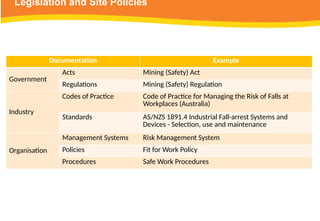
Legislation and Site Policies
Documentation Example
Government
Acts Mining (Safety) Act
Regulations Mining (Safety) Regulation
Industry
Codes of Practice Code of Practice for Managing the Risk of Falls at
Workplaces (Australia)
Standards AS/NZS 1891.4 Industrial Fall-arrest Systems and
Devices - Selection, use and maintenance
Organisation
Management Systems Risk Management System
Policies Fit for Work Policy
Procedures Safe Work Procedures
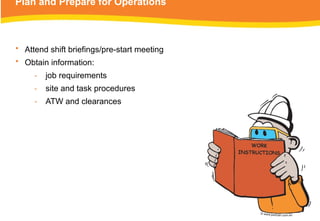
Plan and Prepare for Operations
• Attend shift briefings/pre-start meeting
• Obtain information:
‑ job requirements
‑ site and task procedures
‑ ATW and clearances
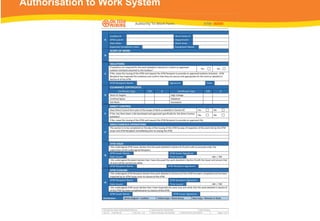
Authorisation to Work System
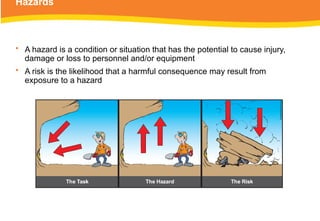
Hazards
• A hazard is a condition or situation that has the potential to cause injury,
damage or loss to personnel and/or equipment
• A risk is the likelihood that a harmful consequence may result from
exposure to a hazard
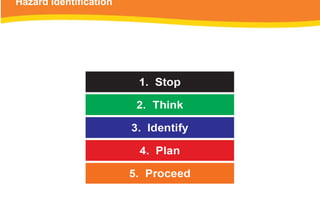
Hazard Identification
Conduct Site Safety Inspections
• Work area layout
• Ground conditions
• Physical condition and safety of surfaces
• Change in levels
• Stability of structures
• Entry to and exit from work area
• Missing edge protection, guards, etc
• Weather conditions
Types of Hazards
• Hazards associated with working at heights include:
‑ falls from height or into a pit or excavation
‑ dropped objects striking a person below
‑ contact with overhead power lines
‑ suspension trauma
‑ changing weather conditions
‑ poor manual handling technique
‑ untrained, inexperienced, unauthorised personnel completing the task
or entering the work area
Hazard Report
• Communicates an identified hazard to supervisor and management
• Controls can be put in place to reduce or eliminate the hazard
• Prevents unsafe condition or behaviour causing an incident or emergency
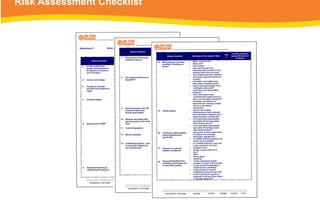
Risk Assessment Checklist
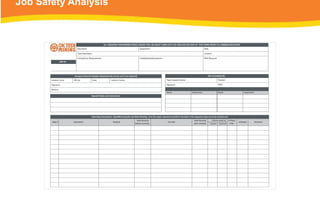
Job Safety Analysis
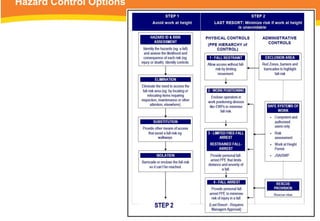
Hazard Control Options
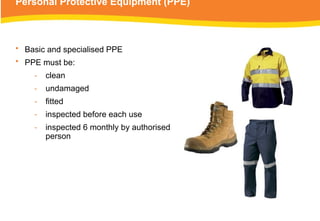
Personal Protective Equipment (PPE)
• Basic and specialised PPE
• PPE must be:
‑ clean
‑ undamaged
‑ fitted
‑ inspected before each use
‑ inspected 6 monthly by authorised
person
Fall Protection Systems
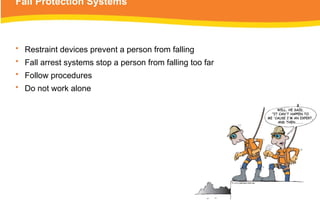
• Restraint devices prevent a person from falling
• Fall arrest systems stop a person from falling too far
• Follow procedures
• Do not work alone
Restraint Devices
• Restraint belt or work positioning harness
• Fall restraint line
• Fall prevention static line
• Self-locking triple action hooks or karabiners
• Anchorage points
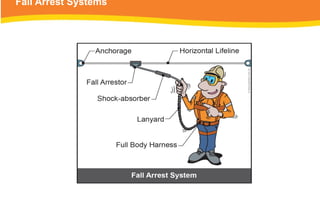
Fall Arrest Systems
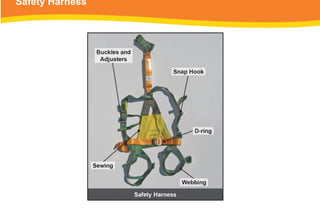
Safety Harness
Anchor Points
• Anchor points must:
‑ support a worker in the event of a
fall
‑ withstand a static load of 15kN
(1500 kg)
• Authorised personnel will test and colour
code the anchor points
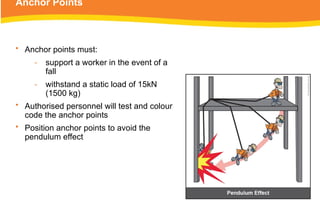
• Position anchor points to avoid the
pendulum effect
Suspension Trauma
• Never work alone when using fall protection
• Use a harness that allows your legs to be kept horizontal
• Where possible, move your legs in the harness
• Keep legs as high as possible and head as horizontal as possible
Rescue Plan
Minimise Climbing Fall Risks
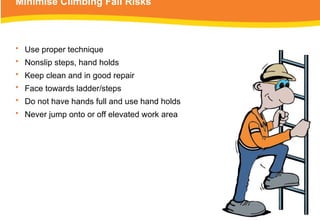
• Use proper technique
• Nonslip steps, hand holds
• Keep clean and in good repair
• Face towards ladder/steps
• Do not have hands full and use hand holds
• Never jump onto or off elevated work area
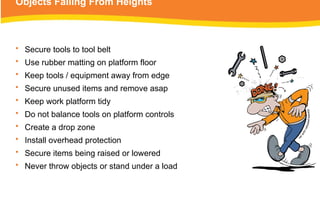
Objects Falling From Heights
• Secure tools to tool belt
• Use rubber matting on platform floor
• Keep tools / equipment away from edge
• Secure unused items and remove asap
• Keep work platform tidy
• Do not balance tools on platform controls
• Create a drop zone
• Install overhead protection
• Secure items being raised or lowered
• Never throw objects or stand under a load
Select and Inspect Equipment
• Consult with authorised personnel to select appropriate equipment and tools
• Equipment must be suitable for the task and conditions
• Operate equipment that you are competent and authorised to use
Equipment Checks and Inspections
• Check serviceability of tools and equipment
• Do not use equipment in an unsafe condition
• Check work at heights equipment for:
‑ test and inspection tags currency
‑ damage, wear, corrosion or distortion
‑ clear labelling for safe working loads
• Isolate defective equipment, report and arrange for maintenance or repairs
• Use equipment as per manufacturer guidelines
• Keep equipment clean
Install and Use Equipment
• Basic and specialised equipment
• Equipment must:
‑ comply with approved design standards
‑ be used as per manufacturer and site specifications
• Before starting work at height check:
‑ job authorisation, procedure, JSA and clearances are complete
‑ personnel are qualified and authorised for the task
‑ Safe Working Load is sufficient if an EWP is required
‑ correct equipment is available and serviceable
‑ spotter is allocated
‑ signalling procedures are confirmed
Basic Equipment - Signage
• Signs draw attention to hazards
• Do not move safety signs unless authorised
• Report or replace damaged signs
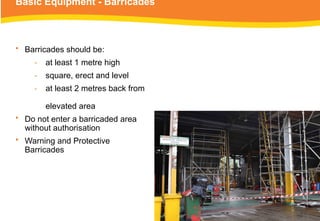
Basic Equipment - Barricades
• Barricades should be:
‑ at least 1 metre high
‑ square, erect and level
‑ at least 2 metres back from
elevated area
• Do not enter a barricaded area
without authorisation
• Warning and Protective
Barricades
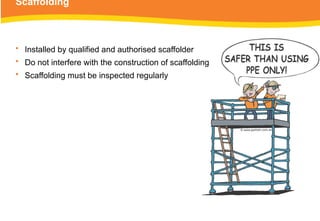
Scaffolding
• Installed by qualified and authorised scaffolder
• Do not interfere with the construction of scaffolding
• Scaffolding must be inspected regularly
Ladders
• Must comply with design and usage standards
• Use only for lightweight work and short duration
• Inspect before use
• Ladders include:
‑ fixed
‑ portable (step and extension)
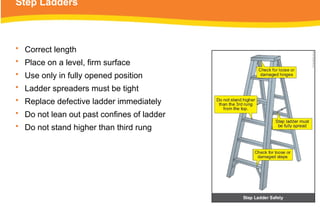
Step Ladders
• Correct length
• Place on a level, firm surface
• Use only in fully opened position
• Ladder spreaders must be tight
• Replace defective ladder immediately
• Do not lean out past confines of ladder
• Do not stand higher than third rung
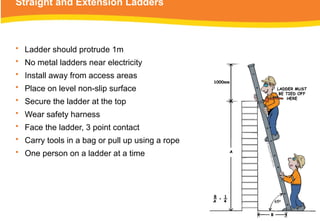
Straight and Extension Ladders
• Ladder should protrude 1m
• No metal ladders near electricity
• Install away from access areas
• Place on level non-slip surface
• Secure the ladder at the top
• Wear safety harness
• Face the ladder, 3 point contact
• Carry tools in a bag or pull up using a rope
• One person on a ladder at a time
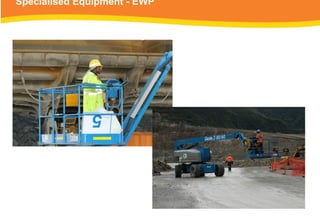
Specialised Equipment - EWP
Elevating Work Platform Hazards
• To avoid an EWP incident:
‑ stabilise the work platform
‑ do not exceed SWL of machine
‑ locate tools and materials safely, securely and evenly
‑ identify emergency stop button locations
‑ only climb in carrier while it is on ground
‑ check that risk control measures cover contingencies
‑ check distance from overhead electrical cables
Electrical Hazards
• Contact with overhead power lines is a major hazard when operating an
EWP
• Follow state and site regulations regarding distances and no go zones when
working near overhead power lines
Mobile Scaffold/Work Platform
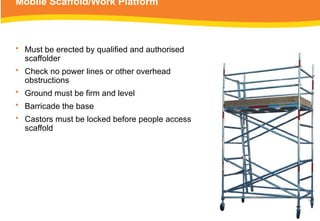
• Must be erected by qualified and authorised
scaffolder
• Check no power lines or other overhead
obstructions
• Ground must be firm and level
• Barricade the base
• Castors must be locked before people access
scaffold
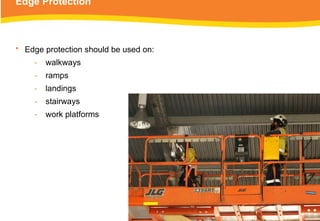
Edge Protection
• Edge protection should be used on:
‑ walkways
‑ ramps
‑ landings
‑ stairways
‑ work platforms
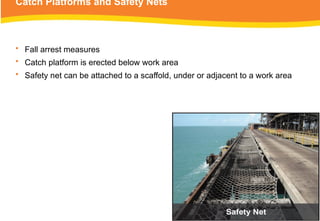
Catch Platforms and Safety Nets
• Fall arrest measures
• Catch platform is erected below work area
• Safety net can be attached to a scaffold, under or adjacent to a work area
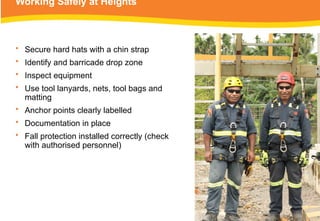
Working Safely at Heights
• Secure hard hats with a chin strap
• Identify and barricade drop zone
• Inspect equipment
• Use tool lanyards, nets, tool bags and
matting
• Anchor points clearly labelled
• Documentation in place
• Fall protection installed correctly (check
with authorised personnel)
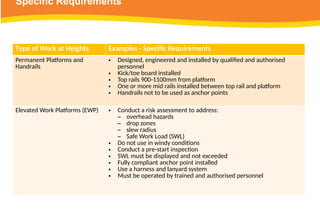
Specific Requirements
Type of Work at Heights Examples - Specific Requirements
Permanent Platforms and
Handrails
• Designed, engineered and installed by qualified and authorised
personnel
• Kick/toe board installed
• Top rails 900-1100mm from platform
• One or more mid rails installed between top rail and platform
• Handrails not to be used as anchor points
Elevated Work Platforms (EWP) • Conduct a risk assessment to address:
− overhead hazards
− drop zones
− slew radius
− Safe Work Load (SWL)
• Do not use in windy conditions
• Conduct a pre-start inspection
• SWL must be displayed and not exceeded
• Fully compliant anchor point installed
• Use a harness and lanyard system
• Must be operated by trained and authorised personnel
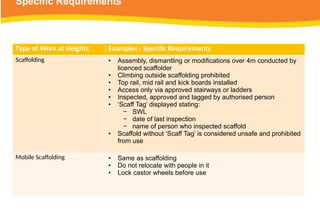
Specific Requirements
Type of Work at Heights Examples - Specific Requirements
Scaffolding • Assembly, dismantling or modifications over 4m conducted by
licenced scaffolder
• Climbing outside scaffolding prohibited
• Top rail, mid rail and kick boards installed
• Access only via approved stairways or ladders
• Inspected, approved and tagged by authorised person
• ‘Scaff Tag’ displayed stating:
− SWL
− date of last inspection
− name of person who inspected scaffold
• Scaffold without ‘Scaff Tag’ is considered unsafe and prohibited
from use
Mobile Scaffolding • Same as scaffolding
• Do not relocate with people in it
• Lock castor wheels before use
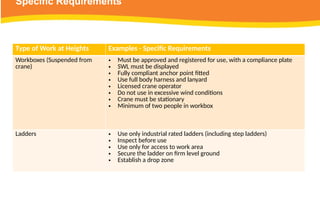
Specific Requirements
Type of Work at Heights Examples - Specific Requirements
Workboxes (Suspended from
crane)
• Must be approved and registered for use, with a compliance plate
• SWL must be displayed
• Fully compliant anchor point fitted
• Use full body harness and lanyard
• Licensed crane operator
• Do not use in excessive wind conditions
• Crane must be stationary
• Minimum of two people in workbox
Ladders • Use only industrial rated ladders (including step ladders)
• Inspect before use
• Use only for access to work area
• Secure the ladder on firm level ground
• Establish a drop zone
Specific Requirements
Type of Work at Heights Examples - Specific Requirements
Fall Restraint • Preferred option for fall protection
• Anchor points must be rated to 15kN
• Wear full body harness
• Restraint mechanism must be double action or double locking
• Personnel must never work alone
Fall Arrest • Rescue plan must be in place
• Personnel must never work alone
• Personnel must be trained and authorised to use fall arrest
equipment
• Consists of fully body harness, lanyard and anchor point
Workplace Access
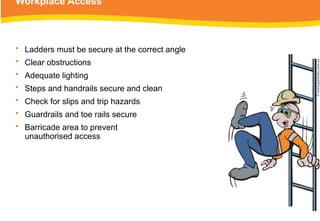
• Ladders must be secure at the correct angle
• Clear obstructions
• Adequate lighting
• Steps and handrails secure and clean
• Check for slips and trip hazards
• Guardrails and toe rails secure
• Barricade area to prevent
unauthorised access
Equipment Transport
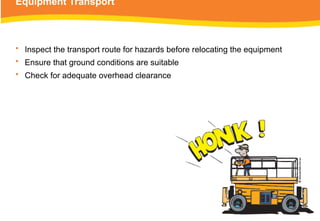
• Inspect the transport route for hazards before relocating the equipment
• Ensure that ground conditions are suitable
• Check for adequate overhead clearance
Tool Management
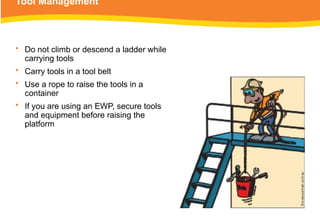
• Do not climb or descend a ladder while
carrying tools
• Carry tools in a tool belt
• Use a rope to raise the tools in a
container
• If you are using an EWP, secure tools
and equipment before raising the
platform
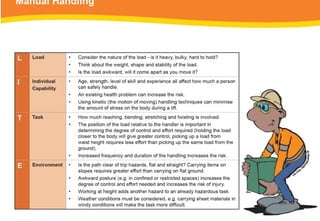
Manual Handling
Monitor Controls and Safety Measures
• Following safe work practices
• Monitor controls and safety measures regularly
• Ensure that:
‑ barricades and signage are visible and in good condition
‑ protective devices such as guard rails, hand rails, foot walks and toe
boards remain effective
‑ lifting equipment has not been altered
• Reassess and adjust controls to suit changed conditions
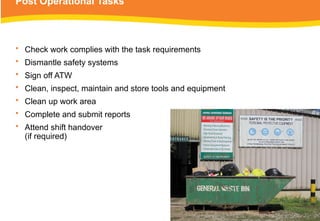
Post Operational Tasks
• Check work complies with the task requirements
• Dismantle safety systems
• Sign off ATW
• Clean, inspect, maintain and store tools and equipment
• Clean up work area
• Complete and submit reports
• Attend shift handover
(if required)
Summary
• Do you have any questions?

RIIWHS204D-Work-at-Height-Presentation.pptx

  • 1.
    RIIWHS204D Work Safeylat Heights Training Package
  • 2.
    Introduction • RIIWHS204D WorkSafely at Heights • This resource will assist you to: ‑ plan and prepare for work ‑ select and install the right equipment for the work ‑ comply with procedures and authorisations ‑ identify and control hazards ‑ perform work at heights ‑ perform post operational tasks
  • 3.
    What is Workat Height • Work at height takes place where there is potential: ‑ To fall 1.8m or more ‑ To be seriously injured in a fall of less than 1.8m ‑ To fall from one level to another as a result of working within 2m of an open edge ‑ For materials to fall on to people working or travelling below
  • 4.
    Operator Obligations • Physicallyand mentally fit for task • Trained and authorised • Ensure SWP, JSA and ATW in place • Select, check and use appropriate PPE • Report unsafe conditions, incidents and near misses • Report damaged /faulty equipment • Operate equipment in line with manufacturer and site requirements • Adhere to site environmental requirements
  • 5.
    Legislation and SitePolicies Documentation Example Government Acts Mining (Safety) Act Regulations Mining (Safety) Regulation Industry Codes of Practice Code of Practice for Managing the Risk of Falls at Workplaces (Australia) Standards AS/NZS 1891.4 Industrial Fall-arrest Systems and Devices - Selection, use and maintenance Organisation Management Systems Risk Management System Policies Fit for Work Policy Procedures Safe Work Procedures
  • 6.
    Plan and Preparefor Operations • Attend shift briefings/pre-start meeting • Obtain information: ‑ job requirements ‑ site and task procedures ‑ ATW and clearances
  • 7.
  • 8.
    Hazards • A hazardis a condition or situation that has the potential to cause injury, damage or loss to personnel and/or equipment • A risk is the likelihood that a harmful consequence may result from exposure to a hazard
  • 9.
  • 10.
    Conduct Site SafetyInspections • Work area layout • Ground conditions • Physical condition and safety of surfaces • Change in levels • Stability of structures • Entry to and exit from work area • Missing edge protection, guards, etc • Weather conditions
  • 11.
    Types of Hazards •Hazards associated with working at heights include: ‑ falls from height or into a pit or excavation ‑ dropped objects striking a person below ‑ contact with overhead power lines ‑ suspension trauma ‑ changing weather conditions ‑ poor manual handling technique ‑ untrained, inexperienced, unauthorised personnel completing the task or entering the work area
  • 12.
    Hazard Report • Communicatesan identified hazard to supervisor and management • Controls can be put in place to reduce or eliminate the hazard • Prevents unsafe condition or behaviour causing an incident or emergency
  • 13.
  • 14.
  • 15.
  • 16.
    Personal Protective Equipment(PPE) • Basic and specialised PPE • PPE must be: ‑ clean ‑ undamaged ‑ fitted ‑ inspected before each use ‑ inspected 6 monthly by authorised person
  • 17.
    Fall Protection Systems •Restraint devices prevent a person from falling • Fall arrest systems stop a person from falling too far • Follow procedures • Do not work alone
  • 18.
    Restraint Devices • Restraintbelt or work positioning harness • Fall restraint line • Fall prevention static line • Self-locking triple action hooks or karabiners • Anchorage points
  • 19.
  • 20.
  • 21.
    Anchor Points • Anchorpoints must: ‑ support a worker in the event of a fall ‑ withstand a static load of 15kN (1500 kg) • Authorised personnel will test and colour code the anchor points • Position anchor points to avoid the pendulum effect
  • 22.
    Suspension Trauma • Neverwork alone when using fall protection • Use a harness that allows your legs to be kept horizontal • Where possible, move your legs in the harness • Keep legs as high as possible and head as horizontal as possible
  • 23.
  • 24.
    Minimise Climbing FallRisks • Use proper technique • Nonslip steps, hand holds • Keep clean and in good repair • Face towards ladder/steps • Do not have hands full and use hand holds • Never jump onto or off elevated work area
  • 25.
    Objects Falling FromHeights • Secure tools to tool belt • Use rubber matting on platform floor • Keep tools / equipment away from edge • Secure unused items and remove asap • Keep work platform tidy • Do not balance tools on platform controls • Create a drop zone • Install overhead protection • Secure items being raised or lowered • Never throw objects or stand under a load
  • 26.
    Select and InspectEquipment • Consult with authorised personnel to select appropriate equipment and tools • Equipment must be suitable for the task and conditions • Operate equipment that you are competent and authorised to use
  • 27.
    Equipment Checks andInspections • Check serviceability of tools and equipment • Do not use equipment in an unsafe condition • Check work at heights equipment for: ‑ test and inspection tags currency ‑ damage, wear, corrosion or distortion ‑ clear labelling for safe working loads • Isolate defective equipment, report and arrange for maintenance or repairs • Use equipment as per manufacturer guidelines • Keep equipment clean
  • 28.
    Install and UseEquipment • Basic and specialised equipment • Equipment must: ‑ comply with approved design standards ‑ be used as per manufacturer and site specifications • Before starting work at height check: ‑ job authorisation, procedure, JSA and clearances are complete ‑ personnel are qualified and authorised for the task ‑ Safe Working Load is sufficient if an EWP is required ‑ correct equipment is available and serviceable ‑ spotter is allocated ‑ signalling procedures are confirmed
  • 29.
    Basic Equipment -Signage • Signs draw attention to hazards • Do not move safety signs unless authorised • Report or replace damaged signs
  • 30.
    Basic Equipment -Barricades • Barricades should be: ‑ at least 1 metre high ‑ square, erect and level ‑ at least 2 metres back from elevated area • Do not enter a barricaded area without authorisation • Warning and Protective Barricades
  • 31.
    Scaffolding • Installed byqualified and authorised scaffolder • Do not interfere with the construction of scaffolding • Scaffolding must be inspected regularly
  • 32.
    Ladders • Must complywith design and usage standards • Use only for lightweight work and short duration • Inspect before use • Ladders include: ‑ fixed ‑ portable (step and extension)
  • 33.
    Step Ladders • Correctlength • Place on a level, firm surface • Use only in fully opened position • Ladder spreaders must be tight • Replace defective ladder immediately • Do not lean out past confines of ladder • Do not stand higher than third rung
  • 34.
    Straight and ExtensionLadders • Ladder should protrude 1m • No metal ladders near electricity • Install away from access areas • Place on level non-slip surface • Secure the ladder at the top • Wear safety harness • Face the ladder, 3 point contact • Carry tools in a bag or pull up using a rope • One person on a ladder at a time
  • 35.
  • 36.
    Elevating Work PlatformHazards • To avoid an EWP incident: ‑ stabilise the work platform ‑ do not exceed SWL of machine ‑ locate tools and materials safely, securely and evenly ‑ identify emergency stop button locations ‑ only climb in carrier while it is on ground ‑ check that risk control measures cover contingencies ‑ check distance from overhead electrical cables
  • 37.
    Electrical Hazards • Contactwith overhead power lines is a major hazard when operating an EWP • Follow state and site regulations regarding distances and no go zones when working near overhead power lines
  • 38.
    Mobile Scaffold/Work Platform •Must be erected by qualified and authorised scaffolder • Check no power lines or other overhead obstructions • Ground must be firm and level • Barricade the base • Castors must be locked before people access scaffold
  • 39.
    Edge Protection • Edgeprotection should be used on: ‑ walkways ‑ ramps ‑ landings ‑ stairways ‑ work platforms
  • 40.
    Catch Platforms andSafety Nets • Fall arrest measures • Catch platform is erected below work area • Safety net can be attached to a scaffold, under or adjacent to a work area
  • 41.
    Working Safely atHeights • Secure hard hats with a chin strap • Identify and barricade drop zone • Inspect equipment • Use tool lanyards, nets, tool bags and matting • Anchor points clearly labelled • Documentation in place • Fall protection installed correctly (check with authorised personnel)
  • 42.
    Specific Requirements Type ofWork at Heights Examples - Specific Requirements Permanent Platforms and Handrails • Designed, engineered and installed by qualified and authorised personnel • Kick/toe board installed • Top rails 900-1100mm from platform • One or more mid rails installed between top rail and platform • Handrails not to be used as anchor points Elevated Work Platforms (EWP) • Conduct a risk assessment to address: − overhead hazards − drop zones − slew radius − Safe Work Load (SWL) • Do not use in windy conditions • Conduct a pre-start inspection • SWL must be displayed and not exceeded • Fully compliant anchor point installed • Use a harness and lanyard system • Must be operated by trained and authorised personnel
  • 43.
    Specific Requirements Type ofWork at Heights Examples - Specific Requirements Scaffolding • Assembly, dismantling or modifications over 4m conducted by licenced scaffolder • Climbing outside scaffolding prohibited • Top rail, mid rail and kick boards installed • Access only via approved stairways or ladders • Inspected, approved and tagged by authorised person • ‘Scaff Tag’ displayed stating: − SWL − date of last inspection − name of person who inspected scaffold • Scaffold without ‘Scaff Tag’ is considered unsafe and prohibited from use Mobile Scaffolding • Same as scaffolding • Do not relocate with people in it • Lock castor wheels before use
  • 44.
    Specific Requirements Type ofWork at Heights Examples - Specific Requirements Workboxes (Suspended from crane) • Must be approved and registered for use, with a compliance plate • SWL must be displayed • Fully compliant anchor point fitted • Use full body harness and lanyard • Licensed crane operator • Do not use in excessive wind conditions • Crane must be stationary • Minimum of two people in workbox Ladders • Use only industrial rated ladders (including step ladders) • Inspect before use • Use only for access to work area • Secure the ladder on firm level ground • Establish a drop zone
  • 45.
    Specific Requirements Type ofWork at Heights Examples - Specific Requirements Fall Restraint • Preferred option for fall protection • Anchor points must be rated to 15kN • Wear full body harness • Restraint mechanism must be double action or double locking • Personnel must never work alone Fall Arrest • Rescue plan must be in place • Personnel must never work alone • Personnel must be trained and authorised to use fall arrest equipment • Consists of fully body harness, lanyard and anchor point
  • 46.
    Workplace Access • Laddersmust be secure at the correct angle • Clear obstructions • Adequate lighting • Steps and handrails secure and clean • Check for slips and trip hazards • Guardrails and toe rails secure • Barricade area to prevent unauthorised access
  • 47.
    Equipment Transport • Inspectthe transport route for hazards before relocating the equipment • Ensure that ground conditions are suitable • Check for adequate overhead clearance
  • 48.
    Tool Management • Donot climb or descend a ladder while carrying tools • Carry tools in a tool belt • Use a rope to raise the tools in a container • If you are using an EWP, secure tools and equipment before raising the platform
  • 49.
  • 50.
    Monitor Controls andSafety Measures • Following safe work practices • Monitor controls and safety measures regularly • Ensure that: ‑ barricades and signage are visible and in good condition ‑ protective devices such as guard rails, hand rails, foot walks and toe boards remain effective ‑ lifting equipment has not been altered • Reassess and adjust controls to suit changed conditions
  • 51.
    Post Operational Tasks •Check work complies with the task requirements • Dismantle safety systems • Sign off ATW • Clean, inspect, maintain and store tools and equipment • Clean up work area • Complete and submit reports • Attend shift handover (if required)
  • 52.
    Summary • Do youhave any questions?

Editor's Notes

  • #1 Welcome. Introduce yourself. Outline your experience. Explain where the facilities are and any OHS issues if necessary Timeframe for the course. Handouts: - Attendance Sheet - get all trainees to sign - Training Material (Reference book, permits, etc). Any questions?
  • #2 Briefly explain: The training material supports competency unit RIIWHS204D which is part of the Resources and Infrastructure Industry (RII) training package. The competency unit requires that the learner can demonstrate the required skills, knowledge and practical application in the workplace. A Statement of Attainment may be issued if this unit is not done as part of a qualification. Explain the assessment procedure.
  • #3 Discuss the definition of work at height and how it relates to OTML sites.
  • #4 Discuss the obligations of personnel required to work at heights.
  • #5 Explain why workplaces must comply with legislation, standards and site policies. Outline the documentation that must be accessed and followed to ensure that work activities are compliant. Outline the requirements of relevant compliance documentation for work at height.
  • #6 Explain that no work should start until all the information has been received and understood. Discuss the importance of work briefings or pre-start meetings. Discuss the site requirements for planning and preparing for tasks, such as: developing a work plan with supervisor understanding the task gathering all the required information for the task.
  • #7 Discuss the site Authorisation to Work System. Discuss the requirement for a clearance certificate Discuss the elements that make up the Work at Heights clearance certificate, including: location checks and inspections hazards controls personnel involved ATW holder job steps authorisation fall recovery plan
  • #8 Define the terms hazard and risk. Discuss the role of managers, all employees and personnel working at height, in relation to hazard identification and risk management.
  • #9 Discuss the general process for personal hazard identification and risk assessment using a Take 5. ACTIVITY – if time allows, have the participants complete a Take 5 for a task they do. Discuss.
  • #10 Discuss the importance of inspecting the site before starting any work and the types of things to look for in relation to working at height. Note that this list contains examples and is not exhaustive.
  • #11 Discuss the hazards associated with working at heights. Note that this list contains examples and is not exhaustive. Discuss additional hazards that may be present at your site.
  • #12 Discuss the hazard reporting procedure at your site.
  • #13 Discuss the purpose and use of the Work at height Risk Assessment Checklist. NOTE: A copy is in the Appendix at the back of the Learner’s Resource book.
  • #14 Discuss the purpose and use of the JSA. ACTIVITY – if time allows, have the participants work in groups to complete a JSA for a task at their work place. Discuss.
  • #15 Discuss the Hierarchy of applying Controls to eliminate hazards or minimise the risks when working at heights.
  • #16 Discuss the site requirements for PPE for working at height. ACTIVITY – if time allows, demonstrate inspecting work at height PPE using the PPE checklist (in the Appendix at the back of the reference book).
  • #17 Discuss the types of fall protection equipment: restraint devices fall arrest systems. Explain when personal fall protection must be used and the precautions to take.
  • #18 Demonstrate and discuss the devices that make up a restraint system.
  • #19 Demonstrate and discuss the devices/components that make up a fall arrest system. Discuss the requirements when working with a fall arrest system.
  • #20 Discuss the use and fitting of safety harnesses. Explain the need to conduct a thorough inspection of the safety harness before use. Demonstrate inspecting a harness and explain all of the inspection points, including the inspection date.
  • #21 Discuss the purpose of anchor points. Explain the requirements for anchor points. Outline the pendulum effect and describe how to locate anchor points to avoid it.
  • #22 Explain suspension trauma and the causes. Outline the symptoms of suspension trauma. Emphasise the severity of suspension trauma. Discuss the procedure for rescuing a suspended person.
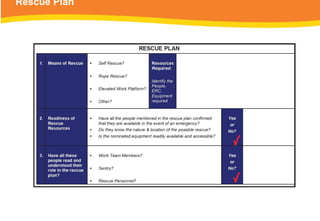
  • #23 Refer to the rescue plan in the Appendix at the back of the reference book andiscuss the site requirements for a Work at Heights Rescue Plan.
  • #24 Discuss ways to minimise the risk of a climbing fall.
  • #25 Discuss the: importance of securing items to prevent objects falling from heights possible consequences of objects falling from heights actions you can take to minimise the risk.
  • #26 Discuss the importance of selecting appropriate tools and equipment for the task.
  • #27 Discuss the site requirements for inspecting equipment before use.
  • #28 Discuss the importance of correctly installing and using equipment for work at heights. Discuss the importance of performing checks before starting work. Note: this list contains examples only.
  • #29 Discuss the purpose and types of signs to be used when working at heights. Explain the site procedures for using and replacing signs.
  • #30 Outline the classes of barricades. Discuss the requirements for barricades. Explain the purpose and types of warning barricades used at the work site. Explain the purpose and types of protective barricades used at the work site.
  • #31 Explain the standards and requirements for scaffolding. Discuss the benefits of using scaffolding.
  • #32 Explain the standards and requirements for ladders. Discuss the use of fixed ladders. Discuss safe climbing of fixed ladders.
  • #33 Explain the correct use of step ladders and the precautions to followed.
  • #34 Explain the correct use of straight and extension ladders and the precautions to followed.
  • #35 Outline the types of work platforms – EWP and mobile work platform of scaffold. discuss the features and use of EWPs. Emphasise that personnel must wear a fall arrest device connected to a dedicated anchor point in the basket.
  • #36 Discuss the hazards of working with elevating work platforms. Explain the safety precautions that must be observed at all times when working with elevating work platforms.
  • #37 Discuss the dangers of overhead electrical cables. Explain No Go or Exclusion zone limits. Emphasise the importance of maintaining constant awareness about the location of overhead power lines. Explain that different states have different legislation regarding distances from power lines, and outline your site orders.
  • #38 Describe mobile scaffolds and work platforms. Discuss the control measures to be used when working with mobile scaffolds or work platforms.
  • #39 Discuss the purpose and requirements for edge protection. Describe toe boards and explain the requirements for toe boards.
  • #40 Discuss the purpose and correct location of catch platforms and safety nets.
  • #41 Discuss the general requirements for working safely at heights.
  • #42 Explain that sites will have additional requirements for working safely at height. The table provides some examples of requirements. Discuss your site specific requirements.
  • #43 Explain that sites will have additional requirements for working safely at height. The table provides some examples of requirements. Discuss your site specific requirements.
  • #44 Explain that sites will have additional requirements for working safely at height. The table provides some examples of requirements. Discuss your site specific requirements.
  • #45 Explain that sites will have additional requirements for working safely at height. The table provides some examples of requirements. Discuss your site specific requirements.
  • #46 Discuss the importance of checking that access to the workplace is safe. Explain the guidelines for making access to the workplace safe.
  • #47 Discuss transporting the equipment to the work site. Explain the precautions to be followed when transporting equipment.
  • #48 Discuss the importance of managing tools while working at heights. Explain the precautions to be observed to prevent tools or equipment falling from heights.
  • #49 Explain the importance of safe manual handling. Discuss the features of the LITE lifting technique.
  • #50 Discuss the need to monitor the control measures that are in place. Explain the precautions that must be observed for the duration of the working at heights task.
  • #51 Discuss the required post operational tasks, including the following. Ensuring the work is compliant. Removal of safety systems. Discuss the importance of signing off the ATW when leaving the work site. Explain the site procedures for Work at Heights ATW sign-off, closing and filing. Inspection and care of equipment after use and site defect reporting procedures. Work area clean up including waste management and general housekeeping. Site reporting requirements.
  • #52 This training material provided information for working safely at heights. Explain the assessment procedure for this unit.