MEWP Rescue Plan
Familiarisation of safety measures and ground controls
Instructor: Simon Slater
Syllabus
• Introduction to MEWPs
• Hazards to assess
• The rescue plan
• Ground controls
• Accident reporting
• Questions
• Practical explanation, demonstration and practice
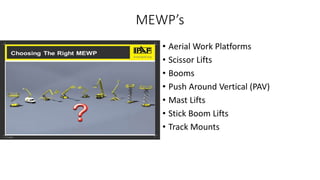
MEWP’s
• Aerial Work Platforms
• Scissor Lifts
• Booms
• Push Around Vertical (PAV)
• Mast Lifts
• Stick Boom Lifts
• Track Mounts
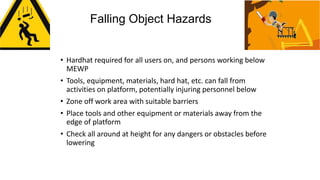
Falling Object Hazards
• Hardhat required for all users on, and persons working below
MEWP
• Tools, equipment, materials, hard hat, etc. can fall from
activities on platform, potentially injuring personnel below
• Zone off work area with suitable barriers
• Place tools and other equipment or materials away from the
edge of platform
• Check all around at height for any dangers or obstacles before
lowering
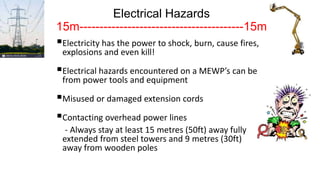
Electrical Hazards
15m-----------------------------------------15m
Electricity has the power to shock, burn, cause fires,
explosions and even kill!
Electrical hazards encountered on a MEWP’s can be
from power tools and equipment
Misused or damaged extension cords
Contacting overhead power lines
- Always stay at least 15 metres (50ft) away fully
extended from steel towers and 9 metres (30ft)
away from wooden poles
Electrical Hazards
If a fellow worker does come in contact with an energized power
source, do not rush to assist them. Immediately call 999, try to shut
off the main power source, and follow the directions of the operator
Keep yourself safe as you can not help if you are also hurt!
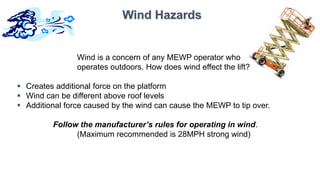
Wind Hazards
Wind is a concern of any MEWP operator who
operates outdoors. How does wind effect the lift?
 Creates additional force on the platform
 Wind can be different above roof levels
 Additional force caused by the wind can cause the MEWP to tip over.
Follow the manufacturer’s rules for operating in wind.
(Maximum recommended is 28MPH strong wind)
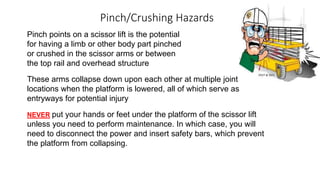
Pinch/Crushing Hazards
Pinch points on a scissor lift is the potential
for having a limb or other body part pinched
or crushed in the scissor arms or between
the top rail and overhead structure
These arms collapse down upon each other at multiple joint
locations when the platform is lowered, all of which serve as
entryways for potential injury
NEVER put your hands or feet under the platform of the scissor lift
unless you need to perform maintenance. In which case, you will
need to disconnect the power and insert safety bars, which prevent
the platform from collapsing.
Lone Working
• All MEWP operators are required to carry a lone worker alarm on their
body at all times
• This can be clipped on or placed in a pocket but must be held vertically
• The lone worker register must be filled out and include the area the MEWP
will be working
• If the area changes, then the register needs to be updated
• If you hear the lone worker alarm sound, you must react whether it is a
MEWP being used or not
• A first aider should be sourced every time to assess the lone worker
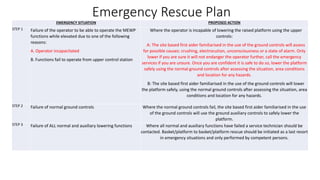
Emergency Rescue Plan
EMERGENCY SITUATION PROPOSED ACTION
STEP 1 Failure of the operator to be able to operate the MEWP
functions while elevated due to one of the following
reasons:
A. Operator incapacitated
B. Functions fail to operate from upper control station
Where the operator is incapable of lowering the raised platform using the upper
controls:
A: The site based first aider familiarised in the use of the ground controls will assess
for possible causes: crushing, electrocution, unconsciousness or a state of alarm. Only
lower if you are sure it will not endanger the operator further, call the emergency
services if you are unsure. Once you are confident it is safe to do so, lower the platform
safely using the normal ground controls after assessing the situation, area conditions
and location for any hazards.
B: The site based first aider familiarised in the use of the ground controls will lower
the platform safely, using the normal ground controls after assessing the situation, area
conditions and location for any hazards.
STEP 2 Failure of normal ground controls Where the normal ground controls fail, the site based first aider familiarised in the use
of the ground controls will use the ground auxiliary controls to safely lower the
platform.
STEP 3 Failure of ALL normal and auxiliary lowering functions Where all normal and auxiliary functions have failed a service technician should be
contacted. Basket/platform to basket/platform rescue should be initiated as a last resort
in emergency situations and only performed by competent persons.
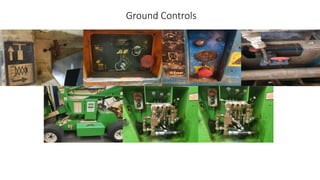
Ground Controls
Accident Reporting
• Report all accidents and near misses immediately
• Perform an investigation as soon as an accident occurs
• Lock off MEWP if damaged and seek engineers advice
Questions?

Mewp rescue plan

  • 1.
    MEWP Rescue Plan Familiarisationof safety measures and ground controls Instructor: Simon Slater
  • 2.
    Syllabus • Introduction toMEWPs • Hazards to assess • The rescue plan • Ground controls • Accident reporting • Questions • Practical explanation, demonstration and practice
  • 3.
    MEWP’s • Aerial WorkPlatforms • Scissor Lifts • Booms • Push Around Vertical (PAV) • Mast Lifts • Stick Boom Lifts • Track Mounts
  • 4.
    Falling Object Hazards •Hardhat required for all users on, and persons working below MEWP • Tools, equipment, materials, hard hat, etc. can fall from activities on platform, potentially injuring personnel below • Zone off work area with suitable barriers • Place tools and other equipment or materials away from the edge of platform • Check all around at height for any dangers or obstacles before lowering
  • 5.
    Electrical Hazards 15m-----------------------------------------15m Electricity hasthe power to shock, burn, cause fires, explosions and even kill! Electrical hazards encountered on a MEWP’s can be from power tools and equipment Misused or damaged extension cords Contacting overhead power lines - Always stay at least 15 metres (50ft) away fully extended from steel towers and 9 metres (30ft) away from wooden poles
  • 6.
    Electrical Hazards If afellow worker does come in contact with an energized power source, do not rush to assist them. Immediately call 999, try to shut off the main power source, and follow the directions of the operator Keep yourself safe as you can not help if you are also hurt!
  • 7.
    Wind Hazards Wind isa concern of any MEWP operator who operates outdoors. How does wind effect the lift?  Creates additional force on the platform  Wind can be different above roof levels  Additional force caused by the wind can cause the MEWP to tip over. Follow the manufacturer’s rules for operating in wind. (Maximum recommended is 28MPH strong wind)
  • 8.
    Pinch/Crushing Hazards Pinch pointson a scissor lift is the potential for having a limb or other body part pinched or crushed in the scissor arms or between the top rail and overhead structure These arms collapse down upon each other at multiple joint locations when the platform is lowered, all of which serve as entryways for potential injury NEVER put your hands or feet under the platform of the scissor lift unless you need to perform maintenance. In which case, you will need to disconnect the power and insert safety bars, which prevent the platform from collapsing.
  • 9.
    Lone Working • AllMEWP operators are required to carry a lone worker alarm on their body at all times • This can be clipped on or placed in a pocket but must be held vertically • The lone worker register must be filled out and include the area the MEWP will be working • If the area changes, then the register needs to be updated • If you hear the lone worker alarm sound, you must react whether it is a MEWP being used or not • A first aider should be sourced every time to assess the lone worker
  • 10.
    Emergency Rescue Plan EMERGENCYSITUATION PROPOSED ACTION STEP 1 Failure of the operator to be able to operate the MEWP functions while elevated due to one of the following reasons: A. Operator incapacitated B. Functions fail to operate from upper control station Where the operator is incapable of lowering the raised platform using the upper controls: A: The site based first aider familiarised in the use of the ground controls will assess for possible causes: crushing, electrocution, unconsciousness or a state of alarm. Only lower if you are sure it will not endanger the operator further, call the emergency services if you are unsure. Once you are confident it is safe to do so, lower the platform safely using the normal ground controls after assessing the situation, area conditions and location for any hazards. B: The site based first aider familiarised in the use of the ground controls will lower the platform safely, using the normal ground controls after assessing the situation, area conditions and location for any hazards. STEP 2 Failure of normal ground controls Where the normal ground controls fail, the site based first aider familiarised in the use of the ground controls will use the ground auxiliary controls to safely lower the platform. STEP 3 Failure of ALL normal and auxiliary lowering functions Where all normal and auxiliary functions have failed a service technician should be contacted. Basket/platform to basket/platform rescue should be initiated as a last resort in emergency situations and only performed by competent persons.
  • 11.
  • 12.
    Accident Reporting • Reportall accidents and near misses immediately • Perform an investigation as soon as an accident occurs • Lock off MEWP if damaged and seek engineers advice
  • 13.